Home |
Data Base |
Technical |
Radio |
Search
BARGUZIN (BZHRK)
БЖРК «Баргузин» | Moscow Institute of Thermal Technology (MIT) | No confirmed NATO reporting name
Proposed rail-mobile ICBM complex, successor to the Soviet RT-23 UTTKh Molodets (SS-24 Scalpel) trains; not confirmed in service
Project Orlan Data Base // public encyclopedia
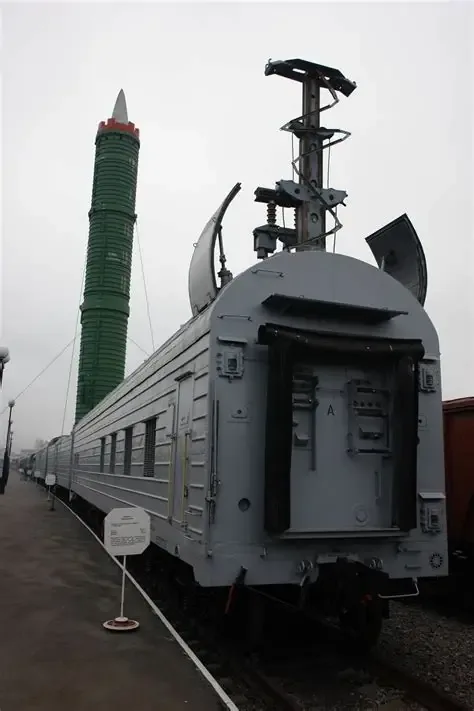
A demilitarised Soviet-era Molodets combat railway missile complex (15P961) on display at a Russian railway museum, with its green missile canister mock-up raised to the vertical behind the cars. The silver cars are built to look like ordinary refrigerator vans. A roof-mounted mast with a hooked frame and two dish-shaped fittings stands at the near end of the car; the exhibit signage is not legible in this photo, so this page does not identify that equipment. This is a retired Molodets train, not a Barguzin.
Related articles: RS-24 Yars, the missile Barguzin was to be built around; RS-28 Sarmat, the heavy ICBM Barguzin was shelved in favour of; Perimeter (Dead Hand), for the retaliatory command background; and Avangard, part of the same strategic modernisation.
STATUS FIRST
Barguzin is not known to be operational, and this page does not say or imply that it is. A successor rail-mobile ICBM was designed at the Moscow Institute of Thermal Technology between about 2012 and 2016. Its schematic design was approved in December 2014, and one ejection ("pop-up") test was carried out at Plesetsk in late October or early November 2016. In December 2017 a defence-ministry source told TASS that it had been dropped from the 2018 to 2027 state armament programme in favour of Sarmat and RS-26 Rubezh. Since then there has been talk of reviving it, but nothing in the public record states that any Barguzin train entered service, that a production run exists, or that funded work is moving forward. [DOCUMENTED for the 2012 to 2017 record; UNVERIFIED / CONTESTED for anything after]
WHAT IT IS
A combat railway missile complex (боевой железнодорожный ракетный комплекс, BZhRK) is a train that carries, hides and can launch intercontinental ballistic missiles. The Soviet Union actually built and fielded one: the 15P961 complex with the RT-23 UTTKh Molodets missile (Молодец, NATO SS-24 Scalpel; START designation RS-22B), designed by KB Yuzhnoye under Vladimir Utkin. Twelve trains, in three divisions, went on duty from 1987 and were formally adopted on 28 November 1989. They were disguised as ordinary refrigerator and passenger trains, could launch from electrified lines using a special system to short and move the overhead contact wire, and were retired and cut up in the 2000s after START II and the loss of the Ukrainian production base. [DOCUMENTED]
Barguzin (Баргузин) is the proposed successor. It was designed this time at the Moscow Institute of Thermal Technology (MIT), the Topol, Yars and Bulava bureau, around a lighter Yars-family solid missile that, in the public claims, would fit a standard freight car and need only one locomotive. Schematic design was approved in 2014. A single ejection test was reported at Plesetsk in late 2016 and later confirmed in the test site's official history. Flight tests were talked about for 2017 and then 2019, but no flight-test campaign was ever documented. In December 2017 the project was excluded from the 2018 to 2027 state armament programme for lack of money. [DOCUMENTED]
Since then the project has been talked about, not fielded. MIT's general designer Yuri Solomonov said in November 2020 that the institute was ready to resume if the authorities decided to, and that the work had been preserved. On 5 February 2026, the day New START lapsed, the analyst Igor Korotchenko publicly urged a decision to deploy at least five trains. Those are statements of readiness and advocacy, not deployment orders. [DOCUMENTED as talk; UNVERIFIED as to any actual restart]
QUICK FACTS
- Name: Barguzin (Баргузин); BZhRK (БЖРК), combat railway missile complex. [DOCUMENTED]
- NATO name: none confirmed. "SS-X-32Zh" circulates on GlobalSecurity-style pages but was not found in a formal NATO publication. [UNVERIFIED]
- Designer: Moscow Institute of Thermal Technology (MIT), Yuri Solomonov; Votkinsk would be the likely missile plant. [DOCUMENTED as the design house]
- Missile: a Yars or Yars-M derived solid ICBM, about 22.5 m long and 47 to 50 t. [CLAIM; mass CONTESTED]
- Train, as briefed: up to six missiles per train, one locomotive, standard-looking freight cars; five trains per division. [CLAIM / UNVERIFIED as hardware]
- Warheads: briefed as four MIRVs per missile (120 per division); the Yars article on this site gives three as the typical load (90 per division). [CONTESTED]
- Tests: one ejection test at Plesetsk, late October or 1 November or early November 2016. No documented flight test. [DOCUMENTED; date CONTESTED]
- Status: excluded from GPV 2018 to 2027 (TASS, 6 December 2017). Not confirmed in service, in production, or under funded development. [DOCUMENTED / UNVERIFIED]
- Predecessor: RT-23 UTTKh Molodets (15Zh61, SS-24 Scalpel) in 15P961 trains; 12 trains on duty from 1987, scrapped in the mid-2000s. [DOCUMENTED]
LINEAGE: THE MOLODETS MISSILE TRAINS
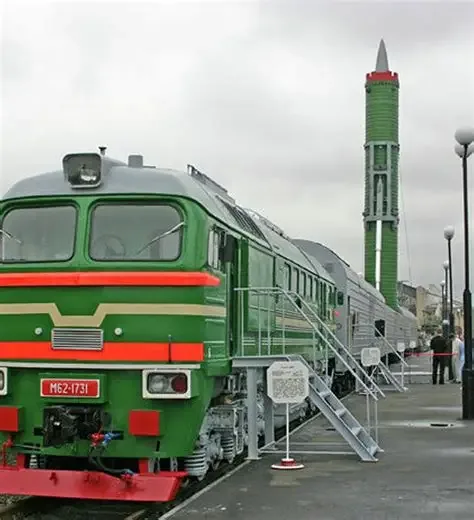
The head of the museum Molodets train: a green diesel locomotive marked M62-1731, with the silver missile-train cars behind it and the canister mock-up standing vertical in the background. The operational trains are described as using modified M62-class locomotives, designated DM62, that looked outwardly ordinary.
Names and indices. The rail-mobile missile is the RT-23 UTTKh Molodets, GRAU index 15Zh61, in the 15P961 combat railway missile system (the launcher car is also cited as 15P761 in the same technical literature). NATO called the family SS-24 Scalpel; under START I the rail missile was RS-22B, counted as an ICBM assembled in a launch container. A silo version existed in parallel. The main designer was KB Yuzhnoye in Dnepropetrovsk, under general designer V. F. Utkin; the launcher came from the Special Machine-Building Design Bureau (KBSM), associated with his brother A. F. Utkin. [DOCUMENTED]
How it got built. Work on a railway ICBM is usually dated from the mid-1970s, with an earlier RT-23 going through a messy design history of cancelled and restarted silo and rail efforts. A decree of 9 August 1983 ordered the improved UTTKh missile in rail, silo and (later abandoned) road-mobile form. Flight tests of the rail 15Zh61 ran from 27 February 1985 to 22 December 1987 at Plesetsk: 32 launches, plus 18 train endurance and transport runs covering more than 400,000 km, from Salekhard to Chardzhou and from Cherepovets to Chita. Special electromagnetic, lightning and shock-wave tests were run at Semipalatinsk and Plesetsk. [DOCUMENTED]
On duty. The first regiment went on duty at Kostroma on 20 October 1987. Formal adoption is given as 28 November 1989. Between 1987 and 1991, 12 complexes were built. By the late 1990s the force is described as three missile divisions, each of four regiments: near Kostroma; at Zvezdny (the Bershet area, Perm region); and at Kedrovy in Krasnoyarsk Krai. The trains sat in fixed shelters about four kilometres apart and, once on duty, dispersed onto the national network. The technical compilation at missilery.info says a train could move its launch position by about 1,000 km in a day. [DOCUMENTED] That is a movement capacity, not a claim that every Kostroma train regularly ran to Vladivostok.
The missile. The 15Zh61 is a three-stage solid ICBM plus a post-boost "combat stage," launched by the mortar or cold-start method from a transport-launch canister. The open figures cluster: launch mass 104.5 t; length about 23.3 m overall, 22.6 m in the canister, and 19.0 m without the nose; first-stage diameter 2.4 m; range 10,100 km (some tables say 11,000); and throw-weight 4,050 kg, carrying ten MIRVs. The warhead yield is contested: missilery.info gives 10 × 0.43 Mt, while the Federation of American Scientists, citing unofficial Russian estimates, gives 10 × 550 kt and a CEP of about 500 m; missilery's accuracy band is 0.2 to 0.5 km. [CONTESTED on yield and CEP; DOCUMENTED as a ten-MIRV, ~104.5 t solid missile]
Two engineering tricks made the missile fit a railway car. The rail missile used an inflatable, variable-geometry nose fairing, a corrugated metal insert pressurised in flight into a cone, so that the round was short enough for a refrigerator-car body; the silo missile used a sturdier folding tip. And it did not light its main motor inside the car. A powder pressure accumulator threw the missile out of the canister; at about 20 to 30 m up, a small powder motor tilted it so that the first-stage exhaust would not wreck or overturn the launch car, and only then did the first stage ignite. [DOCUMENTED]
The train, and the refrigerator-car disguise. A typical Molodets train is described as looking like an ordinary string of refrigerated vans and passenger cars. The most widely repeated composition is: three three-car launch modules (a launch-support car, a car with the erectable canister, and a module command-post car); a regiment command post; a communications car; a main diesel-generator car; a provisions, refrigerator and water car; a dining car; officers' and enlisted living cars; and a camouflaged tank car for diesel and lubricants. That is often tallied as about seventeen cars. [DOCUMENTED as a standard description]
The locomotive count is a small conflict. Most English and many Russian accounts say three modified M62-class diesel locomotives, designated DM62, outwardly ordinary; missilery.info's composition block says two DM62s, each with its own crew. [CONTESTED, 2 against 3] Railway Troops officers who knew the patrol route are described as driving the lead locomotive, with enlisted crews on the others, and officer crews were periodically sent out on civilian Ministry of Railways trains to learn the line.
| Element | Molodets (15P961), as described | Barguzin, as briefed | Tag |
| Launch modules | Three three-car modules: launch-support car, canister car, module command-post car | Up to six missiles per train; module layout not published | DOCUMENTED / CLAIM |
| Missiles per train | 3 | Up to 6 | DOCUMENTED / CLAIM |
| Missile | 15Zh61, about 104.5 t, 10 MIRVs | Yars or Yars-M derived, about 47 to 50 t, 3 or 4 MIRVs | DOCUMENTED / CONTESTED |
| Launch cars | Eight-axle cars of a 135-tonne-class four-body design, more than 200 t with the missile; refrigerator-van look | 24 m, 60-tonne-class standard freight car | DOCUMENTED / CLAIM |
| Locomotives | 2 or 3 modified M62 (DM62) diesels | 1 | CONTESTED / CLAIM |
| Command and comms | Regiment command-post car; communications car | Not published | DOCUMENTED / UNVERIFIED |
| Power | Main diesel-generator car | Not published | DOCUMENTED / UNVERIFIED |
| Life support | Provisions, refrigerator and water car; dining car; officers' and enlisted living cars | Not published | DOCUMENTED / UNVERIFIED |
| Fuel | Camouflaged tank car for diesel and lubricants | Not published | DOCUMENTED / UNVERIFIED |
| Total | About 17 cars | Not published | DOCUMENTED / UNVERIFIED |
| Autonomy | Up to 28 days | Not published | DOCUMENTED as a design figure |
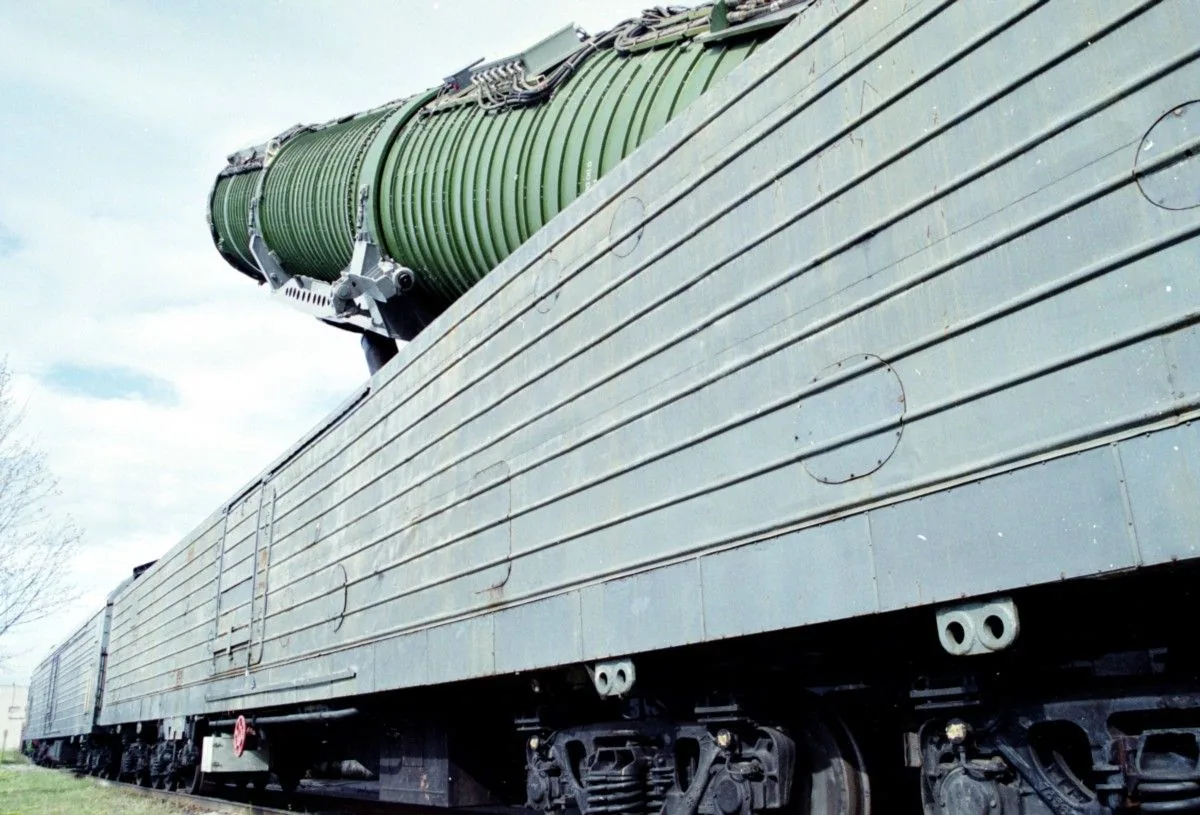
A Molodets-type launch car with its roof panels opened and the green, corrugated missile canister raised part-way on its erector. The ribbed car body is styled like a refrigerator van. The Molodets launch cars rode on eight axles, where the support cars rode on four.
Track loads and the eight-axle giveaway. The launch cars rode on eight axles, while ordinary support cars rode on four. That eight-axle refrigerator look was the visual giveaway. The launch car, developed from a four-body, eight-axle wagon of the 135-tonne class, carried a climate-controlled canister; the roof opened hydraulically; and the canister was raised by a pneumatic drive using a powder pressure accumulator. Even after a reported 1.5-tonne weight cut relative to the silo missile, the launch car still exceeded a normal axle-load limit. The fix was a special three-car coupling, or "unloading," system that spread weight onto the neighbouring cars of the module. One detailed account puts the launch car with its missile at more than 200 t. [DOCUMENTED as design claims] One careful Russian commentary insists the module was not jacked up on outriggers like a road-mobile Topol, but spread its load across six four-axle bogies to stay near a 23 t axle limit; other secondary accounts describe support "paws." [CONTESTED as to the exact mechanism; the need to manage axle load is not in dispute; the 23 t figure is secondary]
Table speed is often given as 80 km/h; other accounts give 80 to 120 km/h. [CONTESTED] Each of the three launchers could, in the technical description, fire as part of the train or on its own, and a missile could be launched from any point on the route. [DOCUMENTED as a design claim]
The catenary problem: ZOKS. On electrified lines, the train could not simply raise a 23-metre canister into the overhead contact wire. The complex carried ZOKS (устройство закорачивания и отвода контактной сети), a device to short-circuit the contact wire to earth and pull it aside before erection. The launch sequence was: stop the train, let ZOKS short and divert the wire, open the roof, raise the canister to vertical, and mortar-eject the missile. Power came from the train's own diesel-generator car, so the train could sit off the electrified grid. [DOCUMENTED]
Guidance and command. Communications included a dedicated communications car and, in the missile's control system, an interface with the Signal-A combat-control network. The inertial guidance system (NPO AP, V. A. Lapygin) is described as radiation-hardened, with disk-backed memory meant to recover after a nuclear burst, and with azimuth transferred from a ground gyrocompass to the onboard platform by an electro-optical link. Missilery.info records the special nuclear-effects tests named "Shining," "Thunderstorm" and "Shift." [DOCUMENTED as a technical description, not as a tested EMP result]
Garrison and patrol. The trains lived in fixed shelters at the three division bases and moved onto the public network for patrol. The advertised advantage was that a launch position could be anywhere along thousands of kilometres of track, not at a surveyed silo. In practice, later specialist commentary describes a patrol zone, not the whole USSR: speed, radio range, crew endurance and the density of the civilian timetable all limited the beat. On a busy line such as the Trans-Siberian, a slower special train could itself become an unmasking problem by breaking the schedule. [The 1,000 km/day figure is documented in the technical compilation; the tighter "patrol radius" reading is specialist commentary] The 28-day autonomy is the brochure figure; how long a Kostroma or Kedrovy train actually stayed out, and how far from its base it usually went, is thinly documented. [UNVERIFIED as practice]
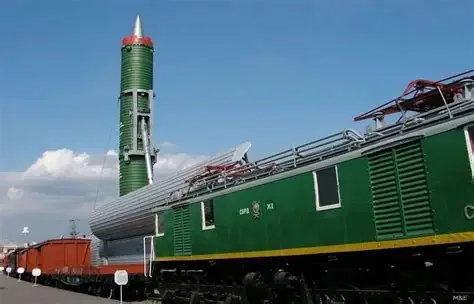
Another view of the museum Molodets train, with the missile canister mock-up raised vertical above the silver cars and the opened roof section of the launch car beside it. A separate green museum locomotive stands in the foreground on the neighbouring track; it is not part of the missile train.
Retirement and scrapping. START I counted the rail missiles as RS-22B. START II, signed on 3 January 1993, required the elimination of multiple-warhead ICBMs including the SS-24, and therefore the rail force. Russia's ratification was conditional, the treaty never fully entered into force in the form of the 1993 text, and Moscow announced its withdrawal on 14 June 2002, after the United States left the ABM Treaty. Scrapping went ahead anyway. The treaty language, post-Soviet money, and the fact that Yuzhnoye and much of the missile's industrial base were now in independent Ukraine all pushed the same way: extending the service life was no longer a simple Russian decision. [DOCUMENTED]
Dismantling is commonly dated 2003 to 2006 or through 2007, with work at the Bryansk missile-repair plant and reported US Cooperative Threat Reduction participation. A March 2008 Sputnik feature describes the trains as having reached their "final destination." Two demilitarised exhibits survived; missilery.info notes an incomplete 15P961 with a 15Zh61 mock-up in the Central Museum of the October Railway in St. Petersburg. [DOCUMENTED as a mid-2000s retirement; the last-cut year of 2005, 2006 or 2007 is CONTESTED] The road-mobile Topol-M and later Yars force is what actually replaced the rail leg in the Strategic Missile Forces, not a new train.
BARGUZIN DEVELOPMENT, ABOUT 2012 TO 2017
Whose project. Barguzin is a different industrial family from Molodets. It is an MIT design, from the Topol, Topol-M, Yars and Bulava house, not a Yuzhnoye one, and Votkinsk would be the obvious missile plant. The Russian Defence Ministry is reported to have announced the work in 2012. Pavel Podvig dates the start to 2013: he first described it as apparently an MIT project of its own with some Strategic Rocket Forces support, and later updated that MIT was in fact sceptical and that the military had pushed it. TASS in 2017 said development began in 2013 on instructions from President Putin. [DOCUMENTED as a 2012 to 2013 start; who initiated it is CONTESTED, though the accounts fit together at a high level]
Schematic design, December 2014. On 16 December 2014, Strategic Rocket Forces commander Col.-Gen. Sergey Karakayev said the schematic design of Barguzin, "to be recreated under the president's decision," had been finalised and that work on the design documentation was under way. Depending on the briefing, that documentation is described as starting in 2015 or as complete by May 2016. [DOCUMENTED]
The missile. In the public line from 2014 to 2017, the missile was the RS-24 Yars or Yars-M, a far lighter solid ICBM than the 104.5-tonne 15Zh61. TASS in 2017: the Yars "weighs 50 tonnes and with its length of 22.5 meters it easily fits into a 24-meter rail car designed to carry 60 tonnes of cargoes." Other tables use about 47 to 47.1 t, or the ~49 t familiar from open Yars data, including this site's Yars article. [DOCUMENTED as claims; the 47, 49 or 50 t spread is CONTESTED; the 22.5 m length is more stable]
NATO name. GlobalSecurity and some wire copy have used SS-X-32Zh as a NATO-style name for Barguzin. That designation was not found in a formal NATO publication, so this page treats it as a secondary label, not a confirmed reporting name. [UNVERIFIED]
Train and warhead claims. On 26 December 2014 a defence source told TASS that one Barguzin regiment would be one train of up to six Yars or Yars-M missiles, and that a division would be five such regiments. TASS repeated this on 6 December 2017: six launchers per complex, five complexes in a division, each Yars "containing four independently targetable warheads." The arithmetic that went round with those briefings was 6 × 4 = 24 warheads per train and 5 × 24 = 120 per division. That happens to match a Molodets division in the standard telling: four trains × three missiles × ten warheads = 120, or 360 for the twelve-train force. [DOCUMENTED as 2014 to 2017 source claims]
Three or four warheads: flagged, not resolved. This site's Yars article describes the missile as typically assessed at three MIRVs, noting that some Russian statements historically claimed up to four, and the 2010 RIA Novosti infographic reproduced there says "at least 4." Both numbers are therefore on the record. With the four-warhead briefing figure, a five-train Barguzin division is 120 warheads; with the typical three-warhead load, it is 90. [CONTESTED] Throw-weight was never published for a "Barguzin missile" as a distinct type. Open Yars throw-weight is about 1,200 kg, against Molodets' 4,050 kg, so a rail Yars would have inherited a much smaller warhead bus, not the old ten-warhead front end. [ESTIMATE, inherited from Yars] The "service until at least 2040" line from that period is a source claim, not the date of a fielded system.
The selling point. The case for the lighter missile was really about the train: one locomotive instead of two or three, standard-looking freight cars instead of eight-axle "refrigerators," and axle loads that would not hammer the track. Those claims made Barguzin look cheaper and stealthier than Molodets. No production train in the public record demonstrates them. The locomotive count, car count, and the exact disguise (refrigerator van, ordinary freight car or tank wagon) remain brochure-level. [UNVERIFIED as hardware]
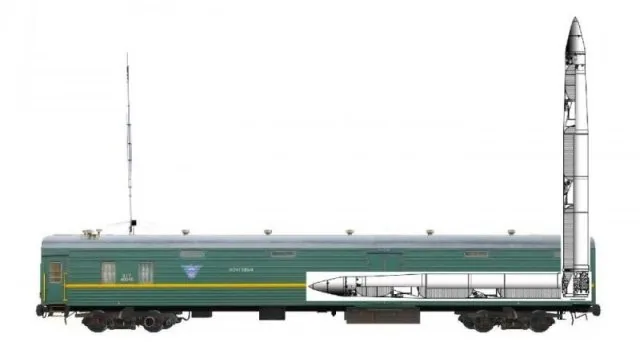
An illustration, not a photograph: a green, passenger-style railway car with a missile drawn in cutaway inside its body and another missile shown standing erect at one end, with a whip antenna on the roof. Drawings like this circulated as artist's concepts of a disguised missile car. It does not show any built or operational Barguzin car, and no official Barguzin car design has been published.
The one documented test, 2016. 2014 was not a test year; it was the year of schematic approval. In early 2016 the programme was reported as about to be terminated, or as slipping a year for money, but MIT and the military kept working on "elements of the system." In May 2016 Yuri Solomonov promised the first ejection test "in the beginning of the fourth quarter of 2016." [DOCUMENTED]
The first press reports, around 3 November 2016, said an ejection or "pop-up" test had just taken place at Plesetsk. Podvig noted that the first outlet was "somewhat dubious," that other sources largely confirmed it, and that there was no official confirmation yet. On 4 November an Interfax "knowledgeable source" denied a launch in the previous few days but said the ejection test would happen before year-end. On 22 November, retired Col.-Gen. Viktor Yesin told Defence.ru that there had been a test in early November, with "acceptable" results, and that it was an ejection test from a rail-mounted launcher. An industry source also confirmed a successful test to Interfax. Podvig later dated the test to 1 November 2016; Jamestown, citing Novye Izvestia, says the end of October 2016 and calls it the "first and only drop test." On 17 August 2017 Podvig recorded that the official history of the Plesetsk test site confirmed the ejection test did take place. TASS in December 2017 called it "pop-up tests of the Yars missile from the Plesetsk cosmodrome" and "the last work carried out under this program." [DOCUMENTED that a test occurred; the exact day is CONTESTED; whether the fixture was a complete rail car is UNVERIFIED]
An ejection test shows that a missile can be mortar-ejected from a canister in a rail-related fixture. It is not a flight test, not a full-range shot, and not a train on the public network. Flight-design tests were said at various times to begin in 2017, with deployment around 2019, or with a "13th missile division" of five Barguzin regiments in the early 2020s; as late as January 2017, industry talk still pointed to flight tests in 2019. No Barguzin flight-test campaign is documented, and there is no evidence that the 13th division was ever formed. In July 2017 Deputy Prime Minister Dmitry Rogozin was still saying Russia was ready to adopt new rail-mobile nuclear missiles. That was a political line, not a date of entry into service.
The 2017 shelf. On 6 December 2017 a Russian defence-ministry source told TASS that Barguzin had been excluded from the state armament programme for 2018 to 2027 for lack of money, and that Russia had "sacrificed the Barguzin project for the time being for the sake of the Sarmat and the RS-26 Rubezh ICBMs." The same source said the project had been on hold since the autumn of 2016, awkwardly close to the Plesetsk test itself; the consistent reading is that the pop-up test was the last funded work. Rossiyskaya Gazeta had already reported that the issue was closed "at least for the near future." Podvig's headline that week was "cancelled (again)," a reminder that the programme had been declared dead before and then revived. [DOCUMENTED]
The irony is that Rubezh itself was later frozen and never fielded, and Sarmat has had a troubled test record of its own. Neither fact is evidence that Barguzin quietly took their place. They are separate unfinished procurement stories.
REVIVAL TALK, 2019 TO 2026
Nothing in the open record shows a funded, official restart, a production order, a flight-test series, or a train entering service with the Strategic Missile Forces. What exists is a short list of dated comments. All of the following is talk, not evidence of deployment.
- 2019: GlobalSecurity, compiling Russian coverage, records a late-2019 line that the project had not been abandoned, could be put into service quickly if needed, and remained on hold for lack of funds. The underlying Russian interview was not independently found. [SINGLE-SOURCE; UNVERIFIED as a decision to resume]
- 2 November 2020: Yuri Solomonov, MIT's general designer, told TASS (as carried by Topwar): "We are ready for this work. It was suspended. If a decision is made to resume work, we are ready to continue them." The work already done was said to have been preserved. That is a design bureau saying it can pick the job back up, not a defence-ministry statement that it has, and not a budget line. [DOCUMENTED as a statement; UNVERIFIED as a restart]
- 2021 to 2025: no defence-ministry announcement, armament-programme amendment, Plesetsk flight-test notice or confirmed production contract was found. Silence in the press is not proof that no quiet paper studies happened, but it is the state of the public record. [UNVERIFIED]
- 5 February 2026: on the day New START lapsed, the military analyst Igor Korotchenko told TASS that Russia "must decide" whether to deploy Barguzin. He claimed about 90 percent commonality with Yars and Bulava, said the trains would be "indistinguishable from conventional refrigerated trains" and "impossible" for reconnaissance satellites to detect, and argued that at least five systems would be needed to guarantee a retaliatory strike. [DOCUMENTED as advocacy; the commonality, detectability and "five systems" lines are an analyst's claims, CONTESTED, not official orders]
Korotchenko is a commentator, not the Strategic Missile Forces commander or the Minister of Defence. "Must decide" is itself a sign that no decision had been taken, or at least none announced. His "impossible for satellites" line should not be repeated as fact (see the detectability section below). And the refrigerated-train disguise is a reused Molodets talking point; even Molodets was not truly indistinguishable.
Not found through November 2026: any official statement that Barguzin has been re-funded, that flight tests have begun, that a first regiment has formed, or that a train is on combat duty; any confirmed photograph of a Barguzin launch car in service; or any treaty data declaration, since New START had lapsed and Barguzin was never a declared deployed type under it. [UNVERIFIED]
PROS AND CONS: WHY BARGUZIN WAS SHELVED
The documented reason for the 2017 decision is money: the armament programme for 2018 to 2027 could not fund everything, and Sarmat and Rubezh came first. Behind that budget line sits a strategic argument that explains why Russia could afford to drop the train. That argument is this site's analysis, set out below, not a quoted official rationale.
The case for rail mobility. Rail mobility is a real survivability concept, and it is worth being fair to it. A silo is a surveyed, pre-targeted hole. A railway missile, in the Soviet and later Russian telling, buys dispersal across a national network that already exists, is already maintained, and already carries civilian traffic that can mask a special train. If an adversary cannot be sure which trains on which lines matter, a disarming first strike gets harder. Molodets was built on exactly that case, and the United States designed its own Peacekeeper Rail Garrison on similar logic. [DOCUMENTED as the advertised rationale]
The case against: Russia already has road-mobile Yars. The main reason a missile train is hard to justify today is that Russia already fields road-mobile Yars launchers. These big wheeled launchers disperse from their garrisons into forest field positions and move between them. An adversary planning a first strike cannot count on finding all of them, or even most of them, in the time a strike takes. Road-mobile Yars already provides the "hard to find, so it survives" leg of the force that a train was supposed to provide, and a Yars launcher is not limited to the rails. (This site's analysis.)
A train is tied to known track. A road-mobile launcher can, within limits, leave the road and hide under trees. A train cannot leave the rails. The railway map is public, finite and easy to watch, and every train on it has to pass through junctions, yards, bridges and tunnels that a satellite constellation can watch repeatedly. Russian Railways is a computerised, timetabled system; a special train that does not fit the timetable is itself a signature, and on a busy line it can break the schedule just by running slower. The garrison is worse still: in peacetime Molodets regiments spent much of their time in known shelters a few kilometres apart at Kostroma, Zvezdny and Kedrovy, and those, or any successor's, are a first-look target set. The survival argument is about the patrol, not the shed. [DOCUMENTED as to Molodets basing; the modern implication is this site's analysis]
An attacker does not have to find the train to limit it. War, sabotage, a washed-out bridge, or a decision to keep a line closed all shrink the patrol area. A campaign against major bridges, switches and traction power could cut down the usable map without locating a single missile car. Electrified lines needed ZOKS on Molodets; a new train would still have to solve the catenary problem or stay on unelectrified track. (This site's analysis, built on the documented Molodets constraints.)
The track-wear and infrastructure tax. This is the engineering reason Barguzin was sold as "Yars in a standard freight car." A 104.5-tonne 15Zh61 in an eight-axle launch car of over 200 t did not sit easily on ordinary track. The three-car unloading coupling, the multiple locomotives and the restricted routes were all answers to that weight. Repeatedly running a consist that heavy wears rail, stresses bridges, and forces the operator to care which lines can take it. Barguzin's lighter missile was meant to stay inside ordinary axle limits with one locomotive, but that remains a design claim. Even a lighter train still needs living cars, a galley, water, a generator car and secure communications, since it cannot sit in a siding for weeks without them, and all of it has to be bought, crewed and maintained alongside the road-mobile force. [DOCUMENTED as Molodets engineering; UNVERIFIED as Barguzin hardware]
Money. Put those together and a train looks like a second, expensive answer to a question road-mobile Yars already answers. When the 2018 to 2027 programme had to choose, the heavy silo Sarmat, the Rubezh project and the existing Yars build-up won, and the train lost. [DOCUMENTED as to the 2017 decision; why the choice made sense is this site's analysis]
What the West does instead. The contrast with the West is sharp: no Western country fields a road-mobile ICBM, or a rail-mobile one. The United States designed both and cancelled both. The Small ICBM, MGM-134A "Midgetman," was a light, single-warhead missile meant to ride a hardened mobile launcher on roads; it was cancelled in 1992. Peacekeeper Rail Garrison was cancelled in 1991. The Peacekeeper missiles were instead placed in existing Minuteman silos and were retired in 2005. Today every US land-based ICBM sits in a fixed silo, and the planned Sentinel replacement is also silo-based. The United Kingdom and France have no land-based ballistic missiles at all and rely on ballistic-missile submarines (France also keeps an air-launched component). The Western answer to survivability is the submarine at sea, plus enough silos that attacking them would take a very large strike. [DOCUMENTED]
| For rail mobility | Against rail mobility |
| Disperses missiles across an existing national network | A train cannot leave known, finite, watchable track |
| Civilian traffic can, in principle, mask a special train | Timetabled railways make an off-schedule train a signature |
| Long reach: Molodets was credited with about 1,000 km a day | Bridges, junctions, tunnels and traction power are chokepoints an attacker can cut |
| A train is a self-contained base with crew, power and command post | Peacetime garrisons are known targets; survival depends on actually being out on patrol |
| Six missiles per train (Barguzin claim) concentrates firepower | Six missiles per train also concentrates the loss if that train is found |
| Lighter Barguzin missile was meant to fit ordinary freight-car loads | Heavy consists wear rail and stress bridges; Molodets needed special couplings and multiple locomotives |
| A real survivability concept, fielded once by the USSR | Road-mobile Yars already provides survivable dispersal, without rails |
DETECTABILITY AND ARMS CONTROL
The "refrigerator train" myth. Molodets cars were disguised as refrigerator vans and passenger cars. They were not actually ordinary cars. The launch modules had eight axles under a refrigerator profile that normally has four; the roof had to open; and the three-car module with its locomotives formed a pattern a trained imagery analyst could learn. The thermal and radar signatures of a generator car, a climate-controlled canister and a train stopped to launch (ZOKS raised, roof opening, canister erecting) are not those of a fruit train. Signals intelligence against a regiment command-post car, even one sending short, low-power bursts, is a classic mobile-missile problem. Later Russian claims that Barguzin would be "indistinguishable" or "impossible" for satellites to find are advocacy. This page's reading: harder to find than a silo, not invisible. [CONTESTED]
Commercial imagery, radar satellites and routine monitoring of rail yards did not exist in their present form in 1987. They do now. That cuts both ways, since a defender can watch its own network too, but it does not make an eight-axle car, or even a standard-looking but unusual consist, disappear.
Treaties. Under START I, rail-mobile ICBMs were declared, limited and inspectable, and the Molodets missile was counted as the RS-22B. The verification problem is well known: when the trains are away from base, an inspector or a satellite at the garrison sees an empty shed. Some secondary and forum accounts describe a rule that garrison roofs be opened for satellite observation; the treaty protocol text was not checked, so that detail is [UNVERIFIED]. What is not in dispute is that a rail-mobile force complicates counting. New START entered into force on 5 February 2011 and was extended in 2021 through 5 February 2026; Russia suspended its participation in February 2023, and on 22 September 2025 President Putin offered to keep observing the treaty's numerical limits for one more year if the United States did likewise. TASS reported no official US response, and the treaty then lapsed. Barguzin was never a declared deployed system under it, and a rail deployment after the lapse would not automatically come with the old inspection regime unless a new agreement created one. [DOCUMENTED as to the treaty calendar]
Command and control. The Molodets answers were the Signal-A interface and a radiation-hardened inertial system. A Barguzin would need a modern command, control and communications design, and almost nothing specific about it is public. For the broader background on Russian retaliatory command systems, see this site's Perimeter (Dead Hand) article; it is not a Barguzin communications manual.
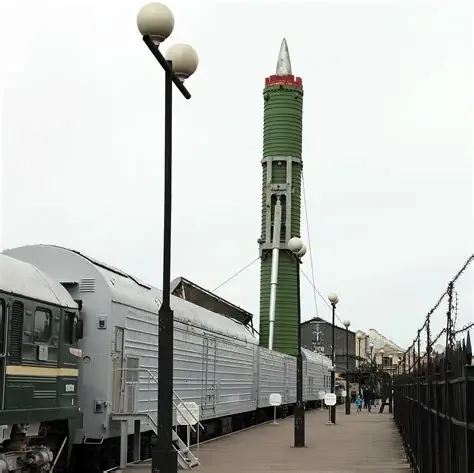
The museum Molodets train seen along its length from the platform, with the canister mock-up raised and visitors walking further down. As an exhibit it is easy to photograph; on the network, the trains' safety depended on not being picked out, and the eight-axle launch cars were their weak point.
COMPARISON TABLE
The figures are open-source compilations. The Barguzin column contains claims, not measured service data. The Yars and Topol-M figures are for the road-mobile and silo missiles, not a fielded rail variant. Peacekeeper Rail Garrison and Midgetman were cancelled, so their figures are design data, not service data.
| Molodets BZhRK (15P961 / 15Zh61, SS-24, RS-22B) | Barguzin (claimed, never confirmed in service) | Yars (RS-24, SS-27 Mod 2) | Topol-M (RS-12M2, SS-27 Mod 1) | Peacekeeper Rail Garrison (US) | Midgetman (MGM-134A, US Small ICBM) |
| Status | Retired; trains scrapped in the mid-2000s (often 2003 to 2007); demilitarised exhibits survive [DOCUMENTED] | Designed 2012 to 2016; one 2016 ejection test; excluded from GPV 2018 to 2027; later talk only. Not confirmed operational [UNVERIFIED / CONTESTED] | In service since 2010, road-mobile and silo [DOCUMENTED] | In service from the late 1990s and 2000s; being displaced by Yars [DOCUMENTED] | Approved 19 Dec 1986; cancelled 1991; never operational [DOCUMENTED] | Cancelled 1992; never operational [DOCUMENTED] |
| Designer | Yuzhnoye (V. F. Utkin); launcher KBSM (A. F. Utkin) | MIT (Solomonov); Votkinsk the likely plant | MIT / Votkinsk | MIT / Votkinsk | USAF and Peacekeeper (MX) contractors | USAF programme |
| Missile | Three-stage solid; 104.5 t; ~22.6 m in canister | Yars or Yars-M derived; ~47 to 50 t; ~22.5 m [CONTESTED mass] | ~49 t; ~22.5 m | ~47 t class; single warhead | LGM-118 Peacekeeper, three-stage solid, ~88 t class; rail was a basing mode, not a new missile | Small solid ICBM, roughly 14 t |
| Throw-weight | 4,050 kg | Not published; would track Yars, ~1,200 kg [ESTIMATE] | ~1,200 kg [ESTIMATE] | Lower than Yars | ~4,000 kg class (silo missile) | Not compared here |
| Warheads | 10 MIRVs; 0.43 Mt (missilery) or 550 kt (FAS) [CONTESTED] | Briefed as 4; typical Yars load is 3 [CONTESTED] | Typically 3; "up to 4" in older claims [CONTESTED] | 1 | 10 | 1 |
| Range | 10,100 km (some tables 11,000) | Yars-class, often ~11,000 km [CLAIM] | ~11,000 km | ~11,000 km class | Intercontinental | Intercontinental |
| Launcher | ~17-car train; 2 or 3 DM62 locomotives [CONTESTED]; 3 missiles; eight-axle launch cars disguised as refrigerator vans | Train with 1 locomotive and up to 6 missiles; 5 trains per division [CLAIM] | 16-wheel MZKT-79221 TEL, or silo | 16-wheel MZKT-class TEL, or silo | Train with 2 locomotives, 2 security cars, 2 launch cars (2 missiles), launch control, fuel and maintenance cars; launch car 87 ft, over 520,000 to 550,000 lb | Hardened mobile launcher on roads |
| Basing | Shelters at Kostroma, Zvezdny (Bershet) and Kedrovy; patrol on the national network | A "13th division" was talked about; not shown to exist [UNVERIFIED] | Garrisons plus forest field positions; silos | Garrisons plus field positions; silos | Garrisons on Air Force bases in peacetime; dispersal onto the freight network in a crisis | Planned to disperse from bases by road |
| Infrastructure burden | Heavy: special couplings, restricted lines, several locomotives, ZOKS | Sold as standard axle loads and one locomotive [CLAIM] | Road, bridge and soil limits of a heavy TEL | Same road limits | Heavy launch car on the US freight network; cancelled before wear could be tested in service | Road and base limits |
| Arms control | START I: RS-22B; START II required elimination | Never declared under New START | Accountable under New START while it applied | Accountable under New START while it applied | Cancelled before deployment | Cancelled before deployment |
TIMELINE
| Date | Event | Tag |
| Mid-1970s | Work on a Soviet railway ICBM usually dated from here | DOCUMENTED |
| 9 Aug 1983 | Decree orders the improved RT-23 UTTKh in rail, silo and (later abandoned) road-mobile form | DOCUMENTED |
| 27 Feb 1985 to 22 Dec 1987 | 32 flight tests of the rail 15Zh61 at Plesetsk; 18 train runs, over 400,000 km | DOCUMENTED |
| 19 Dec 1986 | US approves Peacekeeper Rail Garrison | DOCUMENTED |
| 20 Oct 1987 | First Molodets regiment on duty at Kostroma | DOCUMENTED |
| 1987 to 1991 | 12 Molodets complexes built | DOCUMENTED |
| 28 Nov 1989 | Molodets formally adopted | DOCUMENTED |
| 1991 | US cancels Peacekeeper Rail Garrison | DOCUMENTED |
| 1992 | US cancels the Midgetman Small ICBM | DOCUMENTED |
| 3 Jan 1993 | START II signed; requires elimination of MIRVed ICBMs including SS-24 | DOCUMENTED |
| 1994 | Peacekeeper rail-car prototype delivered to the National Museum of the USAF | DOCUMENTED |
| 14 Jun 2002 | Russia announces withdrawal from START II | DOCUMENTED |
| 2003 to 2005/2006/2007 | Molodets trains retired and cut up, including at Bryansk | DOCUMENTED; end year CONTESTED |
| 5 Feb 2011 | New START enters into force | DOCUMENTED |
| 2012 or 2013 | Barguzin work begins at MIT | DOCUMENTED; start year CONTESTED |
| 16 Dec 2014 | Karakayev: Barguzin schematic design finalised | DOCUMENTED |
| 26 Dec 2014 | TASS source: up to 6 missiles per train, 5 trains per division | DOCUMENTED as a claim |
| May 2016 | Solomonov promises an ejection test early in Q4 2016 | DOCUMENTED |
| Late Oct or 1 Nov or early Nov 2016 | The only documented test: an ejection test at Plesetsk | DOCUMENTED; date CONTESTED |
| Autumn 2016 | Project on hold, according to the 2017 TASS source | DOCUMENTED |
| 17 Aug 2017 | Podvig notes that the official Plesetsk history confirms the ejection test | DOCUMENTED |
| 6 Dec 2017 | TASS: Barguzin excluded from GPV 2018 to 2027 in favour of Sarmat and Rubezh | DOCUMENTED |
| Late 2019 | "Not abandoned" line reported by GlobalSecurity | SINGLE-SOURCE |
| 2 Nov 2020 | Solomonov: MIT "ready" to resume if a decision is made | DOCUMENTED as talk |
| Feb 2023 | Russia suspends New START participation | DOCUMENTED |
| 22 Sep 2025 | Putin offers to observe New START limits for one more year | DOCUMENTED |
| 5 Feb 2026 | New START lapses; Korotchenko urges deployment of at least five trains | DOCUMENTED as advocacy |
| 12 Nov 2026 | No confirmed Barguzin train in service, in production, or under funded development | UNVERIFIED |
GAPS AND CONFLICTS
These conflicts are flagged, not resolved. Where sources disagree, both figures are given above.
- Molodets locomotives: two DM62s (missilery.info) or three modified M62/DM62s (most English and many Russian accounts). [CONTESTED]
- Molodets yield and accuracy: 10 × 0.43 Mt with a 0.2 to 0.5 km CEP (missilery) or 10 × 550 kt with a ~500 m CEP (FAS, unofficial). [CONTESTED]
- Molodets speed: 80 km/h in the missilery table; 80 to 120 km/h elsewhere. [CONTESTED]
- Scrapping end-year: the last trains are dated 2005, 2006 or 2007. The mid-2000s retirement is solid; the final year is not. [CONTESTED]
- Barguzin missile mass: 47 t, 47.1 t, about 49 t, or TASS's 50 t. [CONTESTED]
- Barguzin warheads: four in the 2014 to 2017 briefings (120 per division); three as the typical Yars load (90 per division), as on this site's Yars page. [CONTESTED]
- 2016 ejection-test date: 1 November (Podvig), the end of October (Jamestown, citing Novye Izvestia), or early November (Yesin). All agree that a test happened at Plesetsk. [CONTESTED as to the day]
- Who started Barguzin: MIT with Strategic Rocket Forces support, the military over a sceptical MIT (Podvig, updated), or Putin's instructions (TASS). [CONTESTED in detail]
- "SS-X-32Zh": circulates on secondary pages; not confirmed as an official NATO reporting name. [UNVERIFIED]
- Not established: whether the 2016 test used a complete rail car or a rail-mounted fixture; any Barguzin flight test; the Barguzin car count, disguise, locomotive class or catenary solution; any 2021 to 2026 official restart; the "open garrison roofs" START rule (protocol text not checked); the 23 t axle figure (secondary); and how long Molodets trains actually stayed out on patrol. [UNVERIFIED]
- Left out deliberately: commercial comparison tables that have Barguzin "adopted in 2009" or similar; any claim that the 13th missile division was formed; and any claim that Barguzin gives a "guaranteed retaliatory strike," which is advocacy.
IN ONE SENTENCE
Barguzin is a proposed successor to the Soviet Molodets missile trains: a Yars-derived, six-missile, one-locomotive rail ICBM designed at MIT between 2012 and 2016, with schematic design approved in December 2014 and a single ejection test at Plesetsk in late 2016, then excluded from the 2018 to 2027 armament programme in favour of Sarmat and Rubezh. Since then it has been the subject of readiness statements and advocacy, but nothing confirms that it is operational.
SOURCES
- Missilery.info, "RT-23 UTTH Molodets / 15Zh61 / SS-24 Scalpel B / RS-22": missile and train characteristics, ZOKS, the launch sequence, tests, basing, composition and the St. Petersburg exhibit. Underlying print sources include Karpenko, Utkin and Popov, Otechestvennye strategicheskie raketnye kompleksy (St. Petersburg, 1999), and Podvig (ed.), Strategicheskoe yadernoe vooruzhenie Rossii (IzdAT, 1998). en.missilery.info/missile/15g61
- Federation of American Scientists, "RT-23 / SS-24 SCALPEL": family history, the unofficial 10 × 550 kt and ~500 m CEP figures, and START designations. nuke.fas.org/guide/russia/icbm/rt-23.htm
- Sputnik, "Nuclear missile train at its final destination," 4 March 2008.
- Pavel Podvig, "Test of Barguzin rail-mobile ICBM," Russian Forces, 3 November 2016, with later updates including the 17 August 2017 note on the Plesetsk official history.
- Pavel Podvig, "Barguzin rail-mobile ICBM is cancelled (again)," Russian Forces, 4 December 2017.
- TASS, "Barguzin rail-mobile ICBM excluded from Russia's armament plan until 2027 — source," 6 December 2017.
- The Jamestown Foundation, "Russia Terminates Development of New Rail-Mobile Ballistic Missile," December 2017.
- GlobalSecurity, "RS-24 Yars / Barguzin": a secondary compilation, the source of the 2019 "not abandoned" line [SINGLE-SOURCE] and the SS-X-32Zh label. Used with caution.
- Topwar, "Only a decision is needed: MIT announced its readiness to resume work on the Barguzin BZHRK," 2 November 2020, quoting Solomonov via TASS.
- TASS, 5 February 2026: Igor Korotchenko on Barguzin, and the 22 September 2025 New START offer.
- National Museum of the U.S. Air Force, "Peacekeeper Rail Garrison Car."
- On this site: RS-24 Yars, RS-28 Sarmat, Perimeter (Dead Hand), Avangard.
Related on this site: RS-24 Yars | RS-28 Sarmat | Perimeter (Dead Hand) | Avangard | Strategic Missiles and Strike Weapons
Project Orlan // Underground Information Database