WHAT IT IS
"Elbrus OS" is the loose name used outside Russia for the family of Linux-based operating systems that run on Elbrus computers built around MCST's E2K (Elbrus-2000) VLIW processors. There is no single product behind the name. MCST itself ships several distinct systems under the Elbrus brand, each with its own decimal designation, kernel line and certification status, and three independent Russian vendors (RusBITech-Astra, Basealt and Red Soft) ship their own distributions for the same hardware. [DOCUMENTED] Those processors use their own native VLIW instruction set, e2k, which is neither x86 nor ARM, so the entire system is compiled specifically for them and x86 programs run only through binary translation. [DOCUMENTED]
This article is the deep reference for the software side: what each of those systems is, how they relate to one another, which versions run on which processors, how x86 programs are made to run on a machine that does not speak x86, which systems carry Defence Ministry, FSTEC or FSB certificates, where they are used, and how a reader outside Russia can actually get Elbrus code running today. The hardware, the processor ladder and the history of the Elbrus name are covered in the companion article Elbrus. [BACKGROUND]
QUICK FACTS
NOT x86, NOT ARM: WHY ELBRUS NEEDS ITS OWN OS
Elbrus OS exists because the processors it runs on are not PCs and not phones-or-servers in the ARM sense. MCST's E2K (Elbrus-2000) chips use their own native instruction set, usually written e2k, built on a VLIW (very long instruction word) design: the compiler, not the chip, decides which operations run in parallel and packs them into wide instruction bundles. An x86 or ARM program is simply not machine code an E2K processor can execute. [DOCUMENTED]
The practical consequence is that the whole software stack has to be built natively for E2K: the Linux kernel port, the C library, the desktop and every package. That is done with MCST's own compiler, lcc, which accepts GCC-style code but generates E2K machine code (see the version ladder below for lcc and GCC equivalents). Software that exists only as x86 binaries cannot run natively; it runs only through MCST's binary translators, Lintel and RTC, described under Running x86 software. [DOCUMENTED]
A separate, older line of Elbrus-branded machines is built on SPARC processors rather than E2K. MCST's own software tables list SPARC V8/V9 builds alongside the E2K builds (OPO Elbrus 2.5, Elbrus Linux up to 4.1, OS Elbrus 2.10), so those machines run a SPARC port of the same family, not the E2K binaries. [DOCUMENTED] Which specific SPARC models (for example the Elbrus-90micro and R-series) each build targeted is not broken out in the sources used here. [UNVERIFIED]
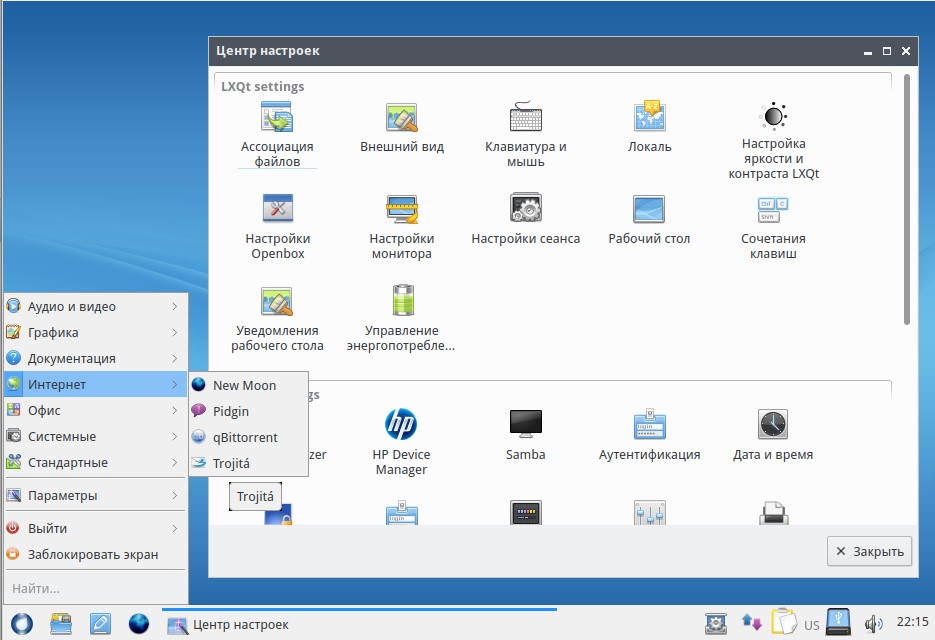
The screenshot above, supplied by the site owner, shows an Elbrus Linux desktop running the LXQt environment, with the Russian-language settings centre open and the start menu listing the New Moon web browser, Pidgin, qBittorrent and the Trojitá mail client. The exact release shown is not identified. [FIELD ACCOUNT, site owner]
ONE NAME, SEVERAL SYSTEMS
MCST's own catalogue page splits the Elbrus software into two headings, and the naming is a common source of confusion even in Russian sources. [DOCUMENTED]
OPO "Elbrus" (ОПО «Эльбрус», general-purpose software)
Under this heading MCST lists the older protected and certified systems and the current free Elbrus Linux. The certified builds are OPO Elbrus 2.5 (designation TVGI.00311-05, Linux 2.6.33) for Elbrus-4S, Elbrus-2S+ and the SPARC V8/V9 machines, and OPO Elbrus 3.0 (TVGI.00311-28, Linux 3.14) for Elbrus-8S. MCST marks both as "protected, certificate": they are delivered only with the permission of the lead customer, and installation media, sources and documentation are released by delivery contract or on request on company letterhead. [DOCUMENTED]
Elbrus Linux (Эльбрус Линукс)
Elbrus Linux is MCST's own distribution. Russian Wikipedia describes it as built on the Linux From Scratch method rather than derived from a mainstream distribution. MCST lists it as "free, stable", carried under the designations TVGI.00333-01 (general) and TVGI.00401-01 (server edition), with package lists and documentation downloadable and installation images "on request to the support service". Source code is supplied as part of the PDK (platform development kit). A build for x86-64 is also listed, which is the same distribution compiled for ordinary PCs so that software can be prepared off the Elbrus hardware. [DOCUMENTED]
OS "Elbrus" / Elbrus-D (ОС «Эльбрус»)
Confusingly, the product formally called "OS Elbrus" is a different system: a port of Debian (Russian Wikipedia gives Debian 8.11 as the base) also known as Elbrus-D, designation TVGI.00950-01. MCST's table lists version 1.4.3 (Linux 4.9) as protected and certified, covering Elbrus-8S, -4S, -2S+, -1S+, SPARC V9 and x86; version 2.10 (Linux 5.4) for SPARC V9; and version 3.9.1 (Linux 5.10) for the current Elbrus range, both "on request". The Debian port is documented in a 2013 MCST conference paper describing how Debian's packaging was brought up on E2K with an lcc toolchain then compatible with GCC 3.4.6. [DOCUMENTED]
Sources conflict on version labels. The Elbrus developer-community wiki gives Elbrus-D 3.9, 2.22 and 1.4, while MCST's catalogue shows 3.9.1, 2.10 and 1.4.3, and Russian Wikipedia gives "8.11" as the version, which is the Debian release, not an MCST version. This article follows MCST's own catalogue where they differ. [DOCUMENTED]
PDK "Elbrus"
The platform development kit is the same system with development tools, compilers and source packages. Older versions (PDK 4.0 on Linux 4.9) were also issued for x86 so that developers could build and test without Elbrus hardware. [DOCUMENTED]
VERSION LADDER OF ELBRUS LINUX
The developer-community wiki (wiki.elbrus.ru) keeps a comparison table of every operating system available for the platform. For MCST's Elbrus Linux it gives the following main lines. [SINGLE-SOURCE]
A Russian-language news report on the 8.0 release lists Linux 5.10.0-1.12, glibc 2.35, lcc 1.27.10, LLVM 13, GTK 4.6 and Ceph 14.2, and says the rtc-5.0 translator was close to release at that time. [SINGLE-SOURCE]
The "E2K v" numbers are instruction-set generations, not chip names. The community wiki maps them as: v2 Elbrus-S and Elbrus-2S+; v3 Elbrus-4S; v4 Elbrus-8S and Elbrus-1S+; v5 Elbrus-8SV; v6 Elbrus-16S, Elbrus-12S and Elbrus-2S3. v7 is the next generation still in development. Because VLIW code is scheduled by the compiler for a specific generation, a binary built for a newer version will not generally run on an older chip; this is why every distribution lists the generations it covers. [DOCUMENTED]
WHY AN ELBRUS OS IS HARDER THAN A NORMAL PORT
On x86 or ARM the processor finds parallelism in the instruction stream at run time. On E2K the compiler does that work ahead of time and packs explicit wide instruction words. The consequence for an operating system vendor is that the quality of every package depends on MCST's lcc compiler, that code tuned for one generation is not ideal for another, and that hand-written x86 or ARM assembly in open-source projects (codecs, crypto libraries, JIT compilers) has to be replaced or disabled. [BACKGROUND]
lcc uses a front end licensed from Edison Design Group and is maintained to accept GCC command-line options, so most open-source build systems work with little change. MCST added LLVM/Clang to the distribution from the 6.x line onward, which matters because Rust and many newer tools depend on LLVM. [DOCUMENTED]
E2K also has hardware-supported "protected mode" (secure pointers with bounds checking). MCST's own literature promotes it as a security feature, but it requires recompiling software in that mode, and the sources reviewed for this article do not show how widely shipped distributions use it. [UNVERIFIED]
RUNNING x86 SOFTWARE: LINTEL AND RTC
Lintel
Lintel is a system-level binary translator. It loads below the operating system, presents an x86 machine, and translates x86 code into E2K code on the fly, caching and re-optimizing hot code. With it an Elbrus computer can boot an unmodified x86 operating system, including Windows. The community wiki lists Lintel 3.4 through 5.0 shipping with successive Elbrus Linux versions; no third-party distribution in its table bundles Lintel. [DOCUMENTED]
RTC
RTC (run-time compiler) is the lighter application-level translator. It runs a single x86 Linux program on an E2K Linux system, translating its code and passing its system calls to the native kernel. RTC ships with Elbrus Linux (5.1 in 9.5), with Alt (4.4) and with Alt SP (up to 4.4). MCST demonstrated it running Yandex Browser and the MAX messenger at its 2026 technology day. [DOCUMENTED]
Translated performance depends on the workload. Long-running loops can be optimized close to native speed, while start-up and rarely executed code is slow. Independent enthusiast benchmarks reported over the years put translated performance well below native for general desktop use, but the figures vary too much by version and chip to quote one number. [ESTIMATE]
THE THIRD-PARTY DISTRIBUTIONS
Astra Linux Special Edition "Leningrad"
Astra Linux SE is the dominant secure Russian distribution, Debian-based, with mandatory access control and integrity control built in. Its Elbrus edition is release "Leningrad", version 8.1, designation RUSB.10265-01, for Elbrus-8S, Elbrus-1S+ and Elbrus-8SV. Astra's certificate page lists a Defence Ministry certificate No. 5085 of 3 December 2020, valid to 3 December 2025, at level A2 and "2 NDV" (second level of control for undeclared capabilities), and Astra's documentation lists version 8.1 under FSTEC, Defence Ministry and FSB certification. The community wiki lists 8.1, 8.1.3, 8.1.4 and 8.1.5, the last on Linux 5.10, covering E2K v4–v6. [DOCUMENTED]
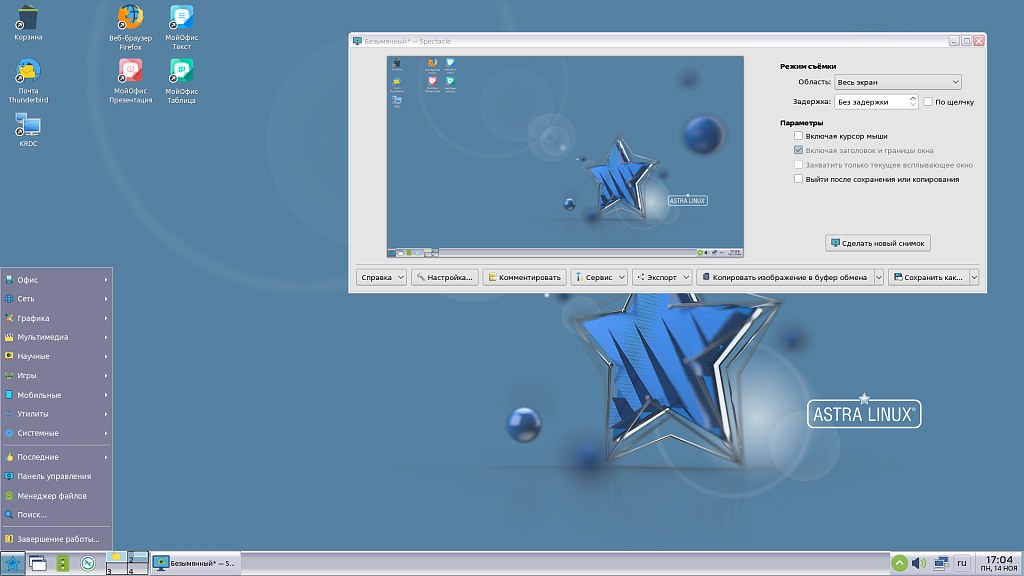
The image above shows the Astra Linux Fly desktop as supplied by the site owner; the image does not itself show which hardware platform or edition it runs on. [UNVERIFIED that it is the Elbrus build]
A separate Astra product, RUSB.10015-16 "Execution 2", is listed in Astra's own variant table for Elbrus-8S and Elbrus-1S+ on a Debian 9 base with Linux 4.9. [DOCUMENTED]
A distributor information letter signed by Astra's deputy general director states that production of Astra Linux 8.1 for Elbrus under FSTEC certificate No. 2557 ends on 27 January 2026, that new licences will no longer be sold, and that further updates will only fix vulnerabilities and critical errors. The sources reviewed do not show what Astra edition, if any, replaces it on Elbrus. [SINGLE-SOURCE]
Alt and Alt SP (Basealt)
Basealt maintains Alt for e2k, with the community wiki listing Alt 10.1 (Linux 5.4), 10.4 (Linux 5.10) and 11.1 in development (Linux 6.1), all covering E2K v3–v6 and bundling RTC. The certified variant Alt SP (Alt 8 SP, 9.1, 10.2), jointly listed under IVK and Basealt, carries Defence Ministry and FSTEC certificates; the 8.2 line also carried FSB. Basealt does not publish e2k installation images on its public download page; images and repositories for Elbrus are "on request" via sales. Basealt's published installation guide for Alt Workstation e2k 10.4 notes that Elbrus machines boot from an ext2/ext3 partition rather than a hybrid ISO. [DOCUMENTED]
RED OS (Red Soft)
RED OS 7.3 is listed for Elbrus (E2K v4, Linux 5.4) with FSTEC certification, and RED OS 8.0 on Linux 6.1 for v4–v6 is listed as in development. [SINGLE-SOURCE]
Real-time and embedded systems
The same table lists Neutrino-E (a QNX-derived real-time OS from SVD VS, Defence Ministry certified), BagrOS-4000 (a real-time OS from Sukhoi, Defence Ministry certified, covering E2K v2–v4), Embox and FX-RTOS. These are the systems more likely to be found in avionics and embedded weapon-system computers than a desktop Linux. [DOCUMENTED]
CERTIFICATIONS AT A GLANCE
Russia has three main certifying bodies for information-security software: FSTEC (technical export and information-protection regulator), the FSB and the Defence Ministry. Holding a certificate lets a system be used in "attested" information systems handling classified or sensitive data up to a stated level. Based on MCST's catalogue, Astra's certificate pages and the community wiki table: [DOCUMENTED]
The pattern is clear: the freely downloadable systems are not the certified ones, and the certified ones are distributed only through contracts. [ESTIMATE]
USE IN MILITARY AND STATE SYSTEMS
Elbrus hardware is used in Russian defence command-and-control computing, state information systems and critical infrastructure, and the main reason for the certified Elbrus operating systems is that use. [DOCUMENTED]
The open sources do not say which operating system runs on which specific military system. MCST and integrators publish certificates and platform lists, not deployment lists. It is a reasonable reading that certified MCST builds and Astra SE "Leningrad" make up most of the defence installations, with Neutrino-E and BagrOS in embedded and avionics roles, but that is inference from the certificates, not a documented deployment record. [SPECULATION]
For the role of Elbrus machines at specific sites, including the Don-2N radar computing complex, see the Elbrus article. [BACKGROUND]
HOW A NON-RUSSIAN READER CAN TRY IT
1. qemu-e2k (easiest, no hardware)
On 25 December 2025 MCST published the source of a QEMU build with Elbrus support. It is a user-mode emulator only: it runs Linux programs compiled for E2K on an ordinary x86-64 Linux host, not a whole Elbrus operating system. MCST's user manual (release 1.0, based on QEMU 10.1.1) gives the build steps: [DOCUMENTED]
wget https://dev.mcst.ru/downloads/latest/qemu-e2k.tar.gz
tar xzf qemu-e2k.tar.gz
cd qemu && mkdir build && cd build
../configure --target-list=e2k-linux-user --disable-docs
make
The emulator supports instruction-set versions elbrus-v2 to elbrus-v6 (v6 by default, selectable with -cpu); elbrus-v7 is listed but not yet reliable. It requires glib 2.68 or newer. MCST describes the intended uses as letting researchers and enthusiasts get to know the platform without hardware, and running the native e2k compiler on x86 servers. The source is also mirrored on MCST's git server (git.openelbrus.ru). Combined with a downloaded Elbrus Linux root filesystem, it lets a reader run real E2K binaries. [DOCUMENTED]
An earlier independent community emulator project, OpenE2K/qemu-e2k on GitHub, predates MCST's release. [SINGLE-SOURCE]
2. Elbrus Linux packages and images
MCST publishes Elbrus Linux package lists and documentation on mcst.ru and dev.mcst.ru; installation images are "on request to the support service". The x86-64 build of Elbrus Linux is listed as downloadable directly. MCST's developer portal also offers remote access to real Elbrus servers. Registration and download from outside Russia may be restricted by geography or sanctions-related blocking. [UNVERIFIED]
3. Real hardware
Second-hand Elbrus-1S+, Elbrus-4S and Elbrus-8S machines appear occasionally on Russian marketplaces. Export of such equipment from Russia is subject to Russian export rules and Western sanctions on the destination side, and buying is not practical for most foreign readers. [ESTIMATE]
For readers who only want to study the architecture, the community wiki, MCST's published manuals on E2K programming and the qemu-e2k emulator are the legitimate starting points. [BACKGROUND]
HOW TO READ ELBRUS OS CLAIMS
IN ONE SENTENCE
"Elbrus OS" is really a family: MCST's free Elbrus Linux, its Debian-based OS Elbrus and older certified OPO builds, plus Astra, Alt and RED OS editions, all held together by the lcc compiler and x86 translators, with only the contract-supplied certified versions used in classified state systems. [DOCUMENTED]
RELATED
Elbrus (hardware, processors and history) | ITMiVT Lebedev Elbrus C2 | Don-2N
HOW THIS ARTICLE WAS BUILT
This article was built only from the sources below, accessed in October 2026. Version tables come from MCST's catalogue and the Elbrus developer-community wiki, which is maintained by enthusiasts and MCST staff but is not an official MCST document. Certification facts come from the vendors' own pages. Nothing here comes from a classified or leaked source. Where a statement rests on one source it is marked [SINGLE-SOURCE].