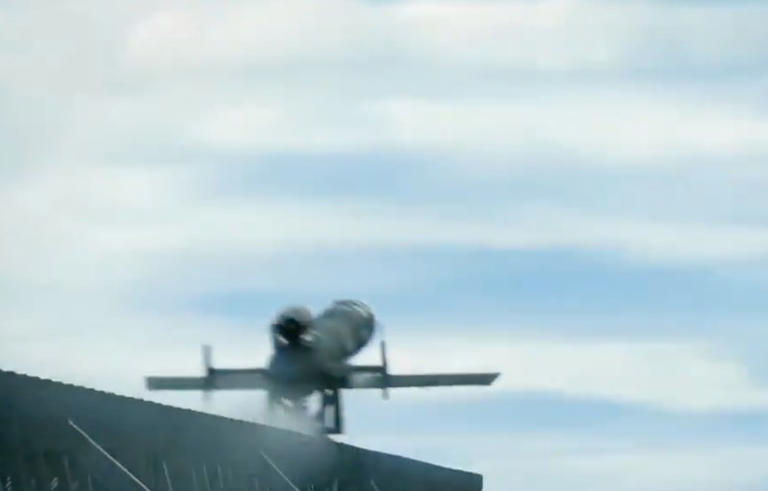
A Geran-5-type jet drone leaving a launch ramp. Twin vertical tails and a top-mounted engine are visible. Video still.
A Geran-5-type jet drone leaving a launch ramp. Twin vertical tails and a top-mounted engine are visible. Video still.
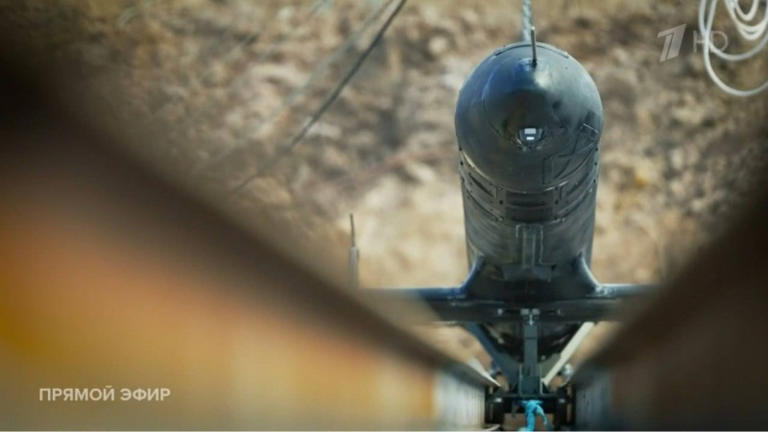
Nose-on view of the drone on its launch rail. Still from a Russian Channel One live broadcast (1 HD logo and «ПРЯМОЙ ЭФИР»).
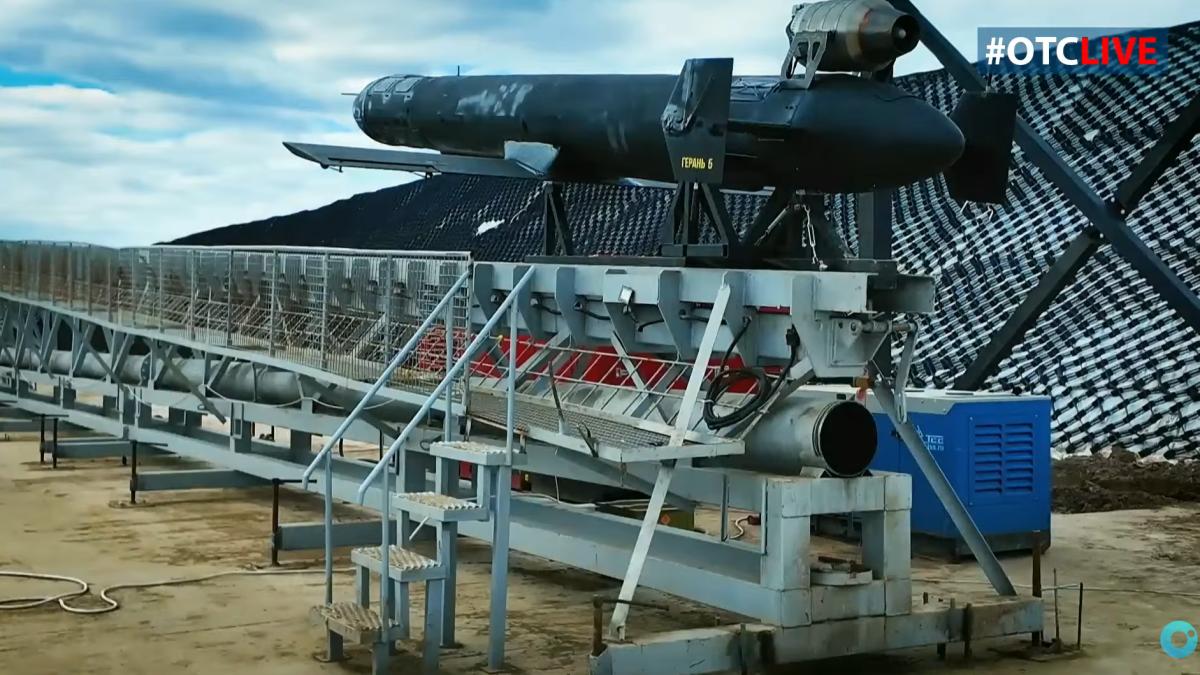
The drone on a long ground launch rail, with a rocket-boosted trolley under the fuselage and a top-mounted engine nacelle. The yellow stencil on the vertical fin reads «ГЕРАНЬ 5». Broadcast still, watermarked #OTCLIVE.
WHAT IT IS
The Герань-5 (Geran-5) is a Russian jet-powered one-way attack drone. It is built at the Alabuga Special Economic Zone, at the Yelabuga plant in Tatarstan, alongside the Geran-4, with other Russian firms supplying parts. [DOCUMENTED, HUR; the US Army ODIN entry lists the maker as Alabuga OEZ PPT JSC] It has a cruise-missile layout with straight wings, rather than the delta wing of the Geran-2 (Shahed-136), and is powered by a Chinese Telefly turbojet.
First combat use was in early January 2026. Ukraine's Defence Intelligence (HUR) published wreckage on 19 January. It is used in the long-range strike campaign against cities and infrastructure, Kyiv included, mixed into salvos with piston Gerans. [DOCUMENTED]
The central point about its role is not whether it can be shot down. It can. It is cheap enough, relative to a conventional cruise missile such as the Kh-101, to be launched in large numbers, and it is too fast — and often too high — for the cheap defensive layer Ukraine built against piston Shaheds: ordinary propeller interceptor drones, hand-held guns and unguided gun platforms. Countering it then falls to expensive conventional air-defense interceptors. That cost exchange is the weapon's point. The evidence for this, and the limits of it, is in the role section below. This is the site owner's assessment, checked against the open sources listed at the end.
HOW IT WORKS
Propulsion. The engine is a Chinese Telefly TF-TJ2000A turbojet. The maker rates it at 200 kgf (1,960 N), 29.24 kg, and 295 × 690 mm. A recovered unit carried serial 0000000060. [DOCUMENTED, HUR component card plus the maker's listing] Early Ukrainian reports named a smaller Telefly JT80, but HUR's later list settled on the TJ2000A. Rated life is about 30 hours. [SINGLE-SOURCE, specialist quoted by Radio Svoboda]
Launch. It is fired from a rail about 80 m long with a rocket-boosted trolley, roughly three times the size of a Geran-2 launcher. A site of this type has been seen at Tsymbulova in Oryol Oblast. [DOCUMENTED: HUR lists a launch engine; satellite imagery; the system was shown at the 9 May 2026 parade] A new site near Millerovo in Rostov Oblast has been reported from anonymous OSINT imagery. [UNVERIFIED] Ukraine struck the Tsymbulova launch site on 30 August and 21 September 2026. [DOCUMENTED, as compiled by drone-warfare.com; not re-checked against primary reports for this article]
Navigation. The standard fit is a Kometa-M12 satellite receiver from VNIIR-Progress, with a 12-element jam-resistant CRPA antenna, plus a SADRA/MINSOO inertial unit, an air-pressure unit and an FCU flight controller. [DOCUMENTED, HUR teardown, also in ODIN] See also this site's article on the Kometa CRPA. The K5 variant adds "Susanin" optical scene-matching navigation, comparable in concept to the Kh-101's Otblesk-U. [SINGLE-SOURCE chain, HUR via Defense Express/Militarnyi] This site has a separate article on Susanin AONS. A magnetometer is fitted in later Gerans, but it is not confirmed on the Geran-5 itself. [UNVERIFIED for this model]
Communications. Recovered examples have carried a "Tracker V3" telemetry unit (a Raspberry Pi with 3G/LTE modems) and a Chinese Xingkay XK-F358 mesh modem that relays from drone to drone. The hardware is documented. A HUR official says operators can steer a strike online. [DOCUMENTED for the hardware; operator-in-the-loop strikes are SINGLE-SOURCE, HUR to RFE/RL] The Insider argues the modem is really the XK-F359, rated 100–300 km line of sight. That is a conflict, so both identifications should be treated as open. [CONTESTED]
Warhead. The warhead is the BCh-90, about 90 kg. [DOCUMENTED, HUR] ODIN describes it as combined thermobaric/fragmentation. [SINGLE-SOURCE] A claim by Wild Hornets of a larger charge is unverified.
Airframe. It is a cruise-missile layout with a carbon-fiber skin over an aluminum and steel structure. The engine was originally in a nacelle on top, as in the launch photographs above. A later move of the engine inside the rear fuselage is an estimate from interceptor video (Militarnyi, September 2026). [ESTIMATE]
HOW IT DIFFERS FROM THE GERAN-2
The Geran-2 is a delta-wing drone with a piston engine and a pusher propeller, cruising around 180–200 km/h. [DOCUMENTED, IEEE for earlier Shaheds] The Geran-5 is a turbojet with a cruise-missile planform and straight wings, cruising at 450–600 km/h. [DOCUMENTED, HUR]
It flies higher. Combat use so far has been from 200 m to 3 km, according to HUR, while other sources say jet Gerans climb to 4–7 km. Both figures are documented, but they describe different things: what has been observed so far, versus what is possible. [CONTESTED as to ceiling; see the specifications table]
It needs a large rail launch instead of the Geran-2's short rack or truck launch, so launch sites are fewer and easier to spot. [DOCUMENTED] The warhead is about the same mass class as the largest Geran-2 warheads, not bigger. [DOCUMENTED, HUR, RobotWar]
It costs more: about $115,000, versus about $30,000 quoted for the old piston models. [ESTIMATE, Kyiv Independent] IEEE quotes about $80,000 for jet Gerans in general. [ESTIMATE]
SPECIFICATIONS
Figures below are from the HUR card unless noted. Contested items are given as ranges, with the conflict marked. The leaked HUR page reproduced under the table is the source of the card values for span, length, thrust, mass, warhead, speed, range, ceiling and endurance.
Item Value Label MTOW 850 kg DOCUMENTED Warhead ~90 kg BCh-90 DOCUMENTED Cruise speed 450–600 km/h DOCUMENTED (HUR claim) Range 950 km (HUR portal, marked estimated/theoretical) to about 1,000 km in other accounts CONTESTED / ESTIMATE Endurance ~2 h DOCUMENTED (HUR) Ceiling 6 km on the HUR card; observed use 0.2–3 km (HUR); 4–7 km in other accounts (DOU, IEEE) CONTESTED Length 6.5 m (HUR card) vs about 6 m (HUR, 11 January) CONTESTED Wingspan 3.2 m (HUR card) vs "up to 5.5 m" (Militarnyi and others) CONTESTED Engine Telefly TF-TJ2000A, 200 kgf DOCUMENTED Unit cost About $115,000 (engine $35,000–40,000); IEEE about $80,000 for jet Gerans in general; a Russian claim of $60,000–75,000 ESTIMATE / UNVERIFIED (Russian claim)
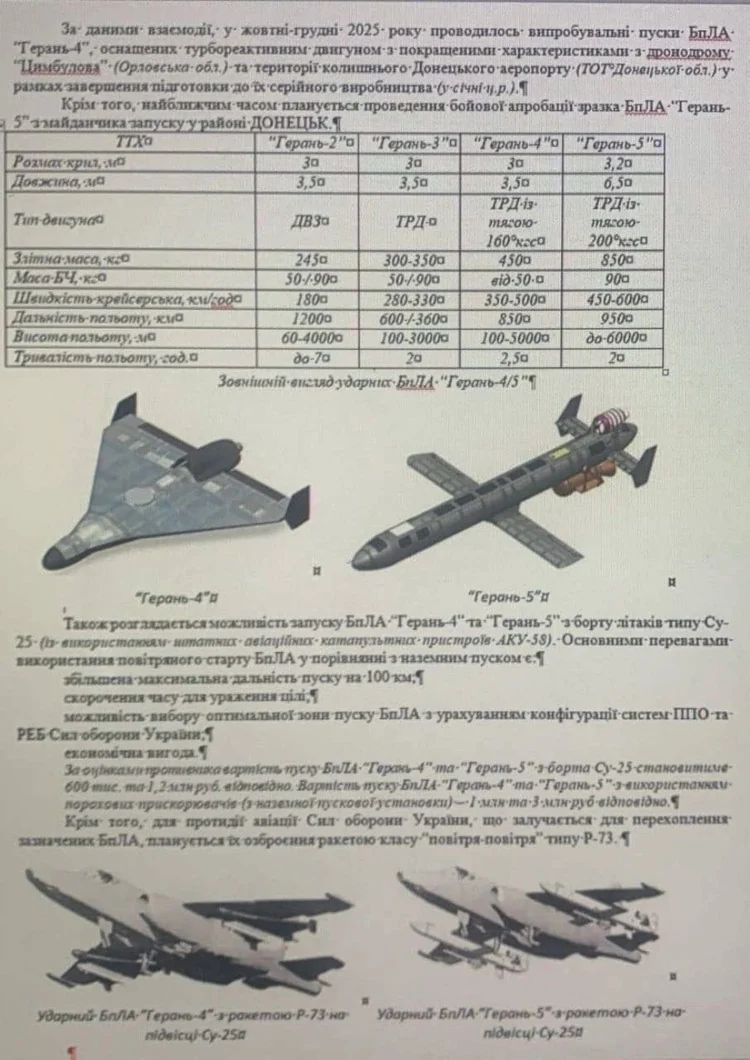
Leaked Ukrainian HUR intelligence document (in Ukrainian): a specification comparison of Geran-2, 3, 4 and 5. The Geran-5 column gives 3.2 m span, 6.5 m length, a 200 kgf turbojet, 850 kg mass, a 90 kg warhead, 450–600 km/h, 950 km, up to 6,000 m and 2 hours. The same page has drawings of the Geran-4 and Geran-5 and a concept for Su-25 air launch with an R-73. Those air-launch drawings are a concept on this page, not a confirmed practice.
HOW AND WHERE IT IS MADE
Production is at Alabuga / Yelabuga in Tatarstan, alongside the Geran-4. [DOCUMENTED] HUR estimated combined output of about 3,000 Geran-4s and Geran-5s a month in August 2026, up from about 500 a month in May. That is a single-source HUR estimate, so it should be treated as an estimate, and there is no Geran-5-only figure. [SINGLE-SOURCE / ESTIMATE]
HUR counted 16 foreign components: 9 American, 4 Chinese, 1 German and 2 of unknown origin. [DOCUMENTED, HUR via ODIN] The Chinese items include the engine and the mesh modem. The Kometa module itself relies on US FPGAs (Intel/Altera Cyclone) and Analog Devices RF chips. [DOCUMENTED, HUR Kometa release]
Some engines are assembled or inspected at Alabuga, and a localized Russian engine has gone into the Geran-4. There is no confirmed Russian engine in the Geran-5 yet. [SINGLE-SOURCE, HUR, October 2026] HUR has said the design is hard to consider a Russian in-house development. That is HUR's opinion, not an independent finding.
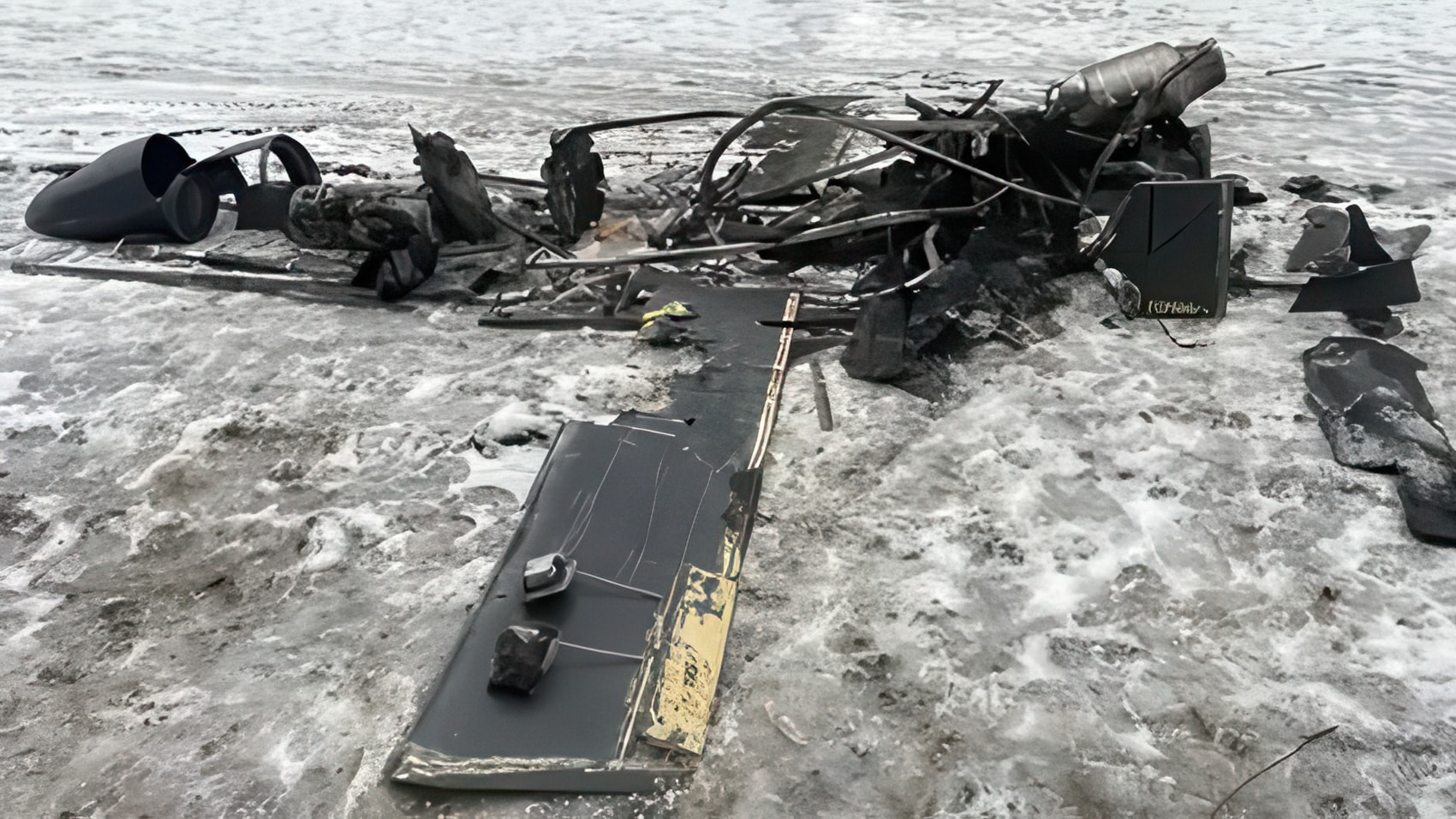
Wreckage of a crashed jet-powered Geran on snow and ice. A straight wing and a vertical tail section are still recognizable.
ROLE AND COMBAT USE
The Geran-5 can be shot down. That is not the issue. The issue is cost and volume. It is cheap enough to launch in large numbers, and Ukraine's normal low-cost defenses — ordinary propeller interceptor drones, hand-held guns and unguided gun platforms — cannot handle it. Countering it then requires expensive conventional air-defense interceptors, the same class of missile used against much costlier cruise missiles. That exchange is the core of its role. [Site owner's assessment, with the figures below]
Guns. At 450–600 km/h, and often several kilometres up, it is out of reach of mobile machine-gun teams and other unguided gun platforms built for 180–200 km/h Shaheds flying low. That part of the cheap layer does not apply. Radar-guided guns of the Gepard type are a different case. [DOCUMENTED for the speed and height problem, DOU and IEEE]
Interceptor drones. The same is true of ordinary propeller interceptors, whose practical ceiling is about 450 km/h. [DOCUMENTED, BlueBird source via IEEE] They were the cheap answer to the Geran-2. They are not a practical answer to the Geran-5. Newer jet and sprint interceptors (STING S, P1-SUN, SPYS, and an SBU jet type) have had confirmed kills since September 2026, and more than 20 teams are working on the problem, but that effort is still emerging and still limited. [DOCUMENTED, multiple outlets] Until that layer is fielded in numbers, the practical counter remains conventional missiles.
Cost versus the Kh-101, and the pressure on SAMs. The useful comparison with the Kh-101 is cost, not a like-for-like substitution. The Geran-5 is estimated at about $115,000. [ESTIMATE, Kyiv Independent] Published estimates for a Kh-101 run from about $1.2–2 million upward, and some run much higher (Forbes Ukraine has used a figure as high as $13 million). On those figures the Geran-5 costs about a tenth of a Kh-101, or less. The pressure on the defender comes from volume. Jet Gerans are now about half of all Shaheds, and jet launches went from about 350 a month in June to about 2,800 in August. That is the volume that pulls on SAMs and fighters — a PAC-3 at more than $3 million, or a NASAMS interceptor at about $1 million. [ESTIMATE for the unit prices; the launch counts are as reported in the open sources below] Interceptor drones at $2,500–10,000 still win the exchange when they make the kill, which is why Ukraine is trying to field faster ones. Until they do, the expensive missiles have to take the shot.
Combat record so far. First published shoot-downs came on 19–23 September 2026: an SBU jet interceptor, Wild Hornets STING S, a WIY/Quantum SPYS sprint drone, and border guards. Brave1 says at least six counter-drone systems have confirmed kills. [DOCUMENTED, multiple outlets] The published interception rate is about 57–60% for jet Gerans as a class, against 85–95% for piston types. [DOCUMENTED, Zelensky; Air Force spokesman Ihnat; Reuters] There is no Geran-5-specific rate.
CAVEATS AND OPEN QUESTIONS
Almost all of the technical detail comes from Ukrainian intelligence (HUR) and from analysts and official entries that work from HUR teardowns. Independent confirmation of production numbers, cost and interception rates is thin. Several published figures conflict: length (6.5 m vs about 6 m), wingspan (3.2 m vs "up to 5.5 m"), range (950 km estimated vs about 1,000 km), ceiling (card, observed use, and other accounts), and the mesh-modem type (XK-F358 vs XK-F359). Where they conflict, this article gives the range and labels it.
There is no Geran-5-only production figure, no audited unit cost, and no Geran-5-specific interception rate. A Millerovo launch site remains unverified. A magnetometer on this model, a larger warhead claimed by Wild Hornets, and the later relocation of the engine inside the fuselage are unverified or estimated. The Su-25 air-launch and R-73 idea appears on the HUR page above as a concept, not as a confirmed method of use.
STATUS
As of November 2026: in serial production at Alabuga / Yelabuga with the Geran-4; in combat use against Ukraine since early January 2026, including in mixed salvos against cities and infrastructure; launch sites include Tsymbulova, which has been struck; first published shoot-downs in mid-September 2026; jet-Geran interception rates well below those for piston types; a faster interceptor-drone response is being built but is not yet the main defence.
IN ONE SENTENCE
The Герань-5 (Geran-5) is a jet-powered one-way attack drone built at Alabuga, with a cruise-missile airframe, a Chinese TF-TJ2000A turbojet, a roughly 90 kg warhead and a cruise speed of 450–600 km/h, first used in January 2026: cheap enough, next to a Kh-101, to be launched in volume, and too fast for ordinary propeller interceptors and unguided guns, so that countering it falls to expensive air-defense missiles.
RELATED
Geran-2 (Shahed-136): the piston predecessor. Kh-101 / Kh-102: the cruise missile it is cheaper than, and the optical-navigation comparison for Susanin. S8000 Banderol: another low-cost jet strike weapon. Kometa CRPA and Susanin AONS: the navigation fit. Kalibr.
SOURCES