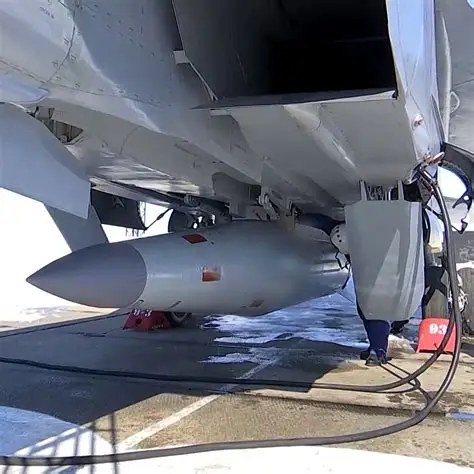
A Kinzhal on the centreline of a MiG-31K. Note the long, sharp nose cone.
A Kinzhal on the centreline of a MiG-31K. Note the long, sharp nose cone.
WHAT IT IS
The Kh-47M2 Kinzhal ("Dagger", factory designation 9-S-7760, complex 9-A-7660, NATO AS-24 Killjoy) is a Russian air-launched, solid-fuel aero-ballistic missile. It is carried by a modified high-speed aircraft, released at altitude and speed, and then flies on its own motor to the target. Russia markets it as "hypersonic". It was built by the Kolomna design bureau (KBM) with the Votkinsk plant, the same team behind the Iskander-M. This article is laid out differently from most on this site: it states what is actually confirmed, gives the site owner's analysis of how the missile must work, explains the physics behind it, and then examines each published claim one by one. Published sources on this weapon, Russian and Ukrainian alike, conflict heavily, so every figure is labelled.
WHAT IS CONFIRMED
SPECIFICATIONS (WITH CONFLICTS)
| Item | Figure | Conflict / note |
| Length | 7,175 mm; 8,000 mm with tail fairing (GUR) | Other estimates 7.2 m; CSIS gives 8.0 m without noting the fairing |
| Diameter | 920 mm (GUR) | CSIS 1.0 m; some estimates 1.2 m. 920 mm matches the Iskander |
| Launch mass | about 4.3 t | Estimate class, no official figure |
| Warhead | about 450-480 kg penetrating HE | GUR 450, CSIS 480, Russian media 500 |
| Nuclear option | yes, low yield | Published yields inconsistent (5-50 kt, 10-50 kt and higher) |
| Missile-only range | roughly 460-1,000 km | Russian 2,000-3,000 km figures include the carrier's radius |
| Speed | Russia: Mach 10 | Site owner's estimate Mach 5.5-8 maximum; see analysis |
| Accuracy (CEP) | Russia: 1 m | Single-source; see claims examined |
KINZHAL VS THE 9K720 ISKANDER
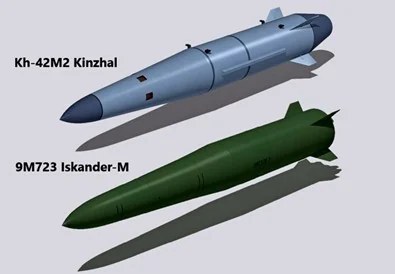
CGI comparison of the Kinzhal (top) and the 9M723 Iskander-M missile. The label "Kh-42M2" in the image is a typo for Kh-47M2. Note how much smoother the Kinzhal's body is.
The Kinzhal comes from the same design house as the 9K720 Iskander, shares its 920 mm diameter and its general layout, and is clearly part of the same family. But it is not simply an "air-launched Iskander". The motor is different, because it must light after release in thin air rather than on the ground. The body construction is different: as the site owner points out from the comparison above, the Kh-47's body is much smoother, without the Iskander's external fittings and fairings, which suits a missile that spends much longer at high speed and high heat. The tail and fairing are different, and the guidance requirements are different too.
Why use it at all? The site owner's argument is a simple one of cost and logic. A Kinzhal is more expensive than an Iskander, needs a specially modified MiG-31 and a full combat sortie, and Russia has far fewer of them. If it hit at the same roughly Mach 3.5 as a 9M723, there would be no reason to pay for any of that. The only reason the weapon makes sense is that it delivers more speed, more reach, or both, at the target.
THE SITE OWNER'S ANALYSIS
This section is the core of the article. It is the site owner's reasoning, built from the physics and from video footage, and it is labelled as such. Where it relies on observation rather than measurement, that is stated.
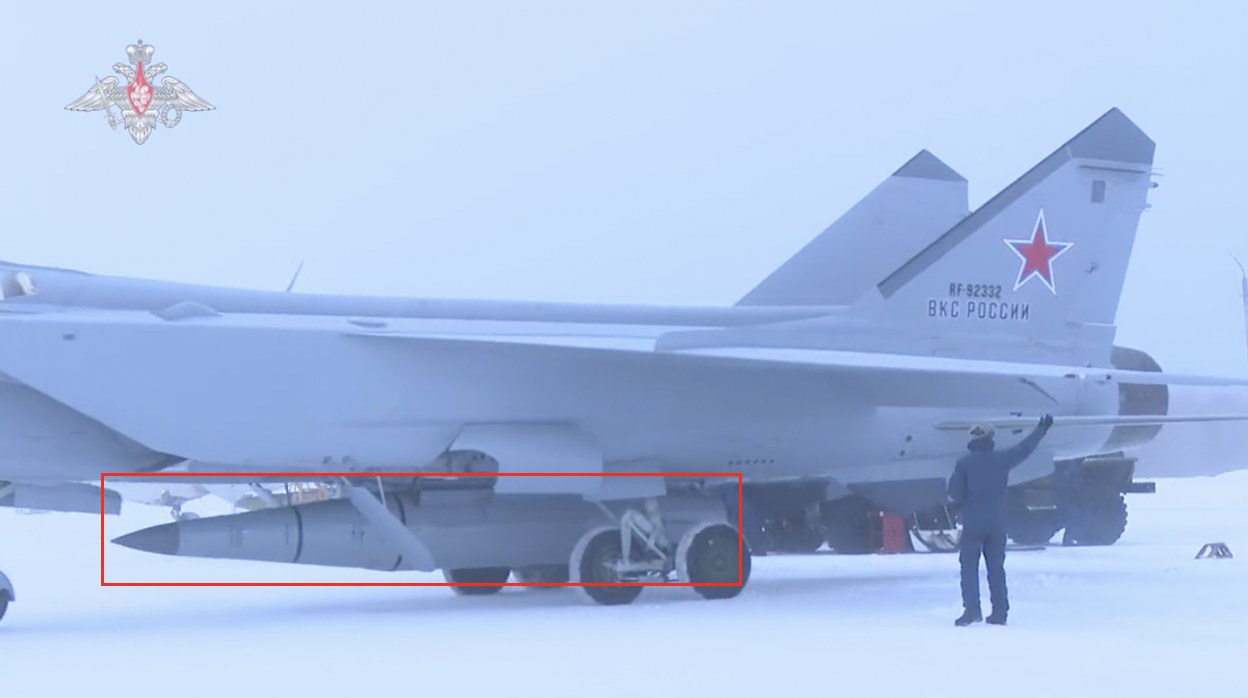
MiG-31K RF-92332 carrying a Kinzhal. Still: Russian MoD.
1. Launch. The missile is released at high altitude and high speed. In Russian launch footage it drops clear of the MiG-31 first, and only then does the motor ignite. That is standard practice to protect the carrier from the motor plume. It then accelerates away in roughly level flight. No immediate climb is seen in the launch video. The carrier's height and speed act as a free first stage: the missile starts already supersonic and above most of the atmosphere's density.
2. Three videos. The site owner bases much of the analysis on three pieces of footage: - (a) The launch: drop, ignition, then acceleration away in level flight from a high-altitude MiG-31. - (b) A ground video of a pass: filmed toward the horizon, so a wide area is in frame. The missile passes at roughly 2,000 ft in level flight with plasma visible around it, and is gone from the whole frame "like a flash of lightning". It does not hit anything in the shot. The sonic boom arrives only after it has already left the frame: it is outrunning its own sound by a large margin. - (c) A strike: the missile comes in steeply and is too fast to see at all, even with the video slowed down. Catching it would take a very high frame rate camera.
3. Plasma in level flight means true hypersonic speed. At Mach 3.5 the air around a missile heats up strongly, but it does not ionise enough to glow as visible plasma. A visible sheath generally takes roughly Mach 5 or more, and in dense low-altitude air the effect appears earlier and brighter because there is more air to heat. A sustained plasma glow in level flight at about 2,000 ft therefore means the missile was well into the hypersonic range at low altitude, not just in a brief ballistic plunge. For comparison, the Iskander only sometimes shows plasma, in its terminal dive.
4. Flexible profiles. The three videos look contradictory at first. Video (b) suggests a hypersonic cruise missile; video (c) suggests a ballistic missile. The site owner's reading is that both are true: the evidence fits a maneuvering aero-ballistic missile with flexible profiles, able to fly high and fast, run low and level, and finish with a steep terminal dive, depending on target and defences. That also explains why published sources describe it in such conflicting ways: each has seen a different profile.
5. How fast, really? Russia claims Mach 10. The site owner considers that overstated and puts the realistic maximum at roughly Mach 5.5 to 8, as a physics-based estimate. The reasoning: a single-stage solid motor in a missile of only about 4.3 t total cannot carry enough propellant to reach and sustain Mach 10 for long, especially while flying in the atmosphere where drag and heating are severe. Compare the A-235 (Nudol) interceptor, the fastest missile of its kind: to get its extreme acceleration it is massive and extremely slender, like a spear, with most of its mass given over to propellant. The Kinzhal is short, thick at 920 mm, and carries a 450-480 kg warhead. It may briefly touch higher figures high up in thin air, but a sustained Mach 10 does not fit its size. The visible plasma at low level shows it is above Mach 5; the motor size suggests it is well below a sustained Mach 10.
6. Impact speed. The site owner compares Kinzhal impacts with known 9K720 hits, which arrive at roughly Mach 3.5. The Kinzhal strikes look clearly different: the approach is effectively invisible and the impacts more violent. That points to a much higher terminal speed than the Mach 3.5-4.5 figures quoted in intercept reporting. This is a field comparison, not a measurement.
7. Guidance: INS the whole way. If the missile stays hypersonic for essentially the whole flight, then the plasma sheath (explained below) blocks satellite reception, datalinks and any radar seeker for most or all of that flight. What remains is the inertial navigation system. The site owner's view is that it is most likely INS the whole way. Air launch helps: the MiG-31's own navigation system can hand the missile a very precise position, velocity and heading at release, so the INS starts from an excellent fix and only has to hold it for a few minutes of flight. Terrain matching (TERCOM) is ruled out: it needs a low, level path over readable terrain for long enough to correlate, and the Kinzhal's high, fast, steep profile does not allow that.
Satellite navigation and radar guidance face the same wall. GPS and GLONASS signals are extremely weak, about -130 dBm at the Earth's surface, below the background noise, and the plasma sheath attenuates and reflects radio energy, so the receiver simply cannot hear them. The antenna windows are also being heated and ablated, which degrades them further. Even if a signal got through, the Doppler shift and heavy acceleration of a hypersonic, manoeuvring body put extreme stress on the receiver's tracking loops, and the airspace over Ukraine is heavily jammed anyway. An active radar seeker has the same problem in reverse: it cannot see out through the plasma, and its radome is heating up the whole time. Any midcourse datalink, or command guidance from a ground radar, is blocked by the same sheath. In the site owner's view, satellite or radar updates could only work briefly, and only if the missile slows down enough near the end for the plasma to clear; otherwise the INS is on its own.
8. Accuracy. A 1 m CEP does not fit INS-only guidance. That is like hitting a front door from hundreds of kilometres with no outside correction. Realistic INS-only accuracy is meters to tens of meters. Two other things fit this: GUR reported in October 2026 that Russia cut Kinzhal orders in favour of the Iskander, citing accuracy (a GUR claim), and Kinzhal strikes are reported far less often now. The site owner's assessment is that the Kinzhal is a speed weapon for large and hardened targets, built to be very hard to intercept, not a precision weapon.
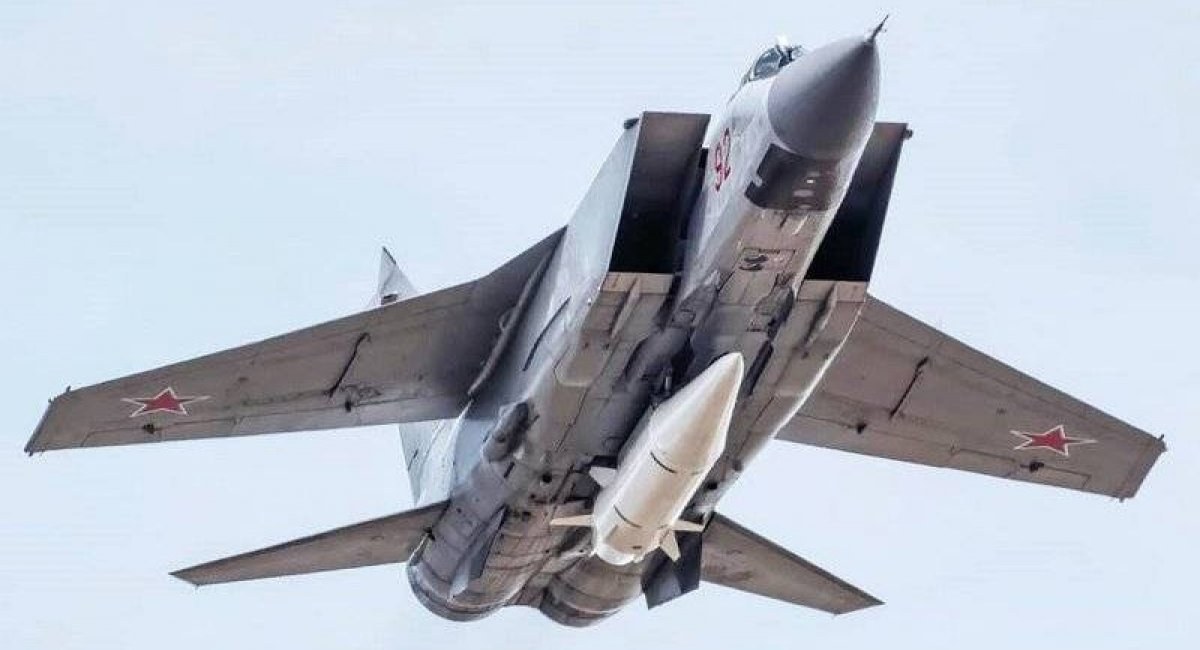
MiG-31K "92" in flight with a Kinzhal.
THE PLASMA SHEATH, EXPLAINED
How it forms. At hypersonic speed the air in front of the missile cannot get out of the way. It piles up into a shock wave, and the air passing through it is compressed and heated almost instantly to thousands of degrees. Above roughly 2,000-3,000 K oxygen and nitrogen molecules start to break apart; higher still, electrons are knocked loose from atoms and molecules. The result is a thin layer of partly ionised gas, a plasma, wrapped around the body. The faster the missile and the denser the air, the hotter the layer and the more free electrons it holds.
Electron density and the plasma frequency. A plasma has a natural "plasma frequency" set by its electron density: roughly f(Hz) = 8.98 x sqrt(n), with n in electrons per cubic metre. Radio waves below that frequency cannot pass through; they are reflected. Waves somewhat above it pass but are attenuated, especially when the gas is dense and the electrons collide often. Re-entry sheaths reach 10^17-10^19 electrons per cubic metre, which gives plasma frequencies from about 3 GHz to almost 30 GHz. That covers GPS/GLONASS (about 1.2-1.6 GHz), most datalinks and most radar seeker bands.
Why the nose is the worst place. The nose meets the air head-on. At the stagnation point the air is brought almost to rest, so nearly all its kinetic energy becomes heat. That is where the gas is hottest and electron density highest. A sharp nose makes the shock layer thinner than a blunt one would, but it is still the worst place on the body for a radio window. Real hypersonic vehicles that need antennas place them on the aft or sheltered sides, where the sheath is thinner. A forward-looking radar seeker sits exactly where conditions are worst.
Communications blackout. The classic example is spacecraft re-entry: Apollo and the Space Shuttle lost radio contact for minutes during the hottest part of re-entry. The same physics applies to any vehicle flying fast enough in the atmosphere. For the Kinzhal it means no reliable satellite navigation fixes, no datalink updates from the carrier or the ground, and no radar seeker picture while the sheath is dense. Lower frequencies are blocked first; very high frequencies get through more easily but are still weakened. Satellite navigation such as GLONASS, even with an anti-jam antenna like the Kometa, cannot receive what does not reach it.
Effects on radar. Plasma does not make the missile invisible. Published electromagnetic modelling shows the effect is frequency-dependent. At some frequencies the plasma absorbs or scatters the radar energy and the return is weakened; at others the plasma is itself a reflector, larger than the missile, and the return grows and smears. The return can fluctuate and shift as the sheath changes with speed, altitude and manoeuvres. For a ground radar the real problem is not detecting something, but getting a clean, focused, stable track precise enough to guide an interceptor, and that is made worse by the speed and the steep dive. See also over-the-horizon radar.
Space-based infrared. The hot plasma and the heated airframe produce a huge heat signature, much brighter than an ordinary missile in cruise. Early-warning satellites built to see rocket launches in infrared can see this kind of target well. That makes space-based infrared the most reliable way to detect and follow the Kinzhal, even though it does not by itself provide a fire-control track.
CLAIMS EXAMINED
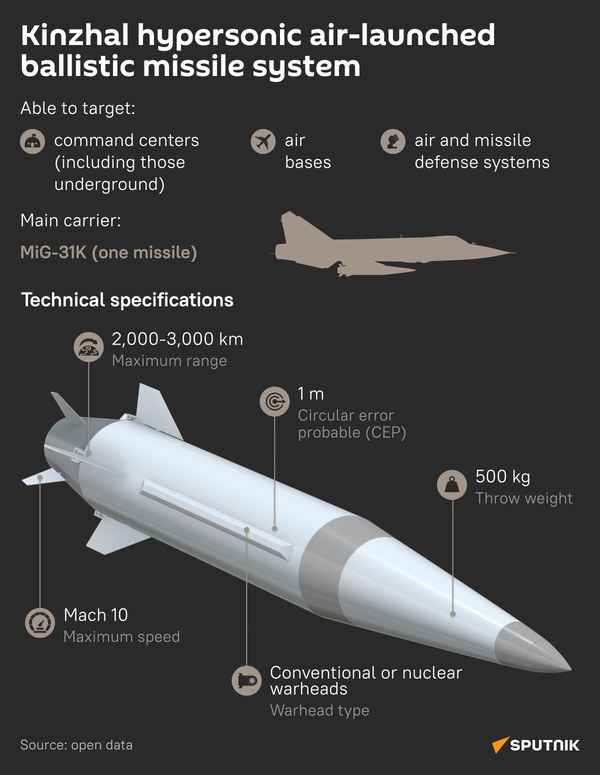
The source of the widely repeated 1 m CEP, Mach 10 and 2,000-3,000 km figures. Infographic: Sputnik.
Sputnik / Russian media. Claim: 1 m CEP, Mach 10, 2,000-3,000 km range, from "open data". Evidence: no test data or official technical sheet backs any of these; the 1 m figure traces to Zvezda and is single-source. The range includes the carrier's combat radius; the missile alone is reported at roughly 460-1,000 km. Assessment: the range is a system figure, not a missile figure. The speed is a peak claim the site owner considers overstated (Mach 5.5-8 realistic maximum). The 1 m CEP does not fit an INS-guided missile that stays hypersonic.
GUR (Ukrainian Defence Intelligence). Claim: about 90% commonality with the Iskander's 9M723; a U508 active radar seeker by NPP Radar MMS; Kometa satellite navigation; a peak altitude of up to 100 km. Evidence: GUR has wreckage and published a component list. Assessment: the shared lineage is real, but "90%" sits awkwardly with the differences in motor, body and guidance needs noted above. Kometa hardware may well be fitted, but it can only work while the plasma is thin. A seeker in the parts list does not show it works through the plasma, and the photos published do not show one (below). A 100 km peak would be a near-ballistic profile, which conflicts with the level-flight footage, unless it is one of several profiles.
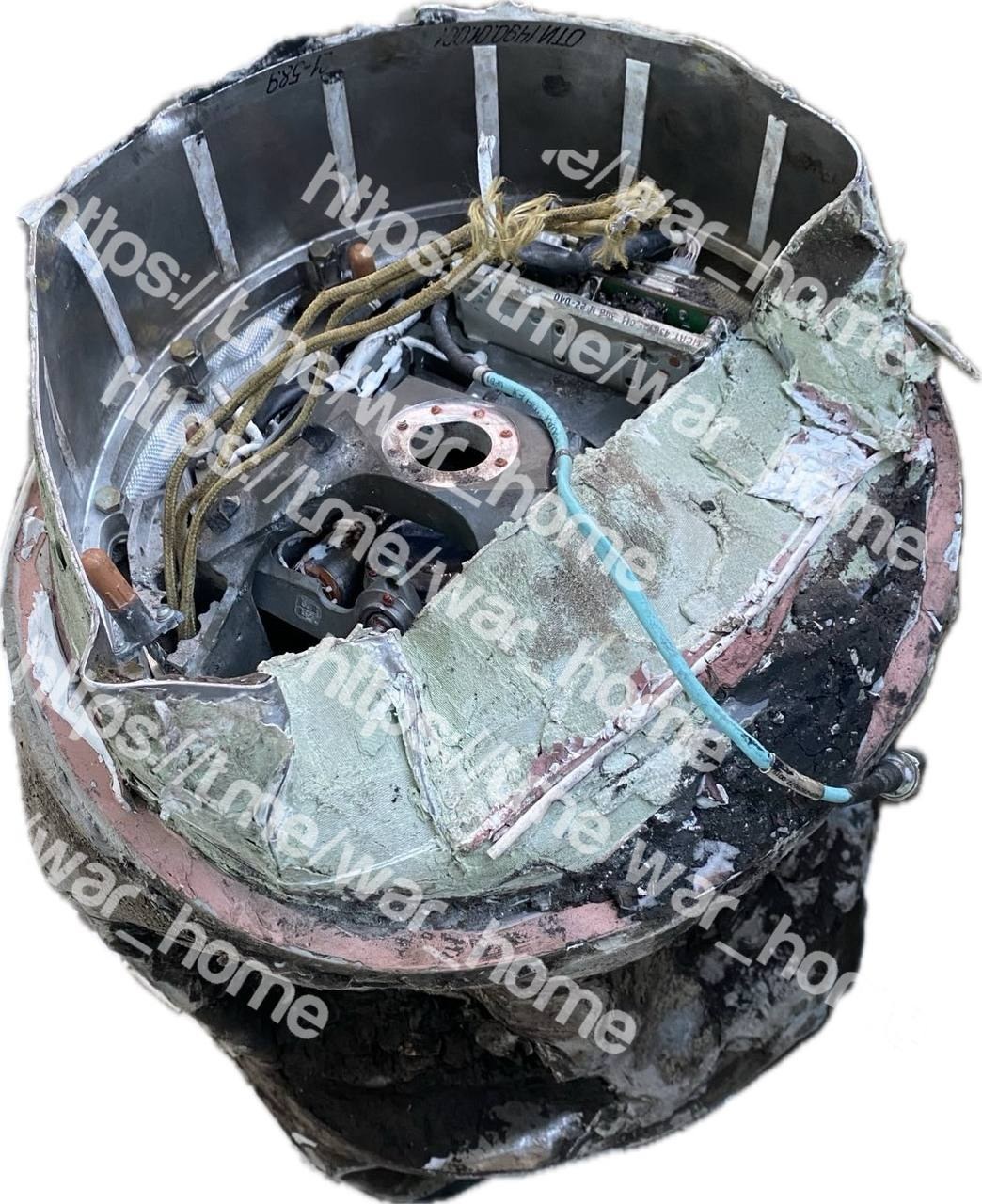
Claimed nose section with radar head, photo via war_home Telegram, as published by Defense Express.
Defense Express photos (January 2024). - The piece labelled "nose part with active radar homing head" is an open, flat-topped equipment-bay ring with a flange: a thin shell with stiffeners, insulation, wiring and a machined block. It is not a radome and has no cone or point. - The bullet-shaped, hardened steel piece shown is the penetrator warhead. It is too small and too blunt to be the nose of a missile whose nose is long and sharp (see the photo at the top). - No radiolucent (radar-transparent) cone and no antenna dish or array appear in any of the photos. - The article itself states the seeker is the same as the Iskander's 9B918 only "with high chance of probability". That is an inference, not a find. - The Iskander itself does not fly with a radar seeker in practice; its options are INS, satellite correction and an optical scene-matching head. Even GUR calls its radar seeker "on paper only". - With the warhead sitting just behind the sharp nose, there is little room for a radar head, and the nose is exactly where the plasma is worst. Assessment: the photos do not show a radar seeker. A seeker is claimed, not demonstrated.
The designation. "Kh-47M2" is a label used by the press and officials; the factory designation is 9-S-7760. No earlier Kh-47, "M" or "M1" missile is publicly known, so the "M2" suffix does not point to any known predecessor. Assessment: treat Kh-47M2 as a name, not as evidence of a development lineage.
Intercepts. Claim: on 4 May 2023 a MIM-104 Patriot shot down a Kinzhal over the Kyiv region; the Pentagon confirmed it on 9 May 2023, and Ukraine has since claimed many more. Evidence: the confirmation relied on Ukrainian reporting; the fragments shown have not been independently verified as a Kh-47, and some Russian media said they were bomb parts. The PAC-3 chain, step by step: - The MPQ-53/65 ground radar must build a fire-control track. Against a plasma-sheathed target the return is distorted and unstable. - The battery must launch into a tiny engagement window: a target diving at well above Mach 5 crosses the whole defended area in seconds. - In the last seconds the PAC-3's own Ka-band seeker must lock on and steer to a direct hit-to-kill, looking at or through the same plasma, at an enormous closing speed with almost no time to correct. - Patriot already struggles with the 9K720 at about Mach 3.5, on speed alone. The Kinzhal adds more speed and the plasma. Assessment: an intercept is plausible and possible, but very hard, and every step must go right at once. No wreckage has been verified as a Kh-47 and the claimed photos cannot be confirmed. Claimed tallies should be read as claims.
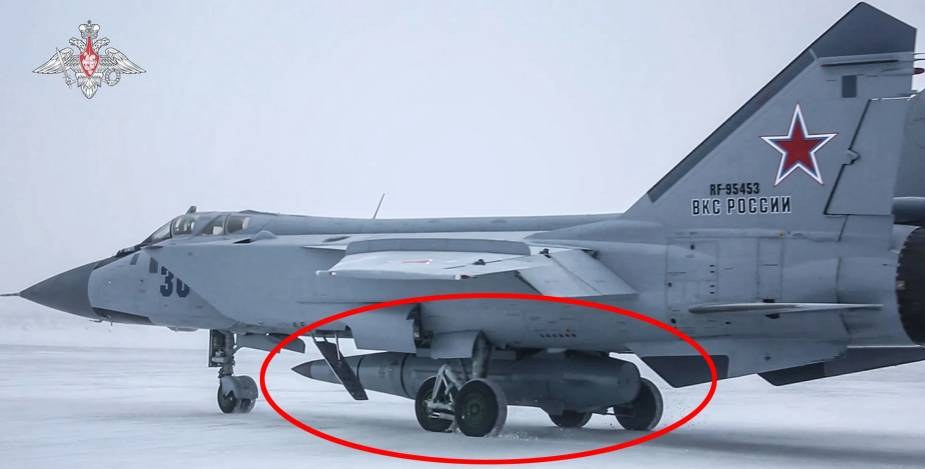
MiG-31K RF-95453 taxiing with a Kinzhal. Still: Russian MoD.
COMBAT HISTORY
IN ONE SENTENCE
The Kinzhal is an air-launched aero-ballistic missile from the Iskander's design house that, on the evidence of the footage and the physics, flies hypersonic and largely blind inside its own plasma on inertial guidance, making it a very hard to intercept speed weapon for large targets rather than the 1 m precision weapon of the headlines.
RELATED
MiG-31: the carrier. Iskander: the land-based relative. Avangard: a true hypersonic glide vehicle. A-235 Nudol: the speed comparison. Tu-160, Patriot, INS, TERCOM, GLONASS, Kometa and over-the-horizon radar.
SOURCES