OVERVIEW
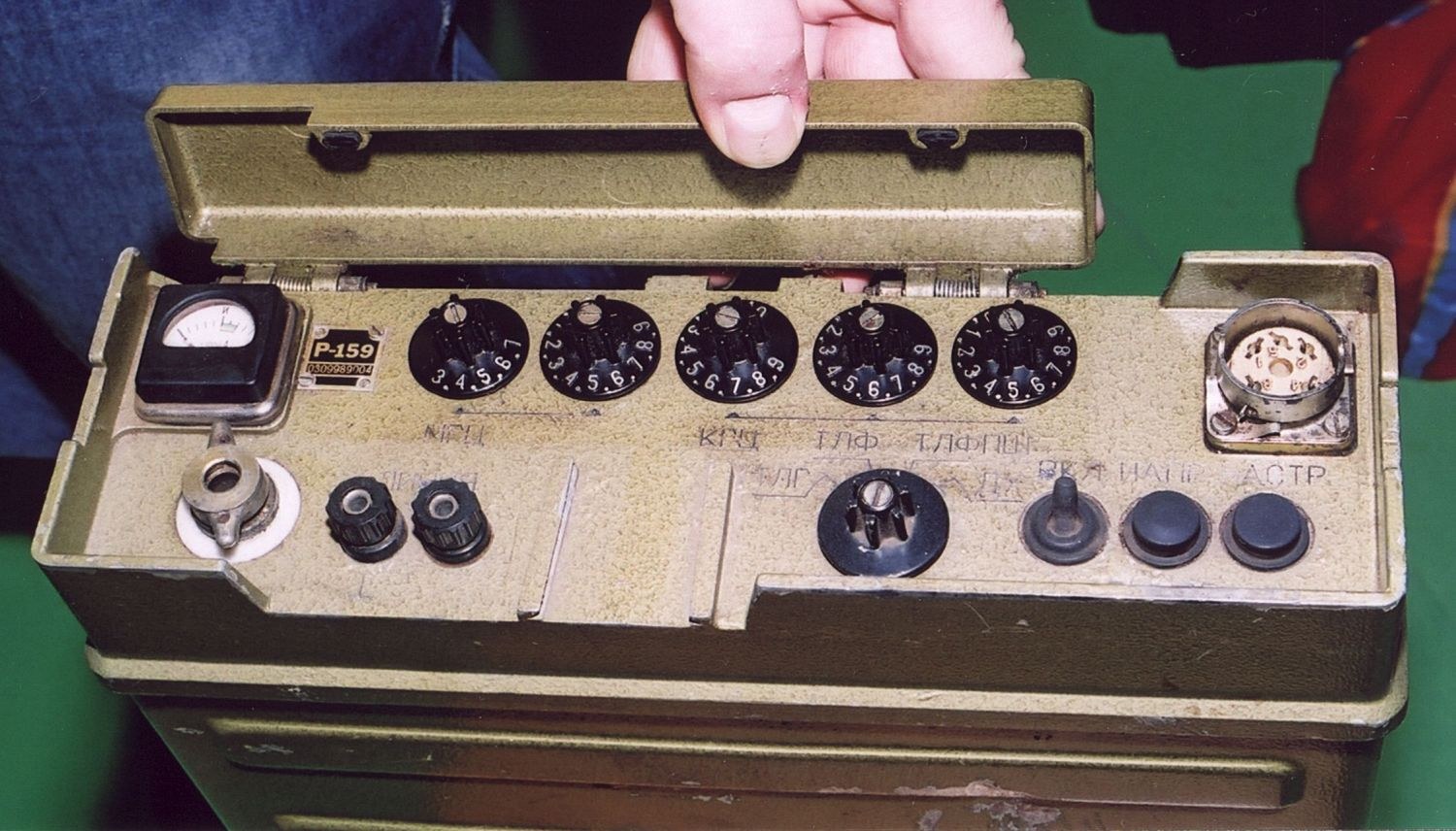
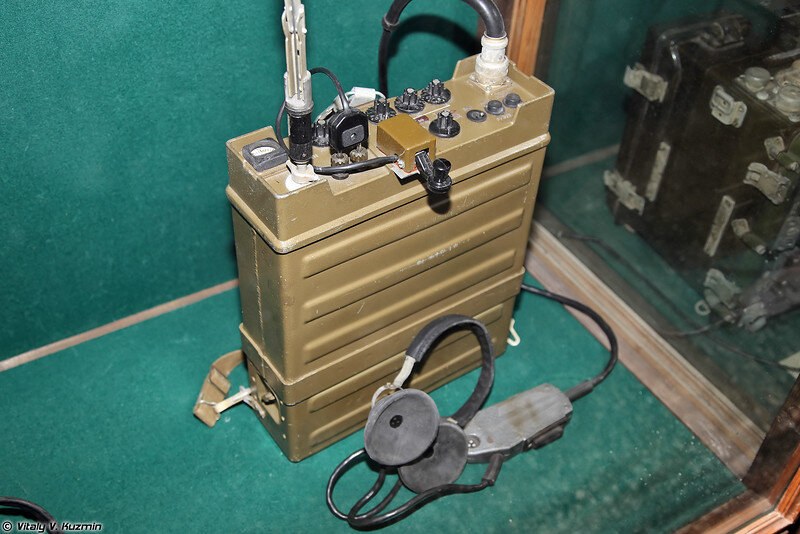
The R-159 is a Soviet and Russian manpack VHF FM radio for telephony and telegraphy at company and battalion level. Signal units also use it as an order-wire set. The R-423-2A Brig tropo kit, for example, lists an R-159 for this purpose. [DOCUMENTED]
SPECIFICATIONS
These figures come from training material and amateur references:
- Frequency range: 30 to 75.999 MHz on a 1 kHz raster, giving 46,000 working frequencies. - Power: 5 W at 30–60 MHz and 4.5 W at 60–75.999 MHz. - Supply: 12 V. - Weight: working set up to 14.5 kg.
[DOCUMENTED]
R-159M
The R-159M adds a 16 kbit/s digital mode. It works with the T-240S and T-235N secure equipment and with the R-168MTs. [SINGLE-SOURCE]
PLACE IN THE FAMILY
The R-159 shares the 30–76 MHz band and 1 kHz raster of the R-173 vehicle set, so the two can work together. [DOCUMENTED]
The R-168 Akveduk family is generally described as replacing both in modernised units. [UNVERIFIED]
DESIGN
The R-159 is a transistorised transceiver. [SINGLE-SOURCE] (Saratov State Technical University museum page.)
- Synthesiser: a single-loop phase-locked synthesiser (193IE3 and 564IE15 chips). The rotary switches set the divider ratio directly. - Receiver: a double-conversion superheterodyne with IFs of 11.5 and 1.5 MHz. Adjacent-channel selectivity comes from an FP2P-307 filter of 18 kHz at the first IF. - Squelch: works on the upper part of the audio spectrum after the FM detector. It deliberately does not mute the audio completely, so that weak stations are not missed on standby. - Transmitter: a separate exciter locked to the synthesiser, a single-ended class C output stage and automatic output-level control. - Antenna tuner: an automatic pi-network with two variable capacitors. The operator holds one button until tuning finishes.
[SINGLE-SOURCE] (SSTU museum.) That page gives the band as 30–75.975 MHz and the power as 5/10 W, against 30–75.999 MHz and 5 W in the technical description. Sources conflict.
TECHNICAL DESCRIPTION
The technical description (series 05) defines the R-159 as a wideband backpack VHF FM transceiver for simplex telephony and telegraphy, with narrow-band telegraph, tone call and remote control. Switches plus automatic antenna tuning let it enter communication in 20–30 seconds, without search. [DOCUMENTED]
- Modes: ТЛФ (telephony), ТЛФ ПШ (telephony with squelch), ТЛГ (telegraph, with the key on the ЛИНИЯ terminals) and ДУ (remote control from a TA-57 telephone over up to 500 m of field cable). - Battery: a 10NKP-8 (or 10NKP-10) 12 V battery gives 9 (10.5) hours at a 5:1 receive-to-transmit ratio. Current is up to 0.35 A on receive and 3.0 A on transmit. - Vehicle use: with the УНЧ audio amplifier it works from the cab of UAZ-469, GAZ-66 and ZIL-131 trucks on 12 V, drawing up to 1.2 A on receive and 4.5 A on transmit. - Environment: −40 to +50 °C, rainproof, vibration up to 80 Hz, and air-droppable by parachute in a GK-30 container. It works while carried or in a vehicle at up to 60 km/h. - Accuracy and size: frequency error within ±1 kHz. The set measures up to 305 × 180 × 410 mm (365 × 230 × 430 mm with the УНЧ). The working set is 14.5 kg (19 kg with the УНЧ), and the full delivery set 50 kg (55 kg). - Sensitivity: 1.0 µV on telephony and 0.4 µV on telegraph. Other training texts and an amateur reference give 1.2 and 0.6 µV. Sources conflict.
[DOCUMENTED] (R-159 technical description, series 05; BSUIR textbook, 2020.)
RANGE TABLE
Guaranteed ranges over average terrain, in km, for telephony and telegraph. The first pair is for 30–49.999 MHz, the second for 50–75.999 MHz:
- 1.5 m whip: 12 / 18; 10 / 15. - 2.7 m whip (1.5 m plus six 0.2 m sections): 18 / 25; 12 / 20. - 40 m travelling-wave wire at 1 m, aimed at the other station: 35 / 50; 30 / 40. - 2.7 m whip, remote-controlled through a TA-57: 18; 12 (telephony only). - With the УНЧ on a 1.5 m whip, in a screened vehicle at up to 60 km/h: 10; 8. - Flexible 1.5 m antenna: 3; 2.5.
[DOCUMENTED] (BSUIR textbook, 2020.)
R-159M
One training text describes a lighter set, probably the R-159M: a 10NKP-10 battery or two 10NKGTs-3.5 batteries, an 11.7 kg working set, and shorter typical ranges of 10, 12 and 30 km. [SINGLE-SOURCE] (studfile.)
SERVICE AND COMBAT USE
- Adoption: adopted by the Soviet Army in 1983. [SINGLE-SOURCE] (rw6ase.narod.ru.) - Afghanistan: a 2017 Russian study names the R-148, R-157, R-158 and R-159 as the manpack sets in wide use in motor-rifle company and battalion nets. It says the R-159 also served in the radio nodes of mobile command posts and in command and command-staff vehicles. [DOCUMENTED] (Gumanitarnye nauchnye issledovaniya, 2017.) The same study gives remote control at up to 6 km over P-274M cable, against 500 m in the manual. Sources conflict. - After 1991: the same study says photos and videos show these sets in conflicts in Ukraine, Abkhazia, North Ossetia and Transnistria. [SINGLE-SOURCE] - Ukraine since 2022: Armada International lists the R-159 among the legacy radios used by Russian land forces, alongside the R-123. Ukrainian sources say the mix of old and new radios lacks a common secure waveform, so traffic often goes in clear. [SINGLE-SOURCE] (Armada International, 8 Jun 2023.)
SETTING UP (R-159M)
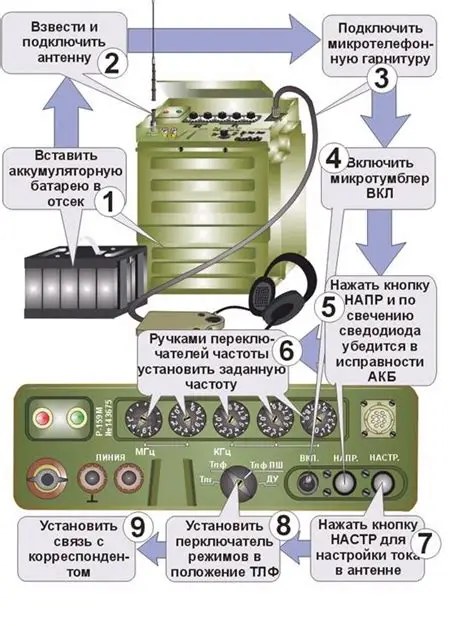
The steps below are translated from the Russian setup diagram for the R-159M. [DOCUMENTED]
RELATED PAGES
R-173
R-168 Akveduk
R-423 Brig
R-163 Arbalet
Radio section