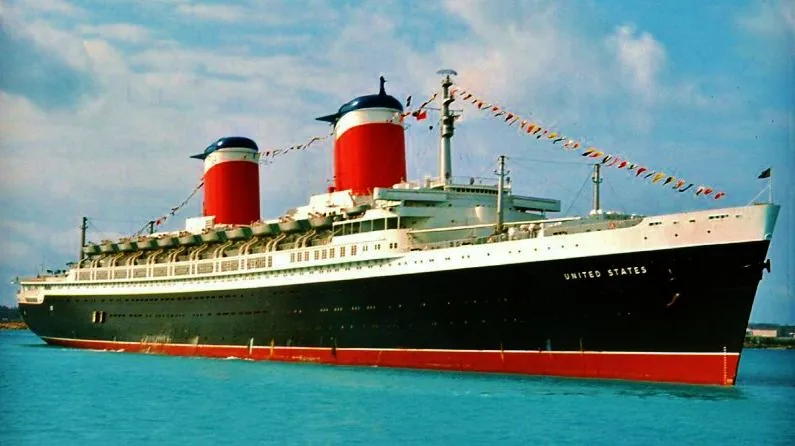
The SS United States in service, dressed in signal flags, in calm water. Period photograph.
The SS United States in service, dressed in signal flags, in calm water. Period photograph.
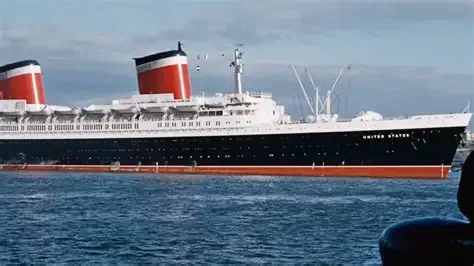
The ship in service, photographed from the water, with the name visible on the bow. Period photograph.
WHAT IT IS
The SS United States was the fastest ocean liner ever built, and the largest passenger ship ever constructed in the United States. Designed by William Francis Gibbs of Gibbs & Cox and built at the Newport News Shipbuilding and Dry Dock Company in Virginia, she entered transatlantic service for United States Lines in 1952 and left it in November 1969. On her maiden voyage she took the Blue Riband from Cunard's Queen Mary in both directions. Those liner records still stand. [DOCUMENTED, HAER PA-647; SS United States Conservancy]
She was never only a liner. The U.S. Navy and the Maritime Administration paid the larger share of her cost so that she could be converted, quickly, into a troopship: a fast naval auxiliary able to carry more than 13,000 troops about 10,000 nautical miles without refueling, with a beam narrow enough to transit the Panama Canal. In commercial service she was a three-class express liner on the New York to Le Havre and Southampton run, with occasional calls at Bremerhaven and, later, some winter cruises. [DOCUMENTED, HAER; MARAD]
The ship was 990 feet long overall, with a welded steel hull and an aluminum superstructure, four screws, and a high-pressure steam plant rated at 240,000 shaft horsepower (247,785 shp on trials). Her design-draft displacement was 45,400 long tons; at maximum draft she displaced 47,264 long tons. Her gross tonnage, a volume measure, not a weight, was 53,329. [DOCUMENTED, HAER PA-647] Those figures are unpacked, and compared with other ships, in the tables below.
This page covers her design, what made her special, her service life from 1952 to 1969, the long afterlife of sales, gutting and layup, and her final use as an artificial reef off Okaloosa County, Florida. The controlled scuttling was scheduled for the afternoon of 11 November 2026 (Veterans Day), having been moved up one day because of weather. The state of that operation, as of the afternoon of 11 November 2026, is set out carefully in the final section. A note from the site owner, at the end of that section, records the view that she should have been saved and kept in government service.
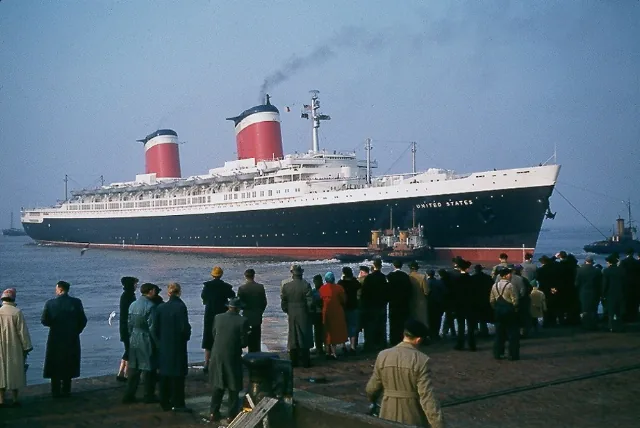
A crowd on the pier watches the SS United States, with tugs at the bow and smoke from the forward funnel. Period photograph.
DESIGN
William Francis Gibbs and Gibbs & Cox. The ship was the life's work of William Francis Gibbs (1886–1967), a self-taught naval architect who headed Gibbs & Cox of New York, then the world's largest naval-architecture firm and the leading designer of U.S. Navy warships and high-pressure steam plants. Gibbs had wanted a record-breaking American superliner since before the First World War. He converted the seized German liner Vaterland into the Leviathan for United States Lines, designed the liner America (launched on the day Germany invaded Poland), and during the Second World War produced the Liberty-ship design that was mass-built for the Allied sealift. After the war, United States Lines needed a running mate for America, and the U.S. government wanted a liner that could be taken up as a troopship, as the Cunard Queens had been in 1939–45. Those needs finally paid for the ship Gibbs had been drawing for decades. [DOCUMENTED, HAER; Conservancy history]
United States Lines had commissioned preliminary studies as early as 1943, with further design work from March 1946. The contract for Design 12202 / MARAD type P6-S4-DS1, yard hull 488, was awarded in 1949. The keel was laid on 8 February 1950 in a graving dock at Newport News — the first major liner built that way, which both sped construction and kept the hull form out of public view. She was christened on 23 June 1951 and delivered on 20 June 1952. More than 3,100 shipyard workers, and more than 800 firms from at least 28 states, contributed. Gibbs & Cox and the yard later said the technical effort exceeded that for any previous ship of any type. [DOCUMENTED, HAER]
Navy-funded troopship convertibility. The total price recorded by HAER was $77.7 million in then-year dollars. A national-defense-features subsidy of $26.3 million (33.8 percent) covered the Navy's share. A construction-differential subsidy of $18.6 million (23.9 percent) came from the Maritime Administration. United States Lines paid $32.8 million (42.2 percent). During her seventeen years in service, MARAD also paid an operating-differential subsidy of about $6.3 to $10.2 million a year. [DOCUMENTED, HAER] Other published totals differ slightly (about $71.8 to $79 million appears in secondary accounts). The HAER breakdown is the one used here. [CONTESTED as to the exact headline total in popular sources]
The defense features were not a paper exercise. The ship had two separate boiler rooms and two independent engine rooms, so that she could still steam if one plant was disabled. Compartmentation and watertight doors followed U.S. Navy standards, with watertight doors carried up to "A" deck. The beam, 101 feet 6 inches molded, was set so that she could pass through the Panama Canal locks with a small clearance. Fuel-oil tankage and fresh-water generating capacity were sized for a 10,000-nautical-mile run, which HAER notes was about 67 percent more range than the commercial service required. Theoretical troop capacity is given by HAER as 13,035, or 13,864 if the ship's crew is counted with the troops. MARAD and the Conservancy commonly round this to about 14,000 troops, plus a 400-bed hospital in the MARAD description. [DOCUMENTED, HAER; MARAD for the hospital and the 14,000-troop figure] She was never actually converted or used as a troopship.
Hull form. The hull is long and relatively narrow, with a straight, raking stem, a slightly bulbous bow, a cruiser stern, and a long, fine entrance and run: a form drawn for high speed with decent seakeeping, not for maximum passenger volume. The hull itself is welded steel, not riveted, which reduced drag and weight. The underwater hull form, and the ship's true top speed, were treated as defense secrets during construction and early service; the Navy declassified them in August 1968, a year after Gibbs's death. [DOCUMENTED, HAER] There are twelve decks, eight in the hull and four in the superstructure. The profile is dominated by two large, raking, teardrop-section funnels, a radar mast just aft of the wheelhouse, and king posts for the cargo, baggage and mail holds.
Aluminum superstructure and fireproofing. The superstructure and the giant funnels were built of aluminum alloy, about 1,400 long tons of it, with about 600 more tons used for furniture, doors, ducts, lifeboats, railings and fittings. HAER and the Conservancy both record that more aluminum went into the United States than had been used in any previous vessel or building. MARAD estimates the light-metal work saved about 8,000 to 10,000 tons compared with a steel superstructure, lowered the center of gravity, and improved stability. Where aluminum met steel, an insulating layer had to be used to stop galvanic corrosion; Ships Monthly records that DuPont PAW tape was selected after tests. [DOCUMENTED, HAER and MARAD for the aluminum and the weight saving; SINGLE-SOURCE, Ships Monthly, for the tape]
Gibbs was obsessed with fire at sea, having helped write stricter U.S. fire rules in the 1930s after a series of liner fires. Wood was banned except in a short list of places HAER records: the two butcher's blocks in the galleys, the eleven pianos, the bilge keels, the propeller-shaft bearings, and the salt and pepper mills in the dining saloons. (High chairs, bassinets and bed lee-boards later added a little more wood.) Five hundred thousand square feet of Marinite asbestos-containing panels partitioned the interior. Decor was in glass, metal, ceramics, synthetic fabrics and rubber flooring. Gibbs tried to have Steinway build an aluminum piano; the firm refused, insisting a standard mahogany instrument would not burn. The popular Conservancy account is that a Steinway was doused with gasoline and set alight as a demonstration, and did not continue to burn once the gasoline was gone. HAER confirms the Steinway refusal but does not itself narrate the gasoline test. [DOCUMENTED, HAER, for the wood ban, Marinite, and the Steinway refusal; SINGLE-SOURCE, Conservancy, for the gasoline test] About 15,500 pieces of custom furniture were built, all with non-flammable upholstery. The interiors were designed by Smyth, Urquhart & Marckwald, with the architects Eggers & Higgins laying out the spaces, and a decorative-art program organized by Hildreth Meiere and Austin Purves Jr. The first-class observation lounge received, among other works, a gold-leaf map of the Atlantic — a mural that appears in one of the period photographs below.
POWER PLANT AND PROPULSION
The plant was a compact, high-pressure, high-temperature steam installation derived from contemporary U.S. Navy aircraft-carrier practice. HAER records eight oil-fired boilers of Babcock & Wilcox type, ten burners each, split between two boiler rooms: the forward boilers built by Babcock & Wilcox, the after boilers by Foster Wheeler. They were designed for 1,000 psig and 1,000°F at the superheater outlet, but were run in service at 950 psig and 965°F to reduce superheater maintenance. (Some secondary accounts give 925 psi and 975°F; those figures are close to the service condition but do not match the HAER design and service numbers, which are used here.) [DOCUMENTED, HAER; CONTESTED in secondary sources]
Four Westinghouse double-reduction geared steam-turbine sets, in two independent engine rooms, drove four shafts. Rated maximum continuous power was 240,000 shp; normal service rating 158,000 shp; maximum power recorded on trials 247,785 shp. The forward engine room drove the outboard, four-bladed propellers; the after engine room drove the inboard, five-bladed propellers. The mixed four- and five-blade arrangement was intended to cut vibration and cavitation. Secondary accounts name Elaine Scholley Kaplan as the propulsion engineer who worked out that propeller combination, and give the propeller diameter as 18 feet. [DOCUMENTED, HAER, for the plant layout, makers, power ratings and the 4- and 5-blade arrangement; SINGLE-SOURCE chain, Ships Monthly and Chatham Marconi, for Kaplan and the 18-foot diameter] Electrical power came from six 1,500 kW General Electric turbo-generators. Four York air-conditioning machines and Griscom Russell distillers (three units, each 250 tons of water a day, in the forward auxiliary room, with similar gear aft) supported hotel load and the long troopship range.
Bunker capacity was 10,306 long tons of fuel oil. Range at 35 knots was 10,000 nautical miles. Service speed, in the HAER characteristics, was 33 knots; her lifetime average in revenue service was 30 knots. On official trials she reached 38.32 knots. [DOCUMENTED, HAER] Popular claims of a 42- or 43-knot top speed, and of a 268,000-horsepower plant, are discussed in the next section.
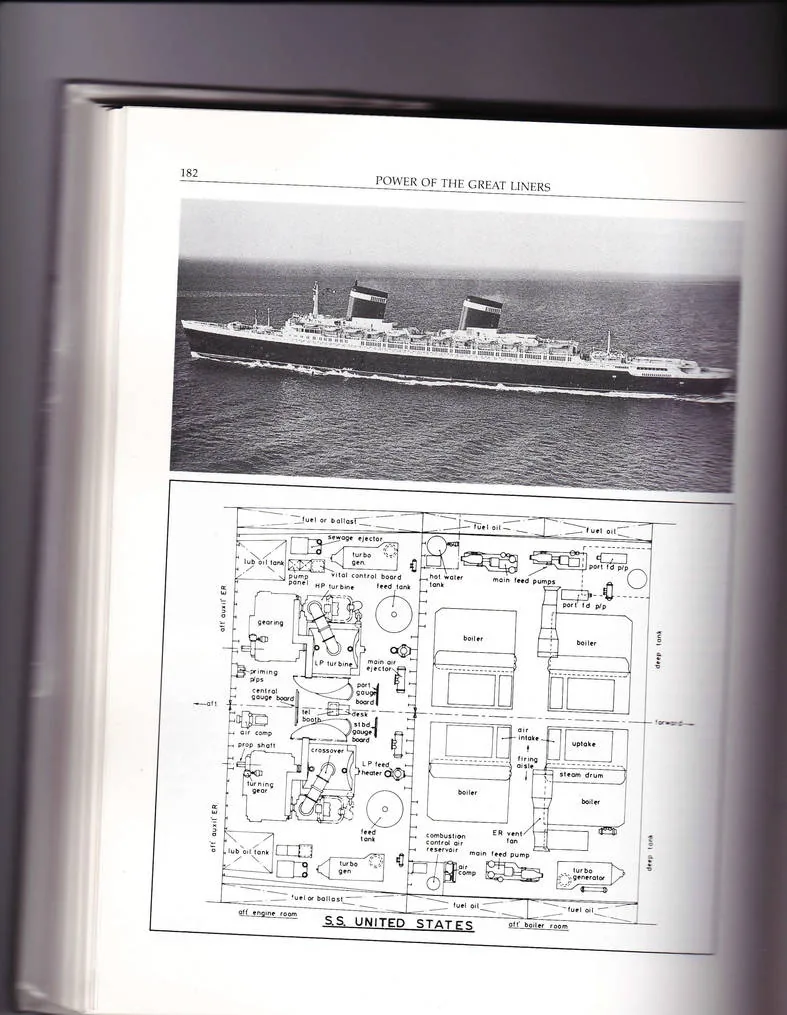
A page from the book Power of the Great Liners (p. 182): a photograph of the ship at sea and a plan of the aft engine room and aft boiler room, showing boilers, turbines, gearing and turbo-generators.
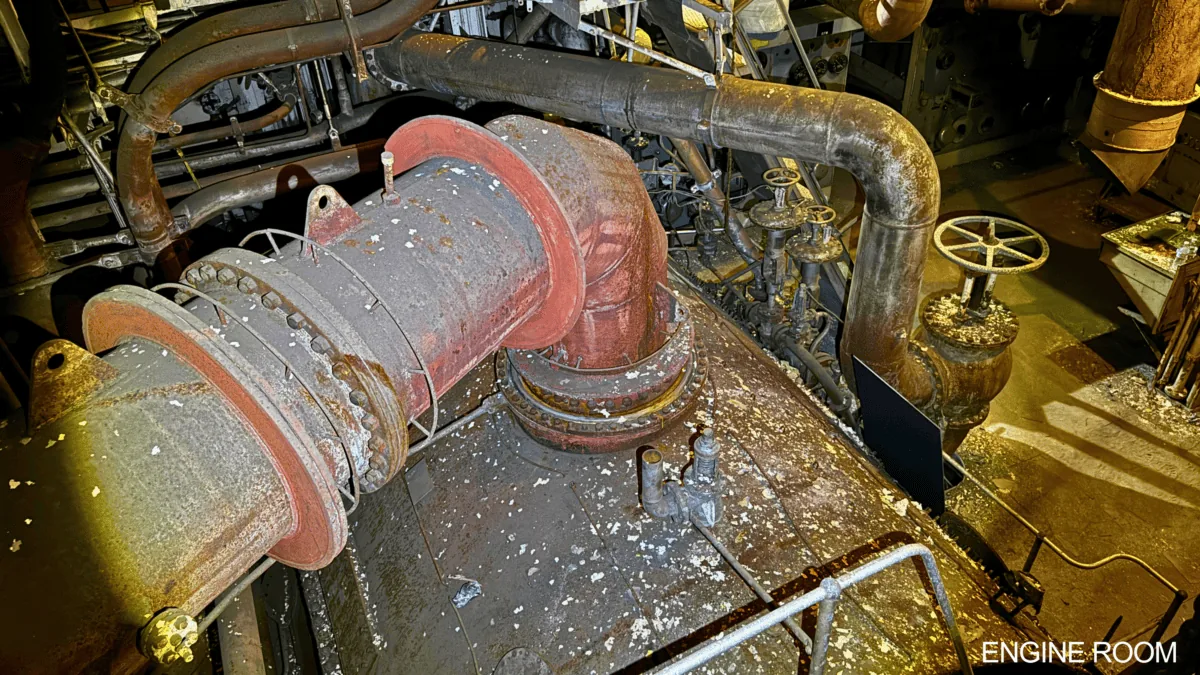
A turbine casing in the engine room, with a large red-painted pipe, photographed in the abandoned ship. The frame is labeled ENGINE ROOM.
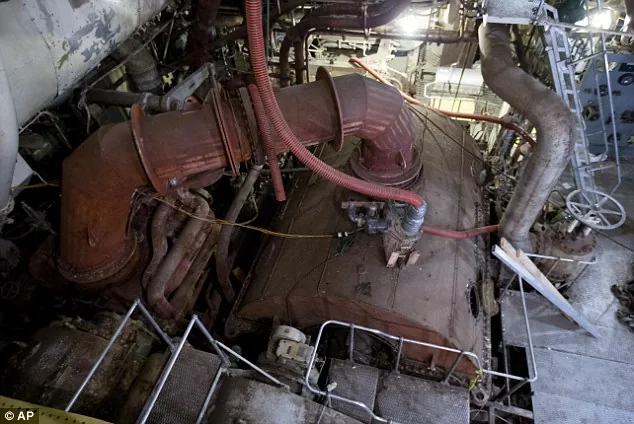
A rusted turbine casing in the engine room, with large red ducting, photographed from above in the abandoned ship. Photograph credited AP.
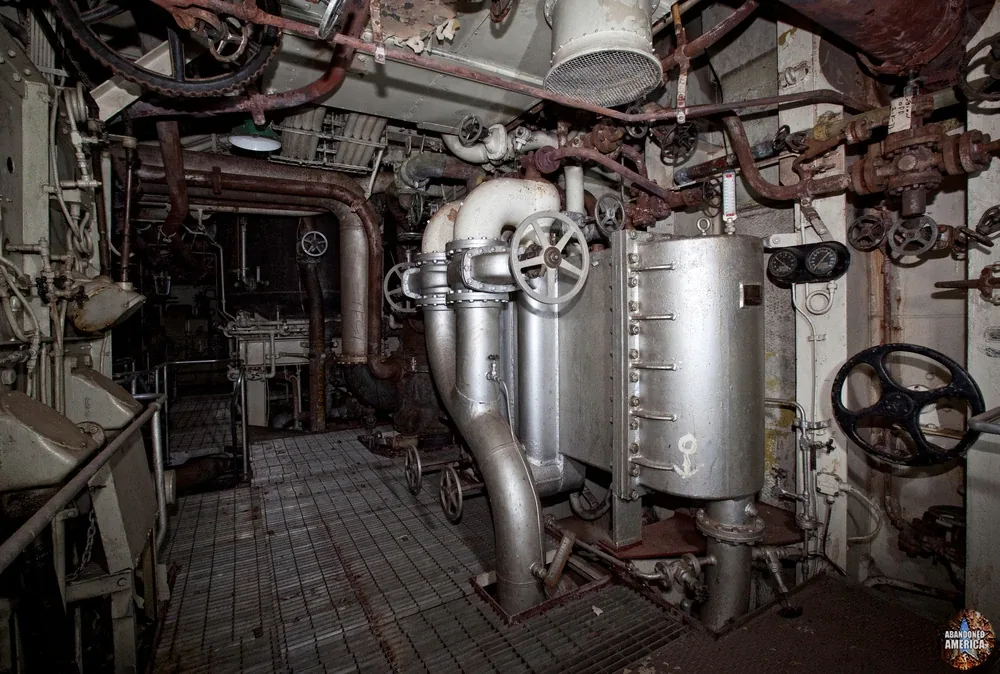
Engine room in the abandoned state: a silver cylindrical heat exchanger, piping and hand valve wheels. Photograph credited Abandoned America.
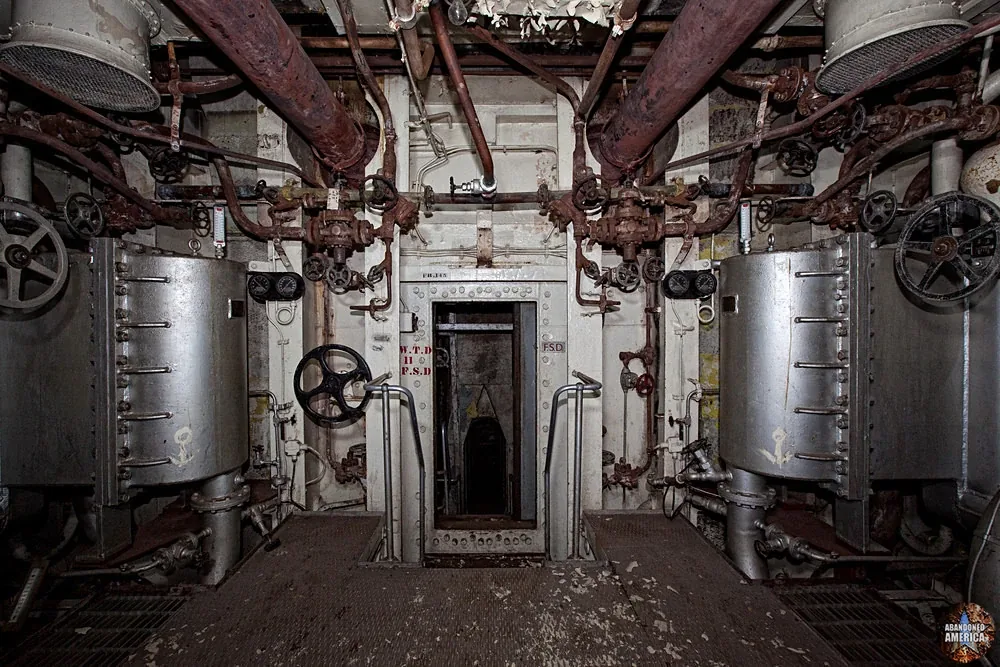
An engine-room passage between two silver heat exchangers, leading to a watertight door stenciled W.T.D. 11 P.S.D. Photograph credited Abandoned America.
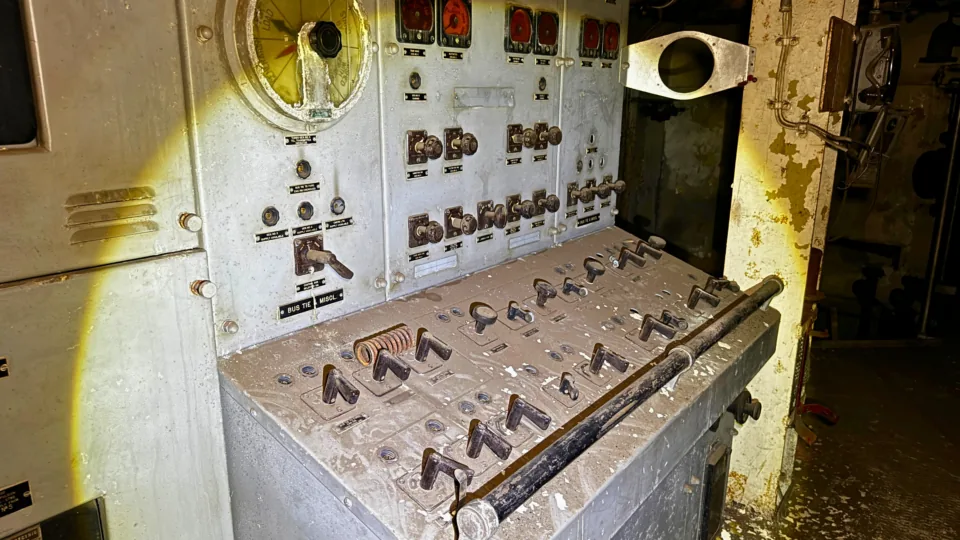
A dusty electrical control console in the abandoned ship. A label on the desk reads BUS TIE / MISCL; a circular meter, indicator lamps and rows of switches are visible.
WHAT MADE HER SPECIAL
On her maiden voyage she became the first American ship in a hundred years to take the Blue Riband, the unofficial honor for the fastest transatlantic crossing by a passenger liner. The official course is Ambrose Light (off New York) to Bishop Rock (off the Isles of Scilly), and the reverse. HAER gives the records as follows, and they are the figures used throughout this page. [DOCUMENTED, HAER PA-647; contemporary reporting, including the New York Times as quoted by the Conservancy]
Eastbound, 3–7 July 1952. Ambrose Lightship to Bishop Rock, 2,942 nautical miles, in 3 days, 10 hours and 40 minutes, at an average of 35.59 knots. She passed Bishop Rock at 06:16 on 7 July. That broke Queen Mary's 1938 eastbound record (31.69 knots is the figure usually published for the Queen Mary's 1938 eastbound run) by a wide margin — about ten hours, in contemporary accounts.
Westbound, 10–14 July 1952. Bishop Rock to Ambrose Lightship, 2,906 nautical miles, in 3 days, 12 hours and 12 minutes, at an average of 34.51 knots.
Commodore Harry Manning commanded the ship. William Francis Gibbs spent much of the crossing on the bridge, watching speed and fuel. Among the roughly 1,700 people on the fully booked maiden voyage were Margaret Truman, Vincent Astor and Sara Roosevelt. She arrived at Le Havre dressed in signal flags. [DOCUMENTED, Conservancy; New York Times account of the arrival]
Those two liner records have not been beaten by another ocean liner. That statement needs a careful distinction. In later decades, high-speed catamarans and other small passenger craft made faster crossings of the same ocean and, in some cases, were awarded the Hales Trophy, a physical trophy associated with the Blue Riband since 1935. Maritime historians and the Conservancy treat the Blue Riband, in the original sense, as a liner honor, and therefore as still held by the United States. The Hales Trophy is a separate object with a later, contested history. [DOCUMENTED as to the liner records still standing; CONTESTED as to whether later high-speed craft "took" the Blue Riband or only the trophy]
The rumored top speed. On official trials the ship made 38.32 knots at 247,785 shp. That is a documented number, not a rumor. [DOCUMENTED, HAER; Conservancy] What was kept secret in the 1950s, and later embroidered, is whether she could have gone faster if the plant had been opened up fully. MARAD's own history page still says the engines provided 240,000 horsepower "for a reported top speed of 42 knots." A private foundation page has claimed 43 knots and 268,000 horsepower. Those higher figures are not supported by the trial report as recorded in HAER, and should be treated as unverified or popular claims. Gibbs never published a higher official maximum, and the Navy only declassified the true top speed in 1968. [CONTESTED / UNVERIFIED for 42–43 knots and 268,000 hp; the trial figure is the one that is documented] A Conservancy remark that she could go almost as fast in reverse as Titanic could go forward is a popular comparison, not a trial number, and is not used as a specification here.
What does not depend on the rumor is already remarkable. She was lighter than the Cunard Queens, more powerful, and consistently faster in regular service. HAER records that in seventeen years she never sailed late, and never had a sailing cancelled, because of mechanical failure, and that her lifetime average speed in revenue service was 30 knots — a record for reliability on the North Atlantic that no other liner matched. [DOCUMENTED, HAER]
SPEED, RANGE AND WEIGHT COMPARED
The tables below compare the SS United States with the liners that were her rivals or successors, and with four naval or special-purpose ships that often come up in discussion of her: an Iowa-class battleship, a Project 1144 Orlan (Kirov-class) battlecruiser, a Nimitz-class carrier, and the nuclear merchant ship NS Savannah. Two different kinds of "size" are listed, and they are not interchangeable.
Full-load (or maximum) displacement is a weight: how much water the ship displaces when loaded. It is given here in long tons (2,240 pounds) unless a source uses metric tonnes, which is noted. Gross tonnage (GRT historically; GT under the later international convention) is a measure of enclosed volume, not of weight. A ship can have a gross tonnage larger than its displacement, as the United States did (53,329 GRT versus 47,264 long tons at maximum draft). Warships are not usually assigned a gross tonnage in the same way, so that column is marked n/a for the warships.
Every number is tagged. Where a primary or official characteristics document was used, that is said. Where only a standard published figure could be found, or where sources disagree, that is said too. Ranges are listed only when a sourced figure exists; a blank or an em dash means this article did not find a reliable published range, not that the ship had none.
Displacement and gross tonnage.
Ship Full-load or maximum displacement Gross tonnage (volume) Length overall Label SS United States (1952) 47,264 long tons at max. draft; 45,400 long tons at design draft; lightship 30,817 long tons 53,329 GRT (29,475 NRT) 990 ft 0 in DOCUMENTED, HAER PA-647 RMS Queen Mary (1936) About 77,000–77,400 long tons (the Conservancy compared the Cunard Queens at about 77,000 long tons; 77,400 is the figure commonly published for Queen Mary) 80,774 GRT as built; 81,237 GRT after the 1947 refit 1,019.4 ft DOCUMENTED for GRT and length, standard references and Conservancy; SINGLE-SOURCE / standard published figure for the 77,400-long-ton displacement RMS Queen Elizabeth (1940/1946) About 83,000 long tons is the figure commonly published; a precise official full-load number was not re-checked against a primary document for this article 83,673 GRT 1,031 ft DOCUMENTED for GRT and length; SINGLE-SOURCE / standard published figure for displacement SS Normandie (1935) 68,350 tons, loaded, in the commonly published characteristics 79,280 GRT as built; 83,423 GRT after the 1936 alterations 1,029 ft (313.6 m) DOCUMENTED for GRT and length, standard references; SINGLE-SOURCE / standard published figure for loaded displacement Queen Elizabeth 2 (1969) 49,708 long tons (50,506 metric tons) in the commonly published characteristics 65,863 GRT as built; 70,327 GRT after the 1994 remeasurement 963 ft DOCUMENTED for GRT and length; SINGLE-SOURCE / standard published figure for displacement RMS Queen Mary 2 (2004) 79,287 metric tonnes (a metric figure, not long tons) 149,215 GT (modern gross tonnage, not the old GRT system) 1,132 ft (345.03 m) DOCUMENTED as the standard published Cunard / register figures Iowa-class battleship (WWII full load) 57,540 long tons full load; 48,110 long tons standard. (Later configurations were heavier: about 60,000 long tons is published for New Jersey in 1968.) n/a (warship) 887 ft 3 in DOCUMENTED as the standard published official characteristics; this site has also used about 57,000 tonnes full load in the Project 1144 article Project 1144 Orlan (Kirov class) About 25,860–26,400 t full load on Russian project tables (26,396 t on one table); about 23,750–24,300 t standard. 28,000 t is a common Western figure. n/a (warship) 250.1 m (about 821 ft) on the Russian tables; about 252 m / 827 ft in many Western listings DOCUMENTED, this site's Project 1144 article, with the Western 28,000 t figure marked there as a conflict Nimitz-class aircraft carrier About 100,000 to 104,600 long tons full load, depending on the hull and the date of the figure n/a (warship) 1,092 ft overall DOCUMENTED as the standard published U.S. Navy range; exact load varies by ship NS Savannah (1962) A commonly published figure is about 22,000 tons; a primary full-load number was not re-checked for this article 13,599 GRT; 9,900 long tons deadweight 596 ft DOCUMENTED for GRT, deadweight and length, standard / MARAD-type listings; ESTIMATE or SINGLE-SOURCE for displacement
Speed and range.
Ship Service or design speed Maximum or trial speed Range (sourced figures only) Label SS United States 33 kn service (HAER); 30 kn lifetime average in revenue service 38.32 kn on trials; 35.59 kn / 34.51 kn on the 1952 Blue Riband crossings. Reported 42 kn is not used here. 10,000 nautical miles at 35 kn; bunker 10,306 long tons DOCUMENTED, HAER RMS Queen Mary 28.5 kn service 31.69 kn eastbound Blue Riband, 1938 (the record the United States broke); higher trial figures are sometimes published — (no figure used here) DOCUMENTED for service speed and the 1938 record as the standard published figures RMS Queen Elizabeth 28.5 kn service Trial figures above 32 kn are sometimes published; not used as a primary number here — (no figure used here) DOCUMENTED for service speed, standard references SS Normandie 29.5 kn designed service 32.2 kn recorded on trials; her 1930s Blue Riband averages were just above 30–31 kn — (no figure used here) DOCUMENTED as the standard published trial and service figures Queen Elizabeth 2 28.5 kn service About 32.5 kn maximum as a steamship; 34 kn is the commonly published maximum after the 1986–87 diesel-electric re-engining — (no figure used here) DOCUMENTED as the standard published Cunard figures; the two maxima are for two different plants RMS Queen Mary 2 26 kn service Just over 30 kn maximum, as published by Cunard — (no figure used here) DOCUMENTED as the standard published Cunard figures Iowa-class battleship 33 kn design Up to 35.2 kn is published for a light-load condition 14,890 nautical miles at 15 kn, the standard published official range DOCUMENTED as the standard published official characteristics Project 1144 Orlan (Kirov class) About 20–25 kn on the reactors alone (published figures vary) About 30–32 kn on the full CONAS plant (reactors plus oil-fired boost boilers); 31 kn is given as a full-power figure on one Russian table Unlimited on the reactors; roughly 1,000 to 1,300 nautical miles on the auxiliary boilers alone at moderate speed, as given in this site's KN-3 and Project 1144 articles. A Western listing of 1,000 nmi at 30 kn on combined plant is a different claim. DOCUMENTED, this site's Project 1144 and KN-3 articles; CONTESTED as to the exact sprint-range claim Nimitz-class carrier 30+ kn (the published official figure; the true maximum is not released) 30+ kn (same official floor) Unlimited distance on the two A4W reactors; on the order of 20–25 years between refuelings DOCUMENTED, U.S. Navy published characteristics NS Savannah 21 kn service 24 kn maximum, as commonly published 300,000 nautical miles at 20 kn on one load of 32 fuel elements, the standard published figure DOCUMENTED as the standard published MARAD / museum figures for speed; SINGLE-SOURCE / standard published figure for the 300,000 nmi range
Maximum or trial speed, drawn to scale. The bar length is 10 pixels per knot. These are not all the same kind of number: trials, Blue Riband averages, design maxima and official "30+" figures are labeled in the note column. The United States is in the lead on a documented trial; the 42-knot rumor is omitted on purpose.
Ship Speed What the number is Bar (10 px / kn) SS United States 38.32 kn Official trials SS United States 35.59 kn 1952 eastbound Blue Riband average Queen Elizabeth 2 34 kn Published max after diesel-electric re-engining Iowa class 33 kn Design speed (35.2 kn is published at light load) SS Normandie 32.2 kn Trials Project 1144 Orlan 32 kn Top of the published 30–32 kn full-plant range RMS Queen Mary 31.69 kn 1938 eastbound Blue Riband average RMS Queen Mary 2 30 kn Published maximum (just over 30 kn) Nimitz class 30 kn Official published floor ("30+ kn") NS Savannah 24 kn Published maximum
The comparison that matters for the United States is not that she was the largest liner — she was not. The Cunard Queens and Normandie were bigger in both gross tonnage and displacement. She was lighter than they were, with more installed power, and she was faster. An Iowa-class battleship, at about 57,540 long tons full load, is in the same weight class as the United States at maximum draft (47,264 long tons) and is shorter (887 feet against 990). The liner is the faster of the two on documented figures. A Kirov-class battlecruiser is much smaller, around 26,000 to 28,000 tonnes, and is credited with about 32 knots on a nuclear plant with oil-fired boost. A Nimitz-class carrier is more than twice the United States' displacement and is officially "30+ knots," with essentially unlimited range. NS Savannah, the American nuclear merchant ship, was smaller and slower, but could steam on the order of 300,000 nautical miles on one reactor core — a reminder of what a nuclear United States, which was never built, might have been asked to do. [The Savannah comparison is illustrative; no official nuclear-conversion study for the United States is cited here.]
SERVICE LIFE, 1952–1969
United States Lines placed the ship on the express North Atlantic run in the summer of 1952: New York to Le Havre and Southampton, with some voyages extended to Bremerhaven. She carried passengers in three classes — first, cabin and tourist — in 695 staterooms, with a total passenger capacity given by HAER as 2,008 and a crew of 1,093 in the as-built characteristics (about 1,000 crew is the figure used in HAER's narrative). MARAD gives 1,984 passengers. Other secondary counts differ by a few dozen. The HAER as-built total is the one used here. [DOCUMENTED, HAER; CONTESTED in the exact passenger total] A first-class ticket on the maiden voyage is reported by one secondary account as $350, with tourist at $165. [SINGLE-SOURCE, Chatham Marconi]
Most of her passengers were not famous. HAER notes that publicity dwelt on celebrities, royalty and industrialists, but that the ordinary list was vacationers, business travelers, students, military families and foreign-service employees travelling at government expense. The Conservancy's passenger list, which should be read as a sample of the well-known names rather than a complete roll, includes Marlon Brando, Coco Chanel, Sean Connery, Gary Cooper, Walter Cronkite, Salvador Dalí, Walt Disney, Duke Ellington, Judy Garland, Cary Grant, Charlton Heston, Bob Hope, Marilyn Monroe, Prince Rainier and Grace Kelly, Elizabeth Taylor, John Wayne, and the Duke and Duchess of Windsor. Four future or sitting U.S. presidents travelled on her: Harry Truman, Dwight Eisenhower, John F. Kennedy, and Bill Clinton, the last as a young Rhodes Scholar on his way to Oxford. In 1963 the Mona Lisa was shipped on her to exhibitions in Washington and New York. [DOCUMENTED, Conservancy, for the named passengers and the Mona Lisa; the "four presidents" claim is the Conservancy's]
Five days before the maiden voyage, the ship was opened to the public in New York; the Conservancy says some 70,000 people came, with a line stretching fourteen blocks. The galleys could turn out up to about 9,000 meals a day. She was fully air-conditioned, which was still a point of pride on a liner in 1952. [SINGLE-SOURCE, Conservancy, for the open-day crowd and the 9,000-meal figure]
With her subsidy, she made a profit for United States Lines through 1960. Jet airliners already carried about 40 percent of transatlantic passengers when she was new, and by the end of the 1950s they were cutting into every liner's revenue. HAER records that she began to operate at a loss in 1961. Labor strikes in 1961, 1962, 1963, 1965 and 1969 cost her sailings. She made her first winter cruise in 1962; more cruise work followed, but the ship was not well suited to it. New owners of United States Lines allowed the operating-differential subsidy to expire at the end of 1969, which made her prohibitively expensive to run. She was withdrawn in November 1969. [DOCUMENTED, HAER]
The exact last-voyage dates vary slightly in secondary sources (7, 11 or 14 November 1969 appear in different places). What is not in dispute is that the withdrawal, announced while she was at Newport News for a scheduled overhaul, came as a shock to the crew. Some left personal gear on board, expecting to be back. The Navy then sealed and dehumidified the ship to hold her as a reserve. [DOCUMENTED, Conservancy and HAER, for the sudden layup and the sealing; CONTESTED as to the exact calendar date of the last voyage]
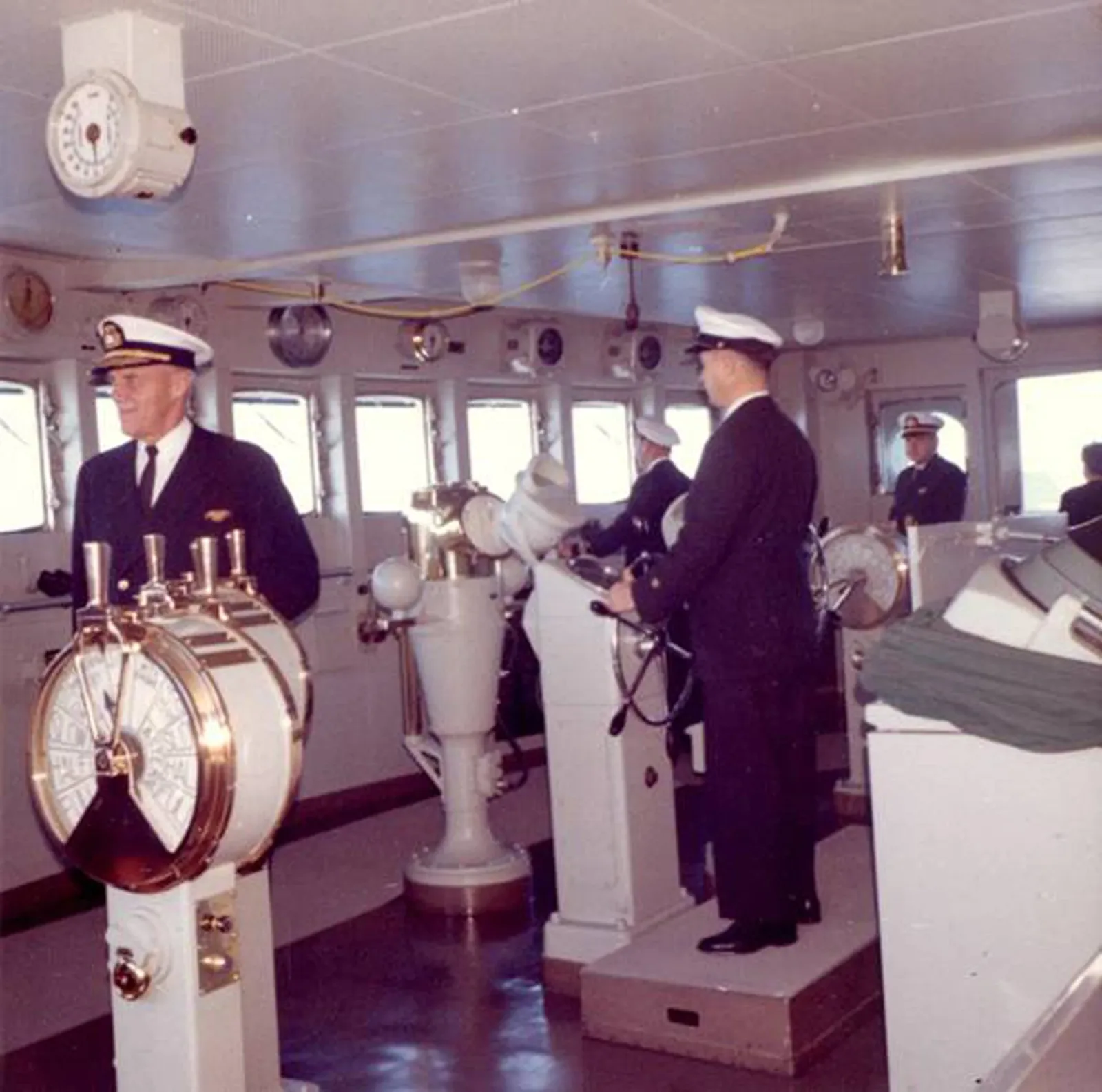
Officers on the bridge in service, with an engine-order telegraph in the foreground, a binnacle, and a helmsman at the wheel. Period photograph.
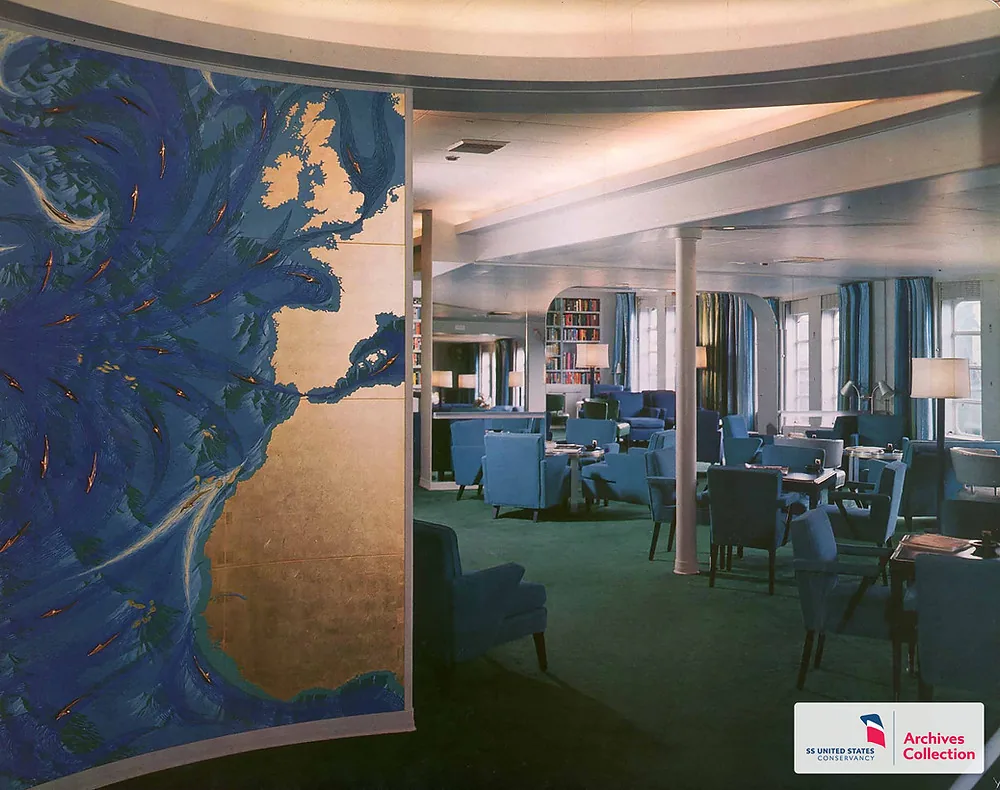
The first-class observation lounge in period color, with a gold-leaf map of the Atlantic on the curved bulkhead, blue chairs and green carpet. Photograph credited to the SS United States Conservancy Archives.
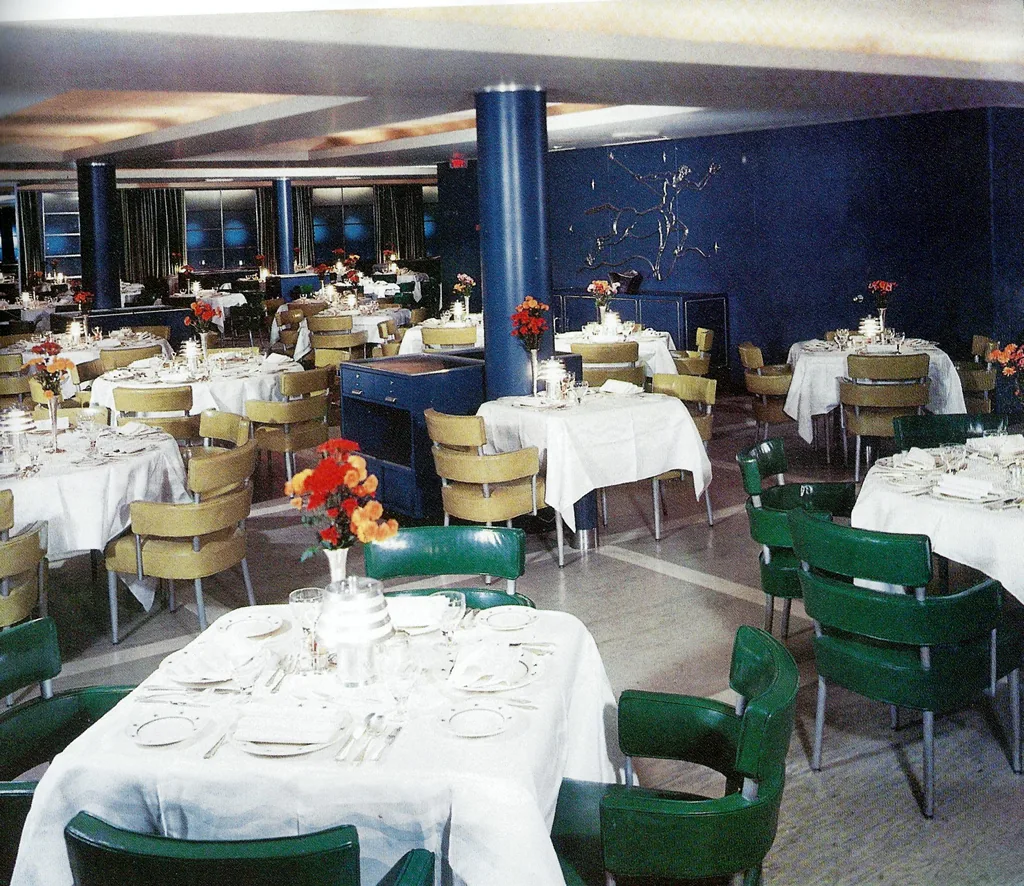
A period dining room with blue walls and columns, green and gold chairs, and white tablecloths.
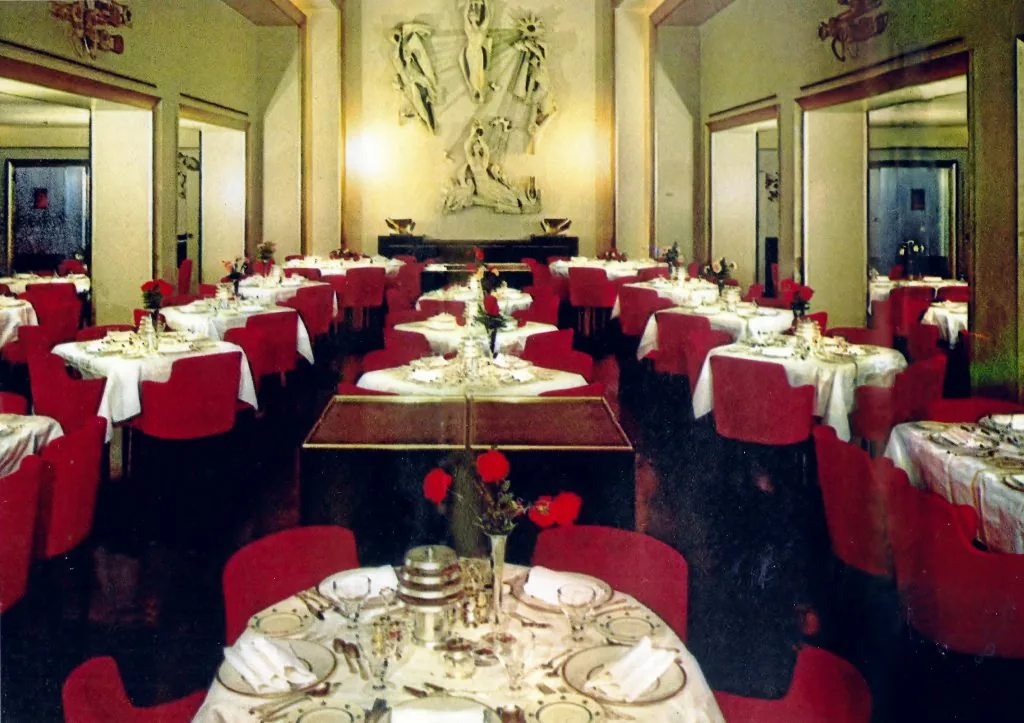
Another period dining room, with red chairs, white tablecloths, and a sculptural relief on the far wall.
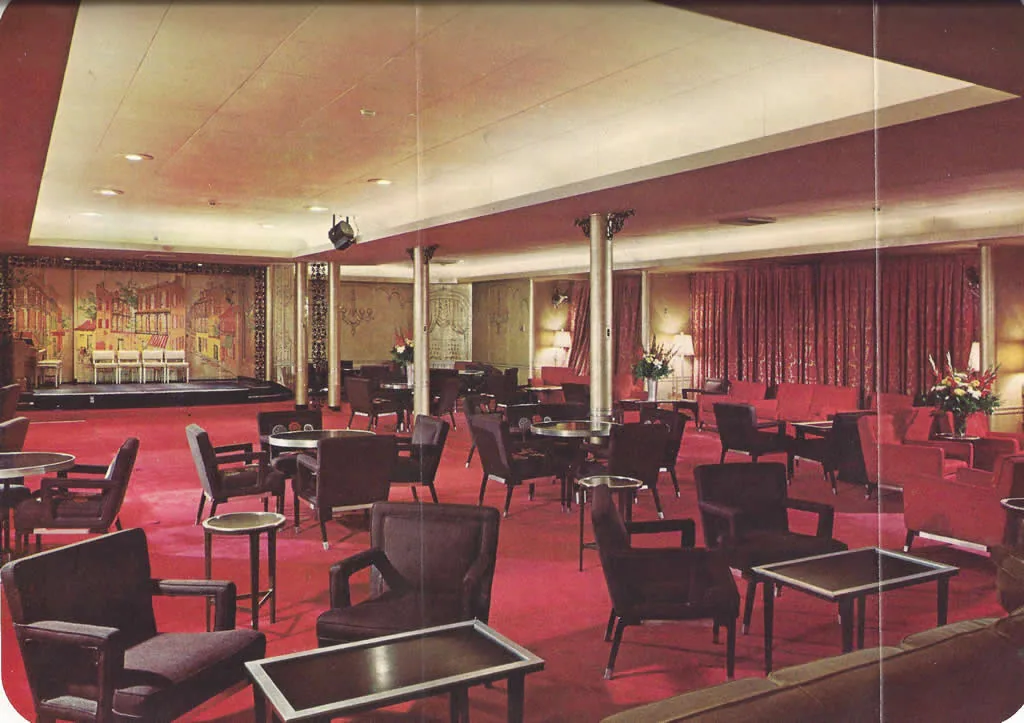
A period ballroom or lounge, with red carpet, clustered chairs and tables, and a mural behind a small stage at left.
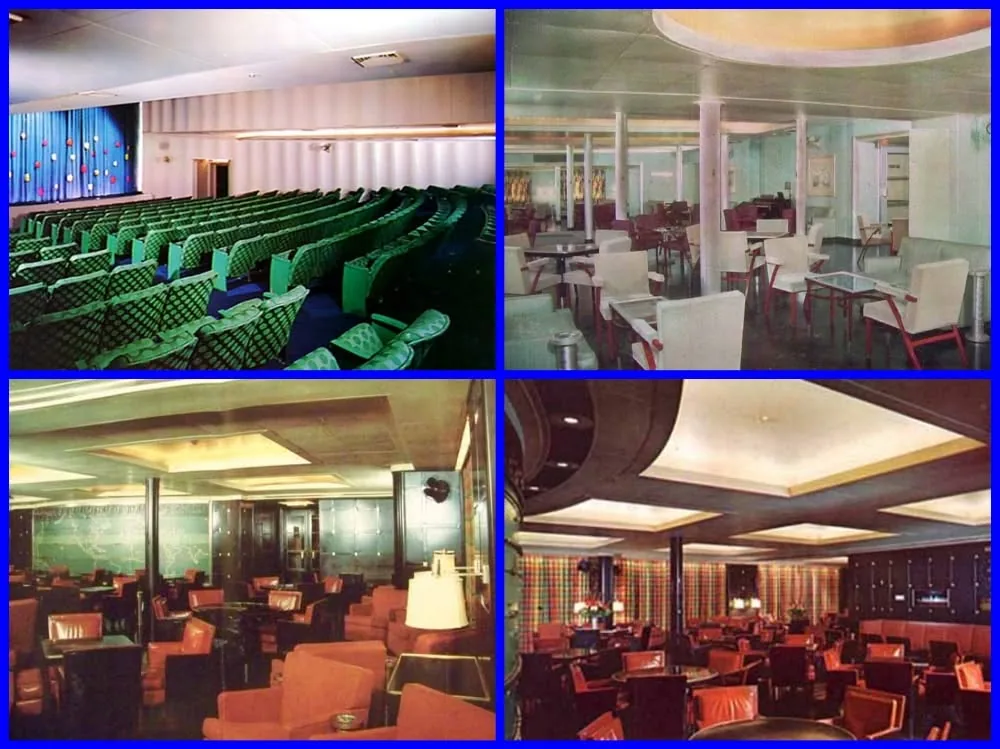
A four-panel collage of period interiors: a theater with green seats and a blue curtain, and three lounges.
AFTER LIFE, 1969–2025
Reserve, 1969–1978. After the 1969 withdrawal, the ship was hermetically sealed with her interiors and machinery left in place, held as a reserve vessel for possible military use. The Conservancy describes her as a U.S. Navy reserve ship in that period. A 1978 Marine Reporter item lists her in the National Defense Reserve Fleet, maintained by MARAD, at the International Terminal in Norfolk, and gives her final transatlantic voyage under United States Lines as 7 November 1969. HAER records that United States Lines sold her to the Maritime Administration in 1973. Those statements can sit together: she was laid up under government control, title passed to MARAD in 1973, and she remained in the reserve until the late 1970s. In 1978 the government decided she was no longer needed and listed her for sale. [DOCUMENTED, Conservancy, HAER, and Marine Reporter 1978]
Richard Hadley, 1980–1992. HAER records the sale to Richard Hadley, of Seattle, in 1980. (A 1978 Marine Reporter headline said a Seattle firm had already bought her "as-is for $5 million"; Wikipedia and other secondary accounts give $7 million and a 1980 closing. The year of the completed sale used here is HAER's 1980; the price is contested.) Hadley planned to convert her into seagoing time-share condominiums. The money was not raised. In October 1984, to pay creditors, most of the remaining furniture and fittings — left on board since 1969 — were sold at a three-day auction in Norfolk. In October 1991 she was arrested for unpaid docking fees, and in April 1992 she was sold at auction for $2.6 million to Marmara Marine, operated by Fred Mayer and Kahraman Sadikoglu. [DOCUMENTED, HAER, for the 1980 sale, the 1984 auction, the 1991 arrest and the 1992 price; CONTESTED as to the Hadley purchase price]
Turkey, Sevastopol, and the gutting, 1992–1996. Mayer wanted a running mate for QE2. In June–July 1992 the ship was towed, in a 36-day voyage, to Istanbul. No refit was done there. In October 1993 she was towed to Sevastopol, Ukraine, arriving on 1 November, for asbestos removal at a cost far below a U.S. yard. Greenpeace protested both in Turkey and in Ukraine. A local account in Sevastopol later said more than 300 tons of asbestos came off the ship; the interior was stripped to the structural members. She returned to Istanbul in April 1994. Lifeboats, davits, ducts and other metal were then sold off for scrap while the owners looked for refit money. To stop further stripping, Mayer had her towed back to the United States in June–July 1996. By the end of 1996 she was at Pier 82 on the Delaware River in Philadelphia, where she would stay for the next 28 years. (A few secondary accounts give a 1997 Philadelphia arrival; HAER and the Conservancy both use 1996, which is the date used here.) [DOCUMENTED, HAER and Conservancy, for the tow sequence and the 1996 berth; SINGLE-SOURCE, Sevastopolskaya Gazeta, for the "more than 300 tons" of asbestos; CONTESTED if a 1997 arrival is preferred]
Cantor, NCL, and the Conservancy, 1997–2024. In 1997 she was arrested again for an unpaid mortgage and bought at auction by the creditor Edward Cantor, who still hoped to see her steam. After his death, his estate sold her in 2003 to Norwegian Cruise Line, which announced a plan to restore her for an American-flagged Hawaiian cruise service. The financial crisis ended that plan. When NCL began taking bids from scrappers, the SS United States Conservancy — founded in 2004 by Susan Gibbs, William Francis Gibbs's granddaughter, and other supporters — raised a $5.8 million pledge from the Philadelphia philanthropist H. F. "Gerry" Lenfest, bought the ship in February 2011, and kept her at Pier 82. For more than a decade the Conservancy paid for dockage, developed a museum collection, and looked for a mixed-use waterfront redevelopment that would keep the hull intact. [DOCUMENTED, HAER and Conservancy]
The rent dispute and the 2024 eviction. In 2021, the Conservancy says, pier operator Penn Warehousing doubled the monthly rent without agreeing a new dockage contract. The Conservancy kept paying the old amount. Penn Warehousing sued in 2022. A court later found that the doubled rent was not owed, but also that the ship would have to leave the pier on a short timetable. After a court-ordered mediation, the dispute was settled in October 2024. No other berth or viable purchaser that would keep her afloat could be arranged in time. The Conservancy then sold the ship to Okaloosa County, Florida. [DOCUMENTED, Conservancy settlement announcement and history pages]
Okaloosa County, the tow to Mobile, and reef preparation. The Okaloosa County Commission voted 4–1 to buy the ship for $1 million in tourist-development funds, with several million more set aside for the tow, environmental work and deployment. Later official and press figures describe a project of about $10 million to $13.5 million all told. The original idea of a November 2024 move was delayed when the Coast Guard questioned the hull's stability and raised pollution and tow-plan requirements; a one-time $100,000 penalty and daily dockage fees followed while the ship sat past a 12 December 2024 departure deadline. [DOCUMENTED, Northwest Florida Daily News reporting of the commission vote, the $1 million price, and the Coast Guard delay]
She finally left Philadelphia in February 2025. A short shift from Pier 82 to Pier 80 on 14 February was followed by the ocean departure; USA Today, citing the county, gives 19 February as the date she started down the Delaware. The Inquirer, also citing Okaloosa County, noted that the tow had to pass under the Walt Whitman, Commodore Barry and Delaware Memorial Bridges, with traffic likely to be halted on the first two. The oceangoing tug was Vinik No. 6, Captain Mike Vinik. On 3 March 2025 she arrived in Mobile, Alabama, about 1,800 miles later, well ahead of schedule, and was berthed at Modern American Recycling Services (MARS) for remediation: removal of remaining oils, wiring, plastics, glass and other material, and the cutting of large openings, under EPA, MARAD, Army Corps and regional fisheries guidance, so that she could be sunk as a reef without explosives. [DOCUMENTED, Conservancy, 3 March 2025; USA Today; Inquirer; later Okaloosa / FOX accounts of the reef preparation]
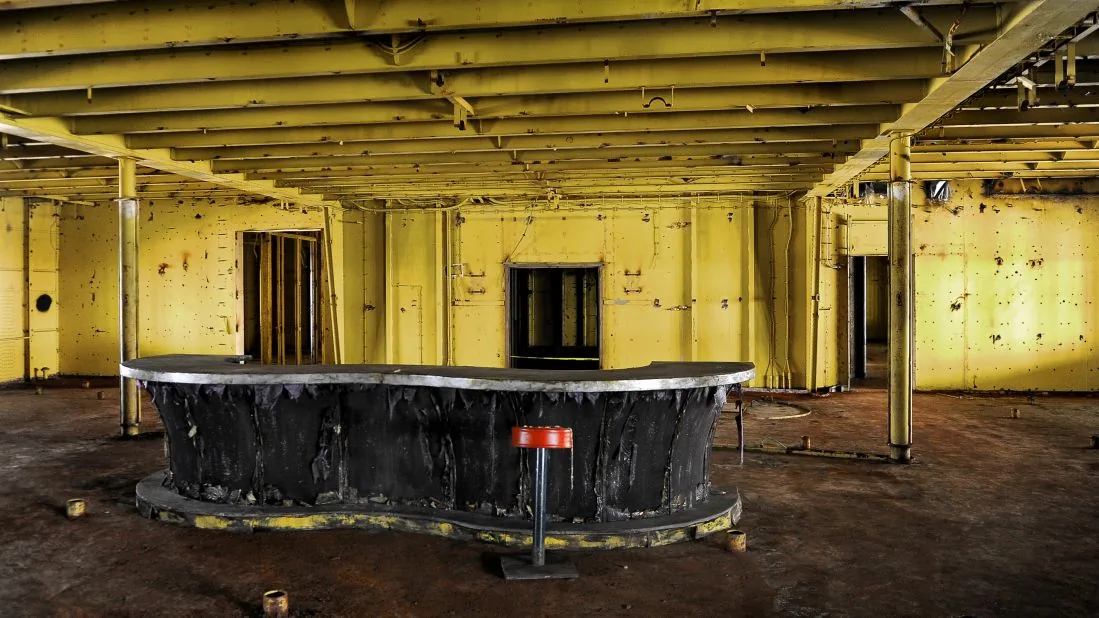
A gutted lounge, with the old curved bar still in place, a single red stool, and yellow-painted steel bulkheads.
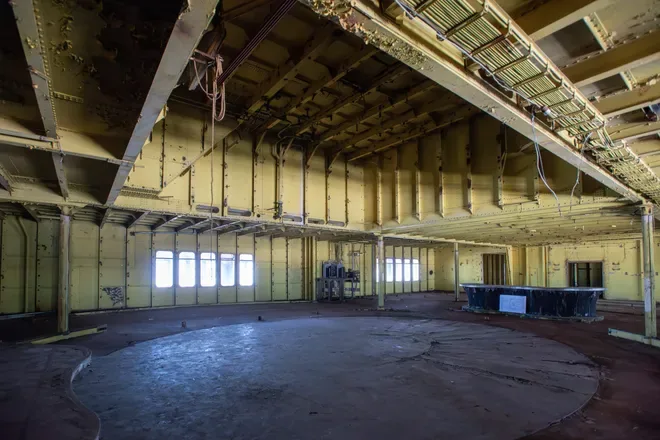
A gutted public room with yellow-painted steel bulkheads, a row of windows, a remaining bar or counter at right, and a circular mark on the floor.
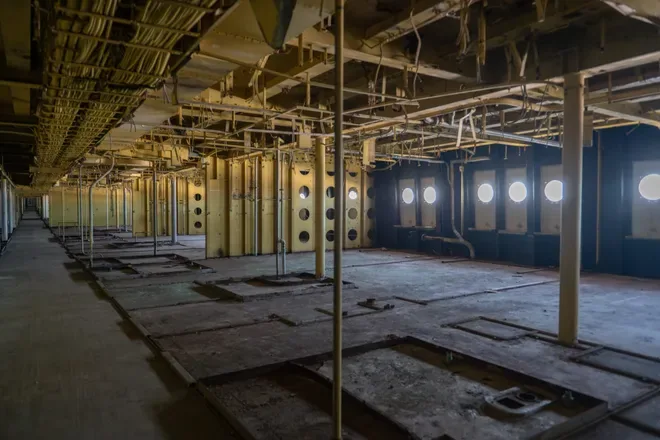
A gutted passenger deck, stripped to the steel, with a row of portholes along the side.
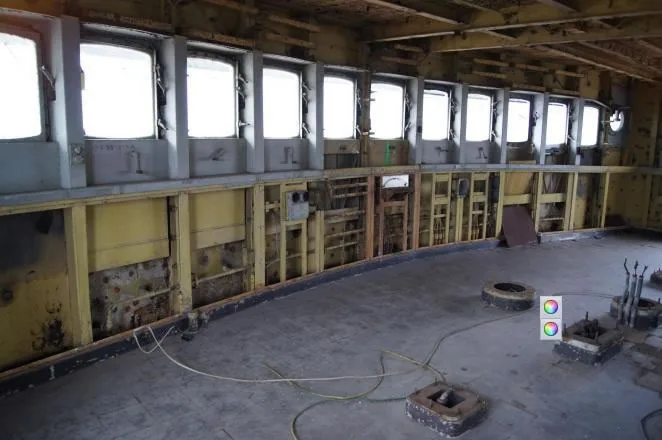
The gutted wheelhouse or bridge, looking out through a row of windows. The instrument pedestals have been removed, leaving only their bases on the deck.
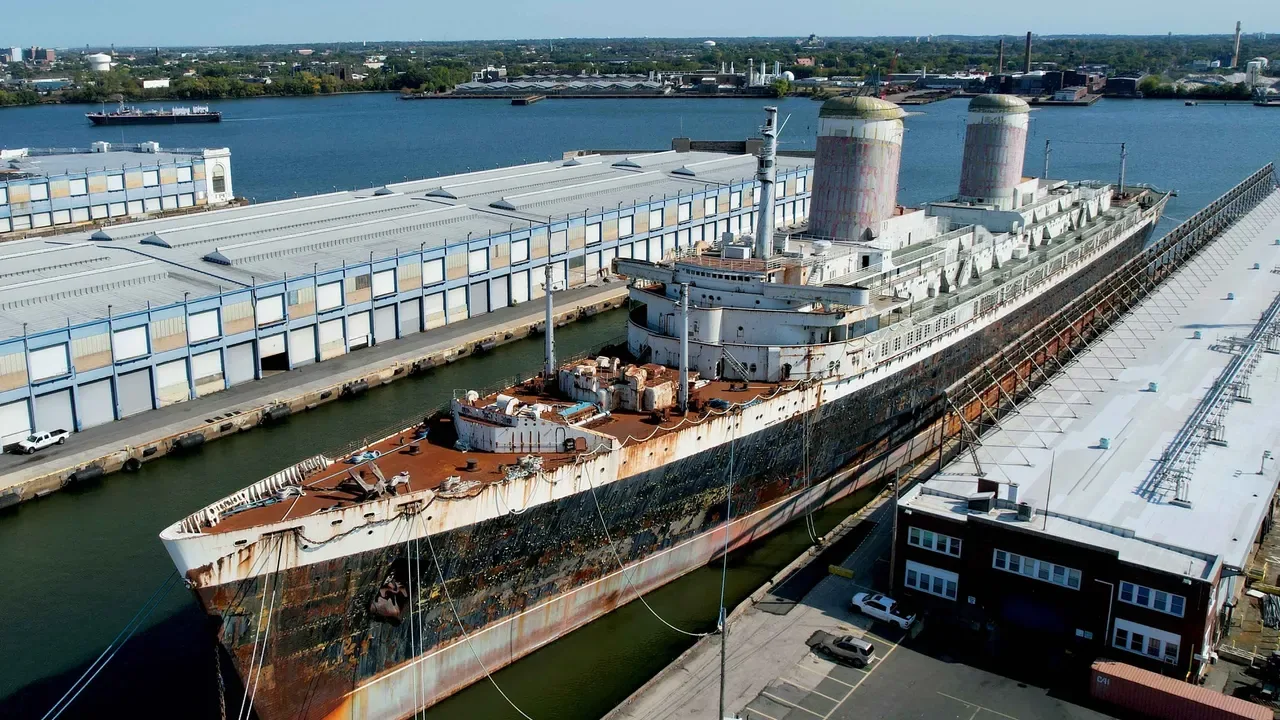
Aerial view of the rusting ship at Pier 82, Philadelphia, in the slip between a long warehouse and the pier, where she lay from 1996 until the 2025 tow.
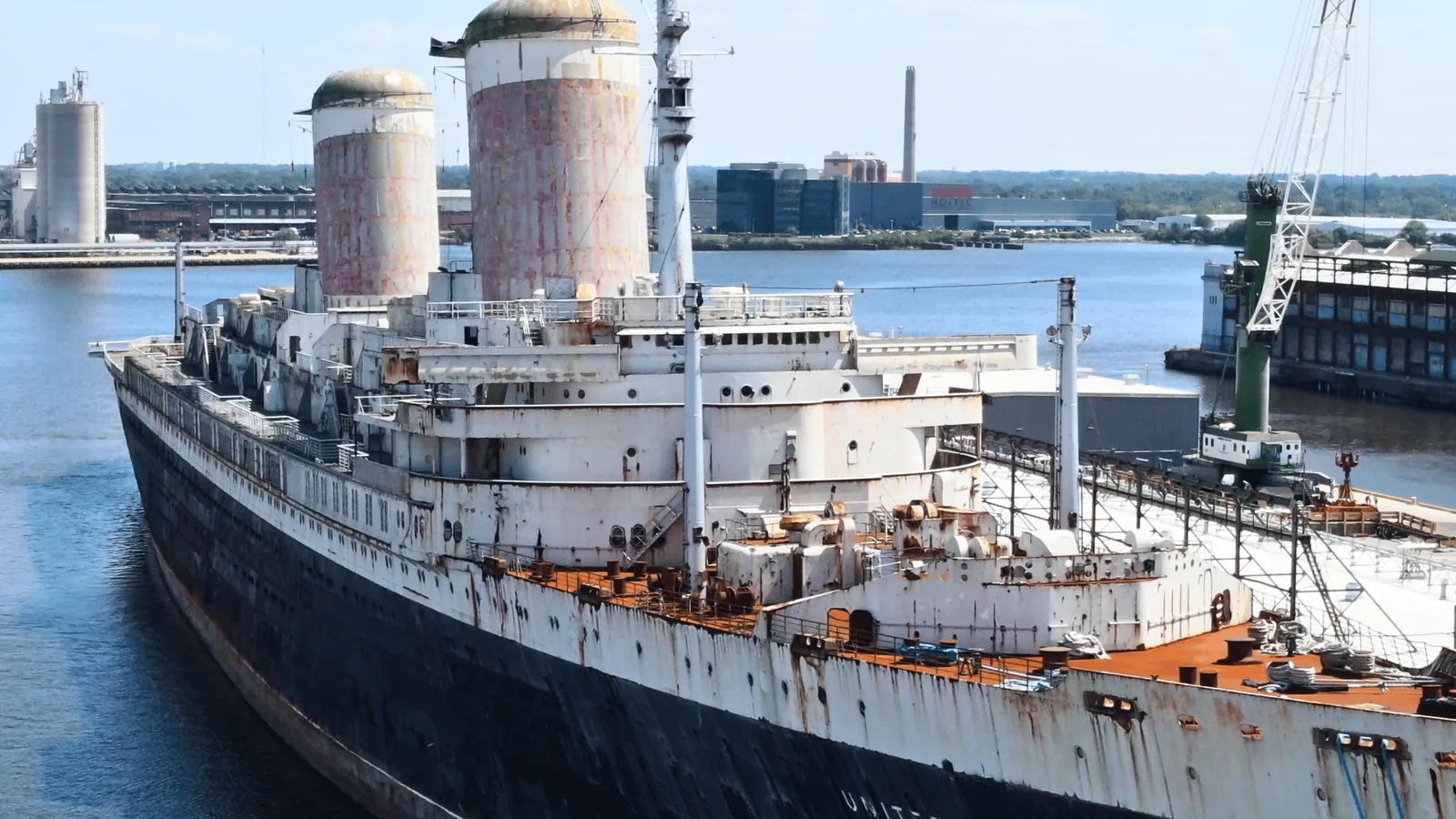
The rusting SS United States at a pier during layup, with the faded funnels and the forward superstructure still in place.
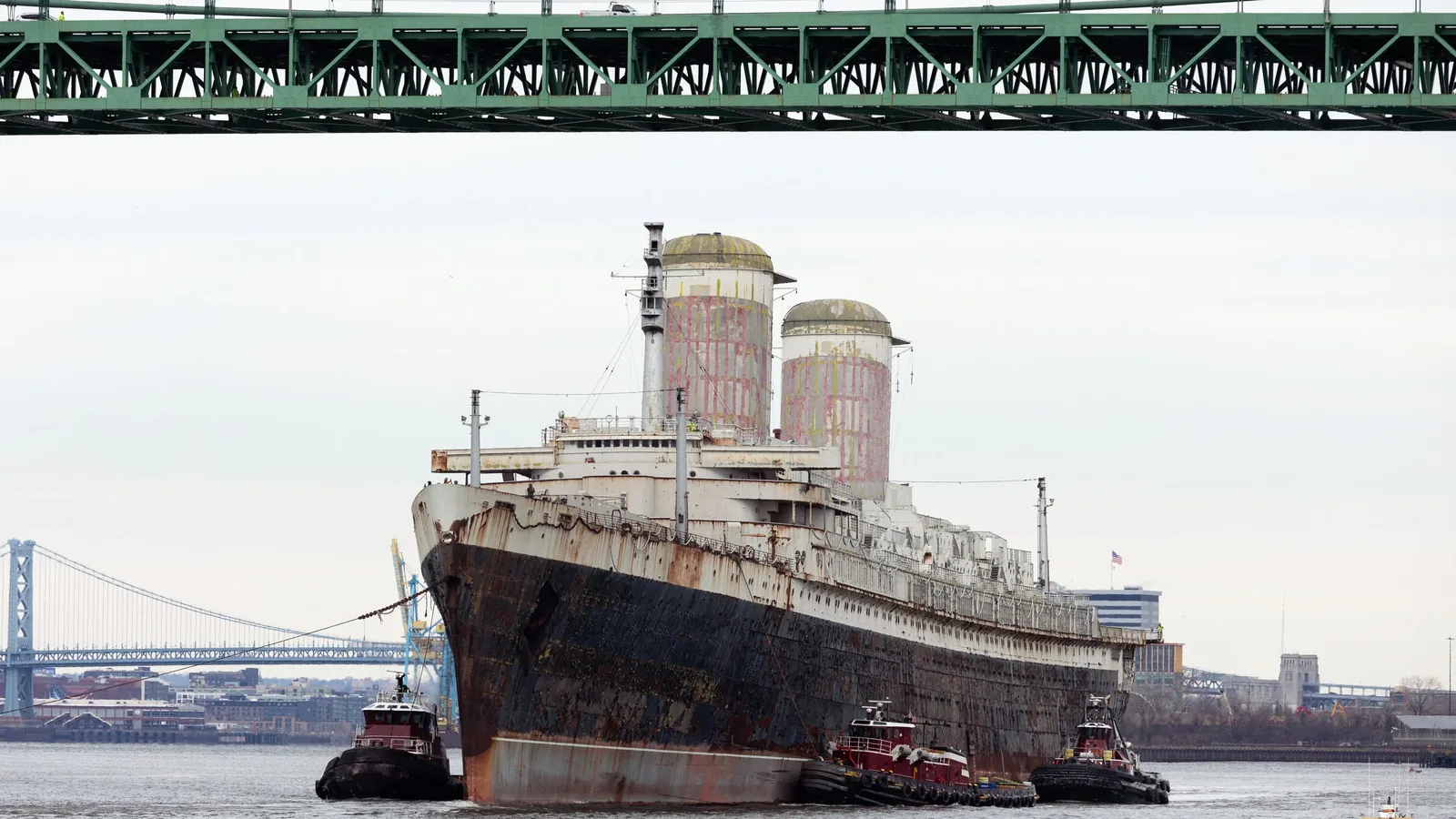
The ship under tow by tugs on the Delaware River in February 2025, passing under the green Commodore Barry Bridge. The blue suspension span of the Delaware Memorial Bridge is visible in the distance ahead.
FINAL RESTING PLACE
Okaloosa County's plan, announced with the 2024 purchase, was to sink the 990-foot hull as an artificial reef in the Gulf of Mexico off Destin–Fort Walton Beach, paired with a land museum and visitor center developed with the Conservancy. County officials and later coverage describe it as the world's largest artificial reef, longer than the aircraft carrier USS Oriskany, which was sunk off Pensacola in 2006 and will lie close enough that technical divers may in time visit both wrecks on one trip. The published project cost in 2026 reporting is about $13.5 million. [DOCUMENTED, Conservancy, Okaloosa County, AP and local reporting]
The planned site is approximately 22 nautical miles southwest of Destin–Fort Walton Beach (about 25 statute miles), and about 32 nautical miles southeast of Pensacola Pass, in roughly 180 feet of water, with the upper decks expected to sit about 55 to 60 feet below the surface so that less-experienced divers can reach the top of the wreck. Coordinates released by the county are 30° 07.148′ N, 86° 46.755′ W, subject to a small shift once the hull is on the bottom. [DOCUMENTED, Okaloosa County / Visit Florida / Pensacola News Journal]
Federal environmental and explosives rules ruled out a demolition shot. Preparation at Mobile included removing tanks, cutting large openings in internal decks (FOX 13, citing the operation, said 10-foot by 10-foot gaps), and taking out more than 400 portholes, plus work on the funnels, so that the hull would flood in a controlled way when valves on the original seawater-intake piping were opened. Some of the ship's tanks were already filled before the final day. The Coast Guard established a one-nautical-mile safety zone around the deployment. [DOCUMENTED, FOX 13, PNJ quoting county spokesman Nick Tomecek, and Okaloosa / Visit Florida]
The date. The county had scheduled deployment for Thursday, 12 November 2026, with a public send-off in Destin on the 11th. A forecast of heavy winds and unsafe conditions led Chairman Trey Goodwin and the county to move the sinking up to Wednesday, 11 November 2026 — Veterans Day — and to cancel the ceremony. Flooding was to begin at 1:00 p.m. Central Time (2:00 p.m. Eastern), and the county told the Pensacola News Journal that the controlled flooding was expected to take about 45 minutes. A livestream was to be posted at thessus.com, with public viewing at AJ's Seafood and Oyster Bar in Destin and at Seville Quarter in Pensacola. [DOCUMENTED, Okaloosa County, WKRG, PNJ, Visit Florida, FOX 13]
Status as of the afternoon of 11 November 2026, America/Chicago. This page was written the same afternoon the sinking was scheduled. Woods Hole Oceanographic Institution issued a 11 November 2026 release that treats the scuttling as having taken place that day, and a key-takeaways line on that release says the ship "has been sunk" as the world's largest artificial reef. WHOI and the University of Southern Mississippi planned a multi-year study of how a large artificial reef is colonized from the first day, including water chemistry and microbial sampling at 132 locations around the hull. Local television earlier in the morning still described the operation in the future tense, with flooding to begin at 2:00 p.m. Eastern. An Associated Press story filed from Destin described the ship still floating under a cloudy sky as she headed toward the site. A MarineRadar item claiming she "slipped beneath the surface around 1 p.m. CST" carries a 01:13 UTC timestamp on 11 November, which is the previous evening in Chicago and is therefore not treated as a reliable after-action report. This article has not independently watched a livestream, and could not retrieve a complete AP after-action piece (the AP page was blocked by a challenge page at the time of writing). [DOCUMENTED that 11 November 2026 was the official date, moved up from the 12th; DOCUMENTED that WHOI's same-day release presents the scuttling as done; UNVERIFIED here, at the hour of writing, as to the exact minute she went under, pending a fuller after-action account] Update, about 3:45 p.m. Central Time, 11 November 2026: the official livestream showed the hull still afloat roughly an hour behind the planned schedule, settling far more slowly than the 45 minutes the county had projected, a last show of the subdivision William Francis Gibbs designed into her. Water was being pumped into the hull by a small fireboat; at about 3:50 p.m. Central Time the stream reported that "valves" had been opened, and the ship was still riding high in the water. The WHOI wording that she "has been sunk" therefore ran ahead of events on the day. [SINGLE-SOURCE, official livestream as watched the same afternoon] Final update, 11 November 2026: after holding out roughly seven hours beyond the planned 2:00 p.m. Central Time sinking, and riding above her old in-service waterline as late as 8:00 p.m., she finally went under at about 9:01 p.m. Central Time, rolling as she went down. Whether she came to rest upright on the bottom had not been confirmed at the time of writing. [SINGLE-SOURCE, official livestream as watched the same evening]
A note from the site owner. The reef will become a habitat and a dive site, and the Conservancy's museum will keep her name on shore. That is not the same as saving the ship. She was built with public money to be a national asset: the fastest liner in the world, and a troopship held in reserve for the government that paid for her. Her hull, even in later years, was widely described as still sound. She could have been kept in government service, or at least kept afloat as a national monument, the way USS Alabama sits in Mobile Bay. Instead, after decades of neglect, a rent fight, and the failure of every preservation plan, she was sold to be sunk. The site owner regards that as a shame, and as a poor showing for a country that once built her. [SPECULATION / site owner's assessment]
SPECIFICATIONS
As-built figures are from HAER PA-647 unless noted. Contested items are labeled.
Item Value Label Type / MARAD design Express transatlantic liner and naval auxiliary; P6-S4-DS1; official no. 263934; IMO 5373476; call sign KJEH DOCUMENTED Builders / architects Newport News Shipbuilding and Dry Dock Co.; Gibbs & Cox (William Francis Gibbs); interiors, Eggers & Higgins and Smyth, Urquhart & Marckwald DOCUMENTED Built Keel 8 February 1950; christened 23 June 1951; delivered 20 June 1952; maiden voyage 3 July 1952 DOCUMENTED Length 990 ft 0 in overall; 940 ft 0 in waterline; 905 ft 3 in between perpendiculars DOCUMENTED Beam / depth / draft 101 ft 6 in molded beam; 74 ft 3 in molded depth; 31 ft 3 in design draft; 32 ft 4 in maximum draft DOCUMENTED Displacement 45,400 long tons at design draft; 47,264 long tons at maximum draft; lightship 30,817 long tons; deadweight 16,447 long tons (also given as 15,283) DOCUMENTED Tonnage (volume) 53,329 GRT; 29,475 NRT DOCUMENTED Power plant 8 oil-fired Babcock & Wilcox-type boilers (forward: B&W; after: Foster Wheeler), designed 1,000 psig / 1,000°F, run at 950 psig / 965°F; 4 Westinghouse double-reduction geared turbine sets; 4 shafts DOCUMENTED Shaft horsepower 158,000 normal; 240,000 maximum continuous; 247,785 maximum on trials DOCUMENTED Propellers Two outboard four-blade, two inboard five-blade; 18 ft diameter in secondary accounts DOCUMENTED for the 4/5 arrangement; SINGLE-SOURCE for 18 ft Speed 33 kn service; 30 kn lifetime revenue average; 38.32 kn trials; 35.59 / 34.51 kn on the 1952 Blue Riband crossings DOCUMENTED Range / bunker 10,000 nautical miles at 35 kn; 10,306 long tons of fuel oil DOCUMENTED Passengers / crew 2,008 passengers and 1,093 crew in the HAER characteristics; MARAD gives 1,984 passengers DOCUMENTED / CONTESTED in the exact passenger total Troop capacity 13,035 theoretical (13,864 possibly including crew) in HAER; about 14,000 plus a 400-bed hospital in MARAD DOCUMENTED, with the rounded 14,000-troop figure also documented at MARAD Cost (1950s dollars) $77.7 million total: $26.3 million Navy national-defense subsidy, $18.6 million construction-differential subsidy, $32.8 million United States Lines DOCUMENTED, HAER Service United States Lines, New York–Le Havre–Southampton (sometimes Bremerhaven), 1952–1969; first winter cruise 1962 DOCUMENTED
STATUS
Built 1950–52; in commercial service 1952–1969; held in government reserve into the late 1970s; sold into private hands in 1980; interiors auctioned in 1984 and stripped during asbestos removal at Sevastopol in 1993–94; laid up at Pier 82, Philadelphia, from 1996 to February 2025; owned by the SS United States Conservancy from 2011 until the October 2024 sale to Okaloosa County, Florida; towed to Mobile, arriving 3 March 2025, and prepared there as an artificial reef. Officially scheduled to be scuttled about 22 nautical miles southwest of Destin–Fort Walton Beach at 1:00 p.m. Central Time on 11 November 2026, a day earlier than first announced, in about 180 feet of water. A same-day Woods Hole release presents the scuttling as completed and the hull as the world's largest artificial reef. On the afternoon of the scuttling the livestream showed her still afloat about an hour behind schedule; she finally went under at about 9:01 p.m. Central Time that evening, rolling as she sank.
IN ONE SENTENCE
The SS United States was America's fastest ocean liner, a Navy-subsidized, aluminum-superstructure, 240,000-shp troopship-convertible express steamer that took the Blue Riband on her 1952 maiden voyage, held those liner records for the rest of her life, steamed the North Atlantic without a mechanical delay until jets and the end of her subsidy laid her up in 1969, and after decades of failed rescue plans was sold to Okaloosa County and scheduled to be sunk as a reef off Destin, Florida, on 11 November 2026.
She began as a dream: fast, fireproof, built to carry a nation. Yet after over half a century of near-total neglect, she fought her intentional sinking.
RELATED
Project 1144 Orlan (Kirov class): the nuclear battlecruiser used in the speed and weight comparison, and in the old thought-experiment of racing a Kirov. KN-3 Naval Reactor: the plant that would have had to be pushed if that race were ever run. The Last Ride of the Vikings (Battleships) and USN Mk 6 / Mk 7 16-inch Guns: the Iowa-class comparison, and the battleship memorial park in Mobile Bay that some people thought would have been a fitter neighbor for her than a reef. WW2 US Navy Ship Refrigeration Systems: another American naval-auxiliary page on this site. Naval and Marine Steam Power Plants: how her 1,000 psig plant works, and how it compares with US naval steam practice.
SOURCES