Home |
Data Base |
Technical |
Radio |
Search
92N6E GRAVE STONE
92Н6Е | Almaz-Antey | NATO reporting name Grave Stone
X-band multifunction engagement radar of the S-400 Triumf, successor to the 30N6 Flap Lid and Tomb Stone
Project Orlan Data Base // public encyclopedia
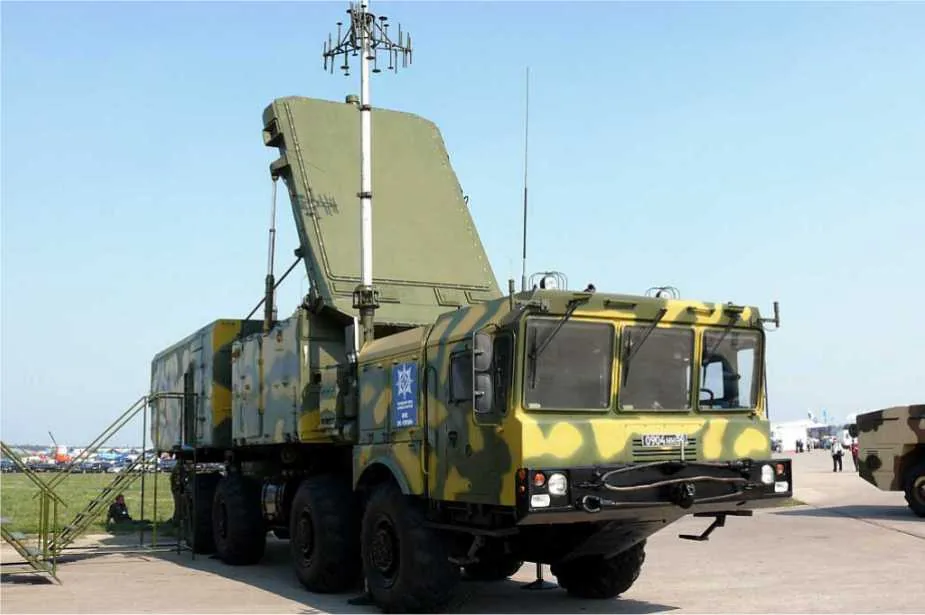
A 92N6E Grave Stone on its MZKT-7930 8x8 chassis at an outdoor air-show display, in a green, yellow and dark-green camouflage scheme. The flat, nearly square antenna face is raised and tilted back on its mount behind the cab, with the two equipment cabins behind it. A telescopic mast carrying a cluster of small antennas rises in front of the antenna face, and a thin whip antenna stands behind the cab. Metal boarding steps lead up to the rear cabin at left, a blue badge is fixed to the cab door, and parked aircraft and spectators are in the background.
Related articles: S-400, the system this radar serves; 91N6E Big Bird, the panoramic radar that hands it targets; S-300, home of its 30N6 Flap Lid and Tomb Stone ancestors; How PESA Radar Works and How AESA Radar Works, for the antenna physics; Nebo, the VHF / L / S cueing radar often attached to S-400 units; and S-500, whose 76T6 and 77T6 are the next generation of engagement radars.
WHAT IT IS
The 92N6E (92Н6Е), NATO reporting name Grave Stone (also written Gravestone), is the multifunction engagement radar of the S-400 Triumf (GRAU 40R6, NATO SA-21 Growler). Russian export material calls it a multifunction radar station (многофункциональная радиолокационная станция, MRLS). It is the radar that turns a target someone else has found into a missile shot: it searches a sector on cue or on its own, locks on, identifies, picks targets for engagement, solves the launch problem, captures the missiles after launch, guides them, triggers the warhead and assesses the result. Rosoboronexport lists exactly that chain of tasks for the 92N6E. [DOCUMENTED] (Radartutorial; Rosoboronexport S-400 page as indexed; S-400)
There is normally one 92N6E per fire unit (98Zh6E, the Russian divizion), and a fire unit has up to 12 launchers, often about eight in practice. The radar takes its targets from the 55K6E command post, which builds the air picture from the 91N6E Big Bird, any attached 96L6E all-altitude detector, and outside sensors. The Grave Stone does not build the long-range, all-round picture; it looks hard at a sector and runs the engagements in it. Because every launcher in the fire unit depends on it, it is also the most valuable single vehicle in a battery, and in Ukraine it has been hunted accordingly. [DOCUMENTED] (S-400; 91N6E; Militarnyi, September 2023)
Technically it is an X-band (NATO I/J band) passive electronically scanned array (PESA) of the space-fed, transmissive lens type. A feed horn behind the antenna shines microwave energy onto the back of a flat face packed with phase shifters, and the face steers the beam electronically, the same family idea as the American Patriot AN/MPQ-53. It is the direct descendant of the S-300P's 5N63 / 30N6 Flap Lid and 30N6E1 / 30N6E2 Tomb Stone, rebuilt with digital processing and a more powerful transmitter and carried on the Belarusian MZKT-7930 8x8 chassis. It is not an AESA, despite some secondary pages calling it one. [DOCUMENTED] (Radartutorial; Air Power Australia; How PESA Radar Works)
Almost every number below is a manufacturer, reference-work or press figure, not a measured result. The open sources disagree on its range, its channel count, its antenna size and even its index (92N6E or "92N2E"). Where they disagree, both figures are printed with their sources, and the conflict is labelled rather than averaged away.
QUICK FACTS
- Name: 92N6E (92Н6Е) export, 92N6 domestic; NATO Grave Stone. Sometimes listed as "92N2" or "92N2E" in Western reference works (status of that index CONTESTED). [DOCUMENTED]
- Role: multifunction engagement radar of an S-400 fire unit: sector search, lock-on, IFF, target selection, launch solution, missile capture, mid-course guidance, terminal illumination and track-via-missile, warhead initiation and kill assessment. [DOCUMENTED]
- Band: X-band, NATO I/J; 8.5 to 10.5 GHz (TRADOC listing via ARMSNET) or 8.5 to 10.68 GHz (Armada International, 2024). [DOCUMENTED; exact window CONTESTED at the margin]
- Antenna: space-fed transmissive lens PESA with monopulse feed, on a turntable; inherited from the 30N6 family, whose array is described with about 10,000 elements. The element count of the 92N6E itself is not published. [DOCUMENTED for the type; ESTIMATE for the element count]
- Range: 400 km instrumented (Armada; a 92N2 listing); about 340 km against large targets (Almaz-Antey brochure, as cited on this site); 300 km, 250 km export and 480 km "92N6A" on one reference page. [CONTESTED]
- Channels: 6 targets and 12 missiles (Radartutorial, the classic P-line figure); 100 tracks in track-while-scan with 6 in precision track (Indian and Ukrainian analyses, a 92N2 listing); battalion 10 targets and 20 missiles (Rosoboronexport; Almaz-Antey 2025). [CONTESTED]
- Chassis: MZKT-7930 8x8, Belarusian; the earlier Flap Lid and Tomb Stone used the MAZ-7910. [DOCUMENTED]
- Mast: the antenna post can be raised on a 40V6M or 40V6MD mobile tower (24 m and about 38 to 40 m antenna phase-centre height) to see low fliers farther out. [DOCUMENTED]
- Crew: three to four in the cabin, per one reference page. [SINGLE-SOURCE]
- In service: with the S-400, accepted 28 April 2007. [DOCUMENTED]
- Operators: every S-400 operator: Russia, China, Turkey, India and Belarus; Algeria reported but unconfirmed. [DOCUMENTED; Algeria UNVERIFIED]
DESIGNATIONS AND NAMES
92N6 and 92N6E. As with the 91N6E, the final "E" (Е, eksportny) marks the export version. Export equipment of this family is supplied without the Russian IFF system and may differ in some modes. No primary source opened for this article states exactly how the 92N6E differs from the domestic 92N6; the assumption that the export radar is somewhat reduced comes by analogy with the 91N6 and 91N6E. [SINGLE-SOURCE by analogy] (91N6E; S-300)
Grave Stone. The NATO name follows the family's naming: Flap Lid for the 5N63 and 30N6 of the original S-300P, Tomb Stone for the 30N6E1 and 30N6E2 of the S-300PMU-1 and PMU-2, and Grave Stone for the S-400's 92N6E. GlobalSecurity describes it simply as "the modified TOMB STONE engagement radar." [DOCUMENTED] (GlobalSecurity; Air Power Australia)
The "92N2E" problem. Carlo Kopp's Air Power Australia pages write "92N2E Grave Stone" in their S-400 sections and "92N6E Grave Stone" in their engagement-radar survey. Armada International (July 2024) writes "92N2E/6E," Global Defense Corp called the radar hit near Kreminna in April 2024 a "92N2," and an aggregator page (ARMSNET) carries a separate 92N2 entry with figures very close to the 92N6E's. Whether 92N2 is a typo, an older index, a domestic designation or a variant is not settled in any source opened here. This article uses 92N6E throughout and does not merge the 92N2 figures silently. [CONTESTED]
Typos to avoid. Radartutorial's Grave Stone page, which is otherwise a useful source, calls the Cheese Board "96N6E"; the correct index is 96L6E. The same page says that every missile has its own active radar seeker, which is not true of the 48N6 family (see below). [DOCUMENTED as errors] (Radartutorial)
WHAT IT IS FOR: ITS ROLE IN THE BATTERY
The division of labour. The S-400 is a specialised-sensor system. The S-band 91N6E sees far and all round but is not accurate enough to guide a missile; the 96L6E fills the low-altitude gaps; outside radars such as the Nebo-M cue against stealthy targets. The 92N6E is the precision instrument at the end of the chain. X-band gives it a narrow beam and fine angle measurement, and its electronically steered face lets it switch between many targets and missiles in microseconds, but only within the sector it is pointed at. [DOCUMENTED for the split] (S-400; 91N6E)
The official task list. Rosoboronexport's S-400 page, as indexed by a search engine for this article (the page itself returned a server error when fetched directly), lists the 92N6E's jobs as: searching for targets on target-designation data or autonomously; locking onto targets for automatic tracking, including in active and passive jamming, weather and ground clutter; determining the nationality of tracked targets (IFF); selecting targets for engagement; automatically solving the launch problem; preparing, launching, capturing, tracking and guiding the missiles; initiating the warhead with automatic assessment of the engagement; and automatically exchanging data with the 30K6E control system. The same page credits the 96L6E2 with handing the 92N6E target coordinates, and "coordinate support" for targets the 92N6E is already tracking. [DOCUMENTED as manufacturer statement] (Rosoboronexport)
Where it sits. In the export organisation, a 30K6E system has a command element (the 55K6E command post and the 91N6E) and up to six, or in some tables eight, 98Zh6E fire units. Each fire unit is one 92N6E, optionally a 96L6E and a 40V6M mast, and up to 12 launchers of the 5P85SE2 / 5P85TE2 or later 51P6E family. A Russian regiment usually fields two or three battalions. The numbers are disputed, and the disputes are explained in the S-400 article. [DOCUMENTED as brochure organisation; numbers CONTESTED]
Autonomy. A fire unit with its own 96L6E can fight alone if the command post is lost or the unit is detached, and the 92N6E can also search a sector by itself. Autonomous search with a narrow X-band beam is slow and short-ranged compared with a dedicated search radar, so it is a fallback, not the normal mode. The same autonomous sector-search ability was added to the 30N6 family with the S-300PM / PMU-1. [DOCUMENTED] (Rosoboronexport; Tekhnika i Vooruzhenie 2004 No. 10; Air Power Australia)
What it is not. It is not the low-altitude detector: Armada International's July 2024 description of the Grave Stone as "primarily tasked with detecting and tracking low altitude targets" conflicts with every other source, which give that job to the 96L6E (and earlier to the 76N6 Clam Shell). It is not a 360-degree surveillance radar, although one reference page claims "360-degree coverage"; that is the turntable's ability to point the face anywhere, not simultaneous all-round coverage. And it is not the radar that sees a target at 400 km on its own: the 400 km figure belongs to the 40N6 missile with outside cueing. [CONTESTED for the Armada and 360-degree claims; DOCUMENTED for the role split] (Armada; Army Recognition; S-400)
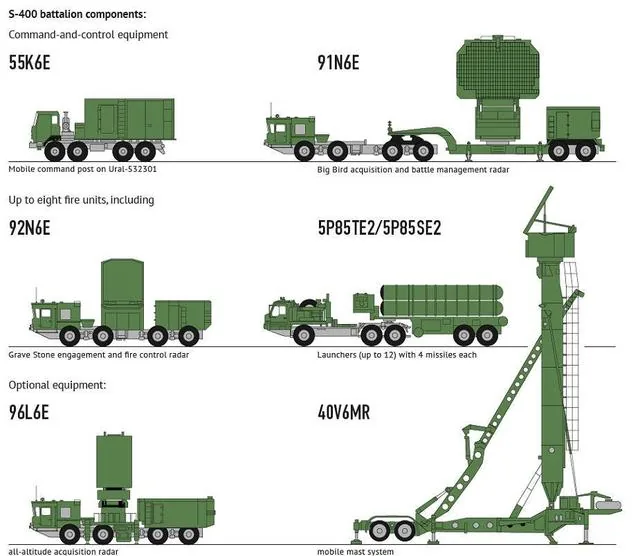
An English-language diagram headed "S-400 battalion components," drawing each vehicle in side view. Under "Command-and-control equipment": the 55K6E "Mobile command post on Ural-532301" and the 91N6E "Big Bird acquisition and battle management radar" on a tractor and semi-trailer. Under "Up to eight fire units, including": the 92N6E "Grave Stone engagement and fire control radar" on an 8x8 truck, and the 5P85TE2 / 5P85SE2 "Launchers (up to 12) with 4 missiles each." Under "Optional equipment": the 96L6E "all-altitude acquisition radar" and the 40V6MR "mobile mast system," drawn erected with an antenna post on top. The diagram's "up to eight fire units" is one side of the six-versus-eight conflict; other material says up to six.
DEVELOPMENT: FROM FLAP LID TO GRAVE STONE
The 5N63 Flap Lid A (1970s). The S-300P's first engagement radar, the 5N63 (later 30N6), was a generational break from the mechanically scanned Fan Song, Low Blow and Square Pair radars of earlier Soviet SAMs. Like the American MPQ-53 being developed for Patriot at about the same time, it used a transmissive, space-fed phased array with a monopulse horn feed behind the face, and it is widely described as influenced by the American design. The antenna stowed flat on the cabin roof, the cabin sat on a turntable that slewed the array onto a sector of interest, and the first version was a trailer towed by Ural or KrAZ 6x6 tractors. It guided the command-link 5V55K missile; commands went out on a special waveform from the main array rather than through a separate uplink antenna. [DOCUMENTED] (Air Power Australia, "Almaz S-300P ... S-400" and "Engagement and Fire Control Radars")
Self-propelled: 5N63S Flap Lid B (1982 onward). With the S-300PS the radar moved onto the 8x8 MAZ-7910, a MAZ-543 derivative, and became the 5N63S. Radar and launchers could now set up to fire in about five minutes and leave quickly after a shot, which was the point: American Wild Weasels and EF-111A jammers had made a fixed SAM site a short-lived one. The 5N63S could engage six targets with two missiles each, the classic P-line figure, and its beam steering was extended to cover a 90-degree sector without moving the turntable. The new 5V55R missile brought track-via-missile guidance, with a semi-active seeker that relays what it sees to the ground. [DOCUMENTED] (Air Power Australia; S-300)
30N6E1 and 30N6E2 Tomb Stone (1993 to 1997). The S-300PM and its export version, the S-300PMU-1, brought the larger 48N6 missile and a "deep modernisation" of most components. The engagement radar became the 30N6 / 30N6E1 Tomb Stone, with element-by-element phasing of the array, new receiving and processing equipment and a new computer, and it gained the ability to search a sector by itself while guiding missiles. The S-300PMU-2 Favorit followed in 1995 to 1997 with the incrementally improved 30N6E2. The manufacturer claimed the 30N6E1 could engage a target with a radar cross-section as small as 0.02 m², at an unstated range. [DOCUMENTED; RCS claim SINGLE-SOURCE] (Tekhnika i Vooruzhenie 2004 No. 10; Air Power Australia)
What the Tomb Stone looked like inside. The best open technical description of the family is David K. Barton's account of an S-300PMU-1 display, reproduced by Air Power Australia. He describes the 30N6E1 array as an X-band space-fed lens of 10,000 elements, tilted 30 degrees from the vertical, with a circular active portion and small sidelobe-canceller arrays inside the cover at the bottom of the main array. The array sits on a rotating turret behind the cab with the RF and IF equipment inside it, which avoids rotary joints and long waveguide runs. The feed uses circular polarisation, a polarising grid and a polarisation-sensitive reflector so that the Faraday-rotator ferrite phase shifters work reciprocally on transmit and receive, and the monopulse receive feed has six horns. The 92N6E is described as a redesign of this family, so these features are its heritage, but no equivalent description of the 92N6E has been published. [DOCUMENTED for the 30N6E1; ESTIMATE for carry-over to the 92N6E] (Barton via Air Power Australia)
Grave Stone (late 1990s to 2007). The S-400 began as the late-1980s Triumf project, was marketed for a time as the "S-300PMU-3," and reused about 70 to 80 percent of the S-300 design, including radars, according to CSIS following Jane's. The engagement radar evolved from the 30N6E2 into the 92N6E. Kopp describes the change as a "significant redesign" with fully digital processing, a "significantly uprated transmitter tube" for the higher power-aperture product that longer range needs, an improved exciter and automatic frequency hopping. Radartutorial says new processors and digital technology let the 92N6E "double the missile range" compared with the 30N6E; that is a catalogue inference, because missile range also depends on the missile. A Russian reference page says the radar uses an Elbrus-90 micro computer complex; that is a single source, consistent with the Elbrus-90 family this site already associates with the S-400. The S-400 was accepted for service on 28 April 2007, and the 92N6E with it. [DOCUMENTED for the lineage and service date; SINGLE-SOURCE for the doubling and the Elbrus-90 micro] (Air Power Australia; Radartutorial; vistat.org; Deagel; S-400)
Who designed it. Deagel and most sources give the S-400 radars to the Almaz-Antey concern, the successor of NPO Almaz, which designed the 30N6 family. One reference page (Army Recognition) says the 92N6 was developed by NIIDAR, the long-range radio-communications institute better known for early-warning radars, and that development "began in the early 2000s." Neither claim is supported by a primary source opened here, and the NIIDAR attribution conflicts with the Almaz lineage. [DOCUMENTED for Almaz-Antey as the system house; NIIDAR CONTESTED / UNVERIFIED]
After 2007. Open sources report software and processing updates for S-400 radars during the war, aimed at drones and jamming, but none describes a specific, verified 92N6E modification. The S-500 does not use the 92N6E; it introduces the 76T6 multimode engagement radar and the 77T6 anti-ballistic radar. See S-500. [DOCUMENTED for the S-500 radars; UNVERIFIED for specific 92N6E upgrades]
TECHNICAL SPECIFICATIONS
The table collects every published figure found for this article. Where sources conflict, all values are shown, with the source alongside. "Not published" means that no source opened for this article gives a figure. Figures marked as belonging to the 30N6 family are heritage values, not confirmed 92N6E values.
| Parameter | Published value(s) | Source and tag |
| Type | Multifunction engagement (illumination and guidance) radar, PESA | Radartutorial; Rosoboronexport [DOCUMENTED] |
| Band | X-band / NATO I/J; 8.5 to 10.5 GHz; 8.5 to 10.68 GHz | TRADOC ODIN via ARMSNET; Armada 2024 [DOCUMENTED; window CONTESTED] |
| Antenna type | Space-fed transmissive lens phased array, monopulse horn feed from the rear, ferrite phase shifters (30N6 heritage), low sidelobes | Radartutorial; Air Power Australia [DOCUMENTED] |
| Element count | Not published for the 92N6E; 30N6E1 array about 10,000 elements | Barton via Air Power Australia [ESTIMATE by heritage] |
| Antenna size | 4 x 2 m; "2.75 m² aperture" (a figure also given for the 30N6 Flap Lid B's planar array) | TRADOC via ARMSNET; ARMSNET 92N2 entry; Army Recognition (Flap Lid B) [CONTESTED] |
| Azimuth coverage | Electronic scan over a sector (5N63S: 90 degrees); the turntable points the sector anywhere in 360 degrees | Air Power Australia; Army Recognition [DOCUMENTED for the family; 92N6E sector width UNVERIFIED] |
| Elevation coverage | Not published for the 92N6E; 30N6E2 −3 to +60 degrees | Army Recognition / ARMSNET (30N6E2) [SINGLE-SOURCE, heritage] |
| Instrumented range | 400 km | Armada 2024; ARMSNET 92N2 [SINGLE-SOURCE each] |
| Detection range | About 340 km against large targets; 300 km (92N6), 250 km (92N6E), 480 km ("92N6A"); 1,000 km | Almaz-Antey brochure via this site; Army Recognition; vistat.org [CONTESTED; 1,000 km rejected as implausible for this radar] |
| Engagement range supported | Up to 380 km (40N6E, current export figure) or 400 km (older figure), with outside cueing | Rosoboronexport; Radartutorial; S-400 [DOCUMENTED as claims] |
| Altitude coverage | About 10 m (system) or 20 m (one reference page) up to 30 km | Rosoboronexport; Army Recognition [DOCUMENTED as published] |
| Target tracks | 100 in track-while-scan; 300; 20 | DRaS; ARMSNET 92N2; Militarnyi 2023; vistat.org; earlier reference cited on this site [CONTESTED] |
| Targets engaged at once | 6 | Radartutorial; DRaS; ARMSNET 92N2 [DOCUMENTED as published] |
| Missiles guided at once | 12 (two per target) | Radartutorial [SINGLE-SOURCE; matches the classic P-line figure] |
| Battalion channels | 10 targets / 20 missiles | Rosoboronexport; Almaz-Antey September 2025 [DOCUMENTED as manufacturer figure] |
| Max target speed | Up to 4,800 m/s (system figure) | Rosoboronexport [DOCUMENTED as published] |
| Transmitter | Tube-based, "significantly uprated" over the 30N6E2; a travelling-wave tube with variable pulse width in a 92N2 listing | Air Power Australia; ARMSNET 92N2 [SINGLE-SOURCE] |
| Peak and average power | Not published | [UNVERIFIED if quoted anywhere] |
| Waveforms, PRF, pulse width | Not published (Radartutorial's data table leaves every field blank) | Radartutorial [gap] |
| ECCM | Low sidelobes, sidelobe cancellers (30N6 heritage), automatic frequency hopping, "radical measures" against noise jamming | Radartutorial; Air Power Australia; vistat.org [DOCUMENTED as claims] |
| Computer | Elbrus-90 micro | vistat.org [SINGLE-SOURCE] |
| Deploy time | About 5 minutes from the march (S-400 battery brochure figure); 5 minutes for the 30N6E2; about 1 hour on a 40V6M mast, about 2 hours on a 40V6MD | S-400; Army Recognition; Air Power Australia [DOCUMENTED as cited] |
| Crew | 3 to 4 | Army Recognition [SINGLE-SOURCE] |
| Chassis | MZKT-7930 8x8 | Radartutorial; ru.wikipedia (MZKT data) [DOCUMENTED] |
| Vehicle dimensions | 12.7 x 3.0 x 3.29 m (complete vehicle, one page); bare chassis 12.669 x 3.07 x 3.017 m; 16 x 4 m | Army Recognition; MZKT data via ru.wikipedia; ARMSNET [CONTESTED] |
| Weights | Chassis curb weight 20.5 to 20.8 t and payload 22.2 to 24.2 t depending on sub-model; complete radar vehicle weight not published | MZKT data via ru.wikipedia; Army Recognition [DOCUMENTED for the chassis] |
| Road speed and range | 70 km/h; about 1,000 km on the chassis' fuel | MZKT data via ru.wikipedia [DOCUMENTED for the chassis] |
| Mast option | 40V6M (24 m phase centre) or 40V6MD (about 38 to 40 m) | Air Power Australia; S-300 [DOCUMENTED; exact height CONTESTED] |
| Unit cost | About USD 30 million domestic, USD 60 million export (a Ukrainian estimate) | SBU, December 2025 [SINGLE-SOURCE estimate] |
HOW IT WORKS: THE X-BAND SPACE-FED LENS, EXPLAINED PLAINLY
Why X-band. X-band is roughly 8 to 12 GHz, a wavelength of about 3 cm. A radar beam's width depends on the antenna's size measured in wavelengths, so a face a few metres across produces a pencil beam about three times narrower at X-band than at S-band (about 10 cm). A narrow beam measures angle precisely, puts more energy on the target, and is harder for a jammer off to the side to get into. The prices are more loss in rain and the problem of searching a large volume with a small beam, which is why the Grave Stone is handed a sector by the command post rather than asked to search the whole sky. [ESTIMATE / DOCUMENTED as general radar practice] (S-400; 91N6E)
The idea of a phased array. A flat face made of thousands of small radiating elements can point a beam without moving, if each element delays its signal slightly more than its neighbour. The delayed wavefronts add up in one direction and cancel elsewhere, and changing the delays moves the beam in microseconds. A passive array (PESA) does this with one central transmitter and a phase shifter at each element; an active array (AESA) puts a small transmit/receive module behind each element. The 92N6E is the passive kind. [DOCUMENTED] (How PESA Radar Works; How AESA Radar Works)
The space feed, or "lens." The usual way to feed a big array is a branching tree of waveguides that carries power to every element. The Flap Lid family does something simpler. A feed horn sits some distance behind the array and shines energy at its back face, like a lamp behind a sheet of frosted glass. Each element picks up its share from behind, passes it through its phase shifter, and re-radiates it from the front. Because the energy passes through the array, this is called a transmissive or lens array; the alternative, a reflective array, bounces it off a mirror of phase shifters. The space feed avoids a heavy waveguide tree across the whole face, which matters on a truck. Radartutorial describes the 92N6E as using "a transmission type of space feeded phased array antenna with a complex monopulse horn feed into the rear plane," and its Russian page adds that the horn has a round dielectric lens. [DOCUMENTED] (Radartutorial EN and RU; How PESA Radar Works)
Monopulse tracking. To guide a missile, the radar needs the target's angle to a small fraction of the beam width. A monopulse feed splits the received signal between several horns and compares them on every single pulse: the "sum" signal tells the radar there is a target; the "difference" signals in azimuth and elevation tell it how far the target is off the beam centre and in which direction. Because the measurement comes from one pulse, it is not fooled by a target or jammer whose strength fluctuates from pulse to pulse, a trick that defeated older scanning trackers. Barton describes the 30N6E1 feed as six horns, with the two centre horns each excited in two modes, the equivalent of a 12-horn feed. [DOCUMENTED for the family; carry-over to the 92N6E ESTIMATE] (Barton via Air Power Australia)
Low sidelobes. Every antenna leaks a little energy outside its main beam, in "sidelobes." Sidelobes are how a jammer off to one side gets into the receiver and how many anti-radiation missiles home on a radar that is not pointed at them. A space-fed lens can taper its illumination smoothly toward the edges of the face, which keeps sidelobes low, and the family also carries small auxiliary sidelobe-canceller arrays that cancel jamming arriving outside the main beam. Radartutorial says the 92N6E's antenna has "low sidelobes as protection against noise jammers and anti-radar missiles." No source publishes a sidelobe level in decibels. [DOCUMENTED as design features; UNVERIFIED for any number] (Radartutorial; Barton via Air Power Australia)
Time-sharing. A PESA with one transmitter generally forms one beam with one waveform at a time. The 92N6E therefore interleaves its jobs in very short time slices: a search look in the sector, a confirmation look at a new detection, track updates on each assigned target, an uplink to each missile in flight, and illumination for each semi-active missile near its target. The more targets and missiles it handles, the less time it has for each, which is one physical reason channel limits exist. Patriot's MPQ-53 works the same way. [DOCUMENTED as PESA practice] (How PESA Radar Works; S-400)
Doppler and clutter. The radar has to pick moving targets out of returns from the ground, the sea, rain and chaff. At about 9.5 GHz, a target closing at 300 m/s produces a Doppler shift of about 19 kHz (f = 2v/λ, with λ about 3.2 cm), roughly three times what the same target produces at S-band, so slow targets separate from clutter more easily. Barton describes the 30N6E1 using a high-repetition waveform with a 1,500 m unambiguous range, which allows unambiguous Doppler filtering to reject moving clutter such as rain, chaff and birds, much as the continuous-wave radars of the American Hawk did. Whether the 92N6E keeps that waveform is not published. [ESTIMATE for the arithmetic; DOCUMENTED for the 30N6E1 waveform] (Barton via Air Power Australia)
Why a PESA still matters in 2026. A passive array has real weaknesses compared with an AESA. If the tube or feed fails, the whole face goes down. Losses in the feed and phase shifters are paid on the way out and again on the way back. It forms one beam at a time, and its instantaneous bandwidth is limited. An AESA fails gracefully, can form several beams at once and is more flexible. But a well-built space-fed PESA is cheaper, uses mature tube technology, and was good enough for Patriot to use one for four decades; Patriot is only now replacing its MPQ-65 with the GaN AESA LTAMDS. Russia's next-generation engagement radars are on the S-500. [DOCUMENTED] (How PESA Radar Works; Patriot)
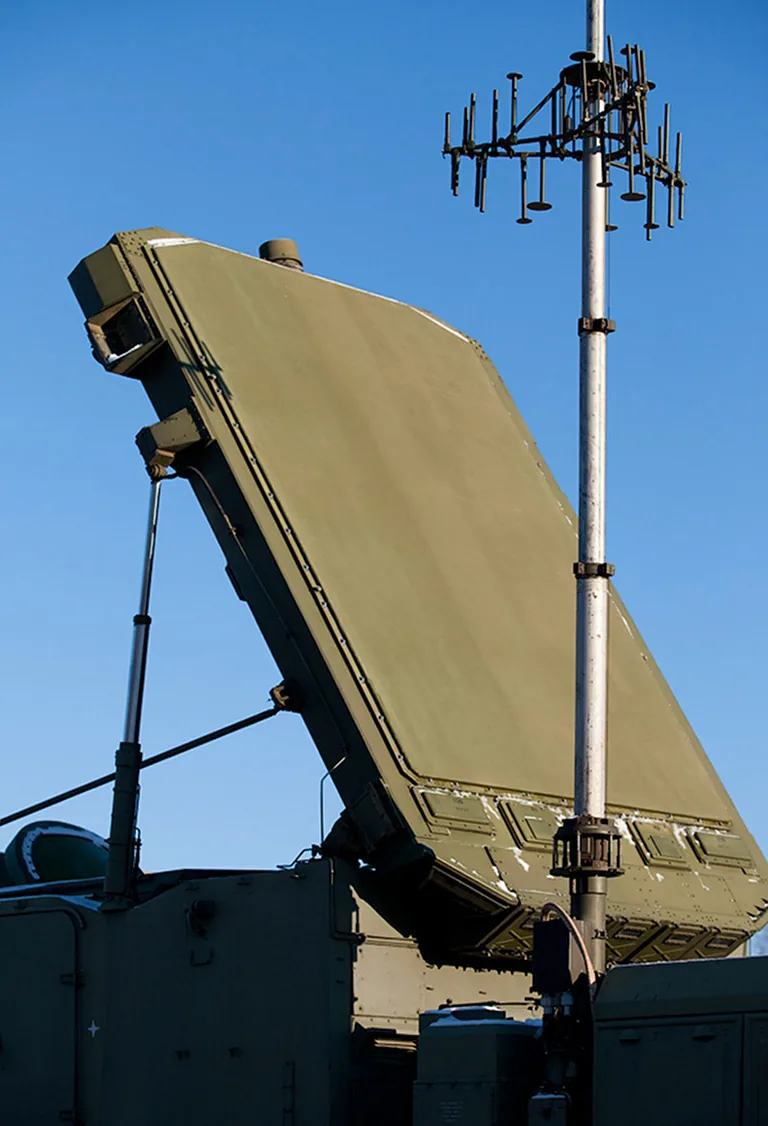
Close-up of a 92N6E antenna raised and tilted back against a blue sky. The face is a smooth, riveted cover; the lens elements behind it cannot be seen. A long strut runs from the cabin roof to the antenna's upper side, small box-shaped fittings sit on the upper corner of the frame, and a short cylindrical fitting stands on its top edge. The row of panels along the bottom edge is streaked with snow or frost. In front, a telescopic mast carries a ring of small vertical antennas. A rounded dome is just visible on the cabin roof at lower left; the photo does not show what it is.
THE ANTENNA POST, THE TURNTABLE AND MAST MOUNTING
On the truck. The antenna travels folded flat over the cabin and is raised hydraulically on arrival, then tilted back to its working angle. Barton gives 30 degrees from the vertical for the 30N6E1 array; Army Recognition describes the Flap Lid B array raised to about 60 degrees above the container, which is the same geometry measured from the horizontal. The antenna assembly sits on a turntable behind the cab, so the crew can swing the electronically scanned sector to face the threat axis. A separate telescopic mast carries communications and auxiliary antennas. Mounted this way, the antenna's phase centre is only a few metres above the ground; this article's horizon figures use 10 m for a truck-mounted antenna, the same reference height used on this site's S-400 and 91N6E pages, because no source gives the 92N6E's exact figure. [DOCUMENTED for the family; 10 m an assumed reference height] (Barton via Air Power Australia; Army Recognition; photos on this page)
Why raise it at all: the radio horizon. Microwaves travel in straight lines, bent only slightly by the atmosphere, so a radar cannot see a target hidden below the curve of the Earth, however powerful it is. With standard refraction the radio horizon is approximately d (km) ≈ 4.12 × (√hradar + √htarget), with both heights in metres. A cruise missile, a helicopter or a strike aircraft flying at 30 to 100 m stays below the horizon of a truck-mounted antenna until it is only a few tens of kilometres away, while a high aircraft can be seen hundreds of kilometres out. The only fix is to put the antenna higher, and that is what the 40V6 masts are for: they let the engagement radar see a low flier, and start tracking it for a missile shot, a few kilometres farther out, which at cruise-missile speeds means tens of extra seconds. [ESTIMATE for the arithmetic; formula as used in 91N6E and S-400]
| Antenna phase-centre height | Target height | Radio horizon (approx.) | What it means |
| 10 m (antenna on the truck) | 30 m (low cruise missile) | About 36 km | At 250 m/s, under two and a half minutes of warning |
| 24 m (40V6M) | 30 m | About 43 km | About 7 km gained |
| 39 m (40V6MD class) | 30 m | About 48 km | About 13 km gained |
| 10 m | 100 m (low-flying aircraft or helicopter) | About 54 km | The baseline for low-altitude coverage |
| 24 m (40V6M) | 100 m | About 61 km | About 7 km gained |
| 39 m (40V6MD class) | 100 m | About 67 km | About 13 km gained, still far short of the brochure ranges |
| 10 m | 10,000 m (high bomber or AWACS orbit) | About 425 km | Only a high target is above the horizon at 400 km |
The 10 m, 24 m and 39 m rows match the worked examples on this site's S-400 page (54, 61 and 67 km against a 100 m target). A 40 m mast, the figure in some Russian literature, adds only a few hundred metres to the 39 m row. The table is this article's own arithmetic, not a manufacturer figure, and it also explains why the Grave Stone's long published ranges only make sense against high targets. [ESTIMATE]
The 40V6 masts. The 40V6 family of universal mobile masts (универсальная передвижная вышка) was designed and built by Novokramatorsky Mashinostroitelny Zavod (NKMZ) in Kramatorsk, Ukraine, from about 1980, first to lift the S-300PT's 5N63 Flap Lid, 36D6 Tin Shield and 5N66 / 76N6 Clam Shell above forests and uneven ground. The two common versions are the 40V6M and the taller 40V6MD. Russian literature cites 24 m and 40 m, which Kopp says refer to the height of the antenna phase centre rather than the tube itself (about 78 ft and 127 ft); other sources give 23.8 m for the short mast and figures from about 37.8 to 40 m for the tall one, and this site's S-300 article gives "about 24 to 39 m" for the series. The masts are built to carry radar heads of 10 tonnes or more in winds of about 30 m/s while radiating and about 50 m/s erected but idle. Kopp and Air Power Australia both say the 40V6M and 40V6MD "remain a cited option" for the S-400's Grave Stone (written "92N2E" there) and the 96L6E, and the Ukrainian infographic on this site's S-400 page shows a "mobile 40V6M tower for the 92N6E antenna post." [DOCUMENTED; exact heights CONTESTED] (Air Power Australia, "40V6M/40V6MD Universal Mobile Mast" and "Almaz S-300P ... S-400"; S-400)
What "40V6MR" means. The string "40V6MR," used on the diagram on this page, is not a radar. It is most likely the mast sub-type 40V6M-R (40В6М-Р) written without its hyphen; Kopp notes that Russian publications on military tractors cite 40V6M-R and 40V6M-R0 variants with no published details. Some aggregator databases have started treating "40V6MR" as if it were a low-altitude radar; that is a misreading. A newer mast, the 40V6MT, was disclosed by the Russian Ministry of Defence in 2011 for late S-400 units and the S-500, towed by a BAZ-6403.01; its height and erection time are not published. [SINGLE-SOURCE for the variants; DOCUMENTED for the 40V6MT disclosure] (Air Power Australia)
How the mounting works. The mast's base is a rigid frame built as a semi-trailer, towed in Russian service by a MAZ-537 or newer BZKT tractors. At the site, the crew positions the trailer, unhitches the tractor, swings out and locks the outriggers, attaches the radar head to the top of the mast through a common adaptor, and raises the mast hydraulically before locking it. A cable duct runs up the mast to the head, and a rotating coupling lets the head turn through 360 degrees, so a masted engagement radar can still slew its sector. On the 40V6MD the upper section, carried on a separate 5T58-2 transporter, has to be fitted by crane first. Only heads with the adaptor and within the weight limit can be used. [DOCUMENTED] (Air Power Australia)
What goes up, and what stays down. On the older Flap Lid the split is documented: the 5N63's antenna head module (F1) went on the mast while the operator consoles stayed in the F2 cabin on a truck, and the self-propelled 5N63S kept the same arrangement, with its F1S head on the mast and the F2S module on the MAZ-7910. The exact procedure for the 92N6E, meaning how its antenna post is detached from the MZKT-7930 and how far the cabin can sit from the mast, is not described in any source opened here. By analogy with the Flap Lid, the antenna post goes up and the crew cabin stays on the ground, linked by cable. [DOCUMENTED for the 5N63 / 5N63S; ESTIMATE for the 92N6E] (Air Power Australia)
The cost in time. A truck-mounted 92N6E can be working in minutes. A mast cannot: Kopp gives about one hour to erect a head on the 40V6M and about two hours on the 40V6MD. A masted Grave Stone is therefore a semi-fixed site, suited to defending a city, base or coastline, and far more exposed to a strike cycle than a shoot-and-scoot battery. Kopp argues that a one-to-two-hour relocation cycle can still beat the targeting cycle of most cruise-missile attacks when the site is defended by point-defence systems, which is a judgement, not a measurement, and one the drone war in Ukraine has tested hard. [DOCUMENTED for the times; ESTIMATE for the survivability argument] (Air Power Australia)
In the photographs. None of Robert's 92N6E photographs on this page shows the radar raised on a mast; all show it on its truck. The photograph below shows a flat-panel engagement-radar head on a 40V6-family mast at an S-300 site. It illustrates the arrangement, but the head in it is probably an S-300-era 30N6, not necessarily a Grave Stone.
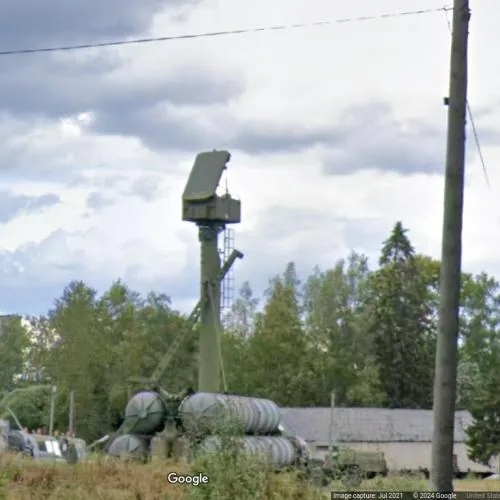
A Google Street View capture (image dated July 2021) taken from a roadside across a field. A flat-panel radar head is raised on top of a tall mobile mast of the 40V6M type, which has a diagonal brace near its base; a slim lattice tower stands behind it. In the foreground, partly hidden by grass, are large cylindrical missile containers of an S-300-family launcher. The head has the flat, tilted face of a 30N6-family or 92N6E fire-control radar; the S-300 containers next to it suggest a 30N6, but the photo alone does not identify the radar or the site. It is shown here to illustrate how such a head sits on the mast.
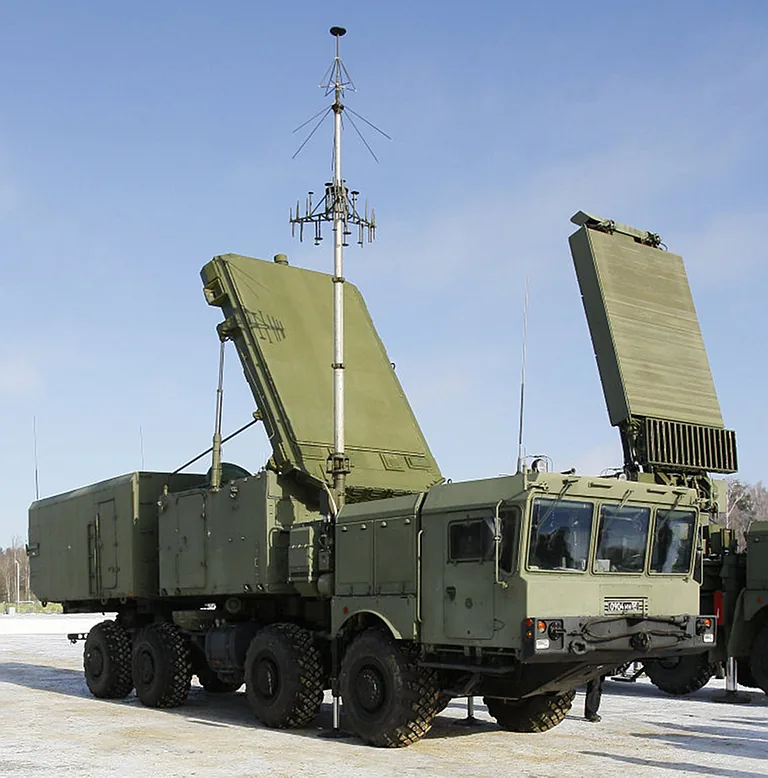
A plain green 92N6E on its MZKT-7930 8x8 on snow-covered ground, with the antenna raised and tilted back and the telescopic communications mast fully extended in front of it. The mast carries a ring of small vertical antennas and, at the top, a set of angled wire elements. Levelling jacks are lowered under the vehicle. Behind it at right, a second radar vehicle has a tall, slatted rectangular antenna raised above a grille-like base; its shape matches the 96L6E, but the photo alone does not identify it.
HOW IT TRACKS AND GUIDES MISSILES
Handoff. The 55K6E command post assigns a target to the fire unit and sends its coordinates. The 92N6E points a search pattern at the predicted position, acquires the target and forms a precision monopulse track. It runs IFF itself, as the Rosoboronexport task list states. A common open-source mistake is to treat the Big Bird's acquisition track as if it were accurate enough to guide a missile; the whole reason for the Grave Stone is that it is not. [DOCUMENTED] (Rosoboronexport; S-400)
Launch and capture. The launcher fires on command, cold and vertically: a gas generator throws the missile clear of its container before the motor lights, and the missile turns over toward the intercept point. The 92N6E then has to capture the missile, find it in its beam and start tracking it, because it cannot guide what it cannot see. That step appears explicitly in the Rosoboronexport task list. [DOCUMENTED] (S-400; Rosoboronexport)
Command guidance and mid-course. In the basic mode, the radar tracks both target and missile and sends steering commands to the missile. The Flap Lid family does this through a special waveform from the main array, since its vehicles carry no separate directional uplink antenna. On long shots the missile flies an inertial or pre-computed path with radio corrections from the 92N6E. An Indian analysis describes the radar as able to "control missiles with direct command link mode as well as the semi-active homing guidance mode," plus track-via-missile. [DOCUMENTED for the family; SINGLE-SOURCE for the Indian description] (Air Power Australia; DRaS)
Track-via-missile (TVM). The 48N6 family carries a semi-active seeker. The 92N6E illuminates the target; the seeker receives the reflection and relays what it sees back to the ground; the ground computer, with far more processing power than the missile, combines that with its own track, calculates the guidance and sends commands back up. Because the measurement is made close to the target, it stays accurate at long range, where the ground radar's own angle error grows. This is the same idea as Patriot's TVM and goes back to the S-300PS's 5V55R. Illumination has to continue until intercept. [DOCUMENTED] (S-400; S-300; Air Power Australia)
Active-seeker missiles. The 9M96E and 9M96E2 carry their own active radar seekers. The 92N6E guides them in mid-course and hands over; in the last phase the missile illuminates the target itself, and the ground radar no longer has to. The 40N6 is described as active or semi-active, with a seeker switch-on late in flight that would let it be launched on outside data at a target the 92N6E cannot see over the horizon; the details are thin. Radartutorial's line that "every missile is fitted with an active radar sensor" is wrong: TVM and an active seeker are different things, and the 48N6 family is semi-active TVM. [DOCUMENTED for 9M96 and 48N6; SINGLE-SOURCE / UNVERIFIED for 40N6 detail] (S-400; Radartutorial)
Fusing and kill assessment. The radar's job does not end at intercept. Rosoboronexport lists ensuring the warhead's detonation "with automatic assessment of the engagement." The blast-fragmentation warheads go off on a proximity fuze; the radar watches the result and the command post decides whether to fire again, with two-missile salvos standard against hard targets. There is no public, verified kill probability from combat. [DOCUMENTED for the task; UNVERIFIED for any Pk] (Rosoboronexport; S-400)
How many at once? The sources do not agree, and their figures describe different things. The table keeps them apart. [CONTESTED]
| Figure | What it describes | Source | Tag |
| 6 targets / 12 missiles | One radar, two missiles per target; the classic P-line figure since the 5N63S | Radartutorial (for the 92N6E, "12 missiles of type 40N6 against 6 aims"); Air Power Australia (5N63S); S-300 | [DOCUMENTED as published] |
| 100 tracks, 6 in precision track | One radar, track-while-scan versus engagement tracks | DRaS (India); Militarnyi (2023); ARMSNET (92N2) | [SINGLE-SOURCE each] |
| 20 tracked targets | One radar | One reference cited in earlier versions of this site's S-400 article | [SINGLE-SOURCE] |
| 300 tracks | One radar | vistat.org | [UNVERIFIED; the 91N6E's figure, probably confused with it] |
| 10 targets / 20 missiles | One battalion (fire unit) | Rosoboronexport; Almaz-Antey, September 2025 | [DOCUMENTED as manufacturer figure] |
| 36 targets / 72 missiles | Whole system (six fire units of 6 / 12) | Brochure figure cited on this site; Deagel (36) | [DOCUMENTED as brochure] |
| 80 targets / 160 missiles | Whole system "in full composition" (eight fire units of 10 / 20) | Rosoboronexport page as indexed, November 2026 | [SINGLE-SOURCE; not fetched directly] |
Read together, the figures are less contradictory than they look. Six targets with two missiles each, times six fire units, gives the old 36 / 72 system figure. Ten targets with 20 missiles per battalion, times eight fire units, gives the newer 80 / 160. The 100 figure counts tracks kept in track-while-scan, not engagements. That reading is this article's own arithmetic, not a manufacturer explanation, and it implies that per-radar engagement capacity grew from six to ten targets at some point, which no source states directly. [ESTIMATE]
INSIDE THE CABIN: CREW AND CONTROLS
Layout. The vehicle carries the antenna post on its turntable behind the cab, with equipment cabins behind it (the photos on this page show two box bodies) holding the radar electronics, signal processing, computer, communications and operator positions. Army Recognition says the crew compartment holds three to four people with control panels, displays and communications, and that the electronics sit in weatherproof enclosures with cooling. No official crew figure has been found. [SINGLE-SOURCE for the crew; DOCUMENTED for the visible layout] (Army Recognition; photos on this page)
What the crew does. Automation is the selling point: Rosoboronexport stresses automatic launch solutions, automatic data exchange with the 30K6E and automatic engagement assessment. In practice the crew sets up and levels the vehicle, aligns it, checks links with the command post and launchers, chooses the sector and modes, supervises target allocation and IFF, and decides on re-engagement when the command post delegates it. The heritage shows in Barton's description of the S-300PMU-1 command post, where data on up to 36 targets was "assigned (six each) to the six Flap Lids" by officers passing them on in priority order. Russian crew procedures and training standards are not public. [DOCUMENTED for the automation claims and the PMU-1 layout; ESTIMATE for crew duties] (Rosoboronexport; Barton via Air Power Australia)
Power. Like the rest of the S-400, the radar draws power from support vehicles (the 30Ts6E set includes 5I57 diesel generators and 63T6 converters). How exposed that makes it was shown on 2 November 2025, when Ukrainian military intelligence (HUR) said it destroyed a 92N6E together with the generator vehicle of an S-400 command post in Crimea. [DOCUMENTED as reported] (S-400; HUR via Euromaidan Press)
THE MZKT-7930 CHASSIS
The truck. The MZKT-7930 Astrolog is an 8x8 special wheeled chassis from the Minsk Wheeled Tractor Plant (MZKT) in Belarus, in the 17.8 to 25 tonne payload class. It carries a long list of Russian systems, including the Iskander-M launcher and loader, the Bal and Bastion coastal missiles, the Uragan-1M rocket launcher, the antenna posts of the S-400 and, in prototype, the S-500. On the S-400 it carries the 92N6E, the 96L6E and the 91N6E's tractor. It is the easiest visual difference between a Grave Stone and its MAZ-7910-mounted Tomb Stone ancestor. [DOCUMENTED] (ru.wikipedia, "МЗКТ-7930," citing MZKT data; Radartutorial)
Published chassis data. The base MZKT-7930 is 12,669 mm long, 3,070 mm wide and 3,017 mm high, with a curb weight of 20,800 kg, a payload of 22,200 kg and a gross weight of 43,300 kg. It has a YaMZ-846 V8 diesel of 370 kW (503 hp), a top speed of 70 km/h, a range of about 1,000 km on two 385-litre tanks, a 55 percent gradient, 1.4 m fording depth and 2.0 m trench crossing, and it can be carried by An-22 and An-124 aircraft. The MZKT-7930-300 and MZKT-79306 sub-models have payloads of about 24 tonnes. Army Recognition gives the complete 92N6 vehicle as 12.7 m long, 3.0 m wide and 3.29 m high, 20.5 t empty with a 24 t payload, which matches the later sub-models. ARMSNET gives 16 m by 4 m, which matches no chassis figure and is probably a different measurement or an error. [DOCUMENTED for chassis data; vehicle dimensions CONTESTED] (ru.wikipedia; Army Recognition; ARMSNET)
The trailer confusion. Radartutorial, copied word for word by ARMSNET, calls the 92N6E "trailer-mounted" in its first sentence and then says it is mounted on the MZKT-7930. Every photograph on this page shows an integrated 8x8 vehicle with the antenna and cabins on the truck itself. The "trailer" wording probably comes from the towed 5N63 of the 1970s. [DOCUMENTED from the photos; CONTESTED in the text sources] (Radartutorial; ARMSNET)
A Belarusian dependency. The chassis is built in Minsk, and Belarus is itself an S-400 operator. For export customers, chassis spares are one more supply chain that runs through Russia's closest ally, alongside the radar electronics and software. [DOCUMENTED for the origin; ESTIMATE for the implication] (S-400)
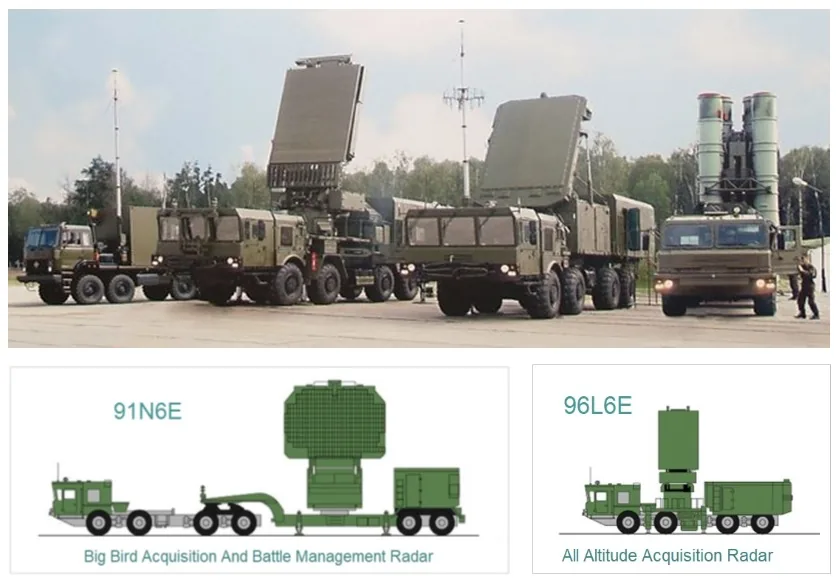
A composite image. Top: a line-up of S-400 vehicles on a paved area in front of trees. From left: a truck with a tall telescopic mast; an MZKT-7930 with a tall, upright rectangular antenna over a box-like base, which matches the 96L6E drawing below; an MZKT-7930 with a flat, tilted antenna face and a mast with an antenna cluster beside it, the 92N6E's shape; and at right a launcher with its four missile containers raised vertical. Bottom: two side-view drawings, one labelled "91N6E, Big Bird Acquisition And Battle Management Radar" showing a tractor and semi-trailer, the other "96L6E, All Altitude Acquisition Radar." The 92N6E itself is not drawn in the lower panels.
VARIANTS AND RELATIVES
- 92N6: the domestic Russian radar. Army Recognition gives it a range of up to 300 km and 100 tracks. [SINGLE-SOURCE for the figures]
- 92N6E: the export version, supplied with the S-400s of China, Turkey, India and Belarus. Army Recognition gives it a reduced range of 250 km, which conflicts with the 400 km instrumented figure other sources attach to the 92N6E. [DOCUMENTED for the export role; range CONTESTED]
- "92N6A": described by Army Recognition as an upgrade with better anti-jamming and processing and a range of up to 480 km. No other source opened for this article mentions it, and a 480 km engagement radar would make sense only against very high targets, given the horizon limits above. [UNVERIFIED]
- "92N2" / "92N2E": the alternative index discussed above. [CONTESTED]
- Predecessors: 5N63 / 5N63S Flap Lid A and B (S-300PT / PS), 30N6 and 30N6E (S-300PS / PMU), 30N6E1 and 30N6E2 Tomb Stone (S-300PMU-1 / PMU-2). A TRADOC entry lists the 30N6E2 at 9 to 9.5 GHz with a 3.8 x 2.5 m antenna. [DOCUMENTED] (S-300; ARMSNET / TRADOC)
- Foreign relative: China's HT-233 engagement radar for the HQ-9 has long been regarded as a derivative of the 30N6E family, with a space feed that "appears indistinguishable from the 30N6E1 design," on a heavier 10x10 chassis. See the comparison below. [DOCUMENTED as analyst assessment] (Air Power Australia, "HQ-9 and HQ-12 SAM System Battery Radars")
- Successors: on the S-500, the 76T6 multimode engagement radar and the 77T6 anti-ballistic radar. One Russian reference site also says the S-400 could use a Podlet-family 48Ya6K1 low-altitude radar on a mast; that is a detection radar, not a replacement for the 92N6E's guidance role. [DOCUMENTED for the S-500; SINGLE-SOURCE for Podlet] (S-500; invoen.ru)
VULNERABILITIES
A single point of failure. One engagement radar serves up to a dozen launchers. Militarnyi put it bluntly in 2023: "the destruction of the radar disables the entire battery." Missiles that need illumination cannot be fired without it. That is why Ukrainian forces have often gone for the radar first, as in the reported sequence at Yevpatoria in September 2023, where drones hit "the radar and antennas" before Neptune missiles hit the launchers. [DOCUMENTED as reported] (Militarnyi, September 2023)
It has to emit. Every 48N6 engagement needs continuous X-band illumination until intercept. That emission can be detected and located by electronic intelligence and, in principle, exploited by anti-radiation missiles. Low sidelobes and a narrow beam make it harder to detect from outside the beam, but anything in the main beam sees it clearly. Active-seeker 9M96 and 40N6 shots shorten the emission window, if those missiles are loaded. [DOCUMENTED as the guidance split] (S-400; Air Power Australia)
A sector, not a sphere. The electronically scanned sector covers a fraction of the horizon. Attacks from several directions at once, or from behind the face, force the turntable to swing or the command post to pass the target to another unit. Patriot's older radars share the limitation, which is why the US built LTAMDS. [DOCUMENTED for the class] (Air Power Australia; Patriot)
The horizon, the mast and the ground. Against low targets the Grave Stone sees only a few tens of kilometres from the truck, and a mast that buys 7 to 13 km more takes one to two hours to erect and pins the radar in place. Small, slow drones sit close to the clutter notch, and cheap ones are a poor trade for expensive missiles. [ESTIMATE / DOCUMENTED as physics] (S-400; Air Power Australia)
Size, signature and value. It is a large, distinctive vehicle, recognisable from the air and in satellite imagery, and worth about USD 30 million by a Ukrainian estimate. In Ukraine, radars of this class have been hit by long-range drones, drones launched from sea drones, HIMARS rockets, ATACMS and Neptune cruise missiles, and the Pantsir and Tor escort layer that should protect it has itself been stretched and hit. Netting and camouflage, visible on the radar hit at Belbek in December 2025, are one response. [DOCUMENTED as the pattern] (SBU via Ukrainska Pravda; TWZ; S-400)
Caught on the move. The July 2023 loss in Kherson region was a 92N6E photographed after a HIMARS strike in the transport position, apparently caught moving to a new site. Mobility protects a radar only if the move itself is not watched. [DOCUMENTED as reported with photographs] (Militarnyi, September 2023)
Jamming. The 92N6E is credited with frequency hopping, sidelobe cancellation and measures against noise jamming. No open source quantifies any of it, and "unjammable" claims are marketing. [DOCUMENTED for the claims; UNVERIFIED for effect] (Air Power Australia; vistat.org)
LOSSES IN UKRAINE, 2022 TO 2026
The list gives reported hits on radars identified as a 92N6 or 92N6E, in date order. Each is a claim by the named source unless noted. Several were not independently geolocated, a "92N6" on video can be a 96L6 under netting, and there is no audited count of 92N6E losses. Oryx's visual count, as cited by Militarnyi on 9 August 2026, is a floor of at least 30 S-400 launchers lost (29 destroyed, 1 damaged); it is not a radar count, and the live Oryx list was not re-checked for this article. [SINGLE-SOURCE per item]
- August 2022: Ukraine said a 92N6E was destroyed in Kherson region. [SINGLE-SOURCE] (as compiled in S-400)
- October 2022: an S-400 radar was "presumably" hit near Belgorod airport; the type was not given. [SINGLE-SOURCE] (Militarnyi, September 2023)
- July 2023: a HIMARS strike in Kherson region destroyed a 92N6E and a 5P85SM2-01 launcher, both photographed in the transport position. This is among the best-documented losses. [DOCUMENTED with photographs as published by Militarnyi]
- 14 September 2023: near Yevpatoria, Crimea, according to Ukrainian special-services sources, SBU drones first hit the radar and antennas of an S-300 / S-400 position, then two Neptune missiles hit the launchers. The radar type was not specified. [SINGLE-SOURCE] (Militarnyi, September 2023)
- 23 April 2024: a HIMARS strike on a 92N6 and a 96L6 was reported, with photographs shared by the Ukrainian official Andriy Kovalenko from near Kreminna; Global Defense Corp called the radar a "92N2." [SINGLE-SOURCE] (Dialog.ua, 24 April 2024; Global Defense Corp; S-400)
- 15 May 2024: after an ATACMS strike on Belbek airbase, ground photographs shared online appeared to show a destroyed 92N6E, as reported by TWZ. [SINGLE-SOURCE; not geolocated here] (TWZ)
- 1 to 2 November 2025: HUR said its Department of Active Operations destroyed a 92N6E and the generator vehicle of an S-400 battalion command post on combat duty in Crimea, on the same night as hits on AORL-1AS and P-18 radars, and released thermal-camera video. [SINGLE-SOURCE, with video] (Euromaidan Press; Kyiv Post; Oboronka)
- 17 to 18 December 2025: the SBU's Alpha group said its long-range drones hit a 92N6 at Belbek, along with two Nebo-SVU radars, a Pantsir-S2 and a MiG-31. The SBU valued the radar at USD 30 million domestic and USD 60 million export. TWZ noted that the radar was under netting and could have been a 96L6. [SINGLE-SOURCE; identification CONTESTED] (Ukrainska Pravda; TWZ)
- 2026, date not given in the compilation used: a Kyiv Independent report described SBU drone hits on launchers, a 96L6 and a 92N6 near Novorossiysk. [SINGLE-SOURCE] (as compiled in S-400)
- 13 to 14 September 2026: the Ukrainian General Staff said its forces struck a 92N6 multifunction radar of an S-400 at Sochi, Krasnodar Krai, with the results still being assessed. [SINGLE-SOURCE] (Interfax-Ukraine; Hromadske; Ukrinform; Ukrainska Pravda, 14 September 2026)
What the pattern shows. The individual claims vary in quality, but the pattern is clear and documented across many reports: Ukraine treats the S-400's radars, the 92N6E among them, as priority targets, and reaches them deep in Crimea and Russia with drones and missiles. A drone traded for a radar worth tens of millions of dollars is this war's lesson for the system. The list stops at the latest item found on 14 November 2026. [DOCUMENTED as the pattern]
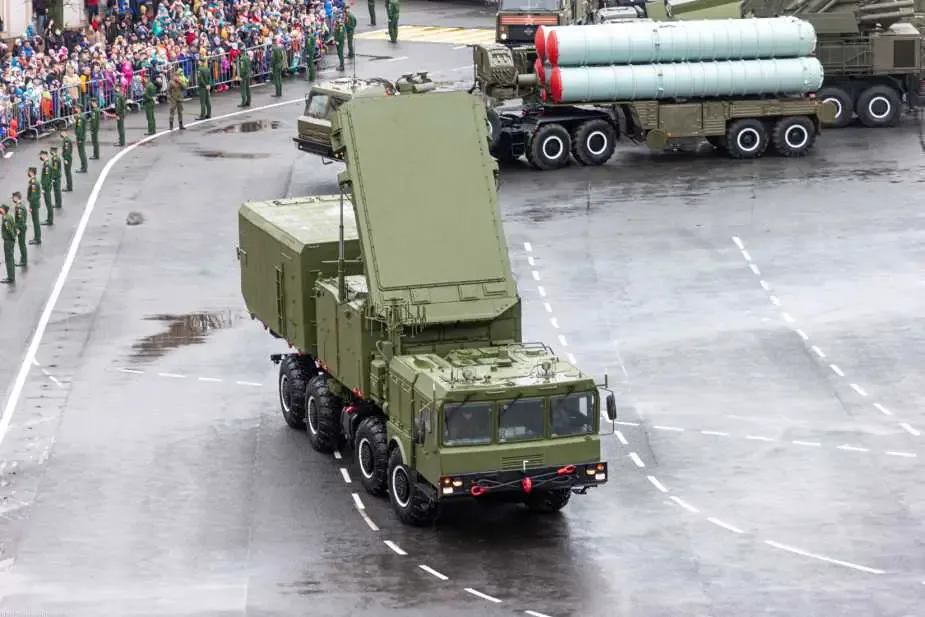
A 92N6E on its 8x8 chassis driving along a wet parade square with its antenna raised. Soldiers in green uniforms line the route and spectators stand behind barriers at upper left. Behind it, a launcher carries its missile containers lowered horizontal for travel, with red end caps, and other vehicles are partly visible at the top of the frame.
COMPARISON
The table compares the 92N6E with its predecessor, the American engagement radars it is most often set against, and its Chinese relative. All figures are published or reference-work figures, not test results, and range figures cannot be compared unless the target size is known. Patriot figures follow this site's Patriot article.
| 30N6E2 Tomb Stone | 92N6E Grave Stone | Patriot AN/MPQ-65 | LTAMDS | HQ-9 HT-233 |
| System | S-300PMU-2 Favorit | S-400 | Patriot PAC-3 | Patriot (successor radar) | HQ-9 / FD-2000 |
| Band | X-band, NATO I/J; 9 to 9.5 GHz (TRADOC) | X-band, NATO I/J; 8.5 to 10.5 or 10.68 GHz | C-band | Primarily C-band | Lower X-band or C-band (sources differ) |
| Antenna | Space-fed lens PESA, about 10,000 elements (30N6E1); 3.8 x 2.5 m (TRADOC) | Space-fed lens PESA; element count not published; 4 x 2 m (TRADOC) | Space-fed lens PESA, about 5,000 elements; second TWT added | GaN AESA, one main array and two rear arrays | Space-fed PESA, about 4,000 phase shifters |
| Coverage | Electronic sector on a turntable; −3 to +60 degrees elevation (one source) | Electronic sector on a turntable | About a 120-degree sector | 360 degrees at once | Turntable, 360-degree field of regard; 0 to 65 degrees elevation |
| Published range | About 300 km detection (one source) | 400 km instrumented; 340 km large target; 250 to 480 km on one page | About 170 km maximum detection, about 100 km instrumented (open sources) | More than 100 km (open sources) | 150 / 100 km detect / track (Air Power Australia) or about 120 / 90 km (MDAA) |
| Channels | 100 detected, 6 engaged (one source) | 6 / 12 per radar; 100 tracks; battalion 10 / 20 | More than 100 tracks; several engagements | Not published | More than 50 tracked (claimed) |
| Guidance supported | Command, TVM, semi-active illumination | Command, TVM, semi-active illumination, mid-course for active missiles | TVM (PAC-2 family); mid-course for active PAC-3 | Mid-course for PAC-3 MSE and others | Command link; terminal illumination disputed |
| Mast option | 40V6M / MD | 40V6M / MD | None | None | Not reported |
| Chassis | MAZ-7910 8x8 | MZKT-7930 8x8 | M860 semi-trailer | Trailer | TAS5501 10x10 (production) |
| Status | Older export standard | In service since 2007 | In service, being replaced | Low-rate production since April 2025; full rate expected late fiscal 2028 | In service |
| Tag | [DOCUMENTED; figures SINGLE-SOURCE] | [DOCUMENTED; figures CONTESTED] | [DOCUMENTED as published] | [DOCUMENTED as published] | [DOCUMENTED as analyst figures] |
Reading the table. The 92N6E, the MPQ-65 and the HT-233 are the same generation of idea: one space-fed passive face per fire unit, aimed at a sector, doing track, guidance and illumination. The Russian and Chinese radars work at X-band, which gives a narrower beam for a given size; Patriot chose C-band, which suffers less in rain and searches more volume per unit of time. The real break is LTAMDS, an AESA that sees all round at once with three faces. The S-400's answer to the 360-degree problem lies in the architecture rather than in the engagement radar: the 91N6E and 96L6E watch all round, and the 92N6E is pointed where it is needed. [DOCUMENTED for the architectures; ESTIMATE for the assessment] (Patriot; Air Power Australia; Raytheon; Breaking Defense)
CONFLICTING FIGURES
| Item | One figure | The other figure(s) | Note |
| Index | 92N6E | 92N2 / 92N2E | Not settled; this article uses 92N6E |
| Frequency | 8.5 to 10.5 GHz (TRADOC) | 8.5 to 10.68 GHz (Armada) | Both X-band / NATO I/J |
| Architecture | PESA, space-fed lens (Radartutorial, this site, Air Power Australia) | "AESA" (DRaS and other secondary pages) | AESA rejected; it is a passive array |
| Range | 400 km instrumented | 340 km large target; 300 / 250 / 480 km; 1,000 km | Different definitions; 1,000 km rejected |
| Tracks | 100 (TWS) | 20; 300 | Different sources; 300 probably confused with the 91N6E |
| Engagement channels | 6 targets / 12 missiles per radar | 10 / 20 per battalion; system 36 / 72 or 80 / 160 | Different echelons; see the channels table |
| Antenna size | 4 x 2 m | 2.75 m² aperture | The 2.75 m² figure also appears for the Flap Lid B |
| Mounting | Integrated MZKT-7930 8x8 | "Trailer-mounted" | The photos show the integrated truck |
| Vehicle size | 12.7 x 3.0 x 3.29 m | 16 x 4 m | The ARMSNET figure matches no chassis |
| Mast heights | 24 m and 40 m (phase centre, Russian literature) | 23.8 m; about 37.8 to 39 m; "about 24 to 39 m" (this site's S-300 article) | Same masts, measured or rounded differently |
| "40V6MR" | A mast variant (most likely 40V6M-R) | "A low-altitude radar" (aggregator databases) | Radar reading rejected |
| Primary task | Engagement and guidance (all other sources) | "Low altitude targets" (Armada 2024) | Armada rejected on this point |
| Coverage | Electronic sector on a turntable | "360-degree coverage" (Army Recognition) | 360 degrees only by slewing |
| Developer | Almaz-Antey (Almaz lineage) | NIIDAR (Army Recognition) | NIIDAR unverified |
| Missile seekers | 48N6 semi-active TVM; 9M96 active | "Every missile ... active" (Radartutorial) | Radartutorial wrong |
| Early losses | August 2022, Kherson region (Ukrainian claim) | July 2023, Kherson region (photographed) | Probably separate events; both kept |
Gaps. No primary Almaz-Antey or Rosoboronexport data sheet with the 92N6E's own range, power, beam width, sector width, element count or crew was available for this article. Peak and average power, waveforms, PRF and monopulse accuracy are unpublished. The difference between the 92N6 and the 92N6E, the meaning of "92N2," the existence of a "92N6A," the complete vehicle weight, the 92N6E's phase-centre height on its truck and the exact procedure for putting its antenna post on a mast are open questions. There is no audited count of 92N6E losses in Ukraine; the Oryx floor quoted is dated 9 August 2026 and counts launchers only. The Rosoboronexport figures were read from a search engine's index of the page, because the page itself did not load. [gap]
IN ONE SENTENCE
The 92N6E Grave Stone (92Н6Е) is the S-400's X-band, space-fed lens PESA engagement radar on an MZKT-7930 8x8, a digital, higher-powered descendant of the S-300's Flap Lid and Tomb Stone that takes targets from the 55K6E, tracks and identifies them, and guides up to a dozen missiles per fire unit by command, track-via-missile and semi-active illumination, at published ranges that conflict from 250 to 400 km, with an optional 40V6M mast to push its low-altitude horizon out by a few kilometres; it is the one vehicle every launcher in its battery depends on, which is why Ukraine has hunted it from Kherson to Crimea and Sochi.
SOURCES
- 1. Radartutorial, "92N6E 'Grave Stone'" (English and Russian pages): I/J band, space-fed lens PESA with monopulse horn feed and dielectric lens, MZKT-7930 versus MAZ-7910, 12 missiles against 6 targets to 400 km, 40V6M option; contains a "96N6E" typo, a "trailer-mounted" description and an incorrect active-seeker statement. radartutorial.eu/19.kartei/06.missile/en/karte006.en.html
- 2. Rosoboronexport, "С-400 'Триумф'" product page: 92N6E task list; 10 targets / 20 missiles per battalion; up to 80 / 160 for the full system; 380 km and 4,800 m/s. Read from a search-engine index on 14 November 2026; the page returned a server error when fetched directly. roe.ru
- 3. Almaz-Antey, September 2025 production statement (battalion 10 targets / 20 missiles), as reported in Russian media and cited in this site's S-400 article.
- 4. Armada International, "Ruining Radars," July 2024 (92N2E/6E, 8.5 to 10.68 GHz, 400 km instrumented, low-altitude task claim). armadainternational.com/2024/07/ruining-radars/
- 5. GlobalSecurity, "S-400 radars" ("the modified TOMB STONE engagement radar"). globalsecurity.org/military/world/russia/s-400-radars.htm
- 6. ARMSNET equipment pages aggregating TRADOC ODIN Worldwide Equipment Guide data: 92N6E (8.5 to 10.5 GHz, 4 x 2 m antenna, 16 x 4 m), 92N2 (TWT, 2.75 m², 100 tracks, 6 engaged, about 400 km) and 30N6E2 (9 to 9.5 GHz, 3.8 x 2.5 m). armsnet.app
- 7. Carlo Kopp, Air Power Australia, "Almaz S-300P/PT/PS/PMU/PMU1/PMU2 / Almaz-Antey S-400 Triumf" and "Engagement and Fire Control Radars (S-Band, X-band)": Flap Lid history, 5N63S six targets and 90-degree sector, F1 / F2 split on the mast, uprated transmitter tube, frequency hopping, "significant redesign." ausairpower.net/APA-Grumble-Gargoyle.html and ausairpower.net/APA-Engagement-Fire-Control.html
- 8. David K. Barton, description of the S-300PMU-1 radars and command post (artwork as used in Microwave Journal, May 1994), reproduced by Air Power Australia as "Design of the S-300P and S-300V SAM Systems": 30N6E1 10,000-element X-band lens, 30-degree tilt, sidelobe cancellers, Faraday-rotator shifters, six-horn monopulse feed, 1,500 m unambiguous-range waveform. ausairpower.net/APA-Russian-SAM-Radars-DKB.html
- 9. Air Power Australia, "40V6M/40V6MD Universal Mobile Mast": NKMZ origin, 24 m and 40 m phase-centre heights, payload and wind limits, deployment sequence, one- and two-hour erection times, 40V6M-R / R0 and 40V6MT variants. ausairpower.net/APA-40V6M-Mast-System.html
- 10. Air Power Australia, "HQ-9 and HQ-12 SAM System Battery Radars": HT-233 as a 30N6E derivative, 4,000 phase shifters, TAS5501 10x10, 150 / 100 km, 0 to 65 degrees, more than 50 tracks. ausairpower.net/APA-HQ-9-12-Battery-Radars.html
- 11. Army Recognition, "92N6 92N6E Grave Stone Radar" (NIIDAR claim, variants 92N6 / 92N6A / 92N6E, 300 / 480 / 250 km, crew 3 to 4, 12.7 x 3.0 x 3.29 m, 20.5 t); "30N6E2 Tomb Stone"; "30N6E Flap Lid B." armyrecognition.com
- 12. Wikipedia (Russian), "МЗКТ-7930," manufacturer data table for the MZKT-7930, -7930-300 and -79306 chassis and the list of systems carried. ru.wikipedia.org/wiki/МЗКТ-7930
- 13. Tekhnika i Vooruzhenie 2004 No. 10, "Система С-300П" (S-300PM / PMU-1 engagement radar with element-by-element phasing and autonomous sector search), as reproduced at military.wikireading.ru/55806
- 14. Defence Research and Studies (DRaS), "'S-400 Triumph' – Big Boost to India's Air Defence Infrastructure (Part 2 of 3)": 100 tracks in TWS, 6 precision tracks, command / semi-active / TVM modes (also calls the radar an AESA, which is rejected here). dras.in
- 15. vistat.org, "92Н6Е" (300 tracks, 1,000 km, Elbrus-90 micro, noise-jamming measures). vistat.org/objects/92n6e-b79
- 16. Deagel, "92N6" (Almaz-Antey, IOC 28 April 2007, 36 engaged targets at system level). deagel.com
- 17. CSIS Missile Defense Project, "S-400 Triumf," 2021 (70 to 80 percent reuse of the S-300 design, following Jane's), as cited in this site's S-400 article.
- 18. Militarnyi, "S-400 SAM: unjustified expectations and losses," 15 September 2023 (July 2023 92N6E loss with photographs, Yevpatoria sequence, Belgorod 2022, "disables the entire battery"). militarnyi.com/en/articles/s-400-sam-unjustified-expectations-and-losses/
- 19. Militarnyi, "Ukrainian Defense Forces Destroy S-400 Air Defense System in Gelendzhik," 9 August 2026 (Oryx floor of 30 launchers). militarnyi.com
- 20. Euromaidan Press, "Three Russian radars down in one night in occupied Crimea," 3 November 2025; Kyiv Post, 2 November 2025; Oboronka, November 2025 (HUR strike on a 92N6E and a generator vehicle). euromaidanpress.com; kyivpost.com/post/63548; oboronka.mezha.ua
- 21. Ukrainska Pravda, "Ukrainian drones strike Belbek airfield in Crimea," 18 December 2025 (SBU claim, USD 30 / 60 million); TWZ, "MiG-31 Foxhound Among Russian Air Defense Assets Targeted In Crimean Drone Strike," December 2025 (netting caveat; May 2024 Belbek photograph). pravda.com.ua; twz.com
- 22. Interfax-Ukraine, Hromadske, Ukrinform and Ukrainska Pravda, 14 September 2026 (General Staff: 92N6 struck at Sochi). en.interfax.com.ua/news/general/1203802.html; ukrinform.net
- 23. Dialog.ua, 24 April 2024 (Kovalenko photographs of an S-400 radar hit by HIMARS near Kreminna); Global Defense Corp, 23 April 2024 ("92N2" and 96L6). dialog.ua; globaldefensecorp.com
- 24. Raytheon (RTX), "LTAMDS"; Breaking Defense, "Facing air and missile threats from all sides, the Army's LTAMDS 360° radar sees all," October 2023; Missile Defense Advocacy Alliance, "HQ-9" and "LTAMDS." rtx.com; breakingdefense.com; missiledefenseadvocacy.org
- 25. invoen.ru, "ЗРС С-400 «Триумф»" (Podlet 48Ya6K1 mention). invoen.ru
- 26. Project Orlan pages used for consistency: S-400 (horizon table and 30K6E infographic), S-300, 91N6E Big Bird, Nebo, How PESA Radar Works, How AESA Radar Works, S-500 and Patriot.
Related on this site: S-400, the system the Grave Stone serves, with its battery organisation, missiles and full combat record.
Related on this site: 91N6E Big Bird, the S-band panoramic radar that finds the targets the 92N6E engages.
Related on this site: S-300, home of the 5N63 / 30N6 Flap Lid and 30N6E1 / E2 Tomb Stone ancestors and the 40V6 masts.
Related on this site: How PESA Radar Works, the physics of space-fed passive arrays like this one.
Related on this site: How AESA Radar Works, the technology replacing it in newer radars such as LTAMDS.
Related on this site: Nebo, the VHF / L / S cueing radars often attached to S-400 units.
Related on this site: S-500, with the 76T6 and 77T6 engagement radars that follow the Grave Stone.
Related on this site: Patriot, whose MPQ-53 / MPQ-65 is the Grave Stone's closest Western counterpart.
Project Orlan // Underground Information Database