WHAT IT IS
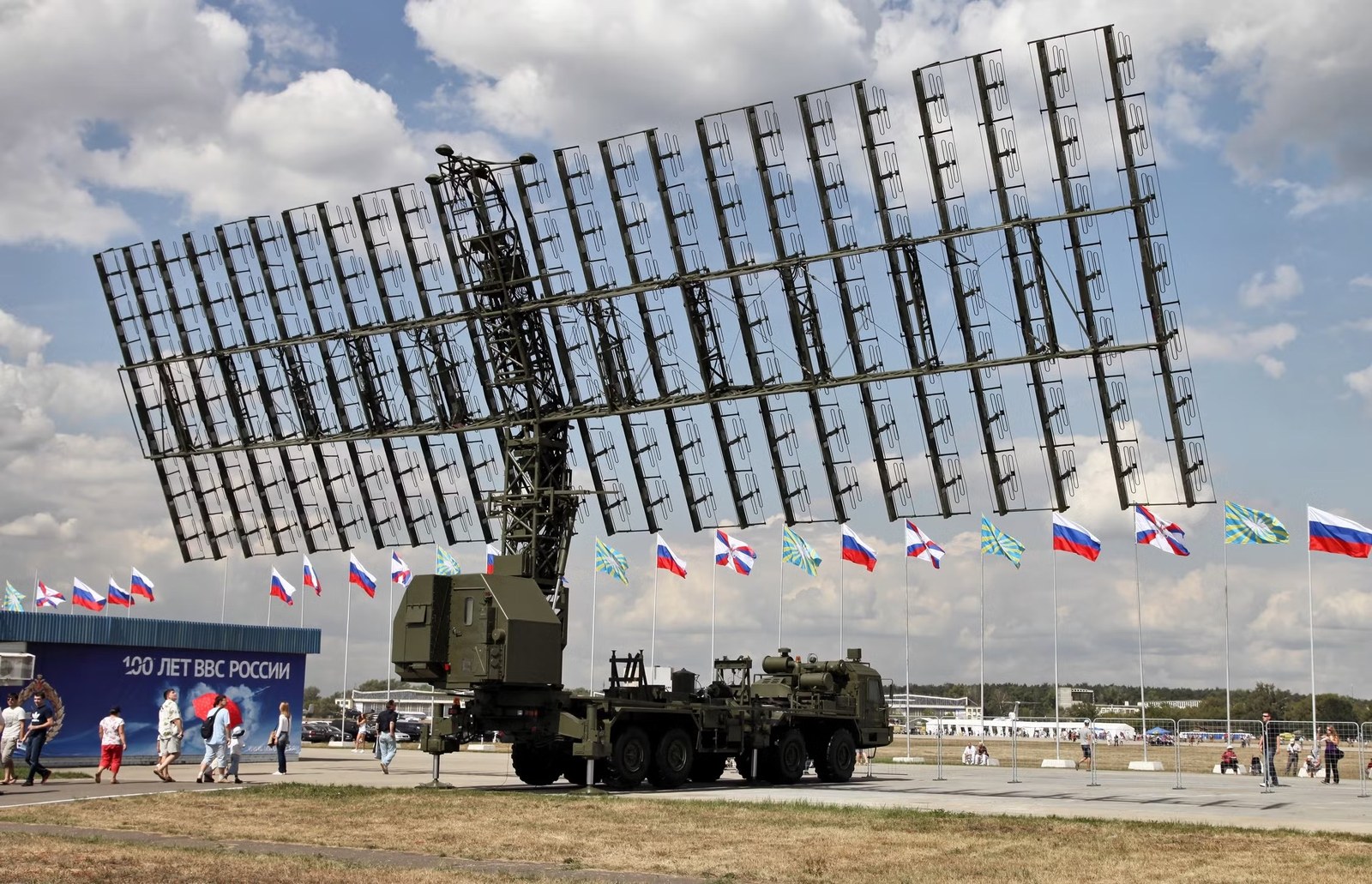
Nebo (Небо, "Sky") is the name of a family of Soviet and Russian long-range air surveillance radars built by the Nizhny Novgorod Research Institute of Radio Engineering, NNIIRT (Нижегородский научно-исследовательский институт радиотехники, ННИИРТ). NNIIRT is now part of the Almaz-Antey air and space defence concern. The family covers fixed and semi-mobile metre-band (VHF) giants of the late Soviet period, the mobile 1L13 Nebo-SV and 1L119 Nebo-SVU, the long-range 55Zh6U Nebo-U, and the multi-band 55Zh6M Nebo-M complex, which ties a VHF radar, an L-band radar and an S-band radar together under one control vehicle. [DOCUMENTED]
What sets the family apart from most Western surveillance radars is the band. Nebo radars work in the metre band, roughly 1.5 to 2 m wavelength (about 150 to 200 MHz). At those wavelengths the size of a fighter aircraft, and especially the size of its tail fins, wingtips and inlet edges, is close to the radar's wavelength. The shaping tricks that make a stealth aircraft hard to see at X-band (3 cm) stop working well. Russia markets the Nebo-SVU and Nebo-M as "counter-stealth" radars for this reason. [DOCUMENTED]
The price of using long wavelengths is accuracy. A metre-band antenna has to be huge to produce a narrow beam, and even a very big one gives bearing and height errors measured in fractions of a degree and hundreds of metres. That is good enough to say "there is something here, heading this way", but not good enough to guide a missile. The Nebo-M answers that problem by fusing its VHF picture with two higher-band radars that can be pointed at the VHF track to refine it. [DOCUMENTED]
In service the Nebo family sits at the top of the radar-technical troops' picture. Nebo-U and Nebo-M units feed regional air defence command posts, which in turn cue S-300 and S-400 regiments, fighter interceptors and the higher-level automated control systems. The Nebo-SVU does the same job for the Ground Forces and for radar battalions in more remote regions. [DOCUMENTED]
Since 2022 the family has become one of Ukraine's priority targets. Ukrainian forces have claimed strikes on Nebo-M complexes in Luhansk, Crimea and the Belgorod/Kursk border area, on Nebo-SVU stations in Crimea, Luhansk and Rostov, and on Nebo-U stations in Bryansk, Crimea, Rostov and Krasnodar. Ukraine values each set at about 100 million US dollars. [DOCUMENTED] That figure is an estimate, not a Russian price. [ESTIMATE]
QUICK REFERENCE
| Item | Value | Label |
|---|---|---|
| Family name | Небо (Nebo, "Sky") | [DOCUMENTED] |
| Designer | NNIIRT, Nizhny Novgorod (Almaz-Antey) | [DOCUMENTED] |
| Main band | Metre band (VHF), about 150–200 MHz | [DOCUMENTED] |
| Soviet ancestors | P-12, P-14 / 5N84 Oborona, P-70 Lena, 55Zh6 Nebo | [DOCUMENTED] |
| 1L13 Nebo-SV | Mobile 2D VHF radar, 1980s, mechanically scanned Yagi array | [DOCUMENTED] |
| 1L119 Nebo-SVU | Mobile 3D VHF AESA, 84 vertically polarised Yagis (14 × 6), in service 2000s | [DOCUMENTED] |
| Nebo-SVU stated detection | 0.1 m² target at about 100 km; large aircraft up to about 360 km at 20 km altitude | [SINGLE-SOURCE] |
| 55Zh6U Nebo-U | Long-range 3D VHF radar, about 43 m antenna height, 500 kW pulse power | [DOCUMENTED] |
| 55Zh6M Nebo-M | Multi-band complex: RLM-M (VHF), RLM-D (L-band), RLM-S (S-band), KU-RLK control vehicle | [DOCUMENTED] |
| Nebo-M stated range | Up to about 600 km; tracks up to about 200 targets | [SINGLE-SOURCE] |
| Nebo-M deployment time | About 15 minutes (manufacturer claim) | [SINGLE-SOURCE] |
| 55Zh6ME export range | 10–400 km circular scan, 10–300 km sector scan | [DOCUMENTED] |
| Nebo-M in service | First complexes delivered around 2012–2017; Central and Eastern military districts named early | [DOCUMENTED] |
| Estimated unit cost | About $100 million (Ukrainian General Staff figure) | [ESTIMATE] |
| Combat losses claimed | Multiple Nebo-M, Nebo-SVU, Nebo-U and Nebo-SV units struck 2024–2026 | [DOCUMENTED] |
WHERE THE NAME AND THE INSTITUTE COME FROM
NNIIRT began life in 1949 as a radar design bureau in Gorky, as Nizhny Novgorod was called in Soviet times. Its first big success was the P-8 Volga, followed by the P-10 and the very widely built P-12 Yenisei, a truck-mounted VHF early warning radar that equipped Soviet and Warsaw Pact air defence units and was exported all over the world. Its successor the P-18 Terek is still in use in many countries and in Russian reserve and border units. All of these were metre-band radars with Yagi antennas on a rotating frame. [DOCUMENTED]
The reason the Soviet air defence forces stuck with VHF for so long is practical. VHF transmitters were cheaper and more reliable than microwave tubes in the 1950s and 1960s, VHF signals travel a little further over the horizon because of diffraction, and metre-band returns are less affected by rain. The weakness, poor accuracy and large antennas, was accepted because the job of these radars was early warning and the handing of tracks to fighter controllers, not missile guidance. [BACKGROUND]
That design tradition is the root of Nebo. When Western stealth programmes became known in the late 1970s and 1980s, Soviet engineers found they already had a large industrial base and a deep body of experience in the one band where stealth shaping is weakest. NNIIRT's later radars were built on that base. [BACKGROUND]
SOVIET ORIGINS: P-14, OBORONA, LENA AND THE FIRST NEBO
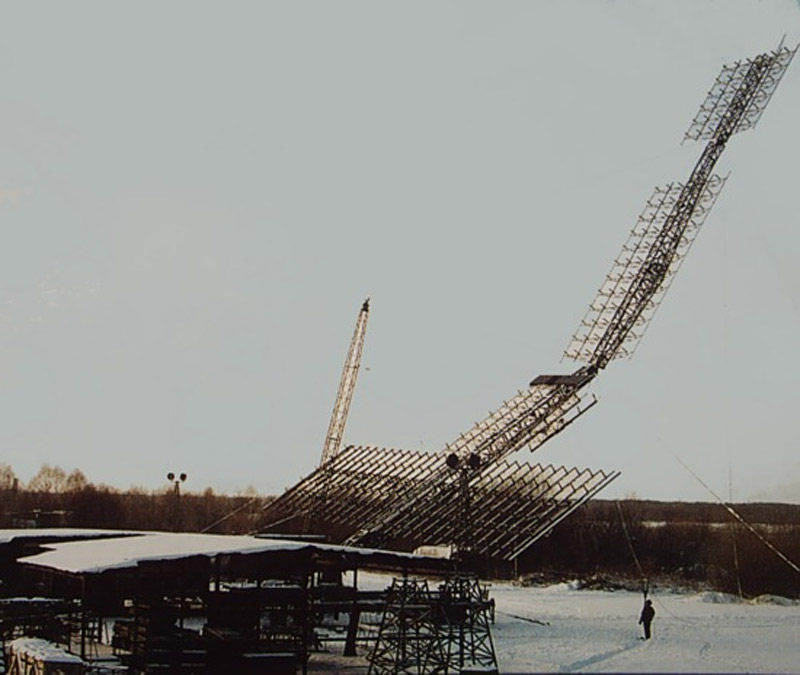
The P-14 Lena (П-14 «Лена»), accepted in 1959, was the first very long-range Soviet VHF early warning radar. It used a huge open-frame reflector antenna, about 32 m wide and 11 m high, mounted on a turntable over an equipment building, and gave detection ranges of the order of 400 to 600 km against large aircraft. It was a static or semi-static installation that took days to put up. Its improved descendants were the 5N84 Oborona (5Н84 «Оборона», Defence) and the 5N84A Oborona-14, and the related 44Zh6. [DOCUMENTED]
These radars were the long ears of the Soviet air defence forces (PVO Strany). They were used along the borders and coasts to pick up bomber streams hundreds of kilometres out and to pass tracks into the automated control systems of the time. They were also exported, with P-14 class radars reported in Warsaw Pact countries and in client states. [DOCUMENTED]
The P-70 Lena-M is described in Russian sources as a further development of the P-14 line, with improved signal processing and better reliability. Detailed public data on the P-70 is thin. [SINGLE-SOURCE]
The first radar to carry the Nebo name was the 55Zh6 Nebo (55Ж6 «Небо»), accepted around 1986. Unlike the 2D P-14, the 55Zh6 was a three-coordinate radar: it combined a large horizontal VHF array for range and bearing with a vertical array for height-finding, so it could give altitude as well as position. It was intended for the national air defence forces and was a large, semi-fixed system needing about a day to deploy. Its stated detection range against a fighter-size target was around 400 km, and its antenna system was mounted on a tall rotating structure. [DOCUMENTED]
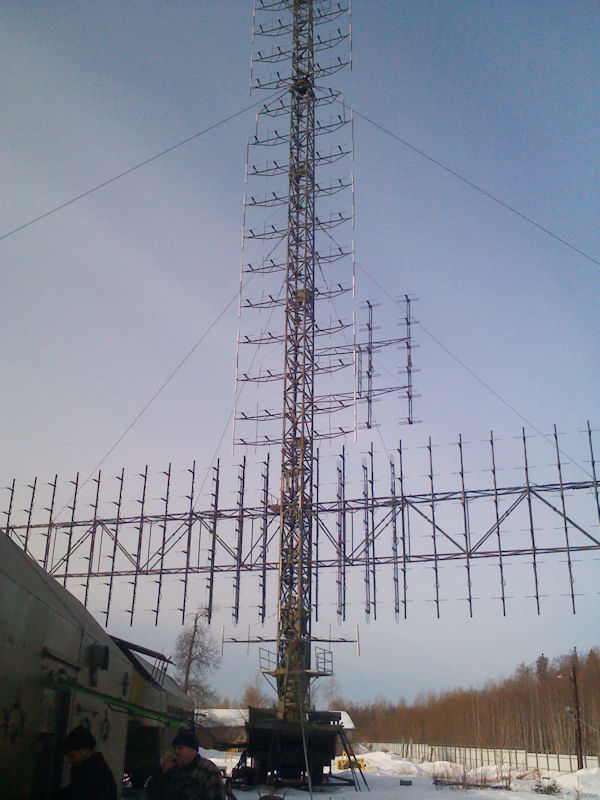
The 55Zh6 was the direct ancestor of the 55Zh6U Nebo-U and, through it, of the RLM-M module of the Nebo-M. The "55Zh6" index, used for all three, shows the family line. The cross-shaped arrangement, with a tall vertical stack of Yagis and a wide horizontal array, is the visual signature of the big Nebo installations. [DOCUMENTED]
A Soviet height-finder array of this kind works by comparing returns in beams stacked in elevation. Because the beams are wide at VHF, height accuracy is limited, but it was enough to tell a high-altitude bomber from a low-flying aircraft and to cue fighters. [BACKGROUND]
1L13 NEBO-SV: TAKING THE BAND MOBILE
The 1L13 Nebo-SV (1Л13 «Небо-СВ»), with "SV" for Сухопутные войска, Ground Forces, was developed in the 1980s to give army air defence a long-range VHF early warning radar that could move with the troops. It was a two-coordinate radar on a semi-trailer, with a large rotating array of horizontally polarised Yagi antennas. It was accepted for service around 1985. [DOCUMENTED]
The Nebo-SV was used to feed early warning to the army's air defence brigades, including those armed with the S-300V and Buk, and to radar battalions of the air force. Its claimed detection range against fighter-size targets was of the order of 350 km at high altitude, with typical deployment time of tens of minutes. [SINGLE-SOURCE]
The Nebo-SV is still in use. Satellite imagery published in 2026 of the Millerovo air base in Rostov Oblast, after Ukrainian drone strikes, was reported to show damage to a Nebo-SV and an RSP-27 airfield radar. [DOCUMENTED]
Like other mechanically scanned VHF radars, the Nebo-SV produced a new picture once per antenna rotation, typically every 10 seconds or so, and its bearing accuracy depended on the array width. It had none of the electronic beam agility of its successor. [BACKGROUND]
1L119 NEBO-SVU: THE FIRST VHF AESA
The 1L119 Nebo-SVU (1Л119 «Небо-СВУ», the "U" for усовершенствованный, improved) replaced the Nebo-SV. Development ran through the 1990s and it was shown publicly at the turn of the century. It is widely described as the first radar in the world to use an active electronically scanned array (AESA) in the metre band. [DOCUMENTED]
In an AESA every antenna element, or small group of elements, has its own transmit/receive module. The beam is formed and steered by changing the phase of each module electronically instead of by turning a dish. For background on the principle see the site's article on AESA radar. In the Nebo-SVU the array is made of 84 vertically polarised VHF Yagi antennas arranged in 14 columns of 6, each with a folded dipole and director element. [DOCUMENTED]
The array still rotates mechanically for 360° coverage, but within each look it can steer its beam electronically in azimuth and elevation. That makes it a three-coordinate radar, giving height as well as range and bearing, and lets it revisit a target, change beam shape, or dwell longer in a direction of interest. The switch from horizontal to vertical polarisation was described as reducing ground reflections and improving low-angle coverage. [DOCUMENTED]
Stated detection ranges published by Ukrainian analysts citing Russian data are about 360 km against a target at 20 km altitude, about 270 km at 10 km altitude, and about 60 km at 500 m altitude, the last limited by the radar horizon. Against a target of 0.1 m² radar cross-section, the figure is about 100 km. [SINGLE-SOURCE]
The Nebo-SVU is carried on a semi-trailer, with the equipment cabin and power supply on separate vehicles. Deployment is quoted at about 20 minutes. Mean time between failures is quoted at about 500 hours. It is produced by NNIIRT within Almaz-Antey. [SINGLE-SOURCE]
The Nebo-SVU has been reported in service with the 45th Air and Air Defence Army of the Northern Fleet for Arctic airspace control, as well as with Ground Forces air defence and radar-technical units elsewhere. Iran and Algeria are listed as operators in open references, though no contract details have been published. [SINGLE-SOURCE]
The Nebo-SVU is also the basis for the RLM-M module of the Nebo-M in the sense that both are VHF AESAs from the same design school, although the RLM-M antenna is larger and mounted on a self-propelled chassis. Some Ukrainian reporting has used "Nebo-SVU" loosely for the VHF element of a Nebo-M complex. [DOCUMENTED]
55Zh6U NEBO-U: THE BIG STATIC SET
The 55Zh6U Nebo-U (55Ж6У «Небо-У») is a modernised, three-coordinate development of the 55Zh6. It was developed in the 1990s and produced from the 2000s for the Air Force's radar-technical troops. It uses a large VHF array for detection and a separate height-finding array, with digital processing replacing the older analogue equipment. Its export version is the 55Zh6UE Nebo-UE. [DOCUMENTED]
Published characteristics cited after the 2026 strike at Millerovo give an antenna height of 43 m and a pulse power of 500 kW with average power of about 5 kW. [DOCUMENTED] Claimed detection ranges are around 400–600 km against high-flying targets, with the ability to detect and track aircraft, cruise missiles and ballistic missiles. [SINGLE-SOURCE]
The Nebo-U is semi-fixed. Western analysts, notably Carlo Kopp in 2010, describe the Nebo-U/UE as taking about 24 hours to deploy and as intended for static long-range air defence applications. That makes it a high-value but vulnerable asset in a war where the other side has long-range drones. [DOCUMENTED]
Nebo-U units are spread through the radar battalions of the Aerospace Forces' air and air defence armies. Several have been reported in western Russia and Crimea since 2022, which is where most of the reported strikes have taken place. [DOCUMENTED]
55Zh6M NEBO-M: THE MULTI-BAND COMPLEX
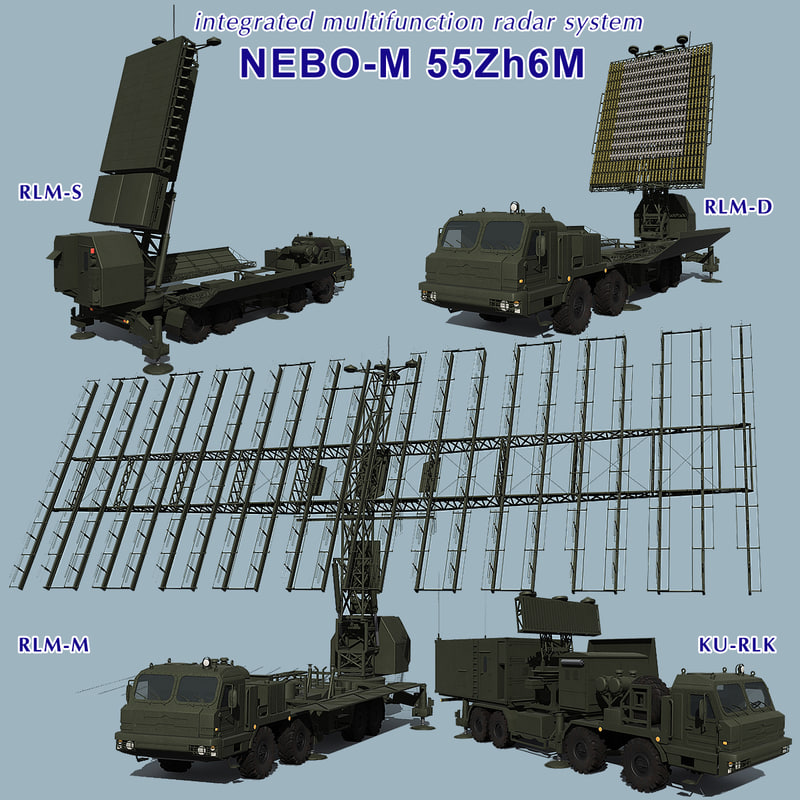
The 55Zh6M Nebo-M (55Ж6М «Небо-М») is NNIIRT's flagship. It is not a single radar but a radar complex (radiolokatsionny kompleks): three separate radar modules working in three different bands, plus a control vehicle that fuses their data into one air picture. Development began in the 2000s under State Armament Programme funding. The complex was first shown publicly at the MAKS air show around 2011 and series production was reported from 2012. [DOCUMENTED]
| Module | Band | Russian name | Job |
|---|---|---|---|
| RLM-M | Metre (VHF), about 1.5–2 m | Радиолокационный модуль метрового диапазона | Long-range search, counter-low-observable detection |
| RLM-D | Decimetre (L-band), about 23 cm | Радиолокационный модуль дециметрового диапазона | Search and refined tracking, ballistic target capability |
| RLM-S | Centimetre (S-band), about 10 cm | Радиолокационный модуль сантиметрового диапазона | Precise tracking, height and bearing refinement |
| KU-RLK | None | Комплексная управляющая кабина / control vehicle | Data fusion, track management, external links |
Each module is on its own BAZ-6909 family 8×8 cross-country truck chassis, the same family used by the S-400 and other Almaz-Antey systems. Each carries its own power and can operate on its own if the others are lost. When working together they are linked to the KU-RLK by radio or cable and their beams are scheduled jointly. [DOCUMENTED]
Some sources, including early Ukrainian reporting, have described the RLM-D as based on the Protivnik-GE L-band radar and the RLM-S as related to the Gamma-S1 S-band radar. These links are plausible given NNIIRT's product line, but are not confirmed by the manufacturer. [SINGLE-SOURCE]
RLM-M
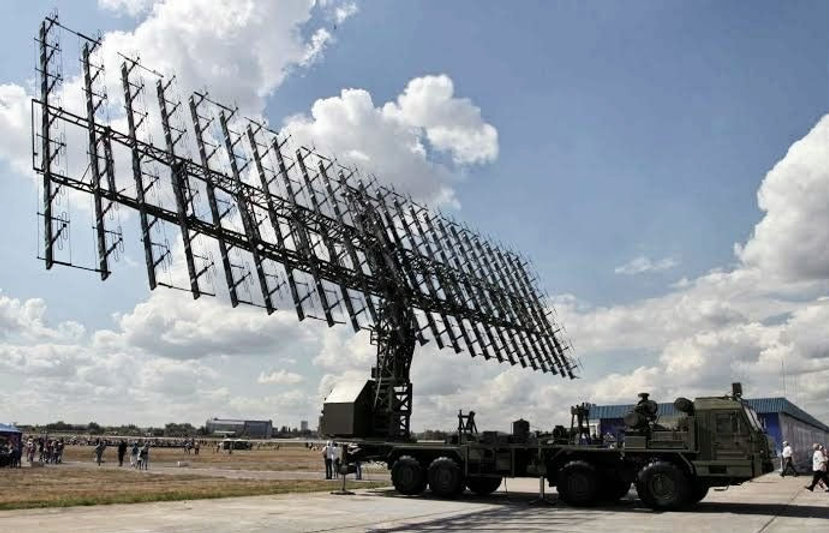
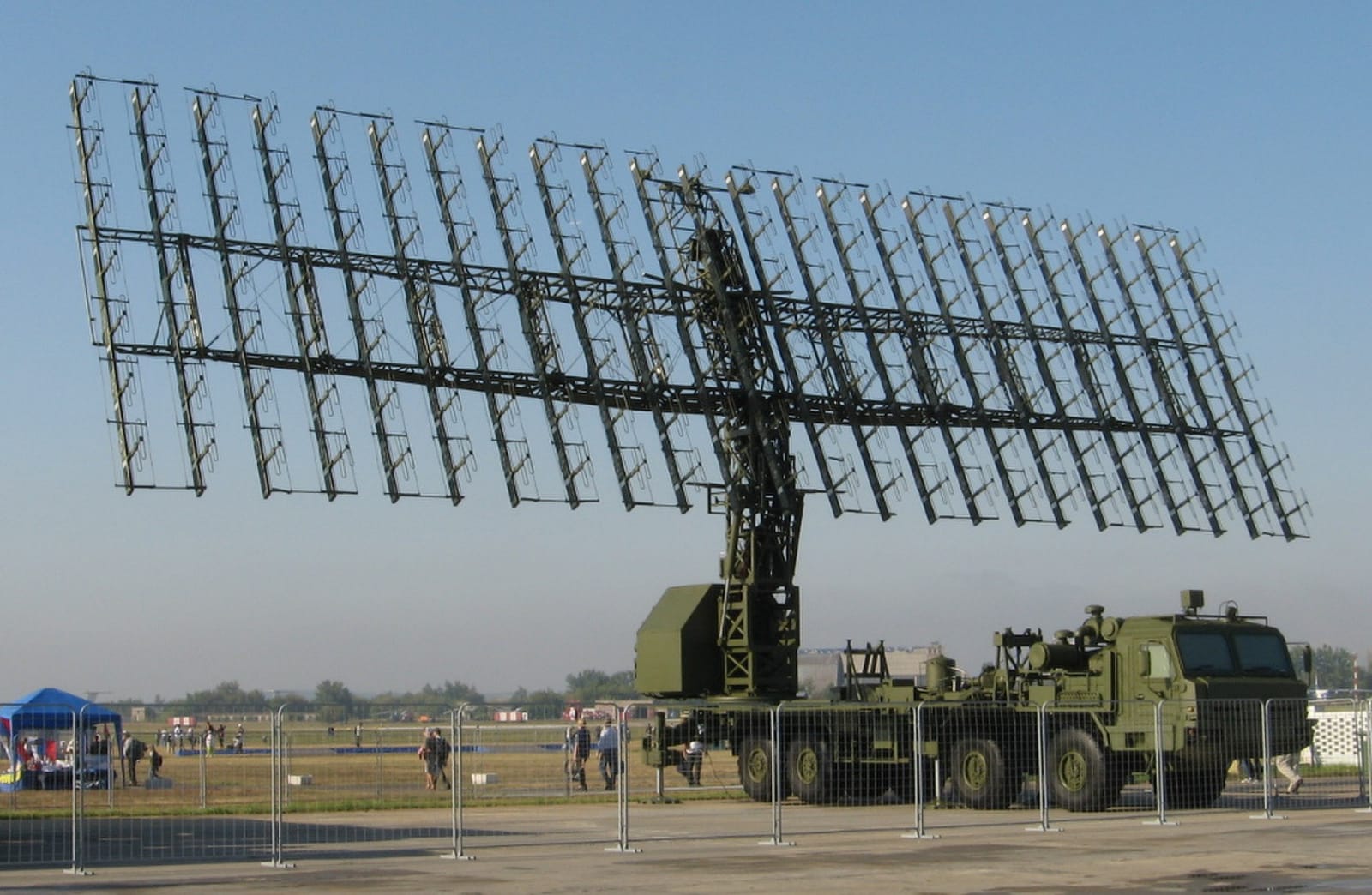
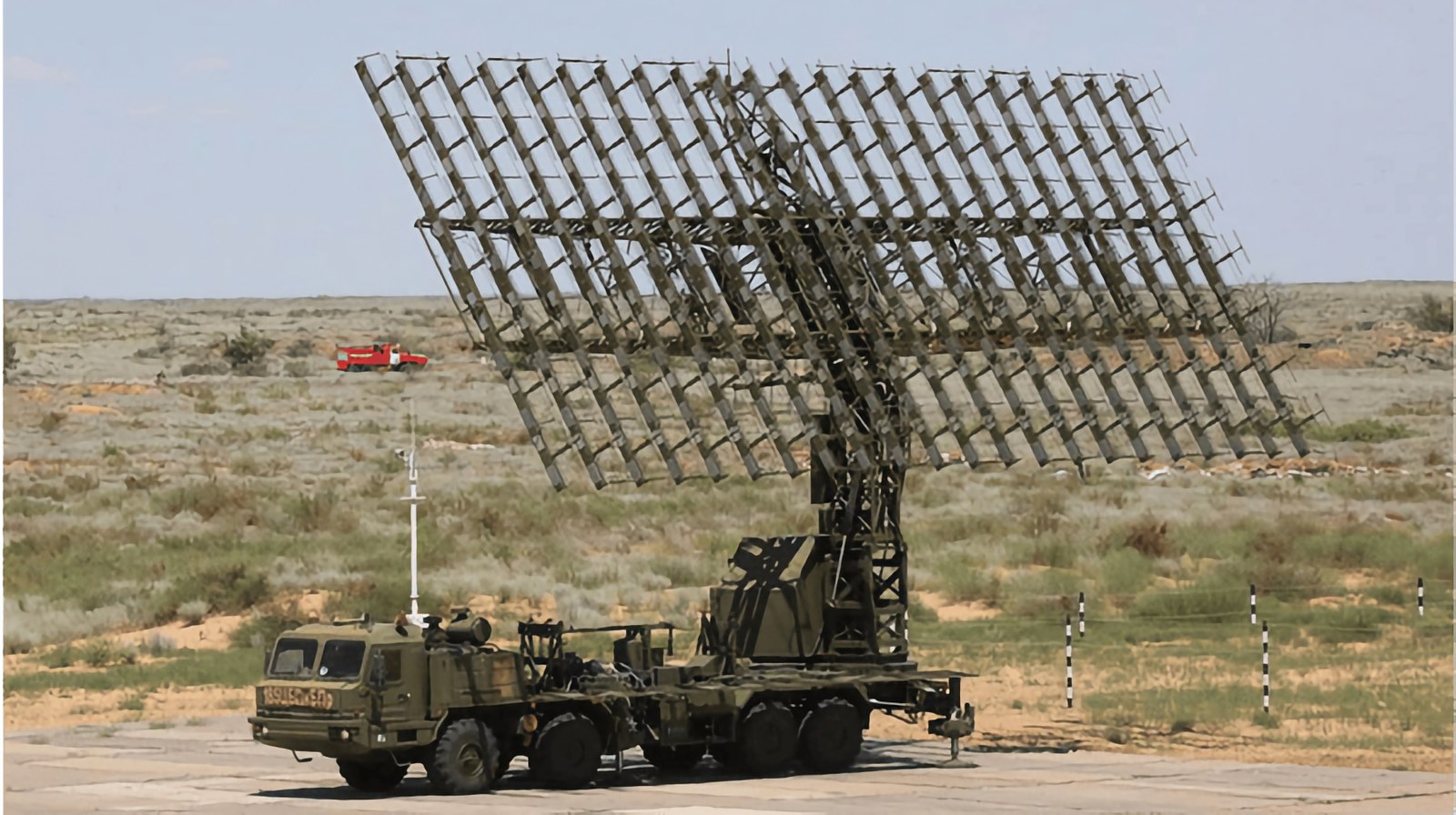
The RLM-M is the big VHF module and the most recognisable part of the complex: a wide, open lattice of Yagi antennas on a folding mast at the rear of the truck. It is an AESA in the metre band, a development of the Nebo-SVU principle on a larger aperture. Russian publicity credits it with detecting low-observable aircraft at long range and with being much harder to jam than higher-band radars because high-power jammers in the VHF band are bulky. [DOCUMENTED]
Its antenna is made of vertical columns of Yagi elements arranged across a horizontal truss. Counting from photographs shows about 24 columns, with several elements in each. The whole array folds down onto the truck for travel. On the move the RLM-M is roughly the size of an S-400 launcher. [ESTIMATE]
RLM-D
The RLM-D is an L-band AESA with a flat, rectangular face. L-band is a middle ground: better accuracy than VHF, with longer reach and better weather performance than S-band, and with some ability against low-observable targets because L-band shaping effects are partly reduced. It is also the module credited with ballistic target capability, with Ukrainian and Russian sources citing detection of ballistic targets at long range. [DOCUMENTED] The figure of 1,500 km for ballistic targets given in some Ukrainian unit statements is not supported by any manufacturer data and should be treated with caution. [UNVERIFIED]
RLM-S
The RLM-S is an S-band AESA with a tall, narrow two-section face. It is the most accurate of the three and is used to refine target coordinates, especially elevation, and to track high-speed and manoeuvring targets. Its detection range is shorter than the other two. [DOCUMENTED]
KU-RLK
The KU-RLK control vehicle holds the operators, the data processing and the communications. It manages the three radars as one system: it builds a single track file from all three modules, schedules which module looks where, assigns targets for refinement, carries out IFF interrogation, and passes tracks to higher command posts and to air defence missile units. It carries its own small radar antenna on a mast, which some sources describe as an IFF or auxiliary radar. [SINGLE-SOURCE]
Stated performance
Almaz-Antey and Russian state media have given a maximum detection range of up to about 600 km and a capacity of up to about 200 targets tracked at once, with a deployment time of about 15 minutes and mean time before failure of about 1,000 hours. [SINGLE-SOURCE] Some Russian statements say the complex can survey airspace out to 1,200 km, which likely refers to the maximum instrumented range for ballistic targets rather than routine detection of aircraft. [SPECULATION]
The export 55Zh6ME is advertised with a radar envelope of 10–400 km in circular scan and 10–300 km in sector scan, with IFF processing and an ability to exchange data in a C4I (command, control, communications, computers and intelligence) environment. [DOCUMENTED]
The ME export version and the market
Russia has marketed the 55Zh6ME at international arms shows. No confirmed delivery to a foreign customer has been documented in open sources as of October 2026. [DOCUMENTED] Iran and Algeria, the countries most often named, are documented customers for the separate Rezonans-NE VHF radar and are listed in some references as Nebo-SVU operators. Statements that they also bought Nebo-M should be treated as unconfirmed. [UNVERIFIED]
A 2021 claim that Azerbaijan destroyed an "Armenian Nebo-M" with a Bayraktar TB2 in 2020 appeared in some Western commentary. The radars hit by Azerbaijan in 2020 have generally been identified as older Soviet types such as P-18 and P-37, and there is no good evidence Armenia operated a Nebo-M. [UNVERIFIED]
Russian deployment
The first Nebo-M sets went to the Aerospace Forces. Russian reporting named deliveries to air defence units of the Central Military District from 2017, to cover the region beyond the Urals and the Arctic, and to the Eastern Military District, plus units around Moscow. [DOCUMENTED] In 2024 Ukraine's General Staff assessed that Russia had only about ten functioning Nebo-M systems. [SINGLE-SOURCE] How many have been produced in total has not been published. [UNVERIFIED]
HOW IT WORKS: WHY THE METRE BAND SEES STEALTH AIRCRAFT
Radar cross-section in plain terms
A radar sees a target by the energy the target scatters back towards it. The measure of how much energy comes back is the radar cross-section, RCS, given in square metres. It is not the physical size of the target; it is the size of a perfectly reflecting sphere that would return the same energy. A big airliner may have an RCS of tens or hundreds of square metres. A conventional fighter is usually quoted around 1 to 10 m² from the front. A modern stealth fighter is quoted, in unclassified estimates, at around 0.001 to 0.01 m² from the front at X-band. [BACKGROUND]
How strongly a shape scatters depends on how big it is compared with the wavelength. Physicists split this into three regions. [BACKGROUND]
| Region | Size compared with wavelength | What happens |
|---|---|---|
| Rayleigh region | Much smaller than the wavelength | Scattering is weak and depends mostly on volume, rising very steeply with frequency; shape hardly matters |
| Resonance (Mie) region | About 1 to 10 wavelengths | Currents flow around the whole object; strong peaks and nulls; shape details matter less than overall dimensions |
| Optical region | Much larger than the wavelength | Scattering behaves like light; flat panels reflect like mirrors, edges diffract; shaping controls where energy goes |
What stealth shaping does
Stealth aircraft like the F-22, F-35 and B-2 rely mainly on shaping, with radar-absorbent materials as a second layer. The shape is designed so that flat panels and straight edges reflect the incoming wave away from the radar, into a few narrow "spikes" in directions where an enemy radar is unlikely to be. Edges are aligned with each other so that the spikes stack in the same few directions. Inlets are hidden or curved so that a radar cannot look straight down to the engine face. [BACKGROUND]
This works because at X-band (about 3 cm), a fighter is hundreds of wavelengths long and every panel, edge and inlet lip is many wavelengths across. The aircraft is deep in the optical region, and the energy behaves like light bouncing off mirrors. Absorbent coatings also work best when their thickness is a reasonable fraction of the wavelength; a coating a few millimetres thick is effective at 3 cm. [BACKGROUND]
What changes at 2 metres
A Nebo VHF radar uses a wavelength of roughly 1.5 to 2 m. At that wavelength: [BACKGROUND]
| Feature | Typical size | Size in VHF wavelengths |
|---|---|---|
| Whole fighter, length | 15–19 m | About 8–12 |
| Wingspan | 11–14 m | About 6–9 |
| Vertical tail fin | 2–3 m | About 1–2 |
| Wingtip, edge segments, inlet lip | 0.3–1 m | About 0.2–0.6 |
| Radar-absorbent coating | A few mm | About 0.002 |
The aircraft as a whole is now in the resonance region, and many of the features that matter for stealth, such as the tail fins, wing tips and control surfaces, are about one wavelength or smaller. Several things follow. [BACKGROUND]
First, the "mirror" idea breaks down. A panel only reflects like a mirror when it is many wavelengths across. When it is about one wavelength across, it scatters energy over a broad angle instead of a narrow spike. The careful steering of energy away from the radar is lost, and some of it comes back. [BACKGROUND]
Second, the tail fins and other small features behave like resonant antennas. A conducting element about half a wavelength long resonates strongly, much like a dipole antenna. A tail fin a metre or two tall, at a wavelength of about two metres, is in exactly that range. Currents flow along its edges and reradiate energy in many directions, including back towards the radar. [BACKGROUND]
Third, radar-absorbent material does almost nothing. A coating a few millimetres thick is a tiny fraction of a two-metre wavelength and cannot absorb the wave in a useful way. Absorbers effective at VHF would need to be tens of centimetres thick, which is not practical on an aircraft. [BACKGROUND]
Fourth, the overall aircraft shape matters less than its size. In the resonance region, the RCS of an object depends mainly on its overall dimensions. A stealth fighter and a conventional fighter of the same size are much closer in RCS at VHF than they are at X-band. [BACKGROUND]
The result is that a stealth aircraft which might show 0.001 m² to an X-band fire-control radar can show something closer to 0.1 to 1 m² to a VHF radar from many angles. Those figures are not official and depend heavily on the aircraft and aspect, but the direction of the effect is well established in open radar literature, including US and Australian analyses. [ESTIMATE]
Why Rayleigh scattering matters for small targets
The very small parts of an aircraft, and very small targets such as small drones, are in the Rayleigh region at VHF, where scattering is weak and falls off steeply as the object gets smaller. That is why the Nebo-SVU's quoted 100 km against a 0.1 m² target is far shorter than its range against large aircraft, and why VHF radars are not the best tool against small drones and cruise missiles. A stealthy aircraft benefits from VHF resonance; a small drone does not. [BACKGROUND]
The price: resolution and accuracy
A radar beam's width depends on the antenna size compared with the wavelength. Roughly, beamwidth in radians is the wavelength divided by the antenna width. An X-band fire-control radar with a 1 m antenna has a beam about 2° wide. A VHF radar with a 2 m wavelength needs an antenna about 30 m wide to get the same beam. The RLM-M antenna is perhaps 15–20 m wide, which suggests a beamwidth of roughly 6–8°. [ESTIMATE]
A beam 7° wide is more than 30 km across at 300 km range. Signal processing can locate a target to a fraction of the beamwidth, typically a tenth or better for a strong return, but the bearing error is still of the order of kilometres at long range. Height is worse, because the vertical aperture is smaller and the beam interacts with the ground. [ESTIMATE]
Range resolution depends on bandwidth. The VHF band is crowded and narrow, so the radar cannot use the very wide bandwidths that give fine range resolution at higher bands. [BACKGROUND]
This is why a VHF radar on its own is a search and early warning radar, not a fire-control radar. It can tell the air defence system that a low-observable aircraft is in a given volume, but not exactly where. A surface-to-air missile needs an accurate position to be launched and guided. [DOCUMENTED]
Ground clutter and multipath
At VHF the beam is wide in elevation and some of it hits the ground. Energy reflected from the ground interferes with energy going directly to the target, creating lobes and nulls in elevation. This helps range at some angles and creates blind spots at others, especially at low altitude. The vertical polarisation of the Nebo-SVU and RLM-M is described as reducing these effects. [DOCUMENTED] Siting on high, flat ground helps and is one reason big VHF sets are seen on hilltops and coasts. [BACKGROUND]
Jamming and interference
Jammers built into fighters and escort jammers such as the EA-18G's pods have historically concentrated on the bands used by fire-control and higher-band surveillance radars. A jammer for the VHF band needs large antennas and high power to be effective. NNIIRT has advertised the Nebo radars' digital adaptive processing and sidelobe cancellation as giving strong resistance to jamming. [DOCUMENTED] The US Navy's Next Generation Jammer Low Band programme, aimed at lower bands, is seen in Western reporting as partly a response to VHF and UHF counter-stealth radars. [DOCUMENTED]
HOW IT WORKS: MULTI-BAND FUSION IN THE NEBO-M
The Nebo-M is designed to use each band for what it does best and to cover the weaknesses of the others. The process can be described in four stages. [DOCUMENTED]
1. Wide search
The RLM-M searches the full volume at long range, rotating or sector scanning. Because it is in the VHF band, it has the best chance of detecting a low-observable target and is the least affected by jamming in the higher bands. [DOCUMENTED]
2. Cueing
When the RLM-M produces a detection, the KU-RLK records a provisional track with a large uncertainty volume. It then tasks the RLM-D and RLM-S to look into that volume. Because they are electronically scanned, they can point a beam at the cued position without changing their search schedule much. [DOCUMENTED]
3. Refinement
Even if a low-observable target has a small RCS at L- and S-band, the higher-band radars no longer need to search the whole sky for it. They can concentrate energy on a small volume, using longer dwell times and more pulses, so their effective detection range against the target increases. When they get a return, their much better angular accuracy shrinks the uncertainty in position. [DOCUMENTED]
4. Fused track
The KU-RLK combines measurements from all three modules into one track. It weights each measurement by its accuracy, so the S-band and L-band measurements dominate the position estimate while the VHF radar keeps the track alive when the target fades from the higher bands. The result is a track that Russian sources describe as of sufficient quality to designate targets to surface-to-air missile systems. [DOCUMENTED]
| Property | RLM-M (VHF) | RLM-D (L-band) | RLM-S (S-band) |
|---|---|---|---|
| Wavelength | About 1.5–2 m | About 23 cm | About 10 cm |
| Best feature | Sees low-observable aircraft; long reach; jam-resistant | Balance of range and accuracy; ballistic targets | Best accuracy; fast and manoeuvring targets |
| Main weakness | Low accuracy | Stealth shaping partly effective | Shortest range; stealth shaping effective |
| Role in fusion | Detect and maintain track | Cue and refine | Refine and hand over |
The underlying idea, combining low-band detection with high-band precision, is also present in Western research. US and other analysts have pointed out that low-band radars need to be part of a networked system to be useful against stealth, and that the critical problem for the defender is turning a low-band detection into a weapons-quality track. Nebo-M is Russia's attempt to solve that on one set of trucks. [BACKGROUND]
How good is the fused track?
No public data shows the actual accuracy of a Nebo-M fused track against a real low-observable aircraft. Ukrainian analysts have noted that Russian sources rarely mention how low the accuracy of metre-band detection is. [DOCUMENTED] Western analysts generally assess that against a modern stealth aircraft the higher-band modules will gain track only at shorter range than their quoted figures, so the handover distance to a missile system will be much shorter than the VHF detection range. [ESTIMATE]
HOW IT WORKS: CUEING S-300 AND S-400
In Russian air defence doctrine, the S-300PM2, S-400 and S-500 regiments have their own radars: the 91N6E Big Bird battle management radar, the 96L6 all-altitude detector, and the 92N6E or 30N6 engagement radars. A Nebo-U or Nebo-M does not normally guide missiles directly. Its job is to give the regiment early warning and an initial target designation. [DOCUMENTED]
The data flow runs through automated control systems such as the Baikal-1ME or Polyana-D4M1 at brigade or division level, and the 55K6 or 30K6 command posts of the S-300 and S-400. A radar-technical unit's Nebo passes tracks to the higher command post, which assigns targets to regiments; the regiment's own radars then search the cued volume. [DOCUMENTED]
The S-400 command post can receive target designation from external sources and use it to direct the 91N6E and 92N6E radars. A good Nebo-M track shrinks the volume the S-400 radars need to search, which matters most against a low-observable target, where the engagement radar's detection range is short. [DOCUMENTED]
There are Russian claims that missiles in the S-400 family can be launched on external target data and guided initially by command updates while their own seeker looks for the target. Whether Nebo-M data is good enough for that against a stealth aircraft is not proven in public sources. [SPECULATION]
DETECTION RANGES AND WHAT LIMITS THEM
Published figures
| System | Target | Stated range | Label |
|---|---|---|---|
| 1L13 Nebo-SV | Fighter at high altitude | About 350 km | [SINGLE-SOURCE] |
| 1L119 Nebo-SVU | Target at 20 km altitude | About 360 km | [SINGLE-SOURCE] |
| 1L119 Nebo-SVU | Target at 10 km altitude | About 270 km | [SINGLE-SOURCE] |
| 1L119 Nebo-SVU | Target at 500 m altitude | About 60 km | [SINGLE-SOURCE] |
| 1L119 Nebo-SVU | 0.1 m² target | About 100 km | [DOCUMENTED] |
| 55Zh6U Nebo-U | Aircraft at high altitude | About 400–600 km | [SINGLE-SOURCE] |
| 55Zh6M Nebo-M | Maximum detection | Up to about 600 km | [SINGLE-SOURCE] |
| 55Zh6M Nebo-M | Low-observable aircraft | About 200–400 km (Ukrainian unit statement) | [UNVERIFIED] |
| 55Zh6M Nebo-M | Drones and cruise missiles | Typically 50–150 km (Ukrainian unit statement) | [UNVERIFIED] |
| 55Zh6ME | Circular / sector scan | 10–400 km / 10–300 km | [DOCUMENTED] |
The radar horizon
No ground radar can see through the curve of the Earth. The distance to the radar horizon, for a standard atmosphere, is about 4.12 × (√h1 + √h2) km, with h1 the antenna height and h2 the target height in metres. For an antenna about 10 m up, the horizon against a target at 100 m is about 54 km; at 500 m about 105 km; at 10,000 m about 425 km. [BACKGROUND]
That is why the big range figures only apply to high-flying targets. A cruise missile at 50 m, or a drone hugging terrain, will not be seen by a Nebo at 300 km whatever its RCS. The Nebo-SVU's own published figures show this: 360 km at 20 km altitude, 60 km at 500 m. [DOCUMENTED]
The radar range equation
For a given radar, detection range rises with the fourth root of the RCS. If a target's RCS drops by a factor of 10,000, detection range falls by a factor of 10. That is why stealth matters so much at X-band: a 0.001 m² fighter is detected at about one-tenth of the range of a 10 m² fighter. [BACKGROUND]
At VHF the same aircraft may have an RCS only 10 to 100 times smaller than a conventional fighter instead of 10,000 times. Detection range then falls only to about 56% or 32% of the conventional figure. A VHF radar that sees a conventional fighter at 400 km would see a low-observable fighter at something like 130–220 km under that assumption, which is consistent with the Ukrainian unit statement of 200–400 km for the Nebo-M. [ESTIMATE]
A worked example
| Assumption | Value |
|---|---|
| Nebo-M range against 5 m² fighter at altitude | 400 km |
| VHF RCS of a low-observable fighter, nose-on | 0.1 m² (illustrative) |
| Ratio of RCS | 50 times smaller |
| Fourth root of 50 | About 2.66 |
| Estimated range against the low-observable fighter | 400 / 2.66 ≈ 150 km |
| Same fighter at S-band, RCS 0.001 m² | 5,000 times smaller than 5 m² |
| Fourth root of 5,000 | About 8.4 |
| If RLM-S sees a 5 m² fighter at 250 km in search | 250 / 8.4 ≈ 30 km |
| With cueing and long dwell (say 10× energy) | Range × 10^0.25 ≈ 1.78 → about 53 km |
These numbers are illustrative only. [ESTIMATE] They show the core problem: the VHF radar may detect a stealth aircraft at 150 km, but the precise S-band module may not get a solid track until the target is within about 50 km. Between those ranges the system knows the target is there but has only an approximate fix. [ESTIMATE]
DEPLOYMENT AND MOBILITY
| System | Mobility | Stated deploy time | Label |
|---|---|---|---|
| 55Zh6 Nebo | Semi-fixed, large antenna structure | About 24 hours | [SINGLE-SOURCE] |
| 55Zh6U Nebo-U | Semi-fixed | About 24 hours | [DOCUMENTED] |
| 1L13 Nebo-SV | Towed semi-trailer | Tens of minutes | [SINGLE-SOURCE] |
| 1L119 Nebo-SVU | Towed semi-trailer plus support vehicles | About 20 minutes | [SINGLE-SOURCE] |
| 55Zh6M Nebo-M | Self-propelled BAZ 8×8, four vehicles | About 15 minutes | [SINGLE-SOURCE] |
The difference between the Nebo-U and the Nebo-M is the difference between a radar station and a radar unit. A Nebo-U is put up at a known site and stays there for months or years; it is easy to find and, once found, easy to target. A Nebo-M is designed to move between prepared positions, set up, radiate, and move again. In practice, both the 2024 ATACMS strike and the 2025 strikes in Crimea hit Nebo-M sets in fixed positions, and one 2025 strike reportedly caught an RLM-M on the move as its crew left its duty position. [DOCUMENTED]
A Nebo-M complex at full deployment spreads its four vehicles over some distance, with cables or radio links between them and to power units. The RLM-M's raised antenna is large and visible in satellite and drone imagery. Russia has used camouflage nets, earth berms and, in some areas, radio-transparent shelters to protect radars; Ukrainian drone units have reported striking such shelters in Crimea in 2026. [DOCUMENTED]
The Nebo-SVU is lighter and more widely spread, and as a towed system it is cheaper to move. Its separate vehicles, the antenna trailer, the equipment cabin and the generator, are each a potential point of failure. [BACKGROUND]
ROLE IN THE INTEGRATED AIR DEFENCE SYSTEM
In the Russian Aerospace Forces, radar-technical troops (радиотехнические войска, RTV) are a branch alongside the anti-aircraft missile troops and fighter aviation. Radar brigades and regiments operate networks of radar companies and battalions that produce the air picture for an area. A typical radar battalion mixes a VHF radar such as a Nebo-U or Nebo-SVU, an L- or S-band radar such as the Protivnik-GE or Podlet low-altitude radar, and height finders. [DOCUMENTED]
The Nebo-M is designed to replace several separate radars with one integrated complex. [DOCUMENTED]
In the bigger picture, the Nebo family fits into a chain that runs from strategic warning down to engagement: [BACKGROUND]
| Layer | Systems | Range of interest |
|---|---|---|
| Strategic warning | EKS Kupol satellites, Voronezh and Daryal radars, 29B6 Container OTH radar | Thousands of km |
| Long-range air surveillance | Nebo-U, Nebo-M, Rezonans-N, A-50/A-100 airborne radar | 300–600 km |
| Medium and low-altitude surveillance | Nebo-SVU, Protivnik-GE, Podlet-K1, Kasta-2E | 50–300 km |
| Battle management and engagement | 91N6E Big Bird, 96L6, 92N6E, S-300, S-400, S-500, Pantsir | Tens to hundreds of km |
The 29B6 Container sees bomber streams and cruise missile raids at 900 to 3,000 km, but with coarse accuracy and only beyond its dead zone. As raids come closer, the Nebo radars pick them up and give a more precise picture, the battle management radars take over, and the engagement radars and missiles finish the job. The Nebo is the middle link. [BACKGROUND]
Nebo radars also support fighters. A MiG-31 or Su-35 can be directed towards a low-observable target detected by a VHF radar, and then use its own radar and infra-red search and track at short range. That is a classic Soviet ground-controlled interception pattern. [BACKGROUND]
COMBAT USE AND LOSSES IN UKRAINE
Russia has used Nebo radars in the war against Ukraine since 2022 to cover Crimea, the occupied territories and Russian border regions, and to cue air defence against Ukrainian aircraft, drones and missiles. Ukraine has made them a priority target, as part of a broader campaign to blind Russian air defence before strikes on airfields, ports and refineries. All claims below are Ukrainian unless noted; Russia rarely comments. [DOCUMENTED]
| Date | Location | System | Means | Label |
|---|---|---|---|---|
| April 2024 | Bryansk Oblast | Modernised Nebo-U | SBU kamikaze drones, reportedly seven | [SINGLE-SOURCE] |
| 27 May 2024 | Luhansk airfield | Nebo-M RLM-M and RLM-D (assessed from imagery) | ATACMS | [SINGLE-SOURCE] |
| 29–30 May 2024 | Armyansk, Crimea | Nebo-SVU | SBU drones | [DOCUMENTED] |
| Early October 2024 | Eastern Ukraine (occupied) | Nebo-M | Three ATACMS cued by recon drone | [DOCUMENTED] |
| 1–2 July 2025 | Near Mayak, Tarkhankut, Crimea | Nebo-M: RLM-M, RLM-D, KU-RLK | Lazar bomber drones launched from sea drones | [DOCUMENTED] |
| Late summer 2025 | Crimea | Nebo-M RLM-M (on the move) | HUR drones | [SINGLE-SOURCE] |
| 29 January 2026 | Lymarivka, Luhansk | Nebo-SVU | Not specified | [DOCUMENTED] |
| 12 February 2026 | Near Yevpatoriia, Crimea | Nebo-U | Not specified | [SINGLE-SOURCE] |
| Spring 2026 | Belgorod region | Nebo-M, alongside S-400 strike | Long-range strike | [SINGLE-SOURCE] |
| 29 April 2026 | Ukolovo, Belgorod/Kursk border | Nebo-M | Achilles brigade drone | [DOCUMENTED] |
| July 2026 | Near Ruskyi Kolodiaz, Rostov | Nebo-SVU | USF drones | [SINGLE-SOURCE] |
| 13 August 2026 | Sevastopol | Nebo-U | Not specified | [SINGLE-SOURCE] |
| 27 August 2026 | Millerovo air base, Rostov | Nebo-U | RAM-2X drone | [DOCUMENTED] |
| 30 August 2026 | Millerovo air base | Nebo-SV (damage seen in satellite imagery) | FP-1 drones | [DOCUMENTED] |
| 16 October 2026 | Near Mahri, Krasnodar Krai | Nebo-U | Not specified; fire reported | [SINGLE-SOURCE] |
The October 2024 ATACMS strike
Ukraine's General Staff reported on 3 October 2024 that ATACMS missiles had hit a Nebo-M and said the strike would open an "air corridor" for Storm Shadow and SCALP-EG cruise missiles. It assessed that Russia had only about ten functioning Nebo-M systems. Video released in December 2024 showed a reconnaissance drone finding the radar after about 50 minutes in the air, followed by a strike with three ATACMS. The extent of damage was not confirmed. [DOCUMENTED]
The July 2025 Crimea strike
On the night of 1–2 July 2025, Ukraine's Southern Defence Forces used uncrewed surface vessels to carry Lazar ("Baba Yaga") heavy bomber drones close to Cape Tarkhankut in western Crimea. The drones were launched from the boats and dropped munitions on an RLM-M, an RLM-D and the control vehicle near the village of Mayak. Satellite imagery reportedly showed burn marks at the site. It was the first public example of sea drones launching bomber drones. [DOCUMENTED]
The location mattered. A Nebo-M on the western tip of Crimea covers the north-western Black Sea and the approaches from Odesa. Losing it would weaken Russian coverage of the sea routes used by Ukrainian drones and cruise missiles heading for Crimea. [DOCUMENTED]
The 2026 strikes
Through 2026 the pace increased. Nebo-SVU stations were reported struck in Luhansk in January and in Rostov in July, and Nebo-U stations in Crimea in February and August, at Millerovo air base in August, and in Krasnodar Krai in October. A Nebo-M was reported struck by the Achilles drone brigade near Ukolovo, about 100 km from the border, in April. The Millerovo strikes were partly confirmed by satellite imagery, which showed damage to a Nebo-SV and an RSP-27 radar rather than clearly to the Nebo-U. [DOCUMENTED]
What the losses show
The pattern is clear even if individual claims are hard to confirm. Big VHF radars cannot hide easily, and they are now within range of Ukrainian long-range drones as well as missiles. A radar that can see a stealth fighter at 200 km cannot necessarily see a small, slow drone flying low at a few kilometres, especially when the radar is sited for long-range coverage. [ESTIMATE]
It also shows that the Nebo family is treated as worth hunting. Ukraine has repeatedly linked radar strikes to opening corridors for cruise missiles and long-range drones, implying that it regards these radars as effective when they work. That is in line with the reputation the family has among people who follow air defence closely. [ESTIMATE]
Ukrainian claims of "destroyed" often mean damaged. A VHF antenna is a lattice structure; shrapnel can damage elements and cables without wrecking the whole system, and modules can be replaced. The vehicles and the control cabin are more vulnerable. Russia has never published loss figures. [ESTIMATE]
WHERE NEBO FITS GEOGRAPHICALLY
The Arctic and the north
The Arctic is the clearest example of what the family is for. The northern approaches to Russia are the shortest path for US bombers and cruise missiles, and the region is vast and thinly populated. Radar coverage there has to come from a small number of sites on the coast and islands, each covering as much as possible. VHF radars, with their long reach and tolerance for harsh conditions, suit the job. Nebo-SVU stations have been reported on Arctic islands under the Northern Fleet's 45th Air and Air Defence Army, and Nebo-M sets were named among the deliveries for coverage beyond the Urals and in the Arctic. [DOCUMENTED]
Moscow
Around Moscow, the long-range picture is built by the 1st Air and Missile Defence Army's radar units. Here Nebo radars sit alongside a dense network of other sensors, including S-400 and S-500 regiments' own radars and the strategic warning radars. In such a dense network, the value of a VHF radar is in adding a band that a stealthy attacker cannot easily defeat, so the S-400 radars are not left searching blind. [ESTIMATE]
The south-west and Crimea
In the south-west the Nebo family has been used to cover the Black Sea, Crimea and the border with Ukraine. Those are the sets that have been hit. Their positions on coasts and high ground make sense for coverage but put them within range of Ukrainian drones and missiles. [DOCUMENTED]
The Far East
Eastern Military District units received Nebo-M sets early, covering the Pacific approaches and the area around Vladivostok and Kamchatka. Little has been published about these deployments. [SINGLE-SOURCE]
NEBO AND THE OTHER SENSORS
A Nebo is one of several long-range sensors in the Russian air picture, and each covers the others' gaps. [BACKGROUND]
The 91N6E Big Bird is the S-400's own S-band battle management radar. It has better accuracy than any VHF set and can track ballistic targets, but at S-band it is more affected by stealth shaping. In a typical S-400 deployment, external VHF cueing is what lets the 91N6E look in the right direction early. Ukraine's General Staff said in 2026 that a strike on a Nebo-M in Belgorod reduced the operational capacity of a nearby 91N6E-type radar, which illustrates how closely they are tied together. [DOCUMENTED]
The A-50 and its successor A-100 airborne early warning aircraft see further over the horizon against low-flying targets because their radar is at altitude. A Nebo on the ground cannot see a cruise missile at 50 m beyond about 50 km; an A-50 at 9,000 m can see it at a few hundred kilometres. The two complement each other: the airborne radar for low-level threats, the ground VHF radar for low-observable aircraft at altitude. [BACKGROUND]
The 29B6 Container over-the-horizon radar gives the earliest warning of all, at 900–3,000 km, but with poor accuracy and a large minimum range. When the Container sees a raid forming over Europe, the Nebo network is what picks it up as it gets closer. [BACKGROUND]
The Rezonans-N is a different design, a fixed VHF phased array built by a different company, and marketed even more explicitly for detecting stealth aircraft and ballistic missiles at long range. It is sometimes confused with Nebo. [DOCUMENTED]
OPERATING A NEBO: CREWS, ROUTINE AND MAINTENANCE
A Nebo radar is operated by a radar company or battalion of the radio-technical troops. For a Nebo-M, the crew sits in the KU-RLK and the module cabs; for a Nebo-U or Nebo-SVU, operators work in the equipment cabin next to the antenna. Russian reporting from exercises describes crews of around a dozen people per complex on a shift, covering operators, a commander, technicians and drivers. [SINGLE-SOURCE]
Combat duty (боевое дежурство) means the radar runs continuously or on a schedule set by the higher command post, with the air picture passed up the chain in real time. In peacetime, much of the traffic is civil aviation, which the radar identifies through IFF and flight-plan correlation. The operators' main job is to spot anything that does not fit: an unidentified track, a transponder that is off, a track that changes course towards a defended area. [BACKGROUND]
Exercises reported by the Russian Ministry of Defence show Nebo-M and Nebo-SVU units practising rapid redeployment, camouflage, operating under jamming, and passing data to S-400 regiments and fighter units. Arctic units have been shown deploying Nebo-SVU stations on islands and along the Northern Sea Route. [DOCUMENTED]
Maintenance matters more than the brochures suggest. The quoted mean time between failures, about 500 hours for the Nebo-SVU and about 1,000 hours for the Nebo-M, means a radar running around the clock will see a failure every three to six weeks. AESA designs degrade gracefully: losing a few transmit/receive modules lowers performance slightly instead of shutting the radar down. That is one of the main practical advantages of the AESA approach over the older single-transmitter designs. [ESTIMATE]
SIGNAL PROCESSING AND WAVEFORMS
NNIIRT has said little in public about the waveforms used. What is known is general: the modern Nebo radars use digital beamforming and processing, pulse compression to get useful range resolution within the narrow VHF bandwidth, moving-target indication and Doppler processing to separate aircraft from ground clutter, and adaptive sidelobe cancellation against jamming. [DOCUMENTED]
Digital processing also allows the radar to keep tracks on targets that appear only in some scans, using track-before-detect methods that integrate weak returns over time. That is important for low-observable targets, which may fluctuate in and out of detection as their aspect changes. Whether the Nebo-M uses formal track-before-detect is not published. [SPECULATION]
Frequency agility within the VHF band helps against jamming and lets the radar avoid frequencies used by broadcasters and communications. The VHF spectrum is crowded with FM and TV broadcasting and land mobile radio, so interference management is a constant concern for VHF radars. [BACKGROUND]
COUNTERMEASURES AGAINST NEBO
An attacker facing a Nebo network has several options, none of them complete. [BACKGROUND]
| Countermeasure | How it works | Limits |
|---|---|---|
| Fly low | Stay below the radar horizon | Limits range of the aircraft; exposes it to short-range defences |
| Low-band jamming | Jam the VHF and L-bands | Needs large antennas and high power; US NGJ-LB is new |
| Stand-off weapons | Release weapons before entering the radar's detection zone | Weapons themselves may be detected; costly |
| Decoys | Miniature air-launched decoys mimic aircraft returns | Must be convincing in several bands |
| Destroy the radar | Missiles, drones, anti-radiation weapons | Requires finding it first; mobile sets may move |
| Shape for low band | Design airframe without vertical tails, as in B-2 and B-21 flying wings | Reduces resonant features; does not eliminate size effect |
The flying-wing shape of the B-2 and B-21 is often cited as partly a response to low-band radars. With no vertical tails and a smooth planform, a flying wing has fewer of the resonant features that VHF radars pick up, although its overall size still puts it in the resonance region. [ESTIMATE]
Anti-radiation missiles such as the AGM-88E AARGM home on radar emissions. Older anti-radiation missile seekers were not designed for VHF; how well current versions can home on Nebo emissions is not public. Ukraine has used HARM missiles against Russian radars, but no confirmed case involving a Nebo has been published. [UNVERIFIED]
TIMELINE
| Year | Event | Label |
|---|---|---|
| 1949 | Gorky radar design bureau founded, later NNIIRT | [DOCUMENTED] |
| 1950s | P-8, P-10 and P-12 VHF radars enter service | [DOCUMENTED] |
| 1959 | P-14 Lena accepted | [DOCUMENTED] |
| 1970s | 5N84 Oborona developed from the P-14 | [DOCUMENTED] |
| Mid-1980s | 1L13 Nebo-SV accepted; 55Zh6 Nebo accepted | [DOCUMENTED] |
| 1990s | Nebo-SVU and Nebo-U developed through the post-Soviet funding crisis | [DOCUMENTED] |
| Early 2000s | 1L119 Nebo-SVU shown as first VHF AESA | [DOCUMENTED] |
| 2000s | 55Zh6U Nebo-U in production | [DOCUMENTED] |
| Around 2011 | Nebo-M shown publicly at MAKS | [SINGLE-SOURCE] |
| 2012 | Nebo-M series production reported | [DOCUMENTED] |
| 2017 | Nebo-M deliveries to Central Military District reported | [DOCUMENTED] |
| 2022 | Nebo radars used in the full-scale invasion of Ukraine | [DOCUMENTED] |
| 2024 | First reported Ukrainian strikes on Nebo-U, Nebo-SVU and Nebo-M | [DOCUMENTED] |
| 2025 | Sea-drone launched strike on Nebo-M in Crimea | [DOCUMENTED] |
| 2026 | Strikes continue on Nebo-SVU, Nebo-U and Nebo-M in Russia and occupied territories | [DOCUMENTED] |
WHAT IS NOT KNOWN
Several important things about the Nebo family are not in the public record. [DOCUMENTED]
The total number built. Russia has not said how many Nebo-M, Nebo-U or Nebo-SVU sets exist. Ukraine's 2024 estimate of about ten functioning Nebo-M sets is the only public figure, and it was made in the context of a strike announcement. [SINGLE-SOURCE]
Real performance against stealth aircraft. Russia claims the Nebo-M can detect fifth-generation fighters such as the F-22 and F-35. Claims that a Nebo-M tracked F-35s over Syria or elsewhere circulate online but have no supporting evidence. [UNVERIFIED]
Real track accuracy. No public data shows the accuracy of a fused Nebo-M track. [DOCUMENTED]
Replacement rate. How quickly Russia can replace lost sets, given sanctions on electronics, is unknown. [SPECULATION]
Export deliveries. Whether any Nebo-ME has been delivered abroad is unconfirmed. [DOCUMENTED]
COMPARISON WITH WESTERN AND OTHER EQUIVALENTS
The West has mostly not built VHF surveillance radars since the 1960s, because its air forces did not face stealthy opponents and preferred the accuracy of higher bands. That is starting to change. [BACKGROUND]
| System | Country | Band | Type | Notes |
|---|---|---|---|---|
| 55Zh6M Nebo-M | Russia | VHF + L + S | Mobile multi-band complex | Integrated three-band fusion |
| 1L119 Nebo-SVU | Russia | VHF | Mobile AESA | First VHF AESA |
| Rezonans-N / NE | Russia | VHF | Fixed AESA | Long-range early warning; exported to Iran, Algeria, Egypt |
| JY-27 / JY-27A | China | VHF | Mobile AESA (A version) | Marketed as counter-stealth; claims of F-22 detection |
| YLC-8B | China | UHF | Mobile | Long-range counter-stealth search |
| E-2D Hawkeye AN/APY-9 | USA | UHF | Airborne electronically scanned radar | Navy's main low-band radar; part of NIFC-CA network |
| AN/TPY-4 | USA | S-band | Mobile ground radar | Not low-band; accuracy first |
| SMART-L MM | Netherlands/Thales | L-band | Ship and ground | Long range, ballistic capability |
| Ground Master 400 Alpha | France/Thales | L-band | Mobile | NATO workhorse |
The nearest Western idea to the Nebo approach is the US Navy's E-2D Hawkeye. Its APY-9 UHF radar is described as capable against low-observable targets and, in the Navy's integrated fire control concept (NIFC-CA), its tracks can be used to launch SM-6 missiles. The low-band detector sits on an aircraft instead of on trucks, but the concept is the same: low band for detection, a network for precision. [DOCUMENTED]
China's JY-27A is the closest ground counterpart to the Nebo-SVU. China has publicised it as able to detect stealth fighters and has exported earlier JY-27 versions. [DOCUMENTED]
The Western L-band radars such as the Ground Master 400 and SMART-L sit between Nebo-M's RLM-D and RLM-S in band. They are more accurate than VHF and have some counter-low-observable value, but they are not designed around the resonance effect. [BACKGROUND]
For a reference on how Western AESA ground radars work in the higher bands, see the AESA radar article. [BACKGROUND]
WORKED SCENARIO 1: NEBO-M DETECTS A LOW-OBSERVABLE AIRCRAFT AND HANDS OFF TO S-400
This scenario is illustrative. The ranges and timings are estimates based on the figures above and are not derived from classified data. [ESTIMATE]
Setting: a Nebo-M complex is deployed on high ground about 30 km behind an S-400 regiment. A single low-observable strike fighter is flying at 10,000 m and 900 km/h (250 m/s) directly towards the S-400 position, carrying stand-off weapons with a range of around 100 km.
Step 1. Long-range search. The RLM-M is rotating, scanning the full horizon every 10 seconds. At about 180 km from the radar, the faint return from the fighter's tail fins and wingtips rises above the noise in several consecutive scans. The KU-RLK opens a provisional track. Position uncertainty is several kilometres in bearing and over a kilometre in height. [ESTIMATE]
Step 2. Classification. The track's speed and altitude match a fighter. There is no IFF reply. No matching return appears from the higher-band modules in their routine search. The KU-RLK operators flag it as a possible low-observable aircraft. [ESTIMATE]
Step 3. Report. The KU-RLK sends the track to the brigade command post through the automated control system. The track is shared with the S-400 regiment's 55K6E command post and with any fighters on alert. Total time since first detection: about 30–60 seconds. [ESTIMATE]
Step 4. Cue. The KU-RLK tasks the RLM-D to dwell on the predicted position. The L-band module concentrates its beam on the uncertainty volume. At about 120 km, it starts getting intermittent returns. Combined with the VHF data, the track uncertainty shrinks. [ESTIMATE]
Step 5. Refine. At about 70 km, the RLM-S starts getting returns on cued dwells. The fused track's bearing error is now a fraction of a degree and height error a few hundred metres. The KU-RLK sends an updated track. [ESTIMATE]
Step 6. Handoff. The 55K6E command post gives target designation to the S-400 regiment. The 92N6E engagement radar points its beam at the predicted position instead of searching. Because it is cued, it can use long dwell times and pick up the target at a longer range than in autonomous search. [ESTIMATE]
Step 7. Engagement decision. Once the 92N6E has a stable track, the regiment can launch. If the fighter is still more than 70 km from the S-400 when the engagement radar locks on, there is time for one or two engagement attempts before the fighter reaches its own weapon release point. If the engagement radar only locks on at 40 km, the fighter may already have launched its stand-off weapons. [ESTIMATE]
Step 8. The weak point. The whole chain depends on the fused track being good enough and fast enough. If the RLM-S cannot hold the target, the S-400 may have to rely on a less accurate track and on the missile's seeker to finish the job. The defender also has to deal with jamming, decoys and the strike package's own anti-radiation missiles. [SPECULATION]
| Time (s) | Range to Nebo (km) | Event |
|---|---|---|
| 0 | 180 | RLM-M detection, provisional track |
| 40 | 170 | Track reported to brigade and S-400 |
| 240 | 120 | RLM-D first returns on cue |
| 440 | 70 | RLM-S returns, fire-control quality track |
| 460 | 65 | Designation to 92N6E |
| 500 | 55 | 92N6E lock; launch decision |
WORKED SCENARIO 2: A LOW-FLYING CRUISE MISSILE RAID
Setting: four cruise missiles fly at 50 m over the sea towards a coastal target, with an RCS of around 0.1 m² at higher bands. A Nebo-M is on a coastal cliff with its antennas about 50 m above sea level.
Step 1. The radar horizon for a 50 m target and a 50 m antenna is about 4.12 × (7.07 + 7.07) ≈ 58 km. No radar on this site can see the missiles beyond that, whatever band. [BACKGROUND]
Step 2. At VHF, a missile is a small object with an RCS that may be lower than at higher bands because it is near the Rayleigh region. The RLM-M may not pick it up reliably even inside the horizon. [ESTIMATE]
Step 3. The RLM-D and RLM-S, searching low elevations, detect the missiles at around 40–50 km. Sea clutter and multipath limit performance. At 250 m/s the missiles reach the coast within three minutes. [ESTIMATE]
Step 4. The result: in this kind of raid, the Nebo-M's counter-stealth advantage counts for little. The job falls to low-altitude radars such as the Podlet and Kasta, to the A-50 or A-100 airborne radar, and to short-range systems such as the Pantsir. This is why Russia pairs Nebo radars with low-altitude detectors, and why Ukraine hit a Podlet-K1 alongside a Nebo-M in Crimea in 2025. [DOCUMENTED]
WORKED SCENARIO 3: HUNTING THE RADAR
Setting: an attacker wants to remove a Nebo-M before a strike.
Step 1. Find it. The RLM-M radiates powerful VHF signals; electronic intelligence aircraft, satellites and ground stations can locate it by direction-finding. Reconnaissance drones and satellite imagery then confirm the position. [BACKGROUND]
Step 2. Decide the weapon. A ballistic missile like ATACMS gives a short flight time, which counts against a mobile system that might move. A long-range drone is cheaper but slower and must get through air defence. [BACKGROUND]
Step 3. Choose the aim point. The KU-RLK and the vehicles' electronics are the most valuable and least repairable parts. A lattice antenna can absorb shrapnel; a control cabin and power plant cannot. The Achilles brigade's April 2026 statement said it had hit "the most vulnerable part of the system". [DOCUMENTED]
Step 4. Assess the damage. Satellite imagery can show burn marks or vehicle wreckage, but whether the radar is out of action for days or permanently is hard to know from outside. [BACKGROUND]
ANALYSIS
The Nebo family is a good example of a design tradition paying off over a long time. The Soviet air defence forces kept faith with the metre band when the West abandoned it, mostly for reasons of cost and reliability. When stealth arrived, that choice turned out to be an asset: Russia had the industrial base, the engineering experience and the existing radar sites to build low-band counter-stealth radars without starting from scratch. The owner of this site has heard it said that Nebo works well, and the best open evidence supports that judgement within its limits. [ESTIMATE]
The physics behind Nebo is sound. At VHF, stealth shaping and coatings lose much of their effect, and a stealth fighter is detectable at useful range. The US has accepted this: its own work on low-band jammers and its own use of UHF radars like the APY-9 show that low-band detection is taken seriously. Claims that VHF radars are useless against stealth, or that Nebo is a "scam", do not stand up. [ESTIMATE]
But the claims for Nebo also need to be read carefully. Detecting a stealth aircraft is not the same as shooting it down. The weak point in the chain is the step from detection to a fire-control-quality track. The Nebo-M's multi-band design is a direct and intelligent attempt to close that gap, but nobody outside Russia knows how well it works against a real F-35 or B-21 in combat. [ESTIMATE]
The war in Ukraine has exposed different weaknesses. Nebo radars are large, high-value and few in number, and many sites are fixed. They have been found and hit by missiles and drones again and again. A radar optimised for long-range high-altitude detection is not the best tool against low, slow drones, and those are the threat that has defined the war. [ESTIMATE]
The strikes have also shown how much Ukraine values taking them out. When a country with limited long-range weapons repeatedly spends ATACMS missiles and long-range drones on one class of radar, it is a sign that the radar is doing its job. [ESTIMATE]
For the future, Russia will likely keep investing in the family. Replacement Nebo-M sets, further digitisation, and integration with the S-500 and the A-100 airborne radar are logical next steps. The bigger question is survivability: whether Russia can make these radars harder to find and hit, through better mobility, decoys, emission control and dispersed or passive receivers. [SPECULATION]
For readers of this database, the lesson is simple. Stealth is not invisibility. It is a trade between bands, ranges and accuracy. The Nebo family shows what happens when a defender builds its system around the band where stealth is weakest, and the Ukrainian war shows what happens when the attacker builds its campaign around the radar's own weaknesses. Both are true at once. [ESTIMATE]
RELATED ARTICLES
S-400 Triumf
S-300
91N6E Big Bird
29B6 Container
AESA radar
GLOSSARY
| Term | Meaning |
|---|---|
| NNIIRT / ННИИРТ | Nizhny Novgorod Research Institute of Radio Engineering, the designer of the Nebo family |
| VHF | Very high frequency, 30–300 MHz; metre band in Russian usage |
| L-band, S-band | About 1–2 GHz and 2–4 GHz; decimetre and centimetre bands in Russian usage |
| AESA | Active electronically scanned array, an antenna with a transmit/receive module behind each element |
| RCS | Radar cross-section, a target's apparent size to a radar |
| Rayleigh region | Targets much smaller than the wavelength; weak scattering |
| Resonance region | Targets around 1–10 wavelengths; strong, shape-insensitive scattering |
| RLM | Радиолокационный модуль, radar module |
| KU-RLK | Control vehicle of the Nebo-M complex |
| RTV / РТВ | Radio-technical troops, the radar branch of the Aerospace Forces |
| IFF | Identification friend or foe |
| Target designation (целеуказание) | Passing target coordinates to a weapon system |
SOURCES
1. Almaz-Antey / NNIIRT product descriptions of the 55Zh6M Nebo-M, 1L119 Nebo-SVU and 55Zh6U Nebo-U, and export brochures for the 55Zh6ME (Rosoboronexport, MAKS and Army forum materials).
2. Wikipedia, "Nebo-SVU" and "Nebo-M" articles, with cited Russian sources. https://en.wikipedia.org/wiki/Nebo_SVU
3. Militarnyi, "Three ATACMS Missiles Hit Russian Nebo-M Radar in Ukrainian Strike", December 2024. https://militarnyi.com/en/news/three-atacms-missiles-hit-russian-nebo-m-radar-in-ukrainian-strike/
4. Kyiv Post, "Ukraine Destroys $100M Russian Radar with ATACMS", 3 October 2024 (including April 2024 Nebo-U strike in Bryansk). https://www.kyivpost.com/post/39969
5. Kyiv Independent and Ukrinform reporting of the General Staff statement on the Nebo-M ATACMS strike, 3 October 2024.
6. The War Zone (TWZ), "Ukraine's Uncrewed Surface Vessels Are Now Launching Bomber Drones To Attack Crimea", July 2025. https://www.twz.com/news-features/ukraines-uncrewed-surface-vessels-are-now-launching-bomber-drones-to-attack-crimea
7. NV (New Voice of Ukraine), "Nebo-M: Southern Defense Forces destroy three enemy radars in occupied Crimea", 3 July 2025.
8. Euromaidan Press, strike on Nebo-M near Mayak, Crimea, 3 July 2025, citing Krymsky Veter and satellite imagery.
9. Kyiv Post, "Kyiv Forces Destroy Russia's 'Podlet,' 'Nebo-M' Radar Systems in Occupied Crimea" (HUR statement), 2025. https://www.kyivpost.com/post/59766
10. Ukrainian General Staff via UNN, Ukrinform, RBC-Ukraine and Kyiv Post: Nebo-SVU struck at Lymarivka, Luhansk, 29 January 2026; Defense Express performance figures. https://www.kyivpost.com/post/69044
11. Kyiv Independent, Nebo-U struck near Yevpatoriia, 13 February 2026.
12. UNITED24 Media, "Ukraine Destroys Russian Nebo-M Radar Near Belgorod–Kursk Border", 30 April 2026, and General Staff statement on S-400 and Nebo-M strikes in Belgorod region.
13. Interfax-Ukraine, Unmanned Systems Forces July 2026 summary (Nebo-SVU near Ruskyi Kolodiaz) and General Staff report on Nebo-U near Mahri, Krasnodar Krai, 16 October 2026.
14. RBC-Ukraine, Nebo-U struck in Sevastopol, 13 August 2026; Ukrainska Pravda, Nebo-U struck at Millerovo air base, 27 August 2026.
15. Militarnyi, "Satellite Imagery Confirms Damage to Millerovo Air Base" (Nebo-SV and RSP-27 damage), 2026.
16. Armada International, "Russian IADS Redux Part 1: Resonating with Resonance", March 2023; GlobalSecurity.org entries on Rezonans-NE.
17. Global Defense Corp, "Russia's Nebo-M Radar, is it a scam or propaganda?", July 2021 (source of the 55Zh6ME export envelope and the disputed Armenia claim).
18. Carlo Kopp, Air Power Australia technical reports on Russian VHF and counter-stealth radars (Nebo SVU, Nebo U/UE, Nebo M), 2008–2014.
19. TASS, RIA Novosti and Zvezda reporting on Nebo-M deliveries (2012–2017) and Arctic Nebo-SVU deployments.
20. Background on radar cross-section and scattering regions: M. I. Skolnik, Introduction to Radar Systems, McGraw-Hill; E. F. Knott et al., Radar Cross Section, SciTech.
21. Background on low-band counter-stealth and networked fire control: US Navy E-2D / NIFC-CA and Next Generation Jammer Low Band programme descriptions.
Related on this site: Russian Unified Air Defense (how the layers fit together).