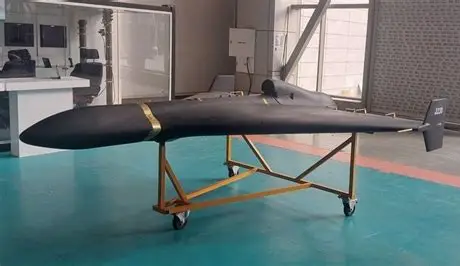
An Iranian Shahed-238 jet airframe on a yellow indoor display stand, side view. The Shahed-238 is the Iranian basis of the Geran-3; the Russian drone is not identical (see below).
An Iranian Shahed-238 jet airframe on a yellow indoor display stand, side view. The Shahed-238 is the Iranian basis of the Geran-3; the Russian drone is not identical (see below).
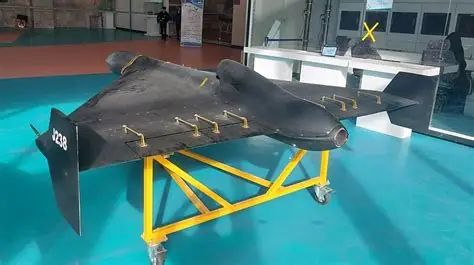
Rear-quarter view of the same type of display unit, with «J238» on the fin and the turbojet at the rear. Iranian Shahed-238, not a recovered Geran-3.
WHAT IT IS
The Герань-3 (Geran-3) is Russia's first jet-powered Shahed-type one-way attack drone. It is essentially the Geran-2 airframe and almost all of the same components, with a Chinese turbojet in place of the piston engine and pusher propeller. [DOCUMENTED, HUR] That was the design idea: keep a cheap, already-produced airframe, make it faster, and field a strike weapon meant to outrun the established cheap defences — ordinary propeller interceptor drones, hand-held guns and unguided gun platforms — so that the defender would have to spend costly air-defense missiles. This is the site owner's assessment of the concept, checked against the sources below.
It was the experimental, proof-of-concept step in that cheap-jet line. At about 300–370 km/h it was only partly successful. Good propeller interceptors could still reach it, and Wild Hornets Sting drones were killing Geran-3s by November 2025. Russia then improved on the idea with the faster Geran-4 and Geran-5, and HUR says Geran-3 production had stopped by August 2026, calling it a "transitional stage" to the Geran-4. [DOCUMENTED, HUR via Militarnyi and RBC]
HUR announced in February 2025 that Russia was setting up production. Wreckage was first found in June 2025, including serial "U-36". The maker is listed as Alabuga OEZ PPT JSC, with the Kometa receiver from VNIIR-Progress. [DOCUMENTED, HUR] First mass use included strikes on Kyiv on the nights of 30–31 July 2025. [DOCUMENTED]
HOW IT WORKS
Propulsion. The recovered "U" series carries a Chinese Telefly JT80 turbojet, rated by its maker at about 80 kgf (about 785 N). It is mounted externally on top of the rear fuselage, where the Geran-2's piston engine and pusher propeller used to be. [DOCUMENTED, HUR teardown] heise says the JT80 is probably a copy of the Czech PBS TJ80-90. [SINGLE-SOURCE] In February 2025, before the teardown, HUR said Russia would use an Iranian Tolou-10/13 engine, a copy of the PBS TJ150. That earlier claim is not matched by the recovered "U" series and should be treated as superseded. [CONTESTED / SUPERSEDED]
Navigation. A Kometa-M12 anti-jam satellite receiver (VNIIR-Progress) with a 12-element CRPA antenna, plus a SADRA inertial unit, an air-pressure unit (ADC) and a power distribution unit. HUR says the electronics layout is "mostly the same" as the gasoline Geran-2 "Ы" series. [DOCUMENTED] See also this site's article on the Kometa CRPA. Parts records list an Altera Cyclone programmable logic chip, an Analog Devices AD9258 converter and a Linear Technology power module in the Kometa, and a TI TMS320 processor and a Chinese Unicore UC9810 satellite receiver in the flight computer. [DOCUMENTED, HUR via RobotWar]
Communications. A Raspberry Pi 4 "tracker" reports position over mobile networks. Some units carry a camera, a live video link and a mesh modem carried over from the Geran-2 "Ъ" series. [DOCUMENTED, HUR, heise] Identifying that modem as the Xingkai XK-F358 is an assumption, so it is unverified. Ukrainian sources say jet Shaheds often carry radio-control modules for real-time rerouting. [SINGLE-SOURCE, Ukrainska Pravda analyst]
Warhead. The recovered unit had a TBBCh-50M, a thermobaric warhead of about 50 kg with steel-ball fragments. [DOCUMENTED, HUR/heise] Brave1 and CSIS give a 50–90 kg range across variants. A 90 kg option on the Geran-3 specifically is unverified.
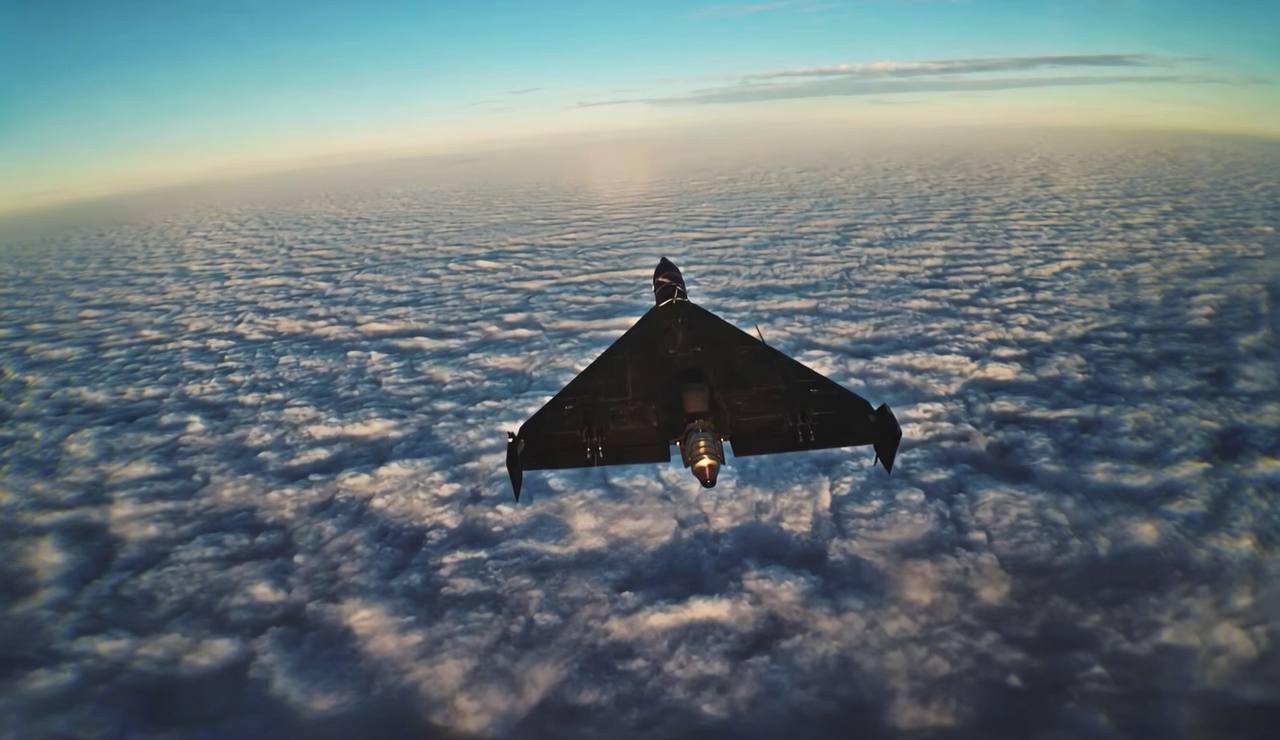
A promotional or video still of a jet-powered delta flying above clouds, with the engine glowing at the rear. Not a documented combat photograph of a specific Geran-3.
HOW IT DIFFERS FROM THE GERAN-2 AND THE SHAHED-238
From the Geran-2 / Shahed-136: it keeps the same airframe with "minimal modifications" and almost the same electronics. Only the propulsion really changes. [DOCUMENTED, HUR] The Geran-2 uses a 50 hp copy of the Limbach L550E piston engine, cruises at about 180–250 km/h and is credited with a range of up to about 2,000 km. The Geran-3 flies at 300–370 km/h with up to about 1,000 km of range. [DOCUMENTED, HUR, heise, Brave1] The jet engine trades range for speed.
From the Iranian Shahed-238: the 238 buries its engine inside the airframe, with a distinctive inlet, and uses revised control-surface actuators. The Geran-3 has an exposed top-mounted turbojet and keeps the Geran-2's wingtip stabilizers and actuators. [DOCUMENTED, SPAS imagery analysis; Ukrainska Pravda] HUR still calls the Geran-3 an "analog" of the Shahed-238, but the recovered airframe is closer to a re-engined Geran-2 than a licensed 238. The Shahed-238 specification usually quoted is about 600 km/h with a TJ150-class engine. [DOCUMENTED as Iranian or leaked spec-sheet figures, CSIS and leaked documents via Ukrainska Pravda] That is well above the Geran-3.
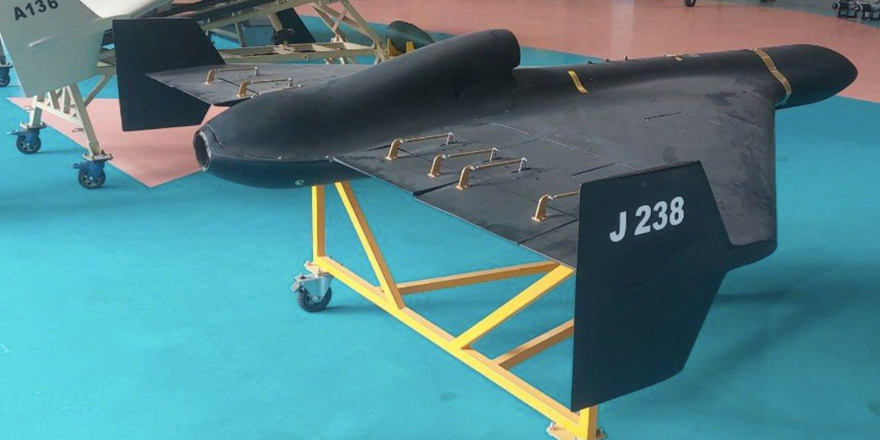
Iranian exhibition display of the Shahed-238, with «J 238» on the fin. A Shahed-136-type airframe marked «A136» is visible at left. Display unit, not a Geran-3.
SPECIFICATIONS
Contested items are given as ranges and labelled. Length, span and takeoff weight are Shahed-238 figures applied to the Geran-3, not measurements of a recovered Russian airframe.
Item Value Label Engine Telefly JT80, about 80 kgf DOCUMENTED Speed 300–370 km/h (HUR). The maximum is used mainly inside air-defense zones and in the terminal dive; observed cruise is about 300–350 km/h DOCUMENTED Speed, other claims 500–600+ km/h (Ihnat, July 2025; Ukrainska Pravda, November 2025, citing "intelligence"; CSIS). These likely mix up Shahed-238 or Tolou-engine claims CONTESTED Range Up to about 1,000 km (HUR) vs 2,500 km in early claims. SPAS calls 2,500 km implausible CONTESTED Warhead About 50 kg TBBCh-50M on the recovered unit; 50–90 kg reported across variants DOCUMENTED / UNVERIFIED for 90 kg Length / span About 3.5 m / 3 m (Shahed-238 figures applied to it) ESTIMATE Takeoff weight 250–370 kg (CSIS, Shahed-238) ESTIMATE, not measured for the Geran-3 Foreign parts 45 on the "U" unit: 22 US, 8 Chinese, 7 Swiss, 3 German, 2 British, 1 Japanese DOCUMENTED (HUR)
PRODUCTION AND COST
It was made at Alabuga. How large the run was is contested: Ukrainska Pravda reported a plan for serial production in the second half of 2026, while Col. Skurativskyi said mass production began in early 2025. [CONTESTED] No total build count has been published.
HUR told Militarnyi that production had stopped by 11 August 2026 and called the Geran-3 a "transitional stage" to the Geran-4. Alabuga now builds an estimated 3,000 Geran-4s and Geran-5s a month. [DOCUMENTED, HUR via Militarnyi, RBC; the monthly figure is a HUR estimate]
There is no published Geran-3 unit price. The inference that it is cheaper than the Geran-5 comes from the engine: the JT80 sells for about $15,000–20,000 (₽1.3–1.7 million), against $35,000–40,000 for the Geran-5's TJ2000A. [ESTIMATE, RobotWar] The Geran-5 as a whole has been estimated at about $115,000; IEEE puts jet Gerans as a class at about $80,000. A leaked Iranian asking price for a Shahed-238 was $0.9–1.4 million, but that is an export quote, not a production cost.
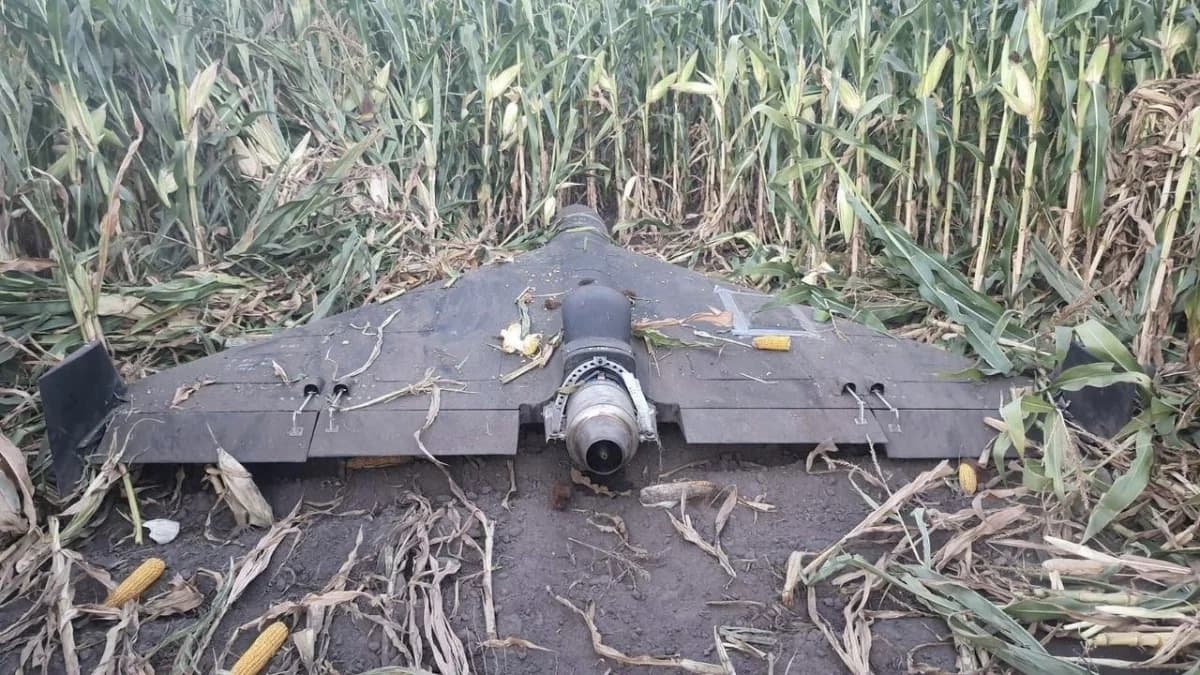
A downed, mostly intact jet-powered Shahed / Geran-3-type drone in a cornfield. The turbojet exhaust is visible at the rear, on the same delta airframe as the Geran-2.
ROLE AND COMBAT USE
The concept was the same one later used on the Geran-5: a cheap strike weapon, built around a familiar airframe, made fast enough that the cheap defensive layer would fail and costly SAMs would have to take the shot. On the Geran-3 that idea was only partly borne out. Its documented top speed of 300–370 km/h sits within reach of good propeller interceptors, whose practical limit is about 450 km/h, and it often cruises slower still to save fuel, so interceptors can catch it on long routes. [DOCUMENTED, HUR speed note plus Ukrainska Pravda analysis] The speed did stress mobile gun teams and older interceptors, and it compressed reaction time near the front. It was not fast enough to escape the cheap layer for long.
First mass use included Kyiv on the nights of 30–31 July 2025. Ihnat said it looks like a cruise missile on radar and that "not all systems can intercept" it. [DOCUMENTED] The largest reported raid was 138 Geran-3s on the night of 29–30 November 2025, with "most" destroyed. That night brought the first interceptor-drone kills, by Wild Hornets' Sting. [DOCUMENTED, General Staff, Ukrainska Pravda, Militarnyi] It is often aimed at frontline or near-rear cities a few hundred kilometres out, where it can stay fast. [HUR and Ukrainska Pravda analysis]
There is no Geran-3-specific interception rate. The 2026 jet-Geran figure of about 57–60%, against 85–95% for piston types, is dominated by the Geran-4 and Geran-5 and should not be applied here.
In short, the Geran-3 proved that a re-engined Geran-2 could be fielded as a jet, but not that 300–370 km/h was enough. The fully "too fast for cheap defences" problem belongs to the later, faster Geran-4 and Geran-5.
CAVEATS AND OPEN QUESTIONS
Most technical detail comes from HUR's "U" series teardown and from reporting that follows it. Speed claims of 500–600+ km/h, a 2,500 km range, a 90 kg Geran-3 warhead, and Shahed-238 length, span and weight figures applied to this drone are contested, unverified or estimates. There is no published unit price and no total production count. The XK-F358 modem identification is unverified. The early Tolou-10/13 engine claim was superseded by the recovered JT80.
There is no article on this site yet for the Geran-4 as a separate type; it is discussed with the Geran-5.
STATUS
As of November 2026: production at Alabuga reported halted by 11 August 2026; treated by HUR as a transitional type before the Geran-4 and Geran-5; first found as wreckage in June 2025; first mass use at the end of July 2025; first published interceptor-drone kills in late November 2025.
IN ONE SENTENCE
The Герань-3 (Geran-3) is a jet-powered one-way attack drone built at Alabuga on the Geran-2 airframe and almost the same electronics, with a Chinese JT80 turbojet of about 80 kgf, a recovered 50 kg thermobaric warhead and a documented speed of 300–370 km/h: the proof-of-concept cheap jet, fast enough to stress guns and early interceptors but not to escape good propeller drones, and dropped in 2026 in favour of the faster Geran-4 and Geran-5.
RELATED
Geran-2 (Shahed-136): the piston airframe it is built on. Geran-5: the later, faster jet that, with the Geran-4, replaced it. Kometa CRPA. Kh-101.
SOURCES