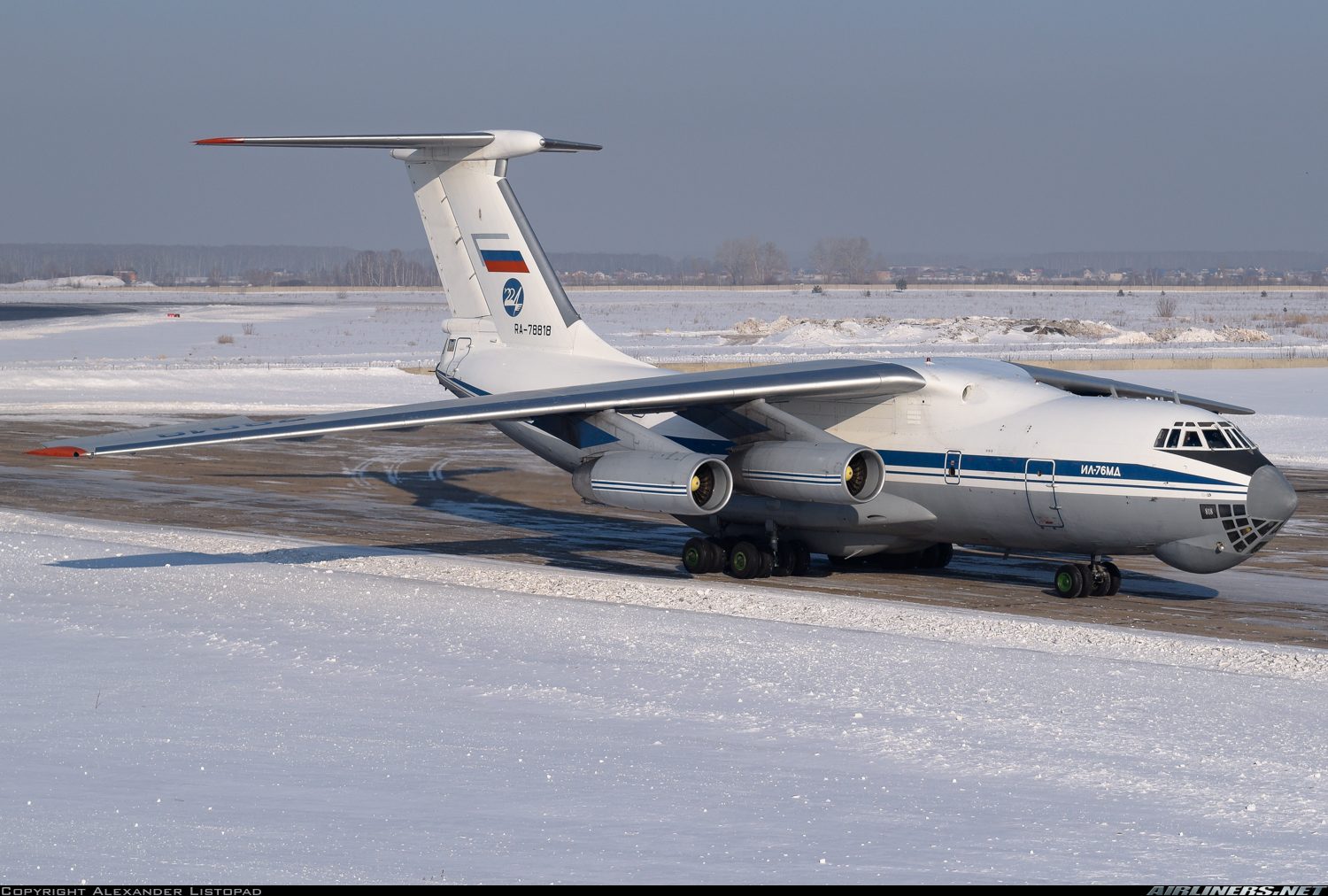
Il-76 RA-78818 on a snow-covered ramp. Built for exactly this kind of place.
Il-76 RA-78818 on a snow-covered ramp. Built for exactly this kind of place.
WHAT IT IS
The Ilyushin Il-76 (NATO reporting name "Candid") is a four-engine, high-wing heavy transport with a T-tail and a rear loading ramp. It was designed in the late 1960s to carry big loads a long way and to land them on short, rough, frozen strips at the far end. It first flew on 25 March 1971. More than fifty years later it is still the backbone of Russian military transport aviation, still flown by cargo airlines and air forces across Asia, Africa and the Middle East, and back in production at Ulyanovsk as the Il-76MD-90A. [DOCUMENTED]
About 860 of the basic transport versions were built at Tashkent in Soviet and early post-Soviet times. Total figures that include all special-mission variants are often quoted as "about 950" or "981", but no reliable primary source for an exact total was found, so this page does not give one. [DOCUMENTED for the Tashkent transport figure; total UNVERIFIED]
THE SITE OWNER'S VIEW
The site owner considers the Il-76 a fantastic aircraft: tough, versatile, long-lasting and great for cargo. It is the kind of machine that gets a job done in places where nothing else can, and then comes back and does it again for another forty years. Most of what follows on this page is really an explanation of why that reputation is earned.
HISTORY AND ORIGINS
The requirement. By the mid-1960s the turboprop An-12 was the Soviet Union's standard military transport, and it was too small, too slow and too short-legged. Design work on a replacement started at the Ilyushin bureau in 1967 under Genrikh Vasilyevich Novozhilov, who became Ilyushin's General Designer on 28 July 1970, before the first flight. The requirement was demanding: carry 40 tonnes over 5,000 km in under six hours, operate from short unprepared strips of around 500 m, and work in Siberian and Arctic conditions with little ground support. In other words, a jet with the reach of a strategic airlifter and the field performance of a tactical one. [DOCUMENTED]
First flight. The prototype, SSSR-86712, first flew on 25 March 1971 from the Frunze Central Aerodrome (Khodynka) in Moscow with D-30KP turbofans, flown by a crew led by test pilot Eduard Kuznetsov. It landed at Zhukovsky (the LII flight-test centre) after 40 minutes. In May 1971 it was shown at the Paris Air Show at Le Bourget. Series production went to the Tashkent Aviation Production Association (TAPO) in Uzbekistan, and the first Tashkent-built aircraft flew on 5 May 1973. [DOCUMENTED]
Into service. The Il-76 entered Soviet Air Force (VVS) service in June 1974, and Aeroflot began flying the civil versions in 1976. It replaced the An-12 in the heavy end of the transport fleet and became the standard way to move paratroops, armour and supplies across the USSR. [DOCUMENTED]
Afghanistan. The war in Afghanistan from 1979 to 1991 proved the design. Il-76s flew about 14,700 sorties, carrying 786,200 personnel and 315,800 tonnes of cargo. That was about 89% of all troops and 74% of all freight moved by air in the war, much of it into high-altitude, hot airfields under threat of ground fire. [DOCUMENTED]
After 1991. The breakup of the USSR left the factory in independent Uzbekistan and the main customer in Russia. Production at Tashkent dwindled through the 1990s and 2000s. In 2010 Russia decided to move production to Ulyanovsk, and Tashkent production ended in 2012: the last aircraft, the fifth Il-76TD-90 for Volga-Dnepr, left the factory on 27 April 2012. At the same time thousands of tonnes of commercial cargo work opened up, and Il-76s became a familiar sight at airports around the world, flying humanitarian loads, oil-field equipment, outsized freight and much else. The new home is Aviastar-SP in Ulyanovsk; see BACK IN PRODUCTION below. [DOCUMENTED]
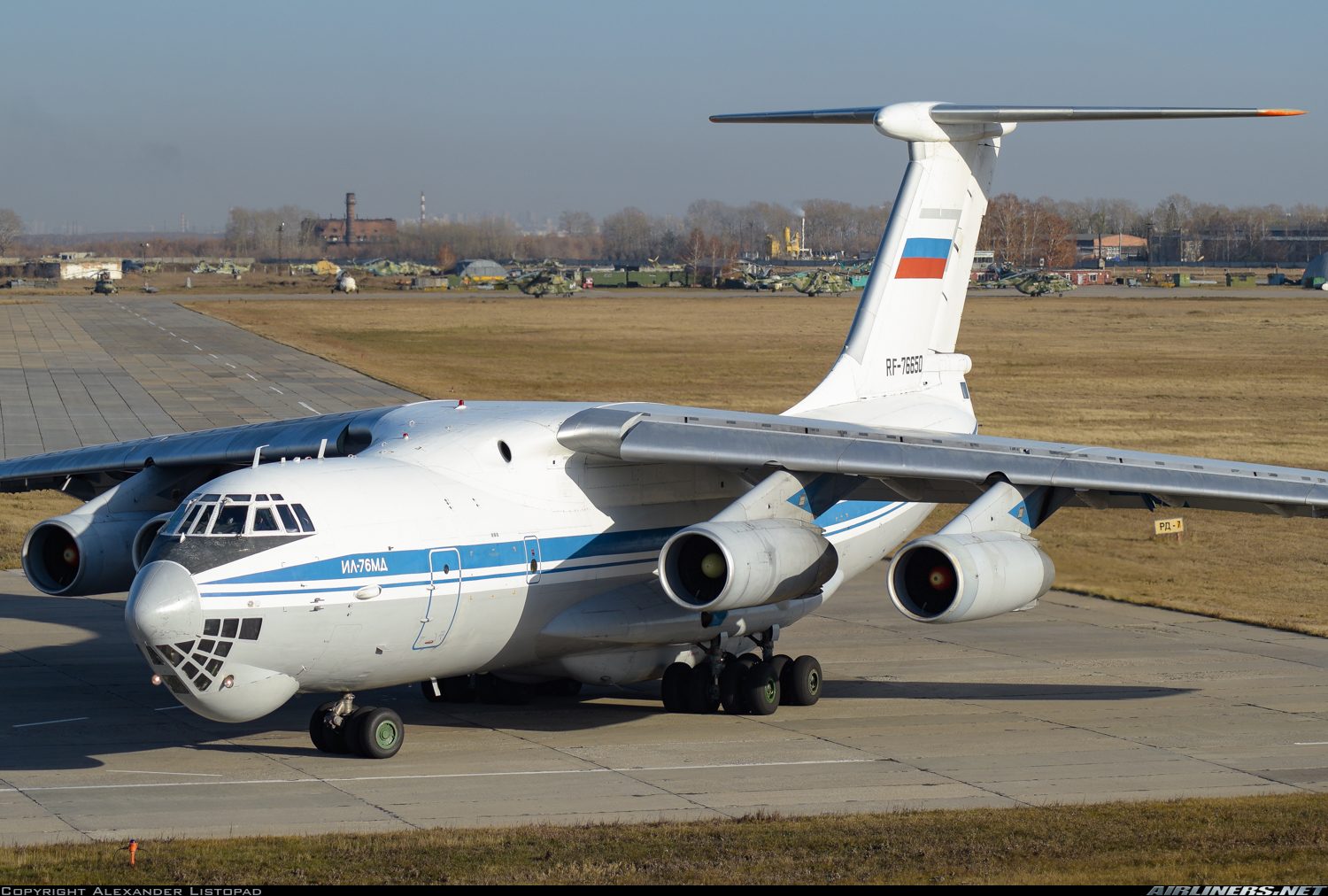
Il-76 RF-76550, a Russian Aerospace Forces transport with the original D-30KP engines.
DESIGN: WHAT MAKES IT A GOOD AIRCRAFT
High wing, T-tail, four engines. The wing sits on top of the fuselage, which keeps the engines high above debris on unpaved strips and lets the cargo floor sit low to the ground. The T-tail keeps the horizontal stabiliser clear of the rear ramp and the engine wake. Four engines give engine-out margin on long overwater and over-tundra legs. The wing is fitted with slats along the leading edge and triple-slotted flaps along the trailing edge, so it can fly slowly enough for short fields. [DOCUMENTED]
Landing gear for rough fields. The gear is the Il-76's signature: 20 wheels in all, a four-wheel nose leg and four main legs of four wheels each. The main gear retracts into large fairings on the fuselage sides rather than into the wing, keeping the hold uncluttered. Tyre pressure is selectable for the runway surface: about 5.5 kgf/cm² on the nose and 4.5 kgf/cm² on the mains for dirt strips, and 7.5 and 7 kgf/cm² for concrete. According to some references the pressure can even be adjusted in flight, between about 2.5 and 5 atm; that comes from a single secondary source. The Il-76MD-90A has strengthened gear for its higher weights. [DOCUMENTED; in-flight adjustment from one secondary source]
A real cargo hold. The pressurised hold is about 20 m long without the ramp and 24.5 m with it, 3.45 m wide and 3.4 m high. A two-section rear door and a ramp that can be lowered to the ground or set level with a truck bed let vehicles drive straight in. Four electric overhead hoists of 2.5 t each (up to 10 t combined) and two forward winches with 3 t of pull each let the crew load and unload heavy items at airfields with no ground equipment. The hoists reach 5 to 6 m beyond the ramp sill (sources differ). The floor can be fitted with roller tracks for pallets and containers. [DOCUMENTED; hoist reach varies between sources]
Self-sufficient. An auxiliary power unit provides engine starting, electrical power and air on the ground, so the aircraft can operate from strips with no ground carts. The navigator's glazed nose station and a ground-mapping radar under the nose were designed for flying into poorly equipped airfields in bad weather. [DOCUMENTED]
Tough and long-lasting. The structure was designed for repeated heavy landings on unprepared surfaces and for extreme cold. Many airframes built in the 1970s and 1980s are still flying; the MD-M programme, below, exists precisely because the old airframes still have life left in them. [ANALYSIS]
Versatile. The same basic airframe has been a troop and paratroop transport, airliner-freighter, air tanker, airborne early-warning aircraft, firefighting bomber, flying hospital, zero-gravity trainer for cosmonauts and engine testbed. Few airframes in history have done so many jobs. [DOCUMENTED; see VARIANTS]
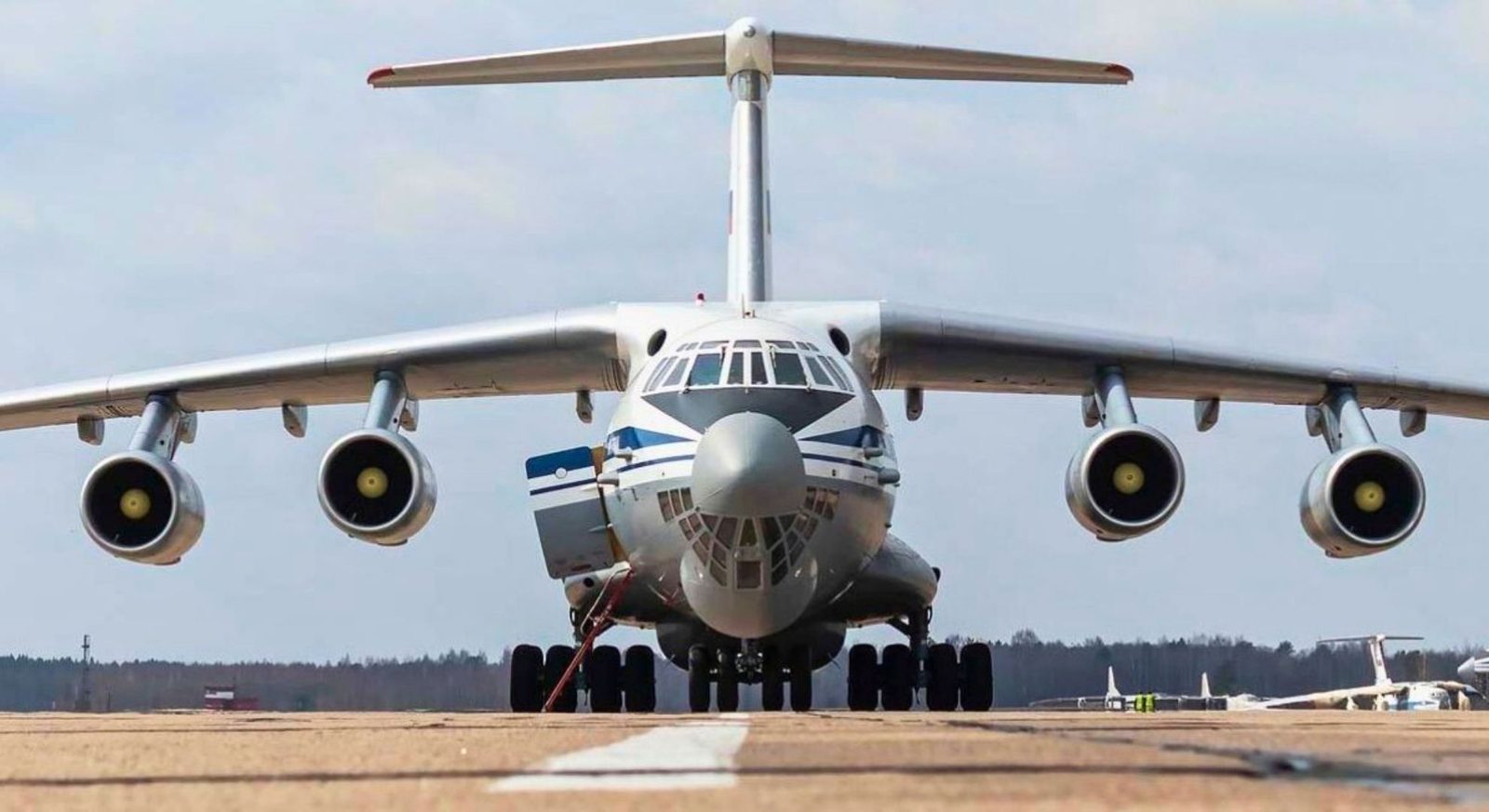
Head-on: high wing, four D-30KP engines, glazed navigator's nose and the radome under it.
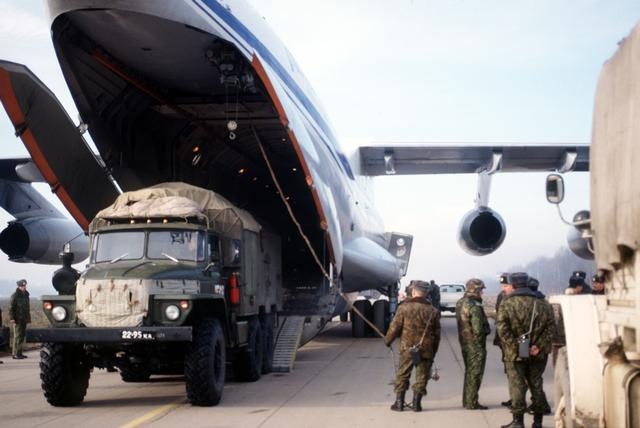
A Ural truck at the rear ramp. Vehicles drive straight into the hold.
HOW IT FLIES
The crew. The standard crew is five: two pilots, a flight engineer, a navigator in the glazed nose and a radio operator. Military versions add a gunner for the tail turret, and loadmasters ride in the back. Compared with Western heavy transports of the same era it is a large crew, but it reflects Soviet doctrine of flying into airfields with few navigation aids. [DOCUMENTED]
Takeoff and climb. The thrust-to-weight ratio is about 0.32 at a 200-tonne weight, healthy for a heavy freighter. With slats and the big flaps out it gets airborne in a short distance and climbs steeply, which suits short strips with obstacles and threat areas where a fast departure matters. [Thrust-to-weight DOCUMENTED; the rest ANALYSIS]
Landing. Thrust reversers and the multi-wheel gear give a minimum landing run of about 450 m in the right conditions. In Afghanistan crews became known for steep, spiralling approaches straight down over the airfield to stay out of range of ground fire, a technique the airframe tolerated well. [Landing run DOCUMENTED; tactical approaches widely reported]
Handling. No formal flight-test handling report was found, but there are attributed accounts. Ilyushin's chief test pilot, Sergey Sukhar, says he loves the plane and considers it one of the best, and that the nine-screen glass cockpit of the MD-90A eases the crew's workload. A Boeing 747 pilot who rode in the cockpit of a classic Il-76 described it as "flying by committee": the flight engineer worked the throttles, the navigator steered, and the approach was hand-flown on raw data, with a lower flare than a 747. A passenger account noted that an empty Il-76TD climbed much steeper than expected. [Attributed accounts; no formal test data]
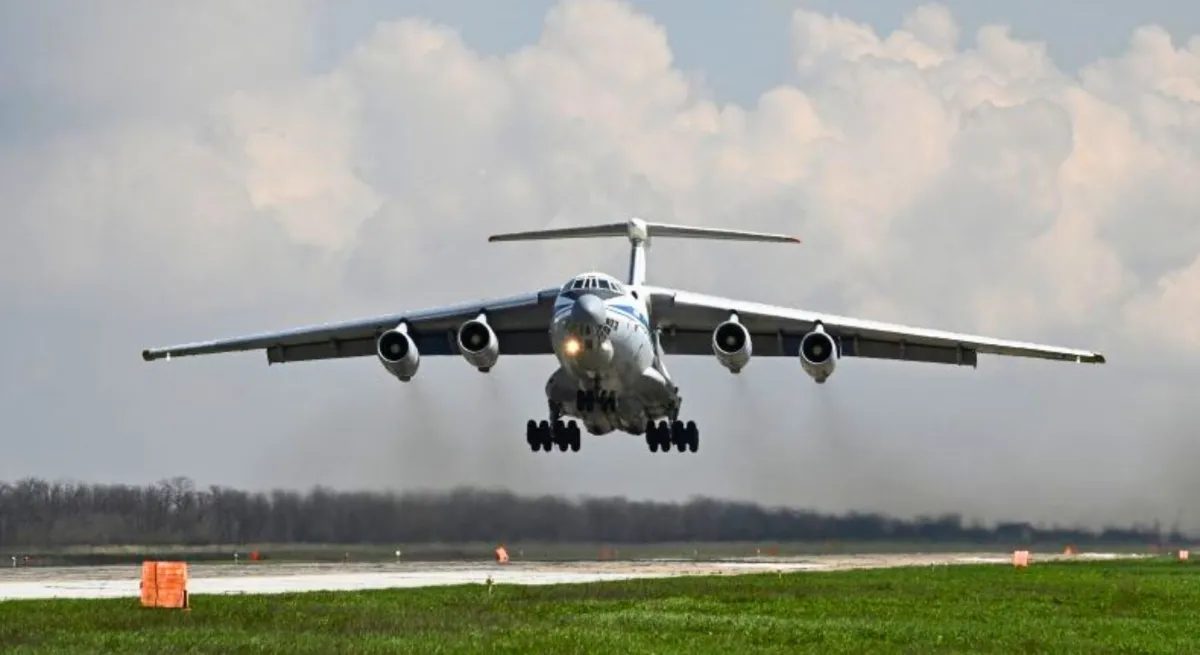
Il-76 lifting off, gear still down.
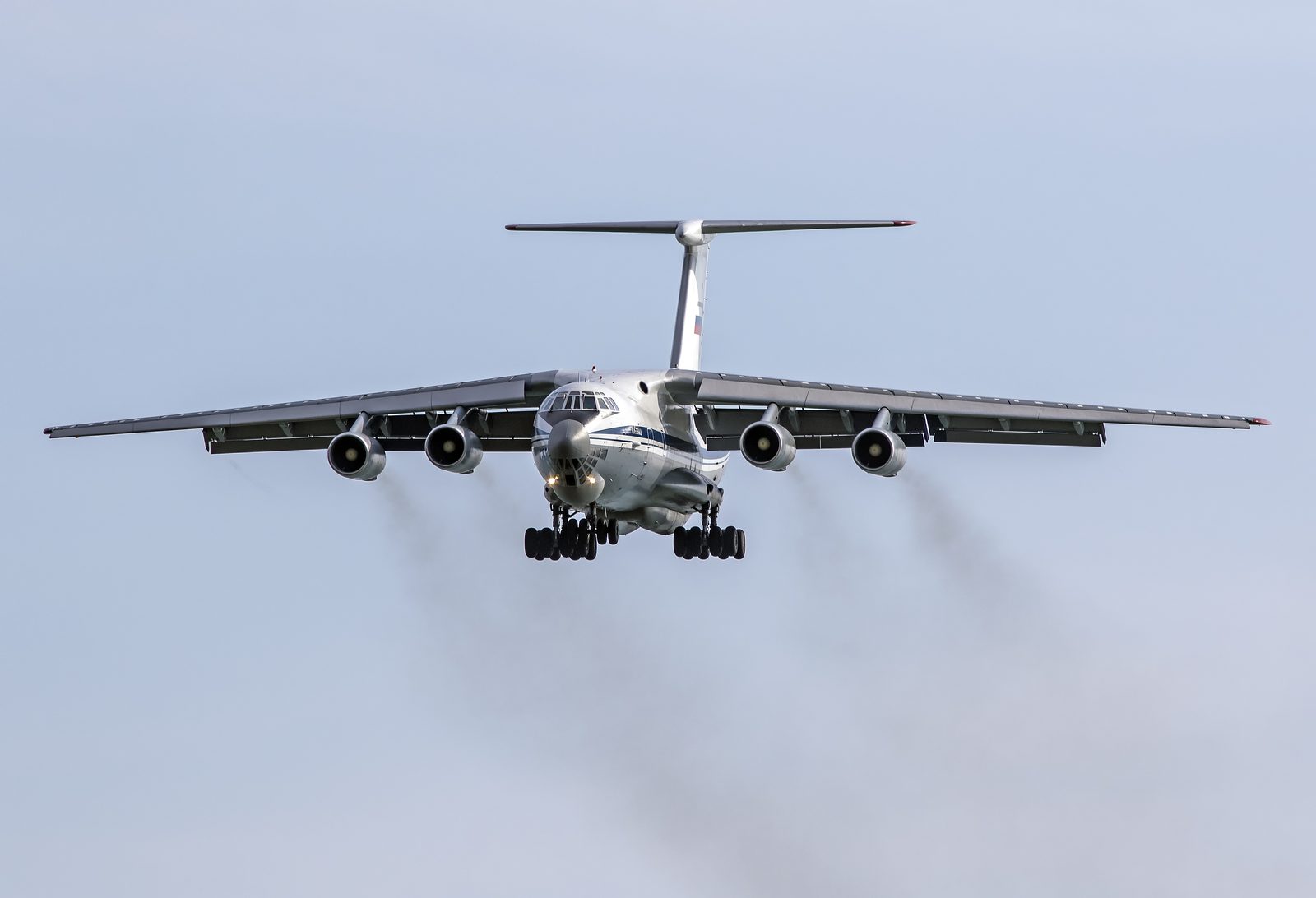
On approach, head-on, flaps and gear down.
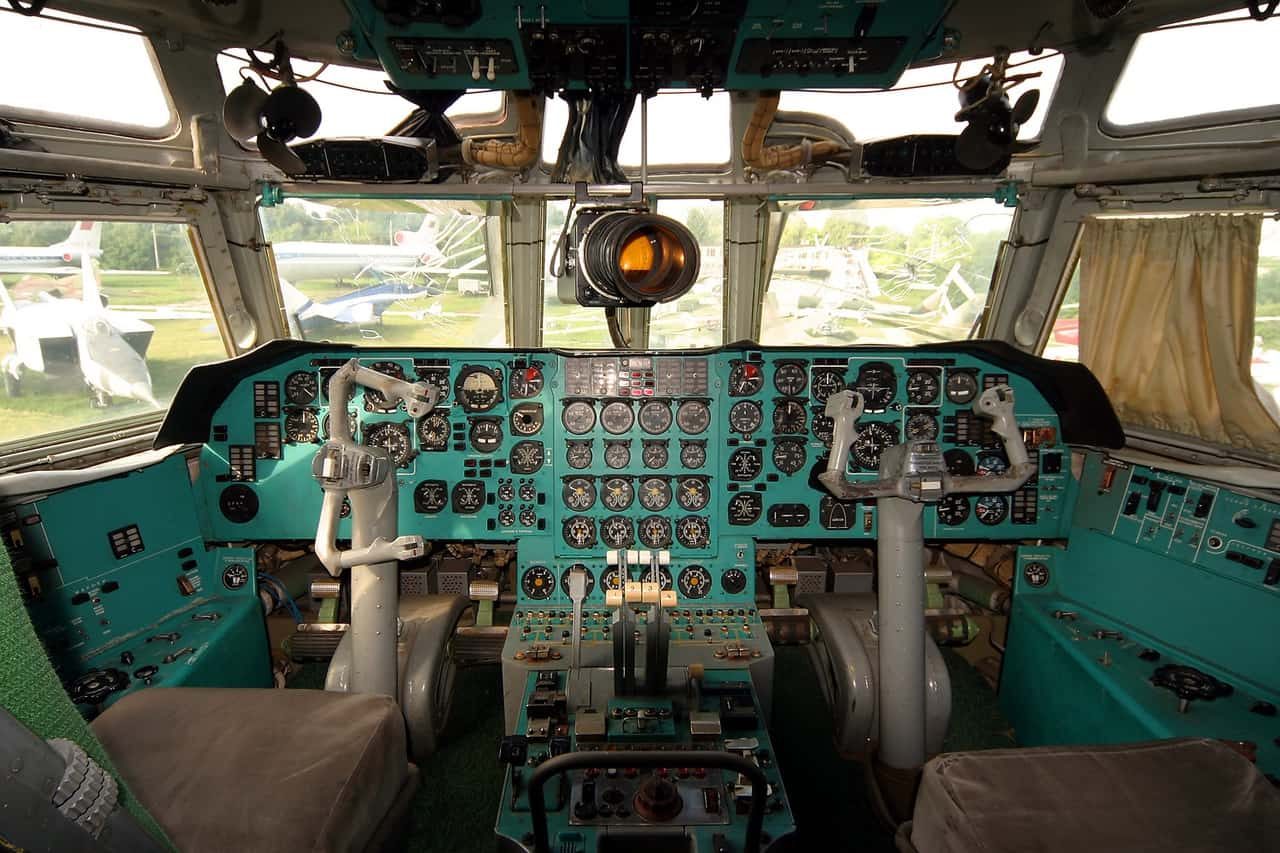
The classic Il-76 flight deck: round dials, a flight engineer's station and the navigator's position below and ahead.
ENGINES
Soloviev / Aviadvigatel D-30KP. The original engine, a two-spool low-bypass turbofan built in Perm and later Rybinsk. Takeoff thrust is 12,000 kgf, cruise thrust 2,750 kgf, cruise specific fuel consumption about 0.7 kg per kgf per hour, bypass ratio 2.36, fan diameter 1,455 mm, and weight 2,640 kg with thrust reverser. The D-30KP-2 of later aircraft keeps its thrust at higher temperatures and altitudes. One reference gives a bypass ratio of 2.24 for the KP-2; the difference may be between sub-variants. The D-30KP is reliable and simple, but it is thirsty and loud, and it cannot meet modern ICAO noise rules. [DOCUMENTED, Aviadvigatel]
Aviadvigatel PS-90A-76. The high-bypass engine of the modern aircraft, a version of the PS-90A that powers the Il-96 and Tu-204/214. It gives about 14,500 kgf of takeoff thrust, burns 12–14% less fuel than the D-30KP and meets ICAO Chapter 4 noise limits, which is what lets the aircraft into European airports. Some references quote 156.9 kN (about 16 t); 14.5 t is the figure used by Russian official and defence press for the -76 version. [DOCUMENTED, TASS; thrust figure varies between sources]
You can tell them apart at a glance: the PS-90A-76 nacelles are noticeably larger and fatter than the slim D-30KP pods. Compare the photo in MODERNIZATION with the ones above.
VARIANTS
MODERNIZATION: THE IL-76MD-90A
The Il-76MD-90A, known during development as the Il-476, is not a simple re-engine. It is the Il-76 rebuilt in Russia with a new wing, new engines, a new cockpit and stronger gear, and it is the basis for every new Il-76 family aircraft today. [DOCUMENTED]
Timeline. The first aircraft was rolled out in Ulyanovsk on 16 June 2014 after a long move of tooling and documents from Tashkent. In 2012 the Defence Ministry signed a contract for 39 aircraft worth 139.42 billion rubles; it was revised in May 2020 after years of delays. The first serial aircraft was delivered on 2 April 2019. At least two military transport aviation regiments have since re-equipped with it. [DOCUMENTED]
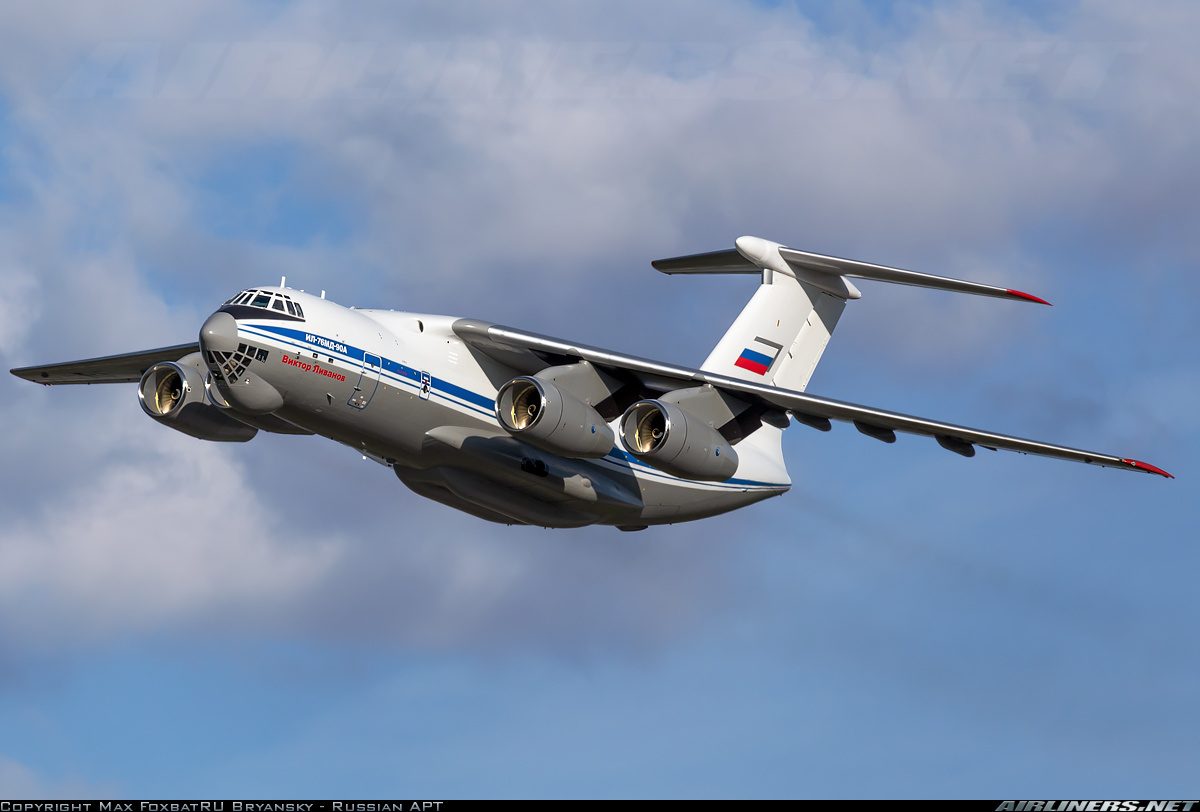
Il-76MD-90A "Viktor Livanov" in flight. Note the larger PS-90A-76 engine nacelles.
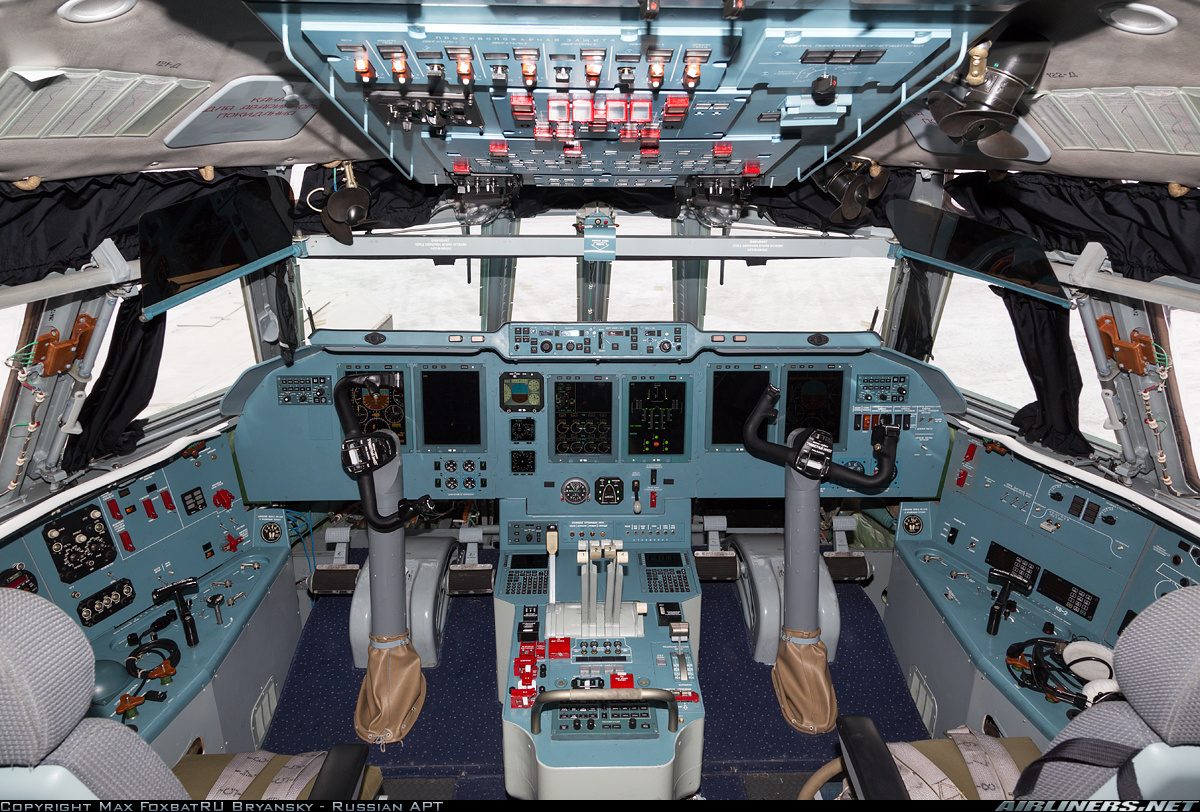
The Il-76MD-90A glass cockpit, compared with the classic flight deck above.
BACK IN PRODUCTION AT AVIASTAR-SP
Aviastar-SP in Ulyanovsk, the plant that built the An-124, is now the only factory building the Il-76 family. Deliveries of the MD-90A to the Defence Ministry have risen slowly since 2019, but the plant has missed every target it announced. [DOCUMENTED]
| Year | Target | Delivered (approx.) | Notes |
| 2019 | – | 3 | first serial delivery 2 April 2019 |
| 2020 | 6 | 3 | contract revised May 2020 |
| 2021 | – | 2 | not listed by every source |
| 2022 | – | 5 | |
| 2023 | – | 6 | one source says 5 produced |
| 2024 | ~10 (12 in the 2020 plan) | 6 | |
| 2025 | 7 | 7 | last was RF-78686; 37 built including the prototype |
| 2026 | 9 (earlier quoted as 12, then 10) | not confirmed | one aircraft (RF-76323) to FSB aviation in March |
| 2027 | 12 | – | |
| 2028–29 | 18 / yr design capacity | – | 24–30 / yr long-term aim |
Yearly counts differ by about one aircraft between sources, and Russia reduced public reporting of deliveries in 2025, so some figures rely on analysis by the Moscow defence think tank CAST. Treat them as approximate. [DOCUMENTED; ±1 per year]
Why it is slow. Ilyushin asked for about 80 billion rubles to retool the line and realistically expects 20–22 billion. Sanctions have slowed purchases of machine tools and equipment. The PS-90A engine is shared with the Tu-214 and Il-96 revivals, which compete for the same Perm output. The result is a line that is improving year on year but at roughly half the announced rate. [DOCUMENTED, Kommersant; engine competition ANALYSIS]
SPECIFICATIONS
| Il-76M | Il-76MD / TD | Il-76MD-90A | |
| Crew | 5 (plus gunner on military versions, loadmasters) | ||
| Max payload | 42 t | 48 t | 60 t |
| Length / span / height | 46.6 m / 50.5 m / 14.42 m; wing area 300 m² | ||
| MTOW | 170 t | 190 t (TD-90VD: 195 t) | 210 t |
| Empty weight | varies | 92.5 t | |
| Engines (x4) | D-30KP / KP-2, 12,000 kgf | PS-90A-76, ~14,500 kgf | |
| Cruise / ceiling | 750–800 km/h; 12,200 m | ||
| Range | varies with load | 5,000 km with 52 t; ferry 9,700 km | |
| Min landing run | about 450 m with reversers | ||
| Armament | military: tail turret, 2 x 23 mm cannon | ||
MD-90A figures are from the manufacturer and export agency data. M and MD/TD weights are from reference and operator data. One source gives 48 t payload for the Il-76M as well; most give 42 t. [DOCUMENTED]
LEGACY
The Il-76 did for the Soviet Union what the C-141 and C-130 together did for the United States: one airframe that could fly strategic distances and still land on a dirt strip. It carried an army through a ten-year war, became a workhorse of world cargo flying after 1991, and turned into a family of tankers, radar aircraft and specialised platforms. Now, rebuilt as the MD-90A, it is being made again, slowly, by a country that cannot buy anything to replace it. [ANALYSIS]
IN ONE SENTENCE
The Il-76 is Ilyushin's tough, four-engine rough-field jet freighter from 1971, the backbone of Russian military airlift for half a century and now back in slow production at Ulyanovsk as the PS-90A-powered, glass-cockpit Il-76MD-90A.
RELATED
A-50: the radar aircraft built on the Il-76. An-124: the giant built at the same Ulyanovsk plant. Il-96 and Tu-204: the airliners that share the PS-90A engine family.
SOURCES