WHAT IT IS
The Beriev A-50 (А-50, NATO reporting name "Mainstay") is the Soviet and Russian airborne early warning and control aircraft. It is an Ilyushin Il-76MD military transport rebuilt by the Beriev design bureau at Taganrog to carry the Shmel (Шмель, "Bumblebee") pulse-Doppler surveillance radar in a rotating disc-shaped radome mounted on two pylons above the rear fuselage. Its job is to look down from altitude, see aircraft and cruise missiles flying low over land and sea well beyond the reach of ground radars, build an air picture, and pass that picture and direct control instructions to fighters, ground command posts and surface-to-air missile units. [DOCUMENTED]
The type first flew in December 1978, entered squadron service in the mid-1980s and was formally accepted into Soviet service in 1989. About forty were built on Il-76 airframes at the Tashkent aviation plant and converted at Taganrog before production stopped in 1992. The modernized A-50U, with a digitized Shmel-M radar, new consoles and computers, has been the only version in front-line Russian use for the last several years. The intended successor, the A-100 "Premier" (Премьер) on the new Il-76MD-90A airframe with an active electronically scanned array from Vega, has flown but has not entered service as of late 2026. [DOCUMENTED]
The A-50 is a small fleet doing a large job. Russia has never had more than a handful of these aircraft serviceable at once in the post-Soviet era, and since January 2024 it has lost at least two in the air to Ukrainian air defense and had others damaged on the ground. Because airborne radar is the only practical way to see low-flying targets at long range over a country as large as Russia, every A-50 lost is a hole in the integrated air defense picture that cannot be patched quickly. [DOCUMENTED]
QUICK REFERENCE
Designation: A-50 (izdeliye "A"), A-50M, A-50U; export A-50I (China, cancelled), A-50EI (India); successor A-100 "Premier". [DOCUMENTED]
NATO reporting name: Mainstay. [DOCUMENTED]
Designer: Beriev (TANTK im. G. M. Berieva), Taganrog; mission system by Vega (Концерн «Вега», formerly MNIIP), Moscow. [DOCUMENTED]
Airframe: Ilyushin Il-76MD (A-50/A-50U); Il-76TD-90 / Il-76MD-90A class with PS-90A engines (A-50EI and A-100). [DOCUMENTED]
Engines: four Soloviev / Aviadvigatel D-30KP-2 turbofans, about 12,000 kgf each (A-50/A-50U). [DOCUMENTED]
Radar: Shmel (A-50), Shmel-M (A-50M/A-50U) pulse-Doppler, S-band region, in a mechanically rotating radome about 10.8 m across and 2 m deep. [DOCUMENTED for radome size; ESTIMATE for exact band]
Radome rotation: about 6 revolutions per minute (one sweep every 10 s). [DOCUMENTED]
Detection range against a fighter-size target: about 230 km (A-50 original); large aircraft about 400 km; surface ships up to roughly 400 km. Published A-50U figures are higher but inconsistent. [DOCUMENTED for original; ESTIMATE for A-50U]
Tracking: about 50 to 60 targets at once on the original A-50, with guidance of 10 to 12 fighters; A-50U figures of 150 tracked targets and more are commonly quoted. [DOCUMENTED / SINGLE-SOURCE for A-50U figures]
Crew: 5 flight crew and 10 mission crew, 15 in total, with variation by version. [DOCUMENTED]
Maximum take-off weight: about 190 t. [DOCUMENTED]
Endurance: about 4 hours on station at 1,000 km from base; about 7.5 to 9 hours total unrefuelled depending on version; in-flight refuelling probe fitted. [DOCUMENTED]
Patrol altitude: typically 8,000 to 10,000 m. [DOCUMENTED]
Built: about 40 (last airframe 1992). [DOCUMENTED]
Main base: Ivanovo Severny (Иваново-Северный), home of the 610th Combat Employment and Aircrew Conversion Center and the former 144th AEW&C regiment. [DOCUMENTED]
Status 2026: A-50U in limited service, roughly four to seven airframes on strength with perhaps four flyable at a time; original A-50 retired from active use; A-100 not in service, program reported stopped. [DOCUMENTED / ESTIMATE]
WHY THE SOVIET UNION NEEDED IT
Ground radars are limited by the curvature of the Earth. A radar antenna 30 m up a mast can see an aircraft at 10,000 m altitude out to roughly 400 km, but an aircraft or cruise missile flying at 50 m only out to about 40 km. Anything that comes in low hides below the radar horizon until it is close. The Soviet Union, with the longest borders in the world and huge stretches of sparsely covered Arctic and Siberian territory, could not ring itself with enough ground radars to see low fliers everywhere. [BACKGROUND]
By the late 1960s the threat was changing in exactly the direction that made this worse. NATO strike aircraft such as the F-111 and later the Tornado were designed to penetrate at very low altitude with terrain-following radar. US strategic bombers practised low-level penetration. And from the mid-1970s the United States was developing air-launched and ground-launched cruise missiles, the AGM-86 ALCM and BGM-109 Tomahawk, that would fly at tens of meters above the ground for thousands of kilometres. To intercept these targets, the air defense forces (ПВО страны, PVO Strany) needed to see them early and far out, and the only way to do that was to lift the radar high into the air. [BACKGROUND]
An airborne radar at 9,000 m has a radar horizon against a sea-level target of about 390 km. Put that aircraft 200 to 300 km out in front of the defended border and it can see low-flying targets far before they reach the ground radar belt. The problem is that, looking down, the radar also sees the ground, and the ground returns an echo millions of times stronger than a small aircraft. Separating a moving target from that clutter is the central technical problem of every airborne early warning radar, and the Soviet Union's first attempt did not solve it. [BACKGROUND]
THE PREDECESSOR: Tu-126 LIANA
The first Soviet AEW aircraft was the Tupolev Tu-126 (NATO "Moss"), developed from the Tu-114 turboprop airliner, itself a derivative of the Tu-95 bomber. It carried the Liana (Лиана) radar in an 11 m rotodome above the fuselage. The prototype flew in January 1962, and eight production aircraft plus the prototype served from 1965 with a single unit, the 67th Independent Long-Range Radar Detection Aviation Squadron at Šiauliai in Lithuania. [DOCUMENTED]
Liana was a VHF-band radar designed by NII-17 (the institute that later became MNIIP and then Vega). It could detect bomber-sized targets over the sea at roughly 300 km and fighters at about 100 km, but its performance over land was very poor because it had little ability to reject ground clutter. In practice the Tu-126 worked best over water, over the Barents and Baltic approaches, as a long-range picket against bombers. Its cabin was crowded with vacuum-tube equipment, the crew suffered from high noise and microwave exposure, and the aircraft acted more as a flying radar post that reported to the ground than as a true controller of fighters. [DOCUMENTED]
The Tu-126 was also deployed in a single wartime role abroad: in 1971 two aircraft with Soviet crews were sent to India during the Indo-Pakistani war, according to several accounts. [UNVERIFIED]
The Tu-126 fleet was retired by 1984, as the A-50 came in. Its lessons shaped the new aircraft: the radar had to work over land, it had to track low targets in clutter, the crew had to be able to control fighters directly, and the airframe had to have the space and power for a large crew and computers. [DOCUMENTED]
DEVELOPMENT OF THE A-50
Work on a new aircraft began under a 1973 government decree. The radar complex was assigned to MNIIP (Московский научно-исследовательский институт приборостроения, Moscow Research Institute of Instrument Engineering), which became the Vega radio engineering concern. The airframe integration went to the Beriev design bureau at Taganrog, best known for flying boats, which had the large-aircraft modification experience and the facilities to take the work. Ilyushin supplied the Il-76 transport as the platform. Chief designer for the aircraft at Beriev was Aleksei Konstantinov. [DOCUMENTED]
The choice of the Il-76 was practical. It was in mass production at Tashkent, it had four turbofans with plenty of electrical generating capacity, a wide fuselage able to take consoles and processing racks, rough-field capability, and a large fuel load. Its high wing and T-tail kept the space above the rear fuselage clear for the rotodome pylons. The Il-76's cargo ramp and rear doors were sealed and the glazed navigator's nose was retained. [DOCUMENTED]
Some Western accounts say a Tu-142 or Tu-154 platform was considered early on; this is unclear in the sources. [UNVERIFIED]
The first A-50 flew from Taganrog on 19 December 1978. The original aircraft was a converted Il-76 with the radome and test equipment; the radar complex itself took years to mature, and the first production-standard aircraft did not reach the air defense forces until 1984. The aircraft was officially accepted into service in 1989 after a long state test program. [DOCUMENTED]
The development time is not surprising. The Shmel was the Soviet Union's first look-down airborne radar designed from the start to pick out low-flying targets over land, a problem that also took US industry most of the 1960s and early 1970s to solve for the E-3 Sentry. Shmel was a large analogue and early digital system with heavy power demands and a substantial cooling load, and integrating it, the identification-friend-or-foe system, data links and the crew stations onto the Il-76 was a major project for the time. [BACKGROUND]
THE AIRFRAME
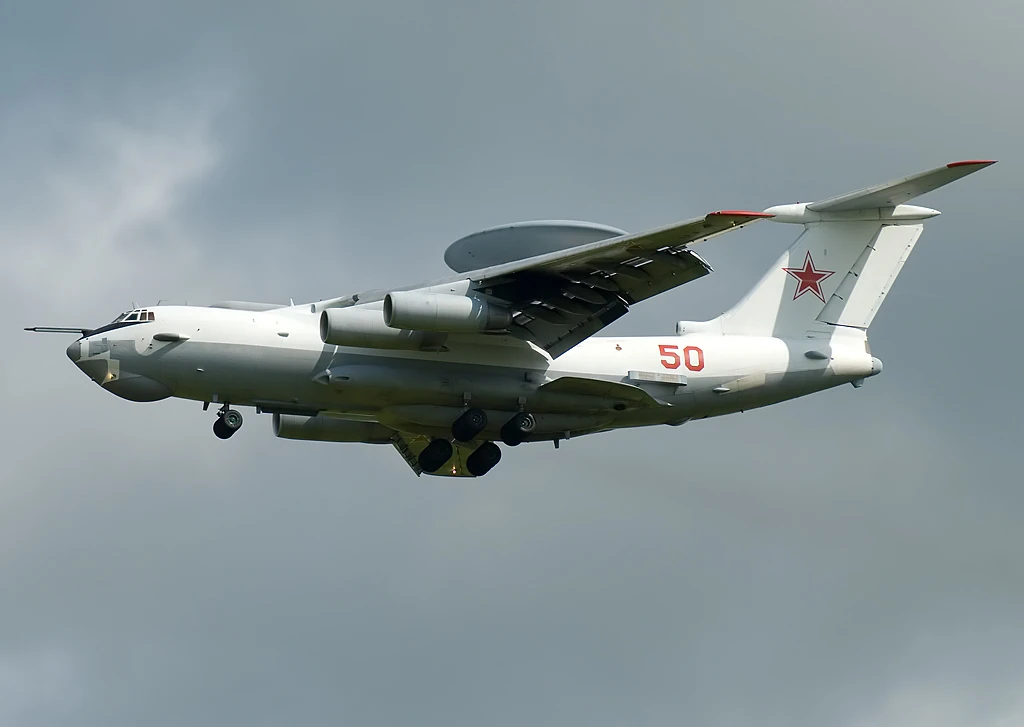
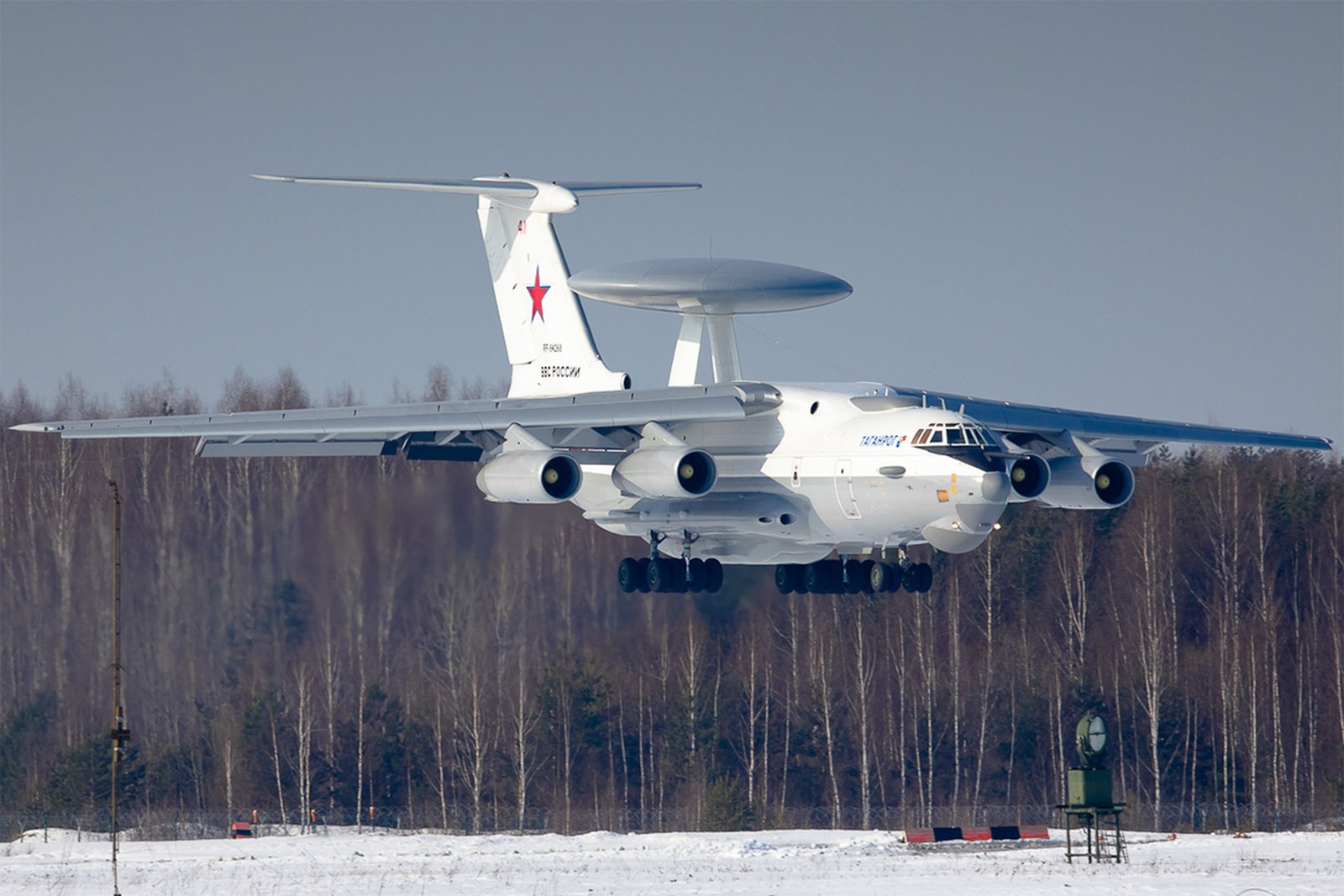
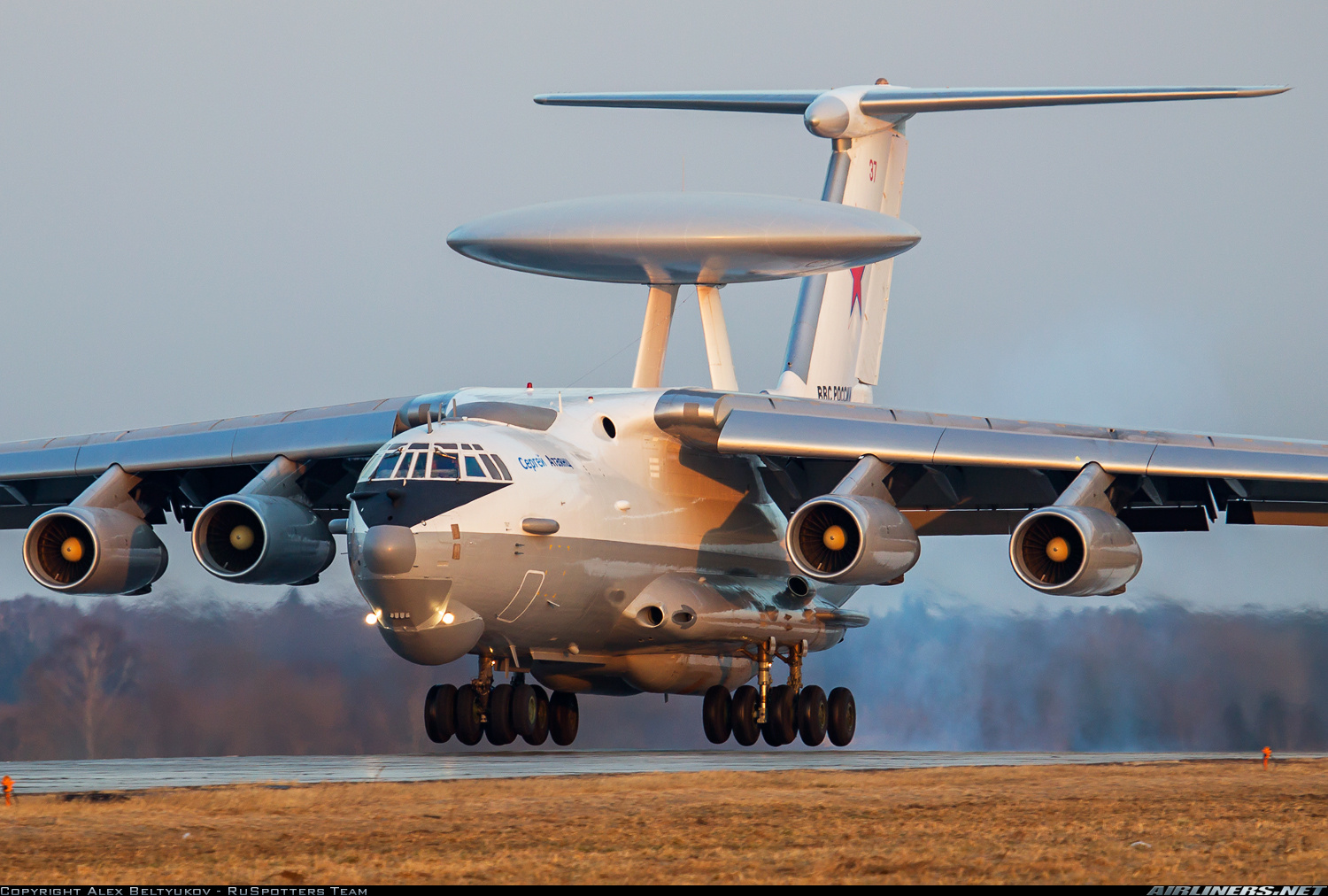
The A-50 retains the basic Il-76MD outline: a high-mounted swept wing, four underwing D-30KP-2 turbofans, a T-tail and the bulged undercarriage fairings on the lower fuselage sides. The obvious difference is the rotodome, a flattened disc about 10.8 m in diameter and around 2 m thick, carried on two swept struts above the rear fuselage forward of the fin. [DOCUMENTED]
Less obvious changes include:
• A shortened, solid tail with the rear gun turret and cargo ramp removed, though the tail cone was retained as a fairing on some aircraft. [DOCUMENTED]
• An in-flight refuelling probe above the nose, for use with Il-78 tankers. [DOCUMENTED]
• Numerous antennas for communications, satellite links, IFF and electronic support measures along the fuselage. [DOCUMENTED]
• A small fin area increase and ventral strakes to deal with the aerodynamic effect of the radome. [SINGLE-SOURCE]
• Extra air intakes and heat exchangers to cool the radar and electronics. [DOCUMENTED]
• Additional electrical generation, since the radar and consoles draw far more power than the cargo version ever needed. [DOCUMENTED]
The rotodome creates drag and turbulence at the fin, and with the radar equipment and crew the aircraft's maximum take-off weight rises to about 190 t, against 170 t for the Il-76MD. Practical range on internal fuel is about 5,000 km and on-station time at 1,000 km from base is about 4 hours. With one in-flight refuelling the endurance is extended to around 7 to 9 hours and is limited mainly by crew fatigue and engine oil. [DOCUMENTED]
Airframe construction is the point that limits replacement. The airframe needs reinforcement around the radome pylons and the structural fittings that carry the radome loads into the fuselage, plus cutouts and internal reinforcement for equipment and cooling. These are bespoke changes made at Taganrog on airframes built at Tashkent in Soviet times, and there has been no new A-50 airframe since 1992. Upgrades to A-50U are done on existing airframes. [DOCUMENTED]
THE SHMEL RADAR
The Shmel (Шмель, "Bumblebee") is a pulse-Doppler surveillance radar developed by MNIIP/Vega. Its antenna sits inside the rotating radome and turns at about six revolutions per minute, giving one complete sweep every ten seconds. The radome contains the main radar antenna on one side and, back-to-back with it, the antenna for the IFF interrogator system. [DOCUMENTED]
The operating band is usually given in Western sources as S-band (roughly 2 to 4 GHz); some Russian sources say decimetre-wave, which is consistent with that. [ESTIMATE]
Pulse-Doppler and the clutter problem
A look-down radar receives echoes from everything in its beam: the ground below the target, the sea surface, hills and buildings. Over land those echoes are millions of times stronger than a cruise missile's. A pulse-Doppler radar separates moving targets from the background by measuring the Doppler shift in each echo, the small change in frequency caused by the target's motion toward or away from the radar. Ground clutter has a Doppler shift determined by the aircraft's own motion and the angle to that patch of ground; a target moving across the ground has a different shift. By transmitting a coherent pulse train at a high or medium pulse repetition frequency and running the echoes through a filter bank, the radar can pick out the target's line from the clutter spectrum. [BACKGROUND]
This only works well if the transmitter is very stable, the antenna has very low sidelobes (so that strong clutter from directly below the aircraft does not leak in), and the signal processor has enough dynamic range. Shmel achieved this with a high-power coherent transmitter and a large, carefully designed antenna, but the Soviet electronics of the late 1970s limited the processing. Western analysts generally judged the original Shmel to be somewhat behind the E-3A's AN/APY-1 in clutter rejection and ECM resistance, though it was a large step beyond the Tu-126's Liana. [ESTIMATE]
Modes
Published descriptions of the A-50 give the following main modes: [DOCUMENTED, details SINGLE-SOURCE]
• Pulse-Doppler look-down mode for detecting and tracking airborne targets above land and sea, including low-flying aircraft and cruise missiles. This is the main air surveillance mode.
• Pulse mode for surface surveillance, giving detection of ships at sea and, in some accounts, large ground vehicle columns. The A-50 is not a ground-moving-target-indicator aircraft in the sense of the US E-8 JSTARS, but it can see ships and big surface movements.
• Beyond-the-horizon long-range mode for high-altitude targets using longer pulses and lower pulse repetition frequency.
• IFF interrogation synchronised with the radar sweep to separate friendly aircraft (which answer with the correct code) from unknowns.
• Passive electronic support measures, which detect and locate emitting radars and help identify target types.
Detection ranges
Published figures for the original A-50 Shmel are fairly consistent: [DOCUMENTED]
• Fighter-size air targets: about 230 km.
• Large aircraft (bomber or transport size): about 400 km.
• Surface ships: up to about 400 km.
• Cruise-missile-size targets: shorter, commonly quoted around 100 to 200 km depending on altitude and background.
The A-50U with the Shmel-M is claimed to have improved detection range and target capacity, with Russian sources speaking of detection of fighter-size targets beyond 300 km and the ability to see aircraft at up to about 600 km against large targets. These figures have not been confirmed independently and often mix detection and tracking ranges. [ESTIMATE]
Detection range for any radar scales with the fourth root of target radar cross section. A cruise missile with a frontal radar cross section of 0.1 m² has roughly 0.4 times the detection range of a 5 m² fighter, all else equal; a stealthy target at 0.01 m² has about 0.2 times. That is why figures quoted "against a fighter" can be misleading when the real threat is a cruise missile. [BACKGROUND]
Tracking capacity
The original A-50 was quoted as tracking 50 to 60 air targets simultaneously and controlling 10 to 12 fighter intercepts at once. The A-50U is quoted at about 150 tracks and controlling up to around 30 fighters, but these numbers come from Russian promotional sources. [SINGLE-SOURCE]
Radar horizon in practice
At a patrol altitude of 9,000 m the radar horizon against a target at 100 m is about 430 km and against a target at sea level about 390 km. The geometry sets a ceiling on what any airborne radar can see regardless of power. Inside that ceiling, the actual detection range is set by power, antenna size, target size and clutter. [BACKGROUND]
WORKED CALCULATION: HOW FAR CAN THE A-50 SEE A LOW FLYER?
The radar horizon is the hard geometric limit on any radar, and it is the single best way to understand why the A-50 exists. Radar energy at these frequencies travels in nearly straight lines, bent slightly downward by the atmosphere. The standard engineering approximation, which uses an effective Earth radius of four-thirds the real one to account for normal atmospheric refraction, is: [BACKGROUND]
distance (km) ≈ 4.12 × ( √(radar height in m) + √(target height in m) )
The two square-root terms are each one side's distance to the horizon. A target is visible only if the sum covers the distance between them. Everything below is worked with that formula; real conditions (temperature inversions, ducting over the sea, terrain masking) can add or subtract a good deal. [BACKGROUND]
Step 1: a ground radar on a 30 m mast. √30 ≈ 5.48, so the radar's own horizon is about 4.12 × 5.48 ≈ 23 km. Against a cruise missile at 50 m (√50 ≈ 7.07, worth 29 km), total line of sight is about 23 + 29 = 52 km. Against a missile hugging the sea at 10 m (√10 ≈ 3.16, worth 13 km), it is about 36 km. At 800 km/h a cruise missile covers 36 km in about 2 minutes 40 seconds. That is the entire warning a ground radar can give, even if its power and processing are perfect. [ESTIMATE]
Step 2: the A-50 at 9,000 m. √9000 ≈ 94.9, so the aircraft's horizon is about 4.12 × 94.9 ≈ 391 km. Against the same 50 m missile the line of sight is about 391 + 29 = 420 km; against the 10 m sea-skimmer about 404 km. [ESTIMATE]
Step 3: compare the two. Geometry alone gives the airborne radar roughly eight to eleven times the line of sight of the ground radar against a very low target. [ESTIMATE]
Step 4: apply the radar's real range. Geometry is only the ceiling. The Shmel's actual detection range against a small target is set by its power, antenna and clutter rejection, and is well inside the horizon. If we take the original A-50's published 230 km against a fighter-size target of about 3 to 5 m², and apply the fourth-root rule to a cruise missile of about 0.1 m², the range drops by a factor of about (0.1/4)^0.25 ≈ 0.40, giving roughly 90 to 100 km. For the A-50U, with better processing, a figure of 120 to 150 km against the same target is plausible. These figures are our own calculation from published numbers, not official data. [ESTIMATE]
Step 5: turn range into warning time. If the A-50U is orbiting 150 km in front of the defended zone and detects the missile at 130 km beyond its own position, first detection happens about 280 km from the target area. At 800 km/h that is about 21 minutes of warning, against under 3 minutes from the mast-mounted radar. This is the difference between scrambling fighters and hoping the point defense works. [ESTIMATE]
Step 6: altitude trade-off. Flying lower costs horizon fast. At 6,000 m (√6000 ≈ 77.5) the aircraft's horizon is about 319 km; at 10,000 m about 412 km. But as Step 4 shows, the A-50's real limit on small targets is well inside even the 6,000 m horizon, so in practice altitude matters more for seeing over terrain and for the depth of view into enemy airspace than for raw range against low flyers. Crews generally fly as high as fuel and weight allow because it keeps the aircraft further from short-range threats and reduces terrain masking over hills. [ESTIMATE]
Step 7: what the formula hides. Over land, hills, forests and buildings shadow low targets even inside the horizon. A cruise missile flying along a valley may be hidden from a radar looking at a shallow angle. The higher the aircraft, the steeper its look angle and the less terrain masking it suffers, which is another reason high patrol altitude helps. Over the sea, by contrast, the main problem is sea clutter and occasional atmospheric ducting, which can make detection ranges either much longer or shorter than the formula predicts. [BACKGROUND]
SHMEL-M PROCESSING IN MORE DETAIL
The original Shmel was a mix of analogue circuits and early digital processing. Its returns were filtered in hardware to separate moving targets from clutter, then passed to the Argon-family computer for track formation. The weak points were dynamic range (very strong clutter could swamp the receiver), the small number of Doppler filters that could be run in real time, and the limited ability of the computer to maintain many tracks at once. That is the reason behind the 50 to 60 track limit on the original aircraft. [ESTIMATE]
The Shmel-M of the A-50U kept the antenna and much of the transmitter but replaced most of the processing chain with digital equipment. In general terms, the improvements claimed are: [SINGLE-SOURCE]
• Digital receivers and analogue-to-digital conversion earlier in the chain, which preserve more of the signal's dynamic range and allow more flexible filtering.
• More Doppler filters and adaptive clutter maps. A clutter map stores the expected background for each patch of ground or sea and lets the processor raise or lower its detection threshold cell by cell, so a target over a quiet field is detected at a lower signal level than a target over a city.
• Constant false alarm rate processing that keeps the number of false tracks manageable as clutter changes.
• Multiple pulse repetition frequencies interleaved to resolve the range and velocity ambiguities that come with pulse-Doppler operation.
• Modern track-while-scan computing able to hold around 150 or more tracks and to correlate them with IFF, ESM and data-link reports.
None of these can overcome the basic limits of a mechanically rotating antenna. With a 10-second rotation, each target is illuminated only briefly once every 10 seconds. A fast target may move 2 to 3 km between looks, and the track must be predicted across that gap. An AESA like the A-100's can revisit a priority target in a fraction of a second; the Shmel-M cannot. Against manoeuvring targets and in heavy jamming, that difference is significant. [ESTIMATE]
CREW STATION LAYOUT
Published photographs and Russian television coverage of the A-50 and A-50U show the general arrangement, although exact layouts vary between aircraft: [SINGLE-SOURCE]
• Flight deck at the front, as on the Il-76, with two pilots, a flight engineer behind them, and the navigator in the glazed nose below and forward. A radio operator sits at a station behind the flight deck.
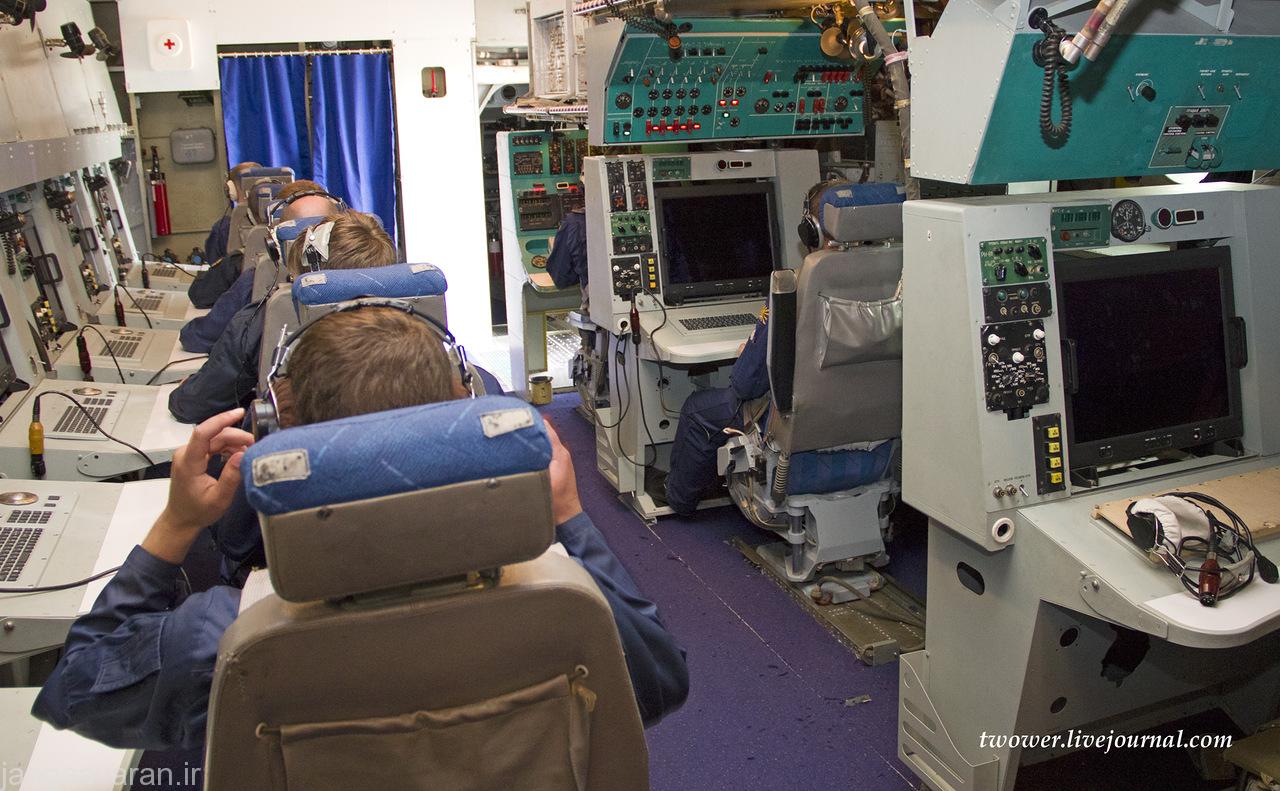
• Forward main cabin, behind the flight deck and below the wing area, holds the mission crew's operator consoles. On the A-50U these are in rows facing the fuselage sides or forward, each with one or two LCD screens, keyboards and trackball-type controls. The mission commander's station has a wider view of the overall picture.
• Equipment bays fill the middle of the fuselage: radar transmitter and processing racks, computers, power conversion and cooling. The heavy transmitter equipment is placed near the rotodome to keep waveguide runs short.
• Rear cabin on the A-50U includes a galley, rest bunks and a toilet, which were missing or very basic on the original aircraft.
Each operator can switch between functions: surveillance, identification, and fighter control. On the original aircraft roles were more fixed. On the A-50U, any console can in principle show the full picture, which allows the mission commander to move work to whoever is less loaded during a raid. [SINGLE-SOURCE]
Noise and heat were the main complaints about the original cabin. The radar's high-power transmitter and processing racks produced a lot of heat, and the four D-30KP engines are loud. On long sorties, operators wore headsets almost constantly. The A-50U's new equipment produces less heat and weighs less, which also helped crew comfort. [SINGLE-SOURCE]
THE MISSION SYSTEM AND CREW
The A-50 mission system is a complex built around the radar, with these main parts: [DOCUMENTED]
• The Shmel radar and its signal processor.
• The IFF interrogator, using the Soviet Parol (Пароль) system on the original aircraft.
• A central digital computer system (on the original aircraft based on the Argon family of Soviet military computers) for track formation, identification and display.
• Electronic support measures.
• Communications: HF, VHF and UHF voice radios, satellite communications on modernized aircraft, and data links.
• Display and control consoles for the mission crew.
• Navigation and self-protection equipment.
Crew
The A-50 has a crew of about 15. The flight crew of five consists of two pilots, a navigator, a flight engineer and a radio operator. The mission crew of about ten includes the mission commander (the senior combat controller), radar operators, identification operators, communications operators and several fighter controllers. [DOCUMENTED]
Each operator sits at a console in the forward main cabin. On the original A-50 these were analogue-style displays with radar returns overlaid with symbols. Operators complained of noise, vibration, high cabin temperature and poor ergonomics; the A-50 has no toilet or rest area worthy of the name in some accounts, which matters on a long sortie. [SINGLE-SOURCE]
The A-50U modernisation replaced these with multifunction colour LCD consoles, more computing power, a proper galley and rest area, and a toilet. Russian media coverage of the A-50U in 2011 made a point of these comfort improvements, because on 8-hour sorties they affect crew performance directly. [DOCUMENTED]
Command and control role
The A-50 is not just an airborne radar. It is a flying command post. Its mission crew can do three distinct jobs: [DOCUMENTED]
1. Surveillance and warning. The aircraft detects and tracks targets and passes the air picture to ground command posts of the air defense forces and to other aircraft. 2. Fighter control. The fighter controllers on board direct interceptors such as the MiG-31, Su-27, Su-30SM and Su-35S onto targets, giving them vectors, altitudes and target designations by voice or data link, so that fighters can approach with their own radars off or in standby until the last moment. 3. Strike support. The aircraft can direct attack aircraft and help them avoid enemy fighters and air defenses, and can monitor naval activity.
The A-50 is meant to act as a control center when ground command posts cannot see the target, are out of range, or are being jammed or attacked. In theory it can run an air battle on its own. In practice, in the Russian system it is one sensor and one control node in a larger automated network. [DOCUMENTED]
Data links
The A-50 passes data by line-of-sight radio data links to fighters and ground command posts, and by HF and satellite links to higher command. The exact designations of the links are not consistently published. Russian sources mention the use of the same secure data link family used for ground-controlled interception of PVO fighters, and the A-50U adds modern secure links compatible with the Russian Aerospace Forces' automated control systems. [SINGLE-SOURCE]
The MiG-31 is significant here because it was designed from the start to work in groups with its own data link (APD-518), allowing four MiG-31s to share radar data across a front of about 800 to 900 km. An A-50 can feed that group with targets, and the group can act as an extension of the A-50's picture. [DOCUMENTED]
EXTERNAL DETAILS: WHAT TO LOOK FOR IN PHOTOS
Several features of the A-50 are easy to pick out once you know where to look, and they say something about how the aircraft is operated. [BACKGROUND]
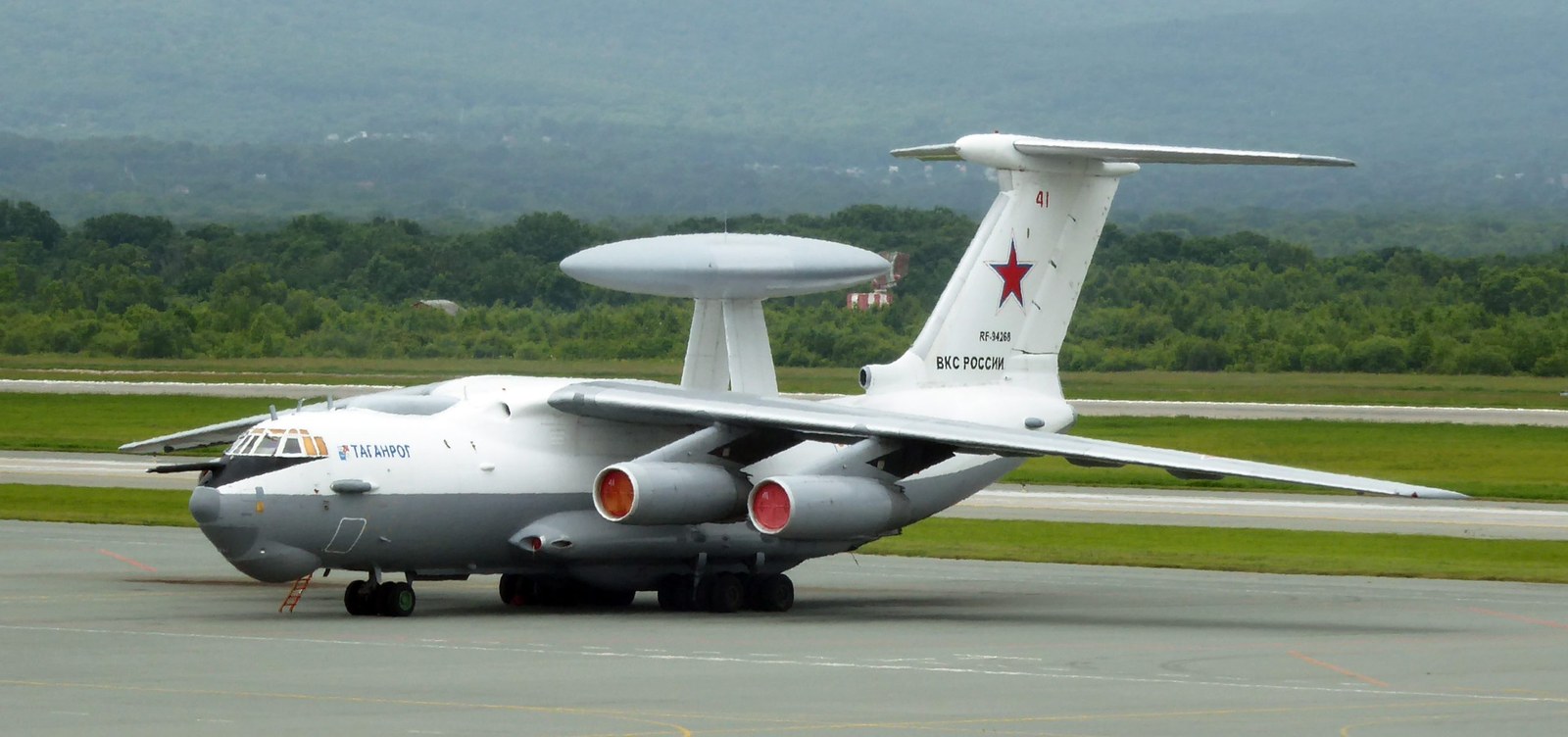
The rotodome and its struts. The two swept struts that carry the radome are set forward of the fin, on the upper rear fuselage, and lean slightly backward. Head-on, the radome sits well above the fuselage and only slightly below the T-tail, which is why the Il-76 fin had to be tall enough to keep the tailplane in clear air. The disc is not a wing; it produces some lift at certain attitudes but is primarily a fairing for the antennas. [DOCUMENTED]
The APU intake at the base of the fin. At the base of the vertical fin, on the left side of the rear fuselage just ahead of the fin root, there is a small air intake. On the Il-76 family this feeds the TA-6A auxiliary power unit, which is housed in the rear fuselage. The APU starts the main engines without ground equipment and provides electrical power and air conditioning on the ground. On the A-50 it is especially important, because the mission equipment needs cooling and power during long ground checks before a sortie, and because the aircraft must be able to start and run from forward or dispersal airfields where ground support is thin. The intake is visible in most side-on photographs of the type. [DOCUMENTED for Il-76 APU location; BACKGROUND for operational importance]
The refuelling probe. A fixed in-flight refuelling probe sits on top of the nose, ahead of the cockpit glazing, with a fuel line running along the upper fuselage. The A-50 refuels from Il-78 and Il-78M tankers using the probe-and-drogue method: the tanker trails a hose with a basket (the drogue), and the A-50 pilot flies the probe into the basket. Contact with a large aircraft is demanding, because the A-50 is heavy, the rotodome disturbs the airflow over the tail, and the pilot has to hold a precise position behind a tanker of similar size. A single refuelling can extend a patrol from about 4 hours on station to roughly 7 to 9 hours total, limited then by crew fatigue, engine oil and the radar's cooling. In practice Russian A-50 crews have practised refuelling regularly in exercises, but most operational sorties appear to be flown without it, partly because of the small number of tankers and partly because the aircraft rarely orbits very far from base. [DOCUMENTED for probe and Il-78 compatibility; ESTIMATE for operational practice]
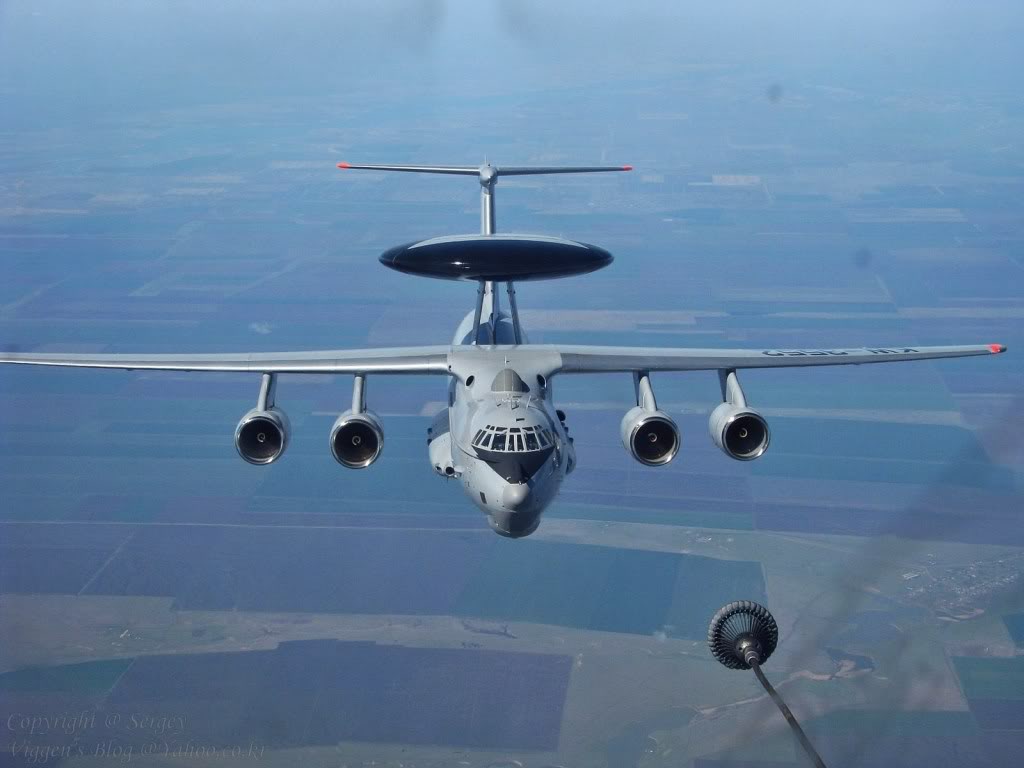
Reading the refuelling photograph: PS-90A engines. The aircraft closing on the drogue in this photograph is not a standard Russian A-50 or A-50U. Its engines are PS-90A-76 turbofans, not the D-30KP-2 fitted to every Russian A-50. The giveaways are the larger, fatter nacelles with a bigger intake diameter, the longer nacelle profile reaching further ahead of the wing, and the different pylon shape; the D-30KP nacelle is slimmer, with a narrower intake. [FIELD ACCOUNT, site owner's visual identification] Together with the overall grey scheme and the registration-style marking on the upper wing, which reads as an Indian "KW" serial, this points to one of the three Indian Air Force A-50EI Phalcon aircraft (KW3551, KW3552, KW3553) during refuelling from an Il-78 tanker. All three were re-engined at Taganrog with PS-90A-76 engines in place of the D-30KP-2 before their radars were fitted in Israel. [DOCUMENTED for A-50EI engines; ESTIMATE for the identification of this airframe]
As a rule, a PS-90A-engined Il-76 AEW aircraft is either an export A-50EI or a new-build airframe from the Il-76MD-90A (Il-476) line, which is what the A-100 Premier uses. No open source describes a program to re-engine Russian A-50 or A-50U aircraft; the A-50U upgrade kept the D-30KP-2. [DOCUMENTED for A-50U engines; no re-engine program found] The PS-90A-76 has become the standard engine for new Il-76 production because the Il-76MD-90A, built at Aviastar in Ulyanovsk, uses it, and United Engine Corporation and Perm Motors have been increasing PS-90A output to match the Il-76MD-90A and Il-78M-90A orders. Any future Russian AEW airframe would therefore almost certainly fly on PS-90A engines. [DOCUMENTED for Il-76MD-90A engine; SINGLE-SOURCE for production increase] The site owner also notes that PS-90A production is scaling up, so new airframes are likely to use it by default. [FIELD ACCOUNT, site owner] In the site owner's assessment, any rebuilt or newly built A-50 would probably receive PS-90A engines as well. [SPECULATION, site owner]
The navigator's glazed nose and chin radome. The A-50 keeps the Il-76's glazed navigator station and the chin radar for navigation and weather. This is a reminder that the aircraft is still a converted transport, with a navigator on board. [DOCUMENTED]
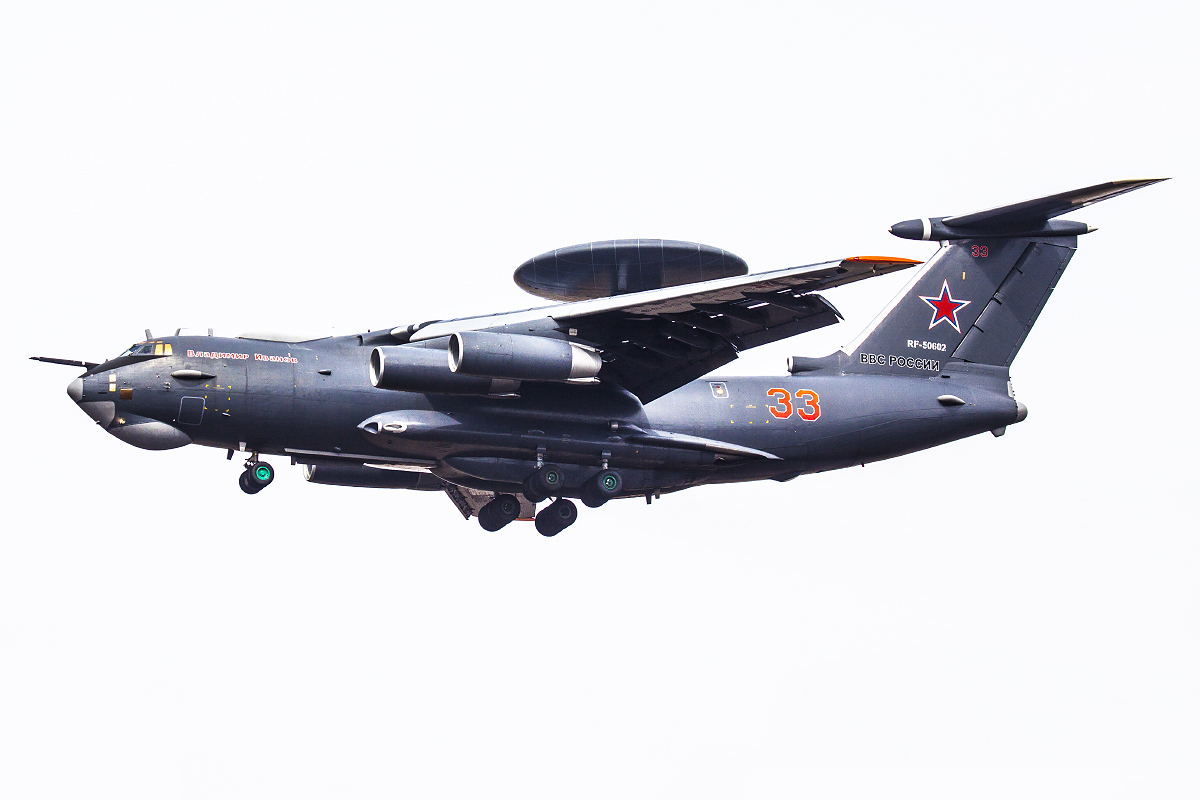
Paint and names. Early A-50s wore a white and light grey scheme. Several A-50Us have been repainted in an overall dark grey, which Russian media described as improving camouflage at altitude and on the ground. A-50Us also carry names on the nose: "Vladimir Ivanov" honours the Vega chief designer of the Shmel radar complex; "Sergey Atayants" honours a Beriev test pilot; and "Taganrog" honours the city where the aircraft were converted. [DOCUMENTED for names; SINGLE-SOURCE for the meaning of the dark grey paint]
Antennas. The fuselage carries numerous blade antennas for VHF/UHF radios, satellite communications domes on the A-50U, ESM antennas, and, on some aircraft, small fairings for the self-protection system. [DOCUMENTED]
SELF-PROTECTION AND IDENTIFICATION
The A-50 is not built to fight. Its defence is to stay far from the enemy and rely on fighter cover. Its self-protection suite is limited: radar warning receivers, and on some aircraft chaff and flare dispensers and possibly an infrared countermeasure system. These may help against a short-range infrared missile but offer little against a large long-range SAM like the Patriot, whose missile arrives at high speed with little warning. [ESTIMATE]
Identification is a different story. Telling friend from foe at long range is the hardest part of air defense, and mistakes can be catastrophic. The A-50 carries an IFF interrogator whose antenna sits back-to-back with the main radar inside the radome, so every radar target can be interrogated on each sweep. The original aircraft used the Soviet Parol system; modernised aircraft use newer Russian IFF systems. Electronic support measures add another source of identification by recognising the emissions of particular radar types. [DOCUMENTED]
IFF failures and coordination problems among Russian air defense units have been widely reported during the war in Ukraine, including suspected friendly fire incidents. An AEW&C aircraft does not solve this automatically, but in principle it gives one controller a single picture of all friendly and unknown aircraft in a large area, which is the best tool for avoiding such incidents. [SINGLE-SOURCE]
THE A-50 AND THE GROUND RADAR NETWORK
It is easy to describe the A-50 as replacing ground radars, but its real role is to complement them. The ground radar network is permanent, has no endurance limit and covers medium and high altitudes very well. Long-range systems like the 55Zh6M Nebo-M, with its VHF component, have some ability against low-observable targets at higher altitudes, and the 91N6E Big Bird panoramic radar gives an S-400 regiment its own picture out to several hundred kilometres. [DOCUMENTED]
What the ground network cannot do is see over the horizon at low altitude. Russia has tried to fill some of that gap with radar on towers and on aerostats, such as the 48Ya6 Podsolnukh coastal over-the-horizon surface wave radar and tethered balloon radars, and with the 29B6 Container's sky-wave radar for large targets. These are all partial answers. Only an airborne radar, flying at high altitude and able to move to where the threat is, gives broad low-altitude coverage at long range. [DOCUMENTED / ESTIMATE]
In practice, the A-50's picture is merged with ground radar data in the command post's automated control system. Where the ground radars see a target, they usually provide better position accuracy, and the A-50's track is used for early warning and for coverage beyond the ground radars' horizon. [ESTIMATE]
TERMS USED IN THIS ARTICLE
AEW&C / AWACS: airborne early warning and control. AWACS is the US name for the E-3 system, but is commonly used for any such aircraft. The Russian term is ДРЛО (дальнее радиолокационное обнаружение, long-range radar detection) and ДРЛОиУ (with control, i Upravleniye). [BACKGROUND]
Rotodome: a rotating radome containing the radar antenna. [BACKGROUND]
Pulse-Doppler: a radar method that uses the Doppler shift of echoes to separate moving targets from clutter. [BACKGROUND]
AESA: active electronically scanned array, an antenna made of many small transmit-receive modules whose beam is steered electronically. [BACKGROUND]
IFF: identification friend or foe, a system that interrogates aircraft and expects a coded reply from friendly ones. [BACKGROUND]
ESM: electronic support measures, passive receivers that detect and identify enemy radar and radio emissions. [BACKGROUND]
Radar horizon: the maximum distance at which a radar can see a target of a given height, set by the curvature of the Earth. [BACKGROUND]
SERVICE HISTORY: SOVIET ERA
The first A-50s went to the air defense forces' long-range radar detection aviation (авиация дальнего радиолокационного обнаружения, ДРЛО), initially at Šiauliai in Lithuania where the Tu-126 squadron had been based. The unit expanded to a regiment, and from the late 1980s A-50s flew patrols over the Baltic, the Barents Sea and the Black Sea, and along the southern borders. [DOCUMENTED]
During the 1991 Gulf War, A-50s patrolled over the Black Sea and along the Soviet southern border, and Western accounts say they monitored coalition air activity over Turkey and northern Iraq as far as their radar could reach. This has never been officially detailed. [UNVERIFIED]
After the collapse of the Soviet Union the regiment moved from Lithuania to Russia, to Ivanovo Severny (Иваново-Северный) in central Russia. It became the 144th Separate AEW&C Aviation Regiment, later part of the 610th Combat Employment and Aircrew Conversion Center of the Russian Air Force. Ivanovo remains the A-50 base. [DOCUMENTED]
SERVICE HISTORY: 1990s TO 2022
The 1990s were hard on the fleet. Flying hours collapsed, several airframes were stored, and some A-50s were returned to Taganrog or the Ilyushin side for possible conversion to other roles. At least one airframe was converted as a test bed, and one was lost in a ground accident. The Western estimate of A-50s actually flying in the late 1990s ranges from as few as three to about ten. [ESTIMATE]
The aircraft were used during both Chechen wars, flying over the North Caucasus to watch for any air activity and to support Russian aviation; and in the 2008 war with Georgia, where an A-50 reportedly monitored Georgian aircraft. [SINGLE-SOURCE]
In the 2000s the Russian Air Force carried out a small first modernisation, the A-50M, mainly improved communications and navigation. Proper modernisation came with the A-50U, which flew in 2008 and was first delivered in 2011 (the aircraft "Red 47"). Further A-50Us were delivered in 2012, 2014, 2016, 2017, 2018 and 2023. Eight in all were upgraded by 2023, with a possible ninth delivered in 2026. [DOCUMENTED]
From 2015 the A-50 flew over Syria at least occasionally, supporting the Russian air contingent at Khmeimim, though the main AEW&C role there was usually covered by ground radars and Su-30/Su-35 fighters. [SINGLE-SOURCE]
A-50s were regularly seen over the Baltic and Black Sea, along the Arctic coast, and near Crimea after 2014. They also took part in exercises with MiG-31 regiments, practising control of long-range intercepts over the Arctic. [DOCUMENTED]
THE A-50U
The A-50U is a deep modernisation of the mission system on existing airframes. Its main features: [DOCUMENTED]
• Shmel-M radar with a new digital signal processor and computing system, improving clutter rejection, detection range and track capacity.
• New multifunction LCD operator consoles.
• New central computing system on modern processors.
• Satellite navigation and communications.
• New secure communication suite and data links.
• Improved crew comfort: galley, rest area, toilet.
• Reduced weight of equipment, which allows more fuel and longer endurance.
Russian sources claim that the A-50U's radar can track up to about 150 targets and guide 30 or more fighters, and that its detection range against fighter-size targets has increased. [SINGLE-SOURCE]
The A-50U kept the old mechanically rotating antenna and the analogue front end. It is a well-modernised 1980s radar, not a new radar. That matters against modern stealthy or very small targets like long-range drones, where antenna aperture and modern processing make most of the difference. [ESTIMATE]
EXPORT VARIANTS
A-50I: the cancelled Chinese Phalcon
In the mid-1990s China agreed to buy an AEW&C aircraft from Russia and Israel: a Russian Il-76/A-50 airframe with the Israeli Elta EL/M-2075 Phalcon radar. The Phalcon used fixed active phased arrays in a non-rotating dome on top of the aircraft. A Russian A-50 airframe was sent to Israel in 1999 for installation of the radar. [DOCUMENTED]
The United States opposed the sale strongly because of concerns about the threat to Taiwan and to US forces in the region. Under that pressure, Israel cancelled the contract in July 2000 and paid compensation to China. The prototype airframe was returned to Russia without the radar. [DOCUMENTED]
KJ-2000: the Chinese answer
China took the lesson and built its own. The KJ-2000 (空警-2000) uses Il-76 airframes, some ex-A-50 converted by Beriev, carrying a Chinese AESA radar in three fixed arrays inside a non-rotating dome. It first flew in 2003 and about four or five were built. It has since been replaced as China's front-line AEW&C by the KJ-500 and KJ-3000, but the KJ-2000 remains an important part of the story because it was the first Il-76 AEW&C with an AESA radar to enter service anywhere, years before Russia's A-100. [DOCUMENTED]
A-50EI: India's Phalcon
India achieved what China could not. In 2004 India, Israel and Russia agreed a deal for three A-50EI aircraft: Il-76TD airframes with new Aviadvigatel PS-90A-76 engines, converted at Taganrog, carrying the Elta EL/W-2090 Phalcon radar in a fixed, non-rotating dome. The first was delivered in May 2009, the second in 2010 and the third in 2011. They serve with No. 50 Squadron of the Indian Air Force at Agra. [DOCUMENTED]
The A-50EI is an unusual hybrid: a Russian airframe and engine installation with an Israeli mission system and a dome that looks like an A-50's but does not rotate. India has repeatedly discussed buying more, and in 2026 reports suggest additional Phalcon or Indian-developed systems are in the pipeline. [DOCUMENTED / UNVERIFIED for 2026 plans]
The A-50EI was used in the 2019 Balakot crisis and the 2025 Indo-Pakistani clashes to watch Pakistani air activity. [SINGLE-SOURCE]
THE A-100 PREMIER
The plan
By the 2000s the A-50's mechanical radar, analogue front end and old airframes made replacement urgent. The A-100 "Premier" (Премьер) program was launched around 2006 to combine a new Il-76MD-90A (Il-476) airframe from Aviastar in Ulyanovsk with a new Vega radar using an active electronically scanned array (AESA). [DOCUMENTED]
The A-100's radar is unusual. It still uses a rotodome, but instead of a single mechanically scanned antenna the rotodome contains two back-to-back AESA panels. The radome rotates about every 5 seconds, but the arrays can also scan electronically, so the radar can dwell on a target or sector without waiting for the next rotation. This combines continuous 360-degree coverage with electronic agility. [DOCUMENTED]
Claimed performance includes tracking up to about 300 targets at ranges up to about 600 km, and detecting a fighter at 600 km and cruise missiles at a few hundred kilometres. These are Russian claims without independent testing. [SINGLE-SOURCE]
Other planned features included modern data links to the Russian Aerospace Forces' automated control system, an electronic intelligence suite, a fully digital crew compartment and the PS-90A-76 engines which give better fuel efficiency and range. [DOCUMENTED]
Testing
The program progressed very slowly. A flying laboratory, the A-100LL, was converted from an A-50 airframe and flew with the new radar from 18 November 2017. The first A-100 on an Il-76MD-90A airframe flew in November 2017 without the radar system and with the radar in February 2022. Russian officials repeatedly gave delivery dates: 2020, 2022, 2024. None held. [DOCUMENTED]
Problems
The reasons are several. AESA radars need large numbers of transmit-receive modules made from gallium arsenide or gallium nitride semiconductors, and Russia's production of such modules is limited. Western sanctions from 2014 and especially from 2022 cut access to many foreign components. The Il-76MD-90A line at Aviastar is producing only a few airframes a year, and these are competing with demand for transports and tankers. Beriev itself has suffered serious financial difficulties. [DOCUMENTED]
Status in 2026
In November 2025 Ukraine struck the Beriev plant at Taganrog with long-range drones. The A-100LL flying laboratory was reported destroyed, along with damage to the factory. The open-source loss-tracking project Oryx confirmed the destruction of the A-100LL. [DOCUMENTED]
In December 2025 a well-connected Russian military Telegram channel, Fighterbomber, said the A-100 project had "long been closed" and the only existing A-100 had left Taganrog in 2024 and not returned. This was not confirmed officially, and Russian aviation experts suggested that the A-100's systems could be used to upgrade the A-50 family. [SINGLE-SOURCE]
As of October 2026 the A-100 has not entered service. One or two airframes may exist; the 2026 World Air Forces report counts a combined fleet of 12 AEW&C aircraft including the A-100s, a figure that is higher than most other estimates. [ESTIMATE]
Our assessment is that the A-100 is not a factor in Russia's air defense in 2026, and any revival would take many years. [SPECULATION]
ROLE IN RUSSIA'S INTEGRATED AIR DEFENSE
The layered system
Russia's air defense is built in layers. At the outermost edge, the 29B6 Container over-the-horizon radar sees large aircraft 900 to 3,000 km away. Voronezh radars and the EKS Kupol satellites warn of ballistic missiles. Long-range surveillance radars on the ground such as the 55Zh6M Nebo-M and the 91N6E Big Bird panoramic radar of the S-400 cover medium and high altitudes. Then come the S-400, S-300 and S-500 batteries, the Pantsir and Tor point-defense systems, and the fighter regiments. [DOCUMENTED]
The weak spot in all this is low altitude. Ground radars cannot see over the horizon at low altitude, and the Container sees only fairly large targets far away. Low-flying cruise missiles, helicopters and drones can slip below. The A-50 is the system that fills that gap: from altitude it can see low-flying targets hundreds of kilometres beyond the ground radars. [DOCUMENTED]
Cueing fighters
The A-50 can direct fighters onto targets the fighters cannot yet see. It gives the target's position, altitude, speed and heading, and the fighter can fly an intercept course with its radar silent. When the fighter is close enough, it switches on its own radar and engages. This is particularly important for the MiG-31, which has a powerful Zaslon radar but is designed to work under ground or airborne control. [DOCUMENTED]
Cueing surface-to-air missiles
The A-50 can also feed targets to SAM brigades through the automated control system. An S-400 battery's engagement radar, the 92N6E, can see low targets only out to its radar horizon, about 30 to 40 km for a target at 50 m. The S-400's 40N6 missile has an active radar seeker, which in principle allows it to engage a target beyond the horizon if it is guided to the right area by external data, then locks on itself. That is exactly the role the A-50 can play. How far Russia has made this work in practice is not known publicly. [ESTIMATE]
Defending Moscow and strategic sites
The A-50 has a particular role in protecting Moscow and other strategic sites, including during the Ukraine war. Defence analyst Michael Bohnert noted in 2026 that the A-50U fleet is used mainly to protect the President and key installations, and only occasionally to support the front against Ukrainian drones and missiles. [SINGLE-SOURCE]
A-50 IN THE WAR IN UKRAINE
Role
From February 2022 the A-50 played a central role in the war. Flying over Russian territory, Belarus and the Sea of Azov and Black Sea, A-50s watched Ukrainian air activity and directed Russian fighters, especially MiG-31s firing R-37M long-range air-to-air missiles, and Su-35s. Ukrainian pilots said that the A-50 was one of the main reasons Russian fighters could fire on them from long range while Ukrainian aircraft flew low. [DOCUMENTED]
The A-50 also gave early warning against Ukrainian missile and drone strikes, and helped guide Russian strikes and glide bombs. [SINGLE-SOURCE]
Machulishchy, February 2023
On 26 February 2023, an A-50U, believed to be "Red 41", was damaged on the ground at Machulishchy air base near Minsk in Belarus. The Belarusian opposition partisan group BYPOL claimed that small drones had damaged the radome and the front of the aircraft. Ukraine's security service was later linked to the operation. The aircraft was flown back to Russia and reportedly never returned to service. [DOCUMENTED]
Sea of Azov, January 2024
On 14 January 2024 an A-50U, believed to be "Red 37", was lost over the Sea of Azov. An Il-22M airborne command post was damaged at the same time and made an emergency landing at Anapa. Ukraine claimed both; Russian sources acknowledged the loss of the A-50, with speculation that friendly fire was involved. The weapon was most likely a Patriot system placed close to the front. [DOCUMENTED]
Krasnodar, February 2024
On 23 February 2024 another A-50U, believed to be "Red 42", was shot down over Krasnodar Krai near Kanevskaya, about 200 km from the front. Ukraine said it was destroyed by its air defense; reports variously credited a Patriot ambush or an S-200 missile. The US Army later described a Patriot "SAMbush". [DOCUMENTED]
Operation Spiderweb, June 2025
On 1 June 2025 Ukraine's security service carried out Operation Spiderweb, striking Russian strategic aviation bases with FPV drones launched from trucks. Ivanovo Severny, the A-50 base, was one of the targets, and Ukraine claimed hits on A-50 aircraft. The exact damage to the A-50 fleet is unclear. [SINGLE-SOURCE]
Taganrog, November 2025
Ukrainian long-range drones struck the Beriev plant at Taganrog in November 2025, destroying the A-100LL flying laboratory. [DOCUMENTED]
Fleet in 2026
The best estimate for October 2026 is: [ESTIMATE]
• About eight A-50Us modernised up to 2023, plus possibly a ninth handed over in May 2026.
• At least three lost (Red 41 damaged beyond service, Red 37 and Red 42 destroyed).
• Perhaps four to six on strength, with no more than four available for "periodic operation" according to the Russian CAST bmpd blog.
• Old A-50s retired from active use.
• A-100 not in service.
In July 2026, four A-50Us were tracked airborne simultaneously, which observers called nearly the entire operational fleet. [SINGLE-SOURCE]
TIMELINE
1962: Tu-126 Liana prototype flies; the type enters service in 1965 at Šiauliai. [DOCUMENTED]
1973: Government decree launches the A-50 program, with MNIIP (later Vega) for the radar and Beriev for the aircraft. [DOCUMENTED]
19 December 1978: First flight of the A-50 at Taganrog. [DOCUMENTED]
1984: First aircraft delivered to the air defense forces; the Tu-126 is retired. [DOCUMENTED]
1989: A-50 formally accepted into Soviet service. [DOCUMENTED]
1991: A-50s patrol the Black Sea during the Gulf War. [UNVERIFIED]
1992: Last A-50 conversion completed; regiment moves from Lithuania to Ivanovo. [DOCUMENTED]
2000: Israel cancels the A-50I Phalcon sale to China under US pressure. [DOCUMENTED]
2003: First flight of China's KJ-2000. [DOCUMENTED]
2004: India signs for three A-50EI Phalcon aircraft. [DOCUMENTED]
2009–2011: A-50EI deliveries to the Indian Air Force. [DOCUMENTED]
2011: First A-50U delivered to the Russian Air Force. [DOCUMENTED]
18 November 2017: A-100LL flying laboratory flies with the Premier radar. [DOCUMENTED]
February 2022: A-100 flies with its full mission system; Russia invades Ukraine. [DOCUMENTED]
22 September 2023: Eighth A-50U delivered. [DOCUMENTED]
26 February 2023: A-50U damaged at Machulishchy, Belarus. [DOCUMENTED]
14 January 2024: A-50U lost over the Sea of Azov. [DOCUMENTED]
23 February 2024: A-50U shot down over Krasnodar Krai. [DOCUMENTED]
1 June 2025: Operation Spiderweb strikes Ivanovo and other bases. [DOCUMENTED]
November 2025: A-100LL destroyed at Taganrog. [DOCUMENTED]
December 2025: Report that the A-100 program has been closed. [SINGLE-SOURCE]
31 May 2026: Photograph published of a further A-50U handed over to the Aerospace Forces. [SINGLE-SOURCE]
July 2026: Four A-50Us observed airborne simultaneously. [SINGLE-SOURCE]
CREW TRAINING AND THE HUMAN FACTOR
Every A-50 lost takes its crew with it, and the crew is in some ways harder to replace than the aircraft. A fighter controller on an AEW&C aircraft needs years of training: understanding radar behaviour, the tactics of both sides, the procedures of the air defense network, and the ability to run several intercepts at once under stress. Radar operators must learn to read clutter, false tracks and jamming. Russia trains these specialists at the 610th Center at Ivanovo, on the same small fleet of aircraft that flies operationally. With the fleet down to a handful of airframes and committed to wartime duty, training time is squeezed. [ESTIMATE]
The two 2024 shootdowns killed the entire crews, perhaps 20 to 30 specialists in total. For a community that in peacetime may have numbered only a few hundred trained mission crew, that is a significant loss of experience. This is a factor that rarely appears in fleet counts but matters as much as the number of airframes. [ESTIMATE]
HOW A SORTIE WORKS
An A-50 mission begins hours before take-off. The mission crew receives the tasking from the air defense command: the patrol area, the expected threat, the fighters and SAM units it will work with, frequencies, IFF codes and data link settings. The flight crew plans the route to the patrol orbit, the tanker rendezvous if one is planned, and diversion airfields. [DOCUMENTED]
The aircraft climbs to its patrol altitude, typically 8,000 to 10,000 m, and settles into a racetrack orbit. The orbit's legs are usually 100 to 150 km long and are flown so that the radar's coverage stays on the threat axis. Because the rotodome gives 360-degree coverage, the orientation of the racetrack matters less than with a fixed-array aircraft, but the fuselage, wings and tail cause some shadowing in certain directions, and crews orient the orbit to minimise that toward the threat. [BACKGROUND]
The orbit is placed far enough back to be safe from enemy fighters and SAMs, but far enough forward to see deep into enemy territory. Before 2024 Russian A-50s often orbited about 100 to 200 km from the front line. After the 2024 losses, they moved much further back, reportedly to 300 km or more, which reduced how far they could see into Ukraine. [ESTIMATE]
Once on station, the radar operators build the air picture. Each track is classified as friendly, hostile or unknown, using IFF, flight plan data, ESM and the target's behaviour. The picture is passed to ground command posts by data link and voice. Fighter controllers take over individual intercepts. The mission commander decides priorities: which targets to engage first, which fighters to commit, which SAM units to warn. [DOCUMENTED]
At the end of the sortie, a relief aircraft ideally takes over the orbit before the first leaves, so that there is no gap. With only four or so serviceable A-50Us, continuous 24-hour coverage of even one orbit is very hard to sustain for more than a few days. Each orbit needs at least three aircraft rotating to cover 24 hours, plus spares for maintenance. [ESTIMATE]
COMPARISON WITH OTHER AEW&C AIRCRAFT
Boeing E-3 Sentry
The E-3 Sentry, on a Boeing 707 airframe, is the A-50's direct Western counterpart. It entered service in 1977, seven years before the A-50, with the AN/APY-1/2 radar, also in a rotating 9 m rotodome. Its detection range against low-flying targets is about 400 km, and its data processing and ECM resistance were considered better than the original Shmel. NATO and the US Air Force flew around 60 E-3s at peak. [DOCUMENTED]
The two aircraft are similar in concept: a large four-engine jet with a mechanically rotating radar, a big crew and a fighter control role. The E-3 had the advantage of early digital computers and a more mature pulse-Doppler radar, and was produced in much larger numbers. The A-50 had a larger airframe with more internal space and the ability to operate from rougher airfields. [ESTIMATE]
Boeing E-7 Wedgetail
The E-7 Wedgetail, on a Boeing 737 airframe, carries the Northrop Grumman MESA radar, a fixed AESA "top hat" array with a long dorsal panel and end-fire arrays. It entered service with Australia in 2010 and has since been bought by South Korea, Turkey, the UK and, with major delays and debate, the US Air Force. It represents what the A-100 was supposed to be: an AESA AEW&C aircraft with electronic scanning and modern data links. [DOCUMENTED]
Chinese KJ-500 and KJ-3000
China now has the world's most active AEW&C program. The KJ-500 on the Y-9 turboprop airframe has three fixed AESA arrays in a dome and has been built in large numbers. The KJ-3000 on the Y-20 jet transport airframe is entering service. China's AEW&C fleet is now several times larger than Russia's. [DOCUMENTED]
What this means
In the 1980s the A-50 put the Soviet Union roughly level with NATO in AEW&C. Today Russia lags: its AEW&C aircraft are few, old and mechanically scanned, while the US, China, Australia and others field AESA aircraft in larger numbers. [ESTIMATE]
VULNERABILITIES
The A-50 has several vulnerabilities, most of them shared with all large AEW&C aircraft: [DOCUMENTED / ESTIMATE]
• Size and signature. It is a large, slow jet with a powerful radar that announces its presence to any enemy ESM receiver hundreds of kilometres away.
• Long-range SAMs. A Patriot or similar SAM, moved forward and fired from ambush, can reach an A-50 orbiting within about 150 to 200 km of the front, as the 2024 losses showed.
• Long-range air-to-air missiles. Fighters with missiles like the AIM-120D or Meteor could in principle reach an AEW&C aircraft if they could approach close enough.
• Ground attack. On the ground, an A-50 is a large, valuable target that can be hit by drones, missiles or saboteurs, as Machulishchy, Spiderweb and Taganrog showed.
• Small fleet. With only a handful of aircraft, each loss is a serious blow and the fleet cannot be quickly replaced.
• Old radar. The mechanically scanned Shmel-M has less agility and ECM resistance than modern AESA radars, and probably struggles with small, low-signature drones.
WORKED SCENARIO 1: A-50U AND MiG-31s AGAINST A CRUISE MISSILE RAID
This scenario is illustrative, built from published capabilities. [SPECULATION]
Setting. It is 02:30 local time. A Russian A-50U is on a racetrack orbit at 9,000 m over central Russia, about 350 km from the border, covering the approaches to a strategic site. Two pairs of MiG-31BMs are on combat air patrol about 150 km apart, with radars on standby, and a third pair is on 15-minute alert at an airfield. Two S-400 battalions defend the site.
Step 1: Detection. At 02:31 the A-50U's Shmel-M detects a group of small, fast targets flying at about 50 m altitude, 220 km from the aircraft, heading toward the strategic site. Their speed is about 800 km/h. They do not answer IFF. The radar operator marks them as unknowns and assigns tracks. As more sweeps come in, he counts eight targets in two groups of four.
Step 2: Classification. The mission commander checks the tracks against known friendly flights and flight plans. There are none. Speed, altitude and flight profile match a cruise missile raid. He declares them hostile and sends the picture to the regional air defense command post by data link. The ground radars have not seen them yet because they are below the radar horizon.
Step 3: Commitment. The command post orders the A-50U to commit the two airborne MiG-31 pairs. The fighter controllers each take one pair. They pass the target tracks by data link and voice: position, heading, speed, altitude. The MiG-31s turn toward the targets and descend to about 6,000 m to improve the look-down geometry, keeping their radars in standby.
Step 4: Alert. The command post scrambles the third MiG-31 pair. The S-400 battalions are warned to expect targets along a given axis within about 15 minutes, and their 92N6E engagement radars are prepared but not switched to radiation until needed.
Step 5: Intercept. At about 120 km from the targets the first MiG-31 pair switches on their Zaslon-M radars. Using the A-50U's target data and their own radars, they lock on to the first group at about 80 km and launch R-37M missiles in a look-down shot. The second pair does the same with the second group. Within three minutes six of the eight targets disappear from the A-50U's display.
Step 6: Leakers. Two missiles survive. The A-50U passes their tracks to the S-400 battalions, which still cannot see them because they are below the horizon. Using the A-50U's data, one battalion launches a 9M96 missile with an active seeker into the target area; the seeker locks on and kills one missile. The last missile comes into view of the 92N6E at about 35 km and is engaged by a 48N6 and then a Pantsir point-defense system near the site.
Step 7: Assessment. The A-50U crew report the raid's outcome to the command post. They also note that the missiles came from a direction that suggests launch from aircraft or ground launchers a known distance away, which is passed to intelligence.
Lesson. Without the A-50U, the ground radars would have seen the cruise missiles only at about 35 to 40 km, giving roughly two to three minutes of warning. With the A-50U, the defence had about 15 minutes and could engage at long range with fighters. This is the core value of AEW&C.
WORKED SCENARIO 2: THE PATRIOT AMBUSH
This scenario reconstructs the type of engagement that destroyed two A-50Us in 2024. [SPECULATION based on DOCUMENTED events]
Setting. An A-50U is flying its usual racetrack about 150 to 200 km from the front, over the Sea of Azov. Its crew is directing Russian fighters and monitoring Ukrainian air activity. It has flown this orbit many times without problems.
Step 1: The setup. Ukraine moves a Patriot launcher with its radar close to the front at night, under camouflage. The radar stays silent, relying on cueing from other sensors or allied intelligence for the A-50U's position. The A-50U's own ESM does not detect any threat radar.
Step 2: The launch. When the A-50U turns onto the leg of its orbit nearest the front, the Patriot radar switches on briefly, tracks the A-50U at maximum range, and launches a PAC-2 GEM-T missile. The radar then switches off to avoid detection.
Step 3: The hit. The A-50U crew may get only a few seconds of warning, if any. The aircraft is too large and slow to manoeuvre out of the way. The missile hits, and the aircraft breaks up.
Step 4: The aftermath. Russia loses an irreplaceable aircraft and its crew, about 10 to 15 highly trained specialists. The remaining A-50Us are pulled back much further from the front, which reduces their coverage of Ukraine. Ukrainian fighters gain more freedom of action.
Lesson. An AEW&C aircraft's predictable orbit is its weakness. Once the enemy knows where it flies, a mobile long-range SAM can be moved into range. The loss of even one aircraft forces the rest further back, reducing their usefulness.
WORKED SCENARIO 3: COVERING A DRONE ATTACK ON A REFINERY
This scenario reflects the kind of target the A-50U was facing in 2025 and 2026. [SPECULATION]
Setting. Ukrainian long-range drones are heading toward a refinery deep in Russia. Each drone is a small, slow target, flying at about 150 km/h at a few hundred metres altitude, with a radar cross-section perhaps comparable to a light aircraft, and the attack includes dozens.
Step 1: Detection. An A-50U on patrol detects some of the drones at around 100 km. Others are not detected, because they are small, slow and low, and the Doppler processor cannot easily separate them from clutter, birds and road traffic.
Step 2: Response. The A-50U passes the tracks to ground units. Pantsir, Tor and mobile fire groups move into position. Fighters and helicopters are vectored to some of the drones.
Step 3: Saturation. The large number of drones overloads the system. Some get through and hit the refinery.
Lesson. The A-50U was designed against fast jets and cruise missiles, not swarms of small, slow drones. It can help, but a few aircraft cannot cover the whole country against this threat. This is one reason Russia has relied more on ground radars, mobile fire groups and electronic warfare against drones.
ANALYSIS: THE A-50 IN THE CURRENT PICTURE
The site's view
The A-50 is the most important single aircraft in Russia's air defense that most people have never heard of. It is the eye that looks over the horizon at low altitude, the part of the system that turns a network of ground radars into a defense that can see a cruise missile 200 km out instead of 40. Without it, the MiG-31's long-range missiles and the S-400's active-seeker missiles lose much of their reach against low targets, because nothing can tell them where to look. [SPECULATION]
The problem for Russia is not the concept. The A-50 concept is sound and has been since 1978. The problem is industrial. Russia built about 40 of these aircraft in the Soviet era and has built none since. It has spent nearly two decades trying to field an AESA successor and failed. The A-50U is a decent modernisation of an old radar on old airframes. Each aircraft lost is gone for good. [ESTIMATE]
What the 2024 losses tell us
The two 2024 shootdowns over the Sea of Azov and Krasnodar Krai showed a simple fact: an AEW&C aircraft flying a predictable orbit within reach of a modern long-range SAM is vulnerable. Russia's response, moving the aircraft further back, was sensible, but it reduced the A-50U's value over Ukraine. It also showed that the fleet is so small that Russia cannot accept losses at even a low rate. [ESTIMATE]
The West's AEW&C aircraft have been protected by air superiority in most of their wars. They have not faced an enemy with long-range SAMs that could be moved within range. In a war with a peer, Western AEW&C aircraft would face the same problem. That is one reason the US Air Force has been debating the E-7 and space-based sensors. [SPECULATION]
Can Russia rebuild?
Russia faces three choices for its AEW&C future: [SPECULATION]
1. More A-50U upgrades. Russia can keep converting existing airframes. But the pool of A-50 airframes that can be upgraded is limited, and they are old. 2. Revive the A-100. The A-100's AESA radar is the right technology, but the program has been stopped or nearly stopped, its test aircraft destroyed, and its component supply is a problem under sanctions. 3. New approaches. Russia could rely more on ground-based over-the-horizon radars such as the 29B6 Container, more aerostats, more ground radars like the Nebo-M, and perhaps smaller AEW aircraft. None of these fully replaces a large AEW&C aircraft.
Our judgment is that in the next five years Russia will continue to rely on a handful of A-50Us, perhaps with one or two more upgrades, and that the A-100 will not enter service in significant numbers if at all. [SPECULATION]
The bigger picture
The A-50 is a reminder that air defense is a network, not a collection of systems. The S-400, S-500, MiG-31 and Pantsir are all formidable, but they need sensors to tell them where to look. The 29B6 Container sees far but sees only large targets; the Voronezh sees ballistic missiles; ground radars see medium and high altitudes. The A-50 sees low. Take it away and the network has a hole exactly where modern threats such as cruise missiles and drones like to fly. [SPECULATION]
For Russia's integrated air defense, the shortage of AEW&C aircraft is a real weakness that will last for years. For the countries that might face Russia, it is a weakness that can be exploited. For students of air defense, the A-50's story is a lesson in how a good concept can be undermined by industrial decline, sanctions and a war that targets the few aircraft that make it work. [SPECULATION]
RELATED
MiG-31 | S-400 | 91N6E Big Bird | 29B6 Container | Voronezh | Nebo
SOURCES
1. Beriev Aircraft Company (TANTK im. G. M. Berieva), A-50 and A-50U product descriptions.
2. Vega Radio Engineering Corporation (Концерн «Вега»), Shmel-M and Premier radar complex descriptions.
3. United Aircraft Corporation and Rostec press releases on A-50U deliveries (2011–2023) and the A-100.
4. IISS, The Military Balance, editions 2022–2026 (Russian AEW&C fleet entries).
5. FlightGlobal, World Air Forces 2026.
6. Oryx, "Attack On Europe: Documenting Russian Equipment Losses" (aircraft losses including A-50 and A-100LL).
7. Defense Express (defence-ua.com), "russia Can Keep No More Than Four A-50U AWACS Aircraft Flying", 2026, citing the CAST bmpd blog.
8. Defence Blog, "Russia's air defense leans on a few 'flying quarterback' jets", 2026 (interview with analyst Michael Bohnert).
9. The Aviationist, "Image Shows Russia Fielded a New A-50U Airborne Early Warning Aircraft", 1 June 2026.
10. Migflug, "Beriev A-50: Russia's Radar Jet and Its Catastrophic War", 2026.
11. www1.ru, "A-100 'Premier' AWACS Aircraft Project Abandoned", 1 December 2025 (citing Fighterbomber Telegram channel).
12. Reuters, BBC and Ukrainian Air Force statements on the A-50 losses of 14 January and 23 February 2024.
13. BYPOL statements and Belarusian independent media on the Machulishchy attack, 26 February 2023.
14. SBU statements and press coverage of Operation Spiderweb, 1 June 2025.
15. Indian Air Force and Ministry of Defence statements on the A-50EI Phalcon (2004 contract; 2009–2011 deliveries).
16. Reporting on the cancelled A-50I/Phalcon deal with China (2000) and the KJ-2000 program.
17. Background on Soviet AEW&C: Yefim Gordon, Beriev A-50 and Tupolev Tu-126 monographs (Midland Publishing / Polygon).
18. Background on airborne radar principles: M. I. Skolnik, Introduction to Radar Systems; G. W. Stimson, Introduction to Airborne Radar.
19. a50.mariwoj.pl, "A-50EI" production list (PS-90A-76 in place of D-30KP-2 on all three Indian aircraft); russianplanes.net airframe record KW3553.
20. United Engine Corporation / Perm Motors statements on PS-90A-76 production for the Il-76MD-90A and Il-78M-90A.
21. Site owner's visual identification of the refuelling photograph.
Related on this site: Russian Unified Air Defense (how the layers fit together).