
WHAT THIS PAGE IS
Nivelir (Russian «Нивелир», "dumpy level", the surveyor's levelling instrument) is the name of a Russian military space project that has put a series of small, secretive satellites into low Earth orbit since 2013. Several of them have shadowed American reconnaissance satellites, several have released smaller satellites, and two of those released a still smaller object at high speed that the US government calls an anti-satellite weapon test. Russia says very little. Its Ministry of Defence called the 2017 mission a "space platform which can carry different variants of payloads" and the small satellite it released a spacecraft "intended for the inspection of the condition of a Russian satellite". Everything else comes from procurement records, patents, technical papers, ground-based tracking and a small group of careful analysts. [DOCUMENTED]
This page is a companion to Unknown Russian Military Satellite Cluster, which covers Kosmos 2609 to 2614 and the 2026 approach of Kosmos 2612 to the commercial radar satellite ICEYE-X36. That cluster is a current mystery. Nivelir is the opposite: it is the best-documented Russian inspector programme, and almost all of what is known comes from one body of work, the open-source research of Bart Hendrickx, published in The Space Review in two parts in April and May 2025 (with an earlier 2019 article), supported by the tracking work of Marco Langbroek, Jonathan McDowell, Anatoly Zak and others. This page leans on them heavily and says so.
The one-paragraph version. The programme was contracted on 30 September 2011 to a Moscow institute called TsNIIKhM (the Central Scientific Research Institute of Chemistry and Mechanics), which in Soviet days made the explosive charges for Russia's first anti-satellite interceptor. TsNIIKhM subcontracted NPO Lavochkin, the builder of Russian lunar and planetary probes, to build the larger "parent" satellites (index 14Ф150) around a small bus called Karat-200, with a telescope and a hyperspectral camera as payload. TsNIIKhM itself is responsible for the small "subsatellites" (believed index 14Ф162) that the first two parents carried and released, and for the ground network. Five parent satellites have flown to date (Kosmos 2519, 2542, 2558, 2576 and, very probably, 2588). The first two released subsatellites; each subsatellite released a still smaller object, and in July 2020 the one released by Kosmos 2543 was a fast projectile-like object that US Space Command called a weapon test. The last three parents have so far been observed only to stay in the orbital plane of an American optical reconnaissance satellite, at tens of kilometres distance, though Kosmos 2558 released a second object in June 2025. [DOCUMENTED, with individual attributions labelled below]
HOW TO READ THIS PAGE
Every substantive statement carries a label.
About the photographs. Five images are placed on the page: a badge, a drawing of two spacecraft layouts, a laboratory photograph of a telescope unit with a patent certificate, a launch photograph, and an orbit plot. They have no captions by house rule, so the text beside each one says what it is and, where I could not establish a provenance, says that too.
Naming warning. Do not confuse Nivelir's sister project, the satellite interceptor Burevestnik (military index 14K168, "Petrel"), with the nuclear-powered cruise missile 9M730 Burevestnik, which has the same name and is covered in its own article. They are unrelated. The satellite project is discussed below only where it overlaps Nivelir.
SUMMARY AT A GLANCE
| Item | What is known | Label |
|---|---|---|
| Project name and indices | Nivelir; "space complex" 14K167, "rocket and space complex" 14K245 | [SINGLE-SOURCE; Hendrickx's reading of Russian documents] |
| Start | Contract between the Ministry of Defence and TsNIIKhM, 30 September 2011 | [SINGLE-SOURCE; Hendrickx 2025; see conflict on the customer] |
| Prime contractor | TsNIIKhM (Moscow); space work done in its Design Bureau of Applied Mechanics, KBPM; chief designer Vladimir I. Verkhoturov | [SINGLE-SOURCE] |
| Parent satellites | 14Ф150, built by NPO Lavochkin (subcontract of 1 December 2011), Karat-200 bus, optical payload | [SINGLE-SOURCE; strongly supported] |
| Subsatellites | 14Ф162 (designator seen in only one source), built by TsNIIKhM, hydrazine propulsion, laser rangefinder and machine vision | [SINGLE-SOURCE] |
| Parents launched | Kosmos 2519 (2017), 2542 (2019), 2558 (2022), 2576 (2024), 2588 (2025, "little doubt" per Hendrickx) | [DOCUMENTED / SINGLE-SOURCE] |
| Launchers | Soyuz-2.1v with Volga (2017, 2019, 2022); Soyuz-2.1b (2024, 2025); all from Plesetsk | [DOCUMENTED] |
| Targets of observation | Kosmos 2486 (Russian Persona); USA 245, USA 326, USA 314 and USA 338 (American optical reconnaissance satellites) | [DOCUMENTED by orbital geometry; intent inferred] |
| Release events | Kosmos 2523 (30 Oct 2017, about 27 m/s, perigee dropped about 100 km); object 45915 from Kosmos 2543 (15 Jul 2020, about 140 to 186 m/s quoted); Object C from Kosmos 2558 (26 Jun 2025) | [DOCUMENTED; the weapon interpretation of the 2020 event is the US Government's] |
| US position | Space Command called the 2020 event a "non-destructive test of a space-based anti-satellite weapon"; in April 2026 General Whiting said Russia is "through testing" and fielding operational systems | [DOCUMENTED] |
| Russian position | Official descriptions are "inspection" and "remote sensing"; Russia dismissed the 2024 US claim as "fake news" | [DOCUMENTED] |
| Link to the Kosmos 2609-2614 cluster (2026) | None documented | [see section below] |
NAMES, INDICES AND TERMINOLOGY
Russian military space hardware is catalogued with indices that Western analysts have to infer from procurement documents. The ones that matter here:
Source conflict on the project's nature. Anatoly Zak's RussianSpaceWeb page about the 2017 launch, written around that mission, tentatively identified 14Ф150 as a satellite called "Napryazhenie" (Russian for "voltage") in a "Nivelir-ZU" project for military geodesy, a satellite class that supplies precise reference points for the Earth's shape and gravity field. Hendrickx's later reading of the procurement record (the Lavochkin subcontract, the optical payload makers, the Plesetsk construction tenders) treats 14Ф150 as an observation satellite, and the launches since then fit that. "Napryazheniye" appears in Hendrickx's account as one of the other TsNIIKhM project names (with Numizmat) whose "current status is unknown". Treat the geodetic reading as an early hypothesis that later evidence did not support, though it does not prove that geodesy plays no role. [SINGLE-SOURCE conflict]
Other labels in circulation. Gunter's Space Page lists the parents as "Nivelir-L" with question marks, numbers the subsatellites "Nivelir #4" and "#6", and lists Kosmos 2523 as "Naprazheniye #1 ?". These are a hobbyist reference's catalogue labels, not Russian designations. Jonathan McDowell's page on the programme uses "Nivelir-L parent" and "Inspector" for the same objects. The US catalogue gives an object a Kosmos number only once Russia registers it with the United Nations; the object ejected in July 2020 from Kosmos 2543 was never registered (McDowell tentatively calls it "Kosmos-2547?"; the US catalogue number is 45915). [DOCUMENTED catalogue practice]
WHO BUILDS IT: TsNIIKhM, KBPM AND THE SUBCONTRACTORS
TsNIIKhM is Tsentralny nauchno-issledovatelsky institut khimii i mekhaniki, in full the "D. I. Mendeleev Central Scientific Research Institute of Chemistry and Mechanics", a federal state unitary enterprise in the Nagatino-Sadovniki district of Moscow. Hendrickx (2019, "Russia's secret satellite builder") traces it to a chemical laboratory founded in 1894 in St Petersburg to study smokeless powder, moved to Moscow in 1931, renamed NII-6 in 1937 and TsNIIKhM in 1969. It made solid propellants and explosives. Its only known role in the Soviet space programme was the production of directional explosive charges for the IS ("Istrebitel Sputnikov", satellite destroyer) co-orbital interceptor, which flew about 20 test missions between 1968 and 1982, some of which destroyed target satellites by exploding nearby. [SINGLE-SOURCE; Hendrickx, restated in Russian by the bmpd blog]
In the first decade of this century it branched into other fields, and by 2010 it held a Federal Space Agency licence (No. 1337K, 23 August 2010) for space technology. Hendrickx (2019) also says the institute came under the Russian federal technical and export control service FSTEK in 2005, and records that in October 2018 the security company FireEye reported evidence linking the institute to the TRITON industrial-control malware used against a Saudi petrochemical plant in 2017. Those statements concern TsNIIKhM's wider activities rather than its space work; I include them so you can see what kind of organisation it is. [SINGLE-SOURCE]
What KBPM stands for. The badge above reads «КБПМ», «ЦНИИХМ», "15 лет" and "2008-2023", with a red star and a stylised satellite on a blue shield inside a cogwheel. I checked the expansion rather than guess it. КБПМ is «Конструкторское бюро прикладной механики», the Design Bureau of Applied Mechanics. Hendrickx describes it as the department of TsNIIKhM that carries out the institute's space work, "a cover name for its space department", and says it was set up in 2008, which matches the badge's 15-year span to 2023. TsNIIKhM's own website (as archived before it was trimmed in 2018) described the bureau's work as development and production of space hardware and space materials; construction of ground infrastructure to receive, process and store satellite data; and participation in ground testing, launch preparation, flight control and use of satellites. The badge image is unattributed here: Hendrickx's part 1 shows a "pin marking the 15th anniversary of KBPM, TsNIIKhM's secretive space department", and the picture supplied for this page appears to be of the same pin. [SINGLE-SOURCE, expansion confirmed by two reproductions of the institute's own description]
Vladimir I. Verkhoturov heads KBPM and, per Hendrickx, is "the man in charge of Nivelir at TsNIIKhM". His name appeared mainly in obscure procurement documents and a handful of patents until a short biography was published in a journal of his alma mater in Tomsk. Hendrickx (2025) writes that after "a 40-year career working on communications satellites at ISS Reshetnev and Gazprom" he joined TsNIIKhM in 2008, the year KBPM was set up, and that the biography credits him with leading development of "technology to monitor space objects in the interests of the country's information security". Source conflict: Hendrickx's 2019 article (as restated in Russian by bmpd) said he previously held senior posts at RKK Energia and Gazkom (now Gazprom Space Systems), where he oversaw the Yamal communications satellites. The accounts overlap on Gazprom and differ on the earlier employer; the later article draws on the biography, so I weight it more. He is also a co-author of the 2012 telescope patent discussed below. [SINGLE-SOURCE with a conflict on career detail]
Another TsNIIKhM unit that works on space projects is its Nanotechnology Research Center (also set up in 2008, head Vladimir Turkov), which has worked on microbolometer detectors, black optical coatings, radar-absorbing materials and solid-fuel microthrusters. The institute has close ties to the Moscow Institute of Physics and Technology (MIPT), whose software work on the project was reportedly carried under a topic called "Nivelir-PO". [SINGLE-SOURCE]
Contract chain
| Date | Event | Label |
|---|---|---|
| 1 Sep 2011 | Burevestnik contract between Garant and NPK KBM of Kolomna (as stated in 2019) | [SINGLE-SOURCE] |
| 30 Sep 2011 | Nivelir starts: contract with TsNIIKhM as prime contractor. Hendrickx (2025) says the customer was the Ministry of Defence; in 2019 he wrote that the contract was with the state scientific-technical centre GNTTs "Garant". On the same day TsNIIKhM also received a major role in Burevestnik (14K168). | [SINGLE-SOURCE; conflict on the customer] |
| 1 Dec 2011 | TsNIIKhM subcontracts NPO Lavochkin for the parent satellites. Money for the project reached Lavochkin through TsNIIKhM, as expected for a prime contractor. | [SINGLE-SOURCE] |
| 1 Dec 2011 | NPO Lepton subcontracts the State Institute of Applied Optics (GIPO, Kazan) for the optical structure of an infrared camera; Hendrickx notes the coincidence of the date with the Lavochkin contract. | [SINGLE-SOURCE] |
| 2011 | TsNIIKhM placed in overall charge of the ground network (MNK) | [SINGLE-SOURCE] |
| 2 Nov 2016 | Contract under Nivelir with NII Ferrit-Domen (St Petersburg) for tests of a "protective coating" (project "Nivelir-RP") | [SINGLE-SOURCE] |
| 13 Nov 2017 | Government contract 4Ts/2017 appears alongside the 2011 contract in one GIPO purchasing record; KB Tochmash tasked with a "guided missile" called "Product R". Relation to Nivelir uncertain. | [SINGLE-SOURCE / UNVERIFIED] |
| 2019 | ISS Reshetnev awarded two contracts for mobile ground stations ("Nivelir-MNK-PPPS") | [SINGLE-SOURCE] |
Who does what. The division of labour is unusual. NPO Lavochkin, the bigger and older organisation, is the subcontractor, and the institute with no earlier record of building satellites is the prime. The documents leave "no doubt" about this, per Hendrickx, since some state that the money flowed from TsNIIKhM to Lavochkin. NPO Lavochkin builds the 14Ф150 parents; TsNIIKhM is responsible for the subsatellites and, presumably, the projectiles they release; ISS Reshetnev, its subsidiary NPO PM Razvitiye and the company OOO Tekhnologii Radiosvyazi supply ground stations and antennas. Component suppliers named in the record are listed in the design sections.
Possible supervision by MAK Vympel. The company MAK Vympel, which also oversees Russia's ground-based space surveillance network (see Russian Space Surveillance System and Krona), may have a supervising role. Its annual reports from 2010 to 2014 mention a "space-based space surveillance system"; a 2015 article by NII Televideniya says its work on such a system was "together with NPO Lavochkin and under the leadership of MAK Vympel"; and the 2010 report distinguished "space surveillance" from "orbital inspection", categorising the latter as an integral part of the anti-satellite programme (referred to in some reports as 71P6) whose objectives included "the use of microtechnology and nanotechnology to develop orbital assets for the inspection, functional suppression and destruction of satellites". That wording is the closest thing to a Russian-language statement of intent that has surfaced. [SINGLE-SOURCE]
PURPOSE AND TASKS: WHAT IT IS FOR
There is no single answer, and the programme appears to have several goals. The documented building blocks are these.
The inspection mission and the weapon mission look alike from outside. The same skills that let a satellite approach, hover near and image another one (relative navigation, small precise burns, laser ranging and machine vision) are what a co-orbital interceptor needs. Secure World Foundation's counterspace reports treat rendezvous and proximity operations as dual-use for this reason. The only way to tell the two apart from outside is behaviour: does the object stay at a safe distance, does it come back, does anything separate from it, does it ever need to be close.
What the two observers say. Hendrickx, summarising the parents' behaviour: "Kosmos-2558 and 2576 are space surveillance satellites that themselves pose no direct threat to the American satellites." What US officials have "probably" been concerned about, he writes, is that they may carry subsatellites armed with ASAT projectiles, which is "not at all certain", and "one must assume that the Russians are happy enough with the alarm triggered by their potential presence." Marco Langbroek, in 2025, reads the long shadowing differently: "What is there still left to inspect after 3+ years?" The satellites make only periodic close approaches (every few days), so monitoring attitude or radio signals is not an explanation, and he has "repeatedly voiced a concern that these missions might be the positioning of 'dormant' on-orbit Anti-Satellite (ASAT) weapons". He told Breaking Defense: "Rather, I strongly suspect they are sleeping interceptors, to be activated when necessary." The US Space Command position in April 2026 follows his reading. These are interpretations of the same data. [DOCUMENTED statements; SPECULATION about the underlying purpose]
Why target reconnaissance satellites? The foreign targets of the parents have been the large American optical reconnaissance satellites of the Keyhole/KH-11 class (called "Advanced Crystal" in some reporting). Hendrickx offers reasons, all labelled speculation: to learn the operational capabilities of the satellites; to obtain information that makes anti-satellite use easier; and to learn the placement of on-board optics so that Russia's ground-based lasers, Peresvet (mobile) and Kalina (fixed), which can temporarily dazzle imaging satellites over Russian territory, can be used effectively. Supporting evidence is TsNIIKhM's own web page, which says the institute is engaged in creating "high-tech space systems for monitoring the effectiveness of defensive measures against foreign technical reconnaissance [assets]". [SINGLE-SOURCE / SPECULATION]
A noon-sun orbit. A 2024 article in NPO Lavochkin's in-house magazine analysed the orbits of operational US reconnaissance satellites, including USA 326 and USA 314, and concluded they most likely carry multispectral and hyperspectral cameras because they cross the descending node near local noon (minimising shadows) and fly orbits good for infrared imaging by day and night (an artificial object is colder or warmer than its surroundings at noon and at night respectively, so comparing the two helps pick it out). Hendrickx draws an inference: by flying similar orbits the Russian satellites can both watch the American ones and benefit from the same advantages for their own hyperspectral Earth imaging. That is a double-purpose explanation, and a good example of how a technical paper can reveal motivation. [SINGLE-SOURCE]
THE PARENT SATELLITE: 14Ф150 ON THE KARAT-200 BUS
The Ministry of Defence described Kosmos 2519 as "a space platform which can carry different variants of payloads". That points to a standard bus carrying interchangeable payloads, not a one-off design. Hendrickx reasons by elimination. NPO Lavochkin has designed only three platforms this century: Navigator (a heavy bus too big for the Soyuz-2.1v), Karat and Karat-200. Karat was a light platform (mass up to about 100 kg, payload up to about 140 kg) built for small scientific missions; it flew twice (Zond-PP in 2012 and Relek in 2014), both cut short by technical problems, and the Russian Academy of Sciences abandoned it in March 2014. Karat-200 is a more capable follow-on that Lavochkin promoted quietly in the early 2010s; its bus began at 200 kg and, in Hendrickx's words, "both the platform and payload mass grew significantly in the following years". A 2012 Lavochkin presentation showed six Karat-200-based satellites, three for "fundamental space research" and three for "studies of the Earth and near-Earth space"; in 2015 Lavochkin engineer Nikolai Klimenko (formerly of the Military Space Forces) singled out Karat-200 as a platform for optical payloads observing geostationary objects; and a 2016 MAK Vympel paper proposed it for satellite observation. [SINGLE-SOURCE; consistent]
Indirect confirmation. A 2022 article said Karat-200 "had already been flown", and no civilian satellite has flown on it, which leaves the 14Ф150 parents. In July 2024 Roscosmos announced the civilian remote-sensing system Avtograf, whose first two Pixel-VR satellites (about 1 x 1 x 1.9 m, initially about 600 kg, for Sun-synchronous orbits of 500 to 700 km) will use "the proven, well-established" Karat-200 platform, in the words of chief designer Ilshat Gubaydullin (aex.ru, from the Roscosmos press service). Hendrickx notes that the 590 kg announced mass suggests the bus has more than doubled in mass over a decade, that the Pixel-VR telescope (silicon-carbide mirrors) has nothing in common with the 14Ф150 payload, and that Pixel-VR may use spare Nivelir hardware. [DOCUMENTED announcement; SINGLE-SOURCE inference]
The one in-flight picture. The best evidence is an image of Kosmos 2558 in orbit, credited to the Australian company HEO (which flies cameras as hosted payloads on commercial satellites and images other satellites) and published in CSIS's 2024 Space Threat Assessment; Ars Technica reproduced it in April 2026. The Earth is in the background, so the picture was taken from above, which fits the view from USA 326, which orbits above Kosmos 2558 (about 40 km according to Hendrickx, about 60 km according to Langbroek in 2022; the orbits changed). Hendrickx sees "at least some resemblance" to Karat-200: two solar panels of two segments each, a white platform at the centre and an upward-pointing payload "not unlike the telescopes seen in some of the NPO Lavochkin slides". The image is low resolution. [DOCUMENTED image; SINGLE-SOURCE interpretation]
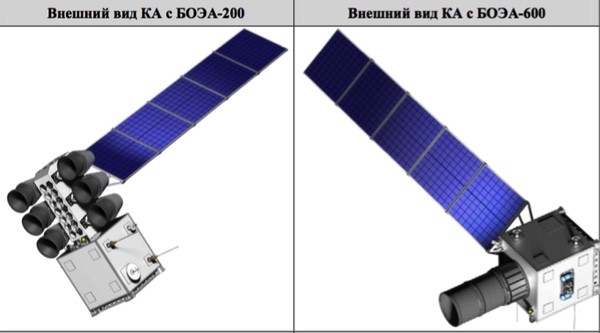
The BOEA-200 and BOEA-600 drawing. The picture above (Russian captions «Внешний вид КА с БОЭА-200» and «Внешний вид КА с БОЭА-600», "external view of the spacecraft with BOEA-200 / BOEA-600") shows two small spacecraft, each with a box-shaped body, a multi-segment solar array and a payload block at one end: on the left a cluster of six short conical elements; on the right a single long cylindrical tube. I could not find the source document, and I could not find any published definition of «БОЭА». The only plausible candidate is the standard Russian technical phrase «блок оптико-электронной аппаратуры» ("optical-electronic equipment block"), which appears in a Lavochkin patent for a geostationary satellite, but that patent does not define the abbreviation, so I am not asserting the expansion. The numbers 200 and 600 could be a mass, a focal length, an aperture or a model index; the left-hand cones could be a multi-camera cluster with lens hoods and the right-hand tube a single long-focus telescope, but that is [SPECULATION]. I have not been able to tie this drawing to Nivelir. It is placed here as a layout illustration of how a small Karat-class-style spacecraft might carry alternative payload blocks, not as a picture of Kosmos 2519, 2542, 2558, 2576 or 2588. [UNVERIFIED provenance; expansion of БОЭА UNVERIFIED]
Propulsion. Hendrickx reports that the 14Ф150 propulsion system uses K50-10.5 monopropellant hydrazine thrusters made by OKB Fakel, also flown on several other Russian satellites, with thrust between 0.113 and 0.548 newtons and specific impulse between 176 and 216 seconds. A drawing for the Karat-200-based Rezonans science satellite shows units of one thruster (DB-1) and of three thrusters (DB-3), and a similar arrangement may be used. Gunter's Space Page also lists the K50-10.5 for Kosmos 2519. [SINGLE-SOURCE, two sources agree on the thruster type]
What a hydrazine thruster of this size means in practice [ESTIMATE]. A thrust of 0.1 to 0.5 N is feeble. Take a spacecraft of 400 to 600 kg (a guess: the parents' mass is not published, the bus began at 200 kg and Pixel-VR is about 590 kg). A single 0.5 N thruster gives about 1 mm/s of velocity per second, so a 1 m/s burn takes ten to twenty minutes of continuous firing and a 100 m/s change takes roughly a day of cumulative firing (less if several thrusters fire together). That explains why the orbit changes seen for these satellites are many small manoeuvres, not single impulsive ones, and why close passes are timed days apart. It also means the parents are not agile; the small, much lighter subsatellites are the nimble part.
Attitude control. At least partly through a control moment gyroscope, the SGK-5 from the Research Institute of Command Instruments (NII KP), which weighs 4.5 kg and has an angular momentum of 5 N·m·s. A gyroscope of this kind saves propellant on attitude control. Because the payload does not appear to sit on a gimbal (unlike SBSS), the whole satellite must be pointed to look at an orbiting target. [SINGLE-SOURCE]
THE SUBSATELLITE: 14Ф162
Much less is known about the small satellites the first two parents released. Kosmos 2521 (from 2519) and Kosmos 2543 (from 2542) are the two documented cases. Hendrickx writes there are "strong indications" they share many design features with the Burevestnik interceptor satellites. [SINGLE-SOURCE] The details that have surfaced:
The projectiles. "Virtually nothing is known" about the objects ejected at speed. Since they came out of subsatellites they must be very small. Neither showed activity after being fired, and visual observations suggest they tumbled. Hendrickx suggests miniature solid-fuel propulsion, perhaps arrays of micro-electromechanical (MEMS) thrusters with an ignition layer, a combustion-chamber layer and a nozzle layer, as used on some cubesats. TsNIIKhM's Nanotechnology Center worked on such thrusters under projects Nota-Kh (2012 to 2015) and Naveska-Kh (2016 to 2017) with the Mendeleyev University of Chemical Technology (RKhTU). In 2016 the two published a patent for a "solid-fuel charge for micro engines". No such thruster has flown on a Russian civilian satellite, which raises the possibility that the work relates to the projectiles. A possible test was an unannounced cubesat-size payload (2024-069D) on the first Angara-A5 from Vostochny in April 2024, which raised its apogee by about 100 km after separation. [SINGLE-SOURCE / SPECULATION]
A cross-check on the Kosmos 2523 release [ESTIMATE]. McDowell and Mowthorpe and Trichas say Kosmos 2523 was released from Kosmos 2521 at 27 m/s, and Hendrickx says it then lowered its perigee by about 100 km in "a single maneuver". The numbers are consistent with each other. For a near-circular orbit at about 660 km (period about 98 minutes) a retrograde push of 27 m/s changes the semi-major axis by 2·Δv/n, where n = 1.07 x 10⁻³ rad/s, so by about 50 km; the burn point stays at apogee, so the perigee drops by twice that, about 100 km. In other words the release itself may account for the perigee drop, and the object may never have needed a motor of its own. That supports the "inert object" description. It is arithmetic, not a measurement of the actual direction of the push.
The same check for the July 2020 event [ESTIMATE; unresolved]. The object released from Kosmos 2543 on 15 July 2020 changed its perigee by about 100 km and apogee by about 170 km (Hendrickx), and a relative velocity of 140 to 186 m/s is quoted by Mowthorpe and Trichas (McDowell: 140 to 180). Take the orbit then as about 368 x 858 km (Gunter's Space Page; the sources do not agree on the orbit at that time), mean altitude about 613 km, n about 1.08 x 10⁻³ rad/s. A purely along-track burn at an apsis changes the opposite apsis by about 4·Δv/n, so a 100 to 170 km change needs only about 27 to 46 m/s of along-track speed. A relative speed of 140 to 186 m/s must therefore have been mostly in a direction that does not change the orbit size much (radial or out of plane), or the quoted relative speed is a different quantity. I cannot resolve this from public data. It is a reminder that "an object was fired at 150 m/s" is itself an inference from sparse orbital elements, not a measured launch speed, and that the direction relative to any target is what would matter and is unknown.
THE OPTICS: WHAT THE PARENTS CAN SEE WITH
Part 2 of Hendrickx's series is about payloads. The parents carry at least two instruments for both Earth and space viewing.
1. A hyperspectral camera, Pribor-GS, from NPO Lepton. NPO Lepton is an optical company at Zelenograd near Moscow. The evidence that it works on Nivelir is direct: in a video of a doctoral defence, Lepton's director Oleg Kazantsev specifies a payload flown on Kosmos 2519, "the first 14F150 satellite", as a high-resolution camera, and the supervisor of the candidate (Gleb Shcherbina, a hyperspectral-camera specialist) says the work was for a "special instrument" successfully tested in orbit. Two Shcherbina papers of 2014 and 2015 describe a camera adapted both for Earth remote sensing and for observing space objects, which matches the announced goals. The name Pribor ("instrument"), with "GS" for hyperspectral and "VR" for high resolution, comes from research under the 2006 to 2015 federal space programme; by early 2011 Lepton had been assigned three bands: visual 0.4 to 0.9 micron (70 channels), near-infrared 0.9 to 1.7 (40 channels) and shortwave infrared 2.0 to 2.4 (20 channels). [SINGLE-SOURCE; the direct evidence is the defence video]
How it switches between ground and space. Shcherbina says the camera uses an interline-transfer CCD, which minimises smear. For ground targets it runs in time-delay integration (TDI) mode, in which charge is shifted across the detector at the rate the ground image moves, so a target can be exposed for longer as it slides across the field. For space targets it switches to "staring" or frame mode, with the whole array pointed at one object. That matters because a satellite does not move across the image the way terrain does.
The infrared module [documented technical papers]. The GS-4 infrared hyperspectrometer (two modules for 0.9 to 1.7 and 2.0 to 2.4 microns) uses an objective of three aspherical mirrors with a 120 mm entrance pupil, 250 mm focal range and 3.5-degree field of view, an entrance slit, a diffraction-grating spectrometer and a detector. It scans in pushbroom fashion; the stated spatial resolution is at least 60 m from a 500 km orbit (roughly where most 14Ф150 parents have operated) and spectral resolution is 10 to 50 nm. A civilian satellite called Obzor-O was once to carry Lepton's three cameras (25 m resolution in the visual band to 84 m in the infrared from 700 km); it was cancelled in 2016. [SINGLE-SOURCE]
Why hyperspectral? For ground work the advantages are plain: it helps find camouflage, decoys, buried structures and chemical or nuclear sites. For space objects Hendrickx found only a 2017 conference paper (Mozhaysky Military Space Academy) on imaging space objects in dozens or hundreds of narrow channels, using different techniques for high-speed flybys and slow close inspections, "two observation modes that have both been seen during the Nivelir missions". He adds that there are no other known examples of such cameras being used this way. A related Lepton paper of 2015 described a "Hyperspectral Optical Complex" (GOK, 0.4 to 12 microns) with applications including monitoring nuclear power plants and "monitoring plantations of psychoactive plants", co-written with the Ministry of Defence's 27th Scientific Center, which the US sanctioned in 2021 over chemical weapons; there is no evidence that GOK flew. [SINGLE-SOURCE]
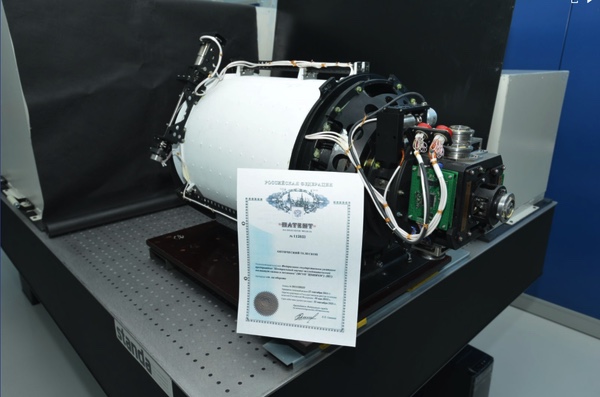
2. A panchromatic telescope, PKVR, from NPO Optika. The image above is a laboratory photograph of a white-sleeved telescope objective with a detector and electronics section at the right, on an optical bench, with a certificate headed «ПАТЕНТ» in front. I could read parts of the certificate when enlarged. It is a Russian patent for an «ОПТИЧЕСКИЙ ТЕЛЕСКОП» (optical telescope), and the patent holder line names the Federal State Unitary Enterprise TsNIIKhM. The certificate number is not legible at this resolution. The match is with Russian utility-model patent RU 115933 U1, "Оптический телескоп", published 10 May 2012, held by TsNIIKhM, with inventors including Vladimir Turkov, Oleg Kazantsev (Lepton's director), Vladimir Verkhoturov and others. That patent describes a telescope for scanning imaging in which sharp-edged flat mirrors at 22.5 to 67.5 degrees to the axis split the beam from the objective onto several detector arrays in separate focal planes, giving "a really continuous synthesised field of view" and fewer breaks in images of moving objects. Hendrickx identifies this telescope with a picture that was for a time on TsNIIKhM's website, "the white-colored part" being "most likely the objective produced by NPO Optika (enclosed in a protective cover)", with the section carrying the three detector arrays and tilted mirrors attached. The supplied photograph looks like that picture and the certificate matches the patent, but I could not independently confirm it is the same photograph or that this hardware has flown. What it shows is therefore a TsNIIKhM-patented scanning telescope design, associated by Hendrickx with the PKVR payload, not a verified Nivelir flight unit. [SINGLE-SOURCE / identification by match]
PKVR specifications. NPO Optika (part of the Shvabe holding) began cooperating with Lepton on space optics in 2011, the year Nivelir was approved. Its annual reports describe a "high-resolution panchromatic camera" (PKVR) that is in fact a telescope: a Korsch system of three curved mirrors with a primary mirror diameter given as 32 and 33 cm (close to SBSS's 30 cm). An experimental version was built in 2012 and flight versions were ready by the middle of the decade. A 2019 NPO Optika article says it was being "successfully used" for civil and scientific remote sensing (no Russian civilian satellite carried it, so Hendrickx assigns it to Kosmos 2519) and gives a mass of about 30 kg, size 470 x 990 mm, entrance pupil 320 mm, focal length 2750 mm and field of view 1.4 degrees. The 33 cm aspheric mirror, in Sitall SO-115 glass-ceramic, is described in a 2017 Optika patent; Sitall is Soviet-era, cheaper than silicon carbide or beryllium and less sensitive to thermal expansion. The 2019 article calls the same objective catadioptric rather than Korsch, a conflict Hendrickx notes. TsNIIKhM's Nanotechnology Center also applies black light-trapping coatings inside optics with picosecond lasers, in collaboration with Lepton since at least 2011. [SINGLE-SOURCE]
What those specifications mean when looking at another satellite [ESTIMATE]. These calculations use the published aperture and focal length and standard physics; the detector pixel size is not published.
The subsatellites' imagers. Subsatellite imaging is probably in-house (the microbolometer work above). From 2 km or less a small thermal camera of modest aperture already sees a large satellite as a detailed shape, and the heat view works in Earth's shadow, which suits an approach on the night side. [SPECULATION]
The one known image [DOCUMENTED]. A Czech radio amateur intercepted imagery transmitted on a high-data-rate S-band downlink from Kosmos 2499 in 2014. Almost all of it showed black space, except for one frame with a bright object at the edge. The amateur guessed the Sun; Hendrickx thinks it was not bright enough, and it could be the Briz-KM upper stage the satellite had been rendezvousing with, or an artefact. It is the only known image from the programme's satellites.
LAUNCH VEHICLES AND TIMING
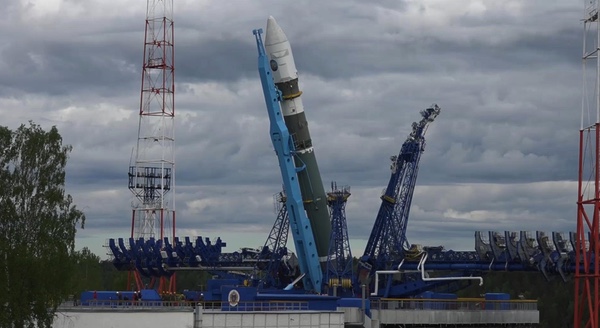
The picture above shows a Soyuz-2 family rocket on its transporter-erector at a pad, a white fairing at the top and a slim core with no strap-on boosters visible, which is a feature of the lightweight Soyuz-2.1v; lattice towers stand in the foreground. The Ministry of Defence released similar images of the June 2017 launch (Hendrickx: "A Soyuz-2.1v rocket being prepared for the launch of Kosmos-2519 in June 2017"). I do not know the date or mission of this specific photograph, so treat it as generic. All the parents have launched from Plesetsk in north-western Russia. [UNVERIFIED which launch]
Why the launch time matters [ESTIMATE]. A satellite's orbital plane is defined by its inclination and the longitude of its ascending node (RAAN). The Earth turns once per sidereal day (86,164 s), so the plane in which a launch site sits relative to a fixed orbit sweeps through 360 degrees in that time, about 0.0042 degrees per second or 0.25 degrees per minute. To launch into the plane of an existing satellite, the rocket must lift off at the moment Plesetsk crosses that plane, which happens twice a day. Langbroek measured the RAAN differences between each Russian satellite and its apparent target: Kosmos 2558 and USA 326, 0.04 degrees; Kosmos 2576 and USA 314, 0.02 degrees; Kosmos 2588 and USA 338, 0.11 degrees. Converted at the rate above, 0.04 degrees is about 10 seconds of launch-time error, 0.02 degrees about 5 seconds and 0.11 degrees about 26 seconds. These are tiny. Ars Technica quotes US officials as saying a few minutes earlier or later would have put the satellite in a different plane, making it much more difficult, "perhaps impossible, depending on fuel loading", to reach the target, and that "the circumstances suggest intentionality". The coincidence of plane and launch time is the strongest evidence that the targets are chosen before launch. [DOCUMENTED data; ESTIMATE conversion]
Hendrickx adds that Kosmos 2558 was orbited only about six months after USA 326 (February 2022), "demonstrating that targets for the 14F150 satellites can be selected at relatively short notice." [SINGLE-SOURCE]
ORBITS AND RENDEZVOUS: THE PHYSICS IN PLAIN LANGUAGE
Why can a satellite "stalk" another, and why are the Nivelir missions shaped as they are? Seven pieces of orbital mechanics explain most of what the trackers see. All numbers in this section are my own arithmetic from standard formulas, so they are [ESTIMATE]; they use a circular orbit of about 500 km (orbital speed 7.6 km/s, period about 95 minutes) unless stated.
1. Everything moves at 7.6 km/s, so "close" means "same orbit"
Two satellites passing at random in low orbit have relative speeds of kilometres per second, and nothing useful can be done in a flyby. To stay near another satellite the chaser has to share its orbit nearly exactly: same plane, same altitude, nearly the same timing. Proximity operations are therefore not "flying toward" a target; they are matching an orbit and then adjusting small differences.
2. Changing plane is the expensive thing
A plane change by angle Δi at orbital speed v costs Δv = 2·v·sin(Δi/2). At 7.6 km/s that is about 13 m/s for 0.1 degree, 66 m/s for 0.5 degree, 133 m/s for 1 degree and 660 m/s for 5 degrees. A satellite like the 14Ф150 (hydrazine, thrusters under 1 N) cannot move planes by more than a degree or so without spending most of its propellant. That is why the launch has to put it into the right plane on day one, and why Kosmos 2576's reported drift out of plane with USA 314 in February 2025 matters: it may mean the Russian satellite is out of reach of its target.
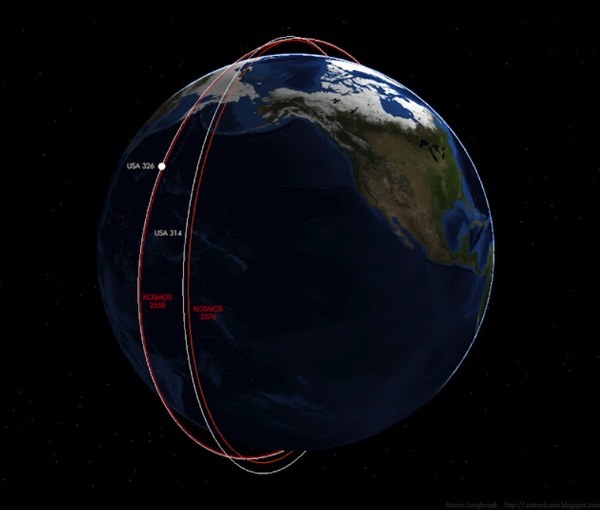
The globe above is the orbit plot by Marco Langbroek (credited in the image to his SatTrackCam Leiden blog; it also appears in Hendrickx's part 1 as "The co-planar orbits of Kosmos-2558/USA 326 and Kosmos-2576/USA 314"). The red lines are the two Russian satellites, the white lines the two American ones, and the labels name each pair. The plot shows the two Russian orbits lying almost exactly over the two American orbits over the North Pacific and Arctic: pairs of near-identical planes. What it does not show is altitude, which is where they differ: the Russian satellites are lower. [DOCUMENTED]
3. The plane drifts, and the shape of the orbit decides how fast
The Earth is not a perfect sphere. Its equatorial bulge (the J2 term) makes every orbital plane slowly rotate, or "precess", around the Earth's axis. At 518 km and 97.4 degrees the rate is about +0.98 degrees per day, and it depends on both altitude and inclination: about -0.0005 degrees per day for each added kilometre of altitude, and +0.013 degrees per day for each added degree of inclination (for retrograde orbits like these). A satellite 60 km below its target precesses about 0.03 degrees per day faster. Left alone, in a month the planes are almost a degree apart, about 130 m/s of plane-change delta-v to fix. To avoid that, the lower satellite uses a slightly different inclination so that the two planes precess together. My arithmetic for a satellite at 458 km matching a target at 518 km and 97.4 degrees gives an inclination of about 97.18 degrees; Langbroek reported Kosmos 2558 launched into 97.25 degrees with USA 326 at 97.4 degrees, agreement within a tenth of a degree. In September 2022 he wrote that Kosmos 2558 was adjusting its inclination to "synchronise" the precession of its plane with that of USA 326, and that the target is the satellite that does not manoeuvre. Plane matching is therefore a continuous, fuel-light, deliberate act, and the observed corrections are the strongest evidence that the shadowing is intentional. [DOCUMENTED observation; ESTIMATE arithmetic]
4. Phasing: how often does the chaser pass the target?
Even in the same plane, a satellite at a different altitude has a different period. At 60 km lower the period is shorter by about 74 seconds, so the lower satellite gains one full lap every about five days (the synodic period, T1 x T2 / ΔT). Langbroek, from real tracking in 2022, reported the same: Kosmos 2558 "taking over USA 326 every 5 days, resulting in flyby's at distances of 60 to 80 km each 5 days". In the target's frame the chaser drifts along-track by about 3π x Δa per orbit, i.e. about 565 km per orbit for a 60 km offset, and laps the target after about 76 orbits. [DOCUMENTED data; ESTIMATE check]
5. Relative speed at a flyby is not small
Coplanar satellites with a 60 km altitude difference meet at a relative speed of about 1.5 x n x Δa, roughly 100 m/s (the lower one runs faster). That is slow compared with kilometres per second but fast for any detailed observation, so long-range imaging with a scanning telescope is practical. It is also why Hendrickx writes that the parents operate "at fairly large distances and high relative velocities" while the subsatellites work at "low relative velocities". Slowing to near-zero relative speed means matching the target's orbital period, which is cheap for something already at 2 km or less.
6. Relative orbits: how an inspector hovers
In the frame of one satellite, a nearby satellite follows a slow curve described by the Clohessy-Wiltshire (Hill) equations. The key facts: a higher or lower orbit drifts along-track; a small radial offset or velocity difference can be turned into a stable ellipse in which the inspector circles the target once per orbit (the ellipse is twice as long along-track as it is radial); and the way to hold station is to put the two satellites on the same orbital period, i.e. the same semi-major axis. The reported Nivelir sequences show these elements. Kosmos 2521, for instance, made flybys of Kosmos 2519 at about 10 km on 11 and 15 October 2017, a 2 km rendezvous on 18 October, then moved away to 15 km; passed at 7 km (15 December 2017) and 10 km (3 February 2018) and about 30 km (20 February); made 1 km flybys on 1 and 7 March 2018; moved out to about 550 km for a 24 km pass on 26 March; and then held station within 1 km from 26 March to 30 April (Gunter's Space Page, from McDowell's tracking). A month of station keeping within a kilometre is the clearest demonstration of precise relative control in the programme. [DOCUMENTED]
7. Fuel is the limiting resource
A rough budget for a subsatellite [ESTIMATE]: an 8-litre hydrazine tank holds about 8 kg (hydrazine density about 1.0 g/cm3). If the satellite's wet mass is 54 kg (the one figure published, from one schematic) the rocket equation at an Isp of 176 to 216 s gives Δv = Isp x g x ln(54 / 46), about 277 to 340 m/s. That is an upper bound that assumes a full tank, a wet mass of 54 kg and no reserve; the K50-10.6 specific impulse is lower in pulse mode, so 200 to 300 m/s is a more reasonable guess. That is enough for dozens of 1 to 5 m/s manoeuvres, a good deal of relative drift control, and altitude changes of tens of kilometres (a tangential 10 m/s changes the semi-major axis by about 19 km), but nowhere near enough for a large plane change (5 degrees is 660 m/s). It fits what was seen: the long patient flybys of 2017 and 2018 consumed little.
The rule of thumb: everything the Nivelir satellites have been seen to do is cheap in delta-v. Relative drift, distant flybys, plane keeping and altitude changes of tens of kilometres are all in the tens-of-m/s range, and staying near a target in the same orbit is cheap. What is expensive, and has not been seen, is changing plane after launch. That is why Nivelir targets are chosen before launch. [ESTIMATE]
THE DOCUMENTED OPERATIONS TIMELINE
Dates are UTC unless the source gives Moscow time. Most come from Hendrickx (2025), McDowell, Langbroek, Zak and the US statements listed in the sources. The last column says how firmly the item is tied to Nivelir.
| Date | Event | Attribution / label |
|---|---|---|
| 25 Dec 2013 | Kosmos 2491 launched (Rokot, with Rodnik and Gonets-M satellites); solo mission; later fragmented | [Precursor; may or may not be Nivelir (Hendrickx)] |
| 23 May 2014 | Kosmos 2499 launched; rendezvous with Briz-KM; camera images received by an amateur; later fragmented | [As above] |
| 31 Mar 2015 | Kosmos 2504 launched (Rokot, index 14Ф153); rendezvous with Briz-KM | [As above] |
| 27 Mar 2017 | Kosmos 2504 reportedly lowers its orbit and passes within 2 km of Chinese anti-satellite test debris | [SINGLE-SOURCE; Mowthorpe and Trichas] |
| 23 Jun 2017 | Kosmos 2519 launched (Soyuz-2.1v), in the plane of Kosmos 2486 (Persona optical reconnaissance, launched 7 June 2013) | [DOCUMENTED; Nivelir with fairly high certainty] |
| 27 Jul and 1 Aug 2017 | Kosmos 2519 makes small orbit-lowering manoeuvres; early August matches inclination to Kosmos 2486 | [DOCUMENTED] |
| 23 Aug 2017 | 2519 releases Kosmos 2521; Ministry of Defence announces a small spacecraft "intended for the inspection of the condition of a Russian satellite" | [DOCUMENTED] |
| Oct 2017 to Apr 2018 | 2521 passes 2519 at about 10, 10, 2, 7, 10, 30, 1, 1 and 24 km, then holds station within 1 km from 26 Mar to 30 Apr 2018 | [DOCUMENTED] |
| 30 Oct 2017 | 2521 releases Kosmos 2523 at about 27 m/s; 2523 lowers its perigee about 100 km and never approaches anything | [DOCUMENTED; purpose unknown] |
| Aug 2018 | US Assistant Secretary of State Yleem Poblete calls 2523's behaviour inconsistent with anything seen before from inspection or space-awareness satellites, and hints at a space-weapon link | [SINGLE-SOURCE; as restated in 2019] |
| 10 Jul 2019 | Kosmos 2535, 2536, 2537, 2538 launched (Soyuz-2.1v); 2537 and 2538 are inert radar calibration satellites; 2535 and 2536 start mutual encounters | [Hendrickx: 2535 is Nivelir "with a fairly high degree of certainty"] |
| Aug 2019 | Ministry of Defence press release on an "inspection satellite" and a "registering satellite"; about two dozen debris pieces later released by 2535 or 2536 | [DOCUMENTED; conflict on the source] |
| 12 Sep 2019 | Kosmos 2521 re-enters | [DOCUMENTED] |
| 25 Nov 2019 | Kosmos 2542 launched (Soyuz-2.1v, 20:52 Moscow time), in the plane of USA 245 | [DOCUMENTED] |
| 6 Dec 2019 | 2542 releases Kosmos 2543; 2543 stays within 2 km of 2542 for three days, then raises its apogee to about 590 km by 16 Dec | [DOCUMENTED] |
| Jan to Mar 2020 | 2543 and 2542 make passes within about 20 to 30 km of USA 245 (sources differ) | [DOCUMENTED; conflict] |
| Feb 2020 | General Raymond calls the activity "unusual and disturbing" and says the US raised it through diplomatic channels | [DOCUMENTED] |
| Jun 2020 | 2543 manoeuvres to within about 60 km of Kosmos 2535 | [DOCUMENTED] |
| 15 Jul 2020 | 2543 releases an object (catalogue 45915) near 2535; relative velocity quoted as 140 to 186 m/s; apsides change by about 100 and 170 km | [DOCUMENTED] |
| 23 Jul 2020 | US Space Command: Russia conducted "a non-destructive test of a space-based anti-satellite weapon"; the UK also condemns | [DOCUMENTED] |
| Aug 2020 to Apr 2021 | McDowell lists a possible docking of 2536 with 2535 (20 Aug 2020), undocking (12 Oct) and a rendezvous in Mar and Apr 2021; the satellites were too close to resolve visually | [SINGLE-SOURCE / SPECULATION on docking] |
| Sep 2021 | 2536 and 2543 lower their perigees, apparently retired | [SINGLE-SOURCE; McDowell] |
| 23 Dec 2021 | Kosmos 2519 re-enters | [SINGLE-SOURCE; McDowell] |
| 1 Aug 2022 | Kosmos 2558 launched (Soyuz-2.1v, 20:25 UTC), in the plane of USA 326; 435 x 452 km, 97.25 degrees | [DOCUMENTED] |
| 4 Aug 2022 | First flyby of USA 326 at about 67 km (Langbroek), mostly in altitude; further 60 to 80 km passes about every 5 days | [DOCUMENTED] |
| Aug 2022 | US officials criticise 2558; dates and wording differ by source (see conflicts) | [DOCUMENTED; conflict] |
| Sep 2022 | 2558 adjusts inclination and altitude to synchronise precession with USA 326 | [DOCUMENTED] |
| 21 Oct 2022 | Kosmos 2561 and 2562 launched; 2562 later does proximity operations with Resurs-P3 (2023) | [Hendrickx: apparent inspector, not tied to Nivelir] |
| 16 May 2024 | Kosmos 2576 launched (Soyuz-2.1b) in the plane of USA 314 | [DOCUMENTED] |
| 20 to 21 May 2024 | US ambassador Robert Wood and Pentagon spokesman Brig. Gen. Pat Ryder allege a Russian "counterspace weapon" in the same orbit as a US satellite; Space Command assesses it as launched "in an operational capacity"; Russia calls it "fake news" | [DOCUMENTED] |
| Feb 2025 | 2576 makes corrections that reportedly move it out of plane with USA 314 | [SINGLE-SOURCE; CSIS 2025 via Hendrickx] |
| 5 Feb 2025 | Kosmos 2581, 2582, 2583 launched (Soyuz-2.1v, 82 degrees, about 590 km); complex proximity operations including an approach to about 50 m, and an object released from 2583 on 18 Mar | [Hendrickx: not tied to Nivelir] |
| 23 May 2025 | Kosmos 2588 launched (Soyuz-2.1b), 73 degrees, 464 x 481 km, near-coplanar with USA 338 (RAAN 0.11 degrees, inclination 0.6 degrees); Hendrickx: "little doubt" it is a Nivelir mission | [DOCUMENTED orbit; SINGLE-SOURCE attribution] |
| 23 Jun 2025 | Kosmos 2589 launched into a high elliptical orbit; Object D released 26 Jun, registered as Kosmos 2590; proximity operations to under 1 km; 2589 begins circularising toward GEO on 19 Nov 2025 | [Mowthorpe and Trichas: "suspected Nivelir"; Ars: "Nivelir or similar"; disputed] |
| 26 Jun 2025 | Kosmos 2558 releases Object C (2022-089C, catalogue 64627), almost three years after launch; later manoeuvres (dates differ by source) lower it 15 to 16 km and raise it 33.7 km; closest approach to USA 326 about 58 km on 19 Jul | [DOCUMENTED; first release from a parent since 2020] |
| 6 to 9 Sep 2025 | Kosmos 2588 raises its orbit about 6.4 km, staying near-coplanar with USA 338; approaches under 100 km every four days | [SINGLE-SOURCE; ISR University via TSR] |
| 16 Apr 2026 | Kosmos 2609 to 2614 launch; no link to Nivelir documented | [see section below] |
| 21 Apr 2026 | General Stephen Whiting at CSIS: "now we assess they're through testing, and now they're putting operational systems up within orbit reach of our high-value satellites" | [DOCUMENTED] |
THE MISSIONS ONE BY ONE
The Rokot precursors: Kosmos 2491, 2499, 2504
These three small satellites rode with communications satellites on Rokot launches and were detected at once by US tracking. Russia acknowledged 2491 and 2499 only after registering them with the United Nations, and announced 2504 shortly after launch. Kosmos 2499 carried a non-classified payload for radio amateurs. 2499 and 2504 did rendezvous and proximity operations with the Briz-KM upper stage that delivered them, a convenient test target at no extra cost. Long after their active missions both 2491 and 2499 suffered fragmentation events that created a significant amount of space debris. Hendrickx can trace them to the same manufacturer that produced the 14Ф162 subsatellites, and 2504 to the index 14Ф153, but "it is not clear if they were part of Nivelir"; a star tracker linked to Burevestnik was reported tested in orbit before January 2017, probably on one or more of them. The cautious reading is that they are precursors or technology demonstrators for both projects. [DOCUMENTED launches, SINGLE-SOURCE relation]
Kosmos 2519, 2521, 2523 (2017)
The mission that opened the programme in public, and in Hendrickx's words the template that the 2019 mission copied almost exactly: a parent (2519) placed in the plane of a Russian reconnaissance satellite, Kosmos 2486, as a test target; an inspector (2521) released to inspect the parent for months; and an object (2523) released from the inspector that behaved like an inert projectile, with 2519 as the simulated target. The State Department raised concerns in 2018. Details are in the timeline. [DOCUMENTED]
Kosmos 2535, 2536, 2537, 2538 (2019): the odd one
This launch carried four satellites, two of them passive radar calibration satellites. 2535 and 2536 started "a long series of mutual encounters", described in an August 2019 ministry statement as an inspection satellite and a registering satellite studying the effects of space factors and testing protection and servicing technology. Later one of the two shed about two dozen debris pieces into widely scattered orbits, indicating "some kind of energetic event", and the satellites remained operational. In late 2020 and in March and April 2021 they were so close together that visual observers could not tell them apart, and orbital elements were read by some as showing they had docked. US Space Command identified 2535 as the debris source, but Hendrickx points out the two were flying close together and the debris was widely scattered, so it may have come from 2536. From its index 14Ф153 he suggests 2536 may be a Burevestnik-type satellite that tested an explosive anti-satellite payload while 2535, "the registering satellite", acted as a simulated target, and later as the phantom target for the projectile fired by Kosmos 2543. Catalogue note: the US catalogued 2536 as "Kosmos 2538", and Russia later registered it with the UN as Kosmos 2536 (international designator 2019-039D). [SINGLE-SOURCE; Hendrickx flags the uncertainty]
Kosmos 2542 and 2543 (2019 to 2020): the first mission aimed at USA 245
The "nesting doll" template in complete form: a parent launched into the plane of USA 245, a subsatellite released on 6 December 2019 that made passes of the American satellite at roughly 20 to 30 km, then a projectile-like object fired near the old Russian satellite Kosmos 2535 on 15 July 2020, with Space Command calling it a weapon test. Raymond used the nesting-doll image several times, and said the satellites were designed to "kill US satellites" (CNN, August 2021, as cited by Hendrickx). Both 2542 and 2543 later lowered their perigees (April 2020 and September 2021, McDowell) and re-entered. [DOCUMENTED]
Kosmos 2558 (2022 to present) and Object C (2025)
Launched into the plane of USA 326, which had launched in February 2022 into a 489 x 518 km, 97.4 degree orbit, and shadowing since. It makes repeated passes at tens of kilometres (about 50 km in 2024), adjusting its inclination to match precession; Hendrickx wrote in 2025 that it came "no closer than about 50 kilometers". On 26 June 2025, nearly three years after launch, near 12:03 UTC according to Langbroek, it released a second object (2022-089C, catalogue 64627). Langbroek saw it manoeuvre, lowering its orbit by 15 km on 3 July; ISR University (via Mowthorpe and Trichas) reports a 16 km lowering on 8 to 10 July and a 33.7 km raise on 10 to 11 July, putting it 58 km from USA 326 on 19 July. The dates differ between the two sources, and the later source is a second-hand summary. Langbroek counted this as "the third time we see this kind of Matrushka Doll behavior from Russian military satellites in five years time". What is new is that it came long after launch, not in the first weeks. As far as I found, no further release from Object C has been reported. [DOCUMENTED, with a date conflict]
Kosmos 2558 was called "irresponsible" by then-Space Command commander James Dickinson in an NBC News report of 10 August 2022 (Hendrickx's citation); Mowthorpe and Trichas give an 18 August 2022 Space Command statement calling it "dangerous and irresponsible behavior". I have not read the primary statement, and the two may be separate remarks. [conflict, see below]
Kosmos 2576 (2024 to present) and Kosmos 2588 (2025 to present)
2576 was launched into the plane of USA 314 (a 2021 satellite) with a RAAN difference of only 0.02 degrees and an inclination difference of 0.8 degrees, on a Soyuz-2.1b that also carried nine small civil satellites, which at first confused the identification of the primary payload. Hendrickx says "all indications are that they are of the same type as Kosmos-2519 and 2542". Space Command described it as a likely counterspace weapon "presumably capable of attacking other satellites in low Earth orbit", launched "in an operational capacity" unlike the three test missions of 2017, 2019 and 2022 (as reported by Hendrickx, citing SpaceNews); Russia called the US claim "fake news". It reportedly moved out of plane with USA 314 in February 2025. No subsatellite has been reported. [DOCUMENTED]
2588 was launched on 23 May 2025, first noticed by Hendrickx from launch warnings, within 0.11 degrees of the plane of USA 338 (a September 2022 launch in a roughly 73-degree orbit; no public catalogue elements exist for it, so the comparison used amateur-derived orbits). It passes within about 94 km every four days (Slingshot). Slingshot's Seradata database calls it "thought to be a NIVELIR military inspection satellite with a suspected kinetic weapon onboard", a commercial assessment. No release has been reported. [DOCUMENTED orbit; SINGLE-SOURCE attribution]
Where the programme stands
Of the five parents, Kosmos 2519 and 2542 have re-entered, and 2558, 2576 and 2588 are in orbit and are still tracked. A 2019 Lavochkin report expected five 14Ф150 satellites to be produced between 2017 and 2021, and Hendrickx counted four launched by May 2025, leaving one in the inventory, which Kosmos 2588 may have been; further ones may have been ordered. In early 2025 USA 290 and USA 338 were the two large US optical satellites in 73-degree orbits that had not been shadowed. In 2021 the Ministry of Defence ordered an environmental study for Soyuz-2.1v launches from Plesetsk into that inclination, which had not been used since the late 1980s, and Kosmos 2588 later flew to it, on a Soyuz-2.1b. Hendrickx's suggestion that these were potential next targets was borne out for USA 338 within weeks. [SINGLE-SOURCE; later event DOCUMENTED]
THE GROUND SEGMENT: MNK, OZS AND KITs
The ground network is described in procurement and court documents and a 2024 TsNIIKhM patent. TsNIIKhM was put in overall charge of it in 2011; subcontractors include ISS Reshetnev, NPO PM Razvitiye and OOO Tekhnologii Radiosvyazi. The overall name is MNK, «многофункциональный наземный комплекс» ("multifunctional ground complex"), with three elements: a network of OZS ground stations («объединённая земная станция», "integrated ground station"); a mission control centre called the Command and Information Center (KITs); and a data processing centre. The OZS stations are scattered across Russia and are the interface between the satellites and the control and processing centres. [SINGLE-SOURCE]
What this means physically [ESTIMATE]. A 500 km satellite sees a ground station within a radius of about 2,500 km at the horizon (sqrt(2 x R x h) with R = 6,371 km), so a single pass over a station lasts at most about 12 minutes. A polar Sun-synchronous satellite passes high-latitude stations on many orbits, but its time in view of stations on Russian territory is only part of each day. Close manoeuvres that need real-time decisions are therefore either planned autonomously on board (which the subsatellite's laser ranging and computer vision exist for) or planned ahead from the ballistic data of 1009/5; sea-based stations, if real, would extend the window. The S-band Doppler shift of a 2.28 GHz carrier at a line-of-sight speed of about 6.5 km/s is roughly ±50 kHz, which the station's receiver must track. The X-band 8 GHz imagery downlink explains the six-metre dishes: higher frequency and data rate need more antenna gain. None of this comes from the programme itself; it is the physics of the stated frequencies and antenna sizes.
THE SISTER AND OTHER PROJECTS: WHAT IS NOT NIVELIR
THE 2026 LINK: KOSMOS 2609 TO 2614
The six satellites launched on 16 April 2026 on a Soyuz-2.1b with a Volga upper stage, described in Unknown Russian Military Satellite Cluster and including Kosmos 2612, which has approached the commercial ICEYE-X36, are discussed by some commentators as possible Nivelir-type inspectors. No link has been documented. No Russian designation for those six satellites has surfaced, and no public source ties them to TsNIIKhM, NPO Lavochkin or the 14Ф150 or 14Ф162 designators. The Nivelir connection is an analogy drawn from the kind of behaviour (a rendezvous in a chosen orbital plane), not an identification.
| Property | Nivelir parents (documented) | Kosmos 2609-2614 (2026) |
|---|---|---|
| Launch | One parent per launch (2519, 2542, 2558, 2576, 2588), once with civil secondary satellites | Six satellites on one Soyuz-2.1b with Volga |
| Orbit | Low, Sun-synchronous or near-polar, about 435 to 660 km; 73 degrees for 2588 | Sun-synchronous, about 543 km, 97 degrees |
| Target | US optical reconnaissance satellites in the same plane; Russian satellites as test targets | Commercial radar satellite ICEYE-X36 (Kosmos 2612, after plane-change burns by some of the six) |
| How the plane was reached | Chosen at launch, to within seconds of launch time | Large plane-change burns after launch, in May |
| Behaviour | Plane-matching adjustments; passes at tens of km; subsatellite releases in 2017, 2019 to 2020 and (2558) 2025 | 2612 re-aligned and closed to a few km or less in Oct 2026; no release reported |
| Distance | Tens of km (parents); about 2 km or less (subsatellites) | A few km, possibly a few hundred metres (single-source) |
| Official statements | "inspection", "remote sensing" | None on purpose |
| Documented designators | 14Ф150, 14Ф162 | None |
Hendrickx has said the Soyuz-2.1b/Volga combination is unusual and may point to a new type of satellite, and in June thought the ICEYE alignment could be chance (both as reported in the cluster article). Jonathan McDowell has been quoted calling Kosmos 2612 an "inspector satellite" and another analyst has floated the name Nivelir; both are second-hand and neither is a documented identification (see the cluster page for how they were weighed). The honest position is that Nivelir is the closest documented precedent, not the identification. The one clear difference of method is that the Nivelir parents were launched into their targets' planes and have not been seen changing plane afterwards, while the 2026 satellites changed plane after launch at a fuel cost the physics section above shows is large. If the six are new members of a family, that implies a different design, perhaps a much more manoeuvrable one. [SPECULATION]
LEGAL AND NORMS CONTEXT
WHAT IS NOT KNOWN
SOURCE CONFLICTS (SUMMARY)
SUGGESTED SUB-ARTICLES
SOURCES AND HOW THEY WERE USED
RELATED ARTICLES