OVERVIEW
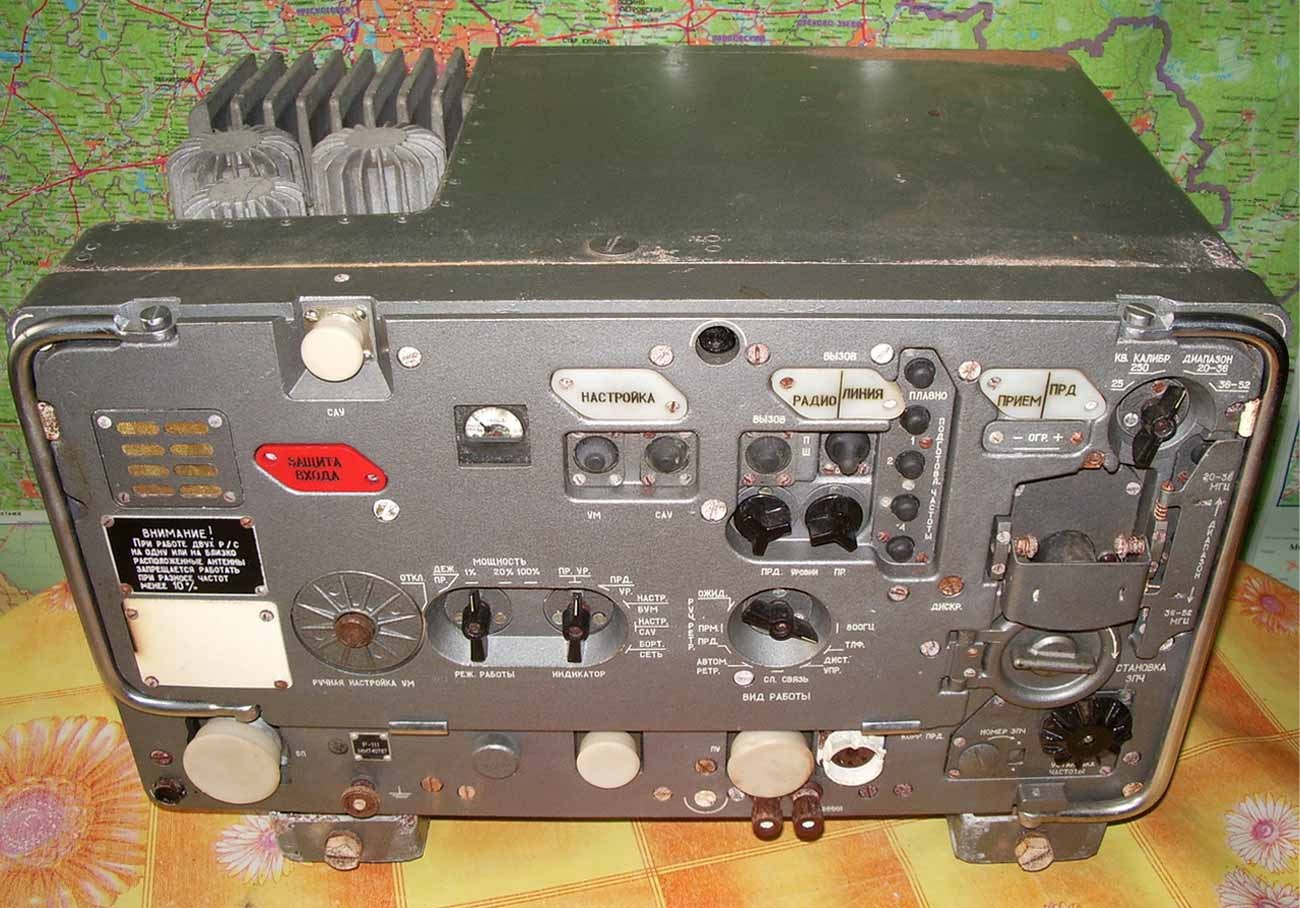
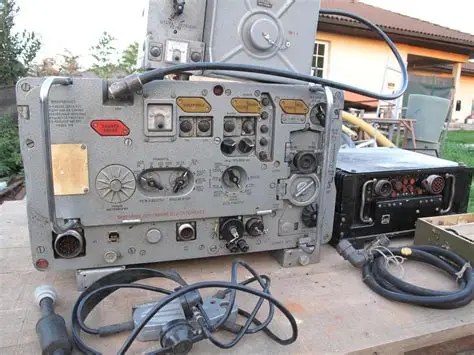
The R-111 «Бином-М» (Binom-M) is a Soviet vehicle-mounted wideband VHF FM radio of medium power, used in command-staff vehicles to reach further than the tank-level R-123. [DOCUMENTED]
SPECIFICATIONS
These figures come from the technical description:
- Frequency range: 20.0 to 52.0 MHz, in two sub-bands, 20–36 and 36–52 MHz. - Channels: 1281 on a 25 kHz raster. Four pre-set frequencies are fixed by an automatic mechanism. Retuning takes about 4–5 seconds, and setting up all four presets takes about 4 minutes. - Calibration: a crystal calibrator at 25 and 250 kHz points. - Power settings: 1%, 20% and 100%. Full power is at least 65 W into 75 Ω at 26 V, depending on sub-band. Short spec cards round this to 75 W, and other summaries go up to 80 W. Sources conflict.
[DOCUMENTED]
RANGE
These ranges assume average terrain:
- At least 35 km on the move with the 3.4 m whip. - At least 45 km when one end uses an antenna on an 11 m mast. - At least 60 km with masts at both ends.
The R-145BM description gives 35–75 km. [DOCUMENTED]
FEATURES
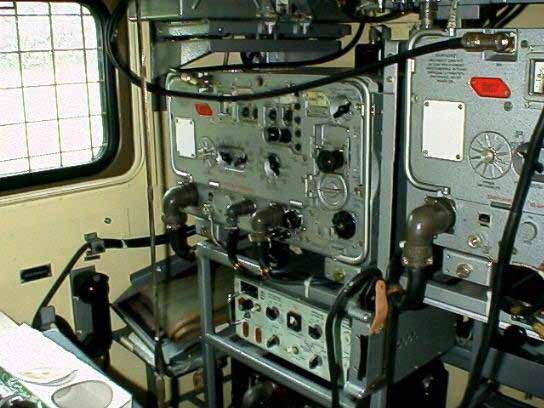
The R-111 can be remote-controlled from a TA-57 telephone over up to 500 m of line. It supports automatic and manual retransmission when two sets are linked, and it works with telecode data equipment. A twin antenna matching unit lets two transceivers share one antenna if their frequencies are at least 10% apart. [DOCUMENTED]
PURPOSE AND VARIANTS
A training text places the R-111 in the corps–brigade–battalion command link, for telephony between moving vehicles, with tone calling. [DOCUMENTED] (studfile training notes.) It was built in a simplex version and a double-simplex version. The double version runs two transceivers on one antenna and can relay between correspondents automatically or by hand. [DOCUMENTED] (R-111 technical description.)
DESIGN
- Master transceiver: a two-band RF block with its scale, an IF block, a 28–44 MHz reference oscillator-exciter, a crystal calibrator with a search generator, and a front panel carrying the preset-frequency mechanism. - Power amplifier: a single-band block mechanically coupled to a two-circuit tunable filter, with its own automation unit. - Receiver: a double-conversion, two-band superheterodyne with a sensitivity of 1.5 µV (1.7 µV in the double version), measured with the noise suppressor off. - Switching: transmit-receive changeover in 0.7 s or less. Deviation is at least ±4 kHz from the line input and ±5 kHz from the microphone.
[DOCUMENTED] (R-111 technical description.)
A training text gives the output stage as two GU-50 valves, at 60–100 W. [SINGLE-SOURCE] (studfile.) Radiomuseum lists 0.75, 15 and 75 W for the three power steps. [SINGLE-SOURCE] (radiomuseum.org.)
POWER AND WEIGHT
The set runs from 26 V ± 3.9 V DC, negative to the case. A simplex set draws up to 20 A on transmit, 7 A on receive and 2 A on standby receive. The working set weighs up to 100 kg (simplex) or 180 kg (double), without power sources or antennas. [DOCUMENTED] (R-111 technical description.)
It can run continuously for 48 hours at a 3:1 receive-to-transmit ratio (15 minutes receive to 5 transmit). Continuous transmission is limited to 1 hour, or 4 hours with forced-air cooling of at least 10 m³/min on the case and the power-amplifier supply; the cooling system was not part of the set. [DOCUMENTED] (R-111 technical description.)
ANTENNAS
The training text lists a 3.4 m whip (35 km), a 1.5 m whip on an 11 m telescopic mast (60 km) and the ShDA-10 m broadband antenna (75 km). It gives 950 working frequencies, against 1281 in the technical description. Sources conflict. [SINGLE-SOURCE] (studfile.)
IN SERVICE
Besides the R-145BM above, the BMP-1KSh «Поток-2» command-staff vehicle carries two R-111s with an R-130M and an R-123MT. [DOCUMENTED] (training texts.) Amateur owners praise its receiver and its power but call it heavy, with a whining power converter and a primitive scale. One also says it has no squelch, though the manual refers to a noise suppressor. Sources conflict. [SINGLE-SOURCE] (cqham.ru reviews.) No source was found for its use in a specific war. [UNVERIFIED]
RELATED PAGES
R-123M
R-130M
R-173
Radio section