OVERVIEW
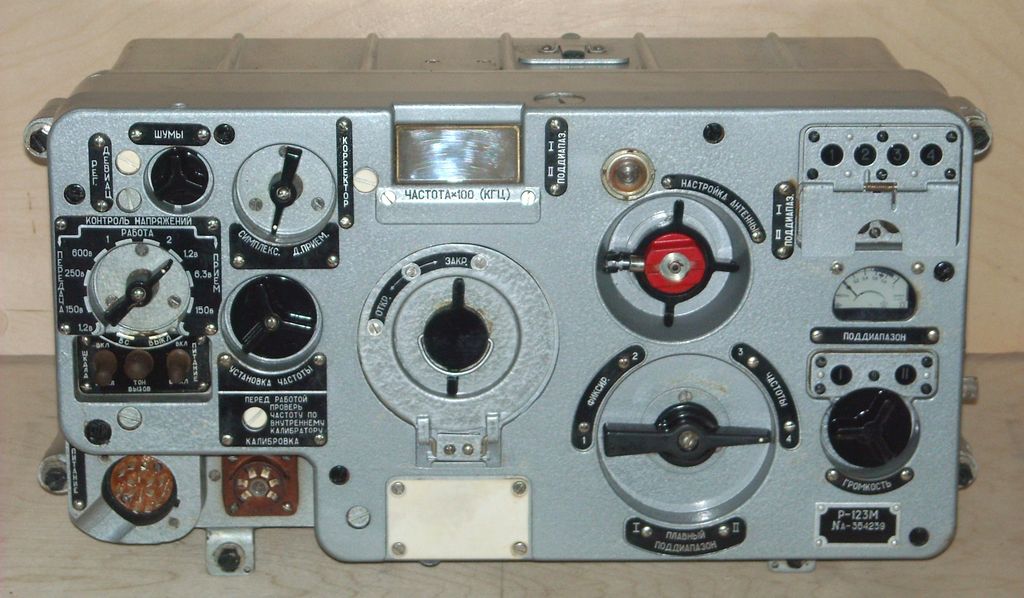
The R-123M «Магнолия» (Magnoliya) is the Soviet VHF FM tank radio. From the 1970s it was the standard radio, linked to the intercom, in Soviet tanks and other armoured vehicles. [BACKGROUND]
Its 1983 technical description defines it as a transceiver for "radio communication between moving objects", working on the move and at the halt. [DOCUMENTED]
SPECIFICATIONS
These figures come from the technical description:
- Frequency range: 20 to 51.5 MHz, in two sub-bands, 20–35.75 MHz and 35.75–51.5 MHz. - Channels: 1261 on a 25 kHz raster. Tuning is continuous on an optical scale, with four pre-set frequencies (ЗПЧ) that a motorised mechanism selects in one action. - Transmitter: at least 20 W, with 4.5–7 kHz deviation. - Receiver sensitivity: 2.5 µV with the squelch off, or 4 µV with it on. - Frequency setting accuracy: within ±4 kHz. - Power: from vehicle 26 V or 13 V supplies (22–30 V or 11–15 V tolerance). On 26 V it draws up to 9.6 A on transmit and 3 A on receive. - Duty cycle: transmit to receive 1:3, with no more than 10 minutes of continuous transmission. - Temperature: −50 to +50 °C.
[DOCUMENTED]
A Ukrainian training text gives −40 °C and 3 µV instead. Sources conflict, and the difference is probably between edition and test conditions. [SINGLE-SOURCE]
RANGE
The manual guarantees at least 20 km on the 4 m whip over average terrain at speeds up to 40 km/h (tracked) or 100 km/h (wheeled), dropping to 13 km with the squelch on. Its table rises to about 48–70 km with an 11 m mast. Another source gives the complete set's weight as 45 kg, and English-language summaries give the transceiver's as 25 kg. [DOCUMENTED]
OPERATION
The radio works simplex telephony and standby receive. It uses a laryngophone headset or the tank helmet, through the R-124 intercom or directly. It has no loudspeaker. An emergency 3 m wire antenna can be used at reduced range. With an antenna filter unit, two R-123Ms can share one antenna if their frequencies are far enough apart. [DOCUMENTED]
VARIANTS
- R-123: the base model. - R-123M: revised electronics. - R-123MT: remotely controllable. - R-123Z: a Polish version with higher output power.
[SINGLE-SOURCE]
IN COMMAND VEHICLES
The R-145BM «Чайка-БМ» command-staff vehicle combines an R-123MT (20–40 km), an R-111 (35–75 km) and the R-130M HF set (75–350 km), with T-219 secure equipment. The 1V18 «Клён-1» battery commander's vehicle pairs an R-123M with an R-107M. [DOCUMENTED]
SUCCESSORS
The R-173 replaced it in later vehicles. [BACKGROUND]
The R-173 covers 30 to 75.999 MHz, so the two sets share only the 30–51.5 MHz overlap. [DOCUMENTED]
DESIGN
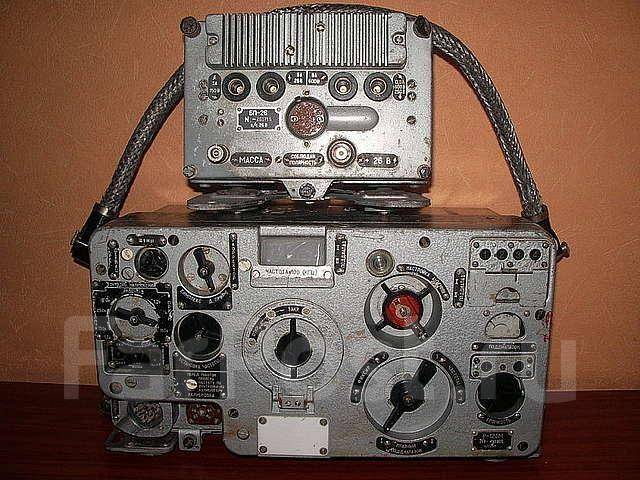
The set is built in three parts: the transceiver, the BP-26 power supply and the antenna unit. The transceiver and power supply are dust- and splash-proof, sit in shock-absorbing frames, and are linked by a screened cable; the antenna connects through 75 Ω coaxial cable. [DOCUMENTED] (1983 technical description.)
- Transceiver: a block construction on fibreglass and ceramic printed boards, using subminiature valves and semiconductor diodes. Parts that set the frequency are sealed against humidity. - Receiver: a double-conversion superheterodyne with a noise suppressor. The first IF is 7875 kHz; the second is 465 kHz. - Frequency control: an automatic frequency control (AFC) loop and a crystal calibrator to check the set against its nominal frequency. The scale is a micro-film projected through an optical magnifier onto a matt screen. - Power supply: the BP-26 is fully transistorised. Three push-pull blocking-generator converters running at about 2 kHz turn the 26 V vehicle supply into the +150 V, −150 V, 6.3 V and 1.2 V rails the valves need.
[DOCUMENTED] (1983 technical description; IF pair from radiomuseum.org.)
Collector references count 32 valves, of types 1P24B, GU-50, 1Zh29B, 6Zh45B-V and 6Zh5B; the R-123MT and Polish Z versions use 30, adding the 6N28B-V. [SINGLE-SOURCE] (radiomuseum.org; katonairadiok.hu.) The transceiver measures 428 × 222 × 239 mm. [SINGLE-SOURCE] (radiomuseum.org.)
WHAT COMES IN THE SET
The standard set is the transceiver and power supply in their frames and covers, working and spare antenna rods, the RF and power cables, an antenna mounting kit, a connector for the R-124 intercom, a spares box and the documentation. For special cases the factory also supplied the BAF-M antenna filter unit (two R-123Ms on one antenna), the EA-123 dummy antenna, an adapter for the 11 m mast antenna and a chest-mounted press-to-talk switch. [DOCUMENTED] (1983 technical description.)
SERVICE AND USE
- Origin: made by the Ryazan radio works. It replaced the R-113 tank radio, and through an antenna filter it could share an antenna with the R-112 and R-113. [SINGLE-SOURCE] (radiomuseum.org.) - Warsaw Pact: it was fitted to armoured vehicles of the Soviet Army and other Warsaw Pact armies, among them the East German NVA and the Hungarian army. [DOCUMENTED] (radiomuseum.org; katonairadiok.hu.) - Command vehicles: the BMP-1KSh «Поток-2» command-staff vehicle carries an R-123MT alongside an R-130M and two R-111s. [DOCUMENTED] (Ukrainian and Russian training texts on command-staff vehicles.) - Ukraine since 2022: Armada International, citing Ukrainian sources at a 2023 electronic-warfare conference, lists the R-123 among legacy Soviet radios still used by Russian land forces. The sources said the old and new sets share no common secure waveform, which pushes units into talking in clear. [SINGLE-SOURCE] (Armada International, 8 Jun 2023.) Armada gives its band as 21–75 MHz, against the manual's 20–51.5 MHz. Sources conflict; the wider figure looks like the R-173's.
The Arbalet R-163-50U vehicle set has exactly the same transceiver dimensions (428 × 239 × 222 mm), which suggests it was designed to drop into the same mounting. [ESTIMATE]
No source was found for its use in a specific war before 2022. [UNVERIFIED]
RELATED PAGES
R-173
R-130M
R-111
R-107
Radio section