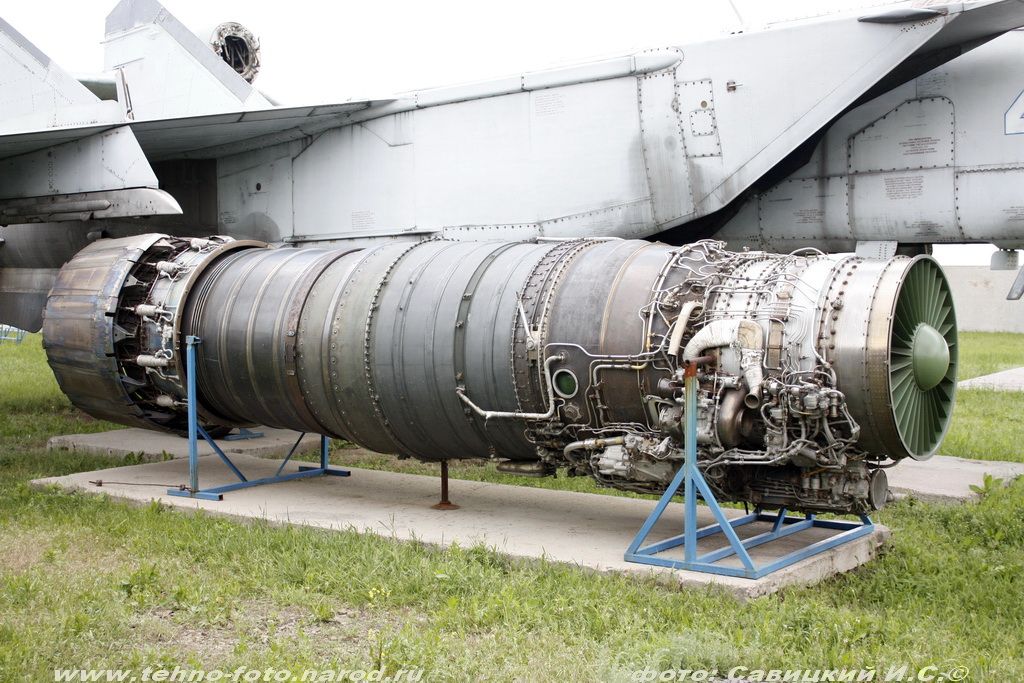
A Tumansky R-15 turbojet displayed on a stand in front of a MiG-25. Photo: tehno-foto.narod.ru, Savitsky I.S.
A Tumansky R-15 turbojet displayed on a stand in front of a MiG-25. Photo: tehno-foto.narod.ru, Savitsky I.S.
WHAT IT IS
The Tumansky R-15 is a Soviet single-shaft afterburning turbojet designed by OKB-300 under Tumansky. Its best-known version, the R15B-300, powers the MiG-25, the Mach 2.83 interceptor and reconnaissance aircraft that alarmed the West in the 1970s. Built largely of steel to survive the heat of sustained high-speed flight, it was a simple, very large-airflow engine made for one job: going extremely fast at extremely high altitude. [DOCUMENTED]
ORIGINS
OKB-300 developed the engine in the late 1950s, first for the Tu-121 unmanned strike aircraft and then for the Tu-123 reconnaissance drone, which used the KR15-300 version. Engines made for a short-lived drone did not need a long life, and that origin shows in the design. When Mikoyan needed an engine for its new high-speed interceptor, the R15B-300 was developed for the MiG-25 and tested on the Ye-150 and Ye-152 experimental aircraft. [DOCUMENTED]
DESIGN
The R-15 is deliberately simple. It has a single shaft, a five-stage compressor and a single-stage turbine. Its pressure ratio is only 4.75, which is very low for a jet engine, but it moves a large mass of air, about 144 kg/s. The engine is built mostly of steel, with silver plating, rather than lighter alloys, so it can cope with the heat at high Mach numbers. It was also the first Soviet engine with electronic engine control. [DOCUMENTED]
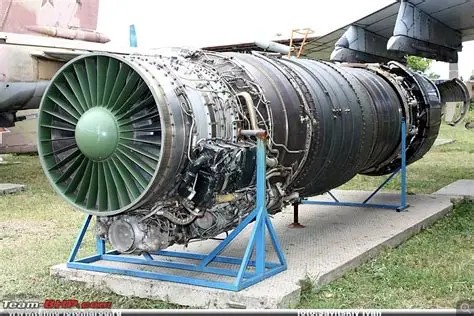
Front view of the R-15, showing the intake face and the compressor's first stage. Photo: Team-BHP.
HOW IT WORKS: THE AIRFLOW, STAGE BY STAGE
1. The intake. The engine never sees free-stream air directly. Each R-15 sits behind one of the MiG-25's large rectangular side intakes, which carry movable horizontal ramps (wedges). At low speed the ramps stay retracted to let in as much air as possible. As the aircraft accelerates past Mach 1, the ramps move down to set up a series of oblique shock waves that slow the air from supersonic to subsonic speed before it reaches the compressor face. Each shock compresses the air, so at Mach 2.8 the intake itself delivers most of the total pressure rise in the engine, far more than the compressor. Bleed and spill doors dump the air the engine cannot swallow. [DOCUMENTED; ramp details general to the MiG-25 intake design]
2. The compressor. Air then passes an inlet guide vane row and enters a 5-stage axial compressor on a single shaft. Its pressure ratio is only about 4.75 (some sources give about 4.95 for later builds; figures VARY). A modern fighter engine has a ratio of 20 to 30, but the R-15 did not need more: at high Mach, ram compression in the intake had already done most of the work, and a short, low-ratio compressor is light, tolerant of very hot inlet air and resistant to stall at extreme speed. In early service the MiG-25 did suffer compressor surge and turbine blade failures, which led to design changes. Mass airflow is about 144 kg/s, very high for an engine of its size. [DOCUMENTED]
3. The combustor. The combustion chamber is of the cannular (tube-annular) type: individual flame tubes inside a common annular casing, where fuel is sprayed and burned to heat the compressed air. [DOCUMENTED]
4. The turbine. A single-stage axial turbine drives the compressor through the shaft. The turbine inlet temperature is about 1,230 K (about 957 °C), modest by later standards, which helped the engine survive with the materials of its day. Because there is only one shaft and no fan, all of the air goes through the core: this is a pure turbojet, with no bypass at all. [DOCUMENTED]
5. The afterburner. Behind the turbine sits a very long afterburner (augmentor), which makes up a large part of the engine's 6.26 m length. Extra fuel is injected into the hot exhaust through spray rings and burned behind flame holders, raising thrust from about 7,500 kgf dry to 10,980 to 11,200 kgf. Reheat is scheduled in stages, so the pilot can select partial or full afterburner. At high Mach the MiG-25 cruises with the afterburner lit, which is why it consumed so much fuel. [DOCUMENTED; number of fuel stages not confirmed in our sources]
6. The nozzle. The exhaust leaves through a variable nozzle that Russian sources describe as a three-position nozzle: its area is set to one of a few fixed positions, for dry thrust, afterburning and high-speed afterburning, rather than being continuously variable as on later engines. [DOCUMENTED]
Starting and control. The engine is spun up by a 150 hp turbo-starter. It was the first Soviet engine with an electronic engine regulator, which managed the engine's operating modes. [DOCUMENTED]
WHY A LOW PRESSURE RATIO SUITS MACH 2.8
A jet engine needs compressed air. At Mach 2.8 the air arriving at the intake has so much kinetic energy that slowing it down compresses it by a ratio of roughly 25 to 30 in an ideal intake, and still well over 10 after real-world shock losses. Stack a high-ratio compressor on top of that and the air would arrive at the combustor so hot that little fuel could be added before the turbine overheated. The R-15's low compressor ratio leaves room to add heat, and at those speeds the engine behaves more and more like a ramjet with a turbine in it. [ANALYSIS; ram figures are standard textbook values, approximate]
The same choice is why the engine is poor down low. At low speed and low altitude there is almost no ram compression, so the overall pressure ratio is just the compressor's 4.75. A jet engine's efficiency rises with pressure ratio, so at sea level the R-15 is very thirsty for the thrust it makes, and the large, heavy MiG-25 structure is restricted to about 1,300 km/h indicated airspeed. In the site owner's words, it was a good engine but only shone at high altitude. [ANALYSIS; site owner]
For background on how adding a bypass stream changes this trade-off, see the site's Turbofan Bypass Ratios article. The R-15 has no bypass at all, while its successor on the MiG-31, the D-30F6, has a low bypass ratio of about 0.57. [RELATED]
MATERIALS AND HEAT
At Mach 2.8 the air arriving at the engine is already heated to roughly 300 °C by compression in the intake. Aluminium alloys lose strength at those temperatures, so, like the MiG-25's airframe, the R-15 relies heavily on steel, with silver plating on parts of the engine, and on titanium only where it was needed. Steel is heavy but cheap, easy to weld and keeps its strength when hot. [DOCUMENTED; exact temperatures approximate]
Water-methanol injection. The MiG-25 carried a water-methanol mixture that was sprayed into the intake ducts ahead of the engines during high-speed runs. Evaporating the mixture cools the incoming air, which protects the compressor and lets the engine take in more mass of air at high Mach. Sources describe it as a measure for the highest speeds rather than routine use, and the exact tank size and speed threshold vary between accounts. [REPORTED; details VARY]
FUEL AND FUEL BURN
The main fuel is T-6, a special high-temperature, thermally stable kerosene developed for high-speed flight; T-7P was the reserve fuel. Ordinary jet fuel would break down and form deposits when heated by the airframe and used as a heat sink at Mach 2.8. [DOCUMENTED]
Specific fuel consumption is about 1.25 kg/kgf·h at its most economical dry setting and 2.70 kg/kgf·h in full afterburner. Multiplying these by thrust gives a rough fuel flow per engine of about 9 tonnes per hour at full dry power and roughly 29 to 30 tonnes per hour in full afterburner at sea-level static conditions. Real fuel flow in flight varies with altitude and speed, so treat these as illustrations of scale, not measured figures. [SFC DOCUMENTED; fuel flow CALCULATED]
SPECIFICATIONS (R15B-300)
VARIANTS
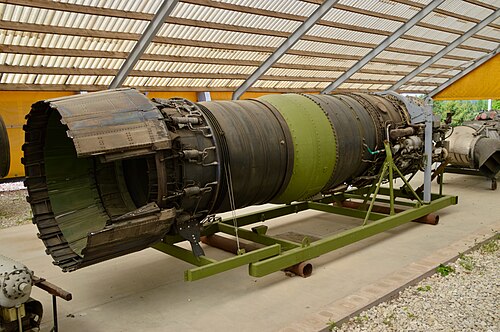
A complete R-15 with its long afterburner section on museum display.
HOW IT PERFORMED
The site owner's view is that the R-15 was a good engine, but it only shone at high altitude. Lower down its performance was poor. The low pressure ratio and high fuel burn that suited a sprint at the edge of the stratosphere made it thirsty everywhere else, and at sea level the MiG-25 was limited to about 1,300 km/h indicated airspeed. [ANALYSIS; site owner]
On speed, the MiG-25 could reach about Mach 3.2, but doing so wrecked the engines. In service it was therefore limited to Mach 2.83. [DOCUMENTED]
THE WEST FINDS OUT
On 6 September 1976 Soviet pilot Viktor Belenko defected in a MiG-25 and landed at Hakodate in Japan. Western engineers examining the aircraft found the steel construction and the large, simple engines, and realized the MiG-25 was a specialized high-speed interceptor rather than the super-fighter many had feared. In total 1,186 MiG-25s were built. [DOCUMENTED]
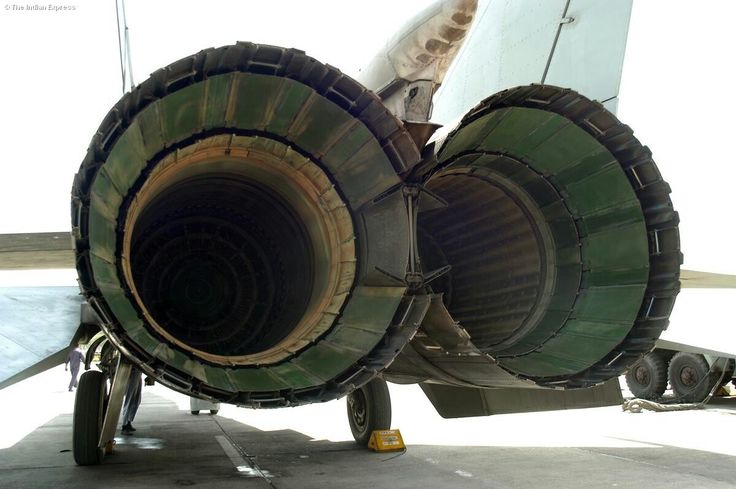
Rear view of a MiG-25 showing the twin R-15 afterburner nozzles. As the site owner points out, this is how to tell a MiG-25 from a MiG-31 from behind: the MiG-25's two nozzles touch each other, while the MiG-31's are spaced apart. Photo: The Indian Express.
R-15 VS D-30F6
The MiG-25's successor, the MiG-31, flies on the Soloviev D-30F6, an afterburning low-bypass turbofan, and the MiG-31 has the same Mach 2.83 limit. The two engines are close in weight, but the F6 is a very different machine: much more efficient, with far lower fuel burn.
| R15B-300 | D-30F6 | |
| Type | Single-shaft turbojet | Two-shaft turbofan, bypass ratio 0.57 |
| Pressure ratio | 4.75 | 21.15 |
| SFC dry / afterburner | 1.25 / 2.70 | 0.72 / 1.9 |
| Weight | 2,454 kg | 2,416 kg |
| Production | For 1,186 MiG-25s | 1,364 built, 1977 to 1993 |
The site owner's assessment: the D-30F6 gave the MiG-31 better performance at all altitudes and much more range, while the MiG-25 was a tad faster. The R-15 was a good engine, but it was built for the high-altitude sprint, and the F6 was built for everything. [ANALYSIS; site owner]
IN ONE SENTENCE
The Tumansky R-15 is a simple, steel, single-shaft turbojet, first built for drones, that took the MiG-25 to Mach 2.83 and a 37,650 m record, and was a superb high-altitude engine with poor performance lower down.
RELATED
D-30: the engine family that includes the MiG-31's D-30F6. Turbofan Bypass Ratios: background on bypass and low-bypass engines; the R-15 itself is a pure turbojet. MiG-31: the MiG-25's successor.
SOURCES