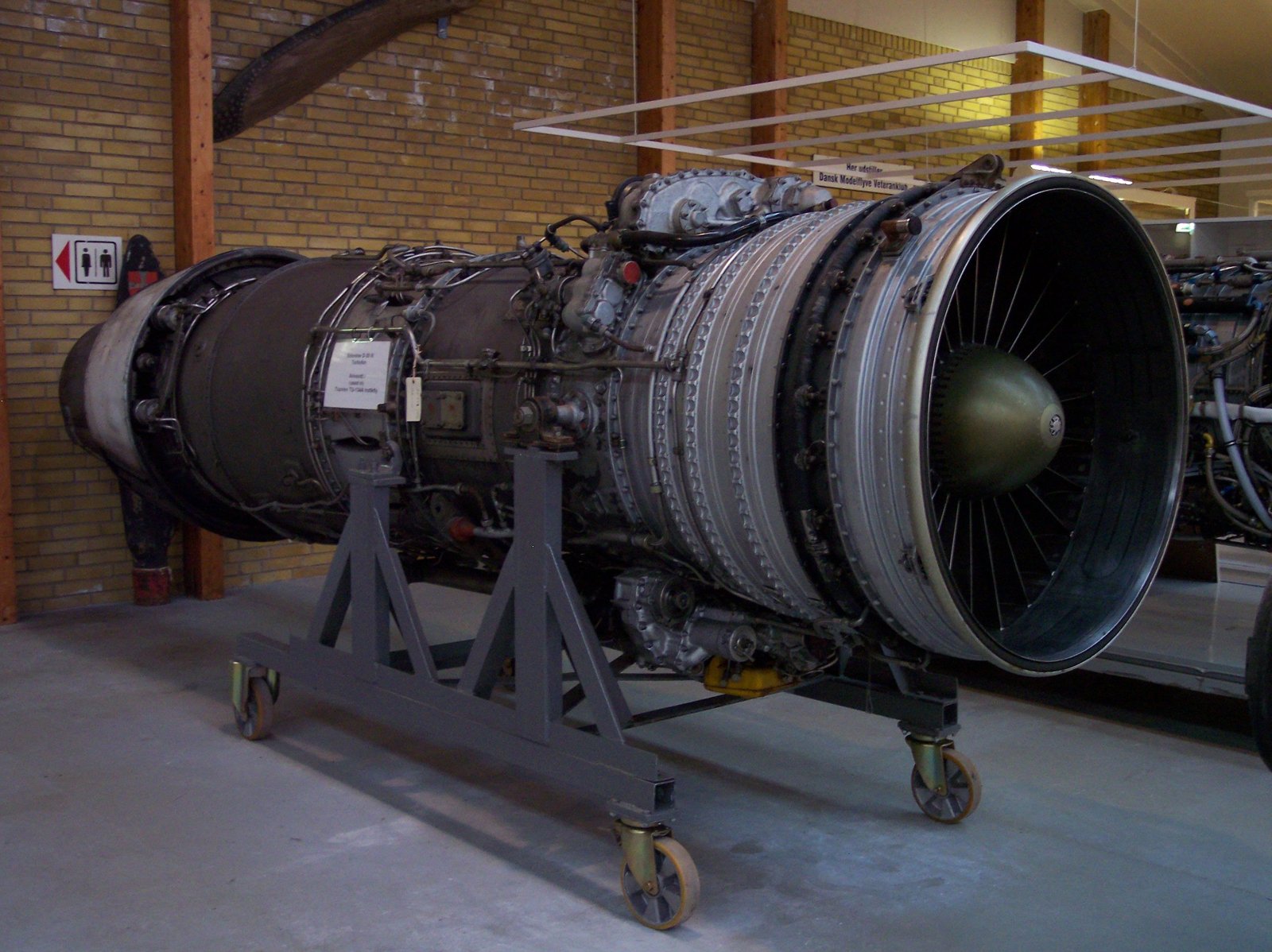
A D-30 family turbofan on display.
A D-30 family turbofan on display.
WHAT IT IS
The Soloviev D-30 is a family of Soviet two-shaft turbofan engines designed by the Soloviev design bureau (OKB-19) in Perm, today ODK-Aviadvigatel. Starting as a small, low-bypass engine for the Tu-134 airliner in the 1960s, it grew into the D-30KU for the Il-62M and Tu-154M, the D-30KP that powers the Il-76 transport and its tanker and radar offshoots, and the afterburning D-30F6 that gives the MiG-31 interceptor its speed and reach. Counting all variants, well over ten thousand have been built. It is one of the most widely used jet engines the Soviet Union ever produced, and much of Russia's transport, tanker and interceptor fleet still flies on it today. [DOCUMENTED; total is the sum of variant figures below]
ORIGINS
In the late 1950s and early 1960s the Soviet Union was moving from turbojets to the more economical bypass (turbofan) engine. Pavel Soloviev, chief designer of OKB-19 in Perm since 1953, had already produced the D-20P, the first Soviet production turbofan (5,400 kgf), for the Tu-124. His bureau was given the task of a larger engine for the coming Tu-134 twin-jet airliner. The result, the D-30, first ran in 1963 and entered serial production in 1966. It was the first Soviet engine with cooled turbine blades, an advance that let the turbine run hotter and more efficiently, and the design team received a State Prize for it. From that core the bureau developed every later member of the family. [DOCUMENTED]
D-30 (TU-134)
The original D-30 is a low-bypass turbofan with a bypass ratio of about 1.0: roughly as much air goes around the core as through it. The Series II engine, with a thrust reverser added in 1969, was built from 1970 to 1987 and is the most common version. It produces 6,800 kgf of takeoff thrust, weighs 1,546 kg, has a fan diameter of 963 mm, an overall pressure ratio of 18.6 and a specific fuel consumption of 0.781 kg/kgf·h. The Series III, rated at 6,930 kgf, was built from 1983 to 1993. Production of the Tu-134 engine ended in 1993, after about 3,000 had been built. [DOCUMENTED]
D-30KU (IL-62M)
The Il-62 long-range airliner originally flew on Kuznetsov NK-8-4 low-bypass turbofans, which were thirsty. From 1971 the Soloviev bureau developed a much larger, higher-bypass engine for it, the D-30KU (bypass ratio about 2.4, which the site owner sees as closer to medium bypass than low bypass), rated at 11,000 kgf. (The Perm Motors factory gives 11,500 kgf; sources disagree.) Fitted to the Il-62M, it added about 1,500 km of range. It also introduced the first Soviet bucket-type (clamshell) thrust reverser. The engine was built in Rybinsk, which produced 1,584 of them. [DOCUMENTED; thrust figures DISPUTED]
D-30KU-154 (TU-154M)
The D-30KU-154 is a version of the KU adapted for the Tu-154M trijet, replacing the Kuznetsov NK-8-2 and NK-8-2U of earlier Tu-154s; it was fitted only to the Tu-154M, from 1984. It is rated at 10,500 kgf (some sources, including Perm Motors, say 11,000 kgf) and went into serial production in 1984. It burns about 28% less fuel than the NK-8, which is the main reason the Tu-154M became the long-lived standard version. Data: bypass ratio 2.5, weight 2,305 kg, specific fuel consumption 0.705, fan diameter 1,455 mm, overall pressure ratio 17.1. Time between overhauls is 3,000 hours and total service life 15,000 hours. More than 1,500 were built. See the Tu-154 page. [DOCUMENTED; thrust DISPUTED]
D-30KP / KP-2 (IL-76, IL-78, A-50)
The workhorse. The D-30KP is the transport version, rated at 12,000 kgf. It was certified in 1972 and entered service in 1974, and it powers the Il-76, the Il-78 tanker and the A-50 radar aircraft. More than 4,700 were built at Rybinsk (today ODK-Saturn). The prototype Il-76 flew on D-30KPs in 1971. [DOCUMENTED]
The KP-2. Data for the improved D-30KP-2: bypass ratio 2.24, weight 2,640 kg with reverser, specific fuel consumption 0.715, fan diameter 1,455 mm, overall pressure ratio 20.1. [DOCUMENTED]
The base D-30KP. Series I data: 12,000 kgf takeoff thrust and 2,750 kgf in cruise at 11 km and Mach 0.8; specific fuel consumption 0.50 at takeoff and 0.70 in cruise; bypass ratio 2.36; turbine inlet temperature 1,427 K; airflow 279 kg/s; weight 2,640 kg; reverse thrust 3,800 kgf. The Series II has a bypass ratio of 2.2-2.24 and weighs 2,650 kg. [DOCUMENTED; single secondary source]
China. China became the largest new customer. 55 engines were delivered in 2009-2011, and a further 184 were contracted for 2012-2015; the first batch of 12 under that contract was accepted on 16 October 2012. The prototype of China's Y-20 heavy transport flew on D-30KP-2s, and according to Jane's, China's WS-18 engine is a copy of the D-30KP-2. [DOCUMENTED]
Longer life. In 2020 the assigned service life of the D-30KP-2 on the Il-76 was raised from 6,500 hours and 3,375 cycles to 9,500 hours and 4,875 cycles, a strong sign of confidence in the engine. [DOCUMENTED]
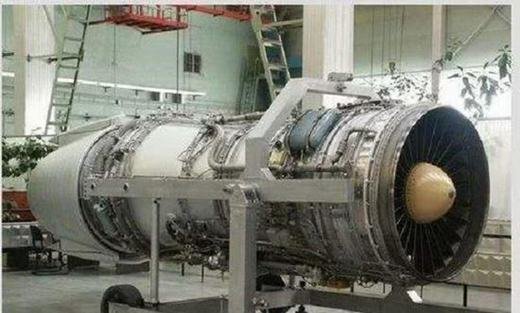
A D-30KP-2 type engine on a stand.
The D-30KP "Burlak". The Burlak modernization of the D-30KP has a much more modern-looking intake fan, and in photos it can at first glance resemble a PS-90A. The site owner's analysis of photos from Russian sources shows the giveaway: the intake diameter is still clearly smaller than a PS-90A's. [SITE OWNER]
Telling a D-30KP from a PS-90A-76 on an Il-76. Both engines appear on the Il-76 today, and the site owner points out how to tell them apart from the front. On the D-30KP the nose cone (spinner) sits close to the front of the fan fairing, almost flush with the inlet, and the intake is much smaller. The PS-90A-76 has a far larger, wider intake and looks like a modern high-bypass engine such as a GE90 when seen head-on. [SITE OWNER]
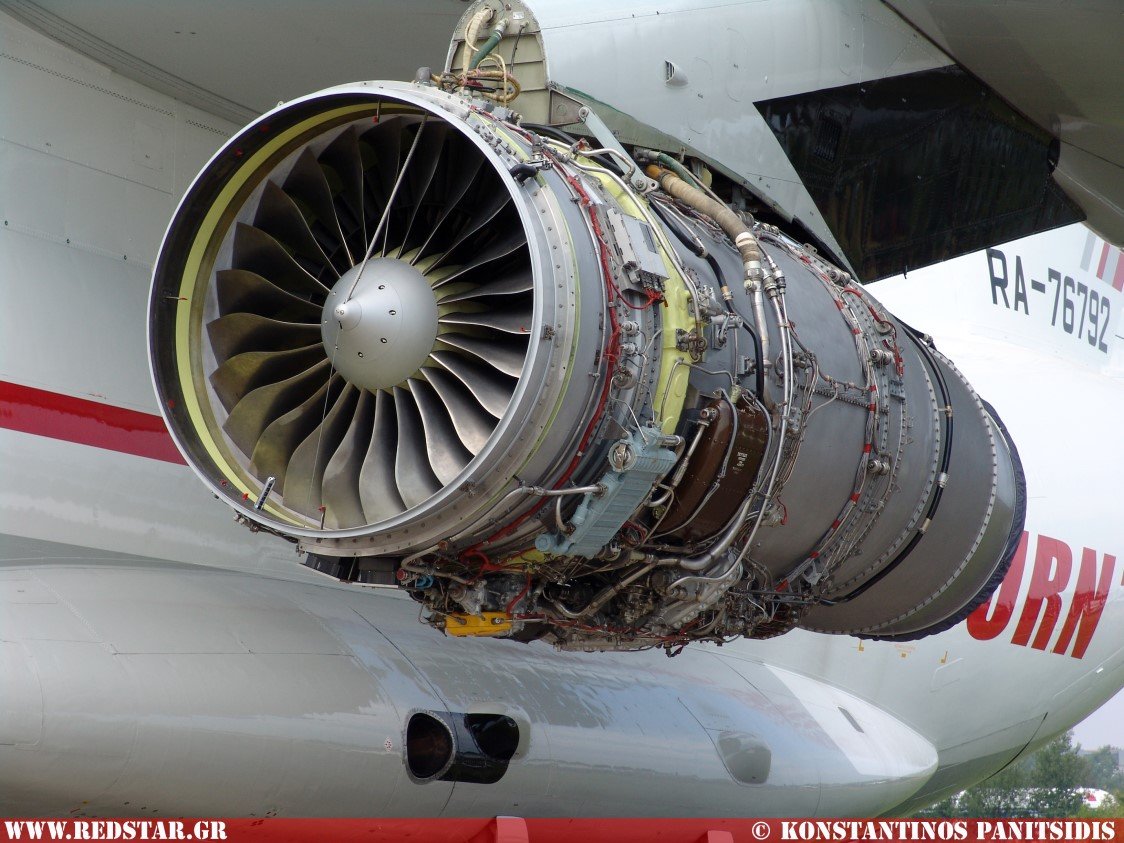
D-30KP installed on Il-76 RA-76792, cowling open. Note the small intake and the spinner close to the fan fairing. Photo: Konstantinos Panitsidis.
HOW IT WORKS: THE D-30KU/KP, STAGE BY STAGE
1. The fan (low-pressure compressor). Air enters past the spinner into a 3-stage low-pressure compressor, 1,455 mm across at the front. Its first stage acts as the fan: the air it compresses splits behind it, most of it going around the core in the outer (bypass) duct and the rest going into the core. With a bypass ratio of about 2.36 on the D-30KP, roughly 70% of the air bypasses the core; in the site owner's terms that makes it closer to a medium-bypass engine than a true low-bypass one (see Turbofan Bypass Ratios). The low-pressure spool is driven by the 4-stage low-pressure turbine at the back of the engine. [DOCUMENTED; split CALCULATED from bypass ratio]
2. The airflow. Total airflow at takeoff is about 279 kg/s for the D-30KP and 264 to 269 kg/s for the D-30KU-154 Series II and III. Our own calculation from the bypass ratio: on the KP about 83 kg/s goes through the core and about 196 kg/s goes around it. [DOCUMENTED; core/bypass split CALCULATED]
3. The high-pressure compressor. The core air then enters an 11-stage high-pressure compressor on a second, separate shaft, so the two spools can turn at their own best speeds. Ahead of its first stage sits a variable inlet guide vane row. At start and low power it is closed to 33° to limit airflow and prevent surge; it starts to open at 74.5% high-pressure spool speed and is fully open at 92.5%. Anti-surge bleed valves behind the 5th and 6th stages, worked by six fuel-powered hydraulic cylinders, are open during start and close at above 79% speed. Overall pressure ratio is about 17.1 for the KU-154 and 20.1 for the KP-2. [DOCUMENTED; Russian sources describe this as the D-30KP; how the overall ratio splits between the two compressors was not found]
4. The combustor. The combustion chamber is cannular (tube-annular), with 12 flame tubes inside a common annular casing, a design carried over from the original D-30. [DOCUMENTED]
5. The high-pressure turbine. Hot gas leaves the combustor and drives a 2-stage high-pressure turbine, which powers the high-pressure compressor. The D-30 family was the first Soviet engine with cooled turbine blades: air bled from the compressor runs through the blades so they survive gas hotter than the metal's own limit. Turbine inlet temperature is 1,336 K at takeoff for the KU-154 Series II, 1,316 K for Series III and about 1,427 K for the KP. One Russian reference gives 1,043 °C (1,316 K) for the KU, which matches the Series III figure. [DOCUMENTED; figures VARY by variant and source]
6. The low-pressure turbine. A 4-stage low-pressure turbine drives the fan. It needs more stages than the high-pressure turbine because the fan moves far more air at a lower shaft speed. In total the turbine has six stages. [DOCUMENTED]
7. The mixer. Unlike most airliner engines of later decades, the D-30KU/KP does not exhaust its two streams separately. A lobe (forced) mixer behind the turbine blends the hot core gas with the cool bypass air in a mixing chamber, and both leave through a single common nozzle. Mixing evens out the jet's temperature and speed, which gives a small gain in efficiency and some reduction in noise. [DOCUMENTED; benefit is general engineering ANALYSIS]
8. The thrust reverser. The D-30KU was the first Soviet aircraft engine with a bucket-type (clamshell) reverser. On landing two buckets close behind the common nozzle and turn the whole mixed exhaust forward. On the D-30KP that gives about 3,800 kgf of reverse thrust. Because the streams are already mixed, one reverser at the tail handles all of the engine's air; the D-30KPV for the A-40 amphibian leaves it off. [DOCUMENTED]
Fuel burn. Specific fuel consumption on the D-30KP is about 0.50 kg/kgf·h at takeoff and 0.70 in cruise (0.64 to 0.70 for the KP-2, depending on source). Our own calculation: at full takeoff thrust a single KP burns about 6 tonnes of fuel an hour; in cruise at 11 km and Mach 0.8 (2,750 kgf) it burns about 1.9 tonnes an hour, so an Il-76's four engines use roughly 7.7 tonnes an hour. Real fuel burn varies with weight, altitude and temperature. [SFC DOCUMENTED; fuel flow CALCULATED]
Materials. The turbine was made from the most advanced heat-resistant alloys available to the Soviet industry at the time, used together with blade cooling. The exact alloy grades used for the D-30KU/KP were not found in reliable sources, so we do not name them. [DOCUMENTED in general terms; specific alloys UNVERIFIED]
D-30F6 (MIG-31)
The interceptor engine. Work on an afterburning, low-bypass version for the MiG-31 interceptor began in 1970. The D-30F6 produces 9,500 kgf dry and 15,500 kgf with afterburner. Dry weight is 2,416 kg, bypass ratio 0.57, overall pressure ratio 21.15, and specific fuel consumption 0.72 dry and 1.9 with afterburner. Unlike the civil KU and KP, the F6 is a true low-bypass afterburning turbofan: with a bypass ratio of about 0.57, only about a third of its air goes around the core. For background on what that means, see the site's Turbofan Bypass Ratios article. Length is given as 7.04 m or 8.0 m; sources differ. Vzlyot gives 1,364 built in 1977-1993; Alexander Inozemtsev, Perm's longtime general designer (chief designer from 1983, general designer from 1997), quoted by Interfax-AVN, gives about 1,500. [DOCUMENTED; length and total DISPUTED]
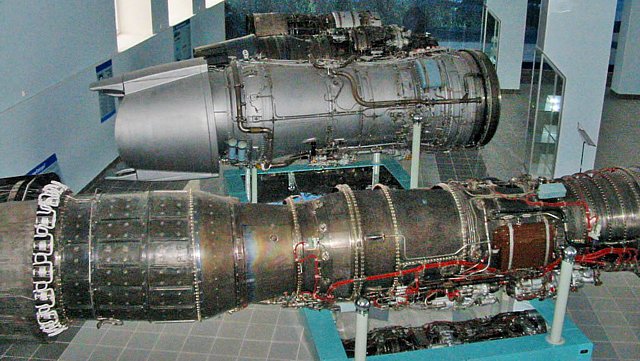
A D-30F6 in front, much longer than the engine behind it because of its afterburner section.
Against the MiG-25's R-15. The MiG-31 grew out of the MiG-25, which was powered by two Tumansky R-15 engines. The R-15 is a single-shaft turbojet (5-stage compressor, 1-stage turbine, pressure ratio only 4.75) with a large afterburner, designed for sustained speed near Mach 3 at high altitude; at low and medium altitude, and at cruise power, it is very thirsty. The D-30F6 is a two-shaft low-bypass turbofan: the bypass air makes it far more economical at cruise and gives it much better thrust and response at low altitude, The MiG-25 could reach about Mach 3.2, but doing so wrecked its engines, so it was limited to Mach 2.83; the MiG-31 is also limited to Mach 2.83. Low down the difference is clear: the MiG-31 can go supersonic at low altitude (about 1,500 km/h), while the MiG-25's sea-level limit was about 1,300 km/h indicated airspeed. [DOCUMENTED]
| R-15B-300 (MiG-25) | D-30F6 (MiG-31) | |
| Type | Single-shaft turbojet | Two-shaft turbofan, BPR 0.57 |
| Pressure ratio | 4.75 | 21.15 |
| Thrust dry / AB (kgf) | 7,500 / ~11,000 | 9,500 / 15,500 |
| Weight (kg) | 2,454 | 2,416 |
| SFC dry / AB | 1.25 / 2.70 | 0.72 / 1.9 |
The site owner's view: the D-30F6 gave the MiG-31 much better, well-rounded performance at all altitudes than the R-15 gave the MiG-25. The MiG-25 was a little faster, but it had less range and performed poorly anywhere but high up. [SITE OWNER]
Repair, and the hot section. The D-30F6 is not listed as in serial production; the fleet is supported by overhaul at Proton-PM in Perm, from a pool said to be more than 1,200 engines. In May 2024 Sergei Popov, managing director of ODK-Perm Motors, said the turbine hot-section modules had been brought back into manufacture over the previous three to four years, and that the compressor could follow. An October 2025 Russian report described production as being "revived", but its text only said a restart "will become possible". [DOCUMENTED; full restart UNCONFIRMED]
The site owner's view. Making the high-temperature turbine section again means Perm is already making the hardest, highest-level parts of the engine. A complete D-30F6 could be built with little preparation, and production may already have resumed: the MiG-31 has been used enormously to launch Kh-47M2 Kinzhal missiles, logging flight hours far above its normal patrol duties, and those engines have to come from somewhere. See the MiG-31 page. [SITE OWNER]
HOW IT WORKS: THE D-30F6, STAGE BY STAGE
Where it came from. Soloviev's choice of a two-shaft bypass engine with an afterburner that burns the mixed core and bypass flow was controversial; no production engine yet used that layout. A demonstrator, a production D-30 with an afterburner (the D-30F), was tested at TsIAM first. For the F6 the bureau took the D-30KU core without its first high-pressure stage, and the D-30's low-pressure compressor with one stage added at the front, sized for 150 kg/s of air. [DOCUMENTED, ODK-Aviadvigatel history]
1. The inlet guide vanes. The air arrives from the MiG-31's variable intake and first meets an inlet guide vane module, which, like the spinner, is anti-iced. [DOCUMENTED]
2. The low-pressure compressor (fan). A 5-stage low-pressure compressor with a pressure ratio of about 3, inlet diameter 1,020 mm. Total airflow is about 150 kg/s. With a bypass ratio of 0.57, our own calculation puts about 95 kg/s through the core and about 55 kg/s through the bypass duct. This is a true low-bypass engine; see Turbofan Bypass Ratios. Single damaged first-stage blades, or the whole low-pressure compressor module, can be replaced in service. [DOCUMENTED; split CALCULATED]
3. The high-pressure compressor. A 10-stage compressor with a pressure ratio of about 7.05 and variable first-stage stator vanes, with air bleed after the 4th and 5th stages to control surge. Together the two compressors give an overall pressure ratio of 3 × 7.05 = 21.15, roughly four and a half times the R-15's 4.75. [DOCUMENTED; one source puts the bleeds after stages 5 and 10, which may describe turbine cooling air; VARIES]
4. The combustor. Tube-annular, with 12 flame tubes, as on the civil engines. [DOCUMENTED]
5. The turbines. A 2-stage high-pressure turbine drives the high-pressure compressor and a 2-stage low-pressure turbine drives the fan, both with air-cooled blades; one source says the cooling air comes from the 5th and 10th compressor stages. Maximum turbine inlet temperature is 1,660 K (1,387 °C); another source gives 1,367 °C (about 1,640 K). The control system raises turbine temperature as flight speed rises, a schedule Russian engineers later called "temperature spin-up", so the engine still made the thrust needed at its second design point, 20 km altitude and 2,500 km/h. [DOCUMENTED; TIT figures VARY]
6. The mixer. A mixer case blends the bypass air with the core exhaust before the afterburner. Burning in the mixed flow lets the cool, oxygen-rich bypass air feed the afterburner. [DOCUMENTED; reasoning ANALYSIS]
7. The afterburner. Fuel is burned behind four ring-shaped flame holders, and the afterburner is lit by the "fire track" (hot streak) method: a jet of extra fuel injected into the combustor burns through the turbine and lights the afterburner. Thrust rises from 9,500 kgf dry to 15,500 kgf with full afterburner. [DOCUMENTED]
8. The nozzle. A cooled, multi-flap, variable-area supersonic (convergent-divergent) nozzle, moved by 18 actuators. The nozzle, the main engine and the afterburner fuel each have their own control loop. [DOCUMENTED]
Control. The D-30F6 was the first Soviet turbofan with an electronic digital computer as its main regulator, the RED-3048 from the Perm aggregate design bureau, backed up by a hydraulic system if the electronics fail. It also limits low-pressure spool speed and turbine gas temperature. [DOCUMENTED]
Fuel burn. Specific fuel consumption is 0.72 kg/kgf·h at maximum dry thrust and 1.9 with full afterburner, sea level static. Our own calculation: one engine burns about 6.8 tonnes an hour at maximum dry and about 29.5 tonnes an hour at full afterburner, so in full reheat a MiG-31 burns roughly a tonne of fuel a minute. The far lower dry figure than the R-15's 1.25 is where the MiG-31's range comes from. [SFC DOCUMENTED; fuel flow CALCULATED]
Heat and materials. Because the bypass air cools the engine casing, the MiG-31 runs a cooler engine bay than the MiG-25 and did without the roughly 5 kg of silver heat-shield coating used around the R-15s. Specific alloy grades for the F6 hot section were not found in reliable sources. [DOCUMENTED, single source; alloys UNVERIFIED]
Figures that vary. Length is given as 7,040 mm by one source and 8,000 mm by another. Bypass ratio is 0.57 for the production engine; the design study chose about 0.5. [VARIES]
OTHER VARIANTS
SPECIFICATIONS BY VARIANT
| Variant | Aircraft | Thrust (kgf) | BPR | Weight (kg) | SFC | Fan (mm) | OPR | Built |
| D-30 Srs II | Tu-134 | 6,800 (Srs III 6,930) | 1.0 | 1,546 | 0.781 | 963 | 18.6 | ~3,000 |
| D-30KU | Il-62M | 11,000 (or 11,500) | – | – | – | – | – | 1,584 |
| D-30KU-154 | Tu-154M | 10,500 (or 11,000) | 2.5 | 2,305 | 0.705 | 1,455 | 17.1 | >1,500 |
| D-30KP Srs I | Il-76, Il-78, A-50 | 12,000 (cruise 2,750) | 2.36 (Srs II 2.2-2.24) | 2,640 (Srs II 2,650) | 0.50 TO / 0.70 cr | 1,455 | – | >4,700 |
| D-30KP-2 | Il-76, Il-78, Y-20 proto | 12,000 | 2.24 | 2,640 w/ reverser | 0.715 | 1,455 | 20.1 | incl. above |
| D-30KPV | A-40 / Be-42 | 12,000 (no reverser) | – | – | – | – | – | – |
| D-30F6 | MiG-31 | 9,500 dry / 15,500 AB | 0.57 | 2,416 dry | 0.72 dry / 1.9 AB | – | 21.15 | 1,364 (Vzlyot) / ~1,500 |
SFC in kg of fuel per kgf of thrust per hour, at takeoff or cruise as quoted by the source. A dash means no reliable figure was found. [DOCUMENTED]
NOISE AND THE EU
The D-30 family was designed before modern noise rules. From 1 April 2002 the European Union banned Il-62s, Tu-134s and Tu-154Bs that did not meet ICAO Chapter 3 noise standards; only modified Tu-154Ms qualified, with hushkits costing about $100,000-200,000 per aircraft. Even the Tu-154M passed Chapter 3 by only 1.6 EPNdB. EU Directive 2002/30/EC, effective 28 September 2003, allowed airports to restrict aircraft with less than a 5 EPNdB margin, so Saturn developed additional acoustic liners for the D-30KU-154 at about $100,000 per engine. Noise, more than anything mechanical, pushed the older D-30 airliners out of Western airports. [DOCUMENTED]
RELIABILITY
The maker, ODK-Saturn, describes the D-30KU and KP as among the most reliable Soviet engines; that is the manufacturer's own claim. The hardest evidence is the 2020 life extension of the KP-2 to 9,500 hours and 4,875 cycles, and the fact that thousands still fly decades after manufacture. A figure of 300 hours between overhauls for the D-30F6 circulates but comes from a single Ukrainian source and is not verified. [Maker's claim ATTRIBUTED; F6 TBO UNVERIFIED]
PRODUCTION TODAY
REPLACED BY THE PS-90
The Soloviev bureau's own successor, the PS-90A, was designed in the 1980s to replace the D-30KU on new airliners such as the Il-96 and Tu-204. On the Il-76 the PS-90A-76 has replaced the D-30KP on the new Il-76MD-90A, giving more thrust, longer range and much lower noise. The D-30 family remains in service alongside it on the large existing fleet. [DOCUMENTED]
LEGACY
The D-30 is the engine that carried Soviet aviation from the turbojet age into the turbofan age. From one core came an airliner engine, a long-haul engine, a heavy-transport engine and a Mach 2.8 interceptor engine, and more than sixty years after it first ran, it still powers the Il-76 fleet, the A-50, the Il-78 and every MiG-31. It is also proof of a point the site owner makes on the PS-90 page: being able to design and build your own jet engines at all is something very few countries can do. [ANALYSIS]
IN ONE SENTENCE
The Soloviev D-30 is Perm's family of two-shaft turbofans, first run in 1963, that has powered the Tu-134, Il-62M, Tu-154M, Il-76 and MiG-31, with well over ten thousand built and the KP-2 and F6 still at the heart of Russian aviation today.
RELATED
PS-90: the successor engine. NK-32: the Kuznetsov engine for the Tu-160. Il-76, A-50, Tu-154 and MiG-31: aircraft that fly on the D-30.
SOURCES