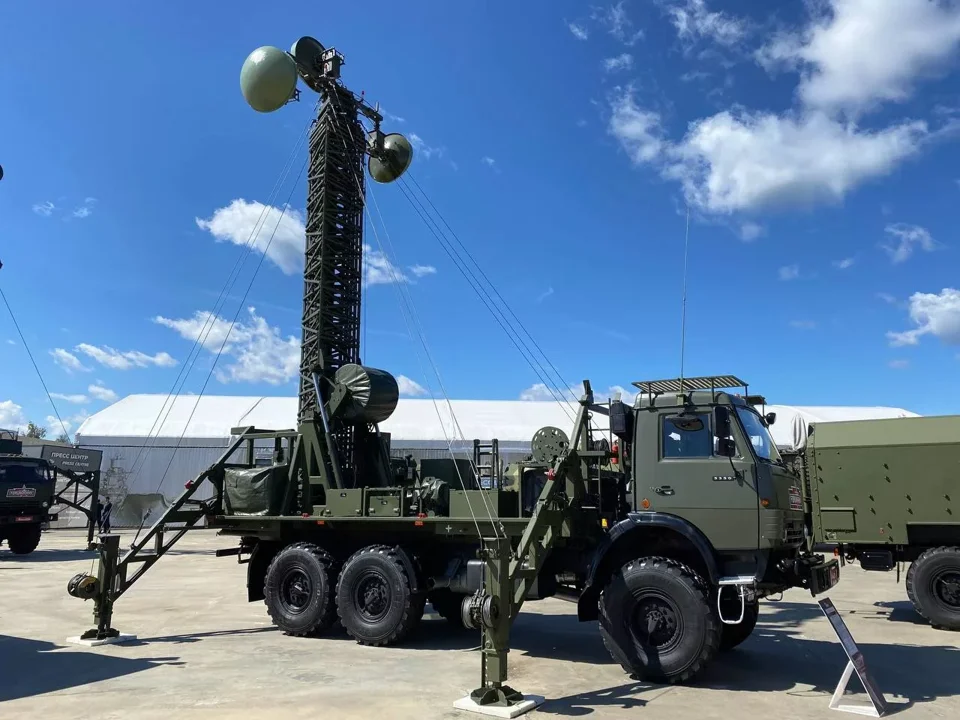
The R-416G-MO is a Russian mobile microwave radio-relay station that carries the high-capacity trunk of the field communications network: the backhaul between army, district and strategic-level headquarters. It beams up to 155 Mbit/s (one STM-1) on narrow 6 GHz-band microwave links from a 30 m telescopic lattice mast, hop by hop, about 40 km at a time. It is built by the Radio Engineering Equipment Plant (ZRTO) in St Petersburg. Its successor, the R-416GM, entered service in 2018, and one was destroyed in Ukraine in 2024. Lower down the network, the smaller R-419L1 carries the branch circuits that peel off this trunk; see that page for the other half of the picture.
WHAT IT IS FOR: THE TRUNK, NOT THE BRANCH
A field communications system looks like a road network. Thick trunk lines link the main command posts of a front or army with each other and with the fixed national network; thinner branch lines peel off to brigades and other users. R-416G-class stations are described as stations for operational and operational-strategic command levels, carrying high-rate digital streams between major nodes and also acting as a bridge in mixed networks where new digital and old analogue relays work together. [SINGLE-SOURCE, RusArmy forum; DOCUMENTED for R-416GM: "strategic, operational-strategic and operational levels", вооружение.рф] The R-419L1, by contrast, is defined by its maker as a station to branch channels off multi-channel trunks. [DOCUMENTED, Rosoboronexport] So the R-416G-MO is the backhaul; the R-419L1 is a branch circuit.
Why 155 Mbit/s matters: a large headquarters needs many simultaneous phone circuits, secure data for automated command systems, video conferencing, imagery and links to air defence and higher command. One STM-1 can carry the equivalent of 63 E1s, or nearly 1,900 voice channels; that is the capacity of a trunk, not a branch. [BACKGROUND] See Russian C3 and YeSU TZ for the systems that ride on such links.
SHARED BACKGROUND: LINE-OF-SIGHT RADIO RELAY
Line of sight. At UHF and microwave frequencies radio goes in nearly straight lines. With normal atmospheric bending (the "4/3 earth" rule) the radio horizon in km is about 4.12 x sqrt(antenna height in m). Two 20 m masts see about 37 km over flat ground, two 30 m masts about 45 km, two 60 m masts about 64 km. Range grows only with the square root of height, so doubling a mast does not double the hop. [BACKGROUND]
Fresnel zone. The beam fills an ellipsoid around the straight line. Its radius at mid-path is about 8.66 x sqrt(D/f) metres (D in km, f in GHz). Planners keep at least 60 percent of it clear of ground and trees, or the link fades. [BACKGROUND]
Free-space path loss. FSPL in dB = 32.45 + 20 log10(f in MHz) + 20 log10(d in km). Loss rises 6 dB for every doubling of either distance or frequency. Higher frequencies lose more in free space, but for the same dish size the antenna gain rises by the same amount at each end, so microwave links win back the loss with narrow beams. [BACKGROUND]
Digital hierarchy. In the European/Russian PDH and SDH system: E1 = 2.048 Mbit/s (30 x 64 kbit/s voice channels plus signalling); E2 = 8.448 Mbit/s (4 x E1); E3 = 34.368 Mbit/s (16 x E1); STM-1 = 155.52 Mbit/s (up to 63 x E1, or one E4/140 Mbit/s). [BACKGROUND, ITU-T G.703/G.707]
Duplex and retransmission. Each hop transmits on one frequency and receives on another, separated by a duplex spacing so the station's own transmitter does not deafen its receiver. A relay in the middle of a line receives on one direction and retransmits on another, regenerating the bit stream and optionally dropping or inserting channels. [BACKGROUND]
MAKER, HISTORY AND VARIANTS
Developer. The lead developer is ZRTO (Zavod radiotekhnicheskogo oborudovaniya, St Petersburg), working with the Military Academy of Communications, the 16th Central Research Institute of the MoD and industrial partners. [SINGLE-SOURCE, RusArmy forum; ZRTO as maker of R-416GM is DOCUMENTED, вооружение.рф and ZN.ua]
Production. First series R-416G-MO stations are reported from 2005, at about 50 a year with plans to reach 70-80. A 2008 field trial reportedly held a 39.5 km semi-obstructed hop under active EW jamming with excellent quality. [SINGLE-SOURCE, RusArmy forum; not confirmed by the maker]
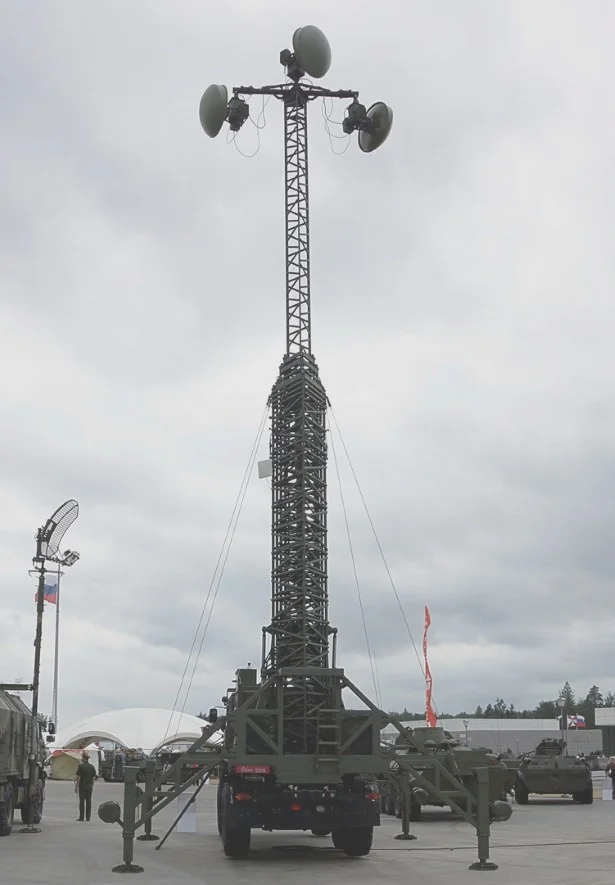
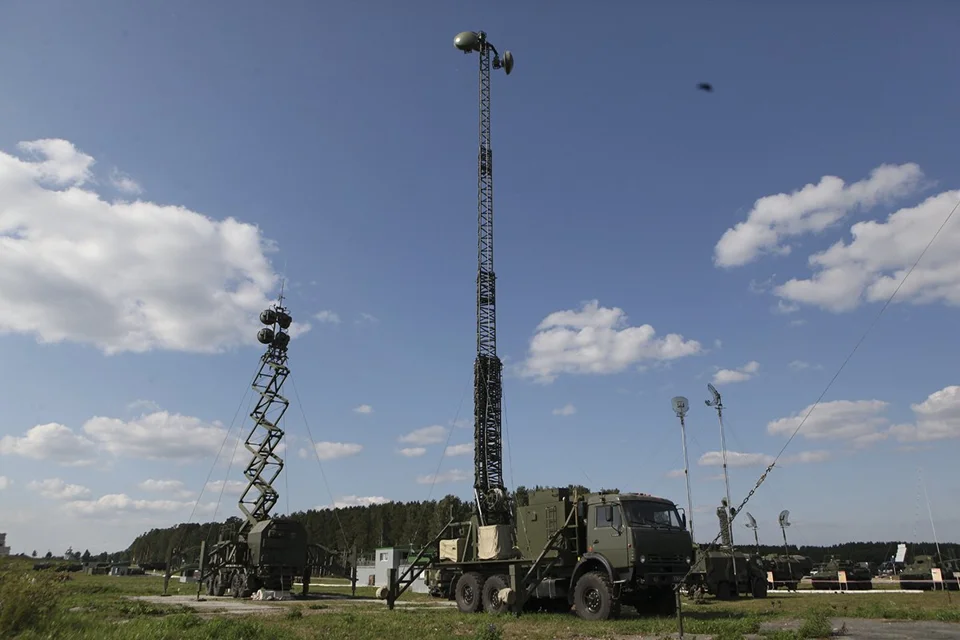
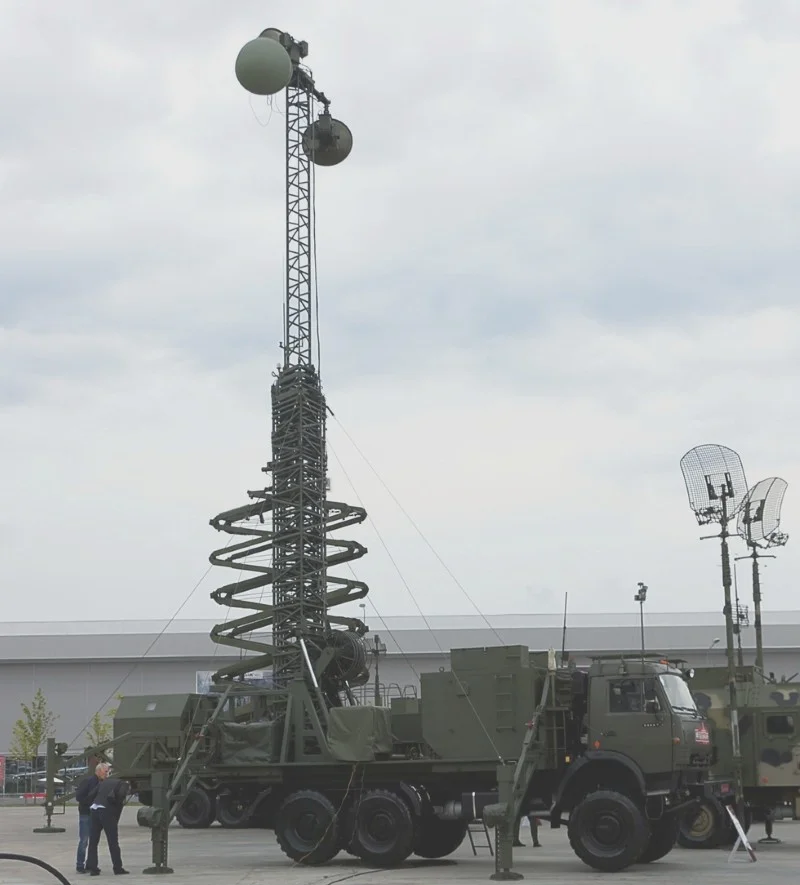
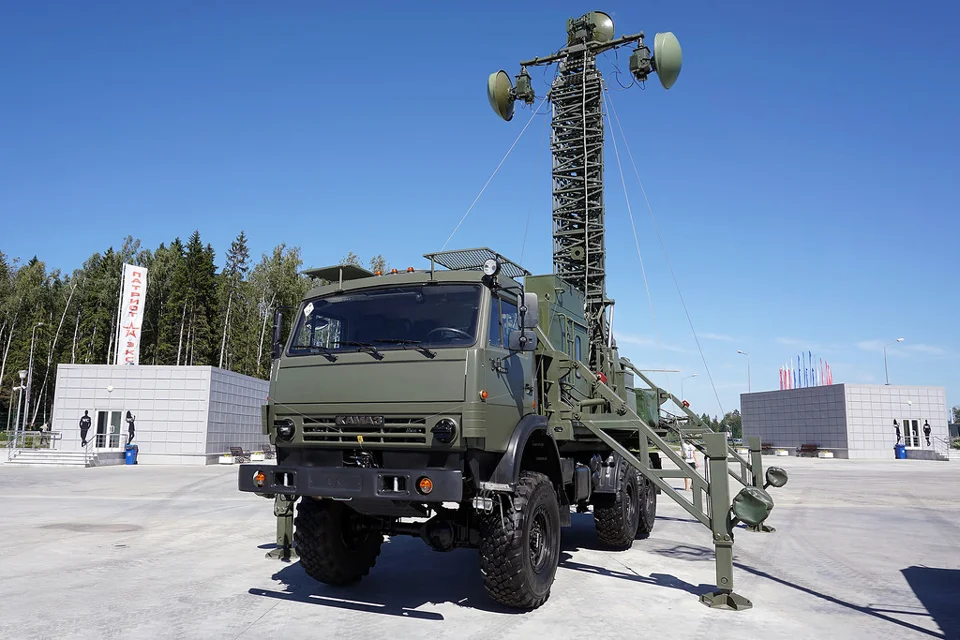
The trucks shown at Army-2018 and in later photos with a lattice mast carrying two or three dishes are most likely the R-416GM. Exterior differences from the earlier G-MO are not documented, so photos on this page are described as R-416G-series. [ESTIMATE]
HOW THE RF SYSTEM WORKS
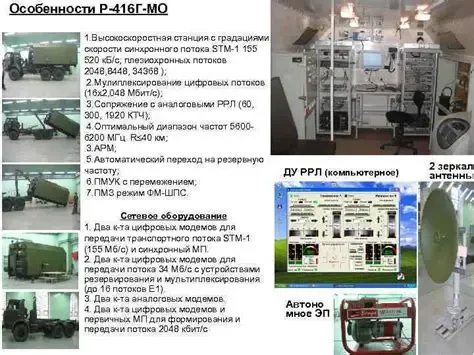
Frequency band. A Russian briefing slide on the R-416G-MO gives the optimal band as 5,600-6,200 MHz. [DOCUMENTED, slide] The forum description says it tunes smoothly within the 6 and 8 GHz bands. [SINGLE-SOURCE] The R-416GM is specified at 5.6-6.2 GHz and 7.9-8.4 GHz with a 3.5 MHz channel grid. [DOCUMENTED, вооружение.рф] Sources conflict on whether the G-MO itself had the 8 GHz band; the slide lists only 6 GHz.
Why 6 and 8 GHz. These are classic trunk microwave bands: high enough for wide channels and narrow beams from a 1 m dish, low enough that rain causes little fading over 40 km (rain attenuation becomes serious mainly above about 10 GHz). [BACKGROUND]
Transmitter and receiver chain. No block diagram has been published. A station of this class normally has a baseband multiplexer (combining E1/E3/STM-1/Ethernet streams), a modem that maps bits onto the radio carrier with error-correction coding, an up-converter and power amplifier feeding the antenna through a waveguide or coax, and a low-noise receiver and down-converter on the return path, with a duplexer or separate antennas for each direction. [BACKGROUND] The slide shows separate modem pairs: two for the STM-1 transport stream, two for 34 Mbit/s with up to 16 E1s, two analogue modems, and two for 2,048 kbit/s primary streams, plus a remotely controlled relay unit and an autonomous generator. [DOCUMENTED, slide]
Modulation. The slide lists an "FM-ShPS" anti-jam mode. In Russian usage FM is phase modulation (fazovaya modulyatsiya) and ShPS means wideband noise-like signals, so this is a phase-modulated spread-spectrum mode, in effect direct-sequence spreading that trades data rate for jamming resistance. [DOCUMENTED term; interpretation BACKGROUND] The normal high-rate modulation (for example a QAM order) is not published. [UNVERIFIED]
Transmitter power. For the R-416GM, maximum transmitter power is 33 dBm, which is 2 W. [DOCUMENTED, вооружение.рф] No figure is published for the G-MO. [UNVERIFIED] Microwave relay relies on antenna gain, not raw power.
ANTENNAS, MAST AND POLARISATION
Dishes. R-416GM beamwidths are 3.6 degrees at 6 GHz and 2.8 degrees at 8 GHz. [DOCUMENTED, вооружение.рф] Using the rule of thumb beamwidth = 70 x wavelength / diameter, both figures point to a dish of about 0.95-1.0 m, which matches the photos. A 1 m dish with typical 55 percent efficiency gives about 33 dBi at 6 GHz and about 36 dBi at 8 GHz. [ESTIMATE] The photos show solid parabolic dishes with radomes, two or three on a crossbar at the mast top, one per direction. [DOCUMENTED, photos]
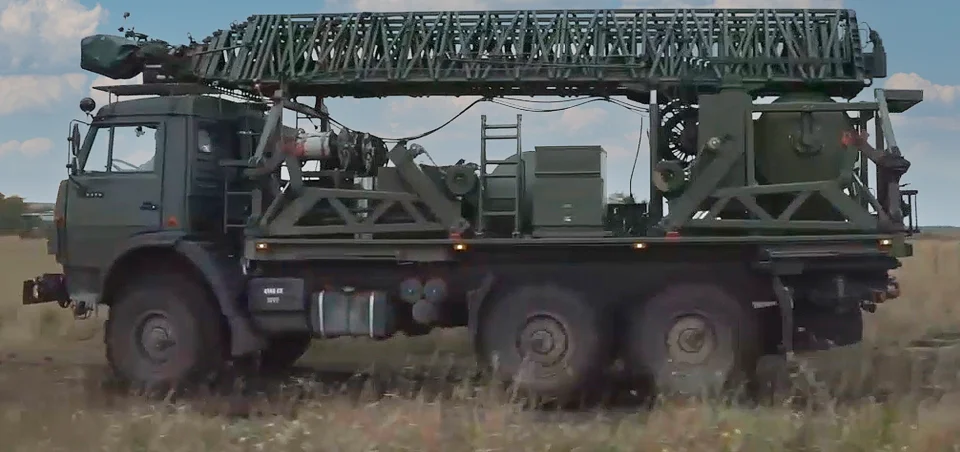
Mast. A 30 m telescopic lattice mast, guyed, about 20 minutes to deploy; the R-416GM spec assumes antenna height up to 30 m. [SINGLE-SOURCE for G-MO; DOCUMENTED for R-416GM] Remote alignment of the antennas allows directions and frequencies to be changed quickly; a service radio links neighbouring crews for alignment. [SINGLE-SOURCE, RusArmy forum] A 1 degree aiming error on a 3.6 degree beam already costs a few dB, so remote motorised alignment matters at this band. [BACKGROUND]
Polarisation. Not published. Trunk relays commonly use horizontal or vertical polarisation, and the opposite polarisation on adjacent hops, to keep neighbouring links from interfering. [BACKGROUND; for R-416G UNVERIFIED]
HOP BUDGET AT 6 GHZ: A WORKED EXAMPLE
Take a 40 km hop at 6 GHz with R-416GM-class figures. [ESTIMATE throughout]
Fresnel clearance. At 6 GHz over 40 km the first Fresnel zone radius at mid-path is about 22 m, 60 percent of that is 13 m. Add earth bulge (about 31 m at mid-path for 40 km with the 4/3 earth) and it is clear why a 30 m mast is the minimum over flat ground, and why sites are on hills. [BACKGROUND/ESTIMATE] The quoted R-416GM range assumes terrain with height differences up to 50 m and antennas at 30 m. [DOCUMENTED, вооружение.рф]
MULTIPLEXING AND INTERFACES
The slide gives selectable rates: synchronous STM-1 at 155,520 kbit/s, or plesiochronous 2,048, 8,448 and 34,368 kbit/s, with multiplexing of 16 x 2.048 Mbit/s streams. [DOCUMENTED, slide] Terminal interfaces listed by the forum: S1-FL telegraph, 2- and 4-wire voice channels, OTsK-64 (64 kbit/s), E1, E3, STM-1 and 10/100 Ethernet, with SNMP network management, field cable entry boxes and P-29x cable couplings. [SINGLE-SOURCE, RusArmy forum] The R-416GM moved to packet switching. [DOCUMENTED, вооружение.рф]
Analogue compatibility. The slide lists interfacing with analogue relay lines of 60, 300 and 1,920 voice channels, the legacy FDM trunk sizes, so the station can carry traffic across a network still using older equipment. [DOCUMENTED, slide]
JAMMING RESISTANCE: HOPPING AND BACKUP FREQUENCIES
The slide lists frequency hopping (perestroika), automatic switch to a reserve frequency, and the FM-ShPS spread-spectrum mode. [DOCUMENTED, slide] The forum adds variable data rate, error-correcting coding, and a low intercept risk because narrow beams are hard for enemy signals intelligence to detect. [SINGLE-SOURCE]
How these work together [BACKGROUND]: if a hop's error rate rises, the station can drop to a lower rate (more energy per bit), move to a pre-planned reserve frequency, or switch to spread spectrum. A 3-4 degree beam means a jammer has to be almost on the line between two masts, or very powerful in a sidelobe, to have any effect; this is a much harder target than an omnidirectional VHF net.
THE VEHICLE AND DEPLOYMENT
R-416G-MO: KamAZ-5350 6x6 with a shelter for equipment and two crew rest places, ventilation and air conditioning, a navigation set, duty radios and an autonomous generator; deployment about 20 minutes. [SINGLE-SOURCE, RusArmy forum; generator DOCUMENTED, slide] R-416GM: crew of 2, 30 minutes to deploy. [DOCUMENTED, вооружение.рф]
SPECIFICATIONS
| Parameter | R-416G-MO | R-416GM |
| Maker | ZRTO, St Petersburg [SINGLE-SOURCE] | ZRTO [DOCUMENTED] |
| In service | series from about 2005 [SINGLE-SOURCE] | 2018 [DOCUMENTED] |
| Bands | 5.6-6.2 GHz (slide); 6 and 8 GHz (forum) | 5.6-6.2 and 7.9-8.4 GHz |
| Max rate | 155.52 Mbit/s STM-1 | not published |
| Other rates | 2,048 / 8,448 / 34,368 kbit/s | packet-switched |
| Hop | about 40 km (slide); 39.5 km in trial | up to 40 km at 30 m antenna height |
| Tx power | not published | 33 dBm (2 W) |
| Beamwidth | not published | 3.6 deg (6 GHz), 2.8 deg (8 GHz) |
| Directions | not published | up to 3 |
| Mast | 30 m telescopic | antenna height up to 30 m |
| Chassis | KamAZ-5350 | KamAZ 6x6 (photos) |
| Crew / deploy | not published / about 20 min | 2 / 30 min |
COMBAT LOSS
In June 2024 the 3rd Regiment of Ukraine's Special Operations Forces said it found and struck an R-416GM, the first of its type hit in the war, disrupting links between a command post and Russian units. [DOCUMENTED, ZN.ua citing Ukrainian SSO] A 30 m mast with dishes is easy to see from a drone, and a trunk station has to sit on a predictable high point to do its job. [SPECULATION]
R-416G-MO AND R-419L1
See the companion article: R-419L1 radio relay. The R-416G-MO is the 6 GHz trunk: up to 155 Mbit/s, narrow 1 m dishes, 30 m mast, linking major headquarters. The R-419L1 is the UHF and L-band branch station: up to 8.448 Mbit/s, lower frequencies that cope better with poor paths, linking brigades and branch users to that trunk and patching damaged cables. [DOCUMENTED roles; comparison ESTIMATE]
LIMITS OF THE OPEN RECORD
No official datasheet for the R-416G-MO was located. Detail comes from one Russian briefing slide and one forum post, which agree with each other, plus official figures for the R-416GM. Modulation orders, receiver sensitivity, polarisation and numbers in service are unpublished. [ESTIMATE]
RELATED ON THIS SITE
HOW THIS ARTICLE WAS BUILT
Written for this site from the sources below. Claims are labelled [DOCUMENTED] where a primary or multiple independent sources support them, [SINGLE-SOURCE] where only one does, [UNVERIFIED] where nothing published located confirms them, [ESTIMATE] for approximate figures or reconstructions, [BACKGROUND] for general physics and context, and [SPECULATION] for reasoning beyond the sources. Where sources disagree, the page says "Sources conflict" and gives both.