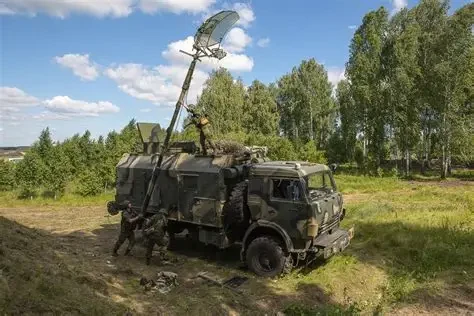
The R-419L1 is a Russian mobile digital radio-relay station that builds branch circuits: it peels channels off the big trunk lines of the field network and carries them to brigades, command posts and other users, and patches damaged cable lines. It works in the 390-645 MHz and 1550-1850 MHz bands at up to 8.448 Mbit/s (one E2, four E1s), over hops of 35-45 km and lines of up to 400 km. It is made by the A.S. Popov Radio Plant in Omsk and entered service around 2018. The high-capacity backbone it branches from is carried by stations such as the R-416G-MO; see that page for the trunk side.
WHAT IT IS FOR: THE BRANCH, NOT THE TRUNK
Rosoboronexport describes the R-419L1 as a universal mobile station for tactical and operational field systems, designed to deploy radio-relay or cable lines, to branch channels off multi-channel radio-relay, troposcatter and cable trunks, and to act as a radio patch on damaged or repaired cable lines. It claims searchless link set-up, duplex quality equal to digital cable and fibre, and video transfer and video conferencing. [DOCUMENTED, Rosoboronexport] Training material phrases it the same way: for independent relay lines and branching from multi-channel relay, troposcatter and wire lines. [SINGLE-SOURCE, studfile]
In network terms: the trunk, carried by stations like the R-416G-MO at up to 155 Mbit/s, links major headquarters. The R-419L1 takes a few E1s off that trunk and carries them out to where they are needed, over terrain the trunk would not cross. [ESTIMATE, from the stated roles] It can also branch channels off troposcatter trunks such as R-423 Brig, and its traffic ultimately serves the automated command systems of YeSU TZ. [BACKGROUND]
SHARED BACKGROUND: LINE-OF-SIGHT RADIO RELAY
Line of sight. At UHF and microwave frequencies radio goes in nearly straight lines. With normal atmospheric bending (the "4/3 earth" rule) the radio horizon in km is about 4.12 x sqrt(antenna height in m). Two 20 m masts see about 37 km over flat ground, two 30 m masts about 45 km, two 60 m masts about 64 km. Range grows only with the square root of height, so doubling a mast does not double the hop. [BACKGROUND]
Fresnel zone. The beam fills an ellipsoid around the straight line. Its radius at mid-path is about 8.66 x sqrt(D/f) metres (D in km, f in GHz). Planners keep at least 60 percent of it clear of ground and trees, or the link fades. [BACKGROUND]
Free-space path loss. FSPL in dB = 32.45 + 20 log10(f in MHz) + 20 log10(d in km). Loss rises 6 dB for every doubling of either distance or frequency. Higher frequencies lose more in free space, but for the same dish size the antenna gain rises by the same amount at each end, so microwave links win back the loss with narrow beams. [BACKGROUND]
Digital hierarchy. In the European/Russian PDH and SDH system: E1 = 2.048 Mbit/s (30 x 64 kbit/s voice channels plus signalling); E2 = 8.448 Mbit/s (4 x E1); E3 = 34.368 Mbit/s (16 x E1); STM-1 = 155.52 Mbit/s (up to 63 x E1, or one E4/140 Mbit/s). [BACKGROUND, ITU-T G.703/G.707]
Duplex and retransmission. Each hop transmits on one frequency and receives on another, separated by a duplex spacing so the station's own transmitter does not deafen its receiver. A relay in the middle of a line receives on one direction and retransmits on another, regenerating the bit stream and optionally dropping or inserting channels. [BACKGROUND]
MAKER AND SERVICE
Developed and produced by the A.S. Popov Radio Plant, Omsk (OmPO Radiozavod im. A.S. Popova, also known as Relero). [DOCUMENTED, вооружение.рф; Popov plant] Shown at Army-2016; deliveries from 2018. In September 2018 a batch reached a combined arms army of the Eastern Military District, whose press service said deployment time was 2.5-3 times shorter and range almost twice that of predecessors, with GLONASS positioning and up to 15 days autonomous work. [DOCUMENTED, TsAMTO] An improved R-419L1M was shown to the defence minister in April 2017 as "the first Russian station designed to build networks, not lines". [DOCUMENTED, Popov plant newspaper Signal]
Lineage. It succeeds the R-419 family (R-419A, R-419M, R-419MP, R-419MTs) and works with them: compatible stations listed include R-419MP, R-419M, R-419MTs, R-419MS, R-415V, R-419A, R-764, R-409 and R-414. [DOCUMENTED, Popov plant / Bastion via warshistory.ru]
HOW THE RF SYSTEM WORKS
Two bands. Band 1 is 390-645 MHz (UHF), band 2 is 1550-1850 MHz (L band). [DOCUMENTED, Rosoboronexport] Band 1 diffracts better over ridges, penetrates foliage better and needs less precise aiming; it is the band for difficult, obstructed paths and for compatibility with older R-419 stations, which used up to 645 MHz. Band 2 gives more bandwidth and narrower beams for the same antenna size. [BACKGROUND]
Frequency grid. 100 kHz in band 1; band 2 is given as 1 MHz by the maker's Army-2016 data and as 100 kHz in training tables. [Sources conflict] Retune time is 2 s or less. [DOCUMENTED]
Duplex spacing. At least 45 MHz in band 1 when using error-correction coding or at 8,448 kbit/s, 35 MHz in other modes, and 94 MHz in band 2. [SINGLE-SOURCE, training tables] The larger spacing at the highest rate lets the receiver filter out more of the station's own transmitter. [BACKGROUND]
Transmitter. 22.8 W in band 1 and at least 2 W in band 2 (about 43.6 dBm and 33 dBm). [SINGLE-SOURCE, training tables] Receiver sensitivity: 8 to 32 dBuV depending on mode. [SINGLE-SOURCE] Across 50 ohms, 8 dBuV is about -99 dBm and 32 dBuV about -75 dBm. [BACKGROUND conversion] The least sensitive figure presumably applies to the highest data rate.
Modulation. Not published for the R-419L1. [UNVERIFIED] The analogue predecessors used frequency modulation. [DOCUMENTED for R-419-series, lektsii.com] Error-correcting coding is mentioned as a mode. [SINGLE-SOURCE]
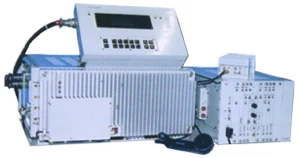
Transmitter and receiver chain. No block diagram is published. [UNVERIFIED] The channel-forming unit UTsS-E builds the baseband; it feeds the radio modem, then transceiver units for each band, then the antennas via feeders. [DOCUMENTED that UTsS-E is the channel equipment; chain BACKGROUND]
ANTENNAS, MAST AND POLARISATION
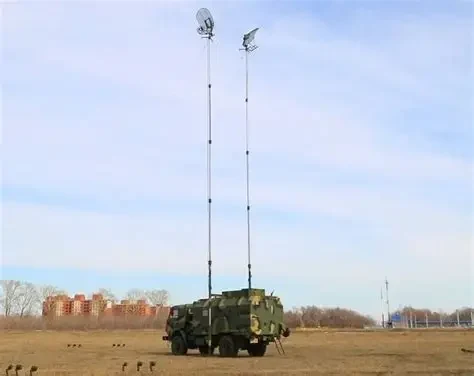
Antennas. Antenna aiming is remote and automated, motorised in azimuth and elevation. [DOCUMENTED, Popov plant via warshistory.ru] Two directions are supported, so a station can be a terminal or a mid-line relay. [DOCUMENTED] Antenna type and gain are not published. [UNVERIFIED] Photos show dish-type reflectors on the masts. [DOCUMENTED, photos] For comparison, the older R-419A used Z-shaped directional antennas with 7.5-14.5 dB gain across its bands plus an omnidirectional discone. [DOCUMENTED, lektsii.com; cqham.ru] A 1.2-1.5 m reflector would give roughly 13-15 dBi at 500 MHz and 24-26 dBi at 1.7 GHz. [ESTIMATE, not a published figure]
Mast height. Sources conflict. The maker's data gives an antenna suspension height of 20 m. [DOCUMENTED, Popov plant via warshistory.ru; вооружение.рф] The training range table assumes a 60 m mast. [SINGLE-SOURCE] The 60 m figure is likely a planning case with a separate tall mast set or a high site, not the vehicle's own mast. [SPECULATION]
Polarisation. Not published. [UNVERIFIED]
HOP BUDGET: A WORKED EXAMPLE
All figures [ESTIMATE], using the published transmitter powers and sensitivities and assumed antenna gains.
Fresnel clearance. Over 40 km the mid-path Fresnel radius is about 78 m at 500 MHz and about 42 m at 1.7 GHz. These are big, which is why lower-band links rarely achieve full clearance and instead rely on the more forgiving diffraction of UHF over obstacles. [BACKGROUND/ESTIMATE] This is the physics behind its role: it can reach a brigade in rough or wooded ground where a 6 GHz trunk link cannot.
DATA RATES AND MULTIPLEXING
Modes listed in training tables: S1 channel at 1.2-48 kbit/s and 480 kbit/s; information streams at 2,048 kbit/s (E1) and 8,448 kbit/s (E2); and analogue 6 voice channels. [SINGLE-SOURCE, studfile] The UTsS-E channel equipment provides voice-frequency (TCh) channels, S1-FL telegraph/data, OTsK 64 kbit/s digital channels, E1, E2 and Ethernet. [DOCUMENTED, Popov plant via warshistory.ru] In analogue mode it carries six voice channels of P-330-6 (Azur-6) equipment, with re-reception over P-340 GMN on lines up to 120 km. [SINGLE-SOURCE, militaryarms.ru]
8.448 Mbit/s is exactly one E2, four E1s: about 120 voice channels, or a mix of voice, data and video. That is plenty for a brigade branch and an order of magnitude less than an STM-1 trunk. [BACKGROUND]
JAMMING RESISTANCE
Fast retune (2 s or less) and error-correction coding are documented. [DOCUMENTED; SINGLE-SOURCE for coding] No frequency-hopping mode is listed for the R-419L1 in the sources located. [UNVERIFIED] Directional antennas reduce exposure compared with an omnidirectional radio, but lower-band beams are wider than microwave beams, so a branch link is easier to detect and jam than a 6 GHz trunk. [BACKGROUND]
THE VEHICLE
KamAZ-4350 4x4, crew of 4, a comfortable shelter with work and rest places and food and water storage, batteries and two AD4-T400-1VM2 generators, deployment in 35 minutes or less, mass up to 11,900 kg. [DOCUMENTED, Rosoboronexport] The vehicle in some photos appears to be a 6x6, perhaps a different version or related station. [UNVERIFIED]
SPECIFICATIONS
| Parameter | Value | Note |
| Bands | 390-645 MHz; 1550-1850 MHz | [DOCUMENTED] |
| Grid | 100 kHz; band 2 1 MHz or 100 kHz | Sources conflict |
| Max rate | 8.448 Mbit/s (E2) | [DOCUMENTED] |
| Hop | up to 40-45 km; 35 km at 8.448 Mbit/s | [DOCUMENTED]; [SINGLE-SOURCE] |
| Line | up to 400 km digital | [DOCUMENTED] |
| Directions | 2 | [DOCUMENTED] |
| Tx power | 22.8 W / 2 W | [SINGLE-SOURCE] |
| Sensitivity | 8-32 dBuV | [SINGLE-SOURCE] |
| Duplex spacing | 35-45 MHz / 94 MHz | [SINGLE-SOURCE] |
| Retune | 2 s or less | [DOCUMENTED] |
| Antenna height | 20 m (60 m planning case) | Sources conflict |
| Chassis / crew | KamAZ-4350 4x4 / 4 | [DOCUMENTED] |
| Deploy / mass | 35 min / 11,900 kg | [DOCUMENTED] |
| Autonomy | 48 h to 15 days | Sources conflict |
| MTBF / life | 20,000 h / 15 years | [DOCUMENTED] |
Sources conflict on reach. One Russian site claims digital lines up to 1,500 km in band 2, which is not in the maker's figures and would only be possible as a long multi-hop chain. [SINGLE-SOURCE, militaryarms.ru; treat with caution] Autonomy is 48 hours without refuelling in the export brochure and up to 15 days in Eastern MD and Bastion statements, which probably assume resupply. [Sources conflict]
R-419L1 AND R-416G-MO
See the companion article: R-416G-MO radio relay. The R-419L1 is the branch: UHF and L band, up to 8 Mbit/s, forgiving of rough paths, two directions, a four-man crew. The R-416G-MO is the trunk: 6 GHz microwave, up to 155 Mbit/s, 1 m dishes on a 30 m mast. One feeds the other. [DOCUMENTED roles; comparison ESTIMATE]
LIMITS OF THE OPEN RECORD
Maker data covers the basics. Antenna types and gains, modulation, polarisation and numbers in service are unpublished, and the most detailed RF figures come from training tables of uncertain edition. [ESTIMATE]
RELATED ON THIS SITE
HOW THIS ARTICLE WAS BUILT
Written for this site from the sources below. Claims are labelled [DOCUMENTED] where a primary or multiple independent sources support them, [SINGLE-SOURCE] where only one does, [UNVERIFIED] where nothing published located confirms them, [ESTIMATE] for approximate figures or reconstructions, [BACKGROUND] for general physics and context, and [SPECULATION] for reasoning beyond the sources. Where sources disagree, the page says "Sources conflict" and gives both.