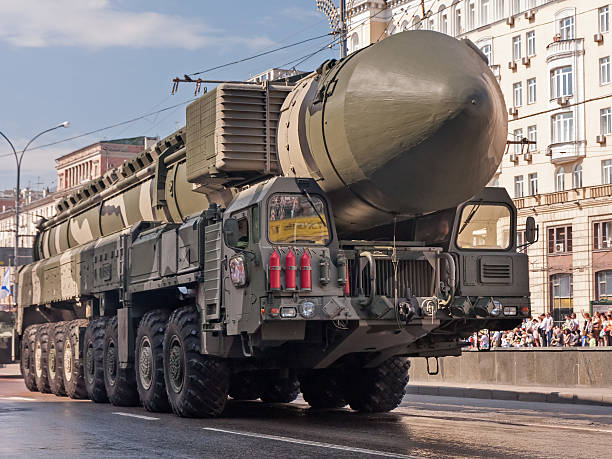
WHAT IT IS
The RT-2PM2 Topol-M (РТ-2ПМ2 «Тополь-М»; NATO SS-27 Sickle B, also SS-27 Mod 1) is Russia’s first fully indigenous solid-fuel intercontinental ballistic missile. It is a three-stage, cold-launched, single-warhead ICBM designed by the Moscow Institute of Thermal Technology (Московский институт теплотехники, MIT / MITT) and produced at the Votkinsk Machine-Building Plant (Воткинский завод). It can be fired from a converted UR-100N UTTKh (SS-19) silo or from a 16×16 MZKT-79221 road-mobile transporter-erector-launcher. It is the direct predecessor of the MIRV-capable RS-24 Yars (SS-27 Mod 2), and it sits in the same solid-mobile family as the sea-based RSM-56 Bulava. [DOCUMENTED]
Treaty and service names split by basing. Under START and New START accounting the silo missile is RS-12M2 and the road-mobile missile is RS-12M1. Specialist catalogues commonly give GRAU 15Ж65 (15Zh65) for the silo missile and 15Ж55 (15Zh55) for the mobile missile, with related complex indices 15П165 / 15P165 (silo) and 15П155 / 15P155 (mobile). Those strings circulate widely; they should be treated as catalogue usage, not as a plant plate. One specialist database swaps the complex pairing (15П065 silo / 15П165 mobile). The GRAU and complex indices are therefore [UNVERIFIED] as a set, and the pairing is [CONTESTED]. The service and NATO names are [DOCUMENTED]. Some older Western cards used RT-2UTTKh or RT-2PMU for this missile; that form is a common mislabel, not a settled industry name.
Topol-M was built for a specific political and industrial problem. After 1991, the liquid heavy and intermediate ICBMs that had been designed in Dnipro — the R-36M family and the UR-100N UTTKh — depended on Ukrainian plants that Russia no longer controlled. A solid missile that could be designed in Moscow, assembled in Votkinsk, and dropped into existing silos or driven out of a forest garrison was the sovereign answer. It was also kept as a single-warhead missile in the START II era, even though the airframe and the post-boost bus had the design margin that later became Yars. [DOCUMENTED]
It is no longer the growth edge of the land force. That role belongs to Yars, and to a much smaller Avangard glide-vehicle force and the troubled heavy liquid RS-28 Sarmat. Topol-M is the missile that is still in the silos at Tatishchevo and still on the TELs at Teykovo while that transition crawls. The Bulletin of the Atomic Scientists 2026 Nuclear Notebook, as of March 2026, counts 50 silo and 18 road-mobile Topol-M launchers remaining, each assessed as a single warhead. Pavel Podvig’s January 2026 notes still carried the peak silo figure of 60. The difference is the start of Yars conversion at Tatishchevo, and it is discussed honestly below. [DOCUMENTED; CONTESTED on the 2026 silo remainder]
Source tags on this page: [DOCUMENTED] is a fact with a named public source. [SINGLE SOURCE] is a specific claim that sits on one account and has not been corroborated. [UNVERIFIED] is a widely repeated figure or detail that does not sit on a plant sheet or an official announcement. [CONTESTED] is a point where published sources disagree. [SPECULATION] is a reconstruction or a claim that goes beyond the public record. [FIELD ACCOUNT] is a local report, video, or eyewitness description, not an official communiqué.
QUICK FACTS
PURPOSE AND PLACE IN THE STRATEGIC FORCE
Topol-M was never meant to be a heavy silo monster in the SS-18 class, and it was never meant to be a MIRV farm. It was meant to be a missile Russia could build by itself, keep on alert without a liquid-propellant circus, and hide either under a silo lid at Tatishchevo or under the trees around Teykovo. For a force that had just lost Yuzhmash, that was the whole point. [DOCUMENTED]
In the mid-2020s it is the bridge, not the future. The mobile regiments at Teykovo already share the garrison with Yars. The silo division at Tatishchevo has started taking Yars, and the Bulletin’s March 2026 table treats at least one Topol-M regiment there as already emptied for conversion. What remains is still a serious force: several dozen hardened silos and two mobile regiments, each missile counted as one warhead, sitting on the same RVSN combat-control network as Yars and Sarmat, with Kazbek at the top and Perimeter as the last-resort backup. [DOCUMENTED]
It also taught the industry how to build the next one. The airframe, the solid motors, the canister, the MZKT-79221 TEL, and the silo-conversion method are the reason Yars could be fielded as a MIRV missile without starting from a blank sheet. Bulava is the sea-based cousin from the same institute. That lineage is the real strategic product of Topol-M, more than any one remaining regiment. [DOCUMENTED]
HISTORY AND LINEAGE
Work on what became Topol-M started in the late Soviet period, around 1989, as a solid-fuel follow-on that could replace older missiles and ride out a renewed American missile-defence effort. In a split that was unusual even then, the early programme was shared between the Moscow Institute of Thermal Technology, which knew mobile solids, and KB Yuzhnoye in Dnipro, which knew heavy silo missiles. The Soviet idea was a single design that could live in existing silos and on a high-mobility transporter without a redesign. [DOCUMENTED]
That split did not survive the country. After 1991 the Ukrainian plants were in another state. In 1992 the missile was recast as an all-Russian design, with MIT as prime and Votkinsk as the production plant. A February 1993 presidential decree is widely cited as formally confirming the programme. Boris Lagutin led the institute into the mid-1990s; Yuri Solomonov, who would later be the public face of Yars and Bulava, took over as general designer around 1997. Stanislav Konyukhov’s Yuzhnoye role ends in 1992 in the standard team lists. [DOCUMENTED for the 1992 sovereign shift and the design leads; the 1993 decree is widely cited]
The first flight was a silo launch from Plesetsk on 20 December 1994. Contemporary Western reporting, preserved in later specialist chronologies, treated the shot as a success and, in at least one account, as a flight of about 6,400 km to the impact area. Four more silo tests followed in 1995, 1996 and July 1997. In December 1997, after those early flights, the first two missiles were put on experimental combat duty with the 60th Taman Missile Division at Tatishchevo, in converted UR-100N UTTKh silos. [DOCUMENTED]
State trials were not a clean sweep. The fifth test, on 22 October 1998, failed; the missile was reported as self-liquidated after launch. The sixth test, on 8 December 1998, was successful. At the end of that month the first full regiment — ten silo missiles, the 104th Regiment of the Taman division in the usual account — was declared operational. Specialist chronologies give 27 December or 30 December 1998 for that declaration. A second ten-missile regiment followed in December 1999, a third in 2000, a fourth beginning in 2003 and completed in December 2004, and a fifth from December 2005. Silo deployment at Tatishchevo was completed in 2012 at 60 missiles. [DOCUMENTED; the exact December 1998 day is CONTESTED]
The official adoption date is the one point in this early history that will not sit still. One careful specialist account, drawing on contemporary Jane’s-type reporting, dates formal acceptance into service to 28 April 2000. Other widely repeated accounts, including later encyclopedia summaries, give a presidential decree of 13 July 2000 for the silo complex. A TASS opinion piece has also been quoted as giving 13 July 2003, which lines up with the fourth regiment and is probably a confusion, not a third official date. The practical facts are not in doubt: missiles were already on duty at Tatishchevo before either 2000 date, and silo conversion continued for years after. [CONTESTED]
The mobile missile used the same solid airframe in a transport-launch canister on a new 16×16 tractor. The first road-mobile flight was on 27 September 2000 from Plesetsk, the day after an 11th (silo) test on 26 September. Some secondary tables move that first mobile shot to 20 September 2000; the 26/27 September pairing is the one that sits on the detailed chronologies and on the FAS contemporary summary, and it is the one used here. A second mobile launch followed on 6 June 2002. On 20 April 2004, at 21:30 Moscow time, a mobile Topol-M was flown to full range, with the warhead mock-up reported in the Pacific rather than at Kura. Solomonov said on 15 May 2004 that the impact had been filmed and spoke of unprecedented accuracy, without publishing a CEP. The final mobile state trial, on 24 December 2004, was flown from Plesetsk to Kura with the defence and economic-development ministers in attendance, and was described as the last test before series deliveries. [DOCUMENTED; 20 September 2000 is a CONTESTED alternative for the first mobile shot]
The first three mobile launchers went on combat duty with the 54th Guards Missile Division at Teykovo on 10 December 2006. President Putin visited the division on 14 December, was shown the erection of the canister and a battalion on the march, and used the visit to underline the point of the design: the mobile missile is the same missile as the silo missile, which cut the flight-test burden and let the force reuse existing garrison infrastructure and the existing combat-control network. A full mobile regiment is nine launchers, typically going on patrol in groups of three; the 2006 debut was the first three, not a finished regiment. The Teykovo mobile force later filled out to 18 launchers in two regiments, and it is still there. [DOCUMENTED]
WHO BUILDS WHAT
A Topol-M is a Moscow design, a Votkinsk missile, and a Minsk chassis, with a long list of cooperating plants that is unusually well documented for a Russian strategic system. The standard team table, compiled from official and near-official attributions, is: [DOCUMENTED as a widely published team list]
The important political fact in that list is the first one after 1992: every name except the Belarusian tractor plant is Russian. That is what “sovereign ICBM” meant in the 1990s, and it is why Topol-M was funded when almost nothing else was.
DESIGN OVERVIEW
Topol-M is a three-stage solid missile that lives its whole service life in a transport-launch canister. The canister is loaded into a silo or carried on the TEL, and the missile is mortar-ejected from it before the first-stage motor lights. That is the same cold-launch logic later used on Yars, and it is why the expensive ground equipment can be reused. [DOCUMENTED]
The design goals that keep coming back in serious accounts are: a short, relatively low boost to shrink the window against boost-phase defences; a hardened airframe and avionics against nuclear-blast effects and electromagnetic pulse; a post-boost bus that can deploy the warhead and a set of penetration aids; and, in some specialist wording, a re-entry vehicle able to make limited evasive manoeuvres on the way in. Those are design claims and specialist attributions, not a public test-range dossier. They should be read that way. [DOCUMENTED as stated goals and specialist claims]
An early-project detail is worth keeping, because it explains later arguments about “the fourth stage.” In the Soviet split, Yuzhnoye was developing a liquid fourth stage to carry a package of an unguided warhead plus decoys, while MIT was developing a solid fourth stage for a single warhead without decoys. What was fielded is a three-stage solid missile with a post-boost vehicle. The bus is not a fourth boost stage. [DOCUMENTED as an early-project split; the fielded layout is the three-stage-plus-bus missile]
One further specialist account, from Anatoly Zak’s Topol-M technical summary, says the third stage sits in a cylindrical adapter intended to protect it from a nuclear blast during the second-stage burn — the designers apparently treated that moment as a high-vulnerability window against nuclear-tipped interceptors — and that at the end of powered flight the third stage is programmed to turn about 180 degrees and burn residual propellant in the opposite direction, to cut leftover velocity error. That is a detailed reconstruction from a single careful compiler. It is included here as [SINGLE SOURCE], not as a plant-manual fact.
SPECIFICATIONS (PUBLISHED FIGURES)
There is no single official Ministry of Defence specification card for Topol-M comparable to the January 2021 Yars-S card. What follows is a clean list of published figures, not an average. Where sources disagree, both (or several) figures are kept.
| Item | Published figure | Notes | Tag |
| Launch mass | 47.2 t (FAS; Jane’s body text); 47,000 kg (CSIS glance card); 46.5 t (one Russianspaceweb table, with 47–47.2 t as the alternative) | The 47.1–47.2 t band is the usual open-source working figure. 46.5 t is an outlier in a compiled table and is not treated here as a second official mass. | [CONTESTED] |
| Length | 22.7 m (widely cited); 22.55 m (Russianspaceweb primary figure); 21.9 m (Jane’s / CSIS); 21.0–22.7 m (FAS range); 17.9 m without the warhead section (FAS / Russianspaceweb) | These are different measuring conventions (bare missile, missile with nose section, missile without warhead). They should not be averaged. The canister is longer: about 21.2–23 m in the same compiled table. | [CONTESTED] |
| Diameter / calibre | 1.86–1.95 m (FAS range); 1.9 m (CSIS glance); 1.95 / 1.61 / 1.58 m for the three stages (Jane’s); 1.81 m (one Russianspaceweb figure) | 1.86 m is also the official Yars-S calibre. The canister diameter is given as about 2.0 m. First-stage body diameter and canister diameter are not the same number. | [CONTESTED] |
| Stages | Three solid stages plus a post-boost bus | Universal in official and specialist descriptions. The bus is not a fourth boost stage. | [DOCUMENTED] |
| Throw-weight / payload mass | 1,200 kg (CSIS / common cards); 1,000–1,200 kg (FAS); 1,250 kg (one Russianspaceweb table) | Combined mass of the bus, the warhead, decoys and shrouds, not warhead yield. 1,250 kg is also the official Yars-S payload figure and may be a family number bleeding across cards. | [CONTESTED] |
| Range | 11,000 km (CSIS / Jane’s and most secondary cards); 10,000–10,500 km (FAS); “about 10,000 km” in TASS wording that cites open sources | Range always depends on payload. A 20 April 2004 mobile shot was officially described as a full-range flight, with the mock-up reported in the Pacific rather than at Kura (the usual Plesetsk-to-Kura track is on the order of 5,700–6,000 km). | [CONTESTED] |
| Warhead | One. Bulletin 2026: 1 × 800 kt (mobile figure marked 800?). Jane’s: typically 550 kt. CSIS glance card: 500 kt. Unconfirmed 1 Mt in Jane’s. | No official Ministry of Defence yield. The missile was deployed as a single-warhead system. Designer and command statements that it can carry several warheads describe a design margin, later used by Yars, not a Topol-M operational load. | [CONTESTED] |
| Propellant | Solid | Three composite solid motors, attributed to FTsDT Soyuz. Grain chemistry is not published. | [DOCUMENTED] |
| Basing | Converted UR-100N UTTKh silos at Tatishchevo; MZKT-79221 TEL at Teykovo | Both modes use the same missile in a transport-launch canister and a cold launch. | [DOCUMENTED] |
PROPULSION, SOLID FUEL, AND THE SHORT BOOST
Each of the three stages is a composite solid-propellant motor. Open team lists give the charges to FTsDT Soyuz in Dzerzhinsky and Lyubertsy. That is the same solid-motor industry that later fed Yars and Bulava. Exact grain chemistry, case design, and nozzle drawings are not published. [DOCUMENTED for the plant attribution; chemistry UNKNOWN]
The design intent of a short, relatively low boost is on the record in specialist technical summaries: a shorter powered flight shrinks the window in which a boost-phase sensor or interceptor can see and engage the missile. Jane’s, in the CSIS write-up, treats that hardening logic as part of the type. What is not official is a stopwatch. Secondary encyclopedias often give a total powered flight of about 180 seconds, and at least one Russian-language technical summary breaks the first two stages into burns of about 60 and 64 seconds, with first-stage thrust around 100 tonnes-force and second-stage around 50, and first-stage mass around 26 t. Those stage-by-stage numbers do not sit on a Ministry card or a plant sheet. They are kept here as [UNVERIFIED] encyclopedia figures, and they should not be turned into a precise 180-second official boost time. [DOCUMENTED as a design goal; numbers UNVERIFIED]
Thrust-vector control is similarly thin in the open record. The older RT-2PM Topol used gas injection into the diverging part of the nozzle on later stages. For Topol-M, serious sources do not publish a confirmed method — flexible nozzle, gas-dynamic control, or secondary injection. It is safer to say the missile has a powered-flight control system and leave the hardware as UNKNOWN than to copy a later-family description backwards from Yars. [UNVERIFIED]
COLD LAUNCH FROM THE CANISTER
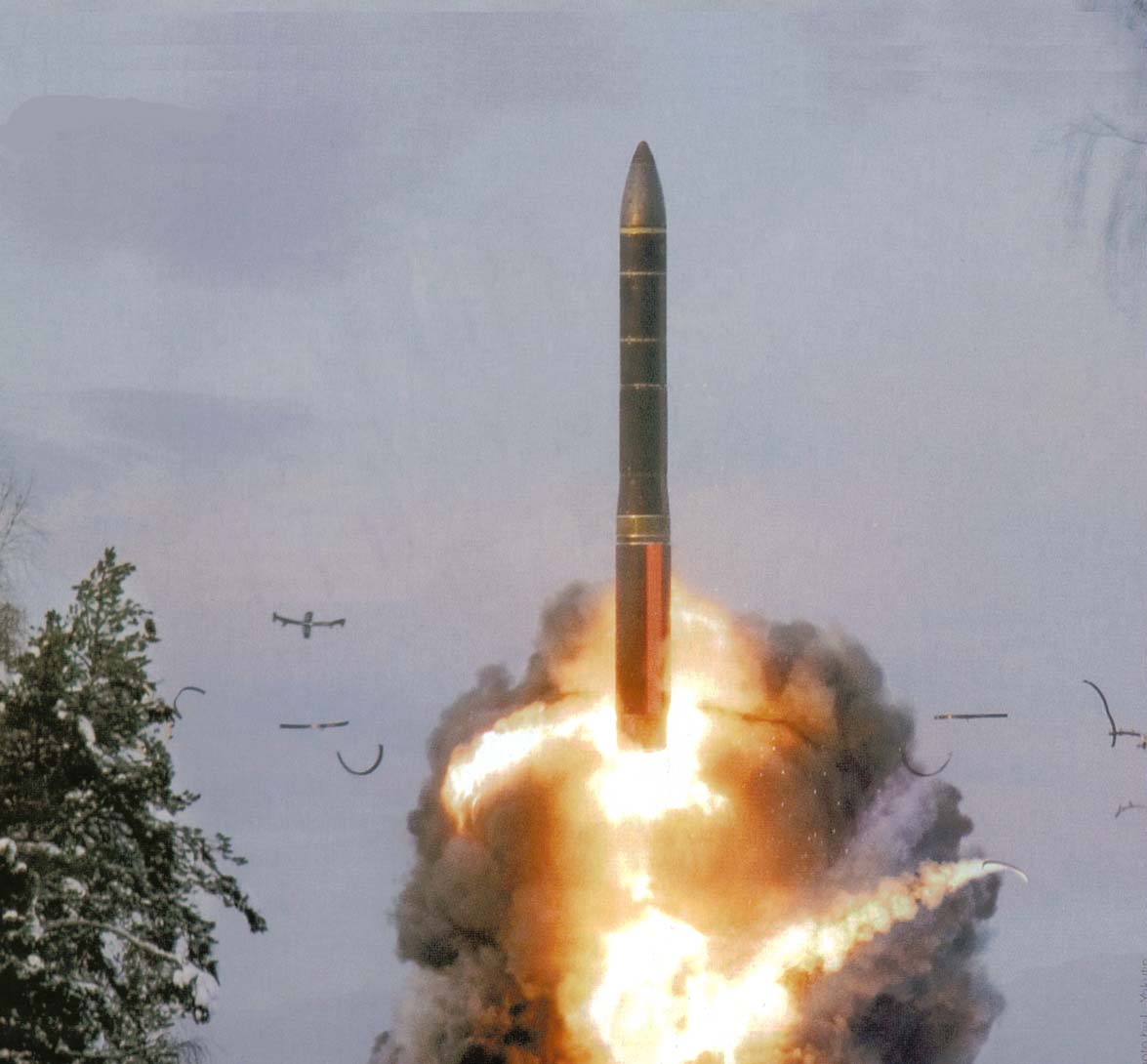
Topol-M leaves its transport-launch canister under powder-gas pressure before the first-stage motor lights. Russian descriptions call this a mortar start (миномётный старт) or a cold start (холодный старт), using a powder-gas accumulator (пороховой аккумулятор давления; also called a PAD in some English technical summaries). The sequence is the same in a silo and on a TEL: the upper protective device or the silo lid opens, the powder charge fires, the missile is thrown clear of the canister to a safe height, and only then does the first-stage solid motor ignite. The method protects the TEL and the silo hardware from the full solid-motor plume and lets the regiment reuse expensive ground equipment. The published ejection height, in metres, is not official. [DOCUMENTED for the method; height UNKNOWN]
The missile is stored in that canister from the factory to the end of its service life. That is why a Topol-M can be trucked into a converted silo or driven out of garrison on the same basic round, and why Putin, at Teykovo in December 2006, could say the mobile missile and the silo missile are the same missile. [DOCUMENTED]
A FLIGHT, STEP BY STEP
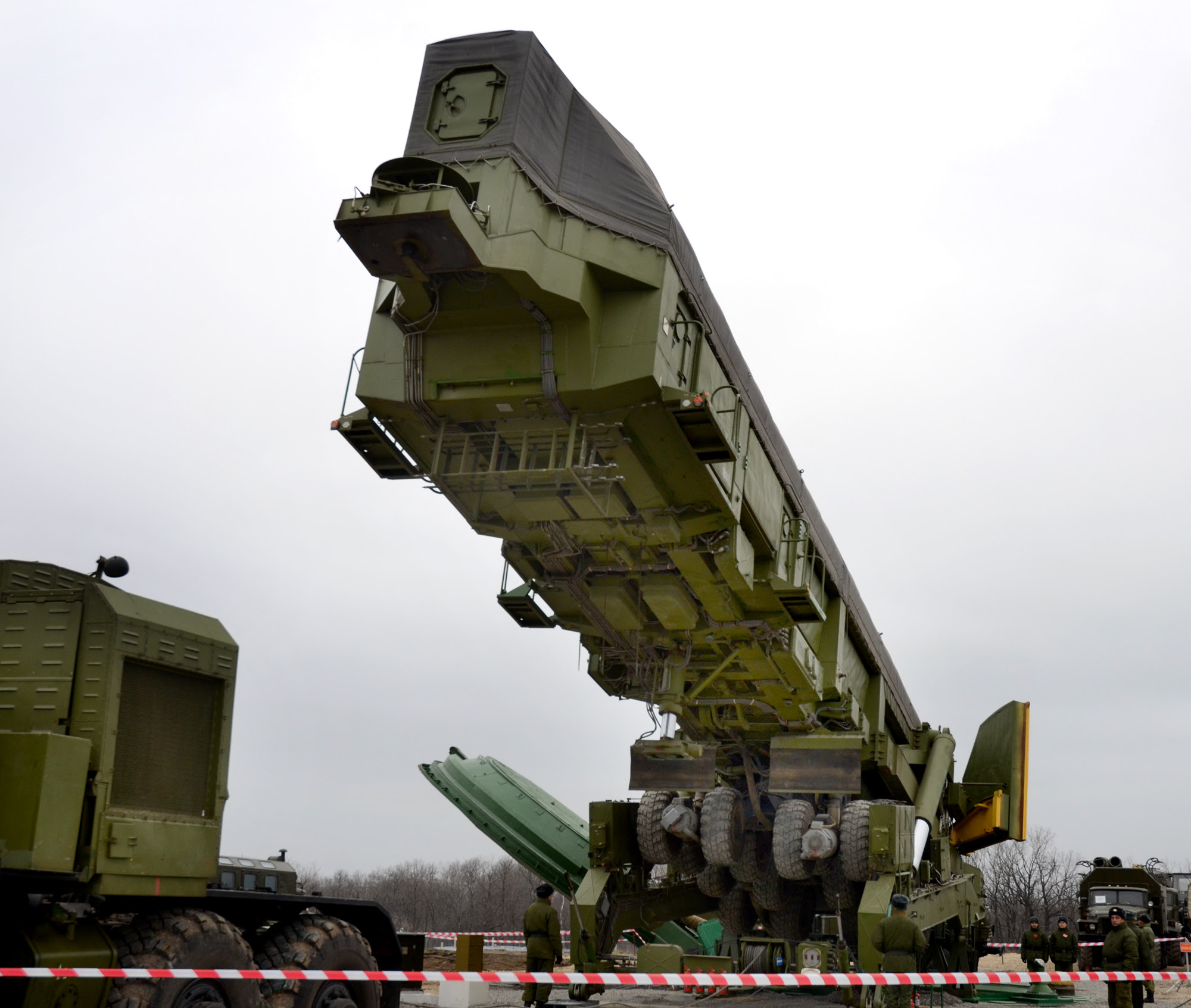
1. Order and preparation. A silo regiment at Tatishchevo is already in a hole in the ground; the work is to authenticate the launch order on the RVSN combat-control net, open the lid, and let the canister do its job. A mobile regiment at Teykovo has more to do: leave the garrison or a field hide, level the TEL on hydraulic jacks, erect the canister to the vertical, and complete the geodetic / topographic tie-in so the inertial system knows where it is and which way is north. The named survey set used on the Topol-M TEL is not published. [DOCUMENTED for the sequence; survey hardware UNKNOWN]
2. Cold launch / mortar eject. The powder-gas accumulator fires and throws the missile out of the transport-launch canister. First-stage ignition waits until the missile is clear of the silo mouth or the TEL. The first seconds of open photography — a bright fireball, dark smoke, and tumbling covers — are this moment, whether the camera is at Plesetsk or, more rarely, at a training area.
3. Boost. Three solid stages burn in sequence. The published intent is a relatively short, relatively low powered flight, then staging, then the bus. Stage-by-stage burn times and thrusts in encyclopedia tables are [UNVERIFIED].
4. Post-boost bus. The post-boost vehicle orients, trims velocity, and deploys the single warhead and, in specialist accounts, a set of penetration aids. This is the same architectural idea later scaled up to MIRV deployment on Yars, which is why a Topol-M bus is often described as “MIRV-capable” even though the deployed load is one RV.
5. Re-entry. The warhead comes in on a ballistic path, with whatever evasive authority the production RV actually has. Open sources do not give a reliable, official description of the production vehicle’s manoeuvre programme. Experimental hypersonic or “skipping” test vehicles flown in the early 2000s were usually lofted on older Topol (SS-25) boosters, not demonstrated as the standard Topol-M warhead, and they should not be folded into this step as if they were. Avangard is a later, separate system.
GUIDANCE, NAVIGATION AND CONTROL
Topol-M is flown by an autonomous digital inertial navigation system and an onboard digital computer (бортовая цифровая вычислительная машина). That architecture is on the record in official-style descriptions and in the standard design-team lists: the flight-control system is attributed to NPO Avtomatiki i Priborostroeniya, the Pilyugin bureau in Moscow (today NPTs AP), under Vladimir Lapygin. Inertial measurement — gyros and accelerometers — is the wartime heart of the missile. The gyro type itself (strapdown, floated, optical, or fibre-optic) is not published in a form that can be treated as a plant fact. [DOCUMENTED for the institute and the INS architecture; gyro hardware UNKNOWN]
Jane’s Weapons: Strategic 2015–2016, as quoted on the CSIS Missile Threat SS-27 card, says the missile uses a post-boost vehicle and a digital inertial system with a GLONASS receiver. That is the best specialist attribution in the open literature for a satellite-aided update. It is not the same thing as an official Ministry of Defence statement that Topol-M must have GNSS to complete a wartime flight. The design logic, and the wording used for this solid-mobile family, is that the missile can be launched and can finish the mission on its own inertial system if satellite updates are jammed, spoofed, or simply not there. GLONASS is an aid in peacetime testing and, if available, a correction in flight. It is not a crutch the regiment is supposed to depend on when it matters. For the underlying inertial method, see also INS. [Jane’s attribution is a specialist [SINGLE SOURCE] of a widely repeated kind; wartime autonomy is the documented design logic]
Circular error probable is not an official number. Secondary articles sometimes give about 200 m. Solomonov, after the 20 April 2004 full-range mobile shot, said the impact of the warhead mock-up had been filmed and spoke of unprecedented accuracy, which is a designer’s claim, not a published CEP. This page does not treat 200 m, 350 m, or any other unofficial figure as a working accuracy. [UNVERIFIED]
For the mobile force, the hard guidance problem starts on the ground. A Topol-M TEL is supposed to be able to go to an unprepared or semi-prepared dirt site, establish its position and azimuth, and launch without a pre-surveyed concrete pad. Open descriptions call this an autonomous topographic tie-in (автономная топопривязка). The named geodetic set on the launcher, the survey time, and the residual heading error are not published. What can be said honestly is that the capability is part of the type’s reason for existing, and that the hardware remains UNKNOWN in the public record. [DOCUMENTED as a stated capability; equipment UNKNOWN]
Launch authority is not a Topol-M-unique radio. The missile sits on the RVSN automated combat-control system, with unlock and target data coming down the same national chain described in the Russian C3 and Kazbek articles, and with Perimeter as the last-resort path if the chain is gone. Specialist accounts of the 1990s–2000s often give NPO Impuls as the designer of that automated battle-management layer. The missile’s own computer then flies the profile. [DOCUMENTED for the command relationship; Impuls is a standard open attribution]
THE POST-BOOST VEHICLE, WARHEAD, AND PENETRATION AIDS
Every Topol-M that has been declared operational has been a single-warhead missile. That was not an accident of the production line. The type was designed and fielded in the START II era, when a MIRVed land-based ICBM was the thing the treaty was written to get rid of. Russia’s later relationship with START II was messy, and New START counted each Topol-M as one warhead because that is how it was deployed. The airframe, however, was not a dead-end monoblock. Solomonov has said the missile can carry four to six warheads plus decoys. In December 2006, just after the first mobile regiment went on duty, RVSN commander Nikolai Solovtsov told Interfax that the force would soon begin replacing Topol-M monoblocks with multiple re-entry vehicles. That programme, first flown in 2007, is RS-24 Yars. [DOCUMENTED]
Yield is not official, and the published figures do not agree. The Bulletin of the Atomic Scientists 2026 table uses 1 × 800 kt for the silo force and the same figure, marked uncertain, for the mobile force. Jane’s, as quoted by CSIS, says the missile is typically equipped with a 550 kt warhead, mentions an unconfirmed 1 Mt figure, and also records unconfirmed talk of up to six MIRVs. The CSIS glance card itself prints 500 kt. Wikipedia and many mirrors use 800 kt. This page keeps those numbers on the table and does not pick a favourite. [CONTESTED]
The post-boost vehicle is the piece that makes both the single-warhead flight and the later MIRV story possible. It is a manoeuvring bus with its own thrusters, used to trim the trajectory and to deploy the warhead and, in specialist wording, a “package” of penetration aids. Jane’s says the Topol-M re-entry vehicle is capable of making evasive manoeuvres as it approaches the target, and that the missile likely also carries countermeasures and decoys against mid-course defences. Specific inventories — how many decoys, whether chaff, flares, or jammers are actually carried on a duty round — are not in the public primary record. They stay [UNVERIFIED] beyond the general penaids language. [DOCUMENTED as a specialist claim for a manoeuvring RV and decoys; the packing list is UNKNOWN]
Two things should not be mixed into that production warhead. The first is a set of early-2000s tests of experimental manoeuvring or air-breathing vehicles, often lofted on older Topol (SS-25) boosters — including the February 2004 Security exercise, after which General Yuri Baluyevsky spoke of a highly manoeuvrable vehicle able to penetrate missile defences. Those tests are part of the wider Russian story that later includes Avangard. They are not a demonstration that the standard Topol-M duty warhead is a hypersonic glide vehicle. The second is Avangard itself, which is a later, separately named system, deployed in small numbers on converted UR-100N UTTKh missiles, not on Topol-M. [DOCUMENTED]
Jane’s also credits the type with shielding against radiation, electromagnetic interference, and physical disturbance, and says earlier missiles could be disabled by a nuclear detonation within about ten kilometres. That is a specialist hardening claim, not a published hardness curve in kV/m or overpressure. Claims of a unique boost-phase laser or kinetic-kill armour, beyond the short-boost design goal, do not sit on official MIT or Ministry statements in the open record. [SINGLE SOURCE for the Jane’s wording; laser/kinetic specifics UNVERIFIED]
SILO BASING AT TATISHCHEVO
The silo Topol-M lives in the 60th Taman Missile Division at Tatishchevo (Татищево), Saratov Oblast — a division that had been a UR-100N UTTKh (SS-19 Stiletto) silo field. The expensive parts of those shafts, official Russian wording said at the time, would be kept: the protective lids, a good deal of the control equipment, and the existing launch-control and communications infrastructure. OKB Vympel did the conversion. The new missile sits in the shaft inside its metallic transport-launch canister, shock-isolated in the usual description of this kind of conversion, and is cold-launched out of that canister so the lid and the shaft are not washed by a solid-motor plume. Regiment organisation for the silo force is ten missiles to a regiment in the standard open accounting. [DOCUMENTED for the conversion and the division; the exact shock-isolation hardware is described in specialist language, not a plant manual]
Deployment was slow, because the 1990s were slow. Two missiles on experimental duty in December 1997; a first ten-missile regiment at the end of 1998; then a regiment a year or every two years, sometimes arriving in dribs of four or six missiles, until the field reached 60 silos in 2012. Early plans talked about 20 to 40 new missiles a year and a force of several hundred Topol-Ms by the late 2000s. That rate never happened. Production of Topol-M as such was announced complete in 2009, with future Votkinsk solids to be RS-24s. The last silo rounds were already in the pipeline. [DOCUMENTED]
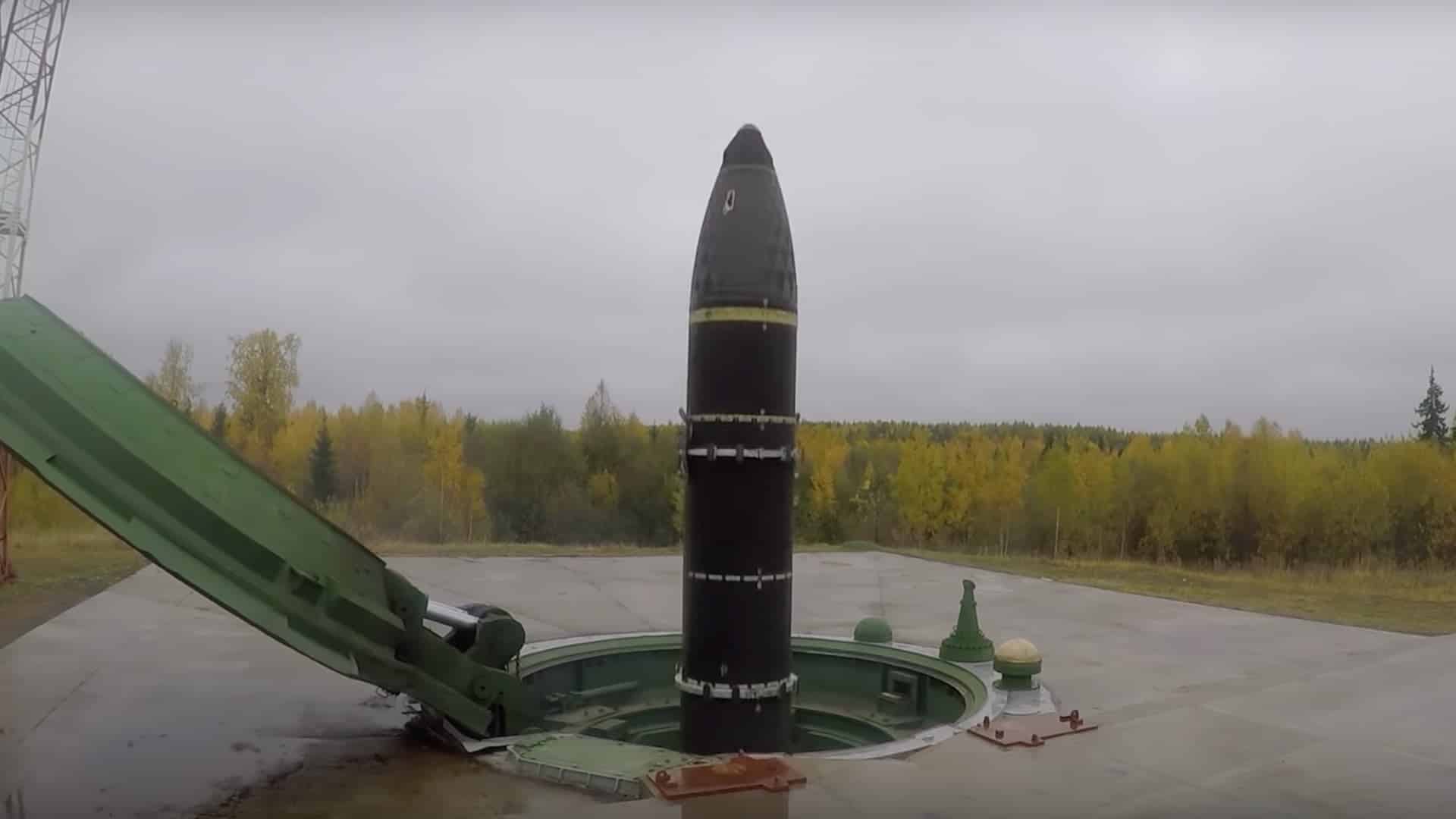
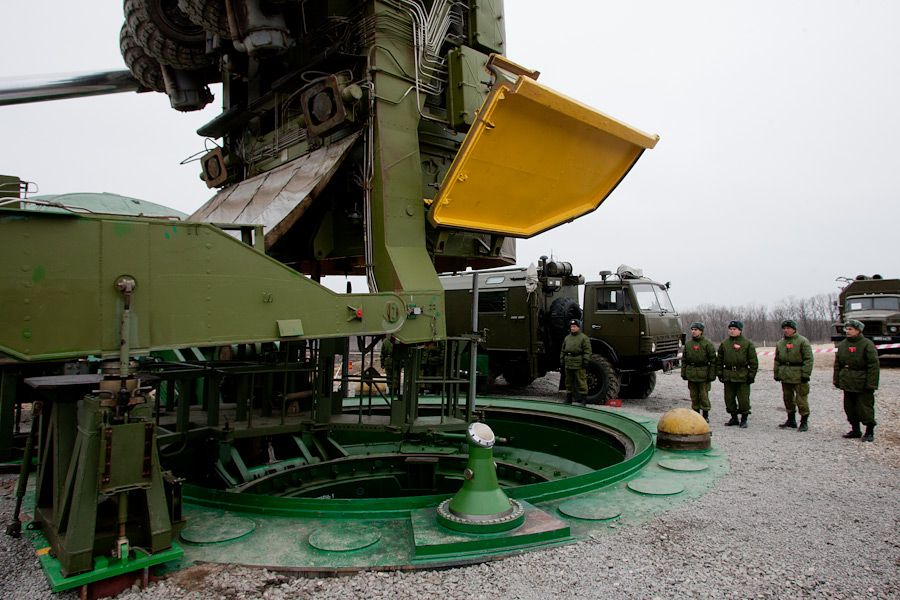
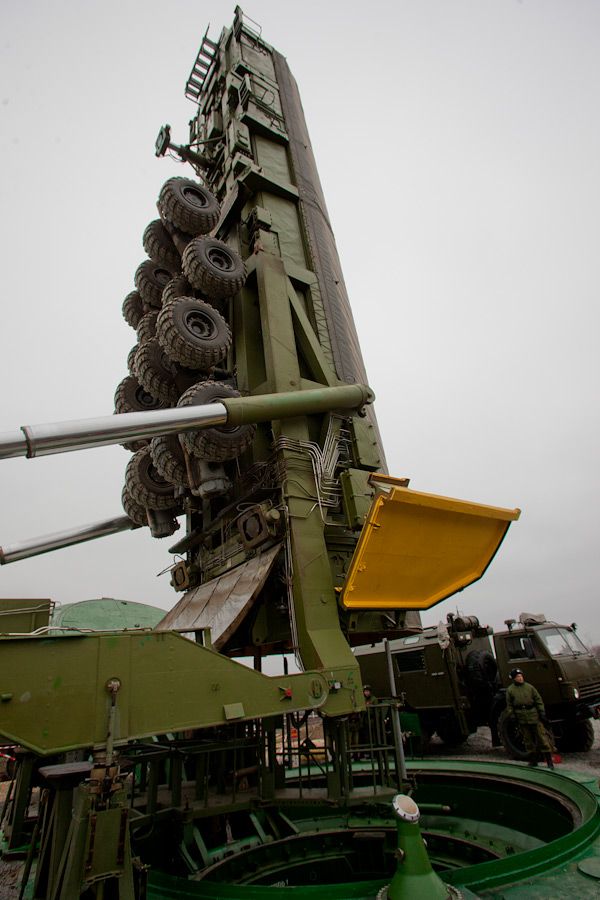
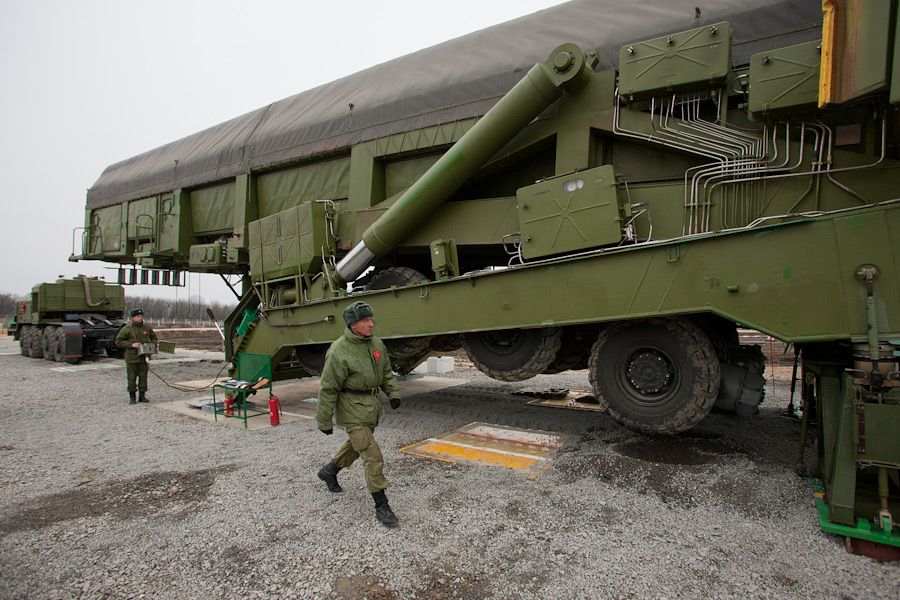
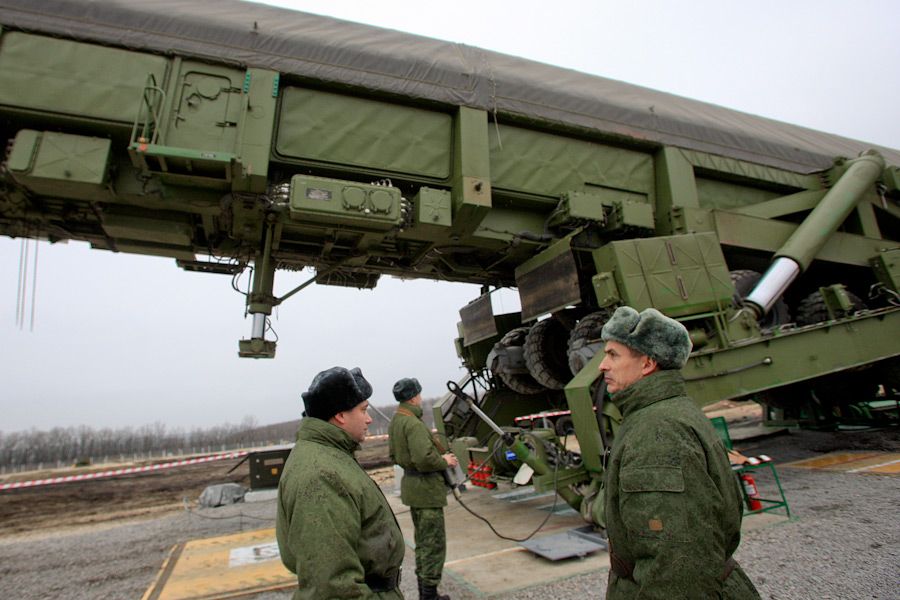
Readiness in a converted silo is the usual solid-silo story: the missile is already in the tube, already in its canister, and the regiment’s job on the day is to authenticate an order and open a lid, not to fuel a bird. Official wording has always claimed a high state of launch readiness. A public stopwatch figure, in minutes, is not official. [DOCUMENTED as a stated capability; time UNKNOWN]
THE TEL AND ROAD-MOBILE OPERATIONS AT TEYKOVO
The road-mobile Topol-M rides on the MZKT-79221, a 16×16 wheeled tractor built in Minsk. It is the same chassis family later used by Yars, which is why parade photographs of the two types are easy to mix up. The open technical picture is: a YaMZ-847.10 V-12 turbo-diesel in plant-related tables, about 800 horsepower in secondary cards, a published road speed of about 45 km/h, all-wheel drive, and steering on six of the eight axles in the usual description of this tractor. Hydraulic leveling jacks take the weight and plumb the canister before erection. Combat weight of a fully loaded launcher is not a single official number; one secondary card gives a 44 t unladen mass and an 80 t payload rating for the bare chassis, which is a tractor rating, not a published “combat TEL with missile” weight. [DOCUMENTED for the 16×16 MZKT-79221 and the 45 km/h road-speed figure as published on plant material; engine designation and horsepower from plant-related / secondary tables]
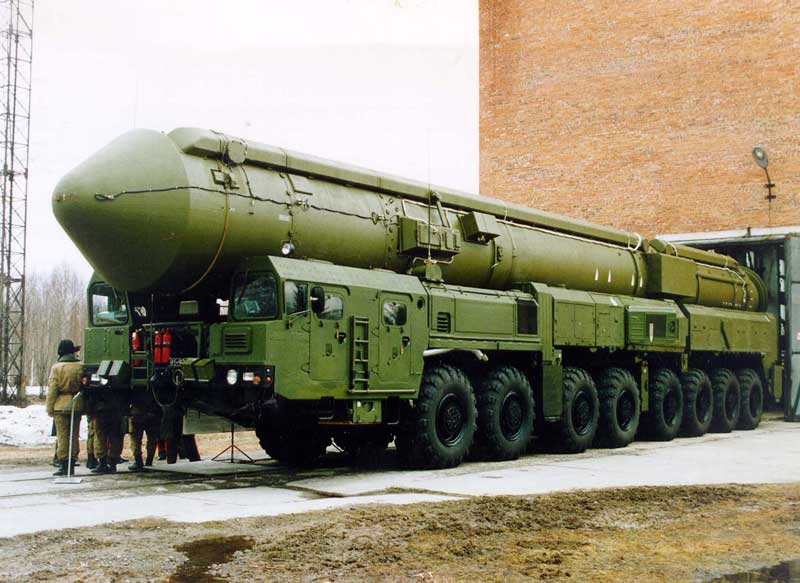
The mobile force belongs to the 54th Guards Missile Division at Teykovo (Тейково), Ivanovo Oblast. The first three launchers went on combat duty on 10 December 2006; a full regiment is nine missiles, usually understood to patrol in groups of three. The division later fielded two Topol-M regiments, 18 launchers, and then took Yars as well. As of the 2026 open tables, Teykovo still has those 18 Topol-M TELs plus a matching Yars force. [DOCUMENTED]
A duty convoy is more than the launcher. Specialist catalogues give a 15В240М (15V240M) combat-duty support vehicle (МОБД) as the mobile-force companion, plus a command post and, in later years, a Typhoon-M (Тайфун-М) counter-sabotage vehicle to walk the column. The 15V240M index is catalogue usage. Typhoon-M is a real vehicle, more tightly documented in the Yars era; it should not be read backwards as part of the original 2006 Teykovo package unless a contemporary source says so. Krona (Крона) arched shelters are the usual garrison housing for later Yars regiments; they are not clearly documented as original Topol-M 15P155 kit, though Teykovo later acquired them as Yars arrived. See also the site’s note on the other Krona, the space-surveillance complex, which is a different thing with the same name, on the Yars page and at Krona. [DOCUMENTED for the 2006 duty date and the 18-launcher force; support-vehicle indices and Krona-as-original-Topol-M kit UNVERIFIED or later]
COMPARED WITH OTHER ICBMS
The useful comparison is not Topol-M against Sarmat, which is a different class of machine, but Topol-M against the missile it replaced, the missile it became, and the American silo missile in the same throw-weight band. Figures in the Topol-M column are the same contested set used in the specification table; the Yars column follows the official January 2021 Yars-S card and the Western cards already discussed on the Yars page.
| Item | RT-2PM Topol (SS-25) | RT-2PM2 Topol-M (SS-27 Mod 1) | RS-24 Yars (SS-27 Mod 2) | LGM-30G Minuteman III | Tag (Topol-M column) |
| Status (late 2026) | Withdrawn from service in 2023 (Bulletin / Podvig) | In service; being replaced by Yars. Bulletin 2026: 18 mobile + 50 silo remaining; Podvig, January 2026: still 60 silo | In service, road-mobile and silo; the modern bulk of the RVSN land force | In service since 1970; Sentinel is the planned replacement, not yet deployed | [DOCUMENTED; CONTESTED on the 2026 silo remainder] |
| Launch mass | About 45.1 t (CSIS) | About 47.2 t in the usual cards; 47,000 kg on the CSIS glance card; 46.5 t in one compiled table | 46 t official Yars-S (2021); about 49–49.6 t in Western cards | About 36 t | [CONTESTED] |
| Length / diameter | 20.5 m; first stage about 1.6 m (CSIS). Other cards give a longer missile and a larger calibre. | About 22.7 m / 1.86–1.95 m in many cards; 21.9 m / 1.9 m (Jane’s / CSIS) | 17.8 m / 1.86 m official missile (Yars-S); about 22.5 m / about 2.0 m in Western cards | About 18.2 m / about 1.7 m | [CONTESTED] |
| Stages / propellant | 3 solid + post-boost bus | 3 solid + post-boost bus | 3 solid + post-boost bus | 3 solid | [DOCUMENTED] |
| Throw-weight | About 1,000 kg (CSIS) | About 1,200 kg (1,000–1,200 kg in the FAS range) | 1,250 kg official Yars-S; about 1,200 kg in Western cards | Historically on the order of 1 t; now typically a single warhead | [CONTESTED] |
| Published range | More than 11,000 km (CSIS) | About 11,000 km in most cards; 10,000–10,500 km in the FAS range | Up to 10,000 km official Yars-S; 10,500–12,000 km in Western cards | More than 6,000 miles (about 9,700 km) on the official US wording; longer figures circulate | [CONTESTED] |
| Warhead load | One; CSIS gives 550–800 kt | One. Bulletin 2026: 1 × 800 kt (mobile marked uncertain). Jane’s typically 550 kt. Designer statements of four to six warheads describe a margin, not a duty load. | Typically 3 in force tables; up to 4 in a 2010 Karakayev statement | Designed for up to 3; deployed with one under New START practice | [CONTESTED] |
| Basing / launch method | Road-mobile TEL (MAZ-7917 family, 14-wheel); cold launch | Road-mobile TEL (MZKT-79221) and silo; cold launch | Road-mobile TEL and silo; cold launch | Silo only; hot launch | [DOCUMENTED] |
| Guidance (public) | Autonomous inertial; family precedent for unprepared-site launch | Autonomous digital INS and onboard computer (Pilyugin bureau). Jane’s: GLONASS-aided. No official CEP. | Autonomous INS, onboard computer, GLONASS updates widely attributed; field survey / retargeting claimed for the mobile force | Inertial (NS-50 / later updates in US fact sheets) | [DOCUMENTED for the architecture] |
| Launch prep (public) | Solid-mobile family: minutes, not hours, once at readiness | Same solid-mobile / solid-silo logic; official wording claims high readiness, not a published stopwatch figure | Solids on alert: minutes, not hours, once the regiment is at readiness; official wording also says a combat position can be taken in minutes | Silo force on day-to-day alert; launch on authenticated order | [DOCUMENTED as a stated capability; not a measured stopwatch figure] |
RVSN DEPLOYMENT AND FORCE STRUCTURE
The peak open accounting, which is not seriously disputed, is about 60 silo missiles at Tatishchevo and 18 road-mobile missiles at Teykovo — 78 deployed rounds. Silo deployment ran from December 1997 to 2012. The mobile force filled out after the 10 December 2006 debut. Production of Topol-M as a named type was declared complete in 2009, with later Votkinsk missiles to be Yars. [DOCUMENTED]
The 2026 remainder is the argument. The Bulletin of the Atomic Scientists, Russian nuclear weapons, 2026, Table 1, as of March 2026, counts:
Pavel Podvig’s notes of January 2026 still carried 60 silo Topol-Ms at Tatishchevo and said it was not clear that Yars was replacing them: the first Yars regiment was announced on combat duty there in 2025, but did not appear to have a full ten missiles yet, and the new rounds might be going into modified former UR-100N UTTKh silos rather than into emptied Topol-M holes. He also noted that the oldest Topol-Ms, from 1997, were then about 27 years old, close to the service-life edge learned from Topol, which ultimately stayed in service closer to 30 years and was withdrawn in 2022–2023. [DOCUMENTED]
Those two pictures can both be right on their dates. Podvig was writing in January. The Bulletin table is a March 2026 cut, published in May, and it is the one that first treats a Tatishchevo Topol-M regiment as already emptied. This page uses the Bulletin’s 50 + 18 as the later published table, and keeps Podvig’s 60-silo reading as the January alternative, with the 165th Regiment footnote as the reason for the drop. A 2015 secondary figure of about 70 silo Topol-Ms is, as Podvig has noted, doubtful. [CONTESTED on the 2026 silo remainder; 50 + 18 is the later table]
Teykovo is more stable in the open record: two Topol-M mobile regiments and two Yars mobile regiments, 18 + 18, in both the Bulletin garrison picture and Podvig’s January notes. [DOCUMENTED]
TESTING HISTORY AND LIFE-EXTENSION LAUNCHES
The flight-test record below is the one that can be tied to Topol-M with named sources. Topol (SS-25) and Yars launches are easy to mix into this list and are kept out unless a source clearly says Topol-M. Plesetsk to Kura is the usual track; the 20 April 2004 shot is the notable exception.
Two related test stories are often pasted into Topol-M lists and should be kept to one side. Experimental manoeuvring or air-breathing vehicles in 2001 and during the February 2004 Security exercise were, in the careful accounts, flown on Topol (SS-25) boosters, not demonstrated as the standard Topol-M duty warhead. A 22 April 2006 shot from Kapustin Yar used a modified Kosmos-3M (K65M-R) to test a manoeuvring, decoy-carrying upper stage described as being for Topol-M and Bulava; that bus work is part of the road to Yars, not a Topol-M combat-duty launch. [DOCUMENTED as related tests; not Topol-M operational flights]
COMMAND, READINESS, AND SURVIVABILITY
A Topol-M regiment, silo or mobile, is a node on the same national nuclear command chain as every other RVSN missile: Kazbek at the top, the Strategic Missile Forces’ own combat-control network underneath, and Perimeter as the last-resort path if the chain is broken. Early-warning and the missile-defence picture around Moscow — SPRN at Solnechnogorsk, Voronezh, Don-2N, A-135 / A-235 / Nudol — are the sensors and the defences, not the missile’s own guidance. [DOCUMENTED]
Survivability was the reason for building two basing modes. The silo force sits in converted, already-hardened shafts and can be held at a high readiness state without a liquid-fuel train. The mobile force is supposed to leave the garrison, disappear onto forest roads, and launch from a site the other side did not have a pre-surveyed coordinate for. Jane’s hardening language — radiation, electromagnetic pulse, physical disturbance, a shorter boost, a manoeuvring RV and decoys — is the open-source description of how the missile itself is meant to live through the first hours of a nuclear war. How well any of that works against a modern mid-course defence is not a fact this page can measure. [DOCUMENTED as the design intent and as specialist claims]
ARMS CONTROL, LIMITS, AND THE ROAD TO YARS
Topol-M is the START II missile that Russia actually built. It is a solid, single-warhead ICBM that could be put into existing silos or taken on the road, and it was declared and later counted as one warhead under New START. The design margin for a MIRV load was never a secret. Solovtsov said so in December 2006. The first flight of what became RS-24 Yars was on 29 May 2007. From 2010, Yars took the production line, the TEL, and, eventually, the silo-conversion method. Topol-M production as a named type stopped. The remaining Topol-M force is the single-warhead stock that has not yet been replaced. [DOCUMENTED]
The same institute, and many of the same plants, also produced the RSM-56 Bulava for the Borei-class submarines, and worked on the shorter-range RS-26 Rubezh and the cancelled Barguzin rail-mobile concept. Those are cousins, not Topol-M variants. The honest lineage statement is that Topol-M is the first all-Russian solid ICBM, and that Yars, Bulava and the later paper projects are what MIT and Votkinsk built once they had that missile in their hands. [DOCUMENTED]
STATUS AND OUTLOOK (LATE NOVEMBER 2026)
As of late November 2026, Topol-M is still a deployed combat system: 18 mobile launchers at Teykovo in every careful open table, and a silo force at Tatishchevo that is either 50 or 60 launchers depending on whether one accepts the Bulletin’s March 2026 reading that the 165th Regiment has already been emptied for Yars. The oldest rounds are approaching three decades on duty. Yars is the replacement, in the same holes and in the same garrisons, and the replacement is not finished. There is no public sign of a new Topol-M production run, and there should not be: the plant has been building Yars for years. [DOCUMENTED]
What happens next is a retirement and conversion problem, not a design problem. If Topol’s service-life history is the guide, the last Topol-Ms can be kept a few more years with life-extension launches from Plesetsk. If the Bulletin’s 165th Regiment footnote is the guide, the silo drawdown has already started. Either way, the type’s historical job is done. It got Russia through the 1990s and 2000s with an all-Russian solid ICBM, and it gave the force Yars. [DOCUMENTED]
WHAT IS UNCERTAIN IN THIS ARTICLE
TIMELINE
~1989: Design work begins on a solid follow-on that can live in silos and on a mobile transporter; early work is shared between MIT and KB Yuzhnoye. [DOCUMENTED]
1992: The programme is recast as an all-Russian MIT / Votkinsk design after the break with Yuzhnoye. [DOCUMENTED]
February 1993: A presidential decree is widely cited as formally confirming the programme. [widely cited]
20 December 1994: First flight test, silo, Plesetsk. [DOCUMENTED]
December 1997: First two missiles on experimental combat duty at Tatishchevo, 60th Taman Missile Division. [DOCUMENTED]
22 October 1998: Fifth test fails (self-liquidation). [DOCUMENTED]
27 or 30 December 1998: First ten-missile regiment declared operational at Tatishchevo. [DOCUMENTED; day CONTESTED]
December 1999 / 2000: Second and third silo regiments. Official adoption dated 28 April 2000 or 13 July 2000. [DOCUMENTED; adoption date CONTESTED]
27 September 2000: First mobile launch from Plesetsk, the day after a silo test. [DOCUMENTED]
20 April 2004: Full-range mobile launch; mock-up reported in the Pacific. [DOCUMENTED]
24 December 2004: Final mobile state trial, Plesetsk to Kura. [DOCUMENTED]
December 2003–2005 / 2012: Fourth and fifth silo regiments; silo deployment completed at 60 missiles in 2012. [DOCUMENTED]
10 December 2006: First three mobile Topol-M launchers on combat duty at Teykovo; Putin visits on 14 December. [DOCUMENTED]
2007–2010: First RS-24 Yars tests; Yars enters service at Teykovo in January 2010. Topol-M production as a named type is announced complete in 2009. [DOCUMENTED]
1 November 2014 / 30 September 2019: Silo life-extension launches from Plesetsk to Kura. [DOCUMENTED]
2025–March 2026: First Yars regiment announced on duty at Tatishchevo. Bulletin 2026 table: 50 silo + 18 mobile Topol-M remaining, with the 165th Regiment assessed as emptied for Yars conversion. Podvig in January still counted 60 silos. [DOCUMENTED; remainder CONTESTED]
RUSSIAN TERMS USED IN THIS ARTICLE
РТ-2ПМ2 «Тополь-М» — RT-2PM2 Topol-M; РС-12М1 / РС-12М2 — RS-12M1 (mobile) / RS-12M2 (silo) treaty names; РТ-2ПМ «Тополь» — RT-2PM Topol (SS-25); РС-24 «Ярс» — RS-24 Yars; МБР — ICBM.
15Ж65 / 15Ж55 — GRAU indices in common open use for the silo and mobile missiles; 15П165 / 15П155 — common complex indices (pairing CONTESTED); самоходная пусковая установка (СПУ) — self-propelled launcher / TEL; МЗКТ-79221 — MZKT-79221 chassis; ТПК — transport-launch canister; миномётный старт / холодный старт — mortar / cold launch; пороховой аккумулятор давления (PAD) — powder-gas accumulator.
Московский институт теплотехники (МИТ) — Moscow Institute of Thermal Technology; Воткинский завод — Votkinsk plant; ФЦДТ «Союз» — FTsDT Soyuz; НПО автоматики и приборостроения / НПЦ АП (бюро Пилюгина) — Pilyugin bureau; ОКБ «Вымпел» — OKB Vympel; ЦКБ «Титан» / ПО «Баррикады» — Titan / Barrikady; РВСН — Strategic Missile Forces.
платформа разведения — post-boost / dispensation bus; средства преодоления ПРО — missile-defence penetration aids; инерциальная навигация — INS; бортовая цифровая вычислительная машина (БЦВМ) — onboard digital computer; автономная топопривязка — autonomous topographic tie-in / launch-point survey; ГЛОНАСС — GLONASS; машина обеспечения боевого дежурства (МОБД) 15В240М — combat-duty support vehicle; «Тайфун-М» — Typhoon-M; «Крона» — Krona garrison shelter (not the Krona space-surveillance complex).
Плесецк — Plesetsk; Кура — Kura range; Татищево — Tatishchevo; Тейково — Teykovo; 60-я Таманская ракетная дивизия — 60th Taman Missile Division; 54-я гвардейская ракетная дивизия — 54th Guards Missile Division.
IN ONE SENTENCE
The RT-2PM2 Topol-M (РТ-2ПМ2 «Тополь-М», SS-27 Sickle B) is Russia’s first fully indigenous solid-fuel ICBM — a single-warhead, cold-launched MIT/Votkinsk missile fired from converted silos at Tatishchevo or MZKT-79221 TELs at Teykovo, still fielded in 18 mobile plus 50 (or, in a January 2026 reading, 60) silo launchers, and the airframe, motor and launcher from which RS-24 Yars and the related Bulava lineage were built.
SOURCES
Plain-text citations only. No outside hyperlinks. Four items were spot-checked for this article: the 20 December 1994 Plesetsk debut, the December 1997 / late-December 1998 Tatishchevo entry, and the 10 December 2006 Teykovo mobile debut; published dimensions, mass and GRAU / treaty names (CSIS Missile Threat / Jane’s 2015–2016, FAS, and the compiled Russianspaceweb table); the Bulletin of the Atomic Scientists, Russian nuclear weapons 2026, for remaining launcher counts and warhead-load assumptions, read against Pavel Podvig’s January 2026 notes; and the warhead-yield / single-warhead START II history, including Solomonov’s and Solovtsov’s on-the-record remarks about a possible MIRV load. Other points follow the public record named below.
Related pages on this site: RS-24 Yars · RS-28 Sarmat · Avangard · Barguzin · GLONASS · INS · Kazbek · Perimeter (Dead Hand) · Russian C3 · SPRN Solnechnogorsk · Voronezh · Don-2N · A-135 / A-235 / Nudol · Krona