WHAT IT IS
Antey (Антей, "Antaeus") is a Russian Navy very-low-frequency (VLF) radio station near the town of Vileyka (Вилейка), in the Minsk region of Belarus, about 80 km north-west of Minsk. Officially it is the 43rd Communications Center of the Russian Navy (43-й узел связи ВМФ России), also called the 43rd VLF radio station, military unit number 49390 in one Russian press account. Its job is to put a powerful, encrypted, one-way radio broadcast on the air that a submarine can receive while still underwater, so that the Russian Navy's Main Staff, and for the strategic forces the General Staff above it, can reach ballistic-missile and attack submarines on patrol in the Atlantic, the Indian Ocean and part of the Pacific. [DOCUMENTED, in the sense that Russian state-linked and Belarusian state-linked press, the Russian Wikipedia article built on them, and the 1995 intergovernmental agreement all describe this role. No independent technical inspection is public.]
It is the Russian counterpart of the US Navy stations Cutler and Jim Creek. Three steel-tube masts about 305 m tall stand at the centres of three "umbrella" antennas. Fifteen lattice masts about 270 m tall stand around them, tied to the umbrellas by long wires. Together they carry some 900 tonnes of cable over roughly 400 hectares of marsh and pine forest. The transmitter is rated at 1,000 kW (1 MW) in the Russian sources and sits in a buried, earth-covered concrete building. [DOCUMENTED for the broad layout; individual numbers are labelled below because sources disagree]
This page follows the signal from the moment an order enters the Navy's chain to the moment a submarine copies it. It covers what the station is, where it is and why it is there, what is known of its history and its legal status on Belarusian soil, the call signs and frequencies, the physics that forces a station like this to be so enormous, the antenna and what is publicly known about its feed and tuning, how it compares with its American and German relatives, and where it sits in the wider Russian command-and-control picture. It also says plainly what is not known, which is a great deal. Open information about Soviet and Russian VLF stations is thin. Even the best Russian-language technical survey says so at the top.
The one-paragraph version. A missile submarine is safe only while nobody knows where it is, so it must stay deep and silent, yet the national leadership must be able to reach it. Ordinary radio dies within a fraction of a metre of seawater. Radio at about 20 kHz penetrates roughly ten to fifteen metres, enough for a boat that has come up near the surface and is trailing a buoyant wire or a towed buoy. That frequency has a wavelength of about 15 km, so no antenna that can be built is anywhere near a natural size for it. The engineering answer is a huge, tall, wire-cage "umbrella", a huge coil to tune it, a huge transmitter and a great deal of earth wire, all to push out a very slow message, tens to a few hundred bits per second. Antey is that answer in Belarus. It was built in the early 1960s, still stands, and its use was extended by treaty for another 25 years in 2021-22.
HOW TO READ THIS PAGE
Claims carry a label:
Where sources disagree the page says so in the text and again in a table near the end. Nothing here gives access information for the site. It is a fenced, guarded military installation of a foreign navy with a ten-kilometre guarded perimeter, and nothing on this page is meant to help anyone approach it.
NAMES, UNIT NUMBERS AND CALL SIGNS: WHICH NAME MEANS WHAT
The same place goes by several names, and some of the confusion online comes from mixing them up.
| Name | What it refers to | Status |
| Antey / Антей / Antei / Antaeus | The station name. In Greek myth Antaeus was a giant who grew stronger every time he touched the earth. That is an apt name for an antenna whose performance depends on the ground under it. The Soviet VLF stations all carry mythological names: Goliath, Hercules, Antey, Atlant, Prometey, Gerakl. | [DOCUMENTED] as the station name. The "apt name" remark is the author's aside. |
| 43-й узел связи ВМФ / 43rd Communications Center / "Vileyka" | The Navy unit that runs it. One Russian press account also gives the 43rd as a station of the "31st Central Communications Center of the Navy" and a military unit number 49390. | [DOCUMENTED]/[SINGLE-SOURCE] for the unit number |
| RJH69 | The call sign under which the station transmits the Beta time and frequency signal, and the call sign given for the station in most hobbyist and Wikipedia lists. It is a Beta time-signal call sign. Whether RJH69 is also the call sign for naval traffic is not shown by what this page found. | [DOCUMENTED] for Beta; [UNVERIFIED] as a general ID |
| RDL | The call sign of the Russian military's nationwide VLF broadcast network (hobbyist SDR listeners hear it on 18.1 and 21.1 kHz and around). A Russian hobbyist survey says all six big Soviet VLF stations share RDL as their common call sign, with the individual RJH-type call signs as extras. Which individual station is keyed at a given moment cannot be told from the signal. | [SINGLE-SOURCE] for "Antey is part of the RDL network" |
| Molodechno | Hobbyist and BIPM time-signal tables list RJH69 as "Molodechno". Molodechno (Maladzyechna) is the larger town about 40 km north-east of Vileyka. The Beta table places the transmitter near it. | [DOCUMENTED] as a labelling quirk |
| Hercules / Геркулес | Not the station. It is the name of the transmitter type (Геркулес, 1,000 kW) built by the Russian Institute of High-Power Radio Engineering. The same name is also the name of the Khabarovsk station, which received the first one in 1962. | [DOCUMENTED] |
Do not confuse Antey with the Russian Alpha (RSDN-20) navigation system. Alpha also works in the VLF band, but near 11-15 kHz, and its job is to give a position fix, not to broadcast orders. It is covered in its own article, Alpha (RSDN-20). Do not confuse it with Chayka either: that is a 100 kHz low-frequency navigation chain, covered in Chayka.
QUICK FACTS, WITH THE CONFLICTS SHOWN
| Item | Figure | Label / note |
| Location | Minsk Oblast, Belarus; about 10 km west of Vileyka town; centre point about 54°27'48"N 26°46'33"E in one Russian survey, 54°27'49"N 26°46'44"E in Wikipedia | [DOCUMENTED]. Coordinates differ by a few hundred metres depending on which mast is picked. |
| Entered service | Acceptance act approved 22 January 1964 | [DOCUMENTED] (Red Star, Sovetskaya Belorussiya, TASS, Russian Wikipedia) |
| "On combat duty" | September 1988 | [SINGLE-SOURCE] (Red Star 2008). Possibly a later declaration after modernisation. See the history section. |
| Central masts | 3 steel-tube masts, 305 m (Russian press, German Wikipedia, Structurae); the English Wikipedia says 330 m | Conflict. Russian press is consistent with 270 m + 35 m = 305 m. English Wikipedia figure is likely an error. [UNVERIFIED which] |
| Peripheral masts | 15 lattice masts, 270 m, triangular cross-section | [DOCUMENTED] |
| Antenna cable weight | About 900 tonnes | [DOCUMENTED] (several Russian outlets repeat the same number, probably from one source) |
| Antenna area | About 400 hectares ("about 9 km perimeter, 5.5 km² area" in the hobbyist survey) | Conflict: 400 ha vs 550 ha. Perimeter of the fenced technical zone is quoted as 10 km. |
| Total site | 650 ha (leased land) in the treaty and press; "600 ha" in one Red Star article | [DOCUMENTED] 650 ha |
| Transmitter | 1,000 kW, type Hercules (Геркулес), tube-type, five amplifier stages (Red Star), buried and earth-banked | [SINGLE-SOURCE] for the details; 1,000 kW is repeated widely |
| Claimed range | More than 10,000 km | [DOCUMENTED] as a Russian claim |
| Personnel | 350 officers and warrant officers (Russian Wikipedia, press); "about 400" in Red Star; about 200 Belarusian guards; conscripts gone since April 1994 | Conflict. Different counting of civilians. |
| Operator | Russian Navy; Belarus leases it free of rent under the 6 January 1995 agreement, extended on 20 October 2021 | [DOCUMENTED] |
| Equipment designer | Russian Institute of High-Power Radio Engineering (РИМР) | [SINGLE-SOURCE] (statement by the institute's director at the 50th anniversary event, reported by Sovetskaya Belorussiya) |
WHERE IT IS AND WHY THERE
Vileyka is a district town of about 30,000 people on the Viliya river, in the north-west of central Belarus. The station is in the pine forest and marsh west of the town; Russian press gives "ten kilometres" from Vileyka and "ten kilometres west" in different pieces. The nearest larger town is Molodechno (Maladzyechna), about 40 km to the south-west, and Minsk is roughly 80 km south-east. That is why hobbyist time-signal tables label the Beta transmitter RJH69 "Molodechno". Climbers on the mast say they can see Minsk from the top in good weather, though one of the journalists who went up noted that Minsk lies to the south, into the sun, and could not confirm it. [DOCUMENTED]
The Belarusian state newspaper Sovetskaya Belorussiya (2014) gives the official explanation for the site, and Red Star (2005 and 2008) says the same: the site is far from large industrial cities, it is marshy, and it is close to a railway, roads, local building-material sources and electric power. The marsh matters most. A VLF station radiates by driving current through the ground as well as through the wire, and damp, conductive earth is a better "other half" of the antenna than dry sand or rock. Red Star adds that the surrounding country "has dried out a little in recent years", a reminder that the ground system, like the mast, is part of the machine. [DOCUMENTED for what the sources say; the physics explanation is standard]
Distance matters too, and it is where the "why Belarus" question gets its geopolitical answer. Great-circle distances from the site, worked out by the author [ESTIMATE, rounded]: about 1,700 km to Severomorsk on the Kola Peninsula (the Northern Fleet), about 2,900 km to Iceland, about 3,200 km to Gibraltar, about 4,900 km to the Bab-el-Mandeb at the mouth of the Red Sea, about 6,100 km to the Cape Verde area, about 6,400 km to the Maine coast, about 7,100 km to the Sargasso Sea and about 9,900 km to Cape Town. All of these are inside or at the edge of the claimed 10,000 km reach, which is why the Russian descriptions say Antey covers the North and Central Atlantic first, and parts of the South Atlantic and Indian Ocean. A hobbyist survey says the same thing in its own words. [DOCUMENTED for the claimed coverage; [SINGLE-SOURCE] for the Indian Ocean part]
The reason for several stations is the same one given by the Russian survey: a station deep in the continent has only a limited reach, and the Kola area and the Arctic are covered best from the north (Arkhangelsk), the Pacific from Khabarovsk, the Indian Ocean from Bishkek and Krasnodar, and so on. An inland Belarusian station is a natural western hub for Atlantic patrols. The North Atlantic and the Norwegian Sea are the traditional exit routes for Northern Fleet boats. [DOCUMENTED as the reasoning in Russian survey and press]
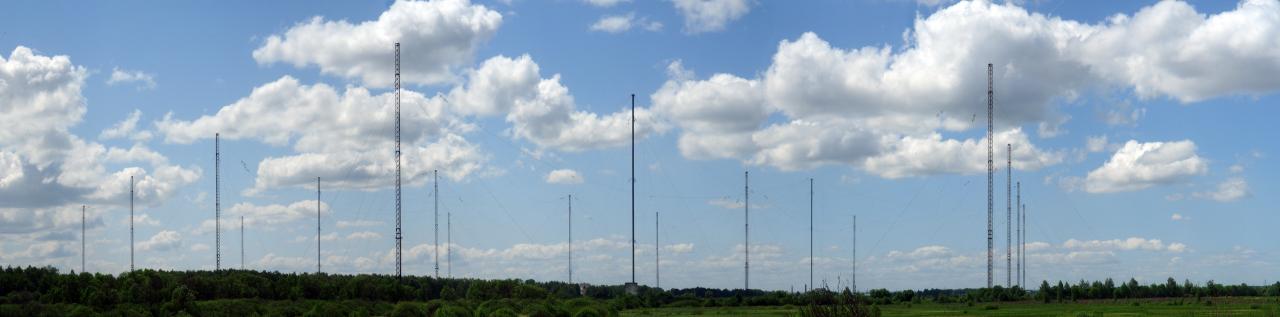
The panorama above shows a long line of tall, thin masts across a flat green landscape, consistent with the layout described for Antey. It is one of three photographs taken at the site by a visiting amateur radio operator. See "About the photographs" below.
HISTORY
Late 1950s: the decision. By the end of the 1950s the Soviet Navy had nuclear-powered submarines and was bringing ballistic-missile submarines into service. Red Star (2008) and Sovetskaya Belorussiya (2014) both say the effectiveness of these boats depended on communications and that the question was "discussed at the highest level", and that the result was the construction of a second large domestic Navy VLF station. The first was the war-booty German Goliath, moved and rebuilt near Nizhny Novgorod and in service from about 1952. Antey is thus called the "third" station by one source and the "second" by another, depending on whether the Khabarovsk station (Hercules, 1962) is counted. [DOCUMENTED, with the numbering conflict flagged]
Construction. Red Star says construction took place over about 600 hectares, with "several cement factories working for years only for this project". [SINGLE-SOURCE] A declassified CIA Scientific Intelligence Digest (a Top Secret item, released 2003 and graphically dated around November 1963) reports photographic intelligence of a VLF antenna system under construction at Vileyka, "Belorussia", and says it clearly shows the ground-plane pattern of a Goliath-type VLF antenna. It calls this "the first firm evidence" that the Soviets were continuing to use the Goliath pattern for their LF/VLF stations, noting that Vileyka and the original were "almost identical" in arrangement. It also mentions an antenna farm seen east of Kiev and counts "at least eight" Soviet LF/VLF stations built since the war. That is an independent confirmation, from an adversary's intelligence service, of the site, the date of construction and the design family. [DOCUMENTED, CIA reading room document CIA-RDP78T05439A000300040108-9; the date is an inference from the map stamp]
22 January 1964: acceptance. The USSR Navy commander-in-chief approved the state commission's act accepting the station into service. That is the date every Russian and Belarusian source uses, including the 50th-anniversary coverage of 2014. The station then began passing traffic from the Navy Main Staff to submarines in real time. [DOCUMENTED]
1966: the time-service post. A "transmitting point" of the Soviet Defence Ministry's unified time service (Служба единого времени) was completed at the site, equipped with a "Sandal" (Сандал) time standard. A staff member told Red Star that the atomic clocks might drift "one second in 300,000 years" (the number was 100,000 years in the 2005 Red Star article, so treat both as boasts). The time signal is broadcast every day under the Beta system. [DOCUMENTED that it exists; the precision claims are [UNVERIFIED]]
1968 onwards: staff and records. Press profiles of the long-serving commander, Captain 1st Rank Vladimir Kuznetsov, say he arrived as a conscript sailor in 1968 and then served some 37 years at the site, commanding from 1989 (the figure of "16 years in command" in July 2005 dates this to 1989). The station was described as always among the leaders of the Navy's units from 1968, and as first among the Navy's VLF stations from 1994. These are morale-story facts, not technical ones, but they show how long the same people have run the same equipment. [SINGLE-SOURCE]
September 1988: "combat duty". The 2008 Red Star article says that in September 1988 the station "was placed on combat duty" (поставлен на боевое дежурство), and Russian Wikipedia repeats it. The same article gives the 1964 acceptance date and shows no gap in service. The likeliest reading is a formal re-declaration after a major upgrade (the 1980s were the decade in which Soviet VLF stations got new transmitters), but no source says so. [UNVERIFIED; a conflict with "in service since 1964" is only apparent]
1991-94: the Soviet collapse. The station, now on the territory of an independent Belarus, stayed in Russian hands. Sources say that Alexander Lukashenko, as soon as he was elected in 1994, stated that as long as he led the country there would be no demand to withdraw Russian military facilities. The last conscript sailors left the site in April 1994, and since then all posts have been filled by contract service members. The legal framework is the agreement of 6 January 1995 (below). [DOCUMENTED]
1996: Lukashenko visits. The Belarusian president visited the station and, according to Sovetskaya Belorussiya, set his watch by the "Sandal" time standard. [SINGLE-SOURCE]
2005-08: press visits. Red Star reporters climbed a 270 m mast in 2005 and toured the transmitter building in 2008. These are the best public descriptions of the inside of the station and are the source of most of the technical details on this page.
2014: 50th anniversary. Celebrated with officials, including the head of the equipment-maker. [DOCUMENTED]
Late 2010s-2020s: modernisation? An undated Russian news item quotes a member of the Russian parliament that the station "will be modernised in the next three to four years". The year of the item is not clear from what this page could read, and no public source confirms a rebuild. [UNVERIFIED]
2 July 2021: the alleged sabotage plot. In an Independence Day speech, Lukashenko said that "self-defence" cells uncovered in Belarus, which he said were organised from abroad, had tried to blow up the Vileyka communications centre "that maintains contact between Russia and its naval ships in the Atlantic", that he had discussed it with Putin, and that all participants including organisers were found and arrested in two days. State media named a detainee. Independent reporting did not corroborate the foreign-backed plot (Ukraine denied involvement), and a later account described an attempted disruption, not an actual explosion. [DOCUMENTED that the claim was made; the claim itself is [UNVERIFIED]]
20 October 2021 and 2022: the agreement extended. The defence ministers of Russia and Belarus signed protocols extending the Vileyka agreement and the Baranovichi early-warning-radar agreement. Russia's Federation Council ratified the protocols on 21 September 2022 (Federal Law of 24 September 2022 No. 369-FZ), and they took effect on 7 October 2022 per the Russian publication record. The extension is for 25 years, with automatic renewal in five-year periods unless a party gives a year's notice. The Russian foreign ministry's treaty record lists the agreement as valid to 7 June 2046. [DOCUMENTED]
Since 2022. Belarus has been used as a staging area for Russian forces in the war in Ukraine. This page found no verified report of any change in the Navy station's role, any attack on it, or any outage. [UNVERIFIED either way; absence of reports is not evidence]
THE LEGAL STATUS: A RUSSIAN NAVAL STATION ON BELARUSIAN LAND
The status of the station is set by an intergovernmental agreement signed in Minsk on 6 January 1995 "on the procedure for the use and maintenance of the Vileyka radio station located on the territory of the Republic of Belarus". It came into force in 1996 (31 May for the Russian side, 7 June for the Belarusian side, according to different records) for 25 years. The preamble lists the 1992 treaty on coordination in the military field, the 1992 agreement on strategic forces temporarily stationed in Belarus and the 1993 agreements on their status and withdrawal. That is, Vileyka was dealt with as a leftover of the Soviet strategic forces in Belarus. The same day, a second agreement covered the unfinished early-warning radar at Baranovichi (the Volga radar). The two have been renewed together ever since. [DOCUMENTED, Russian MFA treaty database]
According to Russian and Belarusian press summaries of the agreement: the property and the 650-hectare land plot are transferred to the Russian Federation for 25 years, rent-free, without taxes other than those connected with the unit's own economic needs; Belarusian citizens may be employed at the site, and in practice they make up most of the civilian staff and the guard force; the guards (about 200 people, called VOKhR in one article) are Belarusians who go through checks by Belarusian police and security services as well as Russian counter-intelligence. [DOCUMENTED]
The practical meaning is simple, and it is worth stating plainly. For the Russian Navy the station is the westernmost of its big VLF transmitters and so a natural Atlantic hub, though the Arkhangelsk and Krasnodar stations also reach the Atlantic, so its loss would reduce coverage and redundancy rather than end it. For Belarus it is a cheap, visible way to show Moscow it is a partner. There is no public statement that Russia plans to leave or replace it, and the agreement now runs to the mid-2040s. [SPECULATION as to the motives; the dates are documented]
THE JOB: WHAT THE STATION IS FOR
Every description from Russian sources names the same task. The station receives orders and messages from the Navy Main Staff (and, "if necessary", the General Staff of the Armed Forces) and transmits them to submarines on combat patrol in the Atlantic, the Indian Ocean and part of the Pacific. Sovetskaya Belorussiya (2014) calls it, in effect, a "relay amplifier of the signal", which is a good plain description: the thinking is done in Moscow, and Vileyka is a very large, very loud loudspeaker. Sputnik Belarus (2021) says the station was opened "to ensure communication of the Navy's central communications node with missile-carrying strategic submarine cruisers while submerged". [DOCUMENTED]
The same sources add three more tasks, each of which should be read with care:
Is it really two-way? Russian Wikipedia says the station provides "direct and reverse communication" with the submarines. Red Star in 2005 says Antey "catches with its sensitive ear the encoded signals of our submarines and passes them up in the same encoded form". Physically this cannot be done on the VLF band: a submarine has no practical means of transmitting on 20 kHz with a useful range (it would need a huge radiating antenna and a lot of power, and it would reveal its position). So the "reverse" path, if it exists, must use another band, most likely HF shortwave when the boat surfaces or raises a mast, or satellite, or a short-range burst system. The shortwave centre in the town may be part of this. [ESTIMATE/reasoning, consistent with how other navies work; the Russian press statements are loose journalism and the detail is not public]
How the Navy chain is described. Red Star's account of a communications session is the best insider description of the Vileyka end. The order arrives from the Navy Main Staff "in encoded form". Equipment "moulds the signal into the required type of operation". The modulated signal at a given frequency is then passed to a five-stage power amplifier, the radio transmitter. The transmission is scheduled because the submarine has to rise to a certain depth to receive it. Sovetskaya Belorussiya adds that special equipment "compresses the transmission speed by tens of times", which "makes it possible to transmit more than a thousand words a minute", and that the control room displays which territory the signal covers. The "thousand words a minute" is not credible as a VLF data rate (see the physics below, where the usable rate is a few hundred bits per second at best) and is probably a garble of "the message is sent in a short burst" or of a different link. [SINGLE-SOURCE; the thousand-words claim is [UNVERIFIED] and physically implausible for the VLF path]
The same journalist watched a live session: "exactly on schedule, a signal sounded at the command post, the huge lamps flickered, and the officers on duty tensed. It lasted a few minutes, and after confirmation that the signal had been received, everything returned to the normal working rhythm." Two things follow, with the usual caution. First, the transmissions are on a schedule. Second, the "huge lamps" are consistent with a tube-type output stage. [SINGLE-SOURCE; the second point is an inference]
Encryption. Red Star's officer says the signal is encrypted, so "it is not frightening if it is intercepted", and that decryption "might happen in about 40 years, when the information has lost all relevance". That is a typical modern view of VLF security: anyone can hear a VLF transmission, and what matters is that the content is encrypted and that the schedule and addressing do not reveal anything. [SINGLE-SOURCE; the claim about decryption is a boast, not an analysis]
WHY VLF AT ALL: THE SEAWATER PROBLEM IN PLAIN LANGUAGE
Seawater is salty, which makes it a conductor. Its conductivity is about 4 siemens per metre (varying 3 to 5 with temperature and salinity). A radio wave trying to enter it drives currents in the water and loses energy as heat. The higher the frequency, the faster the wave is eaten. The rule of thumb is the skin depth: the depth at which the field has fallen to about 37 percent (a loss of 8.7 dB). In good conductors it is about 503 metres divided by the square root of (conductivity in S/m times frequency in Hz). This page uses 4 S/m. [ESTIMATE from a standard formula]
| Frequency | Wavelength in air | Skin depth in seawater | Loss at 10 m | Loss at 20 m |
| 82 Hz (ELF, ZEVS) | about 3,660 km | about 28 m | about 3 dB | about 6 dB |
| 3 kHz | 100 km | about 4.6 m | about 19 dB | about 38 dB |
| 18.1 kHz (RDL net) | 16.6 km | about 1.9 m | about 46 dB | about 93 dB |
| 20.5 kHz (Beta, lowest) | 14.6 km | about 1.76 m | about 49 dB | about 99 dB |
| 25.0 kHz (Beta, highest) | 12.0 km | about 1.59 m | about 55 dB | about 109 dB |
| 100 kHz (Chayka, LORAN-C) | 3 km | about 0.8 m | about 109 dB | about 218 dB |
| 3 MHz (HF) | 100 m | about 0.15 m | hopeless | hopeless |
[ESTIMATE for the whole table; the wavelength column is exact, the others are idealised plane-wave figures for 4 S/m seawater] These losses look huge, and they are, but the field at the sea surface from a megawatt station can be very strong and a good receiver can pull a signal out of noise. A loss of 50 dB is a factor of about 300 in voltage and 100,000 in power. A boat at ten metres is receiving about a hundred thousand times less power than one just under the surface, which is still a workable signal for a modest loop, a long towed wire or a buoy when the transmitter is a megawatt. At 20 metres the loss doubles in decibels. Boats that want to hear VLF therefore come up to the shallow depth where the signal is strong enough, or stream a floating wire or a buoy, which is why Antey's broadcasts are on a schedule and why boats are not reachable at any time at any depth. Red Star says exactly this in different words: "work goes on by schedule, because to receive the signal the submarine has to rise to a certain depth".
The same table shows why ELF (very low data rate, deep) and VLF (higher data rate, shallow) are complementary, and why 100 kHz navigation signals (Chayka, LORAN-C) are useless to a submerged boat. Antey is one of several layers: ELF to say "come up", VLF to deliver a short message, and trailing-wire aircraft as a survivable backup (see below).
HOW THE SIGNAL TRAVELS: THE EARTH-IONOSPHERE WAVEGUIDE
A VLF wave does not go out into space and come back like a shortwave signal. At 20 kHz, the wavelength is 15 km, and the space between the conducting ground (or seawater) and the lowest layer of the ionosphere (the D layer by day, about 70 km up, and the E layer by night, about 85 km up) is only a few wavelengths thick. The two surfaces act like the top and bottom of a pipe, a waveguide, and the wave runs along it with very small loss, a few decibels per thousand kilometres, because most of the energy is reflected rather than absorbed. [ESTIMATE of the loss; standard published figures for 20 kHz over seawater are of the order of 2 to 3 dB per 1,000 km by day, and a little less at night, but they vary with the path and the magnetic field, and this page does not give a station-specific number]
There is a cutoff frequency below which the pipe carries only its simplest mode. It is roughly the speed of light divided by twice the height of the pipe: about 2.1 kHz for a 70 km day ionosphere and about 1.8 kHz for 85 km at night. [ESTIMATE] Above those frequencies, higher modes can also propagate, and at 20 kHz several modes exist and interfere. Even so, at long distances the lowest modes dominate and the signal is stable. The result is the property that makes VLF valuable: the phase and amplitude of the signal are steady and predictable over thousands of kilometres, and a station can reach most of an ocean basin. Distances of ten thousand kilometres are possible with enough power, but the signal weakens and the day-night cycle shifts it. The Russian claim "more than 10,000 km" is credible for a megawatt transmitter with a good antenna. [ESTIMATE; DOCUMENTED as a Russian claim]
Several effects of the waveguide matter for the user:
WHY IT IS SLOW: BANDWIDTH LIMITS
A VLF antenna is very small compared with a wavelength. That makes it a high-Q circuit. The same property that makes the signal steady makes it narrow-band. A rough way to see it: the bandwidth of a tuned antenna is about the carrier frequency divided by its Q (the ratio of its reactance to its total resistance). For a large VLF umbrella Q is in the range of 50 to 300 depending on the design. At 20.5 kHz, with a Q of 130 (an illustrative middle value), the bandwidth is about 158 Hz. The message cannot use more bandwidth than the antenna passes without being heavily distorted, unless the antenna is "de-Q-ed" with extra resistance (losing power), or the transmitter is built so that it forces the antenna current through a compensating network. [ESTIMATE; the Q is assumed, not measured]
MSK (minimum-shift keying), the usual submarine broadcast modulation, needs a main-lobe bandwidth of roughly one and a half times the bit rate. A 50 bit-per-second message needs about 75 Hz, which fits in the narrow antenna bandwidth. A 200 bit-per-second message needs about 300 Hz, which does not fit without help. That is the plain reason that VLF broadcasts are typically 50 to 200 bits per second (a few words per second at the very best, and a short coded message in a minute), and why the Navy uses short code groups. The Cutler / Jim Creek article on this site shows the US version of the same arithmetic. [ESTIMATE with textbook formulas]
Antey's actual data rate is not public. There is no verified source for its modulation or rate beyond hobbyist radio records (below) and the loose press remark about "a thousand words a minute". A system designed in the 1960s with tube transmitters may originally have used keyed carrier (telegraphy, A1A) and later FSK/MSK; hobbyist lists of the Russian VLF net show both carrier-keyed ("A1A") and frequency-shift ("F1B") modes. [UNVERIFIED]
CALL SIGNS, FREQUENCIES AND WHAT LISTENERS HAVE RECORDED
Because VLF travels so far, enthusiasts with a long wire, a soundcard or an SDR can receive Russian VLF stations in Europe, and several public WebSDR receivers can hear them. That gives the only genuinely independent technical record of what Antey does. The record is thin for the communications broadcast and fairly good for the time signals.
The Beta time and frequency signal (RJH69) [DOCUMENTED]
Beta (Бета) is the Russian military's VLF time and frequency system, run from the same stations as the submarine broadcast. Its transmissions are published in the BIPM annual time-signal reports and in hobbyist schedules. RJH69 at Vileyka (listed by BIPM as "Molodechno, Belarus, 54°28'N 26°47'E") transmits a daily sequence of fixed-frequency periods. Hobbyist tables give, in UTC:
| Frequency | Time (UTC) | Note |
| 25.0 kHz | 07:00 - 07:25 | longest period; includes the call-sign ID and the time-code pulses |
| 25.1 kHz | 07:25 - 07:30 | |
| 25.5 kHz | 07:30 - 07:35 | |
| 23.0 kHz | 07:35 - 07:41 | |
| 20.5 kHz | 07:41 - 07:47 | a hobbyist table gives winter 07:41-07:47 and summer 06:41-06:47 for this slot |
That is 47 minutes in all, from 07:00 to 07:47. Red Star says "41 minutes daily"; the numbers differ because the shortwave.live type tables, the BIPM text and the hobbyist table all count the frequency periods and the ID and pulse periods in different ways. The BIPM entry describes a 07:06 identification and then time-pulse formats of different widths between minutes 10 and 22 (the exact pulse trains are in the BIPM report). [DOCUMENTED for the schedule; the 41-minute vs 47-minute difference is a conflict]
One hobbyist list adds that RJH69 does not operate on the 2nd, 12th and 22nd of each month. That is a pattern for maintenance days that the other Beta stations share with different day numbers (each station has its own "silent days", in a rotation). [SINGLE-SOURCE; the list is a hobbyist compilation]
The Beta transmissions are the same in kind at every station of the network, and are what monitoring stations and time-signal laboratories use to identify Russian VLF transmitters. They also tell us something indirectly: each station has to be able to tune across the 20.5 to 25.5 kHz range. Tuning an antenna this size over a 5 kHz span (about 20 percent) is a real engineering achievement, and it means that the antenna and its tuning coils are not fixed-frequency devices. The tuning equipment is covered below. [ESTIMATE/reasoning]
The naval broadcast: RDL and the "network of frequencies" [SINGLE-SOURCE]
The Russian military VLF communications network is monitored by hobbyists under the call sign RDL. Public listings (Trond Jacobsen's long-standing VLF list) record RDL on 18.1 kHz as the busiest frequency and on 21.1 kHz, with entries in the form "N0N/A1A/F1B", i.e. unmodulated carrier, carrier-keyed telegraphy and frequency-shift keying, and with a shift of a few tens of hertz mentioned. The listings say these signals come from several transmitter sites in the network (for example Krasnodar and Tashkent are named for 21.1 kHz) and that there is "no apparent transmission schedule". A Russian survey gives a common frequency set of 18.100, 18.900, 21.100 and 27.300 kHz and says that transmission can be on several frequencies at once, including synchronously, with 18.1 and 21.1 kHz the most common. It labels the emission class F1B (FSK and MSK), with A1A as a reserve, and says the stations' own call signs (RJH69 for Antey and so on) may be used on top of RDL. [SINGLE-SOURCE for each; they agree with each other, but the Russian survey is itself a hobbyist document that says its own sources need verification]
The honest summary: Antey is part of a Russian military VLF network that broadcasts on a handful of frequencies in the 18-22 kHz band, but nothing public shows which broadcast is coming out of Vileyka at any moment. RDL cannot be attributed to a single station from the signal alone unless a direction-finding network or a long observation of the schedule links it. The signal at 18.1 kHz can be heard on WebSDR receivers in the Netherlands and in Tambov in Russia (from screenshots in the Russian survey). The sending site is not identified there. [UNVERIFIED for any link between a given RDL transmission and Vileyka]
The 20.5-25.5 kHz Beta range lies partly above and partly below the commonly quoted communications range, and the Beta transmissions are on at fixed times. The NATO and US stations (24.0 kHz Cutler, 24.8 kHz Jim Creek) live in the same part of the spectrum, so that a long-wire receiver in Europe can hear all of them at once, which is why VLF monitors enjoy the band. See Cutler / Jim Creek VLF. [DOCUMENTED]
What the signals reveal: Antey is on the air for the Beta slot daily; the content of the naval broadcast is encrypted; the data rate of the broadcast is not public. There is no verified public recording that is identified as the Antey naval broadcast. That is the largest gap in the technical picture. [UNVERIFIED/unknown]
THE ANTENNA: THREE UMBRELLAS ON A MARSH
The station's antenna is the best documented part of it, because it is huge, tall, outdoors, and photographed by satellites. It copies the pattern of the German Goliath at Kalbe an der Milde and its Soviet rebuild at Nizhny Novgorod, with larger dimensions. See the Goliath VLF article on this site for the original. The CIA digest of the early 1960s said the Vileyka layout was "almost identical" to the Goliath layout and the later German-language and Russian sources agree. [DOCUMENTED]
Layout
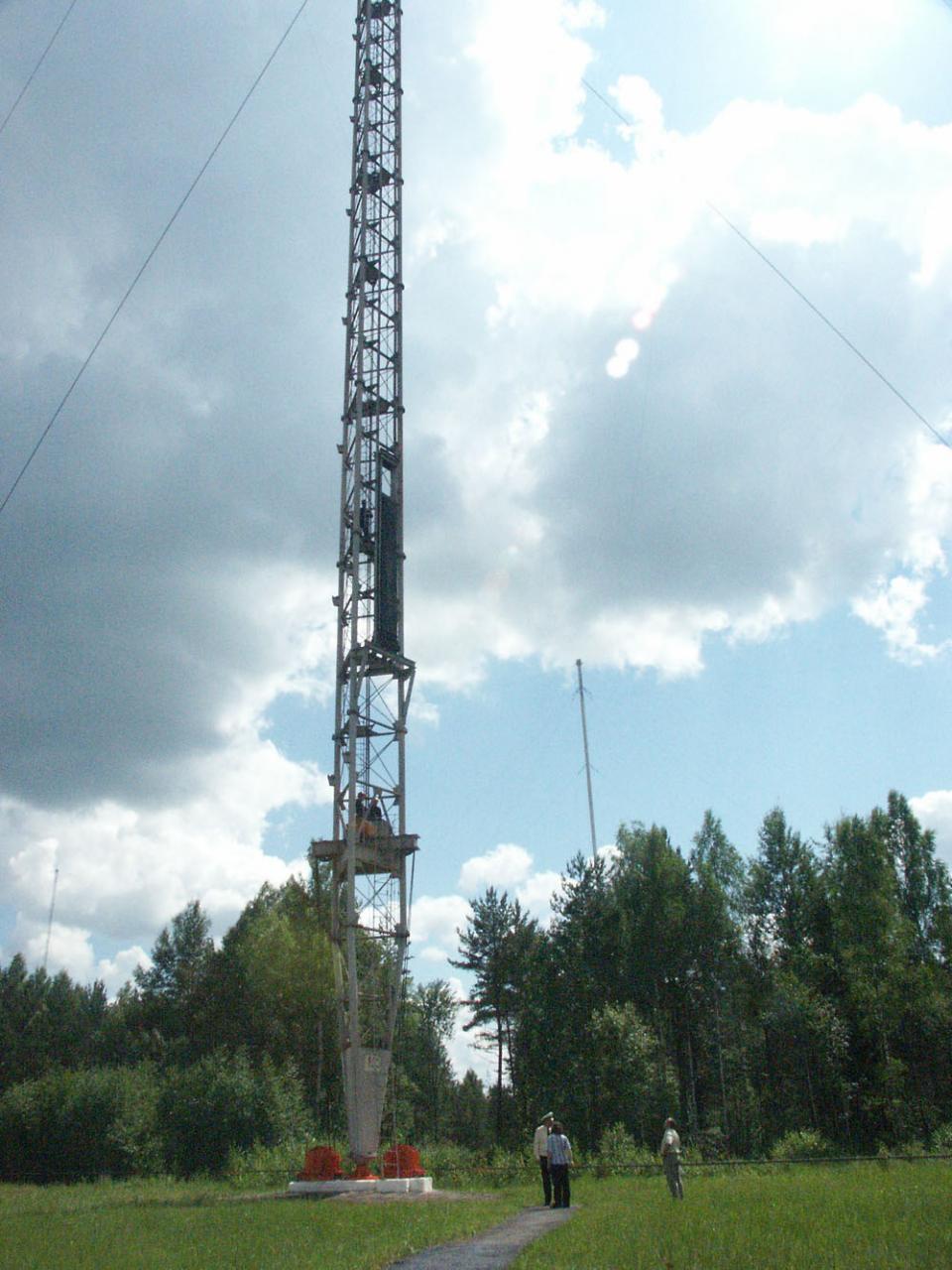
The lattice mast photograph above, supplied by the site owner, shows a tall triangular lattice mast with climbing platforms and a narrowing base on a small pedestal, with three people at the bottom for scale. That is consistent with the description of a peripheral mast of this type (a grounded triangular lattice structure on a pivot-like foot with guy wires leading away), and the picture is one of the three taken at the site by the visiting amateur radio operator (see "About the photographs").
Why an "umbrella" or "flat-top"
A 305 m mast is long in human terms, but at 20 kHz it is only about 2 percent of a wavelength. A vertical wire that short radiates very poorly. Its radiation resistance, the figure that decides how much of the current ends up as radio waves rather than heat, is proportional to the square of the height measured in wavelengths. The trick of the umbrella is to add a large "top hat" of horizontal wire at the top of the mast. The top hat acts like one plate of a huge capacitor against the ground, and it lets current flow all the way up the mast instead of dying away toward the top. The effective height rises to a good fraction of the physical height, perhaps half to two-thirds. [ESTIMATE; standard antenna theory]
Take 305 m, an effective height of about 200 m (two-thirds, borrowing the ratio of the Goliath numbers on this site), and 20.5 kHz. The radiation resistance of a short vertical antenna is about 160 times pi-squared times (h/λ)². With h/λ = 200/14,634 = 0.0137 the value is about 0.29 ohm per umbrella. At 25 kHz it is about 0.44 ohm. [ESTIMATE; the real values depend on the top hat, the ground screen and how the three umbrellas are fed]
That sounds absurdly small, and it is. A normal broadcast antenna has a radiation resistance of tens of ohms. The ground (earth) loss resistance is of the same order as the radiation resistance, and in a poor site it is much worse. Antey's planners could not make the radiation resistance any bigger without making the antenna taller. They did the only other thing available: reduce the ground and coil losses, and drive the antenna with an enormous current.
The ground system
Red Star gives a rare ground-level detail: each peripheral mast is "permanently grounded by copper wire laid at a depth of 10 centimetres, and more than 300 kilometres of such wire lies in the ground". That is a buried radial earth screen, essentially the same thing as Goliath's (at least 350 km of conductor in the German accounts) and as the "ground screen" at US stations. Its purpose is to give the antenna current a metal path back to the mast base, instead of a long resistive path through damp soil. Most of the loss in a small VLF antenna is in the ground return, so this copper is worth about as much as the masts. [DOCUMENTED, one source, repeated by Wikipedia]
A caution: 300 km of wire is a small number for 400 hectares. Fifteen radial systems of 20 km each is what that would give, or about 1 m of wire per 13 m² of ground. That is a sparser screen than Cutler's or Goliath's. The Red Star number may count only the wire at the peripheral masts, and the wire under the central mast is not mentioned. [ESTIMATE/reasoning; unresolved]
Maintenance: winch houses and jacks
Red Star describes two clever features. Next to each mast is a winch house, and with the winches "the antenna cloth can be lowered to the ground for inspection and repair", so the high wires are not repaired by climbers at 300 m. And because the central masts sit on porcelain insulators that can fail, "each of the central masts can be lifted by a few centimetres with jacks" so that a broken insulator can be replaced. Red Star says the mast weighs 300 tonnes. The climbers go up the masts every ten days, to inspect them. [SINGLE-SOURCE, but the 2005 and 2008 articles agree]
Maintenance has one more consequence, which is not mentioned in the sources but follows from the physics: the siting. Lightning loves tall grounded masts. A thunderstorm approached the Red Star climbers in 2005, and the station radioed a recall. The grounded peripheral masts take the strike, and the tall insulated central masts need spark gaps and surge arresters at the base. [ESTIMATE/reasoning]
The antenna pavilion is in the same spirit: "under each of the masts is an antenna pavilion with the equipment that makes the station work" (Sovetskaya Belorussiya). That is a tuning house at each umbrella: the next section.
FEEDING AND TUNING: HELIX HOUSES AND VARIOMETERS
Antey's technical building is not described in the sources beyond a few lines, so this section combines what is documented with what must be true of any station of the Goliath type. The labels say which is which.
The electrical problem. Seen from the feed point, a short umbrella is a very large capacitor with a tiny resistance in series, like a 0.3-ohm resistor in series with a capacitor whose reactance at 20 kHz is tens of ohms. To drive current through it, the transmitter needs a series inductor that cancels the capacitor's reactance exactly (resonance). That inductor is the helix or loading coil, and in a plant of this class it is the size of a small house, with a coil of heavy water-cooled or hollow tubing or stranded cable, held with insulators and enclosed so that wind and rain do not detune it. At resonance the antenna looks like a pure resistance of a few tenths of an ohm, and the transmitter's coupling transformer matches that to the output of the tube amplifier. [ESTIMATE/reasoning; standard VLF practice, as detailed in the Cutler / Jim Creek article]
What the sources say. The Russian survey says Antey's transmitter is in a buried, concrete bunker that protects equipment and staff against nuclear weapons effects, that the transmitter and the helices (the coil houses, "геликсы") at Arkhangelsk and Bishkek are also in buried, concreted bunkers, and that only at Krasnodar are they on the surface. Red Star says the station's main transmitter is in "technical building number one", a buried concrete structure, "banked with soil to the height of a three-storey house", with trees now growing on top. The plan assumed "even after a nuclear attack the station could continue to work autonomously", for which it has diesel generators, a water well and so on. Sovetskaya Belorussiya says the crew serves in a bunker with heavy iron doors between compartments "like a submarine", which "can withstand a direct hit by a high-explosive aerial bomb". The statement about a bomb is a hearsay boast ("they say"), and the statement about nuclear survival is a design intent, not a tested fact. [SINGLE-SOURCE for each; the three accounts are consistent]
Tuning across the band. Since the Beta schedule needs 20.5, 23.0, 25.0, 25.1 and 25.5 kHz from the same antenna, the coil must be tunable. In a Goliath-type plant that is done with a variometer, a coil whose inductance is varied by rotating one winding inside another, with a motor servo. The German Goliath was servo-tuned across 15 to 60 kHz in a plan described elsewhere on this site. Whether Antey uses variometers, tapped coils or switched capacitors is not public. [UNVERIFIED]
The three umbrellas. Three separate umbrellas could be driven together (to get more total radiated power, with their currents in phase, the three behave like one larger antenna and the radiation resistance of the group goes up through mutual coupling) or one at a time. The central pavilion arrangement hints that each has its own tuning house. Which way Antey operates is not public. In the German Goliath, the three were fed together from one transmitter. [SPECULATION for Antey]
The transmitter
The transmitter type is the Hercules (Геркулес), a 1,000 kW VLF transmitter developed by the Russian Institute of High-Power Radio Engineering (РИМР, St Petersburg). The first was installed near Khabarovsk in 1962, and Antey received one for its start in 1964. A summary of an institute history, seen only as a search snippet, repeats the Khabarovsk 1962 and Vileyka 1964 installations. The Russian survey says Arkhangelsk was "originally equipped with the megawatt Hercules that was already used at Hercules and Antey" and that its power was too little, so a 4 MW "Okean" was developed in the 1980s; Bishkek got a "Rotor" with hydrogen-thyratron keyed output stages, Krasnodar got a "Prolom" of 2 MW, and Goliath got a "Titan" of 2 MW with an efficiency of up to 80 percent. These are [SINGLE-SOURCE] details from the Russian hobbyist survey, which itself cites a book on the role of Russian science in the creation of the nuclear submarine fleet as its only trusted source. [DOCUMENTED for Hercules/RIMR/1,000 kW; [SINGLE-SOURCE] for the rest]
The Red Star description of the five-stage chain is concrete: the exciter forms the modulated signal at the required frequency, and "a power amplifier of five stages" raises it to the final power. The museum on the site shows vacuum tubes "from small to very considerable", and the commanding officer said the tubes "build up the required power". So Antey's transmitter was, at least when described in 2008, a valve (tube) transmitter, not a solid-state one. That is the first of two things that are clear from a distance: this plant was built for reliability, and a megawatt of RF out of a single set of valves needs a lot of cooling, lots of high voltage and lots of upkeep. [SINGLE-SOURCE]
The Russian survey says that at some stations the tube output was replaced during the 1970s-80s with keyed (switch-mode) stages using hydrogen thyratrons at up to 80 percent efficiency. Whether Antey got such an upgrade, perhaps tied to the 1988 "combat duty" milestone, is not stated by any source. A 1 MW linear tube transmitter would be about 40 to 60 percent efficient, so it would draw 2 to 2.5 MW from the grid to radiate 1 MW. The station needs a substantial electrical supply. [ESTIMATE; the efficiency is a generic figure for large tube RF amplifiers]
A worked example: current, voltage and bandwidth [ESTIMATE]
To show why the hardware is so big, here are illustrative numbers. They are not measurements of Antey. Assume a single umbrella radiating, say, 330 kW (one third of the 1,000 kW if the three share it equally) at 20.5 kHz, with the radiation resistance of 0.29 ohm from above and a total ground and coil loss resistance of 0.3 ohm. Total resistance 0.59 ohm. The current for 330 kW into the radiation resistance is the square root of (330,000 / 0.29), which is about 1,070 amperes. That is about 1 kA of RF current flowing up the mast. The power dissipated in the 0.3 ohm of losses is about 340 kW, so the antenna efficiency is about 50 percent and the transmitter has to supply roughly 670 kW at the antenna terminal for that single umbrella. A 1 MW rating at the transmitter output, with three umbrellas running, would give a lower figure per mast, but the order of magnitude, hundreds to a thousand amperes, is right.
For a voltage estimate, assume the capacitance of one umbrella is 0.1 microfarad (an assumed value; Goliath-class umbrellas are of this order). At 20.5 kHz the reactance is 1/(2 pi f C) = 78 ohms. The voltage across it at 1,070 A is about 83 kV. That is already high, and at the tuning coil and the insulators the real peak voltage will be higher, a hundred kilovolts or more. This is why the central masts stand on porcelain insulators and why the coil houses have high-voltage insulators and spark gaps. [ESTIMATE with an assumed capacitance; the order of magnitude is what matters]
For the bandwidth, the Q is the reactance divided by the total resistance, 78 / 0.59 = 132, and the bandwidth is 20,500 / 132 = about 155 Hz. That is the narrow-band picture used in the bandwidth section. A 50 bit-per-second message in MSK fits and a 200 bit-per-second message does not without extra tricks. [ESTIMATE]
Two things stand out. First, the engineering of a VLF station is about keeping resistance down: the cable, the coil, the insulators and above all the ground. Second, anything that changes the capacitance or the inductance by a small fraction detunes it. At a Q of 130, a 1 percent change in capacitance shifts the resonance by 0.5 percent, about 100 Hz, which is as much as the whole bandwidth. Ice on the wires, a wet snow load, or wind swaying the 300-metre masts changes the capacitance. This is why the real station needs automatic tuning and why de-icing and maintenance are serious subjects. How Antey handles them is not public. [ESTIMATE/reasoning]
COMPARISON WITH CUTLER, JIM CREEK, GOLIATH AND THE OTHER RUSSIAN STATIONS
| Station | Country, operator | Entered service | Frequency / call sign | Power | Antenna |
| Antey (Vileyka) | Belarus site, Russian Navy | 1964 | Beta 20.5-25.5 kHz as RJH69; RDL network 18.1/21.1 etc. | 1,000 kW (Russian sources) | 3 umbrellas, 3 x 305 m tube masts + 15 x 270 m lattice, ~400 ha |
| Cutler (NAA) | USA, Navy | 4 January 1961 | 24.0 kHz | 1 MW radiated normally, up to 1.8 MW (Navy 1997 report, per the Cutler article) | Two Trideco arrays of 13 towers each (26 towers), the tallest about 304 m, six-pointed star-shaped top loads |
| Jim Creek (NLK) | USA, Navy | 18 November 1953 | 24.8 kHz | a few hundred kW at most (the Cutler article assumes about 250 kW) | Valley-span: wires strung across a valley between mountain crests on modest towers |
| Goliath (Kalbe) | Germany, Kriegsmarine | 1943 | 15-60 kHz tunable, main about 16.55 kHz | 1,000 kW antenna circuit | 3 umbrellas, 3 x 210 m + 15 x 170 m |
| Goliath (Nizhny Novgorod) | USSR/Russia, Navy | about 1952 | RJH99 (Beta) | 1,000 kW first, later "Titan" 2,000 kW (survey); status uncertain | the same antenna moved from Germany |
| Hercules (Khabarovsk) | USSR/Russia | 1962 | RAB99 | 1,000 kW (up to 1,500) | different layout: 3 rows of masts, "Lambda" twin-mast axial row (survey) |
| Atlant (Arkhangelsk) | USSR/Russia | 1970 | RJH77 | 4,000 kW "Okean" (survey) | same plan as Antey; central masts are lattice (survey) |
| Prometey (Bishkek) | USSR/Russia | 1974 | RJH66 | 500 kW "Rotor" (survey) | like Atlant (survey) |
| Gerakl (Krasnodar) | USSR/Russia | 1986 | RJH63 | 2,000 kW "Prolom" (survey) | Trideco-type configuration (survey) |
[Cutler and Jim Creek facts: see the Cutler / Jim Creek article. The Russian rows are all [SINGLE-SOURCE] from the Russian hobbyist survey, apart from the Antey row, which is backed by several sources.] The table shows the family resemblance. Antey is a scaled-up Goliath. By height the central masts at Antey (305 m) are about 95 m taller than Goliath's (210 m) and the peripheral masts (270 m) are 100 m taller than Goliath's (170 m). English Wikipedia gives 330 m for the central masts and says they exceed the Goliath masts by 135 m, which does not fit the Goliath figures on this site (it would be 120 m over a 210 m mast), while the Russian press, German Wikipedia and Structurae all say 305 m. [Conflict, probably an error in one article]
Antey against Cutler. Cutler is a Trideco design in which many towers of up to 300 m carry two large star-shaped flat-tops, with a helix house at each centre. The US Navy rates its output in the high hundreds of kilowatts to a megawatt. Antey is a three-umbrella design with fewer, bigger masts and, on paper, a similar power. They differ in philosophy, as the Cutler article describes for the American approach: Cutler's feed and tuning, de-icing and efficiency work were published by the US Navy in the 1990s, while Antey's are not published at all. [DOCUMENTED for Cutler; the comparison of power is [ESTIMATE]]
Antey against Jim Creek. Jim Creek strings its wires across a valley to use mountains for supports, a "valley span", a very different solution made possible by the landscape. Antey stands on flat marsh, so it needs the masts.
Antey against Goliath. The structure matches almost exactly, down to the 3 + 15 mast count and the tube/lattice split. The heights are larger. The German station was built for tube-type output stages at 15-60 kHz with servo tuning; the Soviet stations went to a narrower set of frequencies used with mostly fixed tuning for the naval broadcast and stepped tuning for Beta. [partly SPECULATION]
About Kaliningrad and Kolyma. The brief that led to this page asked about stations at Kaliningrad and Kolyma. This page found no verified source for large Soviet or Russian VLF stations at either place. Hobbyist lists mention a few other VLF transmitters (Millerovo, Sarpa, Novaya Zemlya "Matochkin Shar", Vladivostok "RJS"), mostly marked "not active" or "no recent information", and the Russian survey says the Soviet Union also built "considerably lower-power" VLF stations with cable-balloon antennas to talk to submarines in local waters. The six big stations in the table are the ones the Russian sources name. [UNVERIFIED for anything else]
WHAT ANTEY IS NOT: ALPHA, CHAYKA AND NAVIGATION
Alpha (RSDN-20) is a Russian hyperbolic navigation system on three frequencies near 11.9, 12.65 and 14.9 kHz, with transmitters at Novosibirsk, Krasnodar and near Khabarovsk, the Soviet equivalent of the US Omega system (details and sourcing in the Alpha article). Chayka is a 100 kHz LORAN-C-like chain covered in Chayka. Antey is not part of either. It is a communications transmitter, and it does not carry a navigation signal. The reasons the confusion arises are physical: all three work in the VLF/LF range, all three use huge antennas and all three are state-run. What differs is the job and the frequency plan. [DOCUMENTED for the separate roles]
The one thing the three do share is the underlying point of this site's whole VLF series: when you want an unjammable, hard-to-destroy signal that follows the Earth rather than bouncing off the sky, you go to very low frequency and you build very big. Alpha delivers a position, Chayka a position over land and sea, and Antey a message.
WHERE ANTEY SITS IN THE RUSSIAN COMMAND-AND-CONTROL PICTURE
The Navy's own descriptions put Antey as one link in a "single, permanently operating Navy communications system" that was built after the arrival of nuclear submarines. Russian sources use the phrase "global" for the whole system and say the stations are controlled from a single command centre of Navy communications. [DOCUMENTED as Russian description; the Russian survey says the same]
For the national command picture, the pieces on this site are Russian C3 (the overall architecture, including submarine broadcast physics and the airborne posts), Kazbek (the leadership nuclear-authorisation network, the Cheget case and its links) and Perimeter (the backup that can launch command rockets if the living chain is cut). The route by which an authorisation would reach a submerged missile submarine is described there as "eventually a shore or airborne VLF broadcast, or an ELF bell-ringer". Antey is, on that description, one of the "shore VLF" boxes. [DOCUMENTED as the architecture on this site; the architecture is itself assembled from open sources]
What no source says. No public source states that Antey is a named element of Kazbek or Perimeter. Red Star (2005) says that if "some madman attacks Russia" the order to strike back would reach the strategic submarines from the Supreme Commander "including with the help of Antey". Sovetskaya Belorussiya (2014) says the duty crew handles "dozens of messages and signals connected with the combat control of nuclear forces" each day, and Red Star (2008) says the submarines get orders from the Navy Main Staff and, "if necessary", from the General Staff. The links are claims by journalists with access to the site. They say Antey is part of the nuclear command chain to the boats, and nothing more precise. [SINGLE-SOURCE; any specific link to Perimeter is [SPECULATION]]
The three-way layering. The Russian submarine-communication layers parallel the American ones:
The US system has the E-6B Mercury as its TACAMO platform, with Cutler and Jim Creek as the fixed pair, and the Cutler article here describes it. In both countries, the airborne element exists because the ground stations are big, fixed and obvious.
Why the airborne layer matters for Antey. A fixed 300 m mast field is visible on satellite imagery, easy to hit, and its transmitter may survive only if the bunker does. The reason the Navy has both is exactly this: a strike that took out Antey would remove the western Atlantic coverage, and the airborne relay and other stations would have to fill in. [SPECULATION about wartime use; the layering is [DOCUMENTED]]
SURVIVABILITY AND VULNERABILITY
ABOUT THE PHOTOGRAPHS
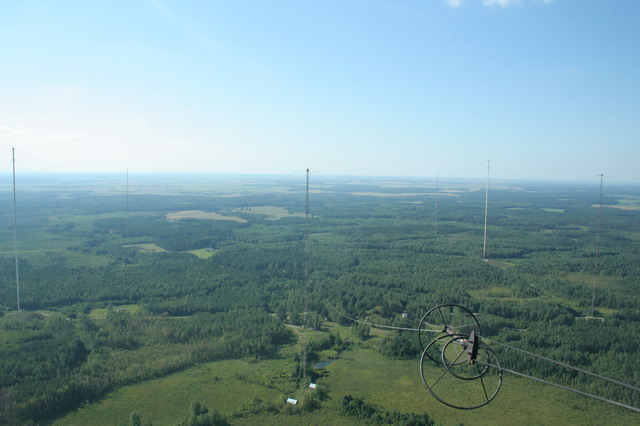
The three photographs on this page show the Antey site. They were taken by an amateur radio operator who visited the station; we do not know his or her name. They reached this site through the site owner, Robert, who passed on the visiting ham's statement that they are from Antey. The site is little known and poorly indexed online, so the attribution rests on that account and not on a published source. This page has not matched the pictures against any published collection. What they show fits the descriptions in the press: tall thin masts on flat, forested and open land; a ring-shaped pulley or insulator fitting on a cable in the foreground of the aerial view; many masts spread across a very wide field in the panorama, some tubular and some lattice-like; and a triangular lattice mast with climbing platforms and people at its foot for scale. The images carry no captions on purpose. The original photographer is unnamed, so check licensing before any reuse. [SINGLE-SOURCE: attribution from the visiting ham via the site owner]
WHAT IS NOT KNOWN
SOURCE CONFLICTS AT A GLANCE
| Point | Version A | Version B | Verdict |
| Central mast height | 305 m (Russian press, German Wikipedia, Structurae) | 330 m (English Wikipedia) | 305 m is better supported; unresolved |
| Antenna area | about 400 ha (press) | about 550 ha (hobbyist survey) | unresolved |
| Total site | 650 ha (treaty, press) | 600 ha (one Red Star article) | 650 ha |
| "Second" or "third" VLF station | second (Russian Wikipedia, counting Goliath only) | third (Sovetskaya Belorussiya, counting Hercules) | depends on whether Khabarovsk is counted; Khabarovsk entered service 1962 per the survey |
| Beta time per day | 41 minutes (Red Star) | 47 minutes, 07:00-07:47 UTC (hobbyist/BIPM tables) | different counting; schedule is better documented |
| Clock accuracy | 1 s in 300,000 years (2008) | 1 s in 100,000 years (2005) | a boast, unreliable |
| Staff | 350 officers and warrant officers | about 400 in all (Red Star 2008) | different counting |
| "On combat duty" date | 1964 (acceptance) | September 1988 | unresolved, probably a later re-declaration |
| Reverse communication | "direct and reverse communication" (Russian Wikipedia, Red Star 2005) | VLF is one-way in practice | the reverse path must use another band; unexplained |
| Data rate | "more than a thousand words a minute" (Sovetskaya Belorussiya) | tens to a few hundred bits per second is the physical range for VLF | the press claim is not credible for VLF |
| Fregat trailing-wire system | Tu-142MR (some sources) | Il-80 (Russian C3 and Kazbek articles on this site) | may be both; unresolved |
| Photo identity | Antey (per the visiting ham, via the site owner) | no published source; [SINGLE-SOURCE] | unverified |
SUGGESTED SUB-ARTICLES
RELATED ARTICLES
SOURCES