Home |
Data Base |
Technical |
Radio |
Search
BAT-2 (БАТ-2) TRACKLAYER
Soviet/Russian high-speed engineer tracklayer | Object 454 | MT-T components, V-46-4 diesel, 710 hp
Route clearing, column routes and road repair: universal blade, 2 t crane, 25 tf winch and rear ripper
Project Orlan Data Base // public encyclopedia
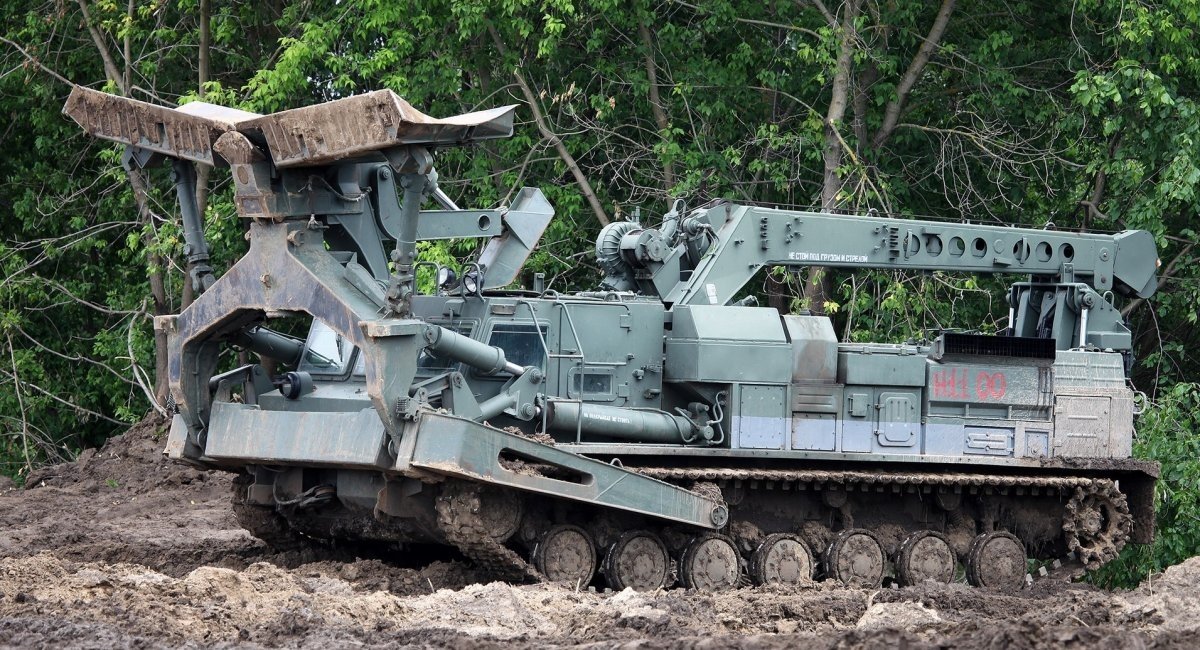
A BAT-2 tracklayer in a churned-up field, seen from the left side. The universal blade is raised high in front of the cab with its wings folded, the crane jib is folded back along the roof, and the toothed drive sprocket is at the rear (right) end of the track. The hull carries the marking "НЦ 00".
Related articles: MT-LB, the light armoured tractor from a different Kharkiv plant; and Carousel vs. Bustle: Tank Ammunition Stowage, for the T-64 as a Kharkiv tank and why "T-64 family" does not cover every Kharkiv tracked vehicle.
WHAT IT IS
The BAT-2 (БАТ-2) is a late-Soviet high-speed tracked путепрокладчик, a "tracklayer" or route-clearing tractor. It was built to mechanize the laying of column routes (колонные пути) and the preparation and upkeep of military roads. The official 1987 technical description, compiled from 1984 documentation and issued by the Directorate of the Chief of Engineer Troops, lists its jobs in plain words: filling craters and trenches, cutting ramps down to crossing sites, clearing brush, trees, stumps, snow and stone, cutting lanes through forest and urban rubble, placing road-and-bridge blocks, digging a self-entrenchment pit, and working on ground contaminated with radioactive material. The same book describes the machine as a tracked chassis carrying a universal dozer blade, a crane, a rear ripper and a winch. [DOCUMENTED, 1987 technical description]
It is not a tank, and it is not an "engineering tank" in the sense of the turreted, tank-hulled IMR family. It has no turret, no built-in machine gun, and no mine plough or line charge in the issued fit. What it does have is a big folding blade that can be set three ways, a 2-tonne crane on the roof, a 25-tonne-force winch inherited from the old AT-T artillery tractor, a ripper at the back, and a sealed, filtered eight-seat cab that carries a two-man crew plus a six-man sapper section. On a road it was listed at 60 km/h, roughly twice the speed of the machine it was meant to replace. [DOCUMENTED, 1987 technical description; armforc; Ukrainian Wikipedia]
That machine was the BAT-M, the earlier bulldozer on the AT-T heavy artillery tractor. The BAT-M is the predecessor, not a successor or an upgraded BAT-2, and that point is easy to get backwards. The BAT-2 sits on component parts of the newer MT-T heavy transporter-tractor, with its engine and drive moved to the rear. It was made in small numbers in the last years of the Soviet Union, it never fully replaced the BAT-M, and both Russia and Ukraine still had it when the full-scale war began in 2022. Both sides have used it since, and both have lost it.
This page goes through the machine one part at a time: the name, the two competing origin stories, the chassis and what it does and does not share with the T-64, the engine, the working equipment, the cab, production, operators, service in peace and war, the predecessor and the comparison set, and where the BAT-2 fits in Soviet movement-support doctrine. As everywhere in this database, figures are tagged, conflicting values are printed side by side rather than averaged, and the disagreements are collected in a table near the end. No armour thickness and no production total have been published, and none are given here.
QUICK FACTS
- Designation: BAT-2 (БАТ-2), "bulldozer on an artillery tractor, model 2"; factory / GBTU index изделие 454 (Object 454). [DOCUMENTED]
- Role: tracklayer / route-clearing tractor for engineer troops: column routes, road repair, crater filling, ramps, snow and debris clearing, light lifting. Not a mine-clearing vehicle by design. [DOCUMENTED]
- Chassis: built from component parts of the MT-T heavy transporter-tractor, but rear-engined and rear-driven (the cargo MT-T is front-driven). Seven road wheels a side, torsion bars, rubber-metal track hinges. [DOCUMENTED]
- Engine: V-46-4, a Chelyabinsk-built V-12 multi-fuel diesel, liquid-cooled and supercharged, 522 kW (710 metric hp). [DOCUMENTED, 1987 technical description]
- Crew: 2, plus a 6-man sapper section, in a sealed eight-seat cab with filter-ventilation. [DOCUMENTED]
- Weight and size: 39.7 t; 9.64 × 4.0 × 3.69 m in travel order. [DOCUMENTED; 40.0 t and 3.96 m in single tables]
- Speed and range: 60 km/h on roads, 28–35 km/h on dirt; 1,746 L of fuel; 500 km. [DOCUMENTED; 65.5 km/h in one table]
- Working gear: universal blade 4.57 m (dozer), 4.30 m (grader), 4.0 m (V); crane 2 t at 7.36 m reach; winch 25 tf with 100 m of 29 mm cable, taken from the AT-T; rear ripper to 500 mm. [DOCUMENTED]
- Output: 350–400 m³/h of earthmoving; column route at 6–8 km/h in rolling country. [DOCUMENTED]
- Origin: contested. Either the Morozov bureau in Kharkiv, accepted 1987 and series-built at the Malyshev plant from 1988; or Stroydormash in Kiev jointly with Malyshev, accepted on 26 May 1980. [CONTESTED]
- Users: USSR; Russia, Ukraine, Belarus; Algeria, Egypt, Iraq and Syria named in a single cited source. [DOCUMENTED / SINGLE-SOURCE]
THE NAME AND THE IDEA
BAT-2 is a piece of Soviet engineer nomenclature, not a marketing name. БАТ stands for бульдозер на артиллерийском тягаче, "bulldozer on an artillery tractor." The "-2" marks it as the second model in that line issued to the troops. [DOCUMENTED, Russian and Ukrainian Wikipedia]
The idea behind the name is older than this vehicle. A heavy tracked artillery tractor already has a strong frame, a powerful engine, a cross-country chassis and a winch. Hang a universal blade on the front and a crane on the roof, and you have a fast, self-recovering road machine that can keep up with a column instead of travelling on a low-loader behind it. The first widely issued machine of that kind was the BAT, followed by the modernized BAT-M, both on the post-war AT-T heavy tractor. The BAT-2 does the same job on a new and faster chassis. [DOCUMENTED]
In English the machine gets called many things: a tracklayer, a route-clearing tractor, a heavy engineering vehicle (Oryx's term), and, loosely and unhelpfully, an "engineering tank." Russian Wikipedia classifies it as an engineering tank, and some Russian popular outlets still use the phrase, but it fits badly. The 1987 manual and the Russian and Ukrainian engineer tables all treat it as a путепрокладчик, a road machine. [DOCUMENTED, 1987 technical description; Oryx]
The development index was изделие 454, or Object 454. Weaponsystems.net publishes a photograph captioned as an Object 454 prototype chassis, credited to the Morozov bureau's website, but the bureau's own page behind that credit could not be found. The index is well attested; the prototype photograph's provenance is not. Do not confuse Object 454, the BAT-2, with изделие 429AM, the MT-T. [DOCUMENTED for the index; Weaponsystems.net; armforc]
The 1987 manual is the best foundation for the hardware. Its title page reads: Ministry of Defence of the USSR, Directorate of the Chief of Engineer Troops, Путепрокладчик БАТ-2. Техническое описание и инструкция по эксплуатации ("Tracklayer BAT-2. Technical description and operating instructions"), Military Publishing House, Moscow, 1987. The preface says it is for engineer units that have the machine, for driver-mechanic schools and for engineer-officer students. It must be used together with a separate technical description of the tracked chassis, and it was compiled from the technical documentation as of 1984. So the design was mature enough to freeze a manual in 1984. That fits either of the two origin stories below, and does not settle the argument between them. [DOCUMENTED, 1987 technical description]
TWO ORIGIN STORIES
Who designed the BAT-2, and who built it? The sources do not give a single clean answer. Two things can be cleared away first. The Kharkiv Tractor Plant (KhTZ), the home of the MT-LB, is a different enterprise, and no source assigns the BAT-2 to it. Chelyabinsk (ChTZ) appears only as the builder of the V-46-4 engine; it is not attested as the BAT-2's design bureau or assembler. What remains is a contest between a Kharkiv design-bureau story and a Kiev Stroydormash story, with the Malyshev plant in Kharkiv in both. [DOCUMENTED]
Dossier A: Morozov bureau, Malyshev series, 1987 / 1988. Russian Wikipedia's body text, citing Aleksei Ardashev's 2021 article in the magazine Oruzhie, says that work began in the 1970s in Department 61 of the A. A. Morozov design bureau (KhKBM) in Kharkiv, under the department's chief designer P. I. Sagir, on a tracklayer built on the MT-T multi-purpose tractor to replace the BAT-M at divisional level. The development designation was изделие 454. In 1987 the machine was accepted for service as the BAT-2, and in 1988 series production began at the Malyshev plant (KhZTM). It was built in a small series for the engineer troops and for civil-defence formations. BAT-2s began to arrive in the Urals Military District in the second half of 1988 and early 1989. Perestroika and falling defence budgets then cut production, the Soviet re-equipment was never finished, and foreign sales began after 1991. [SINGLE-SOURCE, Ardashev via Russian Wikipedia; the Ardashev article itself was not checked]
The independent technical page at armforc.su, signed A. K. Lysochenko, tells the same story with a slightly later start. It puts project work in the early 1980s, in the same Department 61 under Sagir, and says the special equipment was partly taken from the BAT-M. It gives acceptance in 1987 and series production the following year at KhZTM, and says that large-scale production was blocked by the collapse of the USSR. Weaponsystems.net, also citing the Kharkiv institutions, gives development in the mid-1980s, the Morozov bureau as developer and Malyshev as producer, service entry in 1988 and production from 1988 to 1991. A 25 April 2026 Russian popular item repeats the Kharkiv design, series at KhZTM from 1988, and production "until 1993," the same end year that appears in the Wikipedia infobox. Ukrainian writing agrees with the Kharkiv half of the story: Militarnyi, reporting on a repaired batch in January 2022, says the machine "was developed at the Kharkiv Machine-Building Design Bureau and produced in a small series." [DOCUMENTED for each page's wording; armforc; Weaponsystems.net; www1.ru; Militarnyi; "until 1993" SINGLE-SOURCE as a hard year]
Dossier B: Stroydormash Kiev, accepted 26 May 1980. On 26 May 2021 the armour blogger Andrei (andrei_bt) published a short note with a different set of documents. In his account the BAT-2 was developed by the Stroydormash design bureau of the Ministry of Construction and Road Machine Building in Kiev, jointly with the Malyshev production association of the Ministry of Defence Industry. The authority was a CPSU Central Committee and Council of Ministers decree of 16 January 1967 (no. 37-10) and a Council of Ministers decree of 8 June 1970 (no. 418-147). The machine was accepted for service with the Soviet Army by Minister of Defence order no. 151 of 26 May 1980, and series production ran from 1980 at the Stroydormash plant in Kiev, on a "base chassis" from Malyshev. The same note says that as of 2021 there was "nothing to replace the BAT-2 with," and that VNIItransmash was modernizing it, with completion planned for 2019. [SINGLE-SOURCE, andrei_bt]
Andrei's note is almost certainly the source of the Russian Wikipedia infobox lines "manufacturer: Stroydormash, Kiev," "years of production: 1980–1993" and "in service from 1980." Those lines sit in the same article as body text that says 1987, 1988 and KhZTM. The infobox and the body have never been reconciled. [CONTESTED]
Reading the conflict. The two dates and two factories cannot both be right as stated, and they should not be averaged into "the early 1980s." Three things can be said with some confidence. First, the 1967 and 1970 decrees, even if they are genuine, are too early to be orders for work on this chassis: the MT-T itself is a late-1970s design, in series production from 1979. They may belong to a broader road-machine or engineer-equipment programme that was later attached to the BAT-2 in secondary writing. Second, the Malyshev chassis appears in both accounts, so the Kharkiv half of the story is the better attested. Third, a tidy compromise is plausible: Kiev designed or built the road equipment while Kharkiv designed the chassis and assembled the vehicle, or Kiev assembled machines on Kharkiv chassis. That would fit armforc's remark that the working equipment was partly carried over from the BAT-M. But it is an inference. Order no. 151, the two decrees and a factory history from either plant have not been published in a form that could settle it, and the 1987 manual does not print a factory or an acceptance date on the pages examined. [CONTESTED]
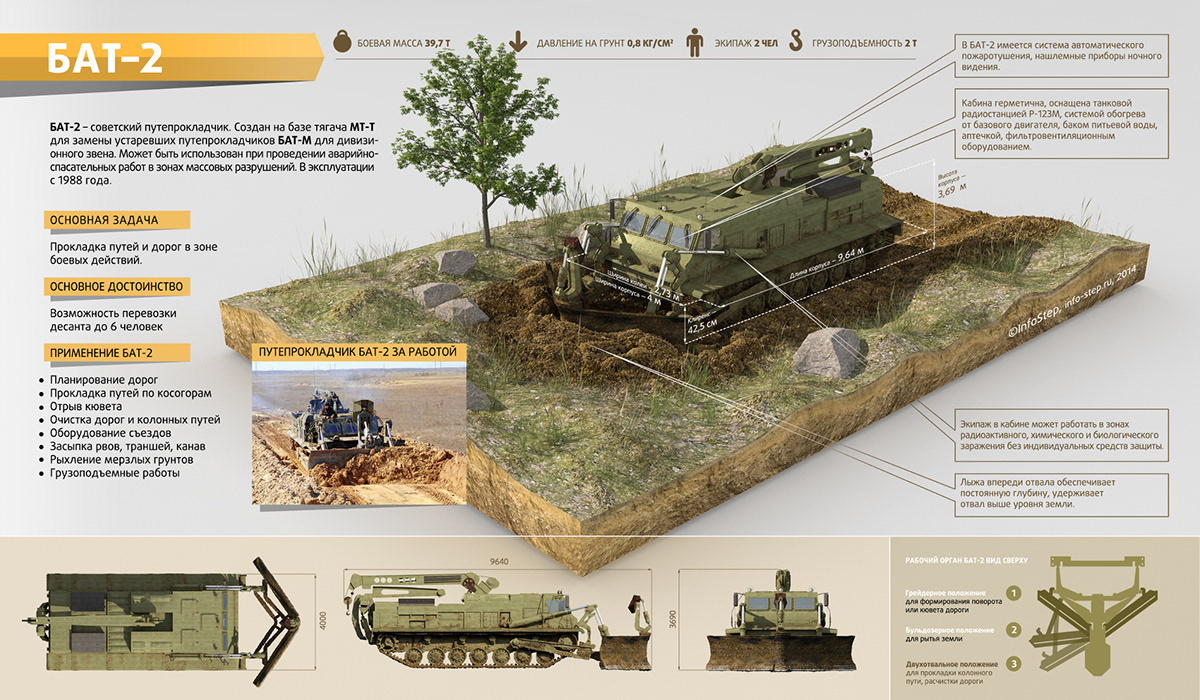
Russian-language infographic of the BAT-2, © infoStep, info-step.ru, 2014. Key labels, translated: combat weight 39.7 t; ground pressure 0.8 kg/cm²; crew 2; crane capacity 2 t; in service since 1988; can carry up to 6 troops; length 9.64 m, width 4 m, height 3.69 m. The blade diagram (lower right) shows its three positions: grader position, for forming a turn or a roadside ditch; bulldozer position, for digging earth; and two-wing (V) position, for laying column routes and clearing roads. Other callouts note the sealed cab with an R-123M tank radio, heater and filter-ventilation unit, and the ski in front of the blade that keeps a constant cutting depth.
THE CHASSIS: MT-T PARTS, NOT A T-64
The MT-T (Многоцелевой тягач — тяжёлый, "multi-purpose tractor, heavy"), also called Enei (Эней) and изделие 429AM, is the late-Soviet heavy tracked transporter-tractor designed to replace the AT-T. It came from the same Kharkiv bureau in the late 1970s and was built at Malyshev, with production usually given as 1979 to 1992 (some tables say 1991). In its cargo form it is a 25-tonne tractor with a 12–12.5-tonne cargo bed, a five-man cab with room for up to 18 more on the platform, a 25 tf winch, and a highway speed of 65 km/h. [DOCUMENTED, Russian Wikipedia "МТ-Т"; Weaponsystems.net]
The 1987 manual states the BAT-2's relationship to that tractor exactly: "The tracked chassis of the tracklayer is developed on the basis of the component parts of the heavy transporter-tractor MT-T." That is the right level of claim. The BAT-2 is not an MT-T with a blade bolted on. Its chassis consists of a frame, cab, power plant, transmission, running gear, pneumatics and electrical system. The frame is a welded box structure. The cab is at the front, the winch is in the middle of the frame, and the power plant and transmission are at the rear. [DOCUMENTED, 1987 technical description]
That is the one big layout change. Armforc puts it this way: "The running gear, transmission and suspension are fully analogous to the mechanisms and assemblies of the MT-T, with the exception of the location of the drive wheel, which on the BAT-2 is at the rear." The cargo MT-T is front-engined and front-driven, like a conventional artillery tractor. The BAT-2 has to carry a heavy hydraulic blade and its rams at the front, so the automotive plant goes to the back, the drive sprockets go to the back, and the idlers move to the front. Pioniertechnik makes the same point and adds that the cab was made narrower and longer than the MT-T's to leave room for the blade hydraulics. Weaponsystems.net says the same in English. [DOCUMENTED, armforc; Pioniertechnik; Weaponsystems.net]
What is shared with the T-64? The MT-T "was created using elements of the chassis of the T-64" tank. The typical description of the MT-T running gear, which by the armforc analogy is also the BAT-2's, is seven road-wheel stations a side with internal shock absorption, four return rollers, independent torsion-bar suspension, and a small-link metal track with parallel rubber-metal hinges. Russian Wikipedia's BAT-2 running-gear paragraph, citing the 1987 engineer-vehicles textbook Машины инженерного вооружения, adds that there is no main clutch and no planetary steering mechanism, with two side gearboxes in their place. That matches the BAT-2 manual's own transmission list. [DOCUMENTED, Russian Wikipedia; 1987 technical description]
What is not shared matters just as much, so that nobody reads the BAT-2 as "a T-64 bulldozer":
- The T-64's engine is the Kharkiv 5TDF (later the 6TD), an opposed-piston two-stroke diesel. The BAT-2 and the MT-T use the Chelyabinsk V-46-4, a conventional four-stroke V-12 of the V-2 family. There is no 5TDF in a BAT-2. For the T-64 as a Kharkiv tank, see Carousel vs. Bustle. [DOCUMENTED]
- The T-64's compact armoured hull, its autoloader carousel and its tank packaging have nothing in common with the BAT-2's welded box frame and eight-seat cab. [DOCUMENTED]
- Even the MT-T, the actual parent, is not a drop-in: the BAT-2 reverses the drive direction and reshapes the cab. [DOCUMENTED]
So the fair one-line version is: a rear-drive chassis built from MT-T components, whose running gear descends from T-64 practice. "T-64-based" with no qualifier is wrong.
One detail in the 1987 manual belongs to the earthmoving story, not the tank family tree. The BAT-2 can lock out selected road-wheel arms. The electrical description names a "suspension-off" panel with a selector for front or rear and left or right balancer stops, up and down buttons, and a stop button for the stop-screw motors. Locking the suspension gives the blade a stiffer working platform. That is a dozer's trick, not a tank feature. [DOCUMENTED, 1987 technical description]
Other machines built on the MT-T component family include the MDK-3 pit-digging machine, the BTM-4 high-speed trencher, the KGS-25 crane, the BG-1 tracked bulldozer and the UPG-92 impulse-powder firefighting vehicle. They are relatives, not BAT-2 variants. [DOCUMENTED, Russian Wikipedia "МТ-Т"]
ENGINE AND POWERTRAIN
The 1987 manual's own wording is the best starting point. The power plant "consists of the engine and the systems that serve it: lubrication, cooling and preheating, fuel feed, air cleaning, exhaust, and starting. The engine is a V-46-4, a four-stroke, multi-fuel, high-speed diesel of 522 kW, liquid-cooled, with supercharging." 522 kW works out to 709.7 metric horsepower, which is why every table says 710 hp. [DOCUMENTED, 1987 technical description]
The V-46 family is a Chelyabinsk development of the wartime V-2 V-12. The T-72's common production engines are the V-46 and V-46-6 at about 780 hp (574 kW in the engineer-troops comparison table for the IMR-2). The V-46-4 is a different, lower rating of the same family. It is not a typo for the tank engine, and it should not be called "the T-72 engine" without saying so. ChTZ built the engine; that is the extent of Chelyabinsk's documented part in the BAT-2. [DOCUMENTED]
Several other engine names circulate and are wrong. Weaponsystems.net gives "V-64-4 V12 diesel" on its BAT-2 and MT-T pages, which looks like a mash-up of V-46-4 and T-64; the same site's running text then says the MT-T "uses the V-64-4 diesel engine from the T-72," which compounds the typo with the wrong tank. Pioniertechnik names the "W46-6 of the T-72," which is the right family but the wrong mark. A Ukrainian technical-literature blog calls the MT-T engine an "A-24-4 (a modification of the V-46), similar to that installed on T-64 series tanks." The T-64 never carried a V-46, and "A-24-4" does not appear in the 1987 manual pages examined. [CONTESTED, Weaponsystems.net; Pioniertechnik; military-references.com]
The lubrication system is a circulating, combined type: oil tank, tube-and-plate radiator, oil pump, intake and fine filters, oil cleaner, priming pump, relief and drain valves. Cooling is a closed, forced-circulation liquid system with ejector cooling, and the same circuit warms the oil in cold weather. One TTX table gives an engine oil fill of 115 L of MT-16p, a transmission fill of 110 L of MT-8p, a coolant fill of 125 L (A-40 or A-65 antifreeze) and a hydraulic fill of 250 L, with 100 L in the tank. Those fluid figures come from a single table seen only as a search extract, and should be treated as provisional. [DOCUMENTED for the systems, 1987 technical description; SINGLE-SOURCE for the fluid capacities, twwiku.ru]
Fuel and range. The tank capacity is 1,746 L in the Ukrainian Wikipedia table and the twwiku extract; Weaponsystems.net rounds it to 1,750 L. Consumption is given as 275–300 L per 100 km on the road and 80–100 L per engine-hour while working, and the fuel radius is 500 km. One student table writes the radius as "500 km + 3 hours of work," which is a useful way to think about it: a road march followed by a short working period. The manual calls the engine multi-fuel, but the pages examined do not list the permitted fuels. [DOCUMENTED, Ukrainian Wikipedia; studfile; armforc]
Transmission. The manual lists a cylindrical reduction gear, a conical reduction gear with reverse, two gearboxes with final drives, and a transmission oil system, with no main clutch and no planetary steering mechanism. That is a different arrangement from a T-64 or T-72 tank, and one more reason not to describe the BAT-2 as having "T-64 running gear and transmission." A power take-off and a pump-drive reduction gear run the working-equipment hydraulics. An emergency hydraulic pack, an electric motor driving a pump through a reduction gear, sits in the lower stowage box on the right fender behind the cab. Its job is to bring the working equipment from the working position to the travel position if the main pumps fail, so that a broken-down machine can still be moved. [DOCUMENTED, 1987 technical description; Russian and Ukrainian Wikipedia]
SPECIFICATIONS
These are the figures that recur across the engineer-troops tables and the 1987 manual. Where a source disagrees, the other value is shown in the same row; nothing has been averaged.
| Item | Value | Notes and source |
| Designation | BAT-2 (БАТ-2); изделие / Object 454 | 1987 technical description; armforc; Weaponsystems.net |
| Role | Tracklayer / route-clearing tractor (путепрокладчик) | 1987 technical description |
| Parent chassis | Component parts of the MT-T; rear engine and rear drive | Unlike the front-drive cargo MT-T; armforc |
| Engine | V-46-4 V-12 multi-fuel diesel, liquid-cooled, supercharged | Built by ChTZ, Chelyabinsk |
| Power | 522 kW / 710 hp | 1987 technical description |
| Crew | 2, plus 6 sappers (eight-seat sealed cab) | 1987 technical description; armforc; Ukrainian Wikipedia |
| Combat weight | 39.7 t | 40.0 t in one training table [CONTESTED] |
| Length × width × height (travel) | 9,640 × 4,000 × 3,690 mm | Pioniertechnik gives a travel height of 3.96 m [CONTESTED] |
| Working length / height | 12.65 m / 3.34 m | Pioniertechnik only [SINGLE-SOURCE] |
| Track / ground clearance | 2,730 mm / 425 mm | armforc |
| Ground pressure | 0.8 kg/cm² | 0.78 in Weaponsystems.net |
| Power-to-weight | 17.9 hp/t | [ESTIMATE] from 710 hp and 39.7 t |
| Road speed | 60 km/h | 65.5 km/h in one training table, probably the MT-T figure [CONTESTED] |
| Average dirt-road speed | 28–35 km/h | Pioniertechnik: 35 |
| Fuel | 1,746 L | Sometimes rounded to 1,750 L |
| Consumption | 275–300 L/100 km; 80–100 L per engine-hour | studfile; armforc |
| Range | 500 km | "500 km + 3 hours of work" in one table |
| Ford / wall / trench | 1.3 m / 0.8 m / 2.7 m | Weaponsystems.net only [SINGLE-SOURCE]; 1.3 m is also the MT-T ford |
| Gradient / side slope | 60 % / 40 % | Weaponsystems.net only [SINGLE-SOURCE] |
| Blade width, dozer | 4,570 mm | Blade height 1.20 m (Pioniertechnik) |
| Blade width, grader | 4,300 mm | 4,280 mm in Pioniertechnik [CONTESTED] |
| Blade width, two-wing (V) | 4,000 mm | The column-route setting |
| Earthmoving rate | 350–400 m³/h | Levelling, filling, ramp cutting |
| Column route | 6–8 / 2–3 / 8–15 / 0.2 km/h | Rolling country / brush and light woods to 30 cm / virgin snow / forest blowdown |
| Crane | 2 t; outreach 7.36–7.365 m; hook height about 7.42–7.5 m; 360° slew | Can lower into a 3.5 m pit |
| Winch | 25 tf; 100 m of 29 mm cable | Taken entirely from the AT-T tractor |
| Ripper | Rear; depth 500 mm ("not less than 500 mm") | Ukrainian Wikipedia; armforc |
| Radio / intercom | R-123M / R-124 | armforc; R-123 named in the 1987 cab description |
| NBC protection | Sealed cab, filter-ventilation unit, collective-protection system | 1987 technical description |
| Armour | No thickness published | Weaponsystems.net and Pioniertechnik: cab not armoured |
| Armament | None; mounts in the cab for the crew's own rifles | 1987 technical description |
| Production total | Not published | "Small series" |
THE UNIVERSAL BLADE
The 1987 manual's inventory of working equipment is a universal dozer, a crane, a ripper and a winch, on the tracked chassis. Ukrainian Wikipedia adds the power take-off, the hydraulic drive and the electrical control of the hydraulics. The blade is the centre of it. [DOCUMENTED, 1987 technical description; Ukrainian Wikipedia]
The blade sits at the front on an enveloping frame and a pushing frame. Ahead of the mouldboard is a ski (лыжа), and hydraulics control lift, down-pressure, tilt, and the stowing of both the blade and the ski. Changing the blade's plan shape, swinging the wings into one of the working configurations, is done by hand by the crew, and the wings are then locked with telescopic braces. Russian Wikipedia, citing Yu. G. Veremeev, says there are four lock positions. The three named working modes, which every serious account repeats, are: [DOCUMENTED, armforc; Russian and Ukrainian Wikipedia; Pioniertechnik]
- Dozer (бульдозерное). The wings are in line with the centre section, square to the direction of travel. Width 4,570 mm. Used for digging, filling pits and rough levelling.
- Two-wing, V or "arrow" (двухотвальное; German Pfeilstellung). The wings fold back into a V and throw material to both sides, for cutting a column route or clearing snow. Width 4,000 mm. This is the column-route setting.
- Grader (грейдерное). The wings are set in a skewed line, left or right, to cut a ditch, push spoil to one side or form a curved edge. Width 4,300 mm in the Russian and Ukrainian tables, 4,280 mm in Pioniertechnik.
Pioniertechnik also gives a blade height of 1.20 m, and a working length of 12.65 m and working height of 3.34 m against a travel length of 9.64 m. Those working-envelope figures have not been checked against the 1987 dimensioned drawings. [SINGLE-SOURCE, Pioniertechnik]
The ski in front of the blade lets the mouldboard take a constant cut that follows the ground rather than the pitching of the hull. The BAT-M has the same feature. Hydraulics raise and lower the blade, force it down, tilt it, move the dozer, the ripper and the ski between their working and travel positions, and lock the wings in the chosen working position. For road travel the blade is raised high in front of the cab, as in the photographs on this page. [DOCUMENTED, Ukrainian Wikipedia; Russian Wikipedia "БАТ-М"]
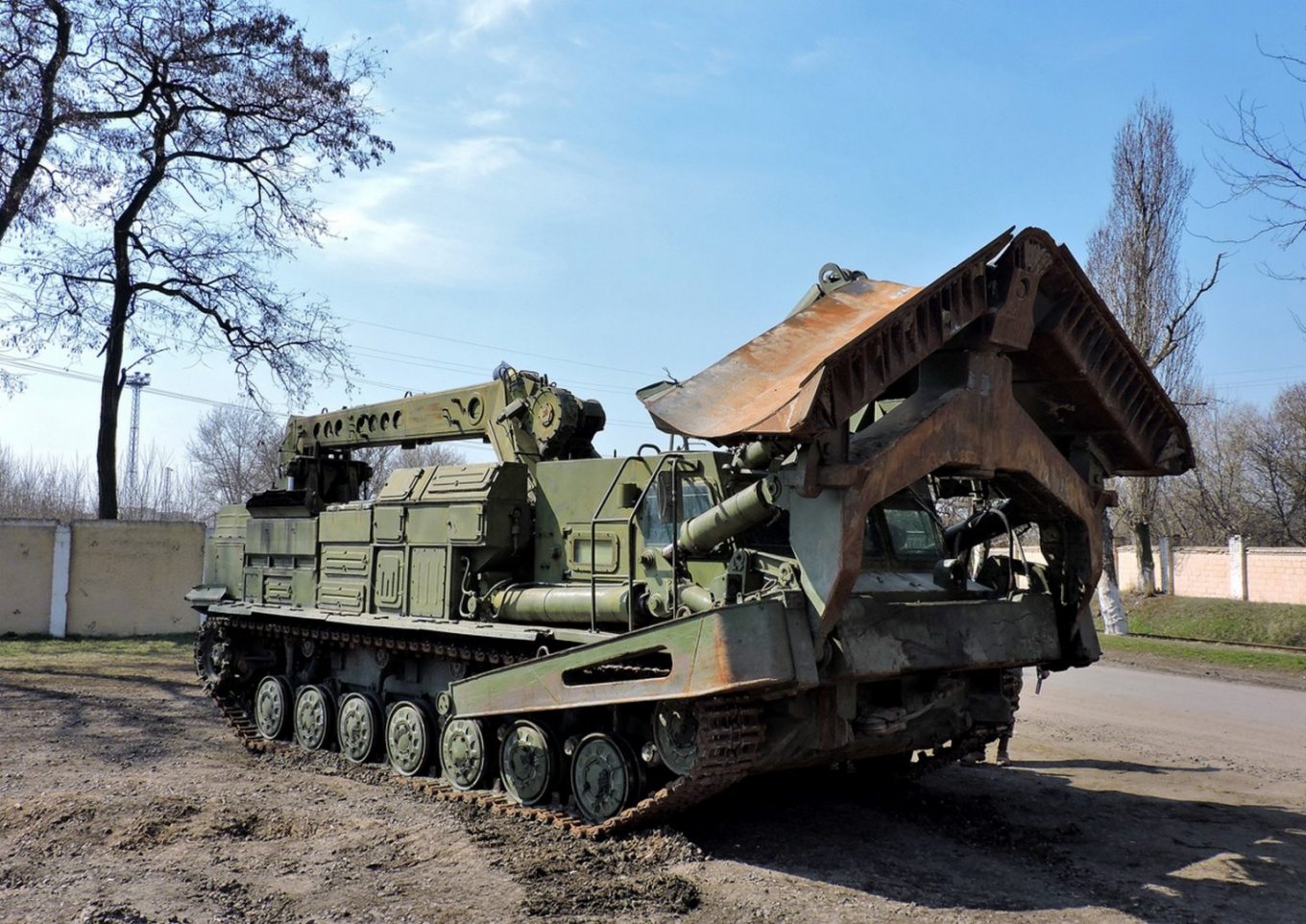
A parked BAT-2 seen from the front right, with its folding blade raised and the wings set back in the two-wing (V) position used for cutting column routes. The crane jib lies folded along the roof, and the seven road wheels and the front idler are visible.
OFFICIAL WORK RATES
The engineer-troops "technical productivity" figures are the ones to print. They are rates for the machine in the stated conditions. They are not guarantees for a cratered or mined road under fire. [DOCUMENTED, studfile; Pioniertechnik; Ukrainian Wikipedia]
- Column route, rolling country: 6–8 km/h
- Column route, brush and light woods with trees up to 30 cm: 2–3 km/h
- Column route, virgin snow (Pioniertechnik adds "up to 50 cm snow depth"): 8–15 km/h
- Forest blowdown: 0.2 km/h, also written as 200 m/h
- Levelling, cutting ramps, filling and general earthmoving: 350–400 m³/h
A 31 July 2023 report by ArmyInform, the Ukrainian defence ministry's news agency, interviewed a Ukrainian airborne engineer crew in Donetsk oblast, and it is a useful field check on those figures. The driver, Vitalii, and the unit commander, Anton, said that clearing 100 m of road took 20 to 30 minutes, depending on how much rubble there was. They said the machine's top speed is 60 km/h but that it moves at about 5 km/h while working, and that its lifting capacity is "not more than two tons," meaning the crane. Twenty to thirty minutes per 100 m is 0.2–0.3 km/h. That is the official forest-blowdown rate, not the 6–8 km/h rolling-country rate, which is about what you would expect on a road broken up by artillery. [DOCUMENTED as a field account, ArmyInform]
Against its predecessor the numbers are a clear step up. The BAT-M's earthmoving rate is given as 200–250 m³/h; the BAT-2's is 350–400. [DOCUMENTED, Russian Wikipedia "БАТ-М"; studfile]
THE CRANE
A hydraulic crane sits on a slewing ring on the hull roof, roughly amidships. Its capacity is 2 tonnes. Maximum outreach is 7,365 mm in the armforc table and 7.36 m in most others; Pioniertechnik gives a maximum hook height of 7.42 m. Russian Wikipedia, citing Veremeev, says the hook can be lowered into a pit 3.5 m deep or raised to about 7.5 m, and that the jib slews through 360°. [DOCUMENTED, armforc; Pioniertechnik; Russian Wikipedia]
The crane must not be confused with the 25 tf winch. Ukrainian Wikipedia's general-arrangement section lists "a cargo winch, pulling force 25 tf" under the crane heading, which is a grouping error. The 25 tf figure belongs to the vehicle's pulling and recovery winch in the middle of the frame. The crane lifts 2 tonnes. [DOCUMENTED; the Ukrainian Wikipedia heading is the error, not the 25 tf figure]
The crane lets a BAT-2 place road-and-bridge blocks, handle culvert sections and do the light lifting a route-support party needs without calling up a separate truck crane. It is not an IMR-style manipulator. There is no grabbing arm for pulling tree trunks or wall slabs out of a lane, which is one reason the IMR exists alongside the BAT rather than instead of it.
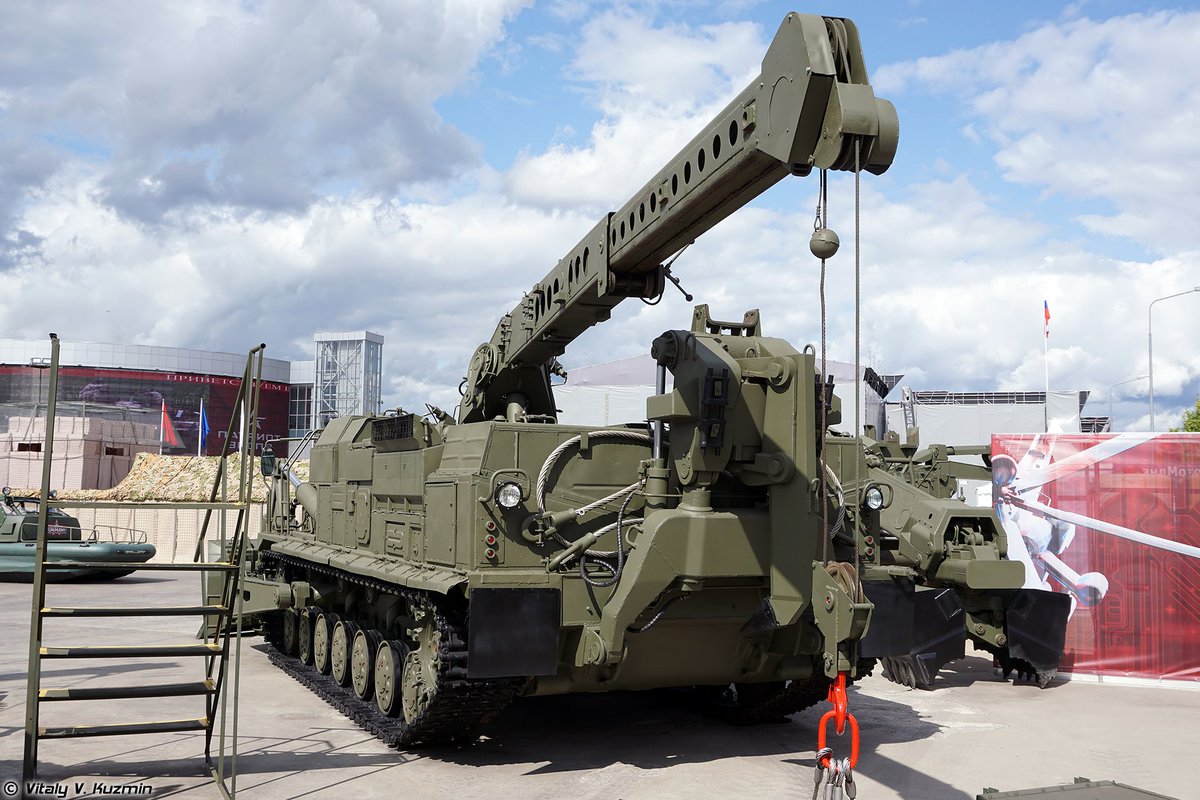
Rear view of a BAT-2 on static display at an Army expo, with the crane jib raised and its hook lowered. The rear working gear and the towing and cable fittings on the back of the hull are visible, along with the rear lights. Photo © Vitaly V. Kuzmin.
THE WINCH
On the winch the 1987 manual is unusually precise. In the middle of the frame is "a mechanical-type winch, reversible, with traction rollers and an unloaded built-up drum. The winch is taken entirely from the AT-T tractor." The working length of the rope is 100 m, and the rope is a steel cable 29 mm in diameter with a thimble on the end. A fairlead on the front of the frame feeds the rope into the first groove of the forward traction roller and supports it when the pull is off the vehicle's centreline, and a cleaner in the fairlead housing scrapes off mud and snow. Electrical gear works the separator clutch and the drive brake and signals when the rope is fully paid out. The tables give the line pull as 25 tf, which is also the AT-T and MT-T figure. [DOCUMENTED, 1987 technical description; armforc; Russian Wikipedia "МТ-Т"]
The reuse is a doctrinal fact as well as a mechanical one. The BAT-2 is a new chassis, but the pull it can put on a stuck vehicle or a felled obstacle is the pull the Soviet heavy tractor already had. Armforc says the winch is "similar in design to the BAT-M's winch," which comes to the same thing, since the BAT-M also sits on an AT-T. It is a small irony that the machine meant to replace the BAT-M carries its predecessor's tractor winch.
THE REAR RIPPER
A ripper (Russian рыхлитель, Ukrainian розпушувач) is mounted at the rear. In the Ukrainian description it is intended "for loosening hard and frozen upper layers of soil." It works to a depth of 500 mm, given in one table as "not less than 500 mm." It has a working element and a traversing drive, and the hydraulics move it between the working and travel positions. Pioniertechnik publishes photographs of the tooth in its travel position. On frozen ground, ripping first and then dozing is often the only practical way to move earth at all, which matters for a machine that went first to the Urals Military District. [DOCUMENTED, Ukrainian Wikipedia; Pioniertechnik; armforc]
THE CAB: EIGHT SEATS, SEALED, NOT RATED AS ARMOUR
The 1987 manual's cab paragraph says the cab is there "to accommodate and protect the crew from the effects of the surrounding environment, and to accommodate the controls and the apparatus. The cab is welded, eight-seat, closed-type, sealed." Inside are two rows of seats. The front row holds the driver-mechanic and the second crewman; the second row is the sapper section. Every standard table agrees on the split: two crew and six troops. Armforc: "Besides the crew, a sapper section can also be accommodated in the cab." Pioniertechnik's "besides the crew, one additional person" is an error against the eight-seat manual and the 2+6 tables. It is also wrong to describe the cab as holding "a crew plus up to eight." Eight is the total. [DOCUMENTED, 1987 technical description; armforc; Ukrainian Wikipedia]
Russian Wikipedia, citing the 1987 engineer-vehicles textbook and Veremeev, adds that the cab's inner and outer surfaces are lined, with sound-insulating profiles between the lining and the shell, and that the cab is fully sealed. The manual's equipment list puts, on the rear wall, the lock for the filter-ventilation unit (FVU) valve drive, a first-aid kit, a suspension-control contactor box, an engine-stop box, an antenna and a cross-cut saw. In a niche of the cab is the blower with its filter-absorber. On the right wall are an intercom set and locks for the crew's personal assault rifles. On the left wall are the pump-drive reduction-gear lever, the blower-control box, another intercom set, a socket for a night-vision device, a dome light, a contactor box and the working-equipment control panel. The electrical text names a ZETsP-2 (ЗЭЦП-2) protective system and a blower motor in the protection circuit. [DOCUMENTED, 1987 technical description; Russian Wikipedia]
Pioniertechnik says the cab protects against radioactive, biological and chemical contamination, so that the crew can work in a contaminated area without individual protective equipment. That is the FVU and overpressure claim, and it agrees with the manual, with armforc, and with the same claim made for the BAT-M. The 2014 infoStep infographic says the same thing, and adds an automatic fire-suppression system, night-vision driving devices, a heater and a drinking-water tank. [DOCUMENTED, Pioniertechnik; armforc; infoStep]
Ballistic armour is a separate question, and it should not be blurred into the NBC paragraph. The 1987 manual pages examined describe a welded, sealed, lined cab. They never give a plate thickness or a bullet-resistance rating. Weaponsystems.net's protection line reads "Armor: No," with "NBC system: Yes, overpressure." Pioniertechnik says flatly, "Die Kabine ist nicht gepanzert" ("The cab is not armoured"). On the other side, some Ukrainian writing, including Militarnyi's reporting on the 2020 Chornobyl-zone fires, calls the type "armoured tracklayers" (броньовані шляхопрокладачі) in a loose, everyday sense, and Russian Wikipedia calls it an "engineering tank" and, in one sentence about its development, an armoured vehicle. None of those words is a measurement. The honest summary is: sealed, sound-insulated and NBC-filtered; ballistic protection not specified in the official text examined; two Western specialist pages say the cab is not armoured. No armour thickness is published, and none is given here. [DOCUMENTED for the absence of a thickness and for the Western "not armoured" wording; CONTESTED as to popular "armoured" language]
The rifle locks in the cab are for the crew's own weapons. The BAT-2 has no vehicle armament.
Communications, per armforc, are an R-123M VHF radio with a stated range of up to 20 km and an R-124 intercom. The 1987 cab list names the R-123 and the intercom sets. [DOCUMENTED, armforc; 1987 technical description]
ROAD PERFORMANCE AND THE PRICE OF WEIGHT
Road speed is the whole point of the new chassis. The BAT-M, on the AT-T, weighs 27.5 tonnes, has a 415 hp engine and tops out at about 35–35.5 km/h. The BAT-2 weighs 39.7 tonnes, has 710 hp, and is listed at 60 km/h on the road and 28–35 km/h on dirt, with a 500 km fuel radius. That puts it in the same league as an MT-T or a T-72 on a road march, at roughly twice the BAT-M's road speed. That is why Soviet writing presents it as the high-speed replacement at divisional level: a route machine that can keep pace with the column it is clearing for. [DOCUMENTED, armforc; Russian Wikipedia "БАТ-М"]
Russian Wikipedia's evaluation paragraph, citing Veremeev, names the cost: a disproportionate rise in weight and a high ground pressure, so that the machine "often gets stuck." That verdict has not been independently tested, and it should be read as one specialist's judgement, not as a measured soil-mechanics result. A 0.8 kg/cm² ground pressure is ordinary for a heavy tracked vehicle, but a 40-tonne dozer pushing a full blade into wet ground is a different load case from a tank driving across it. [SINGLE-SOURCE for "often gets stuck," Russian Wikipedia citing Veremeev]
The 65.5 km/h top speed found in one training compilation is almost certainly the MT-T's 65 km/h figure carried over. The same table gives the mass as 40.0 tonnes against the standard 39.7. Both are shown in the specification table, but 60 km/h and 39.7 t are the figures to use. [CONTESTED, studfile]
PRODUCTION, DATES AND FACTORIES
Production and dates are as contested as the origin story, and for the same reason. Summarized:
- Dossier A: accepted in 1987; series production at KhZTM (Malyshev) from 1988; a small series; first issues to the Urals Military District in the second half of 1988 and early 1989; Soviet re-equipment never completed. The end of production is given as 1991 (Weaponsystems.net) or 1993 (Wikipedia infobox and a 2026 Russian popular item).
- Dossier B: accepted on 26 May 1980 by Minister of Defence order no. 151; series production from 1980 at Stroydormash in Kiev, on chassis from Malyshev.
No production total has been published. "A small series," "a certain number issued to the troops" and "re-equipment not completed" are the strongest statements the sources support. Any figure in the hundreds, or any other round number, would be a guess, and this page does not make one. [CONTESTED on years and plant; no total published]
OPERATORS
Soviet issue and the successor states. Under dossier A, the type went first to the Urals Military District in 1988–89, and also to engineer and civil-defence formations, in numbers too small to finish a force-wide replacement of the BAT-M. That is why both machines survived in the post-Soviet inventories, and why the BAT-M is still the machine many people picture when they hear "BAT." [SINGLE-SOURCE, Ardashev via Russian Wikipedia]
The Military Balance 2016, as cited in Russian Wikipedia, listed Russia with "some" BAT-2s and Ukraine with 53. A Belarusian holding is cited from a 2018 report in Armiya magazine on a military competition event. [SINGLE-SOURCE to those citations; the Military Balance volume itself was not checked]
Ukraine's 2008 surplus decision is on the public record. Cabinet of Ministers instruction no. 1092-r of 6 August 2008 authorized the disposal of a list of Armed Forces property that included ten BAT-2s. Wikipedia's remark that "over time their number decreased" is an inference from that decision and the 2016 figure of 53, not a year-by-year inventory. [DOCUMENTED as cited, Russian Wikipedia]
On 14 January 2022, Militarnyi reported, citing the state concern Ukroboronprom, that the state-owned Kharkiv Automobile Plant had finished repairing a batch of BAT-2s. The work covered the major assemblies, the hydraulic systems, the engineer equipment and the running gear, and after a performance check the machines were handed to an engineer unit of the Armed Forces. The size of the batch was not given. [DOCUMENTED, Militarnyi]
Export users. Ardashev, as cited in Russian Wikipedia, names Algeria, Egypt, Iraq and Syria as operators and says foreign sales began after 1991. That list rests on a single source: no delivery contract, parade record or Military Balance entry has been found for those countries. Armforc adds the GDR, Czechoslovakia and Hungary with the word "presumably," and that is a presumption, not a delivery record. [SINGLE-SOURCE for the four export names; UNVERIFIED for the former Warsaw Pact users]
PEACETIME WORK IN UKRAINE
The road-and-disaster role is not just a brochure line. Ukrainian Wikipedia, with dated local citations, records several jobs: [DOCUMENTED, Ukrainian Wikipedia and the citations gathered there]
- January 2016: a Navy BAT-2 clearing the Odesa–Mykolaiv highway, and roads in the Bilhorod-Dnistrovskyi and Bolhrad districts, after a blizzard.
- Early 2018: a military BAT-2 called in to help the road service in Smila.
- April 2020: engineer troops sent seven BAT-2s to fight the fire in the Chornobyl exclusion zone (Defense Express). Here the sealed, filtered cab and the ability to cut firebreaks on contaminated ground were exactly what the machine had been designed for.
- October 2020: two BAT-2s used against the wildfires in Luhansk oblast (Ukrinform and the State Emergency Service).
- February 2021: a machine from the Desna training centre clearing snowbound approaches to villages.
THE WAR SINCE 2022
Both armies went into the full-scale war with leftover Soviet-issue BAT-2s, and both have lost them. The best way to count those losses is Oryx's lists, which include only losses backed by photographs or video. Their figures are floors, not inventories: the real totals can only be equal or higher, and the figures say nothing about how many machines remain in service.
| Side | Lost (floor) | Breakdown | Oryx page updated |
| Russia | 17 | 9 destroyed, 3 damaged, 1 damaged and abandoned, 4 captured | 15 Nov 2026, 8:13 a.m. CST |
| Ukraine | 5 | 3 destroyed, 1 captured, 1 damaged and captured | 15 Nov 2026, 8:14 a.m. CST |
On the Russian page, the next entry after the BAT-2 is the related MT-T-family MDK-3 pit-digger (3 vehicles), and there is no separate BAT-M heading. The individual photographs have not been checked here for BAT-M and BAT-2 mix-ups, so a small identification risk remains, but that is not a reason to change the floor. On the Ukrainian page, file dates on the three destroyed machines include 2 June 2023 (a frame that also shows an IMR-2), 17 March 2024 and 16 July 2024. An Oryx snapshot from May 2022 listed a single Ukrainian BAT-2, captured, so the list has grown since. [DOCUMENTED, Oryx, both pages modified 15 November 2026]
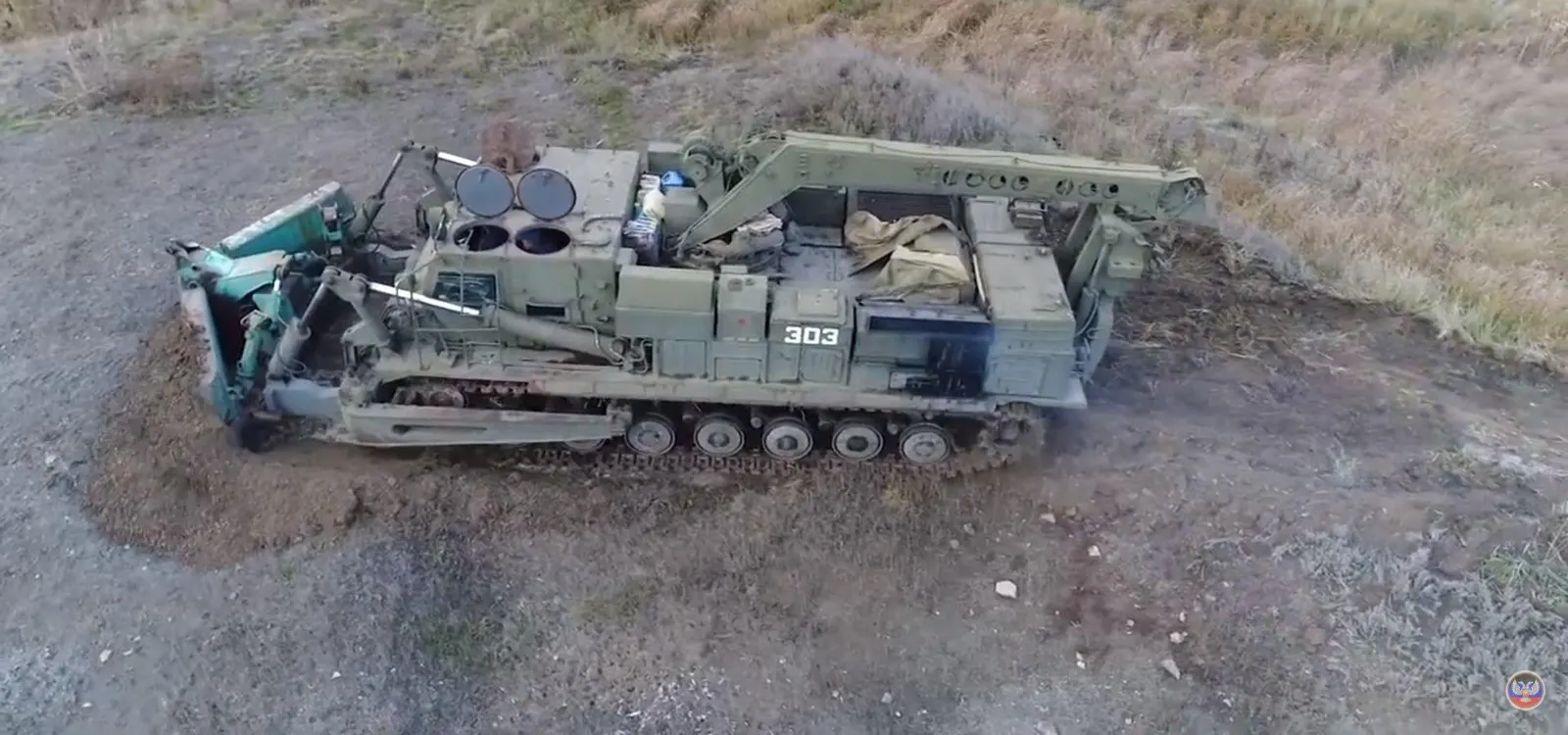
Overhead drone view of a BAT-2 with the hull number 303 pushing earth with its blade. The two round searchlights on the cab roof and the folded crane jib are clearly visible. DNR video still; date not confirmed.
Ukrainian open reporting fills in some of the incidents behind those numbers:
- June 2022: the 79th Air Assault Brigade reported destroying a Russian BAT-2. [DOCUMENTED, Militarnyi via Ukrainian Wikipedia]
- Early September 2022: a Russian BAT-2 captured in Kharkiv oblast. [DOCUMENTED, Ukrainian Wikipedia]
- 31 July 2023, Donetsk oblast (ArmyInform): a Ukrainian airborne engineer crew described using the BAT-2 "on all axes," clearing trees and concrete rubble under artillery fire. They said the machine is a priority target because it is special equipment; in one account, when infantry, tanks and the tracklayer moved up together, the enemy fired at the engineer vehicle first. They worked with sappers ahead of them on new ground, with infantry in tree lines they already held, and with electronic warfare cover against Lancet and ZALA-type drones. Maintenance, they said, takes up to three people, and before each run the crew checks the mechanisms, fluids, filters and oil. [DOCUMENTED, ArmyInform]
- February 2024, near Vodiane in the Vuhledar area: a machine recorded destroyed. Ukrainian reporting noted that the Russians had been using it, unsuccessfully, for mine clearing, a job it was neither designed nor equipped for. [DOCUMENTED, Ukrainian Wikipedia]
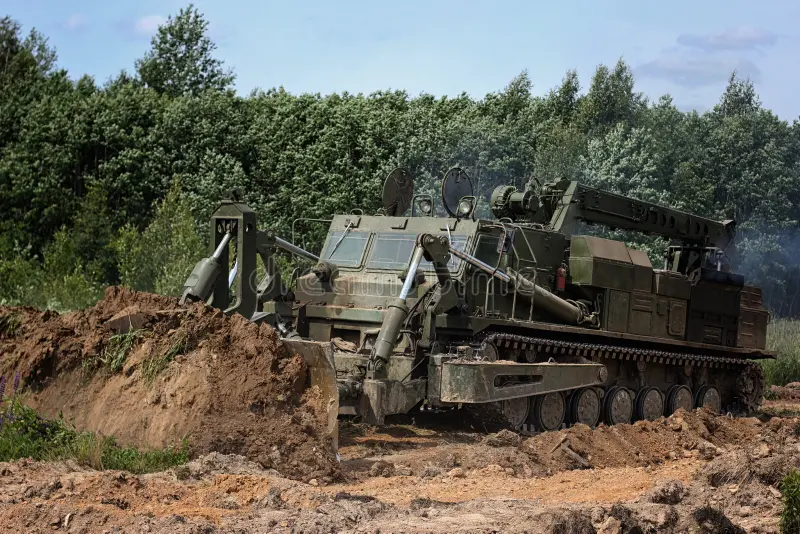
A BAT-2 pushing up an earth berm at the edge of a forest, with the blade down and the two large round searchlights on the cab roof.
NOT A MINE-CLEARER
A 25 April 2026 Russian item, citing the defence ministry through TASS, said Russian sappers were using the BAT-2 every day to "neutralize hundreds of mines and explosive devices" and to support the advance of assault groups, with small drones for reconnaissance. Set that beside the February 2024 Ukrainian comment and beside the issued equipment list. [DOCUMENTED as a ministry claim, www1.ru / TASS]
The BAT-2 can push spoil, fill a crater and clear a lane through debris. It has no mine plough, no electromagnetic attachment for magnetic fuzes, no line charge, and no published protection rating against a mine blast. All of those belong to the IMR-2 family, which exists for exactly that job. A BAT-2 driven into a minefield is a misuse of the type, however often it happens. A ministry press line that treats it as a demining machine describes how it is being used, not what it was designed to do. [CONTESTED as a description of the type's purpose]
VARIANTS AND MODERNIZATION
No factory-designated series variant, such as a BAT-2A or BAT-2M, can be described from an official specification sheet. Ukrainian Wikipedia's "see also" list includes an episode of the television programme Tekhnika viiny (no. 64) titled "Tracklayer BAT-2M," but a programme title is not a service designation. Andrei's 2021 note that VNIItransmash was modernizing the BAT-2, with completion planned for 2019, has not been followed by any official acceptance, named variant or production photograph. The one documented Ukrainian "upgrade" is not a new design at all: it is the January 2022 overhaul at the Kharkiv Automobile Plant. [UNVERIFIED as to any BAT-2M or completed modernization]
THE BAT-M: THE PREDECESSOR
The BAT-M (бульдозер-артиллерийский тягач модернизированный, "bulldozer artillery tractor, modernized") is the modernized BAT on the AT-T heavy tractor. It weighs 27.5 tonnes and has a V-401 or A-401G engine of 415 hp, a highway speed of 35–35.5 km/h and a range of over 500 km (about 950 kg of fuel, or 12–15 hours of independent work). Its cab is sealed and has a filter-ventilation unit; Wikipedia's BAT-M infobox gives "armour type: none." [DOCUMENTED, Russian Wikipedia "БАТ-М"]
The BAT-M's blade can be set 5.0 m wide as a dozer, 4.5 m in the two-wing position or 4.0 m as a grader. It too has a ski, and in travel order the blade is swung up and over the cab, which takes weight off the front road wheels. Earthmoving is given as 200–250 m³/h, and column-route work as 1.5–10 km/h. It has a 2-tonne crane worked from a remote pendant, and a powerful engine-driven winch. The original BAT's blade was worked by cables; the BAT-M's is hydraulic. In Soviet force structure the engineer-sapper company of a motor-rifle or tank regiment held one BAT-M, and the engineer-sapper battalion of a division held nine. The East German army bought a batch. Wikipedia's own words settle the order: "Later replaced by the BAT-2." [DOCUMENTED, Russian Wikipedia "БАТ-М"]
Against that predecessor, the BAT-2 is heavier, much faster on the road, more productive at earthmoving (350–400 against 200–250 m³/h), able to carry six sappers, and built on a newer chassis, whose winch is nonetheless the old AT-T winch. It did not make the BAT-M disappear, because it was never built in the numbers a divisional replacement needed.
| Item | BAT-M (earlier) | BAT-2 (later) |
| Base tractor | AT-T (front drive) | MT-T components (rear drive) |
| Weight | 27.5 t | 39.7 t |
| Engine | V-401 / A-401G, 415 hp | V-46-4, 710 hp |
| Road speed | 35–35.5 km/h | 60 km/h |
| Blade widths (dozer / V / grader) | 5.0 / 4.5 / 4.0 m | 4.57 / 4.0 / 4.30 m |
| Earthmoving | 200–250 m³/h | 350–400 m³/h |
| Crane | 2 t | 2 t |
| Winch | AT-T winch | AT-T winch, 25 tf |
| Cab | Sealed, FVU | Sealed, FVU, 2 crew + 6 sappers |
THE IMR FAMILY: THE ARMOURED COMPETITOR
The инженерная машина разграждения (IMR, "obstacle-clearing engineer vehicle") is the Soviet and Russian engineering tank in the strict sense: a tank hull, a crew of two, a dozer blade, a telescopic manipulator, mine-clearing equipment, a machine gun, and a sealed, protected compartment. It is a separate family, not a BAT-2 follow-on.
- IMR (later IMR-1): T-55 hull, about 37.5 t, 580 hp, about 50 km/h. Dozer 4.15 m, grader 3.4 m; manipulator 2 t at 8.8 m reach. Column route 5–8 km/h; forest blowdown 200–300 m/h; urban rubble 160–200 m/h. Deep-wading gear to 5 m, filter-ventilation, anti-radiation protection. [DOCUMENTED, studfile]
- IMR-2: designed at Omsk, with working equipment from Chelyabinsk (SKB-200) and Kramatorsk (NKMZ); accepted 1980, series from 1982 at Uralvagonzavod and NKMZ. T-72 chassis, GBTU Object 637. Dozer and crane-manipulator, track-width mine plough, an electromagnetic attachment against magnetic fuzes, and a mine-clearing charge installation; a 7.62 mm PKT machine gun in the operator's cupola. 42.6 t, 574 kW (the 780 hp V-46 class), 60 km/h. The IMR-2M is the 1990s modernization. [DOCUMENTED, Russian Wikipedia "ИМР-2"; studfile]
- IMR-3 and IMR-3M: accepted in 1999 on a T-90-family chassis; the IMR-3M is the later Uralvagonzavod production mark. 840 hp; 49.5 t in the IMR-3M infobox and 50.8 t in some IMR-3 tables; a 12.7 mm machine gun in place of the PKT. [DOCUMENTED / CONTESTED on mass, Russian Wikipedia "ИМР-3М"; studfile; VPK.name]
Veremeev's verdict, as quoted in the BAT-2 Wikipedia article, is that the IMR-2 can do every one of the tracklayer's jobs and is the BAT-2's "main competitor," but is much more expensive. That is a fair statement, with one correction: the IMR is also a mine-clearing and obstacle-breaching vehicle, which the BAT-2 is not. The two sit in the same movement-support system and do not replace each other. [SINGLE-SOURCE for the "competitor" wording, Russian Wikipedia citing Veremeev]
THE PKT-2: THE LIGHTER TRACKLAYER
The PKT-2 is the lighter, lower-echelon tracklayer in the same Soviet road-machine set. It runs on the IKT tractor with a two-man crew. Figures in circulation are a D12A-375 engine of 375 hp (276 kW in one table), a mass of 21 or 23 tonnes depending on the source, 45 km/h on the road, a blade of about 3.33 m in the two-wing setting and 3.8 m as a dozer, and a 1.2 m ford. It is a different weight class and a different tractor family, not a BAT-2 derivative. [DOCUMENTED as to the class; CONTESTED on mass, studfile; bmz.ru]
WESTERN ANALOGUES
Two Western machines often get mentioned alongside the BAT-2, and both comparisons are loose.
The US M9 ACE (Armored Combat Earthmover) is an air-transportable, aluminium-armoured tractor with a scraper bowl, built for the combat-engineer companies of heavy brigades. It is a much lighter vehicle with a smaller engine, designed to dig and carry rather than to run a 4.5 m blade down a column route at 6–8 km/h and then march at 60 km/h with six sappers aboard. It is a doctrinal cousin, not a match in weight or speed.
The armoured Caterpillar D9 used by the Israel Defense Forces is a civilian heavy dozer wrapped in armour and used under fire to break obstacles, demolish structures and clear routes. By BAT-2 standards it is slow and very heavily protected. It has no high-speed march, no eight-seat sealed cab of this kind, and no 25 tf tractor winch. It is what you build if you start from a construction dozer instead of a fast artillery tractor. Neither comparison is based on an official specification sheet for the Western vehicle, and this page does not attempt a full Western comparison.
DOCTRINE: WHERE THE BAT-2 FITS
The Soviet and post-Soviet term is отряд обеспечения движения (OOD), a movement-support detachment. A textbook answer from a student officer's exam ticket gives its purpose: the OOD is sent out "to clear and restore a road, to lay a column route, and in some cases to build crossings." It is usually built from engineer-sapper subunits and their machines, attached to the unit it serves. A longer instructional outline breaks an OOD into a reconnaissance and obstacle-clearing group, one or two road-and-bridge groups, and a combat-support group. [DOCUMENTED, studfile; studopediaru]
Within that system the BAT-type tracklayer is the machine that cuts and keeps up the column route and the military road: the 6–8 km/h work in rolling country, the snow cut, the crater fill, the ramp down to a river. The IMR punches a lane through forest or urban rubble and, in the IMR-2 and later marks, through a minefield. The MDK and BTM families dig pits and trenches. The MTU family lays bridges. The lighter PKT does a BAT's job at a lower echelon. [DOCUMENTED]
The one hard holding figure is for the older BAT-M: one per regimental engineer company and nine per divisional engineer battalion. In the Ardashev account, the BAT-2 was meant to replace that BAT-M holding at divisional level. Because only a small series was built, many units kept the BAT-M, or a mix of the two, through the 1990s and after. A January 2022 Forbes remark that a Russian battalion's OOD "had four BAT-2s" has not been confirmed in the doctrinal material and is not a table of organization; no documented BAT-2 holding per regiment, division or OOD has been found. [DOCUMENTED for the BAT-M holdings; UNVERIFIED for any BAT-2 holding]
The current war has not changed that division of labour; it has only made the cost of ignoring it visible. A BAT-2 clearing a broken road under artillery fire, as in the Donetsk ArmyInform report, is doing the job it was built for, and is a priority target because of it. A BAT-2 pushed into a minefield in place of an IMR is doing a job it was never fitted for.
COMMON MISTAKES
- "The BAT-M is the upgraded BAT-2." No. The BAT-M is the earlier machine on the AT-T. The BAT-2 was meant to replace it and never fully did.
- "The BAT-2 is T-64-based." Only with a qualifier. Its chassis is built from MT-T components, and the MT-T's running gear descends from T-64 practice. It has no 5TDF engine and no tank hull, and unlike the cargo MT-T it is rear-engined and rear-driven.
- "V-64-4," "W46-6" or "the T-72's 780 hp engine." The engine is the V-46-4, 522 kW / 710 hp.
- "Built by the Kharkiv Tractor Plant" or "designed in Chelyabinsk." KhTZ built the MT-LB, not the BAT-2. ChTZ built only the engine.
- "In service from 1980, built by Stroydormash" stated as fact. That is one of two competing accounts; the other says 1987 and the Malyshev plant.
- "A crew plus up to eight troops," or "one extra man." The cab has eight seats in total: two crew and six sappers.
- An armour thickness. None has been published. NBC sealing is documented; ballistic armour is not.
- "A 25-tonne crane." The crane lifts 2 t. The 25 tf figure is the winch.
- A production total, or a BAT-2M series. Neither is documented.
- "A mine-clearing vehicle." It is not one by design, whatever it is being used for.
- Oryx counts with no date, or used as inventories. They are photographic floors, here as of 15 November 2026.
- Object 454 and Object 429AM mixed up. 454 is the BAT-2; 429AM is the MT-T.
- The 1967 and 1970 decrees as proof that work on the BAT-2 began in 1967. The MT-T chassis did not exist yet.
CONFLICTS TABLE
| Item | Values in circulation | What this page prints |
| Design bureau and factory | Morozov Dept 61 (Sagir), series at KhZTM (dossier A); Stroydormash Kiev with Malyshev, series at Stroydormash (dossier B) | Both, tagged |
| Acceptance | 1987 (A); 26 May 1980, MoD order 151 (B) | Both; the 1984/1987 manual fits either |
| Series start / end | 1988, ending 1991 or 1993 (A); from 1980 (B) | Both |
| Development start | 1970s (Ardashev); early 1980s (armforc); mid-1980s (Weaponsystems.net); 1967/1970 decrees (andrei_bt) | A late-1970s start, after the MT-T existed, is the conservative reading |
| Engine | V-46-4, 522 kW / 710 hp; V-64-4; W46-6; A-24-4 | V-46-4, 522 kW / 710 hp |
| Road speed | 60 km/h; 65.5 km/h | 60 km/h; 65.5 is probably the MT-T figure |
| Mass | 39.7 t; 40.0 t | 39.7 t |
| Travel height | 3,690 mm; 3.96 m | 3,690 mm, with 3.96 m noted |
| Grader blade width | 4,300 mm; 4,280 mm | Both |
| Ground pressure | 0.8; 0.78 kg/cm² | 0.8 kg/cm² |
| Fuel | 1,746 L; 1,750 L | 1,746 L |
| Cab protection | Sealed and filtered (manual); "not armoured" (Western pages); "armoured tracklayer" (popular use) | NBC yes; no armour thickness published |
| Extra seats | 6 sappers; "one additional person" | 2 + 6 |
| Mine clearing | MoD/TASS 2026 claim; Ukrainian comment on the 2024 Vodiane loss | Not by design; field misuse reported |
| IMR-3 / IMR-3M mass | 49.5 t; 50.8 t | Both (comparison row only) |
| PKT-2 mass | 21 t; 23 t | Both (comparison row only) |
WHAT IS STILL UNKNOWN
- The complete 1987 technical description as a clean, searchable page image, and the companion chassis manual.
- The texts of MoD order no. 151 of 26 May 1980 and of the 1967 and 1970 decrees.
- A factory history from KhZTM / the Morozov bureau or from Stroydormash that would settle who designed the road equipment, who built the chassis, who assembled the vehicle, and how many were built in which years.
- A production total.
- Export-contract evidence for Algeria, Egypt, Iraq and Syria, and for the "presumed" East German, Czechoslovak and Hungarian deliveries.
- A formal BAT-2M, and the outcome of the VNIItransmash modernization said to be due in 2019.
- A table of organization giving a number of BAT-2s per regiment, division or OOD.
- The armour basis of the cab, or an official statement that it is unarmoured.
- Ford, wall, trench, gradient and side-slope figures from the Soviet manuals rather than from a single Western site.
- Current Russian and Ukrainian holdings.
SOURCES
- 1. Путепрокладчик БАТ-2. Техническое описание и инструкция по эксплуатации. Moscow: Voenizdat, 1987; compiled from 1984 documentation. https://djvu.online/file/e5pEGczl7RicC
- 2. Military-References, listing of the 1987 BAT-2 manual and the 1977 MT-T manual. https://www.military-references.com/2025/03/01/mt-t-bat-2-technical-manuals/
- 3. A. K. Lysochenko, "Путепрокладчик БАТ-2," armforc.su. https://armforc.su/isv_bat2.htm
- 4. Pioniertechnik, "BAT-2." https://www.pioniertechnik.de/bat2.html
- 5. Weaponsystems.net, "BAT-2." https://weaponsystems.net/system/306-BAT-2
- 6. Weaponsystems.net, "MT-T." https://weaponsystems.net/system/305-MT-T
- 7. Russian Wikipedia, "БАТ-2," citing Ardashev (Oruzhie no. 7, 2021), Veremeev, Машины инженерного вооружения part 4 (1987), The Military Balance 2016, and Cabinet of Ministers of Ukraine instruction 1092-r of 6 August 2008. https://ru.wikipedia.org/wiki/БАТ-2
- 8. Ukrainian Wikipedia, "БАТ-2," including peacetime and 2022–24 incident citations. https://uk.wikipedia.org/wiki/БАТ-2
- 9. Russian Wikipedia, "МТ-Т." https://ru.wikipedia.org/wiki/МТ-Т
- 10. Russian Wikipedia, "БАТ-М." https://ru.wikipedia.org/wiki/БАТ-М
- 11. Russian Wikipedia, "ИМР-2." https://ru.wikipedia.org/wiki/ИМР-2
- 12. Russian Wikipedia, "ИМР-3М." https://ru.wikipedia.org/wiki/ИМР-3М
- 13. Engineer-troops TTX compilation (BAT-2 work rates, 2 + 6, 710 hp). https://studfile.net/preview/14771288/page:9/
- 14. Comparison TTX table: IMR-2, IMR-2M, IMR-3, IMR-3M, BAT-M, BAT-2, PKT-2. https://studfile.net/preview/13278862/page:4/
- 15. Student exam ticket on the movement-support detachment (OOD). https://studfile.net/preview/9455936/page:16/
- 16. OOD group outline. https://studopediaru.com/16_11119_tema-.html
- 17. twwiku.ru, BAT-2 TTX table (seen as a search extract only).
- 18. Andrei (andrei_bt), "26 мая 1980 г. Принят на вооружение БАТ-2," 26 May 2021. https://yablor.ru/blogs/26-maya-1980-g-prinyat-na-voorujeni/6794524
- 19. Militarnyi, "Військовим України передали партію шляхопрокладачів БАТ-2," 14 January 2022. https://militarnyi.com/uk/news/vijskovym-ukrayiny-peredaly-partiyu-shlyahoprokladachiv-bat-2/
- 20. ArmyInform, "БАТ-2 на Донеччині: як працює спеціальна техніка під постійними артобстрілами," 31 July 2023. https://armyinform.com.ua/2023/07/31/bat-2-na-donechchyni-yak-praczyuye-speczialna-tehnika-pid-postijnymy-artobstrilamy/
- 21. Oryx, "Attack On Europe: Documenting Russian Equipment Losses," page modified 15 November 2026. https://www.oryxspioenkop.com/2022/02/attack-on-europe-documenting-equipment.html
- 22. Oryx, "Attack On Europe: Documenting Ukrainian Equipment Losses," page modified 15 November 2026. https://www.oryxspioenkop.com/2022/02/attack-on-europe-documenting-ukrainian.html
- 23. Oryx, Ukrainian list, archived snapshot of May 2022. https://web.archive.org/web/20220510152646/https://www.oryxspioenkop.com/2022/02/attack-on-europe-documenting-ukrainian.html
- 24. www1.ru (TASS-sourced), Russian MoD claim of BAT-2 use in demining, 25 April 2026. https://www1.ru/news/2026/04/25/razrabotannyi-v-kharkove-puteprokladchik-bat-2-ispolzuiut-v-vs-rossii-dlia-razminirovaniia-territorii.html
- 25. VPK.name, IMR-3M delivery note. https://vpk.name/news/234759_minoborony_poluchilo_poslednyuyu_partiyu_inzhenernyh_tankov_imr-3m.html
- 26. Aleksei Ardashev, "Чудо-монстры инженерных войск," part 5, Oruzhie no. 7, 2021, pp. 20–28 (cited via source 7).
- 27. Машины инженерного вооружения, part 4, ed. N. G. Borodin, Voenizdat, 1987, pp. 85, 88 (cited via source 7).
- 28. Yu. G. Veremeev, "Путепрокладчик БАТ-2" (cited via sources 7 and 8).
- 29. bmz.ru, PKT-2 page. https://bmz.ru/pkt-2
- 30. Images: five photographs and one infographic supplied for this article. Credits printed on an image are repeated in its caption (© Vitaly V. Kuzmin; © infoStep, info-step.ru, 2014; DNR video still).
Related on this site: MT-LB, the light, amphibious armoured tractor from the Kharkiv Tractor Plant (KhTZ): a different Kharkiv factory and a 12-tonne class, against the BAT-2's heavy Malyshev-side chassis.
Related on this site: Carousel vs. Bustle: Tank Ammunition Stowage, for the T-64 as a Kharkiv tank, and why the BAT-2's T-64 ancestry runs only through the MT-T's running gear.
Project Orlan // Underground Information Database