WHAT IT IS
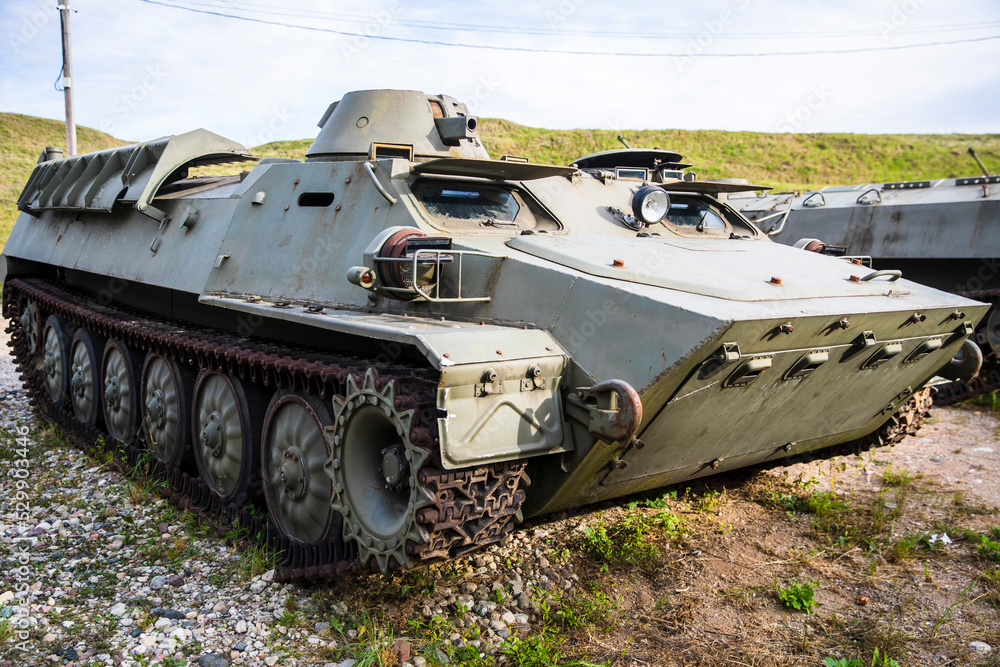
The MT-LB (МТ-ЛБ, многоцелевой транспортёр-тягач лёгкий бронированный, "multipurpose light armoured transporter-tractor") is a Soviet tracked, fully amphibious, lightly armoured vehicle built from the late 1960s/early 1970s at the Kharkiv Tractor Plant (KhTZ) in Soviet Ukraine. Its factory designation is "Object 6" (Объект 6). Soldiers call it the motolyga (мотолыга), also motolaba and emteelbeshka. [DOCUMENTED] (ru.wikipedia; en.wikipedia.)
It was not designed as an infantry fighting vehicle. It was designed as an armoured artillery tractor and general carrier: a vehicle that tows a gun, carries its crew and ammunition, crosses snow, swamp and rivers, and can be fitted with almost any equipment that fits in a box hull. The Russian article on the type makes this point explicitly, and argues that judging it against BMPs and BTRs misses its purpose. [DOCUMENTED] (ru.wikipedia, "Опыт боевого применения".)
Total production of the MT-LB and its stretched sister, the MT-LBu, is usually given as more than 55,000. [SINGLE-SOURCE] The figure recurs in Wikipedia (citing Popular Mechanics, 2023) and in Russian commentary ("more than 50 thousand"), but no factory-level production table has been found to confirm it. [UNVERIFIED]
| Item | MT-LB (basic) | Source / label |
| Crew | 2 (driver, commander-gunner) | [DOCUMENTED] |
| Passengers | 10-11 (sources differ) | FAS: 10; en.wikipedia/ru.wikipedia: 11 [DOCUMENTED] |
| Combat weight | 9.7 t empty, 11.9-12.2 t loaded | ru/en.wikipedia [DOCUMENTED] |
| Length / width / height | 6.40-6.51 m / 2.82-2.87 m / 1.86-1.92 m | figures vary by source and variant [DOCUMENTED] |
| Engine | YaMZ-238V (V-8 diesel), 240 hp | en/ru.wikipedia [DOCUMENTED] |
| Road speed | 61-61.5 km/h | [DOCUMENTED] |
| Water speed | 5-6 km/h, propelled by tracks | [DOCUMENTED] |
| Range | 500 km road | [DOCUMENTED] |
| Payload / towed load | 2,000 kg / 6,500 kg | FAS; en.wikipedia [DOCUMENTED] |
| Armour | 7-14 mm rolled steel | ru.wikipedia gives 14 mm upper front at 54 deg, 7 mm sides [DOCUMENTED] |
| Armament | 7.62 mm PKT in small turret (TKB-01) | [DOCUMENTED] |
| Ground pressure | about 0.45-0.46 kg/cm2 (standard track) | FAS; ru.wikipedia [DOCUMENTED] |
ORIGINS: AT-P, AT-L AND THE MT-L
In the 1950s the Soviet Central Auto and Tractor Directorate (the main automotive authority of the Defence Ministry) began a programme to replace the AT-P family of light artillery tractors, which used components of the ASU-57 airborne self-propelled gun. [DOCUMENTED] (en.wikipedia.) The Kharkiv plant already built the AT-L light artillery tractor, produced from 1947 to 1967 per tank-afv.com, which gave KhTZ experience in light tracked vehicles. [SINGLE-SOURCE] (tank-afv.com.)
The first result was the MT-L: an unarmoured, turretless light tracked transporter. FAS notes it was first developed for geological work in the far north. [SINGLE-SOURCE] Wikipedia says the MT-L drew on the PT-76 amphibious tank chassis. [SINGLE-SOURCE] Neither claim is backed by a primary document here; the PT-76 link is widely repeated but the MT-LB's road wheels, suspension and engine differ substantially from the PT-76, so "based on" probably means "drew lessons from" rather than "shared a hull". [SPECULATION]
The MT-L and MT-LB were adopted together by USSR Council of Ministers decree No. 1030-401 of 1964, according to ru.wikipedia (repeated by tank-afv.com). [SINGLE-SOURCE] Only a small batch of the MT-L was built, because KhTZ could not run two vehicles in parallel. [DOCUMENTED] (ru.wikipedia.)
DATES: WHERE THE SOURCES DISAGREE
DESIGN: LAYOUT
The hull is a box of welded steel plate. The driver and commander sit side by side at the front, the commander on the right under the small machine-gun turret. The engine sits behind them, offset to the left, with a narrow passage on the right to the rear. The rear two-thirds of the hull is an open troop and cargo compartment. [DOCUMENTED] (FAS; ru.wikipedia layout entry "transmission and control at front, engine in the middle, transport compartment at rear".)
Infantry leave by two rear doors, each with a firing port, and through two forward-opening roof hatches over the troop compartment. There are four firing ports in all: one in each rear door and one on each side. The troops sit on inward-facing folding canvas seats. [DOCUMENTED] (FAS.)
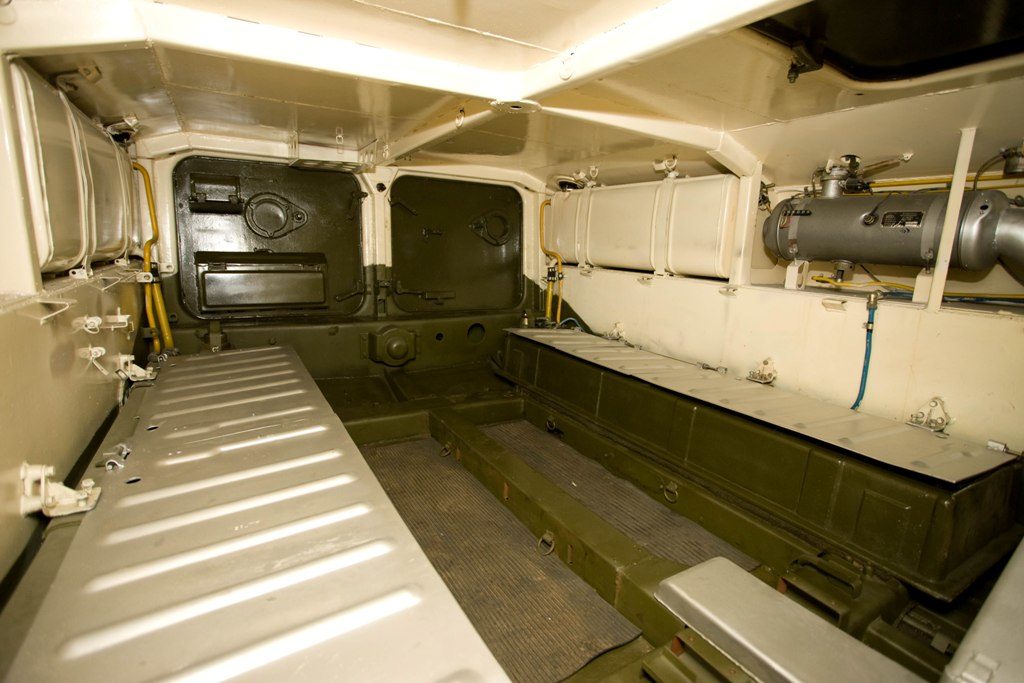
The troop compartment interior is bare: folding bench seats along the sides, stowage, and the engine housing intruding at the front. It doubles as a cargo bay for up to 2 tonnes, which is why the same hull carries radios, radars, stretchers or ammunition with little structural change. [DOCUMENTED] for capacity; layout description [ESTIMATE] based on photographs.
DESIGN: ARMOUR AND PROTECTION
Protection is light: rolled steel 3-10 mm thick according to en.wikipedia, up to 14 mm on the turret front. ru.wikipedia gives 14 mm on the upper glacis at 54 degrees, 7 mm at 80 degrees in the middle front, 14 mm at 45 degrees low on the nose, and 7 mm on the sides and rear. [DOCUMENTED] Both sources agree it is proof only against rifle-calibre fire and shell splinters. [DOCUMENTED]
All vehicles have an NBC filtration system. [DOCUMENTED] (FAS.) The light armour is the price of amphibious ability and low weight; Russian commentary argues that compared with the truck it often replaces, an MT-LB still gives tracks, bullet-resistant armour and a machine gun. [DOCUMENTED] (ru.wikipedia.)
DESIGN: ENGINE AND RUNNING GEAR
The engine is a YaMZ-238 V-8 diesel, a truck engine, giving 240 hp at 2,100 rpm (YaMZ-238V/VM). [DOCUMENTED] Using a mass-produced truck engine kept cost down and simplified logistics. [DOCUMENTED] (en.wikipedia; tank-afv.com.) Polish-built vehicles from the mid-1990s used the SW 680 six-cylinder diesel, also 240 hp. [DOCUMENTED]
The running gear has six road wheels per side on torsion bars, with no return rollers ("flat-track"), a front drive sprocket and rear idler. [DOCUMENTED] (FAS.) Power-to-weight is about 20 hp/t. [DOCUMENTED]
The transmission and final drives were made only at Kharkiv in Soviet times. A 2025 report from the Irkutsk Tracked Vehicle Plant (IZGT) stated that from the 1960s to the 1990s KhTZ was the sole maker of MT-LB transmissions, and that for 20-25 years users had relied on stocks or rebuilt units. [DOCUMENTED] (drom.ru, newsinfo.ru, June 2025.) This matters for the production question below.
DESIGN: AMPHIBIOUS ABILITY AND LOW GROUND PRESSURE
The MT-LB swims without preparation, driven by its tracks at 5-6 km/h. [DOCUMENTED] There are no water jets; the Polish SPG-2 and Opal derivatives added them. [DOCUMENTED]
Ground pressure on the standard 350 mm track is about 0.45-0.46 kg/cm2, close to that of a man on foot. [DOCUMENTED] The wide-track MT-LBV (entered service 1972 per en.wikipedia) cut this to about 0.28 kg/cm2 per FAS. [DOCUMENTED] The width of the MT-LBV track is disputed: FAS says 565 mm, en.wikipedia says 670 mm. [UNVERIFIED] This is the vehicle's defining trait: it goes where wheeled trucks cannot, which is why it became the standard prime mover for Arctic, Siberian and swamp units, and why civilian derivatives remain in demand. [DOCUMENTED]
Obstacle figures from ru.wikipedia: 35 degree slope, 1.1 m wall, 2.8 m trench. [SINGLE-SOURCE]
DESIGN: ARMAMENT
The basic turret, the TKB-01, mounts a 7.62 mm PKT with 360 degree manual traverse and -5 to +30 degree elevation, with 2,500 rounds. [DOCUMENTED] The sight is the PP-61B. [SINGLE-SOURCE] (ru.wikipedia.)
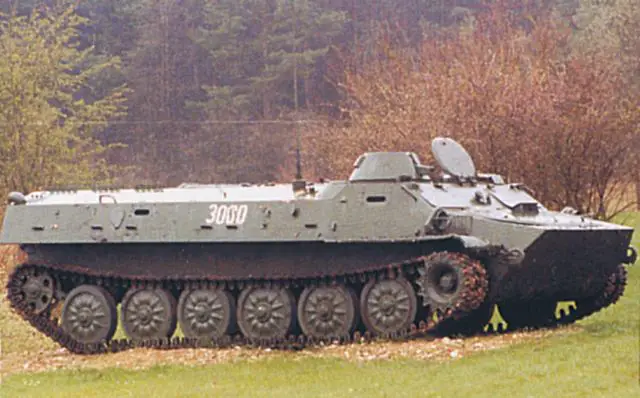
Later Russian upgrades replace the turret with an open 12.7 mm NSVT (MT-LBVM) or Kord (MT-LBVMK), or with full turrets carrying a 14.5 mm KPVT or a 30 mm cannon (see Variants). [DOCUMENTED]
DESIGN: TOWING
The rated towed load is 6.5 tonnes. [DOCUMENTED] The MT-LB was the standard tow for the 100 mm MT-12 (T-12) anti-tank gun, carrying the gun crew in the rear compartment, and for light and medium artillery such as the 122 mm D-30. [DOCUMENTED] for MT-12 (FAS); D-30 [ESTIMATE], commonly photographed but not in the sources listed here.
In Afghanistan, crews found the MT-LB could cover gun crews it towed with its machine gun, a role it had not been designed for. [SINGLE-SOURCE] (ru.wikipedia.)
THE MT-LBu (OBJECT 10)
The MT-LBu is a larger version: a hull about 40 cm higher, a longer chassis with seven road wheels per side, a YaMZ-238N engine of 300 hp, about 15.5 t weight, and a 13 m3 rear compartment. [DOCUMENTED] (en.wikipedia MT-LBu.) It shares much running gear with the 2S1 Gvozdika howitzer (Object 26). [DOCUMENTED] (FAS.)
Wikipedia lists its armour as "welded aluminium" in the infobox and "3 to 10 mm steel" in the text; the aluminium entry is very likely an error. [UNVERIFIED]
Many so-called "MT-LB variants" are actually MT-LBu-based. It carries most of the Soviet and Russian artillery command, radar and electronic-warfare systems. [DOCUMENTED]
COMMAND AND RADAR CARRIERS
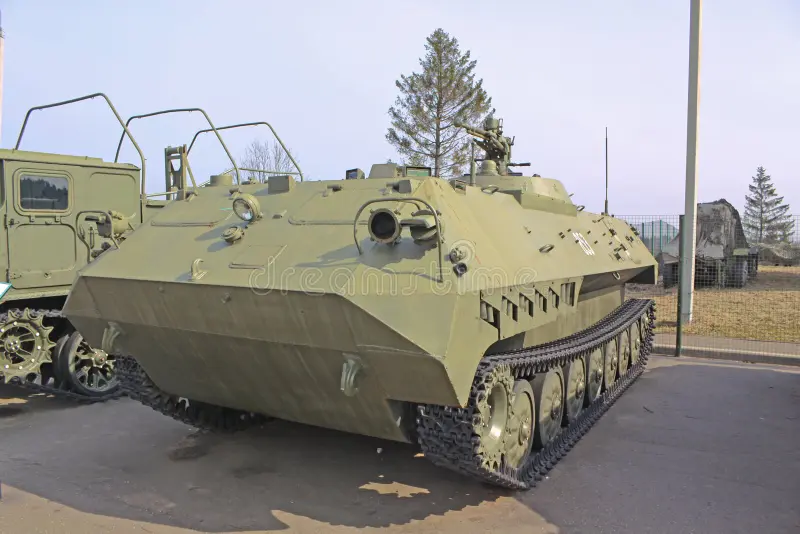
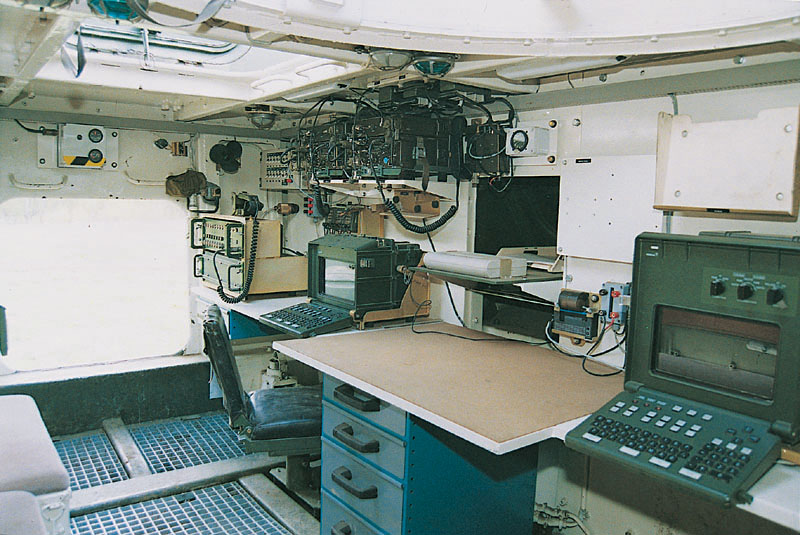
The command and radar versions turn the rear compartment into a workspace: radio racks, map tables, operator consoles, a generator and often a rotating turret with optics or a dish. The interior photograph above shows a typical fit: radio sets and operator positions along the hull side. [ESTIMATE] The exterior shown above carries a small rotating turret with a dish antenna; the exact model cannot be confirmed from the photo, and its wheel count should be checked against MT-LB (6) versus MT-LBu (7). [UNVERIFIED]
1V12 "Mashina" artillery fire-control set (KSAUO). Entered service 1974, eight vehicles in four models, used by units with 2S1, 2S3, 2S5 and 2S19 howitzers. Upgrades include 1V12-3, 1V12M "Faltset", 1V12M-1 and 1V12M-2. [DOCUMENTED] (en.wikipedia MT-LBu.)
How the set communicates: forward observers (1V14/1V15) use laser rangefinders and optics to fix targets and pass data over VHF (R-123/R-173) to the battery centres (1V13), which compute firing data and pass it to the guns; the battalion centre (1V16) uses the HF R-130 and R-326 for links upward. This chain is the editor's reading of the radio fits listed above. [ESTIMATE]
Other MT-LBu systems (en.wikipedia MT-LBu unless noted):
COMMUNICATIONS: RADIO AND DATA-LINK FITS OF THE COMMAND VEHICLES
There is no single "MT-LB command radio fit." Each command system on the hull has its own published fit, and those fits changed between generations. The pattern is the same throughout: two to four VHF FM sets for the battery and battalion nets, one HF set for longer links on the senior vehicles, an intercom, a data-transfer unit on the air-defence and fire-control vehicles, and a generator so the sets can run with the engine off. [ESTIMATE] The specific fits below are documented. For the background on the sets themselves, see the site's Russian C3, R-173, R-168 Akveduk and R-187 Azart articles.
The radios themselves
1V12 "Mashina" artillery fire-control vehicles
1V13 battery centre: three R-123M (or R-173) and the APK/APPK data-processing unit. 1V14 observer: as 1V13 plus one R-107. 1V15 battalion commander: R-130M HF on a mast, one R-123M replaced by an R-111. 1V16 battalion fire-direction centre: 1V15 radios plus the R-326 receiver and the 9V59 computer. The 1V13 carries a GIV-8/8000 generator. [DOCUMENTED] (en.wikipedia MT-LBu.) "Mashina-M" (1V12-3) and the later 1V12M "Faltset" are upgrades of the set; their radio changes are not described in the sources used here. [UNVERIFIED]
In practice this gives each vehicle a net to the guns, a net to the observers, and a net upward. The battalion vehicles add HF because battalion-to-regiment distances outrun VHF ground wave. [ESTIMATE]
PPRU-1 "Ovod-M-SV" (9S80) and PPRU-1M "Sborka" (9S80M1): air-defence control
This is the link from the MT-LB family into the air-defence articles: the Sborka is the post that tasks the Strela-10 batteries, which themselves ride on the MT-LB. [DOCUMENTED]
Barnaul-T: 9S932-1 reconnaissance and control module
The current Russian tactical air-defence automation set, Barnaul-T, puts its battery-level module (9S932-1, MRU-B) on the MT-LBu or the BTR-MD. It has three workstations and a 1L122-1 L-band radar with 1-40 km range. [DOCUMENTED] (ru.wikipedia; US Army ODIN; VPK.name.) Higher levels use the 9S931/9S931-1 planning modules, and the MANPADS levels use the 9S933 and 9S935 kits. [DOCUMENTED] The published sources describe it as fitted with "modern automation, communication and data-exchange equipment" but do not name the radios. [UNVERIFIED]
PU-12M
The PU-12/PU-12M air-defence battery command post is normally built on the wheeled BTR-60/BTR-80 family, not the MT-LB. [BACKGROUND]
Export fits
What the interior photograph shows
The interior photo in the command section shows a row of radio sets and junction boxes mounted high along the left hull wall with coiled handsets, a small CRT terminal with a keyboard, a larger dark terminal with a full alphanumeric keypad on the right, a plywood work table over a steel drawer cabinet, a crew chair, and a steel grating floor. [DOCUMENTED] as a description of the photo. The sets' type plates cannot be read at this resolution, so the radios cannot be named. [UNVERIFIED] The office-style drawer cabinet, painted interior and keypad terminals do not match published photos of Soviet 1V12 fits, and suggest a post-1990 Western conversion such as the Swedish Stripbv 4021 or a Finnish MT-LBu-TP/PS. [SPECULATION] No source matched to this photo has been found.
AIR DEFENCE AND ANTI-TANK VARIANTS
Strela-10 (9K35). The 9A34 and 9A35 combat vehicles of the Strela-10 short-range SAM use the MT-LB hull; the 9A35 adds a passive radio direction finder. [DOCUMENTED] Full article: Strela-10.
Sosna / Strela-10ML. The successor SAM uses the MT-LB as its baseline carrier. [DOCUMENTED] See Sosna.
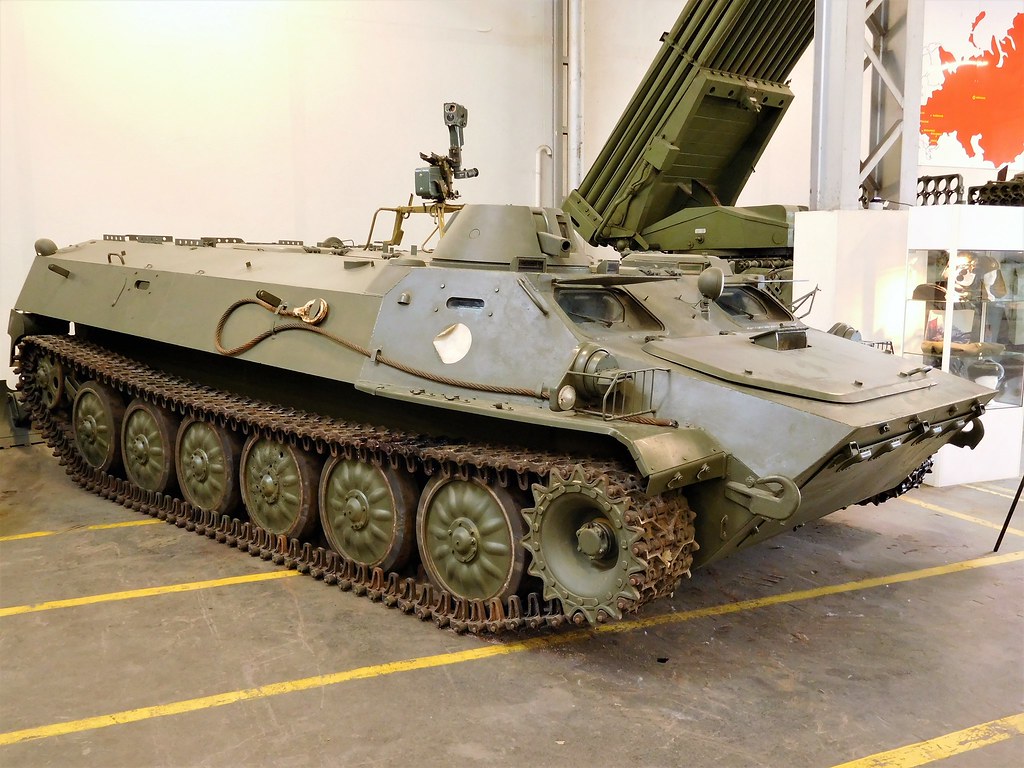
9P149 Shturm-S. The self-propelled launcher of the 9K114 Shturm anti-tank missile system, with a retractable launcher and autoloader inside the hull, 1979. [DOCUMENTED] (ru.wikipedia; tank-afv.com.) Oryx records 39 Russian and 4 Ukrainian 9P149s lost as of 26 Oct 2026. [DOCUMENTED] Note: the museum vehicle shown above is a standard turreted MT-LB; the launcher visible behind it belongs to a separate exhibit, not to the MT-LB. [ESTIMATE]
2S1 Gvozdika. The 122 mm self-propelled howitzer uses the related Object 26 chassis. [DOCUMENTED] Oryx: 192 Russian and 416 Ukrainian 2S1 lost. [DOCUMENTED]
OTHER SOVIET AND RUSSIAN VARIANTS
VARIANTS ABROAD
Poland (Huta Stalowa Wola): WEM Lotos ambulance; WPT Mors recovery (1983); R-137T signals; ZWD-1 Irys command post; Przebiśnieg EW set; TRI Hors engineer recce (on SPG-2); Opal-I/II artillery command (prototypes); MT-LB-2AP, Krak and BWO-40 (prototypes); Kroton minelayer. [DOCUMENTED]
Bulgaria: MT-LB AT-I minelayer, MRHR radiochemical recce, SE ambulance, TMH 82 mm mortar, BMP-23 IFV, Sova recce vehicles, KShM-R-81 Delfin command post, Tundzha 120 mm mortar, R-80 artillery recce. [DOCUMENTED]
East Germany: engineer, anti-tank, command, ambulance and technical support versions. [DOCUMENTED] Sweden: ex-East German vehicles as Pbv 401 and derivatives (Pvrbbv 452 with BILL ATGM, Lvrbv 4016 with RBS 70, Bgbv 4012 recovery, command and signals versions, Sjtpbv 4024 ambulance). [DOCUMENTED]
Ukraine: MT-LBMSh with Shkval module (26 for Myanmar per ru.wikipedia; en.wikipedia/IISS say 350+). [UNVERIFIED] This is a large conflict; 26 is more consistent with KhTZ capacity. [ESTIMATE] Also MT-LBR6 and MT-LBR7 (prototypes), KhTZ-3N civilian derivative, MT-LB-12 with MT-12 gun (2022), MT-LB S ambulance, BMP-1LB on MT-LBu with BM-7 Parus. [DOCUMENTED]
Kazakhstan: Aibat 120 mm mortar (with Soltam), AMTE ambulance, Aselsan Igla turret. Azerbaijan: MTLB-AM with S-5 rocket pod and AG-17. Iraq: ZU-23-2 field conversions. [DOCUMENTED]
PRODUCTION HISTORY
DID RUSSIA RESTART PRODUCTION? THE EVIDENCE
This question has three separate parts, and the sources need to be kept apart.
(c) New-build MT-LB in Russia before and during the war.
Assessment: as of 26 Oct 2026 no source found confirms wartime series production of new MT-LB hulls in Russia. The evidence fits deep overhaul and modernisation of existing hulls (Remdizel, Muromteplovoz), with a domestic transmission supply only beginning in 2025. Claims that the MT-LB is "still in production" trace back to one undated ru.wikipedia sentence and its copies. [ESTIMATE]
(a) MGT-LB: unveiled. The MGT-LB (МГТ-ЛБ, "izdeliye 6448") under the OKR "Transporter" programme was shown for the first time at Army-2024 (12-14 August 2024) as the intended MT-LB successor. [DOCUMENTED] (Rossiyskaya Gazeta, 12 Aug 2024; www1.ru; Army Recognition.) Developer: Zavolzhye Tracked Tractor Plant. [SINGLE-SOURCE] (Yuri Pasholok, Dzen; GlobalSecurity.) Published figures: 16.5 t, 2.5 t payload, 7 t trailer, 450 hp turbodiesel, 70 km/h road, 10 km/h afloat by water jets, 800 km range, crew 2 plus 8, STANAG 4569 level 3 ballistic and level 1 mine protection, -50 to +40 C, up to 4,500 m altitude. [DOCUMENTED] Army Recognition also gives a "curb weight" of 5,600 kg, which cannot be right for a 16.5 t vehicle; RG calls 16,500 kg the "own weight". [UNVERIFIED] A sister chassis, MGSh-LB-6447 (20 t, 4 t payload), is in the same programme. [SINGLE-SOURCE] (Pasholok.)
(b) MGT-LB: serial production. Not confirmed. Pasholok described the Army-2024 vehicle as a mock-up ("макет"), not a finished product, and GlobalSecurity says no production contract has been published. [DOCUMENTED] Army Recognition's headline "Russia launches new MGT-LB" refers to the public launch, not series production. No later source found reports trials completion or deliveries. [UNVERIFIED]
Storage stockpiles as an explanation. If large reserves sat in storage, rebuilding them was cheaper and faster than tooling a new line, which would explain overhaul over new build. [SPECULATION, site owner] The open-source counts:
The counts differ in date and method (Jompy noted he changed method, e.g. adding 9P149 hulls), but all point the same way: a large reserve in 2022 that made overhaul the obvious choice, falling to a few hundred by 2025. As the reserve runs out, the overhaul route loses its feedstock, which is when a new-build line or the MGT-LB would become necessary. [ESTIMATE]
RUSSO-UKRAINIAN WAR
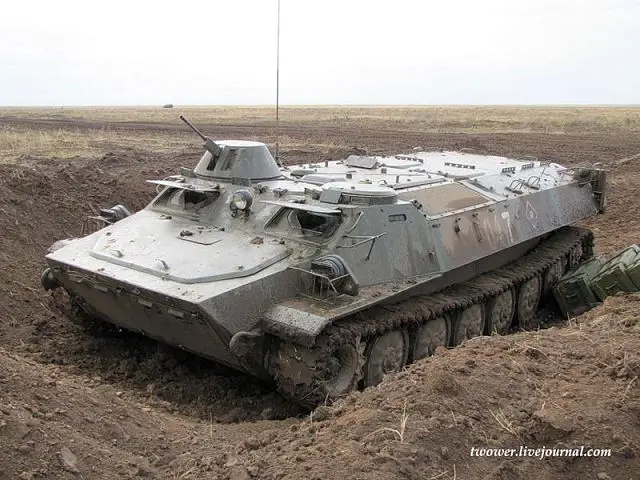
Both sides use the MT-LB heavily, as tractor, APC, ambulance and gun platform. As heavier BMPs were lost, Russia drew thousands of MT-LBs out of storage and used them as improvised assault APCs. [DOCUMENTED] (Axe, Trench Art.) Earlier, in the 1990s, its classification as a tractor kept it outside CFE treaty limits, which helped its wide use in Chechnya. [SINGLE-SOURCE] (ru.wikipedia.)
Field modifications. Russian units have mounted ZU-23-2 AA guns (also trialled officially in the Western Military District in 2021, per TsAMTO), 14.5 mm BPU-1 turrets, 2M-7 and 2M-3 naval gun mounts, S-60 57 mm guns, MT-12 100 mm guns, 2B9 Vasilek mortars with UB-32 rocket pods, A-22 Ogon 140 mm naval rocket launchers from landing craft (Militarnyi, June 2023), a Type-75 MRL and RBU-6000 anti-submarine launchers. [DOCUMENTED] (Oryx; Forbes/Axe; Militarnyi.) Ukraine built MT-LB-12 with the MT-12 gun and versions with the 85 mm D-44. [DOCUMENTED]
Turtle MT-LBs. From May 2024 Russian units fitted MT-LBs with sheet-steel "turtle" shells against FPV drones, as with the turtle tanks. [DOCUMENTED] (Army Recognition; Armourer's Bench, May 2024.) Ukraine's Metinvest began producing anti-FPV screens for MT-LBs in May 2025; 11 screened vehicles returned to service with the 110th Territorial Defence Brigade for evacuation. [DOCUMENTED] (Interfax-Ukraine, 6 May 2025.)
Losses (Oryx, visually confirmed, as of 26 Oct 2026). [DOCUMENTED]
| Type | Russia | Ukraine |
| MT-LB | 1,576 | 124 |
| MT-LBVM / VMK | 251 | - |
| MT-LB with ZU-23 | 53 (+1 VMK) | 14 |
| MT-LBu | 41 (+3 gun conversions) | 18 (+1 Parus) |
| MT-LBM 6MA / 6MB | 1 / 26 | - |
| MT-LB ambulance (MT-LB-S) | - | 35 |
| MT-LB-AT | - | 4 |
| Other gun/rocket conversions | about 19 | 2 |
| MT-LB family total (excl. Strela-10, Shturm-S, 2S1, command sets) | about 1,975 | about 198 |
Totals are the editor's sums of Oryx line items. [ESTIMATE] Separately Oryx lists 58 Russian and 34 Ukrainian Strela-10, and 25 1V13, 20 1V14, 2 1V15 and 2 1V16 Russian artillery command vehicles. [DOCUMENTED] Oryx counts only photographed losses, so true losses are higher. [BACKGROUND]
OTHER WARS
Afghanistan, Baku (January 1990), Transnistria, Nagorno-Karabakh (both wars), Abkhazia, both Chechen wars (667 in Chechnya by November 1999), Georgia 2008, Donbas from 2014, Iran-Iraq, Gulf War, Iraq 2003 and the war against ISIS, Syria, and Boko Haram. [DOCUMENTED] (ru/en.wikipedia.)
OPERATORS
IISS-based figures (2024 unless stated; ru/en.wikipedia): Russia 2,500 active + 1,000 stored (pre-war), naval infantry 250; Ukraine 2,090 (2017); Azerbaijan 336; Finland 320 MT-LBu/MT-LBV; Iraq about 400; Kazakhstan 150 (2017) / 50 (2024 per ru.wikipedia); Bangladesh 134; Bulgaria 100; Belarus 58 + 20 (CSTO); Georgia 66; Moldova 60; Nigeria 67; Angola 31; Armenia; Myanmar (MT-LBMSh); North Macedonia 10; Uruguay 5; DR Congo 6; Eritrea 10; Syria; Vietnam; North Korea (Strela-10 derivative). [DOCUMENTED] Former: USSR, East Germany, Germany, Czechoslovakia, Lithuania, Poland, Sweden (460, last 147 sold to Finland 2011), Yugoslavia, Croatia, Hungary, Artsakh, ISIS; the US holds vehicles for OPFOR training. [DOCUMENTED]
CIVILIAN LIFE
Demilitarised MT-LBs and new copies are widely used in Russia's far north and Siberia: KhTZ-3N (Ukraine), SGT-31 (Tyumenspetstekh), TG-126 series (Irkutsk), Girtek MSG, UZGT vehicles, USM-30 "Karandash" and USM-40 "Argus". [DOCUMENTED] (ru.wikipedia.) Civilian demand helped keep part suppliers alive after 1991. [ESTIMATE]
RELATED ARTICLES
SOURCES