WHAT THIS ARTICLE IS
This is an analysis article, not a description of a single weapon. It compares the two main ways modern main battle tanks store their ready ammunition and asks a simple question: which layout keeps a tank fighting on the battlefield that actually exists in the 2020s, where the most common attacker is not another tank but a cheap first-person-view (FPV) drone diving onto the roof, the engine deck or the turret rear.
The two layouts are:
The usual Western verdict is short: the carousel is a death trap and the bustle is the civilised solution. This page argues that the verdict depends on the threat environment, and that on today's drone-heavy battlefield the carousel layout, done properly as on the T-90M, has real advantages that Western write-ups rarely weigh. It also lays out, fairly, where the bustle remains better.
How claims are labelled on this page. [DOCUMENTED] means at least two independent-looking sources agree. [SINGLE-SOURCE] means one source, often a manufacturer or one outlet. [FIELD ACCOUNT] means a report from troops at the front, relayed by journalists or social media, usually unverifiable in detail. [UNVERIFIED] means a claim that circulates but could not be confirmed. [CONFLICT] means sources disagree. [ESTIMATE] is this page's own arithmetic. [ANALYSIS] is this page's argument: reasoned, but an opinion, and open to challenge.
THE THESIS IN SHORT
[ANALYSIS] The argument of this page runs in seven steps:
None of these points says the carousel is safe. When a carousel does go up, the result is usually the loss of the whole vehicle and crew, the famous "turret toss". The question is how often each layout is hit in the place that matters, under the threats it actually faces.
A SHORT HISTORY OF AMMUNITION AND COOK-OFFS
[BACKGROUND] Every tank carries its own worst enemy. Modern tank rounds use tens of kilograms of nitrocellulose-based propellant per round, and a tank carries 40 or more rounds. That is roughly a tonne of material designed to burn violently. When armour is penetrated, the most important question for the crew is not whether the jet or fragment hits a person, but whether it reaches the ammunition.
World War II: the lesson is learned the hard way
[DOCUMENTED] Wartime studies by the British and Americans found that ammunition fires were the leading cause of catastrophic tank losses. Early Sherman tanks stored rounds in sponson racks high in the hull, next to the turret ring, exactly where a side penetration was likely to land. The British and American response was twofold:
[ANALYSIS] The second point is the one that matters for this article. Low stowage was the decisive improvement, and it is exactly the logic the carousel follows: put the propellant where enemy fire is least likely to reach it.
Soviet tanks: the autoloader arrives
[DOCUMENTED] The Soviet T-64 (in service from the mid-1960s) introduced a mechanised loading system to cut the crew to three and the turret to a minimum size. Its mechanism, the МЗ (mechanism of loading) of the "Korzina" (корзина, "basket") type, holds 28 rounds in a ring around the base of the fighting compartment. Each cassette holds the projectile lying flat and the propellant charge standing upright. The T-80 family inherited this mechanism.
[DOCUMENTED] The T-72, built by Uralvagonzavod in Nizhny Tagil as a simpler, cheaper tank, used a different design, the АЗ (автомат заряжания, automatic loader). Its carousel holds 22 rounds in two-tier cassettes, with the projectile in the lower tier and the propellant charge in the upper tier, both lying flat. The carousel sits on the hull floor under the turret basket. The T-90 and T-90M kept this design.
[ESTIMATE] Both layouts put the ready rounds roughly at the level of, or below, the top of the road wheels, under the turret ring, the lowest and best-shielded volume of the tank.
The weak point: the rounds outside the carousel
[DOCUMENTED] The carousel itself was never the whole story. Soviet tanks carried more rounds than the autoloader held. A T-72 typically carried about 39–45 rounds in total, so 17 to 23 extra rounds were stowed in racks around the fighting compartment, in the hull beside the driver, and in combination fuel-tank racks at the front of the hull. These "loose" rounds sat higher, often against the hull sides, in exactly the places a side penetration reaches.
[ANALYSIS] Many famous carousel catastrophes were actually caused by these extra rounds, not by the carousel. A penetration ignites a loose charge near the turret ring; the fire spreads to the carousel; the whole load goes. Crews in Chechnya and later in Ukraine learned to carry only what fits in the carousel, precisely to avoid this.
The Gulf War, 1991
[DOCUMENTED] Coalition M1A1 Abrams and Challenger 1 tanks destroyed large numbers of Iraqi T-72s (mostly export "Asad Babil" or T-72M/M1 types with simplified armour and old 3BM9/3BM15-type ammunition). Many of those losses were catastrophic, with turrets blown off. The images shaped Western opinion of Soviet tank design for a generation.
[ANALYSIS] The context is important. Those T-72s were export models with weaker armour than Soviet T-72B, often hit at close range from the flank by 120 mm APFSDS rounds that could penetrate any part of them, and often carrying loose rounds outside the carousel. The engagements were tank-on-tank, at night, against an enemy that could see through thermal sights and they could not. In that environment, any tank that is penetrated is in trouble, and a layout whose rounds sit in the penetration path will burn. The Gulf War showed what happens when the main armour fails; it did not show how often the carousel is reached when the main armour holds.
[DOCUMENTED] On the other side, the small number of M1A1s whose bustle magazines were hit (mostly by friendly fire) saw the blowout panels work as designed: crews survived. That record is a real and important strength of the Western layout.
Chechnya, 1994–1996
[DOCUMENTED] In the First Chechen War, Russian T-72 and T-80 tanks entering Grozny were attacked at close range from above and from the sides by RPG teams firing from buildings. Many were destroyed by ammunition fires, often after multiple hits. Russian after-action analysis pointed to the extra rounds stowed outside the carousel, to the lack of reactive armour on many vehicles, and to vulnerable roofs and rear areas.
[ANALYSIS] Grozny is the closest historical analogue to today's drone battlefield: attacks from above, from the rear, at close range, with shaped charges. The lesson Russian designers drew was not to abandon the carousel but to protect it better and to stop crews from stuffing extra rounds into the fighting compartment.
Syria, Yemen and Iraq
[DOCUMENTED] Turkish Leopard 2A4s lost near al-Bab in 2016–2017 to ATGMs showed that the Leopard 2's hull stowage, a rack of rounds beside the driver without any blowout protection, could cook off catastrophically. Saudi M1A2S Abrams lost in Yemen, and Iraqi M1A1Ms lost to ISIS, included vehicles hit in the side and rear with ATGMs and burned out. Syrian T-72s and T-90s were destroyed by TOW missiles in large numbers, with famous footage of a T-90 surviving a TOW hit in 2016.
[ANALYSIS] Two lessons. First, no Western tank actually stores all its rounds in a blowout-protected bustle; the Leopard 2 and others carry a substantial hull load that behaves like any other unprotected stowage. Second, when Western tanks met an enemy firing from the flank and rear with guided weapons, they burned too.
Ukraine, 2022 onward
[DOCUMENTED] The war in Ukraine produced thousands of documented tank losses on both sides, recorded photographically by open-source projects such as Oryx. Early in the war, Russian T-72B, T-72B3 and T-80BV tanks were destroyed in large numbers, and many of the images showed "turret toss": turrets thrown metres from the hull after ammunition detonation.
[DOCUMENTED] From 2023, the threat picture changed. FPV drones became the leading killer of armoured vehicles on both sides, with mines, artillery and ATGMs behind. Tanks sprouted welded cages ("mangals", or cope cages), anti-drone netting, and later full steel "turtle" shells. Western tanks sent to Ukraine (Leopard 1, Leopard 2A4/2A6, Challenger 2, M1A1 Abrams) were lost too, mostly to mines, artillery, ATGMs and drones.
[ANALYSIS] This is the environment the rest of this page is about.
HOW A COOK-OFF ACTUALLY HAPPENS
[BACKGROUND] To understand why location matters more than anything else, it helps to know what happens physically when armour is penetrated and the jet or fragments reach propellant.
The propellant
[DOCUMENTED] Tank gun propellant is mostly nitrocellulose, often with nitroglycerine and other energetic additives, formed into grains or sticks with perforations that control the burn rate. In the gun, it burns in a closed chamber at pressures of several thousand atmospheres in a few milliseconds. Outside a gun, in a rack, it does not usually detonate; it deflagrates: burns very fast, releasing enormous volumes of hot gas.
[ESTIMATE] A single 125 mm charge for a modern APFSDS round holds roughly 7–10 kg of propellant, depending on type. A 120 mm NATO round is similar. Twenty rounds is therefore something like 150–200 kg of propellant. Burned inside a closed steel box of a few cubic metres, it produces pressures that can lift a 15-tonne turret.
Three outcomes of a hit on ammunition
[ANALYSIS] The shaped-charge jet from an RPG, ATGM or FPV warhead is especially good at causing ignition: it is extremely hot, it sprays fragments of armour (spall) behind the plate, and it can pass through several charges in a row. Combustible-case charges, used in both Russian 125 mm and NATO 120 mm ammunition, ignite more easily than old brass cases.
What determines whether a hit reaches the ammunition
[ANALYSIS] The carousel optimises the first three. The bustle optimises the fourth. The rest of this page is about which matters more under today's threats.
HOW THE CAROUSEL WORKS
The T-72 / T-90 AZ in detail
[DOCUMENTED] The T-72's АЗ carousel is a horizontal rotating ring on the hull floor, under the turret basket. It holds 22 cassettes. Each cassette has two tiers: the projectile lies in the lower tier and the propellant charge in the upper tier, both horizontal and pointing toward the centre of the tank. The loading sequence is:
[DOCUMENTED] After firing, the stub base of the charge (the partially combustible case has a steel stub) is ejected and, in many versions, caught and stowed in the empty cassette or thrown out through a port in the turret rear.
[CONFLICT] The cycle time is usually given as about 6.5–8 seconds, depending on how far the carousel must rotate; Russian sources sometimes give lower figures for the best case.
The T-64 / T-80 MZ, and why it is different
[DOCUMENTED] The Korzina-type МЗ of the T-64 and T-80 holds 28 rounds. Each cassette carries the projectile lying horizontally and the charge standing vertically, so the ring is taller and sits around the wall of the fighting compartment rather than as a flat stack on the floor. The lift raises the cassette, the charge is tilted into line, and a rammer loads the projectile and then the charge in sequence. The tall standing charges come further up the hull sides than the T-72's flat stack.
[ANALYSIS] The two mechanisms are often lumped together in Western writing as "the Russian autoloader". They are different machines, from different design bureaus (Kharkiv for the T-64 lineage, Nizhny Tagil for the T-72), with different geometry and different vulnerabilities. The T-72's flat carousel is the lower and more compact of the two, which is why the T-72 lineage, including the T-90M, keeps more of its charges below the hull side line.
Lengthening the T-72 carousel for long darts
[DOCUMENTED] The main limitation of the original T-72 AZ was length. Because projectile and charge lie flat side by side within the ring's radius, the projectile could only be so long. Old APFSDS such as 3BM15, 3BM22 and 3BM42 Mango had rods short enough to fit. Modern long-rod penetrators, such as 3BM59 Svinets-1 (tungsten) and 3BM60 Svinets-2 (depleted uranium), are much longer, about 740 mm for the complete projectile, and did not fit the original cassettes.
[DOCUMENTED] The modernised autoloader on the T-90A (later versions), T-72B3 and T-90M was modified to accept these longer projectiles. The T-90M's carousel remains the T-72-type АЗ, not the T-80's МЗ: same principle, same 22 ready rounds, lengthened cassettes. [CONFLICT] Exact maximum length figures differ between sources, and some sources say the modernised cassette changed the position of the charge rather than the ring diameter.
Where the carousel sits, and what protects it
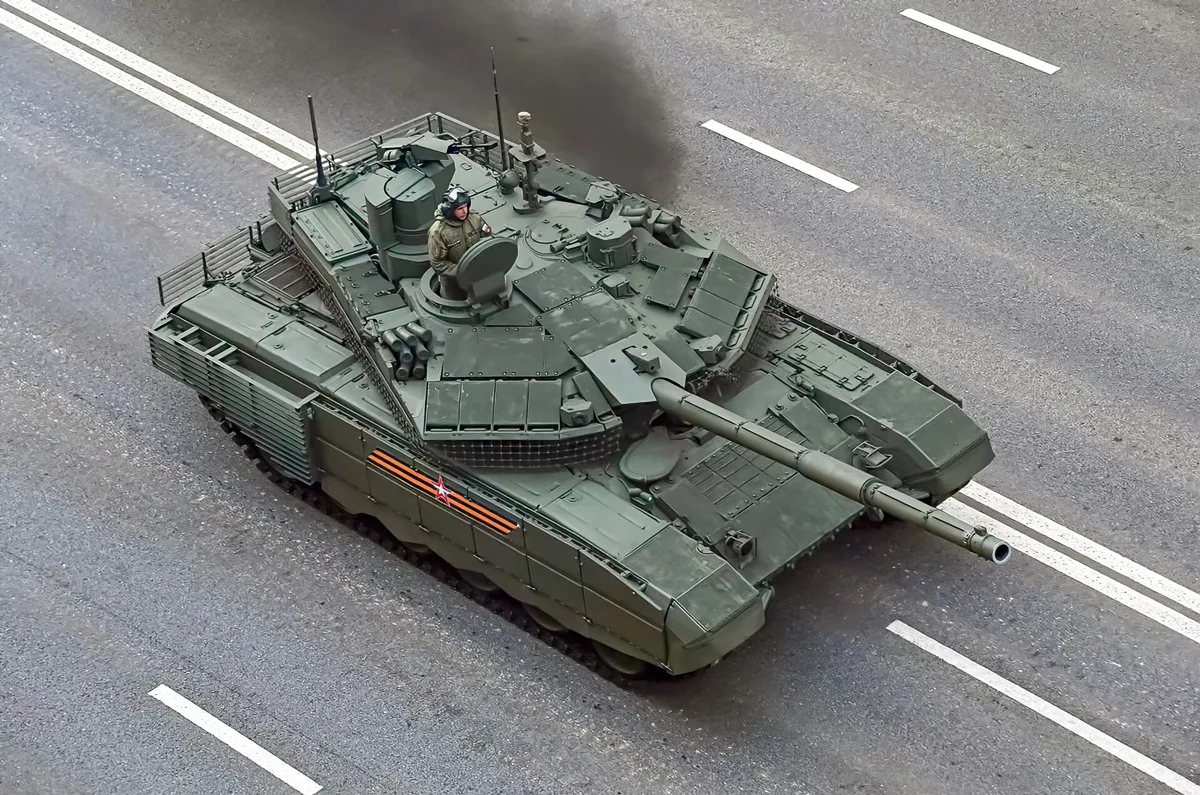
[ESTIMATE] On a T-72/T-90 the top of the carousel sits roughly at the level of the hull roof's lower edge, under the turret ring, with the turret basket above it. From the side, it is roughly behind the third and fourth road wheels, behind the side hull plate, the side skirts and, on modern vehicles, reactive armour and slat screens. From the front, a penetrator must cross the upper glacis (with Relikt or Kontakt-5 ERA on top), the driver's compartment and part of the fuel/ammunition racks. From above, it must cross the turret or the hull roof plus the turret basket floor and the crew space.
[ANALYSIS] In other words, every likely path to the carousel passes through the vehicle's main protection. That is the core of the carousel argument: you have to beat the tank to beat the carousel.
HOW THE BUSTLE MAGAZINE WORKS
The M1 Abrams
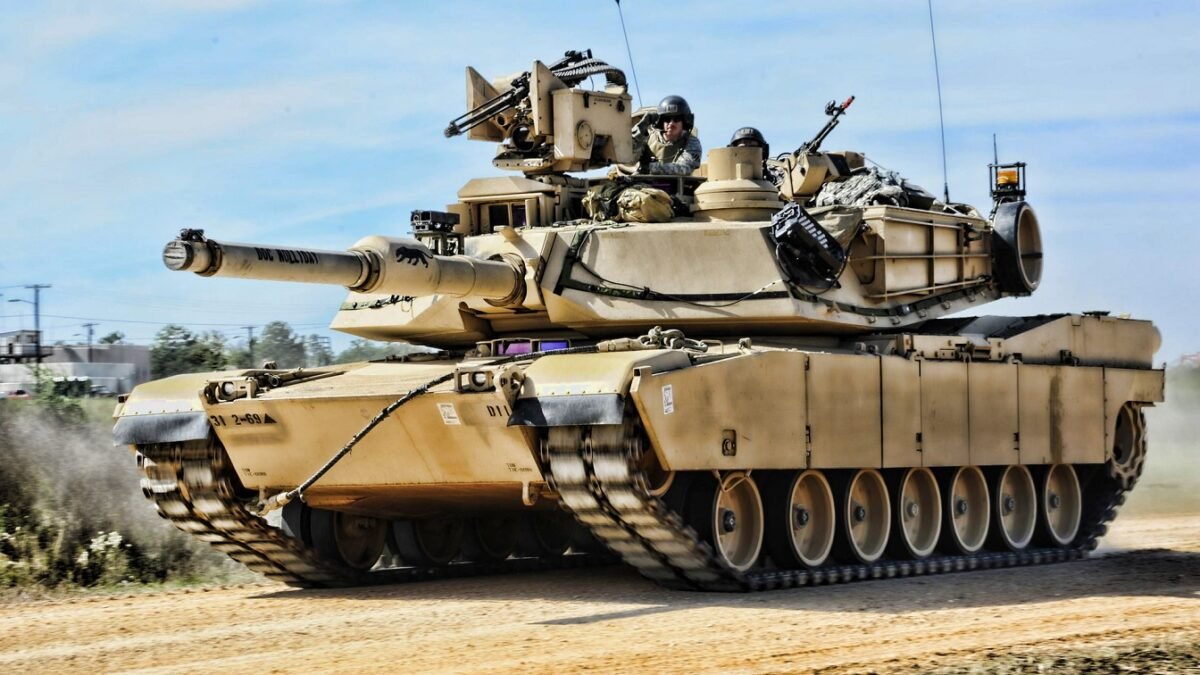
[DOCUMENTED] The M1 Abrams carries most of its 120 mm rounds in a magazine in the turret bustle, behind the crew. On the M1A1 and M1A2, this compartment holds about 34 to 36 rounds (figures vary by variant and the presence of other equipment), divided by internal walls. A few more rounds are stowed in the hull. The magazine is separated from the crew compartment by sliding armoured doors. The loader opens a door with a knee switch, pulls a round, and the door closes automatically.
[DOCUMENTED] Above the magazine, the roof has blowout panels: plates held in place by fasteners designed to fail at a specific internal pressure. If ammunition in the magazine ignites, gas pressure lifts the panels and the flame vents upward and out, instead of through the doors into the crew compartment. In tests and in combat, crews have survived magazine fires that destroyed every round in the bustle.
How a blowout panel is designed
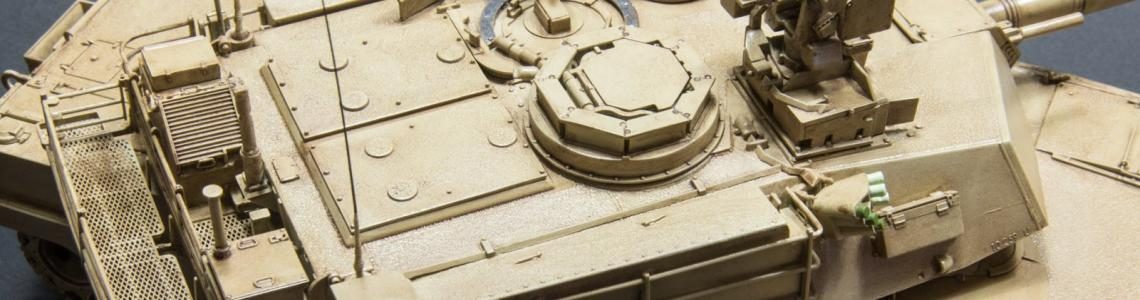
[BACKGROUND] A blowout panel is a structural fuse. Its designer must satisfy two conflicting requirements:
[ANALYSIS] The second requirement sets the strength: the panel must be much weaker than the walls around it. If it were as strong as the turret roof, the internal pressure would find the next weakest path, which might be the blast door. That is the basic reason why a blowout panel cannot be heavily armoured. Make it stronger and the fuse rating rises; at some point the blast doors or the turret fail first, and the bustle becomes a bomb attached to the crew compartment.
The Leopard 2
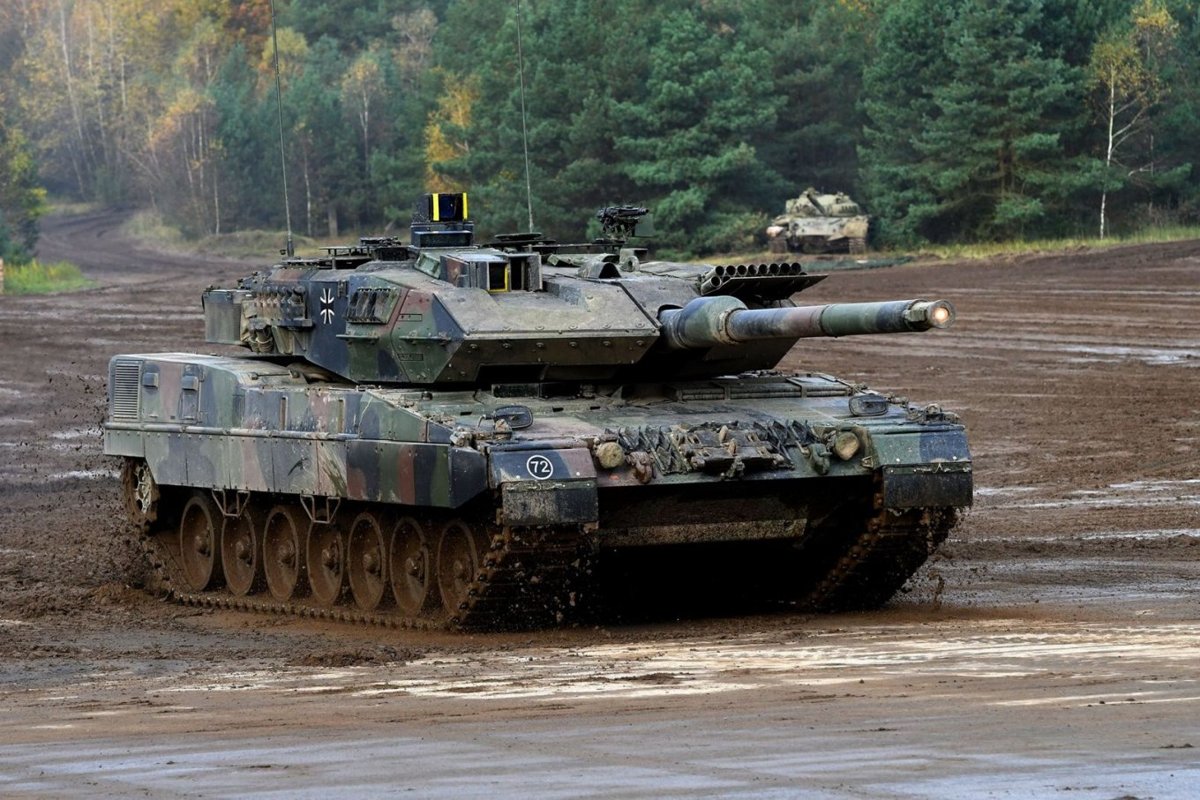
[DOCUMENTED] The Leopard 2 stores about 15 rounds in its turret bustle with blowout protection, and the rest, about 27 rounds, in a rack in the hull front, to the left of the driver. The hull rack has no blowout system. Later versions (2A7 and the Swedish Strv 122) added better protection and in some cases improved hull stowage arrangements, but the basic split remains. [CONFLICT] Exact counts vary by variant.
[ANALYSIS] The Leopard 2 is therefore a hybrid: a bustle for the rounds used first, plus a large conventional hull stowage. The Turkish losses in Syria showed what happens when that hull rack is reached.
Bustle autoloaders: Leclerc and K2
[DOCUMENTED] The French Leclerc and South Korean K2 Black Panther use autoloaders mounted in the turret bustle. The Leclerc's autoloader holds 22 rounds in a conveyor belt in the bustle, with blowout panels and a firewall; more rounds are stored in a drum in the hull. The K2's bustle autoloader holds 16 rounds, again with more in the hull. The Japanese Type 90 and Type 10 use similar bustle autoloaders.
[ANALYSIS] These designs show that an autoloader does not require a carousel. Western designers who wanted a three-man crew chose to keep the ammunition in the bustle and isolate it, rather than move it to the hull floor.
Challenger 2: a third way
[DOCUMENTED] The British Challenger 2 uses a rifled 120 mm gun with separate projectiles and bagged charges. The charges are stored in armoured bins below the turret ring, many surrounded by water jackets: a direct descendant of WWII wet stowage. There is no bustle magazine for main gun charges. [ANALYSIS] This is closer in philosophy to the carousel (low stowage, below the turret ring) than to the Abrams, and the Challenger 2 has an excellent survivability reputation.
Merkava
[DOCUMENTED] The Israeli Merkava, with its front-mounted engine, stores most of its ammunition in the rear hull in fire-resistant containers, with a rear door. [ANALYSIS] Israel's design priority was crew survival above everything, and its solution was to put the engine in front of the crew and the ammunition low at the rear. It is another reminder that "the West" is not one design school.
THE THREAT HAS CHANGED: FPV DRONES AND TOP ATTACK
What an FPV drone carries
[DOCUMENTED] The typical FPV strike drone in Ukraine is a racing-style quadcopter, 7 to 10 inches in propeller size, carrying a warhead of roughly 0.5 to 3 kg. Common warheads are RPG-7 grenades (PG-7V, PG-7VL and tandem PG-7VR) or their copies, improvised shaped charges, thermobaric charges and fragmentation charges. Larger drones and loitering munitions such as Lancet carry bigger shaped charges.
[DOCUMENTED] Published penetration figures for the RPG-7 family give an idea of the scale: about 260–300 mm of rolled homogeneous armour (RHA) for the old PG-7V, about 500 mm for PG-7VL, and about 600+ mm behind ERA for the tandem PG-7VR. Improvised shaped charges vary widely and are often weaker because of poor manufacture and stand-off.
What that penetration can and cannot defeat
[ESTIMATE] Approximate protection levels for a modern MBT (all figures rough, varying by vehicle, and secret in detail):
[ANALYSIS] An FPV warhead is therefore unlikely to penetrate a modern tank's main protection, but it will usually go through anything that is thin: the roof, the engine deck, the rear plate, the bustle panels, the tracks and running gear, optics, the gun barrel. FPV operators know this. Ukrainian and Russian drone videos show a consistent pattern of aim points: the turret rear and bustle, the engine deck, the gap at the turret ring, open hatches, and the rear of the hull.
Where the drones hit
[FIELD ACCOUNT] Drone teams on both sides describe hunting for "weak points" rather than the main armour, and published compilations of strike videos overwhelmingly show hits from above and behind. Some units publish guides for pilots showing the aim points on each tank type.
[ANALYSIS] This is where the two layouts part ways:
Multiple, cheap, persistent attackers
[ANALYSIS] The second change is quantity. A tank in a 1991-style battle might be shot at a few times by enemy tanks and missiles; any penetration was likely fatal to the vehicle. A tank on today's front may be attacked by dozens of drones in an hour, each costing a few hundred dollars. The question is no longer "can it survive one hit to the front?" but "how many hits can it absorb before it stops fighting?". A layout that can be put out of action by one hit to a predictable weak point is a much bigger liability in this environment than it was in a tank duel.
THE T-90M: A CAROUSEL DONE PROPERLY
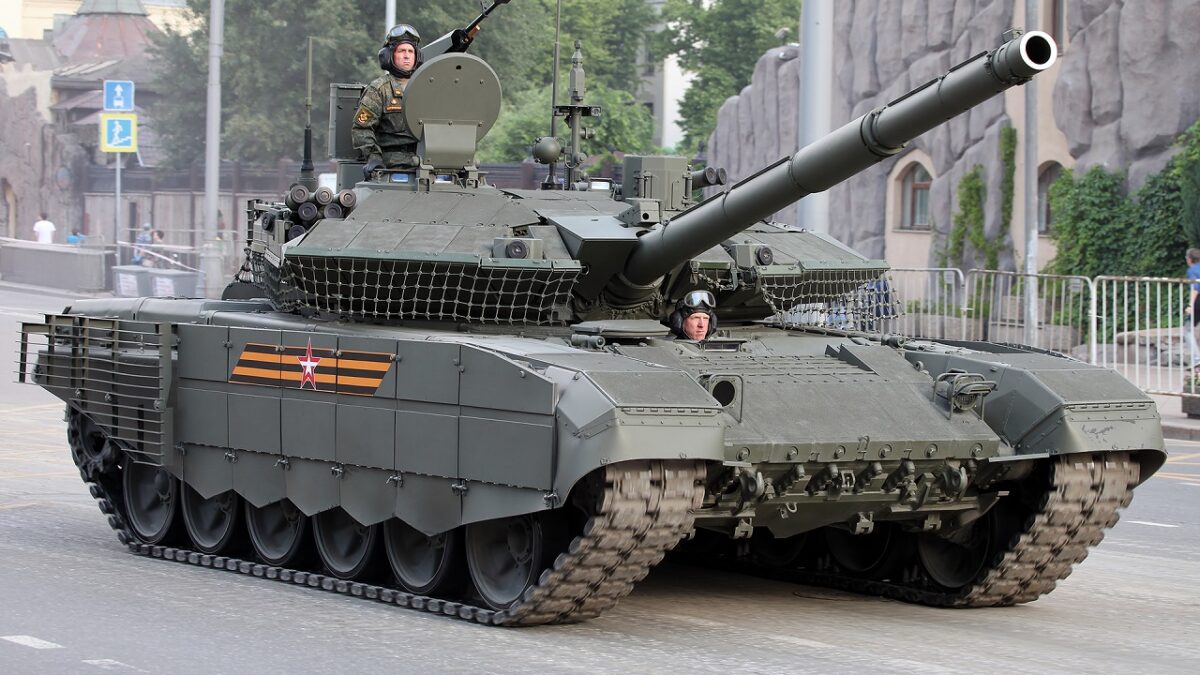
[DOCUMENTED] The T-90M "Proryv" (Прорыв, "breakthrough") is Uralvagonzavod's deep modernisation of the T-90, in serial production since about 2020 and Russia's main new-built tank. Its relevant features for ammunition survivability are:
[ANALYSIS] The important point is the combination. The T-90M keeps the main load where it always was in the T-72 family, low in the carousel, but removes the two things that made earlier carousel tanks burn: unprotected extra rounds in the fighting compartment, and weak protection around the carousel itself. People who see the bustle box on the turret rear often assume the T-90M has adopted a Western layout. It has not; the box is overflow storage.
Relikt: why less hard armour is acceptable
[DOCUMENTED] Relikt (4S23 elements), developed by NII Stali, is a second-generation explosive reactive armour. Unlike the first-generation Kontakt-1, which was effective mainly against shaped charges, Relikt (like its predecessor Kontakt-5) uses heavy flying plates that are thrown into the path of an incoming threat. Against a shaped-charge jet, the moving plates disrupt and consume the jet. Against an APFSDS long rod, the heavy plates strike the rod at an angle, shearing, bending or breaking it, so that it reaches the main armour yawed or in pieces.
[SINGLE-SOURCE] NII Stali claims Relikt reduces the penetration of APFSDS rounds by more than half and is effective against tandem warheads. These are manufacturer figures.
[ANALYSIS] Because ERA does a large part of the work against both chemical and kinetic threats, the designer can achieve strong frontal protection without a huge mass of steel and composite. The weight saved can go into side, roof and carousel protection. That is a better spread of armour for today's threats than piling everything onto the front. The T-90M weighs about 48 tonnes; a current Abrams weighs well over 60.
The T-72B3M and T-80BVM
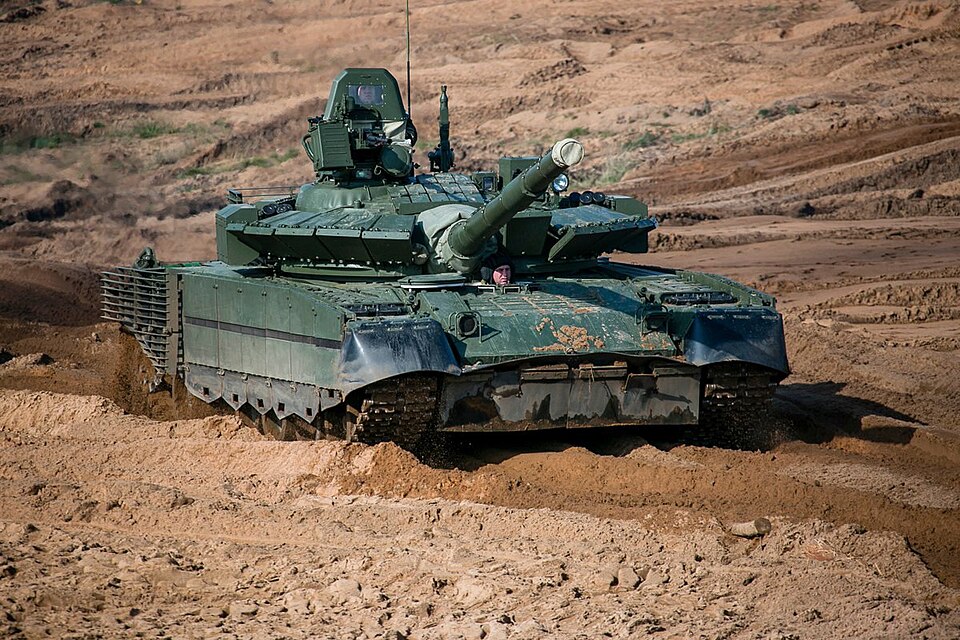
[DOCUMENTED] The T-72B3M (sometimes called T-72B3 obr. 2016) and T-80BVM are cheaper modernisations of older hulls. Both received Relikt on parts of the vehicle, improved fire control and, later, cages and anti-drone screens. The T-72B3M keeps the T-72 АЗ; the T-80BVM keeps the T-80 МЗ. Neither has the full welded turret of the T-90M, and their cast turrets and older hulls are weaker. [ANALYSIS] They show the layout working with less protection: still a carousel, still low, but more likely to be reached by a penetration.
THE T-14 ARMATA: RUSSIA'S CLEAN SHEET KEPT THE CAROUSEL
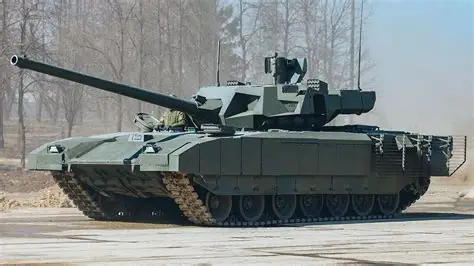
[DOCUMENTED] When Russia designed a completely new tank, the T-14 Armata, it did not move the ammunition to a bustle. The T-14 keeps a carousel autoloader under an unmanned turret, and puts the three-man crew in an armoured capsule in the front of the hull, separated from the ammunition compartment by an armoured bulkhead.
[ANALYSIS] This is the logical next step of the carousel idea. The weakness of the classic carousel is that the crew sits directly above it; if it does go, they die. The T-14 keeps the ammunition low and protected and moves the crew away from it. Russia had every chance to adopt a Western layout with a clean sheet design, and chose not to. No Russian design bureau has publicly proposed a switch to a Western-style bustle magazine for its main tanks.
[DOCUMENTED] The T-14 has seen very limited production and, by most reports, little or no frontline combat use in Ukraine. Its layout remains a design statement rather than a combat-proven solution.
[ANALYSIS] It is worth noting that the US Army's own next tank, the M1E3, appears to be heading the same way: an uncrewed turret and a three-person crew in the hull. The details of its ammunition stowage are not public, but the crew-in-the-hull concept is the T-14's concept.
UKRAINIAN FIELD ACCOUNTS: HOW MANY HITS DOES IT TAKE?
[ANALYSIS] The most useful evidence on the uptime question comes from the people trying to destroy these tanks. Reports from Ukrainian units describe the T-90M as one of the hardest Russian tanks to kill, and describe Arena-M as an unwelcome development. These accounts are informal and difficult to verify, and need careful labelling.
[ANALYSIS] Read together, these accounts support the core argument of this page. Tanks with protected low ammunition stowage are being disabled after many hits, by the gradual loss of optics, weapons, mobility and systems, rather than destroyed by the first hit that gets through. The 40-hit T-90M is the important case: it was not saved by an active protection system, but by its armour layout and screening. The tanks are not invulnerable, and Arena-M can be exhausted, but the number of drones needed per kill is high, and a disabled tank can often be recovered and repaired.
WORKED ENGAGEMENTS: STEP BY STEP
[ANALYSIS] The best way to see the difference between the layouts is to walk through the same attacks on each. The scenarios below are illustrative, built from public descriptions of the vehicles and threats; they are not reconstructions of specific events. Timings and penetration figures are [ESTIMATE].
Scenario 1: one FPV drone with a PG-7VL warhead, diving onto the turret rear
The attack. A drone operator 3–5 km away flies a quadcopter carrying a PG-7VL grenade, about 500 mm RHA penetration on paper, less if the stand-off is wrong. The tank is stationary in a treeline, turret pointing forward. The operator dives at roughly 40–60 degrees onto the turret rear, the classic aim point.
Carousel tank (T-90M type).
Bustle tank (Abrams type).
[ANALYSIS] This single scenario is the core of the argument. It is the most common attack geometry of the current war, and it is exactly the case the bustle is worst at.
Scenario 2: an FPV onto the engine deck
Carousel tank. The warhead penetrates the engine deck. The engine, transmission, cooling and fuel lines are damaged; the tank may stop. The carousel, forward of the engine bulkhead, is not reached. Result: mobility kill, repairable, crew safe.
Bustle tank. Identical in principle: the bustle is above and forward of the engine, and the deck hit does not reach it. Result: mobility kill, repairable, crew safe.
[ANALYSIS] Neither layout is advantaged here. The point is that many FPV hits produce exactly this kind of outcome, which is why tanks on both sides can survive many hits.
Scenario 3: a tandem ATGM into the hull side, at the turret ring
The attack. A Javelin, Stugna-P or Kornet-class missile with a tandem warhead, 900–1,200 mm RHA penetration, hits the hull side roughly below the turret ring.
Carousel tank. The precursor charge triggers the side ERA; the main charge goes through skirts and side plate. The jet enters the fighting compartment at carousel level. Unless the carousel protection stops it, the jet strikes charges in the carousel. This is the worst case for the carousel: a high chance of catastrophic detonation and loss of crew.
Bustle tank. The jet enters the crew compartment or the hull stowage. In the Abrams, a few hull rounds may be hit; crew casualties likely; the bustle is not involved. In the Leopard 2, the jet may reach the hull rack beside the driver, with no blowout protection: catastrophic loss possible.
[ANALYSIS] This is where the carousel is most vulnerable, and it is honest to say so. But note what had to happen: a heavy guided missile with a warhead large enough to defeat the side armour, hitting a specific low zone. That threat existed in 1991 and still exists; it is not the threat that has multiplied in 2023–2026.
Scenario 4: tandem top-attack ATGM (Javelin) onto the turret roof
Carousel tank. The Javelin's main charge penetrates the turret roof and travels down into the crew compartment. The jet may reach the carousel below, through the turret basket floor; the crew is directly in its path. Likely result: crew casualties and possibly carousel ignition.
Bustle tank. If the missile hits over the crew, crew casualties are likely but the magazine may survive. If it hits the bustle, the panels vent and the crew likely survives.
[ANALYSIS] Javelin was designed for this. Both layouts suffer; the bustle gives the crew better odds. This is the best case for the Western layout in the drone era, and it is one reason roof protection, cages and APS matter so much on both sides.
Scenario 5: APFSDS frontal hit, tank-on-tank
Carousel tank. A 120 mm DU or tungsten dart hits the turret front at 2 km. Relikt shears the rod; the composite stops the remains. No penetration. If the dart instead penetrates the lower front hull, it may reach the fuel-tank racks and potentially the carousel.
Bustle tank. A 125 mm dart hits the turret front. The armour holds. The bustle, at the rear, is not exposed.
[ANALYSIS] In the classic duel, the bustle is effectively invisible to the enemy. That is why the layout made sense when it was designed in the 1970s, against a Soviet tank army coming through the Fulda Gap.
Scenario 6: a swarm of drones over an hour
The attack. A tank on an assault is attacked by 20 FPV drones over an hour, from different directions.
Carousel tank with Arena-M. The APS defeats a number of the first drones (field accounts suggest around seven before running out on a 12-round system). Cages and screens defeat or degrade more. Some hit optics, tracks, barrel and engine deck. The tank loses capability piece by piece, and finally stops. The carousel is never reached. Crew evacuates; tank is recoverable.
Bustle tank with Trophy. Trophy, with a limited number of reloads per launcher, defeats the first several. Subsequent drones find the turret rear. The first one that penetrates the bustle ends the tank's ability to fight.
[ANALYSIS] Here the arithmetic is decisive: the carousel tank's failure mode is gradual, the bustle tank's is a cliff. The cliff is reached the first time a single drone gets through to one predictable spot.
THE LOADING SEQUENCE AND CREW SIZE
[BACKGROUND] Ammunition layout is tied to how the gun is loaded, and that in turn shapes the size of the turret and crew.
[ANALYSIS] The small turret is one of the carousel's big hidden advantages. Turret armour is the heaviest armour on a tank per square metre, because the turret faces the enemy. A turret that does not house a standing loader or a magazine can be smaller, lower, and better armoured for the same weight. The T-90M's turret is far smaller than the Abrams's, and part of its weight saving comes from that.
[ANALYSIS] Carousel critics point out disadvantages too: the carousel limits round length (which forced the modernisation for 3BM59/60), limits ammunition count, and makes the crew space cramped. These are real costs. They are design trade-offs, not defects.
ANSWERING THE "DEATH TRAP" CLAIM DIRECTLY
[ANALYSIS] The "death trap" view usually rests on three observations: turret toss images, the total ammunition load near the crew, and the claim that any penetration means catastrophe. Each deserves a direct answer.
GLOSSARY
LAYERS AROUND THE LAYOUT: CAGES, APS AND EW
[ANALYSIS] Ammunition layout is the last line of defence. Before a threat ever reaches it, modern tanks on both sides now rely on several outer layers, and those layers interact with the layout question.
[ANALYSIS] Every one of these layers can be saturated or bypassed. When that happens, the layout decides what the next hit does. For the carousel tank, the next hit lands on equipment and armour. For the bustle tank, the next hit can land on the magazine. That is why the layout question matters even for tanks with APS: the APS buys time, the layout determines what happens when time runs out.
OTHER WESTERN DESIGNS WORTH WATCHING
[ANALYSIS] The trend among Western next-generation designs is clear: uncrewed or smaller turrets, three-person crews, autoloaders, and crew placed lower and further from the ammunition. That is a convergence toward the principles behind the T-14, even when the ammunition itself stays in a bustle.
WESTERN TANKS ON THE DRONE BATTLEFIELD
[DOCUMENTED] Ukraine received 31 M1A1 Abrams from the United States, along with Leopard 2A4, 2A6 and Strv 122 tanks from European countries, Challenger 2s from Britain and many Leopard 1s. Open-source tallies show substantial losses of all types, mostly to mines, artillery, ATGMs, Lancet loitering munitions and FPV drones. Ukraine pulled its Abrams back from the front line for a period in 2024, citing drone vulnerability, and later returned them with added ERA, cages and screens.
[FIELD ACCOUNT] Ukrainian Abrams crews quoted in Western media praised the tank's crew survivability; several crews survived hits that destroyed the vehicle. At the same time, crews and commanders described the tank as heavy, hard to maintain and recover, and vulnerable to drones attacking the rear and the top.
[ANALYSIS] This is the trade-off in a single sentence: crew survival was excellent; combat availability was poor. A tank that is often knocked out but whose crews usually survive keeps the crews and loses the tanks. A force with a small number of heavy, hard-to-replace vehicles feels the second effect very quickly.
[ANALYSIS] It is important not to overclaim. Western tanks in Ukraine were used in small numbers, often without the full combined-arms support they were designed for, and frequently with older ammunition and protection. Many were lost to mines and artillery that have nothing to do with ammunition layout. There is no clean public data set showing how many Abrams or Leopards were put out of action specifically by bustle hits. The argument on this page is about the exposure each layout creates, not a claim that every Western loss was a bustle fire.
WHY THE BUSTLE CANNOT SIMPLY BE ARMOURED
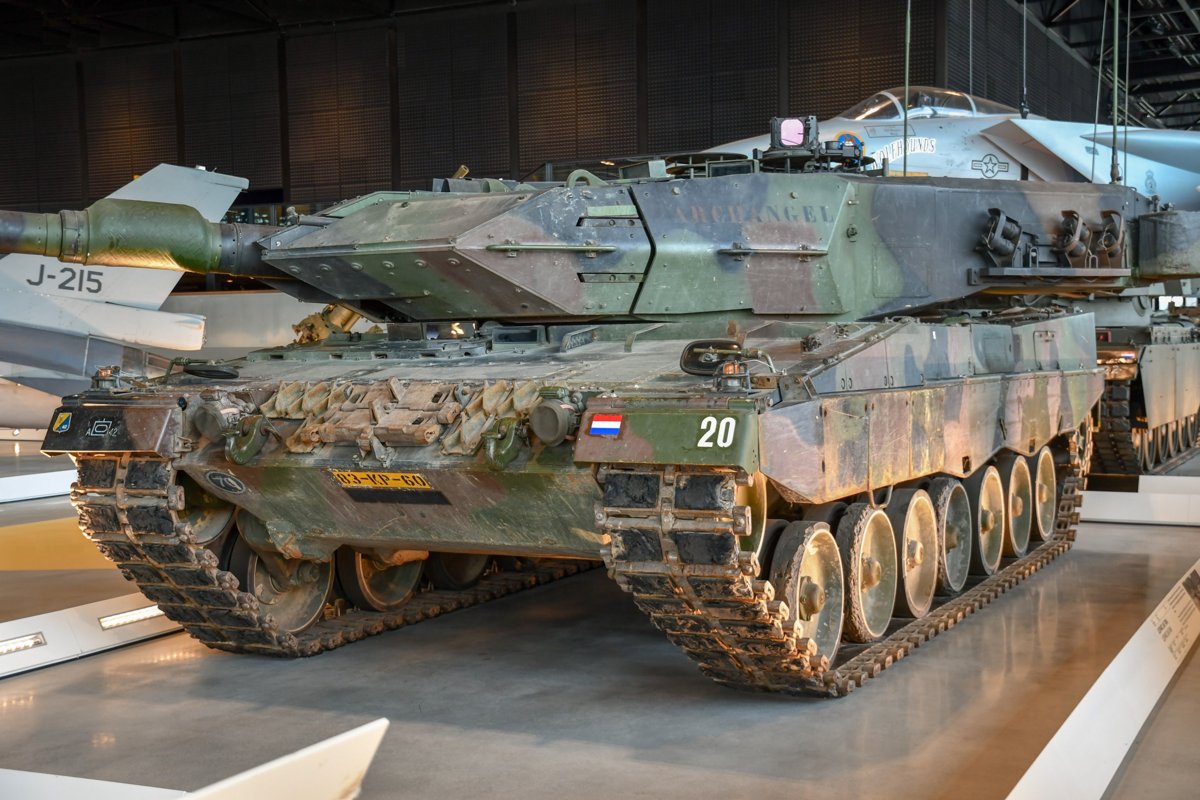
[ANALYSIS] An obvious response is: if the bustle roof is a weak point, armour it. The difficulty is physical:
[ANALYSIS] Designers have therefore relied on cages, nets, soft-kill jammers and active protection systems such as Trophy to keep threats away from the bustle, rather than on hardening the bustle itself. That works only while those systems work. The carousel, by contrast, is protected by the main armour of the tank, which is always there.
THE ABRAMS: A GREAT BASE THAT NEEDS A NEW TURRET
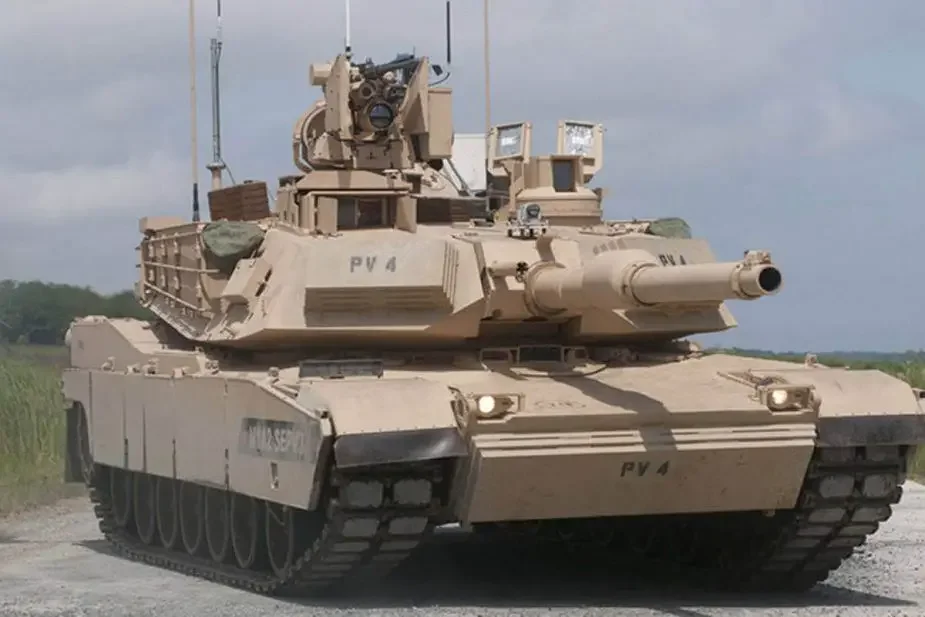
[DOCUMENTED] The M1A2 SEPv3 is the current production Abrams. With additional armour, systems and the Trophy APS, it weighs about 73–74 US short tons (around 66–67 metric tonnes); some sources give higher figures for fully equipped vehicles [CONFLICT]. Its weight has created problems with bridges, transport, fuel consumption and recovery.
[DOCUMENTED] In September 2023 the US Army cancelled the planned M1A2 SEPv4 upgrade, which would have added more equipment and weight, and launched the M1E3 programme instead. The Army's stated reasons included weight, logistics and lessons from Ukraine, including the drone threat.
[DOCUMENTED] By October 2026, the programme had moved quickly:
[ANALYSIS] This is, in effect, the T-90A-to-T-90M approach: keep the proven hull, automotive and fire-control lineage, and redesign the turret and protection around today's threats. The SEPv3 piled weight onto the same turret shape, mostly strengthening the front, while the roof, sides and rear, exactly where drones hit, stayed comparatively exposed. Cancelling SEPv4 was the right call. A smaller uncrewed turret lets the designers spend protection where it matters, and moving the crew into the hull removes them from the bustle's neighbourhood entirely. How the M1E3 stores its ammunition is the most interesting open question: whether it will keep a bustle-type magazine in an uncrewed turret (where a fire would cost the tank but not the crew), or move rounds lower. [UNVERIFIED] Public sources do not yet say.
COMPARISON TABLE: LAYOUT VS. THREAT
[ANALYSIS] The table below summarises the likely result of a single successful hit by each threat type on each layout, assuming a modern vehicle of each type (T-90M-class carousel, Abrams-class bustle, Leopard 2-class hybrid). "Penetrating" means the threat gets through the armour it hits.
| Threat / hit location | Carousel (T-90M class) | Bustle (Abrams class) | Hybrid (Leopard 2 class) |
| FPV, turret rear / bustle | Stowage and extra rounds damaged; 22 ready rounds intact; keeps fighting | Magazine burns, panels vent; crew survives; tank out of the fight | Bustle rounds burn, panels vent; hull rounds remain; combat power sharply reduced |
| FPV, engine deck | Mobility kill, repairable | Mobility kill, repairable | Mobility kill, repairable |
| FPV, optics / barrel / tracks | Degraded, still in action or repairable | Degraded, still in action or repairable | Degraded, still in action or repairable |
| Tandem ATGM, hull side at turret ring | Worst case: carousel may detonate; crew loss likely | Crew casualties likely; bustle not involved | Hull rack may detonate; crew loss likely |
| Top-attack ATGM, turret roof | Crew casualties; carousel may ignite | Crew casualties if over crew; vented if over bustle | As Abrams for turret; hull rack usually not reached |
| APFSDS, frontal arc | Usually defeated by ERA + composite | Usually defeated; bustle not exposed | Usually defeated; bustle not exposed |
| Mine under hull | Mobility kill; belly penetration can reach carousel | Mobility kill; hull rounds at risk | Mobility kill; hull rack at risk |
| Artillery fragments / near miss | Minor; optics and running gear | Minor, unless bustle roof penetrated | Minor, unless bustle roof penetrated |
| Drone swarm (20+ over an hour) | Gradual loss of systems; usually disabled, not destroyed | First bustle penetration ends the fight | First bustle or hull-rack penetration ends the fight |
COUNTERARGUMENTS
[ANALYSIS] The case for the bustle is strong, and a fair article must state it clearly.
Crew survival is the whole point
A trained tank crew takes years to produce. A commander, gunner and driver with combat experience are worth far more than the steel around them. The bustle layout's record of crews walking away from catastrophic ammunition fires is real, and it has saved hundreds of lives. A carousel that does detonate usually kills the crew. For a professional, volunteer army that cannot easily replace experienced soldiers, crew survival may matter more than vehicle availability.
Morale and recruitment
Crews who believe their tank will protect them fight more aggressively and are easier to recruit and retain. The image of a turret thrown fifty metres has a psychological effect on carousel crews.
Repairability
A tank whose bustle burned out but whose crew compartment, hull and drive are intact can, in principle, be repaired: new panels, new doors, new ammunition. A carousel tank that detonates is a total loss. On the other hand, a carousel tank that is disabled without ammunition ignition, as the field accounts describe, is the most repairable case of all.
The hull stowage problem
Even carousel tanks carry rounds outside the carousel, and those rounds are dangerous. Crews often carry more than they should. The bustle-equipped Abrams, by contrast, keeps most of its load behind blast doors.
Hits through the carousel's armour do happen
FPV drones carrying tandem warheads, ATGMs, Lancets and mines can and do penetrate the hull sides, rear and belly, and some hits do reach the carousel. Turret tosses have continued in Ukraine in 2023–2026. The carousel's protection is only as good as the armour around it, and older T-72s and T-80s with weaker armour remain vulnerable.
Answer
[ANALYSIS] Each of these points is valid. None of them changes the central observation: in today's threat environment, the bustle is hit far more often than the carousel is reached, and a bustle hit ends the tank's fight. The right comparison is not "crew survival vs. no crew survival", but crew survival per hit vs. hits survived per tank. The carousel trades worse outcomes in rare events for far fewer mission-ending events. The T-14's crew capsule, and apparently the M1E3's hull crew compartment, try to get both.
CONCLUSION
[ANALYSIS] Western sources have long treated the carousel as an inferior design, based mostly on images from the Gulf War and early Ukraine. That judgement made more sense in a world of tank-on-tank combat, where penetrating hits came into the frontal arc and the bustle was rarely touched. On today's battlefield, the most common threat is a small warhead from above and behind, which rarely penetrates main armour but easily breaches thin structures. A carousel low in the hull can only be reached by a hit that defeats the tank's main protection. A bustle magazine is protected by panels that must, by design, be weak.
[ANALYSIS] Done properly, as in the T-90M, with a welded turret, spall liner, protection around the carousel, Relikt ERA and no loose rounds in the fighting compartment, the carousel layout gives a tank that tends to be disabled after many hits rather than knocked out of the fight by one. Ukrainian field accounts of T-90Ms absorbing dozens of drone hits, and of Arena-M-equipped tanks requiring 15–20 drones, point the same way. Western designers appear to be drawing similar conclusions: the next Abrams moves its crew into the hull under an uncrewed turret.
[ANALYSIS] The bustle remains the better solution when crew survival per hit is the only measure, or when combat is mainly frontal. On the drone battlefield, measured by how long a tank stays in the fight, the Russian carousel layout is the more practical answer.
WHAT THIS PAGE CANNOT SAY
RELATED ARTICLES
SOURCES