Home |
Data Base |
Technical |
Radio |
Search
DAN-T
Дань-Т | Kronstadt / Rostec (attributed) | related to the S8000 Banderol, identity unresolved
Small jet-powered quasi-cruise missile
Project Orlan Data Base // public encyclopedia
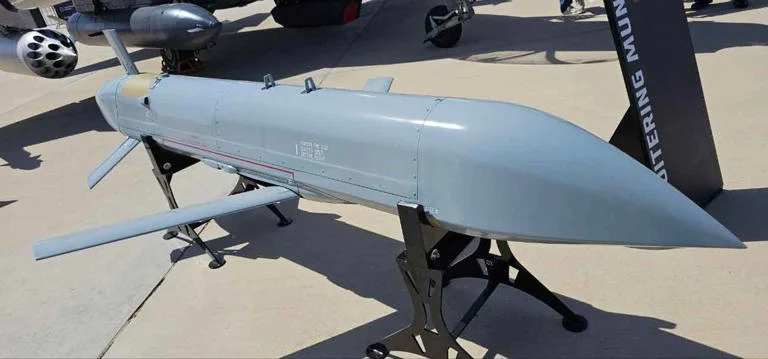
A Dan-T on a static display stand at the El Alamein International Airshow, Egypt, 8 to 10 September 2026, the first public showing of the weapon under that name. The sign behind it reads "...ERING MUN" (loitering munition). The folding wings are deployed, with a pop-out wing visible on the near side. The airframe is hard to tell apart from the S8000 Banderol by appearance alone. El Alamein International Airshow 2026.
Related article: S8000 Banderol, a related Kronstadt / Rostec weapon in the same class. The two look very alike and are often grouped together, but they have not been shown to be the same missile.
WHAT IT IS
The Dan-T (Дань-Т) is a small, jet-powered, air-launched Russian strike weapon that Rostec and Rosoboronexport unveiled at Egypt's El Alamein Airshow on 8 to 10 September 2026. The exporter's show figures are a maximum take-off weight of 268 kg, a maximum warhead of 130 kg, GNSS and inertial guidance, a maximum speed of 500 km/h and a maximum range of 450 km. Rostec markets it as a fire-and-forget "loitering munition," claims "hundreds of successful launches" against enemy targets in Ukraine, and offers it for Russian and foreign aircraft and helicopters. [DOCUMENTED]
Most analysis treats it as a small cruise missile, or as what the Institute for the Study of War (ISW) calls a "quasi-cruise missile": jet speed and a 100-plus-kg warhead at a fraction of a Kh-101's cost, used to strain air defences already dealing with Gerans, cruise missiles and ballistic missiles. "Loitering munition" should not be read as in-flight retargeting. ISW notes that it is unclear whether weapons of this class can change targets dynamically. [DOCUMENTED for the ISW framing and the official wording; the category is CONTESTED]
Identity is the main unsettled question, and it is the reason this is a separate page rather than a section of the S8000 Banderol article. Janes, reporting from El Alamein, judged the display article "almost identical" to Kronstadt's S8000 Banderol and therefore likely an export version. Defense Express has later written of "Dan-T (also known as Banderol)" as one system. Other reporting, including Militär Aktuell, Militarnyi citing Table.Briefings, and the Ukrainian analyst Anatolii Khrapchynskyi, describes a separate Kronstadt / Rostec design derived from the 1990s Sokol Dan-M target drone, about 35 percent cheaper than the Banderol, and a candidate to replace it. HUR deputy chief Major General Vadym Skibitskyi has treated Banderol and Dan-T as two "novel systems." The evidence is not strong enough to treat them as the same missile, and not strong enough to treat Dan-T as simply a re-warheaded Dan-M. This page presents both views and leaves the identity unresolved. [CONTESTED; see DAN-T VERSUS THE S8000 BANDEROL]
No GRAU index or factory "izdeliye" number applied specifically to this weapon has been published. Rostec, Rosoboronexport and the Russian Ministry of Defence all use «Дань-Т» in public, including on the MoD's November 2026 Mi-28NM launch video. There is still no public HUR teardown of a Dan-T, and RobotWar lists zero recovered parts. Almost every firm number traces to the El Alamein card, to Ukrainian analysts, or to Banderol data borrowed across. [DOCUMENTED]
QUICK FACTS
- Name used by Rostec, Rosoboronexport and the Russian MoD: Дань-Т (Dan-T). [DOCUMENTED]
- Domestic / internal designation: none documented. No GRAU index or izdeliye number has been published. S8000 Banderol is the leading candidate only if the export-relabel view is right, and Rostec has not confirmed that link. Izdeliye 720 is speculation with a mass mismatch. [DOCUMENTED for the official name; the candidates are CONTESTED]
- Designer / manufacturer: Rostec presents it; Rosoboronexport is the exporter. JSC Kronstadt is named as manufacturer by the US Army ODIN entry and by Militär Aktuell, and is independently documented by HUR as the designer of the S8000 Banderol and the Orion UAV. No Russian official statement found for this page actually says Kronstadt builds the Dan-T. The factory is UNVERIFIED. [SINGLE-SOURCE for the Kronstadt attribution]
- Type: advertised as an air-launched loitering munition; treated here as a small jet-powered quasi-cruise missile for pre-surveyed ground targets. [DOCUMENTED as wording; category CONTESTED]
- First public showing: El Alamein Airshow, Egypt, 8 to 10 September 2026. [DOCUMENTED]
- Launch mass: 268 kg maximum take-off weight (Janes / Rosoboronexport); "up to 270 kg" (RIA / Rostec). [DOCUMENTED]
- Warhead: 130 kg maximum (Janes / Rosoboronexport); 135 kg in some Ukrainian estimates. Type, fill and fuzing have not been published. [DOCUMENTED / SINGLE-SOURCE; type UNVERIFIED]
- Range: 450 km maximum declared; up to 500 km air-launched and about 250 km ground-launched in Ukrainian estimates. Helicopter launch should sit in between. The 450 km figure is not a demonstrated Mi-28 engagement distance. [DOCUMENTED / ESTIMATE]
- Speed: 500 km/h maximum declared, slower than the Banderol's reported 520 to 650 km/h maximum. [DOCUMENTED]
- Length / span: not published by Rosoboronexport. Militär Aktuell alone gives 3.4 m and 2.0 m; those figures are unverified and happen to match Piotr Butowski's estimates for the earlier Izdeliye 720 project. [UNVERIFIED / SINGLE-SOURCE]
- Engine: "compact turbojet"; model not published. Reported as the Russian MD-120 or as a Chinese microjet, by analogy with the Banderol and with commentary on the class. [CONTESTED]
- Guidance, as sold: GNSS plus INS; fire-and-forget; autonomous after launch. A Kometa-16 anti-jam antenna and an electro-optical terminal seeker are reported as work in progress, not as confirmed standard fit. No datalink has been documented. [DOCUMENTED for GNSS/INS; upgrades SINGLE-SOURCE; datalink UNVERIFIED]
- Documented carriers: the El Alamein display, photographs of a missile on a Mi-28NM, and a Russian MoD video of an Mi-28NM launching a weapon it names as Dan-T, with two rounds on the outer stub-wing stations and one release. Many other platforms are claimed. [DOCUMENTED for the imagery; other platforms UNVERIFIED]
- Combat use: claimed by Rostec ("hundreds of successful launches") and by the MoD video. The Ukrainian Air Force began naming Dan-T on 13 September 2026 and has generally lumped "Banderol/Dan-T" together since, so the two cannot be counted separately. ISW judged in early October 2026 that it was unclear whether Dan-T had already been fielded at scale. [DOCUMENTED as claims and as the Air Force category; scale UNVERIFIED]
- Production / cost: no official figures. Reported 2027 targets of 10,000 or even 14,000 units are unconfirmed. A cost of about 35 percent below the Banderol, and a possible Banderol phase-out, rest on a single reporting chain. [SINGLE-SOURCE / UNVERIFIED]
WHY IT MATTERS
By 2026 Russian forces already had cheap, slow one-way drones at one end of the scale, and expensive cruise missiles such as the Kh-101 at the other. The gap between them is the point of the Banderol / Dan-T class. A 500 km/h jet with a 100-plus-kg warhead is faster than the propeller interceptors built for 180 to 200 km/h Shaheds, cheaper than a heavy cruise missile, and typically mixed into salvos with Gerans and Kh-59/69s. ISW's October 2026 paper is the right frame: these are inexpensive "quasi-cruise missiles," used to strain air defences rather than to replace the Kh-101. [DOCUMENTED for the ISW framing]
Whether Dan-T is an export or cheaper variant of the Banderol, or a related programme built around a more domestic parts set, does not change that class. It does change how the two pages should be written. This article concentrates on what is distinct about Dan-T, on the identity question, and on the radio-frequency and guidance picture. General Banderol background is kept short and is cross-linked.
DAN-T VERSUS THE S8000 BANDEROL
Three views are in circulation. They are not equally sourced, and they are not fully compatible. This page does not pick a winner.
View A — an export Banderol, or the same missile under a new name. Janes reported from El Alamein that "externally, the Dan-T looked almost identical" to the S8000 Banderol, used against Ukraine since mid-2025, and that this "would indicate that Dan-T is an export version of the S8000 Banderol." A Rosoboronexport representative told Janes on 8 September 2026 that all four air-launched weapons on the stand, Dan-T included, were already in service with the Aerospace Forces and had been used in combat. [DOCUMENTED as Janes's assessment and as the exporter's service claim]
Defense Express has gone further, writing of "Dan-T (also known as Banderol)" and "Dan-T (also known as the S8000 Banderol)" when covering the November 2026 Mi-28NM launch video, and earlier calling Dan-T a possible "licensed copy." [SINGLE-SOURCE as an identity finding; the video itself is DOCUMENTED] Can Kasapoğlu, quoted by Ukrinform, likewise called it "the export version of the Banderol" and "a derivative." [SINGLE-SOURCE]
Circumstantial support is real and is not decisive. The Ukrainian Air Force began naming Dan-T in daily reports on 13 September 2026 and has generally lumped "Banderol/Dan-T" together since. That is a practical classification, not a technical finding of identity. [DOCUMENTED] The show-stand figures (450 km, 130 kg warhead, 500 km/h, 268 kg) sit in the same band as published Banderol figures (about 350 to 500 km, 114.3 to 150 kg, 520 to 650 km/h). [DOCUMENTED as published figures; the inference of identity is CONTESTED] Kommersant reported that, from Rostec's description of hundreds of combat launches, "experts concluded" the article is probably the weapon known as Banderol and that Dan-T would then be its export modification, and immediately noted that Rostec has not publicly confirmed that link. [DOCUMENTED as Kommersant's account of an inference, not as an official designation]
View B — a separate Kronstadt design, derived from the Dan-M target, and cheaper. Militarnyi, on 28 August 2026, before El Alamein, described Dan-T as having "technical specifications similar to those of the S8000 Banderol," not as the same missile. Citing Table.Briefings, it said work was under way to fit a Kometa-16 antenna and an electro-optical terminal seeker; that Aerospace Forces command was considering exclusive Dan-T procurement and a gradual Banderol phase-out; and that a key reason was a cost cut of about 35 percent. [SINGLE-SOURCE chain: Table.Briefings as cited by Militarnyi]
Militär Aktuell (Martin Rosenkranz, 12 October 2026) states that Dan-T "is a combat version of the Dan-M target-indicator missile from the early 1990s," lists Kronstadt (Rostec) as manufacturer, and cites FW-MAG for the same "about 35 percent cheaper" figure. [SINGLE-SOURCE for the Dan-M-combat-version wording] Khrapchynskyi told RBC-Ukraine that Dan-T is a modification of the Dan-M training target: the recovery parachute and Luneberg lens were removed. He says it uses the Russian MD-120 turbojet. [SINGLE-SOURCE]
HUR deputy chief Maj. Gen. Vadym Skibitskyi, on 10 August 2026, treated Banderol and Dan-T as two "novel systems" and "loitering munitions launched from helicopters," and said one goal for Dan-T is that "the entire component base [be] their own," in contrast to Geran-4/5 engines bought from China. [DOCUMENTED as a HUR official statement] If that localisation goal is real, Dan-T is at least a distinct bill of materials, even if the airframe looks like the Banderol. Serhii "Flash" Beskrestnov, cited by ISW, said Dan-T "resembles the Banderol," and also that Dan-T and Dan-M are distinct air vehicles and that Russia has significant Dan-M stockpiles. [SINGLE-SOURCE, via ISW]
View C — visually similar, different specifications. Alexander Stepanov of RANEPA told TASS the munition "is visually similar to … ‘Banderol,’" but "features different specifications." TASS's own description mostly restates the official show data. [SINGLE-SOURCE as analysis] The same expert is quoted more strongly by www1.ru as calling Dan-T "the export version of the S8000 Banderol." Those two attributions conflict; this page prefers the TASS wording. [CONTESTED] RobotWar notes that a pro-Kremlin channel, "Russian Engineer," also calls them different missiles that merely look alike, and rejects a simple Dan-M conversion. [SINGLE-SOURCE, hostile-source commentary]
Conflicts that actually matter.
1. Length and span. The Banderol is about 5 m long with about 2.2 m span (HUR). The Sokol Dan / Dan-M target is 4.6 m long with a 2.7 m span. [DOCUMENTED] Militär Aktuell's 3.4 m / 2.0 m for Dan-T, if correct, would mean it is neither a simple Dan-M conversion nor the same airframe as the Banderol. No second source was found, and Rosoboronexport has not been quoted with a length or span. Treat 3.4 m / 2.0 m as UNVERIFIED / SINGLE-SOURCE. A further caution: those exact figures are also Piotr Butowski's estimated dimensions for the earlier, unfinished Izdeliye 720 project, discussed below. Defense Express published that comparison on 11 September 2026; Militär Aktuell's table appeared on 12 October. The match may be a measurement, a coincidence, or source contamination.
2. Mass. Dan-T's official maximum take-off weight is 268 kg, or "up to 270 kg" in RIA's wording. The Sokol Dan target is listed at 345 kg; some secondary accounts give Dan-M at 350 to 395 kg. [DOCUMENTED for 268 and 345 kg] A 130 kg warhead substituted into a 345 kg recoverable target, after only the parachute and Luneberg lens come out, should not produce a lighter 268 kg weapon unless the airframe was substantially redesigned or the figures describe different configurations. That is a strong argument against "they just bolted a warhead onto existing Dan-M stock" as an account of the 268 kg export article. It does not, by itself, prove the export-Banderol view.
3. Engine. The Banderol uses a Chinese Swiwin SW800Pro-A95 of 81.6 kgf, documented in the HUR teardown on the Banderol page. Khrapchynskyi says Dan-T uses the Russian MD-120 (120 kgf). Valerii Romanenko, speaking of the class that includes the Banderol, Dan-T and the S-71M Monokhrom, said "half the components — including the engine — are Chinese." Rostec has not published an engine model. [CONTESTED]
4. Timing. Converted Dan-M targets were already reported in strikes in spring and early summer 2025 (Beskrestnov; Defense Express on 30 May 2025 was itself sceptical and floated a possible misidentification with the Iranian Karrar). ISW says those conversions were not then used at scale after mid-2025. The named Dan-T product was unveiled in September 2026. Secondary reporting sometimes collapses the two. They may be related; they have not been shown to be the same weapon. [CONTESTED]
Verdict. The evidence is not strong enough to treat Dan-T as simply "the export Banderol," and not strong enough to treat it as simply "a re-warheaded Dan-M." What is solid is that Russia is publicly selling, under the name Dan-T, a small jet quasi-cruise missile that looks very like the Banderol, carries official figures in the same performance band, is being lumped with the Banderol in Ukrainian air-defence reporting, and is described by Ukrainian intelligence as a related but distinct programme whose designers want a domestic parts set. The name and some expert commentary point to the Sokol Dan / Dan-M family; the 268 kg official mass and the uncorroborated 3.4 m length cut against a straight stock conversion of the 4.6 m / 345 kg target. Janes's export-Banderol reading is a reasonable inference from appearance and marketing, not a demonstrated design identity. The 35 percent cost cut and the planned Banderol phase-out remain a single reporting chain.
DESIGNATION
The working assumption that "Dan-T" looks like an export or Rosoboronexport name, and that a separate domestic designation should exist, is only partly right.
What Russian official sources actually use. Rostec and Rosoboronexport unveiled the weapon as «Дань-Т» (Dan-T). RIA, reporting from El Alamein, said the munition was being offered to foreign customers "in an export version" (в экспортной версии) for Russian and foreign aircraft and helicopters. That wording can be read either as "Dan-T is the export name" or as "an export configuration of the Dan-T is on offer." [DOCUMENTED] The Russian Ministry of Defence, in the November 2026 Mi-28NM launch video and accompanying statement, itself named the weapon «Дань-Т». [DOCUMENTED] So Dan-T is not only a show-stand export label; it is the name the MoD has used in public for a claimed combat shot. No GRAU index (a 9M-series number or similar), factory cipher, or "izdeliye NNN" applied specifically to this weapon was found in the sources reviewed for this page.
Candidate 1 — S8000 Banderol, if Dan-T is an export relabel. This is Janes's inference and the reading of several commentators. As noted above, Kommersant recorded the inference and the lack of a Rostec confirmation. If the identity verdict is right — related but not demonstrated to be the same missile — then S8000 / Banderol should not be written as "the domestic designation of Dan-T."
Candidate 2 — Izdeliye 720 (изделие 720). Defense Express (Ivan Kyrychevskiy, 11 September 2026) asked whether Dan-T is related to the earlier Izdeliye 720 tactical cruise-missile project, shown around 2023 to 2024 and associated in IISS / Piotr Butowski reporting with the Raduga plant. Butowski's estimated 720 figures were a launch weight of 450 kg, a fuselage length of 3.4 m and a span of 2 m, in a Kh-69-like niche. Defense Express called it "reasonable to consider the possibility" that the Banderol and Dan-T represent further development of ideas from that unfinished project. [SINGLE-SOURCE speculation] This is not a documented designation for Dan-T. The masses do not match (450 kg versus the official 268 kg maximum take-off weight). Earlier IISS-based reporting also described Izdeliye 720 as possibly having an active-radar seeker "like" the Kh-35, which is not what Rostec advertises for Dan-T (GNSS/INS only). The exact match between Butowski's 3.4 m / 2.0 m and Militär Aktuell's otherwise uncorroborated Dan-T dimensions is a reason to treat those dimensions even more carefully, not a reason to rename Dan-T "Izdeliye 720."
Candidate 3 — the "-T" suffix as a clue. The expansion of "-T" was not found in a primary source. One Russian blog speculated that "T" might mean a television or thermal seeker, or might inherit "telecontrol" from the original Dan target's radio-command mode. [UNVERIFIED] Rostec's fire-and-forget GNSS/INS wording cuts against a TV seeker as standard fit. This page does not invent an expansion.
Bottom line. No separate, documented Russian domestic designation has been published for Dan-T. The only name used by Rostec, Rosoboronexport and the MoD in public is «Дань-Т». S8000 Banderol is the leading candidate if the export-relabel view is right, but that identity is unresolved and Rostec has not confirmed it. Izdeliye 720 is a dimensional speculation, not a designation. No NATO reporting name was found in the sources reviewed for this page.
THE DAN / DAN-M LINEAGE
The aerial target «Дань» (Dan', "Dan") was developed in the early 1990s by OKB Sokol (Simonov) to simulate subsonic tactical aircraft and Tomahawk-type cruise missiles. It is a single-engine mid-wing monoplane with a tail-mounted turbojet, launched from a ground rail or transport-launch vehicle with a solid booster that is dropped after take-off, and recovered by parachute onto inflatable cushions. It was designed for reuse, about ten flights in the published description. Guidance on the target was a programmed autopilot plus a radio-control link, not a combat GNSS/INS suite. [DOCUMENTED]
Published Dan / Dan' figures: length 4.6 m, height 0.82 m, span 2.7 m (2.683 m in one table), maximum take-off weight 345 kg, MD-120 turbojet of 120 kgf, speed in the 300 to 710 or 400 to 750 km/h band depending on the table, altitude 50 m to 9,000 m, endurance 25 to 40 minutes (or up to 70). Defense Express, describing the improved Dan-M shown in 2020, says the electronics were partly updated and the engine became a small MGTD-125E of 125 kgf, claimed to use additive manufacturing in the combustor and nozzle. Fuel volume is given there as 77.5 litres. [DOCUMENTED for the Dan' card; SINGLE-SOURCE for the Dan-M engine change]
The name, then, is a real Russian product name, not a Western label. "Dan" is Kronstadt's and Sokol's own word for this family, and Rostec itself presented "Dan-T" at El Alamein. That does not settle whether the 2026 weapon is a converted stock target, a redesigned descendant, or a new airframe that only borrowed the name.
OKB Sokol is a weak foundation for a mass-production missile. Defense Express notes that the bureau's CEO was prosecuted for fraud on defence contracts, that the firm was declared bankrupt in 2021, and that its property was divided in 2024. If Dan-T is a Sokol-lineage design now being built at scale, someone else has to be doing the building. [SINGLE-SOURCE as to the bankruptcy narrative]
Who presents it, and who is said to build it. Rostec presents the 2026 weapon and makes the "hundreds of successful launches" claim; Rosoboronexport is the exporter and the source of the El Alamein figures. [DOCUMENTED] JSC Kronstadt is named as manufacturer by the US Army ODIN entry and by Militär Aktuell. Kronstadt is independently documented by HUR as designer and manufacturer of the S8000 Banderol and the Orion UAV. [SINGLE-SOURCE for Dan-T specifically; DOCUMENTED for Banderol / Orion] No Russian official statement found for this page actually says "Kronstadt builds the Dan-T." Kyiv Post, summarising ISW, says "Rostec, which makes the missiles." Militär Aktuell says public information on where the airframe and engines are produced is still lacking. [UNVERIFIED as a factory identification]
SPECIFICATIONS (WITH CONFLICTS)
Rosoboronexport's El Alamein card, as reported by Janes on 10 September 2026, is the only official numbered set.
| Item | Official or close official figure | Other reported figures | Tag |
| Role | Air-launched loitering munition (Rostec); most analysis treats it as a small cruise missile / "quasi-cruise missile" | — | DOCUMENTED as wording; category CONTESTED |
| Maximum take-off weight | 268 kg (Janes / Rosoboronexport); "up to 270 kg" (RIA / Rostec) | — | DOCUMENTED |
| Maximum warhead | 130 kg (Janes / Rosoboronexport) | 135 kg (Kriegsforscher, Ukrainian media). A later Militär Aktuell Mi-28 piece mentions "50 to 135 kg"; do not treat that as a new official range | DOCUMENTED / SINGLE-SOURCE |
| Warhead type | Not published | Intended targets described as armoured vehicles, field fortifications and light infrastructure (Militarnyi) | UNVERIFIED as to fill and fuzing |
| Maximum speed | 500 km/h (Janes / Rosoboronexport) | The class is sometimes discussed at 400 to 500 km/h; slower than the Banderol's reported 520 to 650 km/h maximum | DOCUMENTED for the official figure |
| Maximum range | 450 km (Janes / Rosoboronexport) | Up to 500 km air-launched (Khrapchynskyi, from a Su-35; Kriegsforscher); about 250 km ground-launched (Khrapchynskyi; Militär Aktuell). Helicopter launch should sit in between (Militär Aktuell estimate, not measured) | DOCUMENTED / ESTIMATE |
| Guidance, as sold | GNSS / INS; fire-and-forget; autonomous after launch | "Special flight mode" to evade air defences; terrain-following; "low-observable features" (Rostec claims via NV, TASS, Lenta) | DOCUMENTED for GNSS/INS; UNVERIFIED for stealth and terrain-following |
| Engine | "Compact turbojet"; model not published | MD-120 (Khrapchynskyi) versus a Chinese microjet (by class, Romanenko; by analogy with the Banderol) | CONTESTED |
| Length / span / diameter | Not published by Rosoboronexport | 3.4 m / 2.0 m (Militär Aktuell only). Diameter not found | UNVERIFIED |
| Accuracy (CEP) | Not found | — | Not found |
| Datalink | Not claimed; fire-and-forget wording cuts the other way | Do not import the Banderol's RFD900x modem without a Dan-T teardown | UNVERIFIED; no evidence found |
| Unit cost | Not published | About 35 percent below the Banderol (Table.Briefings / FW-MAG). The Banderol itself is estimated at about $50,000 to $150,000, sometimes up to $300,000 (see the Banderol page) | ESTIMATE, single reporting chain for the 35 percent |
A warhead of 130 kg on a 268 kg missile is an unusually high fraction of launch mass, about half. That is what the official card says; it is flagged here because it leaves little mass for fuel, engine, airframe and guidance if both figures are simultaneous maxima. [ESTIMATE as an observation on the figures, not a finding that one of them is wrong] Rostec's "special flight mode," terrain-following and low-observable claims have not been independently measured. [UNVERIFIED]
PROPULSION
Rostec has only said "compact turbojet." The model is unpublished, and the identity of the engine is contested. The contest matters, because it is also the main public argument about whether the reported 2027 production numbers are physically plausible.
The Russian MD-120. Khrapchynskyi says Dan-T uses the Russian MD-120 turbojet of 120 kgf, the same type listed for the original Sokol Dan target. He has also said that the relevant plant had been making only about 20 of these engines a year, and that the same plant has to make AL-41-class fighter engines, which is why he called 10,000-a-year talk "very strange" unless Iran or China supplies substitute engines. The improved Dan-M was described by Defense Express as switching to an MGTD-125E of 125 kgf. Whether any of that carries over to the 2026 Dan-T is not confirmed. [SINGLE-SOURCE]
A Chinese microjet. The Banderol teardown found a Chinese Swiwin SW800Pro-A95 of 81.6 kgf, an aeromodelling turbojet. Valerii Romanenko, speaking of the class that includes the Banderol, Dan-T and the S-71M Monokhrom, said "half the components — including the engine — are Chinese." That would ease the MD-120 bottleneck, at the cost of the "all-domestic parts" goal Skibitskyi described for Dan-T. [CONTESTED]
No photograph of a named engine on a recovered Dan-T was found, and there is no HUR engine card for this designation, unlike the Banderol. Until a teardown exists, both identifications should be kept in view. The official 500 km/h maximum is slower than the Banderol's reported 520 to 650 km/h, which would be consistent with a different engine, a different installation, or simply a more conservative export figure. None of those can be shown from the sources reviewed. [CONTESTED]
The Dan target was launched with a solid booster that was dropped after take-off. Defense Express, judging from the September 2026 Mi-28 carriage photographs, says the air-launched Dan-T does not appear to have a solid-fuel booster that would accelerate it to flying speed. That point is taken up again under launch tactics. [SINGLE-SOURCE analysis]
GUIDANCE AND NAVIGATION IN DEPTH
Sourcing is thinnest for Dan-T itself and richest for the family of parts it is likely to use. This section keeps the two layers separate. The Kometa CRPA page already covers that hardware in full; what follows is only what matters for this missile.
What is actually claimed for Dan-T. Rosoboronexport lists GNSS plus INS and describes a fire-and-forget weapon that flies to the target autonomously after launch. [DOCUMENTED] RobotWar, looking at the display airframe, saw no optical seeker and inferred a weapon for fixed, pre-surveyed targets. [SINGLE-SOURCE visual observation]
Table.Briefings, as cited by Militarnyi, UNITED24 and NV, says work is under way to fit a Kometa-16 antenna array "to shield the missile's navigation suite from electronic warfare" and an electro-optical terminal guidance package. ODIN repeats this as reported upgrade work, not confirmed standard equipment. [SINGLE-SOURCE chain] No photograph of a Kometa-16 on a recovered Dan-T was found, and Rostec's show card still says only GNSS/INS. This page treats both as development work, not as the baseline.
Khrapchynskyi says mid-course guidance is GLONASS plus a "CRP antenna," consistent with a Kometa-class controlled-reception-pattern array but not identifying the variant. [SINGLE-SOURCE]
The Kometa family, if or when one is fitted. Kometa is VNIIR-Progress's L1 CRPA (and optional receiver) family, made in Cheboksary. The April 2023 Kometa-M8 manual (VUTsA.468166.055 RE), already used on the Kometa page, is the best primary source: a digital array of eight right-hand circularly polarised elements, noise figure 7 dB or less at 1575.42 MHz (GPS L1) and 1602.00 MHz (GLONASS L1). Signals listed there: GLONASS L1OF, L1SF, L1OC and L1SC; GPS L1 C/A; SDKM/SBAS L1. L1 only — no L2 or L5 protection is stated. BeiDou is not listed in the M8 manual as cited on the Kometa page, and should not be assumed on Dan-T without a parts list. [UNVERIFIED for this weapon]
Claimed suppression is at least 50 dB, and in receiver mode a jammer-to-signal ratio of at least 100 dB (manual: up to −71 dBW of jamming at the antenna against GLONASS's guaranteed −161 dBW). Accuracy in the manual is ±10 m horizontal / ±15 m vertical (3σ). An optional interference detector reports jammer presence, count, total power, and the azimuth and elevation of the strongest source. [DOCUMENTED from the manual, via the Kometa page]
Each element is digitised; a processor forms complex weights and steers deep nulls toward interference. GNSS sits in the noise, so power-minimisation can put nulls on whatever is loud without a prior jammer direction. N elements give at most N−1 independent spatial nulls, which is why the M8 manual's "up to seven spatially separated jammers" matches an eight-element array. What the firmware actually runs (plain power minimisation versus space-time adaptive processing) has not been published. [UNVERIFIED] A "Kometa-16" would, by the same arithmetic, have a textbook ceiling of 15 nulls. Sixteen-element Kometa hardware exists as a VNIIR product line, but public combat recoveries of a factory-marked Kometa-M16 are thinner than the M8 and M12 record, and some 16-element arrays from Shaheds have been identified as Chinese. [DOCUMENTED as a product-line issue; thin for combat-recovered M16] For Dan-T, even the presence of a 16-element unit is still only the Table.Briefings development claim.
The Banderol was recovered with a Kometa-M8. If Dan-T is merely a rebadged Banderol, an eight-element antenna is the evidence-based default. If the localisation-and-upgrade story is right, a move to Kometa-16 plus, later, an electro-optical seeker would be the point of the new designation. Neither version is confirmed on a Dan-T wreck. [CONTESTED as applied to this missile]
Where a CRPA breaks, and what Ukrainian EW can and cannot do. Ground jammers sit near the horizon; useful satellites are up in the sky, so a null on a low jammer is cheap in sky coverage. It fails or degrades when there are more spatially separate jammers than N−1; when a jammer lies close in angle to a needed satellite; when the jammer drives the front end into compression (the 100 dB J/S figure is a manual rating, not a measured trial on this airframe); or when a spoofer arrives from high elevation and looks like a satellite. The M8 manual claims it can also suppress "signal-like (spoofing-type) interference." Success still depends on geometry, the authenticity tests in the receiver, and whether the spoofer is in the satellite part of the sky. Spoofing is not a free lunch. [DOCUMENTED as a claim; effect on Dan-T UNVERIFIED]
INS is the coasting path when GNSS is denied or distrusted. No source names the Dan-T inertial unit. Banderol wreckage included a consumer/industrial InvenSense ICM-42688-P MEMS IMU, which is not a navigation-grade gyro. A cheap MEMS unit will drift, and a 450 km / roughly hour-class flight is long enough for that to matter if the satellite path is held off for a large fraction of the flight. [UNVERIFIED for Dan-T; the Banderol IMU is DOCUMENTED on the Banderol page] An electro-optical terminal seeker, if it actually appears, would be the obvious way to stop depending on GNSS in the last kilometres, in the same conceptual family as the Kh-101's Otblesk-U or the Geran-5 K5 "Susanin" scene-matcher — but that is a future-fit report, not a teardown finding.
Beskrestnov, cited by ISW, implied that Ukrainian EW can still be useful against the Banderol and Dan-T because they rely on satellite and inertial navigation. [SINGLE-SOURCE] That is directionally right and easy to overstate. A Kometa-class CRPA is why simple wide-area GPS/GLONASS jamming stopped being enough against this class. The counter is more jammers in more directions, raised or UAV-borne jammers that deny the horizon advantage, high-quality spoofing, and kinetic interception. There is no published Dan-T-specific record of electronic versus kinetic kills. Air Force "destroyed or suppressed" totals for the combined Banderol/Dan-T category should not be read as a measured EW effectiveness figure.
HOW THE MISSILE COMMUNICATES
There is little to report, and this page will not fill the gap with guesses.
- Aircraft or helicopter to missile, before launch. Target coordinates and the route are loaded before release. In the one sortie the MoD has described, reconnaissance provided the coordinates before take-off and the helicopter was a delivery platform in a fire-and-forget, pre-surveyed-target chain. The physical interface through the pylon has not been described. [DOCUMENTED for the MoD's account of that sortie; interface details UNVERIFIED]
- In flight. No command datalink, mesh modem, cellular "tracker," video downlink or operator-in-the-loop retargeting has been documented for Dan-T. Rostec's fire-and-forget wording cuts the other way. The Banderol's HUR list includes an RFD900x-class telemetry modem, but that is not a Dan-T teardown. If a later sentence says the missile may have a telemetry link, as the Banderol does, that is analogy, not evidence. [UNVERIFIED for Dan-T]
- What it listens to. The missile receives satellite navigation signals, through a Kometa-class array if or when one is fitted. That is the main radio-frequency path it depends on in flight, and it is the obvious EW target. [DOCUMENTED for GNSS/INS as sold]
- What it emits. No radio altimeter, telemetry transmitter or other emission has been documented for Dan-T. Rostec's terrain-following claim would imply some form of height sensing, but that claim has not been independently measured and the sensor is unpublished. [UNVERIFIED]
LAUNCH PLATFORMS
Platform claims run well ahead of the pictures. The only reasonably documented carriers are the El Alamein display and Mi-28NM photographs, plus a Russian MoD launch video, and even that footage is sometimes labelled Banderol in Ukrainian reporting. The MoD's own caption is Dan-T.
| Platform | What is said | What the pictures actually show | Tag |
| El Alamein display / Su-57E nearby | Shown with other new air-launched weapons beside the Su-57E and Yak-130M offered for export (Janes). Militarnyi: Russians brought Su-57E jets "equipped with" Monochrome, Kover and Dan-T | Exhibition association, not a documented combat integration | DOCUMENTED as a display; UNVERIFIED as an operational Su-57 fit |
| Mi-28NM (and Mi-28N) | Rostec export examples include the Mi-28N. Photographs of a missile on a Mi-28NM pylon circulated in September 2026 (Lenta; Defense Express). The Russian MoD released video in November 2026 of an Mi-28NM launching a weapon it names as Dan-T. Footage shows two rounds on the outer stub-wing stations and one release. Four-round capacity is theoretical and unseen. See the section below. | Photograph and MoD video: documented carriage and a claimed combat launch. Identity of the round as Dan-T rather than Banderol is still blurred in some Ukrainian reporting; the MoD caption is Dan-T | DOCUMENTED imagery; CONTESTED labelling |
| Mi-8 / Mi-17 | Rostec export examples include the Mi-8. Beskrestnov said forces had practised launching Banderols from Mi-8s (ISW) | No combat image of a Dan-T on an Mi-8 was found for this page | UNVERIFIED |
| Su-25SM3, Su-30SM, Su-34, Su-57 | Listed by Kriegsforscher in August 2026 and repeated by Militarnyi, UNITED24, NV and ODIN as platforms from which Dan-T "can be launched" as of August | No combat imagery found | UNVERIFIED / SINGLE-SOURCE analyst list |
| Su-35S | In Militär Aktuell's table, and used by Khrapchynskyi as the example aircraft for a 500 km range estimate. Not in Kriegsforscher's August list as reported by Militarnyi | No combat imagery found | UNVERIFIED, slightly thinner than the August list |
| Yak-130, MiG-29, "foreign aircraft and helicopters" | Official Rostec / Rosoboronexport marketing | Export offer, not a documented integration | UNVERIFIED |
| Orion UAV | HUR documents the Orion as the main Banderol carrier, with imagery. Dan-T pieces often mention Orion by analogy | Orion plus Banderol is documented; Orion plus Dan-T specifically was not found as a labelled image | UNVERIFIED for Dan-T; DOCUMENTED for the Banderol |
| Ground launchers | Kriegsforscher posted an image of a wheeled chassis with two transport-launch containers, described as a possible Dan-T ground system (Militarnyi, 28 August 2026). Khrapchynskyi gives about 250 km for ground launch. HUR has reported Banderol ground launchers in occupied Crimea | The Kriegsforscher image is unverified as an operational, in-service Dan-T launcher | UNVERIFIED for Dan-T; Banderol ground launch is better attested (see the Banderol page) |
| Ships | Kriegsforscher / ISW: possible in 2027 | Forecast only | UNVERIFIED |
THE MI-28NM LAUNCH
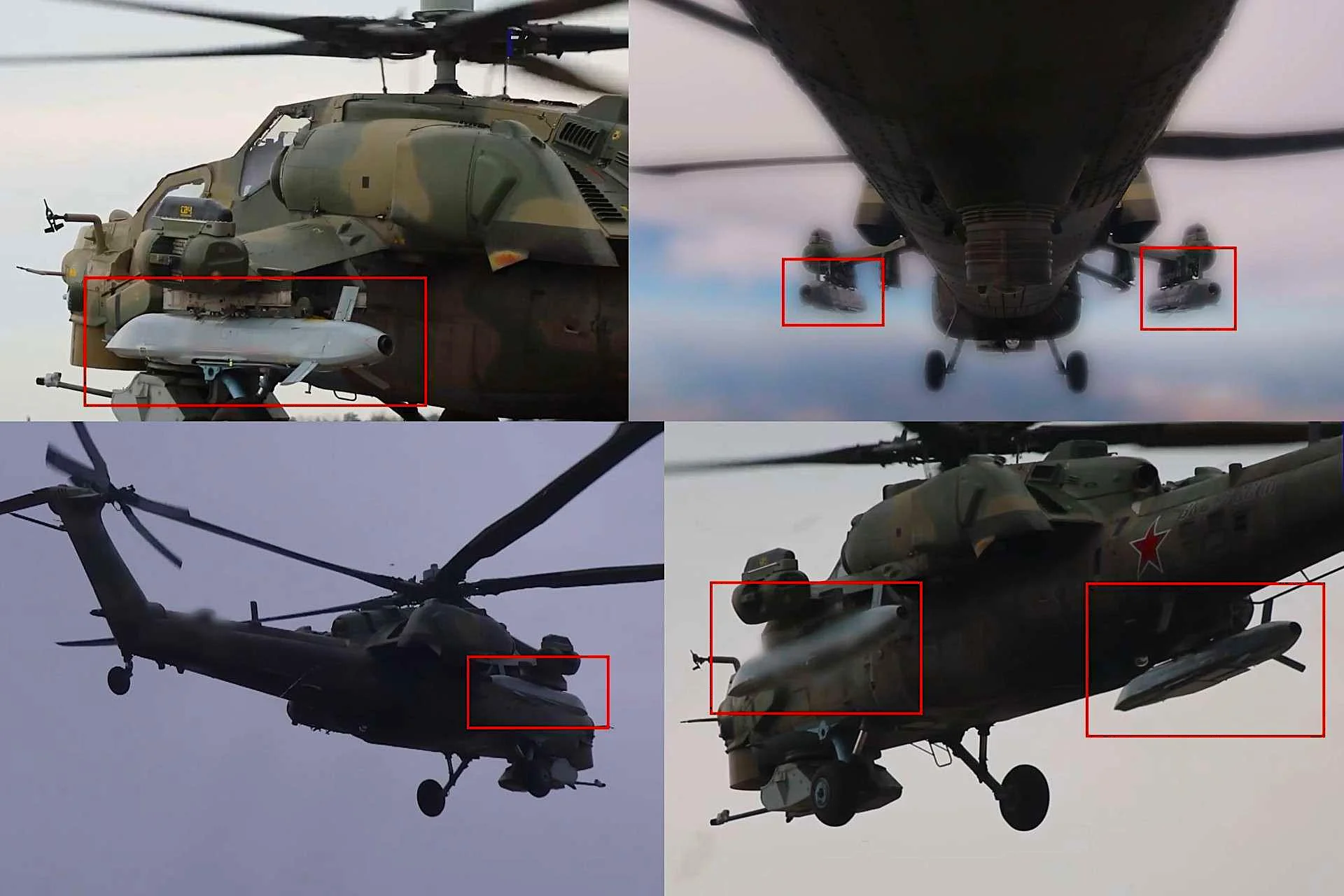
Four frames from the Russian Ministry of Defence video, released around 6 to 8 November 2026, of an Mi-28NM carrying a weapon the MoD names as Dan-T. Red boxes mark the missiles on the outer stub-wing stations: a close-up of one round under the stub wing (top left); an underside view with one missile on each outer station (top right); a side view in flight (bottom left); and a front-quarter view with two rounds (bottom right). The load actually shown is two missiles; a four-round load is theoretically possible and has not been seen. The rounds closely match the El Alamein display article, but Dan-T and the S8000 Banderol are hard to tell apart visually, and some Ukrainian reporting still labels the same pictures as both. Russian MoD video stills.
The footage. The Russian MoD released, on 6 November 2026 (the date given by Army Recognition; widely reported on 8 November), the first official video of an Mi-28NM launching a weapon it names as Dan-T. [DOCUMENTED] According to the ministry, as relayed by TASS, the crew received reconnaissance-derived coordinates of Ukrainian UAV operators and a UAV command-and-control post in the area of the "West" grouping of forces, launched one round at those coordinates, and was told by reconnaissance that the target had been hit; the helicopter then returned to its airfield. The strike result is a Russian claim and has not been independently verified. [DOCUMENTED as MoD wording; UNVERIFIED as battle damage]
Defense Express, Militär Aktuell and Army Recognition, describing the video, agree on the loadout actually shown: two missiles on the outer stub-wing weapon stations, and one separating in flight — Militär Aktuell specifies the release from under the left stub wing. The helicopter is not shown launching the second round. [DOCUMENTED as reported content of the video] Some Ukrainian reporting still labels the same pictures "Dan-T (also known as Banderol)"; the MoD's own caption is Dan-T. The rounds in the video closely match the El Alamein display article, which is the main reason this page treats the footage as relevant to Dan-T, but the two designs remain hard to tell apart by eye. [CONTESTED labelling]
Four-hardpoint capacity. The Mi-28NM has two additional inboard hardpoints and a published payload of about 2.3 tonnes, which is more than enough for four 268 to 270 kg missiles. Defense Express and Militär Aktuell both say four rounds are theoretically possible. That configuration has not been observed. [DOCUMENTED as airframe capacity; UNVERIFIED as an operational loadout] Army Recognition notes that the footage also does not establish operational launch distance or how far the weapon is integrated into the helicopter's fire-control system. [SINGLE-SOURCE observation] Compared with the Orion, which HUR and imagery associate with a single Banderol, a two-round helicopter load already doubles that per-sortie count.
Standoff role. The point of putting a 450 km-class weapon on an attack helicopter is to move the Mi-28NM out of the close-battle anti-tank role. The helicopter's previous longest-range guided weapon, the LMUR (Izdeliye 305 / Kh-39), is cited at about 15 km by Militär Aktuell and at a claimed maximum of roughly 25 km by Defense Express. [CONTESTED as to the LMUR figure] Even a reduced Dan-T range would let the helicopter fire from well behind the front, in principle far enough to reach many large Ukrainian cities without approaching the border. [DOCUMENTED as analysis; the 450 km official figure is not a demonstrated Mi-28 engagement distance] In the mission the MoD describes, reconnaissance provided the coordinates before take-off and the helicopter was a delivery platform in a fire-and-forget, pre-surveyed-target chain — not a pop-up anti-tank shooter using its own sensors in the terminal phase. [DOCUMENTED as the MoD's account of that one sortie]
Launch tactics: not a low-altitude pop-up, on the published evidence. No source documents an official "pop-up" profile for this weapon. The published analysis points the other way. Defense Express, judging from the September carriage photographs, says the missile does not appear to have a solid-fuel booster that would accelerate it to flying speed and altitude. Without a booster, a low-level or nap-of-the-earth release would risk the round failing to deploy its wings or reach the speed needed to stay airborne, and possibly hitting the ground. The implication is that the Mi-28 would first have to climb and accelerate, then release — a high- or at least medium-altitude, higher-speed launch rather than a low-altitude one. That climb, Defense Express argues, makes the helicopter easier for Ukrainian radars to see before the shot and gives air defences and civilians more warning, a problem already familiar from Orion take-offs. A high-altitude release would also increase the missile's cruise range. [SINGLE-SOURCE analysis] The November video has been described as showing a release in flight; public reporting of that video does not include a measured release altitude or airspeed, so the climb-then-release picture remains an inference from the airframe, not a measured tactic. [UNVERIFIED for the actual profile in the MoD film]
Altitude and speed versus fixed-wing and ground launch. A turbojet cruise missile's practical range depends on the kinetic and potential energy it is given at release, and on how much fuel it must burn to get up to cruise. Militär Aktuell puts the published bounds at about 250 km from the ground and 450 to 500 km from a jet at high altitude, and says helicopter launch — lower speed and altitude than a fighter or bomber — should fall in between. [ESTIMATE] The 250 km ground figure is Khrapchynskyi's. Army Recognition makes the same point more cautiously: the advertised 450 km "should not be interpreted as a demonstrated engagement distance from the Mi-28NM," because launch altitude, aircraft speed, flight profile and mission conditions all affect effective range. [DOCUMENTED as a caveat] Fixed-wing release from a Su-34 or Su-35 at height and several hundred knots is the condition under which the official 450 km, or Khrapchynskyi's 500 km, is most plausible. A helicopter cannot offer those conditions. What it can offer, as Militär Aktuell and Army Recognition note, is a launch from a dispersed field or meadow rather than a fixed airfield or a ground rail that needs a long straight road — useful if those sites are themselves under attack — at the price of range, a more conspicuous climb, and a slower, lower carrier. [SINGLE-SOURCE analysis] Shahryar Pasandideh, cited in Militär Aktuell's October Dan-T piece, called helicopter employment "a rather illogical development" outside the Black Sea sector compared with ground launch. [SINGLE-SOURCE]
COMBAT USE IN UKRAINE
At El Alamein, Rostec said "the high efficiency of the device is confirmed by hundreds of successful launches against enemy targets" and that the weapon had completed a cycle of trials as an air-launched munition. No breakdown, dates, or independent confirmation was offered. [DOCUMENTED as a claim; UNVERIFIED as a count]
The Ukrainian Air Force began referring to Dan-Ts in daily strike reports on 13 September 2026. A Russian strike chronicle the same week named Dan-T among weapons used against Odesa. From then on, public Air Force tallies have generally used a combined "Banderol/Dan-T" line, so the two cannot be separated. Examples: the night of 20–21 September, 172 drones and other aerial weapons including one Banderol/Dan-T, of which air defences shot down or suppressed 147 drones and that one Banderol/Dan-T (NV, citing the Air Force); the night of 11–12 October, Banderol/Dan-T used alongside 121 drones and a Kh-59 (Militär Aktuell, citing the Air Force). Speculation that a 19 September strike on a shopping mall in Dnipro was a Dan-T was just that: ISW recorded milbloggers disagreeing, with other suggestions of ballistic missiles or Gerans. [DOCUMENTED for the Air Force category and the example nights; UNVERIFIED for Dnipro]
ISW's judgement as of 5 October 2026 was that it was "unclear if Russian forces have already fielded Dan-Ts in Ukraine at scale as of late September." [DOCUMENTED as ISW's assessment] The November MoD video is a claimed combat shot after that assessment, but it is still a single officially released sortie with an unverified result, not evidence of scale.
Because the Air Force groups the two weapons, this page does not attempt a separate Dan-T launch count, and it does not attribute particular 2025 or early-2026 Banderol strikes — for example the Pechenihy attack, or the regular Odesa port raids described on the Banderol page — to Dan-T.
THE ISW ASSESSMENT AND INTERCEPTOR ECONOMICS
ISW's 5 October 2026 paper, "Russian Inexpensive Quasi-Cruise Missiles: An Emerging Threat for Ukraine's Air Defenses," is the right frame for the class. The Banderol and Dan-T sit between cheap, slow one-way drones and expensive cruise missiles: jet speed, a heavier warhead than a Geran-5's roughly 90 kg, shorter range than a Kh-101, and a low enough price to be used for volume. ISW records Banderols in more than 40 daily strike packages between 14 May and 30 September 2026, first against Odesa in spring 2025, then regularly from summer 2026, often against ports, logistics hubs and warehouses, and also in a "missile spam" pattern of individual rounds through the day to keep air-raid alerts on. Col. Yurii Ihnat said in mid-August that Banderol use was still not widespread and that it was too early to say they were systematically overloading air defences; the jet-Geran volume was the larger immediate problem. [DOCUMENTED] Those Banderol figures are about the Banderol. They are included here because the Air Force has since counted the two together, not because this page treats every Banderol raid as a Dan-T raid.
The cost-exchange argument is the same one already made on the Banderol page and should not be rewritten as a new Dan-T finding. A Ukrainian aviation expert, as cited by ISW, puts Banderol production cost at about $50,000 to $150,000 against about $2 million for a domestically produced Kh-101. Dan-T is *said* to be about 35 percent cheaper, which would put it very roughly in the $30,000 to $100,000 band if the Banderol range is right — an arithmetic illustration, not a price. [ESTIMATE]
At 500 km/h the weapon sits in the same awkward band as the Banderol: faster than the cheap propeller interceptors built for 180 to 200 km/h Shaheds, slower than a heavy subsonic cruise missile, and typically mixed into salvos with Gerans and Kh-59/69s so that using a fighter is risky and using a PAC-3-class or even a NASAMS-class round is a poor exchange. Ukrainian officials and ISW say existing interceptor drones proved ineffective against the Banderol in the mid-2026 assessments. Brave1 said in early September 2026 that some unspecified Banderol countermeasures were already deployed and being scaled. LITAVR+ and Sting 2.0 are credited against jet Gerans above 400 km/h; whether they are a reliable answer to a 500 km/h quasi-cruise missile is not yet shown in public Dan-T-specific reporting. [DOCUMENTED for the Banderol problem and for the existence of new interceptors; UNVERIFIED for Dan-T-specific kill rates] Beskrestnov, via ISW, said Russian developers were trying to modify Banderol, Dan-T, Dan-M and Gerbera-5 toward 750 km/h, low-level flight and more manoeuvre. That is a reported aim, not a measured Dan-T figure. [SINGLE-SOURCE]
PRODUCTION AND COST
Three production numbers are in circulation, none of them a published Russian contract.
- About 10,000 in 2027, from Ukrainian veteran and analyst Dmytro Putiata (Kriegsforscher), posted in August 2026 and reported by Militarnyi on the 28th. NV explicitly notes that HUR had not officially confirmed that figure. [SINGLE-SOURCE / ESTIMATE]
- Up to 2,000 by the end of 2026 and up to 14,000 in 2027, from RBC-Ukraine sources, 21 September 2026, relayed by NV. "The figures have not been independently confirmed." [SINGLE-SOURCE / UNVERIFIED]
- ISW, citing both, treated the 2027 target as a planning indicator and, as of 5 October 2026, did not assess that production had already reached Geran-like scale. [DOCUMENTED as ISW's judgement]
Khrapchynskyi's engine bottleneck is the main public reason for scepticism: if the missile really uses MD-120s from a plant that also has to make AL-41-class fighter engines, and if that plant had been making only about 20 MD-120s a year, then 10,000 to 14,000 complete missiles in 2027 is not credible without a different engine (he suggests Iranian or Chinese substitutes). [SINGLE-SOURCE] Romanenko's remark that the class uses Chinese engines points the other way and would ease that particular bottleneck, at the cost of the "all-domestic parts" goal Skibitskyi described. [CONTESTED] Militär Aktuell, looking at later autumn strike waves, suggested Russia "may be well on its way" toward the ambitious targets; that is an impression, not a factory count. [ESTIMATE]
Cost. No official unit price has been published. The only Dan-T-specific figure is "about 35 percent cheaper than Banderol," from Table.Briefings / FW-MAG via Militarnyi and Militär Aktuell. Banderol estimates remain $50,000 to $150,000 in the ISW-cited expert range, with some outlets going as high as $150,000 to $300,000 (see the Banderol page). [ESTIMATE] The same chain says VKS command is *considering* moving to exclusive Dan-T procurement and phasing the Banderol out. That is not a documented procurement decision. [UNVERIFIED as policy]
Skibitskyi's localisation goal — a fully domestic component base for Dan-T — is the one official Ukrainian intelligence statement that most clearly treats Dan-T as a programme with its own industrial logic, not just a new export label. [DOCUMENTED as a HUR statement]
COMPARISONS
Figures are those used in the sources for this page and on the existing Banderol article. They are not standardised test data. Western analogue prices and ranges are programme or manufacturer figures, not combat-proven equivalents of Dan-T.
| Dan-T | S8000 Banderol | Kh-101 | Geran-2 / Shahed-type |
| Class | Quasi-cruise / advertised loitering munition | Quasi-cruise | Strategic air-launched cruise missile | Piston one-way UAV |
| Maker | Kronstadt / Rostec (attributed); exporter Rosoboronexport | Kronstadt (HUR) | Raduga | Alabuga / Iranian lineage |
| Maximum take-off weight | 268 kg official | Not on the HUR card; informal 200 to 250 kg | about 2,400 kg (secondary) | — |
| Warhead | 130 kg max official; 135 kg in Ukrainian estimates; type unpublished | 114.3 kg measured OFBCh-150; "up to 150 kg" in HUR announcements | about 480 kg (ISW / CSIS) | Varies; often about 50 kg class |
| Speed | 500 km/h official max | Cruise 520 to 560, max 620 to 650 km/h (HUR card) | Up to about 1,000 km/h (ISW) | about 180 to 200 km/h |
| Range | 450 km official; 500 km air / about 250 km ground in Ukrainian estimates | 500 km on the HUR card; 350 to 400 km in some later Ukrainian remarks | Up to about 2,500 km (ISW / CSIS) | Up to about 2,000 km class |
| Guidance | GNSS/INS official; Kometa-16 plus electro-optical reported in development | INS/GNSS with Kometa-M8; no seeker in the HUR list | INS/GNSS plus optical corrector (Otblesk-U) | Kometa-family GNSS plus INS |
| Engine | Unpublished; MD-120 versus Chinese microjet contested | Swiwin SW800Pro-A95, 81.6 kgf (HUR) | TRDD-50A | Piston (Limbach-class copy) |
| Unit cost | About 35 percent below Banderol (unconfirmed) | about $50,000 to $150,000, some estimates to $300,000 | about $2 million in the Ukrainian expert figure ISW uses | about $30,000 often quoted for early piston models |
| Launch | Aircraft, helicopters, claimed ground; imagery so far mainly Mi-28NM plus the show stand | Orion, reported Mi-28 and ground launchers | Tu-95MS, Tu-160 | Ground rail / truck |
| Status | Unveiled September 2026; combat use claimed; scale unclear | In regular use from summer 2026 | Long in service | Mass use |
| Geran-5 | ERAM / AGM-188 Rusty Dagger | Anduril Barracuda-500 / 500M | Lockheed CMMT |
| Class | Jet one-way UAV | Low-cost air-launched cruise missile | Low-cost air vehicle / munition | Low-cost modular cruise missile |
| Maker | Alabuga | Zone 5 Technologies (USAF ERAM) | Anduril | Lockheed Martin |
| Maximum take-off weight | 850 kg (HUR) | — | — | — |
| Warhead | about 90 kg BCh-90 | Payload around 45 kg appears in secondary compilations; not re-checked here against a primary | Official payload undisclosed; 500M is the munition variant | Modular; no published single warhead mass |
| Speed | 450 to 600 km/h | Subsonic | about 190 to 500 kt official (about 350 to 930 km/h) | Subsonic |
| Range | about 950 to 1,000 km (contested / estimated) | Requirement at least 250 nm (460 km); some reporting on the fielded article says much longer — treat as CONTESTED | more than 500 nm official (about 930 km); Defense Express has used about 900 km | Lockheed: "multiple hundreds of miles." Defense Express: 650 km and 800 km variants. A Reuters headline of 3 March 2025 gave about $150,000 and over 800 km; the full body was not retrieved for the research behind this page |
| Guidance | Kometa-M12 plus INS; K5 adds optical scene-matching | Precision guidance in a jammed environment is a programme aim | Software-defined; details not used here | Modular seekers advertised |
| Engine | Telefly TF-TJ2000A, 200 kgf | — | Air-breathing | Modular / not a single published model |
| Unit cost | about $115,000 estimate | USAF FAMM-class cap cited by Defense Express: no more than $218,000 for a related cheap-cruise buy; no ERAM contract price confirmed in the sources opened for this page | Not officially disclosed | About $150,000 in the basic configuration (Lockheed, via Air and Space Forces, 6 March 2025) |
| Launch | Long rail with booster trolley | Air-launched | Air and, for some variants, ground / pallet | Fighters, bombers, rotary, airlifter pallets (advertised) |
| Status | In use through 2026 | In development / early fielding path | In development / test; designated AGM-189A in some reporting | In test; no USAF contract at the March 2025 reveal |
Western analogues are included because they are the same *idea* — a cheap, subsonic, mass-producible stand-off weapon — not because any of them is a design relative of Dan-T. Lockheed's range is quoted here as "multiple hundreds of miles"; the 650 / 800 km split is Defense Express's. [DOCUMENTED as public figures]
Against the Banderol specifically, the official Dan-T card is slightly slower (500 km/h against a reported 520 to 650), in the same range band, and in the same warhead band (130 kg maximum against a measured 114.3 kg, or "up to 150 kg"). The 268 kg official mass sits close to informal Banderol estimates of 200 to 250 kg, which is one reason the export-relabel view is plausible, but it is not a demonstration of identity. The Banderol has a teardown (Kometa-M8, Swiwin engine, RFD900x modem, ICM-42688-P IMU). Dan-T does not. [DOCUMENTED for the published figures; identity CONTESTED]
WHAT IT IS NOT
The Dan-T is not a demonstrated "export Banderol," and it is not a demonstrated conversion of existing Dan-M target stock. Both readings are in circulation; neither is settled. It is not a documented Izdeliye 720: that earlier project's estimated 450 kg mass does not match the official 268 kg, and the 3.4 m / 2.0 m dimensions that appear to link them are uncorroborated. It is not shown to have a Kometa-16 array or an electro-optical seeker as standard fit; those are reported as work in progress. It is not shown to have a datalink. "Loitering munition" in Rostec's wording does not mean in-flight retargeting. It is not a Kh-101-class strategic missile, and it is not a substitute for the Kh-69. No GRAU index, izdeliye number or NATO reporting name was found in the sources reviewed for this page. [DOCUMENTED / UNVERIFIED as noted above]
CAVEATS
Almost every firm number traces to the El Alamein card, to Ukrainian analysts, or to Banderol data borrowed across. There is still no public HUR teardown and no official length, span, diameter, engine model, warhead type, CEP or unit price. The 3.4 m / 2.0 m dimensions are single-source and match Butowski's Izdeliye 720 estimates exactly, so they may be contaminated. Helicopter release altitude and airspeed were not measured in public reporting of the MoD video. The engine identity (MD-120 versus a Chinese microjet) is contested, and that contest drives whether the 2027 production numbers are even physically plausible. The 268 kg official mass versus the 345 kg Dan target, and versus a 130 kg warhead, is an unresolved arithmetic problem. Air Force combined counting hides whether Dan-T is already in regular combat use. "Hundreds of successful launches" is a Rostec claim without a public ledger. The 35 percent cost cut and the Banderol phase-out remain one reporting chain (Table.Briefings / FW-MAG). Who actually builds the missile is not nailed down. The two photographs on this page show the El Alamein display article and MoD video stills of an Mi-28NM load; Dan-T and the Banderol are hard to tell apart visually, so even those images are identified with that caution. [BACKGROUND]
STATUS
Unveiled at El Alamein in September 2026 and offered for export by Rosoboronexport. Rostec and the Russian MoD claim combat use, including an Mi-28NM launch in November 2026 whose result is unverified. The Ukrainian Air Force has counted "Banderol/Dan-T" as a combined category since 13 September 2026. Scale of use and of production is unclear; the 10,000 to 14,000 figures for 2027 are unconfirmed planning indicators, and ISW had not assessed Geran-like scale as of early October 2026. Identity relative to the S8000 Banderol remains unresolved. [DOCUMENTED / SINGLE-SOURCE as noted above]
IN ONE SENTENCE
The Dan-T (Дань-Т) is a small, jet-powered Russian quasi-cruise missile, unveiled at El Alamein in September 2026, with official figures of 268 kg, a 130 kg warhead, 500 km/h and 450 km, guided by GNSS and INS. Rostec and the MoD use that name in public, including on an Mi-28NM launch video that shows two rounds on the outer stations and one release; no GRAU index or izdeliye number has been published. It looks very like the S8000 Banderol and sits in the same class, but the two have not been shown to be the same missile, and a simple conversion of the heavier Sokol Dan-M target does not sit easily with the official mass. A Kometa-16 anti-jam antenna and an electro-optical seeker are reported only as work in progress. Combat use is claimed, scale is unclear, and the large 2027 production figures remain unconfirmed.
RUSSIAN TERMS USED IN THIS ARTICLE
- Дань-Т: Dan-T, the only name used by Rostec, Rosoboronexport and the Russian MoD in public.
- Дань / Дань-М: the Sokol Dan and Dan-M aerial targets of the 1990s and after.
- С8000 «Бандероль»: S8000 Banderol, the related Kronstadt weapon; identity with Dan-T unresolved.
- изделие 720: Izdeliye 720, an earlier unfinished project sometimes compared with Dan-T; not a documented designation for it.
- Комета-16 / Комета-М8: Kometa-16 / Kometa-M8 controlled-reception-pattern (CRPA) anti-jam antennas, made by VNIIR-Progress in Cheboksary.
- МД-120: MD-120 turbojet, the engine of the original Dan target and the engine Khrapchynskyi attributes to Dan-T.
- в экспортной версии: "in an export version," RIA's wording from El Alamein.
- АО «Кронштадт», Ростех, Рособоронэкспорт: JSC Kronstadt, Rostec, Rosoboronexport.
SOURCES
- 1. Janes, "El Alamein 2026: Russia unveils air-launched 'export Banderol'," 10 September 2026.
- 2. RIA Novosti, Rostec presents Dan-T at El Alamein, 8 September 2026.
- 3. TASS, Alexander Stepanov on visual similarity to Banderol, 10 September 2026.
- 4. www1.ru, Stepanov quoted as calling Dan-T the export Banderol, 9 September 2026 (conflicts with the TASS wording for the same expert).
- 5. Kommersant on Dan-T and the unconfirmed Banderol link.
- 6. Lenta, Rostec "special flight mode" claim, 9 September 2026.
- 7. ISW, "Russian Inexpensive Quasi-Cruise Missiles: An Emerging Threat for Ukraine's Air Defenses," 5 October 2026.
- 8. Militär Aktuell, "Masse mit Klasse: Dan-T," 12 October 2026, and the English version.
- 9. Militär Aktuell, Mi-28 as cruise-missile carrier, 9 November 2026, and the English version.
- 10. Army Recognition, Mi-28NM Dan-T launch, 9 November 2026.
- 11. Militarnyi, "Russians plan 10,000 new Dan-T missiles 2027," 28 August 2026.
- 12. NV Ukraine, saturation-threat piece, 3 September 2026, and the RBC-Ukraine 14,000 figure, 21 September 2026.
- 13. RBC-Ukraine, Khrapchynskyi interview on Dan-T and the MD-120.
- 14. Defense Express, Dan-T 450 km / Izdeliye 720 question, 11 September 2026, and the earlier Izdeliye 720 / Raduga piece.
- 15. Defense Express, first Mi-28NM launch video, 8 November 2026, and "Why launching S-8000 Banderol / Dan-T missiles from Mi-28s makes little sense," 8 September 2026.
- 16. Defense Express, Dan-M conversion scepticism, 30 May 2025.
- 17. Kyiv Post, ISW summary, 6 October 2026.
- 18. UNITED24, 10,000 plan, 28 August 2026.
- 19. Ukrinform / Can Kasapoğlu, on Russia offering war-tested drones and missiles for export.
- 20. RobotWar Dan-T page (notes the absence of a public teardown).
- 21. US Army ODIN, Dan-T entry.
- 22. redstar.gr, Sokol Dan' target specifications (K. Panitsidis).
- 23. Projectorlan, S8000 Banderol and Kometa CRPA (Kometa-M8 manual figures, VUTsA.468166.055 RE, as already cited on that page).
- 24. Defence Ukraine, Kometa ladder, 22 September 2026.
- 25. Anduril, Barracuda product page; Air and Space Forces, Lockheed CMMT, 6 March 2025; Defense Express, FAMM / Barracuda / CMMT, 22 November 2025; BattlePolicy, ERAM / AGM-188. Reuters headline, "Eyeing the Pacific, Lockheed unveils low-cost $150,000 cruise missile," 3 March 2025 (headline confirmed; full body not retrieved).
Related on this site: S8000 Banderol, the related Kronstadt / Rostec weapon in the same class; identity unresolved.
Related on this site: Kometa CRPA anti-jam satellite navigation antennas.
Related on this site: Kh-69, Raduga's reduced-signature tactical cruise missile, a different class and a much more expensive weapon.
Related on this site: Kh-101 / Kh-102, the strategic cruise missile this class is meant to complement, not replace.
Related on this site: GLONASS satellite navigation.
Related on this site: Mi-28 (Havoc), the attack helicopter filmed launching a Dan-T in November 2026.
Project Orlan // Underground Information Database