Home |
Data Base |
Technical |
Radio |
Search
MI-28 (HAVOC)
Ми-28 «Ночной охотник» | Mil / Rostvertol | NATO reporting name Havoc
Tandem two-seat armoured attack helicopter
Project Orlan Data Base // public encyclopedia
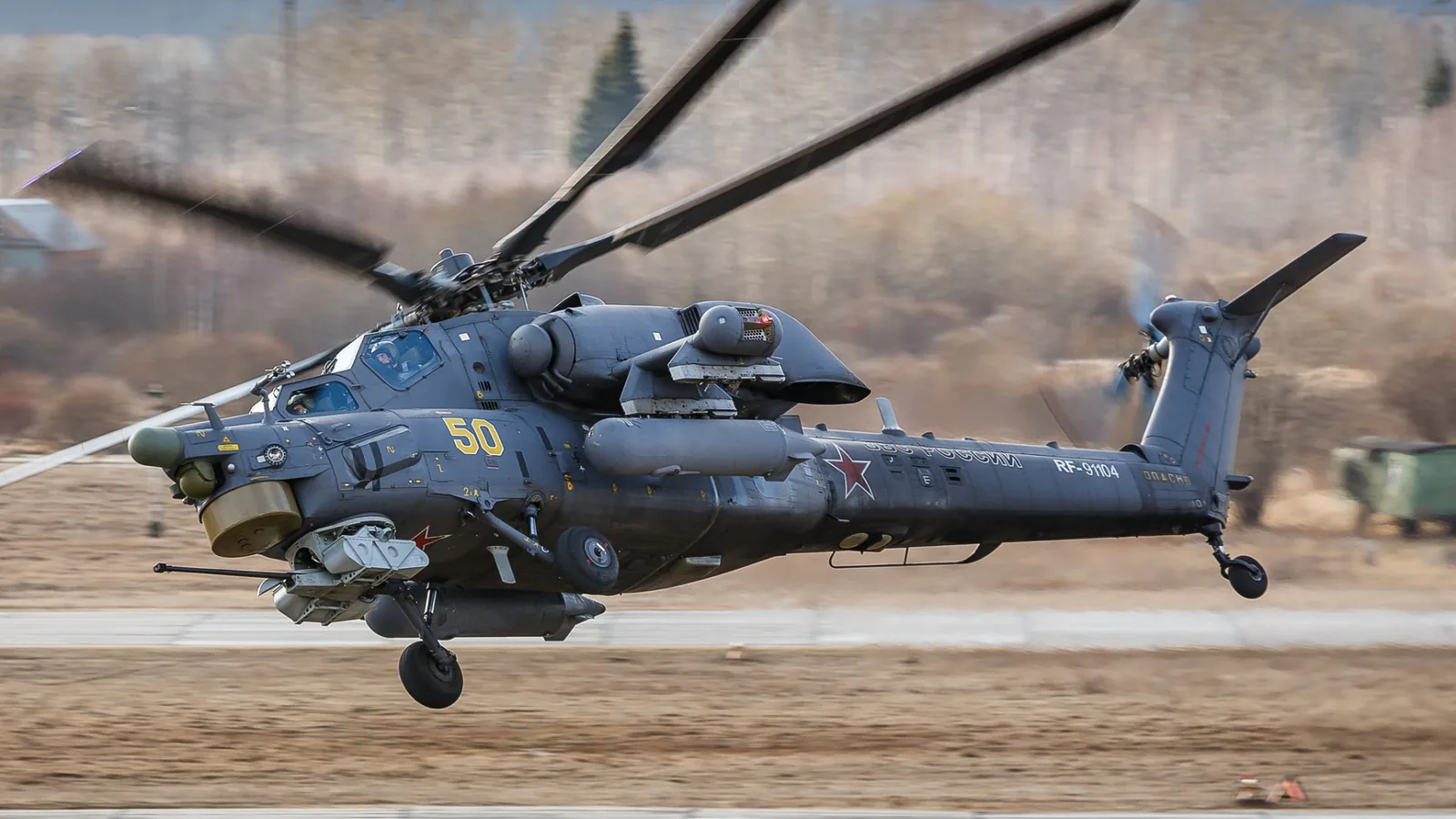
Mi-28 "50" (registration RF-91104) in a low, fast pass close to the ground, nose slightly down, with the five-blade main rotor flexing and the X-shaped tail rotor at the top of the fin. The stepped tandem cockpit, the high, widely spaced engine nacelles, the chin sensor turret and the 30 mm gun under the nose are all visible, with large cylindrical stores on the stub wings.
Related articles: Mi-24 (Hind), the troop-carrying Mil gunship the Mi-28 was ordered to succeed, and Dan-T, the small jet-powered quasi-cruise missile an Mi-28NM was filmed launching in November 2026.
WHAT IT IS
The Mil Mi-28 (Ми-28, NATO reporting name Havoc) is Russia's dedicated tandem-seat attack helicopter. It is built at Rostvertol in Rostov-on-Don, now part of Russian Helicopters, and it was designed as a heavily armoured two-crew gunship rather than a troop-carrying "flying BMP" in the Mi-24 tradition. Design work was ordered in 1976 in a competition with Kamov's V-80, which became the Ka-50. The first prototype flew on 10 November 1982. The day-only Mi-28A was cancelled in 1993, and the night-capable Mi-28N "Night Hunter" (Ночной охотник, NATO Havoc-B) reached operational units from 2008 to 2009, almost a quarter of a century after first flight. [DOCUMENTED]
The type's standout design feature is crew survivability. The two crew sit in a stepped, partitioned, armoured cockpit tub with thick glass, on crash-attenuating seats above energy-absorbing landing gear. The engines are separated, the fuel tanks are self-sealing, and a small aft compartment can pick up a downed crew. The advertised ballistic ratings are not the same from source to source, and this page treats them as manufacturer or secondary claims rather than as a published live-fire test report. [CONTESTED; see ARMOR AND SURVIVABILITY]
In service, the Mi-28N, the dual-control Mi-28UB and the modernised Mi-28NM have fought in Syria and, since 2022, in Ukraine. The armour has not made the type immune. Visually confirmed Ukraine-war losses on the Oryx list, as checked on 12 November 2026, run to 21 Mi-28s, against 68 Ka-52s on the same list. Those are minima, not a census. [DOCUMENTED as visually confirmed minima] The operational adaptation has been to get off the tree line: low pop-up unguided rocket salvos (the "rocket slings" described below), then the longer-range Izdeliye 305 / LMUR missile, and, in November 2026, Russian Ministry of Defence video of an Mi-28NM launching a Dan-T. Cheap FPV drones have still killed even modernised airframes advertised as carrying extra anti-drone sensors. Export operators include Algeria and Iraq, with a small Ugandan fleet and less certain reports elsewhere.
QUICK FACTS
- Name: Mi-28 (Ми-28); production marks Mi-28N "Night Hunter," Mi-28UB, Mi-28NM; export Mi-28NE. NATO reporting name Havoc (the N is Havoc-B). [DOCUMENTED]
- Designer / maker: Mil Moscow Helicopter Plant (MVZ im. M. L. Mil); built by Rostvertol, Rostov-on-Don, part of Russian Helicopters. [DOCUMENTED]
- First flight: prototype no. 012, 10 November 1982; Mi-28A, January 1988; Mi-28N demonstrator, 14 November 1996 (redstar.gr); Mi-28NM prototype first hover 29 July 2016. [DOCUMENTED]
- Service entry: first aircraft formally accepted on 22 January 2008 at the 344th Centre, Torzhok (Butowski); a commonly cited introduction date is 15 October 2009. [DOCUMENTED]
- Crew: two in tandem, in separate armoured compartments: navigator-operator in front, pilot behind and higher. Dual controls on the UB and NM. [DOCUMENTED]
- Engines: 2 × Klimov TV3-117VMA (about 2,200 to 2,256 hp each) on early aircraft; VK-2500 family later, VK-2500P on the NM. [DOCUMENTED; VK-2500 ratings CONTESTED]
- Advertised crew protection: 12.7 mm armour-piercing fire and 20 mm projectiles or fragments for the tub; glass ratings conflict. [CONTESTED]
- Gun: 2A42 30 mm in the NPPU-28 chin mount, 250 or 300 rounds depending on the source. [CONTESTED as to ammunition]
- Main guided weapons: 9M114 Shturm and 9M120 Ataka (up to 16); on the NM, Izdeliye 305 / LMUR and, from November 2026, Dan-T. [DOCUMENTED]
- Radar: N025 mast radar (Ka-band) on the UB and on some N; N025M (Ka- plus X-band, with L-band IFF) on the NM. Many early Mi-28Ns flew without it. [DOCUMENTED]
- Self-protection: L370V28 Vitebsk (export President-S), with a single belly-mounted laser DIRCM turret. [DOCUMENTED as architecture]
- Operators: Russia; Algeria (42 Mi-28NE contracted); Iraq (15 firm is the better-documented figure); Uganda (a handful). [DOCUMENTED / CONTESTED for Iraq and Uganda numbers]
DESIGNATIONS AND NAMES
Soviet and Russian aircraft carry a bureau designation, while the NATO reporting name is a separate Western label. "Mi-28" is the Mil design-bureau and service designation. The letter suffixes describe the mark: A for the improved day-only aircraft of the late 1980s, N for Nochnoy ("night"), UB for the dual-control uchebno-boyevoy (training-and-combat) version, NE for the export N, and NM for the modernised N. The popular name "Night Hunter" (Ночной охотник) belongs to the Mi-28N family. NATO called the original Mi-28 Havoc and the N Havoc-B. [DOCUMENTED] Equipment inside the helicopter carries its own indexes, and those are used throughout this page: OPS-28 for the main sight, N025 for the radar, L370V28 for the Vitebsk self-protection fit, NPPU-28 for the gun mount, and Izdeliye 305 for the LMUR missile.
DEVELOPMENT HISTORY
The 1976 competition. On 16 December 1976 the CPSU Central Committee and the USSR Council of Ministers ordered a new-generation combat helicopter to succeed the Mi-24, on a competitive basis, from the Mil bureau and from Kamov. Kamov's entry was the V-80, later the Ka-50. [DOCUMENTED] Mil's concept, associated with general designer Marat Tishchenko, was a two-seat, tandem, heavily armoured gunship with a clear split of labour between a pilot and a weapons operator. That is the same layout family as the American AH-64 Apache, and the opposite of Kamov's single-seat, coaxial-rotor, ejection-seat approach. [DOCUMENTED as the design concept]
Prototypes. A design and mock-up were accepted in 1981. Prototype no. 012 first flew on 10 November 1982, and a second prototype, no. 022, was completed in 1983. [DOCUMENTED] In 1984 the Mi-28 completed the first stage of state trials, but in October 1984 the Soviet Air Force chose the Ka-50 as its new anti-tank helicopter. A government decree allowed Mi-28 work to continue, partly with foreign customers in mind, and on 14 December 1987 a further decision approved completion of the work and the start of series production at Rostov, with a day-capable Mi-28A first and a night Mi-28N to follow. [DOCUMENTED]
The Mi-28A. The first Mi-28A, no. 032, flew in January 1988 with more powerful engines and a four-blade X, or "scissors," tail rotor in place of the earlier three-blade unit. It was shown at the Paris Air Show in June 1989, and a second Mi-28A, no. 042, was completed in 1991. The programme was cancelled in 1993: it was judged uncompetitive with the Ka-50 and, above all, it was not an all-weather, night-capable aircraft. [DOCUMENTED] Redstar.gr says four Mi-28 and Mi-28A helicopters were built. That is the cleanest prototype count found, and it should not be read as a production run. [SINGLE-SOURCE as a total]
The long road to the Night Hunter. The night programme, the Mi-28N, was a slow recovery. Army funding is reported from January 1994; the demonstrator was rolled out in August 1996, and redstar.gr gives its first flight as 14 November 1996. Budgets in the 1990s kept progress slow. Rostvertol began preparing for series production in 1999, and the first production Mi-28N is reported to have flown in April 2004. The first army delivery from Rostov is widely dated 2006. [DOCUMENTED for the 1996 and 2006 dates; some of the 1994 to 2004 waypoints are secondary]
Piotr Butowski gives the formal acceptance of the first aircraft by the then Russian Air Force as 22 January 2008, at the 344th Centre at Torzhok. Deliveries followed to Budyonnovsk (from March 2009), Korenovsk (2010), Zernograd (2012), Ostrov (2013), Vyazma (2014), Dzhankoy (2014) and Pushkin (2016). A commonly cited introduction date is 15 October 2009. [DOCUMENTED]
No single winner. In the late 2000s, after a further head-to-head with Kamov, Russia chose not to pick a single winner. The Mi-28N and the two-seat Ka-52 both entered production and remain in service side by side, later joined in the attack and assault mix by the Mi-35M, the modernised Hind. [DOCUMENTED] The Mi-28NM modernisation followed under the Avangard-3 research-and-development contract of 24 December 2009.
DESIGN OVERVIEW
The Mi-28 is a conventional single-main-rotor helicopter. It has a five-blade composite main rotor of 17.2 m diameter, an X-shaped tail rotor, two turboshaft engines mounted high and well apart on either side of the main gearbox, stub wings with four weapon stations and wingtip pods, and fixed tailwheel landing gear designed to absorb crash energy. The narrow tandem nose puts the navigator-operator low in front and the pilot higher behind, which gives the pilot a view over the front seat and keeps the frontal area small. [DOCUMENTED]
Under the nose sits the electro-optical sighting turret, with the NPPU-28 30 mm gun mount below it. On aircraft fitted with radar, the N025 or N025M antenna sits in a round dome on a mast above the main-rotor hub, so the helicopter can look over a tree line or ridge while the rest of the airframe stays hidden. Aft of the stub wing, a small port-side door opens into an avionics bay that, in an emergency, can carry two or three people. That bay is a rescue space, not a troop cabin. [DOCUMENTED]
The mass budget is the key difference from the Mi-24. The Hind spent weight and volume on an eight-seat troop compartment. The Mi-28 spends it on the crew tub, the gun and the stub-wing load, with only a remnant rescue bay aft. [DOCUMENTED in outline]
VARIANTS
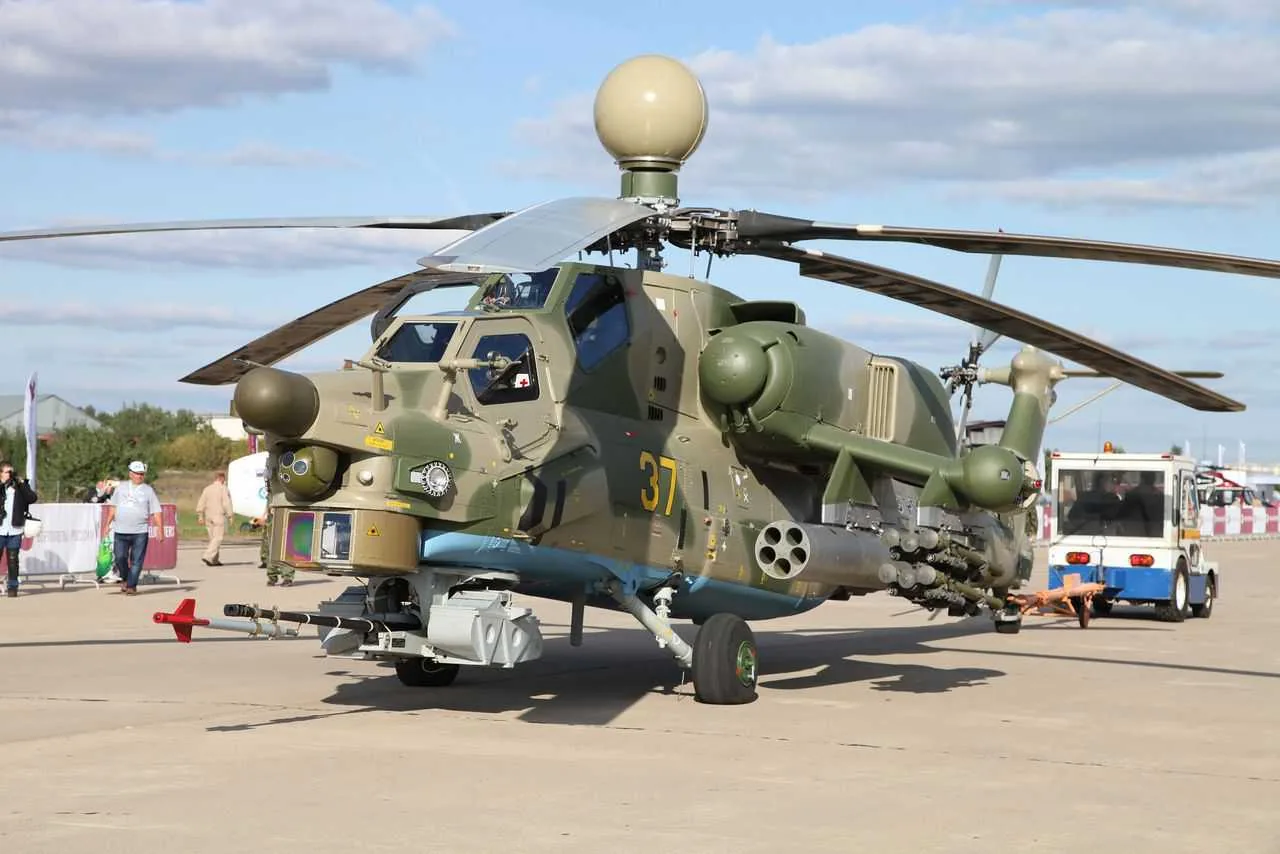
Mi-28 "37" on static display, with the round radar dome on its mast above the main-rotor hub, rocket pods and missile launch tubes on the stub wings, and a missile laid out on a display trolley by the nose. The mast radar is standard on the Mi-28UB and Mi-28NM; many early production Mi-28Ns flew without it. The camouflage is olive and green over a light-blue underside.
Mi-28 / Mi-28A. The original day-only prototypes (first flight 1982) and the improved A-model (January 1988), with the X tail rotor, revised exhausts and incremental changes to sensors and self-defence. Never a service type; cancelled in 1993. [DOCUMENTED]
Mi-28N "Night Hunter" (Havoc-B). The baseline production day and night attack helicopter. It has the OPS-28 electro-optical turret, a night-vision-compatible cockpit, Ataka and Shturm missiles, and the 2A42 cannon. Many early series aircraft lacked the mast-mounted N025 radar that brochures associated with the type. The mast station was an intended fit that lagged the airframe; a helis.com report from about 2008 said the radar was still under development. [DOCUMENTED] On the original N, the front seat is often described as having no flying controls. The powerplant was originally the Klimov TV3-117VMA, with VK-2500 engines reported on later aircraft from about 2016, after the supply line from Motor Sich in Ukraine became a problem. [SINGLE-SOURCE as a 2016 cut-over date]
Mi-28D. The US Army ODIN reference lists a simplified daylight Mi-28D, an Mi-28N without the mast radar and FLIR. [SINGLE-SOURCE compilation]
Mi-28NE. The export Mi-28N, sold to Iraq and Algeria and offered more widely. Russian Helicopters showed an upgraded NE in 2018 with rotor, engine and avionics changes. Export aircraft use the President-S self-protection suite, the export name for the Vitebsk family. [DOCUMENTED]
Mi-28NAe. Listed by ODIN as a version offered to North Korea. No evidence was found that it was delivered. [SINGLE-SOURCE; delivery UNVERIFIED]
Mi-28UB. The training-and-combat dual-control aircraft. The front cockpit is enlarged for an instructor, the canopy is wider, and both seats have hydromechanical flying controls. It also received the mast-mounted N025 radar, which the standard N often lacked, and it can fly attack sorties as well as training. Butowski, in early 2023, put production at only 24. [DOCUMENTED as a variant; SINGLE-SOURCE for the figure of 24]
Modernised Mi-28N. Some later Mi-28Ns shown at Army-2022 have been described as swapping the OPS-28 for a GOES-451 targeting system while keeping a TOES-521 pilot turret. That is a mid-life upgrade path for the N, not a new type code. [UNVERIFIED in detail]
Mi-28NM. The thorough modernisation under Avangard-3. Prototype "701" first hovered at Tomilino on 29 July 2016 and made its first full-profile flight on 13 October 2016. It was sent to Syria in March 2019 for an apparent combat evaluation. Rostvertol received an order for two initial-series aircraft on 31 October 2017, completed in April 2019 as "70" and "71." [DOCUMENTED]
On 27 June 2019, at the ARMY forum with President Putin present, the Ministry of Defence signed for 98 Mi-28NMs to be delivered in 2020 to 2027. Russian Helicopters' then chief executive later described a ramp of six a year in 2020 to 2022 and 16 a year in 2023 to 2027. A further, unspecified batch was ordered at ARMY on 16 August 2022. Actual deliveries lagged the paper plan: Butowski noted in January 2023 that it was doubtful more than about ten were in service, and that 2020 deliveries were not publicly evident. [DOCUMENTED]
The NM changes that matter are: the BRLK-28 suite with the N025M mast radar; a bulkier OPS-28M Tor-M electro-optical turret under the nose and a new SMS-550 turret for the pilot; NSTsI-V helmet-mounted sights for both crew; an ILS-28NM head-up display; the L370V28 Vitebsk self-protection suite; KSS-28NM (S-406-2NM) communications; VK-2500P engines and a TA14-130-28 auxiliary power unit; improved main-rotor blades, which the manufacturer says raise maximum speed by 13 percent and cruise speed by 10 percent; dual controls; equipment for working with UAVs; and new weapons, notably Izdeliye 305 / LMUR and, in 2026, Dan-T. [DOCUMENTED as a package; the speed percentages are manufacturer claims]
Mi-40. A proposed armed-transport derivative of the 1980s and 1990s, listed by ODIN. It never reached prototype. [SINGLE-SOURCE compilation]
| Mark | First flight / status | Key features | Operators | Tag |
| Mi-28 / Mi-28A | 1982 / January 1988; cancelled 1993 | Day-only; A-model introduced the X tail rotor; four Mi-28 and Mi-28A built (redstar.gr) | None (prototypes) | DOCUMENTED; total SINGLE-SOURCE |
| Mi-28N "Night Hunter" | Demonstrator 1996; formal acceptance January 2008 | OPS-28 turret, night cockpit, Shturm / Ataka, 2A42; mast radar often missing on early aircraft; front seat often without flying controls | Russia | DOCUMENTED |
| Mi-28D | Listed | Simplified daylight N without mast radar and FLIR | Not confirmed | SINGLE-SOURCE (ODIN) |
| Mi-28NE | Exported from about 2013 to 2014; upgraded NE shown 2018 | Export N with President-S | Algeria, Iraq, Uganda | DOCUMENTED |
| Mi-28NAe | Offered | Version offered to North Korea | Delivery not confirmed | SINGLE-SOURCE / UNVERIFIED |
| Mi-28UB | In service | Dual controls, enlarged front cockpit, wider canopy, N025 radar; about 24 built by early 2023 | Russia | DOCUMENTED; "24" SINGLE-SOURCE |
| Modernised N (Army-2022) | Shown 2022 | GOES-451 replacing OPS-28, TOES-521 retained | Russia | UNVERIFIED in detail |
| Mi-28NM | Prototype hover July 2016; 98 ordered June 2019 | N025M radar, OPS-28M and SMS-550 turrets, helmet sights, L370V28, VK-2500P, dual controls, LMUR, Dan-T | Russia | DOCUMENTED; deliveries lag the contract |
| Mi-40 | Proposal | Armed-transport derivative | Never built | SINGLE-SOURCE (ODIN) |
ARMOR AND SURVIVABILITY
Russian gunships have a well-earned reputation as tough birds, and the Mi-28 was built to carry that reputation further than the Mi-24. Almost every number in this section, though, is an advertised design figure, not a published trial report, and several of them conflict. The conflicts are left visible here rather than smoothed into one tidy calibre.
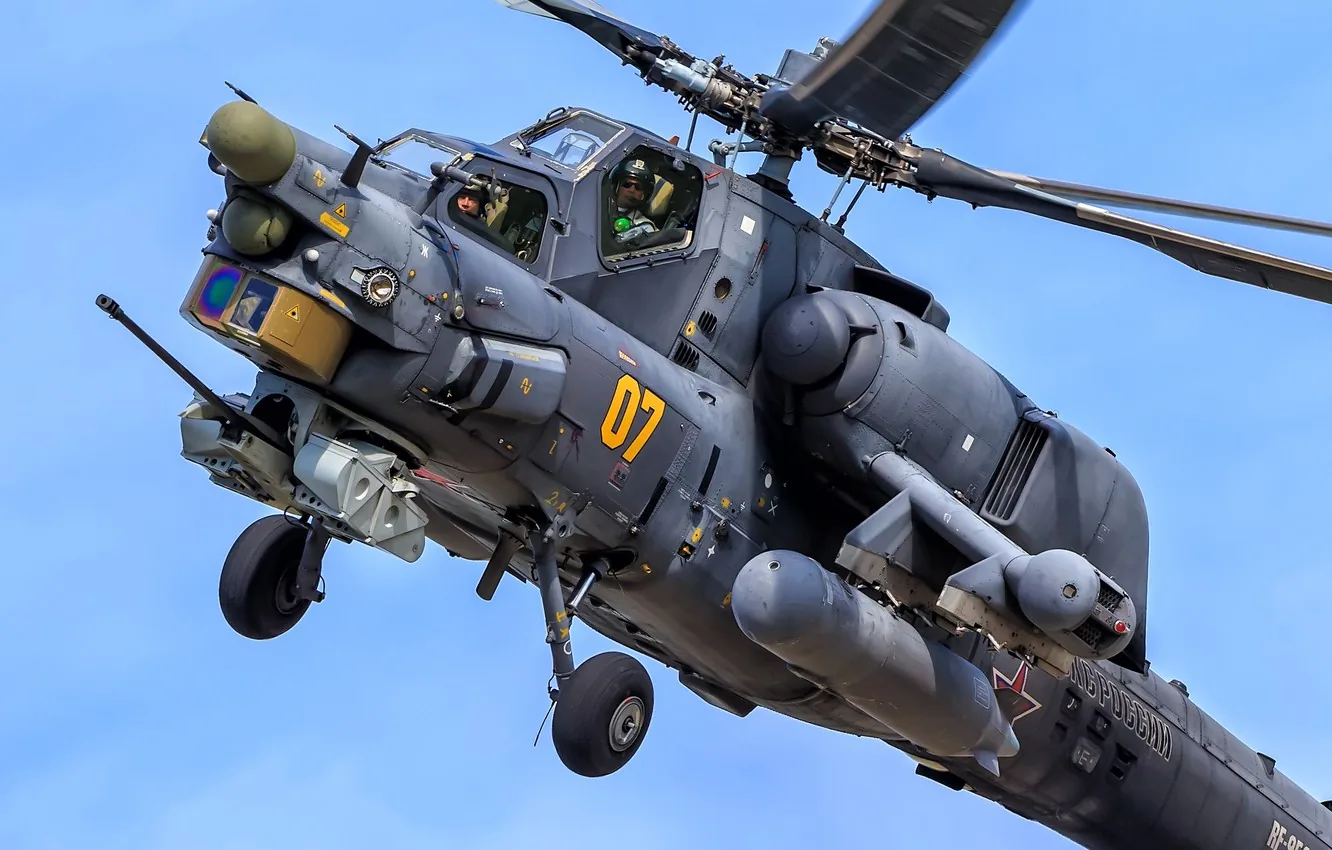
Mi-28 "07" in close flight, banking toward the camera. Both crew are visible, each in a separate cockpit: the navigator-operator low in front and the pilot higher behind, with heavy framing around the flat armoured glazing. The chin sensor turret, the 30 mm gun, the fixed main gear and large cylindrical stores under the stub wing are also visible.
The tub. The two crew sit in a narrow, stepped, tandem armoured nose, with the navigator-operator in front and the pilot on a raised rear seat, in separate compartments divided by an armoured bulkhead. The navigator's door is on the left and the pilot's on the right; both are jettisonable. [DOCUMENTED]
What the tub is made of is described in two different ways. Key.aero, citing Mil designers, says the crew compartments have 10 mm aluminium-alloy armour reinforced with ceramic plates, advertised as able to withstand 20 mm projectiles. [SINGLE-SOURCE as to thickness and alloy] N. Yakubovich's Russian monograph Boevoi vertolet Mi-28 describes titanium armour and ceramic tiles bonded to the nose structure. [SINGLE-SOURCE] Popular English accounts call it a "titanium armored bathtub" around the cockpit and engine areas. [UNVERIFIED as wording]
Redstar.gr's Mi-28N and Mi-28NM pages, in Konstantinos Panitsidis's family of write-ups, say the armoured cabins, "including side armored glasses" on the N page, protect the crew from 12.7 mm armour-piercing and incendiary bullets and from 20 mm projectiles. The NM page repeats "12.7 mm AP and shells up to 20 mm." [DOCUMENTED as consistent manufacturer-style wording] A still higher figure, 14.5 mm, appears in one generalist compilation and is not used here. [CONTESTED / weak]
The fairest summary is this: an aluminium and/or titanium structure with ceramic appliqué, advertised as protecting against 12.7 mm armour-piercing fire and 20 mm projectiles or fragments. Whether the base armour is titanium or aluminium alloy is not reconciled in the sources. [CONTESTED]
Armoured glass. This is the sharpest conflict, and it matters, because a 20 or 23 mm shell through the windshield is a very different claim from a 12.7 mm bullet. Key.aero is the most precise: windshields of 42 mm armoured glass, "strong enough to withstand hits from 12.7 mm ammunition," and flat side windows of 22 mm, "capable of protecting the aircrew from 7.62 mm rounds." [SINGLE-SOURCE for the thicknesses] Yakubovich says the silicate armoured glass will "withstand a hit from 12.7 mm armour-piercing-incendiary bullets and 23 mm shells." [SINGLE-SOURCE, and in conflict with Key.aero on 23 mm] The redstar.gr NM page says the glazing withstands hits up to 12.7 mm "and also withstands hits from 20 mm cannon shells." [CONTESTED with both of the above]
Until a manufacturer test sheet is published, there is no single calibre for the glass. The conservative, source-faithful reading is: the windshields are widely given as rated against 12.7 mm, with a thickness of 42 mm in one detailed account; claims of 20 mm and 23 mm protection exist and conflict with each other; and the side glass may be rated lower, at 7.62 mm in the Key.aero account. [CONTESTED]
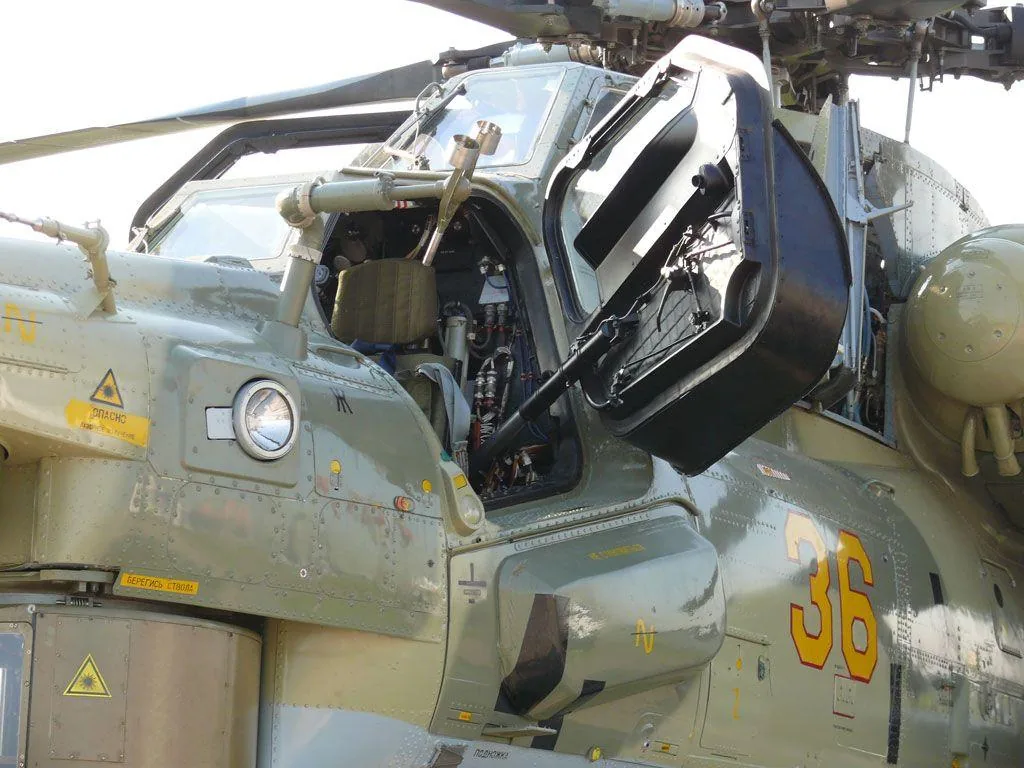
Mi-28 "36" with what appears to be the front, navigator-operator's cockpit door on the left side swung open. The door is a thick, heavily framed armoured panel with a deep glass block, hinged forward and held by a gas strut. The narrow interior of the front office is visible behind it, with the seat headrest and instrument wiring.
Separated compartments. The armoured bulkhead between the two cockpits is a deliberate shot-line break. A penetrating hit in one office is not automatically a hit in the other, so one crew member has a better chance of bringing the aircraft home if the other is wounded. That is a real design difference from a single open tandem bathtub, and it is documented by Yakubovich. [DOCUMENTED as a design feature] It is not a substitute for all-round armour, and it does nothing about a MANPADS or an FPV warhead arriving from below or behind.
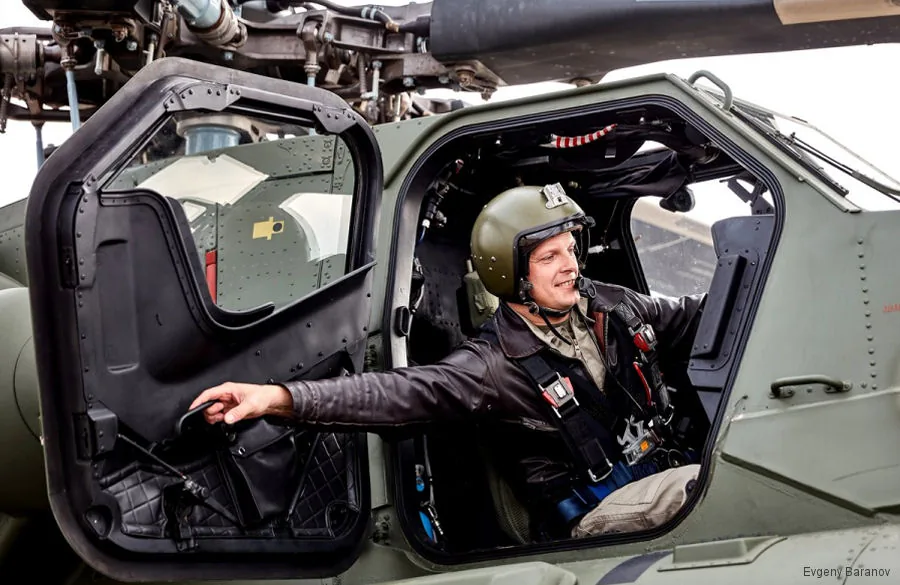
A pilot in a Mi-28 cockpit, harnessed in and reaching for the open door. The door's thick frame, its deep armoured glass and the quilted padding on its inner face show how much of the door's mass is protection. Photo: Evgeny Baranov.
Crash-energy seats and landing gear. The crew sit on energy-attenuating seats, named as the Zvezda Pamir-K by Key.aero and other accounts. Yakubovich and the redstar.gr NM page give the seat a long stroke of up to 30 cm, plus a harness-tightening system. Combined with energy-absorbing fixed landing gear, the design goal is crew survival in a vertical impact of up to 12 m/s, about 40 ft/s. [DOCUMENTED as a consistent advertised figure across several sources] Key.aero, citing Mil, says the forces on the crew are reduced from 58 to 60 g to about 12 g. [SINGLE-SOURCE] The system can be triggered manually, and Yakubovich says automatic sensors will fire it if the pilot cannot. [SINGLE-SOURCE]
This is the less glamorous half of survivability, and arguably the more important half. Many helicopter crews are killed not by the hit itself but by the impact that follows it. A tub that stops a bullet is only part of the answer; seats and gear that let the crew walk away from a hard landing are the rest of it.
Self-sealing, fire-protected tanks. Internal fuel is carried in self-sealing bladder tanks in the centre fuselage, in a protected container under the floor. The capacity is given as 1,500 litres on the Mi-28N pages and as about 1,900 litres (two feed tanks and one common tank) on the redstar.gr NM page. [CONTESTED as to volume] The redstar.gr N page says the fuel system is designed to exclude "blasting or burning of fuel." [DOCUMENTED as manufacturer-style wording] Many combat helicopters fill their tanks with explosion-suppressing foam, but no Mi-28-specific statement that its tanks are foam-filled was found for this page, so none is made here: the tanks are self-sealing and fire-protected, and foam fill is not documented.
Engine separation and redundant systems. The two turboshafts are independent, and the redstar.gr NM page states that the helicopter can continue on one engine. The engines sit high and wide apart, with IR-suppressing exhausts, so a single hit is less likely to take out both. The redstar.gr N page lists "separation of engines and shielding of main aggregates by auxiliary ones" among the survivability features: less critical equipment is placed where it shields more critical equipment. [DOCUMENTED as manufacturer-style claims] Hydraulic, electrical and flight-control redundancy is expected of a combat type of this class, and the UB and NM have dual crew controls, so either seat can fly. A detailed channel-by-channel description of the redundancy was not found, and none is invented here.
Rotor and blade damage tolerance. The five-blade composite main rotor is repeatedly described as able to take a hit of 20 to 30 mm without coming apart (redstar.gr NM: "20 to 30 mm"; Key.aero: "up to 30 mm"). [DOCUMENTED as a consistent advertised claim; not a published test report] The X, or "scissors," tail rotor, two two-blade units on one shaft set at an angle to each other, was introduced on the Mi-28A for lower noise and flapping relief. [DOCUMENTED]
Crew escape: doors, ramps, wings and parachutes. In an emergency the cockpit doors are jettisoned and inflatable ramps, or "chutes," deploy under the door sills so the crew do not strike the fixed main landing gear as they jump. Both Yakubovich and the labelled redstar.gr NM diagram show this pneumatic ramp. [DOCUMENTED] The stub wings are jettisonable so they do not block a parachute exit, and Russian military helicopter crews are required to wear parachutes. [DOCUMENTED]
The rotor-jettison question. Key.aero and Gunpowder Magazine also say the main rotor blades are jettisonable. Gunpowder describes a "bounce bladder" under each door sill and an automatic crash-landing mode below about 100 m (330 ft), with a bail-out-and-parachute regime above that height. [SINGLE-SOURCE for the 100 m automatics and the "bounce bladder" wording] Against that, a detailed English technical compilation, all-aero.com, states there is "no provision for rotor separation." [CONTESTED] Rotor jettison is therefore not treated as a settled fact here. The documented, uncontroversial pieces are: jettisonable doors, inflatable door ramps to clear the gear, jettisonable stub wings, parachutes, and the crash-attenuating seat and gear combination for a heavy landing.
The rescue bay. Aft of the wing, a port-side door opens into a windowless avionics bay that is large enough, in several accounts, to recover two or three people: a downed crew, not a squad of infantry. [DOCUMENTED] It is the last remnant of the Mi-24's troop cabin, and it exists so that a Mi-28 crew can pick up another crew shot down in the same fight.
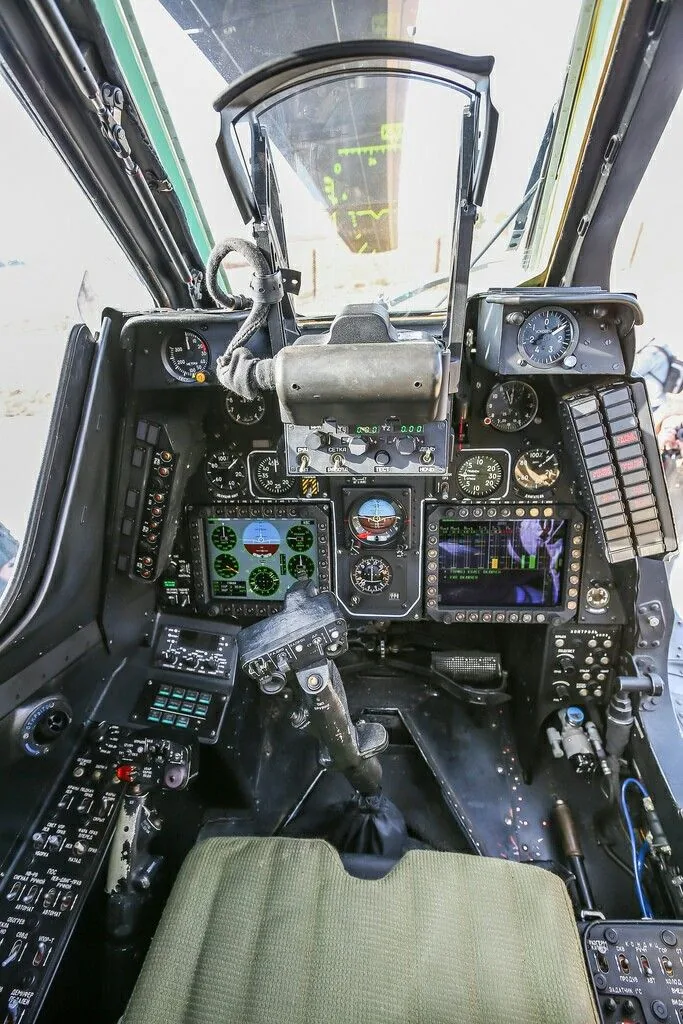
A Mi-28 cockpit station, apparently the pilot's, with a cyclic stick in the centre and two colour multifunction displays flanking the attitude indicator, surrounded by back-up dial instruments. A head-up display frame sits above the panel, in front of the heavily framed windshield, and the cockpit walls crowd in close on both sides of the seat.
Self-protection: L370V28 Vitebsk / President-S. Vitebsk (Витебск) is a modular KRET / Russian EW family; President-S is its export name. The Mi-28 configuration is the L370V28. The component list, consistent across The Aviationist, Butowski and Key.aero, is:
- L370-1 processor and controller, with a threat display and automatic reaction.
- L150 / L150-28M "Pastel" digital radar-warning receiver, 1.2 to 18 GHz, nominally 360° in azimuth and about 60° in elevation, with antennas at the nose, wingtips and tail.
- L140 / L140M "Otklik" laser-warning receiver, for designators and rangefinders.
- L370-2 ultraviolet missile-approach warners, typically in the wingtip pods, for 360° horizontal coverage.
- L370V28-5L (or L370-5L) laser DIRCM: a single turret in a transparent dome under the rear fuselage. This is the distinctive Mi-28 choice; the Ka-52 carries two jammers. The family brochure gives an engagement envelope of about 500 to 5,000 m, 360° around and about 90° in elevation. Rostvertol, via Key.aero, has claimed the suite can jam two IR-guided missiles at once.
- UV-26 / UV-26M 26 mm flare and chaff dispensers, four 32-round units often in the wingtips on later aircraft, plus fuselage units on some fits.
The L370-3S active RF jammer, with two 120° × 60° sectors and 5 to 10° azimuth accuracy in the brochure, is part of the full Vitebsk catalogue but has been repeatedly described as not installed on operational aircraft. [DOCUMENTED]
Claims against combat. Russian sources have described a live-fire trial in which 20 Igla-type missiles were fired at a running, unoccupied Mi-8 on a stand and none hit, the jammers and flares having "blinded" them. [SINGLE-SOURCE as a claim] The Aviationist flagged that Vitebsk-equipped helicopters were still lost in Syria, even if official accounts often called those crashes non-hostile. In Ukraine the suite is clearly present and used, and pop-up rocket runs are typically flown with bursts of decoys. [DOCUMENTED as architecture; UNVERIFIED as a claimed "invincible" live-fire result]
The FPV problem. Vitebsk was built around the MANPADS problem: a hot, fast missile with an infrared seeker and a bright ultraviolet motor plume that the warners can see and the laser can blind. A small FPV drone is a different target. It has a weak IR signature, it is usually steered by a human operator watching a video feed rather than by a seeker that a laser can dazzle, and it does not look like the missile that the approach warners were designed to catch. New "NVCh" (microwave-band) sensors have been photographed on later Mi-28NM wingtips, nose and tail, and have been speculated to be an anti-FPV layer or a Vitebsk upgrade. Their function is not officially confirmed, and they did not prevent a mid-air FPV kill of an Mi-28NM reported on 14 October 2026. [DOCUMENTED as photography and a claimed shoot-down; UNVERIFIED as to what the new antennas do]
Where the armour fits in. The armour package is built for bullets and cannon shells, and for a survivable crash. The losses in Ukraine have come from MANPADS, ground fire, airfield strikes and, increasingly, cheap drones. None of those is a 12.7 mm round fired at the windshield. That does not make the armour a waste: it is what lets a crew survive the hits it does take, and walk away from the landing that follows. But armour rated in machine-gun calibres does not settle an argument with a MANPADS or an FPV, for the Mi-28 or for any other helicopter.
| Item | What is claimed | Source | Tag |
| Tub material | Titanium armour with ceramic tiles | Yakubovich monograph; "titanium bathtub" in popular accounts | SINGLE-SOURCE |
| Tub material | 10 mm aluminium-alloy armour with ceramic plates | Key.aero, citing Mil designers | SINGLE-SOURCE |
| Tub rating | 12.7 mm AP and incendiary bullets, 20 mm projectiles | redstar.gr N and NM pages; Key.aero (20 mm) | DOCUMENTED as manufacturer-style wording |
| Tub rating | 14.5 mm | Generalist compilation | CONTESTED / weak; not used |
| Windshield | 42 mm, 12.7 mm-rated | Key.aero | SINGLE-SOURCE |
| Windshield | 12.7 mm AP-incendiary and 23 mm shells | Yakubovich | SINGLE-SOURCE; conflicts |
| Glazing | Up to 12.7 mm and 20 mm cannon shells | redstar.gr NM page | CONTESTED |
| Side glass | 22 mm, 7.62 mm-rated | Key.aero | SINGLE-SOURCE |
| Crew compartments | Separated by an armoured bulkhead | Yakubovich | DOCUMENTED |
| Seats and gear | Pamir-K seats, stroke up to 30 cm; survival up to 12 m/s vertical impact | Yakubovich, redstar.gr NM, Key.aero | DOCUMENTED as advertised |
| Crew g-load | Reduced from 58 to 60 g to about 12 g | Key.aero, citing Mil | SINGLE-SOURCE |
| Fuel tanks | Self-sealing, fire-protected; foam fill not documented | Key.aero, redstar.gr | DOCUMENTED (self-sealing) |
| Main rotor | Tolerates 20 to 30 mm hits | redstar.gr NM, Key.aero | DOCUMENTED as advertised |
| Escape | Jettisonable doors, inflatable sill ramps, jettisonable stub wings, parachutes | Yakubovich, redstar.gr NM | DOCUMENTED |
| Rotor jettison | Yes (Key.aero, Gunpowder) / "no provision" (all-aero.com) | Conflicting | CONTESTED |
| Rescue bay | Two to three people in the aft avionics bay | Key.aero, redstar.gr NM | DOCUMENTED |
| Self-protection | L370V28 Vitebsk, single belly DIRCM, MANPADS-oriented | The Aviationist, Butowski, Key.aero | DOCUMENTED; FPV defence UNVERIFIED |
Against the Mi-24 and the AH-64. The Mi-24 / Mi-35 is also a heavily armoured Mil product, with a titanium-armoured cockpit and ballistic windscreens, and airframe protection commonly described as 12.7 mm all round. It is a different machine, though: a much larger "flying infantry fighting vehicle" with a troop cabin, a bigger signature and a less specialised attack layout. [DOCUMENTED in outline] The Mi-28 is the dedicated gunship that came out of that family.
The AH-64 Apache is the design the Mi-28 was meant to meet or beat. Western technical literature commonly describes the Apache's cockpit-floor and side armour (boron carbide and Kevlar in US descriptions) as rated against 12.7 mm fire and 23 mm fragments, with a blast shield between the seats; the canopy itself is not usually sold as a 23 mm-proof transparency. That is the standard secondary description; no primary US Army armour specification was consulted for this page, so the comparison is one-sided in its sourcing. [UNVERIFIED as a primary specification] The interesting comparison is not which helicopter is invulnerable, because neither is. It is where the designers chose to spend weight: the Russians on a deeper, ceramic-tiled tub and very thick glass, advertised in 20 mm-projectile language; the Americans on a structural rating against 23 mm fragments and a more mature sensor and radar-cueing system. Claims that the Mi-28 carries several times the Apache's armour weight trace to a single magazine article and are not used here. [UNVERIFIED]
AVIONICS AND SENSORS
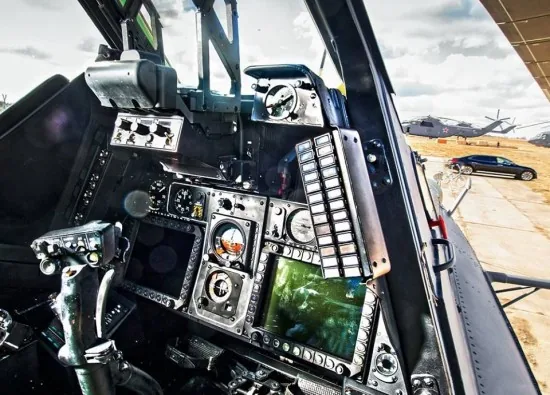
A wide view of a Mi-28 cockpit at an outdoor display, with a large colour multifunction display, a second display to its left, back-up dial instruments and a tall column of push-switches, and the cyclic stick in the foreground. Mi-26 heavy-lift helicopters are visible on the apron through the side glazing.
Sighting turrets. The production Mi-28N has a chin electro-optical targeting turret widely identified as the OPS-28 "Tor" (OPS-28M / Tor-M in later and NM aircraft), with TV, thermal imaging, and laser ranging and designation, used to search, recognise and engage. Above or near it is a smaller turret for the pilot's night navigation and look-around, identified in 2010s technical writing as the TOES-521. [DOCUMENTED as a two-turret layout; the TOES-521 name is from period technical articles] Butowski's 2023 description of the NM is more specific: a bulkier OPS-28M Tor-M under the nose and a new SMS-550 turret for the pilot. Both NM crew members get an NSTsI-V helmet-mounted sight and display, and the NM pilot's cockpit gained an ILS-28NM head-up display with a lighter frame than the earlier ILS-28M. [DOCUMENTED] Some mid-life Mi-28N upgrades are described with a GOES-451 (or GOES-451M) replacing the OPS-28 while keeping the TOES-521. [UNVERIFIED in detail] Night-vision goggles are part of the advertised NM crew fit. Key.aero, for the NE, quotes tank detection and recognition ranges of about 10 and 9 km by day and 9 and 7 km at night for the improved OPS-28M. [SINGLE-SOURCE, manufacturer-flavoured figures]
N025 / N025M mast radar. The radar was developed by GRPZ at Ryazan. The basic N025, fitted to the Mi-28UB and intended (but often not fitted) for the N, is described as a Ka-band millimetre-wave radar in a dome above the rotor hub, used for surface mapping, ground-target detection, cueing the electro-optical sight, weather, and an air-to-air mode. Key.aero, on the export N025E, says it can track up to four targets and can detect a large metal bridge at about 20 km and a main battle tank at about 10 km. [SINGLE-SOURCE for those ranges]
The N025M on the Mi-28NM, part of the BRLK-28 radar system, adds X-band on the same parabolic reflector, a faster air-to-air scan, more tracks (up to ten, according to Key.aero and the redstar.gr NM page, which also says it can "engage up to two targets simultaneously"), weather, and an L-band IFF interrogator and transponder, with a 360° scan. [DOCUMENTED]
The mast position matters. A radar above the rotor can see over a tree line or a ridge while the cockpit, the engines and most of the infrared signature stay below cover. Millimetre-wave bands such as Ka let a small antenna form a narrow beam with good ground-mapping resolution, at the cost of more atmospheric and rain attenuation than X-band. Pairing Ka with X on the same reflector is a reasonable way to buy back range and bad-weather performance.
Two caveats. First, Butowski is explicit that the N025 / N025M does not assign a target directly to a weapon. It hands initial coordinates to the OPS-28M, which then has to see the target. That is a different architecture from a radar that cues a fire-and-forget radar-guided missile, and it is why the optical and thermal turret remains the heart of the shot. [DOCUMENTED] Second, the redstar.gr NM page gives the radar's "frequency range" as 100 to 150 GHz. That would be around W-band or above, not Ka (about 26 to 40 GHz) or X (about 8 to 12 GHz). It conflicts with Butowski's GRPZ description and is treated here as an error on that page unless a primary GRPZ document confirms a third millimetre-wave band. [CONTESTED; not used as fact]
Datalinks and communications. The NM's KSS-28NM (S-406-2NM) communications suite is described as tying the helicopter into the army aviation command system. Avionics work at Ramenskoye, reported in 2015, added interaction with UAVs, an "all-glass" cockpit, high-speed optical links between subunits and a helmet-mounted cueing system. [DOCUMENTED as industry statements] For the LMUR missile, the helicopter carries an AS-BPLA two-way datalink antenna in the upper nose, with viewing angles Butowski reads as about ±90° from the aircraft axis, so the helicopter can manoeuvre after launch and still talk to the missile. [DOCUMENTED] Redstar.gr's N page also advertised target sharing from a leading helicopter to the others in a group and automatic nap-of-the-earth flight at 5 to 15 m. Those are advertised modes, not demonstrated Ukraine-war tactics. [UNVERIFIED as field performance]
WEAPONS
The stub wings carry four weapon stations, and the wingtips carry pods for sensors and countermeasures. The 30 mm gun sits in a chin turret built into the airframe, not in a pod.
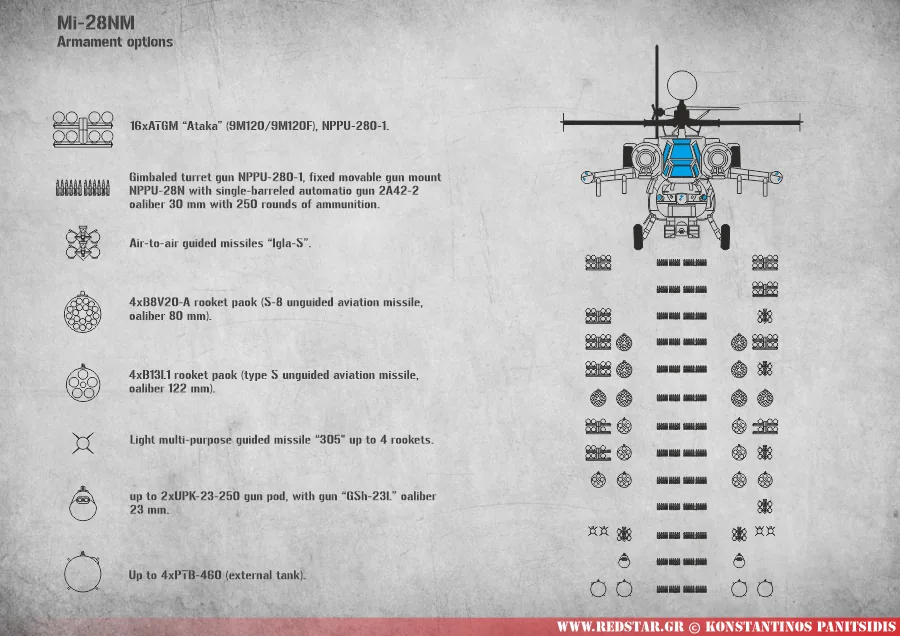
Mi-28NM armament options: 16 Ataka (9M120 / 9M120F) anti-tank missiles; the NPPU-280-1 gun mount with the 2A42-2 30 mm cannon and 250 rounds; Igla-S air-to-air missiles; B8V20-A 80 mm (S-8) and B13L1 122 mm (S-13) rocket pods; the light multipurpose missile "305" (LMUR), shown at up to four rounds; up to two UPK-23-250 23 mm gun pods; and up to four PTB-460 external tanks. The column chart on the right shows which loads go on which station. Infographic © Konstantinos Panitsidis / redstar.gr.
2A42 30 mm cannon in the NPPU-28 mount. A single-barrel, dual-rate Shipunov 2A42, the BMP-2's gun, or the helicopter-adapted 2A42-2, sits in a chin turret designated NPPU-28 or NPPU-280-1. Elevation is given on the redstar.gr UB page as +13° / −45°. The redstar.gr NM gun table gives a rate of fire of 200 to 300 rounds per minute at the low setting and 550 to 800 at the high, and a gun mass of 115 kg. The ammunition load is contested: 250 rounds in the NM page's prose and on the infographic above, 300 rounds in the same page's specification table and on the Panitsidis N, NE and UB pages. [CONTESTED] Using the BMP-2's gun gives the Mi-28 a heavy, long-ranged round that shares ammunition with the ground forces; the trade-off is weight and recoil in the nose.
Anti-tank missiles. The documented in-service family is the radio-command 9M114 Shturm and 9M120 Ataka (AT-9 Spiral-2), carried in packs of four, for up to 16 missiles. The Panitsidis / redstar.gr NM armament table gives Shturm as 130 mm calibre, 5 km range, 650 mm penetration and 35 kg at launch with a 5.4 kg warhead, and Ataka as 130 mm, 5.8 km, 880 mm behind explosive reactive armour, and 42.5 kg with a 7.4 kg warhead. Both are SACLOS radio-command missiles: the operator keeps the sight on the target until impact, so the helicopter has to keep the target in view for the whole flight of the missile. [DOCUMENTED as table figures; secondary or manufacturer-style, not a firing trial] Khrizantema-VM is reported on some upgraded or NM aircraft in secondary compilations; a primary integration announcement was not found. [UNVERIFIED]
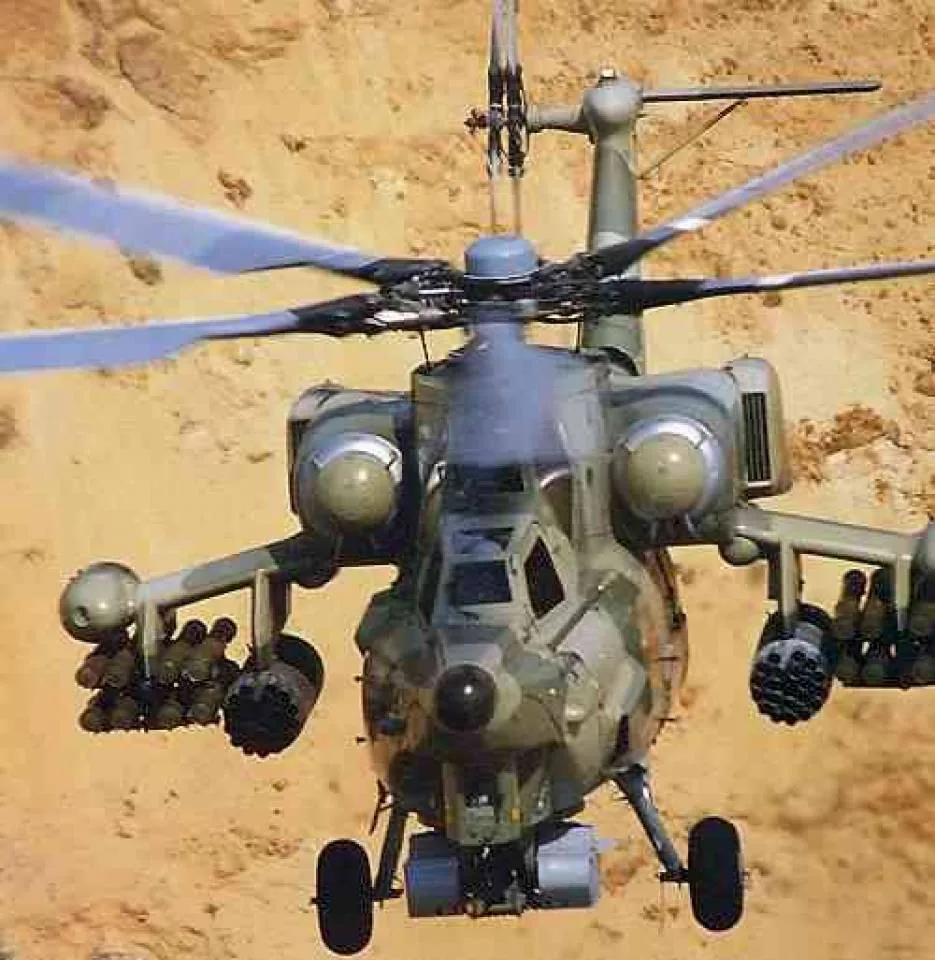
A Mi-28 head-on over desert terrain, with racks of missile launch tubes, identified as Shturm, on the outer stub-wing stations and 20-round rocket pods inboard. The wingtip pods, the chin turret, the twin engine intakes and the fixed main gear are visible. No mast radar is fitted.
Izdeliye 305 / LMUR. The light multipurpose guided missile, trialled on the Mi-28NM from about 2019 and documented in Ukraine in a January 2023 cockpit video. It weighs about 105 kg (231 lb) including a 25 kg (55 lb) warhead, roughly twice a typical Russian helicopter anti-tank missile. Butowski's 2023 account gives a range of "over nine miles" (about 14.5 km); later Russian-source reporting says "up to 25 km." It flies out on inertial navigation with satellite correction; near the target the seeker picture comes back to the operator over the two-way datalink, and the operator can designate. The seeker cap lifts just before launch. A helicopter could in theory carry eight on four APU-L twin rails; in published imagery two is typical, and the infographic above shows up to four. [DOCUMENTED; the 25 km figure is a later Russian-source claim] LMUR is the weapon that first let the Mi-28NM hit a point target from well outside typical MANPADS range.
Rockets, gun pods and bombs. Combat footage from Ukraine shows 80 mm S-8 rockets in B8V-20 pods and 122 mm S-13 rockets in B13L1 pods as the everyday load, often fired in a climbing salvo. [DOCUMENTED] The Panitsidis tables also list 57 mm and 130 mm rocket pods, 23 mm gun pods, 30 mm grenade-launcher pods, 12.7 mm and 7.62 mm gun pods, 500 kg bombs and mine dispensers. Those are options on the brochure, not a Ukraine-war inventory.
Igla-V / S and Strelets. Igla-family missiles on a helicopter are an old option (Igla-V). In October 2025 Defense Express published Russian photographs of a Mi-28N carrying a Strelets remote launch module with four Igla tubes, which it assessed as an anti-UAV fit, with the caveat that a small drone's weak IR signature makes it a hard target for a MANPADS seeker. [DOCUMENTED as photography and as Defense Express's assessment]
Vikhr and R-60. The redstar.gr armament blocks across the Mi-28, Mi-28N, Mi-28NE, Mi-28UB and Mi-28NM pages include "up to 16 Vikhr ATGMs" and "2×2 R-60." Vikhr is the laser-beam-riding missile of the Ka-50 / Ka-52 family, and R-60 is a short-range air-to-air missile. No documented combat use of either from a Mi-28 was found. They are listed options, not confirmed service loads. [CONTESTED / UNVERIFIED in service]
Dan-T. In November 2026 the Russian Ministry of Defence released video of an Mi-28NM launching a weapon it names as Dan-T. As described by Defense Express, Militär Aktuell and Army Recognition, the footage shows two rounds on the outer stub-wing stations and one release from under the left stub wing, against a claimed UAV-control post in the "West" grouping's area. The hit is a Russian claim and is unverified. Four rounds are theoretically possible, using the two inboard hardpoints and about 2.3 tonnes of payload, and have not been seen. [DOCUMENTED as MoD video] The full discussion of the weapon, its identity against the S8000 Banderol, and its launch profile is in the Dan-T article.
| Weapon | Type | Status on the Mi-28 | Tag |
| 2A42 / 2A42-2, 30 mm, NPPU-28 | Chin turret cannon, 250 or 300 rounds | All production marks | DOCUMENTED; ammunition CONTESTED |
| 9M114 Shturm | Radio-command SACLOS ATGM, 5 km | Packs of four, up to 16 | DOCUMENTED |
| 9M120 Ataka | Radio-command SACLOS ATGM, 5.8 km | Packs of four, up to 16; seen in Ukraine | DOCUMENTED |
| Izdeliye 305 / LMUR | Datalinked multipurpose missile; over nine miles (Butowski), up to 25 km claimed | Mi-28NM; usually two carried | DOCUMENTED |
| Dan-T | Jet-powered quasi-cruise missile, 450 km declared | Mi-28NM; two carried, one launch shown (November 2026) | DOCUMENTED as MoD video |
| S-8 (B8V-20) and S-13 (B13L1) | 80 mm and 122 mm unguided rockets | Everyday Ukraine load | DOCUMENTED |
| Igla-V / Igla-S, Strelets | Infrared air-to-air missiles | Option; Strelets anti-UAV fit seen October 2025 | DOCUMENTED as photography |
| Khrizantema-VM | ATGM | Reported on upgraded / NM aircraft | UNVERIFIED |
| Vikhr | Laser-beam-riding ATGM | On the Panitsidis tables only | CONTESTED / UNVERIFIED |
| R-60 | Air-to-air missile | On the Panitsidis tables only | CONTESTED / UNVERIFIED |
| Gun pods, grenade pods, bombs, mine dispensers | Various | Brochure options | UNVERIFIED as war loads |
POWERPLANT AND PERFORMANCE
The original and early-production engines are two Klimov TV3-117VMA turboshafts, commonly rated at about 2,200 to 2,256 hp each (redstar.gr N: 2 × 2,256 hp; other tables give 2,200 or 2,229 hp). From the mid-2010s the type has been moving to the Russian VK-2500 family (the VK-2500-02, and the VK-2500P on the NM), built by UEC-Klimov, after Motor Sich in Ukraine dropped out of the supply line. [DOCUMENTED as a family change; the exact cut-over year is secondary] The redstar.gr NM page prints a VK-2500 setting table with 2,700 hp emergency power; 2,000, 2,200 or 2,400 hp take-off depending on the rating; 1,500 or 1,750 hp cruise; a mass of 300 kg; and FADEC. Other Rostec-family reporting has used 2,500 hp take-off and 2,800 hp emergency for the VK-2500P. [CONTESTED as to the emergency and take-off pair]
The NM's auxiliary power unit is the TA14-130-28, replacing the earlier AI-9V. The engines can be started from the APU on the ground or in flight. Sand filters and vortex-type inlet protection are fitted. IR-suppressing exhausts are standard; one popular account claims a 2.2-fold cut in IR signature. [SINGLE-SOURCE for the 2.2× figure]
The figures below are reported, not flight-test data, and many of them conflict. The first value in each cell is the most commonly cited for that mark.
| Item | Mi-28 / Mi-28A | Mi-28N | Mi-28NE / UB | Mi-28NM | Tag |
| Engines | 2 × TV3-117 | 2 × TV3-117VMA | TV3-117VMA or VK-2500-02 | 2 × VK-2500P | DOCUMENTED |
| Power (each, advertised) | About 2,200 hp | 2,256 hp | 2,256 hp | Take-off about 2,000 to 2,500 hp; emergency 2,700 to 2,800 hp | CONTESTED for VK-2500 |
| Crew | 2 | 2 | 2 (UB: dual controls, larger front cockpit) | 2, dual controls | DOCUMENTED |
| Length | 16.85 m | 17.01 m | 17.01 m | 17.2 m on the NM table (conflicts with 17.01 m) | CONTESTED |
| Main-rotor diameter | 17.2 m | 17.2 m | 17.2 m | 17.2 m | DOCUMENTED |
| Tail-rotor diameter | 3.84 m | 3.84 m | 3.84 to 3.85 m | 3.84 to 3.85 m | DOCUMENTED |
| Empty weight | 7,890 kg | 7,890 kg | About 7,900 kg (UB) | 7,890 kg (same figure reused) | DOCUMENTED / reused |
| Normal / maximum take-off weight | 10,400 / 11,500 kg | 10,500 / 11,700 kg (ODIN also 11,500 kg) | 10,900 to 11,000 / 12,100 kg | 10,900 / 12,100 kg | CONTESTED |
| Internal fuel | 1,500 L | 1,500 L | 1,500 L | About 1,900 L (NM page) vs 1,500 L elsewhere | CONTESTED |
| External tanks | 4 × 500 L | 4 × 500 L | 4 × 500 L | 4 × 460 L (NM table); 4 × 557 L in another source | CONTESTED |
| Weapon load | 1,605 kg | 1,605 kg (ODIN: 2,350 kg on one entry) | 1,605 to 2,400 kg | 2,300 kg (NM table) | CONTESTED |
| Maximum / cruise speed | 282 / 260 km/h | 300 to 324 / 265 km/h | 300 / 270 km/h | 324 / 265 km/h, with a claimed +13% / +10% over the previous mark | CONTESTED |
| Combat radius / range | Combat 460 km | Combat about 450 to 500 km; range 1,105 km | Similar | Combat 450 to 500 km; range 1,105 km | ESTIMATE / brochure |
| Service / hover ceiling | 5,750 / 3,450 m | 5,700 / 3,700 m | 5,000 / 3,600 m | 5,600 / 3,600 m | CONTESTED |
| Climb | — | — | 816 m/min (UB) | 816 m/min | SINGLE-SOURCE |
| Stub-wing span | — | — | — | 4.88 m (NM page) | SINGLE-SOURCE |
COMBAT USE
Syria. The Mi-28N's combat debut was in March 2016, supporting the Syrian army's advance on Palmyra with S-8 rockets and Ataka missiles against Islamic State positions. [DOCUMENTED] Russia lost at least two Mi-28Ns there. One, from the Budyonnovsk regiment, crashed near Homs on 12 April 2016, reported as night-flying pilot error, and both crew were killed; another crashed on 6 October 2017. [DOCUMENTED as losses; the "pilot error" finding is the official account] The Mi-28NM prototype was sent to Syria in March 2019 for an apparent hot-and-dusty combat evaluation. [DOCUMENTED]
Ukraine, 2022 onward. Mi-28Ns and Mi-28UBs have been used from the first weeks of the full-scale invasion. The NM was first photographed in the theatre on 15 October 2022, and it was documented launching an LMUR in a 14 January 2023 video from the Russian Fighterbomber channel, flying as a pair with an Mi-8 for combat rescue and typically carrying two LMURs rather than a full load. [DOCUMENTED] Early losses included wreckage near Hostomel and airframes RF-13654 and RF-13628 in the Kharkiv area in May 2022. The Times reported a Starstreak kill of an Mi-28N in early April 2022. [DOCUMENTED as reported losses; the Starstreak attribution is SINGLE-SOURCE]
After the first weeks, with MANPADS dense along the front, Russian attack helicopters changed how they fought. Butowski described the new standard profile as a low approach, a pop-up, a climbing unguided-rocket salvo, and a turn back into cover, usually with a burst of flares. Accuracy is poorer; crew survival is better. He noted that it became the standard profile for almost all attack-helicopter work, and for the Su-25 as well. [DOCUMENTED as an observed tactic] Typical visible loads were 80 mm and 122 mm rockets, sometimes with four Atakas.
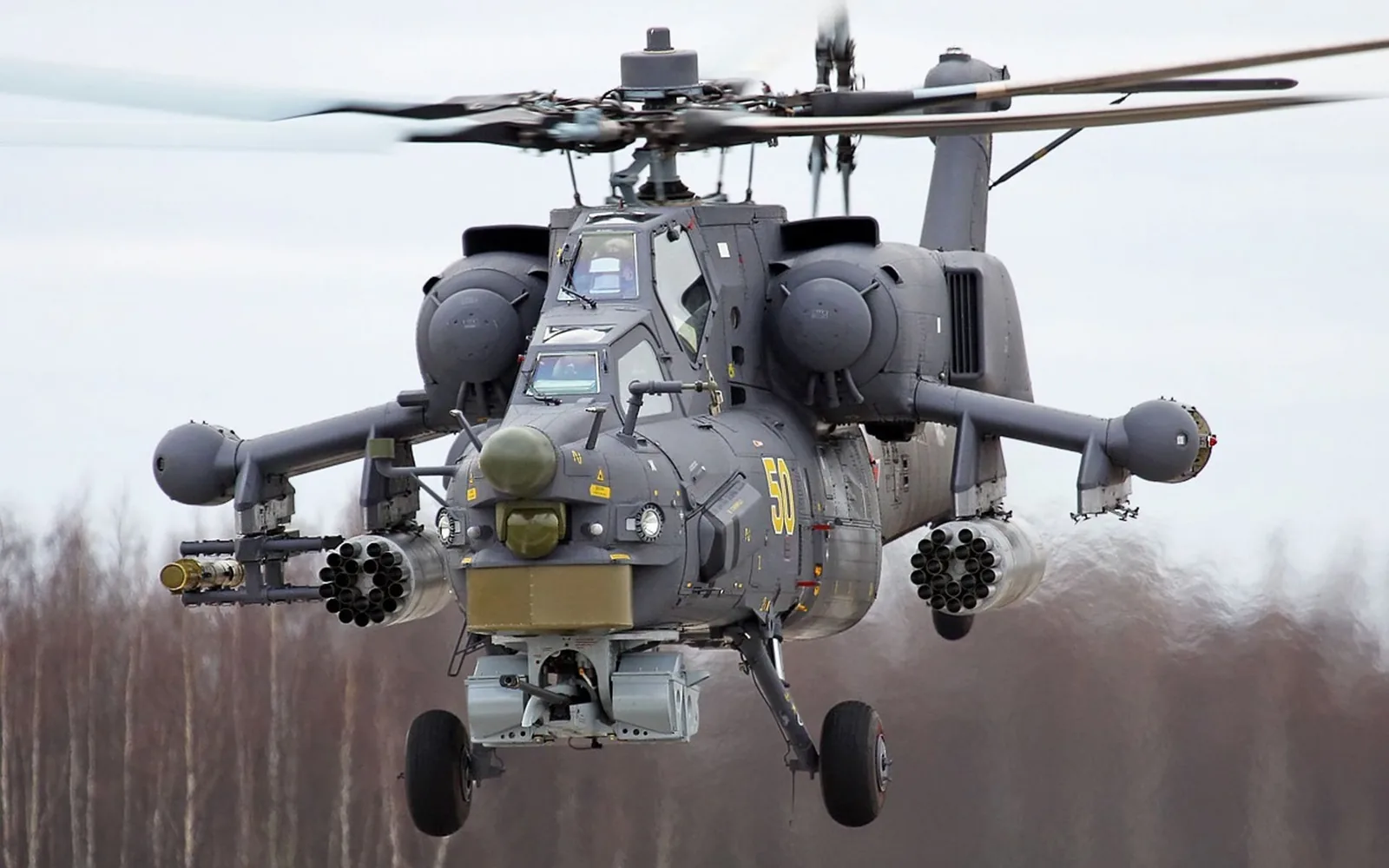
Mi-28 "50" head-on in flight, with 20-round 80 mm rocket pods on the inboard stations and missile launch tubes, identified as Ataka, on the outboard station. This rocket-and-missile mix is the everyday load of the Ukraine war, and rocket pods like these are what a rocket sling fires. The wingtip pods, the chin sensor turret, the 30 mm gun and the fixed main gear are visible.
Rocket slings. Both the Mi-28 and the Ka-52 have been seen many times in Ukraine-war footage flying what this site calls a rocket sling, more commonly described as loft or toss rocket fire. The Russian aviation term is кабрирование (kabrirovanie), "pitch-up." The technique is old: a 1986 East German army-aviation manual written around the Mi-24 already described it as "attack from the climb," and RUSI, after interviews in Ukraine in 2022, described the Russian profile as a run-in below 200 ft, a 15 to 30 degree pitch-up and a ripple-fired salvo, with generally poor accuracy. [DOCUMENTED] The Ka-52 article covers the tactic in more depth. The helicopter runs in low and fast, often at tree-top height. Short of the target, the pilot pulls the nose up sharply, fires a salvo of unguided S-8 or S-13 rockets while the nose is pointing above the horizon, and then breaks hard away, turning back toward cover, usually with flares going out. The rockets are thrown forward and upward, fly a ballistic arc, and come down on the target area while the helicopter is already turning away. It is the same profile Butowski describes as the standard pop-up, climbing rocket salvo. [DOCUMENTED as an observed tactic]
Why sling the rockets. The reasons are simple physics and simple survival:
- Range. A rocket fired level from a low-flying helicopter starts dropping toward the ground as soon as it leaves the pod, and it does not travel far before it hits the ground. Fired with the nose pitched up, it climbs before it falls, so it travels much further downrange. The helicopter's own forward speed adds to the rocket's speed at launch.
- Distance from the threat. That extra range lets the crew fire from further back, at distances where MANPADS, heavy machine guns and other ground fire have less chance of reaching the helicopter, instead of flying over or close to the defended position.
- Short exposure. The helicopter is only above the tree line for the few seconds of the pull-up and the salvo. The run-in is masked by terrain, and the break turn puts it back behind cover quickly.
- The cost: accuracy. An unguided rocket on a long ballistic arc spreads widely. Small errors in pitch angle, launch speed, wind and the rocket's own motor become large misses at the far end. A rocket sling is area fire: it can suppress, damage or pin down a position, but it is a poor way to hit a single vehicle or a point target. No hit rates for the tactic have been published in the sources used for this page, and none are given here.
From slings to stand-off missiles. The rocket sling is the first step in a clear progression. Rockets slung from a pop-up gave range at the cost of accuracy. LMUR gave the Mi-28NM a guided weapon that could hit a point target from beyond typical MANPADS range, with the operator steering it through the datalink while the helicopter stayed back. Dan-T, in November 2026, turned the Mi-28NM into a stand-off missile truck carrying a 450 km-class quasi-cruise missile. That is a different job from the tree-top anti-tank shooter that the armour was designed around. [DOCUMENTED as a progression]
The Dan-T step also changes the launch profile. No booster is visible on the carriage photographs, so a low-altitude or classic pop-up release is a poor match for a small turbojet that has to reach flying speed. The implied tactic is to climb and accelerate, then release, which also makes the helicopter easier to detect. Helicopter-launched range should sit between roughly 250 km (the estimate for a ground launch) and 450 to 500 km (for a launch from a jet at height); the official 450 km is not a demonstrated Mi-28 engagement distance. [ESTIMATE; see the Dan-T article]
Losses. The Oryx visually confirmed list, checked on 12 November 2026, records 21 Russian Mi-28s: 13 destroyed, one damaged beyond economical repair, and seven damaged, some of them on the ground. The same list records 68 Ka-52s. These are minima, and Oryx itself says the true number is likely higher. [DOCUMENTED] The difference between the two types is a comparison, not proof that the Mi-28 is "safer": Ka-52s were seen more often in the war, and the two types have not been shown to fly the same number of sorties. By January 2023, Butowski noted, visually confirmed Ka-52 losses were already about three times the Mi-28's, from pre-war fleets of similar size, about 110 each in his estimate at the time. [DOCUMENTED as of that date]
FPV kills. A Shrike 10 FPV drone of the 427th Rarog Brigade was reported to have brought down an Mi-28N near Vyazove, in Russia's Belgorod region (Militarnyi, citing the drone's maker). On 14 October 2026 the "Pribultsi" unit of Ukraine's 115th Mechanised Brigade released footage of an anti-aircraft FPV killing a Mi-28NM in mid-air, despite the new sensors being discussed as anti-drone defences. [DOCUMENTED as Ukrainian claims with released footage]
The anti-drone role. The Mi-28 is working on drones in two directions at once. Defensively, later NMs have appeared with extra microwave-band sensors whose function is unconfirmed, and Russia has a helicopter EW product, Multik by Gradient, aimed at FPVs; UNITED24 noted that the new NM fit does not obviously match Multik, and an FPV still made the kill. Offensively, helicopters have been used to hunt long-range UAVs with the 30 mm gun and, from at least October 2025, with Strelets / Igla modules on the Mi-28N. [DOCUMENTED as a fit; effectiveness against small, cool drones is an open question]
Lessons. The armour package is built for bullets, cannon shells and a survivable crash. The losses have come from MANPADS, ground fire, airfield strikes and, increasingly, cheap drones. Vitebsk is a serious MANPADS suite, not a demonstrated FPV solution. The useful adaptation has been range: rocket slings, then LMUR, then Dan-T. Each step kept the helicopter further from the front, and the last one changed its signature and launch profile.
OPERATORS AND PRODUCTION
Russia is the main operator, with the Mi-28N, Mi-28UB and a still-limited Mi-28NM fleet. Butowski, in January 2023, estimated about 110 Mi-28s of all marks in army aviation after a dozen Ukraine-war losses, of which the UB was "only 24" and it was "doubtful that more than 10" were NMs. Secondary compilations a few years later have used figures of about 90 to 100 Ns and NMs plus a smaller UB fleet, with the 98-aircraft NM contract still running. [ESTIMATE; no official current inventory has been published] Production is at Rostvertol, Rostov-on-Don. A cumulative total of "more than 190 built as of 2025" is commonly repeated but was not traced to a manufacturer release. [ESTIMATE]
Algeria. A contract for 42 Mi-28NEs, dated 26 December 2013 in a contemporary industry report, makes Algeria the largest export customer. President-S is reported on Algerian Mi-28s, as well as on Mi-17s and Mi-26s. [DOCUMENTED as a contract; in-service status is consistently reported]
Iraq. A large October 2012 arms package was reported as covering up to 36 Mi-28NEs; a later, better-constrained industry figure was 15 firm, and later compilations sometimes say 17. The first aircraft arrived around 2013 to 2014 and were used against Islamic State. [CONTESTED as to the final number delivered; 15 is the better-documented contract figure]
Uganda. A small NE fleet. After a crash at Nyamisingiri, Ntoroko district, on 3 January 2024, which killed both crew, a Ugandan army spokesman described the aircraft as one of three Mi-28s acquired in 2022. Other compilations say four, plus options. [SINGLE-SOURCE for the official "three"; CONTESTED as a fleet total]
Others. The Mi-28NAe was offered to North Korea, and delivery is unverified. Kenya appeared in some 2010s order tables and does not appear as an operator in later summaries; a Kenyan order is not confirmed. Reports in 2026 of a handful of Mi-28s in Iranian service were not independently confirmed. [UNVERIFIED]
| Operator | Mark | Number | Tag |
| Russia | Mi-28N, Mi-28UB, Mi-28NM | About 110 of all marks (January 2023 estimate); UB about 24; NM deliveries against a 98-aircraft contract | ESTIMATE |
| Algeria | Mi-28NE | 42 contracted (December 2013) | DOCUMENTED |
| Iraq | Mi-28NE | 15 firm; up to 36 reported in 2012; 17 in some compilations | CONTESTED |
| Uganda | Mi-28NE | Three (army spokesman, 2024); four in other compilations | SINGLE-SOURCE / CONTESTED |
| North Korea | Mi-28NAe | Offered; delivery not confirmed | UNVERIFIED |
| Kenya | — | Appeared in 2010s order tables; not confirmed | UNVERIFIED |
| Iran | — | 2026 reports of a handful; not confirmed | UNVERIFIED |
COMPARISON
The figures below are the ones used on this page and in standard public descriptions of the other types. They are not a standardised test. The Ka-52 has its own article: Ka-52 (Alligator).
| Mi-28N / NM | Mi-24 / Mi-35 | Ka-52 | AH-64D/E |
| Layout | Tandem two-crew dedicated gunship; small aft rescue bay | Tandem two-crew plus a troop cabin (about 8) | Side-by-side two-crew; coaxial rotors | Tandem two-crew dedicated gunship |
| Special survivability | Partitioned armoured tub with ceramic appliqué, thick glass, Pamir-K seats, 12 m/s gear, door ramps; advertised 12.7 mm AP and 20 mm | Titanium tub, 12.7 mm-class airframe claims; less specialised as a pure attack type | Crew ejection system (unique among these four) | Floor and side armour commonly described as 12.7 mm and 23 mm fragments; no 23 mm-proof canopy in standard descriptions |
| Sensors | OPS-28 / OPS-28M plus pilot turret (TOES-521 or SMS-550); N025 / N025M on UB and NM | Various; generally less capable night and radar fit on older marks | GOES-451-family EO; mast or nose radar depending on mark | TADS / PNVS; Longbow fire-control radar on D/E |
| Self-protection | L370V28 Vitebsk / President-S, single belly DIRCM | Older suites; Vitebsk L370V24 on some later helicopters | L370V52 Vitebsk, two DIRCM turrets | Common Missile Warning, IRCM / DIRCM, chaff and flares, depending on block |
| Gun | 2A42 30 mm, NPPU-28, 250 to 300 rounds | YakB-12.7 or GSh-30-2 / 23 mm depending on mark | 2A42 30 mm | M230 30 mm chain gun |
| Typical guided weapons | Shturm / Ataka; NM: LMUR; 2026: Dan-T | Shturm / Ataka; later Ataka on the Mi-35 | Vikhr; later LMUR on the Ka-52M | Hellfire / JAGM; Stinger on some fits |
| Engines | TV3-117VMA or VK-2500(P), about 2 × 2,200 to 2,500 hp | TV3-117 / VK-2500 class | VK-2500 class | 2 × T700, roughly 2,000 shp class depending on version |
| Ukraine-war losses (Oryx, 12 November 2026) | 21 listed (13 destroyed, 1 damaged beyond repair, 7 damaged) | Mi-24 and Mi-35 listed separately, lower than the Ka-52 | 68 listed | Not used in this war |
| Operators | Russia; Algeria 42; Iraq about 15; Uganda a handful | Very widely exported | Russia; Egypt and others | US and many export operators |
GAPS AND CONFLICTS
- The tub material (titanium versus 10 mm aluminium alloy plus ceramic) is not reconciled.
- Glass ratings conflict: 12.7 mm (with 42 and 22 mm thicknesses) versus 20 mm versus 23 mm.
- The claim that the Mi-28 carries several times the Apache's armour weight is unverified and is not used.
- Rotor-blade jettison is contested; the inflatable door ramps are not.
- Foam-filled tanks are not documented; self-sealing tanks are.
- Internal fuel is given as 1,500 or about 1,900 litres; several MTOW, speed, ceiling and weapon-load figures disagree.
- 2A42 ammunition is given as 250 or 300 rounds.
- The redstar.gr "100 to 150 GHz" figure for the N025M conflicts with Butowski's Ka- and X-band description.
- Early Mi-28Ns without the mast radar are easy to mis-describe from brochure art.
- Vikhr and R-60 appear on the Panitsidis tables but are not confirmed in Mi-28 service use.
- Khrizantema-VM integration was not pinned to a primary source.
- Russian and export inventories are estimates; Iraq's 15, "up to 36" and 17 figures conflict; actual deliveries against the 98-aircraft NM contract are incomplete in public.
- Oryx is a visual floor, not a complete loss list.
- No primary US Army AH-64 armour specification was consulted, so the Apache comparison is one-sided in its sourcing.
IN ONE SENTENCE
The Mil Mi-28 Havoc (Ми-28) is Russia's dedicated tandem two-seat attack helicopter, first flown on 10 November 1982 and in service as the Mi-28N "Night Hunter" from 2008 to 2009, built around a partitioned, ceramic-armoured crew tub advertised against 12.7 mm and 20 mm fire, crash-attenuating seats and gear, and self-sealing tanks, and now fighting in Ukraine with rocket slings, LMUR and the Dan-T stand-off missile, while still losing airframes to MANPADS and FPV drones that its armour and Vitebsk suite were never built to stop.
SOURCES
- 1. Piotr Butowski, The War Zone, "Russia's Mi-28NM Attack Helicopter Seen Using New Anti-Armor Missile In Ukraine," 17 January 2023.
- 2. Key.aero, "Mean Havoc Rising," and "Mean Havoc Rising: Part 2."
- 3. redstar.gr, Konstantinos Panitsidis: Mi-28, Mi-28N, Mi-28NE and Mi-28UB pages (English), and Mi-28N and Mi-28NM pages (Russian, with the labelled diagram and armament tables).
- 4. N. Yakubovich, Boevoi vertolet Mi-28 (monograph; tub, glass, seats, door ramps and the armoured bulkhead).
- 5. GlobalSecurity, "Mi-28 vs Ka-50."
- 6. The Aviationist, on the Vitebsk L370 / President-S DIRCM system, 8 July 2020.
- 7. US Army ODIN, Mi-28 (Havoc) and Mi-24 (Hind) entries.
- 8. Oryx, list of aircraft losses during the Russian invasion of Ukraine, checked 12 November 2026.
- 9. Army Recognition, Mi-28NM avionics and UAV interaction, 2015.
- 10. Defense Industry Daily, Mi-28 fleet and export contracts.
- 11. Defense Express, Igla / Strelets on the Mi-28N, 25 October 2025.
- 12. UNITED24, Mi-28NM FPV shoot-down, 14 October 2026.
- 13. Militarnyi, Shrike 10 FPV against an Mi-28.
- 14. helis.com, Mi-28N radar still in development (about 2008).
- 15. Gunpowder Magazine, "Night Hunter: The Mi-28N Havoc-B Gunship."
- 16. all-aero.com, "Mil Mi-28," February 2025.
- 17. Military Factory, Mi-28 entry (14.5 mm figure, not used).
- 18. Defense Express, Militär Aktuell and Army Recognition on the November 2026 Mi-28NM Dan-T launch video, as cited on the Dan-T page.
Related on this site: Mi-24 (Hind), the troop-carrying Mil gunship the Mi-28 was ordered to succeed.
Related on this site: Dan-T, the jet-powered quasi-cruise missile launched from an Mi-28NM in November 2026.
Related on this site: S8000 Banderol, the related Kronstadt / Rostec weapon in the same class.
Related on this site: Ka-52 (Alligator), the Kamov coaxial-rotor attack helicopter that flies alongside the Mi-28.
Related on this site: Ka-26 (Hoodlum), another Soviet helicopter on this site.
Project Orlan // Underground Information Database