Home |
Data Base |
Technical |
Radio |
Search
KH-69
Х-69 | Raduga / KTRV | successor of the Kh-59MK2
Reduced-signature air-launched cruise missile
Project Orlan Data Base // public encyclopedia
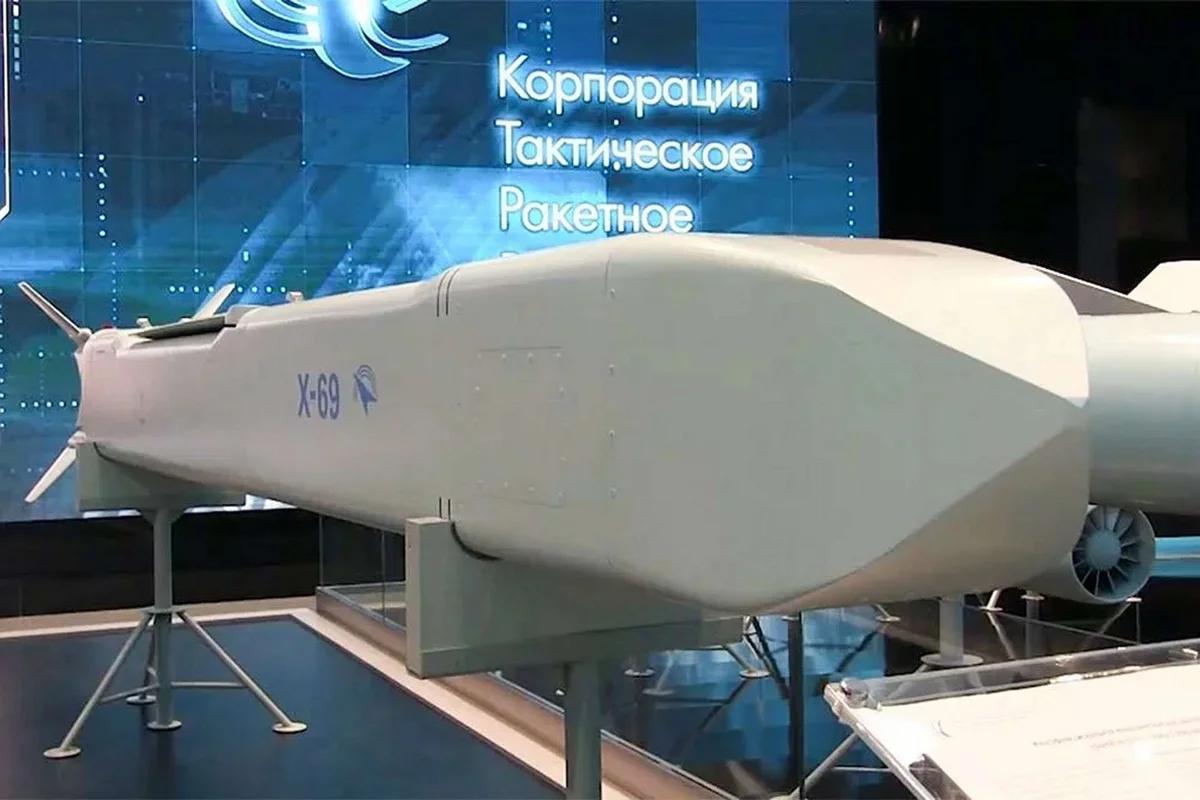
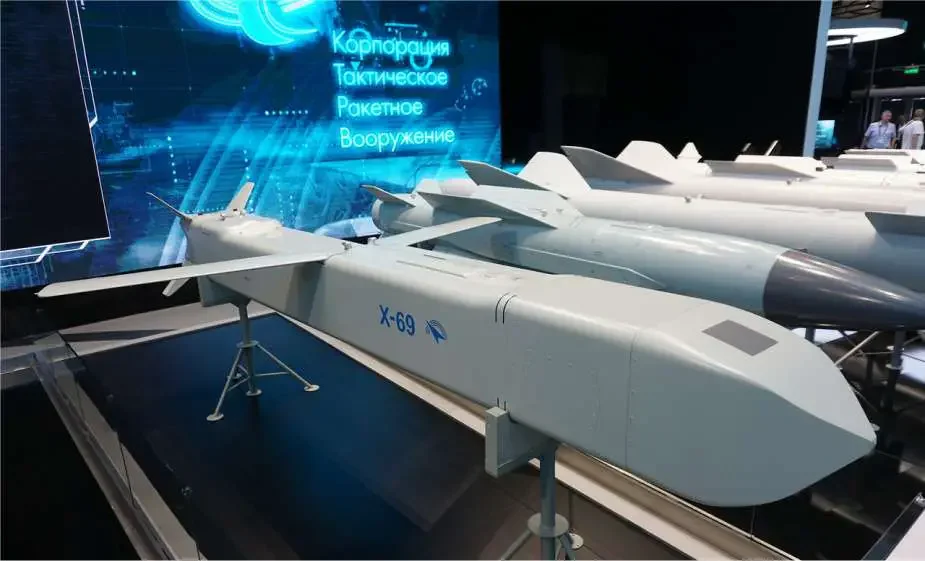
A Kh-69, marked X-69, on an exhibition stand in front of the Tactical Missiles Corporation (KTRV) sign, nose to the right. The side view shows the flat, faceted body with its chines. The engine fan face at far right belongs to a round-bodied Kh-59-family missile behind it, not to the Kh-69, whose engine is inside the body.
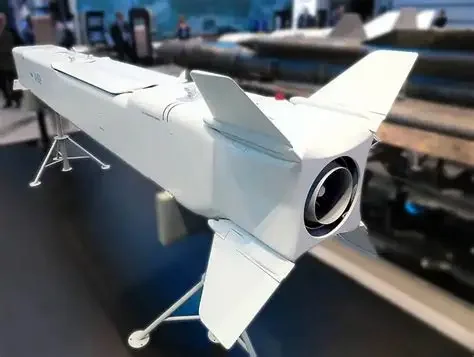
The Kh-69 exhibit from the rear three-quarter, showing the four tail fins, the wings folded flat on top of the body for carriage, and the single engine exhaust in the flat tail face, with no external pod.
Related article: Kh-59 Ovod family, the missile the Kh-69 grew out of.
WHAT IT IS
The Kh-69 (Х-69) is a Russian subsonic, air-launched cruise missile with a reduced radar signature, designed by MKB Raduga, part of the Tactical Missiles Corporation (KTRV), for precision strikes on fixed ground targets whose coordinates are known in advance. It is the direct successor of the Kh-59 family. The design began as a 2015 rework of the Kh-59MK2, which replaced the round body and external engine pod of the Kh-59 with a flat-sided, near-square body carrying its turbofan inside. The square section lets the missile fit the internal weapons bays of the Su-57, but it can also be carried on the outside of the Su-30, Su-34 and Su-35. [DOCUMENTED]
The Kh-69 was first shown under its own name at the Army-2022 forum in August 2022. Russia first used it against Ukraine in early February 2024. In April 2024 it was used in the strike that destroyed the Trypilska thermal power plant near Kyiv. Western analysts compare it with the Storm Shadow/SCALP EG, the AGM-158 JASSM and the Taurus KEPD 350. In size and warhead it is about two-thirds of a Storm Shadow. [DOCUMENTED]
Rosoboronexport's export figures are a launch mass of 770 kg, a 310 or 300 kg penetrating or cluster warhead, and a maximum range of 290 km. Guidance is a strapdown inertial system, satellite navigation, a radio altitude and speed meter and an electro-optical terminal system. The figures Russia has declared at home and what has been seen in Ukraine differ from these in places, as set out below. The Ukrainian Air Force reports it in the same category as the Kh-59, as "Kh-59/69". [DOCUMENTED]
QUICK FACTS
- Designer: MKB Raduga (KTRV), Dubna. [DOCUMENTED]
- Origin: a redesign of the Kh-59MK2, first shown as the "updated Kh-59MK2" at MAKS 2015, then as the Kh-69 at Army-2022. [DOCUMENTED]
- Type: subsonic, low-observable air-launched cruise missile for fixed land targets. [DOCUMENTED]
- Body: near-square section of about 0.4 x 0.4 m, with chined nose; internal turbofan; pop-out wings on top; four folding tail fins. [DOCUMENTED]
- Length: about 4.2 m. [DOCUMENTED, Russian Wikipedia; TWZ gives about 13 ft 9 in]
- Wingspan: up to 2.45 m (updated Kh-59MK2). [SINGLE-SOURCE]
- Launch mass: 770 kg (Rosoboronexport); 710 kg (Russian figures via Militarnyi); up to about 800 kg (Business Insider, Defense Express). [CONTESTED]
- Warhead: 310 kg penetrating or 300 kg cluster (Rosoboronexport); cluster warheads confirmed in Ukraine. [DOCUMENTED]
- Range: 290 km declared; launches from about 400 km reported in Ukraine. [CONTESTED]
- Speed: 700 to 1,000 km/h (Russian figures via Militarnyi); 750 to 1,000 km/h (Russian Wikipedia). [DOCUMENTED]
- Guidance: strapdown INS + GLONASS/GPS with Kometa-M anti-jam antenna + electro-optical/imaging-infrared terminal correction. [DOCUMENTED]
- Carriers: Su-57 (internally, up to four), Su-30MK/SM, Su-34 (export Su-32), Su-35S, MiG-35, MiG-29K. [DOCUMENTED]
- First combat use: 7 to 8 February 2024, Ukraine. [DOCUMENTED]
- Production: about 4 to 10 per month, depending on GUR estimate (December 2025 to July 2026). [SINGLE-SOURCE]
WHY RUSSIA NEEDED IT
By the late 2010s Russian tactical aviation had a gap in its weapons. At the short end were guided bombs and short-range missiles such as the Kh-29 and Kh-38, used within a few tens of kilometres of the target. At the long end were the strategic Kh-101 and the naval Kalibr, built for bombers and ships and fired from 1,000 km or more. Between them was only the Kh-59 family. Its long-range members reached 285 km, but they kept a round body, a bulky external engine pod and, in the TV versions, an operator link to the aircraft. [ESTIMATE as an analysis; the weapon ranges are DOCUMENTED on their own pages]
Three developments made that gap matter:
- The Su-57. A fifth-generation fighter that carries its weapons outside loses most of its low signature. Raduga needed a stand-off missile that fitted its bays, and a round Kh-59 with an engine pod does not. [DOCUMENTED that the Kh-69 is shaped for the bay; the reasoning is ESTIMATE]
- Western air defence. Modern Western SAMs and fighters with look-down radars made it riskier for a non-stealthy, pod-engined missile to get through. Ukraine began receiving such systems from 2022. [DOCUMENTED for the deliveries]
- The Western benchmark. Storm Shadow/SCALP, JASSM and Taurus had shown what a reduced-signature, autonomous tactical cruise missile could do. Russian commentary calls them the Kh-69's closest Western counterparts. [DOCUMENTED]
The Kh-69 answers all three with existing parts. It reuses the Kh-59MK2's guidance and a TRDD-50 family engine, and changes the shape. That is a lower-risk path than a clean-sheet design, and it may explain why the missile reached combat within about two years of its Army-2022 debut. [ESTIMATE]
FROM KH-59MK2 TO KH-69
The name Kh-59MK2 has belonged to two different missiles, which is the main source of confusion about the Kh-69.
The first Kh-59MK2 (MAKS 2009) was a round-bodied Kh-59MK. It kept the 380 mm body and the engine in a pod slung under the rear fuselage, but replaced the anti-ship radar seeker with a land-attack set: inertial navigation, satellite navigation and an electro-optical scene-matching corrector behind a window in the nose. That is the missile described on the Kh-59 page. It weighs up to 900 kg and has a range of 285 km. [DOCUMENTED]
The updated Kh-59MK2 (MAKS 2015) was, in TWZ's words, "entirely reworked". Only the guidance was carried over. The body became boxy with a trapezoidal section, the nose took on a complex faceted shape with a horizontal chine reminiscent of the Kh-101, the wings moved to the top of the body and folded flat, four tail fins deployed in flight, and the turbofan went inside the body. Russian Wikipedia lists it as 4.2 m long, with a span of 2.45 m, a 0.4 x 0.4 m section folded, 770 kg, a 310 kg warhead, a TRDD-50B engine (product 37-04), a range of 290 km and a CEP of 3 to 5 m. [DOCUMENTED]
The Kh-69 (Army-2022) is the domestic product that came out of the updated MK2. According to TWZ it differs again from the 2015 mock-up, with a simpler nose profile that lacks the characteristic flanges and the DSMAC window. CAR, as quoted by IISS, says the basic design was "first shown in 2015 under the banner of the Kh-59 Mk2 designation, with test shots of the missile under way by 2018", identified as the Kh-69 in 2022 and "modified slightly since its first appearance". [DOCUMENTED]
The Syria video. An official video released after the Su-57's short 2018 deployment to Khmeimim in Syria showed a Su-57 releasing a missile now identified as an early Kh-69 or updated Kh-59MK2. The round was painted red, which usually marks a test missile, so the footage may have been shot at a Russian range. [CONTESTED]
Development and acceptance. Russian press reported that the missile's creators received a Russian State Prize in April 2022. IISS wrote in February 2023 that the Kh-69 was "likely now in the final stages of development or entering production", and in September 2023 that it was in flight testing. Militarnyi says development was completed after the full-scale invasion. The Kh-69's main production plant is not stated in the sources reviewed. Ukrainian commentary groups it with the Kh-59 at the Smolensk plant, but that is not confirmed. [DOCUMENTED for the IISS statements; the State Prize is SINGLE-SOURCE (Izvestia via Russian Wikipedia); the production site is UNVERIFIED]
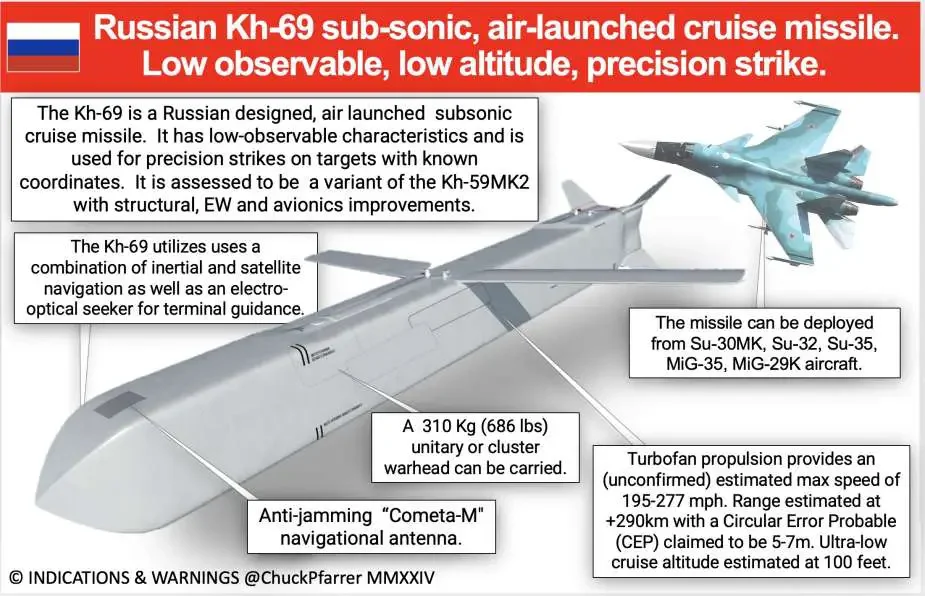
An annotated Kh-69 assessment, 2024: a Kh-59MK2 variant with inertial and satellite navigation, an electro-optical terminal seeker, the Cometa-M anti-jam antenna, a 310 kg unitary or cluster warhead and a turbofan. Its speed, range, CEP and altitude figures are the analyst's estimates and are cross-checked in the specification section. Infographic © Indications & Warnings / Chuck Pfarrer.
HOW THE KH-69 IMPROVES ON THE KH-59
The key question is what Raduga actually changed. The answer, point by point, against the long-range Kh-59M2/MK2:
1. Signature reduction. This is the headline change. The Kh-59's round body, external engine pod and pylon, open intake and cruciform canards are all strong radar reflectors. The Kh-69 replaces them with:
- flat, angled sides that send radar energy away from the emitter instead of back toward it;
- a faceted, chined nose;
- wings and fins that fold away flat until launch;
- an engine buried in the body.
Russian commentary says it uses "modern materials" and has almost no protruding parts. No radar cross-section figure has been published, and Western sources call it reduced-signature or low-observable rather than stealthy. It also flies very low: Defense Express quotes a claimed ability to fly at about 20 m, lower than the Kh-101. [DOCUMENTED for the shaping; the RCS is UNVERIFIED; the 20 m claim is SINGLE-SOURCE]
2. Internal carriage. The square section exists to pack missiles into a weapons bay. The Su-57 can carry up to four Kh-69s internally (Defense Express). A Su-57 carrying them inside keeps its own low signature, which a Su-57 carrying a round Kh-59 on an external pylon cannot. Russian writers also note that the square section holds more fuel and electronics in the same envelope and lets the wings fold more compactly. [DOCUMENTED for carriage; the volume claim is the source's]
3. Engine inside the body. In the Kh-59 family the engine hung in a ventral pod, which left the round body free for fuel and warhead. In the Kh-69 the engine goes inside, which the square section makes possible. This removes the pod's drag and radar return and screens the hot engine parts from below. Russian Wikipedia names the engine as the TRDD-50B (product 37-04). [DOCUMENTED for the internal engine; the engine type is SINGLE-SOURCE]
4. Range. Declared range rose only slightly, from 285 km to 290 km. Russian and Western analysts note that 290 km sits just under the 300 km threshold of the Missile Technology Control Regime, which suggests an export ceiling. Defense Express reported, from its own sources, that the Kh-69s fired at Trypilska in April 2024 were launched from about 400 km. ISW and Business Insider repeated the 400 km figure. The true domestic range is unknown. [DOCUMENTED for 290 km; 400 km is SINGLE-SOURCE (Defense Express) and repeated; the MTCR reasoning is ESTIMATE]
5. Guidance. The guidance is mostly carried over from the land-attack Kh-59MK2, which was the point of the 2015 rework. What changed is how it is integrated:
- the Kometa-M adaptive anti-jam antenna is named for the Kh-69;
- CAR found an imaging-infrared sensor in a recovered missile, which fits an electro-optical terminal stage working on thermal imagery rather than only on daylight TV.
The Kh-69 has no published TV-command mode with an operator in the loop. See GUIDANCE IN DEPTH. [DOCUMENTED]
6. Smaller and lighter. It is 4.2 m long against 5.7 m, and 710 to 800 kg against up to 960 kg. The warhead is almost the same, 300 to 310 kg against 320 kg. [DOCUMENTED, with conflicts on mass]
7. Warheads. Both have penetrating and cluster options. Kh-69s with cluster warheads were documented in Ukraine in October 2024 and July 2025. [DOCUMENTED]
What did not improve: speed. Both missiles are subsonic, at 700 to 1,050 km/h. Low observability, not speed, is the Kh-69's protection. [DOCUMENTED]
SPECIFICATIONS (WITH CONFLICTS)
| Item | Figure | Source / conflict |
| Length | about 4.2 m | Russian Wikipedia (updated Kh-59MK2); TWZ about 13 ft 9 in (4.19 m) |
| Section | about 0.4 x 0.4 m | Russian Wikipedia (folded) |
| Wingspan | up to 2.45 m | Russian Wikipedia / GlobalSecurity, updated Kh-59MK2 |
| Launch mass | 770 kg | Rosoboronexport; 710 kg (Militarnyi, Russian figures); up to 800 kg (Business Insider, Defense Express); TWZ "around 1,700 lb" (about 770 kg) |
| Warhead | 310 kg penetrating or 300 kg cluster | Rosoboronexport; TWZ "up to 680 lb"; Pfarrer 310 kg unitary or cluster |
| Fuze | contact | Rosoboronexport |
| Max range | 290 km | Rosoboronexport; "at least 300 km" (TWZ); about 400 km in use (Defense Express); Pfarrer 290+ km estimate |
| Speed | 700 to 1,000 km/h | Militarnyi; 750 to 1,000 (Russian Wikipedia); up to 621 mph / 1,000 km/h (TWZ); Pfarrer 195 to 277 mph estimate (see below) |
| Cruise height | about 20 m claimed | Defense Express; 50 to 300 m for the Kh-59MK2 family (Russian Wikipedia); Pfarrer about 100 ft |
| Launch height | 200 m to 11 km | Russian Wikipedia, updated Kh-59MK2 |
| Launch speed | 600 to 1,100 km/h | Russian Wikipedia, updated Kh-59MK2 |
| CEP | 3 to 5 m | Russian Wikipedia, updated Kh-59MK2; Pfarrer "claimed 5 to 7 m" |
| Engine | small turbofan, internal; TRDD-50B (product 37-04) | Russian Wikipedia (single source for the type) |
| Guidance | strapdown INS + satellite nav user equipment + radio altitude/speed meter + electro-optical system | Rosoboronexport; Kometa-M (Defense Express); IIR sensor (CAR) |
| Carriers | Su-57, Su-30MK, Su-34/32, Su-35, MiG-35, MiG-29K | Rosoboronexport, KTRV, TWZ |
Cross-checking the Pfarrer infographic. Photo 3 is an assessment published by Chuck Pfarrer of Indications & Warnings in 2024. Most of its figures agree with the Russian sources: the 310 kg unitary or cluster warhead, a range of 290+ km, satellite navigation, inertial guidance and an electro-optical seeker, the Cometa-M antenna, the turbofan, and the carrier list, which is Rosoboronexport's. Two figures stand apart:
- Speed. His 195 to 277 mph (about 315 to 445 km/h) is well below every other source's 700 to 1,000 km/h. A turbofan cruise missile of this kind would not normally cruise at under Mach 0.4, so this page treats the other sources' figure as the better one. [CONTESTED]
- Accuracy. His "claimed 5 to 7 m" CEP matches GUR's figure for the Kh-59M2/M2A, not the 3 to 5 m claimed for the Kh-59MK2. Both are claims, not measurements. [CONTESTED]
His cruise altitude of about 100 ft (30 m) lies between the 20 m claim and the 50 to 300 m Kh-59MK2 figures. [ESTIMATE]
AIRFRAME AND SIGNATURE
From the exhibition missiles and the 2015 mock-up, the airframe has these features:
- Nose and chines. A flattened, faceted nose with a horizontal chine running along the sides, like the Kh-101. A flat, darker rectangular panel on the upper nose is identified in the Indications & Warnings infographic as the Kometa-M anti-jam navigation antenna. TWZ says the DSMAC window of the 2015 model was deleted on the Kh-69. [DOCUMENTED for the panel; its identification as the Kometa-M antenna is SINGLE-SOURCE]
- Body. Flat sides and a near-square section with rounded corners. The upper and lower surfaces meet the sides at angles chosen to deflect radar energy. [DOCUMENTED]
- Wings. A single pair of wings on top of the body. They lie flat along the hull when stowed and swing forward after launch. [DOCUMENTED]
- Tail. Four tail fins, folded until launch. [DOCUMENTED]
- Intake and engine. The turbofan is internal. The exhibition missile has a single exhaust nozzle in the flat tail face and no external engine pod. GlobalSecurity, writing about the 2015 MK2, expected a retractable or flush air intake under the body. No intake is visible in the published exhibit photos. [DOCUMENTED for the nozzle; the intake detail is SINGLE-SOURCE]
- Skin. Ukrainian forensic experts (KSRIFE) reported "a specific foil placed under the outer skin of the warhead" and suggested it acts as a trigger that sets off the warhead if the missile is hit by a fragment. This is the institute's interpretation. [SINGLE-SOURCE]
No RCS figure, radar-absorbent material type or infrared suppression measure has been published. [UNVERIFIED]
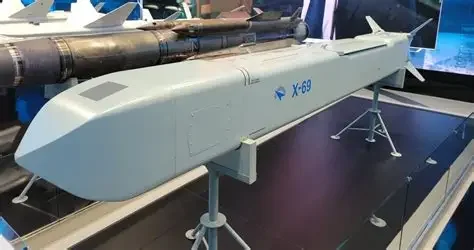
The X-69 exhibit from the front three-quarter. The squared, chined nose carries a flat rectangular panel on top, identified in the infographic as the Kometa-M navigation antenna, and a round-bodied Kh-59-family missile stands behind it.
GUIDANCE IN DEPTH
Cruise: INS and satellite navigation. Rosoboronexport lists a strapdown (platformless) inertial navigation system, navigation user equipment (a GLONASS/GPS satellite receiver), and a "complex radio-technical altitude and speed counter", meaning a combined radio altimeter and ground-speed meter. Together these fly the missile to the target area along a pre-planned route at low height. Ukrainian sources say the satellite receiver works through Kometa-M adaptive anti-jam antennas. The Kometa family, made by VNIIR-Progress in Cheboksary, uses a controlled-reception-pattern array to steer nulls toward jammers. [DOCUMENTED]
Terminal: electro-optical correction. The fourth element on the export sheet is an "electro-optical system". Rosoboronexport says the missile can hit "a wide range of fixed targets including those without radar, IR and optical contrast relative to surrounding environment". That describes navigation-based scene matching, which recognises the surroundings rather than the target itself. Defense Express calls it DSMAC "similar to the one installed in the Kh-101". On the Kh-101 the equivalent system is the Otblesk-U. CAR's examination of a Kh-69 recovered on 28 August 2024 found an imaging infrared sensor and a thermal-vision camera. That points to the terminal correlator working in the infrared, which would allow night use, rather than in daylight TV only. [DOCUMENTED for the components; that the Kh-69 uses an Otblesk-type unit is UNVERIFIED]
Targeting. The missile is meant for targets with known coordinates. One or more targets can be loaded before flight, and coordinates can reportedly be uploaded to the missile from the aircraft once the carrier is airborne (TWZ). [DOCUMENTED]
Operator in the loop. None of the sources reviewed describes a TV-command mode, a video downlink or in-flight retargeting for the Kh-69. In that respect it differs from the TV-guided Kh-59M and M2, which need an APK-9-type pod and an operator. The Kh-69 is described as autonomous after launch. [DOCUMENTED that no such mode is described; that it has no datalink at all is UNVERIFIED]
HOW THE MISSILE COMMUNICATES
There is little to report, and this page will not fill the gap with guesses:
- Aircraft to missile, before launch. Target data and the route are loaded through the launcher interface and, per TWZ, can be updated while the aircraft is airborne. This is a wired interface through the pylon or bay launcher, not a radio link. [DOCUMENTED for the capability; interface details UNVERIFIED]
- In flight. No datalink, frequency band, video downlink or command uplink has been documented for the Kh-69. [UNVERIFIED]
- What it listens to. The missile receives satellite navigation signals through the Kometa-M array. That is the main radio-frequency path the missile depends on in flight, and it is the obvious EW target. Kometa-M is meant to resist that. [DOCUMENTED]
- What it emits. The radio altimeter and speed meter emit downward. A low-power, downward-looking altimeter is hard but not impossible to detect. No source reviewed says Ukraine detects Kh-69s by their emissions. [DOCUMENTED that it has the altimeter; detectability is ESTIMATE]
EW vulnerability. Without an operator link, the Kh-69 cannot be jammed through a datalink as a TV-guided Kh-59 might be. Its exposures are GNSS jamming and spoofing, met by Kometa-M and the inertial system, and anything that defeats the terminal scene match, such as smoke, camouflage, or changes to the area since the reference imagery was made. How well each works against it has not been published. [ESTIMATE]
WARHEADS
Rosoboronexport offers two warheads, a 310 kg penetrating warhead and a 300 kg cluster warhead. Both have been seen in Ukraine:
- Penetrating or unitary: the Trypilska strike in April 2024 destroyed a large thermal power plant. [DOCUMENTED]
- Cluster, October 2024: the war_home Telegram channel published the first photo of a downed Kh-69 with a cluster warhead after the night of 19 October 2024, showing metal-clad spherical submunitions. Defense Express reported it. [DOCUMENTED]
- Cluster, July 2025: Ukraine's State Emergency Service disarmed a Kh-69 cluster warhead that came down in the yard of a house near Kyiv after the 20 to 21 July 2025 attack (Kyiv Post, Ukrainska Pravda). [DOCUMENTED]
Key.Aero reported in 2025 that Russian Kh-69 and Kh-101 missiles had "recently been adapted with cluster warheads". [DOCUMENTED]
THE SU-57 AND INTERNAL CARRIAGE
The Su-57's main weapons bays are in tandem between the engine nacelles, and they are the reason for the Kh-69's shape. Defense Express states that a Su-57 can carry up to four Kh-69s internally. A round missile with a ventral pod would waste most of the bay's width and depth. The square section and flat-folded wings let missiles sit close together. [DOCUMENTED for the four-round load; the packing reasoning is from Russian commentary]
Internal carriage matters only if the carrier is itself low-observable and close enough for that to count. At a 290 to 400 km range, a Su-57 or a Su-34 can launch from deep inside Russian-controlled airspace, where the aircraft's own signature matters less. That is one reason why, as TWZ noted, the Kh-69 "doesn't necessarily require delivery by a Su-57 to be effective". [DOCUMENTED for the TWZ point]
There is no firm public evidence that Su-57s have launched Kh-69s in the war against Ukraine. Ukrainian reporting generally assumes Su-34 or Su-35 launches. Russia operates only a small number of Su-57s, and Ukrainian drones damaged at least one at Akhtubinsk in June 2024. [UNVERIFIED for combat launches; the Akhtubinsk damage is a Ukrainian claim]
LAUNCH PLATFORMS
| Aircraft | Carriage | Evidence |
| Su-57 | internal bays, up to four; also external | the design purpose; 2018 test video; Defense Express on the four-round load [DOCUMENTED; whether Su-57s have launched Kh-69s in combat is UNVERIFIED] |
| Su-34 (export Su-32) | external | maker's list; the most likely carrier in Ukraine [DOCUMENTED for the list; actual carriers by raid UNVERIFIED] |
| Su-35S | external | maker's list; named by Defense Express [DOCUMENTED] |
| Su-30MK / Su-30SM | external | maker's list [DOCUMENTED] |
| MiG-35, MiG-29K | external | maker's list [DOCUMENTED] |
| MiG-31 | external | listed by one Indian outlet and Russian Wikipedia [SINGLE-SOURCE] |
No pod is needed, since the missile is not TV-command guided. An export version for the Su-57E is advertised by Rosoboronexport. No export sale is known. [DOCUMENTED]
TIMELINE
- 2009: Raduga shows the round-bodied Kh-59MK2, with an external engine pod and an electro-optical land-attack seeker, at MAKS. [DOCUMENTED]
- 2015: The "updated" Kh-59MK2 appears at MAKS: square section, internal engine, pop-out wings. [DOCUMENTED]
- 2018: A Su-57 is filmed releasing a red-painted test round after its deployment to Syria. CAR says test shots were under way by 2018. [DOCUMENTED for the video; the location is CONTESTED]
- April 2022: Russian press reports a State Prize for the missile's creators. [SINGLE-SOURCE]
- August 2022: The missile is shown publicly as the Kh-69 at Army-2022. [DOCUMENTED]
- February and September 2023: IISS says it is in the final stages of development or production, then in flight testing. [DOCUMENTED]
- Late 2023: The first wartime rounds are built, dated by markings on wreckage. [DOCUMENTED]
- 7 to 8 February 2024: First confirmed combat use against Ukraine. [DOCUMENTED]
- 11 April 2024: The Trypilska power plant is destroyed. [DOCUMENTED]
- 28 August 2024: CAR documents a Kh-69 built in April to June 2024. [DOCUMENTED]
- 19 October 2024: The first cluster-warhead Kh-69 is photographed. [DOCUMENTED]
- 21 July 2025: A cluster warhead is disarmed in a Kyiv suburb. [DOCUMENTED]
- 10 October 2025: A Kh-69 is shot down by APKWS. [DOCUMENTED]
- 2026: Continued use under "Kh-59/69", with a stock of about 20 and output of about 4 a month (GUR). [SINGLE-SOURCE]
COMBAT USE IN UKRAINE
A wider view of the KTRV exhibit: the X-69 with its wings and fins deployed, beside a round-bodied Kh-59-family missile with a dark radome. The comparison shows the change from the round hull to the flat-sided, chined body.
Late 2023: Defense Express mentions "isolated cases as early as 2023". The missile examined by KSRIFE in February 2024 had markings dating it to late 2023. [SINGLE-SOURCE for the 2023 use]
7 to 8 February 2024, first confirmed use:
- A Ukrainian blogger posted a tail fin from a Kh-69 downed in the 7 February raid.
- The @war_monitor_ua account reported three Kh-69s and three Kh-59s launched at the Poltava, Sumy and Mykolaiv regions, with five of the six shot down.
- The Kyiv Scientific Research Institute of Forensic Expertise (KSRIFE), under its director Oleksandr Ruvin, then examined wreckage. It found little surviving electronics, markings dating manufacture to the end of 2023, and the foil layer under the warhead skin.
[DOCUMENTED; the five-of-six figure is SINGLE-SOURCE]
11 April 2024, Trypilska: Russia destroyed the Trypilska thermal power plant on the Dnipro south of Kyiv, the largest power plant in Kyiv Oblast, rated at about 1,800 MW. Its operator, Centrenergo, said the attack destroyed the plant and, together with earlier strikes on its other stations, cost the company all of its generating capacity. Defense Express, followed by Militarnyi and the Telegraph, reported Kh-69 fragments at the site and a launch range of about 400 km. Defense Express argued that the Kh-69 was in some ways worse for Ukraine than the Kinzhal. Launches from tactical aircraft give none of the warning that comes from tracking Tu-95 or MiG-31K take-offs. And at 400 km, Su-34s and Su-35s can reach much of Ukraine from 50 to 70 km behind the front. [DOCUMENTED for the reporting; the warning-time argument is the source's]
28 August 2024: CAR documented a Kh-69 used in an attack near Kyiv. It was assembled between April and June 2024, so it was fired within a few months of being built. [DOCUMENTED]
19 October 2024: The first Kh-69 with a cluster warhead was photographed. The Air Force reported six Kh-59/69s launched that night and four shot down. [DOCUMENTED]
2025:
- 20 to 21 July: a cluster warhead from a downed Kh-69 was found in a residential yard near Kyiv.
- 10 October: Air Command East shot down one of four Kh-69s with an APKWS laser-guided rocket and published video of the kill, a $25,000-class interceptor against Russia's newest tactical cruise missile.
- Key.Aero lists Kh-69s among the missiles used in the record mixed raids of mid-2025.
[DOCUMENTED]
2026: Kh-69 use continues under the combined "Kh-59/69" heading in Air Force reports, including 26 October (all three downed or suppressed), 30 October (three of four) and 8 and 11 November. Because of that grouping, Kh-69 launches cannot be counted separately from public data. In July 2026 Ukrainian aviation analyst Valerii Romanenko said that Russia had increased its use of the Kh-69 and Kh-59 despite the Ukrainian strike on the Smolensk plant. [DOCUMENTED for the reports; the Kh-69 share is UNVERIFIED]
WHAT TRYPILSKA SHOWED
The Trypilska strike is the Kh-69's defining combat use, and it shows what the redesign was meant to do. Thermal power plants are large, fixed, high-value targets with known coordinates, exactly the target set Rosoboronexport describes. A plant of that size has a few critical points: turbine halls, boiler houses, transformers and switchyards. A missile accurate to a few metres with a 310 kg penetrating warhead can put those out of action without needing to destroy the whole site. [ESTIMATE as an analysis]
Defense Express made three points about the strike:
- the missile was launched by tactical aircraft, so Ukraine did not get the long warning that the take-off of strategic bombers gives;
- the launch range of about 400 km meant the carriers did not have to come near Ukrainian fighters or SAMs;
- the reduced signature and low flight profile shortened the time Ukrainian radars had to track it.
Whether this combination was decisive at Trypilska, or whether the plant's defences were simply saturated by the many other missiles and drones fired the same night, has not been publicly established. [DOCUMENTED for the source's points; the decisive factor is UNVERIFIED]
For Russia the lesson was presumably that a small number of precise, low-observable missiles could achieve what larger salvos of older missiles had not. For Ukraine it was that the air defence of critical infrastructure must cover low, hard-to-see targets coming from directions not tied to the usual bomber routes. The small Kh-69 output on GUR figures limits how often Russia can repeat it. [ESTIMATE]
COUNTERMEASURES AND INTERCEPTS
Ukraine has shot down Kh-69s with medium-range SAMs, fighters and, at least once, an APKWS rocket. Shaping reduces the missile's radar return and the range at which radars detect it. It does not make it invisible to modern radars at short range, and it does nothing against infrared or optical sensors. The engine exhaust still shows in infrared, though the internal engine screens it from below. The successful APKWS kill shows that a laser-guided rocket aimed by an electro-optical sight is a valid answer to a subsonic, low-observable target once it is cued. [DOCUMENTED for the intercepts; the signature remarks are ESTIMATE]
Two things make the Kh-69 harder for Ukraine: short warning from tactical aircraft launches, and Russia's habit of mixing a few missiles into large drone raids. Small numbers limit it. On GUR figures Russia has had only about 20 to 25 at a time and builds a handful a month. [DOCUMENTED for the figures]
PRODUCTION AND STOCKS
| Date of GUR figure | Stock | Monthly output |
| 1 December 2025 | 20+ | about 10 |
| mid-April 2026 | up to 25 | up to 5 |
| mid-July 2026 | up to 20 | about 4 |
Source: GUR via New Voice of Ukraine. Ukrainian estimates, not verifiable. A stock of about 20 against a few built each month means Russia is firing them about as fast as it makes them. [SINGLE-SOURCE]
Components. CAR found almost 800 intact components in the August 2024 missile, 466 of them with legible markings. Almost half of those were made in Russia, and 45 percent of all documented components were made in Russia in 2023 alone. The share of Russian parts rose from 29 percent of components marked 2021 to 90 and 94 percent of those marked 2023 and 2024. IISS draws the contrast: the Kh-69 relies on foreign parts much less than most weapons Russia uses. About 40 percent of its components fall in Tier 1 of the export-control Common High Priority List. The CAR sample included 71 voltage converters, found for example in the imaging infrared sensor and the satellite-navigation module, 28 percent of them Russian-made. Of 39 MOSFETs from the on-board computer and thermal camera, 77 percent were Russian. [DOCUMENTED, IISS/CAR September 2025]
COMPARISONS
| Missile | Mass | Warhead | Range | Section and engine | Terminal guidance | Internal carriage |
| Kh-69 | 710 to 800 kg | 300 to 310 kg | 290 km declared, about 400 km reported | near-square, internal turbofan | IIR/electro-optical scene match | yes (Su-57) |
| Kh-59M2 / MK2 (long-range) | up to 960 kg | 320 kg | 285 km | round, external ventral pod engine | radar, TV or electro-optical | no |
| Storm Shadow / SCALP EG | about 1,300 kg | about 450 kg | about 250 km export, more for domestic | shaped, internal turbojet | IIR, autonomous | no |
| AGM-158 JASSM | about 1,020 kg | about 450 kg | about 370 km (ER over 900 km) | shaped, internal turbofan | IIR, autonomous | yes (B-1B, B-2 bays) |
| Taurus KEPD 350 | about 1,400 kg | about 480 kg | more than 500 km | shaped, internal turbofan | IIR, autonomous | no |
| Delilah | about 250 kg | about 30 kg | about 250 km | round, turbojet | IIR, man in the loop | no |
The Western figures are rounded public values. [DOCUMENTED as public figures]
The Kh-69 is a light member of the Western stand-off cruise missile class. It is smaller and carries about two-thirds of the warhead of Storm Shadow or JASSM, and in range it falls between Storm Shadow's export and domestic versions. TWZ points out that Israel's Delilah, similar in range, keeps a man-in-the-loop IIR datalink that the Kh-69 is not known to have. In Russian service the Kh-69 fills the gap between cheap glide bombs and the strategic Kh-101. [ESTIMATE as a comparison]
Against the Kh-59. The full Kh-59 versus Kh-69 table is on the Kh-59 page. In short, the Kh-69 is the same guidance in a smaller, shaped body with an internal engine. It has a slightly lighter warhead, a declared range almost the same and a demonstrated range much longer. It is built in far smaller numbers, and unlike the Kh-59 it has no operator-steered mode. [DOCUMENTED]
WHAT IT IS NOT
The Kh-69 is not a "stealth" missile in the sense of a measured, very low radar signature. No such figure has been published. It is not supersonic, and it is not a version of the Kh-101. It is also not the round Kh-59MK2 of 2009, which kept the underslung engine pod. [DOCUMENTED]
CAVEATS
Figures from Russia's export agency describe an export configuration capped at 290 km and may understate the domestic missile. Ukrainian figures come from wreckage, intelligence estimates and media sources, and the war's participants are not neutral. Because the Air Force groups the Kh-69 with the Kh-59, the number of Kh-69s fired is unknown. The photos on this page show exhibition missiles and an analyst's infographic, not wartime wreckage. [BACKGROUND]
STATUS
In service with the Russian Aerospace Forces, and in combat use against Ukraine since February 2024, with continued use reported through November 2026. Produced in single-digit numbers per month on GUR estimates, with a stock of about 20. It is the main stand-off weapon designed for the Su-57's internal bays, and offered for export with the Su-57E. [DOCUMENTED / SINGLE-SOURCE as noted above]
IN ONE SENTENCE
The Raduga Kh-69 is the flat-sided, internally powered successor of the Kh-59. It began as the 2015 rework of the Kh-59MK2, which put the Kh-59's underslung-pod engine inside a near-square, chined body that fits the Su-57's weapons bays. It weighs about 770 kg, carries a 310 kg penetrating or cluster warhead and is guided by INS, Kometa-protected GLONASS and an imaging-infrared scene matcher. Its declared range is 290 km, and launches from about 400 km have been reported. It has been fired at Ukraine since February 2024, most notably at the Trypilska power plant, in small numbers matching an output of a few missiles a month.
RUSSIAN TERMS USED IN THIS ARTICLE
- Х-69: Kh-69; Х-59МК2 («обновлённая»): the "updated" Kh-59MK2 of 2015.
- БИНС: strapdown inertial navigation system; НАП: navigation user equipment (satellite receiver).
- комплексный радиотехнический измеритель высоты и скорости: combined radio altitude and speed meter.
- оптико-электронная система: electro-optical system; «Комета-М»: Kometa-M anti-jam antenna.
- проникающая / кассетная БЧ: penetrating / cluster warhead.
- ГосМКБ «Радуга», КТРВ: Raduga design bureau, Tactical Missiles Corporation.
SOURCES
- 1. Rosoboronexport, "Kh-69" product page (roe.ru).
- 2. The War Zone (T. Newdick), "Russia Now Using Kh-69 Cruise Missiles In Ukraine: Reports", 16 February 2024.
- 3. Defense Express, "The russians Used the Latest Kh-69 Missiles to Attack the Trypilska TPP", 12 April 2024.
- 4. Defense Express, "First Photo of a Kh-69 Missile With New Warhead, Downed By Ukraine's Air Defenses", October 2024.
- 5. Militarnyi, "Experts from the Kyiv Scientific Research Institute of Forensic Expertise started examining the wreckage of the Kh-69 missile", February 2024.
- 6. Militarnyi, "Russian Kh-69 Latest Cruise Missile Targets Trypilska Power Station", 11 April 2024.
- 7. Militarnyi, "APKWS vs Kh-69: Ukrainian Defense Shoots Down Russia's Latest Cruise Missile With a Cheap Interceptor", 11 October 2025.
- 8. Kyiv Post, "Russia Attacked Kyiv With 'Stealth' Missile Carrying Cluster Munition Warhead", 22 July 2025.
- 9. IISS, "Tracking the Components of Missiles and UAVs Used by Russia in Ukraine: What Lessons for Control Regimes?", September 2025 (Conflict Armament Research data).
- 10. GlobalSecurity.org, "Kh-59MK2 / Kh-69 - AS-22?".
- 11. Russian Wikipedia, "Х-69" and "Х-59" (updated Kh-59MK2 figures, citing KTRV and bmpd).
- 12. Business Insider and Newsweek, April 2024 reporting on Kh-69 range and mass (ISW assessments).
- 13. Defence Blog, "Ukraine unveils first wreckage of Russia's stealthy cruise missile", February 2024.
- 14. New Voice of Ukraine, GUR stockpile and production figures, December 2025, April 2026 and July 2026.
- 15. Key.Aero, "Russia increases drone attacks", 2025.
- 16. UNN / Defense Express, Su-57 armament and Kh-69 internal carriage, 2026.
- 17. Ukrainian Air Force daily reports via Ukrainska Pravda and Interfax-Ukraine, October and November 2026.
- 18. Indications & Warnings (C. Pfarrer), Kh-69 assessment infographic, 2024.
Related on this site: Kh-59 Ovod family, the predecessor, including the round-bodied Kh-59MK2.
Related on this site: Kh-32, Raduga's supersonic modernised Kh-22.
Related on this site: Kh-101 / Kh-102, whose nose shaping and optical correction the Kh-69 echoes.
Related on this site: Otblesk-U optical scene-matching correlator.
Related on this site: Kometa CRPA anti-jam satellite navigation antennas.
Related on this site: GLONASS satellite navigation.
Related on this site: Kh-47M2 Kinzhal.
Project Orlan // Underground Information Database