WHAT IT IS
Daryal (Дарьял, named after the Darial Gorge in the Caucasus) is a Soviet very-high-frequency (VHF) phased-array early warning radar built to detect ballistic missiles thousands of kilometres away. It was known in NATO as Pechora, after the first site to enter service. It was designed at the Radio-Technical Institute, RTI (Радиотехнический институт имени академика А. Л. Минца), in Moscow, under Aleksandr Mints and later Vladimir Ivantsov. [DOCUMENTED]
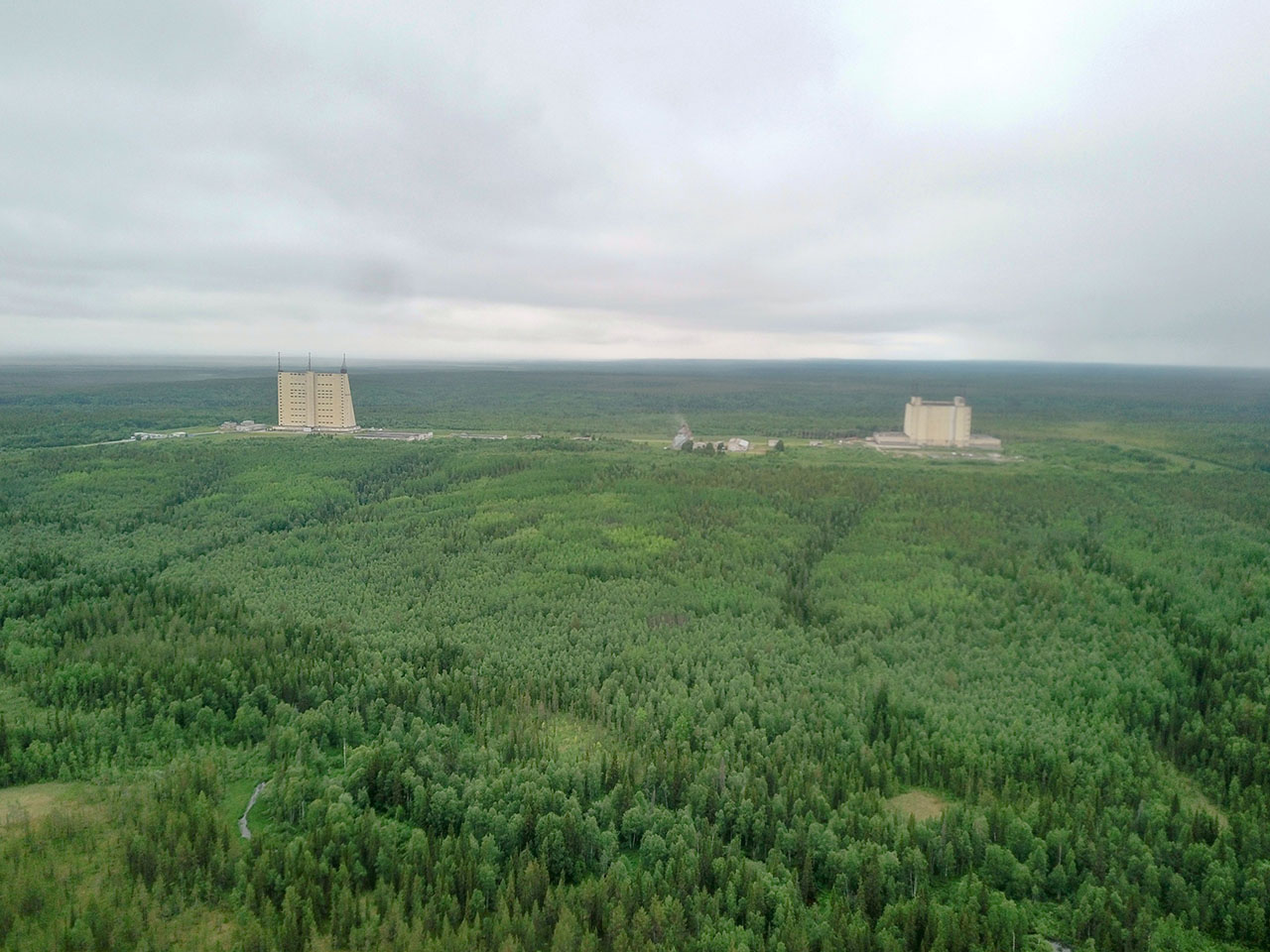
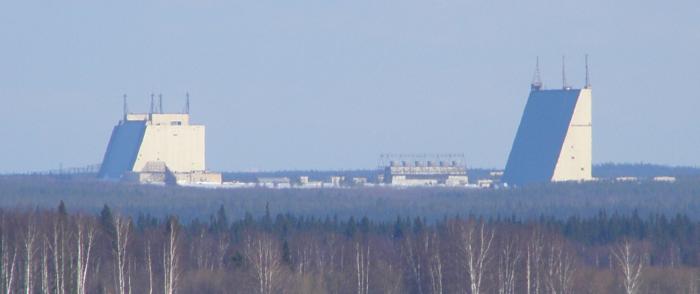
A Daryal is not a single antenna on a mast. It is two enormous buildings, a transmitter and a receiver, each with a flat phased-array face many storeys tall, set some distance apart so that the powerful transmitter does not blind the sensitive receiver. The receive building at Gabala was described as sixteen storeys high. The arrays look outwards along a fixed axis, and the radar sweeps its beam electronically across a sector of roughly 90 degrees without any moving parts. [DOCUMENTED]
Daryal was meant to be the backbone of the second-generation Soviet missile attack warning system, the SPRN (Система предупреждения о ракетном нападении). It was to replace the older Dnestr and Dnepr radars, known in NATO as Hen House, around the borders of the USSR. At least seven sites were planned. Only two, Pechora in the Komi Republic and Gabala in Azerbaijan, ever went into service. The rest were stopped, demolished, burned down or left to rot as the Soviet Union ran short of money, signed arms control agreements and then broke apart. [DOCUMENTED]
By 2026 Pechora is the last Daryal still standing and operating. [SINGLE-SOURCE] Gabala was closed in 2012 and handed back to Azerbaijan. Russia's missile warning radar network has since been rebuilt around the Voronezh family, which is the Daryal's real successor: faster to build, cheaper to run, and assembled from prefabricated modules instead of poured on site over most of a decade. [DOCUMENTED]
QUICK REFERENCE
| Item | Value | Label |
|---|---|---|
| Name | Дарьял (Daryal); NATO: Pechora | [DOCUMENTED] |
| Type | Bistatic VHF phased-array line-of-sight early warning radar | [DOCUMENTED] |
| Designer | RTI (Mints Radio-Technical Institute), Moscow | [DOCUMENTED] |
| Chief designers | A. L. Mints, V. M. Ivantsov | [DOCUMENTED] |
| Band | Metre band (VHF), about 150–200 MHz | [DOCUMENTED] |
| Antenna | Separate transmit and receive phased arrays in large buildings | [DOCUMENTED] |
| Separation of buildings | About 0.5–1.5 km depending on site | [DOCUMENTED] |
| Receive array | About 100 m × 100 m | [SINGLE-SOURCE] |
| Transmit array | About 30 m × 40 m | [SINGLE-SOURCE] |
| Peak power | About 50 MW | [SINGLE-SOURCE] |
| Detection range | About 6,000 km against ballistic missiles | [SINGLE-SOURCE] |
| Sector | About 90° in azimuth, elevation to about 40° | [SINGLE-SOURCE] |
| Simultaneous tracks | About 100 | [SINGLE-SOURCE] |
| Construction time | About 5–9 years per site | [DOCUMENTED] |
| Planned sites | At least 7 (Daryal, Daryal-U, Daryal-UM) | [DOCUMENTED] |
| Sites operational | 2: Pechora (1984), Gabala (1985) | [DOCUMENTED] |
| Still operating in 2026 | Pechora | [SINGLE-SOURCE] |
| Successor | Voronezh family (Voronezh-M, -DM, -VP, -SM) | [DOCUMENTED] |
WHY IT WAS BUILT
The problem of the 1960s
In the 1960s the Soviet Union faced the same problem as the United States: a ballistic missile launched from the other side of the world would arrive in about 30 minutes, and a missile fired from a submarine close to the coast could arrive in 10 to 15. Without warning, the leadership could lose its bombers on the ground and its command posts before it knew an attack was under way. A warning system had to see missiles early enough to give the leadership time to decide. [BACKGROUND]
The Soviet answer had two parts. Early warning satellites, eventually the Oko system and today the EKS Kupol, would detect the heat of missile launches. Ground radars around the edges of the country would detect the warheads and rocket bodies as they rose over the horizon, measure their tracks and predict where they would fall. Both feeds would go to a central command post near Moscow, today at Solnechnogorsk, which would assess the attack and pass warning to the General Staff and the leadership. [DOCUMENTED]
The Dnestr and Dnepr generation
The first generation of Soviet ground warning radars were the Dnestr, Dnestr-M and Dnepr, designed at RTI and built from the 1960s at Olenegorsk, Skrunda, Mukachevo, Sevastopol, Balkhash and Mishelevka. NATO called them Hen House. Each had long horn-shaped antennas, about 250 m long and 20 m high, steered by frequency scanning in one direction and mechanically fixed in the other. They worked in the 150 to 160 MHz region and had a detection range of about 3,000 to 4,000 km. The site's article on the Dnepr covers them in detail. [DOCUMENTED]
The Hen Houses had limits. Their beams covered narrow fans of space, their range was not enough to see deep into enemy territory, and their electronics were valve-based and labour-intensive. Most important, the Soviets wanted a radar that could handle a massed attack of many warheads and decoys and give better tracking for the planned anti-ballistic missile system around Moscow. [DOCUMENTED]
The Daryal idea
From the early 1970s RTI worked on a new kind of radar: a large phased array that steered its beam electronically in both directions, with enough power and aperture to see a missile at 6,000 km and enough processing to handle many targets at once. The result was Daryal. In 1975 the Soviet government ordered Daryal radars to be built at Pechora and Gabala. [DOCUMENTED]
The first step was the Daugava, a Daryal-type receive building built at Olenegorsk on the Kola Peninsula between 1975 and 1977. It used the transmitter of the existing Dnestr-M at the same site and served as a test bed for the receive technology. The Olenegorsk Daugava is still listed in operation. [DOCUMENTED]
Why VHF
Daryal works in the metre band, around 150 to 200 MHz. Like the Nebo air defence radars, a VHF warning radar trades accuracy for range and practicality. At VHF, high peak powers and large apertures were achievable with the technology of the 1970s, and atmospheric losses are low. VHF also suffers more from ionospheric effects and, in the far north, from the aurora, which can produce clutter. Those effects were accepted because of the range advantage. [BACKGROUND]
DESIGN
Two buildings
A Daryal site has two main buildings. The transmitter building holds a phased array about 30 m by 40 m. The receive building, taller and wider, holds an array about 100 m by 100 m. The two arrays point along the same axis but are separated by roughly half a kilometre to one and a half kilometres, depending on the site. [SINGLE-SOURCE] At Pechora the two buildings are about 1.3 km apart going by published coordinates; at Gabala about 1 km. [ESTIMATE]
Separating them is a classic way of keeping the transmitter's huge power out of the receiver. A transmitter pulse of tens of megawatts would overwhelm a receiver in the same building. With the buildings apart, the receiver can listen during and after the pulse without damage and without needing as much protection. [BACKGROUND]
The arrays
Both arrays are flat faces sloped back from the vertical, covered with thousands of crossed dipole antenna elements. The receive array was described as having around 4,000 elements, each with its own receiver channel. [SINGLE-SOURCE] The transmitter array was fed by high-power transmitters; sources describe the Daryal transmitter as producing a peak power of around 50 MW. [SINGLE-SOURCE]
The beam is steered electronically in azimuth and elevation by controlling the phase of each element. That lets the radar search a sector of about 90 degrees, revisit targets quickly, and track many objects at once. [DOCUMENTED]
Electronics and processing
Daryal processing was done by large Soviet computers of the time. Some sources say the original Daryal computing used the M-10 and later Elbrus-family computers. [SINGLE-SOURCE] The radar measured range, bearing, elevation and range rate for each object, built tracks, and sent processed data, not raw signals, to the command post. Pechora and Gabala each relied on other installations for some processing and communications; Russian sources name supporting facilities called "Kvadrat" and "Shvertbot" in connection with Gabala. [SINGLE-SOURCE]
Size and construction
A Daryal building is a reinforced concrete and steel structure of monumental size. The Gabala receive building was described as 16 storeys high. Construction involved pouring huge amounts of concrete on site, building the arrays in place, installing the electronics, and then a long period of testing. [DOCUMENTED]
Pechora construction began in 1975 (receiver building work from 1978) and the radar entered service on 20 January 1984. Gabala construction began in 1977 (or 1982 by some Russian accounts) and the radar was handed over in 1985, with work finally completed in 1987. That is roughly 5 to 9 years per site. [DOCUMENTED]
Crews
A Daryal site was a small town. The radar was run by an independent radio-technical unit (ОРТУ) of the missile attack warning troops, with operators, technicians, guards, support staff and families living in a closed military settlement nearby. At Gabala the Russian contingent in the 2000s was reported at around 900 to 1,500 personnel. [SINGLE-SOURCE] Power consumption was very high, adding to running costs. [DOCUMENTED]
Performance
| Parameter | Value | Label |
|---|---|---|
| Detection range | About 6,000 km against a ballistic missile | [SINGLE-SOURCE] |
| Azimuth sector | About 90° | [SINGLE-SOURCE] |
| Elevation | Up to about 40° | [SINGLE-SOURCE] |
| Targets tracked | About 100 at once | [SINGLE-SOURCE] |
| Frequency | About 150–200 MHz | [DOCUMENTED] |
| Peak power | About 50 MW | [SINGLE-SOURCE] |
The 6,000 km figure is a maximum against large objects rising high above the horizon. A ballistic missile rises hundreds of kilometres into space, so a radar on the ground can see it far beyond the normal radar horizon once it is high enough. [BACKGROUND]
DARYAL-U AND DARYAL-UM
RTI developed two improved variants. The Daryal-U was planned for Balkhash in Kazakhstan, Mishelevka near Irkutsk and Yeniseysk near Krasnoyarsk, following a design review in 1976 and 1977. The Daryal-UM was planned for Skrunda in Latvia and Mukachevo in Ukraine, with construction from 1986. [DOCUMENTED]
Both variants used the same two-building principle. The improvements were mainly in electronics and processing, using more modern components and computers. Detailed differences are not published. [SINGLE-SOURCE]
None of the Daryal-U or Daryal-UM radars ever entered service. [DOCUMENTED]
THE DAUGAVA: A DARYAL HALF-SITE AT OLENEGORSK
Before committing to full Daryal sites, RTI built a single receive building at Olenegorsk on the Kola Peninsula, next to the existing Dnestr-M radar. Called Daugava (Даугава, after the river in Latvia), it was built between 1975 and 1977 and used the Dnestr-M's transmitter. Its job was to test the large receive phased array and its processing in real conditions, facing north-west over the Norwegian and Barents Seas. [DOCUMENTED]
The Daugava proved the receive technology that went into Pechora and Gabala. It also stayed in service: it was the Olenegorsk radar that tracked the Norwegian rocket in January 1995, and it is listed in operation in published lists. A Voronezh radar has since been built at Olenegorsk too. [DOCUMENTED]
The Daugava matters for understanding the Daryal because it shows the Soviet approach of upgrading existing sites step by step: keep the old transmitter, add a new receiver, and learn before building the full system. [ESTIMATE]
HOW A DARYAL WAS BUILT
Building a Daryal was a major construction project, comparable to a large industrial plant. The sequence was roughly as follows. [ESTIMATE]
| Phase | Work | Typical duration |
|---|---|---|
| Site preparation | Clearing forest, roads, rail spur, power lines, military town | 1–2 years |
| Foundations and frame | Deep foundations for two buildings; steel and reinforced concrete frames | 2–3 years |
| Array installation | Mounting thousands of antenna elements on the sloping faces; feed networks | 1–2 years |
| Equipment installation | Transmitters, receivers, computers, cooling, power systems | 1–2 years |
| Testing and acceptance | Factory and state trials, tracking of test launches and satellites | 1–2 years |
That adds up to the 5 to 9 years seen in practice. Pechora's receiver work ran from 1978 to 1983 and the station was accepted in January 1984. Gabala took from 1977 (or 1982, by some accounts) until 1985, with final completion in 1987. [DOCUMENTED]
The construction was done by military construction troops and specialised assembly organisations. The northern sites faced permafrost, very cold winters and short building seasons; Gabala faced earthquake risk at the foot of the Caucasus. [BACKGROUND]
By comparison, Russian sources state that a Voronezh can be erected in 12 to 18 months, or up to about two years including testing, because the equipment arrives in finished containers. [DOCUMENTED]
WHAT THE SITES LOOK LIKE TODAY
Pechora: both buildings standing and in use, in a closed military area. [SINGLE-SOURCE]
Gabala: the receive and transmit buildings still stand in Azerbaijan. After the Russian handover in 2013, the station passed to the Azerbaijani armed forces and later to other state bodies. There have been occasional reports of plans to reuse it, but no confirmed use as a working radar. [DOCUMENTED]
Skrunda-1: the Daryal-UM receiver is gone, demolished in 1995. The old Hen House buildings and the abandoned military town remained for years; the town was later sold off. [DOCUMENTED]
Mukachevo: the unfinished Daryal-UM was taken down around 2011. [DOCUMENTED]
Balkhash: ruins of the burned receive building remained after the 2004 fire. [DOCUMENTED]
Mishelevka: the Daryal-U receiver was blown up in 2011. Voronezh radars now stand at the site. [DOCUMENTED]
Yeniseysk: the Daryal-U was dismantled after 1990. A Voronezh-DM has since been built in the Yeniseysk area. [DOCUMENTED]
KEY PEOPLE AND ORGANISATIONS
Aleksandr Lvovich Mints (1895–1974) founded the Radio-Technical Institute that now bears his name. A radio engineer from the early Soviet period, he led the design of high-power transmitters and, from the 1950s, of the large radars for missile defence and early warning, including the Dnestr and Dnepr. The early Daryal design work started under him. [DOCUMENTED]
Vladimir Mikhailovich Ivantsov was the RTI designer named as leading the Daryal project after Mints. [DOCUMENTED] Public detail on the wider design team is limited. [SINGLE-SOURCE]
The Radio-Technical Institute (RTI) is today part of the RTI Systems group, which also took in NIIDAR. RTI designed the Voronezh-DM UHF variant, and NIIDAR the Voronezh-M VHF variant. The same institutions that built the Daryal therefore designed its successor. [DOCUMENTED]
The operator was the missile attack warning troops (войска ПРН), part over time of the Soviet Air Defence Forces, the Strategic Missile Forces, the Space Forces and today the Aerospace Forces' Space Forces branch. [DOCUMENTED]
DARYAL AND THE HEN HOUSE SIDE BY SIDE
At Skrunda, Mukachevo, Balkhash and Mishelevka, the Daryal was built next to an existing Dnepr. That makes these sites good places to compare the two generations. [DOCUMENTED]
| Feature | Dnepr (Hen House) | Daryal (Pechora) | Label |
|---|---|---|---|
| Antenna | Two long horn antennas, about 250 m × 20 m each | Two flat phased arrays in separate buildings | [DOCUMENTED] |
| Steering | Frequency scanning in one plane; fixed in the other | Electronic steering in both planes | [DOCUMENTED] |
| Range | About 3,000–4,000 km | About 6,000 km | [SINGLE-SOURCE] |
| Sector | Two fans covering a combined sector of roughly 60° | About 90° | [SINGLE-SOURCE] |
| Targets | Limited number | About 100 | [SINGLE-SOURCE] |
| Era | 1960s–1970s | 1980s | [DOCUMENTED] |
The plan was for each Daryal to take over from the Dnepr beside it. Because only two Daryals were finished, and neither of those at a Dnepr site, the Dnepr radars kept working much longer than intended, some into the 2010s. In the end it was the Voronezh, not the Daryal, that retired the Hen Houses. [DOCUMENTED]
That is an odd outcome: the Daryal's predecessor outlived most of the Daryals, and the Daryal's successor replaced both. [ESTIMATE]
A NOTE ON NAMES
Soviet radar names often came from geography. Dnestr and Dnepr are rivers in Ukraine; Daugava is a river in Latvia; Daryal is a gorge in the Caucasus on the Georgian Military Road; Volga is the great Russian river; Voronezh is a city and river in southern Russia. The site names used in Russian sources, such as RO-1, RO-30 and OS-1, are radar node designations: "РО" for radio-technical nodes on the western and northern perimeter and "ОС" for those in the east. [SINGLE-SOURCE]
NATO named the radar Pechora after its first site, so "Pechora-class radar" in Western documents means a Daryal, and "the Pechora radar" can mean either the class or the specific station. [DOCUMENTED]
EVERY SITE AND ITS FATE
| Site | Type | Facing | Built | Fate | Label |
|---|---|---|---|---|---|
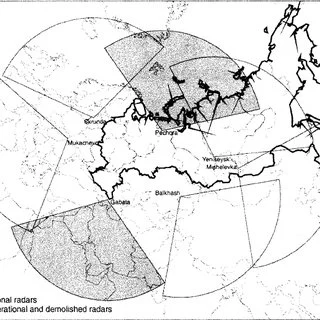
| Olenegorsk (RO-1), Kola | Daugava receiver with Dnestr-M transmitter | North-west | 1975–1977 | Test bed; listed operational | [DOCUMENTED] |
| Pechora (RO-30), Komi | Daryal | North | 1975–1984 | Operating in 2026, the last Daryal | [SINGLE-SOURCE] |
| Gabala (RO-7), Azerbaijan | Daryal | South | 1977–1985 | Leased by Russia from 2002; closed 10 December 2012; handed back 2013 | [DOCUMENTED] |
| Skrunda-1 (RO-2), Latvia | Daryal-UM | North-west | 1986–1991 | Unfinished; receive building blown up 4 May 1995 | [DOCUMENTED] |
| Mukachevo (RO-5), Ukraine | Daryal-UM | South-west | 1986–1991 | Unfinished; work stopped 1990–91; dismantled about 2011 | [DOCUMENTED] |
| Balkhash (OS-2), Kazakhstan | Daryal-U | South-east | 1984–1992 | Nearly complete, never operational; receiver burned 2004 | [DOCUMENTED] |
| Mishelevka (OS-1), Irkutsk | Daryal-U | South-east | 1979–1984 | Unfinished; demolished by explosion 23 June 2011; Voronezh-M built at site | [DOCUMENTED] |
| Yeniseysk-15 / Krasnoyarsk (OS-3) | Daryal-U | North-east, over Siberia | 1982–1987 | ABM Treaty violation; construction stopped 1987, dismantling ordered 1989–90 | [DOCUMENTED] |
Pechora: the survivor
Pechora (Печора) sits in forest and swamp in the Komi Republic, west of the northern Urals, at about 65° north. Its arrays face north, across the Barents and Kara Seas and the polar region, the shortest path for American ICBMs launched from the northern United States and for submarine-launched missiles from the Arctic. Construction began in 1975 and the radar was accepted into service on 20 January 1984 after successful trials. It was the first Daryal to enter service, and its name became the NATO name for the whole class. [DOCUMENTED]
Pechora has outlived every other Daryal. Russian reporting describes it as still operating, and it is listed as in operation in published lists of Russian early warning radars. Some Russian sources state it continues to function though it is not counted as a main element of the modern SPRN. [SINGLE-SOURCE] Its northern sector is now also covered by Voronezh radars at Olenegorsk and Vorkuta, and Russia has announced plans for a Voronezh-type radar at Vorkuta that would take over Pechora's role. [SINGLE-SOURCE] The exact date it will be retired has not been published. [UNVERIFIED]
Gabala: the leased radar
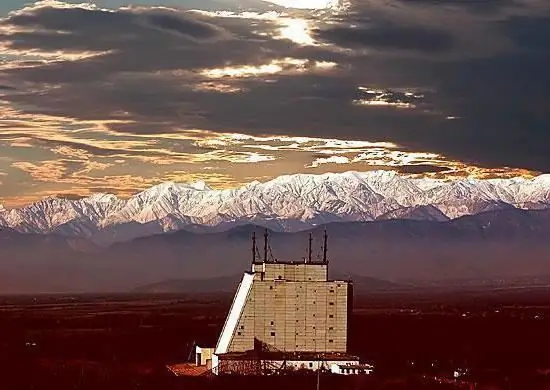
Gabala (Габала, Qəbələ), near the town of the same name in northern Azerbaijan at the foot of the Greater Caucasus, faced south across Iran, the Persian Gulf and towards the Indian Ocean. Its task was to detect missiles launched from submarines in the Indian Ocean and to watch the Middle East and South Asia. It was handed over in 1985 and fully completed in 1987. [DOCUMENTED]
After the Soviet Union broke up, Gabala stood on the territory of an independent Azerbaijan. Russia kept operating it and in 2002 signed a 10-year lease, paying about 7 million US dollars a year. In 2007 President Putin offered the United States joint use of Gabala as an alternative to the planned American missile defence radar in the Czech Republic; the US declined. [DOCUMENTED]
When the lease came up for renewal in 2012, Azerbaijan demanded a large increase, reported as 150 million or even 300 million dollars a year. Talks failed. Russia sent a note on 9 December 2012 and stopped using the radar on 10 December. Russian equipment was flown out in 2013, and Azerbaijan's armed forces took full control later that year. [DOCUMENTED]
Russia could afford to walk away because of the new Voronezh-DM radar at Armavir in Krasnodar Krai, which was entering service and covered much of the same southern sector from Russian territory. The Gabala story is a direct example of the Voronezh replacing the Daryal. [DOCUMENTED]
Skrunda-1: blown up
Skrunda (Скрунда) in western Latvia was already a Hen House site with two Dnepr radars. A Daryal-UM was built there from 1986 to cover the north-west and the North Atlantic. By 1991 it was nearly complete. When Latvia became independent, the unfinished Daryal-UM became a symbol of the Soviet military presence. Under agreements with Latvia, Russia kept the Dnepr radars running until 1998, but the Daryal building was handed over and demolished in a controlled explosion on 4 May 1995, with the work arranged and funded by the US Department of Defense. Russia moved the Skrunda Dnepr's role to the Volga radar at Hantsavichy in Belarus and later to Voronezh radars near St Petersburg and Kaliningrad. [DOCUMENTED]
Mukachevo: abandoned
Mukachevo (Мукачево), in the Zakarpattia region of western Ukraine near the town of Beregovo, was another Dnepr site. A Daryal-UM was started there in 1986 to cover southern Europe and the Mediterranean. Work stopped in 1990–91, before most radar equipment was installed. Ukraine kept the Dnepr running for Russia under agreements until 2008; the unfinished Daryal was left derelict and dismantled around 2011. [DOCUMENTED]
Balkhash: burned
Balkhash (Балхаш), near the Sary Shagan missile test range in Kazakhstan, was a Dnepr site and the home of Soviet anti-ballistic missile testing. A Daryal-U was built there from 1984 to cover China and South Asia. It was almost finished but never became operational and was shut down in the early 1990s. In September 2004 the receive building caught fire in a spectacular blaze, and by 2010 it was a ruin. Russia continued to use the older Dnepr at Balkhash under agreements with Kazakhstan. [DOCUMENTED]
Mishelevka: demolished
Mishelevka (Мишелевка), about 100 km north-west of Irkutsk near Usolye-Sibirskoye, was a Dnepr site. Construction of a Daryal-U ran from 1979 to 1984, to cover China and the Pacific. It was never finished. In 1999 the United States offered to help complete it in exchange for changes to the ABM Treaty allowing a US national missile defence; Russia refused. Part of the site was transferred to the Siberian Branch of the Russian Academy of Sciences for upper atmosphere research. The Daryal-U receive building was destroyed by explosives on 23 June 2011. Two Voronezh-M radars were built at Mishelevka to replace the Dnepr radars there. [DOCUMENTED]
Yeniseysk / Krasnoyarsk: the treaty violation
The Daryal-U at Yeniseysk-15, near the village of Abalakovo about 70 km north of Krasnoyarsk in central Siberia, is the most famous of the unfinished radars. It was started around 1982 and faced north-east, across the interior of Siberia towards the Arctic. That placement was at the centre of a decade-long arms control dispute, described below. Construction was stopped in 1987, the Soviet Union admitted in 1989 that it violated the ABM Treaty, and a government decree in 1990 ordered it dismantled. [DOCUMENTED]
THE ABM TREATY POLITICS
What the treaty said
The 1972 Anti-Ballistic Missile Treaty between the United States and the Soviet Union limited missile defence systems. It also limited early warning radars, because a powerful phased-array warning radar could in principle be used to manage a national missile defence. Article VI(b) required future early warning radars to be located on the periphery of national territory and oriented outwards. The idea was that a radar on the border, looking outwards, could warn of an attack but could not provide the coverage of the interior needed for a nationwide missile defence. [DOCUMENTED]
Why Krasnoyarsk was a problem
US satellites spotted the Krasnoyarsk radar under construction in 1983. It was about 750 km from the nearest border, Mongolia, and faced north-east across Soviet territory, not outwards. To the United States it looked exactly like what Article VI(b) was written to prevent. [DOCUMENTED]
The Soviet Union said the radar was for tracking objects in space, which the treaty allowed. US officials argued that its design was identical to the Pechora-type warning radars and that its location filled the main gap in Soviet early warning coverage, the north-eastern approach from the Pacific and Arctic. [DOCUMENTED]
Why did the Soviets build it there? The most likely explanation is practical. A radar on the coast in north-eastern Siberia would have needed permafrost construction, long supply lines and a new town in a remote and harsh area. Yeniseysk was near a railway, a river and a city. The generals may have judged the treaty risk worth the savings. [ESTIMATE]
Resolution
The dispute was a running item in US compliance reports to Congress through the 1980s. In 1987 construction was halted. In September 1989 Soviet Foreign Minister Eduard Shevardnadze admitted publicly that the radar violated the ABM Treaty. In March 1990 the Soviet Council of Ministers ordered it dismantled, and dismantling followed. Some equipment from the site was reportedly moved elsewhere. [DOCUMENTED]
The other side of the argument
The Soviet Union raised its own complaints, notably about American phased-array radars at Thule in Greenland and Fylingdales in Britain, which it argued were outside US territory and amounted to deployment of ABM-capable radars abroad. Those disputes were never fully resolved, and became moot when the United States withdrew from the ABM Treaty in 2002. [DOCUMENTED]
The Mishelevka offer
In 1999 the Clinton administration offered to help Russia finish the Mishelevka radar in return for agreement to amend the treaty to allow a limited US national missile defence. The offer shows how much the Daryal network had become a bargaining chip. Russia refused, and the US withdrew from the treaty three years later. [DOCUMENTED]
WHY RADAR CONFIRMATION MATTERED: 1983 AND 1995
Two incidents show why the Soviet and Russian warning system insisted on radar confirmation of satellite warnings, the role Daryal was built to fill. [BACKGROUND]
September 1983
On 26 September 1983 the Oko satellite system reported the launch of several American ICBMs. The duty officer at the Serpukhov-15 command centre, Lieutenant Colonel Stanislav Petrov, judged it a false alarm, partly because an American first strike would involve far more missiles and partly because ground radars had not confirmed anything. The false alarm was later traced to sunlight reflecting off high-altitude clouds, which the satellites mistook for rocket plumes. [DOCUMENTED]
In 1983 Pechora was still a few months from acceptance into service, and the north was watched by the older Hen House radars. Missiles from the US would not yet have risen above any radar's horizon at the moment of the alarm in any case. The incident made clear that warning needed two independent kinds of sensor, satellites and radars, and that the radar layer had to be good enough to confirm or deny a warning within minutes. [ESTIMATE]
January 1995
On 25 January 1995 Norway launched a Black Brant XII sounding rocket from Andøya to study the aurora. Its trajectory resembled that of a submarine-launched missile fired from the Norwegian Sea. The Olenegorsk radar, with its Daugava receiver of the Daryal type, detected and tracked it. The warning reached the leadership and President Yeltsin's Cheget briefcase was activated, the only publicly known case of that happening. The rocket fell harmlessly near Svalbard. Norway had notified Russia in advance, but the notice had not reached the right people. [DOCUMENTED]
The Norwegian rocket incident shows Daryal-type technology doing its job, detecting and tracking a missile-like object, and shows the system's weak point: the human and political interpretation of a single sensor's data in a period of confusion. [ESTIMATE]
THE POST-SOVIET YEARS: A NETWORK SPREAD ACROSS NEW BORDERS
In 1991 the Soviet warning network suddenly stood in five countries. Russia had Pechora, Olenegorsk, Mishelevka and the unfinished Yeniseysk. Latvia had Skrunda. Ukraine had Mukachevo and Sevastopol. Belarus had the Volga radar at Hantsavichy, then under construction. Kazakhstan had Balkhash. Azerbaijan had Gabala. [DOCUMENTED]
Russia negotiated agreements to keep using the foreign sites. The Hen Houses at Skrunda ran until 1998; Ukraine's Mukachevo and Sevastopol Dnepr radars worked for Russia until 2008–09; Gabala until 2012; Balkhash's Dnepr under a Kazakh agreement; Hantsavichy in Belarus was finished and leased to Russia. [DOCUMENTED]
This patchwork was fragile and expensive. Russia paid rent, depended on the goodwill of neighbours whose relations with Moscow could change, and had to maintain old equipment far from home. It is no surprise that one of the main aims of the Voronezh programme was to put all warning radars on Russian soil. [ESTIMATE]
| Country after 1991 | Site | What happened |
|---|---|---|
| Russia | Pechora | Kept operating |
| Russia | Mishelevka Daryal-U | Unfinished; demolished 2011 |
| Russia | Yeniseysk Daryal-U | Dismantled after 1990 |
| Latvia | Skrunda Daryal-UM | Demolished 1995 |
| Ukraine | Mukachevo Daryal-UM | Abandoned; dismantled about 2011 |
| Kazakhstan | Balkhash Daryal-U | Abandoned; burned 2004 |
| Azerbaijan | Gabala Daryal | Leased to Russia 2002–2012; returned |
MORE ON PECHORA
The Pechora radar node lies in the taiga a short distance from the town of Pechora. [DOCUMENTED] The transmitter and receiver stand in open ground cleared from taiga, connected by roads and service buildings. Aerial photos show the two blocks clearly separated across the forest. [DOCUMENTED]
Pechora's arrays face roughly north (an azimuth of about 2°, estimated from imagery), looking towards the polar region. Its sector covers the approaches over the Arctic Ocean from North America and the Norwegian and Barents Seas. [SINGLE-SOURCE]
The radar has reportedly been modernised during its service life, with new computing and processing equipment replacing the original Soviet machines. Details are not published. [SINGLE-SOURCE]
Its future is tied to the Voronezh at Vorkuta, about 300 km to the north-east, which Russian sources describe as intended to cover the northern sector. Once Vorkuta's coverage is complete, there is little reason to keep a 1980s radar with hundreds of staff running. [ESTIMATE]
MORE ON GABALA: THE 2007 OFFER
In June 2007, at the G8 summit, President Putin surprised the United States by offering joint use of the Gabala radar as an alternative to the US plan to put a missile defence radar in the Czech Republic and interceptors in Poland. The US argued that Gabala, a VHF warning radar, could not provide the precise tracking needed for interception, and continued with its own plans. Some Western analysts thought the offer was mainly a political move, aimed at showing that Russia was willing to cooperate and that the US plan was really aimed at Russia. [DOCUMENTED]
The episode is interesting technically. Gabala's location gave it excellent coverage of Iran, which was the stated threat behind the US plan. But a Daryal was never designed to guide interceptors. The disagreement was partly about what a warning radar can and cannot do. [ESTIMATE]
MORE ON KRASNOYARSK: THE 1987 VISIT
In September 1987, as a confidence-building gesture, the Soviet Union allowed a group of US congressmen and staff, accompanied by journalists and scientists, to visit the Krasnoyarsk radar. They found the transmitter and receiver buildings largely complete but with little electronic equipment installed. The visit did not settle the treaty question, since the US position rested on the radar's location and orientation, not its state of completion. [DOCUMENTED]
In 1989 Shevardnadze told the Supreme Soviet that the radar had been a clear violation of the ABM Treaty and that its construction had been a mistake. It was a rare public admission by the Soviet government of breaking an arms control agreement. [DOCUMENTED]
INSIDE THE BUILDINGS
Accounts by former personnel and visitors to the abandoned sites describe the inside of a Daryal building as many floors of equipment halls behind the array face, with cable runs, cooling systems and rows of cabinets. The receive building holds the receiver channels connected to each element, and the processing equipment. The transmitter building holds the transmitter stages and the systems that feed the array. [SINGLE-SOURCE]
The abandoned buildings at Balkhash and Mukachevo became destinations for urban explorers before they were demolished, and photos show empty concrete floors and broken antenna elements. These photos are useful for showing scale but say little about the equipment, which was never fully installed or was removed. [DOCUMENTED]
HOW ITS DATA REACHED COMMAND
The warning chain
A Daryal did not decide anything on its own. Its job was to detect, track and measure objects and send processed track data to the centre. The Soviet missile attack warning system was built as a network: satellites, Hen House and Daryal radars, and over-the-horizon radars all fed the main command post of the SPRN, which was built at Solnechnogorsk near Moscow, covered on this site in the SPRN Solnechnogorsk article. [DOCUMENTED]
At the command post, data from the satellites, which see the launch, and from the radars, which see the missiles in flight, were combined. An attack was declared only when independent sources agreed, which reduced the risk of a false alarm from a single sensor. The warning then went to the General Staff and to the leadership through the "Kazbek" system and the Cheget nuclear briefcase. [DOCUMENTED]
Communications
Daryal sites were connected to the centre by dedicated, protected communication lines, cable and radio relay. Russian sources mention intermediate nodes for Gabala's data. The radar's processed data was transmitted in near real time. [SINGLE-SOURCE]
Links to the Moscow ABM system
Daryal data was also meant to support the Moscow anti-ballistic missile system, A-35 and later A-135, which had its own battle management radar, the Don-2N at Pushkino. Early warning radars give the first track of incoming warheads, from thousands of kilometres out; the Don-2N then takes over for the final engagement. See the Don-2N article. [DOCUMENTED]
The space surveillance role
Like other large Soviet warning radars, Daryal was also used to track satellites and space debris for the Soviet space surveillance system, the SKKP (Система контроля космического пространства). That dual role is what the Soviet Union cited when it called the Krasnoyarsk radar a space tracking station. [DOCUMENTED]
COVERAGE AND GEOMETRY
Each Daryal covered a sector about 90 degrees wide. The planned network of seven radars would have covered the whole perimeter of the Soviet Union, with overlapping sectors. [DOCUMENTED]
| Site | Sector covered (approx.) | Threat watched |
|---|---|---|
| Pechora | North, polar region | US ICBMs over the pole; Arctic SLBMs |
| Gabala | South | Indian Ocean SLBMs; Middle East |
| Skrunda | North-west | North Atlantic and Norwegian Sea SLBMs; Western Europe |
| Mukachevo | South-west | Mediterranean SLBMs; southern Europe |
| Balkhash | South-east | China; South Asia |
| Mishelevka | East / south-east | China; Pacific |
| Yeniseysk | North-east | Pacific and Arctic approaches |
With only Pechora and Gabala working, plus the Olenegorsk Daugava, the Daryal network never filled the gaps it was meant to. For the rest of the Soviet period and well into the 2000s, Russia relied on the old Hen Houses and on satellites. [DOCUMENTED]
Why a line-of-sight radar can see 6,000 km
A ground radar cannot see through the Earth. But a missile does not stay low: an ICBM climbs to an altitude of 1,000 km or more in mid-course. The distance to the horizon from a target at height h is about √(2Rh), where R is the Earth's radius. For h = 1,000 km that is about 3,700 km from the target to the horizon point, and together with the radar's own horizon, objects at very high altitude can be seen at 5,000–6,000 km. [BACKGROUND]
So a Daryal sees a missile only after it has risen above the horizon. Against an ICBM from the United States, Pechora would pick up the warheads and rocket stages as they climbed over the North Pole region, giving about 15 to 20 minutes of warning before impact, enough to confirm the satellite warning and estimate the attack's size and targets. [ESTIMATE]
THE SUCCESSOR: VORONEZH REPLACED IT
The Voronezh family replaced the Daryal. This is not just a matter of time passing; Russia designed the Voronezh specifically to avoid the Daryal's problems, and Voronezh radars now cover the sectors the Daryals were meant to cover. [DOCUMENTED]
The Voronezh was developed by RTI (Voronezh-DM) and NIIDAR (Voronezh-M) in the early 2000s. The first Voronezh-M was built at Lekhtusi near St Petersburg from 2006, and entered combat duty in 2012. Others followed at Armavir, Pionersky near Kaliningrad, Mishelevka, Orsk, Barnaul, Yeniseysk, Vorkuta and other sites. Russian officials have said that by the 2020s the whole perimeter was covered by the new generation. The site's Voronezh article covers them in detail. [DOCUMENTED]
| Feature | Daryal | Voronezh | Label |
|---|---|---|---|
| Buildings | Two huge separate buildings | One smaller building plus prefab containers | [DOCUMENTED] |
| Construction | Poured on site, monumental concrete | Factory-built modules (high factory readiness) | [DOCUMENTED] |
| Build time | About 5–9 years | About 1.5–2 years | [DOCUMENTED] |
| Power consumption | Tens of megawatts | Under 1 MW (about 0.7 MW stated) | [SINGLE-SOURCE] |
| Staff | Hundreds per site | Tens per shift | [SINGLE-SOURCE] |
| Cost | Very high | Stated as several times cheaper | [SINGLE-SOURCE] |
| Bands | VHF only | VHF (Voronezh-M), UHF (DM), and other variants | [DOCUMENTED] |
| Status | Pechora only | More than ten radars in service | [DOCUMENTED] |
The key idea in the Voronezh is "high factory readiness" (высокая заводская готовность). Instead of building a radar in place over years, the electronics are built in standard containers at the factory and brought to site, where they are connected to an array on a lighter building. That cuts construction time, cost and staff, and makes upgrades easier. Gabala was given up in 2012 because a Voronezh-DM at Armavir could cover its sector from Russian soil. Mishelevka and Yeniseysk, where Daryal-U radars were never finished, now have Voronezh radars of their own. [DOCUMENTED]
Telling the Daryal and Voronezh apart
From the air or the ground, the two are easy to tell apart. A Daryal is two separate, very large buildings, a transmitter and a taller receiver, standing roughly 0.5 to 1.5 km apart. Each is a monumental, multi-storey concrete block with one face sloped back to carry the array; at Gabala the receiver was described as 16 storeys high. [DOCUMENTED] A Voronezh is a single, much smaller building with the antenna array on its sloping face, with rows of prefabricated equipment containers lined up at its base. It was built in about one to two years, compared with five to nine for a Daryal. [DOCUMENTED] If you see two giant blocks a kilometre apart in a forest, it is a Daryal; if you see one sloped face with containers at its feet, it is a Voronezh. [BACKGROUND]
TIMELINE
| Year | Event | Label |
|---|---|---|
| Early 1970s | RTI begins Daryal design under Mints and Ivantsov | [DOCUMENTED] |
| 1972 | ABM Treaty signed; Article VI(b) limits warning radar siting | [DOCUMENTED] |
| 14 April 1975 | Daryal ordered for Pechora and Gabala | [DOCUMENTED] |
| 1975–1977 | Daugava receiver built at Olenegorsk | [DOCUMENTED] |
| 1979 | Mishelevka Daryal-U construction begins | [DOCUMENTED] |
| 1982 | Yeniseysk construction begins | [DOCUMENTED] |
| 1983 | US detects Krasnoyarsk radar | [DOCUMENTED] |
| 20 January 1984 | Pechora accepted into service | [DOCUMENTED] |
| 1984 | Balkhash Daryal-U construction begins | [DOCUMENTED] |
| 1985 | Gabala handed over (completed 1987) | [DOCUMENTED] |
| 1986 | Daryal-UM construction begins at Skrunda and Mukachevo | [DOCUMENTED] |
| 1987 | Yeniseysk construction halted | [DOCUMENTED] |
| September 1989 | Shevardnadze admits Krasnoyarsk violated the ABM Treaty | [DOCUMENTED] |
| 28 March 1990 | Council of Ministers orders Daryal-U at Yeniseysk dismantled | [DOCUMENTED] |
| 1990–1991 | Work stops at Mukachevo; USSR breaks up | [DOCUMENTED] |
| 4 May 1995 | Skrunda Daryal-UM demolished | [DOCUMENTED] |
| 1999 | US offers to help finish Mishelevka; Russia refuses | [DOCUMENTED] |
| 2002 | Gabala 10-year lease; US leaves ABM Treaty | [DOCUMENTED] |
| 2004 | Balkhash receiver burns | [DOCUMENTED] |
| 2007 | Putin offers US joint use of Gabala | [DOCUMENTED] |
| 23 June 2011 | Mishelevka Daryal-U demolished | [DOCUMENTED] |
| 10 December 2012 | Russia stops using Gabala | [DOCUMENTED] |
| 2013 | Gabala handed back to Azerbaijan | [DOCUMENTED] |
| 2026 | Pechora still operating, the last Daryal | [SINGLE-SOURCE] |
HOW A DARYAL FINDS A TARGET, STEP BY STEP
Steering the beam
A phased array steers its beam by delaying the signal to each element slightly. If every element transmits in phase, the waves add up straight out from the face of the array. If each element is delayed a little more than its neighbour, the combined wavefront tilts, and the beam points off to one side. The amount of tilt depends on the phase step between elements and on their spacing. Changing the phases electronically moves the beam in microseconds, with no moving parts. [BACKGROUND]
In a Daryal, the transmitter array forms a beam that illuminates part of the sector, while the much larger receive array forms narrower receive beams within that illuminated area. Because the receive array is larger, its beams are sharper, and the radar gets better angular accuracy than the transmitter alone could give. [SINGLE-SOURCE]
Beam width at VHF
The beam width of an array is roughly the wavelength divided by the array's width. At about 170 MHz the wavelength is about 1.8 m. For a receive array about 100 m wide, the beam is about 1.8 / 100 = 0.018 radians, roughly 1 degree. For the 30–40 m transmit array it is about 3 degrees. [ESTIMATE]
At 4,000 km range a 1° beam is about 70 km wide. Processing can locate a strong target to a fraction of the beam width, perhaps a tenth, giving a position error of a few kilometres at long range. That is ample for warning and for predicting the impact area of a warhead to tens of kilometres, but not for guiding an interceptor. [ESTIMATE]
Measuring range
Range comes from the time between sending a pulse and receiving its echo. Radio waves travel at about 300,000 km per second, so an echo from a target 4,000 km away returns after about 27 milliseconds (8,000 km round trip). The radar has to wait that long before it can be sure which pulse an echo belongs to, so long-range warning radars use low pulse repetition rates, long pulses and pulse compression to put enough energy on target while keeping fine range resolution. [BACKGROUND]
Measuring speed
The Doppler shift of the echo gives the target's speed towards or away from the radar. At VHF a warhead moving at 7 km/s towards the radar shifts the frequency by roughly 8 kHz. Doppler data helps separate real targets from slow clutter such as the aurora, and helps predict trajectories. [ESTIMATE]
From echoes to tracks
Each echo is a single measurement. The processing system links measurements from successive looks into tracks, fits them to a ballistic trajectory, and works out where and when the object will land. With several objects in flight, it must decide which echoes belong to which object. The original Daryal was said to handle about 100 targets at once. [SINGLE-SOURCE]
WHO COVERS EACH DARYAL SECTOR TODAY
Every sector that a Daryal was meant to watch is now covered, by Russian accounts, by a Voronezh. That is the clearest sense in which the Voronezh replaced the Daryal. [DOCUMENTED]
| Planned Daryal | Sector | Today's coverage (Russian sources) | Label |
|---|---|---|---|
| Pechora | North | Pechora itself, plus Voronezh radars at Olenegorsk and Vorkuta | [SINGLE-SOURCE] |
| Skrunda | North-west | Voronezh-M at Lekhtusi (St Petersburg) and Voronezh-DM at Pionersky (Kaliningrad) | [DOCUMENTED] |
| Mukachevo | South-west | Voronezh-DM at Armavir and at Pionersky | [SINGLE-SOURCE] |
| Gabala | South | Voronezh-DM at Armavir | [DOCUMENTED] |
| Balkhash | South-east | Voronezh-M at Orsk and Voronezh-DM at Barnaul | [DOCUMENTED] |
| Mishelevka | East / south-east | Voronezh-M at Mishelevka | [DOCUMENTED] |
| Yeniseysk | North-east | Voronezh-DM at Yeniseysk | [DOCUMENTED] |
The Yeniseysk and Mishelevka entries are telling. Russia went back to the very sites where Daryal-U radars had been left unfinished and built Voronezh radars there. At Yeniseysk the treaty objection no longer applied after the United States left the ABM Treaty in 2002. [DOCUMENTED]
THE WESTERN INTELLIGENCE VIEW
In the 1980s the Daryal network was one of the central concerns of American arms control policy. The US Department of Defense's annual "Soviet Military Power" publications showed artist's impressions of the Pechora-class radars and maps of their coverage. [DOCUMENTED]
The US worry was not only Krasnoyarsk. American officials argued that a full ring of large phased-array radars around the USSR could provide the battle management for a nationwide missile defence, if the Soviet Union ever decided to break out of the ABM Treaty by building interceptors quickly. In the language of the time, the radars were the long-lead-time item, the part that took longest to build; interceptors could be produced much faster. A completed radar network would therefore shorten the warning the US would have of a Soviet breakout. [DOCUMENTED]
Soviet officials and many Western analysts replied that VHF warning radars were poorly suited to directing interceptors, which need precise, high-frequency radars like the Don-2N, and that the Daryal was simply an early warning system. The debate was never settled by evidence, since the network was never completed. [DOCUMENTED]
In hindsight the breakout fears look exaggerated. The Soviet Union could not even finish the radars, let alone a nationwide missile defence. But the fears had real effects: they shaped US compliance reports, the Strategic Defense Initiative debate and arms control negotiations throughout the 1980s. [ESTIMATE]
WORKED SCENARIO 4: THE NORTHERN SECTOR IN 2026
Setting: today. A test missile is launched from the Norwegian Sea region on a trajectory towards northern Russia. (Illustrative only.) [ESTIMATE]
Step 1. EKS Kupol satellites detect the launch and alert the SPRN command post. [BACKGROUND]
Step 2. The Voronezh radar at Olenegorsk, closest to the launch area, picks up the missile first as it climbs. [ESTIMATE]
Step 3. Pechora, facing north from further inland, picks it up as it rises above its horizon and adds a second radar track from a different angle. Two radars looking from different angles give a better trajectory estimate than one. [ESTIMATE]
Step 4. The command post combines satellite and radar data. Within a few minutes it can say what the object is, where it is going, and whether it is a threat. [ESTIMATE]
Step 5. When Vorkuta's Voronezh fully covers the northern sector, Pechora's contribution will be redundant, and the last Daryal can be switched off without leaving a gap. [ESTIMATE]
THE DARYAL'S PLACE IN THE LINEAGE
| Generation | Radar | Period | Key feature |
|---|---|---|---|
| First | Dnestr, Dnestr-M, Dnepr (Hen House) | 1960s–2000s | Frequency-scanned horn antennas |
| Transitional | Daugava (Olenegorsk receiver) | 1977– | Daryal receiver with Dnestr-M transmitter |
| Second | Daryal, Daryal-U, Daryal-UM (Pechora) | 1984–2026 | Separate transmit and receive phased-array buildings |
| Transitional | Volga (Hantsavichy) | 2003– | Decimetre-band radar, Belarus |
| Third | Voronezh-M, -DM, -VP, -SM and others | 2009– | Modular, high factory readiness, one building |
The Dnepr was the Daryal's predecessor, and the Voronezh is its successor. Read in order, the three articles tell the story of Soviet and Russian missile warning from the first horn antennas of the 1960s to the modular radars of today. [DOCUMENTED]
TECHNICAL LIMITS
The aurora and the ionosphere
Pechora sits at about 65° north and looks north, straight into the auroral zone. At VHF, the aurora produces strong radar echoes from ionised regions in the upper atmosphere, a well-known problem for all high-latitude VHF radars, including the American BMEWS radars of the 1960s. These echoes can mask real targets or appear as false ones. Soviet engineers used Doppler processing and knowledge of the aurora's typical behaviour to reject the clutter, but it is an inherent weakness of a northern VHF warning radar. [BACKGROUND]
The ionosphere also bends and delays VHF signals slightly, adding errors to the measured position of very distant targets. Corrections based on models of the ionosphere were applied. [BACKGROUND]
Accuracy
Because Daryal works at VHF, its accuracy is lower than a UHF or S-band radar of the same size. For an early warning radar, that is acceptable: the task is to detect missiles, count them and estimate their trajectory and impact area, not to guide an interceptor. Fine tracking for interception is the job of radars like the Don-2N. [BACKGROUND]
Single-axis coverage
A flat array can only steer its beam about 45° to either side of its axis before performance falls off badly. That is why a Daryal covers about 90° and why a ring of sites was needed. A two-face or three-face radar would have covered more, but would have meant even more construction. [BACKGROUND]
Power and cost
A Daryal used large amounts of electrical power, tens of megawatts, and needed its own substation and backup. It also needed hundreds of people. After 1991, Russia could not afford to finish most of the network or to run more than a few radars at all. [DOCUMENTED]
LIFE AT A DARYAL TOWN
Each Daryal had a closed military settlement. Pechora's garrison lived in the town of Pechora and a nearby military settlement; Gabala's in a closed town near Qəbələ. These were places with schools, shops, clubs and apartment blocks, where officers and their families lived for years. Duty was in shifts around the clock, with the radar on continuous combat duty. [BACKGROUND]
For the Russian personnel at Gabala, the closure in 2012 meant a move back to Russia with their families within months. Azerbaijani reports in 2013 said the last Russian servicemen had gone and the station was fully under Azerbaijani control. [DOCUMENTED]
WHY SO MANY WERE NEVER FINISHED
Seven planned, two working. The reasons were partly money, partly politics and partly geography. [ESTIMATE]
Money: by the late 1980s the Soviet economy was in crisis. Monumental radar buildings that took the best part of a decade to finish competed with every other military programme. [DOCUMENTED]
Politics: arms control made Krasnoyarsk a liability, and its dismantling was a concession Gorbachev's government was prepared to make. [DOCUMENTED]
Geography: when the USSR broke up, four of the planned sites, Skrunda, Mukachevo, Balkhash and Gabala, ended up in other countries. Latvia wanted the Soviet military gone; Ukraine had no need for an unfinished Russian radar; Kazakhstan and Azerbaijan let Russia stay for a while but on their terms. [DOCUMENTED]
Technology: by the 1990s, electronics had moved on, and a radar designed in the 1970s was outdated before it was finished. Completing it would have cost almost as much as designing something new. That something new turned out to be the Voronezh. [ESTIMATE]
COMPARISON WITH WESTERN EQUIVALENTS
| System | Country | Band | Design | Notes |
|---|---|---|---|---|
| Daryal | USSR | VHF | Separate transmit and receive buildings | About 90° per site |
| BMEWS (original) | US/UK | UHF | Mechanical and fixed antennas, 1960s | Thule, Clear, Fylingdales |
| AN/FPS-115 PAVE PAWS | US | UHF | Two-face phased array, one building | 240° coverage; 1980s |
| AN/FPS-123/132 UEWR | US | UHF | Upgraded PAVE PAWS / BMEWS | Thule, Fylingdales (three-face), Clear, Beale, Cape Cod |
| Voronezh-M / DM | Russia | VHF / UHF | One building, modular containers | Daryal's successor |
The American PAVE PAWS radars of the 1980s solved the same problem as Daryal in a different way. They put transmitter and receiver functions into the same array using solid-state modules, in one building with two faces covering 240°. That was possible because UHF solid-state transmit/receive modules were becoming available in the US at the time. The Soviet Union, with less advanced solid-state electronics, separated transmitter and receiver into different buildings and relied on sheer size. [BACKGROUND]
The Voronezh is in many ways the Russian equivalent of PAVE PAWS, arriving twenty-five years later. [ESTIMATE]
WORKED SCENARIO 1: PECHORA SEES AN ICBM RAID OVER THE POLE
This scenario is illustrative and based on public figures; timings are estimates. [ESTIMATE]
Setting: the Cold War, about 1986. A number of ICBMs are launched from missile fields in the northern United States towards targets in the Soviet Union.
Step 1. Launch detection. Within a minute or two, Oko early warning satellites detect the infrared signature of the rocket boosters. The SPRN command post receives a launch warning from the space layer. [BACKGROUND]
Step 2. Rising over the horizon. The missiles climb and arc north over Canada towards the pole. After about 8 to 10 minutes of flight, the warheads and upper stages rise high enough to clear Pechora's horizon at roughly 5,000 to 6,000 km. [ESTIMATE]
Step 3. Detection and tracking. Pechora's arrays detect multiple objects. The receiver forms beams, the processing system builds tracks for each object, and the radar measures range, bearing, elevation and range rate. [ESTIMATE]
Step 4. Classification. The processing separates tracks into warheads, upper stages and debris based on trajectory and range rate. Decoys complicate the picture. [ESTIMATE]
Step 5. Report. Processed tracks go to the SPRN command post at Solnechnogorsk in near real time. [DOCUMENTED]
Step 6. Confirmation. The command post now has two independent sources, satellites and radar. The attack is confirmed. Estimated impact areas and times are computed. [ESTIMATE]
Step 7. Warning. Warning goes to the General Staff and leadership through the Kazbek system. The leadership has perhaps 10 to 15 minutes before the first impacts. [ESTIMATE]
Step 8. Handoff to defence. Tracks of warheads heading for Moscow are passed towards the A-135 system and the Don-2N radar for engagement. [ESTIMATE]
| Time after launch (min) | Event |
|---|---|
| 0–2 | Satellite launch detection |
| 8–10 | Warheads rise above Pechora's horizon |
| 10–11 | Tracks reported to command post |
| 11–12 | Attack confirmed by two sources |
| 12–25 | Decision window for leadership |
| About 25–30 | First impacts |
WORKED SCENARIO 2: GABALA AND AN INDIAN OCEAN SUBMARINE LAUNCH
Setting: a submarine in the northern Arabian Sea launches a ballistic missile towards southern Russia. The distance is about 3,000 km.
Step 1. Gabala faces south across Iran towards the Indian Ocean. The missile rises over its horizon within a few minutes of launch, much sooner than an ICBM over the pole, because it starts closer. [ESTIMATE]
Step 2. Gabala tracks the missile and passes the data north. Flight time to target is only 12 to 15 minutes, so warning time is shorter. [ESTIMATE]
Step 3. After 2012, the same sector is covered from Armavir by a Voronezh-DM. Its range is shorter than Gabala's, so detection of a missile very far south comes later, but the Voronezh sits on Russian soil and does not need a lease. [DOCUMENTED]
WORKED SCENARIO 3: THE KRASNOYARSK GAP
Setting: 1983. The Soviet warning network has a hole in the north-east, between Pechora's sector and the planned Mishelevka sector.
Step 1. A missile launched from the Pacific towards central Russia would cross this gap. The existing Hen House radars do not see it. [DOCUMENTED]
Step 2. A radar at Yeniseysk facing north-east fills the gap, but stands deep inside Soviet territory, facing over it. [DOCUMENTED]
Step 3. A radar on the coast would satisfy the treaty but costs far more to build and supply. [ESTIMATE]
Step 4. The Soviet planners choose Yeniseysk. The United States detects it, declares it a violation, and the radar becomes a political liability. It is eventually dismantled, and the gap is closed decades later by a Voronezh radar, which Russia built at Yeniseysk after the ABM Treaty no longer applied. [DOCUMENTED]
WHAT IS NOT KNOWN
The exact technical parameters of the Daryal, including its power, the number of elements and its real detection ranges, have never been officially published. The figures widely quoted come from Russian enthusiast sites and Western estimates. [DOCUMENTED]
The current operating status of Pechora is reported in Russian and enthusiast sources but not detailed officially. When it will be replaced is not public. [UNVERIFIED]
Staff numbers for Pechora today, and how far its original equipment has been replaced, are not published. Figures of around 900 to 1,500 people at Gabala in the 2000s come from press reports at the time of the lease dispute and may include support staff and contractors as well as radar crews. [SINGLE-SOURCE]
How much equipment from the unfinished radars was moved elsewhere is not known. [UNVERIFIED]
ANALYSIS
Daryal is a monument to a certain way of building things. The Soviet Union did not have the solid-state electronics that let the United States put PAVE PAWS into one compact building. It did have concrete, steel, labour and the will to build at gigantic scale. So it built radars as big as office blocks, two to a site, and took most of a decade to finish each one. [ESTIMATE]
When they worked, they worked well. Pechora has now been watching the polar approaches for more than forty years, longer than most of the people who built it served. Gabala ran for nearly three decades and was given up over money, not because it had failed. [DOCUMENTED]
But the Daryal shows what happens when a system is too big and too slow for the world around it. Of seven planned, two were finished. The others were caught by arms control, by economic collapse and by new borders. One was dismantled to settle a treaty dispute, one was blown up by a newly independent country with American help, one burned, one was demolished by its own owners, and one was simply abandoned. [DOCUMENTED]
The Krasnoyarsk affair is a lesson in how practical choices become political ones. A radar placed for convenience became a treaty violation and a bargaining chip in superpower politics. The Soviet admission in 1989 was one of the signs of how far Gorbachev's government was willing to go to repair relations. [ESTIMATE]
The Voronezh is the real legacy of the Daryal. Russian designers learned from the failure to complete the Daryal network and built its successor around speed, cost and modularity. The result is a network that, by Russian accounts, covers the whole perimeter for the first time, something the Daryal never achieved. The Daryal and the Voronezh are predecessor and successor, and you cannot understand one without the other. [ESTIMATE]
For this database, the Daryal sits in the history of the warning chain: after the Dnepr, before the Voronezh. Pechora is the last one still in the current picture. When it goes quiet, the Daryal era will be over. [ESTIMATE]
There is also a lesson about the value of a working sensor over a perfect plan. Pechora was the first site built, in one of the harshest places on the list, and it is the one still running. The ambitious later variants, with better electronics on paper, never tracked a single missile in service. A radar that exists and works beats a better radar that is never finished. [ESTIMATE]
Finally, the Daryal is a reminder of how much of the Cold War was fought with concrete. The buildings at Pechora and Gabala were meant to stand for decades, and they have. Whatever happens to Pechora once Vorkuta's Voronezh takes over its sector, the two blocks in the taiga will probably remain for a long time, like the Duga antenna at Chernobyl, as physical evidence of how seriously both sides took the idea of a missile coming over the pole. [ESTIMATE]
RELATED ARTICLES
Voronezh (successor)
Dnepr (predecessor)
SPRN Solnechnogorsk
Don-2N
EKS Kupol
GLOSSARY
| Term | Meaning |
|---|---|
| СПРН (SPRN) | Система предупреждения о ракетном нападении, missile attack warning system |
| RTI | Mints Radio-Technical Institute, designer of the Dnepr and Daryal |
| NIIDAR | Long-Range Radio Communications Research Institute, designer of the Voronezh-M and 29B6 Container |
| ОРТУ | Отдельный радиотехнический узел, independent radio-technical node (radar site unit) |
| Hen House | NATO name for the Dnestr and Dnepr radars |
| Pechora | NATO name for the Daryal |
| ABM Treaty | 1972 US–Soviet Anti-Ballistic Missile Treaty |
| Article VI(b) | ABM Treaty clause requiring warning radars on the periphery, facing outwards |
| SKKP | Система контроля космического пространства, Soviet/Russian space surveillance system |
| Высокая заводская готовность | High factory readiness, the modular construction principle of the Voronezh |
SOURCES
1. Wikipedia, "Daryal radar", including site table with coordinates, azimuths and construction dates. https://en.wikipedia.org/wiki/Daryal_radar
2. PVO.guns.ru, "РЛС СПРН «Дарьял»" (Daryal history, Pechora and Gabala construction, Daryal-U and Daryal-UM sites). http://pvo.guns.ru/abm/darjal.htm
3. Pavel Podvig, Russian Strategic Nuclear Forces blog, "Daryal-U radar in Mishelevka demolished", June 2011. https://russianforces.org/blog/2011/06/daryal-u_radar_in_mishelevka_d.shtml
4. Famhist.ru, "Развитие систем РКО, хроника 1989–2003" (Council of Ministers decree of 28 March 1990 and halting of Daryal-UM work). http://www.famhist.ru/famhist/sprn/001a982f.htm
5. GlobalSecurity.org, "Missile Defense Radar Sites" (Hen House and Pechora-type sites). https://www.globalsecurity.org/wmd/world/russia/facility-radar.htm
6. Kyiv Post (AP/Reuters), "Russia ceases use of radar station in Azerbaijan" and "Russia, Azerbaijan fail to agree on use of radar station", 10–11 December 2012.
7. Eurasianet, "What Will Gabala Closure Mean For Russia-Azerbaijan Ties?", December 2012.
8. BBC Russian, "Азербайджан: российская сторона освободила РЛС в Габале", 5 April 2013.
9. Armenpress citing APA, "Azerbaijan completely takes over Gabala RLS from Russia", October 2013.
10. Treaty Between the United States of America and the Union of Soviet Socialist Republics on the Limitation of Anti-Ballistic Missile Systems (ABM Treaty), 1972, Article VI(b).
11. US Department of State / Arms Control and Disarmament Agency, Soviet Noncompliance with Arms Control Agreements reports to Congress, 1984–1990 (Krasnoyarsk radar).
12. New York Times and Washington Post reporting on the 1987 congressional visit to Krasnoyarsk and Shevardnadze's October 1989 admission.
13. Podvig, P. (ed.), Russian Strategic Nuclear Forces, MIT Press, 2001, chapter on the early warning system.
14. Podvig, P., "History and the Current Status of the Russian Early-Warning System", Science and Global Security 10, 2002.
15. Reporting on the 1983 Oko false alarm (Stanislav Petrov) and the 25 January 1995 Norwegian rocket incident, including Podvig 2002 and contemporary press accounts.
16. Reuters and BBC reporting on Putin's June 2007 offer of joint use of Gabala.
17. Latvian and US government accounts of the demolition of the Skrunda Daryal-UM on 4 May 1995.
18. Russian Ministry of Defence and TASS / RIA Novosti reporting on Voronezh radars (Lekhtusi, Armavir, Mishelevka, Yeniseysk, Vorkuta) and their high factory readiness, construction time and power use.
19. Background on VHF radar, phased arrays and auroral clutter: M. I. Skolnik, Introduction to Radar Systems, McGraw-Hill; Radar Handbook, 3rd ed.
Related on this site: Kartsev M-10 / 5E66 / 17L6 (NIIVK, SPRN command-post computer).
Related on this site: Over-the-horizon radar.
Related on this site: Russian Unified Air Defense (how the layers fit together).
Project Orlan // Underground Information Database