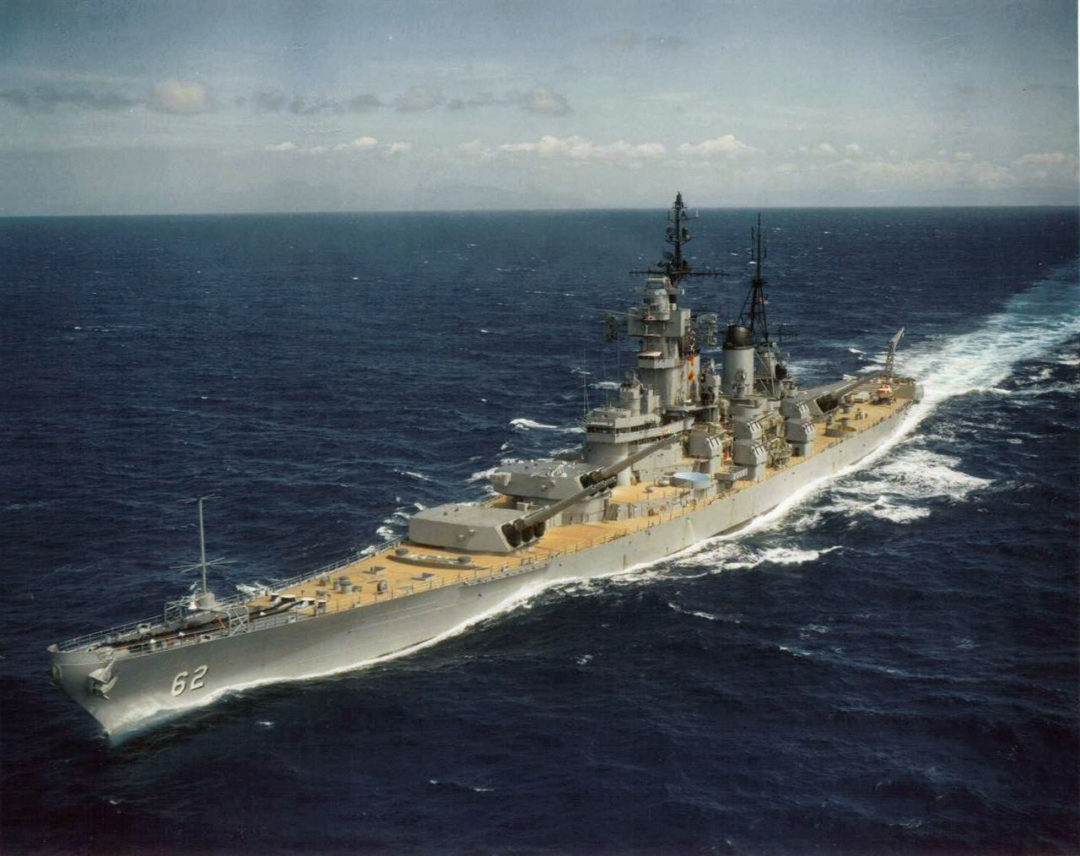
USS New Jersey (BB-62) at speed in open water, seen from the air off the starboard bow, with her bow wave and wake showing.
USS New Jersey (BB-62) at speed in open water, seen from the air off the starboard bow, with her bow wave and wake showing.
Related articles: USN Mk 6 / Mk 7 16-inch Guns, for the gun itself; Mark 38 GFCS, the main-battery fire-control plant; Naval and Marine Steam Power Plants, for the boilers, turbines and feedwater in full; USS Alabama (BB-60), the South Dakota-class predecessor; WW2 US Navy Ship Refrigeration Systems, for magazine and stores cooling; The Last Ride of the Vikings, on what a reactivation would take today; and Project 1144 Orlan (Kirov class), the Soviet cruiser often set against the 1980s reactivations.
WHAT IT IS
The Iowa class is the last and fastest battleship design the United States completed. Four ships were finished: USS Iowa (BB-61), USS New Jersey (BB-62), USS Missouri (BB-63) and USS Wisconsin (BB-64). They are 45,000-ton-standard, 33-knot fast battleships, lengthened from the South Dakota class so that eight 600 psi / 850°F Babcock & Wilcox boilers and four General Electric geared-turbine sets could deliver 212,000 shaft horsepower on four shafts, and so that nine 16-inch/50 Mark 7 guns could be carried at that speed through the Panama Canal. [DOCUMENTED, Iowa crew handbook; DANFS]
Their careers ran across five decades. All four fought in the Second World War, and the Japanese surrender was signed on Missouri's deck in Tokyo Bay on 2 September 1945. Three were back in action off Korea. New Jersey alone fought in Vietnam. In the 1980s all four were recommissioned with Tomahawk and Harpoon missiles, Phalanx close-in guns and new radars, and Missouri and Wisconsin fired their guns and missiles in the 1991 Gulf War. On 19 April 1989 an explosion in Iowa's No. 2 turret killed 47 sailors, and the cause is still disputed. Today all four are museum ships: Iowa at San Pedro, California; New Jersey at Camden, New Jersey; Missouri at Pearl Harbor; and Wisconsin at Norfolk, Virginia. [DOCUMENTED, DANFS; GAO; Iowa crew handbook]
This page is a systems article. It goes through the ships one system at a time: armor, the 16-inch and secondary batteries, radar and electronic warfare, gun fire control, the power plant, electrical and emergency power, damage control, communications, and the "hotel" side of a 2,800-man floating town, from distillers and ventilation to galleys, laundry and ice cream. It then gives each ship's history, the 1980s reactivation and the 1989 turret explosion. The main source is the official Battleship Iowa crew handbook, cross-checked against the Navy's Dictionary of American Naval Fighting Ships (DANFS), NavWeaps, Naval Gazing, the GAO and Sandia reports, and this site's existing pages. As everywhere in this database, figures are tagged, conflicting values are printed side by side, and the disagreements are collected in a table near the end.
QUICK FACTS
HOW THE CLASS CAME TO BE
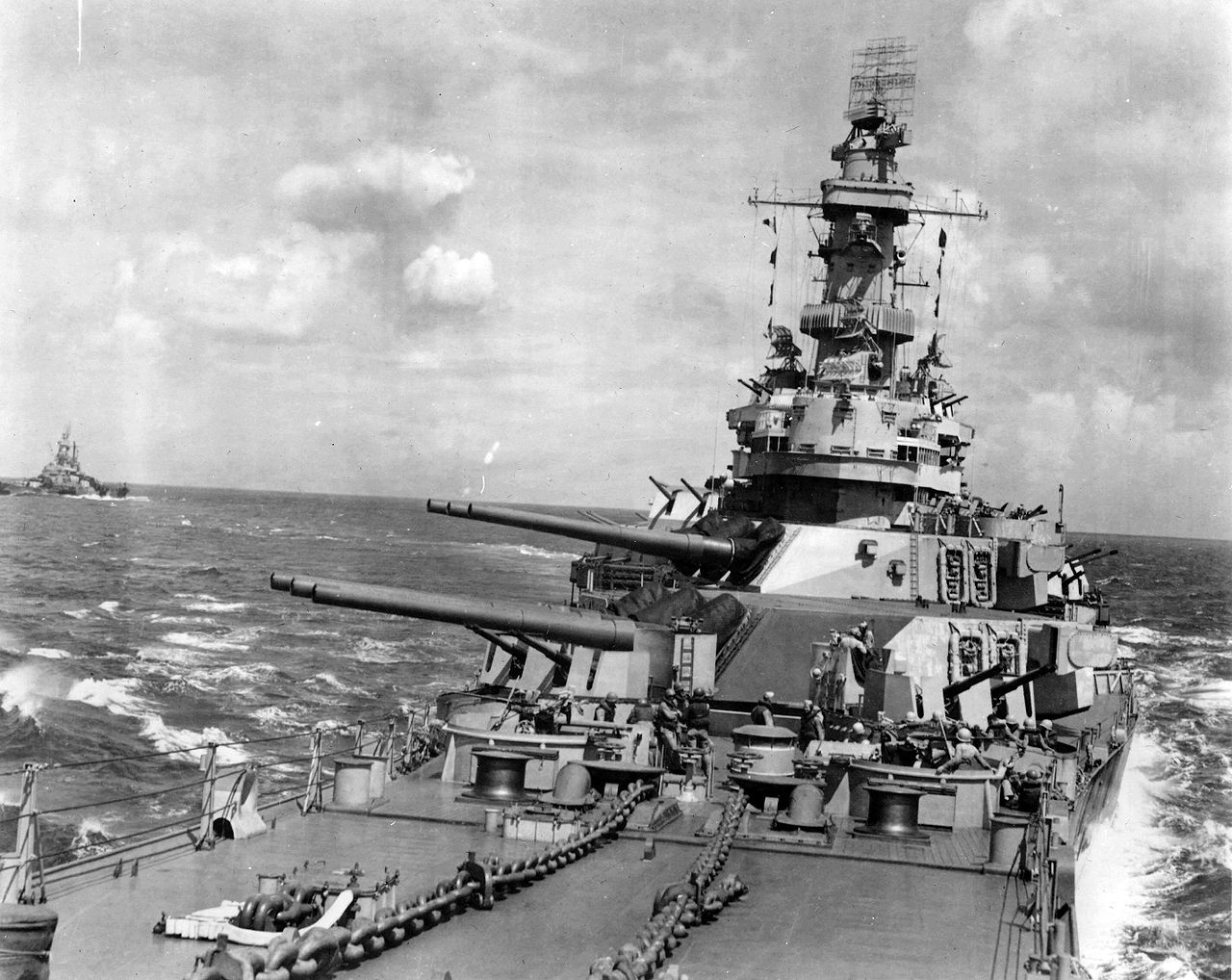
A Second World War photograph taken from the forecastle, looking aft at Turrets 1 and 2 and the tower of an Iowa-class battleship in camouflage paint, probably in 1943–44, with another battleship on the horizon. Two details identify her: the quadruple 40 mm mounts on the forecastle ahead of the main turrets, which the North Carolina and South Dakota classes did not have, and the open bridge around the front of the conning tower, from before the enclosed wraparound bridge added in the 1944–45 refits.
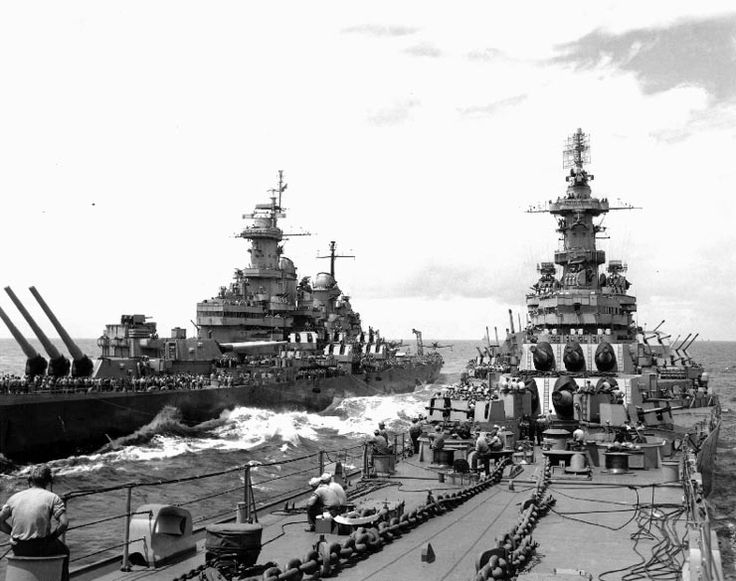
A Second World War photograph from the forecastle of one battleship as another steams close alongside to port.
The Iowas are not a stretched South Dakota with a few extra knots tacked on. After the exchange of notes of 31 March 1938 that invoked the Second London Treaty's escalator clause, the capital-ship limit rose by 10,000 tons, to 45,000. The Navy's Preliminary Design branch looked at several ways to spend the new allowance: another 16-inch turret on a stretched South Dakota, an 18-inch battery, or a much faster ship. The General Board wanted a battleship fast enough to operate with the carriers and to run down Japanese heavy cruisers. A 33-knot study, once freeboard and belt depth were adjusted for that speed, used up most of the new tonnage. The result was an 887-foot fast battleship of Panama Canal beam, with a South Dakota-style internal armored citadel and a new, longer 16-inch/50 gun. [DOCUMENTED, Naval Gazing design history, following the General Board and Preliminary Design story also told by Friedman]
Two more hulls, Illinois (BB-65) and Kentucky (BB-66), were laid down and never completed. They would have introduced a modified torpedo-defense system, estimated to be about 20 percent more effective after disappointing full-scale tests of the South Dakota and Iowa arrangement. Kentucky later gave Wisconsin a 68-foot bow section, and, according to the battleship.org armor article, gave her machinery to the fast combat-support ships Sacramento (AOE-1) and Camden (AOE-2). [DOCUMENTED, Naval Gazing; DANFS Wisconsin; SINGLE-SOURCE, battleship.org, for the AOE machinery]
Dimensions. The handbook and DANFS agree on the main figures: 887 ft 3 in overall (DANFS New Jersey prints 887 ft 7 in, a four-inch variant), 108 ft 2 in beam (some DANFS lines give 108 ft 1 in or 108 ft 3 in), 859 ft 6 in on the waterline, and a full-load draft in the mid-to-high 30s of feet (DANFS Iowa 37 ft 9 in; handbook 36 to 38 ft depending on load). Displacement was 45,000 tons standard by treaty, 57,540 tons full load in 1945 per the handbook, and 48,425 tons standard and 57,500 full load in the Cold War. The handbook gives the cost as about $110 million a ship; a rounded $100 million also circulates. [DOCUMENTED; CONTESTED for cost]
ARMOR
The citadel. The Iowa scheme is an "all-or-nothing" armored box. Instead of spreading thin armor over the whole ship, it concentrates heavy armor over the parts that must not be lost, the magazines, the machinery and the main-battery plotting rooms, and leaves the ends lightly protected. The box runs from Frame 50, just forward of Turret 1, to Frame 166, just aft of Turret 3. Its sides are the belts, its roof is the second (armor) deck, its ends are transverse armored bulkheads, and its bottom is the triple hull, which is not itself a ballistic deck. The turrets, barbettes, conning tower, directors and communication trunks are armored extensions of the box. [DOCUMENTED, Iowa crew handbook; battleship.org]
The design is essentially the South Dakota arrangement, stretched and re-proportioned. The belt is internal, behind the outer hull plating, and sloped 19° inboard. An external belt at that slope would have forced a beam too wide for the Panama Canal's 110-foot locks; the ships' beam is 108 ft 2 in. The cost of the internal belt is that a side hit floods the space outboard of the armor, so the damaged ship's waterline is narrower than the intact one. The never-built Montana class was to have gone back to an external belt. [DOCUMENTED, Naval Gazing; battleship.org; Iowa crew handbook]
The belt. The vertical side armor is an upper and a lower belt, together about 38 ft 6 in deep, running from the second deck down toward the triple bottom between Frames 50 and 166 and sloped at 19°. The upper belt is 12.1 inches of Class A armor, the face-hardened kind, with a very hard surface to break up an incoming shell and a tougher back. The lower belt is Class B, homogeneous armor, 12.1 inches at the top and tapering to about 1.62 inches (handbook) or 1.625 inches (Naval Gazing) as it runs almost to the top of the triple bottom. The lower strake is also the third bulkhead of the torpedo-defense system, and was meant to deal with shells that dive and hit underwater at long range. The handbook's short statement that "each belt is 12.1 inches thick starting at 2nd Deck, tapering to 1.62 inches" is true as a description through the depth, but it does not separate Class A from Class B; both facts are given here. [DOCUMENTED]
Backing and shell plating are contested, and are not collapsed into one number here. Naval Gazing gives the belt as 12.1 inches Class A on 30 lb special treatment steel (STS), with 60 lb STS outer hull plating in way of the belt (60 lb is 1.5 inches, taking 40 lb as one inch); the 60 lb shell was meant to strip the cap from an armor-piercing shell and keep splinters out of the waterline. Many class summaries print 12.1 inches on 0.875-inch STS, plus 1.5-inch STS outer plating; 0.875 inch is 35 lb, not 30 lb. The battleship.org article says the upper belt is bolted to a backing plate, one bolt per five square feet, standing off about two inches with the gap filled with concrete, and that the belt "is attached to a 1.5-inch STS plate," which may conflate the outer shell, the backing, or a local detail. This page prints 12.1 inches Class A, 19°, internal, with STS backing and a 1.5-inch (60 lb) outer shell as the decapping layer. [DOCUMENTED, Naval Gazing; CONTESTED for the backing; SINGLE-SOURCE, battleship.org, for the concrete-filled standoff]
A figure often quoted for the inclined belt, "equivalent to 17.3 inches of vertical Class B at 19,000 yards," is a statement for one range and one projectile, not a universal thickness. Friedman's 13.5-inch vertical equivalent is a different, also range-dependent, reduction. Neither replaces 12.1 inches at 19°. [CONTESTED as to which "equivalent" to print]
Decks. There are three horizontal layers between Frames 50 and 166:
[DOCUMENTED, Iowa crew handbook; Naval Gazing; battleship.org]
Turrets. The handbook and the battleship.org article agree closely on the 16-inch gunhouse armor, except on the side plates. The face is 17-inch Class B on 2.5-inch STS, inclined at 36°, 19.5 inches in total (handbook; some informal summaries say 45°, which is not preferred here). The sides are 9.25-inch Class A on 0.75-inch STS, 10.0 inches in total, in the handbook, and 9.5-inch Class A on 0.75-inch STS in the battleship.org article. The back is 12-inch Class A and the roof 7.25-inch Class B. [DOCUMENTED; CONTESTED for 9.25 vs 9.5 in sides; SINGLE-SOURCE, handbook, for the 36° face]
Barbettes, the armored cylinders that carry each turret down to the magazines, are 11.6 to 17.3 inches of Class A: 17.3 inches abeam, tapering at the quarters to 14.8 inches and to 11.6 inches ahead and astern, where the belt and deck add protection. The 5-inch mounts have 2.5 inches of STS. The conning tower is 17.3-inch Class B, with doors weighing about 4,000 lb each. Iowa is unique in having three armored levels (03, 04 and 05); her sisters have no armored 03 level. The battleship.org article adds a 4-inch STS floor. The steering gear sits in its own 13.5-inch Class A compartment. [DOCUMENTED, Iowa crew handbook; battleship.org]
Transverse bulkheads and the Missouri / Wisconsin difference. The ends of the citadel are vertical Class A transverse bulkheads. On Iowa and New Jersey they are 11.3 inches, which Naval Gazing describes as tapering to 8.5 inches (the taper is SINGLE-SOURCE; the handbook gives 11.3 inches for Iowa without one). The armor for the first two ships had already been ordered when the treaties lapsed, and replacing it would have delayed them. On Missouri and Wisconsin the end bulkheads were increased to 14.5 inches, to improve resistance to raking fire from ahead, which was thought more likely for a 33-knot ship chasing or being chased. [DOCUMENTED, Naval Gazing; Iowa crew handbook]
Torpedo defense and the triple bottom. Below the waterline, outboard of the machinery and magazines, is a side-protection system of four layers of tanks, from about the third deck to the bottom, with the armored belt as bulkhead No. 3. The idea is to let a torpedo's blast burst the outer plating, be absorbed by liquid in the outer tanks, and be stopped by the inner bulkheads before it reaches the vital spaces. As built, after tests, the liquid loading was liquid, liquid, void, void: the two outboard tanks filled with fuel oil or ballast and the two inboard ones empty. The original plan had been void, liquid, liquid, void. The battleship.org article gives bulkheads No. 1 and No. 2 and the inner holding bulkhead as 5/8-inch steel. [DOCUMENTED, Naval Gazing; battleship.org; Iowa crew handbook]
The system is essentially the South Dakota one. Full-scale tests after the ships were already laid down showed structural weaknesses, which is why Illinois and Kentucky were to get the modified, roughly 20 percent better system. The defense is shallow at the fine ends of the hull, and it cannot protect shafts and rudders, which is a limit of every fast battleship, not an Iowa peculiarity. The triple bottom protects against mines, near-miss bombs and explosions under the hull; it is not a substitute for a ballistic deck. A Japanese 24-inch Type 93 "Long Lance" torpedo warhead is cited in the battleship.org article as equivalent to 891 lb of TNT and as having defeated North Carolina's side system; the Iowa system was never tested in combat against that weapon, and claims about how it would have fared are analysis, not trial results. [DOCUMENTED, Naval Gazing; Iowa crew handbook; SINGLE-SOURCE for the 891 lb figure]
The immune zone. An immune zone is the band of ranges, against a particular gun and shell, inside which the belt should keep out direct fire and the deck should keep out plunging fire. Closer in, shells arrive flat and fast enough to pierce the belt; farther out, they fall steeply enough to pierce the deck. The handbook says the original Iowa design specified protection against 16-inch/45 shells between 18,000 and 30,000 yards. The ships were not designed against their own 16-inch/50 firing the 2,700 lb Mark 8 at all ranges, a point often blurred in popular writing. The battleship.org article and some secondaries give 19,000 to 30,000 yards. This page prints the handbook's 18,000 to 30,000 yards against the 16-inch/45 and notes 19,000 as a circulating alternative. The handbook's displacement breakdown at 45,500 tons gives armor as 18,700 tons, 41.6 percent of the ship. [DOCUMENTED, Iowa crew handbook; CONTESTED for the inner edge; SINGLE-SOURCE, handbook, for the weight breakdown]
ARMOR DIAGRAMS
The drawings below show the scheme described above. Where a drawing's figures differ from the text, the text and its sources stand, and the difference is noted in the caption.
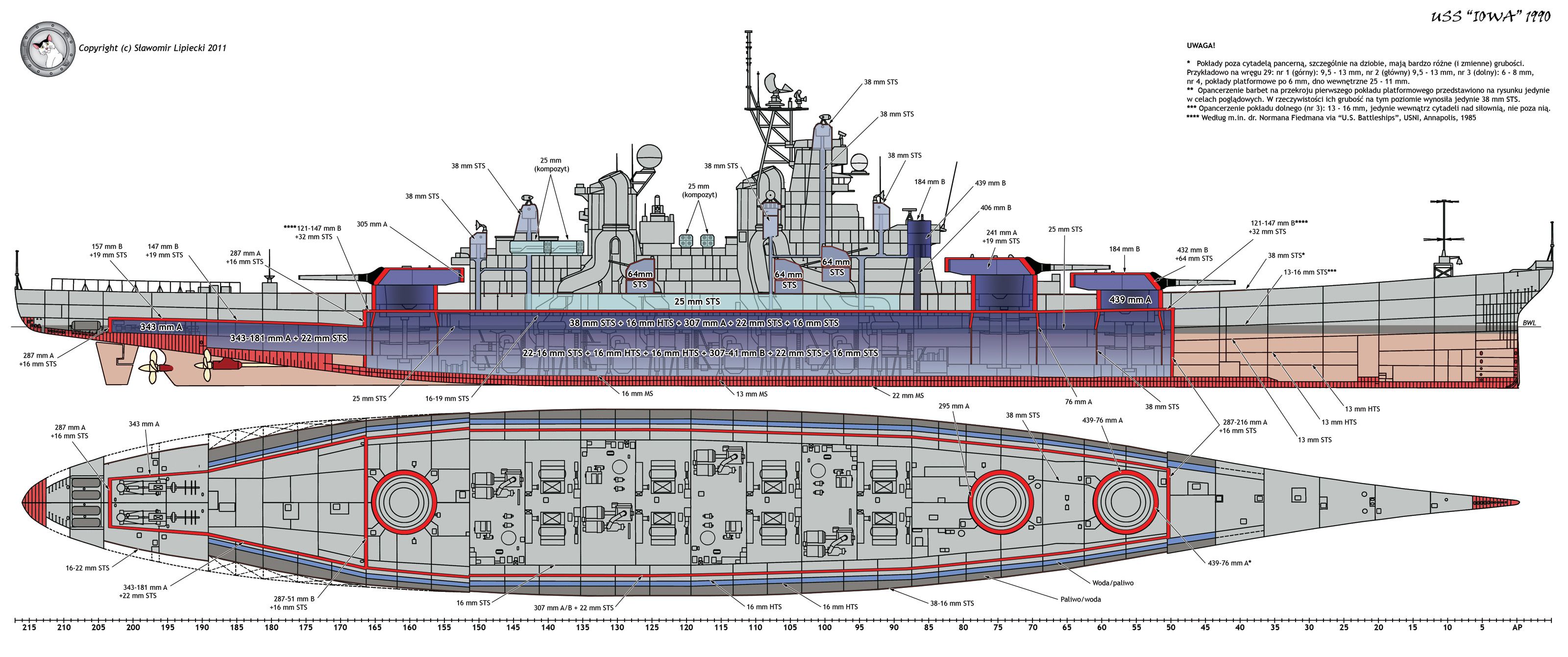
Armor profile and plan drawing titled USS "IOWA" 1990, with armor thicknesses marked in millimetres and notes in Polish. Drawing © 2011 Sławomir Lipiecki, as printed on the image.
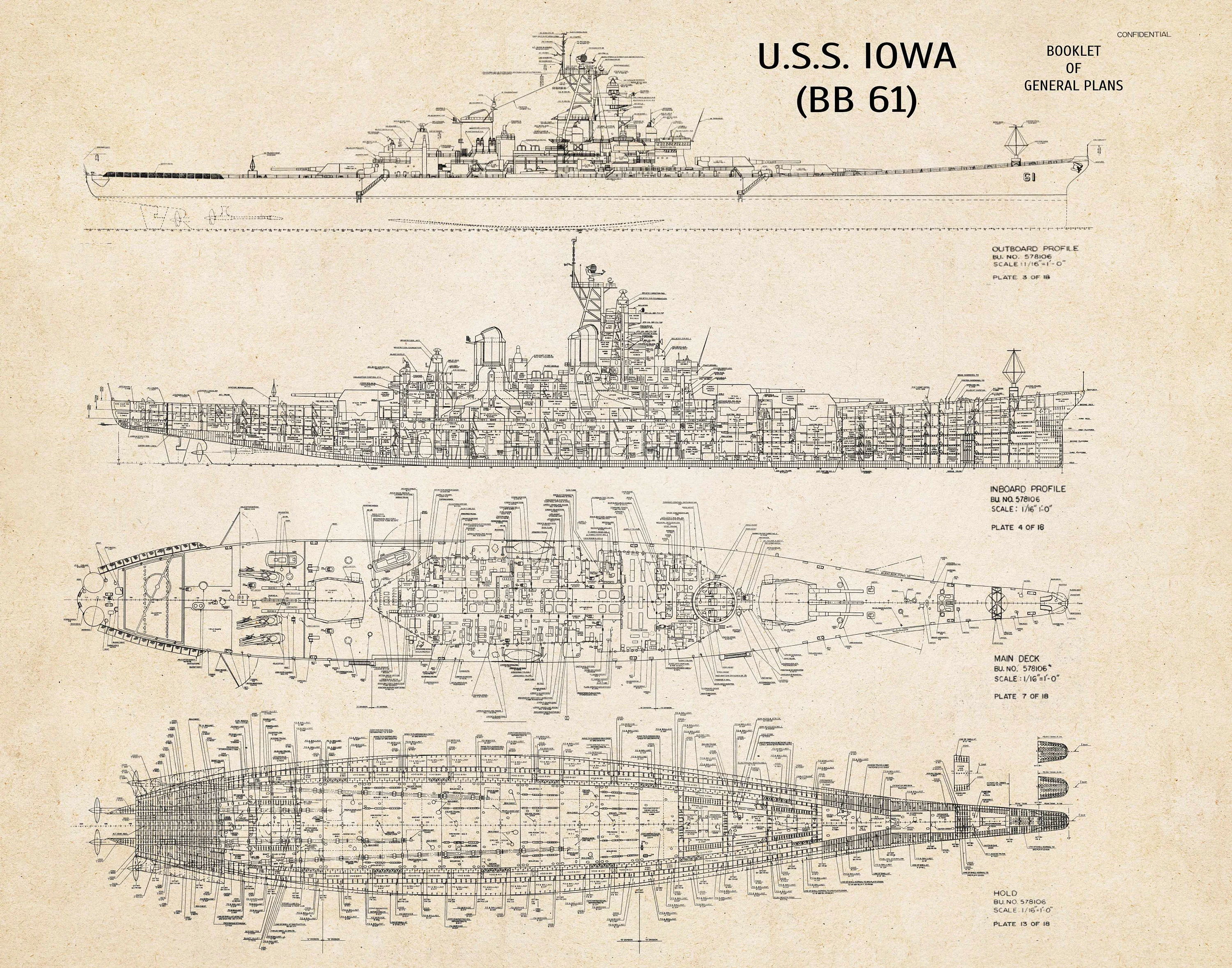
Sheets from the USS Iowa (BB-61) Booklet of General Plans: outboard profile, inboard profile, main deck and hold, reproduced as a print.
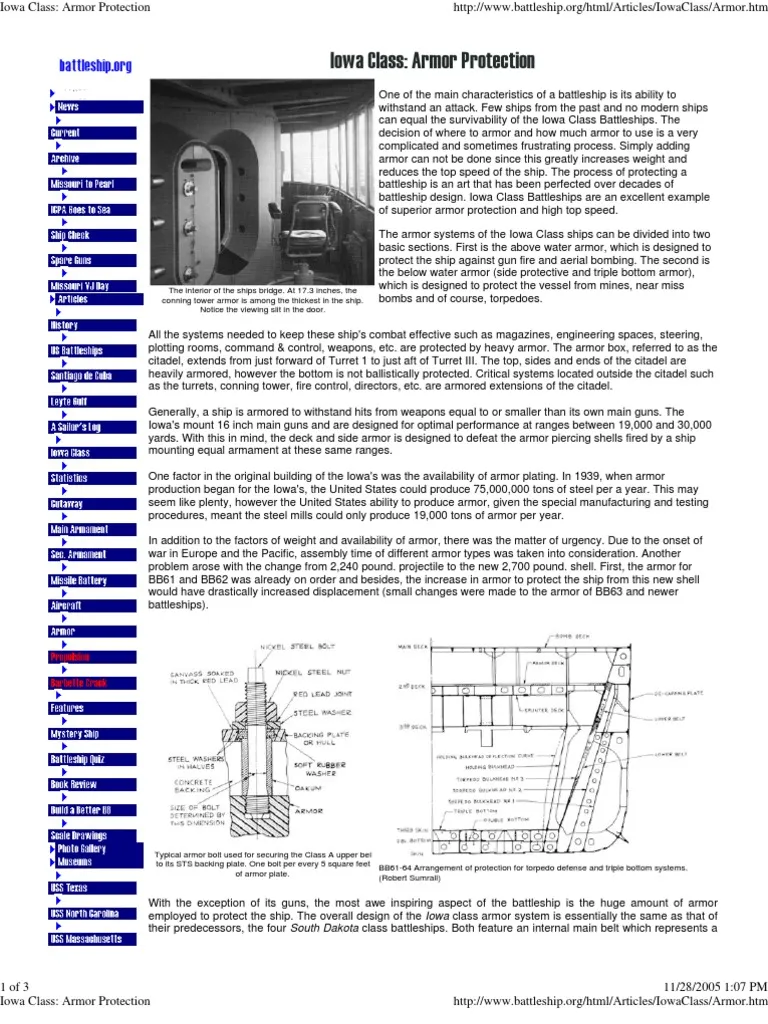
A printed copy of the battleship.org page "Iowa Class: Armor Protection" (printed 28 November 2005), showing the conning tower door, a typical armor bolt and the arrangement of the torpedo-defense system and triple bottom.
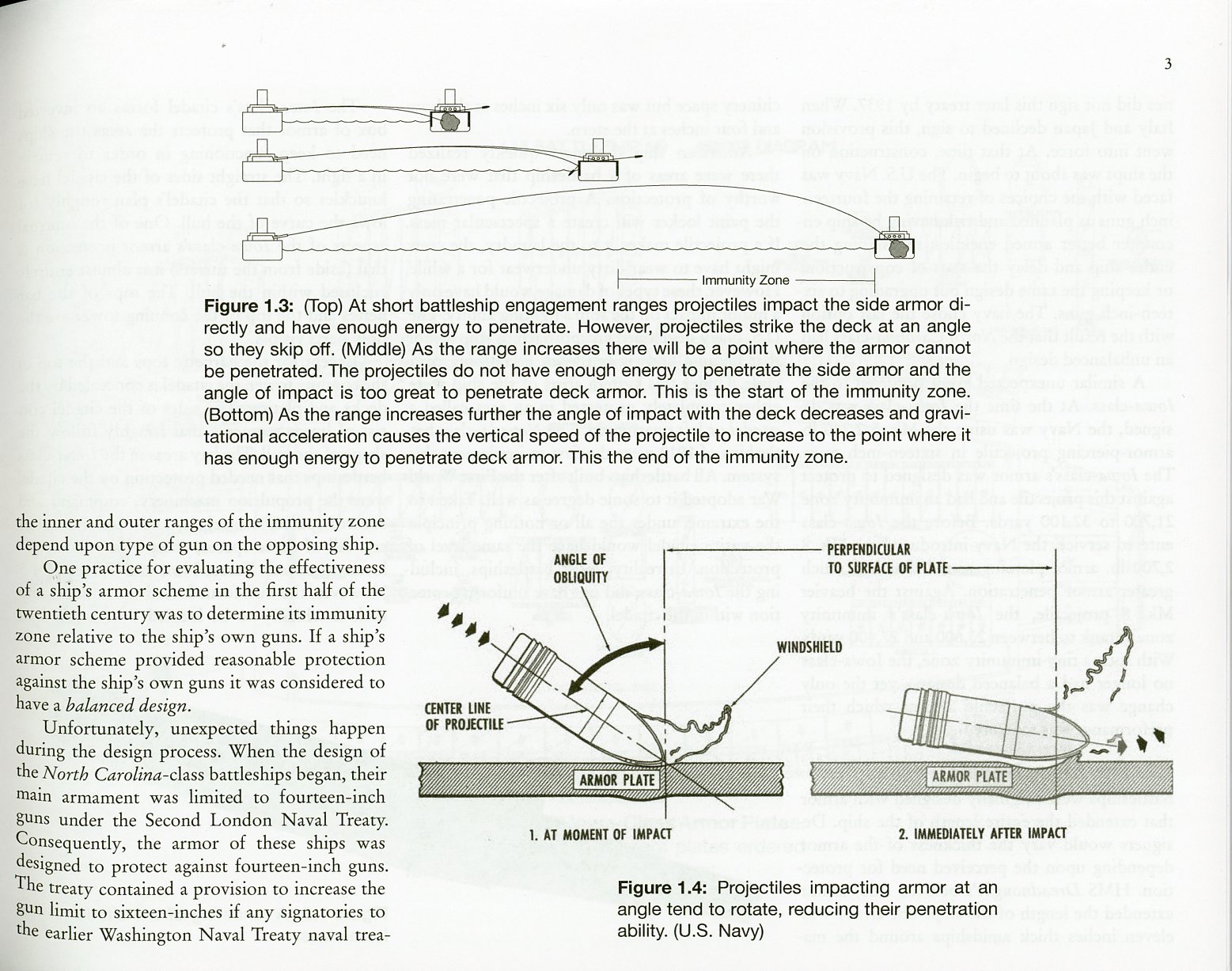
A book page with two figures: how the immune zone is bounded by belt penetration at short range and deck penetration at long range, and how a shell striking armor at an angle tends to rotate (credited on the page to the U.S. Navy).
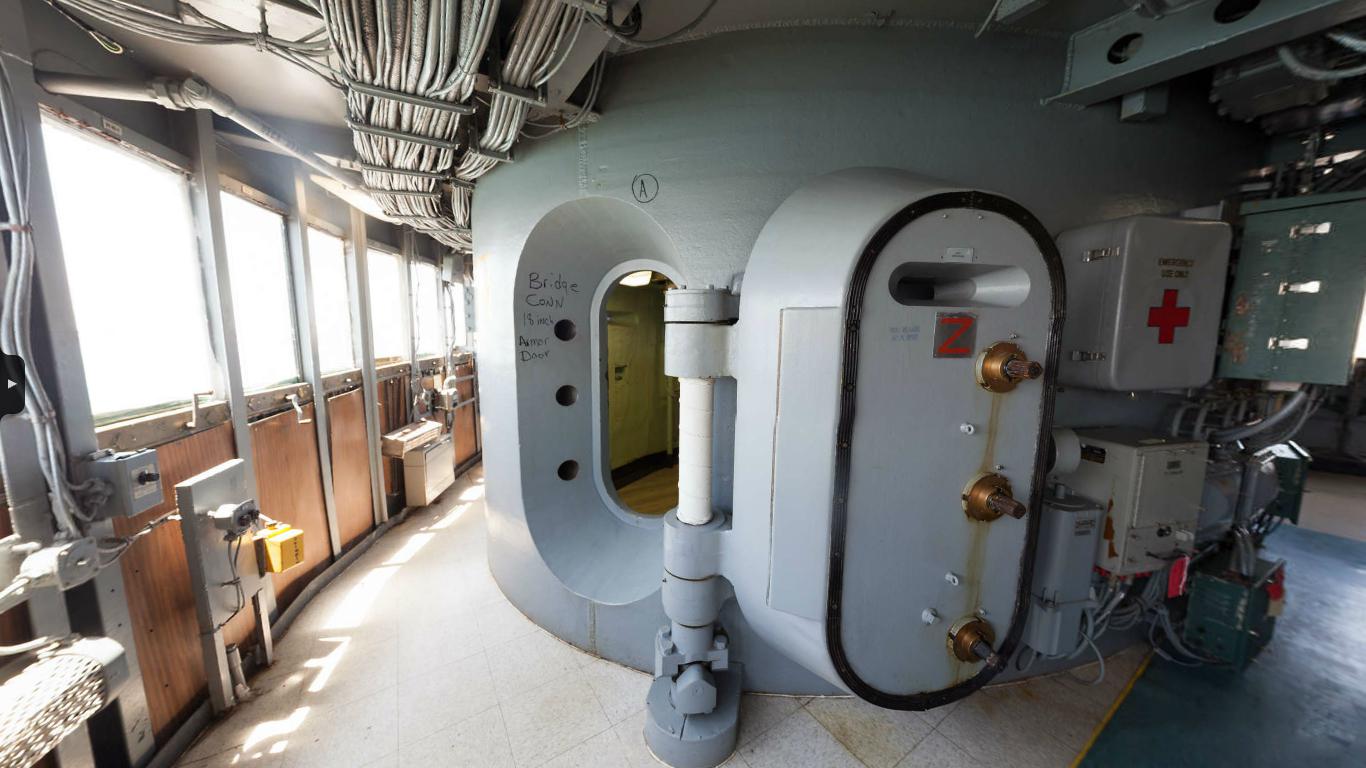
The armored door of a conning tower, open, in an enclosed bridge. A handwritten note beside it reads "Bridge Conn 18 inch Armor Door"; the handbook gives the conning tower as 17.3-inch Class B.
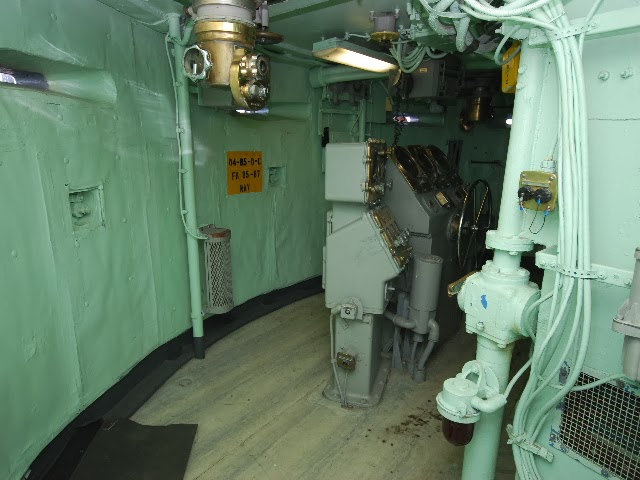
Inside the armored conning tower: the curved armored wall, a compartment label reading 04-85-0-C, and the ship's steering station there, with its steering stand and wheel.
MAIN BATTERY: THE 16-INCH/50 MARK 7
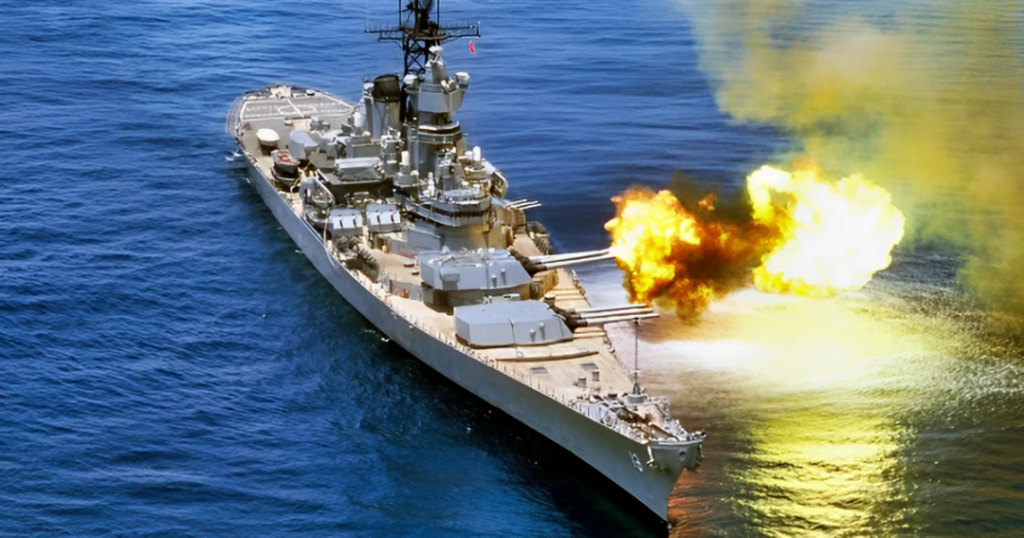
An Iowa-class battleship in her 1980s configuration fires her forward 16-inch guns to starboard, seen from the air.
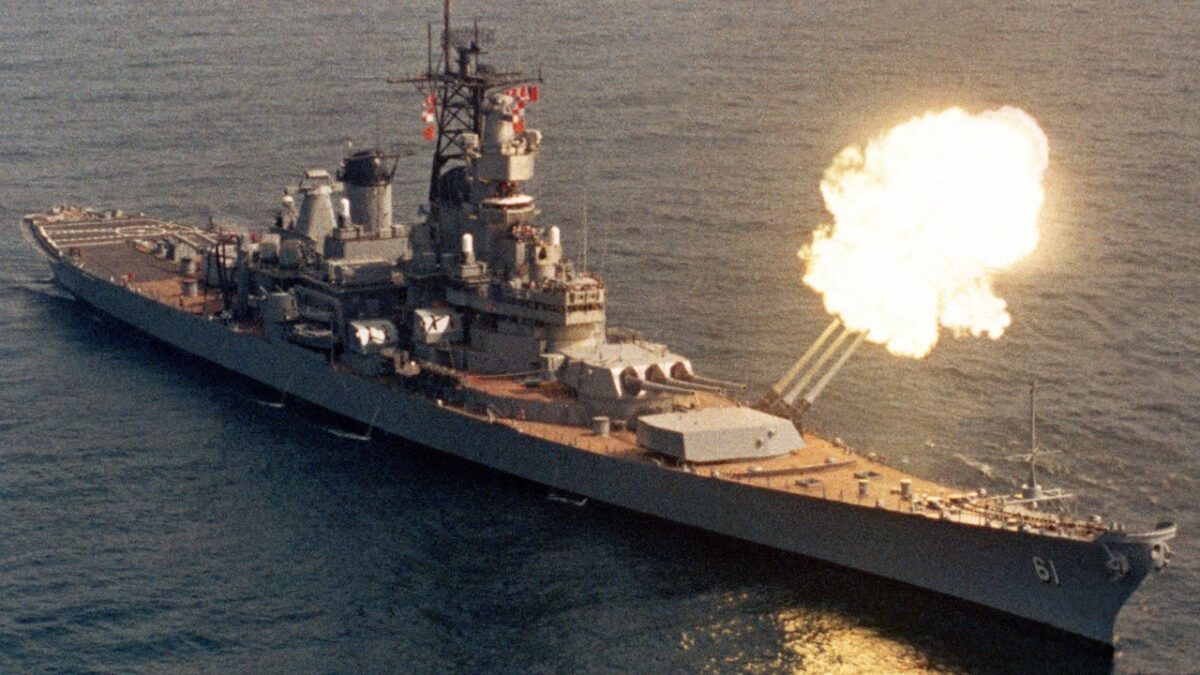
USS Iowa (BB-61) in her 1980s configuration fires to starboard from Turret 2, seen from the air off the starboard bow.
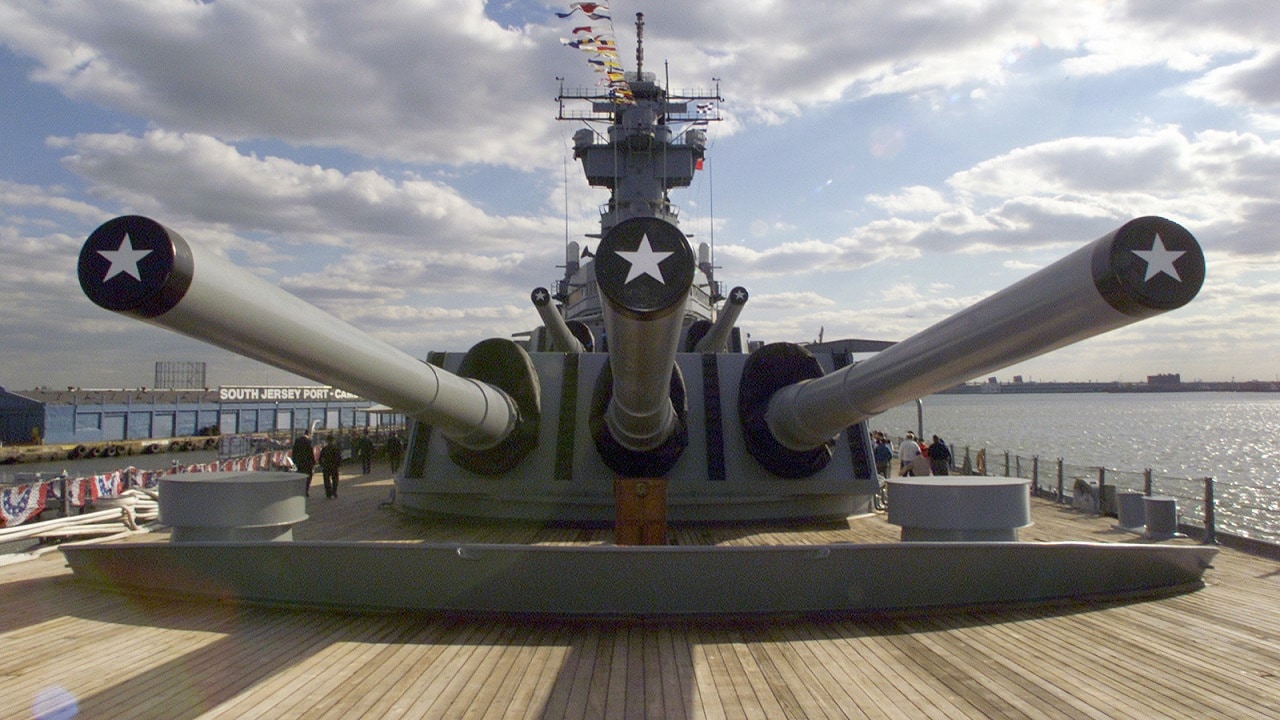
Turret 1 of an Iowa-class museum ship seen head-on from the forecastle, its three 16-inch guns fitted with star-painted tompions, Turret 2 and the superstructure behind.
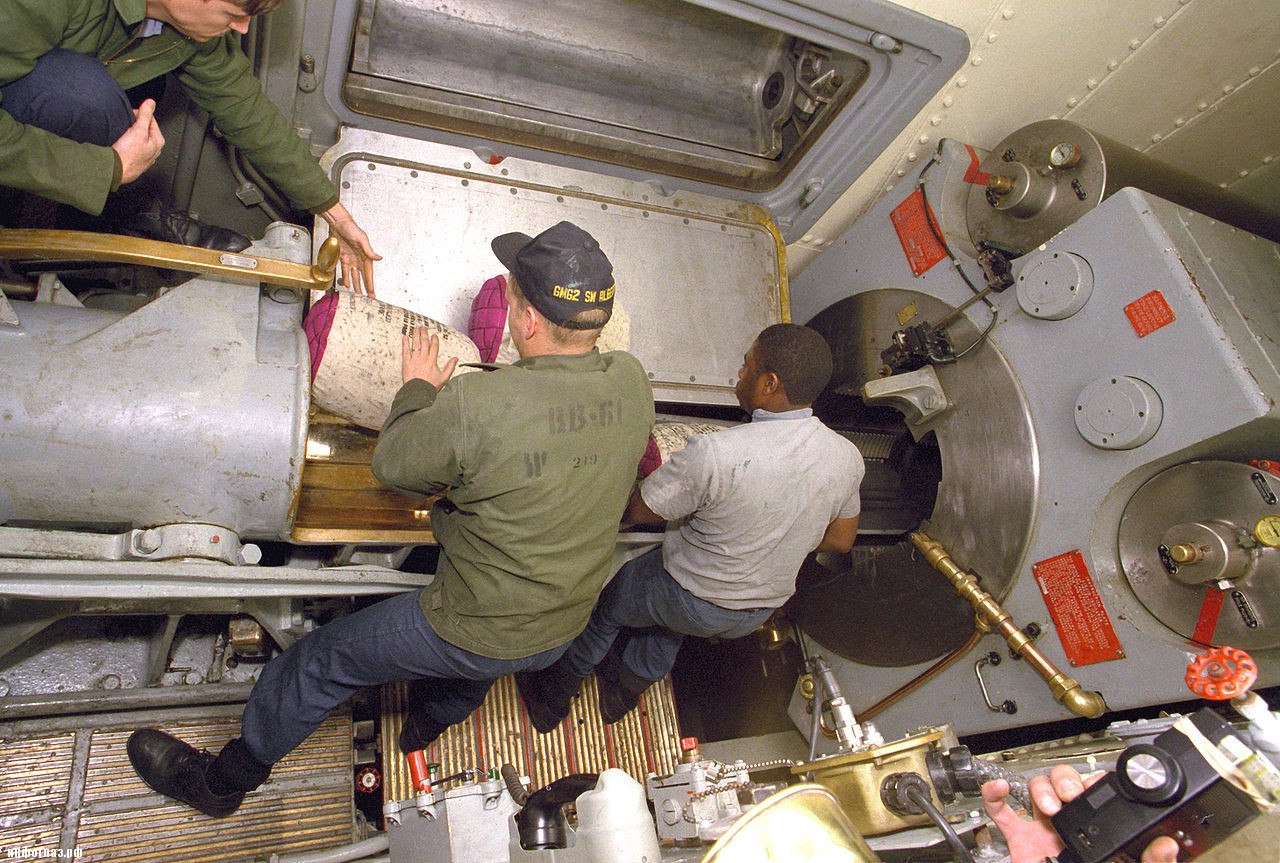
Aboard USS Iowa (BB-61): sailors handle silk-wrapped powder bags at the breech of a 16-inch gun, seen from above. The ship is identified by "BB 61" on a sailor's shirt.
Each ship carries nine 16-inch/50 Mark 7 guns in three centreline turrets, two forward and one aft. The turrets are three-gun houses: each gun has its own slide and can be elevated separately, rather than three barrels being geared together. The 16-inch/50 Mark 7 was designed in 1939 and went to sea in 1943 on this class; it was also intended for the cancelled Montana class. Before any Iowa was laid down, the shell-handling system was redesigned from the 2,240 lb AP Mark 5 to the much heavier 2,700 lb "super-heavy" AP Mark 8. This site's 16-inch Mk 6 / Mk 7 page covers the guns in more detail. [DOCUMENTED, NavWeaps]
The gun. NavWeaps, from Bureau of Ordnance data, gives the gun's weight as 267,904 lb with the breech and 239,156 lb without; overall length 816 inches; bore length 800 inches (50 calibers, which is where the "/50" comes from); 96 rifling grooves with a right-hand twist of one turn in 25 calibers; a chamber of 27,000 cubic inches; and a rate of fire of two rounds per minute. The handbook adds turret training of about 300° at 4° per second, so a full swing takes 75 seconds; elevation from −2° to +45° at 12° per second on Turrets 1 and 3, and from 0° to +45° on Turret 2; recoil of 47 inches; and a turret crew of 77 per turret, not counting the outer powder handlers. [DOCUMENTED, NavWeaps; Iowa crew handbook]
| Projectile | Weight | Burster | New-gun MV | Average-gun MV | Maximum range |
| AP Mark 8 | 2,700 lb | 40.9 lb Explosive D | 2,500 fps | 2,425 fps | 42,345 yd at 45° (new gun, OP 770); 40,185 yd (average gun) |
| HC Mark 13 (and Mk 14) | 1,900 lb | 153.6 lb Explosive D | 2,690 fps | 2,615 fps | 41,622 yd |
At 42,345 yards the OP 770 new-gun table gives a time of flight of 95.32 seconds and a highest point of 36,610 feet: the shell is in the air for more than a minute and a half and climbs to nearly seven miles. The popular "24-mile gun" is a rounding of that table, since 42,345 yards is 24.06 statute miles. Both the new-gun and average-gun figures matter, because a barrel loses velocity as it wears. [DOCUMENTED, NavWeaps / OP 770]
The handbook's popular description of the Mark 8 AP's penetration, "about 30 feet of reinforced concrete or up to 18 inches of armor, depending on distance and angle," is a museum-floor summary. NavWeaps, citing OP 1172 and the Navy's empirical formula, tabulates concrete and armor penetration against range and is the better source for any table. [DOCUMENTED as a summary]
Powder and handling. The 16-inch guns are bag guns: the projectile and the propellant are loaded separately, and the propellant comes in silk bags. The full charge for AP or HC is 660 lb of SPD 839, conventionally six bags of 110 lb each. NavWeaps also lists a separate 593 lb full charge of SPD D846 for HC, a 305 lb reduced charge and a 325 lb reduced flashless charge. Some popular pages print 650 lb; that is a near-miss, and 660 lb is the figure used here. Powder is shipped in tanks that, in the handbook's storage sketch, hold three bags each and are lowered into the magazines. Projectiles are struck down through an armored door and hoisted to the upper or lower projectile flats, where they stand on inner and outer storage rings; the turret is rotated to line up with the hatch for that work. [DOCUMENTED, NavWeaps; Iowa crew handbook]
Broadway is the 256-foot centreline passageway on the third deck, between Frames 87 and 151, a nickname the handbook dates to the 1950s. It is the transfer route between magazines, with an overhead monorail running through nine watertight bulkheads, and it also gives access to the four firerooms, the four engine rooms, and the after 16-inch and 5-inch plotting rooms. [DOCUMENTED, Iowa crew handbook]
Stowage. NavWeaps gives about 130 rounds per gun, 1,170 for nine guns. The handbook gives Turret 1 390, Turret 2 460 and Turret 3 370, for 1,220 in total. Both round to "about 1,200"; the turret split is the handbook's. Each ship had its own dye colour for spotting its fall of shot among others: Iowa orange, New Jersey blue, Missouri red, Wisconsin green. [DOCUMENTED; CONTESTED, 1,170 vs 1,220]
Barrel life. Each shot erodes the bore. Barrel life was 290 effective service rounds (ESR) when the gun was introduced, with some Korean War-era estimates of 350 ESR; an HC round at 2,690 fps counted as 0.43 ESR. A "Swedish additive" of titanium dioxide and wax, used in the 1967 and 1980s deployments, cut wear sharply, to about 0.26 ESR per AP round. A later polyurethane jacket on the bags reduced wear further, until barrel life was recast as 1,500 fatigue-equivalent rounds (FER), erosion no longer being the limit. [DOCUMENTED, NavWeaps]
Special and later projectiles. The Mark 23 "Katie" nuclear shell was real: a 1,900 lb body with a W23 warhead of about 15 to 20 kilotons, the same length as the HC Mark 13, with a Target Mark 24 as the training round. The handbook says it was developed in 1955 and retired in 1961 (a caption on the same pages gives 1955–1963), and that "the Navy never confirmed their presence on Iowa." This page treats the Mark 23 as a real weapon developed for the guns, not as a confirmed load in any Iowa's magazines. [DOCUMENTED, NavWeaps; Iowa crew handbook; UNVERIFIED for any shipboard load-out]
For Vietnam in 1967–69 there was a 280 mm HE M124 round in a sabot and the HE Mark 19, carrying 400 M43A1 grenades, which became the 1980s ICM Mark 144. The 1980s brought the HE-CVT Mark 143, the ICM Mark 144, the HE-ET/PT Mark 145 and the anti-personnel ICM Mark 146, which was tested on Iowa in 1989 and probably entered service shortly after. An improved 2,240 lb HC shell, sometimes called the "Mark 147," was test-fired to more than 51,000 yards at 2,825 fps with an extra 50 lb "baglet," but does not appear to have entered general service. The HE-ER Mark 148 was a prototype. [DOCUMENTED, NavWeaps compilation]
Accuracy. NavWeaps cites a 1987 test shoot off Crete: 15 shells from 34,000 yards fell in a pattern of 220 yards, 0.64 percent of the range, helped by DR-810 muzzle-velocity radars in each turret and more consistent propellant. A persistent story that the Iowas had serious gun-alignment problems until after Leyte Gulf was searched for in official files by William Jurens, the Iowa crew and the Naval Surface Warfare Center at Dahlgren, and was not found. A 26.9-mile shot off Vieques on 20 January 1989, reported in the handbook, is single-source and ambiguous between statute and nautical miles; 26.9 statute miles would be about 47,300 yards, far beyond the service range table, which implies a special or extended-range shoot. The service range is not upgraded here on the strength of it. [DOCUMENTED, NavWeaps; UNVERIFIED for the alignment story; SINGLE-SOURCE for the Vieques shot]
SECONDARY BATTERY: THE 5-INCH/38
The designed secondary battery, which was dual-purpose, firing at both ships and aircraft, was twenty 5-inch/38 Mark 12 guns in ten Mark 28 twin enclosed mounts, five on each side, with 2.5 inches of STS. In the 1980s reactivation four of the ten twin mounts were removed, leaving six mounts and twelve guns, to clear space and topweight for the missiles and Phalanx. New Jersey in 1968–69 kept all twenty 5-inch guns, with her 40 mm battery already removed. Detailed 5-inch/38 ballistics were not extracted for this article and are not given here. [DOCUMENTED, Iowa crew handbook; DANFS New Jersey; Naval Gazing]
LIGHT ANTI-AIRCRAFT, BY ERA
The light anti-aircraft battery was never frozen; it grew through the war and shrank afterwards. The handbook's figures for Iowa:
DANFS class lines for Missouri and Wisconsin often print 80 × 40 mm and 49 × 20 mm. That is a class or rounded figure, not Iowa's 1944 count, and the two are a matter of ship and date rather than a disagreement about the same moment. A complete mount list by ship and year was not compiled. The 20 mm guns were removed as obsolete, "most likely prior to the 1949 decommissioning"; all the 40 mm were gone by the 1980s reactivation, and already gone on New Jersey in 1968. [DOCUMENTED, Iowa crew handbook; DANFS]
THE 1980s MISSILE AND CIWS FIT
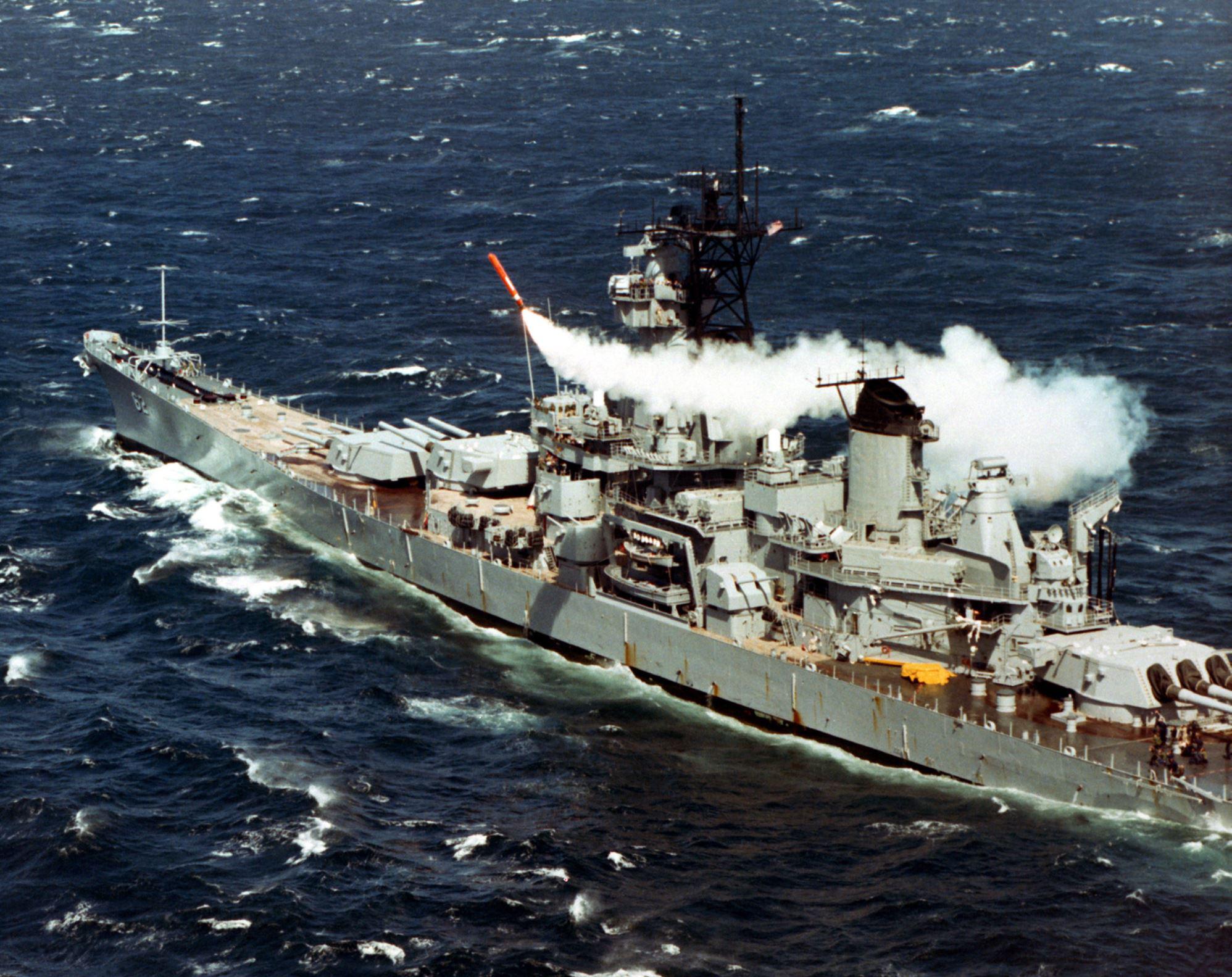
A missile is launched from amidships on USS New Jersey (BB-62) in her 1980s configuration, seen from the air on the starboard quarter.
The 1980s reactivation turned a gun battleship into a missile ship as well:
[DOCUMENTED, Iowa crew handbook; Naval Gazing; DANFS Wisconsin]
RADAR AND ELECTRONIC WARFARE, BY ERA
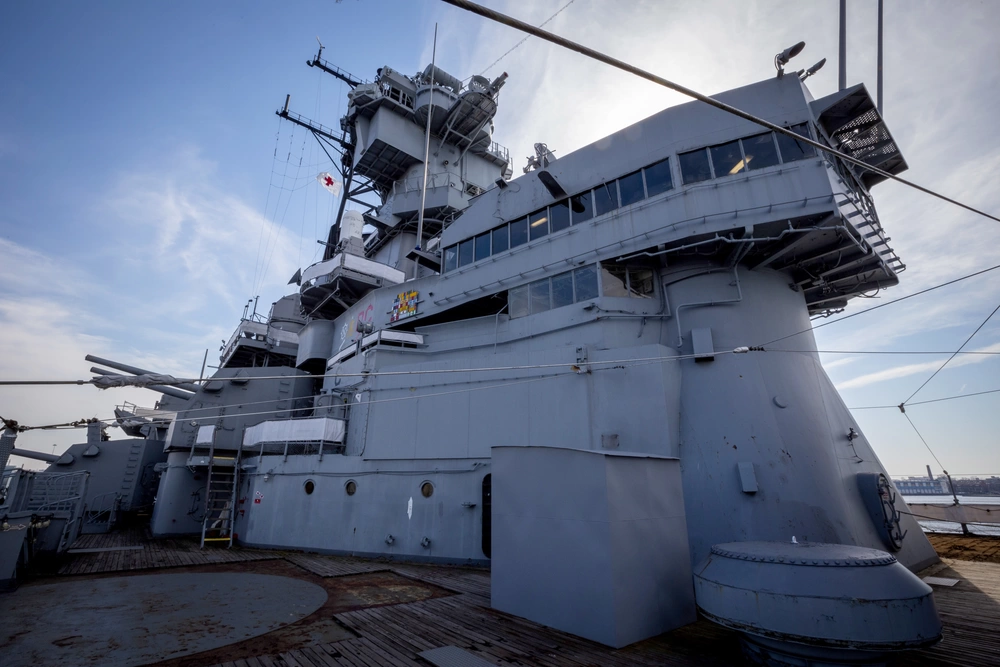
The forward superstructure of an Iowa-class museum ship seen from the main deck, with the bridge windows, the tower and the mast above.
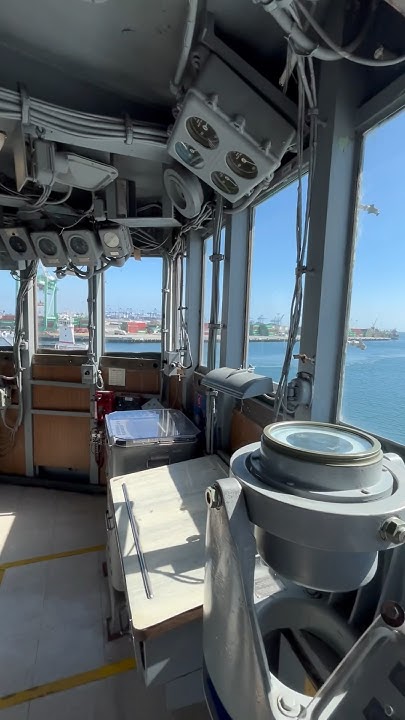
Inside an enclosed bridge: a compass binnacle in the foreground, overhead lights and a chart table, with a harbor and container cranes beyond the windows.
There is no single "Iowa radar fit." Search radars were changed through the 1940s, 1950s and 1980s, and the fire-control radars on the directors were upgraded in place. What follows is the documented pattern, not an antenna log for each ship.
Second World War. The designed air-search set was the SK, with SC-2 listed for some early fits. Surface search was the SG, often with two antennas. Fire-control radar on the Mark 38 main-battery directors began with the Mark 8 (and, in the earliest period, residual Mark 3), and on the Mark 37 secondary directors with the Mark 4, then the Mark 12/22. Late-war and immediate post-war upgrades brought the large dish of the SK-2, the SR air-search set, the SP height-finder, and the Mark 13 main-battery fire-control radar in place of the Mark 8. Encyclopedia-style lists assign SC-2 specifically to Iowa and Wisconsin; those ship-by-date assignments were not checked against Navy antenna plans and are contested. The family of sets on the class is not in doubt. [DOCUMENTED as the family; CONTESTED for ship-by-date assignments]
Korea and the 1950s. The Mark 13 remained the main-battery radar, and the secondary directors received the Mark 25. Air and surface search moved to the AN/SPS-6 and AN/SPS-10, and some ships later carried the AN/SPS-8 height-finder in place of the SP. Exact change-over dates by ship were not reconstructed.
Vietnam (New Jersey only, 1968–69). DANFS says she was "fitted with improved electronics and a helicopter landing pad" and that the 40 mm battery was removed. It does not name the search radars, and this page does not guess them.
The 1980s. The reactivations brought the AN/SPS-49 air-search and AN/SPS-67 surface-search radars in place of the 1950s sets. Iowa and New Jersey recommissioned with SPS-10s, and the SPS-67 came in later refits; the two sets use the same antenna, which is why photographs can mislead. The Mark 13 (main battery) and Mark 25 (secondary) fire-control radars were kept, and IFF was updated. [DOCUMENTED, Naval Gazing]
Electronic warfare, 1980s. The AN/SLQ-32(V)3 ("Slick-32") detected, classified and jammed hostile radars and controlled the Mk 36 SRBOC chaff launchers. An AN/SLQ-25 Nixie towed torpedo decoy was carried at the stern. Second World War and Korean-era EW equipment (SPT-1/4, DBM, TDY-1, later ULQ-6) appears in class compilations but was not verified from a primary source and is not detailed here. [DOCUMENTED, Naval Gazing; Iowa crew handbook]
GUN FIRE CONTROL
Hitting a moving ship twenty miles away, from a ship that is itself moving, rolling and pitching, with a shell that takes more than a minute to arrive, is a calculation problem. The Iowas solved it with the Mark 38 Gun Fire Control System, the same analog plant described on this site's Mark 38 GFCS page, and the handbook agrees with that page. There are two complete systems:
[DOCUMENTED, Iowa crew handbook]
Plotting rooms. Iowa has two separate main-battery plotting rooms, unlike the North Carolina and South Dakota arrangement of one room holding two rangekeepers. Forward main-battery plot is just aft of the Turret 2 barbette on the fourth deck, inside the citadel. After plot is on the third deck, forward of Turret 3, off Broadway. Each contains a Ford Instrument Mark 8 rangekeeper, a Mark 41 stable vertical, Mark 13 radar controls and the associated switchgear. The two plots can run independently or be cross-connected. [DOCUMENTED, Iowa crew handbook; this site's Mark 38 page]
The Mark 8 rangekeeper is an electromechanical analog computer: gears, cams, shafts and integrators that work out the answer continuously rather than step by step. Its inputs include the target's range and bearing; own ship's course and speed (from the gyrocompass and pitometer log); relative wind; the guns' average initial velocity; air density; gravity; the Magnus effect of the spinning shell; earth curvature; Coriolis effect; and parallax between the director and each turret. Its output is where to point the guns so that the shell and the target arrive at the same place at the same time. The Mark 41 stable vertical is a vertical-seeking gyroscope that continuously measures the angles between the deck and the true horizontal, so that the guns can be kept at the right elevation as the ship rolls and pitches; the firing keys are on that unit, so the salvo goes when the deck is in the right place. The handbook says the Mark 8 "was used throughout Iowa's active duty." [DOCUMENTED, Iowa crew handbook]
Turret local control. Each turret has a large rangefinder across the rear of the gunhouse (the "ears" that stick out on each side), trainers' and pointers' telescopes and two periscopes, and can fire in local control if the plots or directors are lost. [DOCUMENTED, Iowa crew handbook]
The Mark 48 shore-bombardment computer. The handbook: "During Korea, a Mk 48 analog computer was added" in forward main-battery plot. The ordnance pamphlet OP 2074 (Computer Mark 48 Mod 1) describes an analog machine that, for indirect shore bombardment, takes the bearing, range and height of a visible reference point together with charted coordinates and own-ship position, and outputs target bearing, slant range and elevation to the Mark 8. That is the device behind the ships' naval gunfire support role in the 1980s as well; it was a Korean-era addition kept in service, not a 1980s invention. [DOCUMENTED, Iowa crew handbook; OP 2074]
The 1980s and the Mark 160 question. In their 1980s form each turret had a DR-810 muzzle-velocity radar, which measured each gun's actual velocity so the plot could correct for it. NavWeaps also mentions a "Mark 160 FCS," together with better propellant, as improving accuracy. The Mark 160 is the digital gun fire-control system of later 5-inch ships. Whether a Mark 160 was ever the firing computer on the Iowas, or whether NavWeaps is loosely grouping a digital adjunct with the retained Mark 8, is contested. The handbook's plain statement that the Mark 8 was used throughout active duty, and the well-attested retention of the analog plots, govern here: the Mark 8 rangekeeper and the Mark 41 stable vertical stayed in service, and the analog plant was not torn out and replaced by a Mark 160. [DOCUMENTED for DR-810 and the retained Mark 8; CONTESTED for any Mark 160 role]
Mark 41 or Mark 43? Some accounts mention a Mark 41 "or Mark 43" stable vertical. The Iowa handbook names the Mark 41. The Mark 43 may belong to other ships of the period, such as the South Dakota class, or to a later modification. Whether Iowa ever carried a Mark 43 is not established. [CONTESTED only as to a Mark 43 on Iowa]
Secondary and light-AA fire control. Four Mark 37 directors served the 5-inch battery; the handbook refers to Sky 1 and Sky 2 and to forward and after secondary plots, separate from the 16-inch plots. Radar on those directors progressed from the Mark 4 to the Mark 12/22 to the Mark 25. The light AA used Mark 51, and later Mark 57 and Mark 63, directors, the standard wartime US progression. A count of Mark 51 directors by ship and year was not compiled. [DOCUMENTED as to the families; UNVERIFIED for counts]
POWER PLANT
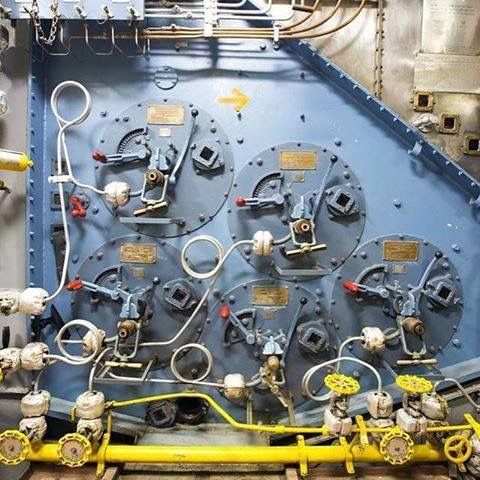
A boiler front aboard an Iowa-class battleship, painted blue, with five burner registers, brass plates and yellow piping.
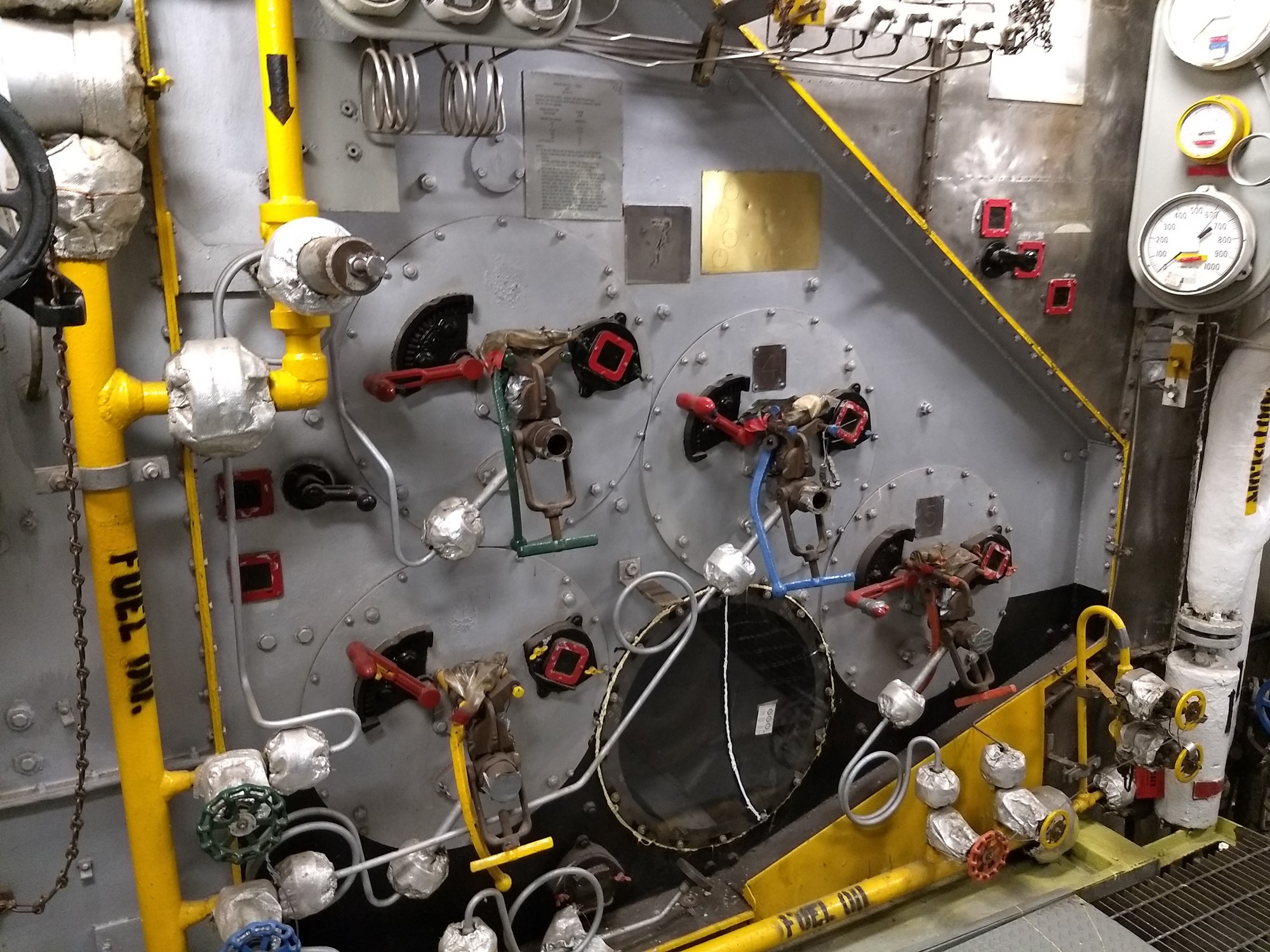
A boiler front aboard an Iowa-class battleship: burner registers, an observation port, a pressure gauge and yellow lines marked FUEL OIL.
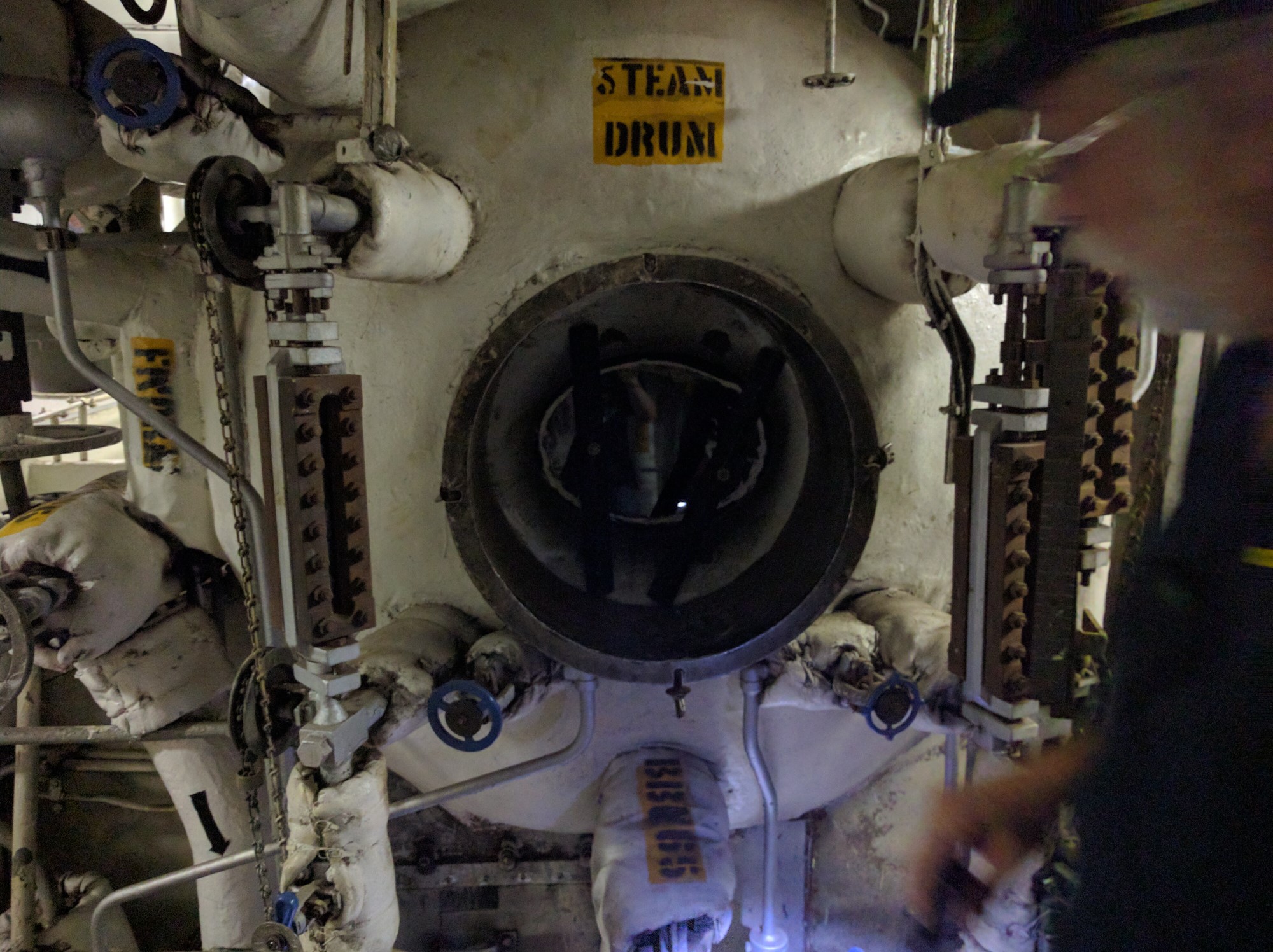
The end of a boiler steam drum aboard an Iowa-class battleship, labelled STEAM DRUM, with its manhole open and a gauge glass on each side.
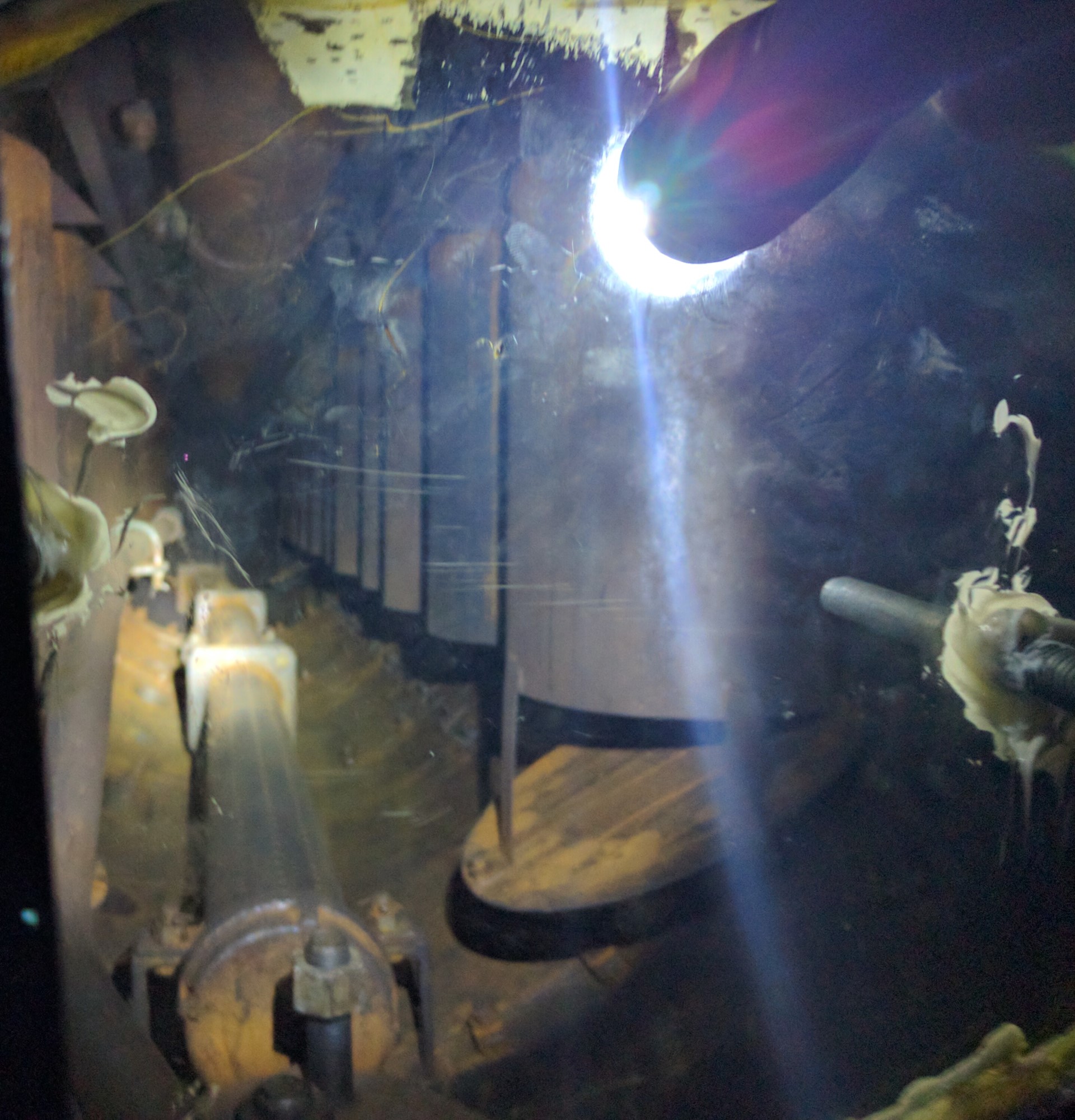
Inside a boiler drum aboard an Iowa-class battleship, lit by a flashlight, showing the drum internals and tube openings.
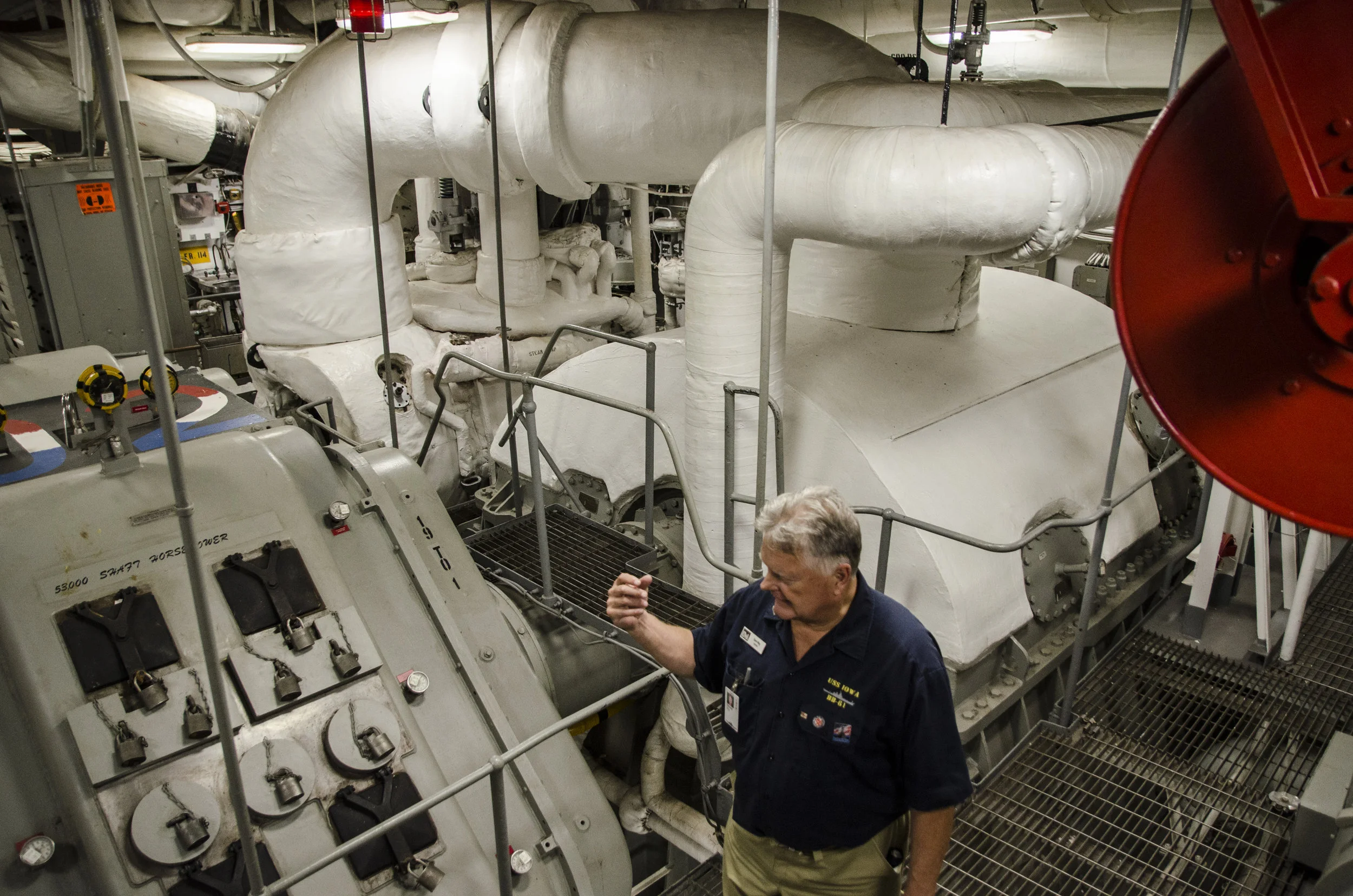
An engine room aboard an Iowa-class battleship: the white lagged turbine casing, a gauge board with a plate reading 58000 SHAFT HORSEPOWER, and a guide on the gratings. The handbook gives 53,000 SHP per engine; the 58,000 on the plate is not explained by the sources used here.
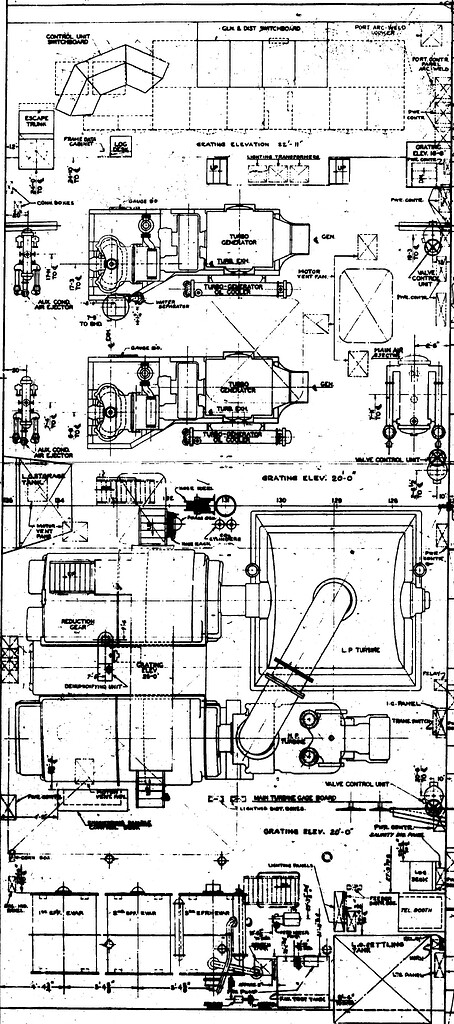
Machinery arrangement plan of an engine room in an Iowa-class battleship, showing the HP and LP turbines, the reduction gear, two turbo-generators, the main turbine gage board and the air ejectors, around Frames 126 to 136.
The full technical story of how a naval steam plant works, from boilers and superheaters to condensers, feedwater chemistry and the people who stood the watches, is in this site's Naval and Marine Steam Power Plants article. The Iowa numbers, in brief:
[DOCUMENTED, Iowa crew handbook; Naval Gazing]
Speed. The handbook gives a design speed of 33 knots and a maximum astern speed of 17.5 knots. Naval Gazing, following Friedman at 53,900 tons, uses 32.5 knots at 212,000 SHP. Capt. William C. Earl's April 1988 Proceedings article says that without superheat the ship could make 22 knots; that with four boilers on superheat and four engines she could "easily cruise at 27 knots"; and that top speed was "in excess of 30." Speeds much above 33 knots are contested. Tony DiGiulian's NavWeaps study takes 32.5 knots at 212,000 SHP and 53,900 tons as the calculated trial-displacement speed, and 35.4 knots at 254,000 SHP (the designed 20 percent overload) at 51,000 tons as the maximum credible deep-water figure. The reported incidents, including the chase of the destroyer Nowaki at 32.5 knots, New Jersey at 35.2 knots at 207 rpm with no shaft power or displacement stated, and Iowa slightly over 32 knots at 205 rpm in 1985, are discussed there and are not flattened here into "the Iowas did 35 knots." [DOCUMENTED; CONTESTED above 33 kn]
Fuel, range and screws. The ships burned heavy fuel oil in the Second World War and were converted to Navy distillate (DFM) in the 1980s. The handbook gives a 1945 fuel capacity of about 2.4 million gallons and a range of 15,000 miles at 15 knots, without saying whether those are statute or nautical miles; a commonly cited 14,890 nautical miles at 15 knots was not found in a primary source. The outboard propellers are four-bladed and larger; the inboard ones five-bladed and slightly smaller. The handbook gives shaft diameters of 23 inches and cites a lee-helm plaque of 219 rpm for 31 knots; the 202 rpm design figure in another compilation is for a different condition, and the two are not averaged. [DOCUMENTED; CONTESTED for the exact endurance]
ELECTRICAL PLANT AND EMERGENCY POWER
Each of the four engine rooms has two ship's service turbo-generators (SSTGs), steam-driven generators fed from the main plant, for eight in all. They generate 450-volt, three-phase, 60 Hz alternating current; the handbook says "450 volt (per nameplate) … for the ship's 440/110 VAC electrical needs." The Iowas were AC ships from the start, like the North Carolina and South Dakota classes before them, not a conversion from an older direct-current plant. [DOCUMENTED, Iowa crew handbook]
The handbook gives the capacity of "the electric generator sets" as 10,500 kW. That total is the arithmetic of eight 1,250 kW SSTGs (10,000 kW) plus two 250 kW emergency diesel generators (500 kW). The 1,250 kW rating per SSTG is the standard figure in class descriptions and in Naval Gazing's machinery walk-throughs; the handbook does not print "1,250" beside each machine, but it is the figure that makes the handbook's total add up. [DOCUMENTED for the 10,500 kW total and the 450 V AC plant; SINGLE-SOURCE chain for 1,250 kW per SSTG]
Emergency diesels. There are two, each rated at 250 kW AC and, according to Naval Gazing's caption for the machine in the after auxiliary machinery room, 5.5 kW DC. Naval Gazing describes the diesel as the same type used in contemporary submarines. These are the ship's backup if steam is lost and the turbo-generators stop. Emergency switchboards and casualty-power cables, which let damage-control parties rig temporary power around damaged sections, are the standard US Navy arrangement; a full one-line wiring diagram for the class was not consulted. The handbook's publicity figures of 250 miles of electric cable, 900 motors, 5,300 lighting fixtures and 1,091 telephones are useful as colour, not as a load study. [DOCUMENTED, Naval Gazing; SINGLE-SOURCE, handbook, for the publicity figures]
DAMAGE CONTROL
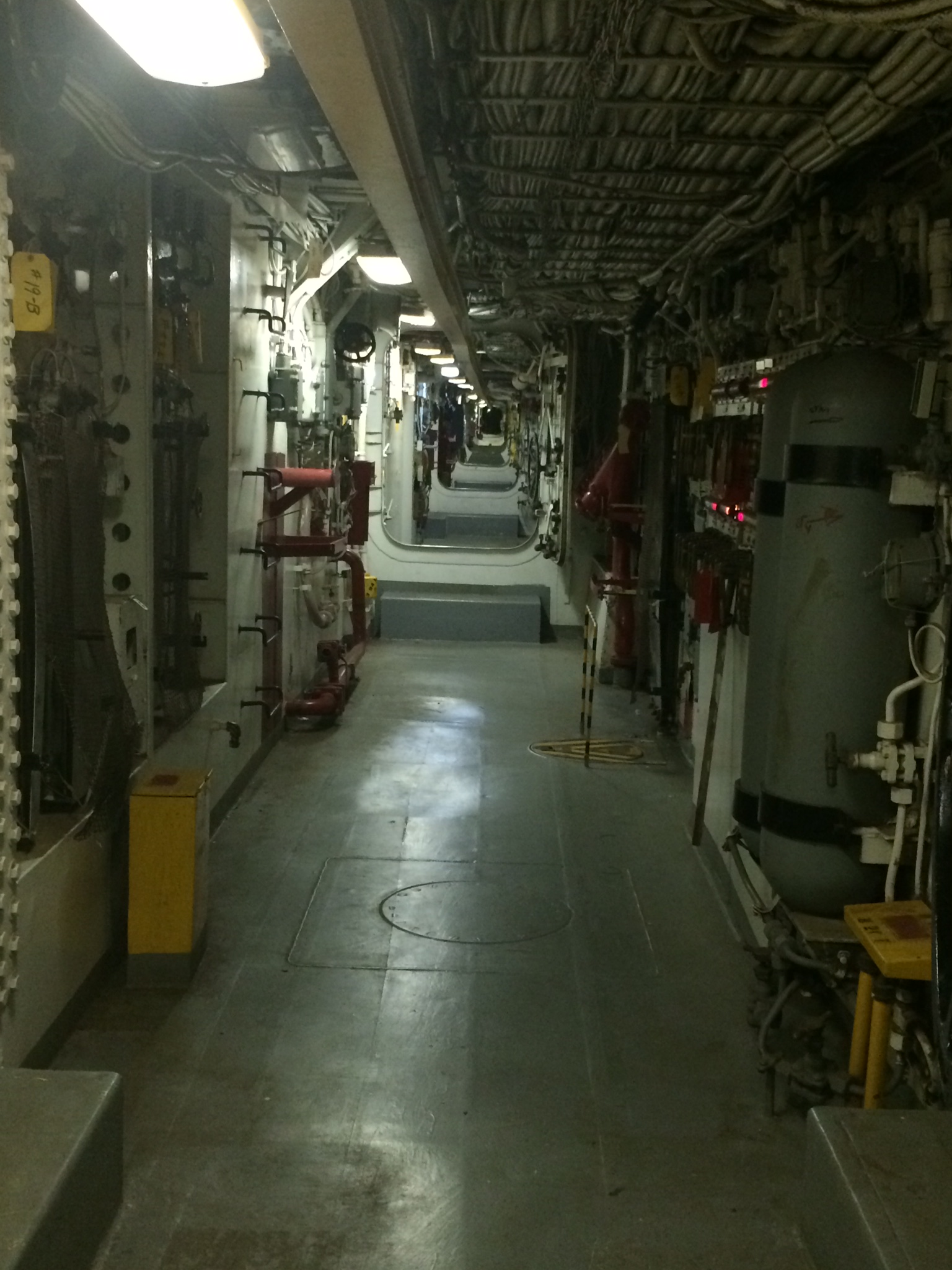
A long passageway running fore and aft, lined with piping, cable runs and a red fire-main riser, with hatches let into the deck.
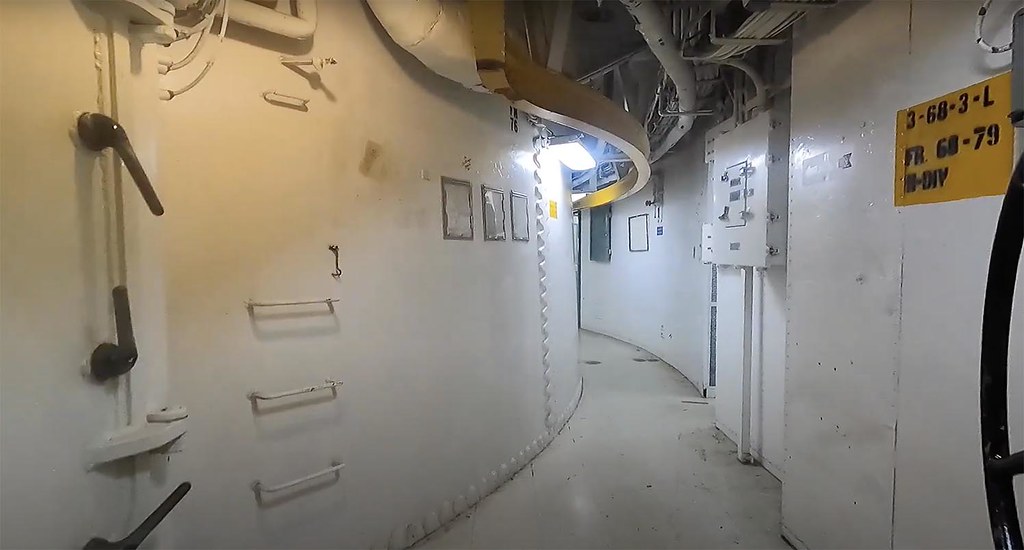
A curved passageway with a compartment label reading 3-68-3-L, FR 68-79, B-DIV. The curved wall is the outside of one of the main-battery turret barbettes.
The sources are thinner here than for armor or guns, and this page says so. What is firm is the architecture: the armored citadel; the four-plant split with alternating firerooms and engine rooms; the absence of a centreline longitudinal bulkhead in the machinery spaces of this generation, which limits off-centre flooding and the dangerous list it causes; watertight subdivision; and the ability to steam any turbine from any boiler. Broadway gives access along the ship through the midships watertight bulkheads. [DOCUMENTED]
Steering. The steering gear sits in its 13.5-inch Class A compartment. After steering, next to the hydraulic ram engines on the fourth deck, can control the twin 21-foot rudders directly if control from the bridge is lost, and as a last resort the rudders can be moved "manually with block, tackle and muscle." [DOCUMENTED, Iowa crew handbook]
A central damage-control station and numbered repair parties were standard US battleship organization of the period, but no primary source listing Iowa's repair parties, their stations, or a formal counter-flooding doctrine was found, and none is invented here. Counter-flooding, deliberately flooding compartments on the opposite side to correct a list, is implicit in the stability problem of the internal belt, but a doctrine card was not found. [UNVERIFIED for repair-party organization and counter-flooding doctrine]
COMMUNICATIONS, BY ERA
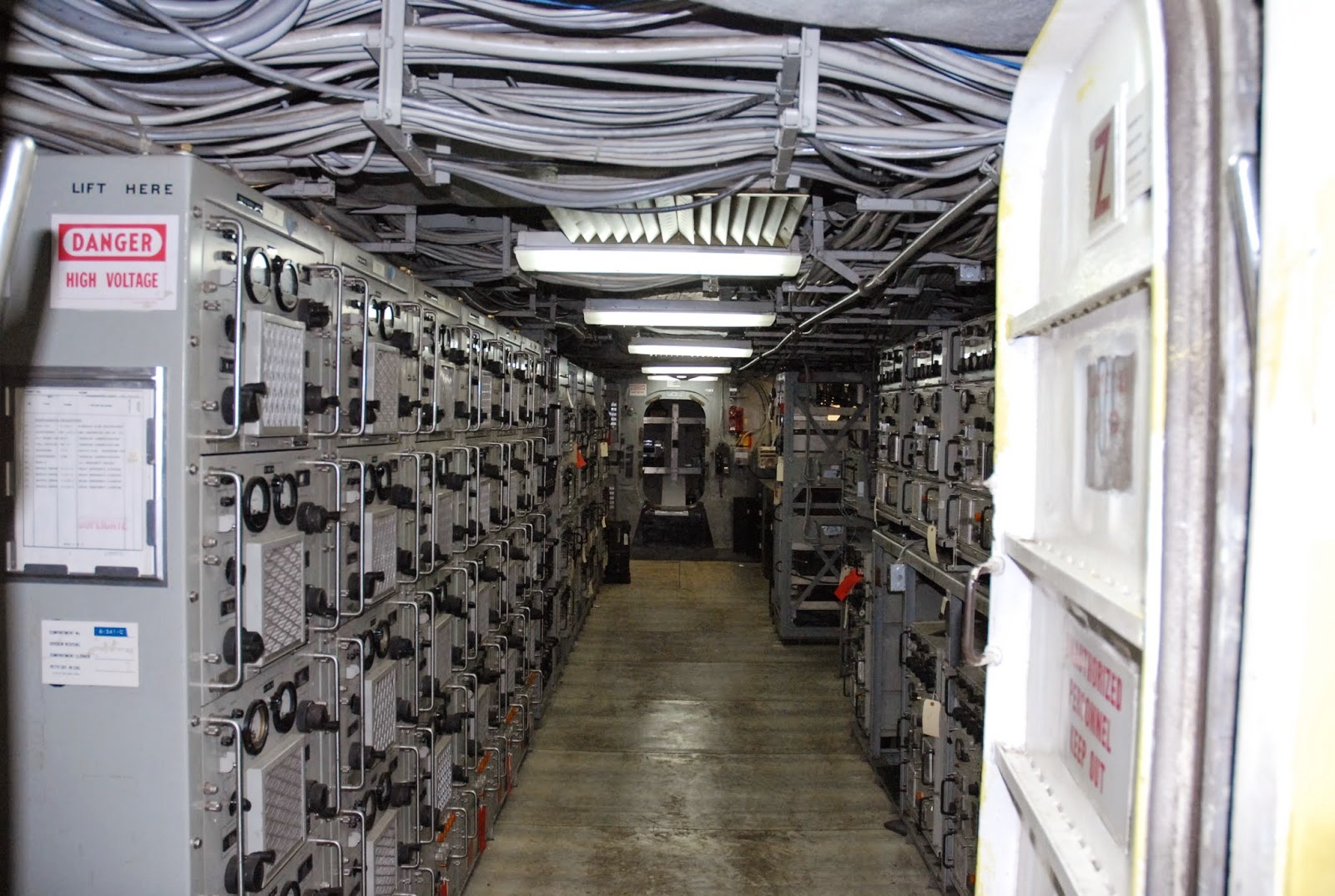
A narrow equipment space lined on both sides with racks of radio equipment, a DANGER HIGH VOLTAGE sign on the left.
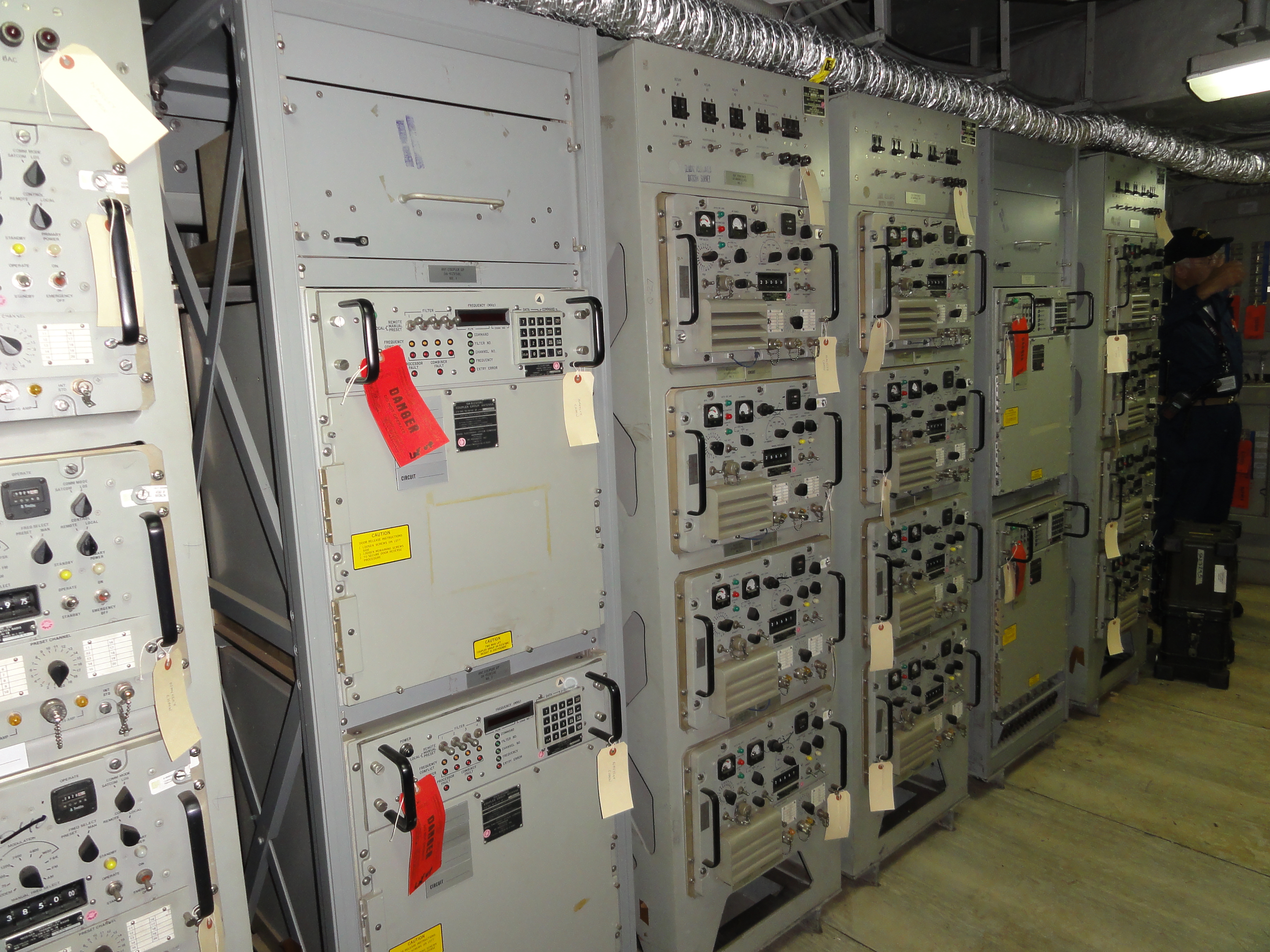
Racks of radio sets with tags hanging from the handles, including red DANGER tags.
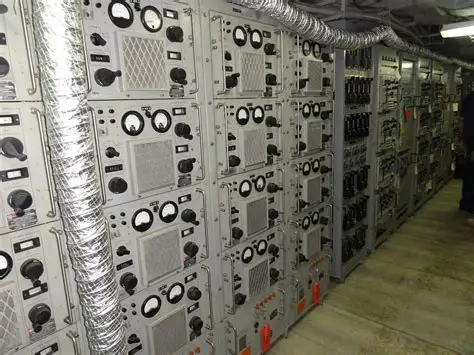
Rows of rack-mounted radio units with meters, knobs and speaker grilles, flexible ducting running above them.
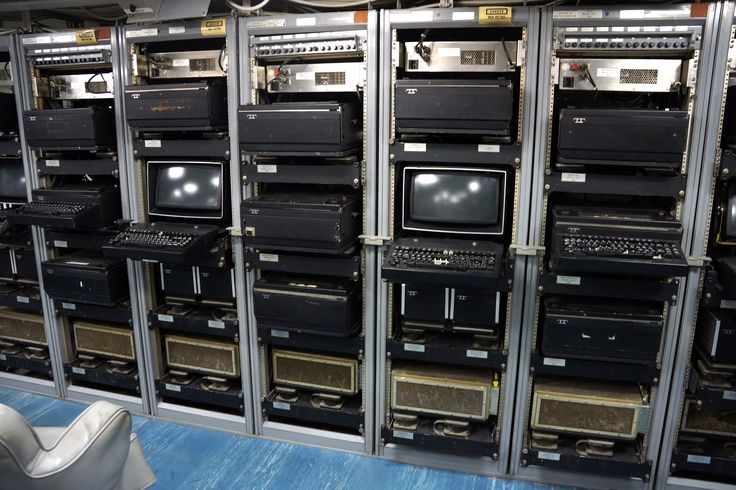
Racks of radio teletype machines, with their display screens and keyboards.
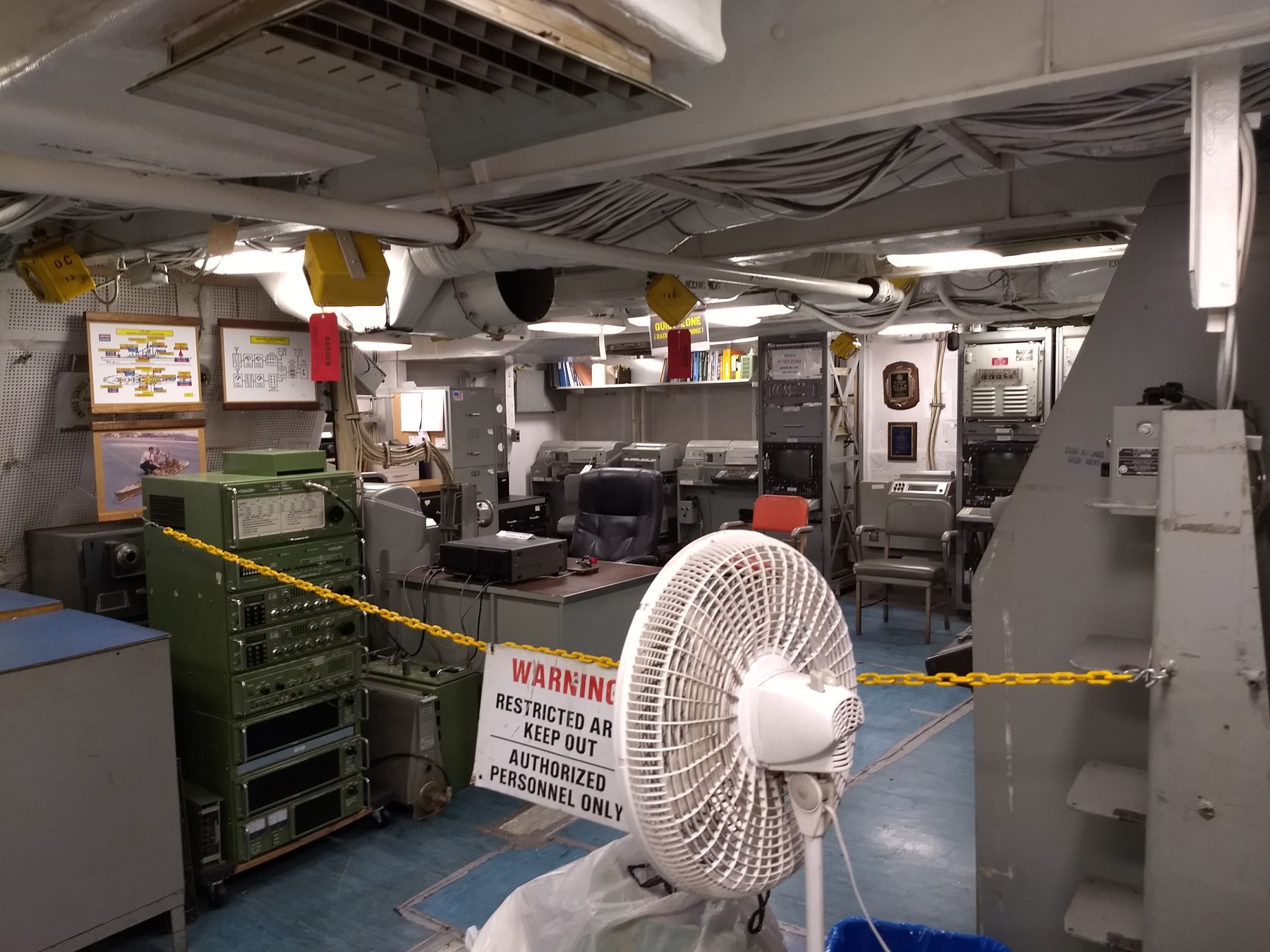
A communications space roped off for visitors: printers, a desk, green rack equipment and wall charts, with a WARNING RESTRICTED AREA sign.
This is the area in which the sources are weakest, and the tags stay conservative. In the Second World War the ships had the standard fast-battleship radio installation of the period: several radio rooms, including at least one transmitter room on the third deck, which survives on the museum Iowa. Visual signalling remained, with flags, the signal bridge, signal lamps and a lightly armored signal shelter, even as TBS (Talk Between Ships, VHF voice) and HF, VHF and UHF voice and Morse made flag hoists less central. A set-by-set list of the wartime radios (TBA, TBL, TBK and so on) was not found in a primary source. [DOCUMENTED as to the rooms and visual signalling; UNVERIFIED for a set inventory]
The 1980s. The radios were replaced in the reactivation. Visible and well attested:
Link 11, NTDS and Link 4A. The distinction matters. The bow discone shows that a radio path for Link 11 / NTDS data was fitted. That is not the same as a full NTDS combat-direction system of the kind installed in contemporary cruisers and carriers, with computers and consoles to build the tactical picture and control aircraft. Whether the Iowas could receive Link 11 from the force, take part as a participating unit, or host a full NTDS is unconfirmed in the sources used here, and this page does not say "the Iowas had NTDS" as a flat fact. Link 4A, the aircraft-control data link, was not documented from a primary source and is left unverified. [DOCUMENTED for the antenna; UNVERIFIED / CONTESTED for NTDS and Link 4A capability]
HOTEL FUNCTIONS: WATER, AIR, FOOD AND THE CREW
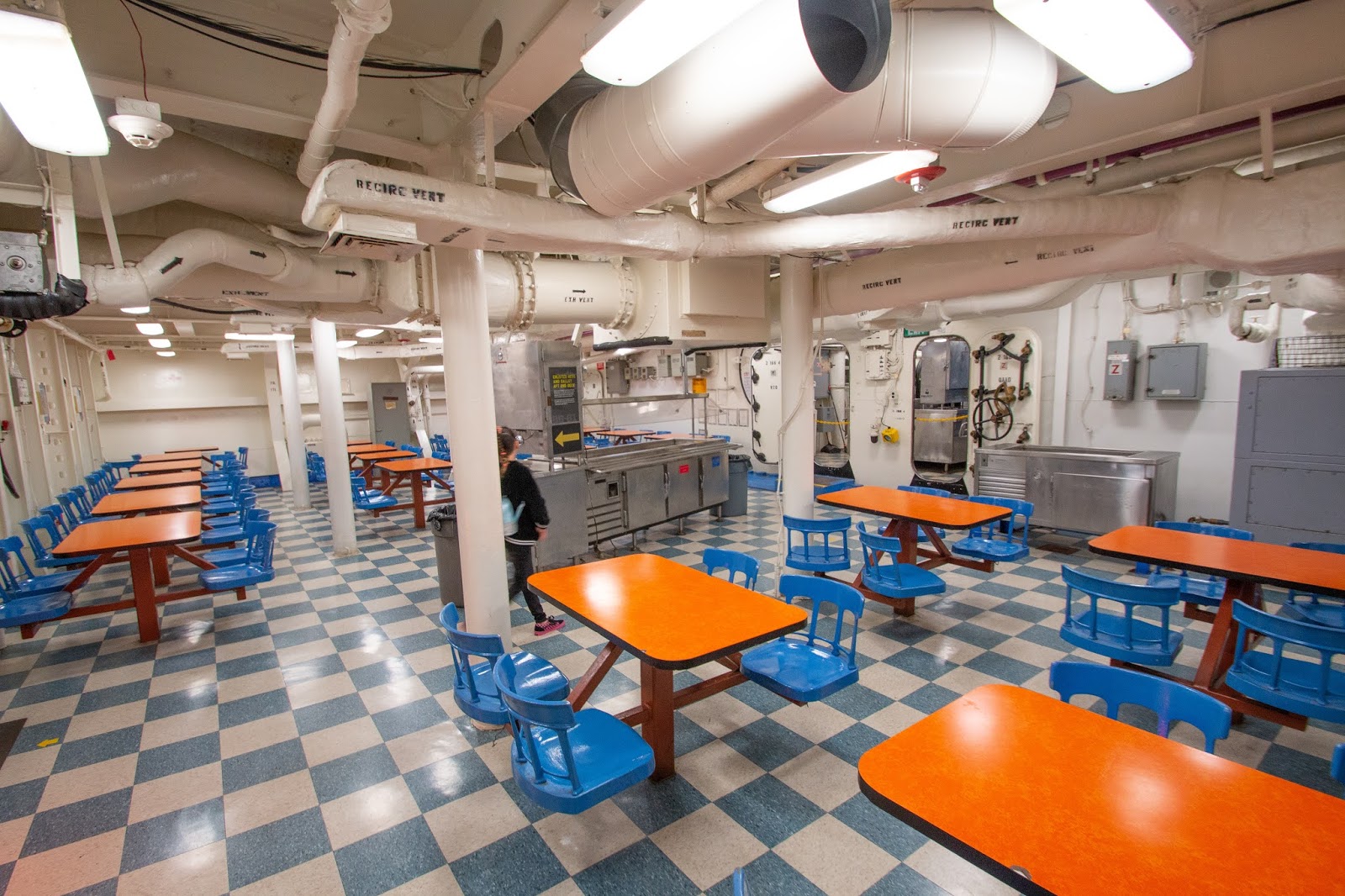
A crew mess deck with orange tables and blue chairs, a checkered floor and overhead ventilation ducts marked RECIRC VENT.
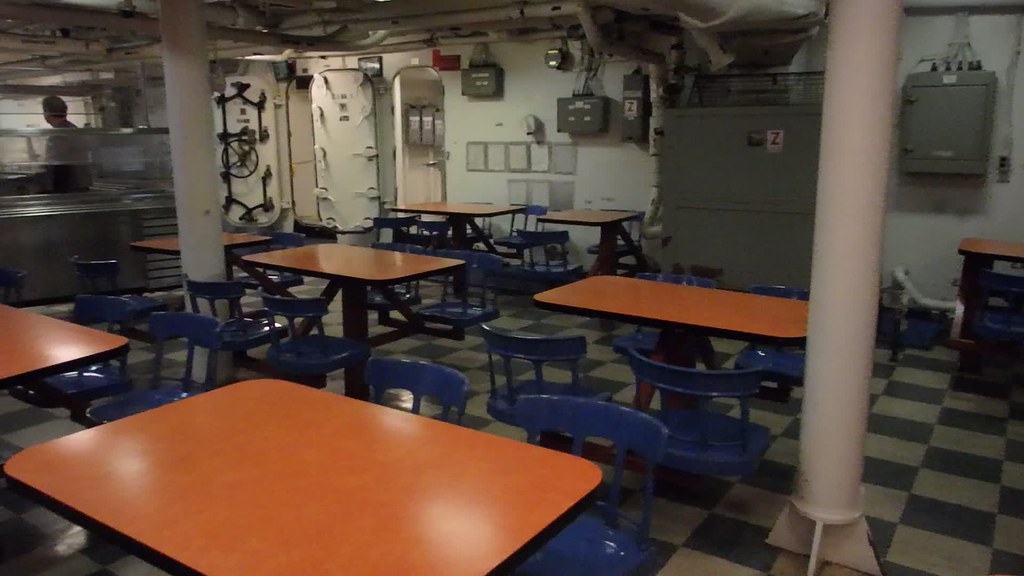
A crew mess deck in low light: orange tables, blue chairs and a watertight door on the far bulkhead.
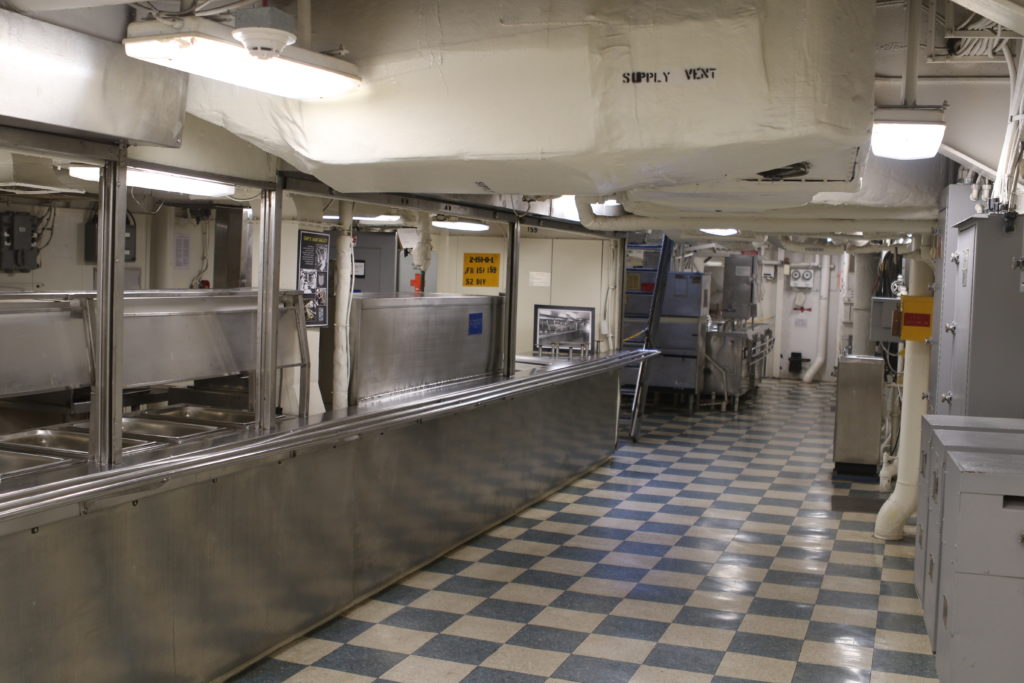
A stainless-steel serving line beside a checkered deck, with a duct overhead marked SUPPLY VENT.
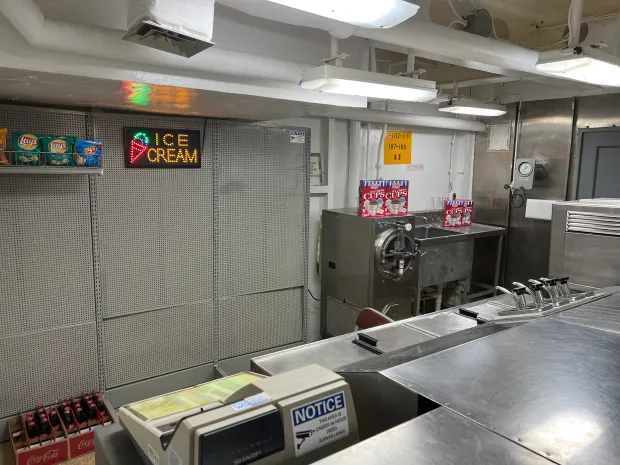
The ship's geedunk, the Navy name for the ship's snack and ice-cream counter, with a soft-serve machine, an ICE CREAM sign, a cash register and snack shelves.
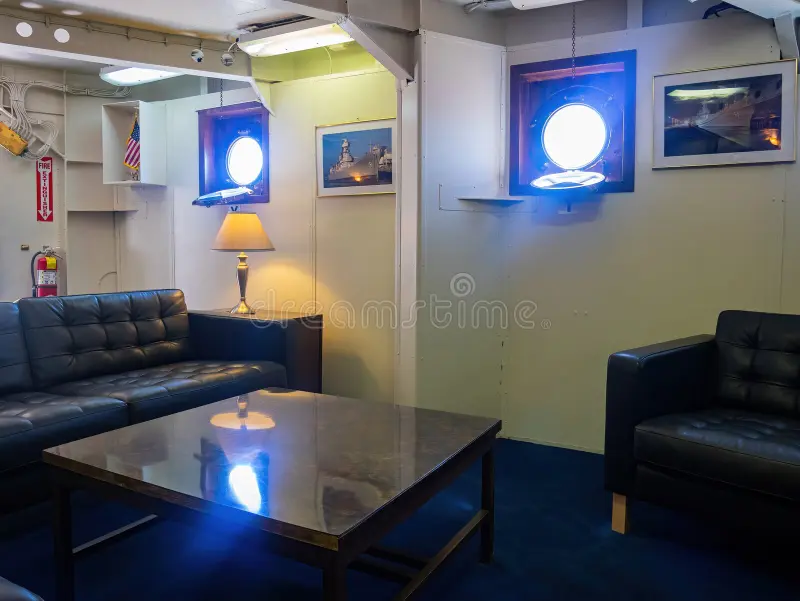
A lounge with black leather sofas, a coffee table, lit porthole fittings and framed pictures of battleships. A stock-photo watermark is visible on the image.
A battleship is also a town of two to three thousand people, and it has to make its own water, move its own air, and feed, clothe and house everyone aboard for months at a time.
Water. The official Iowa crew handbook gives one 20,000-gallon-a-day and two 40,000-gallon-a-day evaporators, making 100,000 gallons of fresh water a day for the boilers and the crew. The boilers come first: their feedwater must be nearly pure, and the naval steam article explains why. A 60,000-gallon-a-day figure, sometimes given as three 20,000-gallon units, circulates in secondary class descriptions but was not traced to a primary source; this page uses the handbook. An official daily water ration per man was not found. [DOCUMENTED, Iowa crew handbook; CONTESTED, 60,000 gpd]
Air, cooling and refrigeration. The handbook's construction-facts list gives 16 miles of ventilation ducts, and 17 miles of piping "used for refrigeration and cooling" within a larger figure of 80 miles of piping. Air conditioning was limited in the Second World War, covering magazines and selected spaces; this site's WW2 US Navy Ship Refrigeration Systems page covers the general practice for magazine and stores cooling. Habitability, including cooling, was improved in the 1980s, but a tonnage figure for the 1980s air-conditioning plant was not found. [DOCUMENTED for the duct and piping mileage as handbook publicity figures; UNVERIFIED for 1980s A/C capacity]
Food. Naval Gazing's "Life Aboard Iowa," mostly about the Second World War, describes four meals a day including midnight rations ("mid-rats"); 7 tons of food a day (1.5 tons fresh, 2 tons frozen and 3.5 tons dry), costing $1,600 a day at the time; 834 tons of food in storage, enough for 119 days between resupply. Stores were still passed aboard hand to hand in the 1980s. [DOCUMENTED, Naval Gazing]
Ice cream, laundry and the rest. The ships carried two ice-cream machines, a laundry, barbers, a cobbler, a tailor, a print shop, a library, a dentist and a hospital (Naval Gazing). The handbook reprints a period "city at sea" fact sheet: the soda fountain, the ship's geedunk, made 9,600 gallons of ice cream a month; the laundry handled 540,000 lb of clothes, 3,600 officers' and chiefs' uniforms and 12,000 lb of linen a month; the eight-chair barber shop gave 7,400 haircuts a month; the cobbler shop fitted 650 pairs of heels and 250 soles a month. The Fourth of July 1945 menu cost $1.05 a man. These are period publicity figures, not an audit, and are given as such. [DOCUMENTED as handbook period figures]
Berthing. The 1980s habitability work brought new three-high racks with curtains, reading lights and stowage under the mattress, where deck height allowed. [DOCUMENTED, Naval Gazing]
Crew by era. There is no single crew figure for the class, and "about 2,700" is a popular rounding. The documented numbers:
| Figure | Number | Source |
| Design | 1,921 (117 officers, 1,804 enlisted) | Iowa handbook; DANFS complement line for New Jersey and Missouri |
| Iowa, Second World War | 2,788 (151 officers, 2,527 enlisted, 110 Marines) | Iowa handbook (Naval Gazing's 151 + 2,637 is the same total with the Marines counted among the men) |
| DANFS Iowa complement line | "cpl. 2,800" | DANFS, rounded |
| Wisconsin, 1945 maximum | 2,978 | DANFS Wisconsin |
| Iowa, 1980s | 1,568 (65 officers, 1,445 enlisted, 58 Marines) | Iowa handbook |
| Wisconsin, 1988 | 1,515 | DANFS Wisconsin |
The wartime swell was the anti-aircraft gun crews and the admirals' flag staffs. The 1980s drop reflects the loss of the 40 mm battery and four 5-inch twin mounts, plus a different manning philosophy; it was still a large crew by the standards of a contemporary destroyer. [DOCUMENTED]
SHIP BY SHIP
The four careers are not interchangeable. In the handbook's short form, the class was in commission in 1943–58, 1968–69 and 1982–92. Builders were the New York Navy Yard in Brooklyn (Iowa and Missouri) and the Philadelphia Navy Yard (New Jersey and Wisconsin). [DOCUMENTED]
USS Iowa (BB-61). Laid down at the New York Navy Yard on 27 June 1940, launched 27 August 1942, and commissioned 22 February 1943 under Capt. John L. McCrea. After shakedown in the Chesapeake and along the Atlantic coast, she went to Argentia in August 1943 to cover a possible breakout by the German battleship Tirpitz. In November 1943 she carried President Franklin D. Roosevelt to Casablanca on the first leg of his journey to the Tehran Conference, and brought him home. She left for the Pacific on 2 January 1944 as flagship of Battleship Division 7 and supported the Marshalls strikes (Kwajalein and Eniwetok, 29 January to 3 February), the Truk sweep of mid-February and the first carrier strikes on the Marianas. On 18 March 1944, off Mili, she was hit by two Japanese 4.7-inch shells and suffered only minor damage. She was in the battle line at the Philippine Sea on 19 June 1944 and with Task Force 38 in the Leyte Gulf campaign, including the run north toward Cape Engaño and the turn back toward Samar. After a West Coast overhaul she returned for Okinawa and the July 1945 bombardments of Muroran and Hitachi, and entered Tokyo Bay on 29 August. [DOCUMENTED, DANFS]
Iowa's own DANFS entry says she "served as Admiral William F. Halsey's flagship for the surrender ceremony, 2 September 1945." That has to be read alongside Missouri's: the instrument of surrender was signed on Missouri's deck. Iowa was in the bay and had been Halsey's Third Fleet flagship; Halsey shifted his flag to South Dakota on the afternoon of 5 September. Iowa was not the surrender ship. [DOCUMENTED, DANFS Iowa and Missouri]
She was decommissioned on 24 March 1949 and recommissioned on 25 August 1951. On 1 April 1952 she became flagship of Vice Adm. Robert T. Briscoe, Commander Seventh Fleet, and from 8 April to 16 October 1952 she bombarded the east coast of Korea at Songjin, Hungnam and Kojo. She was decommissioned again on 24 February 1958 at Philadelphia. She earned nine Second World War battle stars and two for Korea. The online DANFS entry stops in 1958. The handbook gives her third commission as 1984–90; the commonly cited dates are 28 April 1984 for recommissioning and 26 October 1990 for decommissioning, but those exact days were not confirmed from the Naval Vessel Register. She is now the museum ship at 250 South Harbor Blvd., San Pedro, California, run by the Pacific Battleship Center. Her structural peculiarities are the three-level armored conning tower, unique in the class and associated with her flagship role, and the 11.3-inch, not 14.5-inch, end bulkheads of the first pair. [DOCUMENTED, DANFS through 1958 and handbook for 1984–90 and the museum; UNVERIFIED for the exact 1984 and 1990 days]
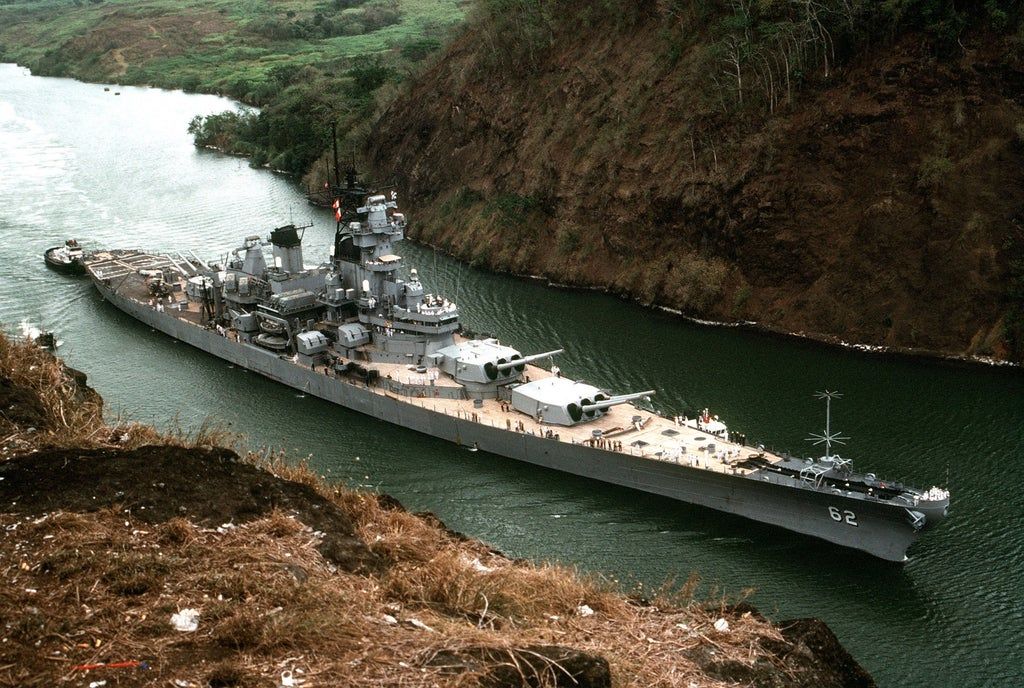
USS New Jersey (BB-62) in a narrow channel between steep banks, a tug at her stern, seen from a hillside above.
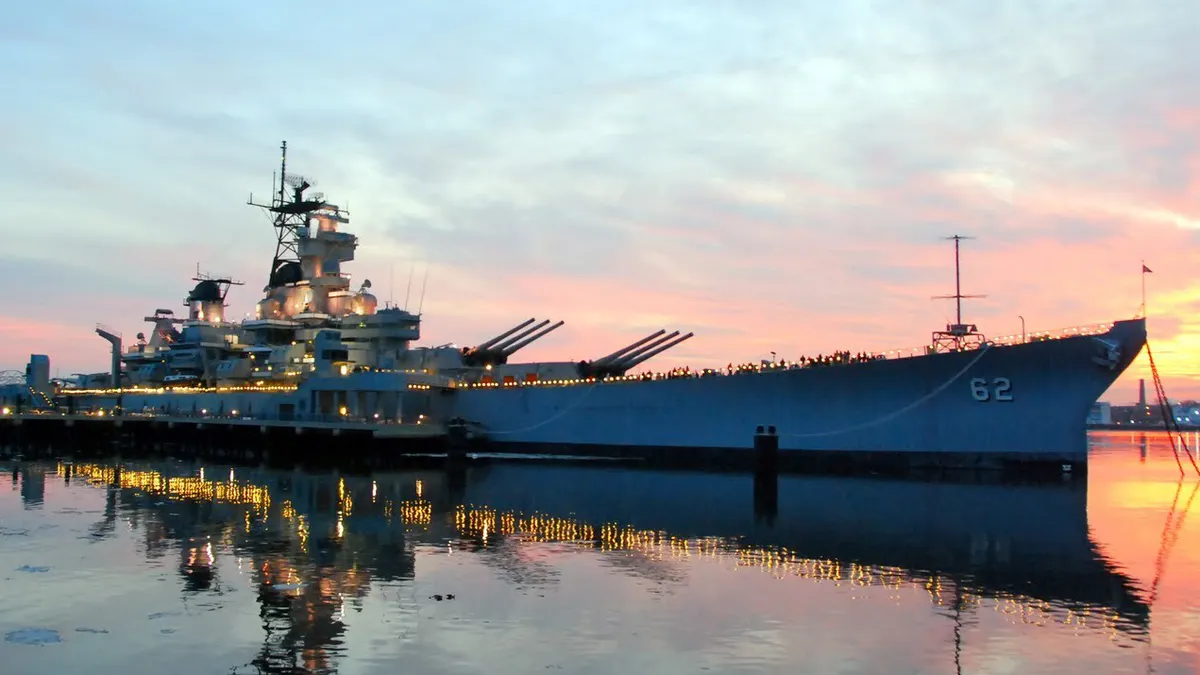
USS New Jersey (BB-62) moored as a museum ship at dusk, her decks lit and reflected in the water.
USS New Jersey (BB-62). Launched at Philadelphia on 7 December 1942 and commissioned 23 May 1943 under Capt. Carl F. Holden. Her DANFS entry does not give a keel date in its opening; the commonly given date of 16 September 1940 is single-source here. She passed through the Panama Canal on 7 January 1944 and, on 4 February 1944 at Majuro, became flagship of Adm. Raymond A. Spruance's Fifth Fleet. She was in the Truk strike of 17–18 February, where DANFS credits her with destroying a trawler and, with other ships, sinking the destroyer Maikaze; then the Marianas, the Philippine Sea, Leyte and Okinawa, where DANFS credits her with shooting down at least three suicide aircraft and helping with others. She earned nine Second World War battle stars. [DOCUMENTED, DANFS; SINGLE-SOURCE for the keel date]
Decommissioned on 30 June 1948 at Bayonne, she was recommissioned on 21 November 1950. Her first Korean tour, from May 1951, was as Seventh Fleet flagship for Vice Adm. Harold M. Martin. On her first mission at Wonsan she took a shore-battery hit on Turret 1 that killed one man and severely wounded two, her only Korean combat casualties in the DANFS account. Her second tour, from April 1953, relieved Missouri as Seventh Fleet flagship. She earned four Korean battle stars. [DOCUMENTED, DANFS]
Vietnam: the only Iowa in that war. New Jersey was recommissioned on 6 April 1968 at Philadelphia under Capt. J. Edward Snyder as "the world's only active battleship," with improved electronics, a helicopter landing pad and the 40 mm battery removed. She fired her first shots in more than sixteen years on 30 September 1968 near the 17th Parallel, at targets in and near the Demilitarized Zone. DANFS says that in her first two months on the gun line she "directed nearly ten thousand rounds of ammunition at Communist targets; over 3,000 of these shells were 16-inch projectiles." A widely copied tour total of 5,688 sixteen-inch rounds does not appear in the DANFS narrative and is not attributed to it here. She left the gun line in early April 1969, was diverted toward Japan after North Korea shot down a US EC-121 reconnaissance aircraft on 15 April, and reached Long Beach on 5 May. She was decommissioned on 17 December 1969 at Puget Sound with two Vietnam battle stars and a Navy Unit Commendation. Her captain at decommissioning, Capt. Robert C. Peniston, closed with a line DANFS records: "Rest well, yet sleep lightly." [DOCUMENTED, DANFS; SINGLE-SOURCE for 5,688]
She was the first of the class reactivated in the 1980s, commonly dated 28 December 1982, and was decommissioned again in 1991, commonly 8 February; those exact days were not confirmed from the Naval Vessel Register. She is now the museum ship at 100 Clinton Street, Camden, New Jersey. Like Iowa, she has the 11.3-inch end bulkheads, and a two-level armored conning tower. [DOCUMENTED for the museum; UNVERIFIED for the exact 1982 and 1991 days]
USS Missouri (BB-63). Laid down at the New York Navy Yard on 6 January 1941, launched 29 January 1944, and commissioned 11 June 1944 under Capt. William M. Callaghan, with the thicker 14.5-inch end bulkheads. She reached Ulithi on 13 January 1945, screened Task Force 58 in the mid-February strikes on Japan, bombarded Iwo Jima, and was off Okinawa from the pre-invasion bombardment of 24 March. On 11 April 1945 a kamikaze crashed into her side just below main-deck level; its starboard wing was thrown forward and started a gasoline fire at 5-inch mount No. 3, but the damage was superficial and the fire was quickly put out. She took part in the July bombardments of Muroran and the Hitachi area. [DOCUMENTED, DANFS]
The surrender deck. Missouri entered Tokyo Bay early on 29 August 1945 to prepare for the ceremony. On 2 September Fleet Adm. Chester Nimitz came aboard shortly after 0800, General of the Army Douglas MacArthur at 0843, and the Japanese party headed by Foreign Minister Mamoru Shigemitsu at 0856. At 0902 MacArthur opened the 23-minute ceremony, broadcast worldwide; by 0930 the Japanese emissaries had left. She earned three Second World War battle stars, fewer than her older sisters because she joined the war later. [DOCUMENTED, DANFS]
Missouri was the only US battleship in commission when the Korean War began and the first of the class off Korea. DANFS credits her with five Korean battle stars, beginning with "North Korean Aggression" (14 September to 1 November 1950) and continuing through the first UN counteroffensive and a later 1952–53 tour. She was decommissioned at Puget Sound on 26 February 1955 and spent thirty years at Bremerton as a much-visited reserve ship. She was recommissioned at San Francisco on 10 May 1986 under Capt. Albert L. Kaiss, served in the Persian Gulf in 1987 (Armed Forces Expeditionary Medal, 1 September to 24 November 1987) and in the Gulf War (Combat Action Ribbon, Navy Unit Commendation, Southwest Asia Service Medal). [DOCUMENTED, DANFS]
An official DANFS count of Missouri's Gulf War Tomahawks and 16-inch rounds was not found in the DANFS paragraphs consulted. Museum and secondary figures of 28 Tomahawks and 759 sixteen-inch rounds circulate, and are often added to a 324-round figure for Wisconsin to make 1,083. Those numbers conflict with Wisconsin's own DANFS count, below, and are treated as contested. Missouri was decommissioned on 31 March 1992, stricken on 12 January 1995 and donated as a museum on 4 May 1998. She lies at Pearl Harbor near the USS Arizona memorial. [DOCUMENTED for dates; CONTESTED for the 28 / 759 figures]
USS Wisconsin (BB-64). Laid down at Philadelphia on 25 January 1941, launched 7 December 1943, and commissioned 16 April 1944 under Capt. Earl E. Stone, with 14.5-inch end bulkheads. She reached the Pacific late in 1944, fought at Iwo Jima and Okinawa, and took part in the 1945 operations against the Japanese home islands. She earned five Second World War battle stars and one for Korea. [DOCUMENTED, DANFS]
The Kentucky bow. On 6 May 1956, operating off the Virginia capes in heavy fog, Wisconsin collided with the escort destroyer USS Eaton (DDE-510) and put into Norfolk with extensive bow damage. A 120-ton, 68-foot section of the bow of the unfinished Kentucky was barged from Newport News to Norfolk Naval Shipyard and grafted on in 16 days, and Wisconsin was ready for sea on 28 June 1956 in time for her midshipman cruise. She is the only Iowa with part of another battleship built into her. [DOCUMENTED, DANFS]
Capt. Jerry M. Blesch took command on 22 October 1988, the date of her 1980s recommissioning. For Desert Shield and Desert Storm her DANFS entry is unusually precise: during an eight-month Persian Gulf deployment she "fired 24 Tomahawk land-attack missiles, fired 528 16-inch rounds in 36 different naval gunfire support missions, 881 5-inch rounds, and 5,200 20 mm CIWS rounds. In addition she flew 348 RPV hours, recorded 661 safe helicopter landings, steamed 46,000 nautical miles … without a serious material casualty or personnel injury." That 528 is the official history's own number, and it conflicts with the widely copied 324. This page uses 528 and does not present 1,083 as an official total. [DOCUMENTED, DANFS; CONTESTED, 324]
She was decommissioned at Pier 11, Norfolk, on 30 September 1991 and stricken on 17 March 2006. She was officially transferred to the city of Norfolk on 14 December 2009 (with a ceremony on 16 April 2010), ending the requirement that she be kept for possible recall, and was listed on the National Register of Historic Places on 28 March 2012. She is berthed at Nauticus. [DOCUMENTED, DANFS]
THE 1980s REACTIVATION
The four ships were not brought back only as gunfire platforms. Naval Gazing's reactivation essay, the clearest systems-level account consulted, argues that the drivers were Tomahawk capacity, eight armored box launchers in a hull that could launch in heavier weather than a destroyer, and peacetime presence, at a cost the essay puts in the neighbourhood of a Perry-class frigate per ship. A pure "they came back to fight the Kirovs" story does not survive a missile-exchange analysis (this site's Project 1144 Orlan page discusses that argument from the Soviet side), and a pure "they came back for amphibious gunfire" story does not explain why four 5-inch twin mounts were landed to make room for missile launchers. [DOCUMENTED as Naval Gazing's argument]
In summary, the reactivation converted the fuel to Navy distillate; kept the analog main-battery fire control, adding DR-810 muzzle-velocity radars; replaced the search radars with the SPS-49 and SPS-10 / SPS-67; added SLQ-32 electronic warfare, Mk 36 SRBOC and the Nixie decoy; replaced the radios and added satellite communications; removed four of the ten 5-inch twin mounts and all remaining 40 mm; and added the Tomahawk, Harpoon, Phalanx, Stinger and Pioneer suite, plus improved berthing. [DOCUMENTED]
THE 19 APRIL 1989 TURRET 2 EXPLOSION
On 19 April 1989 five bags of propellant ignited in the open breech of the centre 16-inch gun in Iowa's Turret 2. Forty-seven sailors were killed. That is the fact that matters first. [DOCUMENTED, GAO; Iowa crew handbook]
The Navy's finding. The Navy's investigation concluded that the explosion was a deliberate act, not a defect in the gun or the propellant. Its technical basis was foreign material found on the rotating band of the projectile left lodged in the barrel, which the Navy said it could reproduce in open-breech tests only when a chemical ignition device, such as calcium hypochlorite, brake fluid and steel wool, was present. The Navy also relied on an FBI psychological analysis of one crew member. [DOCUMENTED as the Navy's conclusion, via GAO]
The GAO and Sandia review. The General Accounting Office asked Sandia National Laboratories to review the technical case. In GAO/NSIAD-91-4 (29 January 1991) and in Sandia's final report, issued as GAO/NSIAD-91-4S (28 August 1991), Sandia could neither confirm nor deny a deliberate act, and could not prove or disprove that the foreign material on the rotating band was evidence of an improvised device. It found the foreign materials in Turret 2 consistent with the levels normally found throughout gun turrets and the maritime environment, and found no explicit physical evidence that the hypothetical chemical device had been present. It identified a plausible accidental cause: a high-speed overram, the powder bags being rammed too far and too fast into the gun, of impact-sensitive powder against the base of the projectile. The Navy halted 16-inch firing pending further tests, which continued with Sandia's help, including under the pressure of Desert Shield. [DOCUMENTED, GAO/NSIAD-91-4 and -91-4S]
This page presents both findings and does not treat either the Navy's original attribution or the overram hypothesis as settled. The investigation remains contested. [CONTESTED]
SUMMARY TABLES
Armor (preferred documented figures; the conflicts table gives the alternatives):
| Element | Figure | Notes |
| Upper belt | 12.1 in Class A, 19° inboard, internal | Frames 50–166, from the second deck down |
| Lower belt | Class B, 12.1 in tapering to about 1.62 in | Also torpedo-defense bulkhead No. 3 |
| Belt backing / shell | CONTESTED | 30 lb STS backing and 60 lb (1.5 in) shell, vs 0.875 in backing, vs a 1.5 in "attachment" |
| End bulkheads | 11.3 in Class A (Iowa, New Jersey); 14.5 in (Missouri, Wisconsin) | First pair's armor already on order when the treaties lapsed |
| Bomb deck | 1.5 in STS | Main deck |
| Armor deck | 4.75 in Class B on 1.25 in STS (6.0 in total) | Second deck, citadel roof |
| Splinter deck | 0.625 in STS | Third deck also 0.625 in STS (handbook) |
| Turret face | 17 in Class B on 2.5 in STS, 36° (19.5 in total) | 36° from the handbook |
| Turret sides | 9.25 in or 9.5 in Class A on 0.75 in STS | CONTESTED |
| Turret back / roof | 12 in Class A / 7.25 in Class B | |
| Barbettes | 17.3 in abeam, 14.8 in at the quarters, 11.6 in ahead and astern, Class A | |
| Conning tower | 17.3 in Class B | Iowa three armored levels, sisters two; doors about 4,000 lb |
| Steering gear | 13.5 in Class A | |
| Torpedo defense | Four layers, liquid–liquid–void–void as built; belt is bulkhead No. 3 | BB-65/66 were to have a modified, about 20 percent better system |
| Design immune zone | 18,000–30,000 yd against the 16-inch/45 (handbook); 19,000–30,000 yd elsewhere | CONTESTED inner edge |
Armament by era (Iowa handbook unless noted):
| Era | 16-inch | 5-inch | 40 mm | 20 mm / other | Missiles / CIWS |
| 1944 (Iowa) | 9 | 20 (10 twin mounts) | 76 (19 quad mounts) | 52 single | None |
| Class line (DANFS Missouri, Wisconsin) | 9 | 20 | 80 | 49 | None |
| 1955 (Iowa) | 9 | 20 | 76 | Removed | None |
| New Jersey, 1968–69 | 9 | 20 | 0 | 0 | Helicopter pad added |
| 1980s | 9 | 12 (6 twin mounts) | 0 | 8 × .50 cal | 32 Tomahawk, 16 Harpoon, 4 Phalanx, 5 Stinger positions, Pioneer RPVs |
Radar and EW by era (class pattern, not an antenna log for each ship):
| Era | Search | Fire control | EW |
| WWII, as built and mid-war | SK or SC-2; SG | Mk 8 (early Mk 3) on Mk 38; Mk 4, then Mk 12/22, on Mk 37 | Not verified |
| Late WWII and 1946 | SK-2, SR, SP | Mk 13 on Mk 38 | |
| Korea and 1950s | SPS-6, SPS-10; some SPS-8 | Mk 13; Mk 25 on Mk 37 | |
| 1980s | SPS-49; SPS-67 (Iowa and New Jersey first recommissioned with SPS-10) | Mk 13 and Mk 25 retained; DR-810 muzzle-velocity radars | SLQ-32(V)3, Mk 36 SRBOC, SLQ-25 Nixie |
Build and service dates (official histories where consulted):
| Iowa (BB-61) | New Jersey (BB-62) | Missouri (BB-63) | Wisconsin (BB-64) | |
| Builder | New York Navy Yard | Philadelphia Navy Yard | New York Navy Yard | Philadelphia Navy Yard |
| Keel laid | 27 Jun 1940 | Often 16 Sep 1940 (not in the DANFS opening) | 6 Jan 1941 | 25 Jan 1941 |
| Launched | 27 Aug 1942 | 7 Dec 1942 | 29 Jan 1944 | 7 Dec 1943 |
| First commissioned | 22 Feb 1943 | 23 May 1943 | 11 Jun 1944 | 16 Apr 1944 |
| WWII battle stars | 9 | 9 | 3 | 5 |
| Post-war decommission / recommission | 24 Mar 1949 / 25 Aug 1951 | 30 Jun 1948 / 21 Nov 1950 | Served in Korea in her first commission; decommissioned 26 Feb 1955 | See DANFS |
| Korea battle stars | 2 | 4 | 5 | 1 |
| Vietnam | None | 6 Apr 1968 – 17 Dec 1969 | None | None |
| 1980s recommission | 1984 (handbook; commonly 28 Apr) | First of the class; commonly 28 Dec 1982 | 10 May 1986 | 22 Oct 1988 |
| Final decommission | Commonly 26 Oct 1990 (handbook: 1984–90) | Commonly 8 Feb 1991 | 31 Mar 1992 | 30 Sep 1991 |
| Museum | San Pedro, California | Camden, New Jersey | Pearl Harbor (donated 4 May 1998) | Norfolk, Virginia (transferred 14 Dec 2009) |
CONFLICTING FIGURES
| Item | Values found | What this page prints |
| Belt backing | 30 lb STS (Naval Gazing); 0.875 in STS (many summaries); 1.5 in STS "attachment" (battleship.org) | 12.1 in Class A, 19°, internal, with STS backing and a 1.5 in / 60 lb shell; no backing winner |
| Immune-zone inner edge | 18,000 yd (handbook, vs 16-inch/45); 19,000 yd (battleship.org, some secondaries) | Handbook's 18,000–30,000; 19,000 noted |
| "Equivalent" belt thickness | 13.5 in vertical (Friedman, as cited); 17.3 in vertical Class B at 19,000 yd | Neither printed as if it were the belt |
| Turret sides | 9.25 + 0.75 in (handbook); 9.5 + 0.75 in (battleship.org) | Both |
| Turret face inclination | 36° (handbook); 45° in some informal summaries | 36° |
| New Jersey length | 887 ft 3 in (class); 887 ft 7 in (DANFS New Jersey) | 887 ft 3 in, with the variant noted |
| Light AA | Iowa 1944: 76 × 40 mm / 52 × 20 mm (handbook); class line 80 / 49 (DANFS) | Both, as ship-and-date figures |
| Projectile stowage | About 130 per gun / 1,170 (NavWeaps); 1,220 (handbook 390 + 460 + 370) | About 1,200, with the handbook's turret split |
| Full powder charge | 660 lb (NavWeaps); 650 lb on some popular pages | 660 lb |
| Endurance | 15,000 miles at 15 kn, unit unspecified (handbook); 14,890 nmi at 15 kn (circulating) | Neither treated as an official card |
| Design speed and rpm | 33 kn (handbook); 32.5 kn at 212,000 SHP and 53,900 t (Naval Gazing / Friedman); 219 rpm for 31 kn (plaque); 202 rpm (one compilation) | 212,000 SHP firm; 32.5–33 kn band; rpm depends on condition |
| Speed above 33 kn | 35.2 kn New Jersey 1968; 35.4 kn calculated at overload; higher unsourced claims | CONTESTED |
| Distillers | 100,000 gpd (20,000 + 40,000 + 40,000, handbook); 60,000 gpd (secondaries) | Handbook |
| Cost | $110 million (handbook); $100 million (many summaries) | $110 million as the handbook figure |
| Mark 160 vs Mark 8 in the 1980s | NavWeaps mentions a Mark 160 FCS; handbook says the Mark 8 was used throughout | Retained analog Mark 8 and Mark 41; DR-810 added |
| Stable vertical | Mark 41 (handbook); "Mark 41 or Mark 43" in some accounts | Mark 41 for Iowa |
| NTDS and Link 4A | Discone "intended for NTDS" / "Link 11/NTDS"; no evidence found of a full NTDS system or Link 4A | Link 11 radio path fitted; full NTDS and Link 4A unconfirmed |
| Mark 23 nuclear shell | Developed and real; "the Navy never confirmed their presence on Iowa" | Not printed as a confirmed load |
| Wisconsin Gulf War 16-inch rounds | 528 (DANFS); 324 (widely copied, often paired with Missouri's 759 to make 1,083) | 528 |
| Missouri Gulf War rounds and Tomahawks | 759 / 28 in museum and secondary accounts; not in the DANFS paragraphs consulted | CONTESTED; not added to 528 |
| New Jersey Vietnam 16-inch total | DANFS: over 3,000 in the first two months; 5,688 as a tour total in later articles | DANFS two-month figure as official |
| Iowa at the surrender | Her DANFS: Halsey's flagship "for the surrender ceremony"; Missouri DANFS: signed on Missouri | Signed on Missouri; Iowa in the bay |
| SSTG rating | 10,500 kW total (handbook); 8 × 1,250 kW the usual breakdown | Both, as a consistent pair |
| Turret 2 explosion | Navy: deliberate act; Sandia / GAO: could not confirm or deny, no explicit physical evidence of a device, overram a plausible accident | CONTESTED; both presented |
GAPS AND UNSETTLED POINTS
IN ONE SENTENCE
The Iowa class packed nine 16-inch/50 guns, an internal 12.1-inch belt and a 212,000-horsepower, 600 psi steam plant into an 887-foot hull that could still pass the Panama Canal, served from 1943 to 1992 as fast carrier escorts, flagships, shore-bombardment ships and finally Tomahawk carriers on an analog fire-control plant that was never replaced, and now survives as four museum ships whose last chapter, the 1989 Turret 2 explosion, is still disputed.
SOURCES
Related on this site: USN Mk 6 / Mk 7 16-inch Guns, the 16-inch/50 Mark 7 and its ammunition in detail.
Related on this site: Mark 38 GFCS, the main-battery fire-control plant: directors, Ford Mark 8 rangekeeper, Mark 41 stable vertical and turret drives.
Related on this site: Naval and Marine Steam Power Plants, the boilers, turbines, condensers and feedwater chemistry behind the 212,000 SHP plant, with the Iowa class as a case study.
Related on this site: USS Alabama (BB-60), the South Dakota-class predecessor: the same 16-inch/45 generation and internal belt, a different plant (Foster Wheeler, Westinghouse, 130,000 SHP).
Related on this site: WW2 US Navy Ship Refrigeration Systems, for magazine and stores cooling.
Related on this site: The Last Ride of the Vikings, a hypothetical on what it would take to bring Wisconsin or Missouri back today.
Related on this site: SS United States, the 1952 liner whose 1,000 psig plant grew out of the same US naval high-pressure steam practice.
Related on this site: TERCOM, the terrain-matching guidance behind the Tomahawks carried in the 1980s.
Related on this site: Project 1144 Orlan (Kirov class), the Soviet nuclear cruiser often cited in the 1980s reactivation debate.
Related on this site: Bismarck Class Battleships, for a German fast-battleship comparison.