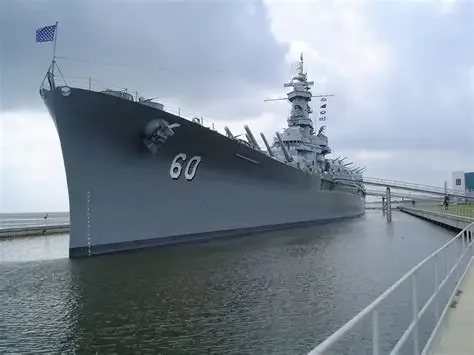
USS Alabama (BB-60) at her berth in Mobile Bay, bow-on, with hull number 60 on the stem. Photograph as the ship is preserved at Battleship Memorial Park.
USS Alabama (BB-60) at her berth in Mobile Bay, bow-on, with hull number 60 on the stem. Photograph as the ship is preserved at Battleship Memorial Park.
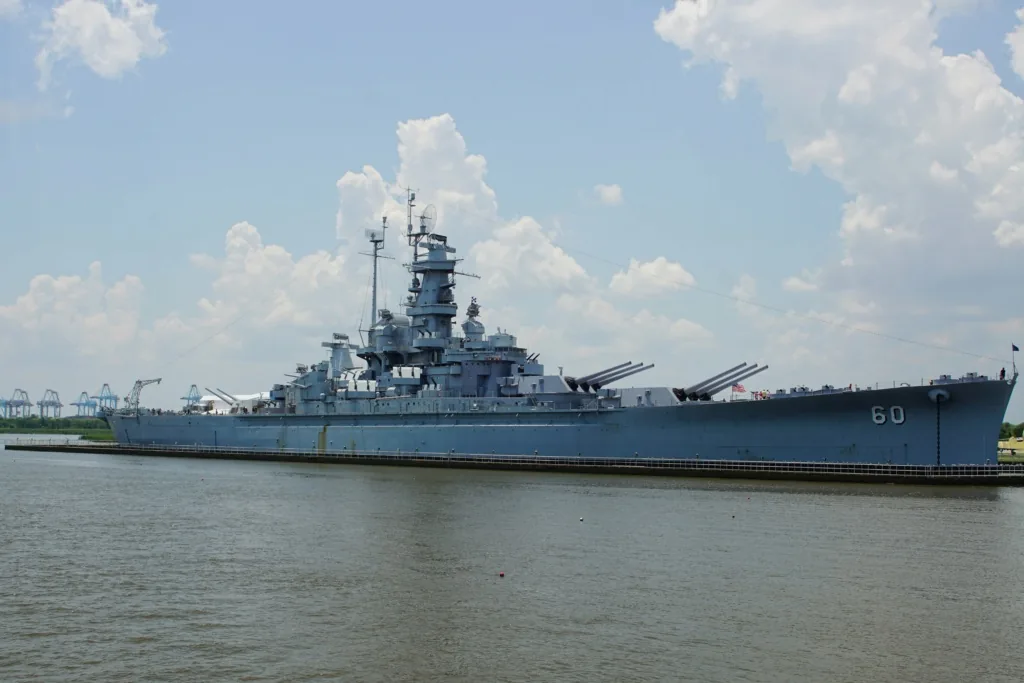
A starboard-side profile of Alabama at Mobile, from the forward 16-inch turrets aft to the fantail crane. The compact 680-foot South Dakota-class hull is visible in one view.
WHAT IT IS
USS Alabama (BB-60) is a South Dakota-class fast battleship, the last of the four ships of that class, built at the Norfolk Navy Yard in Portsmouth, Virginia, and commissioned on 16 August 1942. She is preserved today as the centerpiece of USS Alabama Battleship Memorial Park on Mobile Bay. Of her three sisters, only USS Massachusetts (BB-59), at Fall River, was also saved. USS South Dakota (BB-57) and USS Indiana (BB-58) went to the breakers. [DOCUMENTED, DANFS / NHHC chronology as used in standard references; Encyclopedia of Alabama; park history]
She was designed as a treaty battleship: nine 16-inch /45 Mark 6 guns, a heavy armor scheme, and a speed of about 27.5 knots, all packed into a hull only 680 feet long overall and 108 feet 2 inches in beam, so that she could still pass through the Panama Canal and still, on paper, stay close to the 35,000-long-ton standard-displacement limit of the Washington and London treaties. The naval historians William Garzke and Robert Dulin later called the South Dakotas the best treaty battleships ever built. Norman Friedman called the design "a remarkable achievement within very constricting treaty limits." Those judgments are theirs, and they are recorded here as such. [DOCUMENTED as the published judgments of Garzke & Dulin and of Friedman, as cited in the standard class literature]
In service she did two very different tours. In the spring and summer of 1943 she was with the British Home Fleet at Scapa Flow, covering Arctic convoy work and taking part in a demonstration intended, among other things, to draw the German battleship Tirpitz out of Norway. Tirpitz did not come out. In August 1943 Alabama was pulled back, overhauled at Norfolk, and sent to the Pacific, where she spent the rest of the war in the screen of the fast carrier task force: the Gilberts and the Marshalls, the raid on Truk, the Marianas and the Battle of the Philippine Sea, the Philippines and Leyte Gulf, Okinawa, and the bombardments of the Japanese home islands. She entered Tokyo Bay on 5 September 1945, brought men home on a Magic Carpet run, and was decommissioned on 9 January 1947. [DOCUMENTED, DANFS / NHHC chronology; Wikipedia's documented service narrative citing those histories. The park's account that she "led the fleet into Tokyo Bay the day after" the 2 September surrender is a looser wording; the dated account used here is 5 September.]
Her crew called her the Lucky A, and later the Mighty A, because she was never damaged by enemy fire and never lost a man to the enemy. That nickname is real, and it should be used carefully. On 21 February 1944, during a Japanese air attack off the Marianas, her No. 9 5-inch mount accidentally fired into No. 5. Five men were killed and eleven were wounded. Those are the ship's documented combat-period deaths. They were not inflicted by the Japanese. They are not a reason to drop the nickname, and the nickname is not a reason to leave the five men out of the story. [DOCUMENTED, DANFS / standard operational histories; contemporary accounts of the 21 February 1944 mount casualty]
This page covers her design — the compact hull and its tradeoffs, the armor system, the underwater protection, the 16-inch battery and how it was controlled, and the dual-purpose and close-range antiaircraft batteries — then her service, the campaign that saved her from the scrapyard, and her afterlife as a memorial, including the films shot on board and the damage from Hurricane Katrina in 2005. Comparison tables place her against her sisters, the North Carolina and Iowa classes, and foreign contemporaries, and against the SS United States, whose scuttling on 11 November 2026 is treated in a separate article on this site.
DESIGN
The South Dakota class was the U.S. Navy's second try at a 35,000-ton, 16-inch-gun fast battleship under the treaty system, after the North Carolina class. The North Carolinas were longer — 728 feet 9 inches overall — and were originally designed around 14-inch guns, then re-armed with the same 16-inch /45 Mark 6 that the South Dakotas were built for. The South Dakotas were asked to carry the same nine-gun main battery, comparable or better protection, and a similar speed, on a hull fifty feet shorter, so that more of the treaty tonnage could go into armor. The result is the most compact U.S. treaty battleship: 680 feet overall, 108 feet 2 inches in the beam, a design draft in the mid-thirties of feet, and a standard displacement that, as built, came out well above the paper 35,000 tons. Friedman, as cited in the standard references, gives 37,970 long tons standard and 44,519 long tons full load for the class, and those are the figures used for Alabama in this article. DANFS, as is common in that series, still lists the treaty 35,000 tons. The park has also used "35,000 to 44,500 tons" and, separately, an "actual weight when fully loaded" of 42,500 tons. The 42,500-ton figure is not used as a full-load number here. [DOCUMENTED, Friedman as cited for 37,970 / 44,519 long tons, and Navypedia, which repeats those figures; DANFS 35,000 is the treaty listing; CONTESTED, the park's 42,500-ton full-load wording]
The short hull had consequences that run through every system on the ship. The machinery had to make 130,000 shaft horsepower in a shorter machinery box than the North Carolinas used for 121,000. The armored citadel is dense. The side protection system is shallower than it would have been on a longer, finer hull with an external belt, because the belt itself was brought inside the skin and used as one of the torpedo bulkheads. The forecastle is short; the quarterdeck is short; the 5-inch battery is clustered amidships in two tight groups of five twin mounts. It is a lot of ship in 680 feet, and it looks it.
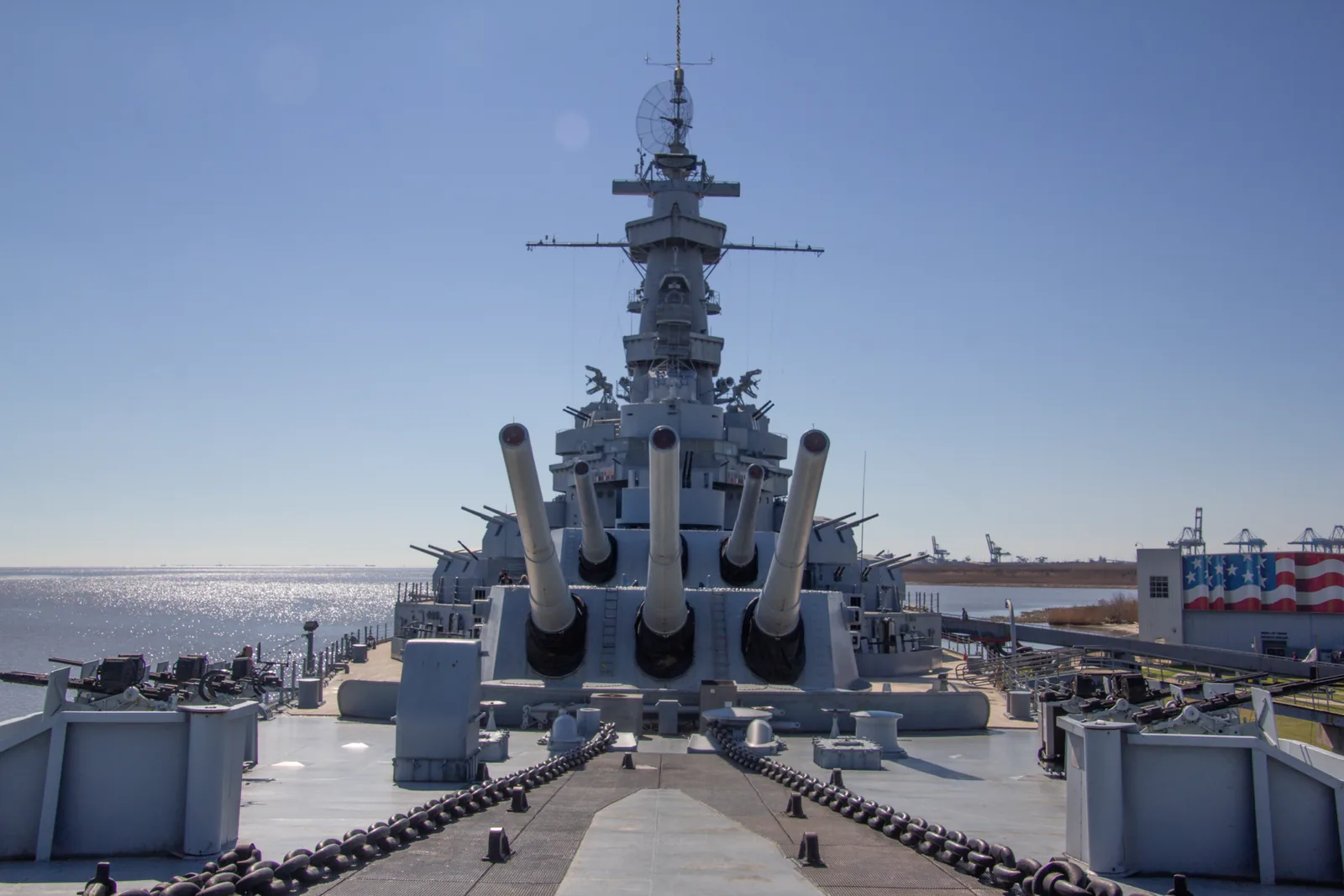
Looking aft from the forecastle, over the anchor chains, at Turrets I and II and the foretop. The Mark 38 main-battery director sits high on the fire-control tower. Alabama as preserved at Mobile.
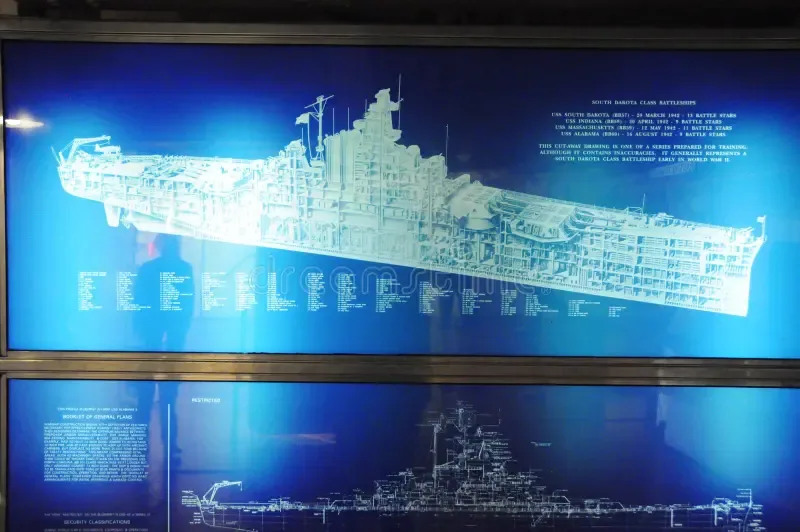
A South Dakota-class cutaway training drawing, photographed as an exhibit. The drawing is one of a series prepared for training and generally represents a ship of the class early in the war. The file as provided includes a stock-agency watermark.
The four ships were not identical in detail. South Dakota, built as a fleet flagship, was given extra conning-tower and superstructure volume and, to pay for it, carried only sixteen 5-inch /38s instead of twenty. Indiana, Massachusetts, and Alabama had the twenty-gun secondary battery, ten twin mounts, five on a side. Alabama was built at Norfolk. Her machinery, in the National Register of Historic Places nomination for the ship and in MaritimeQuest's data table, is four sets of Westinghouse geared steam turbines and eight oil-fired Foster Wheeler boilers, on four shafts, rated at 130,000 shaft horsepower. The design speed in the standard class accounts (Friedman as cited by Wikipedia and Navypedia) is 27.5 knots; the National Register nomination and MaritimeQuest give a maximum speed of 28 knots, as does the park. Some class-wide compilations give Alabama General Electric turbines and Babcock & Wilcox boilers. A widely copied class table that splits the vendors by hull assigns that pairing to South Dakota and Massachusetts instead, and the nomination for this ship contradicts it. Design range is 15,000 nautical miles at 15 knots. [DOCUMENTED, National Register nomination and MaritimeQuest for Foster Wheeler boilers, Westinghouse turbines, 130,000 shp and 28 kn maximum; DOCUMENTED, Friedman / Navypedia / Wikipedia for 27.5 kn design; CONTESTED, B&W / GE in class-wide compilations]
She carried three Vought OS2U Kingfisher floatplanes on a pair of fantail catapults, a peacetime complement of 1,793, and a wartime crew that swelled to about 2,300 in the National Register nomination (2,332 in MaritimeQuest's data; some accounts give about 2,500). Light antiaircraft grew steadily: she was completed with six quadruple 40 mm Bofors mounts and a large 20 mm battery in place of the 1.1-inch and .50-caliber suite in the original sketch, and by late in the war she carried twelve quadruple 40 mm mounts and fifty or more 20 mm guns. Exact 20 mm counts move around in the sources and with the date. [DOCUMENTED as to the general growth of the light battery, Friedman and the standard class summaries; CONTESTED in the exact 20 mm totals at any one date]
ARMOR SYSTEMS
The armor scheme is the reason the hull is so short, and it is the part of the design that most needs to be walked through carefully. The South Dakotas were given an internal, inclined main belt, a lower belt that continues that inclination down into the side protection system and tapers into the triple bottom, and a three-layer deck. The turrets, barbettes, and conning tower are heavily armored in the usual U.S. way. The scheme was designed to produce a useful immune zone against heavy shells, including the Navy's own 16-inch gun, on a treaty displacement and a Panama Canal beam. It did that — and then, in 1939, the Bureau of Ordnance adopted the 2,700-pound Mark 8 "super-heavy" 16-inch AP shell, and the immune zone against the ships' own gun shrank. The underwater part of the same scheme was tested in 1939 and found to be less effective than the North Carolina system it was meant to improve. Both of those results are discussed below. Figures here follow Garzke & Dulin and Friedman as they are given in the standard class literature, in Navypedia, and in the NavWeaps technical notes, and they are tagged where those accounts disagree with one another.
Why the belt is inside the ship, and why it is sloped. A conventional external belt hangs on the outer shell and meets the sea. An inclined belt, sloped back from the vertical, presents a greater effective thickness to a shell arriving on a flat or slightly falling trajectory, because the shot has to travel through more plate and at a more unfavorable angle. The South Dakota belt is sloped 19 degrees from the vertical. On a ship that already had to keep a waterline beam of about 108 feet — the Panama Canal limit that also governed the North Carolinas and, later, the Iowas — hanging a 19-degree belt on the outside of the hull would have eaten into that waterline beam, or forced a wider ship, and would have hurt stability. The designers therefore put the belt inboard of the outer shell, as an internal armored bulkhead, and used the outer plating as a decapping layer and as the first wall of the side protection system. The same choice was later made on the Iowas. It is not free. Building the belt inside the hull is harder. If the belt is damaged, the outer shell has to be cut away before the armor can be reached. Friedman and the class literature are explicit about that repair penalty. [DOCUMENTED, standard Garzke & Dulin / Friedman account of the internal 19-degree belt and the beam/stability reason for putting it inboard]
The main belt. Abreast the citadel, behind 1.25-inch (32 mm) Special Treatment Steel (STS) outer hull plating, the main belt is 12.2 inches (310 mm) of Class A (Krupp cemented) armor, mounted on 0.875-inch (22 mm) STS backing, and inclined 19 degrees from the vertical. The standard account holds that this combination was treated as equal to 17.3 inches (440 mm) of vertical belt at 19,000 yards. The 0.875-inch backing is the figure in Wikipedia's class article, in Navypedia ("310 on 22 mm plating"), and in the Garzke & Dulin-type summaries. The Pacific War Online Encyclopedia gives the backing as 0.75 inch (19 mm) STS. That is a real disagreement, and it is tagged. This article uses 0.875 inch, and records the 0.75-inch figure as a conflicting secondary account. The outer 1.25-inch STS shell is not ornamental. A NavWeaps technical note by Nathan Okun argues that a plate of that thickness is enough, on his decapping formula, to take the cap off an AP projectile up to about 15.5 inches in caliber before the shot reaches the main belt, which would substantially reduce its performance against face-hardened Class A armor at ordinary obliquities. That is an analytical estimate, not a full-scale shooting trial of Alabama's side, and it is tagged as such. [DOCUMENTED, 12.2 in Class A on 0.875 in STS, 19 degrees, and 1.25 in STS outer shell, Garzke & Dulin / Friedman / Navypedia; CONTESTED, 0.75 in backing in the Pacific War Online Encyclopedia; ESTIMATE, Okun / NavWeaps decapping discussion]
The lower belt. Below the main Class A strake the belt continues, still at 19 degrees, as a Class B homogeneous plate, 12.2 inches at the top of that lower strake and tapering as it runs down toward the triple bottom. The standard account, used here, is that it tapers to 1 inch (25 mm) at the lowest edge, where it is welded to the outboard structure of the triple bottom, with the joint reinforced by buttstraps because of a slight knuckle — a change of alignment — at that connection. The Pacific War Online Encyclopedia gives a taper to 1.75 inches (44 mm) "below the waterline," which may be an intermediate height rather than the bottom edge; a Japanese-language technical summary of the class describes a taper to 152 mm (6 inches) at a station 2.1 meters below the top of the lower belt, and then to 25 mm at the toe. Those figures can be reconciled if the belt is a long taper, not a single step. They are recorded, and the 1-inch toe is the number used here. The point of carrying heavy plate this far down was to stop underwater shell hits — AP projectiles that strike short, travel through water, and come up into the side below the waterline — which had concerned the Bureau since the First World War. The same heavy lower belt, unfortunately, became the third bulkhead of the torpedo-defense system, and its stiffness is at the center of the 1939 test results discussed below. [DOCUMENTED, 12.2 in Class B lower belt tapering to 1 in at the triple bottom, Garzke & Dulin / Friedman / Wikipedia class article / Navypedia; CONTESTED or possibly complementary, 1.75 in "below the waterline" in the Pacific War Online Encyclopedia]
The armored citadel is closed at the ends by transverse bulkheads 11.3 inches (287 mm) thick. Steering gear, aft of the after citadel bulkhead, has its own heavy local protection in the class accounts (a thicker sloped side and a heavy after bulkhead and crown). [DOCUMENTED as to 11.3 in citadel bulkheads; SINGLE-SOURCE / standard class listings for the exact steering-gear thicknesses]
The decks. Horizontal protection is a sandwich of three layers, not one thick slab. On top is a 1.5-inch (38 mm) STS weather deck, also called the bomb deck, intended to set off or break up bombs and to decap or yaw AP shells before they reach the main armored deck. The main armored deck is the second deck: a combined 5.75 to 6.05 inches (146–154 mm) of Class B and STS, thicker outboard than on the centerline. Friedman's breakdown, as quoted in technical discussion, is 5.0 inches on the centerline and 5.3 inches outboard, each on 0.75-inch STS, which adds up to the same 5.75–6.05-inch totals. Below that, over the machinery, is a 0.625-inch (16 mm) STS splinter deck, meant to catch fragments from a shell or bomb that bursts on the main deck. Over the magazines the third deck is increased to 1 inch (25 mm) STS. This is a classic American three-deck arrangement, thicker in total than the North Carolina decks (Friedman, as cited: 4.1 inches outboard or 3.6 inches centerline, on 1.4 inches, for the North Carolinas) and in the same family as the Iowa decks (commonly 4.75 inches plus 1.25 inches, for a 6-inch total, with some conflict in the exact outboard figure). [DOCUMENTED, 1.5 in bomb deck, 5.75–6.05 in main armored deck, 0.625 in splinter deck over machinery and 1 in over magazines, Garzke & Dulin / Friedman as cited; the Friedman 5.0 / 5.3 on 0.75 in breakdown is the same totals]
Turrets, barbettes, and conning tower. The main-battery turret faces are 18 inches (457 mm) of Class B, a homogeneous plate, which the Navy preferred for heavy turret faces because it behaves better than face-hardened Class A against the near-normal impacts expected there. Sides are 9.5 inches (241 mm), rears 12 inches (305 mm), and roofs 7.25 inches (184 mm), over STS backing in the usual way. Barbettes, above the main deck, run from about 11.3 inches to 17.3 inches (287–440 mm), heavier on the beam than on the centerline, where they are better covered by other structure. The conning tower sides are 16 inches (406 mm) in the standard U.S. listings (Navypedia: 406 mm sides, 184 mm roof). The Pacific War Online Encyclopedia gives the conning-tower sides as 15 inches. This article uses 16 inches and tags the 15-inch figure as a conflict. Secondary-battery mounts have much lighter protection, on the order of 2 inches of STS, which is splinter armor, not a belt. [DOCUMENTED, Garzke & Dulin / Navypedia / Friedman-type listings for turret 18 / 9.5 / 12 / 7.25 in, barbettes 11.3–17.3 in, conning tower 16 in; CONTESTED, 15 in conning-tower sides in the Pacific War Online Encyclopedia]
The immune zone. An immune zone is not a magic cloak. It is a band of ranges, against a specified gun and a specified shell, inside which that shell is not expected to pierce the belt (because it has not yet lost enough velocity, or is arriving too flat, at shorter range) and is not expected to pierce the deck (because it has not yet begun to plunge steeply enough, at longer range). Inside the inner edge of the zone, the belt can be holed. Outside the outer edge, the decks can be holed. The South Dakotas were designed for a useful zone against the 2,240- or 2,250-pound 16-inch AP shell then in service — on the order of 18,000 to 30,000 yards in one commonly published statement of the requirement, or 17,700 to 30,900 yards against the older Colorado-class 16-inch gun in another. In 1939 the Bureau of Ordnance put the 2,700-pound Mark 8 into service. Against that shell, fired from the ships' own 16-inch /45 Mark 6, the immune zone of the side and deck armor shrank to 20,500–26,400 yards. That is a much narrower band. The Iowa class, similarly protected, had the same problem, which is one reason the stillborn Montana class was drawn larger. These figures are design-office armor-penetration estimates, not battle results, and they assume specified angles and striking velocities. They are still the right way to understand what the Bureau thought it had bought. [DOCUMENTED as the standard published immune-zone figures, Garzke & Dulin / Friedman / class literature: about 18,000–30,000 yd (or 17,700–30,900 yd) against the older 16-inch AP, and 20,500–26,400 yd against the 2,700 lb Mark 8]
UNDERWATER PROTECTION
The side protection, or torpedo-defense, system is a multi-layer sandwich outboard of the machinery and magazines, running from just forward of the forward magazines to just aft of the after magazines, and from the bottom of the belt down to the turn of the bilge. On the South Dakotas it is built around four longitudinal bulkheads plus the outer shell, with liquid-loaded and void spaces alternating in a scheme that was revised after the 1939 tests. The system was designed to absorb an underwater explosion equivalent to 700 pounds of TNT, the same design charge used for the North Carolina class. The total depth of the system, amidships, is 17.9 feet (5.46 m). That depth is the single most important number in a torpedo-defense system: the farther the holding bulkhead is from the point of impact, the more chance the layers have to expend the bubble and stop fragments. [DOCUMENTED, 17.9 ft depth and 700 lb TNT design charge, Friedman / class literature / Wikipedia class article citing those works]
The layers, outboard to inboard, are the 1.25-inch STS outer shell; two relatively light longitudinal bulkheads (described in the Caisson H test literature as 25-pound HTS plates); then the heavy armor belt itself, which is the third torpedo bulkhead and runs down, tapering, to the triple bottom; then, inboard of the belt, the holding bulkhead, a 25-pound STS bulkhead that is supposed to remain watertight even if everything outboard of it is wrecked. Some of the compartments between those walls were designed to be liquid-loaded, usually with fuel oil, to disrupt the explosion bubble and catch fragments; some were left as voids, so that the structure could deflect. After the 1939 tests the operational loading used on the South Dakotas was the outer two compartments liquid and the inner two void — liquid-liquid-void-void, sometimes written WWAA. The North Carolinas had been loaded differently (the third and fourth outboard compartments liquid, in the usual description). The South Dakota loading was also intended to reduce the list that a flooded outboard layer would produce. [DOCUMENTED in outline, Friedman and the published Caisson H / INRO test-account literature; the exact pound-thicknesses of the light bulkheads are from that test-account literature and are tagged as such]
Under the machinery and magazines the ship has a triple bottom: three layers of bottom structure rather than a simple double bottom, the outboard longitudinal of which takes the toe of the lower belt. The welded belt-to-bottom joint, with its riveted HTS buttstraps across the knuckle, is a known hard point. It is also a known weak point in the test results.
The 1939 tests, and the comparison with the North Carolina and Iowa systems. The Bureau did not take the paper design on faith. On 28 September 1939 it fired Caisson H, a half-scale midships section of the South Dakota system, with a 128-pound charge scaled to represent the 700-pound design warhead. The published test account, as quoted in later technical discussion (including an INRO summary of the report), is that the system remained watertight on the holding-bulkhead side: there was no appreciable leakage into the machinery space in the two hours before the caisson was docked. It therefore met its formal goal. The margins were thin. The inner holding bulkhead deflected 11 inches in the half-scale unit, equivalent to 22 inches at full scale, against a clearance of 24 inches to vital machinery. The rigid armor bulkhead itself deflected heavily; the buttstrap at the knuckle joint with the triple bottom failed, though the welded seam was reported intact; and that motion was what drove the holding bulkhead inward. By comparison, the North Carolina system, tested at half scale in Caisson F, deflected the holding bulkhead only 3 inches in the model, or 6 inches at full scale. The South Dakota system was, in Friedman's judgment and in the test literature, less effective than the North Carolina system it had been intended to improve, even though it had been hoped that running the belt down to the triple bottom would help. Subsequent 1/16-scale caisson work led to changes in liquid loading and in local stiffening, and to late design changes on the Iowa class (reinforcement of the third deck inboard of the belt, and the elimination of some brackets that the tests showed were actually harmful). The Iowas kept the same basic geometry and, in the usual figures, the same 17.9-foot amidships depth, with those refinements. A commonly published figure for the North Carolina system's amidships depth is 18.5 feet; that comparison is used here and tagged, because this article did not re-measure the North Carolina drawings from Friedman directly. [DOCUMENTED in outline, Friedman and the 1939 caisson-test record as published; the 11 in / 22 in and 3 in / 6 in deflections, the 28 September 1939 date, and the failed buttstrap are from the published Caisson H / Caisson F test account (INRO / report quotations); SINGLE-SOURCE, 18.5 ft for the North Carolina amidships depth as commonly published]
Known weaknesses. They can be stated without drama. First, the compact 680-foot hull, combined with an internal belt, limits the depth of the side protection system to 17.9 feet amidships, and the system is shallower still toward the ends, where the hull fines in — especially abreast the forward magazines and in the complex afterbody. Depth is the quality a TDS can least afford to lose next to a magazine. Second, making the main armor belt one of the torpedo bulkheads makes that bulkhead too stiff. A torpedo system wants layers that can deflect and absorb; a 12.2-inch armor plate does not do that, and in the 1939 test it transmitted enough motion to push the holding bulkhead almost to the stop. Third, the belt-to-triple-bottom joint is a structural discontinuity, and in the test the reinforcing buttstrap failed. Fourth, the same fine bow that made 27.5 knots possible on 130,000 horsepower is the reason the forward TDS is shallow; the NavWeaps review of Second World War torpedo systems notes that this fine-bow problem also appeared on the North Carolinas, and that a torpedo hit on USS North Carolina sent flash into a forward magazine (flooding, fortunately, prevented a fire). Fifth, the internal belt is difficult to repair after a hit, because the outer shell stands in the way. None of this made the ships fragile. USS South Dakota was hit repeatedly at Guadalcanal, including by 8-inch AP that reached the 12.2-inch belt and stopped there, and she remained a fighting ship. It does mean that the underwater protection was the part of the design that did not live up to the hope invested in it, and that the designers knew that in 1939, before any of the ships were commissioned. [DOCUMENTED, test literature and Friedman as cited; NavWeaps TDS review for the general fine-bow / end-depth problem and the North Carolina magazine flash; Lundgren / NavWeaps analysis of the Guadalcanal belt hits on South Dakota]
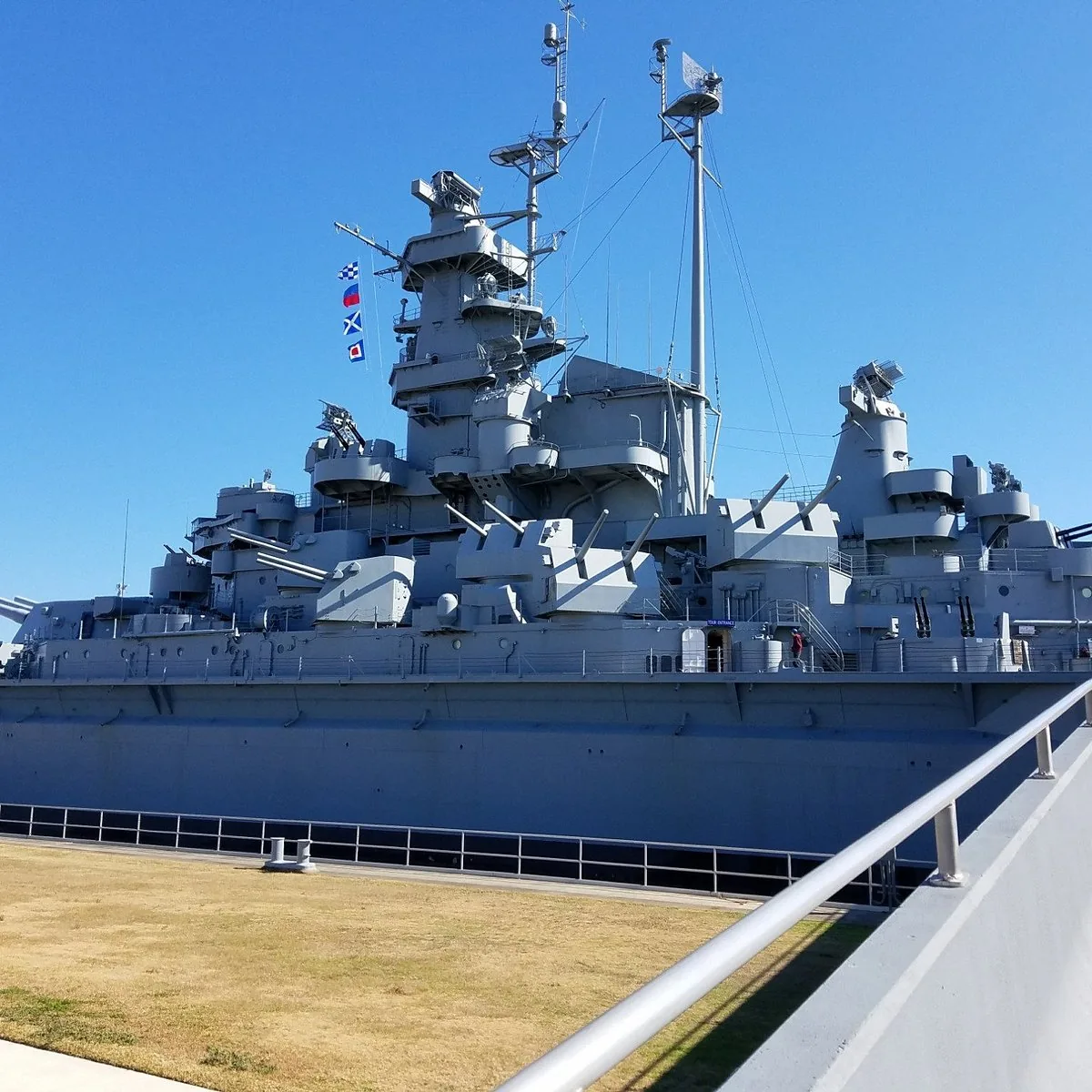
Midships, from the pier at Mobile: the 5-inch /38 twin mounts, the tower, and the signal flags. The side is comparatively clean because the main belt stands inside the hull, behind the outer shell plating, rather than as an external armor strake.
MAIN BATTERY AND GUNNERY
The main battery is nine 16-inch /45 caliber Mark 6 bag guns, in three centerline three-gun turrets: two forward in a superfiring pair, one aft. "Three-gun," not "triple," is the Navy's own distinction, and it matters. Each barrel has its own slide, elevating gear, powder hoist, and projectile hoist. The three guns in a house can load and fire on independent cycles. They are not on one cradle. This is the same gun, and the same turret family, used on the North Carolina class. The Iowa class used the longer 16-inch /50 Mark 7, firing the same projectile family at a higher muzzle velocity. Both guns are treated on this site in USN Mk 6 / Mk 7 16-inch Guns. What follows is the short version that belongs in an account of Alabama.
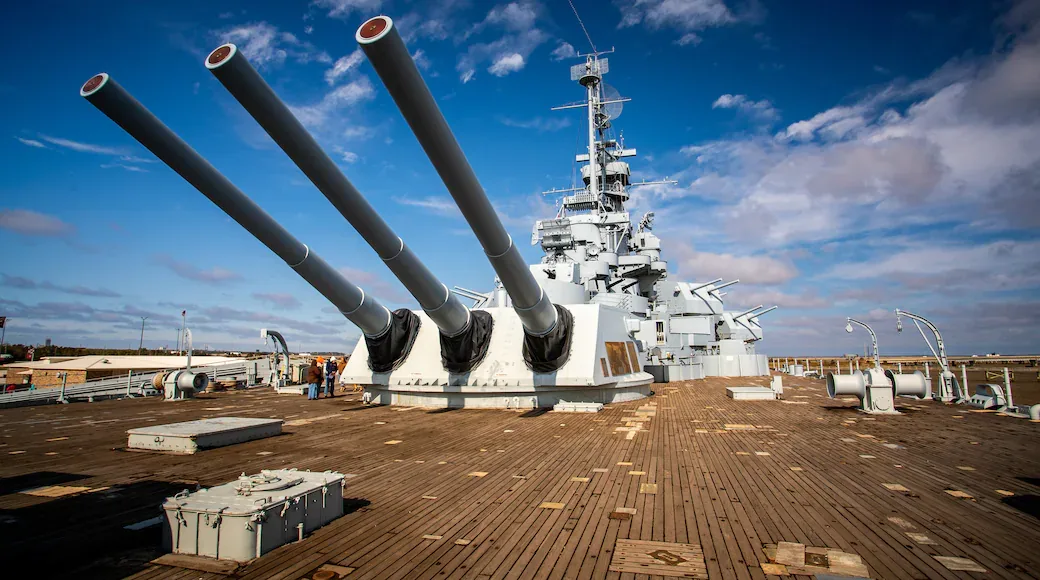
Turret III, trained slightly to starboard, on the teak quarterdeck, with the after superstructure and the after Mark 38 director behind it. Alabama as preserved at Mobile.
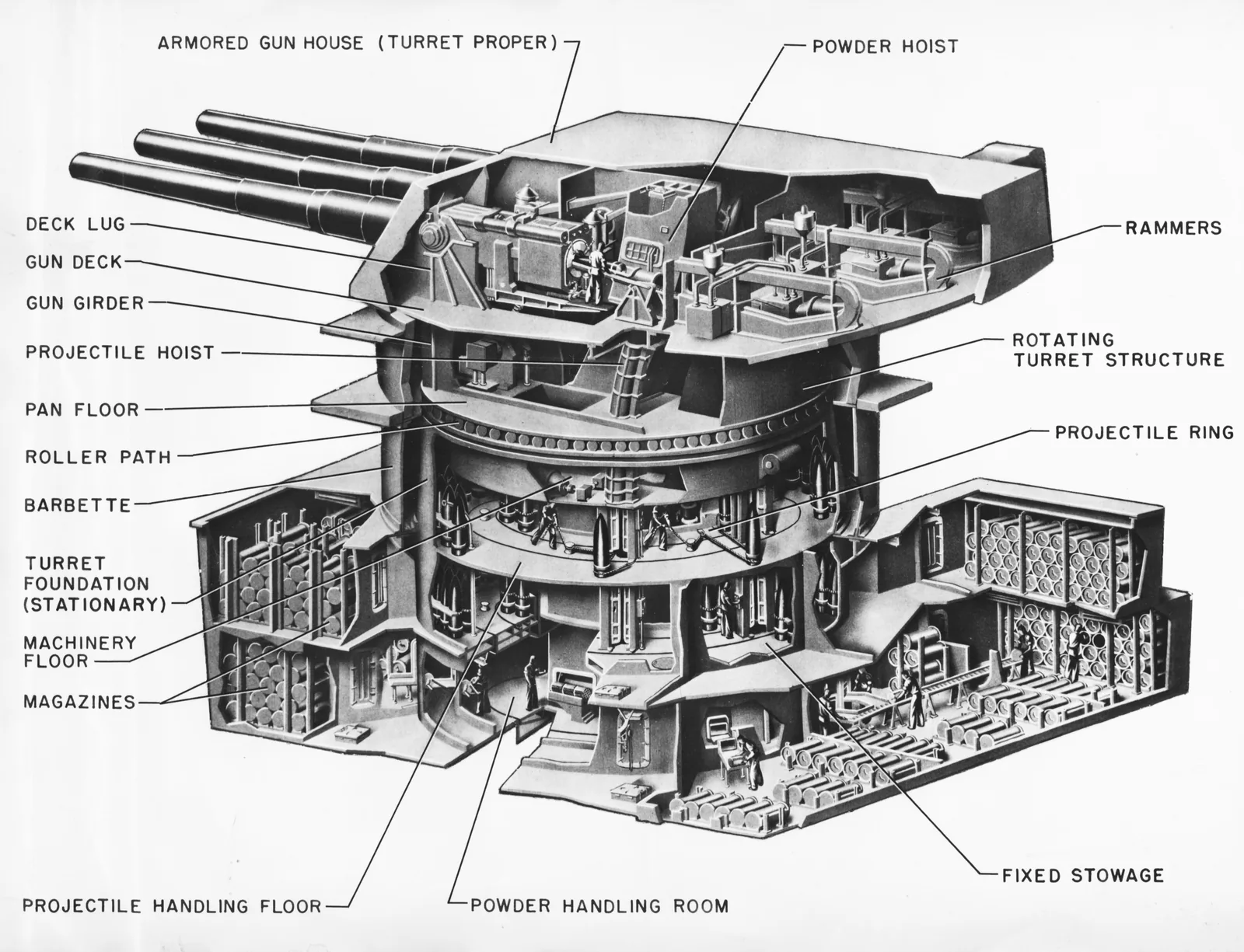
A cutaway of a U.S. 16-inch three-gun turret of the type fitted in the North Carolina and South Dakota classes, showing the armored gun house, barbette, roller path, powder and projectile hoists, handling rooms, and magazines. Official-style Bureau of Ordnance training graphic.
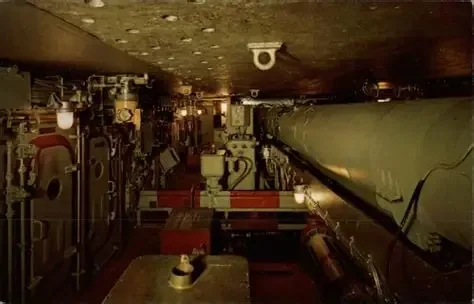
Inside one of Alabama's 16-inch main gun turrets. The large tube running across the compartment is the turret's own rangefinder, used for local control if the main directors were knocked out, and the small doors at left give access to the gun breeches. The heavy armor-plate joint visible overhead is part of the turret roof.
The Mark 6 was designed in 1936 and went to sea in 1941. It is a lighter, simpler successor to the 16-inch /45 of the Colorado class, and it was specifically designed around the 2,700-pound Mark 8 AP shell, which the Colorados could not handle. Gun weight, without breech, is 192,310 pounds. Bore length is 720 inches (45 calibers). The gun is chromium-plated in the bore, uses a Welin breech that opens downward, and can be fired electrically or by percussion. Design rate of fire is two rounds per minute, which is a 30-second loading cycle. In action the sustained rate was lower. At the Second Naval Battle of Guadalcanal, USS Washington (BB-56), with the same gun, averaged about 1.5 rounds per gun per minute in the two documented phases of her firing. Barrel life is about 395 effective full charges. [DOCUMENTED, NavWeaps, 16-inch /45 Mark 6, citing BuOrd data and Garzke & Dulin for penetration; battle rates from the NavWeaps account of Washington's 15 November 1942 action]
The 2,700-pound Mark 8 AP, with a 40.9-pound burster, is the shell the system was built around. Full-charge muzzle velocity with a new gun is 2,300 feet per second, from a 535-pound charge in six bags. Maximum range, at 45 degrees elevation, is 36,900 yards (about 21 miles), from BuOrd OP 757. The lighter 1,900-pound Mark 13 / Mark 14 high-capacity shell, used for bombardment, leaves the muzzle at 2,635 feet per second and ranges to about 40,180 yards. A full charge is rammed as six bags in one stroke, the bags having been transferred from the hoist to the loading tray three at a time. Loading is at +5 degrees. Turrets I and III elevate from −2 to +45 degrees; Turret II, superfiring, from 0 to +45. Elevation rate is 12 degrees per second; train is ±150 degrees at 4 degrees per second. Recoil is 48 inches. Turret mass is 1,403 to 1,437 long tons. Projectile stowage for the class, from OP 755, is 1,333 rounds plus 27 drill projectiles, with Turret II carrying more than I or III because of the greater height of the superfiring house. Alabama was assigned no dye color for her AP shells in the 1945 assignment list; some of her sisters had green, red, or blue dye bags to mark their splashes. [DOCUMENTED, NavWeaps from BuOrd OP 757, OP 1188, OP 755, and Garzke & Dulin]
Armor penetration with Mark 8 AP, from Garzke & Dulin as tabulated by NavWeaps, using the Navy's empirical formula at 2,300 feet per second: 17.62 inches of side armor and 4.29 inches of deck at 20,000 yards; 15.05 inches of side and 5.76 inches of deck at 25,000 yards; 12.77 inches of side and 7.62 inches of deck at 30,000 yards. Those are calculated figures, not proof firings against Alabama's own plate, but they are the figures the immune-zone discussion above is built on, and they show why the Mark 8 shrank the zone: at 25,000 yards the calculated deck penetration is already in the neighborhood of the main armored deck. [DOCUMENTED, Garzke & Dulin via NavWeaps]
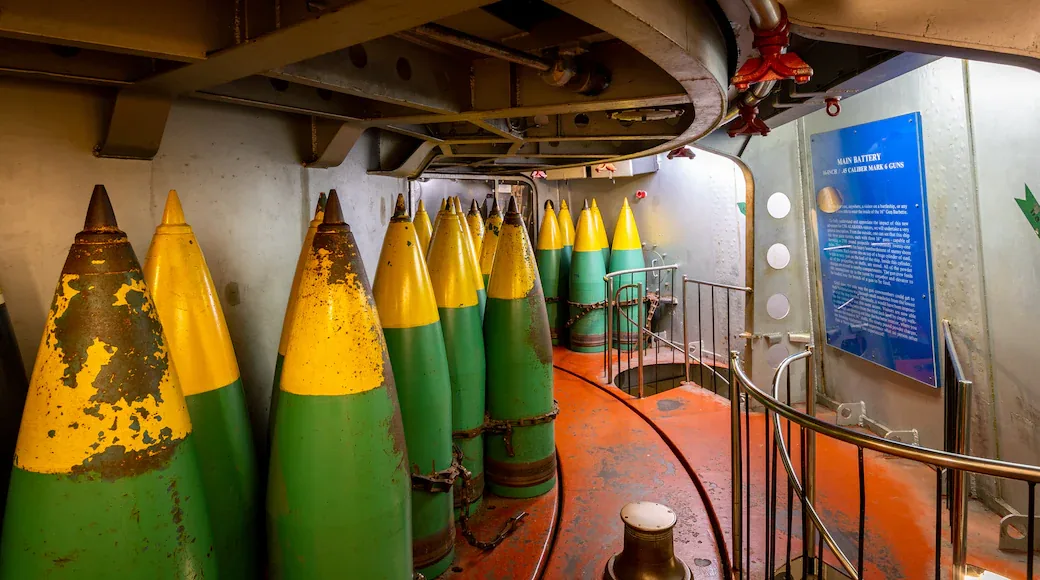
16-inch projectiles in a handling space below a main-battery turret, as displayed at Mobile. The museum plaque identifies them with the 16-inch /45 Mark 6 guns. Display paint should not be read as wartime color coding.
The turret is a vertical factory. Projectiles live in rings on the projectile flats and in fixed stowage; powder lives in the magazines, separated from the projectiles, and is passed through flame-tight scuttles into a handling room before it goes up its own hoist. Powder and projectiles never share a trunk. That separation is the lesson of Hood, Invincible, and every magazine fire the Bureau of Ordnance studied, and it is the way every U.S. 16-inch turret of this generation is built. Hydraulic rammers seat the shell and then the six bags at the +5-degree loading angle. The guns are individually sleeved and slightly more widely spaced than in the older 14-inch three-gun mounts, and they use delay coils of about 0.060 seconds so that adjacent guns in a salvo do not interfere with each other at the muzzles. From the magazine floor to the gun house is a long hoist stack in a rotating structure that weighs more than a World War II destroyer.
MAIN-BATTERY FIRE CONTROL
The guns are only half of the weapon. The other half is the Mark 38 Gun Fire Control System, which this site treats in its own article, Mark 38 GFCS (USN fast battleships). What follows is how that plant was fitted and used in a South Dakota-class ship, and in Alabama in particular.
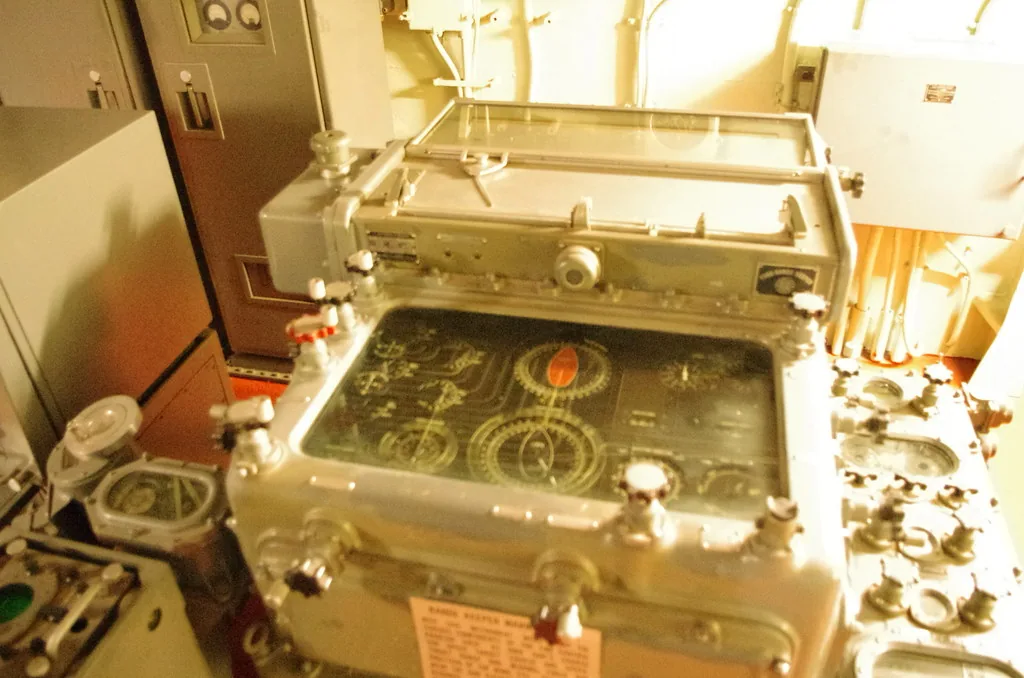
A rangekeeper in Alabama's main-battery plotting room, under its glass cover: the Ford Instrument Mark 8 analog computer that solved the fire-control problem, as the ship is preserved at Mobile.
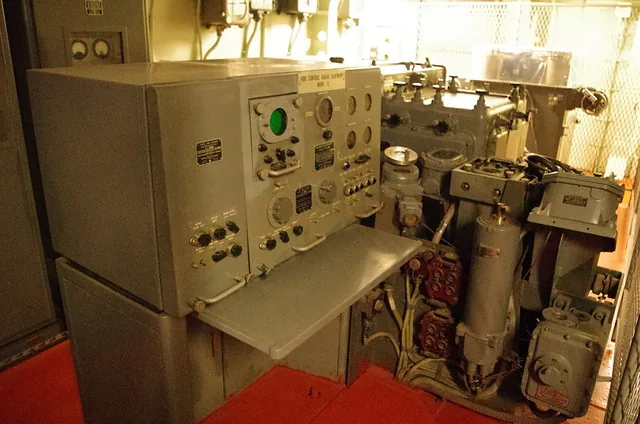
Fire-control radar equipment in a plotting or radar space on Alabama. The cabinet is labeled as fire-control radar equipment. As preserved at Mobile.
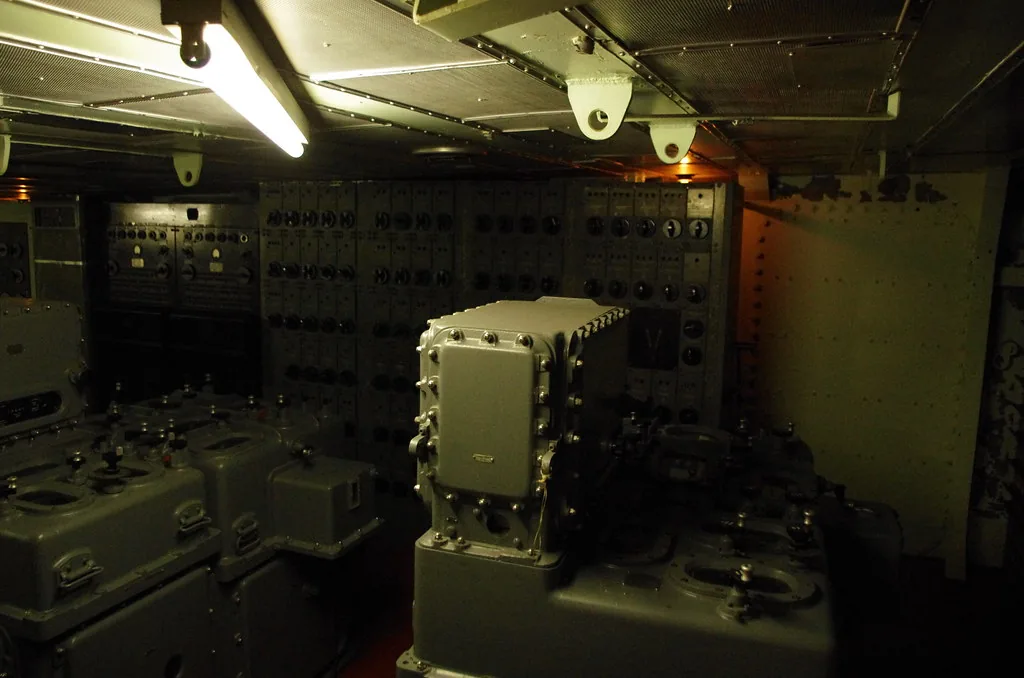
A fire-control plotting space, with switchboards on the bulkheads and armored computing instruments in the foreground — the kind of room, under the armored deck, where the rangekeeper and stable vertical were watched in action. Alabama as preserved at Mobile.
Three kinds of space do the work. High in the fire-control tower, forward, and in a second tower aft, sit the Mark 38 directors (Spot 1 and Spot 2). Each director is an armored, manned pointing station with a long-base stereoscopic rangefinder (Rangefinder Mark 48 in the Bureau's designation for this installation) and, on the roof, a fire-control radar. Below the armored deck, in a plotting room, sit the Ford Instrument Mark 8 Rangekeeper and a Mark 41 or Mark 43 Stable Vertical. The turrets themselves follow synchro gun orders through amplidyne and receiver-regulator power drives, in follow-the-pointer fashion, so that the pointers and trainers in the turret keep matching marks, or, in automatic, the mount does the matching. Two complete systems, forward and aft, can run independently or be cross-connected at the fire-control switchboard, which is why a photograph of that switchboard is not a decoration. If Spot 1 or the forward plotting room is wrecked, Spot 2 and the after plant can still shoot the ship. [DOCUMENTED, this site's Mark 38 article, from NavPers / BuOrd material; standard fast-battleship GFCS layout]
The rangekeeper is an analog computer. It is not a range-only instrument. Given own ship's course and speed, the target's bearing, range, and generated course and speed, the time of flight, drift, and the inclination of the deck (from the stable vertical), it produces continuous train and elevation orders, and it keeps producing them while own ship turns and while the target moves. A projectile fired at long range may be in the air for a minute or more — 43.6 seconds to 25,000 yards, 56.6 seconds to 30,000 yards, with Mark 8 AP, from the OP 757 table — and the computer has to aim at where the target will be when the shell arrives, not at where it is when the guns fire. Optical ranges from the director, and later radar ranges, are the inputs. Spots — up, down, left, right, or a range and deflection correction off the radar B-scope — are applied back into the same solution. [DOCUMENTED, Mark 38 article and BuOrd OP 757 times of flight]
Radar is what changed the plant from a clear-weather instrument into an all-weather one. The South Dakota class completed, in the standard equipment tables, with Mark 8 fire-control radar on the main-battery directors for Indiana, Massachusetts, and Alabama; South Dakota completed with Mark 3 and was later refitted. A secondary account of Alabama's modifications has her receiving Mark 3 in 1943 and then quickly replacing it with Mark 8. The completion-with-Mark-8 listing is the one preferred here; the Mark 3-then-Mark-8 sequence is recorded as a conflicting account. Mark 8 is a lobe-switching, range-and-bearing set that sits on the director roof. Late in the war it was superseded by Mark 13, a better set in the same role, and in 1945 Alabama's traditional spotting scopes were replaced with Mark 27 microwave sets. With radar, the plant can fire at night, through smoke, and, in principle, at ranges where the target is not a clear optical object. The demonstration piece is not Alabama's — she never fought a gun action against a capital ship — but her near-sister in the same system, USS Washington, which opened fire on Kirishima at 18,500 yards on 15 November 1942 using radar ranges and optical train, and had hits by the third salvo. That is the system Alabama carried. [DOCUMENTED, Navypedia equipment tables for completion with Mark 8 on BB-58–60; CONTESTED, a modifications account that gives Alabama a short Mark 3 period; NavWeaps account of Washington / Kirishima for the 18,500 yd radar-range action]
What the system cannot do is stretch the immune zone, or make 36,900 yards a practical battle range against an armored ship. Effective main-battery range is a narrower idea than maximum range. Against a battleship, the useful band is set by the immune-zone discussion above, by the quality of the radar and the spotting, and by the fact that at 30,000 yards and beyond the angle of fall is steep, the time of flight is long, and small errors in generated target motion become large misses. Against a shore target, with a spotter or with radar against a coastline, the same guns were used at whatever range the geometry allowed, including the 1,900-pound HC shell on bombardment days. Alabama's own main-battery work in the war was of that second kind, plus the constant readiness to fight a surface action that never quite arrived — most nearly at Leyte Gulf, when she was part of Willis Lee's TF 34 and was not detached in time to meet Kurita in San Bernardino Strait.
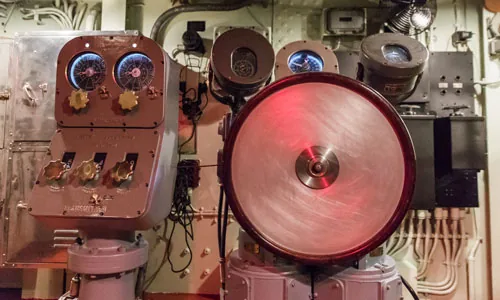
Fire-control or navigation instruments in an interior compartment on Alabama, under red light of the kind used at night. As preserved at Mobile.
SECONDARY BATTERY, ANTIAIRCRAFT, AND THEIR FIRE CONTROL
Alabama carries twenty 5-inch /38 caliber Mark 12 guns in ten twin mounts, five on each side, clustered amidships. The 5-inch /38 is the standard U.S. dual-purpose gun of the war: a wet-mount, power-rammed, semi-automatic 5-inch gun with a high elevation, a high rate of fire, and, once the proximity (VT) fuze and the later fire-control radars were in service, a serious antiaircraft reach. Design and practiced rates of fire are in the 15-to-22-round-per-minute range, depending on the crew and the duration of the shoot; the mount elevates high enough for aircraft work and, with the proper fuze, can also fire against ships and against the beach. Maximum surface range is on the order of 18,000 yards, and the commonly published AA ceiling is about 37,200 feet, both from the standard NavWeaps / BuOrd tables. The 5-inch /38 is treated as a dual-purpose weapon in every serious account of the class, and it is the gun that did most of Alabama's shooting at aircraft. [DOCUMENTED, NavWeaps, 5-inch /38 Mark 12, for the gun and the range and ceiling figures; mount count for Alabama is the class standard of ten twins]
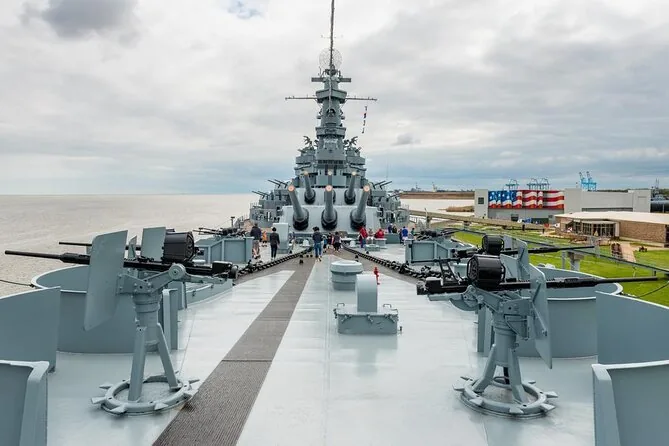
Looking forward from the fantail: single 20 mm Oerlikon mounts in the foreground, the after 16-inch turret and the tower beyond, and the aircraft pavilion ashore to starboard. Alabama as preserved at Mobile.
Those twenty guns are controlled by the Mark 37 Gun Fire Control System, which is a different plant from the Mark 38 and is built for the dual-purpose problem, including aircraft. Alabama has four Mark 37 directors. Each director feeds a Mark 1A computer in a secondary plotting room, with a stable element, and originally carried a Mark 4 fire-control radar on the director roof. The Mark 4s were later replaced by the Mark 12 / Mark 22 combination — a range set and a height-finder, the "orange peel" pairing familiar from late-war photographs. The computer solves a three-dimensional problem: a target with a high angular rate, a changing range, and a fuze time that has to burst the shell at the right instant. Once the VT (proximity) fuze was in fleet service, from 1943, the fuze-time part of that problem became less brittle, because the shell could burst itself when it passed close to the aircraft. VT did not make the director or the computer optional. It made a good solution more lethal. [DOCUMENTED as the standard USN Mark 37 / Mark 1A / Mark 4 then Mark 12/22 fit on the class; VT fuze introduction in 1943 is the standard BuOrd / fleet chronology]
The close-range battery is a different system again. The quadruple 40 mm Bofors mounts were locally controlled, typically by Mark 51 directors with Mark 14 gyro gunsights, which automatically rate the target and throw on a lead. The 20 mm Oerlikons were also locally controlled, often with Mark 14 sights, and were a last-ditch weapon. Neither the 40 mm nor the 20 mm is part of the Mark 37 or Mark 38 plants. Their effectiveness came from numbers, from the gyro sight, and, for the 40 mm, from a useful explosive shell at the ranges where kamikazes and remaining dive-bombers had to be broken up. Alabama's light battery, as already noted, grew from six quadruple 40 mm mounts at completion to twelve by the November 1943 refit, with a 20 mm count that the sources do not agree on to the gun. A 1945 plan to put two more quadruple 40 mm mounts on the forecastle was dropped, on the experience of other ships, because those positions were too wet to be useful. [DOCUMENTED, Friedman-type modifications summary as used in the standard class accounts]
POWER PLANT AND PROPULSION
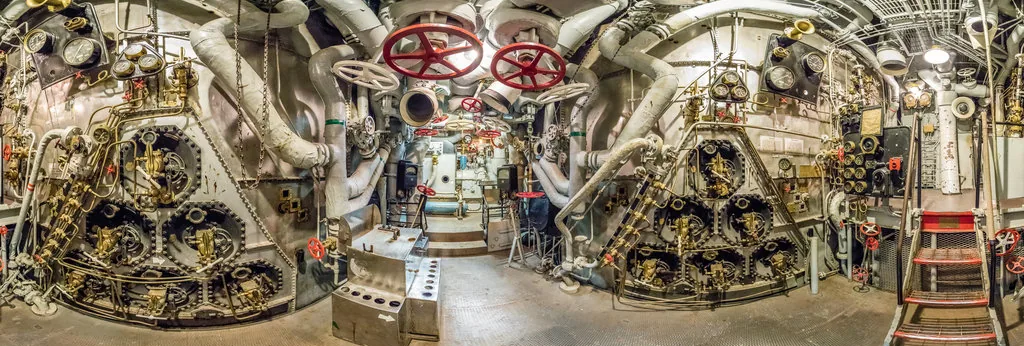
Two of Alabama's eight Foster Wheeler boilers in one of her firerooms, as preserved, with the furnace fronts, steam piping, and valve wheels still in place. The ship has eight boilers in four engine rooms.
Wartime photographs of her #4 fire room, #4 engine room and evaporators, annotated by a sailor who served aboard, are in From a Sailor's War Diary below.
Alabama has four engine rooms, each with two boilers and a turbine set, driving four shafts. The plant is eight oil-fired Foster Wheeler boilers and four sets of Westinghouse geared steam turbines, rated at 130,000 shaft horsepower for a design speed of 27.5 knots and a maximum speed of 28 knots. The park notes two five-bladed and two four-bladed propellers, each of about 18.2 tons; this article has not independently confirmed the blade counts from a primary machinery drawing and tags that detail as a park figure. Fuel, in the Navypedia listing and the National Register nomination, is 6,959 tons of oil, for the 15,000-nautical-mile range at 15 knots already cited. The compact hull means this is a tight, hot, efficient plant, not a spacious one. It is also the plant that, in the early 1980s, was partly cannibalized for spare parts when the Navy reactivated the Iowa class — a pointed footnote to the argument, taken up later, that these ships still had work in them. [DOCUMENTED, National Register nomination and MaritimeQuest for the Foster Wheeler boilers, Westinghouse turbines, 130,000 shp and 28 kn maximum; Friedman / Navypedia for the 27.5 kn design speed and the range; Navypedia and the National Register nomination for the fuel figure; SINGLE-SOURCE, park, for the 18.2-ton / mixed-blade propeller detail; DOCUMENTED, standard museum-ship accounts, for the 1980s cannibalization]
WHAT MADE HER SPECIAL
Several things, and they should be kept distinct. First, the design itself: a 16-inch-gun, heavily armored battleship on a 680-foot, treaty-limited hull, with an internal 19-degree belt and a three-deck armor scheme that, on paper, was a better protected North Carolina in a shorter hull. That is a genuine achievement, even after the Mark 8 shell and the 1939 caisson tests are taken into account. Second, the fire-control plant: Mark 38 directors, the Mark 8 rangekeeper, and fire-control radar, married to a gun that could throw a 2,700-pound AP shell to 36,900 yards and a 1,900-pound HC shell still farther. The same plant, in Washington and in Massachusetts, had already shown what it could do to a battleship at night and to a half-finished opponent at Casablanca. Third, the dual-purpose battery and the VT fuze, which made a fast battleship a serious antiaircraft escort — and that, not a line-of-battle action, is the work Alabama actually did for most of the war.
Fourth, and this is particular to this ship rather than to the class, she had an unusually clean war. She was never hit by the enemy. She shot down, in the park's and the Encyclopedia of Alabama's figure, 22 Japanese aircraft, and she steamed some 218,000 miles. She earned nine battle stars. At the Philippine Sea, on 19 June 1944, she was the first ship in the force to pick up the incoming Japanese air strike on her air-search radar, at 141 nautical miles, at 10:06, a contact quickly corroborated by Iowa. That early warning is a documented piece of the "Marianas Turkey Shoot," and it is a better claim to fame than a nickname. The park's account of a 190-mile contact, and of an SK-2 set installed at sea for the purpose, is not used here; the dated 141-nautical-mile contact is. [DOCUMENTED, 141 nmi at 10:06 on 19 June 1944, standard operational histories as cited in Wikipedia; CONTESTED, the park / Encyclopedia of Alabama 190-mile and SK-2 wording; SINGLE-SOURCE / park and EoA for 22 aircraft and 218,000 miles]
Fifth, she was saved. That is not a design feature, but it is what makes her special now. The Navy struck her on 1 June 1962 and would have scrapped her, as it scrapped South Dakota and Indiana. The people of Alabama, including more than a hundred thousand dollars in schoolchildren's coins, bought her a second life. The SS United States, a larger and in some ways more original ship, was not given that life, and was scuttled as a reef on 11 November 2026, the day this article was finished. The comparison is drawn here on purpose.
SPEED, RANGE, WEIGHT AND ARMOR COMPARED
The tables below place Alabama against her three sisters (which share her hull and, with the exception of South Dakota's reduced 5-inch battery and flagship superstructure, her essential characteristics), against the North Carolina and Iowa classes, and against a set of foreign contemporaries: Yamato, Bismarck, a King George V-class battleship, Richelieu, HMS Vanguard, and the unfinished Soviet Project 23 (Sovetsky Soyuz) design. The SS United States is included because she is in the same weight class at maximum draft, because she is the subject of a companion article on this site, and because the two ships are now a study in what was saved and what was not. Every number is tagged. Where a primary or standard characteristics document was used, that is said. Where only a commonly published figure was available, or where sources disagree, that is said too.
Displacement, length, speed and plant. Displacements are in long tons unless a metric figure is noted. "Standard" is the treaty definition, not always the as-built number.
Ship Standard / full-load displacement Length overall Design or service speed Plant Label USS Alabama (South Dakota class) 37,970 long tons standard; 44,519 long tons full load (Friedman / Navypedia). DANFS lists 35,000. Park also uses 42,500 as an "actual" full load, not used here. 680 ft 27.5 kn design; 28 kn maximum (NRHP, MaritimeQuest, park) 130,000 shp, 8 Foster Wheeler boilers, 4 Westinghouse turbine sets DOCUMENTED, Friedman / Navypedia for 37,970 / 44,519, 680 ft, 27.5 kn, 130,000 shp; NRHP / MaritimeQuest for Foster Wheeler, Westinghouse and 28 kn maximum; DANFS 35,000 is the treaty listing; CONTESTED, park 42,500 t South Dakota, Indiana, Massachusetts Same class figures as Alabama, with small as-fitted differences. South Dakota had 16 rather than 20 5-inch /38s. 680 ft 27.5 kn design 130,000 shp, same plant type (maker details vary by hull in some listings) DOCUMENTED as the class standard; South Dakota's reduced secondary is documented North Carolina class About 36,600–37,500 long tons standard as built, against a 35,000-ton treaty design; about 44,800 long tons full load is the commonly published figure. 728 ft 9 in 28 kn design 121,000 shp SINGLE-SOURCE / standard published official characteristics; exact as-built standard varies slightly by source Iowa class (WWII) 48,110 long tons standard; 57,540 long tons full load. Later configurations were heavier. 887 ft 3 in 33 kn design (up to 35.2 kn is published at light load) 212,000 shp DOCUMENTED as the standard published official characteristics, as used in this site's SS United States article Yamato Commonly published: about 62,315 long tons standard and about 71,659 long tons full load; metric trial and full-load figures in Japanese sources run in the same neighborhood and do not always convert cleanly. 862 ft 10 in (263 m) 27 kn design 150,000 shp SINGLE-SOURCE / standard published figures; Japanese trial displacements are a known source of variation Bismarck About 41,700 long tons standard; about 50,300 long tons full load, the standard published figures. 823 ft 6 in (251 m) 30 kn design About 138,000–150,000 shp in published listings DOCUMENTED as the standard published characteristics; this site has a Bismarck-class article King George V class About 36,700 long tons standard; full load about 42,000–45,200 long tons depending on the date and the ship. 745 ft 28 kn design 110,000 shp SINGLE-SOURCE / standard published official characteristics; wartime full load varies Richelieu Treaty design 35,000 tons; as-built standard commonly about 37,250–38,500 long tons; full load about 44,700–47,500 long tons depending on the date. About 813 ft (247.9 m) 32 kn design 150,000 shp SINGLE-SOURCE / standard published characteristics; full-load figures vary by date HMS Vanguard About 44,500 long tons standard; about 51,420 long tons full load, the commonly published figures. 814 ft 4 in 30 kn design 130,000 shp SINGLE-SOURCE / standard published official characteristics Sovetsky Soyuz (Project 23), design only Design figures commonly given as about 59,150 metric tonnes standard and about 65,150 metric tonnes full load. No ship of the class was completed. About 884 ft (269.4 m) 28 kn design About 201,000 shp, design ESTIMATE / design figures only, standard published Project 23 characteristics; none completed SS United States (1952) 45,400 long tons at design draft; 47,264 long tons at maximum draft; lightship 30,817 long tons. (Gross tonnage, a volume measure, was 53,329.) 990 ft 0 in 33 kn service; 38.32 kn on trials 240,000 shp (247,785 shp on trials) DOCUMENTED, HAER PA-647, as used in this site's SS United States article
Armor and underwater protection. Belt figures are the main (usually midships) belt, not the whole scheme. Deck figures are the main armored deck, with bomb and splinter decks noted where the source gives them. TDS depth is amidships, where the system is deepest.
Ship Main belt Main armored deck Turret face TDS depth (amidships) Immune zone or notes Label Alabama / South Dakota class 12.2 in Class A on 0.875 in STS, internal, sloped 19°. Lower belt Class B, 12.2 in tapering to 1 in at the triple bottom. Outer shell 1.25 in STS. 5.75–6.05 in Class B + STS, plus 1.5 in STS bomb deck and 0.625 in (1 in over magazines) splinter deck 18 in Class B (sides 9.5, rear 12, roof 7.25). Barbettes 11.3–17.3 in. CT 16 in. 17.9 ft (5.46 m), 4-bulkhead system with the belt as the third bulkhead; 700 lb TNT design charge Designed about 18,000–30,000 yd (or 17,700–30,900 yd) against older 16-in AP; 20,500–26,400 yd against the 2,700 lb Mark 8 DOCUMENTED, Garzke & Dulin / Friedman / Navypedia; CONTESTED, 0.75 in backing and 1.75 in lower-belt intermediate in some secondary accounts; CT 15 in in one encyclopedia North Carolina class 12 in Class A, sloped 15°, external belt (the conventional arrangement the South Dakotas abandoned) Thinner than the South Dakotas: Friedman as cited, 4.1 in outboard or 3.6 in centerline, on 1.4 in, plus bomb and splinter decks 16 in class listings commonly give 16 in faces (with heavy barbettes); not identical to the South Dakota turrets in every strake About 18.5 ft amidships is the commonly published figure; a more elastic system than the South Dakota belt-as-bulkhead arrangement, and a shallower holding-bulkhead deflection in Caisson F Designed around the earlier 16-in (and originally 14-in) threat; later handicapped by the same Mark 8 shell SINGLE-SOURCE / standard published figures for belt, deck, and the 18.5 ft TDS depth; Caisson F comparison is from the 1939 test account Iowa class 12.1 in on 0.875 in STS, internal, sloped 19° (a near-sister of the South Dakota belt, 0.1 in thinner in the usual listing). Lower belt tapers, in one standard account, to 1.62 in. Commonly 4.75 in + 1.25 in STS for a 6 in total; Friedman has some conflicting outboard figures 19 in faces on the 16-in /50 turrets, in the standard listings, with heavy barbettes and a 17.3 in CT in some accounts 17.9 ft amidships in the usual figures, same basic geometry as the South Dakotas, with post-1939 local strengthening Same Mark 8 problem as the South Dakotas; a longer hull, not a deeper TDS, is the main underwater difference DOCUMENTED as the standard Garzke & Dulin / Friedman figures; some deck and lower-belt details remain contested between those two Yamato 16.1 in (410 mm), sloped 20°, internal belt continued down as a heavy torpedo bulkhead About 7.9–9.1 in (200–230 mm) in the standard published figures 25.6 in (650 mm) faces, the standard published figure A deep, heavy system, but with a poorly designed joint between the belt and the lower torpedo bulkhead that failed in service and is a known defect (NavWeaps TDS review) Designed against 18-in fire at very long range, on a much larger displacement SINGLE-SOURCE / standard published figures; the joint weakness is DOCUMENTED in the NavWeaps TDS review and in the postwar damage analyses Bismarck 12.6 in (320 mm) vertical belt, external, in the standard published figures Relatively thin by late-1930s standards: on the order of 3–4.7 in (80–120 mm) in standard listings, plus a sloped deck 14.2 in (360 mm) faces, standard published figure A conventional German sandwich; shallower than Richelieu, not in the South Dakota internal-belt family The ship was lost to a combination of damage, not to a single deck or belt failure that can be read straight off this table DOCUMENTED as the standard published characteristics; this site has a Bismarck-class article King George V class 14.7 in (374 mm) belt in the standard published figures, a vertical or near-vertical main strake About 5–6 in in standard listings, heavy by British interwar practice 12.75 in (324 mm) faces is a commonly published figure for the 14-in turrets A British sandwich of conventional depth, not an internal-belt / lower-belt-to-keel arrangement Designed around the 14-in gun and a tight treaty displacement SINGLE-SOURCE / standard published characteristics Richelieu About 13.0–13.2 in (330–335 mm) in standard listings, inclined, on a treaty hull A heavy deck in the French manner, commonly about 6–6.7 in (150–170 mm) over magazines 16.9 in (430 mm) faces is a commonly published figure Often credited as the deepest midships TDS of the treaty generation — on the order of 23 ft (about 7 m) amidships in standard accounts — though, as with all such systems, it shallows toward the ends Designed against 15-in fire on a treaty displacement; the deep TDS is the feature usually singled out SINGLE-SOURCE / standard published characteristics; the ~23 ft TDS depth is the commonly published midships figure HMS Vanguard 13–14 in (330–356 mm) belt in the standard published figures A heavy deck in late-British practice, commonly about 5–6 in 13 in (330 mm) faces is a commonly published figure for the 15-in turrets A conventional late-British system, on a larger hull than the King George Vs The last British battleship, designed with war experience, still on a compact beam SINGLE-SOURCE / standard published characteristics Sovetsky Soyuz (design) Design figures in the 375–420 mm (14.8–16.5 in) range, depending on the strake and the source A heavy deck in the design accounts, commonly around 155–165 mm plus upper layers Design figures around 495 mm (19.5 in) faces appear in standard published tables A deep design system on a very large hull; never built, never tested at full scale Design only. The numbers should not be read as a completed ship's as-fitted protection. ESTIMATE / design figures only, standard published Project 23 characteristics SS United States Not a warship. No armored citadel, belt, or TDS in the battleship sense. Fireproofing and subdivision are treated in the companion article. — — — Included for displacement and speed, not for armor. 47,264 long tons at maximum draft, 38.32 kn on trials. DOCUMENTED, HAER PA-647
Full-load (or maximum) displacement, drawn to scale. The bar length is 8 pixels per 1,000 long tons, using the full-load or maximum figure in the table above. Midpoints are used where a range was given. Project 23 is a design number, in metric tonnes treated here as roughly comparable, and is labeled as such. The United States is in the same weight class as Alabama and is longer and faster. Yamato is in a class of her own.
Ship Full-load or maximum displacement What the number is Bar (8 px / 1,000 t) Yamato 71,659 long tons Commonly published full load Sovetsky Soyuz (design) 65,150 t (design) Uncompleted Project 23 design full load, metric Iowa class (WWII) 57,540 long tons Standard published WWII full load HMS Vanguard 51,420 long tons Commonly published full load Bismarck 50,300 long tons Standard published full load SS United States 47,264 long tons Maximum-draft displacement, HAER Richelieu About 46,100 long tons Midpoint of the published full-load range North Carolina class About 44,800 long tons Commonly published full load USS Alabama 44,519 long tons Friedman / Navypedia full load King George V class About 43,600 long tons Midpoint of the published full-load range
The comparison that matters for Alabama is not that she was the biggest battleship. She was not. Yamato was in another weight class entirely, and even the Iowas, on a much longer hull, are some 13,000 long tons heavier at full load. What the South Dakotas bought, on a treaty displacement and a 680-foot hull, was a 16-inch battery and a belt-and-deck scheme that could stand in the same conversation as much larger ships, at a speed — 27.5 knots — that let them run with the fast carriers. The King George Vs, on a similar treaty displacement, had a heavier belt and a smaller gun. Bismarck was faster and a little heavier, with a vertical belt and a weaker deck. Richelieu was faster still, with a famously deep midships TDS. Vanguard, completed after the war, is the British attempt at the same late-generation problem on a larger displacement. The Project 23 numbers are a reminder of what the Soviet Union drew and did not finish. The SS United States, at 47,264 long tons and 38.32 knots, is the civilian ship in Alabama's weight class, and the ship that was not saved.
SERVICE LIFE, 1942–1943: ATLANTIC AND THE HOME FLEET
The keel was laid at the Norfolk Navy Yard on 1 February 1940. She was launched on 16 February 1942, sponsored by Henrietta Hill, the wife of Senator Lister Hill of Alabama; Crane Ship No. 1, the former battleship Kearsarge, helped lift in the heavy armor and the guns. She was commissioned on 16 August 1942, Capt. George B. Wilson in command, and began shakedown in Chesapeake Bay on 11 November, then operational training out of Casco Bay, Maine. The Encyclopedia of Alabama, in a park-authored article, says more than 3,000 people worked around the clock for 30 months and finished the ship nine months early, at a cost of about $80 million, and that she was the largest ship ever built in Portsmouth. Those figures are the park's, and they are tagged as such. [DOCUMENTED, DANFS / NHHC, for the keel, launch, sponsor, commission, and shakedown dates; SINGLE-SOURCE, Encyclopedia of Alabama / park, for the 3,000 workers, nine months early, and $80 million]
Her first deployment was not to the Pacific. In the spring of 1943 the Royal Navy had sent heavy ships to the Mediterranean for the invasion of Sicily and was stretched at home against the German squadron in Norway, especially Tirpitz. Alabama and South Dakota, as Task Force 22, left the United States on 2 April, called at Argentia, and arrived at Scapa Flow on 19 May. There they became TF 61 of the Home Fleet, under Rear Admiral Olaf M. Hustvedt, and spent the next three months working with British capital ships, including HMS Anson and HMS Duke of York. In early June they covered a reinforcement of Spitzbergen. In July they took part in Operation Governor, a demonstration intended to distract German attention during the Sicily landings and, if possible, to lure Tirpitz out. The Germans did not take the bait. On 1 August the two American battleships were detached; they reached Norfolk on 9 August, and Alabama went into overhaul for the Pacific. She left the yard on 20 August, transited the Panama Canal on 25 August, and reached Efate, in the New Hebrides, on 14 September. [DOCUMENTED, DANFS / NHHC chronology]
The park has written that Alabama is "the only American ship ever honored by the former Soviet Union" for her role in protecting the Russian convoys. That is a large claim, and this article has not been able to verify it. Other Allied ships on the Murmansk run have also been the subject of later Soviet or Russian gestures. The claim is recorded, and it is not used as a fact. [UNVERIFIED, park / Encyclopedia of Alabama claim]
SERVICE LIFE, 1943–1945: THE PACIFIC
From Efate she trained for six weeks with the fast carriers, then went north to the Gilberts. On 20 November 1943 she was in the carrier screen for the landings at Tarawa and Makin, and she twice engaged Japanese aircraft that came out to the force on the night of the 26th. On 8 December she was one of six fast battleships that bombarded Nauru, and she took three wounded men off the damaged destroyer Boyd. After a propeller replacement at Pearl Harbor in mid-January 1944 she joined TG 58.2 for Operation Flintlock. With South Dakota and North Carolina she bombarded Roi-Namur on 29–30 January, then screened the force to the north of Kwajalein. In mid-February she escorted the carriers for Operation Hailstone, the great raid on Truk, and went on with them toward the Marianas. [DOCUMENTED, DANFS / NHHC chronology]
On 21 February 1944, during a Japanese air attack as the force raided Saipan, Tinian, and Guam, Alabama's No. 9 5-inch mount accidentally fired into No. 5. Five men were killed and eleven were wounded. The ship then took part in a sweep southeast of Saipan, found no Japanese surface force, and went into Majuro to replenish. The rest of the spring was carrier work in the Carolines and, in April, cover for the Hollandia landings on New Guinea, then a bombardment of Ponape. [DOCUMENTED, DANFS / NHHC and the standard operational histories of the 21 February mount casualty]
The Marianas and the Philippine Sea were the center of her war. On 13 June 1944 she took part in a long pre-invasion bombardment of Saipan. On 19 June, at 10:06, she was the first ship in the force to detect the incoming Japanese air strike, at 141 nautical miles; Iowa corroborated the contact, and about forty minutes later the aircraft were over the fleet. In the two-day battle that followed — the Battle of the Philippine Sea, the "Great Marianas Turkey Shoot" — the Japanese carrier air arm was wrecked. Alabama remained in the carrier screen, then supported the Guam operation, and went on with the force through the Carolines and into the first raids on the Philippines. [DOCUMENTED, 141 nmi at 10:06, standard operational histories; DANFS / NHHC for the surrounding movements]
At Leyte Gulf she was with the fast carriers, not with Oldendorf's battle line in Surigao Strait, a distinction some popular accounts blur. She supported the 15 October landing, then screened the carriers in TG 38.3 and TG 38.4. On 14 October her gunners claimed three Japanese aircraft destroyed and one damaged. When Ozawa's decoy carriers were sighted, Halsey took the fast carriers, and Willis Lee's newly organized TF 34 — Alabama and five other fast battleships, with cruisers and destroyers — north with him, arrayed as the carrier screen. On the morning of 25 October, while Mitscher's aircraft were sinking Ozawa's carriers off Cape Engaño, Kurita's Center Force came through San Bernardino Strait and fell on the escort carriers of Taffy 3 off Samar. Halsey was slow to detach Lee. A further delay to fuel destroyers stretched the run south. Iowa and New Jersey were later sent ahead as TG 34.5; Lee took the rest, including Alabama, on a more southerly line. Both groups arrived too late. The historian H. P. Willmott has argued that a prompt detachment of TF 34, without the refueling delay, could have placed Lee's radar-directed 16-inch line across Kurita's path in the strait. That is a counterfactual, and it is tagged as such, but it is the closest Alabama came to a battleship action. [DOCUMENTED, standard Leyte Gulf operational histories; Willmott's judgment is his, and is recorded as such]
The rest of 1944 was more carrier screening in the Philippines, including the Mindoro strikes, and then Typhoon Cobra on 17–18 December. Alabama recorded gusts of 83 knots and rolls of up to 30 degrees. Three destroyers in the force were lost. Alabama had only minor superstructure damage, but both of her Kingfishers were wrecked. She reached Ulithi on 24 December and was detached for overhaul at Puget Sound, in dry dock from 18 January to 25 February 1945, with the yard period finishing on 17 March. After trials and a week at Pearl Harbor she was back at Ulithi on 28 April. [DOCUMENTED, DANFS / NHHC chronology; 83 kn and 30-degree rolls from the standard account of her Cobra passage]
In May she was back in the carrier screen off Okinawa, in Fifth Fleet. On 14 May, about 120 miles southeast of Kyushu, she shot down two Japanese aircraft and helped destroy two others; a kamikaze still got through and hit Enterprise. On 4–5 June she rode out another typhoon, again with only superficial damage. On 9 and 10 June, with Indiana and Massachusetts and five destroyers, she bombarded Minami Daito Jima. In July and August, now again under Third Fleet, she screened the carriers in the strikes on the Japanese home islands and took part in two shore bombardments: industrial targets northeast of Tokyo on the night of 17–18 July, in company with four other American battleships, HMS King George V, and two cruisers; and Kamaishi on 9 August, with two battleships and six cruisers. That same day she passed a medical party, via Ault, to the kamikaze-damaged destroyer Borie. She was still at sea off Japan when the surrender came on 15 August. She contributed sailors and Marines to the first occupation parties and helped the carriers search for prisoner-of-war camps. On 5 September she steamed into Tokyo Bay and re-embarked the men she had sent ashore. On 20 September she left for Okinawa, took on about 700 men, most of them Seabees, and as a Magic Carpet ship arrived at San Francisco on 15 October. On Navy Day, 27 October, she hosted some 9,000 visitors. She went to San Pedro two days later, remained there until 27 February 1946, and then proceeded to Puget Sound to be prepared for inactivation. [DOCUMENTED, DANFS / NHHC chronology]
FROM A SAILOR'S WAR DIARY (1942–1944)
The pages below are scanned from an original copy of the ship's book USS Alabama War Diary, 1942–1944. This copy belonged to Howard E. James, who served aboard Alabama, and he wrote notes by hand on many of its pages: where a photo was taken, what a compartment was for, and where his own battle station was. The diary is now in the projectorlan collection. The printed headings on each page are given in capitals, and Howard's notes are quoted as he wrote them, with any parts lost at the page edge marked as such. These are the first nineteen pages, and more are to come.
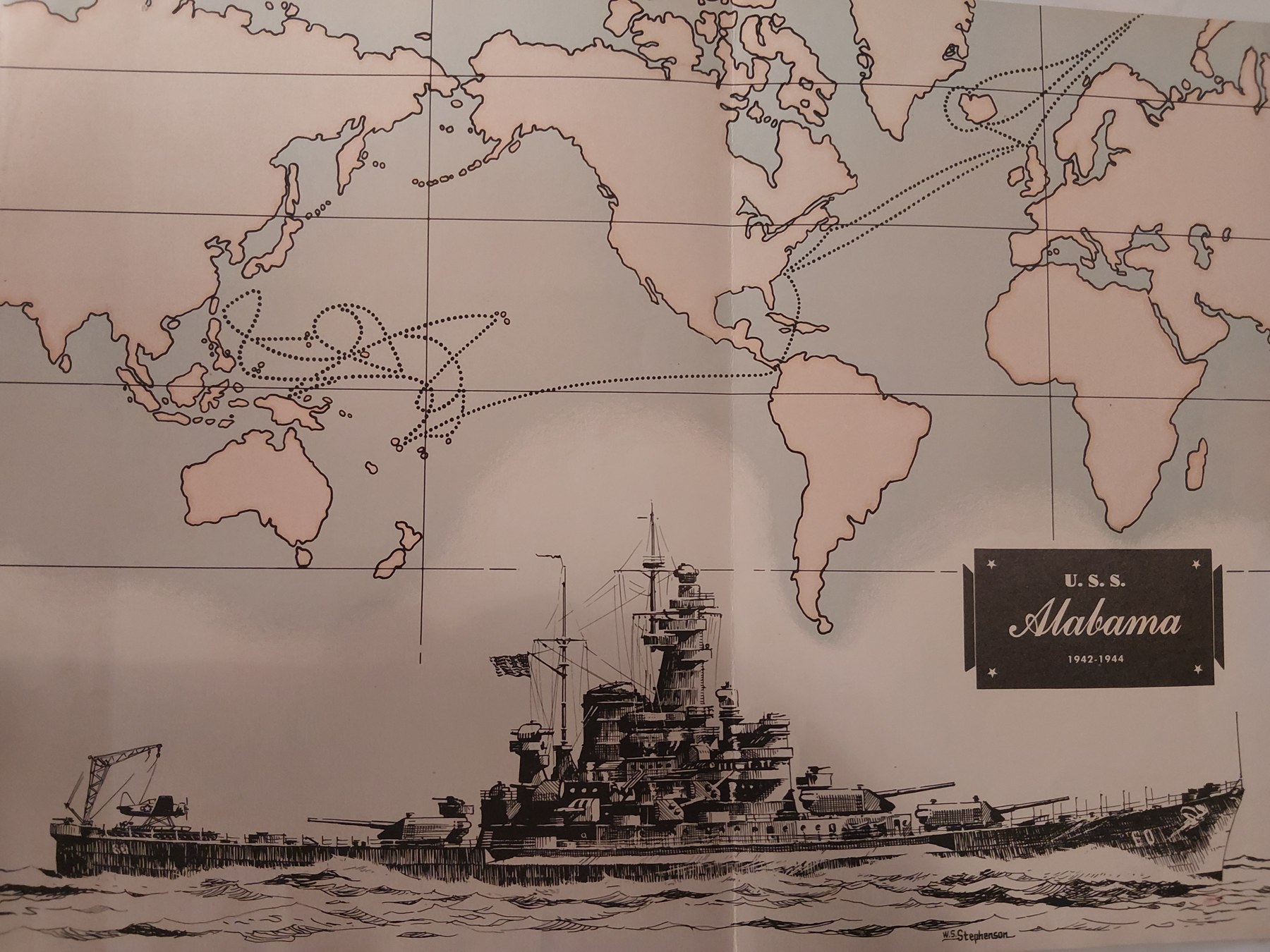
U.S.S. ALABAMA 1942–1944. The book's fold-out cruise map, with dotted lines tracing her wartime voyages: from the US East Coast across the North Atlantic toward Iceland, Scotland and Norway, then through the Panama Canal and across the Pacific. A drawing of the ship runs along the bottom, signed "W. S. Stephenson". From the 1942–1944 USS Alabama War Diary.
Life aboard. Feeding a wartime crew of more than 2,000 men was an around-the-clock job, from the steam tables and kettles of the galley to the refrigerated stores below and the ship's ice-cream counter. For the machinery that kept the food cold, see WW2 US Navy Ship Refrigeration Systems, which has a section on the geedunk.
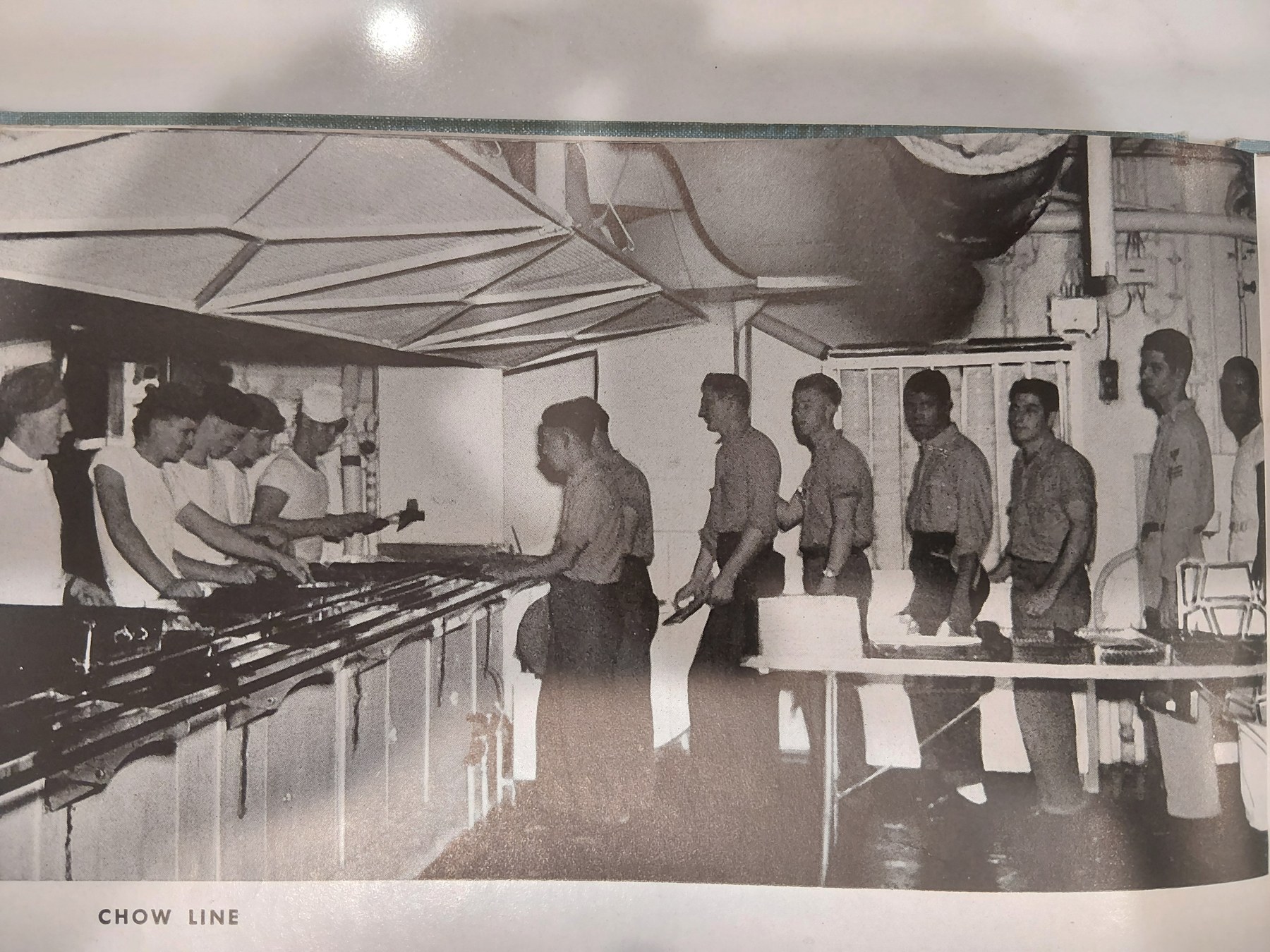
CHOW LINE. Sailors file past the serving steam table, with cooks in white working the line on the left. From the 1942–1944 USS Alabama War Diary.
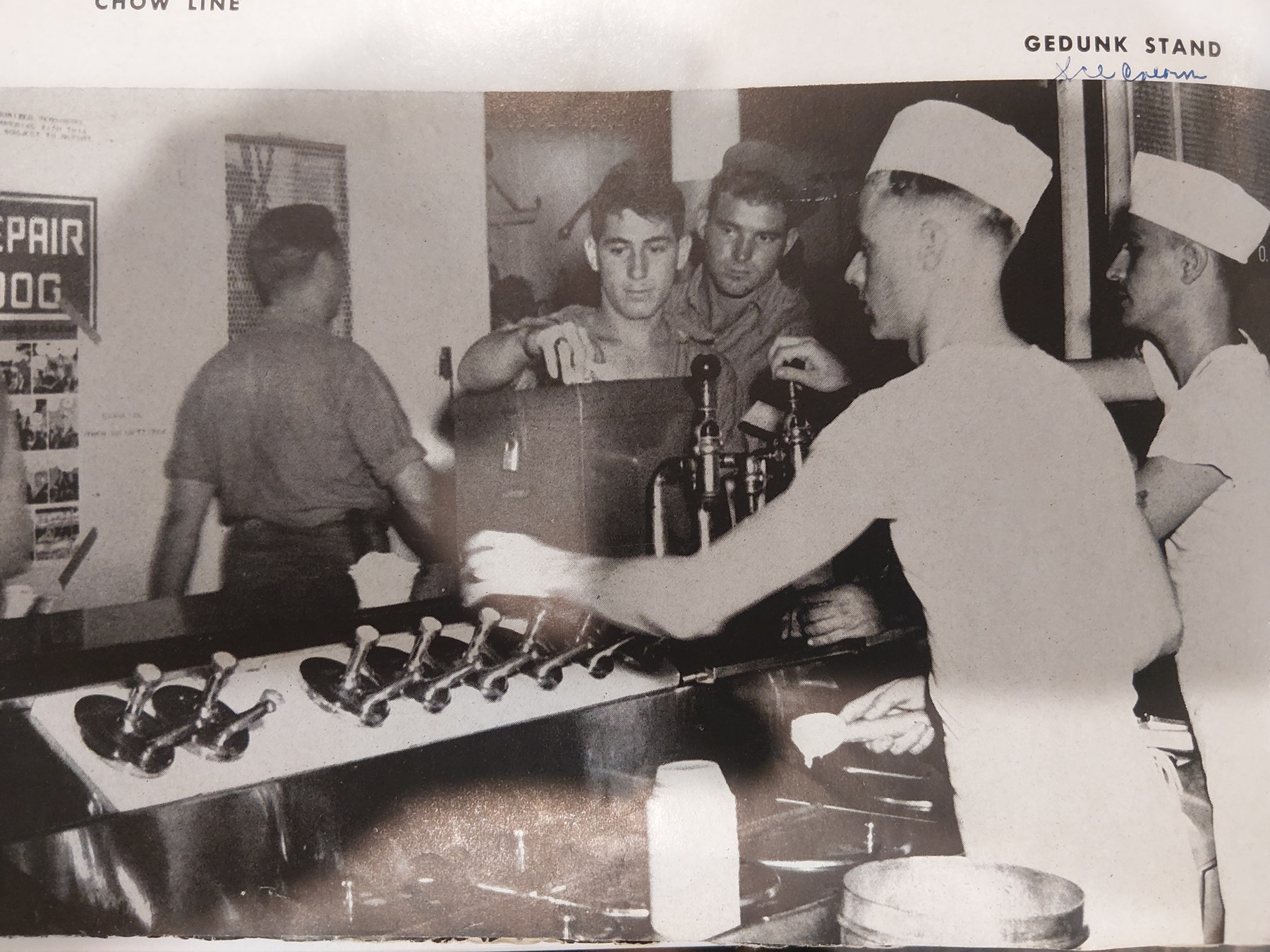
GEDUNK STAND. Servers in white caps work the ship's geedunk, the soda-fountain and ice-cream counter, as sailors lean in from the other side. A sign reading "REPAIR DOG" hangs on the bulkhead behind. Handwritten note by Howard E. James: "Ice cream". See WW2 US Navy Ship Refrigeration Systems for the geedunk and the refrigeration plant behind it. From the 1942–1944 USS Alabama War Diary.
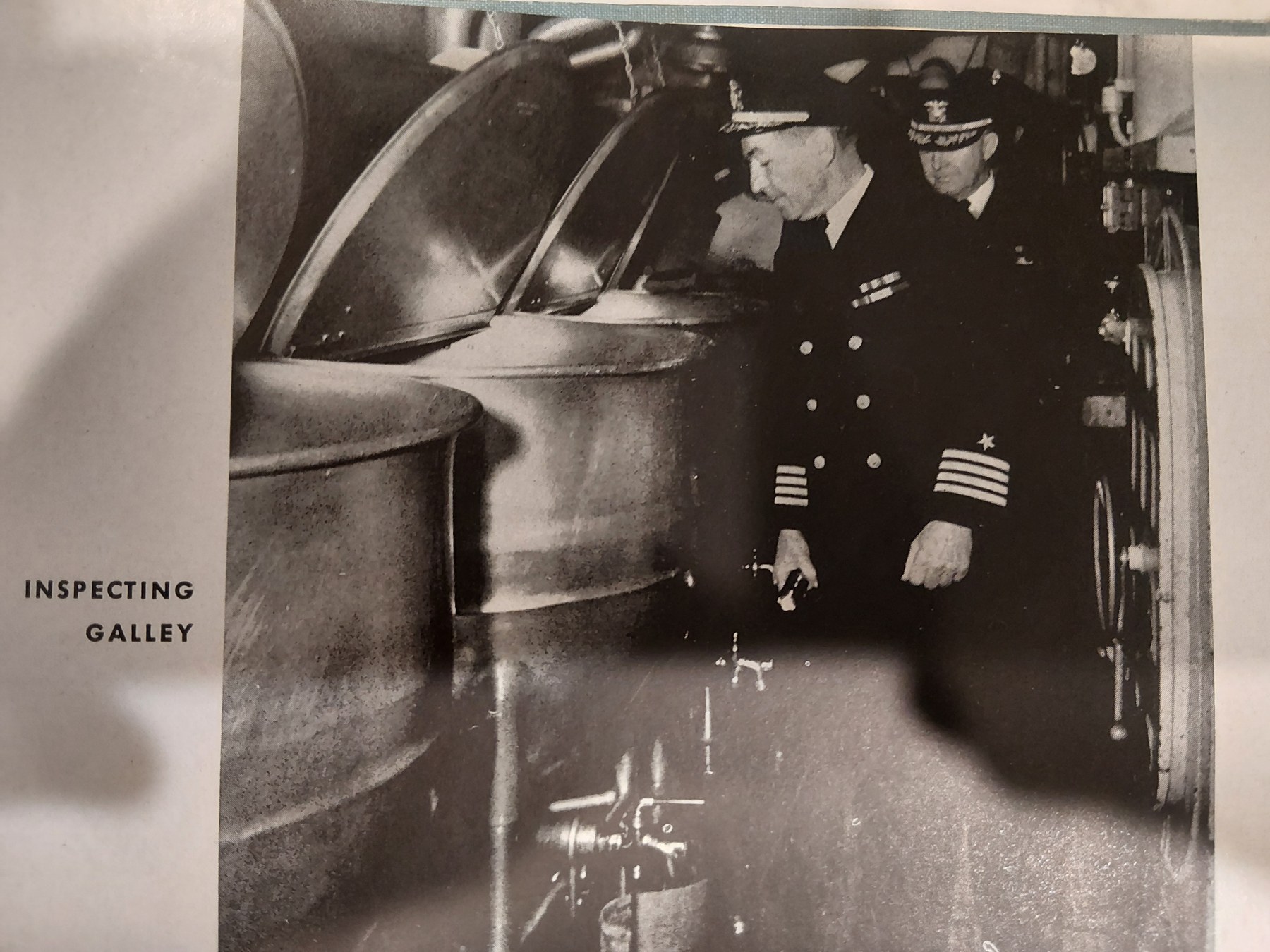
INSPECTING GALLEY. The commanding officer, a captain with four stripes on his sleeves, inspects the galley's steam kettles, followed by another officer. From the 1942–1944 USS Alabama War Diary.
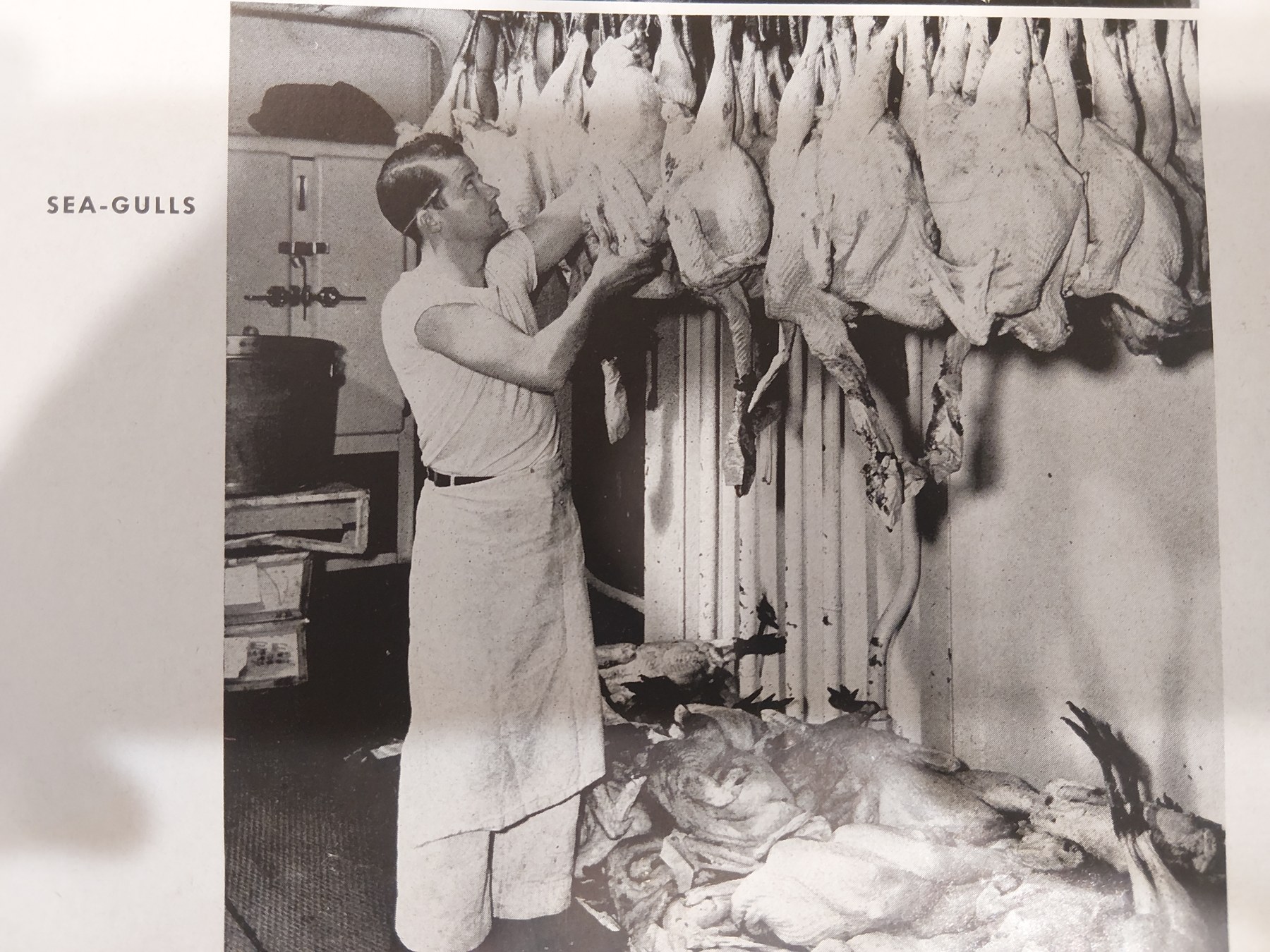
SEA-GULLS. A cook in an apron hangs dressed birds in one of the ship's refrigerated storerooms, with more on the deck at his feet. "Sea-gulls" was Navy slang for chicken. See WW2 US Navy Ship Refrigeration Systems. From the 1942–1944 USS Alabama War Diary.
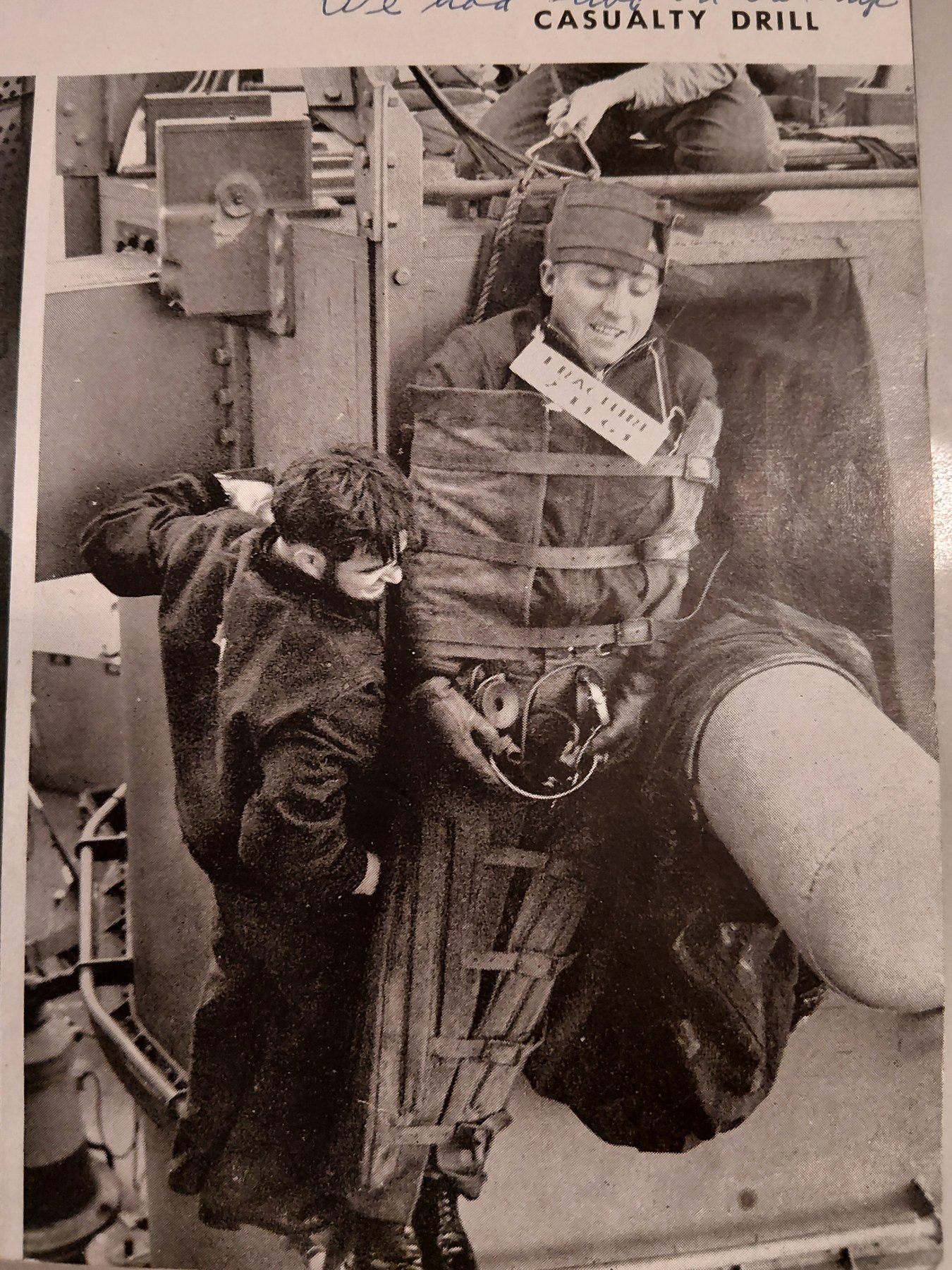
CASUALTY DRILL. A sailor strapped into a slatted stretcher, with a casualty tag hung on his chest, is passed through an opening by his shipmates. From the 1942–1944 USS Alabama War Diary.
The officers. The book's page of department heads, as printed, with ranks and titles as the book gives them.
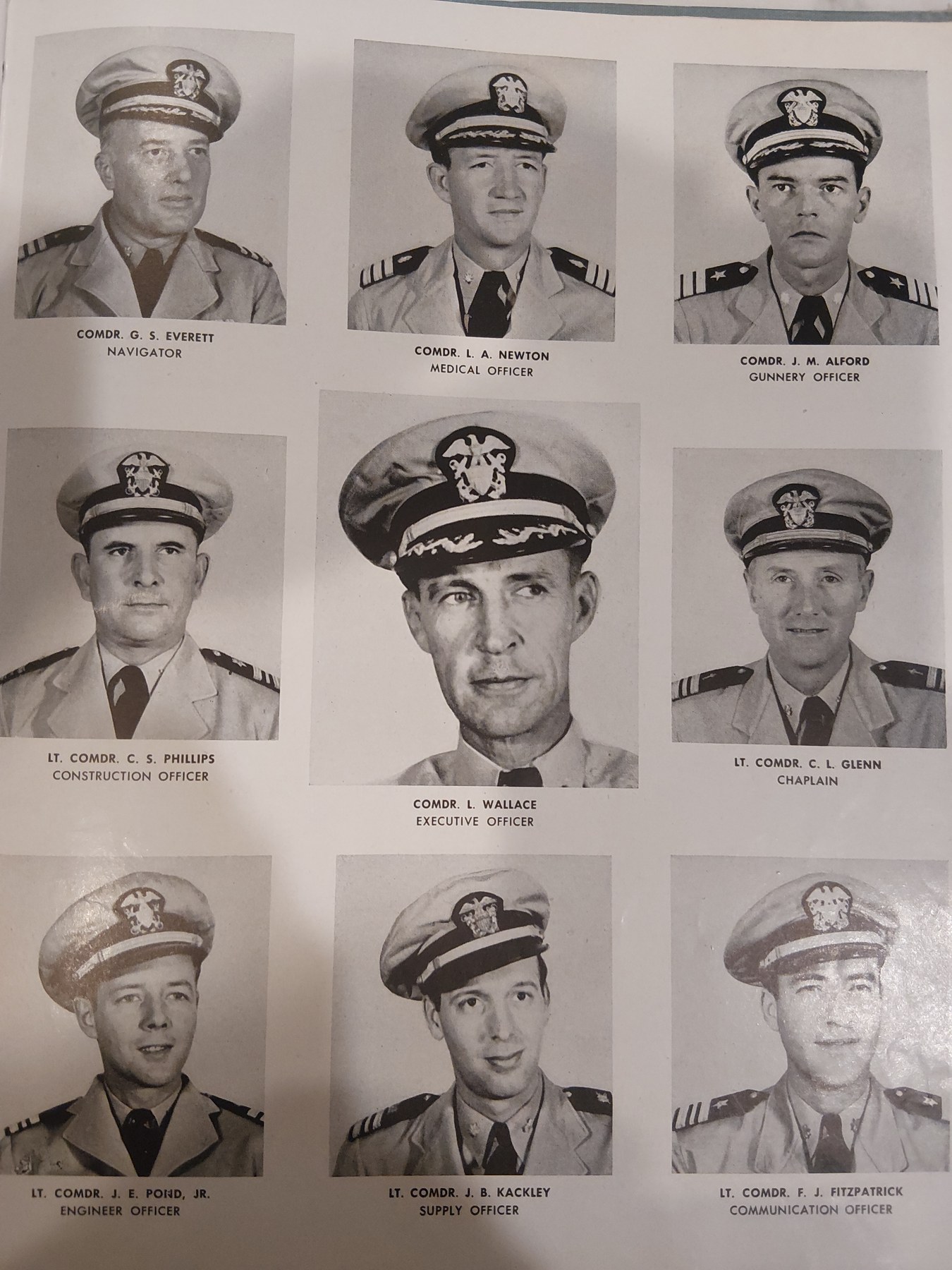
The ship's department heads, as captioned in the book. Top row: Comdr. G. S. Everett, Navigator; Comdr. L. A. Newton, Medical Officer; Comdr. J. M. Alford, Gunnery Officer. Middle row: Lt. Comdr. C. S. Phillips, Construction Officer; Comdr. L. Wallace, Executive Officer; Lt. Comdr. C. L. Glenn, Chaplain. Bottom row: Lt. Comdr. J. E. Pond, Jr., Engineer Officer; Lt. Comdr. J. B. Kackley, Supply Officer; Lt. Comdr. F. J. Fitzpatrick, Communication Officer. From the 1942–1944 USS Alabama War Diary.
Gunnery and the ship at sea. Alabama spent the spring and summer of 1943 with the British Home Fleet in northern waters, then went to the Pacific with the fast carriers (see the service-life sections above). For the guns themselves, see USN Mk 6 / Mk 7 16-inch Guns and Mark 38 GFCS.
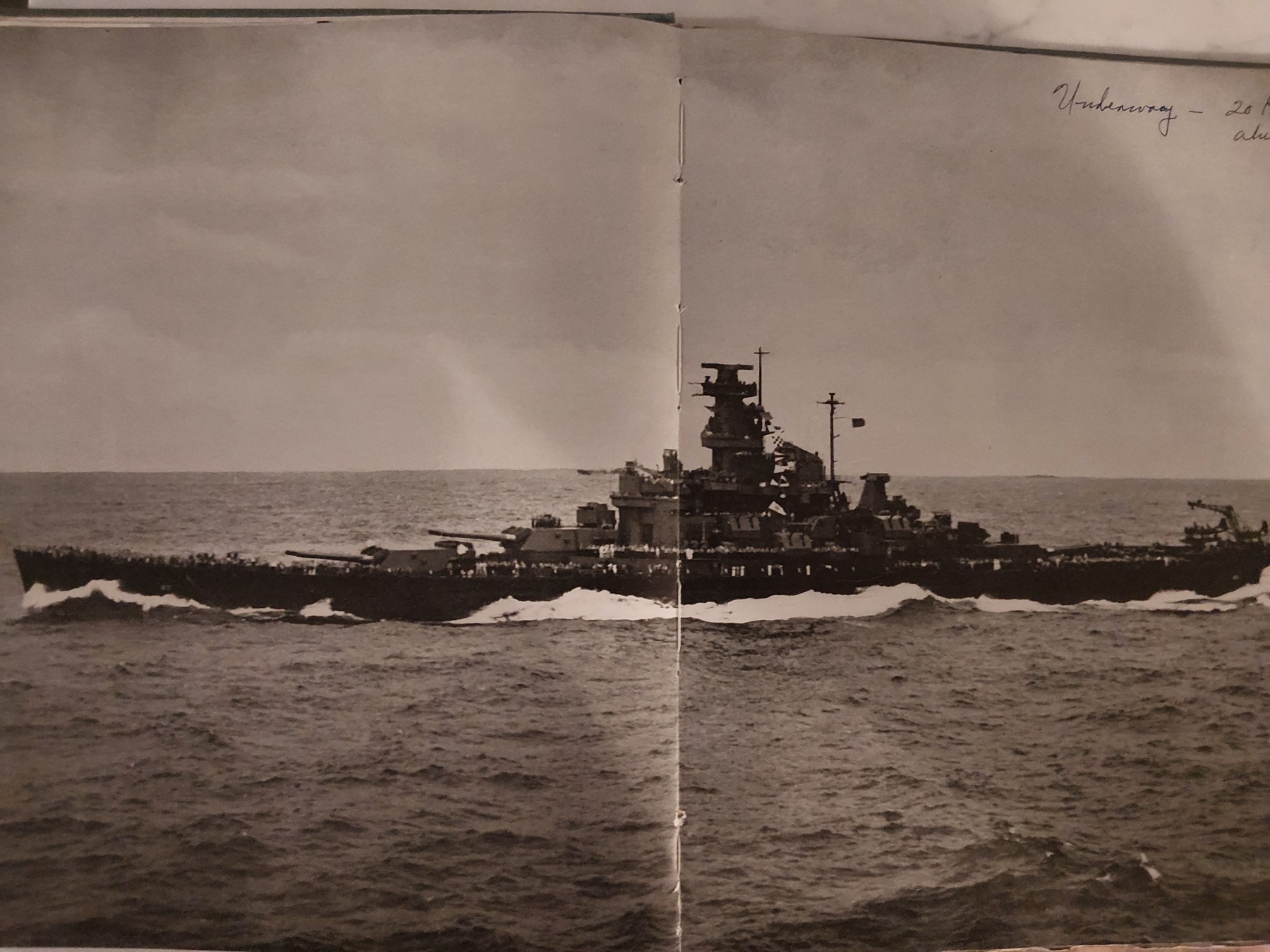
A two-page spread of Alabama underway, seen broadside-on with her crew lining the rails. Handwritten note by Howard E. James: "Underway – 20 knots ahead". From the 1942–1944 USS Alabama War Diary.
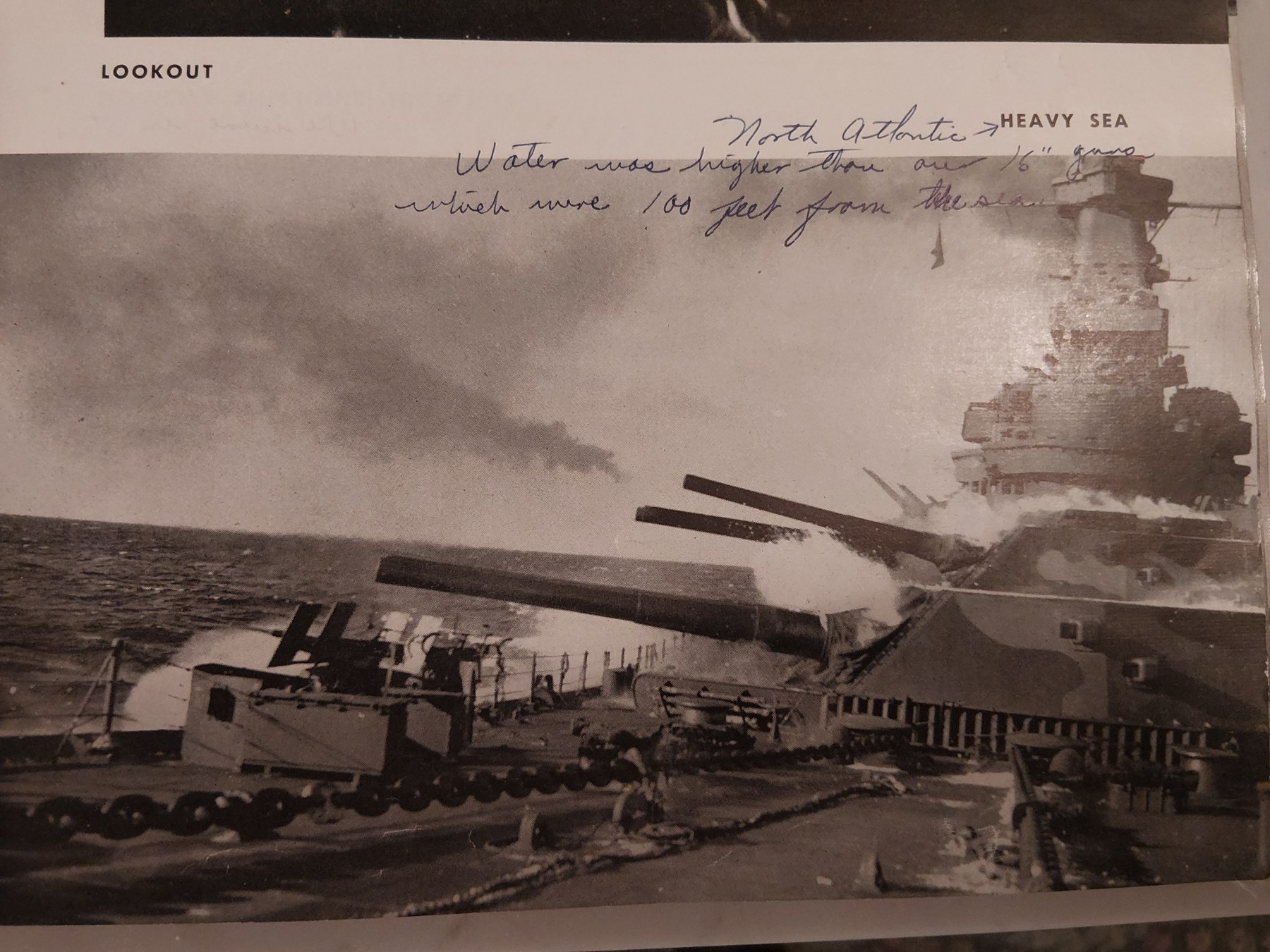
HEAVY SEA. The forward 16-inch turrets and the superstructure, with spray breaking over the forecastle. (The printed heading "LOOKOUT" at top left belongs to the photo above it on the page, which is cut off.) Handwritten note by Howard E. James: "North Atlantic → [HEAVY SEA] Water was higher than our 16" guns which were 100 feet from the sea". The last word is partly hidden by the photo. From the 1942–1944 USS Alabama War Diary.
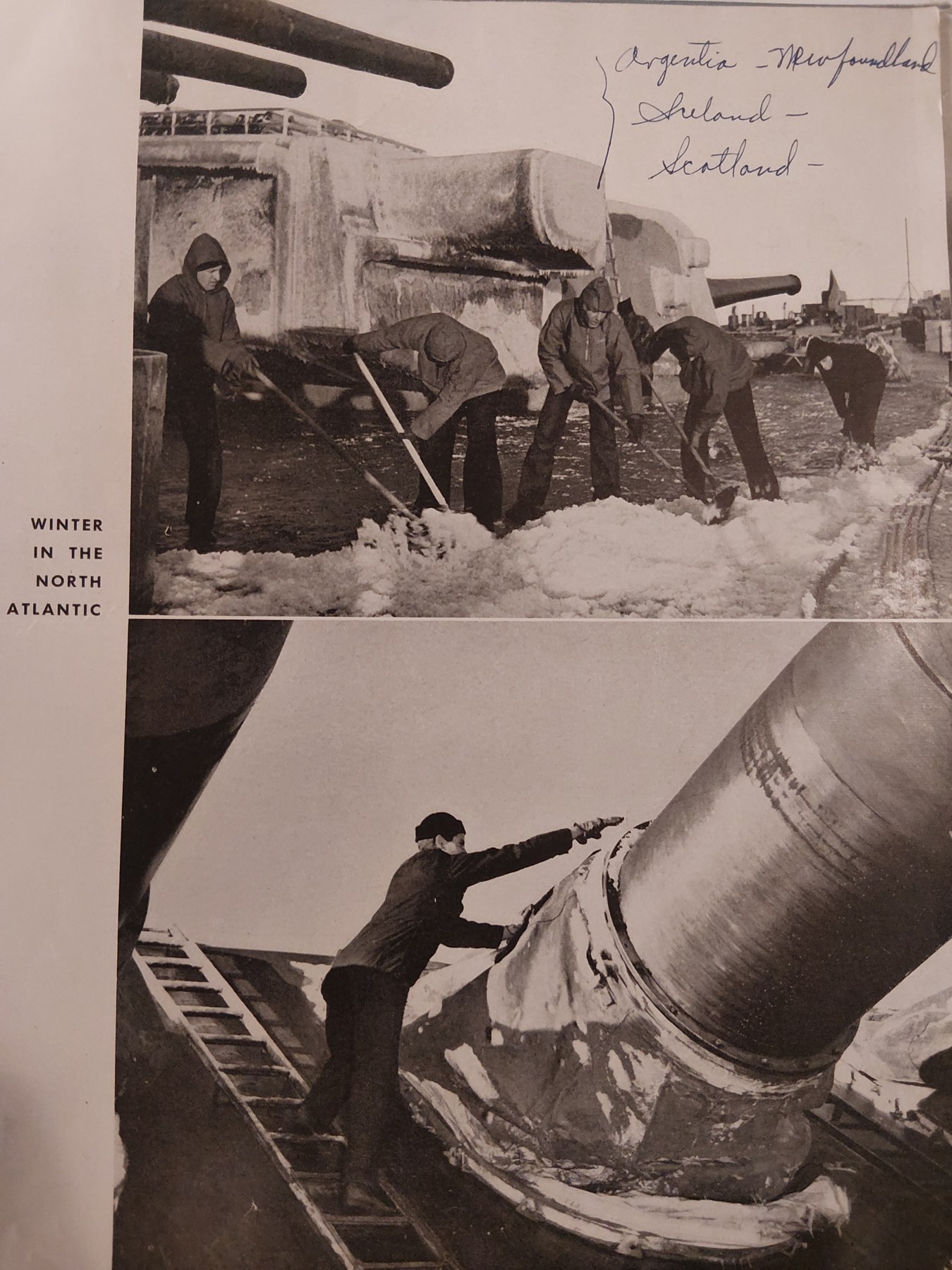
WINTER IN THE NORTH ATLANTIC. Top: men in hooded foul-weather gear shovel snow and ice off the deck beside a 16-inch turret. Bottom: a sailor on a ladder chips ice from the canvas bloomer at the base of a 16-inch gun barrel. Handwritten note by Howard E. James: "Argentia – Newfoundland, Iceland – Scotland –". From the 1942–1944 USS Alabama War Diary.
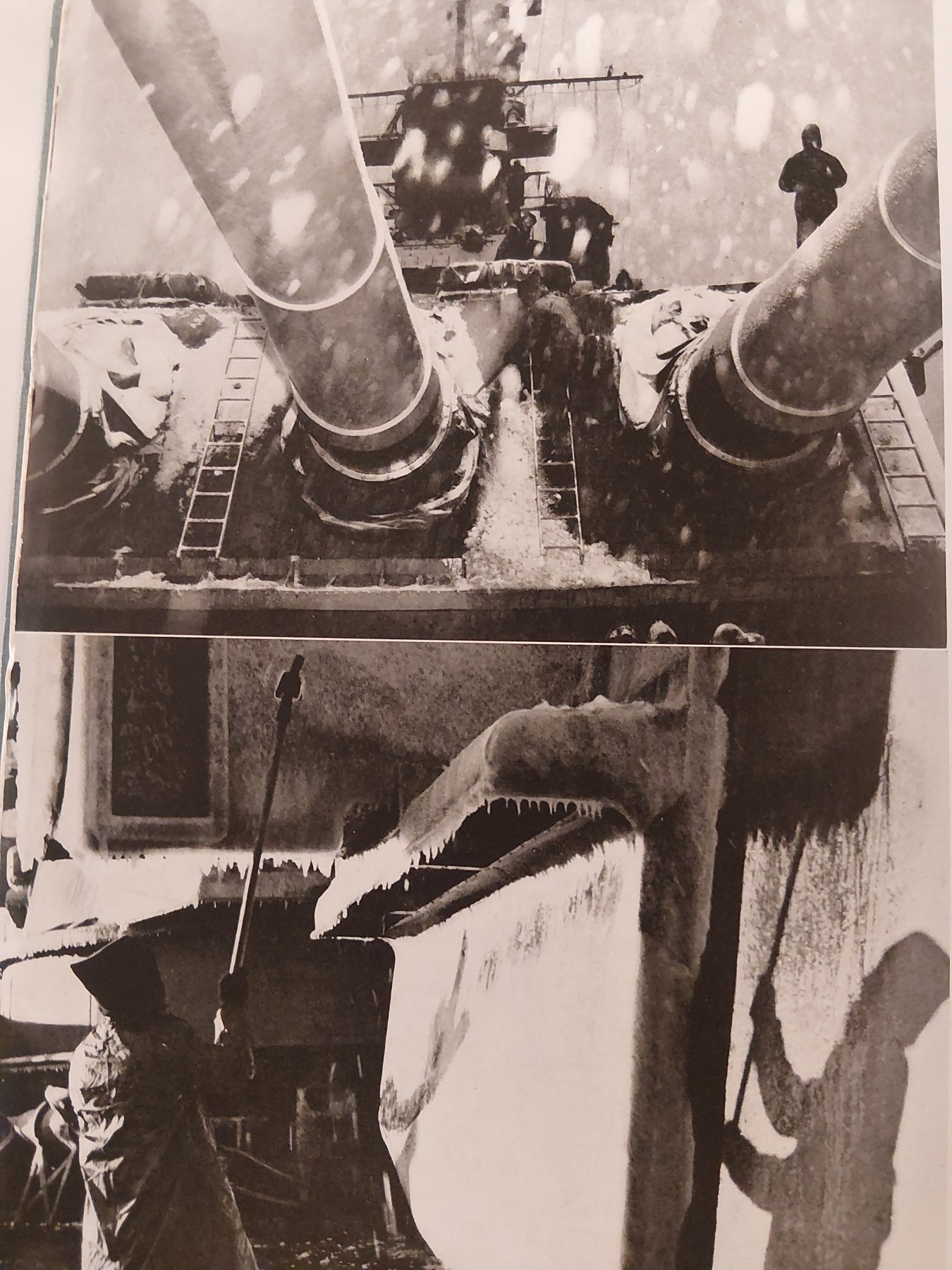
No printed caption; the same North Atlantic winter theme. Top: snow falls over a 16-inch turret and its iced-up guns, with a lookout standing on the turret roof and the superstructure behind. Bottom: a crewman in foul-weather gear knocks icicles off the ship's ice-crusted fittings with a long pole. From the 1942–1944 USS Alabama War Diary.
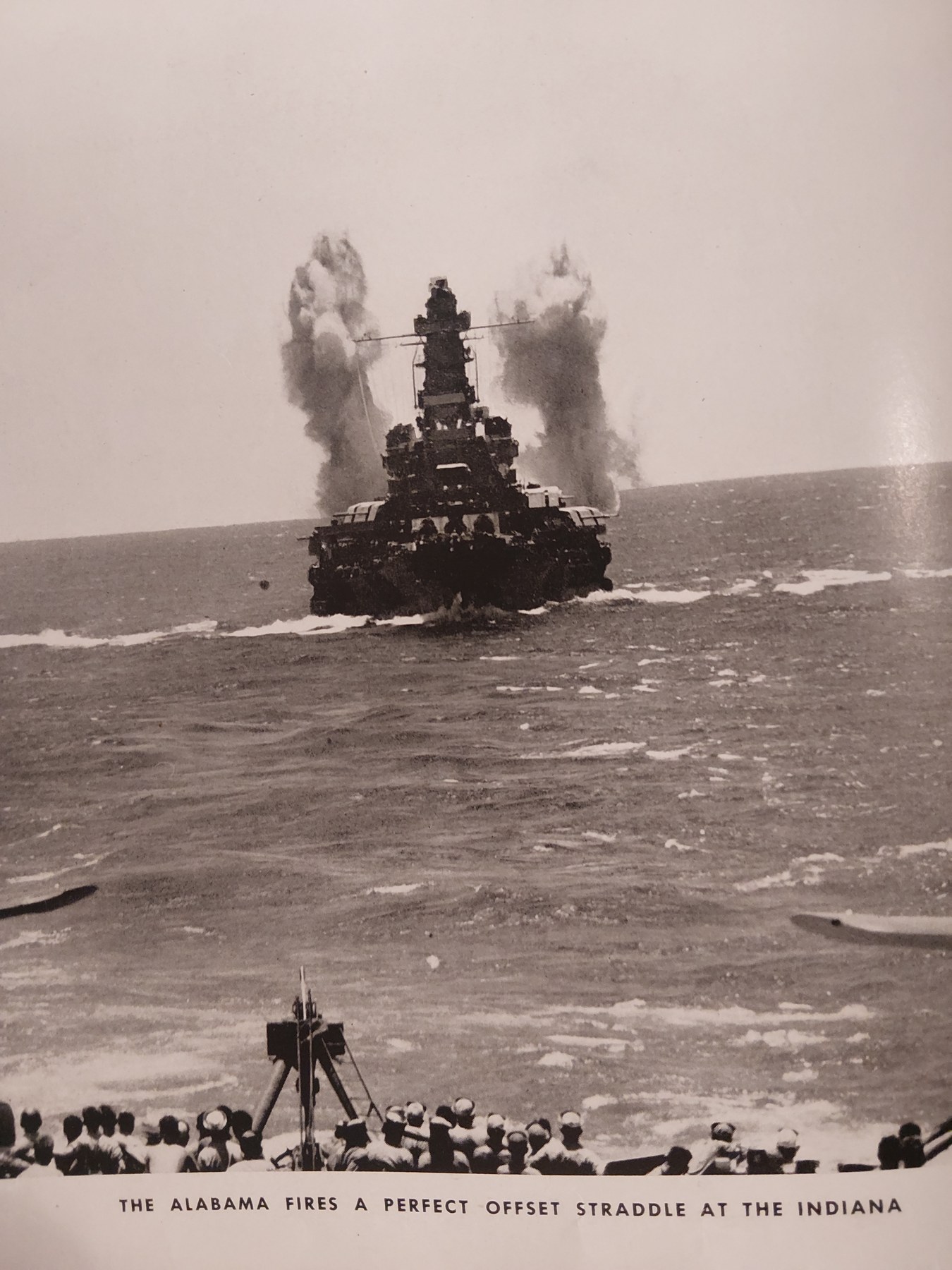
THE ALABAMA FIRES A PERFECT OFFSET STRADDLE AT THE INDIANA. In an offset practice shoot the guns are aimed deliberately to one side of a friendly ship, so the fall of shot can be scored without hitting her. Here the splashes rise on either side of USS Indiana, with Alabama's crew watching from the deck in the foreground. From the 1942–1944 USS Alabama War Diary.
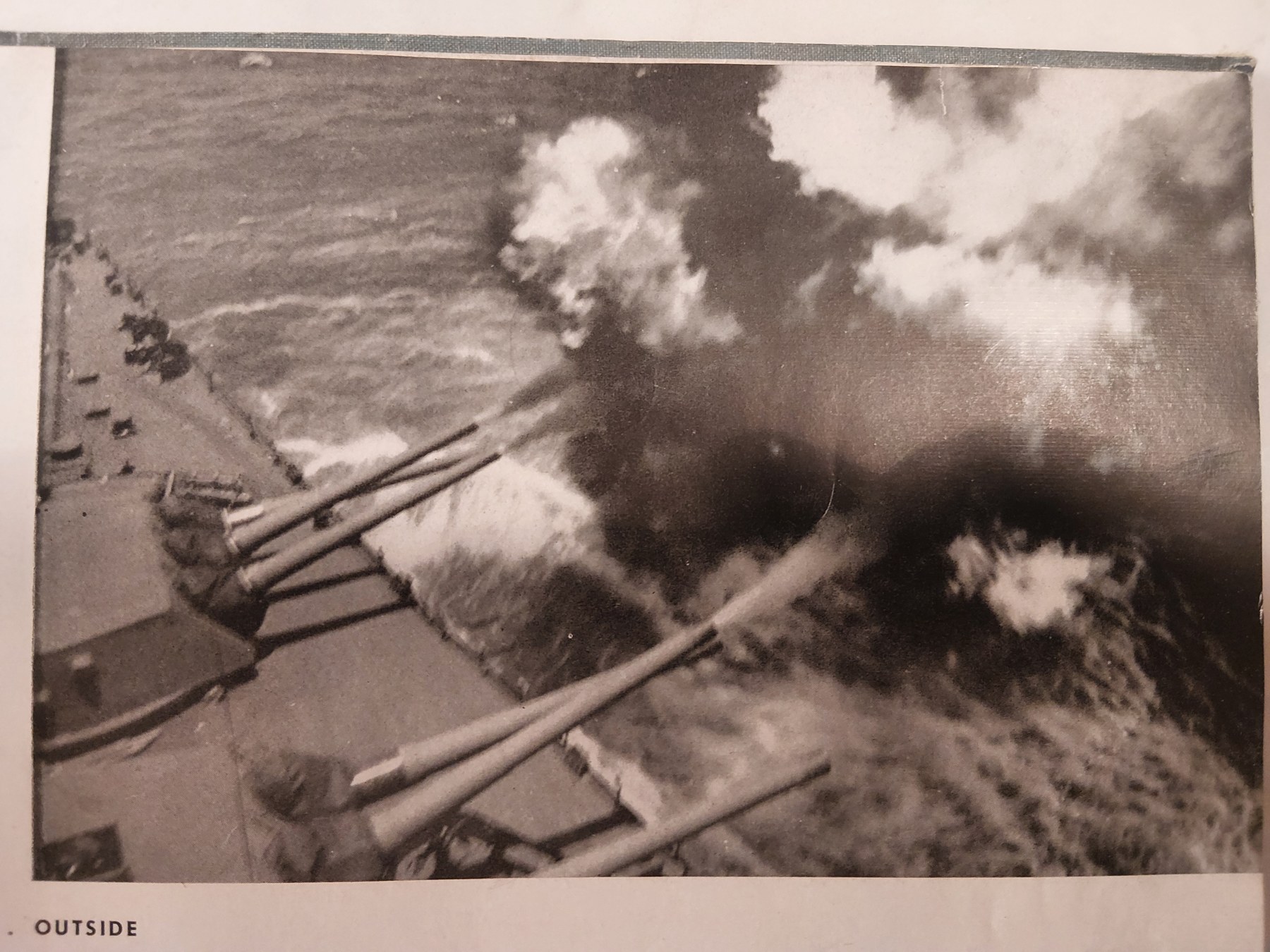
OUTSIDE. The forward 16-inch turrets fire to starboard, photographed from high in the superstructure, with smoke and blast rolling across the water. From the 1942–1944 USS Alabama War Diary.
Inside the ship and in the engineering spaces. The book's "Inside" pages, and a spread it dedicates "to those sailors… who seldom see the sea". Howard's notes name the #4 engine room and #4 fire room, and the evaporators. For the plant itself, see Power Plant and Propulsion above and Naval and Marine Steam Power Plants.
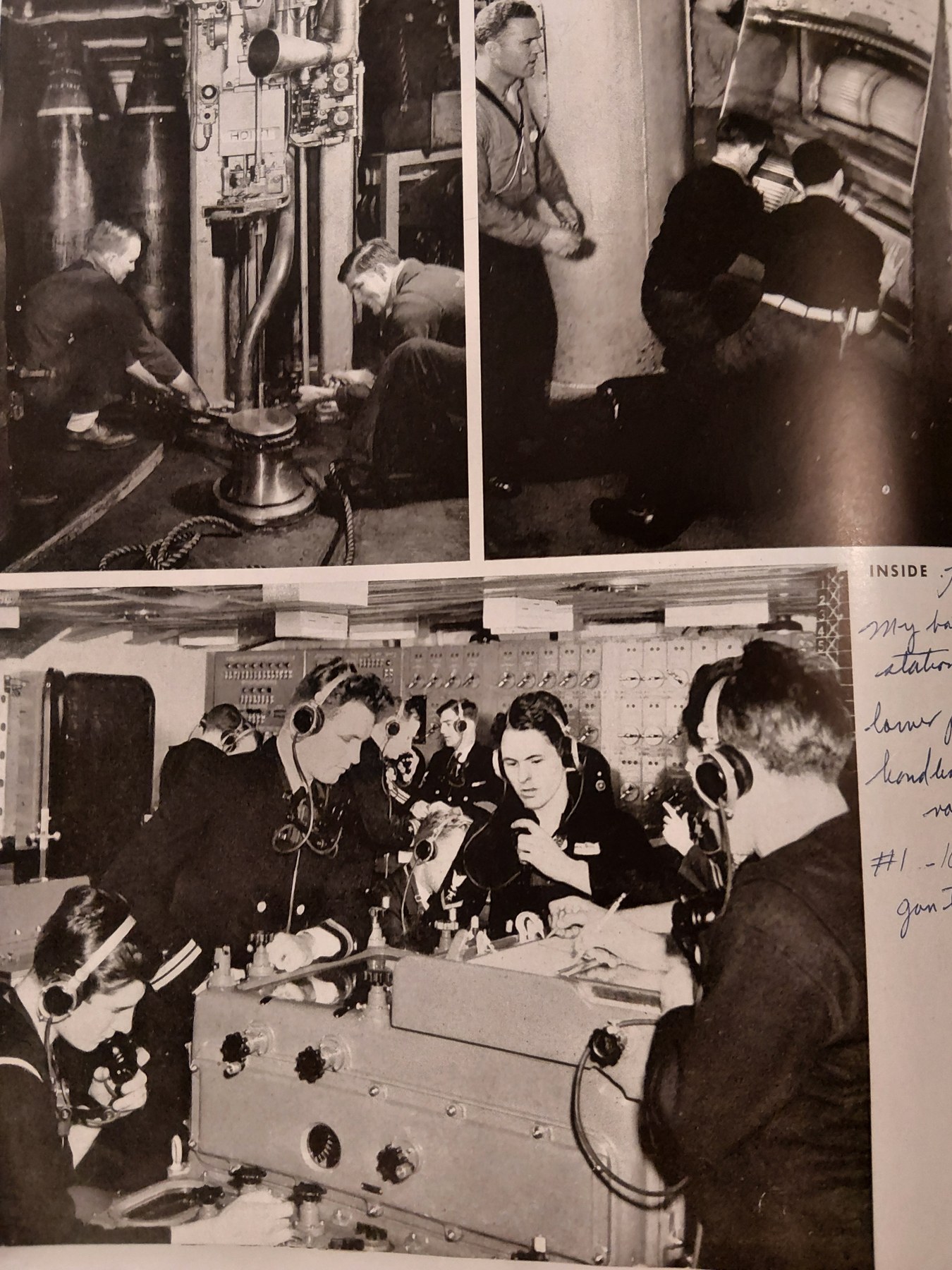
INSIDE. Top left: men working in a handling space, with 16-inch projectiles standing in the background. This is the shell-and-powder train that fed the main guns, and Howard E. James's own battle station was part of it: the lower powder hoist, No. 1 16-inch turret. Top right: men at work inside another compartment. Bottom: sailors in headsets at a console, with jack panels behind them, inside the fire control room of a 16-inch gun turret (see Mark 38 GFCS for how gun orders reached the turrets, and how a turret could fight in local control). Handwritten note by Howard E. James: "My battle station – lower powder hoist, #1 16" gun turret" (the note runs to the page edge; wording as read by Robert). From the 1942–1944 USS Alabama War Diary.
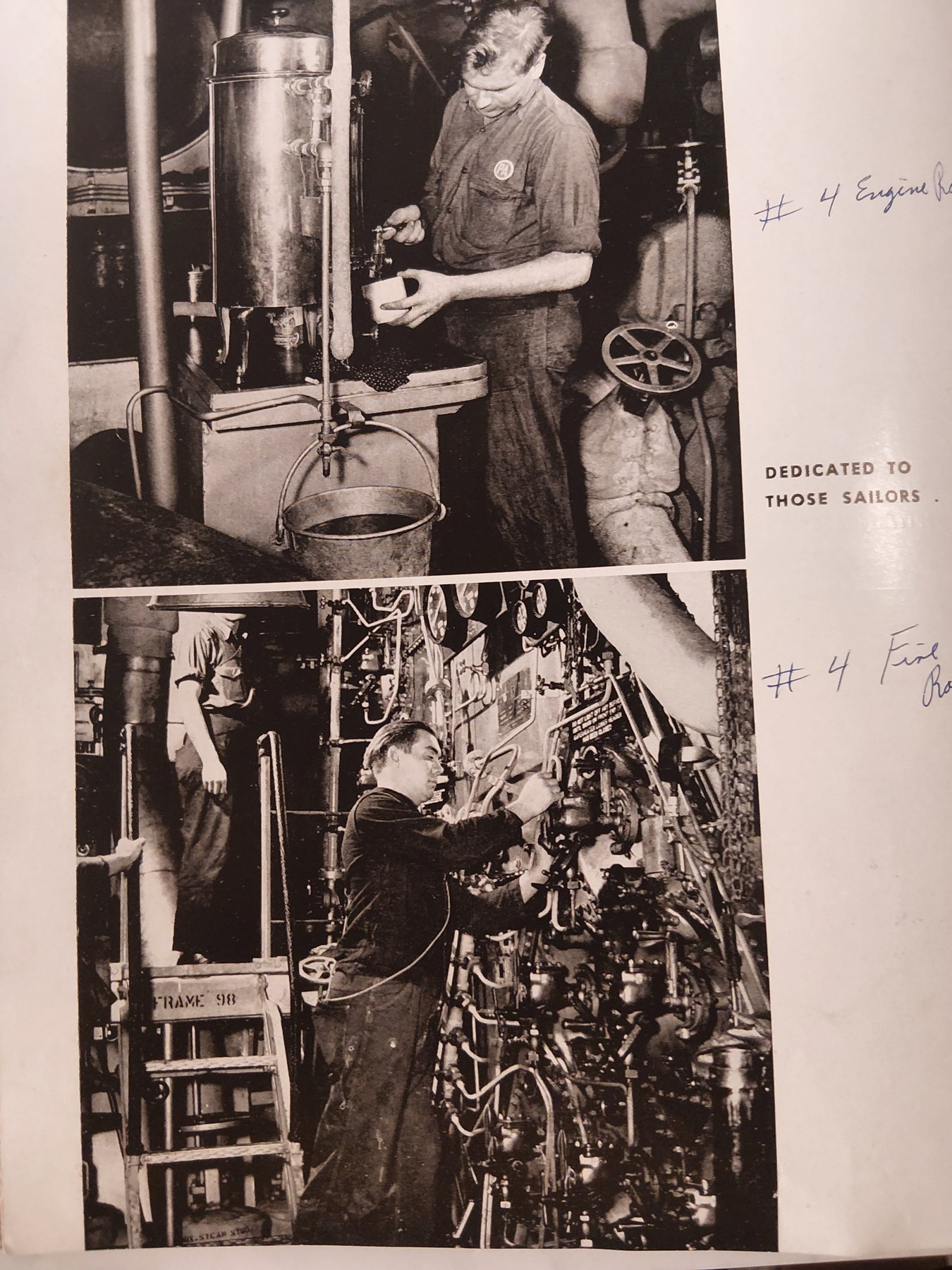
DEDICATED TO THOSE SAILORS… Top: in the No. 4 engine room, a sailor tests boiler feedwater, drawing a sample for the water test that kept salt and impurities out of the boilers. Bottom: a man works the valves on a boiler control panel in the fire room, with a ladder marked "FRAME 98". Handwritten note by Howard E. James: "#4 Engine Room" (top) and "#4 Fire Room" (bottom). See Naval and Marine Steam Power Plants. From the 1942–1944 USS Alabama War Diary.
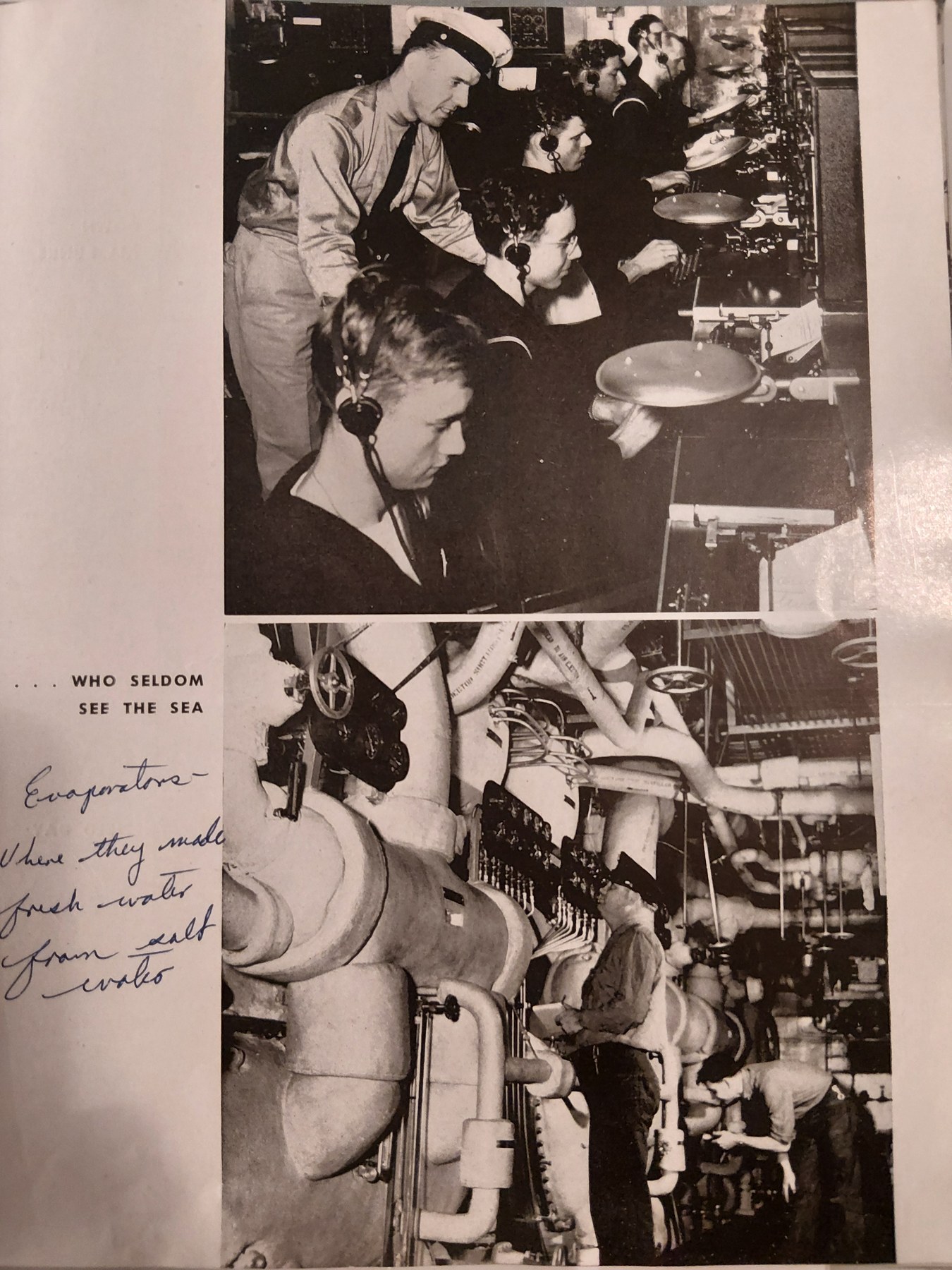
…WHO SELDOM SEE THE SEA. Top: radio operators on watch in Radio Central, wearing headsets at a row of operating positions, with a petty officer looking over their shoulders. Bottom: men at work among the evaporators. Handwritten note by Howard E. James: "Evaporators – where they make fresh water from salt water". See Naval and Marine Steam Power Plants for shipboard distilling plants. From the 1942–1944 USS Alabama War Diary.
Recreation. Dances, boxing on deck and beer on a beach were how the crew let off steam. Alabama was commissioned on 16 August 1942, so her first birthday fell in August 1943, the month she left the Home Fleet and returned to Norfolk; the book does not say where the party pictured was held.
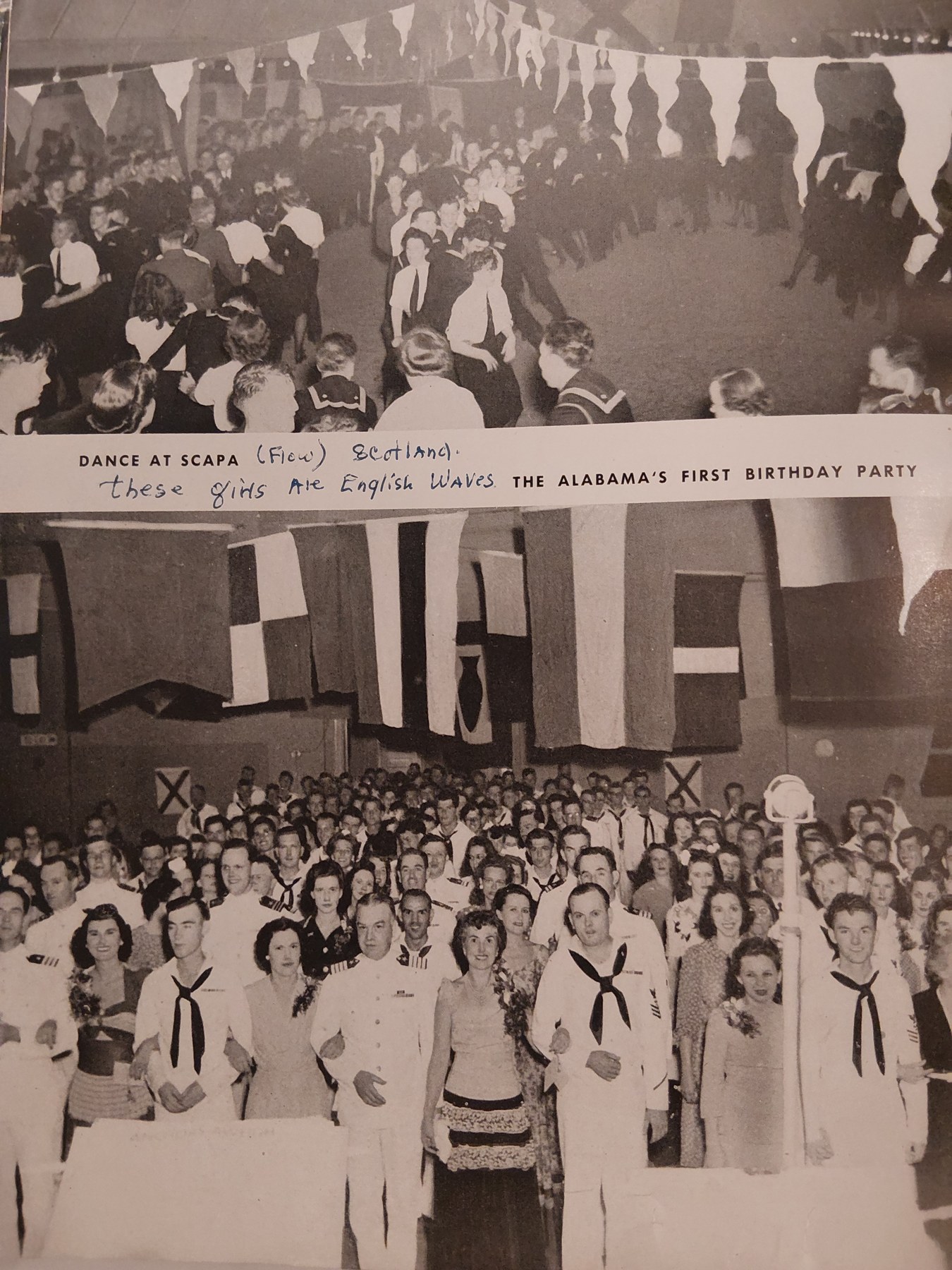
Top: DANCE AT SCAPA, with sailors and their partners on a crowded dance floor under bunting. Handwritten note by Howard E. James: "(Flow) Scotland. these girls are English Waves". (The British counterpart of the US Navy's WAVES was the Women's Royal Naval Service, the "Wrens".) Bottom: THE ALABAMA'S FIRST BIRTHDAY PARTY, with officers, sailors in dress whites and their guests standing under signal flags. From the 1942–1944 USS Alabama War Diary.
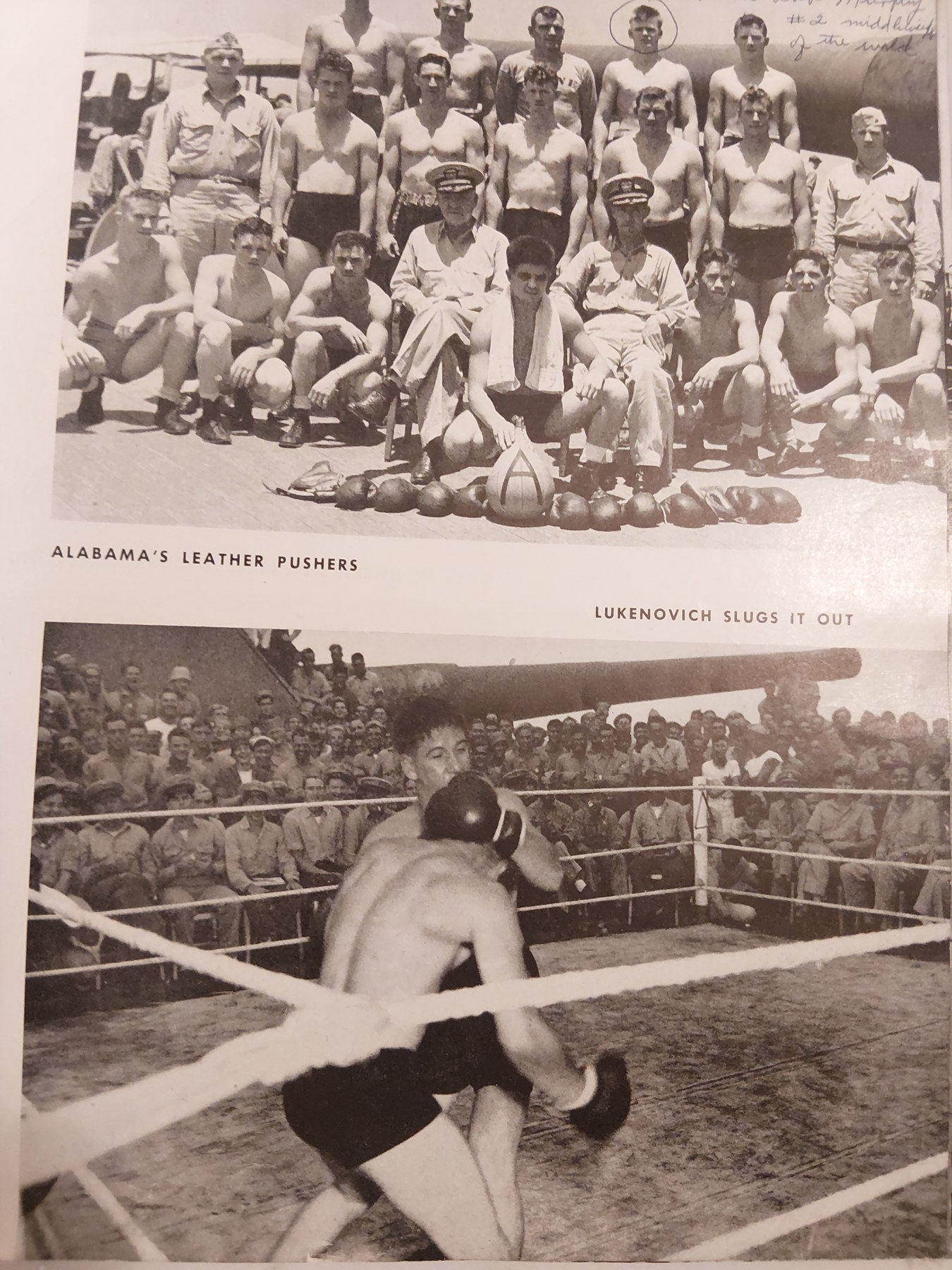
Top: ALABAMA'S LEATHER PUSHERS, the ship's boxing team, posed with two officers, a pile of gloves and a ball marked with an "A". One man in the back row, Bob Murphy, is circled. Handwritten note by Howard E. James: "Bob Murphy the #2 middleweight champion of the world". Bottom: LUKENOVICH SLUGS IT OUT, a bout in a ring rigged on deck in front of a 16-inch gun, with the crew watching. From the 1942–1944 USS Alabama War Diary.
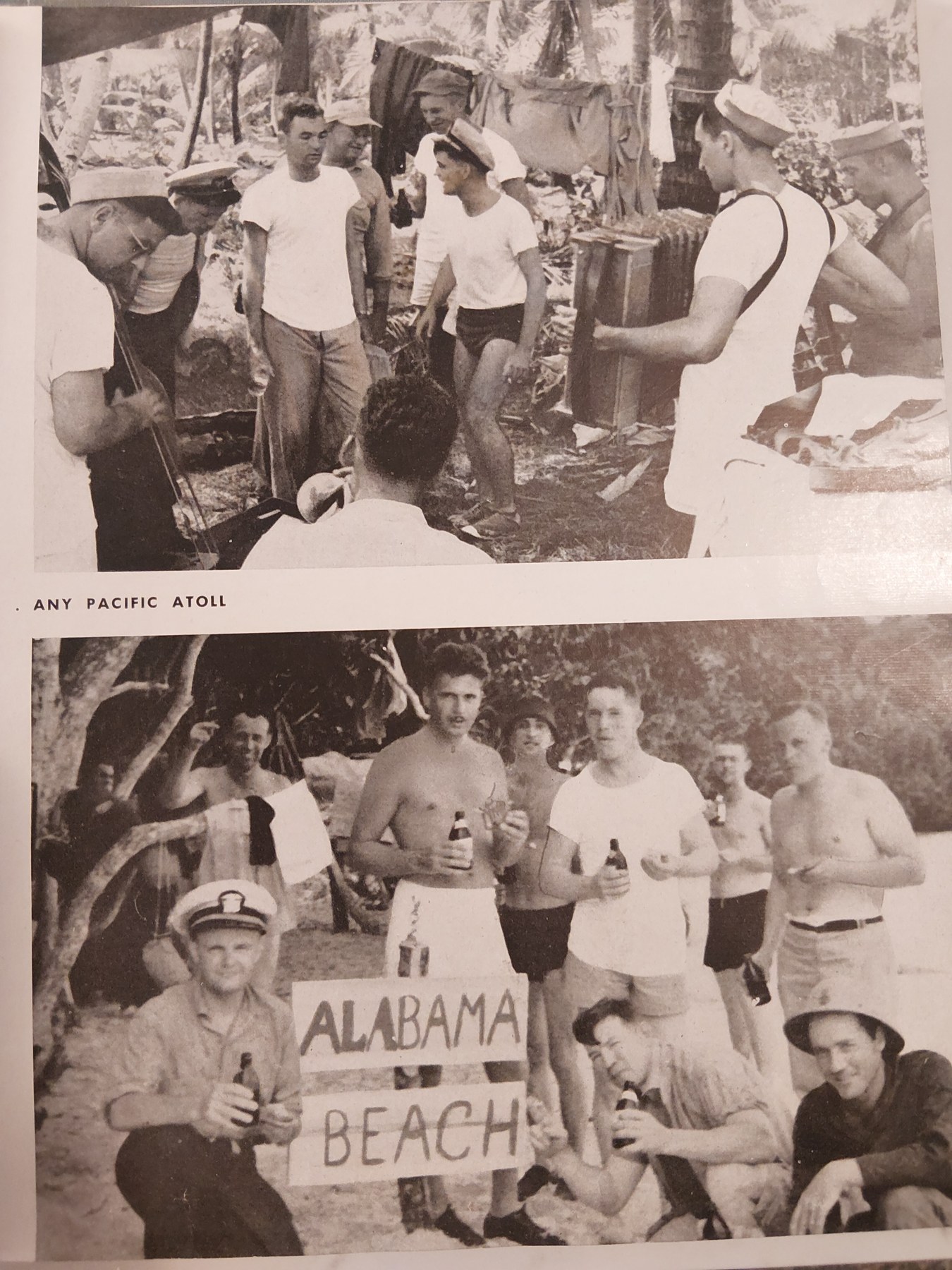
ANY PACIFIC ATOLL. Top: sailors ashore under palm trees, with a musician playing a string bass on the left. Bottom: crewmen with bottles in hand around a hand-lettered sign reading "ALABAMA BEACH". From the 1942–1944 USS Alabama War Diary.
DECOMMISSIONING AND THE SAVE THE ALABAMA CAMPAIGN
She was decommissioned on 9 January 1947 at Seattle and laid up with the Pacific Reserve Fleet at Bremerton. Plans to modernize the class, if they were ever needed again, were drawn and then dropped. A 1954 proposal to re-arm the four ships with ten twin 3-inch mounts came to nothing. A 1956–57 study to convert Alabama into a guided-missile battleship — all three 16-inch turrets removed, a twin RIM-8 Talos launcher forward, two RIM-24 Tartar launchers aft, antisubmarine weapons, and helicopter facilities — was priced at about $120 million and was judged too expensive. On 1 June 1962 she was stricken from the Naval Vessel Register, and she was headed for the breakers. [DOCUMENTED, Friedman / standard class histories for the 1954 and 1956–57 studies and the $120 million figure; DANFS / NHHC for decommissioning and striking]
What happened next is the part of the story the ship now exists to tell. In May 1962, the day the Navy's scrap announcement appeared, a Mobile civic official, Jimmie Morris, started telephoning. A statewide committee formed the same day, in a world without email. The Alabama legislature created the USS Alabama Battleship Commission in September 1963; Governor George Wallace signed the bill on 12 September and told the state, "Now let's bring our ship home." The money still had to be found. In the spring of 1964 a statewide campaign raised around $800,000 (some later retellings say a million). Something like an eighth of it, about $100,000, came from schoolchildren's nickels, dimes, and quarters — the park's figure is more than one million students. Children who gave were issued a charter-member card, good for one free admission with no expiration; the park still honors those cards, and still sees a few dozen of them a year. Corporate donors and civic groups made up the rest. Among the school fundraisers of that year, in the park's later telling, were a Mobile student named Don Siegelman, who later became governor, and a classmate remembered as Jimmy, who became Jimmy Buffett. Those identifications are the park's and a later magazine's, and they are tagged as such. [DOCUMENTED, park history, Encyclopedia of Alabama, and This is Alabama, for the commission, the campaign, the $800,000 and ~$100,000 school figures, and the charter cards; SINGLE-SOURCE, the Siegelman / Buffett identifications]
The Navy awarded the ship to the state on 16 June 1964, with a provision — worth pausing on — that the Navy retained the right to recall her to service in an emergency. Formal handover was on 7 July in Seattle. Her screws were removed for the tow. One of the tugs sank on the way to the Panama Canal. She was eased through the Canal with about 11 inches of clearance on either side, a figure the park and the Encyclopedia of Alabama both use. USS Lexington, still in commission and a veteran of the same fast-carrier war, escorted her across the Gulf of Mexico. She arrived in Mobile on 14 September 1964, after a tow of some 5,600 nautical miles, which the park has called the largest non-military dead-weight tow in American history and which Wikipedia, more cautiously, calls the longest tow of a vessel that was not an active warship. The channel to her berth was not quite ready; she waited until the end of the month to be moved in, then was sandblasted, primed, and repainted. The memorial was dedicated and opened on 9 January 1965, eighteen years to the day after she was decommissioned, by Under-Secretary of the Navy Paul B. Fay, and was received for the state by Governor Wallace. [DOCUMENTED, park history, Encyclopedia of Alabama, and the standard museum-ship accounts, for the dates, the 11-inch Canal clearance, the Lexington escort, the tug loss, and the 9 January 1965 opening; the 5,600 nmi figure is the usual one (some wordings say 5,600 miles); the "largest non-military dead-weight tow" wording is the park's and is tagged as such]
AFTER LIFE: A MEMORIAL PARK, THE FILMS, AND KATRINA
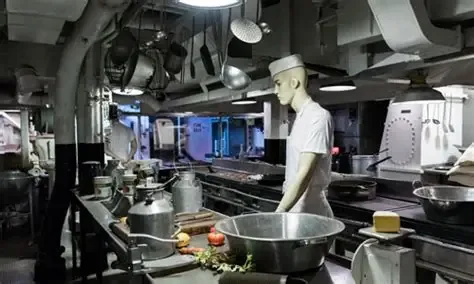
The galley, fitted out as a museum display with mannequins, utensils, and steam kettles. A wartime crew of about 2,500 had to be fed from spaces like this. Alabama as preserved at Mobile.
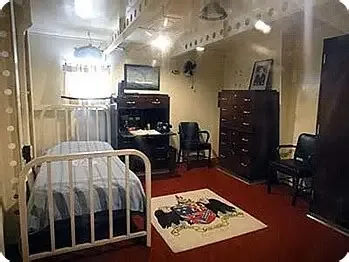
A commanding officer's in-port cabin, as restored at Mobile, with the ship's seal on the rug.
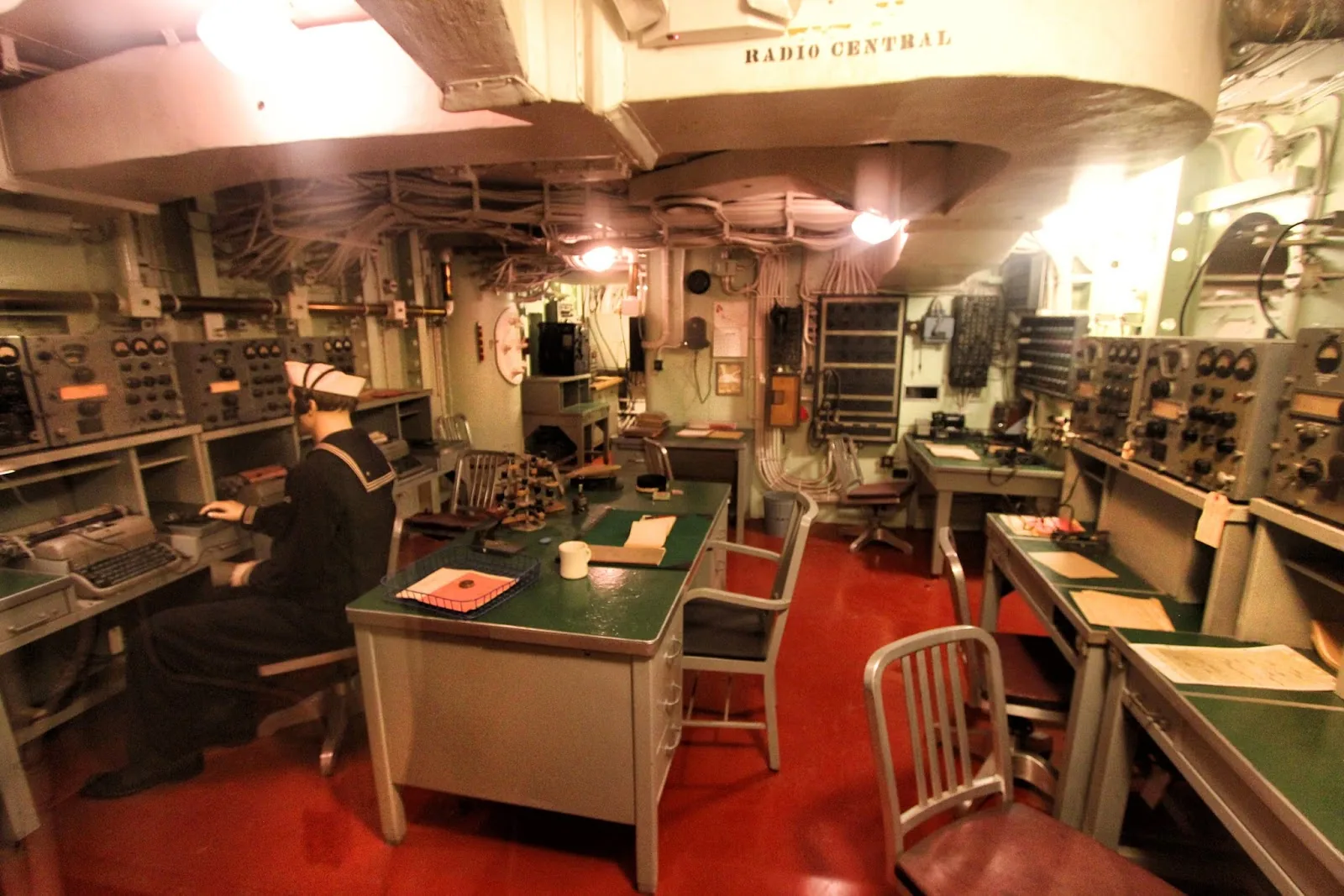
Radio Central, with a mannequin at a radio position and the compartment name painted on the overhead. Alabama as preserved at Mobile.
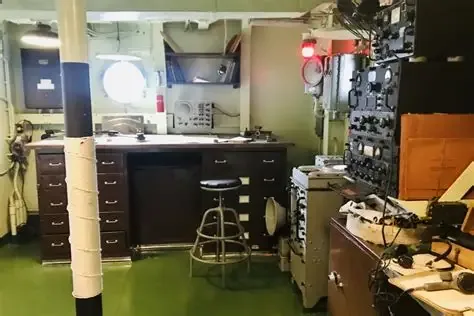
The navigation and radio room at the back of the bridge, located just behind the bridge up in the superstructure, with a porthole, a writing desk, and racks of equipment, as the ship is preserved at Mobile.
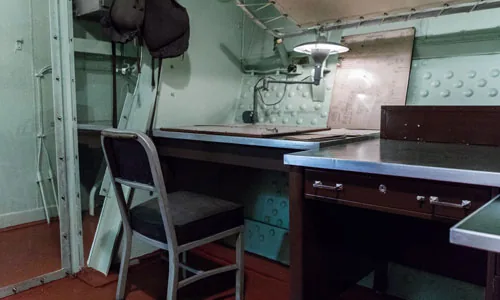
An interior workspace with a chart table against a riveted bulkhead, as the ship is preserved at Mobile.
The park is a state memorial, run by the USS Alabama Battleship Commission, on what is now a 155-acre site. Visitors walk about two-thirds of the ship on self-guided routes: an engine room, the cabin, the galley, the radio rooms, the plotting rooms, the turrets, the weather decks. In 1969 the Navy donated the Gato-class submarine USS Drum (SS-228), a 12-battle-star boat and the first U.S. submarine opened to the public as a museum; she was later moved ashore as part of a large renovation. An aircraft pavilion, memorials, and a collection of aircraft and vehicles grew up around the two ships. The park is self-funding, by admissions and the gift shop; maintenance on the battleship alone is more than a million dollars a year in the park's own figures. Visitor totals in park and civic accounts have been given as more than 13 million and, later, more than 15 million since 1965. [DOCUMENTED, Encyclopedia of Alabama and park history, for the site, Drum, and the self-funding arrangement; the exact lifetime visitor total moves with the date of the telling]
In the early 1980s, when the Navy brought the four Iowa-class battleships back, it took spare parts from Alabama, and from Massachusetts and North Carolina, that were no longer in the supply system — especially engine-room components. The Iowas went back to sea. The South Dakotas, which had been studied for missile conversion in the 1950s and which the 1964 transfer document had still imagined might be recalled, did not. Alabama was designated a National Historic Landmark on 14 January 1986. As a set she has been used for more than one film; the two that are consistently documented are Under Siege (1992), in which she stood in for USS Missouri, and USS Indianapolis: Men of Courage (2016). [DOCUMENTED, standard museum-ship and class histories for the 1980s cannibalization and the 14 January 1986 landmark date; Wikipedia and production records for the two films]
The ship has had to be fought for in place, not only in 1964. In the early 2000s the museum raised money for a major hull repair: a cofferdam was built around her, some 2.7 million gallons of fuel-oil-contaminated water were removed, and the hull was worked on in the dry. That project has been put at about $15 million. Hurricane Katrina, in August 2005, then did the worst weather damage the park has taken — worse than Camille, Frederic, Georges, or Ivan. The ship took on water and assumed a list of eight degrees to port. The aircraft pavilion was destroyed, Drum was damaged, and the park was closed for more than four months. Total park damage has been put at more than $7 million. She was repaired, by Volkert, Inc. among others, and the park reopened on 9 January 2006, the same calendar date as her 1965 opening and her 1947 decommissioning. A residual list of about three degrees to port is recorded in some post-repair accounts. In 2022 the park announced a three-year project to replace the wooden decking. [DOCUMENTED, Encyclopedia of Alabama, park history, the January–April 2006 Naval History news note, and standard Katrina reporting, for the 8-degree list, the $7 million damage, the closure, and the 9 January 2006 reopening; the $15 million pre-Katrina hull project and the 2.7 million gallons are from the standard museum-ship accounts; the residual 3-degree list is a secondary post-repair figure]
Hall of Fame pitcher Bob Feller served in Alabama as a chief petty officer and gun-mount captain, a fact the ship and the park have rightly made part of her public story. It belongs here with the rest of the crew, including the five men killed on 21 February 1944, and not in place of them. [DOCUMENTED, standard biographical and park accounts of Feller's service]
SPECIFICATIONS
Figures are for Alabama as built and as commonly documented, with wartime changes noted. Tags in the tables above apply here as well.
Item Figure Label Class / hull number South Dakota class; BB-60. Last of four (BB-57 South Dakota, BB-58 Indiana, BB-59 Massachusetts, BB-60 Alabama). DOCUMENTED Builder Norfolk Navy Yard, Portsmouth, Virginia. DOCUMENTED, DANFS Laid down / launched / commissioned 1 February 1940 / 16 February 1942 / 16 August 1942. Sponsor: Henrietta Hill. DOCUMENTED, DANFS Decommissioned / stricken 9 January 1947 / 1 June 1962. DOCUMENTED, DANFS Museum ship Awarded to Alabama 16 June 1964; formal handover 7 July 1964; arrived Mobile 14 September 1964; opened 9 January 1965. National Historic Landmark 14 January 1986. DOCUMENTED Displacement 37,970 long tons standard; 44,519 long tons full load (Friedman / Navypedia). DANFS: 35,000 tons (treaty listing). Park also uses 42,500 tons as an "actual" full load, not used here. DOCUMENTED, Friedman / Navypedia; DANFS treaty figure; CONTESTED park 42,500 Dimensions 680 ft overall; 108 ft 2 in beam. Draft 35 ft 1 in in the Friedman / Wikipedia listing; DANFS gives 36 ft 2 in; park design draft 33 ft 8 in. Height, keel to truck light, 194 ft (park / EoA). DOCUMENTED, 680 ft and 108 ft 2 in; CONTESTED, draft figures; SINGLE-SOURCE, 194 ft height Machinery 4 sets of Westinghouse geared steam turbines, 8 Foster Wheeler oil-fired boilers, 4 shafts, 130,000 shp. Some class-wide compilations give GE turbines and B&W boilers. DOCUMENTED, National Register nomination and MaritimeQuest; CONTESTED, GE / B&W in class-wide compilations Speed / range / fuel 27.5 kn design; 28 kn maximum (NRHP, MaritimeQuest, park). 15,000 nmi at 15 kn. Fuel 6,959 t (Navypedia, NRHP). DOCUMENTED, design speed, maximum speed, range, fuel Main battery 9 × 16-inch /45 Mark 6, three 3-gun turrets. 2,700 lb Mark 8 AP at 2,300 fps, 36,900 yd at 45°. Design 2 rpm. Turret mass 1,403–1,437 long tons. DOCUMENTED, NavWeaps / BuOrd Secondary / DP 20 × 5-inch /38 Mark 12 in 10 twin mounts (South Dakota herself had 16 guns). DOCUMENTED Light AA, as completed and later Completed with 6 quadruple 40 mm and a large 20 mm battery (35 in one as-completed listing). Later 12 quadruple 40 mm and 50-plus 20 mm; exact 20 mm counts vary by date. DOCUMENTED in outline; CONTESTED in exact 20 mm totals Fire control 2 × Mark 38 directors with Mark 8 rangekeepers (Mark 41/43 stable verticals) and Mark 8, later Mark 13, FC radar. 4 × Mark 37 directors with Mark 1A computers and Mark 4, later Mark 12/22, radar. Mark 51 directors with Mark 14 sights for 40 mm. DOCUMENTED, BuOrd / class equipment tables; a modifications account giving Alabama an early Mark 3 period is contested Armor, short form Belt 12.2 in Class A on 0.875 in STS, internal, 19°. Lower belt Class B to 1 in at the triple bottom. Decks: 1.5 in bomb, 5.75–6.05 in main, 0.625–1 in splinter. Turret faces 18 in; barbettes 11.3–17.3 in; CT 16 in. TDS 17.9 ft, 700 lb TNT design. DOCUMENTED, Garzke & Dulin / Friedman / Navypedia; conflicts tagged in the armor section Aircraft 3 × OS2U Kingfisher; 2 fantail catapults. DOCUMENTED Complement 1,793 peacetime; about 2,500 wartime. DOCUMENTED, Friedman / standard listings Wartime record, short form 9 battle stars. First radar contact of the 19 June 1944 Philippine Sea raid, 141 nmi at 10:06. No damage and no deaths from enemy action; 5 killed and 11 wounded by the 21 February 1944 5-inch mount casualty. Park / EoA: 22 aircraft, 218,000 miles. DOCUMENTED for battle stars, the 141 nmi contact, and the 21 February casualty; SINGLE-SOURCE, park / EoA, for 22 aircraft and 218,000 miles
STATUS
USS Alabama (BB-60) is a museum ship at USS Alabama Battleship Memorial Park, 2703 Battleship Parkway, Mobile, Alabama, and a National Historic Landmark. She has been on that berth since September 1964 and open to visitors since 9 January 1965. As of 11 November 2026 she is still there, still a memorial, and still the ship the state went out and saved. [DOCUMENTED]
IN ONE SENTENCE
A compact South Dakota-class treaty battleship, heavily armored and radar-directed, that spent a clean, hard war in the Home Fleet and in the fast-carrier screen, lost five men to her own guns and none to the enemy, and was saved by her namesake state when the Navy would have scrapped her.
RELATED
Mark 38 GFCS (USN fast battleships): the main-battery directors, the Ford Mark 8 rangekeeper, the stable vertical, and the radar that aimed Alabama's 16-inch guns. USN Mk 6 / Mk 7 16-inch Guns: the Mark 6 gun and three-gun turret fitted in this class, and the Mark 7 used in the Iowas. The Last Ride of the Vikings (Battleships): the last generation of battleships, including the memorial at Mobile. Bismarck Class Battleships: a contemporary in the comparison tables, and the ship Alabama was, in 1943, in the same ocean with and never saw. SS United States: a ship in the same weight class, scuttled as a reef on 11 November 2026, the contrast to what a successful save looks like. Iowa Class Battleships: the successor class, with the same internal-belt scheme stretched and a 212,000 SHP plant. Naval and Marine Steam Power Plants: her Foster Wheeler and Westinghouse plant set in the wider story of US naval steam.
SOURCES