Home |
Data Base |
Technical |
Radio |
Search
KA-52 (ALLIGATOR)
Ка-52 «Аллигатор» | Kamov / Progress, Arsenyev | NATO reporting name Hokum-B
Side-by-side two-seat coaxial-rotor attack helicopter
Project Orlan Data Base // public encyclopedia
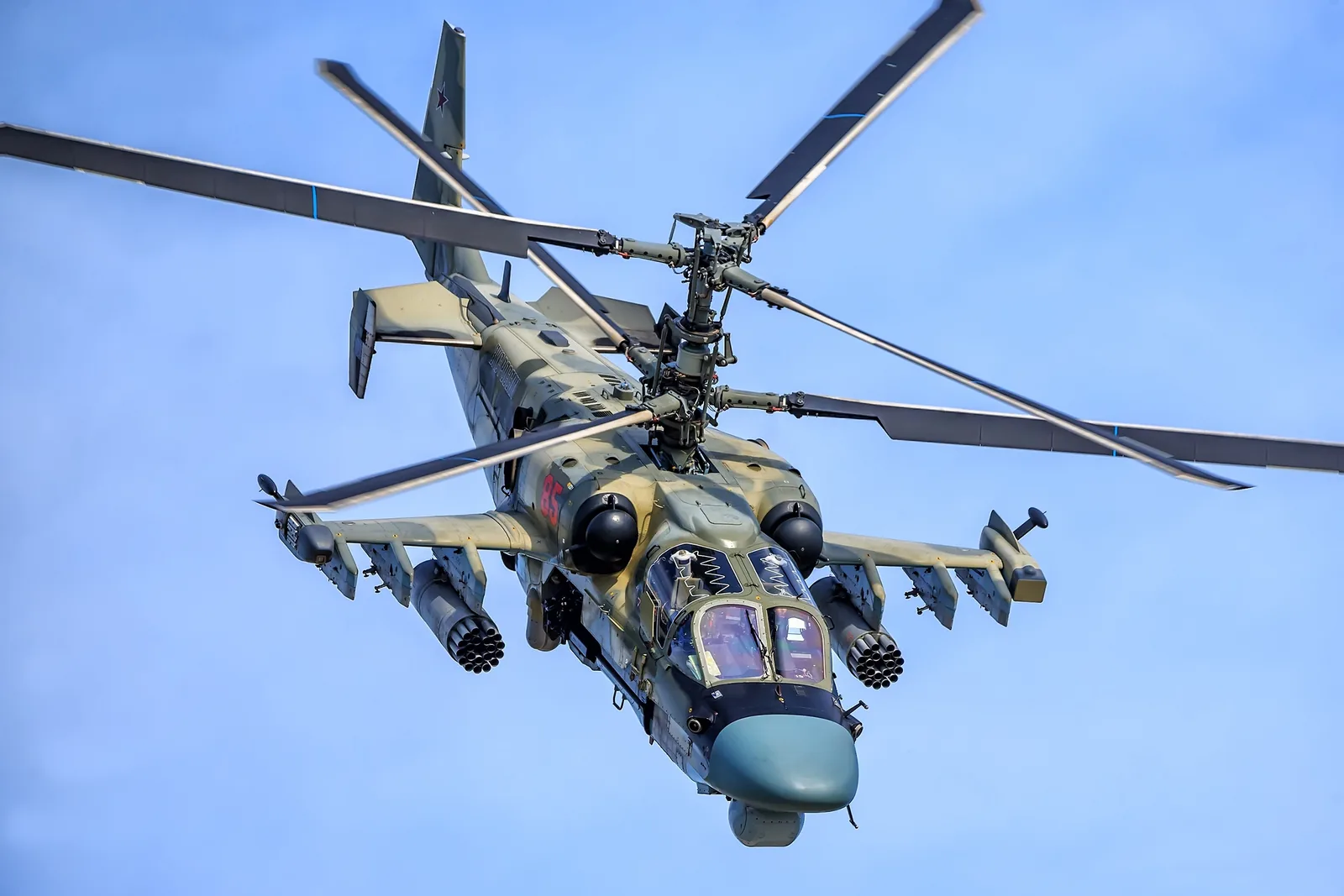
A Ka-52 banking toward the camera, showing the two three-blade coaxial rotors stacked on one mast, the side-by-side cockpit with its heavily framed glazing, and the rounded nose radome with the electro-optical turret beneath it. Twenty-round 80 mm rocket pods hang under the stub wings, with wingtip pods at the ends. There is no tail rotor: the tail carries only fins and a stabiliser.
Related articles: Mi-28 (Havoc), the Mil gunship the Ka-52 competes with and flies beside; Mi-24 (Hind), the gunship both were ordered to succeed; and Dan-T, the stand-off missile filmed on an Mi-28NM (not a Ka-52) in November 2026.
WHAT IT IS
The Kamov Ka-52 Alligator (Ка-52 «Аллигатор», NATO reporting name Hokum-B) is Russia's side-by-side, two-seat, coaxial-rotor attack helicopter. It is built at the Progress plant in Arsenyev, in the Russian Far East, as a derivative of the single-seat Ka-50 "Black Shark." The Ka-50's ancestor, the V-80, hovered on 17 June 1982 and flew on 23 July 1982, in the same 1970s competition that produced the Mi-28. The Ka-50 was formally preferred in the mid-1990s, then almost died with the Soviet collapse. The two-seat Ka-52, first hovered on 25 June 1997, became the production type from about 2010 to 2011. [DOCUMENTED]
A naval Ka-52K "Katran" was built around the cancelled French Mistral sale. A modernised Ka-52M, under the Avangard-4 contract, entered delivery in January 2023 with a longer-range GOES-451M sighting turret, the LMUR missile and, on at least some later airframes, a new self-defence suite and possibly a new nose radar. Egypt is the only confirmed export operator, with 46 aircraft. [DOCUMENTED]
The Ka-52's survivability story is not "a deeper bathtub than the Mi-28." It is a different package: coaxial rotors that do away with the tail rotor, a unique Zvezda K-37-800 extraction system that blows the rotor blades off before a rocket pulls the crew out, foam-filled tanks inside a steel keel, and a Vitebsk / President-S fit with two DIRCM turrets rather than the Mi-28's single belly dome. The cockpit is advertised as resisting 20 to 23 mm fire and the glass 12.7 mm. Against that, Ukrainian technical officers interviewed by RUSI in 2022 said the engine bays have no armour at all, and a Ka-52 force-landed at Hostomel on the first day of the full-scale invasion after fire hit its gearbox and left engine. [CONTESTED; see ARMOR AND SURVIVABILITY]
In Ukraine the Ka-52 has been the most heavily used and the most heavily lost Russian attack helicopter: 68 on the Oryx visually confirmed list as of 12 November 2026, against 21 Mi-28s. That is a floor, not a census. [DOCUMENTED as visually confirmed minima] After early hunter-killer raids, crews were pushed back behind their own lines, and the everyday tactic became the nose-up, lofted unguided rocket salvo: the "rocket sling," called kabrirovanie (pitch-up) in Russian aviation language. In 2023, on the Zaporizhzhia axis, the type mattered again as a stand-off tank killer with Vikhr and then LMUR.
QUICK FACTS
- Name: Ka-52 «Аллигатор» (Alligator); NATO Hokum-B. Derived from the Ka-50 «Чёрная акула» (Black Shark), NATO Hokum-A. [DOCUMENTED]
- Designer / maker: Kamov (design lineage under Sergey Mikheev); built at the Progress plant, Arsenyev, part of Russian Helicopters. Not Rostvertol, which builds the Mi-28. [DOCUMENTED]
- First flight: V-80 prototype hover 17 June 1982, first flight 23 July 1982; Ka-52 first hover 25 June 1997; Ka-52K first flight 7 March 2015 (AIN); Ka-52M first post-conversion flight 10 August 2020. [DOCUMENTED]
- Service entry: initial production Ka-52s to the Torzhok combat-training centre in December 2010; series production from November 2011 (redstar.gr); first ten Ka-52Ms delivered 4 January 2023. [DOCUMENTED]
- Crew: two, side by side, both with flying controls. No armoured wall between them. [DOCUMENTED]
- Rotors: two three-blade coaxial, contra-rotating rotors of 14.5 m diameter; no tail rotor. [DOCUMENTED]
- Engines: 2 × Klimov TV3-117VMA on early and some export aircraft; VK-2500 family on production Ka-52s and the M, about 2,200 to 2,500 hp each. [DOCUMENTED as a family; ratings CONTESTED]
- Advertised protection: cockpit against 20 to 23 mm fire at close range; glazing against 12.7 mm. RUSI: no armour on the engine bays. [CONTESTED]
- Escape: Zvezda K-37-800 rocket extraction system, blades severed first; minimum altitude contested (zero-zero claims versus 100 m). [DOCUMENTED as a system; CONTESTED as to altitude]
- Gun: 2A42 30 mm on the starboard side, limited traverse, 460 rounds. [DOCUMENTED]
- Main guided weapons: 9K121 Vikhr laser beam-riding missile (up to about 12); LMUR (Izdeliye 305) on the Ka-52M. [DOCUMENTED]
- Radar: FH-01 Arbalet-52 Ka-band, main antenna in the nose, plus a small 360° upper antenna; a Rezets X-band AESA is likely on some 2023-series Ka-52Ms. [DOCUMENTED / SINGLE-SOURCE for Rezets]
- Self-protection: L370V52 Vitebsk (export President-S) with two DIRCM turrets; L418 Monobloc on later Ka-52Ms. [DOCUMENTED]
- Operators: Russia; Egypt (46). [DOCUMENTED]
DESIGNATIONS AND NAMES
"Ka" stands for Kamov, and "V-80" (Vertolyot 80, "Helicopter 80") was the bureau's project name for the single-seat prototype that became the Ka-50. The Ka-50 carried the popular name Black Shark (Чёрная акула) and the NATO name Hokum, later Hokum-A; the two-seat Ka-52 is the Alligator (Аллигатор), NATO Hokum-B. The letter suffixes on the Ka-52 are K for korabelny, the shipborne Katran (Катран, a species of dogfish shark); M for the modernised aircraft; and E for the export version delivered to Egypt. The Egyptian aircraft were nicknamed "Nile Crocodile" at Dmitry Rogozin's suggestion. [DOCUMENTED] Equipment indexes used on this page include FH-01 for the radar, GOES-451 for the sighting turret, L370V52 for the Vitebsk self-protection fit, K-37-800 for the extraction system, 9K121 for Vikhr and Izdeliye 305 for LMUR.
DEVELOPMENT HISTORY
The V-80 and the 1976 competition. In December 1976 the same CPSU Central Committee and Council of Ministers resolution that started the Mi-28 also started Kamov's competitor, under Sergey Mikheev: a small, heavily automated, coaxial, single-seat gunship, later designated V-80. Design work is usually dated from December 1977. Prototype 010 hovered at Lyubertsy on 17 June 1982 and made its first flight on 23 July 1982; prototype 011 flew on 16 August 1983. Both wore painted-on "rear cockpit windows" as a deception, to suggest a second crew member. The first prototype was lost in a fatal accident on 3 April 1985. Comparative state tests against the Mi-28 were completed in August 1986. [DOCUMENTED]
The Ka-50 Black Shark. In October 1984 the Soviet Air Force chose the Ka-50 as its new anti-tank helicopter, and a December 1987 production decision followed, at Arsenyev. The first production-standard Ka-50 flew on 22 May 1991. Commissioning dates conflict slightly across sources: army aviation trials from August 1993 at Torzhok, a presidential decree in August 1994 with a formal judgement over the Mi-28, and official acceptance of the first funded production aircraft on 28 August 1995. Helion uses August 1995 as formal commissioning, and says five prototypes and only 13 production Ka-50s were built between 1982 and 2009. [CONTESTED as to the exact in-service year; DOCUMENTED as a tiny production run]
One army Ka-50 was lost on 17 June 1998, attributed to rotor clash, which is a reminder that the coaxial layout has its own failure mode. Two or three Ka-50s were sent to Chechnya (Mozdok in 1999, then again in December 2000), with the first operational firing on 6 January 2001 alongside Mi-24s. [DOCUMENTED]
Night versions and the Ka-50-2. Night derivatives, the Ka-50N and Ka-50Sh, and a tandem-seat Ka-50-2 "Erdogan" offered to Turkey were developed in the 1990s. None became a Russian production type. The night work is where the Samshit-50 electro-optical sight and, at one point, an Arbalet mast radar appear in the record, including with an interim French FLIR. [DOCUMENTED as programmes; not Russian service types]
Why two seats. The single-seat concept was the Ka-50's boldest idea and its biggest argument. Flying nap-of-the-earth, navigating, searching for targets, guiding a missile and watching for threats is a great deal of work for one person, even with heavy automation. First design work on a two-seat derivative is dated to 1994, initially as a company-funded venture, after a dedicated reconnaissance helicopter based on the Ka-60 became unaffordable. Kamov chose side-by-side seating for crew cooperation. [DOCUMENTED]
The Ka-52 Alligator. The first prototype used a production Ka-50 fuselage with a new, wider nose. It was rolled out in November 1996 and first hovered on 25 June 1997. The airframe is widely described as about 85 percent common with the Ka-50, the cabin and avionics being the main changes. Flight-performance testing was completed in 2003; funding for the second phase of state tests and for a production line at Arsenyev came later in the decade. Initial production-standard Ka-52s were rolled out in the second half of 2010 and handed to the Army Aviation combat-training centre at Torzhok in December 2010. Redstar.gr says series production began in November 2011. In the late 2000s Russia chose, after a further comparison, to field both the Ka-52 and the Mi-28N rather than a single winner. [DOCUMENTED]
DESIGN OVERVIEW
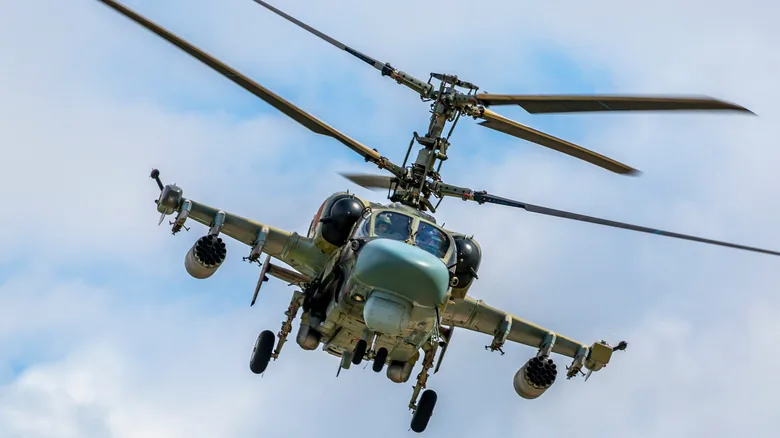
A Ka-52 head-on, showing the layout that sets the Kamov apart: two rotor hubs stacked on one mast, with the upper and lower blades turning in opposite directions; a wide, side-by-side cockpit; engines in nacelles on either side of the fuselage; and stub wings carrying 20-round rocket pods and wingtip pods. The undernose turret and fixed landing gear are also visible.
The Ka-52 is built around Kamov's signature coaxial layout. Two three-blade rotors of 14.5 m diameter turn in opposite directions on a single mast, so their torques cancel and no tail rotor is needed. The tail carries only a fin and a stabiliser. The stacked rotors make the helicopter shorter and more compact than a single-rotor type of the same weight, and they put all the lifting power into lift rather than spending some of it on an anti-torque rotor. The price is a tall, complex rotor head, and the risk that the two rotors can strike each other in extreme manoeuvres. [DOCUMENTED as a design argument]
The fuselage is built around a steel torsion-box keel, about 1.0 m square, through which the wing centre-section passes. The fuel tanks sit inside that box. Two turboshaft engines sit in nacelles either side of the upper fuselage, with dust filters on the intakes and IR-suppressing exhausts. The side-by-side cockpit is wider than the Mi-28's stepped tandem nose. The 30 mm cannon is mounted on the starboard side of the fuselage, not in a chin turret, and the stub wings carry the external stores and, at the tips, countermeasures pods. [DOCUMENTED]
The airframe is about 85 percent common with the single-seat Ka-50. The cabin, the nose with its radar and sensor turret, and the avionics are the main differences. [DOCUMENTED]
VARIANTS
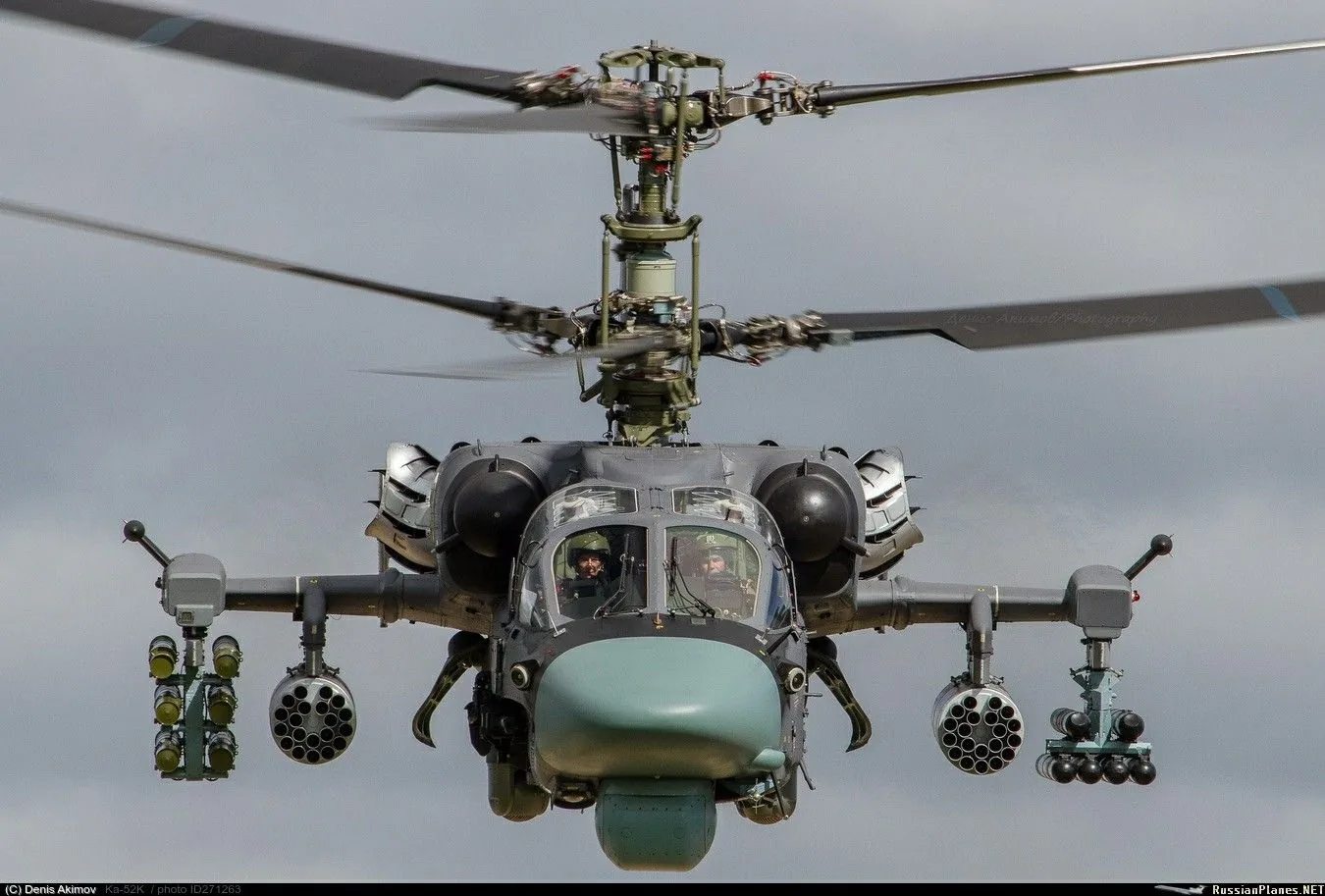
A head-on view with both crew clearly visible side by side behind the armoured glazing. The source photo site labels the aircraft a Ka-52K. Each stub wing carries a 20-round rocket pod inboard and a missile pack on the outer station, with the wingtip pods beyond. Photo: Denis Akimov / RussianPlanes.NET.
V-80 / Ka-50 "Black Shark" (Hokum-A). The single-seat ancestor. Five prototypes and only about 13 production aircraft, fitted with the K-37 extraction system from the start. In service from the mid-1990s, used in Chechnya in 2000 to 2001. Its two-seat derivative, the Ka-52, became the production type. [DOCUMENTED]
Ka-50N / Ka-50Sh. Night versions of the 1990s with the Samshit-50 sight and, on the Ka-50N, an Arbalet radar tested in a mast installation in 1997 and then removed. Not Russian service types. [DOCUMENTED as programmes]
Ka-50-2 "Erdogan." A tandem two-seat Ka-50 offered to Turkey in the 1990s. Not built for service. [DOCUMENTED as a programme]
Ka-52 "Alligator" (Hokum-B). The baseline side-by-side two-seater, with dual controls, the FH-01 Arbalet-52 radar in the nose, the GOES-451 turret, Vikhr missiles and the L370V52 Vitebsk suite. In production from about 2010 to 2011. [DOCUMENTED]
Ka-52K "Katran." The navalised aircraft, built around the two Mistral-class assault ships Russia ordered from France. It has folding rotor blades, shorter folding wings, reinforced landing gear, corrosion protection, and four weapon pylons rather than six. A longer-range radar and the Kh-35 and Kh-38 missiles were discussed; those weapons were not shown as integrated. AIN reported a first flight on 7 March 2015, a 32-aircraft defence-ministry order in April 2015, and a public debut at Army-2015 / IMDS 2015. After Crimea, France cancelled the Mistral sale and the ships went to Egypt. Secondary reporting still gives Russian Naval Aviation a requirement of "at least 32 to 40," but no clean, completed large-scale naval delivery was found. The Rezets AESA radar was later tested on Ka-52K "103." [DOCUMENTED as a variant and as first-flight and order dates; ESTIMATE as to how many reached a squadron] Redstar.gr says "in 2001, the Ka-52K" was derived for a foreign customer. That date does not match the 2015 naval prototype, and is probably an earlier use of the K letter for an export fit, not the Katran. [CONTESTED]
Ka-52M. The modernisation under the Avangard-4 research-and-development contract awarded to Kamov on 5 April 2019, though work had started earlier. Two conversions were ordered at Arsenyev in June 2020, and the first post-conversion flight was on 10 August 2020. The type was shown at MAKS 2021 and Army-2021. The first production contract, for 30 aircraft, was signed on 24 August 2021 (15 in 2022 and 15 in 2023), and a further order of unpublished size was signed at Army-2022. The first ten were delivered on 4 January 2023, and defence minister Shoigu said 2023 Ka-52 deliveries had "doubled" against 2022. Older Ka-52s are described as upgradeable to M standard, and a larger planned buy of 114 appears in several compilations. [DOCUMENTED]
The documented Ka-52M changes are: the GOES-451M targeting turret with longer detection and recognition ranges; BKS-50M communications; the SUO-806PM stores management system and LMUR (Izdeliye 305); stronger wheels; rotor-blade heating for colder weather; a cockpit friendlier to night-vision goggles; and, on later production aircraft photographed in July 2023, the L418 Monobloc self-defence suite in place of the L370P2 Vitebsk. A new nose radar is the open question, covered under AVIONICS AND SENSORS. Not every Ka-52M has the new radar. [DOCUMENTED as a fielded variant; SINGLE-SOURCE / provisional on the radar]
Ka-52E ("Nile Crocodile"). The Egyptian export, a hot-climate, corrosion-protected, reinforced land-based Ka-52, not a folding-blade Katran, even though Egypt also bought the two Mistrals. Some contracts and press items called the Egyptian aircraft Ka-52K; that labelling is contested. See OPERATORS AND PRODUCTION. [DOCUMENTED; CONTESTED as to the K label]
| Mark | Crew | First flight / status | Key features | Tag |
| V-80 / Ka-50 "Black Shark" | 1 | 1982 / in service mid-1990s, about 13 production | Single-seat coaxial gunship; K-37 extraction; Vikhr | DOCUMENTED |
| Ka-50N / Ka-50Sh | 1 | 1990s programmes | Night sights (Samshit-50); Arbalet mast radar trialled on the N in 1997 | DOCUMENTED as programmes |
| Ka-50-2 "Erdogan" | 2, tandem | 1990s offer to Turkey | Tandem two-seat Ka-50 | DOCUMENTED as a programme |
| Ka-52 "Alligator" | 2, side by side | Hover 1997 / production from 2010 to 2011 | FH-01 nose radar, GOES-451, Vikhr, L370V52, dual controls | DOCUMENTED |
| Ka-52K "Katran" | 2 | First flight March 2015; 32 ordered April 2015 | Folding blades and wings, four pylons, corrosion protection; Rezets tested on "103" | DOCUMENTED; numbers delivered ESTIMATE |
| Ka-52M | 2 | Converted 2020 / deliveries from January 2023 | GOES-451M, LMUR, BKS-50M, SUO-806PM, L418 on later aircraft; Rezets likely on some | DOCUMENTED; radar provisional |
| Ka-52E | 2 | Delivered to Egypt from July 2017 | Hot-climate, corrosion-protected land-based export; L418 sensors before Russian aircraft | DOCUMENTED; "Ka-52K" label CONTESTED |
ARMOR AND SURVIVABILITY
Russian gunships are tough birds, and the Ka-52 is no exception, but its toughness is a different kind from the Mi-28's. Kamov did not build a deeper armoured bathtub than Mil. It built a helicopter with no tail rotor to shoot off, a steel keel with foam-filled tanks inside it, a rocket extraction system no other attack helicopter has, and a two-turret laser jammer. Almost every ballistic number below is an advertised design figure, not a published trial report, and the war has tested at least one of them and found it wanting.
The cockpit. The Ka-52 inherited the Ka-50's heavily framed armoured office, widened for two crew sitting side by side. It is not the Mi-28's stepped tandem tub with an armoured bulkhead between two isolated compartments. Both crew have flying controls. Detailed English technical compilations describe a double-wall steel cockpit able to protect the crew from 20 mm and 23 mm gunfire at ranges as close as 100 m, with the nose structure also described as combined steel and aluminium armour and spaced aluminium plates. [SINGLE-SOURCE as to the "100 m / double-wall steel" wording, from all-aero.com, a dense Jane's-like compilation] Popular and manufacturer-style accounts say the cockpit armour was designed to resist 23 mm fire and the glazing 12.7 mm. [DOCUMENTED as a consistent advertised pair]
The armour mass is given as about 300 kg for the cabin, inherited from the Ka-50 (Topwar), or as approximately 350 kg "protecting the pilot, engines, fuel system and ammunition bay" (all-aero.com). [SINGLE-SOURCE for 300 kg; CONTESTED for 350 kg, both as a mass and as to what it covers; see the engines below]
Glass. all-aero.com gives the canopy and windscreen panels as 55 mm thick bulletproof glass. [SINGLE-SOURCE for the thickness] The 12.7 mm rating is the figure repeated for the glazing in shorter accounts. A 44 mm figure that appears in hobby wikis is not used here. The fair summary is: very thick armoured panels, commonly rated against 12.7 mm, with a thickness of 55 mm in one detailed compilation. The glass is not rated against 23 mm in the sources, even though the cockpit walls are. [CONTESTED as to thickness against rating]
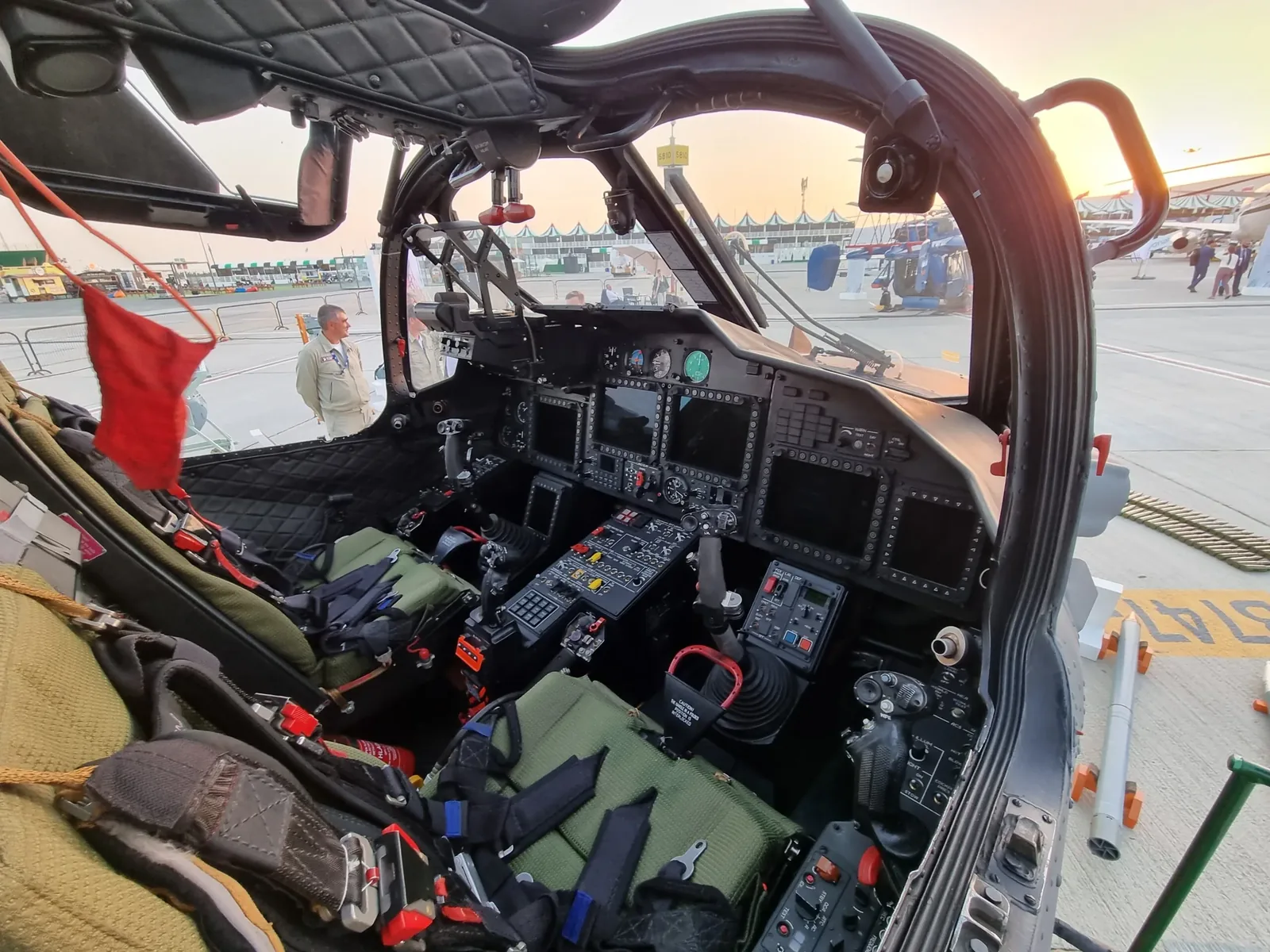
Inside a Ka-52 cockpit at an outdoor air show, looking across from the left seat. The two seats sit side by side under one canopy, with their harnesses laid out and no partition between them, sharing a single instrument panel of multifunction displays. The canopy frame is thick and heavily padded with quilted lining. Air-show chalets, spectators and other aircraft are visible outside.
No wall between the crew. The side-by-side layout has a direct survivability consequence. There is no Mi-28-style armoured wall between two isolated offices, so a hit that gets into the cockpit can affect both people. Kamov chose side-by-side seating for crew cooperation: the two crew can see each other, share displays and split the work more easily. That is a design choice for teamwork, not a survivability upgrade. [DOCUMENTED]
What is not well protected: the engines. This is the finding that should lead any discussion of Ka-52 armour, because it is the one the war actually tested. In their November 2022 special report, Justin Bronk, Nick Reynolds and Jack Watling of RUSI, after interviewing Ukrainian Air Force and military-scientific officers and examining wrecks, wrote that "the Ka-52 has notable deficiencies in armour protection compared with other Russian attack helicopters, especially the engine compartments, which have no armour plating at all — leaving them potentially vulnerable to damage from even small arms fire." [DOCUMENTED as a RUSI finding from wreck examination and Ukrainian technical interviews, not a manufacturer admission] That directly contradicts all-aero.com's claim that the 350 kg of armour protects the engines. [CONTESTED]
The first-day force-landing at Hostomel fits the RUSI finding. The Aviation Safety Network records Ka-52 RF-90680 ("17") making a forced landing on 24 February 2022 after damage to the main gearbox and left engine, attributed to small-arms and ZU-23 fire; an Igla hit is also reported in the same file. The crew got out uninjured, and the airframe was later destroyed so that it would not be captured. [DOCUMENTED as a loss event; the exact mix of small arms, 23 mm and MANPADS is SINGLE-SOURCE to that file] So, on the evidence available, the Ka-52 should not be described as more heavily armoured than the Mi-28. If anything, the serious Western combat analysis runs the other way on the engine bays.
Coaxial rotors: no tail rotor to lose. The Ka-50/52 uses two three-blade, coaxial, contra-rotating rotors of 14.5 m diameter, with composite blades and swept tips. There is no tail rotor. That removes a classic helicopter weak point. On a conventional helicopter, a hit on the tail rotor, its drive shaft or the tail boom can take away anti-torque control, and the aircraft spins. The Ka-52 has no such single point: the yaw control comes from the rotors themselves. That is the usual reason Kamov and secondary sources give for better residual controllability after tail damage. [DOCUMENTED as a design argument] Blade damage tolerance is advertised in the same general language used for the Mi-28, with composite blades that can take automatic-weapons or even cannon hits. No precise, sourced figure for how many hits of what calibre the Ka-52 rotor survives was found, and none is given here. The coaxial layout also has its own risk: the 1998 Ka-50 loss was attributed to rotor clash. [DOCUMENTED as an accident attribution] The transmission is described as able to run for 30 minutes after oil-system failure. [SINGLE-SOURCE, all-aero.com]
Foam-filled tanks in the keel. Two main fuel tanks, filled with reticulated foam, sit inside the steel torsion-box keel. Total internal capacity is given as approximately 1,800 litres. The front tank feeds the port engine; the rear tank feeds the starboard engine and the APU, which gives each engine its own primary supply. Each tank is protected by layers of natural rubber. Four 500-litre underwing ferry tanks can be fitted. [DOCUMENTED in that compilation] Reticulated foam breaks the fuel vapour above the liquid into small cells, which suppresses the explosion that can follow when an incendiary round or hot fragment enters a half-empty tank. GlobalSecurity lists internal fuel as 1,487 kg, which is in the same range if a jet-fuel density is assumed, but it is a different unit and is not merged with the 1,800 L figure here. [CONTESTED as a figure] Foam fill is documented more cleanly for the Ka-50/52 than for the Mi-28, where it was not found at all, though it is still not a published test report.
The K-37-800 extraction system. This is the feature that makes the Kamov unique among attack helicopters. Zvezda's K-37-800 (K-37-800M on the two-seat aircraft, in ODIN's wording) is not a conventional ejection seat. A conventional helicopter cannot simply fire its crew upward, because the main rotor is spinning directly overhead. Kamov's answer is to get rid of the rotor first. The Ejection Site, comparing the system to the American Stanley Yankee extraction system, describes the sequence:
- Explosive charges sever all the rotor blades at the roots, and they fly clear.
- The canopy glazing above the crew is jettisoned.
- A rocket assembly is fired up and out of the cockpit.
- A lanyard attached to the crew member pulls him out of the seat behind the rocket.
- The parachute deploys immediately afterwards.
[DOCUMENTED as a sequence] The idea depends on the coaxial layout: once the blades are gone, there is no tail rotor left to clear. all-aero.com also describes an alternative bail-out: jettison the doors and stores and roll out sideways. Two caveats apply. First, The Ejection Site says "five blades"; the Ka-50/52 has six, in two three-blade rotors, so that is a slip on that page, not a different rotor. Second, the minimum altitude is contested. all-aero.com says "safe ejection from 100 m," while marketing and popular accounts describe a system usable "at any altitude and speed," including low-level flight, sometimes in zero-zero language. No Zvezda manual that settles 0 m against 100 m was found. [CONTESTED]
Some crews have clearly got out of downed Ka-52s alive in Ukraine, but no well-documented combat case was found that isolates a successful in-flight K-37 extraction from a crash landing followed by a scramble out of the wreck. This page therefore makes no claim about how many crews the system has saved.
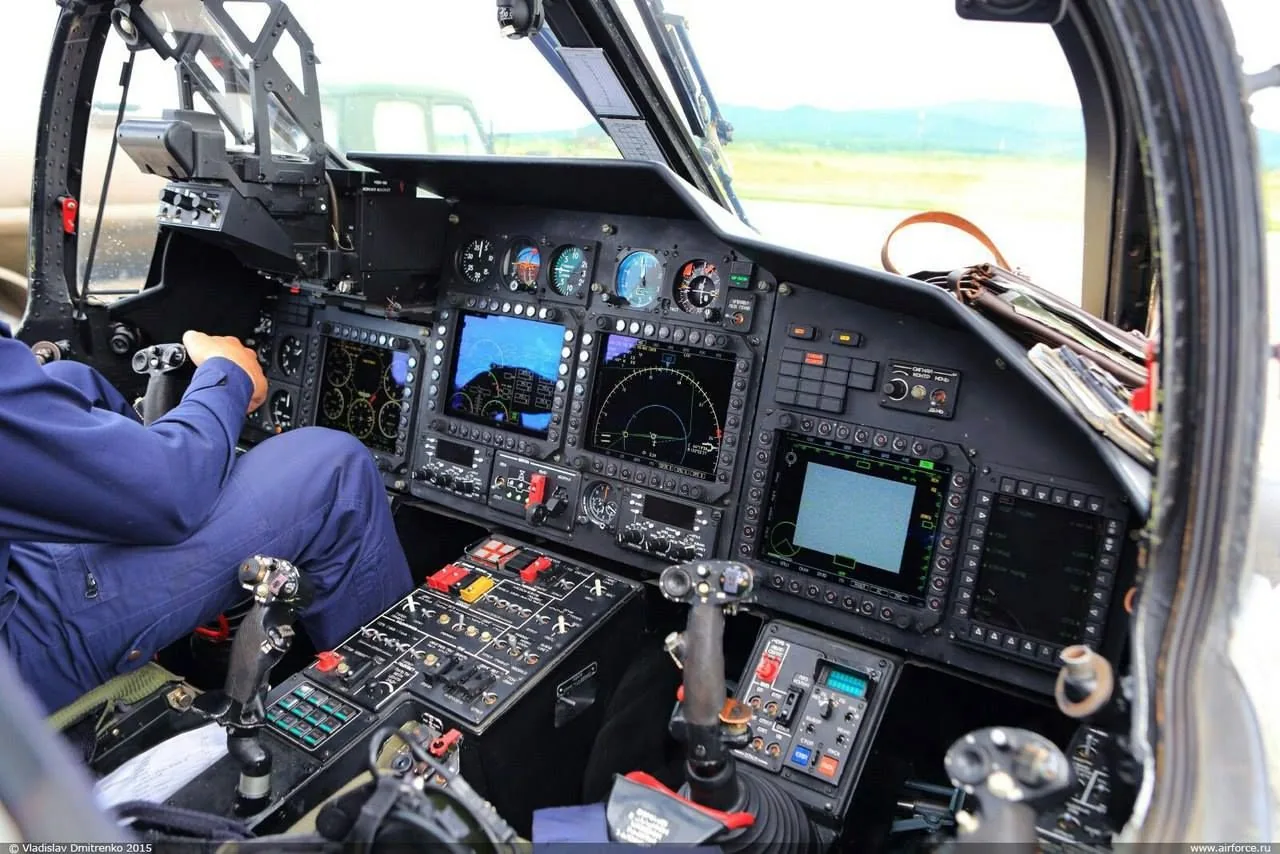
The Ka-52 cockpit panel seen from the right seat, with a crew member in the left seat at the controls. Five colour multifunction displays and a row of back-up dial instruments span the shared panel, with a control stick in front of each seat and what appears to be the head-up display frame at upper left. The side-by-side layout puts both crew in reach of the same displays. Photo: Vladislav Dmitrenko 2015 / www.airforce.ru.
Self-protection: L370V52 Vitebsk / President-S, with two turrets. The Ka-52 fit is L370V52, from the Vitebsk family also used on the Mi-28; President-S is the export name, and The Aviationist says it was delivered to Egypt for its Ka-52s and Mi-17s. The published component list is:
- L370-1 processor and controller.
- L150 "Pastel" radar-warning receiver, 1.2 to 18 GHz, 360° in azimuth and 60° in elevation.
- L140 "Otklik" laser-warning receivers.
- L370-2 ultraviolet missile-approach warners, at the nose and tail on the Ka-52.
- Two L370-5 (later L418-5) laser DIRCM turrets just ahead of the main landing gear. The two jammers are the visible difference from the Mi-28's single L370-5L dome under the rear fuselage. The family brochure gives an engagement envelope of about 500 to 5,000 m, 360° around and about 90° in elevation.
- UV-26 26 mm flare and chaff dispensers in the wingtips.
The L370-3S active RF jammer is part of the catalogue and has been repeatedly described as not installed on operational aircraft. [DOCUMENTED]
L418 Monobloc on the later Ka-52M. On later Ka-52Ms photographed in July 2023, Butowski identifies the L418 Monobloc suite from NII Ekran: L418-2 ultraviolet warners in place of the L370-2 and, though not visible in those photographs in his reading, two angular L418-5 DIRCM fairings with a new SP3-1500 lamp, replacing the spherical L370-5 turrets, the "eggs of life." He notes that L418 sensors were fitted to Egyptian Ka-52Es before they appeared on Russian ones, because the defence ministry's formalities were slower than an export customer's. [DOCUMENTED]
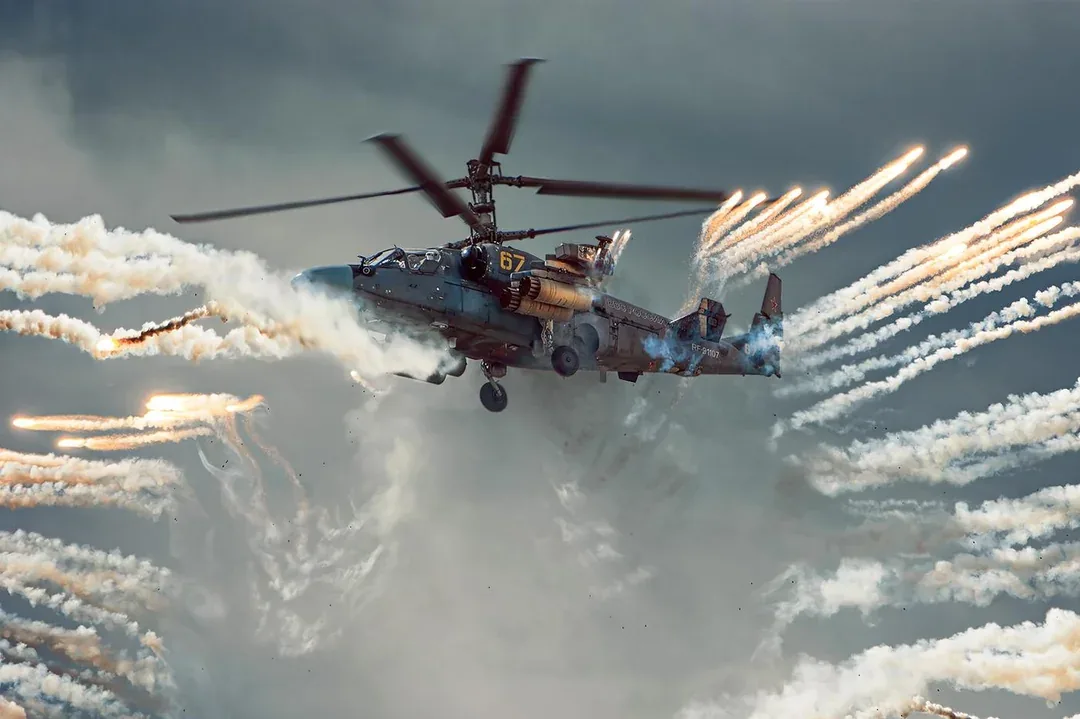
Ka-52 "67" firing a heavy spread of decoy flares at a display. The burning flares arc away on both sides of the helicopter, trailing white smoke. Decoys like these, from the UV-26 dispensers, are the "soft" half of the Vitebsk defence against heat-seeking missiles; the laser DIRCM turrets are the other half.
What Vitebsk did and did not do in Ukraine. The vendor's live-fire story, 20 Igla-type missiles fired at a running, unmanned Mi-8 with none hitting, is the same claim discussed in the Mi-28 article. [SINGLE-SOURCE as a claim] Vitebsk-equipped helicopters have still been lost in Syria and, in large numbers, in Ukraine. RUSI's operational verdict is more useful than the brochure. The combination of missile-approach warners and flare programmes "functioned reasonably well" and decoyed many missiles, but the sheer volume of fire still scored hits. At several points in early March 2022 and later in Donbas, helicopters failed to dispense flares, which the authors read as either empty dispensers or a switch to semi-automatic or manual modes to save stocks. And two threats were specifically called out as immune to flares and chaff: Starstreak, which uses laser beam-riding guidance and carries no heat-seeker to decoy, and Javelin in direct-attack mode. [DOCUMENTED] The suite was built against MANPADS. It did that job often, but not always, and it has nothing to offer against heavy ground fire or a laser-guided dart.
| Item | What is claimed | Source | Tag |
| Cockpit structure | Double-wall steel; combined steel and aluminium; spaced aluminium plates | all-aero.com | SINGLE-SOURCE |
| Cockpit rating | 20 and 23 mm gunfire at ranges as close as 100 m | all-aero.com | SINGLE-SOURCE |
| Cockpit rating | 23 mm | Popular and manufacturer-style accounts | DOCUMENTED as advertised |
| Armour mass | About 300 kg (cabin) | Topwar | SINGLE-SOURCE |
| Armour mass | About 350 kg, covering pilot, engines, fuel and ammunition bay | all-aero.com | CONTESTED |
| Glazing rating | 12.7 mm | Popular and manufacturer-style accounts | DOCUMENTED as advertised |
| Glazing thickness | 55 mm (44 mm in hobby wikis, not used) | all-aero.com | SINGLE-SOURCE |
| Engine bays | "No armour plating at all" | RUSI, from wrecks and Ukrainian technical interviews | DOCUMENTED as a RUSI finding; contradicts all-aero.com |
| Crew partition | None; side-by-side seats under one canopy | Design layout | DOCUMENTED |
| Tail rotor | None; coaxial rotors | Design layout | DOCUMENTED |
| Rotor blades | Composite, advertised as tolerating gunfire; no sourced figure | Secondary accounts | UNVERIFIED as a figure |
| Transmission | Runs 30 minutes after oil-system failure | all-aero.com | SINGLE-SOURCE |
| Fuel tanks | Reticulated foam, rubber-protected, inside the steel keel; about 1,800 L | all-aero.com | DOCUMENTED in that compilation; volume CONTESTED |
| Escape | K-37-800 extraction: blades severed, canopy off, rocket pull | The Ejection Site, all-aero.com, migflug | DOCUMENTED |
| Escape altitude | Zero-zero / "any altitude" vs 100 m | Marketing vs all-aero.com | CONTESTED |
| Self-protection | L370V52 Vitebsk, two DIRCM turrets; L418 on later Ms | The Aviationist, Butowski | DOCUMENTED |
| Combat result | Decoyed many MANPADS; not volume of fire, Starstreak or Javelin | RUSI | DOCUMENTED |
Against the Mi-28 and the AH-64. The Mi-28 spends weight on a deeper, separated cockpit with an armoured bulkhead between the crew, ceramic appliqué, energy-absorbing seats and gear rated for a 12 m/s impact, and inflatable door ramps, and it is advertised in 12.7 mm armour-piercing plus 20 mm projectile language. The Ka-52 spends weight on coaxial residual control, a unique extraction system, foam-filled keel tanks and a twin-DIRCM suite, and it is advertised in 20 to 23 mm cockpit language. But its engines, in RUSI's wreck-based account, are a soft spot that the Mi-28's separated, shielded engine bays are designed to avoid. The side-by-side Ka-52 office is better for crew cooperation and worse as a single shot-line. Neither package is a solution to a MANPADS or an FPV.
The AH-64 Apache, in standard Western descriptions, uses boron-carbide and Kevlar floor and side armour rated against 12.7 mm and 23 mm fragments, with a blast shield between its tandem seats, and has no crew-extraction system of the K-37 type. No primary US Army armour specification was consulted, so that comparison is one-sided in its sourcing. [UNVERIFIED as a primary specification]
AVIONICS AND SENSORS
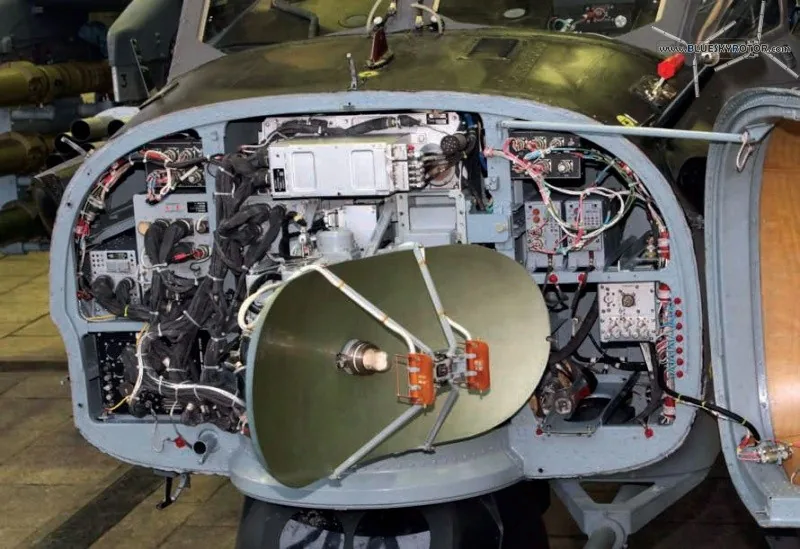
The nose of a Ka-52 opened up, showing the large dish antenna of the nose radar with its sub-reflector on struts at the centre, surrounded by racks of avionics boxes and wiring looms. This nose aperture, not a mast dome, is the main radar antenna of the production Ka-52. Image watermark: blueskyrotor.com.
FH-01 / RN-01 Arbalet-52: a nose radar, not a Longbow mast. The production Ka-52's radar is the Phazotron-NIIR FH-01 Arbalet-52 ("Crossbow"), a Ka-band mechanically scanned radar working at a wavelength of about 8 mm, in Butowski's description. The main antenna is a large, mechanically slewed Cassegrain in the nose, about 80 cm (31.5 inches) across according to Butowski, with L-band IFF dipoles described beside the sub-reflector in one equipment entry. A Cassegrain antenna uses a main dish and a small secondary reflector in front of it, folding the beam path so that the feed can sit behind the dish, which keeps the assembly short enough for a nose. A second, smaller antenna is associated with the rotor hub or upper fuselage and is described as giving 360° coverage for air search and as a warning channel, including, in secondary accounts, against incoming missiles. [DOCUMENTED as a two-antenna, nose-plus-upper architecture]
Several otherwise serious pages are easy to misread here. ODIN says the Ka-52 has a "mast-mounted radar antenna," and Aviastar, in older brochure language, put the Arbalet in a "mast-mounted dome." An Arbalet mast installation was tested on the night Ka-50N in 1997 and then removed. On the production Alligator, the fire-control and mapping antenna that matters is in the nose radome. The upper antenna is a secondary, smaller, 360° sensor, not an equivalent of the AH-64's Longbow mast fire-control radar. [CONTESTED as to the word "mast"; the nose Cassegrain is the well-documented main aperture]
Advertised detection figures cluster, but they are brochure numbers: a tank at about 12 km, a large metal target such as a railway bridge at about 25 km, an aircraft at about 15 km, a Stinger-class missile at about 5 km, and a track capacity of "up to 20 targets" in one Russian-language account. [SINGLE-SOURCE / manufacturer-flavoured; not a measured envelope] The key architectural fact, which Butowski also states for the Mi-28's N025, is that the radar cannot itself assign a guided missile to a target. It hands coordinates to the GOES-451 or GOES-451M electro-optical turret, which is the actual shooter. [DOCUMENTED]
Ka-52M radar options. Prototype Ka-52Ms kept the FH-01. Butowski's July 2023 reading of new cooling inlets on the chin radome of a freshly painted M is that the aircraft likely carries the Zaslon V006 / RZ-001 Rezets X-band AESA: a fixed antenna with 640 transmit/receive modules, air-cooled, advertised by the manufacturer as detecting a group of tanks at about 40 km (25 miles) and a fighter at up to 50 km (31 miles). Phazotron's alternative, the FH-02, would keep a mechanical Ka-band slot array and add an X-band AESA, with company figures for a tank of 12.4 miles (about 20 km) in Ka-band or 21.8 miles (about 35 km) in X-band. GlobalSecurity reprints more optimistic figures (tank 45 km, helicopter 20 km, bridge 100 km) that do not match Butowski and look internally odd, with a tank out-ranging a helicopter. [CONTESTED; Butowski preferred] The fair reading: Rezets is likely on some 2023-series Ka-52Ms, not confirmed fleet-wide. [SINGLE-SOURCE / provisional]
For an RF reader, the shift matters. A mechanically scanned Ka-band dish gives fine resolution from a small aperture but has to physically slew, and Ka-band suffers more from rain and atmospheric loss. An X-band AESA steers its beam electronically, can interleave modes, and loses less to weather, at the cost of a coarser beam for the same aperture. Moving the main radar from Ka to X is a trade of resolution for range, weather performance and agility.
GOES-451, GOES-451M and the Samshit name. The production Ka-52's main targeting turret, under the nose, is the UOMZ GOES-451: a thermal imager, wide and narrow TV channels, a laser rangefinder and designator, the laser beam-rider output for Vikhr, and a laser-spot tracker. A smaller pilot and night-flying turret, given as TOES-520 or TOES-250 depending on the account, is associated with helmet cueing. Topwar, relaying Russian published figures, gives GOES-451 detection of about 10 km by day and 6 km at night, against a "declared" 20 km day figure that Defense Express has flagged as optimistic; the same Defense Express piece is the source for a wartime anecdote of Ka-52 electronics mistaking combine harvesters for tanks. [SINGLE-SOURCE for the 10 / 6 km and 20 km figures]
The Ka-52M turret is the GOES-451M. UOMZ, via Butowski, declares tank detection at 9.3 miles (about 15 km) by TV and 7.5 miles (about 12 km) by infrared, and recognition at 7.5 miles and 5 miles (about 8 km) respectively, numbers chosen to reach out toward LMUR's range. [DOCUMENTED as manufacturer declarations] Samshit-E / Samshit-50 (UOMZ "Boxwood") is the name on the Panitsidis redstar.gr Ka-52 page, on GlobalSecurity's Ka-52 column and in 1990s Ka-50N and early Ka-52 brochures. It is not the name Butowski uses for the Ka-52M turret, and it is treated here as an earlier or alternative UOMZ suite name, not the Ka-52M sight. [CONTESTED naming]
RUSI adds a practical limit that no brochure mentions. In the authors' experience Russian gunships have poor vibration damping, so gyro-stabilised optics struggle to give a clear high-magnification picture. That cuts the practical range of laser- or command-guided missiles and forces the helicopter to linger closer to the front than the brochure ranges suggest. [DOCUMENTED as a RUSI observation]
Mission system and datalinks. The core avionics suite is referred to as Argument-2000 or PrPNK Argument-52, with a Baguet-53-class mission computer, PNK-73DM flight and navigation system, dual crew controls, NSTsI helmet sights, and cockpit multifunction displays plus a head-up display. [SECONDARY / manufacturer-style] The Ka-52M adds BKS-50M communications and is "adapted to work within a new battlefield command and control system" (ODIN). For LMUR, the same AS-BPLA two-way datalink used on the Mi-28NM appears as a wingtip or end-of-wing pod with a radio-transparent nose on the MAKS 2021 Ka-52M trials aircraft (Butowski). A "Sagittarius" (Strelets) reconnaissance and command complex mentioned in one GlobalSecurity line is not relied on here. [UNVERIFIED as a fit]
WEAPONS
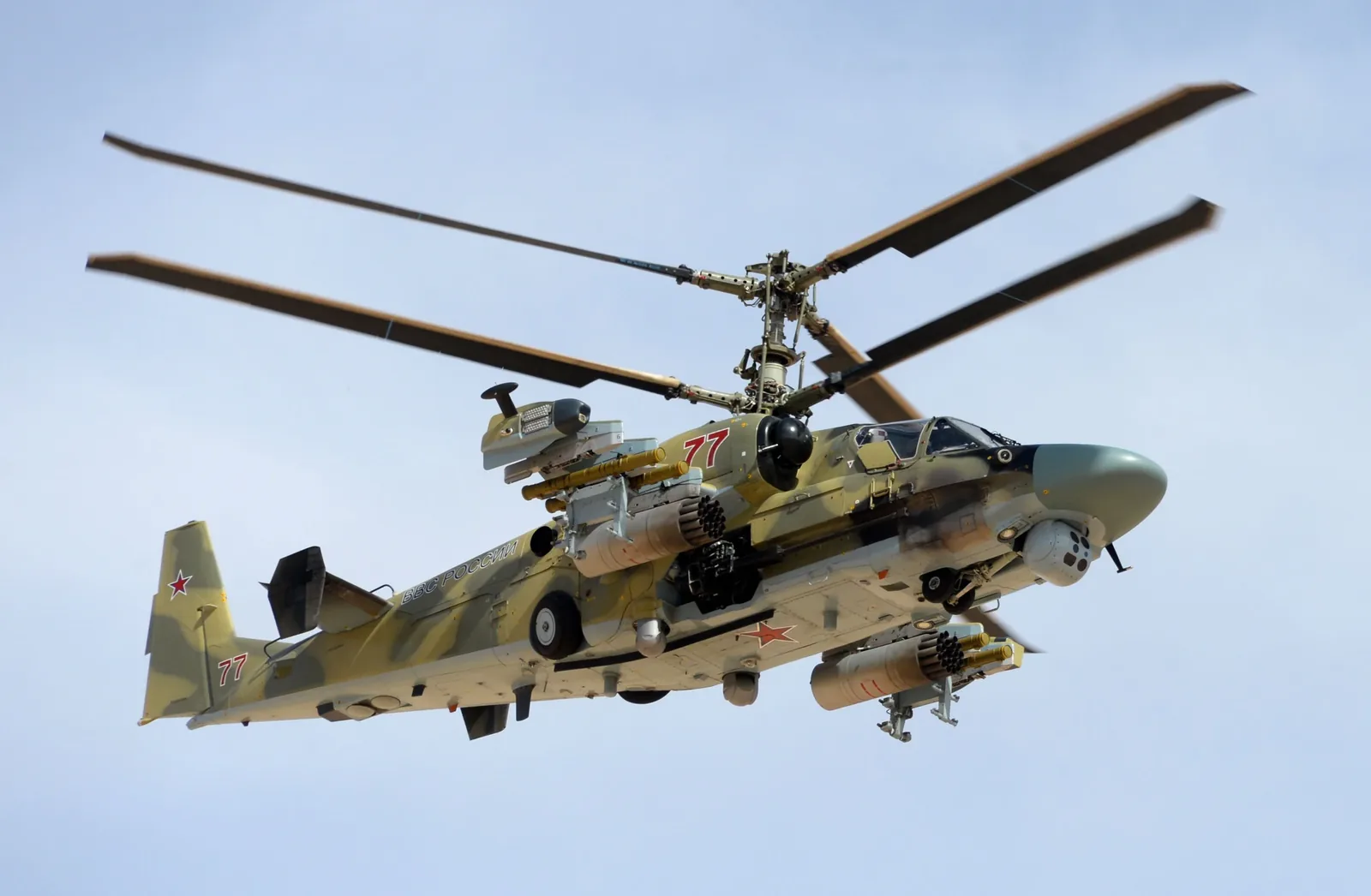
Ka-52 "77" in a sand-and-green camouflage, seen from the left, carrying 20-round rocket pods and missile launch tubes on the stub wings, with the wingtip pod and its sensors at the end of the wing. The rounded nose radome, the sensor turret beneath it, the engine nacelle and the coaxial rotor head are all visible.
2A42 30 mm cannon, starboard, semi-rigid. The Ka-52 uses the same Shipunov 2A42 (or 2A42-1) 30 mm gun as the Mi-28 and the BMP-2, but not in a chin turret. It is mounted on the starboard side of the fuselage, near the centre of gravity, with limited traverse, so the crew generally have to point the helicopter at the target. ODIN claims better accuracy than a turreted chin gun as the compensation; that is an assertion, not a test. Ammunition is consistently given as 460 rounds, distinctly more than the Mi-28's contested 250 to 300. [DOCUMENTED as a fit and as a 460-round load] GlobalSecurity's table lists a sighting range of 4,000 m, and its "20 mm" entry for the Ka-52M gun is a typo.
Vikhr (9K121). The Ka-52's native anti-tank missile is the laser beam-riding Vikhr (NATO AT-16 Scallion), typically carried in packs of three or four, for up to about 12 missiles. Daylight range from a helicopter is commonly given as about 8 km, sometimes 8 to 10 km by day and about 5 km at night; armour penetration figures around 900 to 950 mm appear in secondary tables. [DOCUMENTED / secondary figures] A beam-rider's receiver looks back at a coded laser beam projected from the launch aircraft, and the missile steers itself to stay in the centre of that beam, rather than homing on a laser spot on the target. That makes it very hard to jam, but it also ties the helicopter to the shot. RUSI says the aircraft cannot drift more than a few degrees per second, or the beam walks out of the missile's field of view.
That constraint has cost the Ka-52 dearly. Ukrainian troops have been able to kill hovering or near-stationary Ka-52s with wire-guided Stugna-P anti-tank missiles while the helicopter was holding still to guide a Vikhr. [DOCUMENTED as a guidance constraint and as a combat method] For the few seconds of a Vikhr's flight, the helicopter is a big, slow, steady target.
Ataka. Ataka is the radio-command missile of the Mi-28 and Mi-24 family. It is reported in Egyptian load-out planning, alongside Vikhr-1, and can be carried on some mix-and-match pylons, but Vikhr is the documented Ka-52 combat missile in Ukraine. [Ataka on the Ka-52 is a possible or export-option fit, not the main war load]
LMUR / Izdeliye 305. Added on the Ka-52M with the SUO-806PM stores management system. It is the same weapon described in the Mi-28 article: about 105 kg with a warhead of about 25 kg, a two-way datalink, and the operator in the loop in the terminal phase. Range is "over nine miles" in Butowski's 2023 account and "about 15 km" in the UK Ministry of Defence's July 2023 update, with some later Russian-source figures of up to 20 to 25 km. UK intelligence said in July 2023 that Russia had begun using a long-range anti-tank missile, identified as LMUR, on Ka-52s against the Zaporizhzhia counter-offensive, and was "highly likely" using the modified Ka-52M in theatre. [DOCUMENTED] Unlike Vikhr, LMUR does not need the helicopter to hold a laser beam on it: the missile flies out on its own navigation, and the operator only steers in the final phase through the datalink.
Rockets. The everyday Ukraine-war loads are 80 mm S-8 rockets in B-8V20 20-round pods and 122 mm S-13 rockets in five-round pods. A two-pod S-8 salvo is 40 rockets; two S-13 pods give 10. These are the weapons of the rocket sling, described below. [DOCUMENTED]
Other stores and the pylon count. Igla and Igla-S (sometimes Igla-V) air-to-air missiles, gun pods and bombs appear on brochure lists. Redstar.gr's Ka-52 armament block is thinner than its Mi-28 pages: the 2A42 with 460 rounds, four hardpoints, "4 or 3" Vikhr or Igla, and gun or machine-gun pods. Land-based Ka-52s are often described elsewhere as having six stations; the Katran has four because of its shorter wings. [CONTESTED as to four against six pylons on the land aircraft]
Dan-T. The November 2026 Dan-T launch video shows an Mi-28NM, not a Ka-52. No Ka-52 Dan-T carriage or launch has been documented. [DOCUMENTED as an absence of evidence]
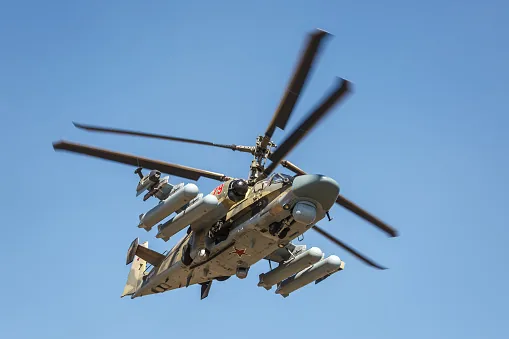
A Ka-52 seen from below during an open demonstration at the Kadamovskiy training ground near Novocherkassk, Rostov region, on 26 August 2018. Four large cylindrical stores hang under the stub wings, with the wingtip pods outboard. The underside view shows the undernose sensor turret, the rounded nose radome and the main landing gear.
| Weapon | Type | Status on the Ka-52 | Tag |
| 2A42 / 2A42-1, 30 mm | Starboard semi-rigid cannon, limited traverse, 460 rounds | All marks | DOCUMENTED |
| 9K121 Vikhr | Laser beam-riding ATGM, about 8 km by day | Native missile; up to about 12; combat use in Ukraine | DOCUMENTED |
| LMUR / Izdeliye 305 | Datalinked multipurpose missile, about 15 km (UK MoD); up to 20 to 25 km claimed | Ka-52M; used from 2023 | DOCUMENTED |
| 9M120 Ataka | Radio-command ATGM | Egyptian planning; possible fit | UNVERIFIED as a Russian war load |
| S-8 (B-8V20) and S-13 | 80 mm and 122 mm unguided rockets | Everyday Ukraine load; used in rocket slings | DOCUMENTED |
| Igla / Igla-S / Igla-V | Infrared air-to-air missiles | Brochure option | DOCUMENTED as an option |
| Kh-35 / Kh-38 | Anti-ship / air-to-surface missiles | Discussed for the Ka-52K; not shown integrated | UNVERIFIED |
| Dan-T | Quasi-cruise missile | Not seen on a Ka-52 (Mi-28NM only) | Not documented |
| Gun pods, bombs | Various | Brochure options | UNVERIFIED as war loads |
ROCKET SLINGS
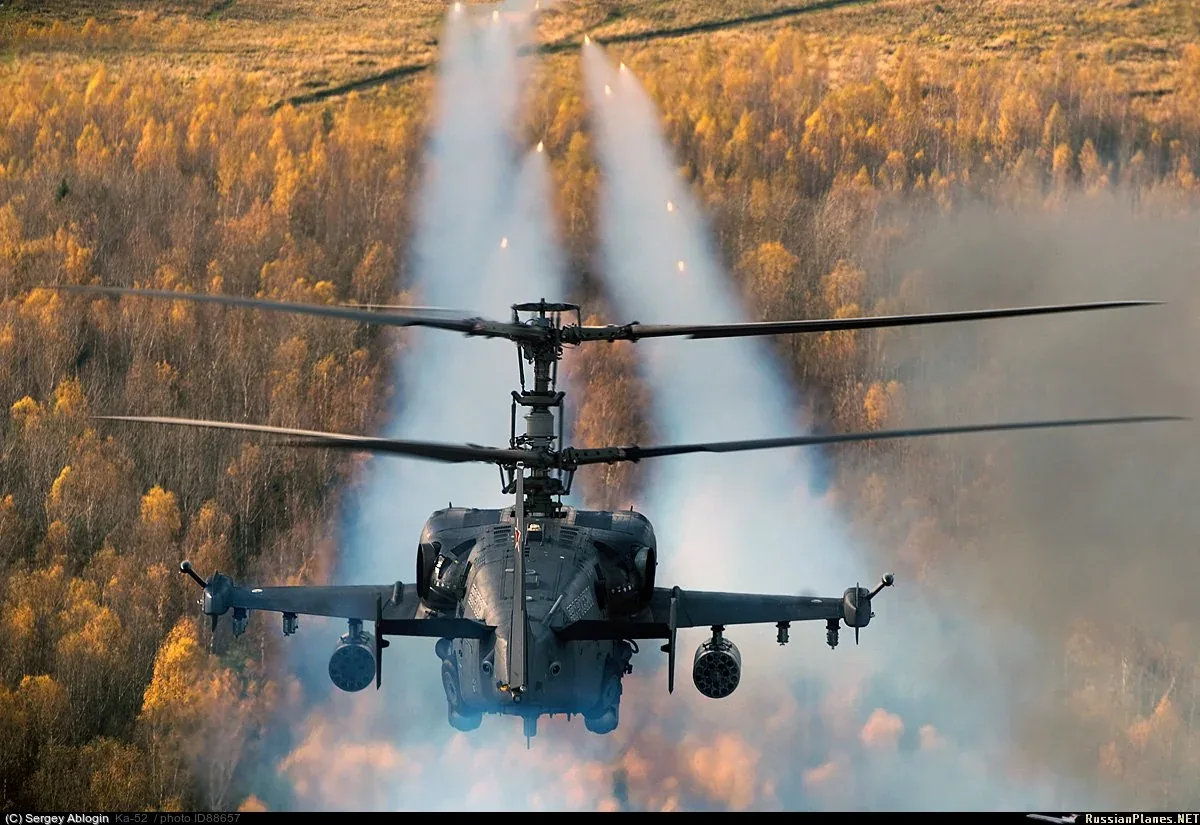
A Ka-52 seen from behind and above, ripple-firing unguided rockets from the pods on both stub wings. Smoke trails stretch ahead over autumn forest toward the rockets' bright motors in the distance. This is a firing at a range, not necessarily a lofted rocket sling, but it shows what a ripple salvo of pod rockets looks like. Photo: Sergey Ablogin / RussianPlanes.NET.
The Ka-52 and the Mi-28 have both been seen many times in Ukraine-war footage flying what this site calls a rocket sling. Western writers have called it lobbing, lofting, toss-rocketing, or turning the gunship into a flying multiple rocket launcher; in English it is usually loft or toss fire. The Russian aviation term is кабрирование (kabrirovanie), "pitch-up," from the same root as the French cabrer, for a horse rearing. Informal speech sometimes slurs it toward kabriolet, which is a convertible car and not a doctrinal word; no Russian official publication was found using "kabriolet" as a tactic name. [DOCUMENTED]
What it looks like. Picture a pair of Ka-52s coming in from behind their own lines, barely above the tree tops, below 200 ft by RUSI's account, fast and nose-down, their dark shapes skimming the field edges with the rotor noise masked by the terrain. A few kilometres short of the front, the lead pilot hauls back. The nose rears up, 15 to 30 degrees above the horizon in RUSI's description, and for a moment the helicopter seems to sit back on its tail, the whole airframe climbing. At the top of that pitch-up the pods light: S-8s or S-13s ripple out in a long, stuttering stream, dozens of smoke trails climbing away ahead of the aircraft into the sky. Before the last rocket has left the pod, the helicopter is already rolling hard over, pulling round into a diving break turn back toward cover, with flares spilling out behind it in white arcs. The rockets keep climbing, slow at the top of their arc, then tip over and fall, coming down on the far side of the line in a long, scattered spray of explosions that walks across the target area well after the helicopters have gone back below the trees. The helicopter never crosses its own front line. [DOCUMENTED as a tactic; the description follows RUSI, The War Zone and Militarnyi]
Why it works. A rocket fired level from low altitude starts falling toward the ground as soon as it leaves the pod, so its useful range is short. Fired with the nose pitched up, it climbs before it falls and travels much further, with the helicopter's own forward speed added at launch. The crew can therefore fire from behind their own lines, outside the reach of most short-range air defences and small arms, and only show themselves above the tree line for the few seconds of the pull-up. [DOCUMENTED]
An old technique. The rocket sling is not new, and not unique to the Ka-52.
- A 1986 East German army-aviation manual, Taktik der Armeefliegerkräfte by Col. H.-R. Reiche of the NVA Military Academy, quoted at length by Militär Aktuell, calls it "attack from the climb" (Angriff aus dem Steigflug). It was written around the Mi-24 and already described the technique as relatively new, controversial, and an exception forced on crews by dense air defences, contrary to the idea of the combat helicopter as a precision weapon. [DOCUMENTED]
- A US Army Foreign Military Studies Office study of the 1994 to 1996 Chechnya campaign, quoted by The War Zone, described Russian crews "launching their S-24 unguided rockets with a pitch-up maneuver, increasing the range of the weapon by six to seven kilometres," to stay out of Chechen air-defence kill zones, "although the tactic reduced accuracy" and "probably was a key factor in increasing the number of civilian casualties." The S-24 is a much larger rocket than the S-8, so that 6 to 7 km gain should not be copied onto the S-8. [DOCUMENTED]
- The 17 March 2022 video that started the Western discussion shows a Ka-52 and then an Mi-28N flying the same profile. RUSI also records Ka-52s and Mi-24s making these indirect attacks in Donbas, including at night "to keep Ukrainian troops awake." [DOCUMENTED]
Range gained. The NVA manual gives the advantage as a maximum firing range for unguided rockets of 4 to 4.5 km. Militarnyi, describing Ukraine-war practice, gives about 3 to 4 km. A longer-range S-8 variant, the S-8OFP, is reported at about 6 km (The Aviationist) or 3.7 miles (The War Zone), but its in-service status in 2022 was unclear. [DOCUMENTED as a set of source figures, not one measured envelope]
The cost: accuracy. Every serious source agrees the trade is range and safety against accuracy. The War Zone noted that unguided rockets on a parabolic path "will also disperse much more widely"; a fire-control computer might give a release cue, but the rockets stay unguided. RUSI's verdict, after interviews in Ukraine, is blunt: "The accuracy that can be obtained using these tactics is generally poor, sufficient only to force Ukrainian forces in the open to take cover, or to fix dug-in units in place until the impacts subside." [DOCUMENTED]
The 1986 NVA manual's list of disadvantages is unusually specific and still reads as current:
- no proper sighting devices for the profile;
- high salvo dispersion caused by the helicopter's own motion;
- reduced terminal effect, because the impact velocity may fall below the 250 m/s some warheads need to detonate;
- large dispersion along the line of fire, and therefore a large safety distance from friendly troops;
- control problems as the climb starts and as a large salvo is fired;
- a relatively large height gain, which is itself a risk.
[DOCUMENTED] A social-media claim of a 50 m CEP for Ka-52 lofted rockets was not corroborated by any analyst source and is doubtful for unguided rockets fired from a manoeuvring helicopter. [UNVERIFIED] No hit rates are given here.
The risk. The point of the manoeuvre is to stay outside short-range air defence, and that is only as good as the arithmetic of the threat. The War Zone compared a typical S-8, at about 1.2 to 2.8 miles (2 to 4.5 km), with a Stinger-class envelope of the order of 3 miles (about 5 km) and up to around 12,000 ft. The Aviationist noted that the Polish Piorun, supplied to Ukraine, is credited with about 6.5 km. A helicopter that pops up to sling its rockets also unmasks itself, however briefly, to anything with a longer reach. [DOCUMENTED]
From slings to stand-off missiles. That is why the 2023 shift to LMUR is the next logical step, not a contradiction. RUSI dates the end of penetrating Ka-52 hunter-killer sorties to June 2022; after that, lofted rockets and the occasional anti-tank missile fired from behind the line were the residual use, until longer-range missiles brought the type back in 2023. On the Mi-28NM, the same progression went one step further, to the Dan-T. [DOCUMENTED as a progression]
What is not documented. No official Russian tactics manual released to the public was found that names the profile, gives a CEP, or prescribes the pitch angle and release speed. What is documented is that the profile is trained (exercise footage was cited in 2022), that it has a Soviet-era pedigree, and that the Western and Ukrainian analysts who have studied it agree: area effect, not precision; survival, not marksmanship. Fire-control support for a lofted solution is possible on a modern helicopter but was not confirmed in a manufacturer manual. [UNVERIFIED]
POWERPLANT AND PERFORMANCE
Early and some export aircraft use two Klimov TV3-117VMA turboshafts of about 2,200 to 2,227 hp each. Production Ka-52s and the Ka-52M are associated with the VK-2500 family, given by redstar.gr as 2,400 to 2,500 hp and in other tables as 2,200 or 2,400 hp. Intake dust filters and IR-suppressing exhausts are standard. The auxiliary power unit is the AI-9V, in the top of the centre fuselage, for engine starting and ground hydraulic and electric power. [DOCUMENTED as a family; CONTESTED as to the exact advertised horsepower]
The figures below are reported, not a standardised flight-test card, and several conflict.
| Item | Ka-50 (lineage) | Ka-52 | Ka-52K | Ka-52M | Tag |
| Engines | 2 × TV3-117V / VMA | VK-2500 or TV3-117VMA | TV3-117VMA in some tables | 2 × VK-2500 class | DOCUMENTED |
| Power (each, advertised) | About 2,200 hp | 2,200 to 2,500 hp | 2,227 hp (redstar.gr K page) | About 2,400 hp | CONTESTED |
| Crew | 1 | 2, side by side, dual controls | 2 | 2 | DOCUMENTED |
| Rotor diameter | 14.5 m (2 × 3 blades, coaxial) | 14.5 m | 14.5 m, folding | 14.5 m | DOCUMENTED |
| Length | About 16 m with rotors turning | 13.5 m fuselage (redstar.gr; other figures exist) | 13.5 m | — | CONTESTED as to which length |
| Empty / normal / maximum take-off weight | Empty about 7,700 kg; MTOW about 10,800 kg | 7,800 / 9,800 / 10,400 kg (redstar.gr); some tables use 10,400 kg as normal | 10,400 kg MTOW (redstar.gr) | About 12,250 kg MTOW (Butowski, about 27,000 lb); 12,200 kg (GlobalSecurity) | CONTESTED |
| Internal fuel | About 1,800 L, foam-filled (all-aero.com, Ka-50/52 family) | Same family figure; 1,487 kg (GlobalSecurity) | — | — | CONTESTED units |
| Weapon load and stations | Up to about 2,300 kg on six stations | 2,000 kg (redstar.gr); four or six hardpoints | 2,000 kg, four hardpoints | 2,500 kg (GlobalSecurity); LMUR added | CONTESTED |
| Maximum / cruise speed | Up to about 310 km/h | 300 / 260 to 270 km/h | 300 / 270 km/h | 300 / 260 km/h (Butowski 186 mph) | DOCUMENTED cluster |
| Combat radius / range | About 450 / 1,200 km in one Ka-50 table | Combat 460 to 520 km; range 1,100 to 1,160 km | Same redstar.gr figures as Ka-52 | Range about 460 km (Butowski, 286 miles) | CONTESTED |
| Service / hover ceiling | — | 5,500 / 3,600 m | 5,500 / 3,600 m | 5,500 m (18,045 ft) | DOCUMENTED cluster |
| Design load factor | 3.5 g (all-aero.com) | 3.0 g (GlobalSecurity) | — | — | CONTESTED |
COMBAT USE
Chechnya. The type's combat record begins with the single-seat Ka-50: two or three were sent to Chechnya, with the first operational firing on 6 January 2001, alongside Mi-24s. [DOCUMENTED]
Syria. Several 2023 official and industry comments describe the Ka-52M as incorporating "lessons from Syria." No detailed, dated Syria combat narrative for the Ka-52, comparable to the Mi-28's Palmyra debut and its documented 2016 to 2017 crashes, was found, and none is invented here. [UNVERIFIED in detail]
Ukraine: the opening phase and Hostomel, February and March 2022. Alongside the Su-34 fleet, RUSI calls the Ka-52 "the dominant ground-attack platform in the Russian air campaign" in the early months. Ka-52s and Mi-24s escorted the Mi-8/17 assault on Hostomel (Antonov Airport) on 24 February. RUSI records at least one Mi-24 shot down by a Javelin used in direct-attack mode and a Ka-52 force-landing after small-arms fire, the RF-90680 event described under ARMOR AND SURVIVABILITY. In Kherson and Zaporizhzhia, where Ukrainian air defences had been badly hit on the first day, Ka-52 hunter-killer pairs were seen penetrating up to 50 km into Ukrainian-held territory in late February and early March, with rockets, cannon and anti-tank missiles. The Ka-52 also flew a larger share of night hunter-killer work, which RUSI attributes to its better night equipment and its doctrinal role supporting special operations. [DOCUMENTED]
The pull-back, spring and summer 2022. Heavy daylight losses, especially of experienced crews, made crews "very hesitant to cross the Ukrainian frontlines from April." The defensive-aids suites decoyed many missiles but could not cope with the volume of fire, nor with Starstreak or Javelin. After that, almost all helicopter attack work was the rocket sling described above, plus occasional anti-tank missile shots at vehicles that could be identified without crossing the line. RUSI dates the last penetrating Ka-52 hunter-killer sorties to June 2022. Recovered airframes sometimes showed poor maintenance and training: encrypted radios without keys, radars or sensors stowed, or pins and covers still fitted. [DOCUMENTED]
Zaporizhzhia, 2023, and the stand-off role. During Ukraine's 2023 southern counter-offensive, the Ka-52 came back into the discussion as a stand-off killer rather than a tree-top hunter. The UK Ministry of Defence, in July 2023, called it "one of the single most influential Russian weapon systems" on the Zaporizhzhia axis, said it had "imposed a heavy cost on Ukraine," judged that Russia was "highly likely" using a heavily modified Ka-52M informed by Syria experience, and said the fleet had been given a new long-range anti-tank missile with a range of about nine miles (15 km): LMUR. The UK MoD used a loss figure of "about 40" since February 2022 at that time, close to Oryx's count then, and no Ka-52M losses had been confirmed in the open reporting those articles cited. [DOCUMENTED as a UK MoD assessment] The Vikhr remained part of that fight, and with it the hover vulnerability to Stugna-P described under WEAPONS.
Airfield strikes. The fleet was then hit hard on the ground. OSINT for Ukraine, citing the Oryx analyst Jakub, reported seven Ka-52s destroyed in the 17 October 2023 ATACMS cluster-munition strike on Berdyansk, and about 15 Ka-52s destroyed or damaged across two large strikes on occupied airfields. The remaining aircraft were then pulled back into Russia and had to lean on forward arming and refuelling points. [SINGLE-SOURCE as to the exact breakdown, but tied to a named Oryx analyst]
Losses. Oryx, checked on 12 November 2026, heads the Russian Ka-52 line at 68 aircraft. The itemised entries comprise 55 destroyed (including a non-combat loss, many destroyed on the ground, among them a group of six consistent with an airfield strike, and two that were damaged, abandoned and later destroyed), 13 damaged, and one damaged and captured. Those categories add to 69 if the captured airframe is counted apart from the damaged group; 68 is the list heading, and the whole is a visual floor, not a census. On the same list the Mi-28 stands at 21. [DOCUMENTED]
That gap is a comparison, not proof that the Mi-28 is "safer." RUSI, in November 2022, already noted that Ka-52 losses were disproportionate to the other gunship types, and gave three reasons: more intensive use, including at night and on all fronts; weaker engine-bay armour; and the Vikhr guidance constraint that holds the helicopter almost still. Pre-war fleet size is itself contested (see OPERATORS AND PRODUCTION), so mid-2023 claims of "a third" or "half" of the fleet lost should be quoted as dated estimates, not a current fraction. [DOCUMENTED]
OPERATORS AND PRODUCTION
Russia is the main operator, with army aviation Ka-52s, a still-limited Ka-52M fleet, and a small or still-forming naval Katran interest. Production is at the Progress plant in Arsenyev. Pre-war inventory figures conflict and are given as a range here, about 90 to 140, rather than picked: Butowski used "approximately 140" at the start of the war; some UK MoD items in 2023 used 90, others 133. Forecast International described an early batch of about 48 plus a follow-on 140, with more than 75 of the latter delivered by the end of 2018, and a planned further 114 under the 2018 to 2027 armament programme, the figure that became attached to the Ka-52M. Helion, writing up to 2015, spoke of "approximately 200 examples ordered — plus another 36 for Naval Aviation." Redstar.gr's "more than 120 delivered" is a stale floor. [ESTIMATE / CONTESTED as a current census] 2023 production was officially described as double 2022, which is a minister's claim, not an audited number.
Egypt. Egypt is the only confirmed export operator. A 2015 agreement covered 46 aircraft, with first deliveries in July 2017, 19 by the end of 2017, formal entry into Egyptian Air Force service announced at EDEX on 6 December 2018, and deliveries running into 2019 to 2021. Helis.com lists the 46 airframes in the 6600 serial series. The aircraft are a modified land-based Ka-52, usually called the Ka-52E: anti-corrosion materials, a reinforced fuselage, new landing gear and wheels for a higher take-off weight, updated avionics, and a cooling system for hot climates. They operate alongside Egypt's two Mistral-class ships, Gamal Abdel Nasser and Anwar El Sadat, which France sold to Egypt after cancelling the Russian deal, but in careful accounts they are not folding-blade Ka-52K Katrans. A separate Egyptian Navy interest in about 32 Katrans was reported as selected in 2017 and still unfinalised in late 2018; no completed Katran delivery to Egypt was found. Early-delivery complaints about power, night vision, navigation and other avionics appear in English-language summaries of 2017 to 2018, but were not pinned to a primary statement. [DOCUMENTED as a 46-aircraft export; CONTESTED where called Ka-52K; UNVERIFIED as to the defect list]
A January 2024 report said Egypt had received a large batch of Vikhr-1 missiles for the same fleet, and was also interested in Ataka. [SINGLE-SOURCE] No transfer of Egyptian Ka-52s to Russia or into the Ukraine war has been documented. At the 2026 Egypt International Airshow, Rosoboronexport displayed Egyptian Air Force Ka-52E serial 6644 in its pavilion; photographers recorded the serial and roundel crudely overpainted for the display and, by 11 September, largely restored except for some tail markings. That is a display practice, not evidence the airframe left Egyptian service. [DOCUMENTED]
Others. Thai and Chinese interest has been reported in passing. No other confirmed operator was found. [UNVERIFIED]
| Operator | Mark | Number | Tag |
| Russia (army aviation) | Ka-52, Ka-52M | About 90 to 140 before the war (sources differ); about 200 ordered by 2015 (Helion); 114 more planned 2018 to 2027 | ESTIMATE / CONTESTED |
| Russia (naval aviation) | Ka-52K | 32 ordered 2015; requirement "at least 32 to 40"; deliveries unclear | ESTIMATE |
| Egypt | Ka-52E | 46 (delivered 2017 to 2021) | DOCUMENTED |
| Egypt (navy) | Ka-52K | About 32 reported selected in 2017; not finalised | UNVERIFIED |
| Thailand, China | — | Interest reported in passing | UNVERIFIED |
COMPARISON
The figures below are the ones used on this page, on the Mi-28 and Mi-24 pages, and in standard public descriptions of the AH-64. They are not a standardised test.
| Ka-52 / Ka-52M | Ka-50 | Mi-28N / NM | Mi-24 / Mi-35 | AH-64D/E |
| Layout | Side-by-side two crew; coaxial rotors; no tail rotor | Single seat; coaxial rotors; no tail rotor | Tandem two crew, separate armoured offices; small aft rescue bay | Tandem two crew plus a troop cabin (about 8) | Tandem two-crew dedicated gunship |
| Special survivability | Advertised 20 to 23 mm cockpit, 12.7 mm glass; K-37-800 extraction; foam-filled keel tanks; twin DIRCM; RUSI: unarmoured engine bays | Same armoured office and K-37 extraction, one crew | Partitioned ceramic-tiled tub, advertised 12.7 mm AP and 20 mm; 12 m/s seats and gear; door ramps; single belly DIRCM | Titanium tub, 12.7 mm-class airframe claims; no ejection system | Floor and side armour commonly described as 12.7 mm and 23 mm fragments; no K-37-style extraction |
| Sensors | GOES-451 / 451M; FH-01 nose Ka-band radar plus upper 360° antenna; possible Rezets AESA on some Ms | Not covered in detail here; Samshit-50 and an Arbalet mast radar on night prototypes | OPS-28M plus pilot turret; N025M mast radar (Ka, X, L-band IFF) on the NM | Various; older marks weaker at night | TADS / PNVS; Longbow mast fire-control radar on D/E |
| Self-protection | L370V52 Vitebsk / President-S, two DIRCM turrets; L418 Monobloc on later Ms | Not covered here | L370V28 Vitebsk, one belly DIRCM dome | Older suites; some L370V24 | Common Missile Warning, IRCM / DIRCM, chaff and flares, depending on block |
| Gun | 2A42 30 mm, starboard, limited traverse, 460 rounds | 2A42 30 mm, starboard | 2A42 30 mm in NPPU-28 chin turret, 250 to 300 rounds | YakB-12.7 or GSh-30-2 / 23 mm depending on mark | M230 30 mm chain gun |
| Typical guided weapons | Vikhr (beam-riding); Ka-52M: LMUR | Vikhr | Shturm / Ataka; NM: LMUR; 2026: Dan-T | Shturm / Ataka; later Ataka on the Mi-35 | Hellfire / JAGM; Stinger on some fits |
| Engines | TV3-117VMA or VK-2500, about 2 × 2,200 to 2,500 hp | TV3-117V / VMA, about 2 × 2,200 hp | TV3-117VMA or VK-2500(P), similar class | TV3-117 / VK-2500 class | 2 × T700, roughly 2,000 shp class depending on version |
| Production | Arsenyev; Russian fleet about 90 to 140 pre-war (contested) | 5 prototypes, about 13 production | Rostvertol; about 110 of all marks in early 2023 (estimate) | Arsenyev and Rostvertol; thousands built | Many hundreds, US and export |
| Ukraine-war losses (Oryx, 12 November 2026) | 68 listed (heading; visual floor) | Not in this war | 21 listed (13 destroyed, 1 damaged beyond repair, 7 damaged) | Mi-24 and Mi-35 listed separately, lower than the Ka-52 | Not used in this war |
| Operators | Russia; Egypt 46 | Russia (small numbers) | Russia; Algeria 42; Iraq about 15; Uganda a handful | Very widely exported | US and many export operators |
GAPS AND CONFLICTS
- Whether the engines are armoured at all: all-aero.com says yes, as part of 350 kg of armour; RUSI's wreck-based account says no. Cockpit armour mass is 300 or 350 kg.
- Glass: a 12.7 mm rating against a 55 mm thickness; 44 mm hobby figures are not used.
- K-37-800 minimum altitude: "any altitude" or zero-zero claims against all-aero.com's 100 m. No well-documented combat extraction was found. The Ejection Site's "five blades" is a slip; the type has six.
- "Mast-mounted" radar language against a documented nose Cassegrain plus a smaller upper 360° antenna. Rezets AESA on the Ka-52M is likely on some 2023-series aircraft, not confirmed fleet-wide. Brochure detection ranges conflict.
- Samshit-E / Samshit-50 against GOES-451 / GOES-451M naming. The documented Ka-52M turret is the GOES-451M.
- Four against six hardpoints on the land aircraft; MTOW 10,400 kg against about 12,200 kg on the M; fuel 1,800 L against 1,487 kg; several range and horsepower figures disagree.
- Pre-war Russian inventory of 90, 133, "about 140" or "about 200 ordered." Oryx heading of 68 against an itemised 69 if the captured airframe is counted separately.
- Egyptian aircraft wrongly labelled Ka-52K in some reports; early defect reports not pinned to a primary statement; no evidence of a transfer to Russia.
- GlobalSecurity's Ka-52M table contains at least one obvious typo (a 20 mm gun) and optimistic radar ranges.
- No detailed, sourced Syria combat narrative was found.
- No official Russian CEP or pitch-angle prescription for lofted rockets exists in public; the 50 m CEP claim is unverified.
- No primary US Army AH-64 armour specification was consulted.
IN ONE SENTENCE
The Kamov Ka-52 Alligator (Ка-52 «Аллигатор») is Russia's side-by-side two-seat, coaxial-rotor attack helicopter, derived from the single-seat Ka-50 and built at Arsenyev since about 2010, protected by an advertised 20 to 23 mm cockpit, foam-filled keel tanks, a twin-turret Vitebsk suite and the unique K-37-800 rotor-jettison extraction system, but with unarmoured engine bays in RUSI's account, and it has been both the most heavily used and the most heavily lost Russian gunship in Ukraine, from early hunter-killer raids to rocket slings to stand-off LMUR shots on the Zaporizhzhia front.
SOURCES
- 1. Justin Bronk, Nick Reynolds and Jack Watling, RUSI, The Russian Air War and Ukrainian Requirements for Air Defence, 7 November 2022.
- 2. Piotr Butowski, The War Zone, "Enhanced Version Of Russia's Ka-52 Attack Helicopter Appears," 21 July 2023.
- 3. Thomas Newdick, The War Zone, "Russian Attack Helicopters Are Now Wildly Lobbing Rockets Over Ukraine (Updated)," 17 to 18 March 2022, including the US Army Foreign Military Studies Office Chechnya study.
- 4. The Aviationist, on the Vitebsk L370 / President-S DIRCM system, 8 July 2020, and on Russian helicopters firing rockets in Ukraine, 17 March 2022.
- 5. Militär Aktuell, "Remarkable: Toss Rocketing in Ukraine," 7 June 2022, including the 1986 NVA manual Taktik der Armeefliegerkräfte (Col. H.-R. Reiche).
- 6. Militarnyi, "The threat of Russian attack helicopters."
- 7. OSINT for Ukraine, "The Alligator Still Lingers."
- 8. Oryx, list of aircraft losses during the Russian invasion of Ukraine, checked 12 November 2026.
- 9. US Army ODIN, Ka-52 Alligator (Hokum B) entry.
- 10. all-aero.com, "Kamov Ka-50 / Ka-52," January 2025.
- 11. The Ejection Site, K-37 helicopter extraction system.
- 12. redstar.gr, Konstantinos Panitsidis: Ka-52 and Ka-52K pages.
- 13. AIN, navalised Ka-52K public debut, 16 July 2015.
- 14. Helion / Mladenov, Gator on the Rise: Kamov's Hokum Attack Helicopter Story 1977-2015.
- 15. GlobalSecurity, Mi-28 vs Ka-50, Ka-52 variants and Ka-52 specifications (with typos and optimistic figures flagged).
- 16. Topwar, "Ka-52. Ruinous perfection."
- 17. Defense Express, on Ka-52 optics and "combines as tanks."
- 18. Forecast International, Ka-52 domestic and export, 17 April 2019.
- 19. helis.com, Ka-52 in the Egyptian Air Force.
- 20. Military Africa, Egypt and Vikhr-1, January 2024.
- 21. AirHistory.net, Egyptian Ka-52E 6644 at EIAS 2026; EDR Magazine, EIAS 2026.
- 22. Aviation Safety Network, Ka-52 RF-90680, 24 February 2022.
- 23. Newsweek and Business Insider, UK Ministry of Defence on the Ka-52, Ka-52M and LMUR, July 2023; The National, Ka-52 losses with RUSI comment, 18 August 2023.
- 24. migflug, Ka-52 Alligator; ARMSNET, RN01 Arbalet-52 entry.
Related on this site: Mi-28 (Havoc), the Mil attack helicopter that competed with the Ka-50 and now flies alongside the Ka-52.
Related on this site: Mi-24 (Hind), the troop-carrying Mil gunship both types were ordered to succeed.
Related on this site: Dan-T, the stand-off quasi-cruise missile launched from an Mi-28NM in November 2026.
Related on this site: Ka-26 (Hoodlum), an earlier Kamov coaxial-rotor helicopter on this site.
Project Orlan // Underground Information Database