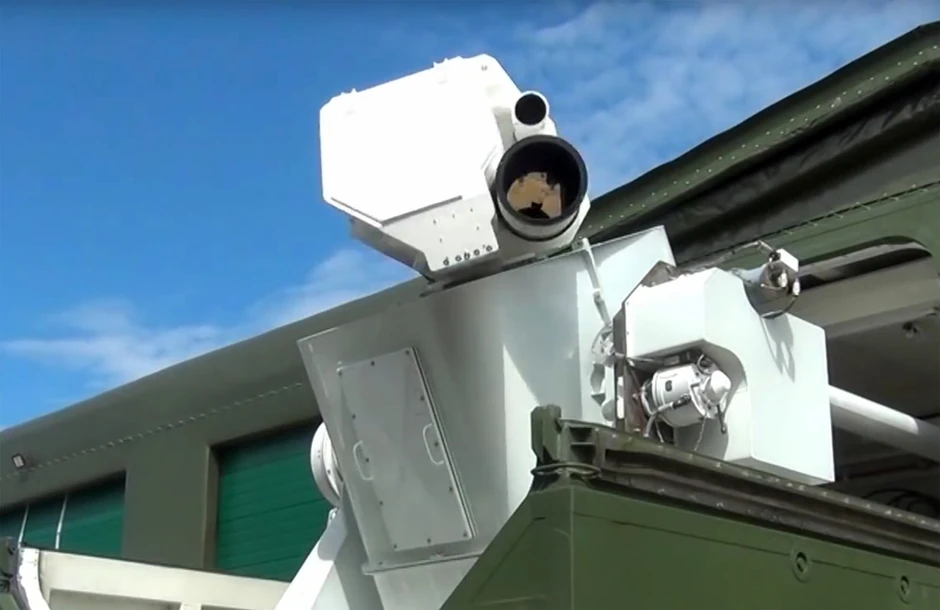
This page covers Peresvet (Пересвет), the truck-mounted laser complex Russia unveiled in March 2018. Russia says its job is to dazzle or blind the cameras of reconnaissance satellites so they cannot follow road-mobile ICBMs as they leave base. It is one of the least documented weapons on this site. Most of the specific claims about it come from a few Russian official statements, plus a small set of procurement and court documents found by Western analysts. This page keeps those separate from the guesses. [DOCUMENTED for the system's existence and stated role]
WHAT IT IS FOR
Russia's main land-based deterrent is the road-mobile ICBM. A Yars launcher on its 16-wheel MZKT chassis is safe because nobody knows exactly where it is. Before an attack, an adversary wants to catch the launchers in their garrisons, or follow them as they move out to dispersed field positions. The most reliable tool for that is the low-orbit imaging satellite. [BACKGROUND]
Peresvet is meant to break that link. In December 2019 Chief of the General Staff Valery Gerasimov told foreign military attaches that the system was there to "cover the movements" of the mobile missile systems. Defence Minister Sergei Shoigu said it had gone on combat duty with five missile divisions on 1 December 2019. Earlier Defence Ministry wording also claimed it could counter "any aerial attack". That claim has no support in the documents found so far. [DOCUMENTED, Russian MoD statements; Hendrickx, The Space Review 2020]
The name comes from Alexander Peresvet, the warrior monk who fought at Kulikovo in 1380. It was picked by a public vote after Putin's speech. In Russian photography, peresvet also means overexposure, which is what a dazzler does to a camera. Whether that pun was intended is not known. [DOCUMENTED for the vote; SPECULATION on the pun]
HOW A LASER AGAINST A SATELLITE WORKS: THE CONCEPTS
What a laser is. A laser pumps energy into a gain medium so that many atoms or molecules sit in an excited state. A passing photon then triggers others to emit identical photons in step. The result is a narrow, single-colour, coherent beam that can be focused far more tightly than ordinary light. The weapon question is how you pump the medium, and how much power you can get out of a box that fits on a truck. [BACKGROUND]
Chemical lasers. The gain medium is created by a chemical reaction, for example hydrogen fluoride, deuterium fluoride, or oxygen-iodine (COIL). They reach megawatt-class power without a big electrical supply, but they use toxic fuels and exhaust them, so each one has only a limited number of shots. The US MIRACL and Airborne Laser were chemical. [BACKGROUND]
Gas-dynamic lasers. Hot carbon dioxide gas is expanded through supersonic nozzles, which leaves a population inversion that lases at 10.6 microns. The Soviet A-60 and some Terra-3 work used this type, and it is very powerful but bulky and loud. The long wavelength also spreads more over distance. [DOCUMENTED for Soviet use, BACKGROUND for the physics]
Solid-state and fiber lasers. These are electrically pumped crystals (such as Nd:YAG at about 1.06 microns) or doped optical fibres. Many fibre modules can be combined into one beam. They need only electricity and cooling, and they can fire for as long as power lasts. Nearly all modern Western laser weapons are of this type. [BACKGROUND]
Nuclear-pumped lasers. Here the gain medium is excited by the fission fragments or radiation from a small reactor, or a pulsed reactor, instead of by electricity. VNIIEF at Sarov did decades of open research on reactor-pumped lasers. In 2018 some Russian and Western commentary therefore suggested that Peresvet carries a compact nuclear power source or a nuclear-pumped laser. No official statement or found document confirms that. Sources conflict: some academic papers repeat the reactor idea, while the main document-based study (Hendrickx) did not find support for it. [UNVERIFIED; Sources conflict]
Dazzling and damaging. A camera on a reconnaissance satellite is built to see dim targets on the ground. Shine a laser into it that is brighter than the scene and the detector saturates, so the image whites out. That is dazzling, and it stops when the laser stops. Push in enough energy and the detector pixels or filters are permanently burned. That is blinding. Physically destroying the satellite body takes far more power again. Because the optics gather light and focus it onto the detector, a dazzler only needs a modest power at the target. [BACKGROUND; Hendrickx]
Beam divergence. No beam stays perfectly narrow. Its spread is set roughly by wavelength divided by the diameter of the output mirror. A 1-micron laser through a 1-metre mirror spreads to a spot of a few metres across at 1,000 km, at best. A 10-micron laser through the same mirror makes a spot ten times wider. Bigger mirrors and shorter wavelengths put more power on the target. [BACKGROUND; ESTIMATE for the worked numbers]
Atmospheric losses. Going up from the ground, the beam passes through the whole thick part of the atmosphere. Water vapour, aerosols and clouds absorb and scatter it, and a cloudy sky simply stops it. Turbulence, the same shimmer you see over a hot road, bends the beam this way and that and smears the spot. Very high power can also heat the air in the beam path and defocus it (thermal blooming). [BACKGROUND]
Adaptive optics. The fix for turbulence is a deformable mirror. A sensor measures how the air is distorting light, often from a guide star or a reflection off the target, and hundreds of actuators reshape the mirror many times per second to pre-correct the beam. Astronomical observatories use the same method. It is one reason the fixed Kalina site at a mountain observatory makes sense. [BACKGROUND]
Tracking and pointing. A low-orbit satellite crosses the sky in a few minutes at about 7.5 km/s. To hold a spot of a few metres on it from 500-1,500 km away, the beam director has to point to within micro-radians while slewing fast. It also has to lead the target slightly, because the light takes a few milliseconds to get there. The orbits come from the space surveillance network, see Krona. [BACKGROUND]
Why imaging satellites are exposed. High-resolution optical satellites fly in low orbits of a few hundred kilometres, and their orbits are public or easily tracked. They point their large mirrors straight down at the area they are photographing. If that area is a missile base with a laser parked next to it, the satellite is looking right down the beam. Infrared early-warning satellites in geostationary orbit, at 36,000 km, are much harder targets. [BACKGROUND; SPECULATION on GEO]
WHY IT DEPENDS ON RUSSIA'S SPACE TRACKING NETWORK
Peresvet cannot work alone. Before it can fire, the crew needs answers to two questions, and the laser cannot answer either one itself. The first is where the satellite will be: which part of the sky it will cross, when, and how fast. Its own optics have a narrow field of view, so it has to be pointed very precisely before it can pick up a target, let alone hold a beam on it. The second is what the satellite is: of the thousands of objects in orbit, which ones are reconnaissance or observation satellites worth engaging, and which are communications satellites, debris or something harmless. [BACKGROUND]
Both answers come from the space-object catalogue that Russia has built up over decades with other systems covered on this site. The early-warning radars, Voronezh, Daryal, Dnepr and Don-2N, track objects in low orbit as a secondary job, alongside their main missile-warning role. Okno at Nurek in Tajikistan watches orbits optically, and Krona in the North Caucasus combines radar and laser-optical sensors to characterise individual satellites, including their size, shape and behaviour. The command and analysis centre at Serpukhov-15 turns all of this into orbit data and decides what each object is. That catalogue tells Peresvet where to look and when, and which passes are worth shooting at. [DOCUMENTED for the sensors and their space-surveillance role; ESTIMATE on how the data flows to Peresvet]
Site owner's assessment. The tracking network is critical to how Peresvet operates, not an optional extra. Without the radar and optical catalogue, the system would not know where the satellites will be, where to aim to find them, or which ones are observation targets. It could only get that information from the database built by those other Russian projects. Its primary use is to blind or damage spy observation satellites passing over the forces it protects, and that tracking data is what makes the mission possible. [SPECULATION, site owner]
THE SOVIET LINEAGE
Terra-3 (Sary-Shagan). This was a large laser and laser-ranging complex at the Sary-Shagan anti-missile range in Kazakhstan. The Soviets built it from the 1960s, first to study laser missile defence, and later to track satellites. In 1984 US officials claimed it could damage satellites, and some reports said its laser had been aimed at the Space Shuttle Challenger. After the Cold War, Soviet participants said it was far weaker than claimed and used mainly for ranging. A US team visited in 1989. [DOCUMENTED for the site; Sources conflict on its power and on the Challenger story]
Omega. A 1960s-80s programme for a laser air-defence system. It tested a ground laser against targets including a drone. It did not lead to a fielded weapon. [SINGLE-SOURCE in English]
Skif and Polyus. Skif was the Soviet plan for a laser battle station in orbit, with a CO2 gas-dynamic laser. A mock-up called Polyus was launched on the first Energia rocket in May 1987 and failed to reach orbit because of an attitude-control error. [DOCUMENTED]
A-60 and Sokol-Eshelon. The A-60 is an Il-76 carrying a large laser in its fuselage with a turret on top, built by Beriev with the Almaz design bureau. It first flew in 1981. In the 2000s it came back as the testbed for Sokol-Eshelon, a programme to dazzle satellites from the air. Russian reports say it bounced a laser off the Japanese Ajisai satellite at about 1,500 km in 2009. Its current status is unknown. [DOCUMENTED for the aircraft; SINGLE-SOURCE for the 2009 test]
WHO BUILT IT
Putin's 2018 speech did not name the developer. Hendrickx and other analysts, working from procurement records, award certificates and company documents, link the system to the Russian Federal Nuclear Centre (RFYaTs-VNIIEF) at Sarov. That institute designs nuclear weapons, and it also has a long history in laser physics. Documents also mention optical and electronic subcontractors. [SINGLE-SOURCE line of evidence, Hendrickx; widely repeated]
Sarov's role is part of why the nuclear-pumped laser story exists. The developer's experience shows what was possible, but it does not show what is inside Peresvet. [SPECULATION]
THE VEHICLES AND DEPLOYMENT
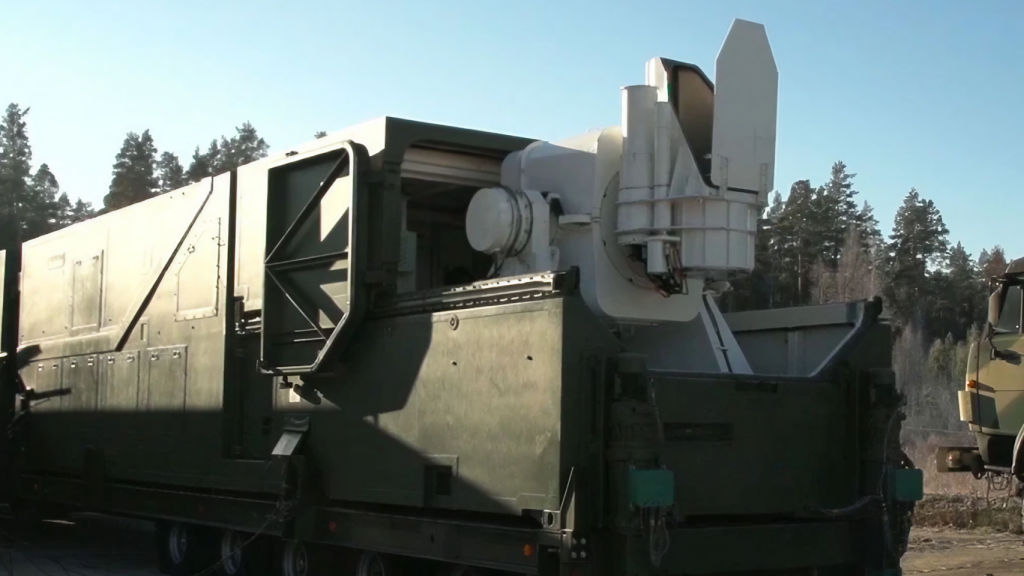
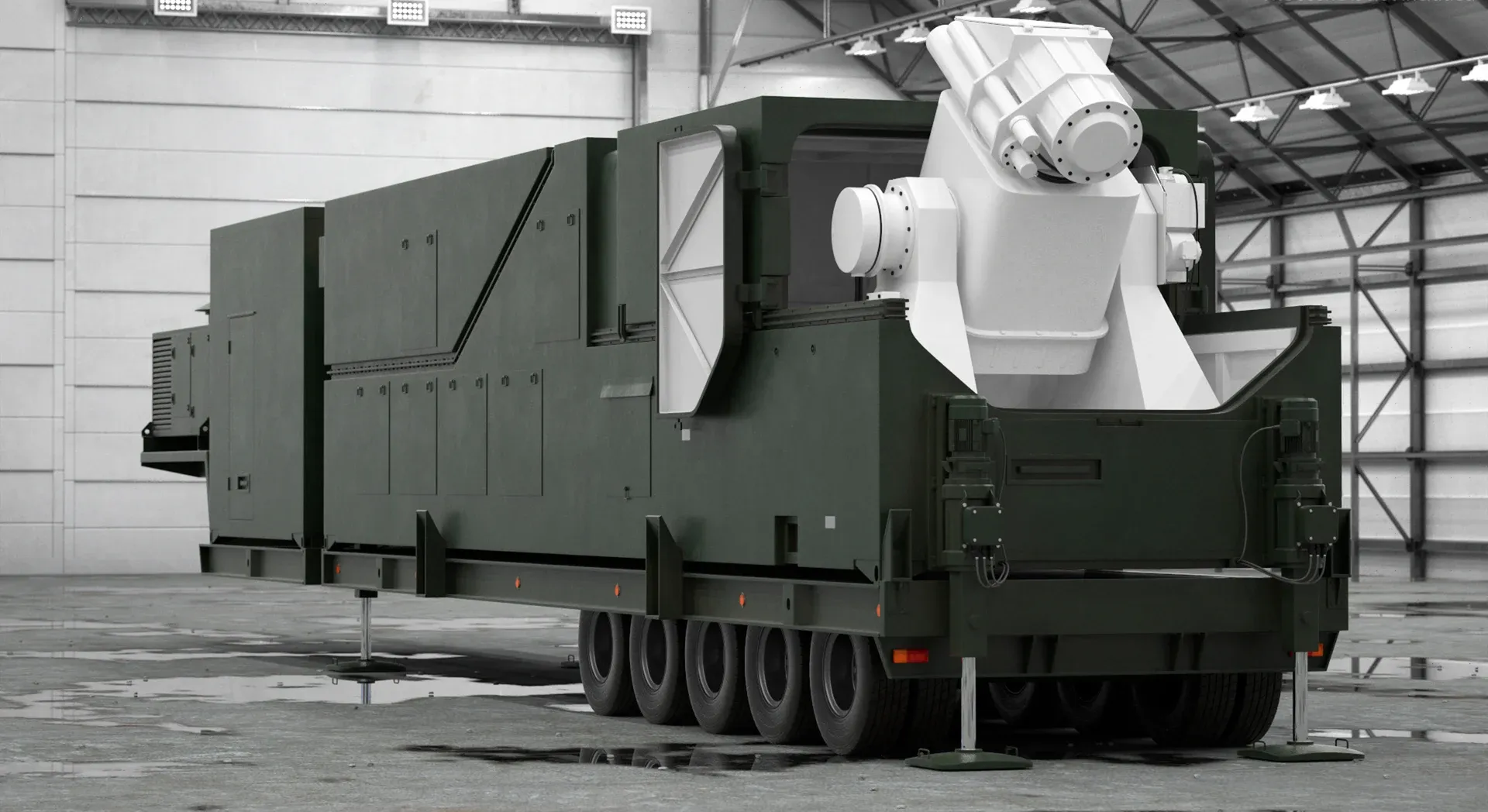
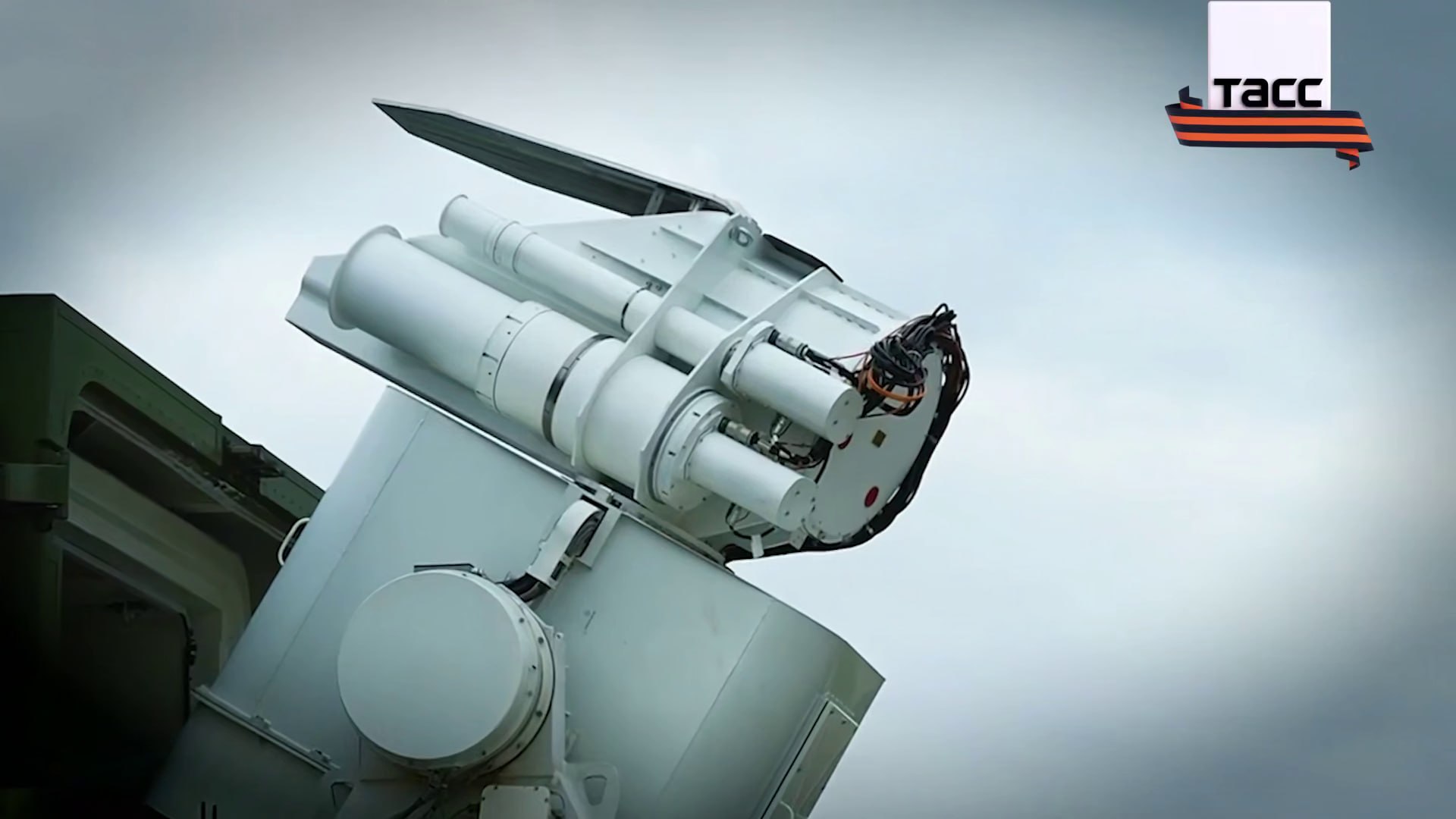
The 2018 video and later MoD footage show the system as large boxes on semi-trailers pulled by heavy tractors. In firing position, a sliding roof or cover opens to expose a turret-like beam director. Separate trailers seem to carry power and support equipment. Each complex appears to be built from several vehicles, not a single truck. [DOCUMENTED from video; ESTIMATE for the number of vehicles]
Russia said Peresvet was on "experimental combat duty" from 1 December 2018 and fully on duty with five Strategic Missile Forces divisions from 1 December 2019. Hendrickx linked the deployment to road-mobile divisions including Teykovo, Yoshkar-Ola, Novosibirsk, Irkutsk and Barnaul. Satellite imagery showed new garages and shelters at these bases matching the trailers' size. [DOCUMENTED for the five-division claim; SINGLE-SOURCE for the base list]
Russia never published power, range, wavelength or effect. Various Russian statements and media put its reach against satellites at up to 1,500 km. Some academic sources say about 500 km. Neither figure comes with a basis. [UNVERIFIED; Sources conflict]
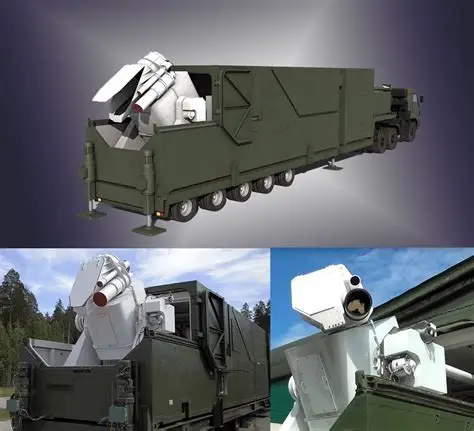
THE 2018 ANNOUNCEMENT
In his address to the Federal Assembly on 1 March 2018, Putin showed Sarmat, Avangard, Kinzhal, Burevestnik, Poseidon and an unnamed laser complex. He said "we have achieved significant results in creating laser weapons", and that the troops had been receiving the systems since 2017. The name Peresvet was chosen later. [DOCUMENTED]
KALINA AT KRONA, AND RELATED PROGRAMMES
In 2022, Bart Hendrickx used Russian court and contract records to describe Kalina. It is a large, fixed laser system being added to the Krona space-surveillance complex near Zelenchukskaya in the North Caucasus. The documents describe a telescope with adaptive optics and a laser meant to fire at imaging satellites passing over Russia, with the aim of "functional suppression" of their optics. Construction appears to have started in the 2010s. Its current status is not public. Peresvet looks like a mobile, local version of the same idea, and Kalina a bigger fixed one. [SINGLE-SOURCE, Hendrickx 2022, from Russian primary documents; ESTIMATE on how the two relate]
Other names circulate. Zadira is a laser that Deputy PM Yuri Borisov said in 2022 was being supplied to troops, and could burn through drones. It is aimed at drones, not satellites. Some secondary sources mention "Zadacha" as a laser or counter-space programme name, but this page did not find a primary source for it. [DOCUMENTED for Borisov's Zadira statement; UNVERIFIED for Zadacha]
CLAIMED TESTS AND COMBAT USE
No confirmed public case exists of Peresvet dazzling a specific satellite. Some Russian and academic commentary claims a test in Syria in 2020, or use against drones, but no evidence was found. During the war in Ukraine, Western commercial and government imaging satellites have photographed Russian forces heavily. CSIS found little public evidence that Russia used Peresvet or Sokol-Eshelon against them. [DOCUMENTED, CSIS; UNVERIFIED for Syria]
US AND WESTERN ASSESSMENTS
The Secure World Foundation's yearly counter-space report, CSIS's Space Threat Assessment, and the US Defense Intelligence Agency's 2022 "Challenges to Security in Space" all list Russian ground-based lasers meant to dazzle or blind satellites, and name Peresvet. They treat it as fielded but of unproven effect. US officials have also cited Russia's directed-energy work as a reason to harden satellite sensors. [DOCUMENTED]
The general view: Peresvet is almost certainly a dazzler, not a satellite killer. Physics and siting point the same way. A system that sits beside the thing it is protecting only needs to spoil photos during a short pass. [SINGLE-SOURCE consensus of open analysts; SPECULATION in the wider sense]
OPEN QUESTIONS
LIMITS OF THE RECORD
Russia has published only short speeches and some video. Most detail comes from one analyst's reading of procurement and court documents, and later reports often repeat each other. No independent physical measurement of the beam is public. Treat any precise figure on the web as a guess unless it names its source. [DOCUMENTED as a limitation]
RELATED ON THIS SITE
HOW THIS ARTICLE WAS BUILT
Written from the sources below. Claims are labelled [DOCUMENTED] where a primary or multiple independent sources support them, [SINGLE-SOURCE] where only one does, [UNVERIFIED] where nothing published located confirms them, [ESTIMATE] for approximate figures, [BACKGROUND] for general context, and [SPECULATION] for reasoning beyond the sources. Where sources disagree, the page says "Sources conflict" and gives both.