OVERVIEW
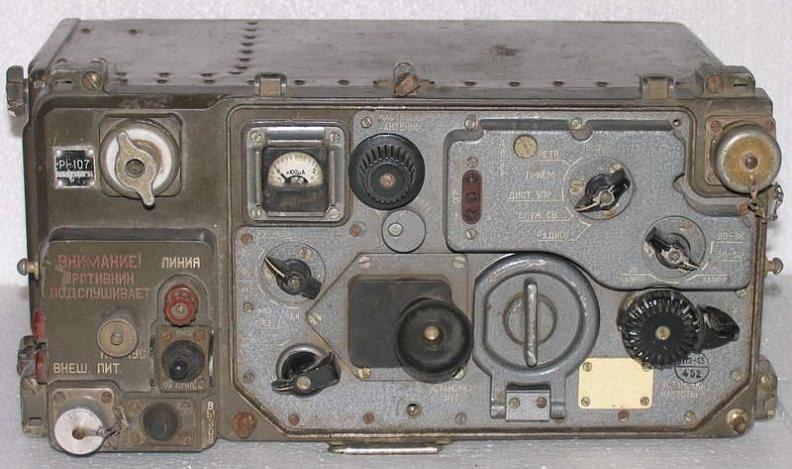
The R-107 is a Soviet manpack VHF radio for 20–52 MHz. The R-107M is the fully transistorised version. Training texts describe it for communication inside airfields, for control of vehicle columns on the march, and as a remote control for medium-power stations. Artillery vehicles such as the 1V18 Klen-1 carried it. [DOCUMENTED]
SPECIFICATIONS (R-107M)
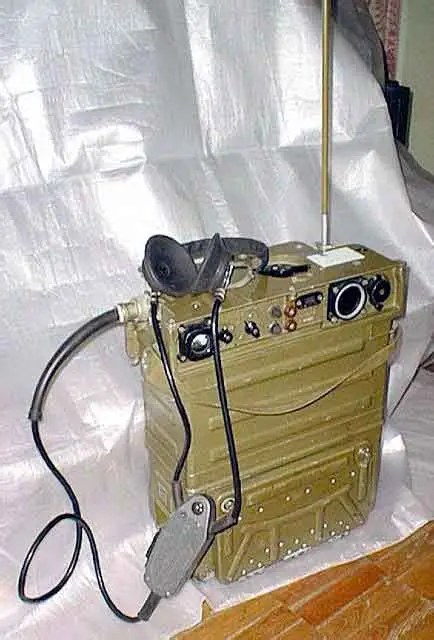
These figures come from the training material and an amateur reference:
- Frequency range: 20 to 52 MHz on a 1 kHz raster, giving 32,000 fixed frequencies, with four pre-set frequencies. - Tuning: a MHz switch plus fine tuning, with a digital frequency counter. - Modes: FM telephony simplex, AM-keyed telegraphy and retransmission. - Power: 1 W on FM and 5 W on telegraph. - Receiver: 1.5 µV on FM, 0.5 µV on CW, IF 10.7 MHz. - Supply: three 2KNP-24 batteries (6.6–7.8 V). - Size and weight: 340 × 395 × 210 mm and 18.5 kg.
[DOCUMENTED]
The amateur reference says the set has no squelch. [SINGLE-SOURCE]
RANGE AND ANTENNAS
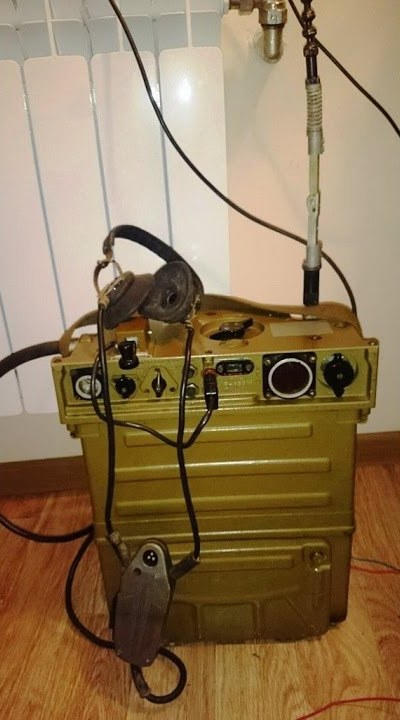
The antennas are a 1.5 m whip, a combined 2.7 m whip and a 40 m long-wire antenna (a simple travelling-wave directional antenna). Telephony reaches up to 12 km on the 1.5 m whip, 25 km on the 2.7 m whip and 35 km on the long-wire raised 5 m. Telegraphy reaches up to 45 km. The antenna matching unit tunes itself with a DC motor driven by antenna current and SWR. [DOCUMENTED]
REMOTE CONTROL
The R-107 can be operated from a TA-57 telephone over up to 500 m of cable. [DOCUMENTED]
DESIGN
The 1977 technical description calls the R-107M a wideband, backpack, VHF FM telephony transceiver for simplex working, with remote control and AM telegraphy, built for communication "without search and without retuning". Two features make that possible: a digital electronic frequency counter for setting the frequency, and an automatic antenna matching unit (САУ). Between stations whose temperatures differ by more than 30 °C, the frequency should be rechecked on the counter before calling. [DOCUMENTED]
- Circuit: a transistorised transceiver. The frequency comes from a free-running LC oscillator, set with the MHz switch and a fine-tuning knob and read on the 1 kHz counter, with a setting error of about 1.5 kHz. - Receiver: a single-conversion superheterodyne on 10.7 MHz, with a lumped-selectivity filter for telephony and a crystal filter for telegraphy, and an 18 kHz bandwidth. - Audio: a headset with a DEMSh-1A microphone and a one-transistor (P15) microphone amplifier, or an MK-10 carbon-microphone handset.
[SINGLE-SOURCE] (cqham.ru.)
The training data add an audio band of 300–3400 Hz, telegraph working at 10–12 groups per minute, an external supply option of 7.6–8.8 V, and battery life at a 1:5 transmit-to-receive ratio of 24 hours on low power or 15 hours on full power. [DOCUMENTED] (studfile training notes.)
ENVIRONMENT
The set works from −40 to +50 °C and in 98% humidity. It is rainproof, survives immersion to 0.5 m for an hour, and keeps working when carried or when shaken in a vehicle at up to 50 km/h. [DOCUMENTED] (1977 technical description.)
MODES AND CONTROLS
The mode switch has five settings: РАДИО (radio), Д. УПР. (remote control), СЛ. СВ. (service line, a wire intercom to the remote point), АТ. ПР. (AM telegraph receive) and АТ. ПРД. (AM telegraph transmit). Telephony can be sent on low or full power. [DOCUMENTED] (1977 technical description.)
WHAT COMES IN THE SET
The working set is the transceiver with its three 2NKP-24 batteries in the battery compartment, a headset, a whip antenna, shoulder straps and counterpoises. The operator's bag holds the whip, a telegraph key, the long-wire antenna wound on a frame, 1.3 m and 2.15 m three-wire counterpoises, and six 0.2 m whip sections. [DOCUMENTED] (studfile lecture notes.)
GUARANTEED RANGES
The technical description gives guaranteed minimums, which are lower than the training-text figures above:
- 1.5 m whip, on the move or from the ground with a 1.3 m counterpoise: at least 12 km on telephony, and at least 20 km on AM telegraph at the halt. - From a screened vehicle body through a 4 m cable at 30 km/h: at least 6 km. - 2.7 m whip with a 2.15 m counterpoise at the halt: at least 18 km on telephony and 35 km on telegraph.
[DOCUMENTED] (1977 technical description.) The training text's 25 km for the 2.7 m whip is a typical figure, not a guaranteed one. Sources conflict.
SERVICE AND USE
A forum post by a veteran recalls airborne signallers carrying R-107s at Kirovabad in 1987–88. [UNVERIFIED] (desantura.ru forum.) A 2017 Russian study of Soviet radio in Afghanistan names the R-148, R-157, R-158 and R-159 as the manpacks in wide use there, not the R-107. [DOCUMENTED] (Gumanitarnye nauchnye issledovaniya, 2017.) No source was found for R-107 use in later wars. [UNVERIFIED]
RELATED PAGES
R-111
R-123M
R-159
Radio section