WHAT IT IS
The R-36M2 Voevoda (Р-36М2 «Воевода»; GRAU 15A18M / 15А18М; the missile complex is listed as 15P018M / 15П018М; Russian treaty and service name RS-20V / РС-20В; NATO SS-18 Satan, usually split in Western cards as Mod 5 and Mod 6) is a two-stage, silo-based, storable-liquid intercontinental ballistic missile. It was designed by KB Yuzhnoye (КБ «Южное», the former OKB-586) in Dnepropetrovsk under general designer Vladimir Fedorovich Utkin, and it was built at the Southern Machine-Building Plant (Yuzhmash / Южмаш). It is a cold-launched, ampullized heavy ICBM: it lives in a transport-launch container, is mortar-ejected from a hardened silo by a powder pressure accumulator, and then lights a hypergolic first stage of unsymmetrical dimethylhydrazine and nitrogen tetroxide. It is the last production version of the Soviet R-36 / SS-18 family, and it is the missile the RS-28 Sarmat is being built to replace. [DOCUMENTED]
Voevoda is an old Russian word for a military chief or governor. In the West the whole R-36M family was tagged SS-18 Satan. Specialist cards usually call the ten-warhead R-36M2 load SS-18 Mod 5 and a single-warhead load Mod 6; the Bulletin of the Atomic Scientists 2026 Nuclear Notebook table, by contrast, lists the remaining RS-20V force as “SS-18 M6 Satan.” Some Russian graphics use the informal label Satan III. Those strings should not be treated as a single official NATO line. The GRAU, treaty, and service names are [DOCUMENTED]. The Mod 5 / Mod 6 / M6 / Satan III pairing is [CONTESTED].
Two things have to be kept apart throughout this article. One is the missile as a 1980s Yuzhnoye design: a 211-tonne-class silo rocket, a published throw-weight of about 8.5–8.8 t, and a standard operational load of ten MIRVs, with other head units designed and then partly abandoned after 1991. The other is the missile as it sits, or may sit, in Russian silos in 2026: a Ukrainian-built system whose production line is gone, whose life has been extended again and again, and whose replacement has been delayed. Open-source counters do not even agree on whether the remaining silos still hold ready missiles. That disagreement is presented honestly below, not averaged. [DOCUMENTED; CONTESTED on the 2026 remainder]
Source tags on this page: [DOCUMENTED] is a fact with a named public source. [SINGLE SOURCE] is a specific claim that sits on one account and has not been corroborated. [UNVERIFIED] is a widely repeated figure or detail that does not sit on a plant sheet or an official announcement. [CONTESTED] is a point where published sources disagree. [SPECULATION] is a reconstruction or a claim that goes beyond the public record. [FIELD ACCOUNT] is a local report, video, or eyewitness description, not an official communiqué.
QUICK FACTS
PURPOSE AND PLACE IN THE STRATEGIC FORCE
Voevoda exists because the Soviet Union wanted a silo missile that could throw a very heavy load a transcontinental distance, hold that load fueled and sealed for years, and still get out of the hole after a nuclear attack on the position area. That is a different job from the solid-fuel road-mobile force that later became Topol-M and Yars. The costs are obvious: a fixed silo is a known target; storable hypergolics are toxic; and after 1991 the plant that built the missile sat in another country. [DOCUMENTED]
In the late Soviet force the SS-18 family was the heavy end of the land leg: SALT II’s Soviet “heavy ICBM,” widely counted at 308 silos, then cut under START I to a ceiling of 154. What remained in Russian service into the twenty-first century was the R-36M2 version, concentrated on two surviving fields, Dombarovsky and Uzhur — also the two fields named for the first Sarmat regiments. Until Sarmat is actually on duty, Voevoda is still the only deployed super-heavy liquid ICBM in the world. Whether every remaining silo still holds a ready missile is a separate, contested question. [DOCUMENTED]
The standard public story is that ten MIRVs, plus a heavy set of penetration aids, give the missile a role against hard targets and against a defended area. A much heavier single warhead, sometimes discussed as a high-altitude electromagnetic-pulse weapon, appears on popular cards and on at least one graphic reproduced on this page. The design-bureau record, as relayed by Missilery.info from Yuzhnoye material, is more cautious: several head-unit types were designed, and the heavy monoblock and a mixed guided-block load were dropped from mandatory combat equipment during state trials. The operational missile that went on duty in 1988 is the ten-warhead system. [DOCUMENTED; the 20-megaton operational load CONTESTED]
HISTORY AND LINEAGE
The R-36 line is a Yuzhnoye family. Mikhail Yangel’s OKB-586 in Dnepropetrovsk built the original R-36 (8K67; NATO SS-9 Scarp), a large storable-liquid silo missile of the 1960s, as a heavy counterpart to Chelomey’s UR-100 light ICBM and to the even larger UR-500 / Proton. The point of a 200-tonne-class liquid silo missile was throw-weight: enough mass for a very large single warhead or, later, a MIRV bus, without standing up a solid-motor industry at that scale. [DOCUMENTED]
The next step was R-36M (15A14; treaty name RS-20; NATO SS-18 Mods 1, 2 and 3). It introduced the cold launch from a transport-launch container and a MIRV bus, and it reused and then replaced SS-9 silos. Russianspaceweb dates the type as in development from 1969, first launched in 1972, and operational on 30 December 1975. R-36M UTTKh (15A18; RS-20B; SS-18 Mod 4) was the improved-accuracy, ten-warhead version that filled out the late-1970s heavy force. Russianspaceweb dates it as in development from 1976, first launched in October 1977, and operational on 17 December 1980. By the early 1980s that missile was the standard heavy ICBM of the Strategic Missile Forces, and it was the baseline that SALT II had already frozen in size and launch weight. [DOCUMENTED]
R-36M2 was not a new missile in the SALT II sense. It had to live inside the same 3-metre bore and the same starting-weight class as 15A18. Yuzhnoye’s own wording, preserved on the Ministry of Defence card and on Missilery.info, is that energy was raised by about 12 percent compared with 15A18 while still observing those treaty limits, by improving the engines, recessing the second-stage engine into the tank, and cleaning up the aerodynamics. The same text family claims accuracy 1.3 times better, a twenty-fold reduction in the nuclear “blocking zone” radius, ten-fold X-ray and hundred-fold gamma-neutron immunity, combat-readiness time halved, and autonomy trebled. Those multipliers are published design-bureau claims, not independent measurements. [DOCUMENTED as published claims]
The paper trail for the programme starts earlier than the formal decree. Specialist reconstructions, including Anatoly Zak at Russianspaceweb and the RVSN compilations used by Missilery.info, date a technical proposal to June 1979. Zak writes that KB Energomash completed a preliminary design of the RD-274 first-stage engine in March 1982, and that his own summary table lists the type as “in development since 1982.” The government go-ahead is not disputed: a decree of the Central Committee of the CPSU and the Council of Ministers of 9 August 1983 tasked Yuzhnoye with a modernized heavy complex, under Utkin, to defeat prospective missile defences and to survive multiple nuclear effects on the position area. [DOCUMENTED for the 1983 decree; 1979 versus 1982 start CONTESTED as a matter of wording]
Flight-development tests began at Baikonur (NIIP-5) in 1986. The first flight is widely given in specialist reconstructions, including Russianspaceweb, as 21 March 1986; the Ministry of Defence and Missilery.info short official paragraphs say only that tests started at Baikonur in 1986. The same official text family gives 26 joint flight-test launches at NIIP-5, 20 of them successful; after the failures were diagnosed and the design revised, tests were completed with 11 successful launches; 33 launches in all, with a stated flight reliability of 0.974. Tests with all types of combat equipment were completed in September 1989. [DOCUMENTED; first-flight day SINGLE SOURCE as a calendar date in specialist reconstructions]
The first regiment with R-36M2 missiles went on combat duty on 30 July 1988 at Dombarovsky. The Ministry of Defence card and Missilery.info name the commander as O. I. Karpov. Twelve days later, on 11 August 1988, a Central Committee and Council of Ministers decree formally adopted the complex (принят на вооружение). That is not a contradiction of wording: experimental or regiment-level duty can precede a formal adoption decree, and both dates are in the same official paragraph. The Ministry of Defence text says that by 1990 the complexes had also been placed on duty in divisions stationed near Uzhur and Derzhavinsk. How many missiles were out by the end of the 1980s is [CONTESTED]: Missilery.info says 58 R-36M2 missiles were deployed in 1998; Russianspaceweb says as many as 58 were reportedly deployed by 1989. [DOCUMENTED]
WHO BUILDS WHAT
The political fact in that list is the same one that later forced Topol-M and then Sarmat: after December 1991 the design bureau, the plant and the guidance house all sat outside the Russian Federation. Russia could life-extend missiles already in the silos. It could not build new 15A18M missiles, and after 2014 it could not do the old warranty work with Ukrainian counterparts. [DOCUMENTED]
DESIGN OVERVIEW
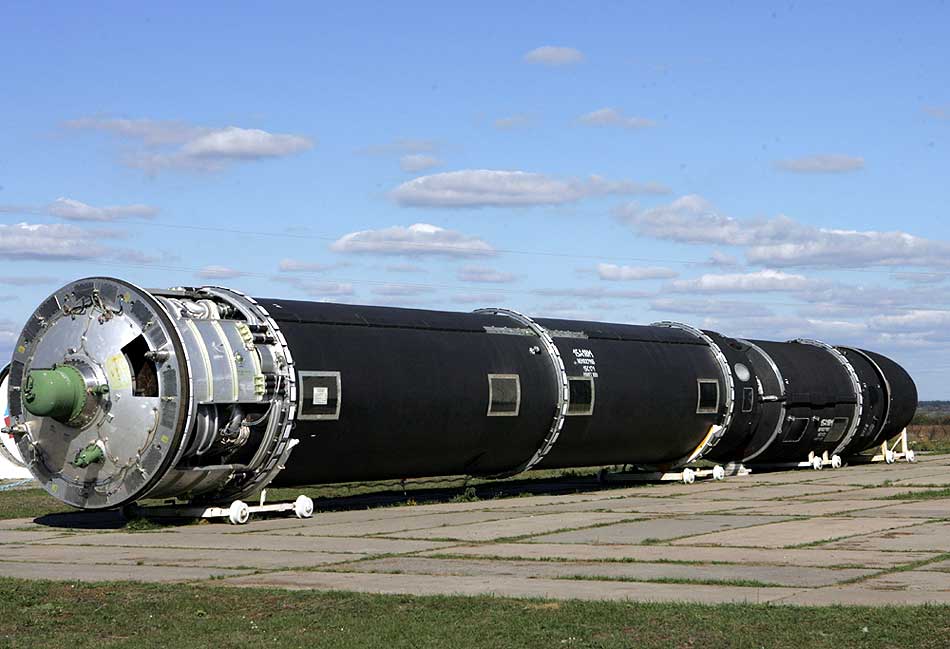
R-36M2 is a two-stage liquid missile with a sequential arrangement of stages and a separate post-boost bus (ступень разведения). The Ministry of Defence card calls it intercontinental, two-stage, liquid-propellant, MIRVed, and ampullized, with stationary silo basing. Russianspaceweb counts three stages by treating the bus as a stage. That is a counting convention, not a different airframe. [DOCUMENTED; stage count CONTESTED only as a matter of counting]
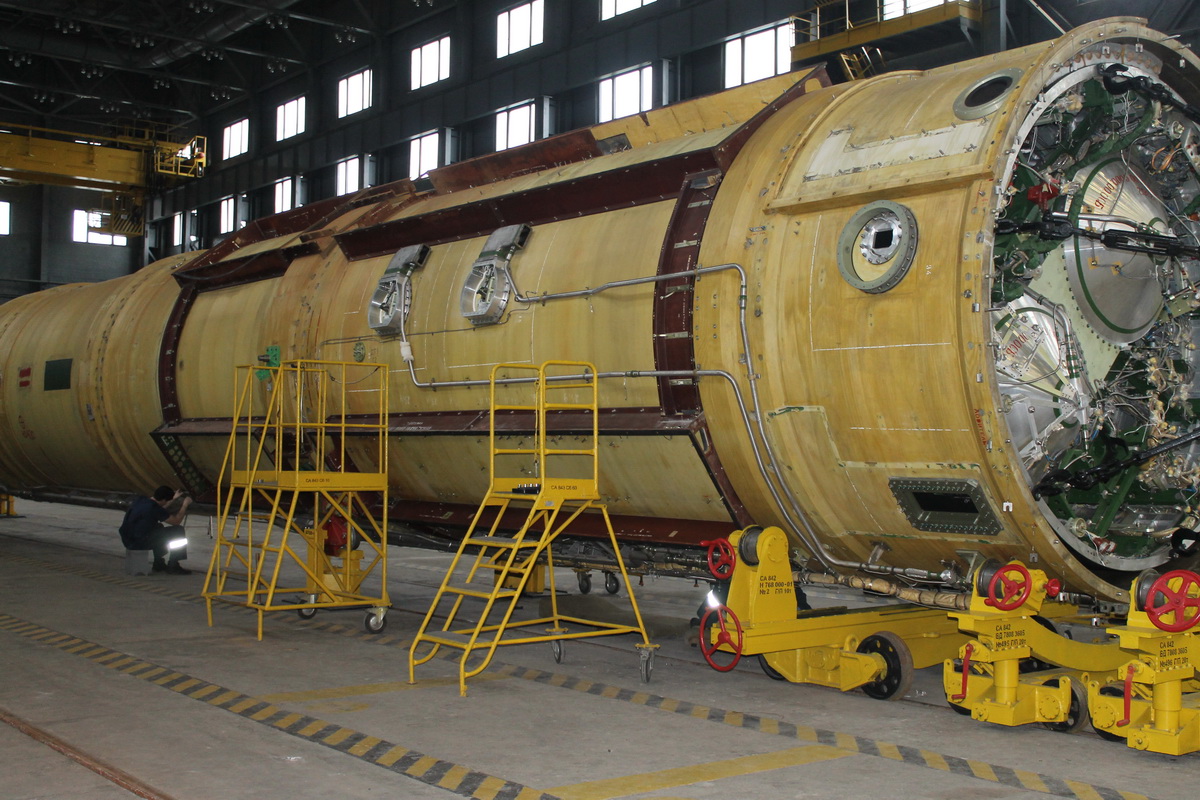
The airframe is a wafer-welded aluminium-magnesium body, described in the Yuzhnoye / Missilery.info text as AMG-6, with a multifunctional coating meant to help the outgoing missile survive X-rays, gamma-neutron flux, and dust in a ground-burst cloud. A new one-piece ogival fairing protects the head section in that same environment and improves the aerodynamics. The second-stage engine is recessed, or “drowned,” in the fuel cavity. Stage separation and the cold-launch sequence were carried over from 15A18. [DOCUMENTED as published design description]
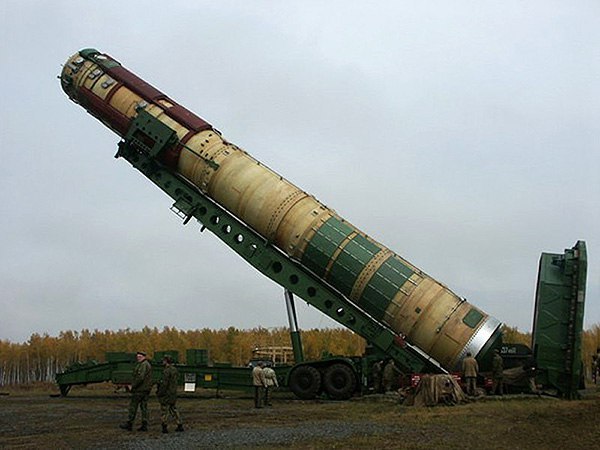
The missile spends its service life in a transport-launch container, factory-fueled and sealed. The container is loaded into a shock-isolated, hardened silo of the 15P018M / 15P718M family, on the infrastructure of the earlier 15P018 complex wherever that could be reused. A powder pressure accumulator throws the canistered missile clear of the shaft; the first-stage engines start in the air so the silo is not burned out. The bus then places re-entry vehicles and penetration aids onto separate paths. [DOCUMENTED]
SPECIFICATIONS (PUBLISHED FIGURES)
Figures in this table are published cards, not flight-test measurements. The Ministry of Defence English card, the Missilery.info characteristics table (which draws on the 2004 Yuzhnoye volume and on Karpenko, Utkin and Popov, 1999), and Anatoly Zak’s Russianspaceweb dossier agree on the airframe size and almost agree on mass. They do not agree on range, throw-weight, or how the stages are counted. Conflicting figures are listed, not averaged.
| Item | Published figure | Notes | Tag |
| Launch mass | 211.4 t with the ten-block head, 211.1 t with a light-class head (Missilery.info table; Russianspaceweb). 211,100 kg (Ministry of Defence English card). “211 t” or “about 211 t” on popular graphics and in the live Sarmat comparison table on this site. | The 211.1–211.4 t band is the usual open working figure. The Ministry of Defence card’s 211,100 kg sits on the light-head side of that band. A minority secondary figure of 208.3 t should not be treated as a second official mass. | [CONTESTED] |
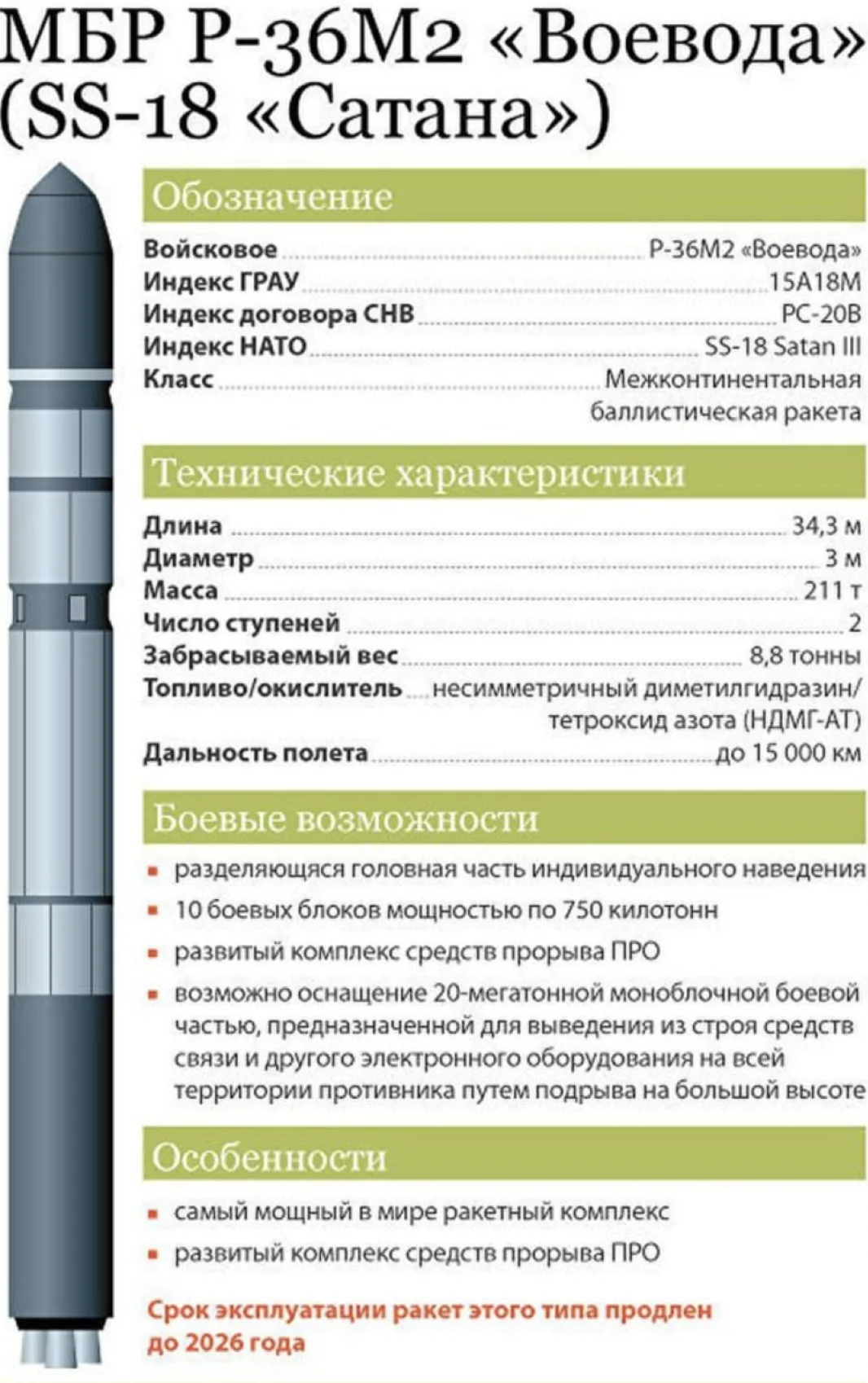
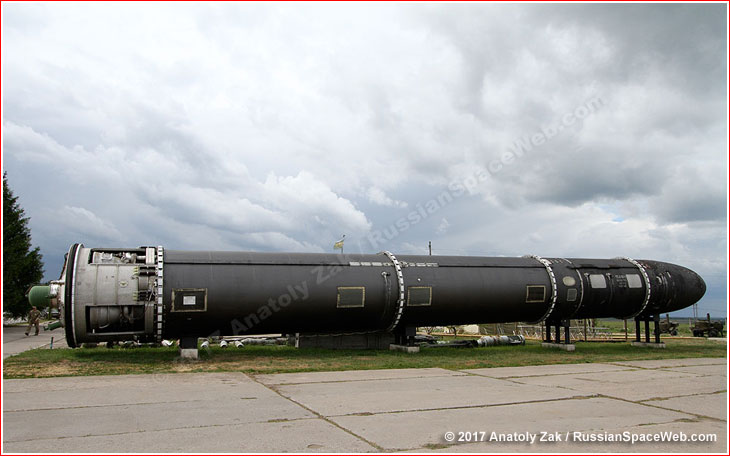
| Length | 34.3 m (Ministry of Defence, Missilery.info, Russianspaceweb, and the graphic on this page). 34.6 m in some secondary cards. | 34.3 m is the agreed specialist and official-card figure. 34.6 m is a minority outlier and is not averaged in here. | [DOCUMENTED; 34.6 m CONTESTED] |
| Diameter | 3.0 m | The same 3 m bore as R-36M UTTKh, and the bore Sarmat is being built to drop into. | [DOCUMENTED] |
| Stages | Two boost stages plus a post-boost bus (Ministry of Defence: “two-stage”). Russianspaceweb lists “3” by counting the bus. | A counting convention, not two different missiles. | [DOCUMENTED] |
| Throw-weight / head mass | 8,800 kg (Ministry of Defence). 8.73 t with a ten-block head and 8.47 t with a lightweight block (Missilery.info). About 8.5–8.8 t in compiled cards, including this site’s Sarmat table. | Do not average 8.47, 8.73 and 8.8. The Ministry of Defence card is the official public figure; the Missilery.info pair is the more finely split Yuzhnoye-derived table. | [CONTESTED] |
| Published range | 11,500 km (Ministry of Defence English card). 11,000 km with a heavy MIRV and 16,000 km with a monoblock (Missilery.info and Russianspaceweb). “Up to 15,000 km” on some graphics, including the one on this page. Missilery.info’s sidebar classification also prints 15,000 km as a single range. | Range always depends on payload. The 11,000 / 11,500 km band is the heavy-load figure; 16,000 km is the light or monoblock figure in the same tables. 15,000 km is a rounded popular figure, not a third measurement. | [CONTESTED] |
| Warhead load | Ten MIRVs in the usual operational card. Ministry of Defence: 10 × 0.55–0.75 Mt. Bulletin 2026: 10 × 500–800 kt, with a footnote that the remaining missiles may carry only five warheads each to stay inside New START practice. Popular graphics: 10 × 750 kt. A 2022 Russian state-media video of the bus, cited by Bulletin 2026 (Kornev), shows up to 14 slots in two tiers of seven; the extra four are generally read as decoy stations. Designed but not necessarily deployed: light and heavy monoblocks, and a mixed load of six unguided plus four guided (15F178) blocks. | No official Ministry of Defence single yield. The heavy monoblock, often quoted at 18–20 Mt (sometimes 20–25 Mt in secondary writing), was designed for a hard-target or high-altitude role in popular accounts; Missilery.info says it was prepared for production but not flight-tested, and was excluded from mandatory combat equipment during state trials. The mixed guided load had three Kura launches; the work was closed after 1991. | [CONTESTED] |
| CEP / accuracy | Missilery.info table: firing accuracy ±0.5 km. Russianspaceweb: each warhead “could strike within 500 meters.” Other secondary cards circulate 220 m, 300–500 m, or similar figures. | 500 m is the published Yuzhnoye-derived and Zak figure. Tighter numbers in compiled tables are not treated here as a second official CEP. The official text also claims a 1.3-times accuracy improvement over 15A18, without publishing both CEPs side by side. | [CONTESTED] |
| Propellant | UDMH (НДМГ, heptyl) + N2O4 (АТ, amyl), all stages | Storable hypergolics, factory-loaded and ampullized. Missilery.info lists propellant mass as 150.2 t (stage I), 37.6 t (stage II), 2.1 t (bus), matching Zak’s stage-I and stage-II figures. | [DOCUMENTED] |
| First-stage thrust (published) | 468.6 tf at sea level / 504.9 tf in vacuum (Missilery.info and Russianspaceweb, same numbers) | Four-chamber unit. Model name RD-274 (4 × RD-273) in Zak; earlier-family RD-264 (4 × RD-263) in many older cards. See the propulsion section. | [DOCUMENTED for the thrust table; model name CONTESTED] |
| Second-stage thrust (published) | 85.3 tf vacuum (Missilery.info and Russianspaceweb) | Specialist pairing: RD-0255 block, RD-0256 main, RD-0257 vernier, KBKhA. | [DOCUMENTED for the thrust figure; index pairing UNVERIFIED] |
| Launch method / readiness | Silo, cold / mortar launch from a TPK, powder pressure accumulator (PAD). Missilery.info table: 62 seconds from full alert. Warranty on unregulated combat duty: 15 years in the same table, later extended many times. | The 62-second figure is a published specialist/Yuzhnoye-derived number, not a Ministry of Defence press line. It should not be treated as a stopwatch measurement from a public test. | [DOCUMENTED as a published table figure] |
| Basing | Hardened silos of the 15P018M / 15P718M / OS-67 family at Dombarovsky / Yasny and Uzhur; historically also Derzhavinsk, Zhangiztobe, Kartaly and Aleysk | The surviving 2020s association is with the 13th and 62nd Rocket Divisions only. | [DOCUMENTED] |
PROPULSION, AMPULLIZED TANKS, AND THE TWO STAGES
Both stages, and the bus, burn the same storable hypergolic pair: unsymmetrical dimethylhydrazine (UDMH, heptyl, НДМГ) and nitrogen tetroxide (N2O4, amyl, АТ). The combination can sit in the tanks for years and lights on contact, which is why a silo missile of this class can be held at high readiness without last-minute fueling. The price is toxicity, and a maintenance culture built around the original Ukrainian plants. [DOCUMENTED]
Ampullization (ампулизация) means the tanks are loaded and hermetically sealed at the factory, so the missile arrives in its transport-launch container already fueled and is not opened for routine field fueling. The Ministry of Defence English card uses the word; Missilery.info repeats it as a defining feature of the 15A18M, and notes that the bus was also fully assembled at the plant, unlike the 15A18 arrangement. That is what allows the long unregulated duty stated in the same table — originally 15 years, later extended. [DOCUMENTED]
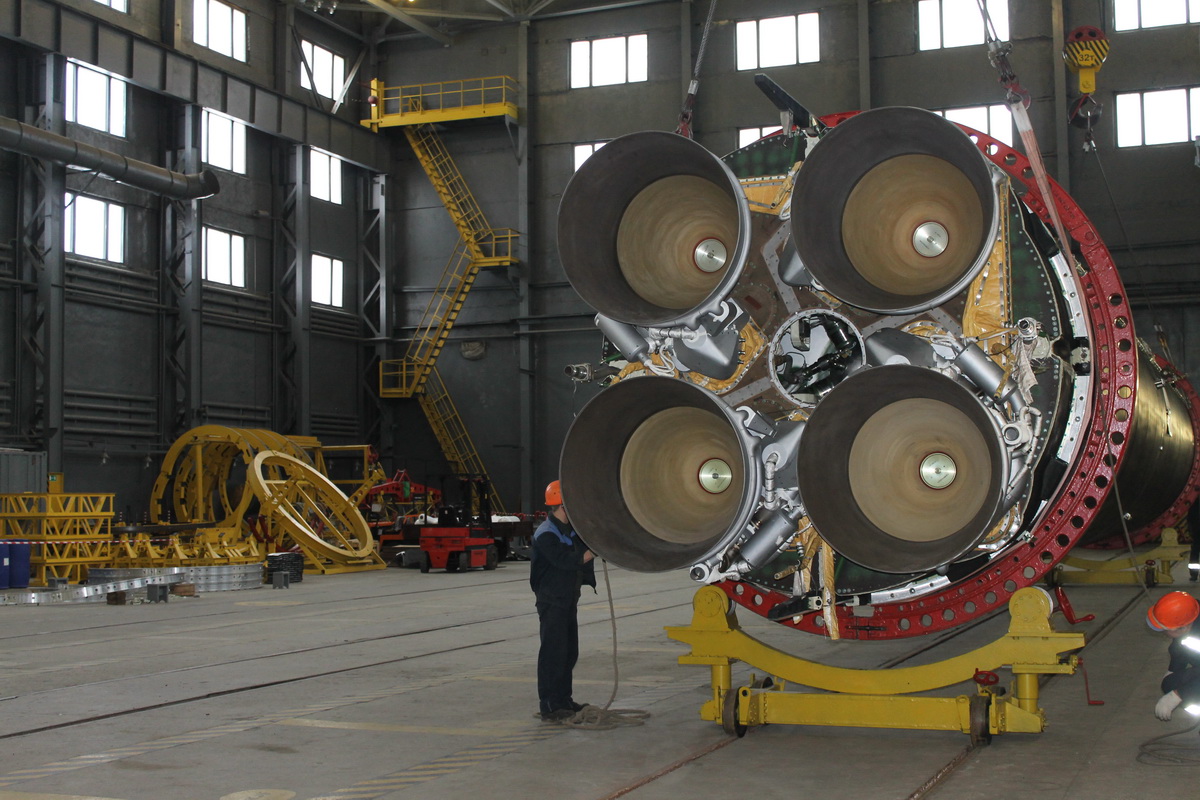
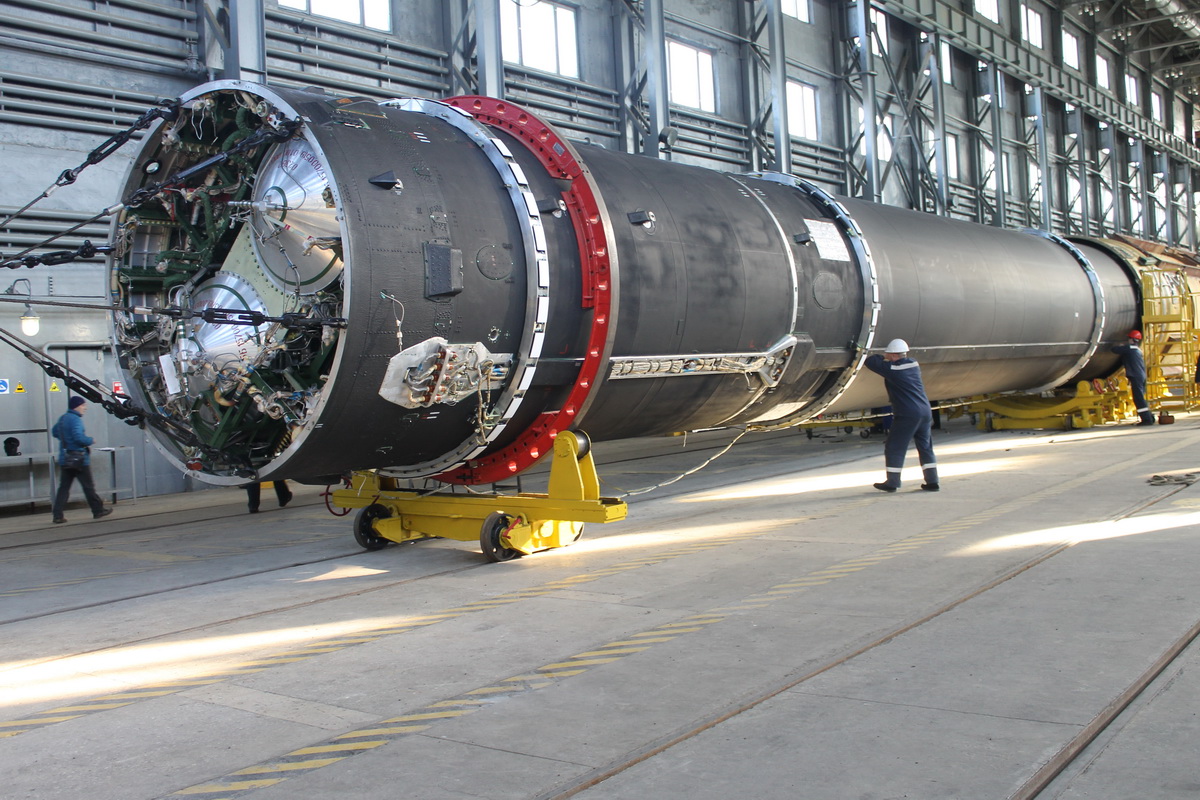
The first stage is a four-chamber unit. Photographs of the exposed aft bay, including the hangar pictures on this page, show four large bells and a red assembly ring. The published thrust table, identical in Missilery.info and on Russianspaceweb, is 468.6 tonnes-force at sea level and 504.9 tonnes-force in vacuum, with 150.2 tonnes of propellant. The model name is [CONTESTED]. Zak lists Stage I as RD-274 (four RD-273 chambers), with a preliminary design in March 1982 and RD-273 tests completed at Dnepropetrovsk in May 1985. Many older cards still say RD-264 / four RD-263, the standard index for the earlier R-36M and R-36M UTTKh first stage. The live Sarmat article on this site places Sarmat’s PDU-99 “in the RD-264 / RD-274 family,” which is the right way to hold the names: a family, not a single settled string. [DOCUMENTED for the layout and thrust; CONTESTED for the index]
The second stage is listed with 85.3 tonnes-force of vacuum thrust and 37.6 tonnes of propellant in the same two tables. Specialist writing attributes the block to KBKhA as RD-0255, a single-chamber closed-cycle main engine RD-0256 plus a four-chamber open-cycle vernier RD-0257, with the main engine recessed into the tank. Zak’s shorter card says RD-0256 (RD-0255). The bus, in the Missilery.info table, has 2.1 tonnes of propellant and 1.9 tonnes-force of vacuum thrust from a four-chamber unit whose chambers swing out in flight. Catalogue pairings give RD-864 / 15D177 on 15A18 and RD-869 / 15D300 on 15A18M. Those bus indices are not printed on the Ministry of Defence card. [DOCUMENTED for the thrust and propellant masses; index pairing UNVERIFIED]
COLD LAUNCH FROM THE CANISTER
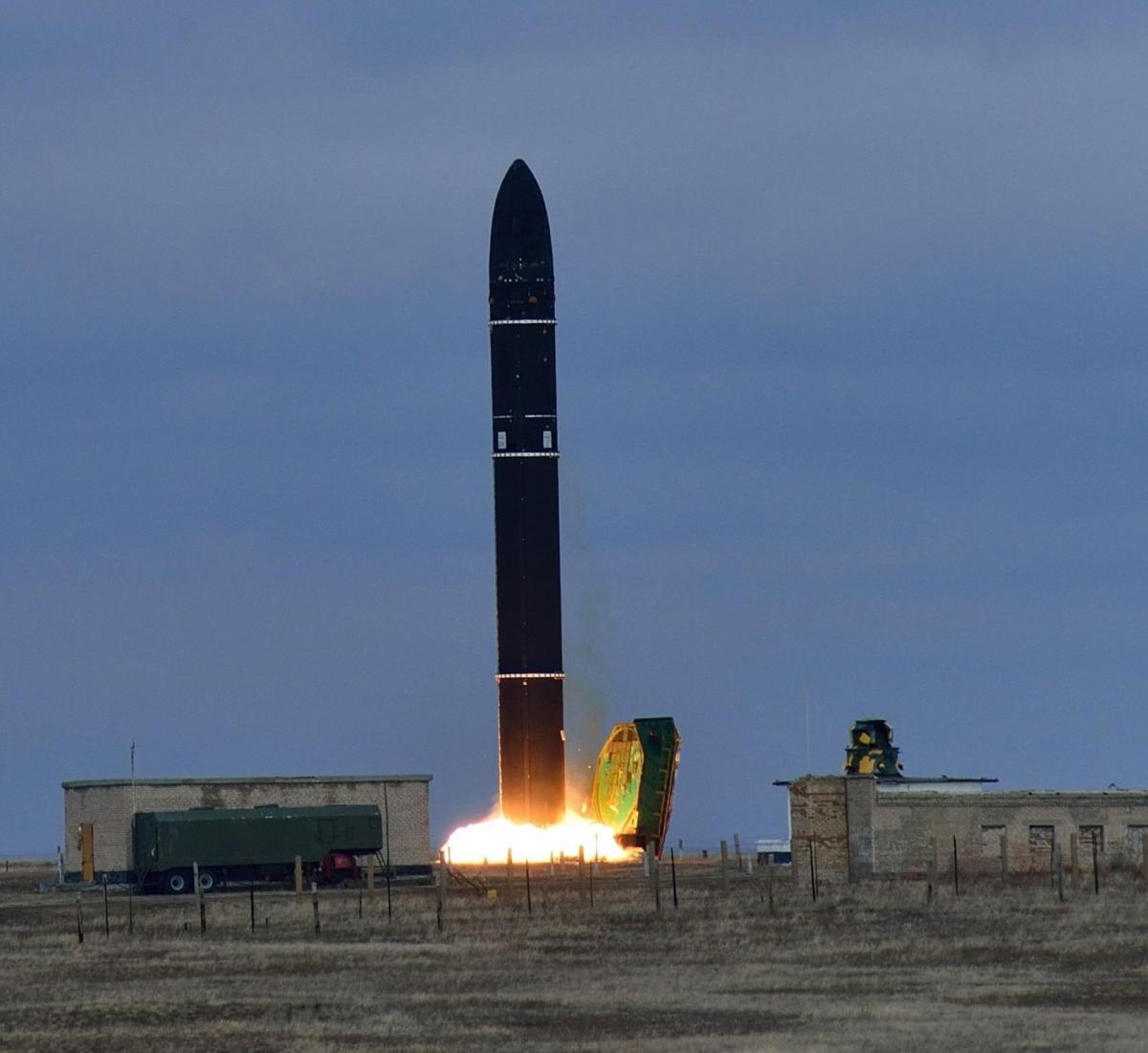
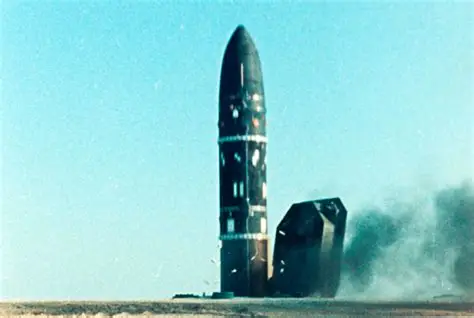
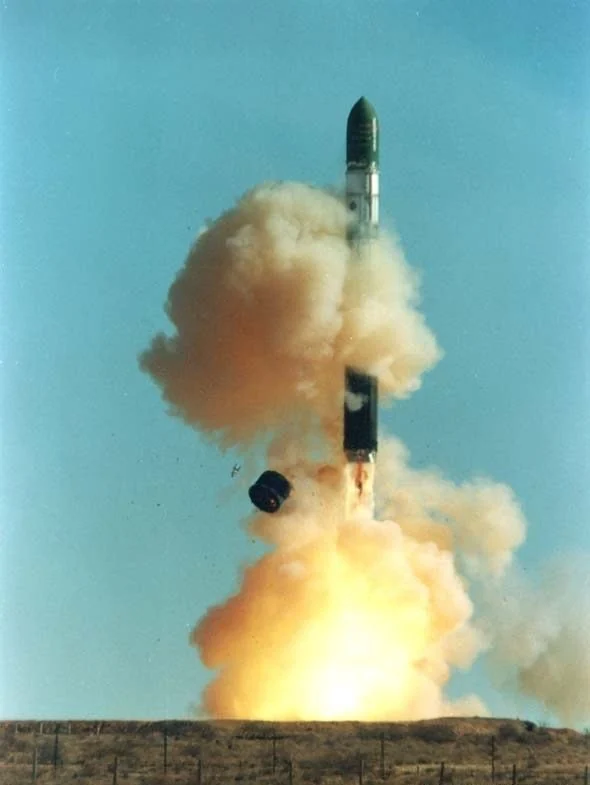
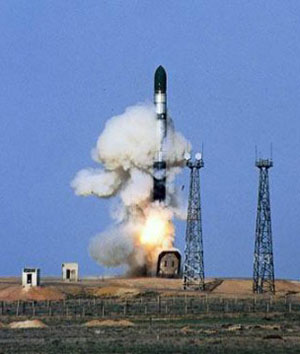
R-36M2 leaves the silo the way its immediate predecessor did: by mortar, or cold, launch (миномётный старт). The missile sits in a transport-launch container (транспортно-пусковой контейнер, TPK) inside a hardened shaft. A powder pressure accumulator (пороховой аккумулятор давления, PAD) generates a pulse of gas that throws the missile, still in or just clearing its container, up and out of the hole. The first-stage engines start in the air, above the silo mouth, so the shaft is not burned out and can, in principle, be reloaded. The same logic is later advertised for Sarmat, and it is the silo counterpart of the cold launch used on Topol-M and Yars from their canisters. [DOCUMENTED]
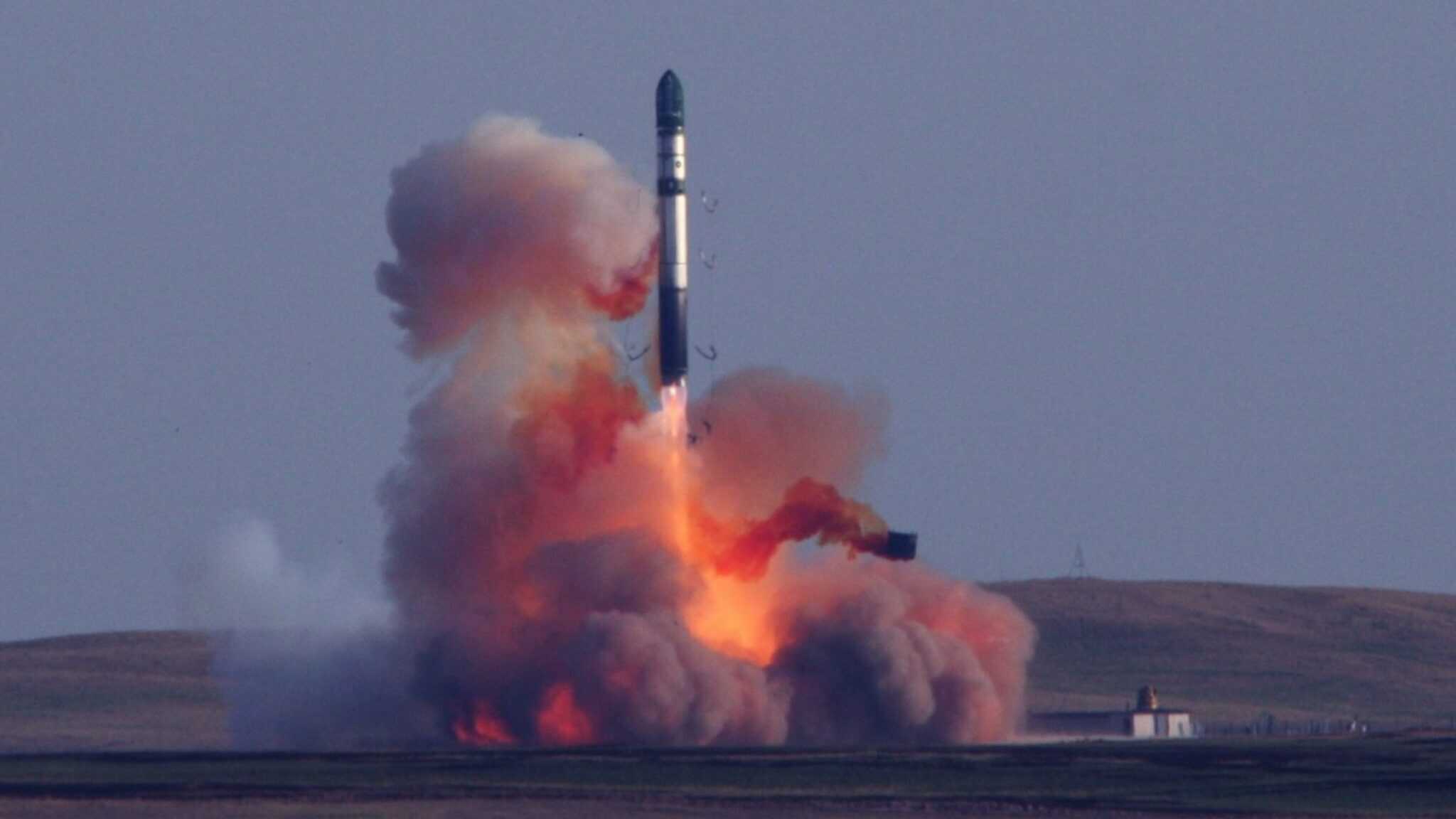
Photographs of the first moments tell the sequence. In one frame a dark missile is already standing clear of the hole, the heavy green lid is open, and a fireball has started at the base. In an older, grainier frame the missile is out and the lid is open, but the only effluent is a puff of dark smoke: the powder charge has done its work, and the first-stage engines have not yet lit, or have only just lit. In later frames a lid or cover tumbles away from the plume. Those pictures are captioned for what they show, not as named flights. Some of the green-nosed, white-banded launches are also consistent with converted space-launch fairings. [DOCUMENTED as the launch method; individual frames not identified as named flights]
The method is also a survivability choice. A hot-launched silo has to swallow the first-stage exhaust; a cold-launched silo does not, and the container plus the shock-isolated mounting are part of the claim that the missile can still get out after a nearby nuclear burst, including under dust, overpressure, EMP and X-ray. The Yuzhnoye / Ministry of Defence text is emphatic on that point — a guaranteed retaliatory launch from a beaten position area — and it gives the multiplicative hardness claims already quoted. What it does not give is a public overpressure rating in pounds per square inch, or a measured EMP test result. Western hardness numbers that circulate for OS-type silos should be treated as estimates, not as a plant sheet. [DOCUMENTED as a design claim; numerical hardness UNVERIFIED]
A FLIGHT, STEP BY STEP
A public reconstruction of a Voevoda flight, based on the published design and on what the photographs show, is straightforward. The regiment uses a planned target set or one sent down from higher command. From the “full alert” state the Missilery.info table gives 62 seconds to launch — a published table figure, not a filmed stopwatch. The silo lid opens, the PAD fires, the missile is thrown clear of the shaft, and the first-stage four-chamber unit lights in the air. [DOCUMENTED as the published sequence]
Boost is short by ICBM standards for a missile this large, because the hypergolic stages are dense and first-stage thrust is high. Stage I burns out and separates; Stage II, recessed in its tank, takes over, with verniers for steering. The official text stresses hardening in this phase: control-system protection against gamma radiation, faster actuators, and delayed fairing separation until the missile has passed a high-altitude blocking burst. Those are published design features, not independently demonstrated in an open test. [DOCUMENTED as published claims]
After Stage II burnout the bus — a four-chamber liquid unit with 2.1 tonnes of propellant in the published table — orients and dispenses re-entry vehicles and penetration aids onto slightly different paths. The official text calls this “precision individual breeding,” and mentions a “direct” guidance method that does not require a previously prepared flight task, plus remote retargeting, including onto an unscheduled target. The usual operational load is ten unguided re-entry vehicles. A mixed load with four guided blocks, and a heavy monoblock, were designed and, in the mixed case, partly flown; they were not kept as mandatory combat equipment. The bus then drops away, and the vehicles follow ballistic paths, accompanied by the published “developed complex of missile-defence penetration aids.” [DOCUMENTED as the design concept; guided-block and heavy-monoblock operational status CONTESTED, and likely never fielded]
GUIDANCE, NAVIGATION AND CONTROL
The flight-control system is an autonomous digital inertial suite from NPO Khartron (the former NII-692) in Kharkiv, associated in specialist writing with Vladimir Sergeyev. Official and catalogue wording agrees on three points: it is inertial, it is digital, and it was hardened to keep guiding after a nuclear burst in flight. The Yuzhnoye text family, via Missilery.info, adds two new-generation computers (one onboard, one on the ground), a high-precision inertial platform that runs continuously on duty, and a thermal path that dumps heat into the silo volume. Combat use is described from −50 to +50 °C and in surface winds up to 25 m/s, including after a nuclear effect on the complex. [DOCUMENTED as published description]
What the public record does not settle is the platform type. Open sources say “inertial” and “autonomous digital.” They do not, in the pages read for this article, say clearly whether the stable element is a gimbaled, gyrostabilized platform or a strapdown cluster. Standard accounts of the type often also say astro-inertial; that was not confirmed as a named official card here. Treat strapdown-versus-gimbal, and any star-tracker, as [UNVERIFIED].
Silo command-post equipment is often listed in catalogues as 15V52U / 15В52У, or as a related 15V-series set. That string circulates; it is not described on any official public card read here, and it is tagged [UNVERIFIED]. The regiment sits inside the ordinary RVSN command system covered in the Kazbek and Russian C3 articles. The Perimeter (Dead Hand) command missile, GRAU 15A11, can pass a launch order to the broader strategic force, including any still-ready R-36M2 regiment, but the 15A11 itself is a command rocket based on the UR-100 / MR-UR-100 family, not an R-36M2 variant and not a documented Voevoda-silo occupant. The connection is at the force-command level. [DOCUMENTED for the 15A11 lineage; any tighter coupling UNVERIFIED]
A related readiness detail, from Podvig’s January 2026 notes, is worth keeping in this section rather than in the force-count section. Colleagues reminded him that R-36M2, unlike its predecessors, was kept in a high degree of readiness with its gyroscopes spun up. If that is right, the missile in the silo is not a fully inert object, and life-extension is not only a matter of chemistry in sealed tanks. The observation is Podvig’s, flagged as a colleague’s reminder, and it is consistent with the Yuzhnoye wording about a continuously running inertial platform. It is not an official Ministry of Defence line. [SINGLE SOURCE]
THE POST-BOOST VEHICLE, WARHEADS, AND PENETRATION AIDS
The tactical-technical assignment, in the Yuzhnoye / Missilery.info text, provided for four head-unit types: a heavy monoblock, a light monoblock, a MIRV with ten unguided blocks, and a mixed MIRV of six unguided plus four guided (15F178) blocks with map-matching homing. 15F178 is described as a bi-conical body with a deflected conical stabilizer and aerodynamic rollers in the atmosphere, and a cold-gas (carbon dioxide) attitude system outside it. During state trials the heavy monoblock and the mixed MIRV were dropped from mandatory combat equipment. Missilery.info says the heavy monoblock was prepared for production but not flight-tested; the mixed version had three Kura launches; after 1991 the guided-block work was closed. That is the most careful public account of a subject popular cards often treat as a fielded 20-megaton “Mod 6.” [DOCUMENTED as the design-bureau account; operational monoblock CONTESTED]
What went on duty, and what Western and Russian cards still mean by the standard R-36M2 / SS-18 Mod 5 load, is ten MIRVs. Yields are not official as a single number. The Ministry of Defence English card prints 10 × 0.55 to 0.75 Mt. Bulletin 2026 prints 10 × 500–800 kt, and in the same article estimates that remaining missiles may carry only five warheads each to stay inside New START practice, even after the treaty’s formal expiry. Popular graphics, including the one on this page, print 10 × 750 kt. None of those figures should be averaged, and none is a plant yield sheet. A 2022 Russian state-media video of the RS-20V bus, cited by Bulletin 2026 from Kornev, shows what looks like 14 stations in two tiers of seven; the usual reading is ten warheads plus four decoy stations, not a 14-warhead operational load. Older Western writing that the type “could carry 14 to 19, or even 20” warheads, which Zak also reports, is a design-margin or throw-weight remark, not a declared operational load. Under START, Russia declared ten. [CONTESTED]
Penetration aids are described in official language as a developed complex of missile-defence countermeasures. Missilery.info lists light and heavy decoys and associated devices in special cassettes, with thermally insulating covers on the bus. That is as specific as a careful public account should get. Named hardware beyond that, or claims of maneuvering operational re-entry vehicles, belong in the abandoned 15F178 and experimental penetrator work, not in the fielded ten-block load. An experimental penetrating block, based on the 15F158U shape with a titanium nose (VNIIEF and the Pavlograd plant), was gun-tested and flown on other carriers in 1989–1990; five blocks were tested successfully, and the follow-on was closed after 1991. [DOCUMENTED as a development programme that did not become regular combat equipment]
THE SILO COMPLEX
The missile complex is designated 15P018M in the same official text family that gives the missile as 15A18M. Specialist catalogues also use 15P718M and OS-67 (ОС-67) for the hardened silo itself. Those extra strings are widely repeated and are treated here as catalogue usage, not as a plant plate. The official wording is that the new complex reused the infrastructure of the earlier 15P018 (R-36M UTTKh) complex to the greatest possible extent — shafts, communications, and systems already in the ground — which is why a fourth-generation missile could be dropped into a third-generation field. [DOCUMENTED for 15P018M; 15P718M / OS-67 UNVERIFIED as official plate]
The public engineering picture is consistent even when the indices vary. The missile is canisterized. The canister is shock-isolated or suspended in the shaft so that a ground shock is not fed straight into the airframe. The lid is a heavy, hinged cover, clearly visible in the launch photographs on this page. A launch-control centre sits with each group of silos; the continuously running ground computer and the thermal path into the silo volume, already mentioned, belong to that ground set. One secondary source gives a silo depth of 39 metres; that figure was not corroborated in the other technical pages read for this article and is tagged [UNVERIFIED]. Published hardness in pounds per square inch is likewise not on an official card. [DOCUMENTED as a design description; numerical depth and hardness UNVERIFIED]
BASES: DOMBAROVSKY, UZHUR, AND THE CLOSED FIELDS
At the end of the Soviet period the SS-18 family occupied six fields and, in the usual open count, 308 silos. The widely cited split is 204 silos in Russia and 104 in Kazakhstan. The two Kazakh fields, Derzhavinsk and Zhangiztobe (also spelled Zhangiz-Tobe / Жангизтобе), were dismantled under START I after independence. The Ministry of Defence official paragraph remembers Derzhavinsk as an early R-36M2 duty location, alongside Uzhur, by 1990; the first regiment, as already noted, had gone on duty at Dombarovsky on 30 July 1988. [DOCUMENTED; the 204 / 104 split is a widely cited reconstruction]
On the Russian side, two of the four original heavy fields were later closed. Kartaly, in Chelyabinsk Oblast, is credited in specialist writing with 46 heavy-ICBM silos; Aleysk, in Altai Krai, was the home of the 41st Rocket Division. Those divisions were disbanded and the silos eliminated in the 2000s, even though START II itself never entered into force. The two fields that remained associated with R-36M2 into the 2010s and 2020s are Dombarovsky / Yasny, in Orenburg Oblast, the 13th Red Banner Rocket Division; and Uzhur, in Krasnoyarsk Krai, the 62nd Rocket Division (Uzhur Red Banner, named for the 60th anniversary of the USSR, in standard honorifics). Those are also the two fields named for Sarmat. [DOCUMENTED; Kartaly’s 46-silo count is a specialist figure]
Bulletin 2026, working from satellite imagery as of early 2026, gives a regiment-level picture that is worth quoting rather than paraphrasing into a single total. At Dombarovsky, the 13th Missile Division, it lists the 175th Missile Regiment with six SS-18 silos as possibly active, the 494th with six as active, and the 767th with six as active, plus two Avangard (SS-19 Mod 4) regiments in the same division. At Uzhur, the 62nd Missile Division, it lists the 229th and 269th with six SS-18 silos each, active; the 735th with ten SS-18 silos, active; and the 302nd with six silos being rebuilt for SS-29 Sarmat, one of them assessed complete, none of them assessed as holding a Sarmat on duty as of March 2026. Arithmetic on that table is 18 SS-18 silos at Dombarovsky if the 175th is counted, and 22 at Uzhur, for 40 in all. If the 175th is not counted, the total is 34. The Bulletin itself flags the 175th as the change from the previous year, and notes that under the now-expired New START an extra SS-18 regiment would have pressed the warhead cap unless the missiles were downloaded. [DOCUMENTED]
COMPARED WITH OTHER ICBMS
Figures in this table are the usual public cards, not flight-test measurements. R-36M UTTKh and R-36M2 follow the cards already discussed. Sarmat follows the Army-2019 / TASS set used in the live Sarmat article on this site. Peacekeeper follows widely published US Air Force and specialist fact sheets; it is the better American peer for a heavy, cold-launched, ten-MIRV silo missile, and it was retired in 2005. Minuteman III, still in service, is a much lighter, hot-launched solid ICBM (about 36 t, about 18.2 m, more than 6,000 miles in official US wording, typically one warhead today). The planned replacement, LGM-35A Sentinel, is not yet deployed.
| Item | R-36M UTTKh (15A18, SS-18 Mod 4) | R-36M2 Voevoda (15A18M, SS-18 Mod 5/6) | RS-28 Sarmat | LGM-118A Peacekeeper |
| Status (late 2026) | Retired from ICBM duty; some converted airframes flew as Dnepr into 2015 | In service since 1988; life-extended; remaining count CONTESTED (see Status) | Flight-tested; first regiment promised at Uzhur by end of 2026; combat duty not independently confirmed | IOC 1986; retired 2005 |
| Launch mass | About 211 t class (same SALT II weight band) | 211.1–211.4 t, or 211,100 kg on the Ministry of Defence card | 208.1 t (Army-2019 / TASS) | About 88,450 kg (195,000 lb) on US fact sheets |
| Length / diameter | Same 3.0 m bore; length in the mid-34 m class on standard cards | 34.3 m / 3.0 m | 35.5 m (35.3 m in CSIS) / 3.0 m | About 21.6 m (71 ft) / about 2.3 m |
| Stages / propellant | 2 boost stages + bus; liquid UDMH/N2O4 | 2 boost stages + bus; liquid UDMH/N2O4 | Usually 3; liquid (UDMH/N2O4 family) | 3 solid stages + bus |
| Throw-weight | About 8.8 t class on standard cards | 8.47–8.8 t, depending on the card (see spec table) | About 10 t | On the order of 4 t on standard US/specialist cards |
| Published range | Intercontinental; commonly 10,000–11,000 km class with a heavy load | 11,000–11,500 km class with a heavy load; 16,000 km on the monoblock card | 18,000 km official card; see the Sarmat article for the longer figures | More than 6,000 miles (about 9,700 km) in official US wording; longer figures circulate |
| Warhead load | 10 MIRVs on the usual Mod 4 card | 10 MIRVs on the usual Mod 5 card; a monoblock was designed | MIRV, count not official; estimates 10 heavy or 15–16 light, or Avangard | Up to 10 × W87, about 300 kt |
| Launch method | Silo, cold launch | Silo, cold launch (PAD) | Silo, cold launch (PAD) | Silo, cold launch (the US heavy exception; Minuteman is hot-launched) |
| Guidance (public) | Inertial; Khartron line | Autonomous digital inertial (Khartron); astro-inertial in some standard accounts of the type | INS; Degtyar: GLONASS-aided correction; astro-correction unconfirmed | Inertial, with satellite updates in standard US accounts |
| IOC / designer | 17 December 1980 (Russianspaceweb); Yuzhnoye / Utkin | Duty 30 July 1988, adopted 11 August 1988; Yuzhnoye / Utkin | Not yet independently confirmed on duty; Makeyev / Krasmash | December 1986; US Air Force / Boeing and associate contractors |
R-36M2 is not a new size of missile. It is a harder, more accurate, slightly more energetic 15A18, still in the SALT II box, still a Yuzhnoye liquid, still ten warheads on the usual card. Sarmat is the attempt to do that job again in Russia, in the same 3 m hole, with a little more throw-weight and a much more troubled test record. Peacekeeper was the American answer to the same 1980s problem, and it was retired two decades ago. [DOCUMENTED]
THE 1991 BREAKUP AND LIFE EXTENSION
The Soviet Union dissolved in December 1991 with R-36M2 still a new missile. Yuzhnoye, Yuzhmash, Khartron, and a large part of the production chain were in independent Ukraine. Kazakhstan still hosted two SS-18 fields. Russia had the command system, most of the divisions, and a stock of already-built missiles, but it did not have a domestic plant that could build a 15A18M. The Kazakh silos were eliminated under START I. The Russian missiles already in the holes were kept alive by warranty work, life-extension firings, and, for as long as it lasted, a contractual relationship with the Ukrainian design bureau and plant. [DOCUMENTED]
The original warranty, in the Missilery.info table, is 15 years on unregulated combat duty. Zak writes that Yuzhnoye and the Ministry’s TsNII-4 later certified the family for 15, then 18, and ultimately 20 years. A Russian–Ukrainian service-life agreement on the RS-20 was ratified by President Vladimir Putin on 12 February 2008. In January 2012, NKAU’s Yuri Alekseev said 52 missiles remained in operational readiness, with Ukrainian contractors still involved. [DOCUMENTED]
Life extension was also proved, in the Russian manner, by firing in-service missiles. Zak records a 22 December 2004 launch from an operational 13th-division silo at Dombarovsky to Kura, at 11:30 Moscow Time, attended by then-commander Nikolai Solovtsov, to certify a 20-year life and to show that the field could also support commercial Dnepr launches; a 21 December 2006 shot from the same field using a 19-year-old missile; and a 24 December 2009 shot described as certifying a 23-year life. On 30 October 2013, during a sudden strategic-forces exercise overseen by President Vladimir Putin, an R-36M2 was launched from Dombarovsky while Topol missiles were fired from Plesetsk. Podvig, writing in January 2026, says that 2013 shot is the last R-36M2 flight test he can find, and that the absence of later Voevoda launches after Ukrainian industrial cooperation ended in 2014 may not be a coincidence. [DOCUMENTED]
The public end-date moved with the tests. In May 2005 Solovtsov said the missiles would remain in service until 2014–2016. On 17 December 2010 Karakayev said life extension would allow Voevoda to be kept until 2026; contemporary reporting also spoke of a possible 33-year life. Podvig noted at the time that this had not already been granted, only that it could be after a programme of measures, apparently including flight tests. Later comments from the same command talked of 30 years rather than 33. Some secondary reports used a 2025–2027 window. The youngest missiles, produced around 1992, are more than 33 years old in 2026. The 2010 “until 2026” line should not be treated as a self-executing retirement date. [DOCUMENTED; official end-year CONTESTED]
After 2014, and completely after 2022, the Ukrainian industrial relationship was gone. Russia could still cannibalize, inspect, and, if it chose, fire remaining missiles, but it could not go back to Yuzhnoye or Khartron for a clean warranty extension of the old kind. The replacement programme, Sarmat, had already been let to Makeyev and Krasmash for that reason. Delays on Sarmat are why Voevoda is still the name that has to be discussed in 2026. [DOCUMENTED]
ARMS CONTROL, LIMITS, AND COUNTS
SALT II, signed in 1979 and never ratified by the US Senate but observed in practice for a time, made the SS-18 a legal category as well as a missile. It defined a “heavy ICBM” by throw-weight and launch weight, froze the Soviet heavy force at the existing SS-18 silos — 308 launchers in virtually every open account — and forbade converting light ICBM silos into heavy ones. That is why Yuzhnoye had to modernize 15A18 inside the same dimensions and starting weight. [DOCUMENTED]
START I, signed in 1991 and in force from 1994, cut that heavy force in half: a ceiling of 154 heavy ICBMs. The Kazakh silos were eliminated, and Russian heavy silos were reduced on top of that. START II, signed in 1993, would have banned MIRVed ICBMs and eliminated the SS-18 force entirely. It never entered into force; after the US withdrawal from the ABM Treaty in 2002, Russia declared itself no longer bound by it. The heavy MIRV silo missile therefore remained legal. Kartaly and Aleysk were still closed in the 2000s, as a force-structure and cost decision as much as a treaty one, but Dombarovsky and Uzhur were kept. [DOCUMENTED]
New START, in force from 2011 and later extended, did not ban heavy ICBMs or MIRVs. It capped deployed warheads and launchers, and counted a deployed RS-20V as one launcher and up to ten warheads unless a lower load was declared. Russia suspended the treaty’s verification regime in February 2023; the last data exchange Podvig cites is 1 September 2022 (1,549 deployed warheads, 540 deployed launchers, 759 total launchers). Both sides have said they will, for now, still observe the central numerical limits. How even 34 to 40 SS-18s at ten warheads each would fit inside those limits is one reason Podvig and the Bulletin disagree about what is still in the holes. Bulletin 2026’s own footnote is that remaining SS-18s may carry only five warheads each. [DOCUMENTED]
Published post-Soviet R-36M2 counts, kept separate and not averaged, include: 58 in 1998 (Missilery.info) or by 1989 (Zak); 52 in operational readiness in January 2012 (Alekseev / NKAU, via Zak); 55 in March 2013 in some compiled lists; 46 remaining in some 2020 secondary tallies; approximately 40 in Bulletin 2026. Each of those figures has a year and a source. They are a declining series, but they are not a single official time series. [CONTESTED]
DNEPR, THE SPACE-LAUNCH CONVERSION
Retired missiles of the R-36 family were also converted into a space launch vehicle marketed as Dnepr (Днепр; Ukrainian: Дніпро). The commercial operator was ISC Kosmotras, a Russian–Ukrainian venture (Kazakhstan also figures in some company histories because of Baikonur). Launches were made from silos at Baikonur and, later, from Yasny / Dombarovsky, the same 13th-division field that was still an R-36M2 base. The first Dnepr orbital launch was on 21 April 1999 from Baikonur, carrying UoSAT-12. The last was on 25 March 2015, carrying KOMPSAT-3A. Launch catalogues and the State Space Agency of Ukraine agree on the score: 22 launches, 21 successful, one failure. The failure was on 26 July 2006 from Baikonur (the BelKA cluster). The usual site split is 12 launches from Baikonur and 10 from Yasny / Dombarovsky. [DOCUMENTED]
Which underlying ICBM was actually converted is [CONTESTED]. Careful accounts, including Russianspaceweb, identify it as R-36M UTTKh (15A18, RS-20), not R-36M2 (15A18M). Other write-ups loosely say SS-18 or even R-36M2. This article treats Dnepr as a conversion of the R-36 family, most carefully as a 15A18 conversion, not as evidence that 15A18M was the standard commercial booster. [CONTESTED]
The programme did not survive the break with Ukraine. In February 2015 Russia suspended the joint conversion programme. Kosmotras said it would still fly three promised 2015 missions; only one flew. Popular claims of a leftover 150-missile stock should be treated as commercial talk, not as a current inventory. Podvig has used the last Dnepr flight, in 2015, as a data point: a 15A18-family missile about 30 years old still flew, which suggests that 30 years is not a hard limit for the family, but says nothing reliable about extending 15A18M past 33 years without tests and without the original bureau. [DOCUMENTED]
A naming caution, because this site already has a page titled Dnepr: that page is about the 5N86 Dnepr early-warning radar (NATO Hen House), a Mints Radiotechnical Institute SPRN radar, not about this space launcher. The two systems share a river name and nothing else. [DOCUMENTED]
COMMAND, READINESS, AND SURVIVABILITY
On a normal day the regiment is a silo field under ordinary RVSN command, on the Kazbek network described in the Russian C3 article, receiving warning from the SPRN system and its Voronezh radars, and in a general-war case also reachable by a Perimeter command message. The missile is designed for a retaliatory launch after nuclear effects on the position area, which is why the official text dwells on lids, coatings, continuously running hardened computers, and a 62-second line from full alert. Seeing such a launch, and trying to engage it, are the subject of the Don-2N and A-135 / A-235 / Nudol articles. [DOCUMENTED as the command context]
Survivability, in the official wording, has three layers: the hardness of the silo and the command post; the hardness of the outgoing missile in flight, including delayed fairing separation and dust-cloud resistance; and the penetration-aid suite on the bus. The published multiplicative claims against X-ray, gamma-neutron flux, and the blocking-zone radius are design-bureau figures. They should be read as such. The operational question in 2026 is narrower and harder: not whether a new 15A18M in 1988 could have got out of a beaten silo, but whether a 33-year-old Ukrainian-built missile, untested in flight since 2013 and unsupported by its design bureau since 2014, is still being held in that same state of readiness. That is a force-status question, and the two best open accounts do not agree. [DOCUMENTED as a design claim; 2026 readiness CONTESTED]
STATUS AND OUTLOOK (LATE NOVEMBER 2026)
Two serious open-source accounts of the remaining R-36M2 force were published in 2026. They should be read side by side, not blended into a single “about 40, or maybe zero” line.
The Bulletin of the Atomic Scientists Nuclear Notebook, “Russian nuclear weapons, 2026,” by Hans M. Kristensen, Matt Korda, Eliana Johns and Mackenzie Knight-Boyle, working as of March 2026, counts approximately 40 SS-18 / RS-20V launchers remaining at Dombarovsky and Uzhur, theoretically able to carry up to 400 warheads. Table 1 lists the type as “SS-18 M6 Satan,” 40 launchers, 10 × 500–800 kt, and 400 warheads, with two footnotes: the 40 is a change from the previous year because the authors now treat Dombarovsky’s 175th Regiment as also active; and they estimate that the missiles may carry only five warheads each to stay inside New START practice. The regiment table behind that total is the one already quoted in the bases section (18 silos at Dombarovsky if the 175th is counted, 22 at Uzhur). The narrative dates formal retirement from 2021 at Uzhur’s 302nd Regiment. As of March 2026 the authors saw that regiment disarmed and its silos at advanced stages of reconstruction, but assessed that no Sarmat had been loaded or placed on combat duty. If Sarmat eventually takes every current SS-18 hole at the two fields, their planning number is up to 46 silos. [DOCUMENTED]
Pavel Podvig, in “Notes on the status of Russian strategic nuclear forces in 2026” (January 2026), starts from the same geography and comes to a different conclusion. He counts three six-silo SS-18 regiments at Dombarovsky whose silos appear intact, but says it is hard to tell whether missiles are in them. Uzhur, in his count, has 28 intact silos, six of them being modified for Sarmat. The youngest 15A18M missiles were produced around 1992 and are more than 33 years old; command statements once spoke of a 33-year life and later of 30; the last flight test he can find is the 2013 exercise launch; Ukrainian support ended after 2014. His own take is that the missiles are probably not deployed: empty silos at the two fields would sit close to the 540 deployed launchers Russia declared in 2022, whereas a still-armed SS-18 force at ten warheads each would, with the newer ICBMs, nearly exhaust the New START warhead cap on the ICBM leg alone. [DOCUMENTED]
Those are not two measurements of the same thing. The Bulletin is counting silos that look active and is willing to attribute missiles, and warheads, to them, with a download footnote. Podvig is counting silos that look intact and is unwilling, on age, test history, industrial severance, and treaty arithmetic, to assume they still hold operational missiles. A responsible article has to carry both readings. [CONTESTED]
The handoff to Sarmat is why the question matters. Sarmat is a Makeyev / Krasmash missile meant to go into the same 3 m holes, first at Uzhur, then at Dombarovsky. Its troubled test record is the subject of the live Sarmat article on this site, not of a second test log here. On 12 May 2026 Karakayev told Putin that the first Sarmat regiment could go on duty at Uzhur by the end of 2026. IISS, on 20 November 2026, read 6 June 2026 imagery at Uzhur as consistent with loading a missile, and noted possible test preparations at Dombarovsky from around 22 October. No independent source confirms a regiment on combat duty as of late November 2026. Until one does, the heavy-silo force is still, in name, a Voevoda force, whether or not every silo still holds a ready 15A18M. [DOCUMENTED]
WHAT IS UNCERTAIN IN THIS ARTICLE
The unsettled points are not small ones, and they should be kept in a list rather than buried in the narrative.
TIMELINE
1960s–1975: R-36 (8K67, SS-9 Scarp) and then R-36M (15A14, SS-18 Mods 1–3). R-36M operational 30 December 1975 in the Russianspaceweb dating. [DOCUMENTED]
17 December 1980: R-36M UTTKh (15A18, SS-18 Mod 4) operational, again in the Russianspaceweb dating. This is the missile whose silos and starting-weight class R-36M2 has to live inside. [DOCUMENTED]
June 1979 / 1982 / 9 August 1983: Technical proposal often dated June 1979; Zak also says “in development since 1982.” Formal go-ahead, Central Committee and Council of Ministers decree of 9 August 1983. [DOCUMENTED; start wording CONTESTED]
May 1985: RD-273 engine testing completed at Dnepropetrovsk, in Zak’s account. [DOCUMENTED as a specialist dating]
1986, widely 21 March: Flight tests begin at Baikonur (NIIP-5). Official short paragraphs say 1986; specialist reconstructions give 21 March as the first flight. [DOCUMENTED; day from specialist reconstructions]
30 July 1988: First regiment on combat duty at Dombarovsky, commander named as O. I. Karpov in the Ministry of Defence card. [DOCUMENTED]
11 August 1988: Complex adopted (принят на вооружение) by Central Committee and Council of Ministers decree. [DOCUMENTED]
September 1989: Tests with all types of combat equipment completed. Official summary: 26 joint flight-test launches at NIIP-5 (20 successful); tests completed with 11 successful launches after revisions; 33 launches in all; stated reliability 0.974. [DOCUMENTED]
By 1990: Complexes also on duty near Uzhur and Derzhavinsk, in the Ministry of Defence wording. [DOCUMENTED]
1989 or 1998: 58 R-36M2 missiles deployed — Zak says “by 1989,” Missilery.info says “in 1998.” [CONTESTED]
1991–1990s: Soviet breakup. Yuzhnoye, Yuzhmash and Khartron in independent Ukraine. Kazakh SS-18 fields at Derzhavinsk and Zhangiztobe eliminated under START I. START I heavy-ICBM ceiling: 154. [DOCUMENTED]
21 April 1999: First Dnepr space launch, Baikonur, UoSAT-12. [DOCUMENTED]
2004, 2006, 2009: Life-extension launches from Dombarovsky to Kura (20-year, 19-year-old missile, 23-year certifications in the official descriptions). [DOCUMENTED]
12 February 2008: Putin ratifies a Russian–Ukrainian service-life agreement on RS-20 / SS-18 missiles, in later specialist recaps. [DOCUMENTED]
17 December 2010: Karakayev says life extension will allow Voevoda to remain in the force until 2026; talk of a possible 33-year life, later qualified. [DOCUMENTED]
January 2012: NKAU’s Yuri Alekseev: 52 missiles in operational readiness, Ukrainian contractors still involved. [DOCUMENTED]
30 October 2013: R-36M2 launched from Dombarovsky during a strategic-forces exercise; the last flight test in Podvig’s later reconstruction. [DOCUMENTED]
2014–February 2015: Ukrainian industrial cooperation ends. Russia suspends the joint Dnepr conversion programme in February 2015. [DOCUMENTED]
25 March 2015: Last Dnepr launch (KOMPSAT-3A). Programme score: 22 flights, 21 successful, one failure. [DOCUMENTED]
2021: Bulletin 2026 dates the formal start of SS-18 retirement, at Uzhur’s 302nd Regiment, to prepare for Sarmat. [DOCUMENTED as a Bulletin dating]
January 2026: Podvig’s status notes: silos at Dombarovsky and Uzhur look intact; his take is that the missiles are probably not deployed. [DOCUMENTED]
March 2026: Bulletin 2026: about 40 remaining launchers; 302nd Regiment at Uzhur upgrading to Sarmat; no Sarmat loaded or on duty. [DOCUMENTED]
12 May 2026 / 20 November 2026: Karakayev tells Putin the first Sarmat regiment could go on duty at Uzhur by year’s end; IISS later reads June 2026 Uzhur imagery as consistent with loading a missile. Combat duty is not independently confirmed as of late November 2026. [DOCUMENTED]
RUSSIAN TERMS USED IN THIS ARTICLE
Р-36М2 «Воевода» — R-36M2 Voevoda; 15А18М / 15A18M — GRAU missile index; 15П018М / 15P018M — missile complex; РС-20В / RS-20V — treaty and service name; Р-36М УТТХ (15А18, РС-20Б) — R-36M UTTKh, the immediate predecessor; Р-36М (15А14, РС-20) — first MIRV generation of the family; Р-36 (8К67) — the SS-9 ancestor.
15П718М / ОС-67 — silo / complex indices in common catalogue use (pairing UNVERIFIED as a plant plate); транспортно-пусковой контейнер (ТПК) — transport-launch container; пороховой аккумулятор давления (ПАД) — powder pressure accumulator; миномётный старт — mortar / cold launch; ампулизация — factory-sealed tank loading; ступень разведения — post-boost / dilution bus; средства преодоления ПРО — missile-defence penetration aids.
КБ «Южное» — KB Yuzhnoye; Южмаш — Yuzhmash; НПО «Энергомаш» — NPO Energomash; КБХА — KBKhA; НПО «Хартрон» — NPO Khartron; Владимир Фёдорович Уткин — Vladimir Fedorovich Utkin.
НДМГ / гептил — UDMH / heptyl; АТ / амил — nitrogen tetroxide / amyl; 15Ф178 — guided combat block (work closed after 1991); 15А11 — Perimeter command missile (UR-100 family, not a Voevoda variant).
Домбаровский / Ясный — Dombarovsky / Yasny; 13-я ракетная дивизия — 13th Rocket Division; Ужур — Uzhur; 62-я ракетная дивизия — 62nd Rocket Division; Державинск, Жангизтобе — Derzhavinsk, Zhangiztobe; Карталы, Алейск — Kartaly, Aleysk; Байконур / НИИП-5 — Baikonur / NIIP-5; Кура — Kura range; Днепр (ракета-носитель) — Dnepr space launch vehicle, not the Dnepr early-warning radar.
IN ONE SENTENCE
The R-36M2 Voevoda (Р-36М2 «Воевода», 15A18M, RS-20V, SS-18 Satan) is a Yuzhnoye / Yuzhmash two-stage, ampullized, cold-launched heavy liquid ICBM, adopted on 11 August 1988, that still defines Russia’s super-heavy silo force at Dombarovsky and Uzhur while a delayed Sarmat replacement tries to take its holes — a 211-tonne-class, ten-MIRV design whose remaining 2026 inventory is honestly contested between a Bulletin count of about 40 launchers and Podvig’s reading that the silos may already be empty.
SOURCES
Plain-text citations only. No outside hyperlinks. Four items were spot-checked for this article: the 1986–1988 test and adoption dates (including 21 March 1986, 30 July 1988 and 11 August 1988); the official and specialist specification cards (Ministry of Defence, Missilery.info, Russianspaceweb); the Bulletin 2026 and Podvig January 2026 force counts, kept side by side; and the START I heavy-ICBM ceiling together with the Dnepr launch record (21 April 1999 to 25 March 2015, 22 flights, one failure).
Related pages on this site: RS-28 Sarmat · RS-24 Yars · RT-2PM2 Topol-M · Avangard · Barguzin · GLONASS · INS · Kazbek · Perimeter (Dead Hand) · Russian C3 · SPRN Solnechnogorsk · Voronezh · Don-2N · A-135 / A-235 / Nudol