WHAT IT WAS
Stroibat (стройбат, short for строительный батальон, “construction battalion”) is the Soviet and Russian soldiers’ nickname for the military construction units: the conscripts who built barracks, airfields, roads, silos, apartment blocks and factories, in uniform, under the Ministry of Defense or under a civilian ministry that borrowed them. It was never an arm of service. The official words were military construction units (военно-строительные части), military construction detachments (военно-строительные отряды, ВСО), and “military builders” (военные строители), a legal status that was not quite the same thing as a soldier. The shovel, not the rifle, was the weapon of the stroibat, and the word came to mean the least prestigious, most overworked and most feared corner of conscript service. [DOCUMENTED for the terms and the lack of a separate arm of service; the reputation is partly FOLKLORE, see below]
This article covers the organization and its paper trail, who was sent into it, the big jobs it did (silos and closed cities, Baikonur and the city of Leninsk, the 1980 Olympics, Afghanistan, Chernobyl), what daily life and pay actually were, why the hazing record made it notorious, the folklore it left behind, the 1990–2009 wind-down, and the unexpected announcement of 27 November 2026 that Russia is rebuilding military construction units from conscripts and contract soldiers. It does not cover the Railway Troops or the Pipeline Troops, which were separate formations and are queued as their own articles.
QUICK FACTS
NAME, TERMS AND WHAT “STROIBAT” ACTUALLY COVERS
Soldiers used one word for several different organizations, and the paperwork distinguishes several.
Construction units of the Defense Ministry (строительные части): ordinary units fully manned by servicemen, kept on the Defense Ministry’s budget, with higher discipline and a heavy presence in the Soviet groups of forces abroad, for example the 57th Military Construction Brigade in the Group of Soviet Forces in Germany and the 342nd Works-Engineering Directorate in Afghanistan. Similar non-self-financing units existed in the MVD, the KGB, Glavspetsstroy, Minsredmash and the Ministry of Communications. [DOCUMENTED]
Military construction detachments (ВСО) and separate companies (ОВСР): the large, self-financing, labor-hire units, which made up most of the manpower. A detachment was a separate battalion-sized unit of three to six companies, with a staff and the trades needed for its jobs. These were the units that sat outside the authorized strength of the Armed Forces and were farmed out to ministries from coal to atomic energy. [DOCUMENTED]
Units of other power ministries: construction formations in the MVD (126,000 servicemen in 1956 on the Russian Wikipedia figures) and the KGB built for their own departments. [DOCUMENTED]
Things that are not stroibat: the Railway Troops (железнодорожные войска), the Road Troops and the Pipeline Troops were separate formations with their own commands, and the NKVD / Gulag prison construction system used prisoners, not conscripts. Soldiers and the public mixed these up in speech, and so do many web sources; this article keeps them apart. [DOCUMENTED]
Russian Wikipedia gives the folk etymology as simple contraction, строительный батальон. A slang dictionary entry reported in a web search links the word with the “black troops” (чёрные войска), conscripts’ term for non-prestigious, labor-heavy units. [FOLKLORE for the “black troops” tie; the contraction itself is DOCUMENTED]
ROOTS BEFORE 1945
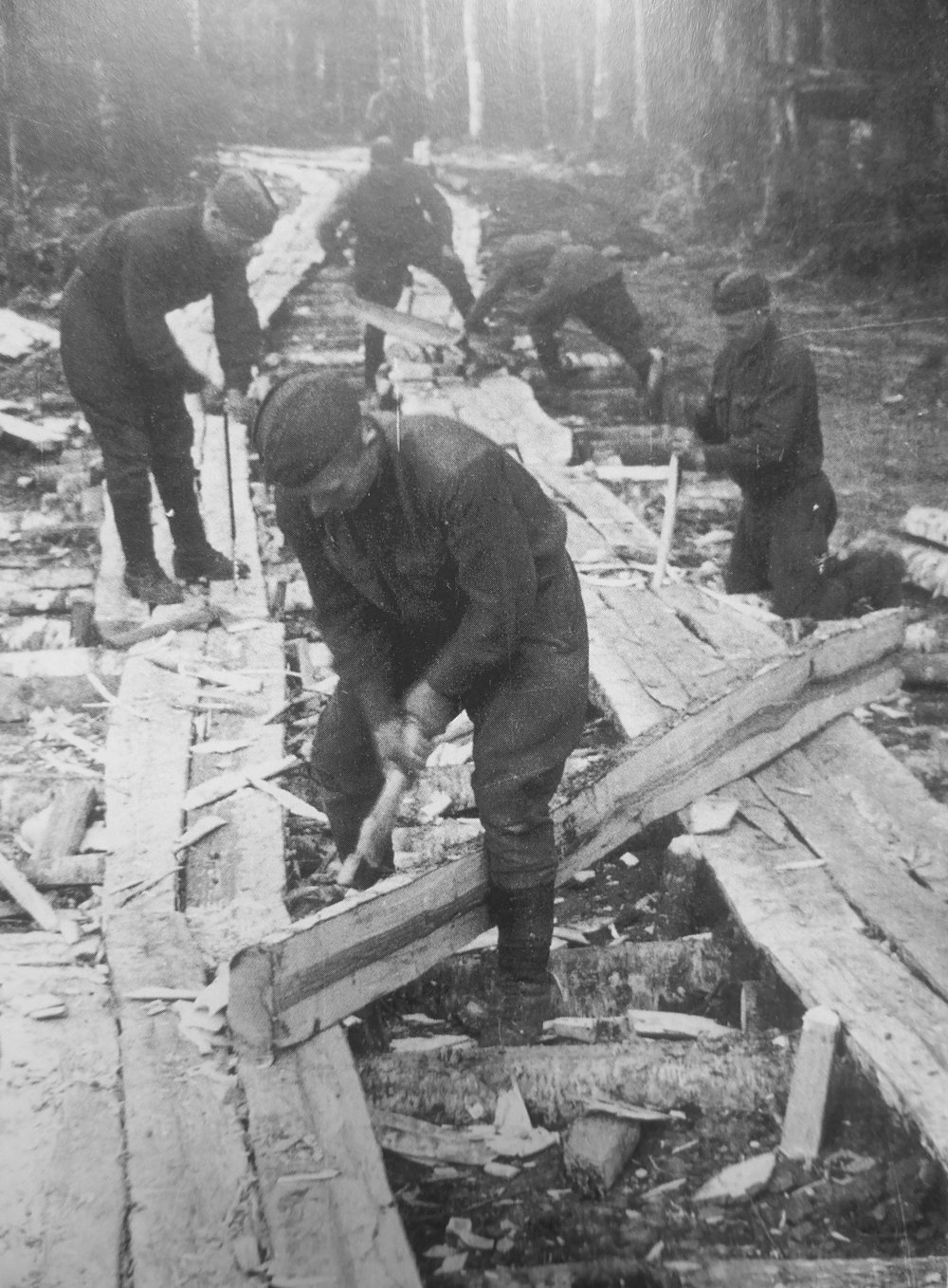
The idea of putting soldiers to work as builders is old. The Imperial Army in 1881 had auxiliary engineer, worker, military-railway and telegraph troops for building and fitting out theaters of war; they dissolved in the 1917 revolution. The 1920 “labor armies” (трудовые армии) turned whole Red Army regiments to logging, coal and firewood work. [DOCUMENTED]
A different ancestor is more direct. From 1918 the Soviet state kept a category of citizens liable to service but not trusted with weapons, the “rear militia” (тыловое ополчение): kulaks, clergy, former nobles and other “non-labor elements” who were not called up into combat units of the Red Army. In 1937, after the law on universal military duty was rewritten, People’s Commissariat of Defense Order No. 020 of 20 February 1937 turned the Directorate of the Rear Militia into the Directorate of Construction Units of the Red Army. That is the earliest formal link between a separate pool of “unfit for combat” conscripts and an army construction organization. [DOCUMENTED, via Russian Wikipedia]
In 1938 a Management of Defensive Construction of the Red Army existed. In the war of 1941–1945 numerous military construction units served inside the fronts and armies, digging fortification lines in front of the advancing enemy and laying roads, cable and telephone-telegraph lines and radio sites. [DOCUMENTED] The wartime “labor army” (трудармия), which put mobilized civilians, including deported peoples, in camp-like labor battalions, is a related but different thing: it was a mobilization of civilians under harsher rules than any soldier’s, and it is outside the subject of stroibat. [DOCUMENTED as a distinct institution]
The Gulag system is likewise not stroibat. Prison labor under the NKVD and MVD built canals, railways and whole cities in the 1930s–1950s; its workers were prisoners, not conscripts. The MVD also kept conscript construction formations of its own, 126,000 servicemen of them in 1956 on the Russian Wikipedia figures. [DOCUMENTED]
THE POSTWAR SYSTEM: MINISTRIES, GLAVKI AND THE CHAIN OF COMMAND
After 1945 the bulk of military construction was concentrated in the Defense Ministry under a Deputy Minister of Defense for Construction and Troop Billeting. Under him were five main directorates and one centrally subordinated directorate, among them the Main Quarters and Maintenance Directorate (ГКЭУ), the Main Military Construction Directorate (ГВСУ), a Moscow-based Main Military Construction Directorate “Center” (ГВСУЦ), and the Main Directorate of Special Construction (ГУСС). [DOCUMENTED]
GUSS is the one that matters for the secret work. It was created on 23 January 1951 out of the prewar Defense Construction Directorate of the People’s Commissariat of Defense; by 1952 it had 39 engineering-construction directorates, 5 brigades, 80 separate battalions of various kinds and 11 separate companies. In June 1957 it merged with the Air Force’s central airfield-construction directorate into a combined airfield-and-special-construction directorate (ГУАСС), which included 47 separate airfield-construction regiments. In 1963 it split back out as GUSS, decorated with the Order of the Red Banner of Labor, and from then on built mainly space and missile-nuclear infrastructure, aircraft-industry plants and defense-industry objects, working in the USSR and in about fifteen other countries. [DOCUMENTED, via Russian Wikipedia]
GVSU “Center” was formed on 27 January 1964 from Moscow’s military construction administration, the Moscow Military District’s construction directorate and eleven industrial enterprises; it built mostly in the Moscow Military District, as well as facilities in Crimea for the country’s leadership and, in that article’s words, objects for the 1980 Olympics. [DOCUMENTED, via Russian Wikipedia]
Below the district and fleet directorates the chain ran: ВСУ (military construction directorate of a district) or ВМСУ (naval counterpart; the civilian analogue is a construction trust), then the works-engineering directorates (УИР), then the works-chief directorates (УНР), then the construction-and-installation sections (СМУ) and construction sections (СУ), depots, transport bases and the manpower in the units themselves. A УНР was a civilian-style contractor in uniform; its numbered organization could include road-building, motor-transport and mechanization battalions, fire teams, prefabricated-concrete plants, oxygen and compressor stations and supply depots. [DOCUMENTED]
Civilian ministries, meanwhile, were allocated whole formations. In 1956 the lists included: the Ministry of Medium Machine Building (the atomic ministry) with 221,921 men; the MVD with 126,000 servicemen; a Special Road-Construction Corps under the Ministry of Automobile Transport and Highways with 43,903 servicemen; the Ministry of Communications with 5,898 servicemen; the Ministry of the Aviation Industry with 2,207; and the Chief Directorate of the Northern Sea Route with 7,293 on airfields in the far North, among others. [DOCUMENTED, as reproduced in Russian Wikipedia from a 1956 report; the original document was not seen]
THE VSO: WORKERS IN UNIFORM
The legal heart of the system was a status invented in 1964. The term “military builders” (военные строители) was introduced by Council of Ministers Decree No. 787 of 18 September 1964, and written into the “Regulation on Military Construction Detachments of the Ministry of Defense of the USSR” of 1965 (Minister of Defense Order No. 60 of 8 March 1965, replaced by Order No. 175 of 30 May 1977). Before that they were called “workers of military construction detachments (units)”. [DOCUMENTED, via Russian Wikipedia]
The rules combined two legal worlds. A military builder’s rights, duties and responsibility were set by military law and the general military regulations; his labor was governed by labor law, with some adjustments. His pay was “by the standing norms”. Time served counted as active military service. Because the detachments sat outside the authorized strength of the Armed Forces and paid for themselves from the proceeds of their own work, they were an accounting entity as much as a military unit. Officers, political officers, medical and rear-service posts were filled by regular officers, with some posts held by conscripted or extended-service soldiers; platoon-brigade leaders (командиры взводов-бригад) were chosen from sergeants who were military builders. [DOCUMENTED]
Combat training was planned but, in the regulation’s own spirit, done formally so as not to pull people off production. Reservists who had been military builders could still be called up into combat units in a mobilization. [DOCUMENTED]
Ranks existed in the status: “military builder – private”, “military builder – corporal”, through sergeant grades to “military builder – warrant officer”; the soldiers who were counted as servicemen carried ordinary ranks. A sleeve patch for military builders and construction-unit servicemen was in use from 1969 until 1994. In 1998 the new Russian insignia scheme made no separate emblem for construction units at all, and from then on their men wore the badges of the service they were attached to. [DOCUMENTED, via Russian Wikipedia]
A forum discussion found in a web search claims that engineering-construction units used a black field on shoulder insignia and that builders in a 1969 everyday uniform wore olive epaulettes without the “СА” cipher. Neither point was confirmed against a regulation. [UNVERIFIED]
THE 1950s MASS LEVY AND THE 1956 MEMORANDUM
The detachments grew out of a postwar habit: the Defense Ministry was given the job of supplying civilian ministries with workers by forming military units and detachments for them, drafting a new cohort each year and supplying officers and sergeants from the army. The numbers rose year after year. [DOCUMENTED]
The figures Russian Wikipedia reproduces for the start of 1956 are large. The Armed Forces carried 231,015 military builders on their own books. Outside the Armed Forces’ authorized strength there were another 73,095 military builders and 218,880 conscripted workers in detachments. The Defense Ministry in October–December 1955 alone formed and handed to civilian ministries 111 detachments for powder and explosives plants, with 2,220 servicemen and 53,280 conscripted workers. In 1953 and 1955 it also sent 51,165 conscripted workers into civilian ministries, among them 41,665 to the coal ministry for new mines and open pits, 7,000 to construction site No. 508 at Sovetskaya Gavan, and 2,500 to the Tbilisi metro. Summing everything in civilian ministries gives 733,087 men at the start of 1956, 593,602 servicemen and 139,485 conscripted workers. [DOCUMENTED, via Russian Wikipedia; original document not seen]
The same page quotes Defense Minister Georgy Zhukov and Chief of the General Staff Vasily Sokolovsky reporting in 1956 that using soldiers’ labor in industry violated the Constitution, since under Article 132 military service had to be done in the Armed Forces, not in the construction organizations of civilian ministries. It records the soldiers’ “sharp displeasure” at being formally drafted into the army and actually used as a labor force outside it, protests “in every form, up to open disobedience and desertion”, and disorders on such a scale that troops and militia had to be called in in some cases. It also records that up to 40 percent of the Railway Troops were then being used for station buildings, industrial buildings, machine-tractor stations and housing that had nothing to do with railways. [DOCUMENTED, via Russian Wikipedia quoting the 1956 report]
The same report is blunt about conditions. Its examples include the 1052nd detachment, put in November 1955 into an unfinished building where the temperature in the rooms did not exceed +3 degrees, where the men slept in their clothes, went a month without a bath or a change of linen, caught lice, and where 75 of them contracted serious colds; the men got no felt boots in severe frost, and were paid no wages in November and December 1955. Units of the Ministry of General Machine Building were described as worse: unheated quarters and food cooked outdoors at 30–40 degrees below zero. [DOCUMENTED, via Russian Wikipedia quoting the 1956 report]
None of this stopped the system. It stayed in place until 1990. Some contemporary critics, and some later authors, said the work of military builders in the national economy contradicted the Constitution and the law on universal military duty, and that the units were illegal. [DOCUMENTED as a recorded criticism]
WHO WENT IN: RECRUITMENT
Official recruitment rules did not say “send the troublemakers to the stroibat”, and no Soviet document listing that as a criterion was found. The summary of the regulation in Russian Wikipedia is more specific, and it is the best published statement. Detachments and separate companies were filled through the draft boards, under the laws on universal military duty, from conscripts: first, mainly those who had finished construction schools or held building or related trades or had construction experience (plumbers, bulldozer drivers, cable layers and the like); in the first place those fit for service with some limitations of health; and also those with a suspended or served sentence for a non-serious crime, and those from the indigenous nationalities of the Soviet and autonomous republics of Central Asia, the Volga, the North Caucasus and Transcaucasia with a low education and weak Russian. [DOCUMENTED, as summarized in Russian Wikipedia; the primary regulation was not seen]
That is a four-part pool: builders, the limited-fit, the previously convicted, and the poorly schooled and poor-Russian-speaking from the south and east, all of whom the combat arms did not want. A US military analysis of Soviet construction troops found in a web search (DTIC report ADA118421) says the authorities viewed all stroibat recruits as “second-class soldiers” and notes “a strict hierarchy, based on nationality, even within the construction units”. [SINGLE-SOURCE; the report was reached only as a search snippet]
Veteran accounts go further. They describe the stroibat as the place for men with criminal records, “political unreliability” or bad Russian, a way of using “undesirable” manpower, and a place where the lack of combat training deepened the hazing. [FIELD ACCOUNT, veteran memoir and video, not checked against orders] A web search turned up a conflict between the universal-duty text of the 1967 USSR Law “On Universal Military Duty” (No. 1950-VII of 12 October 1967), which says nothing about allocation to construction units, and the ubiquity of these accounts. The allocation itself rested on internal Defense Ministry orders. [CONFLICT, legal text versus field accounts]
The mix of trades and the mix of nationalities produced a workforce that was cheap but unlike the Army’s elite arms: Russian-language ability varied widely, building skills varied even more, and the officers and sergeants were regular army cadre. A conscript with a trade and a clean record could have a decent time as a skilled worker; one without either went to the shovel. [SPECULATION, from the structure of the pool; no published breakdown of the proportions was found]
HOW MANY
| Date | Figure | Source and notes | Tag |
| Start of 1956 | 231,015 military builders in Armed Forces’ construction units; 73,095 more outside authorized strength; 218,880 conscripted workers in detachments | Russian Wikipedia reproducing a 1956 Defense Ministry report | [DOCUMENTED; original not seen] |
| Start of 1956 | 733,087 in military construction formations of civilian ministries: 593,602 servicemen and 139,485 conscripted workers | Same | [DOCUMENTED; original not seen] |
| 1980s | About 500 detachments in 11 civilian ministries, average authorized strength 600–800 each; personnel of the construction units 300,000–400,000 | Russian Wikipedia’s own arithmetic; it compares this with the airborne troops (60,000), marines (15,000) and KGB Border Troops (220,000) | [ESTIMATE] |
| June 1990 | Construction units in 22 ministries and agencies besides the Armed Forces; authorized strength over 330,000 servicemen and military builders | Russian Wikipedia citing the report of the Chief Military Prosecutor, Lt. Gen. of Justice A. F. Katusev, to the USSR Supreme Soviet Defense Committee, June 1990 | [DOCUMENTED via citation] |
| 1990s to early 2000s | 918 detachments, 119 separate companies and about 40 other units cut, over 450,000 people in total | Russian Wikipedia | [DOCUMENTED; the summing method is not stated] |
| 1996–2017 | Rosspetsstroy / Spetsstroy authorized strength: 20,000 (mid-1990s), 14.7 thousand, then 18.2 thousand military posts at different dates | Russian Wikipedia | [DOCUMENTED] |
There is no single Defense Ministry-wide figure for peak manpower. The arithmetic is a count of detachments multiplied by a staff size, and the 1956 total includes railway, road and other formations that are not stroibat in the narrow sense. One safe statement is the shape of the history: roughly three-quarters of a million at the 1956 peak in civilian-ministry formations alone, a few hundred thousand in the 1980s, and a quick fall after 1990.
SPECIAL CONSTRUCTION: SILOS, SECRET CITIES AND THE ATOMIC MINISTRY
Special construction (специальное строительство) meant the objects the state did not want outsiders building: missile silos, command bunkers, test sites, atomic plants, space launch sites, and the towns that housed their staff. GUSS from 1963 was the Defense Ministry’s builder for “space and missile-nuclear infrastructure, aircraft-industry objects, defense-industry objects”. The Ministry of Medium Machine Building, the atomic ministry, held the largest block of military builders on the 1956 list (221,921 men, 186,881 of them servicemen, in two construction brigades, forty-five construction regiments and seventy-three detachments), and, in the Soviet-German company Wismut in East Germany and the mining company Kvarts in Romania, it kept an engineering brigade and a technical company abroad (11,561 men in total). [DOCUMENTED, via Russian Wikipedia]
For the missile silos themselves, a general-interest history site reports that military construction units and special directorates dug and poured the shaft complexes for the R-36M2, UR-100 and RT-2PM Topol, and that conscripts often did the digging and concrete without knowing which missile would go in the hole. [SINGLE-SOURCE, a popular history site, 2023; the secrecy claim also appears in FIELD ACCOUNT] That is a plausible reading of how the Strategic Rocket Forces got their shaft launchers built, and it matches GUSS’s mission, but this article found no unit-by-unit record for a named silo field. See the articles on the R-36M2 Voevoda, the Topol-M and the RS-24 Yars for the silos themselves, and the RS-28 Sarmat for the missile meant to take over the R-36M2 holes. [UNKNOWN for specific silo fields; the general role is DOCUMENTED]
The same pattern holds for the atomic cities: Arzamas-16, Chelyabinsk-40 (Ozersk), Krasnoyarsk-26 (Zheleznogorsk) and Tomsk-7 (Seversk). A web summary says military builders were instrumental in the rapid construction of these secret cities together with a mix of civilian specialists. [SINGLE-SOURCE and general; per-city numbers were not found, UNKNOWN] A veteran-archive post notes military-construction units at Minsredmash working on heavy, unskilled labor “starting as early as March 1954”. [FIELD ACCOUNT] The scale of Minsredmash’s 1956 allocation (above) shows why that work was not marginal.
Submarine bases fit the same story, but the sourcing is thin. No unit numbers could be retrieved for stroibat work at Gremikha or Gadzhievo. [UNKNOWN] A 2014 Rossiyskaya Gazeta piece on the Balaklava submarine base (Object 825GTS) says workers and engineers signed nondisclosure agreements; it does not say who the workers were. [UNKNOWN as to the military builders’ share]
BAIKONUR COSMODROME AND THE CITY OF LENINSK
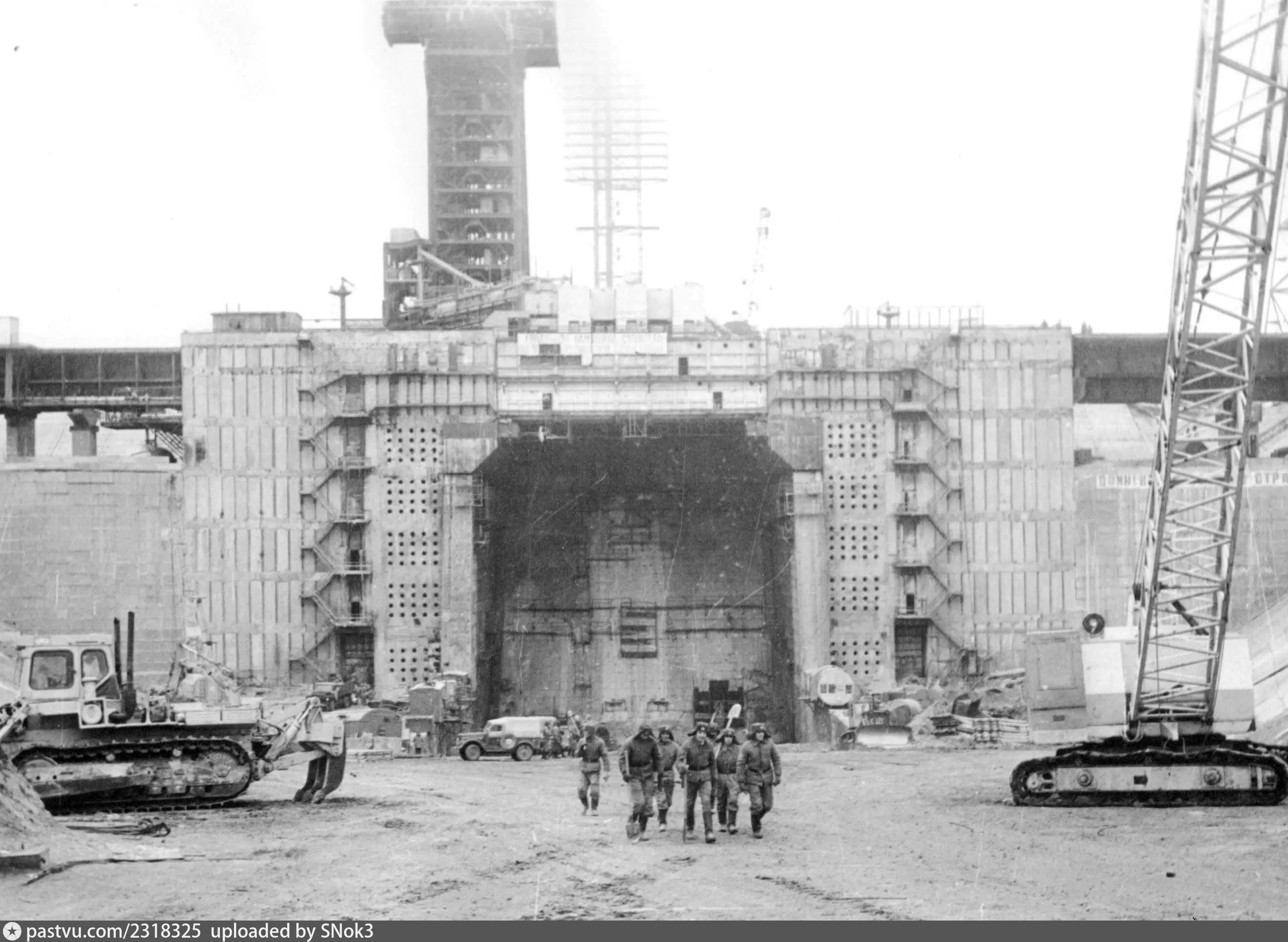
Baikonur, in the Kazakh steppe, is the clearest case of military builders creating a whole place from nothing: the launch complexes, and the town that housed the people who ran them. The steppe site had no town, no water supply and no roads, and the builders in uniform came first.
The start, 1955. According to the chronology in Russian Wikipedia’s Baikonur article, the first unit of military builders arrived at the Tyura-Tam siding on 12 January 1955 to prepare quarters and set up the construction and assembly infrastructure, and the work of building the settlement began. The joint decision of the Council of Ministers and the Party Presidium to create a test range for intercontinental ballistic missiles is dated 12 February 1955 (the range’s area carried the working code name “Taiga” in the first half of 1955), and 2 June 1955 is counted as the official birthday of the cosmodrome. Major General Georgy Shubnikov, a builder, was named head of construction. [DOCUMENTED, Russian Wikipedia; the 12 February date and Shubnikov also appear in a Presidential Library page and a newspaper history reached in web searches]
Dugouts and the first house. At first the military builders lived in tents; in spring the first dugouts (землянки) appeared on the bank of the Syr Darya, and on 5 May 1955 the first permanent (wooden) building of the residential settlement was laid. A collection of veterans’ memoirs, Unknown Baikonur, says that the soldiers of the military construction units lived mostly in dugouts, while barracks and prefabricated shield-houses went up for others. Construction of the first launch pad began on 20 July 1955. [DOCUMENTED for the dates in Russian Wikipedia; FIELD ACCOUNT for the dugout life]
The first complex and the first town. A special commission accepted the first launch complex of the range on 5 May 1957, and the first R-7 was set on it the next day; the first R-7 test launch took place on 15 May 1957, and Sputnik went up on 4 October 1957. The residential settlement, the range’s administrative center, had the unofficial name Zarya (“Dawn”) and on 29 January 1958 got the official name Leninsky, later the city of Leninsk; it was renamed Baikonur in 1995. [DOCUMENTED, Russian Wikipedia] The complex of range and city today comprises 15 launch complexes of nine types, 4 launchers for ICBM tests and 11 assembly-and-test buildings, on the Russian Wikipedia count. [DOCUMENTED]
Who exactly. The construction work is credited in web sources to military construction units, and the Defense Ministry builder for this kind of special work was the Main Directorate of Special Construction (GUSS), whose profile from 1963 explicitly included space and missile-nuclear infrastructure (see the special construction section above). Unit numbers for the 1950s detachments on Site 1, Site 31, the Proton sites, Site 45 and others were not found, and an explicit link to a numbered works directorate such as a “No. 9” could not be confirmed. [UNKNOWN for unit numbers; the general role of military builders is DOCUMENTED]
Energia-Buran, 1978–1988. The photograph reproduced above was identified from the PastVu photo-archive listing as the construction of the universal stand-start complex (УКСС, site 250) at Baikonur, 1978–1982, built for the Energia launcher that carried the Buran shuttle; the soldiers in field jackets in the foreground are consistent with military builders on that site, but the listing does not say which units they were. [DOCUMENTED for the identification of the site and dates by the PastVu listing; the soldiers’ unit UNKNOWN] Site 110 was the Buran-class orbiter launch site, and Energia-Buran’s single orbital flight, an uncrewed one, took place on 15 November 1988. [DOCUMENTED, widely published] No count of soldier-builders on site 250, 110 or 112 (or on the Buran runway), no list of units, and no casualty tally turned up. [UNKNOWN]
BAM AND THE RAILWAY TROOPS
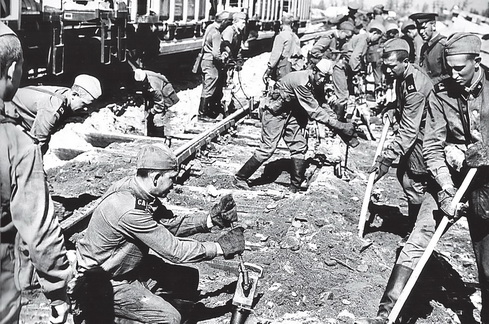
The Baikal-Amur Mainline is the project people most often attach to the stroibat, and it needs careful handling. The eastern section, Tynda to Komsomolsk-on-Amur, 1,475 km of main line and 535 km of station tracks, was assigned to the Railway Troops, a separate arm. By an order of the USSR Minister of Defense of 31 July 1974, the Railway Troops sent two railway corps there, the 35th (headquarters formed at Sverdlovsk and arriving at Tynda on 3 September 1974) and the 1st (moved from Kharkov to Chegdomyn), with the 1st, 4th, 7th, 35th, 37th and 39th railway brigades, 40,180 men in total. The first detachment of railway soldiers went into the taiga on 21 May 1974. [DOCUMENTED, veterans’ association report and Military-Historical Journal]
In ten years the railway soldiers laid 1,449 km of main track and more than 330 km of station tracks and moved over 220 million cubic metres of earth (the Military-Historical Journal says 223 million). The artificial-structure count differs between two documents: 1,217 in the veterans’ report and 1,227 in the Journal. More than 56,000 railway soldiers received the medal “For the Construction of the Baikal-Amur Mainline”, and the Journal reports that the Railway Troops’ military council informed the Party leadership on 18 April 1984 that through train traffic had opened over the whole eastern section. [DOCUMENTED; CONFLICT on the structure count]
Where were the stroibat? Military builders in the narrower sense were most likely in the supporting civilian contractors; the Journal says the Ministry of Transport Construction (Mintransstroy) also built on BAM, and living-and-civil building in the railway settlements was done by crews from union republics and Russian regions, with workers from 17 sponsoring organizations on the eastern section. A collectors’ listing refers to a military tunnel detachment attached to Bamtonnelstroy for the Severomuysky tunnel. [FIELD ACCOUNT, single collector’s listing] No total for the number of ВСО men on BAM was found. [UNKNOWN] The Komsomol side of the story is documented: in April 1974 the 17th Komsomol Congress declared BAM an all-Union shock Komsomol project and a first detachment of 600 left the hall for Ust-Kut and Tynda. An Omsk University history article describes Komsomol members in civilian clothes and in military uniform as the mass workforce that replaced the cheap prisoner labor of the Stalin period. [DOCUMENTED, single academic article]
So for the record: BAM’s eastern section was mostly Railway Troops, which will get their own article. The stroibat’s part on BAM is real but unquantified.
DAMS, MINES, ROADS AND POWER
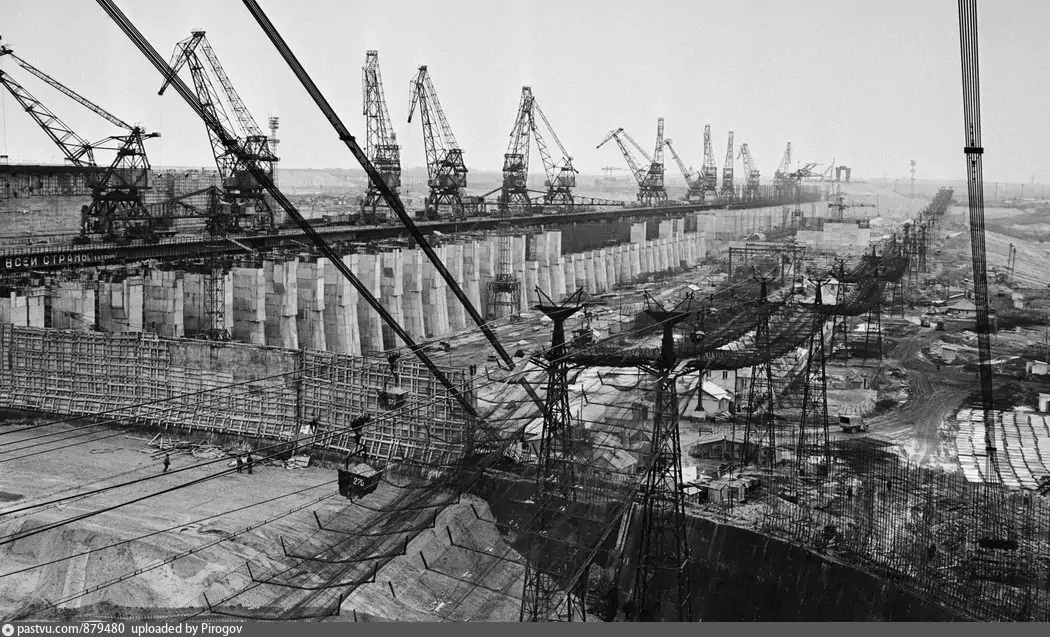
Large hydropower, coal mining and road building were the civil jobs the construction levy was invented for. The 1956 report lists conscripted workers sent to the coal ministry for new mines and open pits (41,665 in 1953 and 1955), to construction site No. 508 at Sovetskaya Gavan (7,000) and to the Tbilisi metro (2,500), plus a special road-construction corps of 43,903 under the highways ministry. [DOCUMENTED, via Russian Wikipedia]
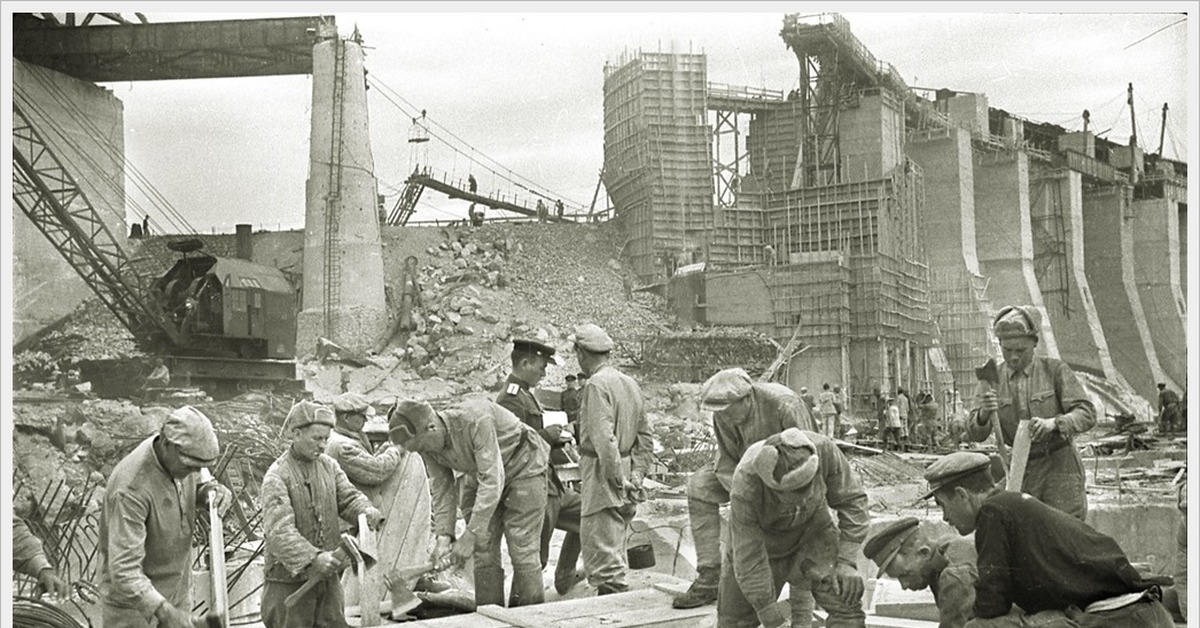
For the named dams, no counts of military builders were found: Sayano-Shushenskaya, Krasnoyarsk, Bratsk, Ust-Ilimsk, Nurek and the Volga stations. Official summaries stress Komsomol volunteers; web searches could not link specific units to Kama or KAMAZ construction or to the Tyumen oil and gas fields. [UNKNOWN] The panorama above was identified from the PastVu archive listing as the Stalingrad (Volga) hydroelectric station under construction, 1958, in a TASS photograph. [DOCUMENTED for that identification; who did the work UNKNOWN] It is a view of a great Soviet building site, not proof that the stroibat built that dam. The dam photograph in the 1950s section comes without a site label and is not identified here.
MOSCOW 1980: THE OLYMPICS
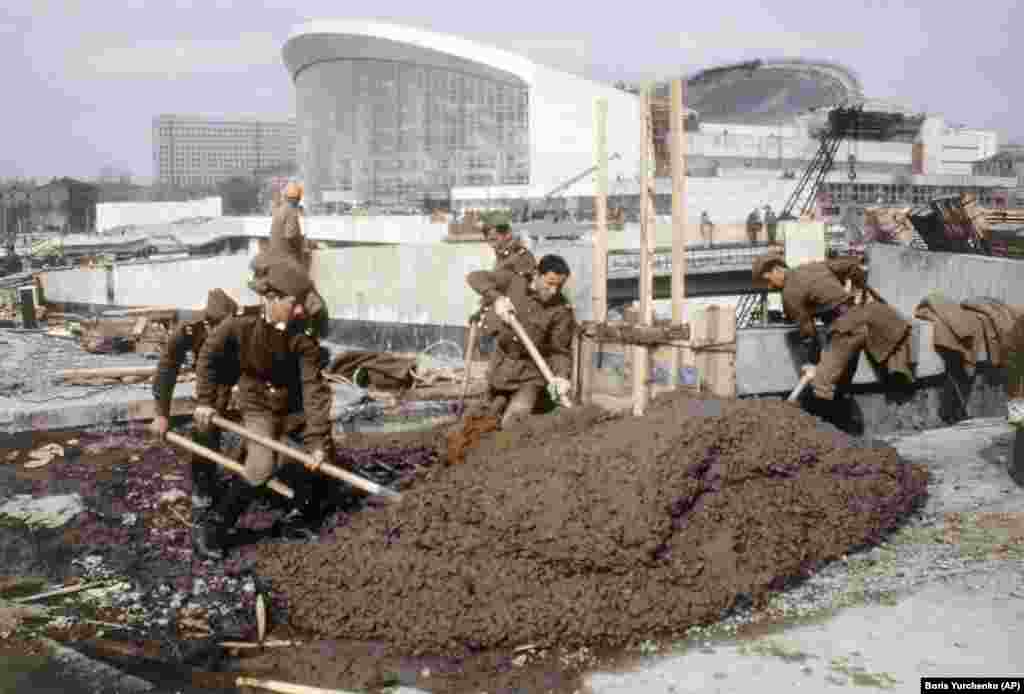
The 1980 Summer Olympic Games in Moscow were a rush job in which the Defense Ministry’s builders had a documented part. GVSU “Center” was the Defense Ministry’s Moscow contractor, and Russian Wikipedia says it built objects of the Olympics. [DOCUMENTED via Russian Wikipedia] The Olympic Sports Complex (Олимпийский), built on the site of the Burevestnik stadium, started in 1977 according to a Moscow city source. [DOCUMENTED, mos.ru, 2016] GlobalSecurity, reached through a web search, says military construction units did major work on the Olympic venues and on the Hotel Rossiya. [SINGLE-SOURCE; the Hotel Rossiya attribution was not checked and is UNVERIFIED]
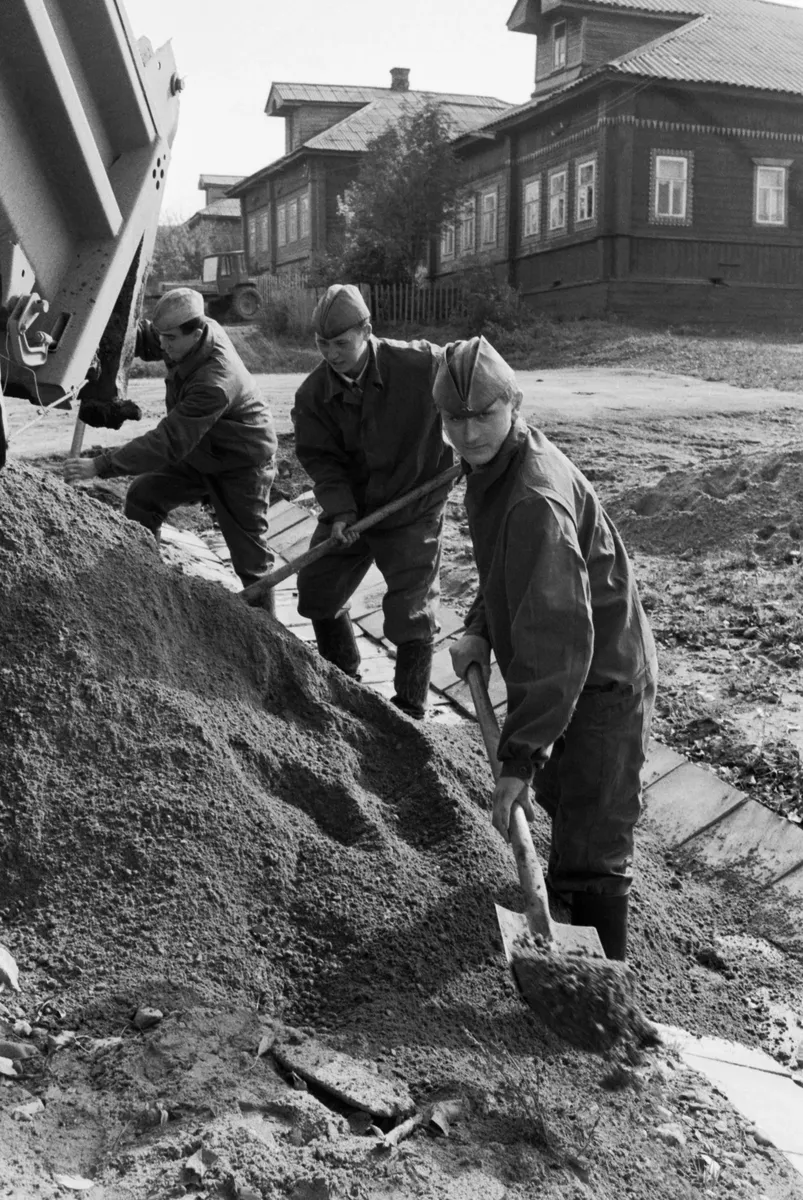
What was not found: a published count of soldier-builders at the Games, a list of which venues they built, or the construction firms by site. Hotel Izmailovo, Sheremetyevo-2, the Ostankino TV tower, the Tallinn yachting centre and the venues in Leningrad, Kiev and Minsk produced no stroibat attribution in official sources; a livejournal memoir mentions a conscript posted to a stroibat unit in Moscow connected with Sheremetyevo-2. [FIELD ACCOUNT; the rest UNKNOWN] Soldiers shovelling and landscaping around finished halls is the kind of work the Soviet press photographed in that period, and the photograph above shows exactly that, though it was identified only by its AP credit and not by a venue label here. [SPECULATION on the venue]
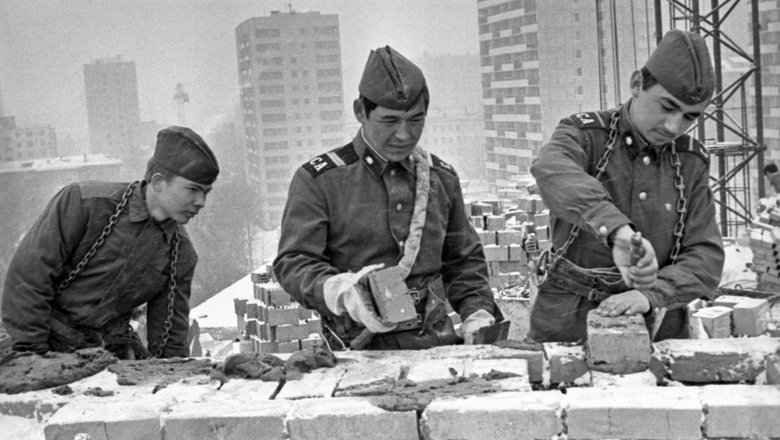
Moscow housing is the longer story: GVSU “Center” built mainly in the Moscow Military District, and the brickwork seen at the top of this article, soldiers with safety chains on a high-rise in the Moscow suburbs, is a typical piece of the military housing-and-quarters work the same organizations did. [SPECULATION on the location]
AFGHANISTAN: THE 342nd
The Afghan war was the one place where a military construction organization worked in a combat zone. The 342nd Works-Engineering Directorate (342-е УИР) was part of the Limited Contingent of Soviet Forces from 1 October 1980 to 30 May 1987, with headquarters in Kabul. It put up hundreds of military towns with full infrastructure, and built bridges and roads across the country. Its units included separate military construction battalions at Puli-Khumri (1110th), Khairaton (1112th), Kunduz (1630th), Shindand (1705th), Bagram (1707th) and Kabul (1708th), construction-installation battalions for electrical and plumbing work, and two separate military construction companies (773rd at Khairaton, 774th at Kabul). The 159th Separate Road-Construction Brigade, later subordinated to the 342nd, had before 1982 road-mechanization battalions in Kabul and Shindand and motor-transport and repair battalions at Shindand, Kabul and Puli-Khumri. [DOCUMENTED, via Russian Wikipedia]
CHERNOBYL, 1986
After the April 1986 explosion at the fourth unit of the Chernobyl plant (see the RBMK article for the reactor), the state built the “Shelter” (Объект «Укрытие», the sarcophagus) over the destroyed unit with military builders at the center of the effort. A Rosatom history site reports that Construction Directorate No. 605 (УС-605) of the Ministry of Medium Machine Building was set up by order of Minister Yefim Slavsky on 20 May 1986 to build the Shelter, and a regional museum source says the directorate commanded a military construction complex of two military construction regiments, a military construction detachment, a sanitary-epidemiological detachment and support units. Gennady Lykov, head of Novosibirsk’s Sibakademstroy, was named to lead it. The first shift of builders is placed on 21 May 1986. [SINGLE-SOURCE for each item, from Rosatom-history and museum pages]
The Shelter was built in 206 days, with about 400,000 cubic metres of concrete mix and 7,000 tonnes of metal structure, using a rotational (shift) method by military construction units, on Russian Wikipedia’s figures as reported in web summaries. [SINGLE-SOURCE] A newspaper page says 250,000 military construction personnel took part in building the Shelter. [CONTESTED and not adopted here: it sits beside a Russian-literature total of 526,250 liquidators of all kinds for 1986–1992, for which UNSCEAR uses different criteria. A figure for one structure that is nearly half of that whole is hard to believe. [SPECULATION] The true number of builders is UNKNOWN.]
The OECD Nuclear Energy Agency reports that the annual dose limit for liquidators was 250 mSv in 1986, cut to 100 mSv in 1987 and 50 mSv in 1988. [DOCUMENTED, OECD NEA] “Partisans” (партизаны), reservists called through medical commissions for the cleanup, were a different group from the conscript builders. [FIELD ACCOUNT] Some builders of the new town of Slavutych were later granted liquidator status. [FIELD ACCOUNT, social-media post]
DAILY LIFE
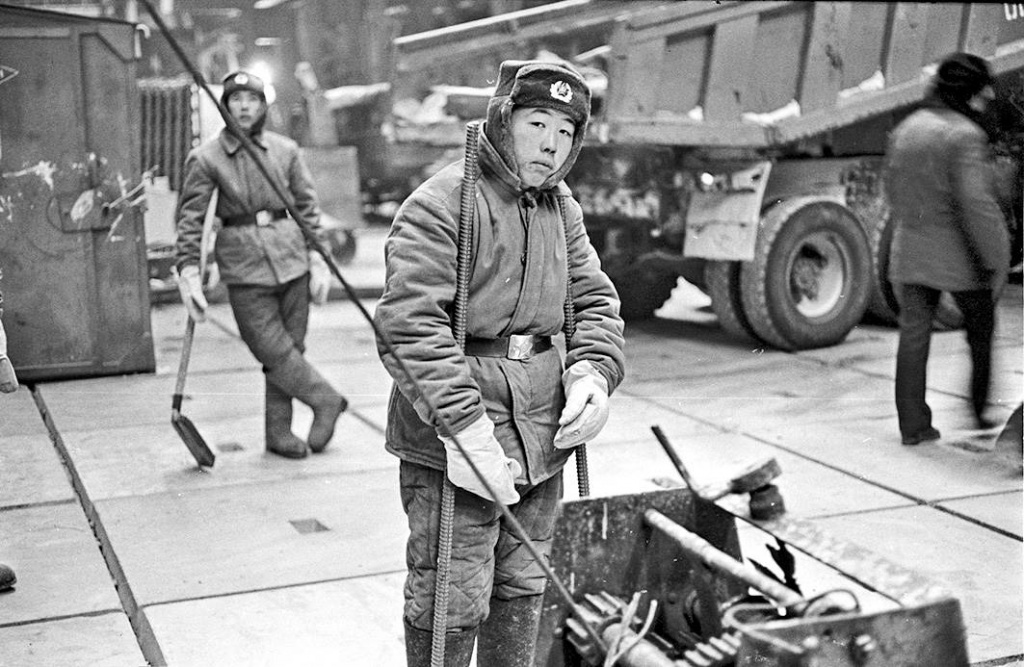
A conscript builder’s day was a shift of manual labor under a foreman, usually a sergeant who doubled as brigade leader (бригадир): digging, hauling, concrete work, bricklaying, rebar, loading, for as long as the site demanded, often longer than a normal army day. The home was a barracks in a garrison or a temporary field camp, and field camps on projects far from towns were described as particularly harsh in winter. Nobody learned to shoot or march much: one memoir summary says that soldiers in the stroibat did not learn to shoot or drill on the parade ground. [FIELD ACCOUNT, video and blog memoirs]
Some of the work was off the books. Shabashka (шабашка) was unofficial paid work for a private customer, and shabashnik a worker who took it; in the stroibat officers and civilian contractors hired soldiers to build private jobs, in exchange for money, better food or privileges. [FIELD ACCOUNT]
The work itself, as the Army saw it, was part of the job. Because the detachments paid for themselves, the officers’ real task was to meet the production plan, and the men worked to that plan. A source on Soviet construction units calls the system “self-sustaining” (самоокупаемая). Claims that soldiers “paid for their own keep” are repeated in veteran sources, and the “uniform debt” mechanism described below is the documented basis for such claims. [CONFLICT between the official status of a soldier on state allowances and the self-financing detachment, both DOCUMENTED]
PAY AND THE LEDGER
The pay system of the military construction detachments is the most unusual part of the arrangement and is documented in outline. Under the Defense Ministry’s detachment regulation, a military builder was credited a wage for his work at the site. From it were deducted the cost of food, clothing, bath-and-laundry services, cultural activities and other kinds of support, pooled in a “uniform debt” (вещевая задолженность). When he was discharged, he was sent a money transfer for what he had earned, or a writ of execution to recover the uniform debt. A man on duty roster or in the unit’s sick bay was credited the average wage of his subunit. [DOCUMENTED, via Russian Wikipedia’s account of the 1965 and 1977 regulations]
That is: the wage was real, the deductions were real, and the balance on discharge could be a payout or a bill, depending on how the detachment’s work was rated. No published sample of balances was found. [UNKNOWN]
The widely repeated figure for an ordinary Soviet conscript’s monthly pay is 3 roubles 80 kopecks. No primary source could be found for that number or for any pay table for construction units or for Afghanistan and Far North allowances. [UNVERIFIED]
HAZING AND THE REPUTATION
Dedovshchina (дедовщина, “grandfather’s rule”) was the system in which second-year conscripts exploited and beat first-year ones. In the stroibat it was reported to be among the worst, because the units had little combat training, a mix of nationalities and educational levels, supervision stretched over distant sites, and a constant stream of men sent there because the combat arms did not want them. Rear-service and construction units are repeatedly named as places of the worst hazing. [FIELD ACCOUNT and journalism; no official ranking found]
The record has one clear public marker. In May 1990, at the height of glasnost, Kommersant’s weekly Vlast carried a piece titled “The Committee of ’Stroibat’ Mothers”, on the Soldiers’ Mothers protest against sending sons to the construction units. The Gorbachev decree of 15 November 1990 ordering most of the civilian-ministry detachments disbanded is described by Russian Wikipedia as issued “under pressure of public opinion”. [DOCUMENTED for the article’s title and date and for the decree; the content of the article was not read here]
Claims that the stroibat had the highest rate of non-combat death, suicide and desertion of any service are everywhere in veteran writing. No table from the Defense Ministry, the Supreme Soviet or the military prosecutor that confirms the ranking was found. [UNVERIFIED] The 1956 report quoted above is a documented earlier example of desertion and disorder linked to the detachment system. [DOCUMENTED]
FOLKLORE AND CULTURE
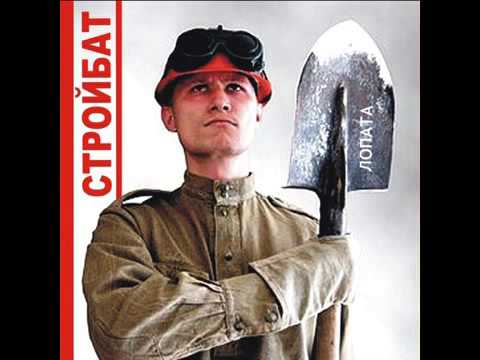
The shovel is the stroibat’s emblem. Folk verse, in a version reported from a greetings site, runs roughly: we are the lads of the stroibat, we serve honestly and wait for demobilization, our weapon is the shovel, our trench is the training ground. [FOLKLORE]
The vocabulary is the army’s general slang with a construction accent. Ded (дед) is a second-year soldier; dembel (дембель) a soldier about to be demobilized and “DMB” (ДМБ) the letters carved on everything at that moment; the dembelsky albom (дембельский альбом) is the handmade scrapbook of photographs and drawings a departing soldier took home; cherpak (черпак) a mid-service soldier, the “ladle”. Soldiers’ saying: “Demobilization is as inevitable as the collapse of imperialism”. A joke reported in a 2026 post: “One border-guard shift replaces the whole stroibat”. [FOLKLORE]
Stroibat jokes make a genre of their own: soldiers who don’t know how to do a soldier’s job doing a builder’s, orders that make no sense, the paratroopers’ glamour set against the reality of the shovel. [FOLKLORE] In literature the memoirs include Stroibat. Moya istoriya (“Stroibat. My Story”, 2019) by Alexander Erzya, about conscripts from Moldova in the “black troops”, and Stroibat. Kak eto bylo... by Sergey Urmanov. [DOCUMENTED as published titles] On screen there is the 2010 lyrical-comedy series Stroibatya (Стройбатя), about four conscripts who reach the construction troops through a criminal record, an injury or vocational training, and Roman Kachanov’s 2000 film DMB (ДМБ), on army life generally, written by Kachanov and the actor Ivan Okhlobystin from their own service. [DOCUMENTED; the screenplay credit reported by one forum summary]
The industrial-metal band Стройбат was conceived in 2004 by vocalist Ivan Soshnikov, called “Brigadir” (Бригадир), with five albums from 2005 to 2023, and its first demo material is titled «Лопата». [DOCUMENTED on the band’s VK page and a music site] The album-style cover reproduced above carries the band-like word and “shovel” and is consistent with that demo’s name, but which release it is could not be confirmed. [SPECULATION]
In culture the stroibat soldier is a tragicomic figure: a man in uniform who does not fight but does exhausting labor, held up against the “ideal” soldier as a symbol of the system’s waste of human material. [FIELD ACCOUNT and criticism]
THE END OF CONSCRIPT STROIBAT, 1990–2009
On 15 November 1990 USSR President Mikhail Gorbachev signed Decree No. UP-1048, which ordered the military construction detachments working on national-economy projects in civilian ministries and agencies disbanded in 1992, except those of the Ministry of Atomic Energy and Industry, the Ministry of Communications, Rosvostokstroy and the Main Directorate of Special Construction under the Council of Ministers. Calls into the disbanded units were to stop from the autumn of 1991, and the released manpower was to go to the Defense Ministry’s detachments. [DOCUMENTED, checked against the decree text quoted in Russian Wikipedia] Note that this order did not abolish the Defense Ministry’s own units or end the system for the exempted ministries, a nuance that several shorter accounts, including some web summaries, lose.
After the Soviet Union ended, the Russian Armed Forces were created on 7 May 1992; the pace of disbanding slowed. Law No. 4455-1 of 11 February 1993 on military duty and military service, with the Supreme Soviet Resolution No. 4457-1 that put it into force, told the President and the Government in its Article 13 (of the resolution) to finish the disbanding of civilian-ministry detachments on the schedule already set. Presidential Decree No. 2140 of 14 December 1993 extended the general military regulations to military builders of the Defense Ministry and other ministries. By the early 2000s, 918 detachments, 119 separate companies and about 40 other units, over 450,000 people, had been cut; the Defense Ministry’s own units were thinned only partly. [DOCUMENTED, via Russian Wikipedia]
The last stage came in the 2000s. In 2002 special construction passed from the Defense Ministry’s military construction complex to Spetsstroy of Russia, and the complex was turned fully to the ministry’s own housing and non-housing stock. A 2003 Presidential Decree (No. 1365) removed the category “military builders” from the regulations. A Government Order of 19 January 2005 (No. 38-r) began the liquidation of the Defense Ministry’s military construction bodies, with some transferred to Spetsstroy, and in 2006 Defense Minister Sergei Ivanov announced that by the end of the year no “stroibats” would be left in the ministry. The process in fact ran to 2007 at least, and in some cases to 2009. [DOCUMENTED, via Russian Wikipedia]
SPETSSTROY, VSK AND NOVEMBER 2026
Spetsstroy. The special-construction line ran as follows: Glavspetsstroy under the USSR Council of Ministers (from 5 September 1990), Glavspetsstroy of the RSFSR (from 28 November 1991), Rosspetsstroy in the 1990s (20,000 authorized military posts), a Federal Directorate for Special Construction under Gosstroy created by Decree No. 174 of 4 February 1999, then a federal executive body from 27 August 1999, and the Federal Agency for Special Construction (renamed 9 March 2004). A reform from late 2010 began disbanding its engineering-technical formations; in August 2011 its director, Grigory Naginsky, said that the agency would separate fully from the Defense Ministry by the end of the year, that more than 3,000 military builders would be discharged, and that no conscripts would remain, to be replaced by workers from “friendly republics”. On 29 December 2016 Decree No. 727 abolished the agency; its functions and all its military formations went to the Defense Ministry from 1 July 2017 (liquidation extended to 1 October 2017 by a Government order of 14 February 2017), merging into the ministry’s military construction complex. Some military analysts concluded from this that military construction formations were being re-created in the Russian Army on the basis of the former Spetsstroy formations. [DOCUMENTED, via Russian Wikipedia and legal-database listings found in web searches]
VSK. The Military Construction Company (Военно-строительная компания, ВСК), a public-law company under the Defense Ministry’s construction department, was set up by presidential decree on 18 October 2019. It groups at least eleven organizations, including enterprises linked to the four military districts and the Northern Fleet and specialized enterprises for roads and airfields, berths and hydraulic works, and general construction, and it names itself the national leader in special, strategic and socially significant construction for the Armed Forces, with work credited on the Vostochny Cosmodrome and Patriot Park. [SINGLE-SOURCE, the company’s own site and press reports; the decree number was not verified and is UNVERIFIED]
27 November 2026. RBC reported on the day this article was written that Deputy Defense Minister Lieutenant General Pavel Fradkov, speaking to the Vesti news service, said that as part of a reform of the military construction sector the ministry will form military construction units “from conscripts and contract soldiers”, and that the General Staff and the ministry are now working out “the order, timing and manning” of their formation. The units will fit out military towns and build infrastructure with restricted access for civilians. In August the Defense Ministry had said that the Armed Forces’ authorized strength was raised by 27,000 to form separate military construction units, citing the special requirements of the construction work and secrecy; RBC says the decree was signed on 27 July and raised the strength by about 27,000 to 2,426,130, and that at the end of September the President raised it by another 15,000 to 2,441,630. General of the Army Anatoly Grebenyuk, quoted by RBC, said “the restoration of military builders is beginning”, first for the fitting out of military towns in remote garrisons and second for serious military infrastructure where not every civilian is admitted. [DOCUMENTED, RBC, 27 November 2026, page read in full for this article]
A web search also found a Radio Svoboda headline that Russian stroibats “will appear again as in the USSR”. [DOCUMENTED as a headline; the article was not read] Whether these will be a new ВСО-type self-financing worker status, a Soviet-style conscript pool, or something closer to the engineering-technical formations of Spetsstroy in 2016 is not in the public record yet. [UNKNOWN] The one clear difference from the Soviet model is the stated manning: conscripts and contract soldiers together, not conscripts alone. [DOCUMENTED]
COMPARED WITH OTHER COUNTRIES
Military construction formations exist in many armies, mostly the large ones, and the largest by number is the US Army Corps of Engineers on the Russian Wikipedia comparison. In North Korea, by the same account, there are no civilian construction organizations at all and all building is done by the military builders of the Korean People’s Army. Bulgaria made its construction troops a separate arm of service, which the USSR never did. [DOCUMENTED, via Russian Wikipedia]
The German parallels are the Todt Organization and the Reich Labor Service (RAD). Service in them started as a kind of civil service for German citizens, but from November 1942 German personnel of the Todt Organization, and from spring 1944 other nationalities, were made equal in status to Wehrmacht servicemen, and from spring 1944 the RAD was likewise. [DOCUMENTED, via Russian Wikipedia] The Soviet construction units differed from both in having been drawn out of the regular annual draft for peacetime use in the civilian economy, in the self-financing detachment form, and in a legal status that left their members formally in uniform and formally workers at the same time.
RAILWAY TROOPS AND PIPELINE TROOPS
Two neighbors of the stroibat in Soviet usage are queued for their own articles on this site: the Railway Troops (Железнодорожные войска), who built the eastern BAM and rebuilt wartime rail, and the Pipeline Troops (Трубопроводные войска), the Defense Ministry’s rear-service formation for fuel pipelines. Neither article exists on the site yet, so there is no link here. The short version: they were units of the military, with their own commands and soldiers trained in their trades, not labor loans to civilian ministries. Where web sources say “stroibat built the BAM” or “stroibat laid the pipelines”, they usually mean one of those two. [DOCUMENTED for the BAM role of the Railway Troops; the Pipeline Troops remark is a general characterization to be checked in its own article]
WHAT IS UNCERTAIN IN THIS ARTICLE
A short list, so it is not buried in the sections:
TIMELINE
1881: Imperial Army’s engineer, worker, railway and telegraph auxiliary troops. [DOCUMENTED]
1918: “Rear militia” created for liable-but-untrusted “non-labor elements”. [DOCUMENTED]
1920: Red Army “labor armies”. [DOCUMENTED]
20 February 1937: NKO Order No. 020 turns the Directorate of the Rear Militia into the Directorate of Construction Units of the Red Army. [DOCUMENTED]
1941–1945: Military construction units on the fronts and in the armies. [DOCUMENTED]
23 January 1951: GUSS established from the prewar Defense Construction Directorate. [DOCUMENTED]
March 1954: Military construction units on heavy work for the atomic ministry, in a veteran-archive account. [FIELD ACCOUNT]
12 January 1955: First unit of military builders arrives at Tyura-Tam; 12 February 1955 decision creating the Baikonur range; 5 May 1957 first launch complex accepted; 29 January 1958 the settlement named Leninsky. [DOCUMENTED, Russian Wikipedia]
October–December 1955: 111 detachments formed for powder and explosives plants. [DOCUMENTED]
Early 1956: 733,087 men in civilian-ministry formations; Zhukov and Sokolovsky report on the unconstitutionality of the practice. [DOCUMENTED, original not seen]
June 1957: GUSS merges into GUASS; split again in 1963. [DOCUMENTED]
27 January 1964; 18 September 1964; 8 March 1965: GVSU “Center” formed; “military builders” term set by Decree No. 787; the detachment regulation (Order No. 60) takes effect. [DOCUMENTED]
1969–1994: Sleeve patch for military builders and construction-unit servicemen. [DOCUMENTED]
1974–1984: BAM eastern section, built by the Railway Troops (orders of 31 July 1974). [DOCUMENTED]
1977; 1978–1982: Olympic Sports Complex begun in Moscow; Baikonur site-250 stand-start complex built. [DOCUMENTED]
1 October 1980–30 May 1987: 342nd Works-Engineering Directorate in Afghanistan. [DOCUMENTED]
1980: Moscow Olympics. [DOCUMENTED]
20 May 1986: Construction Directorate No. 605 formed for the Chernobyl Shelter. [SINGLE-SOURCE]
May 1990; June 1990: Kommersant’s piece on the “stroibat mothers”; Katusev’s report to the Supreme Soviet committee. [DOCUMENTED as to titles and citations]
15 November 1990: Decree No. UP-1048. [DOCUMENTED]
Autumn 1991: Calls into the covered civilian-ministry detachments stop. [DOCUMENTED]
11 February 1993; 14 December 1993: Russian law on military duty; decree on general regulations for military builders. [DOCUMENTED]
19 January 2005; 2006; 2007–2009: Order No. 38-r; Ivanov says no stroibats left in the ministry; liquidation continues. [DOCUMENTED]
August 2011; 29 December 2016; 1 July / 1 October 2017: Spetsstroy told to separate; Decree No. 727; Spetsstroy’s functions pass to the Defense Ministry. [DOCUMENTED]
18 October 2019: Military Construction Company created. [SINGLE-SOURCE on the date]
27 July; August; late September 2026: Decree raising authorized strength by about 27,000; Defense Ministry statement; second increase of 15,000. [DOCUMENTED, RBC]
27 November 2026: Fradkov announces new military construction units of conscripts and contract soldiers. [DOCUMENTED, RBC]
RUSSIAN TERMS USED IN THIS ARTICLE
IN ONE SENTENCE
The stroibat was the Soviet system of drafting several hundred thousand young men, many of them chosen for trades, poor health, past convictions or weak Russian, into a self-financing army of uniformed builders who dug the silos, poured the launch pads and raised the apartment blocks, kept a legal status somewhere between soldier and worker, earned a worse reputation than it perhaps always deserved, was mostly wound down between 1990 and 2009, and, on 27 November 2026, was announced to be returning.
SOURCES
Plain-text citations only. No outside hyperlinks. Five items were spot-checked for this article: the RBC report of 27 November 2026 on the new military construction units (read in full); the Russian Wikipedia article “Строительные войска” (read in the relevant parts and used to check the 1990 decree UP-1048, the 1956 figures, the recruitment summary and the Spetsstroy chronology against the decree text the article quotes); the BAM role of the Railway Troops against a veterans’ report and the Military-Historical Journal; and the early construction of Baikonur and the town of Leninsk (Russian Wikipedia’s chronology); the identification of two reader-supplied photographs against PastVu archive listings. Everything else was assembled from web-search research, with each claim tagged. Where a search result gave a claim that a spot-check contradicted or narrowed, as with Decree UP-1048 (which exempted several ministries and did not abolish the Defense Ministry’s own units), the checked version is used.
Project Orlan Data Base // public encyclopedia