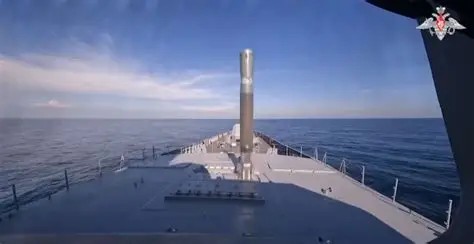
A Zircon leaving a 3S14 vertical launch cell still inside its protective canister. Russian MoD. The canister shields the missile during cold/hot egress from the cell before the booster fully clears the deck.
WHAT IT IS
The 3M22 Zircon (Russian "Tsirkon", Циркон; complex 3K22; NATO SS-N-33; a later variant is reported as 3M22M) is a Russian ship-, submarine- and coast-launched hypersonic anti-ship missile that can also be used as a land-attack weapon (as in the February and March 2024 strikes on Kyiv), built by NPO Mashinostroyeniya in Reutov, the same bureau behind the P-700 Granit and the P-800 Oniks. Russia calls it a hypersonic cruise missile powered by a scramjet, flying at Mach 8 to 9. Ukrainian intelligence, which has examined debris, calls it a two-stage solid-fuel missile on a quasi-ballistic path. This article follows the same layout as the Kh-47M2 Kinzhal article: what is actually confirmed, how the missile must work, the physics behind it, the site owner's analysis, and then each published claim examined one by one. Very little reliable information exists on this weapon, so every figure is labelled, and much of the analysis is reasoning rather than sourced fact.
WHAT IS CONFIRMED
SPECIFICATIONS (WITH CONFLICTS)
| Item | Figure | Conflict / note |
| Length | about 8-10 m (commonly 9 m) | Fits the long 3S14 cell |
| Diameter | 0.60 m (common); 0.666 m (GUR model) | Either way wider than a 533 mm tube |
| Launch mass | not published | 3-4 t is often quoted without a source |
| Propulsion | Russia: solid booster + scramjet | GUR: two solid-fuel stages, no scramjet |
| Speed | Russia: Mach 8-9 | GUR: Mach 6.8 highest recorded, not held; about Mach 4.5 terminal (one Ukrainian spokesman) |
| Altitude | 28 km (Oct 2020 test) | 30-40 km cruise often quoted |
| Range | Russia: up to 1,000 km | Timed tests 350-450 km |
| Warhead | Russia/media: 300-400 kg | GUR/KNDISE: about 120 kg, no more than 40 kg explosive; other Ukrainian research 150-200 kg |
| Guidance | INS in cruise, 3B222 active radar seeker at the end (GUR) | No satellite or datalink module in GUR's public list |
HOW IT WORKS
Launch. The missile sits in a sealed canister in a 3S14 cell (or a Yasen silo, or a Bastion canister on a truck). A solid booster fires it straight up out of the cell; it then pitches over toward the target and climbs. A nose cap protects it during the launch and is jettisoned; GUR says the fairing carries small orientation thrusters for the initial turn.
A Zircon leaving a 3S14 vertical launch cell still inside its protective canister. Russian MoD. The canister shields the missile during cold/hot egress from the cell before the booster fully clears the deck.
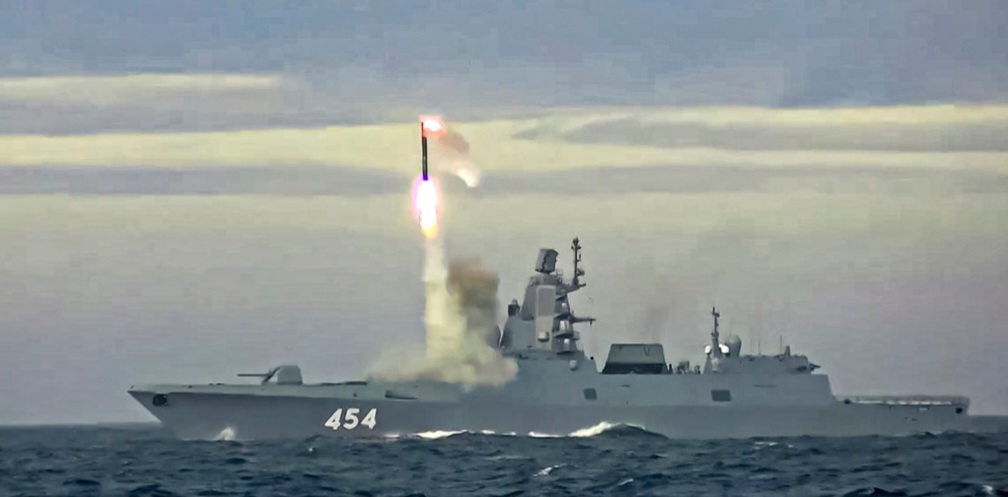
A Zircon launch from the vertical cells of the frigate Admiral Gorshkov (454). Real launch photo, Russian MoD. Note the early pitch-over just above the cell, which looks very much like an Oniks launch from the same type of cell.
Cruise. It flies high, at about 28 to 40 km, where the air is only 1 to 2 percent as dense as at sea level. Thin air means less drag and less heating, which is how a missile keeps a hypersonic speed for a useful distance. Whether something is pushing it along up there (a scramjet) or it is simply coasting and gliding after a rocket burn is the central question of this article.
Terminal. Near the target it dives into thicker air. Drag rises steeply and it slows down. Ukraine puts it at about Mach 4.5 in the final phase over Kyiv, and Kyiv's forensic lab estimated no more than about 2,500 km/h from the debris. It does not sea-skim; no source shows a low run at the end.
Guidance. An inertial navigation system (INS) carries it through the cruise. According to GUR an active radar seeker, the 3B222 by NPP Radar MMS (the same firm that makes the Kinzhal's seeker), takes over at the end. GUR also lists a 3B228 "radio-technical protection" unit, which is most likely an onboard jammer, and a Baget-83 flight computer, the type used in Russian ballistic missiles.
THE SITE OWNER'S ANALYSIS
This section is the core of the article. It is the site owner's reasoning, connecting the few available facts, and it is labelled as such. There is no flight video of the Zircon like the footage used in the Kinzhal article, so this is built from test timings, sizes, physics and the role the missile has to fill.
1. It has to beat the Granit and the Oniks. The Zircon was developed to replace the big Soviet anti-ship missiles: the P-700 Granit and the P-500 Bazalt / P-1000 Vulkan family (NATO SS-N-12 Sandbox), and to go beyond the P-800 Oniks. Its cost and development only make sense if it is clearly better at anti-ship work than those. It is meant to arm smaller ships and submarines from standard cells, and big ones too: the refitted battlecruiser Admiral Nakhimov has had its 20 large Granit tubes replaced with 80 3S14 cells for Zircon, Oniks and Kalibr. She is in trials and basically complete, but not yet officially accepted.
2. Up high, speed is its only defence. At 30 to 40 km the Zircon is not sea-skimming. A sea-skimmer at 5 to 10 m stays below a ship's radar horizon until about 30 km out. A missile at 30 to 40 km is above the horizon from roughly 700 to 840 km away, so the radar's power, not the curve of the Earth, decides when it is seen. The only way to make up for being visible that far out is to be very fast, so the defender has as little time as possible to react.
3. INS alone cannot hit a ship. An INS can only guide the missile to one place, set at launch. That is fine against a fixed land target. Against a ship it is like the battleships of old and their gunnery computers, lobbing shells and trying to work out where the enemy ship would be when they landed: if the ship turns or changes speed at all during the flight, the missile arrives at an empty patch of sea. A missile meant for ships therefore needs an active seeker that looks at the real target at the end.
4. So by design it has to slow down. While it is hypersonic, the plasma sheath (below) blinds a forward-looking radar seeker. To use that seeker, the missile must, by design, slow down enough at the end for the plasma to clear, roughly below Mach 5. That matches Ukraine's Mach 4.5 terminal figure and a 2023 Western think-tank (RUSI) argument that it must slow "well short of hypersonic" to track a ship.
5. A scramjet cannot work that slowly. A scramjet (supersonic-combustion ramjet) has no compressor; it relies on the missile's own hypersonic speed to ram and compress the air, and the air flows through the engine supersonically. Below roughly Mach 5 it no longer works well, and once the missile slows for its seeker the scramjet is effectively dead. That fits a rocket boost to high speed, then a coast or glide, then a terminal slowdown, much better than a sustained scramjet cruise.
6. The timed test is the strongest evidence. Russia's 7 October 2020 test covered 450 km in 4.5 minutes. That is about 1.67 km/s, an average of roughly Mach 5.5, against a claimed "more than Mach 8". A missile cruising on a scramjet at Mach 8 would average close to its top speed after a short boost. An average of about two-thirds of the peak is what a boost, a peak, then a slowing coast looks like. An average near Mach 5.5 is also right at the low edge of where a scramjet works well. It is still hypersonic, but it is not the Mach 8-plus scramjet weapon in the headlines.
7. Size and fuel. Solid rocket propellant packs much more energy into a given volume than the liquid hydrocarbon fuel a scramjet would burn, and a rocket needs no air intake or long combustor. A small, 0.6 m cell-sized missile therefore favours a rocket. The site owner's view is that a real long-range scramjet missile would need to be larger than a standard 3S14 cell allows, something more like the old Granit tubes.
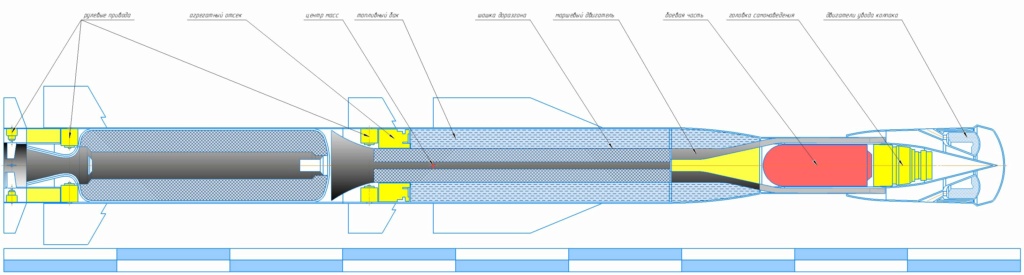
Russian forum render of a rocket layout: seeker, warhead and solid motor stages, with no air intake. Not official, but it fits the canister the missile leaves the cell in.
8. The rocket layout fits the canister. The Russian forum diagram above shows the Zircon as a rocket: seeker, warhead and solid stages, with no intake. It fits the canister seen coming out of the cell, and it lines it up with the Kinzhal and the 9K720 Iskander family: rockets sold as "hypersonic" that get their speed from a solid motor, not an air-breathing engine.
9. Not a Kilo weapon. The Kilo-class submarine fires the Kalibr from its 533 mm torpedo tubes, but the Kalibr is sized for that. At 0.6 to 0.67 m wide and about 9 m long, the Zircon will not fit, and no source claims a torpedo-tube version. It needs large vertical cells: the Gorshkov frigates, the Yasen silos, the Nakhimov and the Bastion.
The site owner's conclusion. The evidence leans toward a two-stage solid, quasi-ballistic missile: boost to about Mach 6 to 7, a high coast and glide at 28 to 40 km on INS, then a dive and slowdown into the seeker window. A scramjet cannot be ruled out entirely; one could burn for part of the flight. But the timed test, the size, the fuel, the seeker requirement and the hardware all point the same way.
THE PLASMA SHEATH AND THE SEEKER
What it is. At hypersonic speed the air in front of the missile is compressed and heated so strongly in the shock layer that molecules break apart and electrons are knocked loose. The result is a layer of ionised gas, plasma, wrapped around the nose and body. Material burning off the heat shield adds to it. The density of free electrons sets a cutoff frequency: radio waves below it are reflected or absorbed, those above it get through but are weakened.
Why the Zircon's case is milder than the Kinzhal's. In thin air at 30 to 40 km there are fewer molecules to ionise, so at the same Mach number the sheath is weaker than lower down. At around 10^18 electrons per cubic metre, typical of Mach 8 to 15 at 40 to 50 km, the cutoff sits near 9 GHz, and satellite navigation is fully blocked. At the Zircon's recorded Mach 6 to 7, the blocking should be partial and depend on where the antenna sits: worst at the nose, better on the sides and rear. No one has published a measured figure for the Zircon itself, and this article does not invent one.
By band: - Satellite navigation (L-band, 1.2-1.6 GHz): the most exposed. GLONASS fixes during the hypersonic cruise are doubtful, though a side- or top-mounted antenna might get some. GUR's public parts list shows no Kometa satellite module on the Zircon, unlike the Kinzhal's. - Datalinks (L/S-band): also exposed. No datalink appears in GUR's list, so mid-course retargeting against a moving ship is not evidenced. - Radar seeker (X/Ku-band): the least affected band, but it looks forward through the nose, where the plasma is thickest. It becomes usable only once the missile has slowed in the dive, roughly below Mach 5.
The catch in the dive. Diving into thicker air at high speed at first makes heating near the nose worse, until drag bleeds the speed off. So the seeker window is late and short. That is the trade-off of an anti-ship hypersonic missile: it can be very fast or it can see, but not both at the same moment, and the slowdown it needs to see is also where defenders get their best chance. That is the window Patriot reportedly used over Kyiv.
WHY NOT GPS/GLONASS OR A DATALINK THE WHOLE WAY
Against a fixed target, satellite fixes would help accuracy, but they need the antenna to receive a weak L-band signal through the plasma, the lowest and most vulnerable band. Against a ship, a satellite fix only tells the missile where it is, not where the ship has gone; that still needs a seeker or a live datalink, and a datalink faces the same plasma. Kyiv's forensic lab said the missile "flies not where it should" against land targets, which fits a missile running on INS alone for most of its flight.
CLAIMS EXAMINED
Russia: a scramjet cruise missile at Mach 8-9. Claim: Russian officials since 2019 describe a scramjet sustainer burning a liquid hydrocarbon fuel, often named in Russian popular press as "Decilin-M", at Mach 8 to 9. Russian state media has released renders showing it as a scramjet vehicle. Evidence: no inlet appears in Russian launch footage, in a Russian patent for its launch cap, in a nose section shown in a Russian documentary, or in debris. The Decilin-M link has no primary source. The only timed test averages about Mach 5.5. Assessment: the scramjet is Russia's official design, and in theory it is what would make Mach 8 to 9 possible. The Russian MoD does distinguish "cruise" from "aero-ballistic" (it uses the second for the Kinzhal), so the label carries some weight, but it is weaker than the hardware evidence. Not ruled out; not demonstrated.
The Russian solid-propellant award. Claim: in 2023 Yuri Milekhin, head of the Soyuz Federal Dual-Technology Center, Russia's lead solid-propellant developer, was made Hero of Labour; Russian state media linked the award to a high-energy solid propellant for the Zircon. Assessment: this is a Russian source, not a Ukrainian one, and it supports the solid-fuel reading independently. A booster is solid either way, so on its own it does not rule out a liquid-fuel sustainer.
GUR (Ukrainian Defence Intelligence), August 2026. Claim: both booster and sustainer are solid-fuel; INS in cruise and a 3B222 active radar seeker at the end; a 3B228 protection unit; a Baget-83 computer; Mach 6.8 highest recorded speed; a warhead of about 120 kg; about 70 supplier companies, including US-made parts. Evidence: GUR has debris and published a 3D model and parts list, and outside analysts and Kyiv's forensic institute report matching hardware. Assessment: Ukraine is a party to the war and its sources must be verified, so these are presented as claims. Notably, the solid-motor conclusion can be reached without them, from the Russian test timing, the award and the missing inlet.
Ukrainian Air Force: about Mach 4.5 at the end; Patriot intercepts. Claim: on 25 March 2024 two Zircons fired from Crimea at Kyiv were shot down by Patriot, at a terminal speed of about Mach 4.5. Evidence: forensic work on fragments; the Mach 4.5 figure comes from one spokesman. Russia has published nothing either way. Assessment: plausible, and consistent with the slowdown the seeker needs, but single-side and unaudited. See Patriot.
Passive or "active-passive" seeker and datalink. Claim: popular explainer sites credit it with a passive homing mode and in-flight retargeting, as on the Granit and Oniks. Assessment: no credible source supports either for the Zircon. Treat as unverified.
Warhead 300-400 kg. Assessment: Russian and media figure, against about 120 kg from Ukrainian debris work. For a missile this size the smaller figure is plausible, with the missile's speed doing much of the damage. Unresolved.
What would settle the scramjet question. A clear photo or video of an air intake, or a Russian timed long-range test showing a near-constant high average speed.
LAUNCH PLATFORMS
TEST AND COMBAT HISTORY
IN ONE SENTENCE
The Zircon is sold as a Mach 8-plus scramjet cruise missile, but the only timed test, its size, its fuel and the simple fact that a missile has to slow down to see a moving ship all point to a two-stage solid rocket that boosts to about Mach 6 to 7, coasts high and blind on inertial guidance, then dives and slows so its radar seeker can find the target: still hypersonic, and still far faster than the Granit and Oniks it replaces.
RELATED
P-700 Granit and P-800 Oniks / Bastion: the missiles it replaces. Kinzhal and Iskander: the rocket "hypersonic" family. Avangard: a true hypersonic glide vehicle from the same bureau. Kalibr, Patriot, INS, GLONASS and Kometa.
SOURCES