The P-800 Oniks is a Russian supersonic anti-ship cruise missile: a 3-tonne ramjet that flies at about twice the speed of sound or more and reaches up to about 300 km in its export form. K-300P Bastion-P is the truck-mounted coastal system that fires it: big 8x8 launchers carrying two missiles each, command vehicles, reload trucks and, optionally, the Monolit-B radar for over-the-horizon target data. Russia built it to guard its coasts against ships. It has also used it against land targets in Syria and, heavily, in Ukraine, around Odesa above all. The export version, Yakhont, is the direct ancestor of India's BrahMos.
WHAT IT IS FOR
The job is to keep enemy ships away from a stretch of coast. One Bastion-P division with its eight ready missiles, and more on its reload trucks, covers a coastal sector reported as more than 600 km long from a single position. [SINGLE-SOURCE, Russian descriptions of the complex] Its main targets are surface ships: carrier groups, convoys and amphibious landing forces. [DOCUMENTED] It can also hit ground targets that stand out to radar, which is how it has been used in Syria and Ukraine. [DOCUMENTED]
Russian coastal brigades field it alongside the subsonic Kh-35 Bal complex. Bastion is the long-range, high-speed layer of coastal defence and Bal the shorter-range, cheaper one. [DOCUMENTED]
THE MISSILE: P-800 ONIKS / 3M55 / YAKHONT
Origins. NPO Mashinostroyeniya of Reutov designed the missile as a ramjet follow-on to earlier work (the P-80 Zubr line). Development began in 1983, and the missile was tested on the one-off Project 1234.7 corvette Nakat. [DOCUMENTED] The year it entered service differs by source. Russian Navy service is usually dated 2002 for the ship version and 2015 for Bastion; some references give 1999 for the export Yakhont. [Sources conflict]
Names. 3M55 Oniks is the Russian-service name, P-800 Yakhont the export name, and NATO calls it SS-N-26 Strobile. K-310 appears as the index for the Yakhont in its transport-launch canister. [DOCUMENTED]
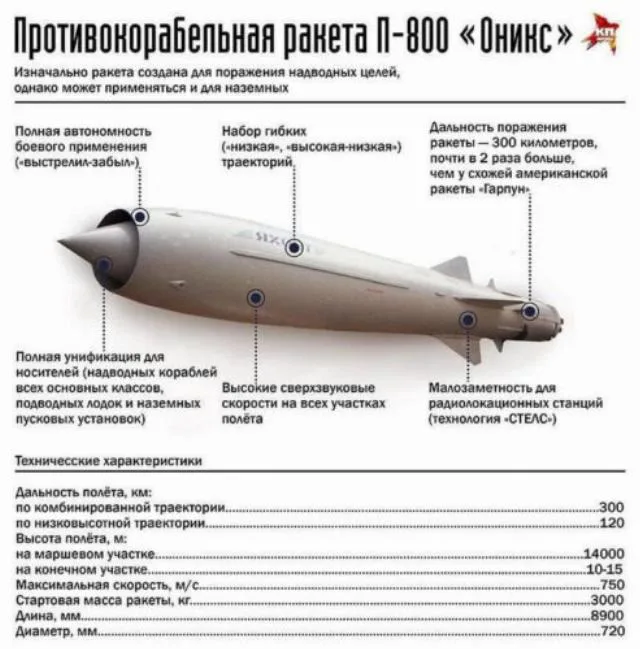
Size. Sources give a length of 8.6-8.9 m, a body diameter of 0.67-0.72 m, a wingspan of about 1.7 m and a launch mass of about 3,000-3,100 kg. [DOCUMENTED; Sources conflict on exact figures] The KP infographic below lists 8,900 mm, 720 mm and 3,000 kg.
Warhead. Sources conflict here too. Export material gives 200 kg (high-explosive or semi-armour-piercing). CSIS cites 250 kg, and Russian-version claims run to 300 kg. The national version is sometimes described as nuclear-capable. [Sources conflict; nuclear option UNVERIFIED]
The infographic is from the Russian newspaper KP. It lists 300 km range on a combined path and 120 km on an all-low path, cruise altitude of 14,000 m, terminal altitude of 10-15 m and top speed of 750 m/s. Its callouts read fire-and-forget autonomy, a choice of low and high-low paths, supersonic speed on every leg, low radar signature and one missile for ships, submarines and land launchers. [DOCUMENTED, maker figures repeated by KP] The low-signature ("stealth") claim is a marketing claim and has not been tested in public. [UNVERIFIED]
HOW THE PROPULSION WORKS: AN INTEGRAL ROCKET-RAMJET
Why a ramjet. A ramjet has no compressor or turbine. At supersonic speed, the air rammed into its intake is slowed down and compressed by the shape of the intake alone. Fuel is sprayed into that compressed air and burned, and the hot gas leaves through a nozzle faster than the air came in. That difference is the thrust. [BACKGROUND] A ramjet is simpler than a turbojet and works far better above about Mach 2, but it gives no thrust when stationary. A ramjet missile therefore needs a rocket booster to get it up to speed first. [BACKGROUND]
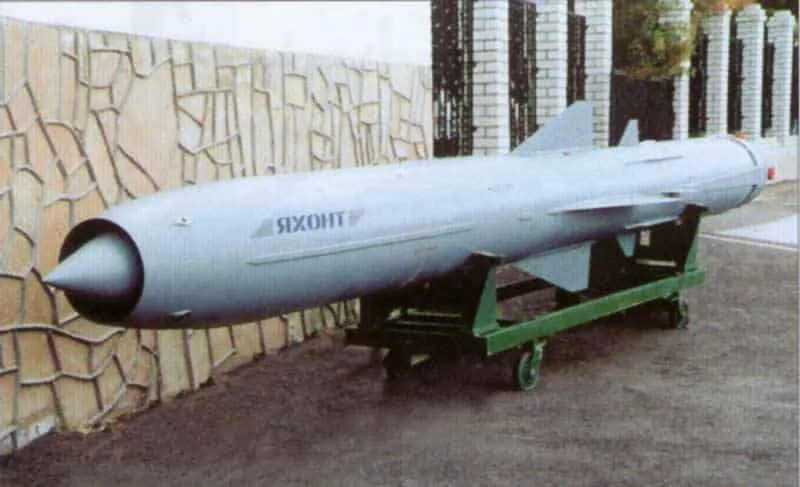
The nose is the intake. The Oniks has the typical layout for this design: a round air intake at the very front with a pointed centre cone inside it. [DOCUMENTED, visible in photos] The cone is not just a fairing. At supersonic speed it sets up shock waves that start slowing and compressing the air before it enters the duct. [BACKGROUND] The radar seeker sits inside the centre cone. [DOCUMENTED; the seeker's mass is published separately below]
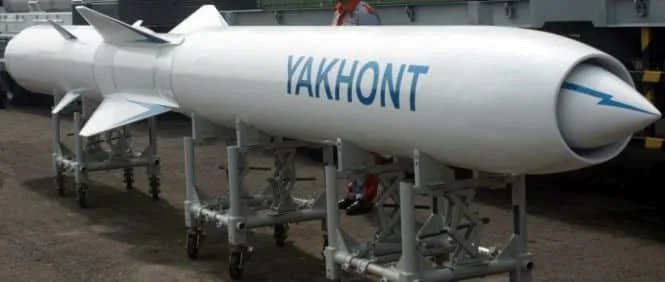
Booster inside the engine. The Oniks is an integral rocket-ramjet. The solid-fuel booster is packed inside the empty ramjet combustion chamber rather than hung behind the missile as a separate stage. [DOCUMENTED] At launch the booster fires through its own nozzle. When it burns out after a few seconds, its casing and nozzle are pushed out of the back of the missile, the intake covers open, air flows in, and kerosene is injected and lit in the now-empty chamber. [DOCUMENTED in general terms; exact sequence and timings UNVERIFIED] Packing the booster this way keeps the missile short enough for an 8.9 m canister. Separate-stage designs such as the older P-270 Moskit are physically longer for the same job. [BACKGROUND]
Fuel and thrust. The fuel is reported as T-6 jet fuel, a dense, heat-stable kerosene. The sustainer engine is reported at about 200 kg dry and about 4 t of thrust. [SINGLE-SOURCE]
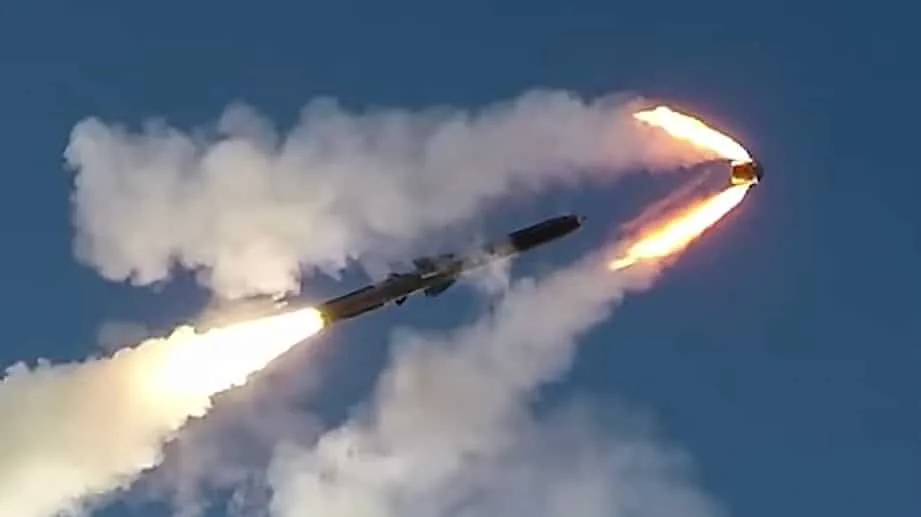
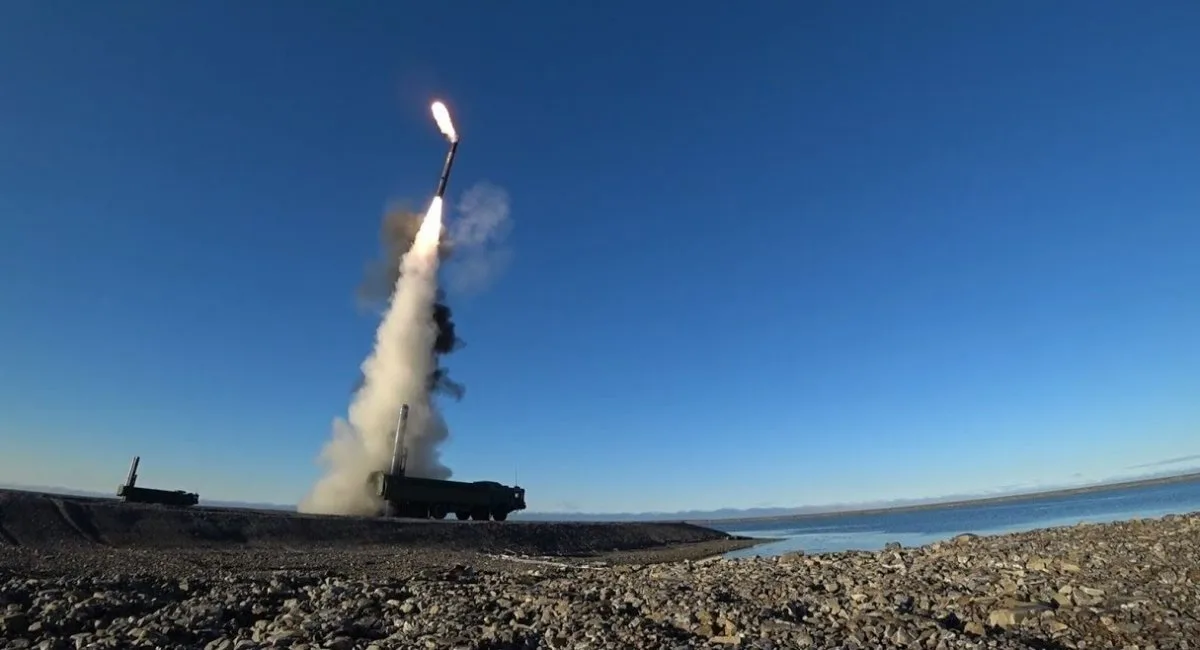
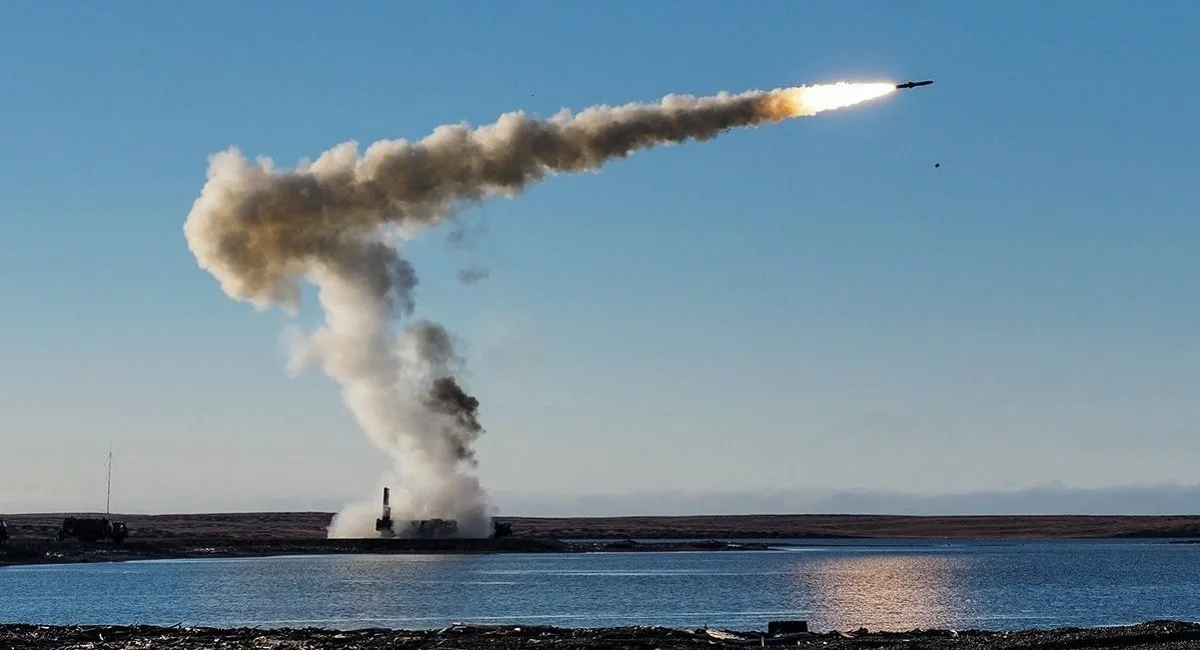
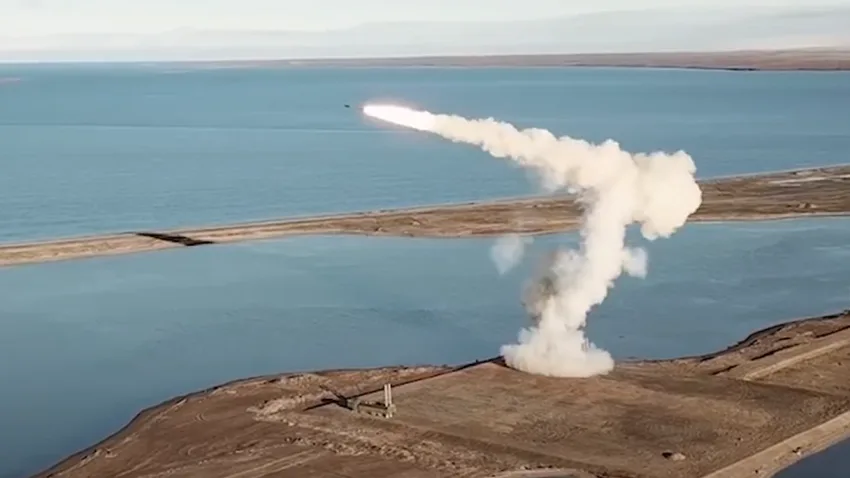
In the photo above, the dense white smoke and bright flame come from the solid booster. The pale trail that follows is the ramjet stage. Launch footage often shows the booster casing tumbling away. [ESTIMATE, from visual interpretation of the published photo]
GUIDANCE AND FLIGHT PROFILE, PHASE BY PHASE
The Oniks combines inertial navigation for most of the flight with an active-passive radar seeker for the end. Once launched it needs nothing from the launcher: it is fire-and-forget. [DOCUMENTED] The phases below come from maker data, Russian press and Ukrainian air-force descriptions. Where those sources go beyond published data, the labels say so.
1. Pre-launch: where target data comes from. The missile is given a target position, course and speed, and an area to search, before it leaves the canister. [DOCUMENTED in general terms] Bastion's command vehicles get that picture from several possible sources:
[DOCUMENTED for Monolit-B and the helicopter kit as listed options; ranges as published by makers]
The 300 km missile range is far beyond what any truck-mounted radar can see. Without an outside sensor, Bastion's reach is set by its radar horizon, not by the missile. [BACKGROUND] The data also ages in flight. At Mach 2.5 a 300 km flight takes about 6-7 minutes, and a ship moving at 30 knots goes about 6 km in that time. That is why the seeker has to search an area rather than look at a single point. [ESTIMATE, arithmetic]
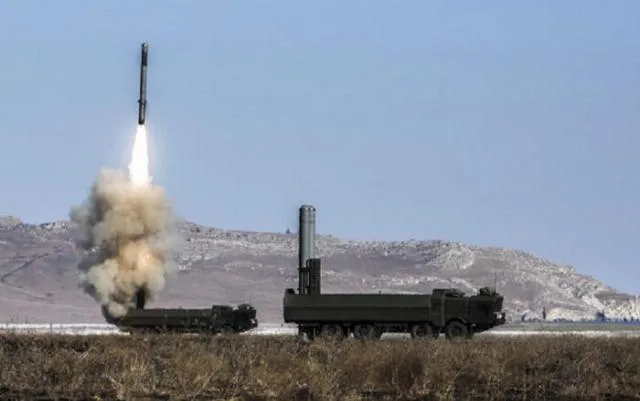
2. Launch and booster burn. The launcher raises its two canisters to vertical. Sources give under 5 minutes from the road march to ready-to-fire, and 2-5 seconds between the two missiles in a salvo from one launcher. [DOCUMENTED] The missile leaves the canister vertically under booster thrust and tilts over toward the target heading early in the climb. [DOCUMENTED from launch footage; the control method (gas vanes or nozzle) is UNVERIFIED]
3. Booster ejection and ramjet start. When the booster has pushed the missile well past Mach 1, its spent casing is pushed out of the back, the ramjet lights, and the missile flies on its own engine. [DOCUMENTED in general terms] The exact transition speed and time after launch have not been published. [UNVERIFIED]
4. Climb and cruise: two profiles.
Speeds. Roughly Mach 2.5 at altitude and roughly Mach 2 near the sea. Sources conflict on the figures. CSIS and Rosoboronexport give 750 m/s (about Mach 2.2-2.5 depending on altitude) high and 680 m/s low. Other references round up to Mach 2.6 or quote up to Mach 2.9. [Sources conflict]
Russian-service range. Export Yakhont is held to 300 km, inside the 300 km / 500 kg limit of the Missile Technology Control Regime. Russian-service Oniks is often credited with about 500-600 km, and an upgraded Oniks-M with up to about 800 km. [SINGLE-SOURCE / UNVERIFIED for the higher figures] In 2016 the Russian defence minister said Bastion could hit sea targets out to 350 km and land targets out to almost 450 km. [DOCUMENTED quote, Sputnik/RIA Novosti] That fits a longer range in Russian service but does not confirm the 600-800 km figures. [ESTIMATE]
5. Inertial midcourse. On the cruise leg the missile navigates with an inertial system. Gyros and accelerometers measure every turn and change of speed and add them up to give its position, with no outside signal needed. [BACKGROUND] Inertial error grows slowly with time. Over a 6-7 minute flight that drift is small compared with the size of the area the seeker searches. [ESTIMATE] Whether newer missiles add satellite navigation (GLONASS) correction has not been published. It would matter most for land targets, which do not move but also do not echo radar as clearly as a ship on open sea. [SPECULATION]
6. Datalink and salvo coordination. Two different claims get mixed together here:
7. Seeker turn-on. In the 2013 Russian press description, the seeker switches on briefly at a set point to fix the target's position, then stays silent until the final dive. That keeps the target's electronic-warfare operators from hearing the radar early enough to jam it. [SINGLE-SOURCE] The seeker data published by Granit-Elektron, as cited in reference works, are:
[SINGLE-SOURCE, maker data as cited] The 2013 article's figures for where the seeker first switches on ("15-50 miles") do not match the 50 km quoted elsewhere. [Sources conflict]
What those terms mean.
[BACKGROUND] The seeker's band is not published. Anti-ship seekers of this class usually work in the X or Ku band (about 8-18 GHz), where a small antenna in the nose cone still gives a narrow beam. [BACKGROUND / SPECULATION for this missile]
Not the ARGS-54. The Oniks seeker is often confused with the ARGS-54, which is the radar seeker of the 3M54 anti-ship Kalibr. Published sources tie the Oniks seeker to Granit-Elektron. Do not assume the two are the same unit. [DOCUMENTED that they are different programmes; exact designation of the Oniks unit UNVERIFIED]
8. Search pattern and target selection. With the seeker on, the missile scans its plus-or-minus 45 degree sector around the expected target area. A plus-or-minus 45 degree sector at 50 km is a strip roughly 70 km wide, easily big enough to cover a 6 km target drift. [ESTIMATE, geometry] Inside a group of ships, the seeker can be told to pick the largest radar echo, the echo in a given place within the formation (for example the centre of a convoy), or a specific emitter. Picking the biggest echo is the classic Soviet rule for finding the high-value ship in an escorted group. [BACKGROUND; specific Oniks logic UNVERIFIED] Russian press says ship-class profiles are stored on board. [SINGLE-SOURCE, 2013]
9. Terminal phase. On a high-low flight the missile dives from cruise altitude down to the 10-15 m sea-skimming band. It is reported to dive when it is 40-60 km out, which is roughly the seeker's active range. [DOCUMENTED for the 10-15 m terminal altitude; dive distance ESTIMATE] It then covers the last tens of kilometres at about Mach 2. A ship's radar sees a sea-skimmer only at about 25-30 km, so the defence has about 40-60 seconds from detection to impact. [ESTIMATE, radar-horizon arithmetic] Ukrainian air-force spokesman Yurii Ihnat described the same pattern in 2023: a high cruise, then 10-15 m above the water in the attack. [DOCUMENTED, Kyiv Post] Some sources say the missile weaves in the terminal phase. [UNVERIFIED] Against land targets the missile is reported to stay higher and dive onto the target rather than skim. [SPECULATION based on the geometry of land-attack use]
10. Defending against jamming (ECCM). Several features work against jamming and decoys:
[DOCUMENTED for listed jamming resistance and chaff immunity; how they are done is BACKGROUND] Ukrainian officials have still said electronic warfare had "some success". They suggested a missile that hit a recreation area in Odesa in September 2023 had been affected by EW, without saying how. [SINGLE-SOURCE, Ukrainian Air Force via Kyiv Post / RBC-Ukraine]
THE BASTION-P COMPLEX
Two forms. Bastion comes as the mobile K-300P Bastion-P (GRAU 3K55) and as the fixed, silo-based K-300S Bastion-S. Only the mobile version is known to be in service. [DOCUMENTED]
Standard division (battery). [DOCUMENTED, multiple Russian references]
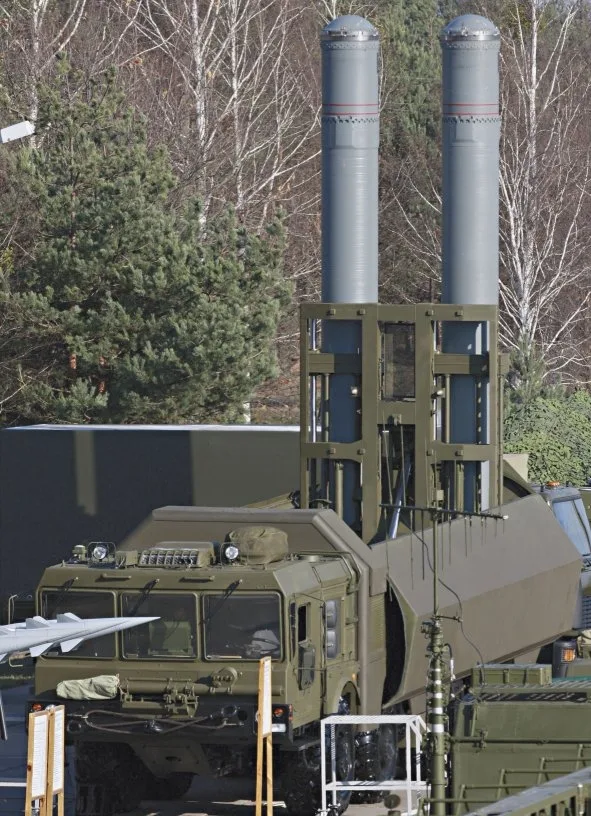
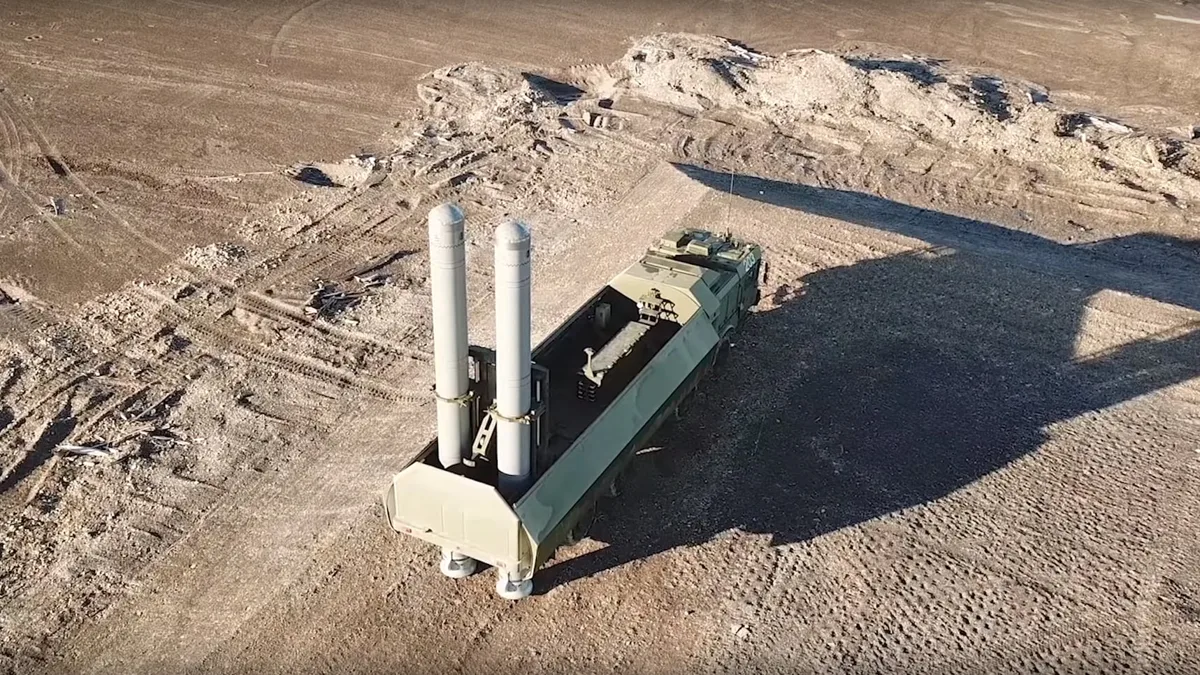
How a division fights. It drives in, spreads out, raises the canisters, takes target data from the command vehicle, fires and leaves. Russian training reports describe crews practising deployment, changing position after firing, and target designation in different conditions. [DOCUMENTED, Russian MoD via VPK.name] Spreading launchers up to 25 km from the command vehicle means a strike on one site does not take out the whole battery. [BACKGROUND]
YAKHONT EXPORT
Customers. Yakhont/Bastion has been exported to Syria, Vietnam and Indonesia. [DOCUMENTED]
BRAHMOS LINEAGE
BrahMos is the Indian-Russian joint-venture missile, set up in 1998 between India's DRDO and NPO Mashinostroyeniya. It is a close derivative of the Yakhont: the same ramjet layout, intake and booster concept and similar size, with Indian systems integration and later its own variants (extended range, air-launched, land-attack). [DOCUMENTED] CSIS gives the joint-venture year as 1988, which is a typo; 1998 is the documented date. [Sources conflict, resolved] BrahMos's combat record (including Indian strikes reported in May 2025) is a BrahMos story, not evidence about the Russian Oniks. [BACKGROUND]
LAND-ATTACK USE
Syria, 15 November 2016. The Russian defence ministry announced that Bastion-P had fired Oniks missiles at land targets in Syria (Idlib and Homs provinces). The targets were reported as including an Islamic State ammunition depot. This was the first announced land-attack use of Bastion. [DOCUMENTED, TASS / Russian MoD / Reuters] The footage shows at least two launches from two launchers. [SINGLE-SOURCE, Jane's via RealClearDefense] Online claims of 25-50 m misses based on the video are amateur analysis. [UNVERIFIED] A Russian commentator suggested the targets were radar-bright (vehicles or radars) rather than buildings. [SPECULATION in the source]
Ukraine, 2022 onward. The Russian MoD announced Oniks strikes near Odesa on 1 May 2022. Ukraine reported four Oniks fired from Crimea at Odesa on 9 May 2022. [DOCUMENTED, Reuters / Ukrinform] Oniks became a regular weapon against Odesa, Mykolaiv and southern targets, including port and grain infrastructure. [DOCUMENTED in general terms] In August 2024 Ukraine's commander-in-chief said 12 of 211 Oniks fired had been intercepted, about 6 percent. That was among the lowest interception rates of any Russian missile type. [DOCUMENTED, Ukrainian official figure] In March 2024 Russian sources announced a new active seeker meant to make the missile more accurate against ground targets. [SINGLE-SOURCE, Militarnyi citing Russian reports]
Bastion launchers in Crimea have themselves been targeted. Ukraine has claimed several Bastion launchers destroyed by ATACMS and other strikes. [SINGLE-SOURCE per incident; not independently confirmed]
OTHER LAUNCH PLATFORMS
Besides Bastion, Oniks arms Russian ships including Project 11356 and 22350 frigates and Project 21631 and 22800 corvettes, the modernised cruiser Admiral Nakhimov and destroyer Marshal Shaposhnikov, and Yasen-class submarines. Many of these use the same universal 3S14 vertical launcher as Kalibr and Zircon. [DOCUMENTED]
ONIKS AND KALIBR COMPARED
The two families split the job:
[DOCUMENTED in general terms] Each has a different weakness. Kalibr is easier to shoot down, but it has a wider reach and is cheaper per kilometre. Oniks is hard to intercept, but its fuel use limits its range, and it is a bigger, hotter, radar-brighter missile at altitude. Both fit the 3S14 ship launcher; Kalibr ground launch belongs to other systems. [BACKGROUND]
ZIRCON: THE SUCCESSOR
Zircon. 3M22 Zircon (Tsirkon) is the NPO Mashinostroyeniya hypersonic follow-on. It is claimed to reach about Mach 8-9 with a scramjet, a supersonic-combustion ramjet. [DOCUMENTED claim; speed UNVERIFIED] It is designed for the same 3S14 ship launcher.
Zircon from Bastion. In 2024 Ukraine reported Zircon strikes on Kyiv and other targets, launched from Crimea. It suggested Bastion launchers had been adapted to fire Zircon. [SINGLE-SOURCE, Ukrainian officials and Kyiv research institute fragment analysis] Russian sources have discussed a Bastion upgrade for Zircon. [UNVERIFIED]
What Zircon changes. It would keep the Bastion vehicles, Monolit-B targeting and coastal-brigade structure while replacing the missile's speed class. [SPECULATION]
SPECIFICATIONS
| Parameter | Value |
| Missile | P-800 / 3M55 Oniks; export P-800 Yakhont; NATO SS-N-26 Strobile |
| Designer | NPO Mashinostroyeniya, Reutov |
| Length | 8.6-8.9 m [Sources conflict] |
| Diameter | 0.67-0.72 m |
| Launch mass | about 3,000-3,100 kg |
| Warhead | 200-300 kg HE / semi-armour-piercing [Sources conflict] |
| Propulsion | integral solid booster + kerosene (T-6) ramjet |
| Range | 300 km high-low, 120 km low-low (export); more claimed for Russian service [UNVERIFIED] |
| Cruise altitude | up to about 14,000 m |
| Terminal altitude | 10-15 m |
| Speed | about 750 m/s high, about 680 m/s low; up to Mach 2.9 claimed [Sources conflict] |
| Guidance | inertial midcourse; active-passive monopulse radar seeker, about 50 km, +/-45 deg |
| Launcher | K-340P on MZKT-7930, 2 missiles, about 41 t |
| Readiness | under 5 min; 2-5 s between launches |
| Division | 4 launchers, 1-2 K-380P command vehicles, 1 MOBD, 4 K-342P transloaders |
LIMITS OF THE OPEN RECORD
Published sources are patchy in several places:
This page labels each claim accordingly.
RELATED ON THIS SITE
HOW THIS ARTICLE WAS BUILT
Written for this site from the sources below. Claims are labelled [DOCUMENTED] where a primary or multiple independent sources support them, [SINGLE-SOURCE] where only one does, [UNVERIFIED] where nothing published located confirms them, [ESTIMATE] for approximate figures or reconstructions, [BACKGROUND] for general physics and context, and [SPECULATION] for reasoning beyond the sources. Where sources disagree, the page says "Sources conflict" and gives both.