Home |
Data Base |
Technical |
Radio |
Search
40V6MR / 40V6M UNIVERSAL MOBILE MAST
40В6М / 40В6МД / 40В6МТ универсальная передвижная вышка | NKMZ, Kramatorsk | 40V6M, 40V6MD, 40V6MT, 40V6M-R ("40V6MR")
Towed hydraulic mast that lifts air-defence radar heads 24 to 40 m above trees and terrain; not a radar
Project Orlan Data Base // public encyclopedia
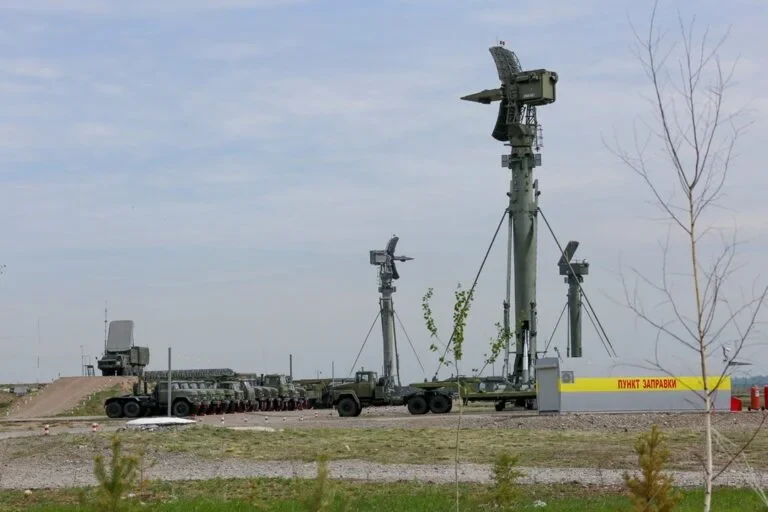
Three 40V6-family masts raised in a vehicle park. The tall mast in front and the shorter one in the middle carry clamshell-type heads, two curved reflectors stacked one above the other with a flat triangular screen jutting out between them: the look of the 76N6 Clam Shell. The mast on the right, partly hidden by guy cables, carries a flat-panel head, likely a 30N6-family fire-control antenna. A separate truck-mounted flat-panel radar, not identified here, stands on the embankment at far left. The Russian sign at right reads "Пункт заправки" (refuelling point). Location and date are not identified in the photo.
Related articles: 76N6 Clam Shell, the low-altitude radar most often carried on this mast; 92N6E Grave Stone, the S-400 engagement radar that can ride it; S-300 and S-400, the systems it serves; 91N6E Big Bird, which never goes on it; and Nebo, another answer to low and stealthy targets.
WHAT IT IS
The 40V6 family (40В6, Russian универсальная передвижная вышка, "universal mobile tower") is a set of towed, hydraulically raised masts that lift a radar antenna head 24 to 40 m into the air. It was designed and built from about 1980 by NKMZ (Novokramatorsky Mashinostroitelny Zavod) in Kramatorsk, Ukraine, a plant better known for space-launch gantries. It is not a radar. It carries radars: the 76N6 Clam Shell low-altitude detector and the 5N63 / 30N6 Flap Lid and Tomb Stone engagement radars of the S-300P, and, as an option on the S-400, the 92N6E Grave Stone engagement radar and the 96L6E all-altitude detector. [DOCUMENTED]
The common shorter mast is the 40V6M, with an antenna phase centre of about 24 m. The 40V6MD adds an upper section for about 38 to 40 m. The 40V6MT is a newer design disclosed in 2011 for late S-400 and S-500 units. Several subtypes exist only as names in Russian lists, among them the 40V6M-R, almost certainly the source of the label "40V6MR". On the standard S-400 battalion chart the tall tower is labelled "40V6MR mobile mast system", and that label is right: it is a mast. Some databases have since called the 40V6MR a radar. It is not. [DOCUMENTED for M, MD and MT; SINGLE-SOURCE for the M-R subtype]
The mast exists because a radar on the ground cannot see a target hidden behind the curve of the Earth, behind trees or behind a ridge. A cruise missile, drone or aircraft at treetop height stays below a ground radar's horizon until it is close. Lifting the antenna 24 to 40 m pushes that horizon out and clears the trees, and the extra distance becomes extra warning time. No amount of transmitter power can do the same, because the problem is geometry, not power. As elsewhere in this database, most numbers below are manufacturer or reference-work figures, and conflicts are kept and labelled. [DOCUMENTED as the stated purpose]
QUICK FACTS
- Name: 40V6 universal mobile mast family: 40V6, 40V6M, 40V6M-R, 40V6M1, 40V6M2, 40V6MD, 40V6MT and others. "40V6MR" is 40V6M-R without the hyphen. [DOCUMENTED for the list]
- What it is: a towed semi-trailer mast that lifts a radar head; not a radar. [DOCUMENTED]
- Maker: NKMZ, Kramatorsk, Ukraine; production from about 1980; supply to Russia ended in 2004. [DOCUMENTED]
- Height (phase centre): 40V6M about 23.8 to 24 m; 40V6MD about 37.8 to 40 m. [CONTESTED on exact figures]
- Payload: heads "often massing 10 tonnes or more" (Kopp). [DOCUMENTED as a class statement]
- Wind: about 30 m/s working; about 50 m/s raised but not working. [DOCUMENTED]
- Set-up: about 1 hour (40V6M); about 2 hours with a crane (40V6MD). [DOCUMENTED]
- Carries: 76N6 / 5N66; 5N63 / 30N6; 36D6 Tin Shield; 96L6E; 92N6E (option); 67N6E (listed). Never the 91N6E. [DOCUMENTED; 67N6E SINGLE-SOURCE]
THE NAME: 40V6MR, 40V6M-R AND WHY IT IS NOT A RADAR
Carlo Kopp's Air Power Australia report, the best open source on the mast, reproduces the Russian list of variants. Every entry is described as a "universal mobile tower", with удлиненная ("elongated") for the 40V6M group and с надставкой ("with an extension") for the 40V6MD. The list includes 40V6M-R and 40V6M-R-01, both "elongated". Kopp wrote that Russian tractor literature cites "the 40V6M-R and 40V6M-R0, but no open source details of these designs have been published as yet." Nothing since has filled that gap. So "40V6MR" is best read as 40V6M-R, a sub-variant of the 40V6M whose differences are not public. No manufacturer brochure found for this article uses it as a radar index, and it is not another name for the 30N6, 92N6E, 96L6E or 76N6. [DOCUMENTED as the list; SINGLE-SOURCE for M-R details]
The radar indices give a hint. The heads that ride the mast carry N or L (5N63, 5N66, 30N6, 76N6, 92N6E, 96L6E); the mast carries V (40V6). V also appears in other kinds of index, such as the 5V55 missile, so the letter is a hint rather than proof, but no radar on the S-300 or S-400 charts has a V index. [ESTIMATE as a reading of the pattern]
Where the radar story comes from. The S-400 battalion chart draws the mast with a flat panel on top. That panel is a radar head riding on it, most plausibly the 92N6E's antenna post, since S-400 material describes the 40V6M as an optional tower "for the 92N6E antenna post". A flat panel on a tower with a mast index under it is easy to read as a flat-panel radar. The ARMSNET database did exactly that, calling the 40V6MR "a mast-mounted radar system intended to detect targets flying at low altitudes at longer ranges than the 91N6E": it describes what a raised radar does, then gives the job to the trailer. Military Factory more carefully lists a "40V6MR Mobile Mast System". This site follows the chart's wording and the Russian list. [DOCUMENTED for the entries; the ARMSNET reading CONTESTED and not followed]
How to tell what is on a mast. The mast says nothing about the radar; look at the head:
- Two curved reflectors, one above the other, with a flat triangular screen between them: a 76N6 / 5N66 Clam Shell low-altitude detector. [DOCUMENTED]
- A single flat panel tilted back on a box-shaped cabin: an engagement radar of the 5N63 / 30N6 family, or on an S-400 the 92N6E. These guide missiles; they are not low-altitude search radars. [DOCUMENTED]
- A tall flat array of many rows, rotating steadily: a 96L6E, the flat-panel set that does low-altitude search in S-300PMU-2 and S-400 units. [DOCUMENTED]
- A big double-sided array on a low tractor-trailer: a 91N6E or 64N6 Big Bird. Never on a mast. [DOCUMENTED]
WHY RAISE A RADAR AT ALL: THE HORIZON PROBLEM
This is the reason the 40V6 exists, and the reason a battery that looks powerful on paper can be surprised by a slow drone at 30 m.
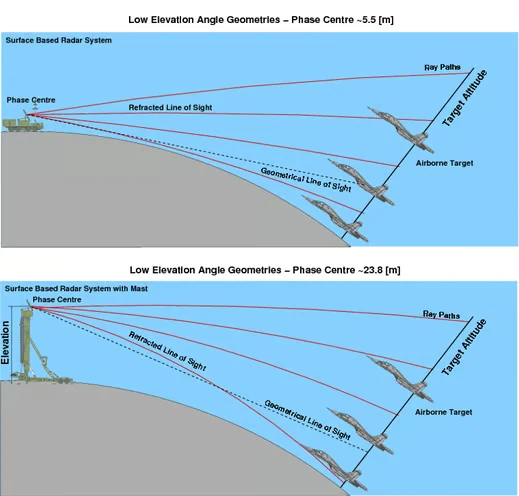
Two diagrams of the same problem. Top, "Phase Centre ~5.5 [m]": a radar on a truck. The lowest aircraft at right sits below both the dashed geometrical line of sight and the slightly bent "refracted line of sight", hidden behind the curve. Bottom, "Phase Centre ~23.8 [m]": the same head raised on a mast; its refracted line of sight now dips low enough to reach the aircraft the truck radar could not see. 23.8 m is the published phase-centre height of a Clam Shell head on a 40V6M. The diagram carries no credit on its face; its layout and figures match Carlo Kopp's Air Power Australia material.
The geometry. Microwave radar travels in nearly straight lines while the Earth curves away beneath it. Stand on a beach with your eyes 1.7 m above the water and the horizon is about 4.7 km away; climb a 25 m lighthouse and it moves to about 18 km. The target has a horizon too: the higher it flies, the further away it rises over the curve. The range at which radar and target can see each other is the sum of the two horizon distances. [DOCUMENTED as standard physics]
Refraction and the 4/3 Earth. Air is denser near the ground, so radio waves bend slightly downward and follow the curve a little. Engineers handle this by doing the geometry on an imaginary Earth with 4/3 of the real radius. That gives the formula used on this site's 91N6E and S-400 pages:
d (km) ≈ 4.12 × (√hradar + √htarget), with both heights in metres.
Without refraction the constant would be 3.57, about 13 percent shorter. Kopp notes that refraction helps "but this effect only becomes significant at tens of nautical miles of range". The 4/3 factor is an average: a temperature inversion over cool sea or ground can bend rays more strongly and form a duct that carries energy well past the normal horizon, and on other days the horizon shrinks. A defence cannot plan around good propagation days. [DOCUMENTED as standard physics]
The horizon table. These are this article's own figures from the formula. They are radio horizons, not detection ranges: they assume a smooth Earth with no trees or hills and say only whether a target can be in view at all. The 2.5 m row is roughly an antenna on its trailer; 5.5 m is the truck phase centre in the diagram; 10 m is the truck convention on the S-400 and 91N6E pages; 24 m and 39 to 40 m are the 40V6M and 40V6MD.
| Antenna height | Target 5 m | Target 10 m | Target 25 m | Target 50 m | Target 100 m | Target 300 m | Target 1,000 m |
| 2.5 m (on the trailer) | 15.7 km | 19.5 km | 27.1 km | 35.6 km | 47.7 km | 77.9 km | 136.8 km |
| 5.5 m (truck, diagram) | 18.9 km | 22.7 km | 30.3 km | 38.8 km | 50.9 km | 81.0 km | 139.9 km |
| 10 m (truck, site convention) | 22.2 km | 26.1 km | 33.6 km | 42.2 km | 54.2 km | 84.4 km | 143.3 km |
| 24 m (40V6M) | 29.4 km | 33.2 km | 40.8 km | 49.3 km | 61.4 km | 91.5 km | 150.5 km |
| 39 m (40V6MD, site figure) | 34.9 km | 38.8 km | 46.3 km | 54.9 km | 66.9 km | 97.1 km | 156.0 km |
| 40 m (40V6MD, Russian literature) | 35.3 km | 39.1 km | 46.7 km | 55.2 km | 67.3 km | 97.4 km | 156.3 km |
A worked example. A 24 m mast and a cruise missile at 100 m: √24 ≈ 4.90, √100 = 10, sum 14.90, × 4.12 ≈ 61 km. From a 10 m truck antenna: 4.12 × (3.16 + 10) ≈ 54 km. From a 39 m 40V6MD: 4.12 × (6.24 + 10) ≈ 67 km. These match the S-400 page's table. [ESTIMATE, this article's arithmetic]
What the table says. Against a very low target the antenna's height matters a lot: against a 5 m target, going from 2.5 m to 39 m more than doubles the horizon, from about 16 to about 35 km. Against a high target it hardly matters: an aircraft at 9,000 m is above the horizon at about 404 km from a 10 m antenna and about 417 km from a 39 m mast. And even the tall mast does not create a long-range low-altitude radar: a 10 m sea-skimmer crosses a 40V6MD's horizon at only about 39 km. The mast buys tens of percent, not multiples. [ESTIMATE]
Why treetop flight works. A cruise missile such as the AGM-86B or Tomahawk, a long-range drone, or a helicopter flying nap-of-the-earth keeps as low as terrain and its navigation allow, often a few tens of metres. It stays below a ground radar's horizon until the last few tens of kilometres, and uses hills, valleys and forest to cut that further. The defence sees it late, and every second lost comes out of the decision, the launch and the missile's flight. This was the threat the 40V6 was built for: Kopp records the Soviet aim as "acceptable low altitude coverage footprint" for the S-300PT against low-flying B-52G/H and FB-111A bombers and the AGM-86B and ground-launched cruise missiles. [DOCUMENTED for the design aim]
The trees are the bigger problem. The smooth-Earth table flatters a ground radar. Much of Russia is forest with trees 20 m and taller, which Kopp names as one of the designers' main problems. Put a 10 m antenna in a clearing with 20 m trees 300 m away: everything below a line over the treetops is blocked. That line climbs at about 1.9 degrees, which at 30 km is already about 1,000 m above the ground, so on that side the radar has almost no low-altitude coverage. Raise it on a 24 m mast, 4 m above the canopy, and the blocking line drops below horizontal; now the Earth's curve, not the trees, sets the limit. That is the difference between seeing a low raid at 40 to 60 km and seeing it at the forest edge. [ESTIMATE, this article's example; DOCUMENTED that forest drove the design]
From kilometres to seconds. Extra horizon matters because it becomes extra time. The table divides the horizon by the target's speed: the time from first possible line of sight to the target reaching the radar, before detection, classification and launch are subtracted. Speeds are round figures: a Shahed-class drone at about 50 m/s, a helicopter at about 70 m/s, a subsonic cruise missile at about 250 m/s and a fast jet at about 300 m/s.
| Target | Altitude | From 10 m antenna | From 24 m mast | From 39 m mast |
| Drone, 50 m/s | 30 m | about 12 min (36 km) | about 14 min (43 km) | about 16 min (48 km) |
| Helicopter, 70 m/s | 10 m | about 6 min (26 km) | about 8 min (33 km) | about 9 min (39 km) |
| Cruise missile, 250 m/s | 30 m | about 142 s (36 km) | about 171 s (43 km) | about 193 s (48 km) |
| Cruise missile, 250 m/s | 10 m | about 104 s (26 km) | about 133 s (33 km) | about 155 s (39 km) |
| Fast jet, 300 m/s | 50 m | about 141 s (42 km) | about 164 s (49 km) | about 183 s (55 km) |
Against a subsonic cruise missile at 30 m, the tall mast adds about 50 seconds, about a third more than a truck antenna. That is time for many more radar looks (the 76N6 turns at 20 rpm, one look every 3 seconds), for the command post to assign the target and the engagement radar to acquire it, and possibly for a second salvo. In a low-altitude fight the timeline is so short that 30 to 50 seconds can be the difference between one shot and two, or between a shot and none. [ESTIMATE, this article's arithmetic]
Both radars need the height. The horizon applies to the fire-control radar as well as the search radar. That is why the classic S-300P layout puts the Clam Shell and the Flap Lid on masts of equal height: there is no point detecting a low target at 45 km if the engagement radar cannot see it until 30 km. Kopp notes the masts are "most frequently used with the 76N6 and 30N6 series radars, usually paired with equal height masts". A mast also helps against high targets by lifting the beam clear of nearby obstacles; Kopp says it "aids in detection of high flying targets at much longer ranges, by reducing the necessary depression angle". [DOCUMENTED]
Clutter. A radar looking along the ground gets echoes from trees, buildings, hills, waves, rain and chaff, often far stronger than the echo of a small cruise missile. Ground radars separate moving targets by their Doppler shift, the small frequency change caused by motion toward or away from the radar. A mast does not remove clutter; it changes it. It clears the strong close echoes from trees and buildings around the site, but lets the beam see more ground further out, so good Doppler processing is still needed. The 76N6 is built around this: as a continuous-wave radar it measures Doppler directly, and its brochure claims chaff rejection of at least 100 dB. The 96L6E claims up to 70 dB of sub-clutter visibility in its slow low-altitude mode. Both are manufacturer figures. [DOCUMENTED as class practice and manufacturer claims]
Multipath. At very low angles the radar's energy reaches the target directly and also by bouncing off the ground or sea. The two paths interfere, adding at some angles and cancelling at others, which leaves gaps in coverage. The lowest useful lobe starts at roughly λ/(4h), where λ is the wavelength and h the antenna height. Raising the antenna lowers that first lobe and packs the lobes closer together. For an S-band radar (about 10 cm) the first lobe sits at about 0.14 degrees from 10 m but about 0.06 degrees from 24 m; for X-band (about 3 cm), about 0.04 and 0.02 degrees. That is idealised flat-surface physics; real ground breaks up the reflection. Narrow elevation beams and vertical polarisation also help, which is why the 76N6 offers a narrow 1-degree vertically polarised beam. [DOCUMENTED as standard physics; the numbers are this article's ESTIMATE]
What the mast cannot fix. It does not see behind a nearby hill, and it does not beat the Earth's curve by much against a target at 10 m. The full answer to very low targets is to look down from far above, from an aerostat or an aircraft, as compared below. The 40V6 is the ground-based compromise: always there, cheap compared with an AWACS, and good for tens of percent more warning. [ESTIMATE]
DEVELOPMENT AND HISTORY
Origins. Development began in the 1970s alongside the S-300PT (SA-10A Grumble), a semi-mobile, towed system meant to stop SAC bombers and cruise missiles coming in low. Production started around 1980, and NKMZ's key designers received Soviet government awards in 1985. NKMZ's experience with launch gantries suited a mast that lifts a 10-tonne head 24 to 40 m, holds it steady in a 30 m/s wind and turns it through 360 degrees. Kopp records stability under wind and near-miss nuclear blast as key design goals; Ukrainian sources claim a simulated blast wave lifted one outrigger of a 40V6M and the mast settled back without toppling. [DOCUMENTED; the blast anecdote SINGLE-SOURCE]
Users. The first known use was with the S-300PT, lifting the 5N63 Flap Lid, the 36D6 / ST-68U Tin Shield and the 5N66 / 5N66M Clam Shell. The mast was also supplied with stand-alone Tin Shield and Clam Shell sites. It stayed with the S-300PS, PM, PMU and PMU-1, and exported batteries took it with them: Kopp shows a Slovak Army S-300PMU raising a 76N6, and the S-300PMU-1 bought by Cyprus and later moved to Crete with a 76N6 on a 40V6M. No production total has been published; Kopp considers "a number in the hundreds" supportable. [DOCUMENTED; the total an ESTIMATE]
The 2004 break. In 2004, after relations between Russia and Ukraine broke down, NKMZ stopped supplying the Russian defence industry. The masts still appeared in offers for new S-300PMU-2 and S-400 packages, so Kopp concluded that warehoused or refurbished stocks were being supplied, though new Russian production "cannot be ruled out". That remains open. [DOCUMENTED for the cut-off; UNVERIFIED for later production]
The 40V6MT. In 2011 the Russian Ministry of Defence disclosed the 40V6MT for late S-400 and the S-500, "an entirely new design with a different outrigger arrangement, and revised elevating mechanism" in Kopp's words, towed by the BAZ-6403.01. Its height, set-up time and payload are not published. [DOCUMENTED as the disclosure; specifications not found]
THE VARIANTS
| Index | Russian | What it is | Height (phase centre) | Tag |
| 40V6 | 40В6 | Basic universal mobile mast | Not published | [DOCUMENTED as a name] |
| 40V6-R-01 | 40В6-Р-01 | Variant | Not published | [SINGLE-SOURCE] |
| 40V6M | 40В6М ("elongated") | The standard shorter mast | 23.8 m (LEMZ, Clam Shell head); 24 m (Russian literature); 78 ft (Kopp) | [DOCUMENTED; 23.8 vs 24 m is rounding] |
| 40V6M-R ("40V6MR") | 40В6М-Р ("elongated") | Sub-variant of the 40V6M; most likely origin of "40V6MR" | Not published | [SINGLE-SOURCE] |
| 40V6M-R-01 / M-R0 | 40В6М-Р-01 | Sub-variant | Not published | [SINGLE-SOURCE] |
| 40V6M1, 40V6M2 | 40В6М1, 40В6М2 | Variants; ODIN pairs "40V6M2 / 40V6MD" | Not published | [SINGLE-SOURCE] |
| 40V6MD | 40В6МД ("with an extension") | The tall mast | 40 m (Russian literature); 37.8 m (Kopp S-300 page); 38.6 m (ODIN); 39 m (Australian Aviation 1995, this site); 127 ft, about 38.7 m (Kopp) | [CONTESTED] |
| 40V6MT, 40V6MT-R | 40В6МТ, 40В6МТ-Р | New mast for late S-400 and S-500, disclosed 2011 | Not published | [DOCUMENTED as disclosed] |
The Russian heights are the elevation of the antenna phase centre, the point the beam effectively comes from, not the length of the tube. That explains some of the spread: 23.8 m is a measured phase centre for one head, 24 m a rounded figure. The 37.8 to 40 m spread for the 40V6MD may reflect different heads, rounding or error; no source explains it. [DOCUMENTED for the definition; ESTIMATE for the explanation]
HOW THE MAST IS BUILT AND ERECTED
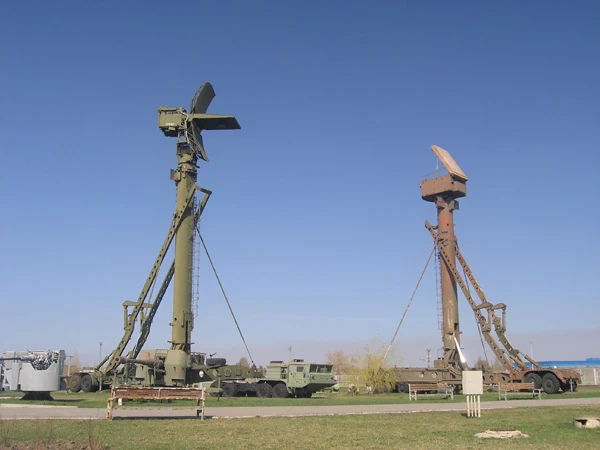
Two 40V6-family masts side by side at a museum. The green mast at left carries a clamshell head, the paired curved reflectors and flat screen of a 76N6 / 5N66 Clam Shell. The rust-coloured mast at right carries a single flat panel tilted back on a box-shaped cabin, likely a 5N63 / 30N6-family fire-control head. Both show the long lattice bracing struts from the semi-trailer base, the guy cables and the outriggers. The museum is not identified in the photo.
The base and the sequence. Both the 40V6M and 40V6MD are built on a rigid base frame that doubles as a semi-trailer. Kopp gives the order: position the trailer, unhitch the tractor, swing out and lock the outriggers, attach the radar head, then raise the mast hydraulically and lock it. The head is fitted while the mast lies flat and tilts as it rises; Kopp describes a Slovak photo sequence showing "the progressive tilt of the antenna assembly during elevation". Guy cables and struts steady the raised mast, a cable duct runs up it, and a rotating joint lets the head turn through 360 degrees. [DOCUMENTED]
The adaptor rule. Any head needs a common adaptor on its base to mate with the mast's turntable; equipment without it, or too heavy, cannot use the mast. That is a practical reason the 91N6E Big Bird, a very large double-faced array built as its own trailer, never appears on one. [DOCUMENTED for the rule; ESTIMATE for the Big Bird explanation]
The 40V6MD needs more. Its upper section, with the head, must be placed by a separate crane, usually the 80-tonne KT-80 on a MAZ-7916, a chassis derived from the RSD-10 (SS-20) launcher. It moves as three semi-trailers. [DOCUMENTED]
| Configuration | Cited set-up time | What it involves | Source |
| 40V6M | About 1 hour | Trailer, outriggers, head, hydraulic raise | Kopp; LEMZ 76N6 table; ODIN |
| 40V6MD | About 2 hours | Plus a KT-80 crane for the upper section; three trailers | Kopp |
| 40V6MT | Not published | New outriggers and lifting gear | Kopp, 2011 disclosure |
| S-400 vehicles without a mast | About 5 minutes (brochure) | Self-propelled; not a mast figure | S-400 page |
The LEMZ table for the 76N6 gives the same 1 hour "with raising on the 40V6M tower", and the same wind pair as Kopp: operation up to 30 m/s and resistance to toppling up to 50 m/s. The "5 minutes from the march" quoted for S-400 vehicles does not apply to a mast. [DOCUMENTED]
THE CHASSIS AND TRACTORS
Legacy tractor. The 40V6M semi-trailer is usually towed by the MAZ-537, a 1960s 8x8 tank transporter and artillery tractor of the 65-tonne class, also widely used for ballistic missile transporters; any compatible 65 to 70-tonne tractor could substitute. Australian Aviation's 1995 article also names the MAZ-537. Kopp's separate S-300P page, however, says early S-300PT masts were "towed by a MAZ-543 derived tractor". The two are different vehicles from the same Minsk family, and the statements are kept side by side. [DOCUMENTED; MAZ-537 vs MAZ-543 CONTESTED]
The 40V6MD upper section rides on a modified NKMZ 5T58 missile-transporter semi-trailer behind a 6x6 KrAZ-260, which also often moves antenna heads such as the 76N6. In late S-300PMU-2 and S-400 packages, the 5T58-2 is towed by a 6x6 BAZ-6402-015. The MAZ-537 is to be replaced by the BAZ-6403.01 Voshchina, which also tows the 40V6MT and the 91N6 Big Bird. [DOCUMENTED]
Swapping heads. On the S-300PS and later, the 5N63S Flap Lid B rides a MAZ-7910 8x8 truck, but its F1S antenna module can be lifted onto a 40V6M or MD while the F2S operator module stays on the truck. The lead photo of Kopp's report shows a deployed S-300PS with the Flap Lid B and the Clam Shell on 24 m masts and the MAZ-7910 standing by without its head. [DOCUMENTED]
WHAT RIDES ON THE MAST
Kopp calls the 40V6 "used with more different radar types than any other design" and says it "has no known equivalents in the West". [DOCUMENTED]
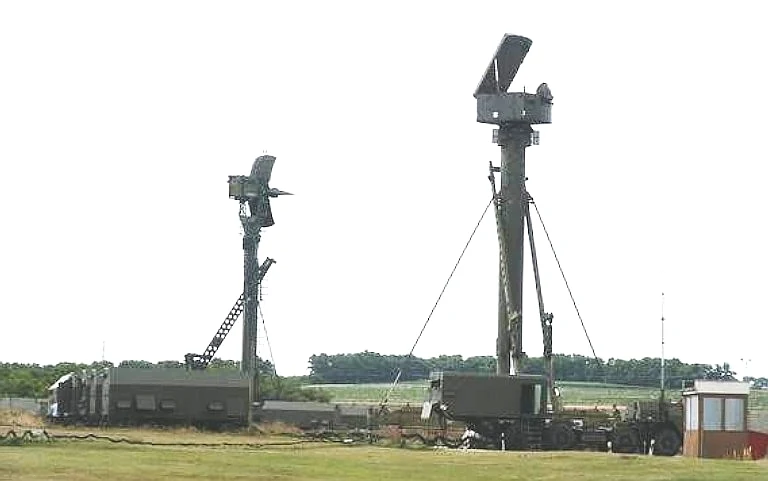
The classic pairing on two 40V6-family masts. Left, a shorter mast with a clamshell head (two curved reflectors and a flat screen between them), the look of the 76N6 Clam Shell. Right, a taller mast with a single flat panel tilted back on a box-shaped cabin, likely a 30N6-family (Flap Lid / Tomb Stone) fire-control head. Bracing struts, guy cables and the semi-trailer bases are visible, with equipment vans below. Which mast model each is cannot be told reliably from the photo, and the site is not identified.
| Radar head | Type | Job | Antenna look | On the mast | Tag |
| 76N6 / 5N66 / 5N66M Clam Shell | LEMZ FMCW low-altitude detector | Finds low, small targets in clutter; cues the 30N6 | Two curved reflectors and a screen; not a flat panel | Standard, S-300PT to PMU-1 | [DOCUMENTED] |
| 5N63 / 30N6 / 30N6E Flap Lid, Tomb Stone | Almaz engagement radar, space-fed phased array | Tracks targets, guides missiles | Single flat panel on a cabin | Standard (F1 / F1S head) | [DOCUMENTED] |
| 92N6E Grave Stone | S-400 engagement radar, lens phased array | Tracks targets, guides missiles | Single flat panel | Option | [DOCUMENTED] |
| 96L6E Cheese Board | LEMZ 3-D all-altitude detector | Search at all altitudes; replaced 76N6 and 36D6 | Tall flat array of 96 rows | Option | [DOCUMENTED] |
| 36D6 / ST-68U Tin Shield | 3-D acquisition radar | Medium and high-altitude search | Large rotating lattice | Photographed on 40V6M | [DOCUMENTED] |
| 67N6E Gamma-DE | VNIIRT AESA acquisition radar | Search | Flat array | Listed by Kopp | [SINGLE-SOURCE] |
| 91N6E / 64N6 Big Bird | Panoramic acquisition radar | Long-range search | Large double-sided array | Never | [DOCUMENTED] |
The classic load-out: 76N6 plus 30N6. On the S-300PT through PMU-1, the usual pair is a Clam Shell and a 5N63 / 30N6 engagement radar at the same height. The Clam Shell finds the low target and passes range, bearing and closing speed to the battery; the engagement radar, looking from the same height, picks it up in a narrow sector and guides missiles to it. Kopp describes "the mast mounted Flap Lid A ... used together with the mast mounted Clam Shell, to provide an integrated acquisition and engagement capability against low flying targets up to the radar horizon". [DOCUMENTED]
The later option: 96L6E and 92N6E. On the S-300PMU-2 and S-400, LEMZ's 96L6E replaced both the Clam Shell and the Tin Shield, and the 92N6E succeeded the 30N6E2. Both can be raised on a 40V6M, but on the S-400 the mast is an option: the Ukrainian infographic on the S-400 page lists "the mobile 40V6M tower for the 92N6E antenna post" among optional items beside the 96L6E. Kopp calls the masts "a cited option for the S-400 system's 92N2E Grave Stone and 96L6 Cheese Board"; 92N2E vs 92N6E is an unsettled index already flagged on the S-400 page. [DOCUMENTED; 92N2E CONTESTED]
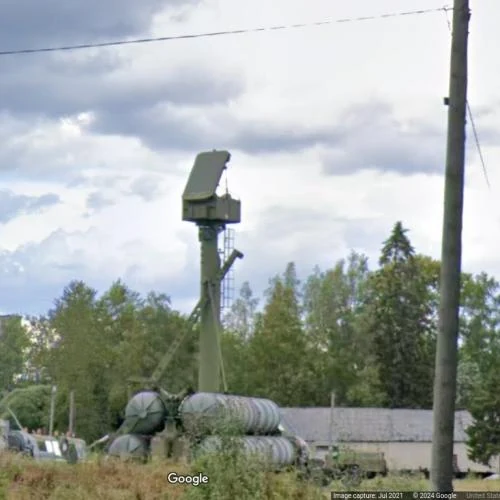
A flat-panel radar head raised on a 40V6-family mast behind large cylindrical transport-launch tubes lying horizontal, the stowed position of S-300P-family launchers. The head, a single flat panel tilted back on a box-shaped cabin, is likely a 30N6-family fire-control antenna. A lattice tower stands behind. A Google Street View capture; the image date printed on the frame is July 2021. The location is not identified here.
Most photos of a flat panel on a 40V6 show an engagement radar, a 30N6-family head on S-300 sites and possibly a 92N6E on S-400 sites, not a low-altitude search radar. A flat panel doing low-altitude search on a mast is a 96L6E; a clamshell is a 76N6. [DOCUMENTED]
HOW A MAST-EQUIPPED BATTERY MEETS A LOW RAID
A simplified reconstruction of the classic S-300P layout against a low cruise missile, assembled from the LEMZ and Kopp descriptions. Russian crew procedures are not public. [ESTIMATE from DOCUMENTED parts]
- 1. Search above the trees. The 76N6 on its mast turns at 20 rpm, one look every 3 seconds, with a narrow elevation beam just above the horizon; continuous-wave Doppler processing rejects ground echoes and chaff.
- 2. Detection. A cruise missile at 30 m crosses a 24 m antenna's horizon at about 43 km. The Clam Shell automatically builds a track with range, bearing and closing speed.
- 3. Hand-off. The track goes to the command post and to the 30N6-family engagement radar on a matching mast, with the same horizon.
- 4. Acquisition. The engagement radar steers its beam into the cued sector, finds and tracks the target. Without the cue, a narrow-beam fire-control radar would search the low sky blind.
- 5. Launch and guidance. The battery fires and the engagement radar guides by track-via-missile; Kopp credits the Flap Lid with up to six targets at two missiles each.
- 6. The clock. With roughly 2 to 3 minutes from horizon to arrival, every kilometre of extra horizon is about 4 more seconds against a 250 m/s target.
An S-400 battery runs the same chain with a 96L6E searching (its low-altitude mode slowed to 5 rpm to dwell near the horizon) and a 92N6E engaging; whether either is raised depends on the site. [DOCUMENTED for the 96L6E mode]
VULNERABILITIES
Visible. A 24 to 40 m guyed tower can be seen from far away, from the air and from satellites, and its shadow points to it. The height that gives the radar its horizon also puts it above the trees for anyone looking. [ESTIMATE]
Slow. One to two hours to set up and stow rules out "shoot and scoot". Kopp argued in 2009 to 2012 that a 1 to 2 hour move was still enough "to defeat the targeting cycle of most cruise missiles", especially with point defence around the site. That was written before cheap persistent drones and commercial satellite imagery; in Ukraine, sites that stay put for days have been found and struck. [DOCUMENTED as Kopp's argument; ESTIMATE for its weakening]
A single point of failure. Lose the mast and the head on it goes too, often with the battery's whole low-altitude picture. CyberBoroshno argued that losing the 76N6 and 30N6 at Voronezh in August 2025 made the whole S-300PM2 division inoperable. Weather is another limit: above 30 m/s the radar cannot work on the mast, and LEMZ lists icing among the conditions it must survive at height. [SINGLE-SOURCE for Voronezh; DOCUMENTED for the limits]
Old stock. With NKMZ out since 2004, Russian 40V6M and MD masts are pre-2004, refurbished or from an unconfirmed Russian line; the 2025 Khabarovsk imagery suggests Russia is drawing on stored masts. [DOCUMENTED for the cut-off; SINGLE-SOURCE for Khabarovsk]
COMBAT USE AND SIGHTINGS, 2022 TO 2026
Each item is the claim of the party that made it unless independently confirmed. No imagery-checked count of 40V6 masts or mast-mounted radars lost in the war exists in open sources.
- 5 to 6 July 2024, near Koptiv (Russian: Koptevo), Poltava oblast, Ukraine. The Russian Ministry of Defence released video of an Iskander-M strike on a Ukrainian S-300PS position, saying two launchers, a command cabin, vehicles and crew were destroyed. Pro-Russian write-ups of the video added two 5N63S engagement radars, "one of which was deployed on a 40V6M semi-mobile mast". The mast detail comes from secondary write-ups, not the Ministry, and the damage is not independently confirmed. [CONTESTED / SINGLE-SOURCE]
- 16 to 17 August 2025, Baltimore airfield, Voronezh, Russia. The OSINT group CyberBoroshno, reported by Militarnyi, Ukrainska Pravda and UNITED24, found burn marks at the positions of a 76N6 and a 30N6 of an S-300PM2 division of the 108th Anti-Aircraft Missile Regiment after a Ukrainian drone attack. Whether they were mast-mounted is not stated. Those reports called the 76N6 a radar for "medium and high altitudes"; that is wrong, and every technical source calls it a low-altitude detector. [SINGLE-SOURCE; the altitude description not followed]
- September 2025, Khabarovsk, Russia. The analyst Athene Noctua, reported by UNITED24 and Militarnyi on 9 and 10 September 2025, compared images of the Khabarovsk Radio Engineering Plant two years apart: six 40V6MD masts, three 30N6 and two 5N66 radars, 13 5P85 launchers, four workshops and 14 generators had moved. The reading was that Russia was trying to restore two of eight stored S-300PS batteries and using the rest for parts. Reactivation, not a strike. [SINGLE-SOURCE]
- 13 November 2026, near Mishino, Leningrad oblast, Russia. Militarnyi, citing photographs from the Telegram channel Dosye shpiona ("Spy Dossier"), reported Ukrainian drones hit three radar sites covering the port of Ust-Luga: a Nebo-SVU, a Sopka-2 and "a 40V6 universal mobile tower equipped with a radar system". Debris suggested FP-1 drones. The radar type on the mast was not identified. Militarnyi noted that the tower is meant "to improve the detection of low-altitude targets" and its loss "can create gaps in airspace surveillance". [SINGLE-SOURCE]
The pattern. Low-flying long-range drones are exactly what masts were built to see, and the same drones can find and hit the masts. Both sides' S-300P-family batteries have been struck repeatedly since 2022, as described on the S-300 and S-400 pages. [DOCUMENTED as a pattern; individual claims SINGLE-SOURCE]
OTHER ANSWERS TO THE SAME PROBLEM
Aerostats: TARS. The US Tethered Aerostat Radar System hangs a radar under a tethered helium balloon. The US Air Force says it can rise to 15,000 ft and normally flies at about 12,000 ft (about 3,700 m), and gives about 60 percent standard availability because of weather. US Customs and Border Protection gives an air-search range of "approximately 200 miles" and says its eight sites, under 2 percent of its radars, detect nearly half of all suspect targets found by radar each year. From 3,700 m the horizon against a 30 m target is about 270 km, more than five times a 40V6MD's. [DOCUMENTED; ESTIMATE for the horizon]
Aerostats: JLENS. The US Army's JLENS paired two 74 m aerostats, one with a surveillance radar and one with a fire-control radar, specifically against cruise missiles; NORAD said they would fly at up to 10,000 ft with coverage up to 340 miles. On 28 October 2015 one broke loose at Aberdeen Proving Ground, Maryland, and drifted into Pennsylvania trailing its tether. The system was stored after October 2015, and a memorandum of 18 July 2017 directed a termination plan. It shows the promise and the problem: far better low-altitude coverage than any mast, from a large, fragile, weather-limited object. [DOCUMENTED]
Airborne early warning. The US Air Force says the E-3 Sentry's radar reaches more than 250 miles against low-flying targets, using pulse-Doppler to separate them from ground clutter. From 9,000 m the horizon against a 30 m target is about 410 km. Russia's equivalent is the A-50. Such aircraft are expensive, few and, as Ukraine has shown, can be shot down. The 40V6 is always on station and costs far less. [DOCUMENTED for the E-3; ESTIMATE for the horizon]
Fixed platforms. Kopp describes Soviet tubular and lattice towers that lifted a whole Tin Shield, and concrete ramps on Czechoslovak S-200 sites: more height and stability, no mobility. [DOCUMENTED]
| Answer | Antenna height | Horizon vs 30 m target | Strength | Weakness |
| Truck antenna | About 10 m | About 36 km | Mobile; ready in minutes | Blind behind trees and the curve |
| 40V6M mast | About 24 m | About 43 km | Clears trees; always on station | 1 hour to set up; conspicuous |
| 40V6MD mast | About 38 to 40 m | About 48 km | Best ground-based option | 2 hours and a crane; very conspicuous |
| TARS aerostat | About 3,700 m | About 270 km | Long low-level coverage | Weather; fixed sites |
| JLENS aerostat | Up to about 3,000 m | About 250 km | Fire-control quality track | Fragile; programme ended |
| E-3 AWACS | About 9,000 m | About 410 km | Mobile look-down radar | Expensive, few, vulnerable |
SPECIFICATIONS
| Parameter | Value(s) | Tag |
| Designations | 40V6, 40V6-R-01, 40V6M, 40V6M-R ("40V6MR"), 40V6M-R-01, 40V6M1, 40V6M2, 40V6MD, 40V6MT, 40V6MT-R | [DOCUMENTED as names] |
| Maker | NKMZ, Kramatorsk, Ukraine; development 1970s, production from about 1980; supply to Russia ended 2004 | [DOCUMENTED] |
| Total built | Not published; "in the hundreds" (Kopp) | [ESTIMATE] |
| 40V6M height | 23.8 m (LEMZ); 24 m; 78 ft | [DOCUMENTED] |
| 40V6MD height | 40 m; 37.8 m; 38.6 m; 39 m; 127 ft | [CONTESTED] |
| 40V6MT height | Not published | [not found] |
| Payload | Heads "often massing 10 tonnes or more"; exact rating not published | [DOCUMENTED as a class] |
| Head interface | Common adaptor; 360-degree rotating joint; cable duct | [DOCUMENTED] |
| Wind | About 30 m/s working; about 50 m/s raised, not working | [DOCUMENTED] |
| Set-up time | 40V6M about 1 h; 40V6MD about 2 h; 40V6MT not published | [DOCUMENTED] |
| 40V6MD crane and trailers | KT-80 (80 t) on MAZ-7916; three trailers | [DOCUMENTED] |
| Base | Semi-trailer frame, swing-out outriggers, guy cables, bracing struts | [DOCUMENTED] |
| Tractors | MAZ-537 (or "MAZ-543 derived"); BAZ-6403.01; 40V6MD upper section on 5T58 / 5T58-2 behind KrAZ-260 or BAZ-6402-015 | [DOCUMENTED; MAZ-537 vs 543 CONTESTED] |
| Heads carried | 76N6 / 5N66; 5N63 / 30N6; 36D6; 96L6E; 92N6E (option); 67N6E (listed); not the 91N6E | [DOCUMENTED] |
| Weights and crew | Not published | [not found] |
| Users | USSR / Russia; Ukraine; export S-300P users including Slovakia and Cyprus / Greece; a full list not confirmed | [DOCUMENTED for named users] |
CONFLICTING FIGURES
| Item | One figure | The other figure(s) | Note |
| Is "40V6MR" a radar? | No: a mast (Russian list, Kopp, S-400 chart, Military Factory) | "A mast-mounted radar system" (ARMSNET) | ARMSNET not followed |
| 40V6MD height | 40 m (Russian literature) | 37.8 m; 38.6 m; 39 m; 127 ft | Unexplained spread |
| Legacy tractor | MAZ-537 | "MAZ-543 derived" | Different vehicles |
| Set-up time | 1 to 2 hours (mast) | 5 minutes (S-400 brochure) | Not a mast figure |
| Production after 2004 | Old or refurbished stock (Kopp) | New Russian production "cannot be ruled out" | Unresolved |
Gaps. What makes the 40V6M-R, M-R-01, 40V6-R-01 and MT-R different is not public. The 40V6MT's height, set-up time and payload, total production, mast weights and crew are not published. There is no verified count of masts lost in the war, and the radar on the mast hit near Ust-Luga on 13 November 2026 was not identified.
IN ONE SENTENCE
The "40V6MR" on S-400 charts is the 40V6M-R, one member of NKMZ's 40V6 family of towed masts (40V6M about 24 m, 40V6MD about 38 to 40 m, 40V6MT for late S-400 and S-500): not a radar but a lift for the 76N6, 30N6, 92N6E and 96L6E, built because low-flying cruise missiles, drones and aircraft stay hidden below a ground radar's horizon and behind the trees until very late, and raising the antenna buys tens of kilometres and tens of seconds of warning at the cost of an hour or two to set up and a tower the enemy can see.
SOURCES
- 1. Carlo Kopp, "NKMZ 40V6M / 40V6MD / 40V6MT Universal Mobile Mast," APA-TR-2009-0504, Air Power Australia, 2009, updated to 2014 (variants, NKMZ, 2004 cut-off, wind, set-up times, tractors, crane, users, platforms). ausairpower.net/APA-40V6M-Mast-System.html
- 2. Carlo Kopp, "76N6 Clam Shell Low Altitude Acquisition Radar," APA-TR-2004-1001, Air Power Australia, 1995 to 2011, with the LEMZ 1994 brochure table (23.8 m, 1 hour, wind limits, Flap Lid pairing). ausairpower.net/clamshell.html
- 3. Carlo Kopp, Almaz S-300P / S-400 survey, Air Power Australia (37.8 m; "MAZ-543 derived"). ausairpower.net/APA-Grumble-Gargoyle.html
- 4. Carlo Kopp, "S-500 Triumfator-M," Air Power Australia (40V6MT). ausairpower.net/APA-S-500-Triumfator-M.html
- 5. "Technology Explained: Clam Shell Radar," Australian Aviation, November 1995 (78 / 127 ft masts, MAZ-537).
- 6. LEMZ, "76N6 Low Altitude Warning Radar," brochure, 1994, as reproduced in source 2.
- 7. US Army TRADOC, ODIN Worldwide Equipment Guide, 76N6 entry (38.6 m; 1 hour set-up).
- 8. ARMSNET, "40V6MR" entry (cited only as the radar misreading); Military Factory, S-400 entry ("40V6MR Mobile Mast System").
- 9. Militarnyi, Zalutskyi Illia, "Ukrainian Drones Struck Three Radar Stations ... Ust-Luga," 13 November 2026, citing Dosye shpiona. militarnyi.com/en/news/ukrainian-drones-3-radar-stations-ust-luga/
- 10. Militarnyi, "Ukraine Hits S-300 Division and Aircraft at Russia's Baltimore Airfield," August 2025; Ukrainska Pravda, 27 August 2025; UNITED24 Media; all citing CyberBoroshno.
- 11. Militarnyi, "OSINT Analyst: Russia Attempts to Reactivate Old S-300 Systems," 10 September 2025; UNITED24 Media, 9 September 2025; citing Athene Noctua.
- 12. RIA Novosti, Russian MoD statement on the Koptevo strike, 6 July 2024, and pro-Russian secondary write-ups of the video.
- 13. US Air Force, "Tethered Aerostat Radar System" fact sheet; US Customs and Border Protection, "TARS" fact sheet, 2021.
- 14. NORAD, "JLENS" fact sheet (archived 2014); US Army FY2019 budget justification, JLENS; CSIS Missile Threat, "JLENS".
- 15. US Air Force, "E-3 Sentry (AWACS)" fact sheet.
- 16. Standard propagation and multipath physics (4/3-Earth model, lobing angle λ/4h), as in M. I. Skolnik, Introduction to Radar Systems. All horizon, masking and timing figures here are this article's arithmetic.
- 17. Project Orlan pages used for consistency: S-300, S-400, 91N6E Big Bird, 92N6E Grave Stone, 76N6 Clam Shell, Nebo.
Related on this site: 76N6 Clam Shell, the low-altitude detector most often carried on the 40V6 mast.
Related on this site: 92N6E Grave Stone, the S-400 engagement radar whose antenna post can be raised on a 40V6M.
Related on this site: S-300, the system the mast was first built for.
Related on this site: S-400, where the mast survives as an option for the 92N6E and 96L6E.
Related on this site: 91N6E Big Bird, the panoramic radar that is never mast-mounted.
Related on this site: Nebo, the VHF / L / S radar family, another answer to low and stealthy targets.
Project Orlan // Underground Information Database