Home |
Data Base |
Technical |
Radio |
Search
76N6 CLAM SHELL LOW-ALTITUDE DETECTION RADAR
76Н6 / 5Н66 / 5Н66М низковысотный обнаружитель | LEMZ (Lianozovo), Moscow | 5N66, 5N66M, 76N6, 76N6E; NATO reporting name Clam Shell
Mast-mounted continuous-wave (FMCW) radar that finds low-flying targets for the S-300P engagement radar
Project Orlan Data Base // public encyclopedia
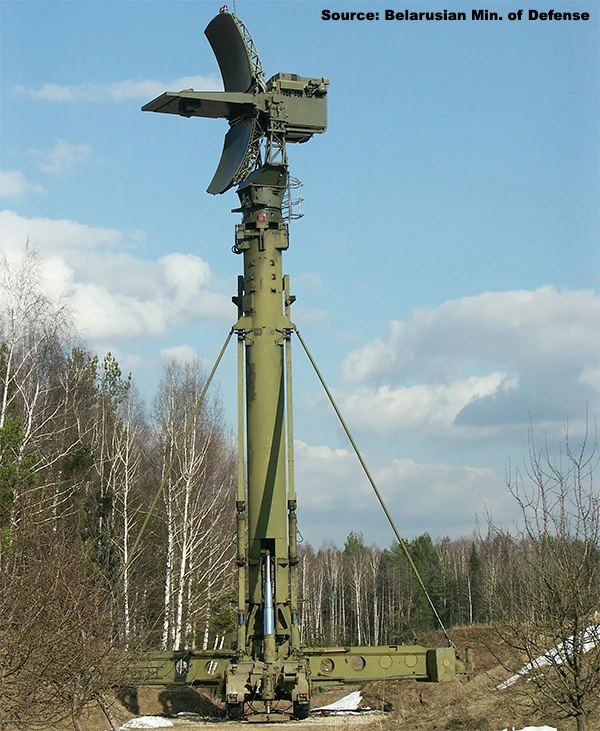
A 76N6 Clam Shell head raised on a 40V6-family mast in a birch and pine forest, exactly the kind of site the mast was built for. The two curved, open-lattice reflectors are stacked one above the other, with the flat triangular spillover screen jutting out sideways between them and the equipment box at the back of the head. Below, the mast stands on its semi-trailer base with splayed outrigger beams and guy cables. The credit printed on the image reads "Source: Belarusian Min. of Defense"; the unit and site are not identified.
Related articles: 40V6MR / 40V6M universal mobile mast, the tower the Clam Shell rides on; S-300, the system it was built for; S-400, whose 96L6E replaced it; 92N6E Grave Stone, the S-400's successor to the 30N6 engagement radar it cued; 91N6E Big Bird, the long-range acquisition radar of the same batteries; and Nebo.
WHAT IT IS
The 76N6 (76Н6; earlier 5N66 and 5N66M, export 76N6E; NATO reporting name Clam Shell) is a Soviet and Russian low-altitude detection radar, the Russian низковысотный обнаружитель, "low-altitude detector". It was designed and built by LEMZ, the Lianozovo Electromechanical Plant in Moscow. Its one job is to find small, low-flying targets, above all cruise missiles, in ground clutter and jamming, and to hand them automatically to the engagement radar of an S-300P battery, the 5N63 / 30N6 Flap Lid or Tomb Stone. [DOCUMENTED]
It is unusual in two ways. First, it is a continuous-wave radar: instead of sending short pulses and listening between them, it transmits all the time and uses a slowly changing frequency (frequency-modulated continuous wave, FMCW) to measure range. That makes it very good at separating moving targets from clutter and chaff. Second, it does not look like a normal radar. Its antenna is two curved reflectors, one to transmit and one to receive, with a large flat screen between them to stop the transmitter leaking into the receiver. Folded open on top of its mast, it looks like an open clamshell, hence the NATO name. It is not a flat-panel radar. [DOCUMENTED]
It almost always works from the top of a 40V6M or 40V6MD mast, 24 to 40 m up, because a low-altitude radar on the ground cannot see past the trees and the curve of the Earth. On the S-300PT, PS, PM, PMU and PMU-1 it was the standard low-level sensor. On the S-300PMU-2 and the S-400, the 96L6E replaced it. It is still in service with older batteries, still being pulled out of storage, and still being targeted in the Ukraine war. [DOCUMENTED]
As with every system in this database, the numbers below are manufacturer and reference-work figures, mostly from a 1994 LEMZ brochure, not measured results. Where the sources disagree, both figures are kept and labelled.
QUICK FACTS
- Names: 5N66, 5N66M, 76N6, 76N6E; NATO Clam Shell (Clam Shell A and B for early and later sets in Kopp's usage). Russian role name: низковысотный обнаружитель (low-altitude detector). [DOCUMENTED]
- Maker: LEMZ (Lianozovo Electromechanical Plant), Moscow. [DOCUMENTED]
- Job: automatic low-altitude search; cues the 5N63 / 30N6 engagement radar against cruise missiles and low aircraft. [DOCUMENTED]
- Waveform: FMCW, at least 1.4 kW average continuous power. [DOCUMENTED]
- Band: contested: LEMZ table "S"; Western catalogues NATO I-band (IEEE X-band, 8 to 10 GHz). [CONTESTED]
- Antenna: split transmit and receive doubly curved reflectors, each 2.8 m (9.2 ft) on a side, with a spillover screen; 360-degree rotation at 20 rpm. [DOCUMENTED]
- Detection: 90 km against a 0.02 m² target at 500 m altitude; 120 km at 1,000 m; horizon-limited lower down. [DOCUMENTED as LEMZ figures]
- Tracks: 180, automatic. [DOCUMENTED]
- Clutter: chaff rejection at least 100 dB; transmit-receive isolation at least 95 dB. [DOCUMENTED]
- Mount: 40V6M mast (23.8 m phase centre, about 1 hour to deploy) or 40V6MD (about 38 to 40 m, about 2 hours). [DOCUMENTED]
- Replaced by: 96L6E on the S-300PMU-2 and S-400. [DOCUMENTED]
DESIGNATIONS AND NAMES
5N66 is the original S-300PT-era index; 5N66M the modernised set; 76N6 the later index used with the S-300PS / PM generation; and 76N6E the export model, the "E" marking an export version. LEMZ marketed the family openly from the mid-1990s as the 5N66 / 5N66M / 76N6 / 76N6E. In LEMZ's own equipment terms, the antenna head is the FA-51MU (also written F5MU in the LEMZ table), and the receiver-transmitter and operator equipment are the FA52MU and F52MU modules. The open sources do not publish what changed between the 5N66, 5N66M and 76N6. [DOCUMENTED for the names; the differences not found]
Clam Shell is the NATO reporting name, from the antenna's look. It should not be confused with the 5N63 / 30N6 Flap Lid, the flat-panel engagement radar it works with, or with the flat-panel 96L6E Cheese Board that replaced it. [DOCUMENTED]
Some Ukrainian press reports in 2025 described the 76N6 as a radar "for detecting targets at medium and high altitudes". That is wrong. Every manufacturer and technical source calls it a low-altitude detector, and this page does not follow the press description. [DOCUMENTED]
WHAT IT IS FOR
The low-altitude gap. The early S-300PT (SA-10A Grumble) was built in the 1970s to defend Soviet territory against American bombers and cruise missiles that would come in low: B-52G/H and FB-111A bombers and the AGM-86B air-launched and ground-launched cruise missiles. A long-range search radar is a poor tool against such targets. It works best looking up, its beam is broad near the ground, it sees huge amounts of ground clutter, and a small cruise missile hides in that clutter until it is close. [DOCUMENTED]
A two-radar answer. The S-300PT's solution was to split the search job. The 3-D 36D6 / ST-68U Tin Shield covered medium and high altitudes. The 76N6 covered the low band, against small, clutter-buried targets. Later batteries added the 64N6 Big Bird at regiment level for long-range search, the forerunner of the S-400's 91N6E. The Clam Shell was never meant to replace any of these; it is a specialist low-level fence. [DOCUMENTED]
Cueing the 30N6. The battery's engagement radar, the 5N63 Flap Lid on the S-300PT and the 30N6 family later, is a narrow-beam phased array that tracks targets and guides missiles. It can search a sector, but it needs to be told where to look. The Clam Shell gives it that cue: it is fully automatic and passes range, bearing and approaching or receding velocity to the battery's fire control. The engagement radar then points its beam at the cued spot, acquires the target, tracks it and guides missiles to it. Kopp describes the usual layout as a mast-mounted Clam Shell used together with a mast-mounted Flap Lid "to provide an integrated acquisition and engagement capability against low flying targets up to the radar horizon". [DOCUMENTED]
Which systems. The 5N66 / 76N6 was the standard low-altitude sensor of the S-300PT, PS, PM, PMU and PMU-1, and was supplied with stand-alone installations as well. Kopp's lead description from the 1995 brochure calls it a radar "for the SA-10A/B (S-300 PMU) Grumble" providing track information "for the fire control system of the static SA-10A or mobile SA-10B". [DOCUMENTED]
DEVELOPMENT AT LEMZ
LEMZ. The Lianozovo Electromechanical Plant in Moscow is one of the main Soviet and Russian makers of air-defence radars, and later built the 96L6E that replaced the Clam Shell. [DOCUMENTED]
The Square Pair family resemblance. Kopp traced the Clam Shell's design to the 5N62 Square Pair, the continuous-wave engagement radar of the S-200 (SA-5) long-range missile system of the late 1960s, which he groups with the Clam Shell as the other widely deployed Almaz-packaged CW radar. Both use separate transmit and receive reflectors built on a latticework tubular frame, a large flat screen (the "knife" in Russian jargon) that separates the two paths and carries the antenna feeds, and a high-purity CW transmitter. He found that the antenna designs of "the late 1960s Square Pair and early 1970s Clam Shell" differ "only in specific details": the Square Pair has a much larger transmit reflector for a narrower beam and an extra clutter screen, and it must be assembled by crane, while the Clam Shell folds hydraulically. The Square Pair is a tracker and illuminator; the Clam Shell is a search radar. The resemblance is in the hardware, and the Clam Shell's exact waveform is not published. [DOCUMENTED for the hardware resemblance; UNVERIFIED for waveform kinship]
Timeline. Kopp's "early 1970s" for the Clam Shell antenna fits the S-300PT programme; the 40V6 mast it rides on entered production around 1980. No open source gives a service-entry date for the 5N66 itself. [DOCUMENTED for Kopp's dating; service date not found]
Going public. After the Soviet Union's collapse, LEMZ began openly marketing the radar. A 1994 LEMZ technical brochure in English and Russian, the "76N6 Low Altitude Warning Radar", was handed out at the 1995 Avalon air show in Australia, and Kopp described it in Australian Aviation that year. Almost every number published since, including those on Western databases, traces back to that brochure. In 2011 Kopp noted that in the sixteen years since, no declassified technical manuals had appeared. [DOCUMENTED]
HOW IT WORKS
Pulse versus continuous wave, in plain terms. Most search radars are pulsed: they send a short, powerful burst, then stop and listen. The time for the echo to return gives the range. A continuous-wave radar never stops transmitting. That has a big advantage: the radar receives the target's Doppler shift continuously, so it can tell very precisely whether a target is moving and how fast, which is exactly what separates a cruise missile from the stationary ground around it. It also has two problems. A plain CW radar cannot measure range, because there is no pulse to time. And because the transmitter is always on, its own signal leaks straight into the receiver, which must hear echoes many billions of times weaker. The Clam Shell's design solves both. [DOCUMENTED as general radar practice]
Range from FM. The Clam Shell's transmitter produces "a high purity CW signal for search mode operation, with imposed low frequency FM modulation for ranging to targets", in the brochure's words. The frequency changes slowly and continuously. When an echo comes back, the transmitter has already moved on to a slightly different frequency, so the difference between what is being sent and what is being received, the "beat", grows with the target's range. The radar reads range from the beat and velocity from the Doppler shift. That is why the brochure quotes both a range and an approaching or receding velocity for every target. Whether the FM is a straight-line sweep or another pattern, such as the sine-wave modulation the Square Pair used for slow targets, is not published. [DOCUMENTED for FMCW and the outputs; UNVERIFIED on the exact FM law]
An illustration. At X-band, around 9 GHz (wavelength about 3.3 cm), a cruise missile closing at 250 m/s produces a Doppler shift of about 15 kHz; at S-band, around 3 GHz, about 5 kHz. Ground clutter sits near zero. A CW radar can separate those easily, and chaff, which slows quickly in the air, falls near the clutter too. That is how the brochure can claim chaff rejection of at least 100 dB, a factor of ten billion in power. These Doppler figures are this article's illustration, because the radar's actual frequency is not published. [ESTIMATE for the illustration; DOCUMENTED for the 100 dB claim]
Power. The transmitter delivers at least 1.4 kW of average CW power. On a CW radar the average is the radiated power; there is no high pulse peak. Some Western database entries list a "peak power" of 55 kW. That figure matches the LEMZ table's maximum power consumption of 55 kW, the electrical load of the whole station, and is almost certainly a mislabel, not RF output. [DOCUMENTED for 1.4 kW and 55 kW consumption; the "peak power" reading CONTESTED]
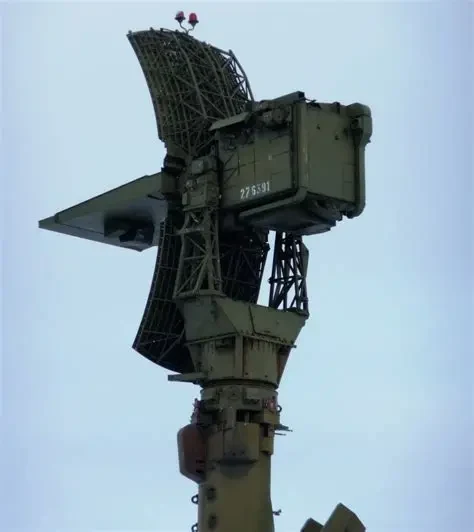
Close-up of a Clam Shell head on its mast against a grey sky. The two curved reflectors, built as an open lattice, sit one above the other; the flat triangular spillover screen, the "knife", juts out to the left between them. The box at the back is the transmitter-receiver equipment, which also counterweights the antenna, with a number painted on its side, and red obstruction lights sit on top. Below is the head's turntable on the top of the mast. The unit and location are not identified in the photo.
The antenna. The FA-51MU head has two doubly curved reflectors, each 2.8 m (9.2 ft) on a side, one transmitting and one receiving. Between them is the flat spillover screen. Its job is isolation: the brochure gives at least 95 dB between transmit and receive antennas, meaning the leak from transmitter to receiver is cut by a factor of more than three billion. Without that, a CW radar would be deafened by itself. Kopp suggests that in the Clam Shell the lower reflector transmits and the upper one receives, so the screen also shields the receiver from ground reflections. Some heads carry an X-band IFF horn under the screen. The brochure also claims sidelobe suppression; the LEMZ table gives first sidelobes below −25 dB and backlobes below −40 to −50 dB. [DOCUMENTED; the transmit-below reading is Kopp's ESTIMATE]
Scanning. The whole head rotates through 360 degrees at 20 rpm, one look every 3 seconds, through a rotating joint; the LEMZ table gives a target data output every 3 seconds. Elevation is not electronically scanned. Instead the radar has selectable beams and polarisation: the LEMZ table gives an elevation coverage of up to 1 degree with vertical polarisation and up to 2 degrees with horizontal, while Kopp's English digest of the brochure says "selectable 1 or 6 degree vertical beamwidths". Either way, the beam is a thin fence just above the horizon, which is where a low-flying target appears. [DOCUMENTED; 1° / 2° vs 1° / 6° CONTESTED]
Processing. The station is fully automatic and tracks up to 180 targets. It has six fixed frequency channels that it can switch between, and the LEMZ table gives a probability of detection above 0.5 and a false alarm rate of 10⁻⁸ to 10⁻⁹. The receiver noise figure is no more than 12 (a factor, not decibels, in the table). The operator console, signal processor, track processor, built-in test and a PPI display are in the F52MU shelter, and the radar can be run manually or automatically, and remotely by cable from up to 500 m. Warm-up takes 2.5 minutes in the LEMZ table; some Western summaries say 3. LEMZ quotes a mean time between failures of 100 hours and a mean time to repair of 0.5 hour. [DOCUMENTED; warm-up CONTESTED]
Accuracy. The brochure distinguishes resolution, the ability to separate two targets, from RMS error, the accuracy on one target, and the two should not be merged. English digest: bearing resolution 1 degree, velocity resolution 9.3 knots, range resolution 2.15 NM (about 4 km); RMS errors 0.3 degree, 4.7 knots and 1 NM. LEMZ table: RMS errors of 10 to 20 minutes of arc in azimuth (about 0.17 to 0.33 degree), 2.4 m/s in velocity and 2.0 km in range. Kopp reads the 0.16 to 0.33 degree angle error as consistent with monopulse angle measurement. [DOCUMENTED; range figures CONTESTED]
Jamming. FMCW radars are generally credited with good resistance to conventional jamming. Kopp's 1995 point was that "many older and established radar warning receivers and trackbreaker jammers may not have the capability to detect and jam this system", because they were built to find pulsed radars. The LEMZ table also quotes a jamming-protection factor of at least 100, without explaining the unit. [DOCUMENTED as Kopp's assessment and the LEMZ figure]
THE BAND: X OR S?
The radar's operating frequency has never been published in megahertz, and the sources disagree on the band. [CONTESTED]
| Source | Band statement | Note |
| LEMZ 1994 brochure table, as reproduced by Kopp | "Диапазон частот излучения: С" translated "Operating frequency band: S" | Russian "С" may mean IEEE S-band or the broad "centimetre-wave" class; no MHz given |
| Kopp, 1995 text | 1.4 kW "at an unspecified carrier frequency" | No band claimed in the text |
| Aviation Week, "NATO Code Names for Russian Radar" | I-band, 2-D, 180 tracks, 120 km | Western catalogue |
| Radartutorial 76N6 card | I-band, 8 to 10 GHz, IEEE X-band, FMCW | The card returned "not found" when re-checked for this article |
| ODIN and ARMSNET entries | I / X-band language | Copied alongside LEMZ figures |
NATO I-band is 8 to 10 GHz, the IEEE X-band; NATO J-band is 10 to 20 GHz. "I/J-band" is a common loose label for X-band-class fire-control and acquisition sets, but it is not a LEMZ statement. Kopp's observation that the Clam Shell feeds look "visually very similar to the C-band" Square Pair receive feed adds a third possibility. This page records the band as contested between a LEMZ "S" entry and Western I-band / X-band catalogues, with no published frequency. The site's S-300 page, which says only that it uses "continuous-wave techniques", is consistent with that. [CONTESTED]
2-D OR 3-D?
Aviation Week and Kopp call the 76N6 a 2-D radar: it measures range and bearing, plus velocity, but not height. ODIN and ARMSNET call it 3-D. A thin elevation fence of 1 or 2 degrees with selectable polarisation, as LEMZ describes, is a 2-D search cut, not a stacked-beam or electronically scanned 3-D volume. The 2-D label fits the brochure better, but the conflict is recorded. [CONTESTED]
RANGE AND THE HORIZON
The brochure's detection figures are 90 km against a 0.02 m² target at 500 m altitude and 120 km at 1,000 m, for target speeds up to 740 m/s. The English digest gives 50 NM (about 93 km) at 1,500 ft (about 457 m) and 65 NM (about 120 km) at 3,000 ft. At "extremely low altitudes" the LEMZ table says plainly that range is "radar horizon limited". 0.02 m² is a very small target, typical of a cruise missile seen head-on. [DOCUMENTED; 90 km vs 50 NM a mild conflict]
The horizon arithmetic shows what that means. Using the site's 4/3-Earth formula, d ≈ 4.12 × (√hradar + √htarget), from a 23.8 m 40V6M phase centre:
| Target altitude | Radio horizon from 23.8 m | From a 38.6 m 40V6MD | What limits detection |
| 10 m | About 33 km | About 39 km | The horizon |
| 30 m | About 43 km | About 48 km | The horizon |
| 100 m | About 61 km | About 67 km | The horizon |
| 500 m | About 112 km | About 118 km | Radar sensitivity: LEMZ gives 90 km for 0.02 m² |
| 1,000 m | About 150 km | About 156 km | Radar sensitivity: LEMZ gives 120 km |
At 500 m and 1,000 m the horizon is well beyond the published detection range, so the radar's sensitivity sets the limit. Below about 100 m the horizon sets it, and the mast height matters more than transmitter power. That is the whole reason the Clam Shell rides a mast. Against a 10 m sea-skimmer, even a tall mast gives only about 39 km. [ESTIMATE, this article's arithmetic; DOCUMENTED for the LEMZ figures]
ON THE MAST
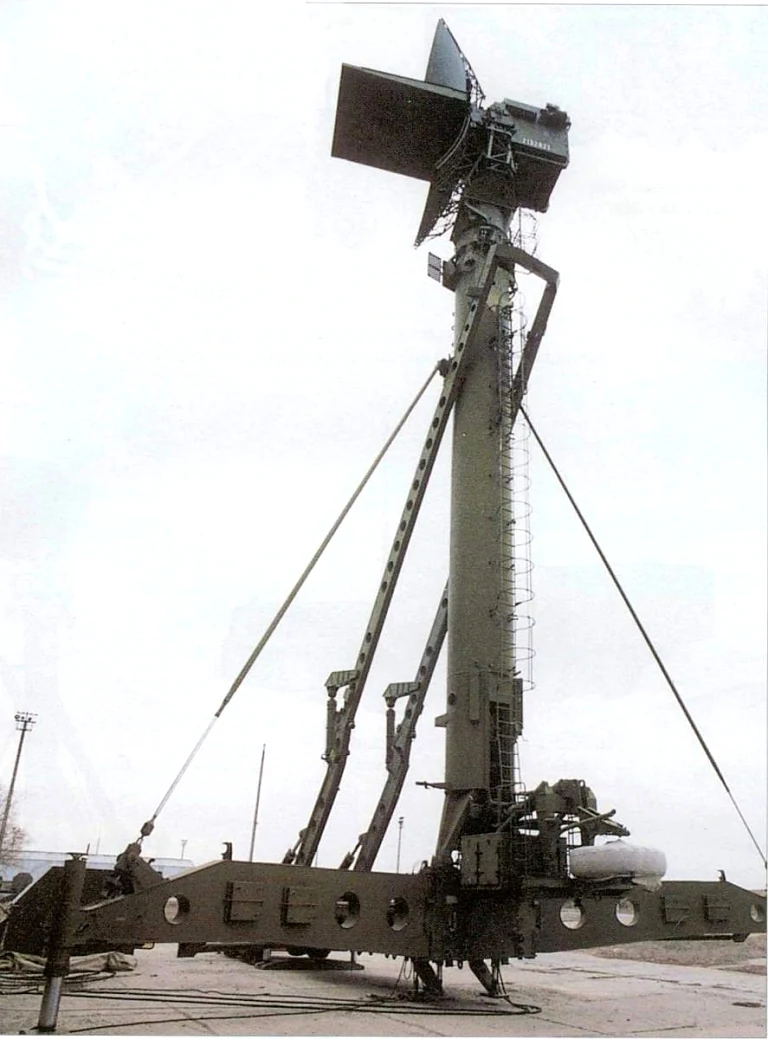
A Clam Shell head on a fully raised 40V6-family mast, seen from near the base of its semi-trailer. The long outrigger beam with lightening holes runs across the foreground, bracing struts and guy cables steady the mast, and a caged ladder climbs it. At the top, the head is seen from below, with the flat spillover screen at upper left and a curved reflector behind it. The source, unit and location are not identified in the photo.
Why the mast. The Clam Shell is almost never seen working from the ground. It rides the NKMZ 40V6M (23.8 m phase centre for this head in the LEMZ table) or the taller 40V6MD (about 38 to 40 m). The head is mated to the mast on the semi-trailer, and the whole assembly tilts as it is raised hydraulically; Kopp shows a Slovak S-300PMU battery doing this. LEMZ gives 1 hour to deploy on a 40V6M; the 40V6MD takes about 2 hours and a crane. The legacy tractor is the MAZ-537, and the head itself is often moved on a KrAZ-260-towed trailer. Claims in some vehicle encyclopedias of a "tracked 76N6" are not supported by the manufacturer description. [DOCUMENTED]
Paired masts. The classic S-300P layout puts the Clam Shell and the Flap Lid engagement radar on masts of equal height, so both see the same horizon. Kopp: the masts are "most frequently used with the 76N6 and 30N6 series radars, usually paired with equal height masts". A detector that sees a low target at 45 km is of little use if the engagement radar cannot see it until 30 km. [DOCUMENTED]
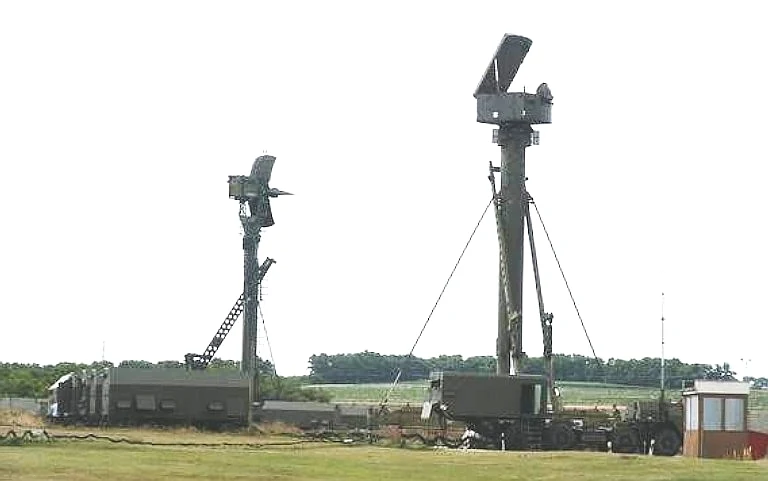
The pairing in practice: on the left, a Clam Shell head on a 40V6-family mast; on the right, on a taller mast, a single flat panel tilted back on a box-shaped cabin, likely a 30N6-family (Flap Lid / Tomb Stone) fire-control head that the Clam Shell cues. Equipment vans are parked below. The masts' exact models and the site are not identified in the photo. The same photo appears in the 40V6 mast article.
The mast article explains the horizon, tree-masking and warning-time arithmetic in full. In short: against a cruise missile at 30 m, a 39 m mast gives about 48 km of horizon versus about 36 km from a 10 m truck antenna, roughly 50 more seconds against a 250 m/s target. [ESTIMATE]
HOW IT WORKS WITH THE 30N6
A simplified engagement chain, assembled from the LEMZ and Kopp descriptions. Crew procedures are not public. [ESTIMATE from DOCUMENTED parts]
- 1. The fence. The Clam Shell turns at 20 rpm on its mast, its thin beam just above the horizon, rejecting ground echoes and chaff by Doppler.
- 2. Detection. A cruise missile at 30 m crosses the horizon of a 24 m mast at about 43 km. Within a few 3-second looks, the automation builds a track: range, bearing, closing speed.
- 3. Cue. The track goes automatically to the battery's fire-control system.
- 4. Acquisition. The 5N63 / 30N6 engagement radar, often on a matching mast, steers its narrow beam to the cued bearing and range, acquires and tracks.
- 5. Engagement. The battery fires; the engagement radar guides by track-via-missile. Kopp credits the Flap Lid with six targets at two missiles each.
- 6. Repeat. The Clam Shell keeps tracking up to 180 targets, so a raid of several missiles can be fed to the engagement radar one after another.
The Clam Shell does not illuminate targets, does not guide missiles and does not give a 3-D height. Its value is a clean, automatic low-level picture handed to the radar that does. [DOCUMENTED]
REPLACEMENT BY THE 96L6E
On the S-300PMU-2 Favorit and the S-400, LEMZ's own 96L6E Cheese Board replaced both the 76N6 and the 36D6 Tin Shield with a single 3-D radar. Kopp's 2011 note puts it this way: S-300PMU-2 batteries "tend to employ the newer planar array 3D LEMZ 96L6 as a single replacement for the paired" Tin Shield and Clam Shell "used almost exclusively with earlier configurations of the S-300P series". The 96L6E can also be put on a 40V6M. [DOCUMENTED]
| 76N6 Clam Shell | 96L6E Cheese Board |
| Maker | LEMZ | LEMZ |
| Job | Low-altitude search only; cues 30N6 | All-altitude and low-altitude search; replaced 76N6 and 36D6 |
| Antenna | Split curved reflectors and screen; not a flat panel | Flat array of 96 rows |
| Waveform | FMCW, continuous | Pulsed, frequency-hopping, coherent MTI / Doppler |
| Band | Contested: "S" (LEMZ) vs X (Western) | Contested: C (5.25 to 5.925 GHz) vs S (2.9 to 3.2 GHz) |
| Elevation | Selectable thin beam; 2-D | Electronic in elevation; 3-D |
| Rotation | 20 rpm | 5 rpm low-altitude mode; 10 rpm all-altitude mode |
| Range | 90 km at 500 m, 120 km at 1,000 m (0.02 m²) | About 5 to 300 km instrumented |
| Tracks | 180 | About 100 |
| Clutter claim | Chaff rejection 100 dB or more | Sub-clutter visibility up to 70 dB |
| Mounting | 40V6M / MD mast, about 1 to 2 hours | Own MZKT-7930 truck, under 5 minutes; mast optional |
The 96L6E figures are those used on this site's S-400 page. The comparison shows the trade: the 96L6E is self-propelled and covers all altitudes in 3-D, but it gives up the Clam Shell's continuous-wave Doppler purity for a pulsed waveform. The two clutter figures measure different things and are not directly comparable. [DOCUMENTED for the figures; ESTIMATE for the trade]
EXPORTS AND STATUS
Exports. Kopp wrote in 2011 that "large numbers of 76N6E Clam Shell radars have been exported", packaged with the S-300PMU, S-300PMU-1 and possibly some S-300PMU-2 batteries, and in 1995 that China was the single largest export customer of the S-300 family. Photos in his reports show a 76N6 with a Slovak Army S-300PMU battery and a 76N6 on a 40V6M with the Cyprus S-300PMU-1, later moved to Crete. [DOCUMENTED]
Possible operators. Any user of the S-300PT, PS, PMU or PMU-1 may hold Clam Shells: Russia, Ukraine, Belarus, China, Greece, Slovakia, Bulgaria, Vietnam, Algeria, Iran and others on the S-300P lists. A unit-by-unit confirmed list has not been published. The photo at the top of this page carries a Belarusian Ministry of Defence credit, which suggests Belarusian use, but the unit is not stated. [DOCUMENTED for those named above; UNVERIFIED as a complete list]
Status. The 76N6 is still in service and in storage with older S-300P-family batteries, and is not the standard low-level sensor of the S-400. Whether any late S-400 battery still uses a 76N6 has not been found. In August 2025 a 76N6 was reported destroyed with an S-300PM2 division at Voronezh, and in September 2025 imagery showed two 5N66 sets being moved at a Khabarovsk plant as Russia tried to reactivate stored S-300PS batteries. [DOCUMENTED for continued presence; SINGLE-SOURCE for the reports]
COMBAT CLAIMS, DATED
Each item is the claim of the party that made it unless independently confirmed. No imagery-verified count of 76N6 losses exists in open sources.
- 16 to 17 August 2025, Baltimore airfield, Voronezh, Russia. The OSINT group CyberBoroshno, reported on 27 August 2025 by Ukrainska Pravda, Militarnyi and UNITED24, said satellite imagery showed burn marks where a 76N6 and a 30N6 of an S-300PM2 division of the 108th Anti-Aircraft Missile Regiment had stood for a long time, after an overnight Ukrainian drone attack. The analysts said losing the two radars would make the division inoperable, and matched the positions to a 2019 Russian TV report on the unit's PM2 upgrade. The reports' description of the 76N6 as a "medium and high altitude" radar is wrong. [SINGLE-SOURCE as to the destruction]
- September 2025, Khabarovsk, Russia. The analyst Athene Noctua, reported by UNITED24 and Militarnyi on 9 and 10 September 2025, found that two 5N66 radars, six 40V6MD masts, three 30N6 radars, 13 launchers and other equipment had been moved at the Khabarovsk Radio Engineering Plant, in an apparent effort to restore two of eight stored S-300PS batteries. Not a combat loss, but evidence that 5N66-family sets were still in Russian stores. [SINGLE-SOURCE]
- 13 November 2026, near Mishino, Leningrad oblast, Russia. Militarnyi, citing Dosye shpiona, reported that Ukrainian drones hit "a 40V6 universal mobile tower equipped with a radar system" near the port of Ust-Luga, along with a Nebo-SVU and a Sopka-2. The radar on the tower was not identified; it may or may not have been a Clam Shell, and this page does not claim it was. [SINGLE-SOURCE; radar type not identified]
The earlier Russian claim of an Iskander strike near Koptiv, Poltava oblast, in July 2024 concerned 5N63S engagement radars, one reportedly on a 40V6M mast, not a 76N6; it is covered in the mast article. [CONTESTED]
PROS AND CONS
Strengths. [DOCUMENTED as manufacturer claims and Kopp's assessment; ESTIMATE for the balance]
- Continuous-wave Doppler gives very strong clutter and chaff rejection, the main problem at low altitude.
- Fully automatic, with 180 tracks and a 3-second update, it can feed a raid to the engagement radar quickly.
- FMCW was hard for older Western radar warning receivers and jammers to detect and jam.
- Mast-mounted, it sees low targets well beyond what a ground radar can.
- Simple mechanical scanning and a 100-hour MTBF with half-hour repair.
Weaknesses. [DOCUMENTED / ESTIMATE as marked in the text above]
- A single-purpose, 2-D sensor: no height measurement and no use above its thin low fence.
- Needs a mast, so 1 to 2 hours to deploy and stow, and a conspicuous tower that can be found and struck.
- Old technology with a published design dating to the 1970s and 1990s; replaced by the 96L6E in new systems.
- Its horizon is still short against sea-skimmers: under 40 km against a 10 m target, even from a tall mast.
- A continuous transmitter is always radiating, which helps an enemy find it once its signal is known.
SPECIFICATIONS
Values are from the LEMZ 1994 table and English brochure digest as reproduced by Kopp, unless another source is named. Conflicting values are shown side by side; "not published" means no open source found.
| Parameter | Value(s) | Tag |
| Designations | 5N66, 5N66M, 76N6, 76N6E; NATO Clam Shell | [DOCUMENTED] |
| Maker | LEMZ (Lianozovo Electromechanical Plant), Moscow | [DOCUMENTED] |
| Role | Automatic low-altitude search; cues 5N63 / 30N6 against low, small targets | [DOCUMENTED] |
| Equipment | FA-51MU / F5MU antenna head; FA52MU receiver-transmitter; F52MU operator shelter | [DOCUMENTED] |
| Waveform | FMCW (high-purity CW plus low-frequency FM); exact FM law not published | [DOCUMENTED / UNVERIFIED] |
| Band | LEMZ "С / S"; Western I-band / X-band (8 to 10 GHz); MHz not published | [CONTESTED] |
| Frequency channels | 6 | [DOCUMENTED] |
| Transmit power | At least 1.4 kW average CW; no pulse peak | [DOCUMENTED] |
| Power consumption | 55 kW maximum (listed as "peak power" by some databases) | [DOCUMENTED; the label CONTESTED] |
| Antenna | Two doubly curved reflectors, 2.8 m (9.2 ft) per side, Tx and Rx, with a spillover screen; not a flat panel | [DOCUMENTED] |
| Isolation | At least 95 dB | [DOCUMENTED] |
| Sidelobes | First below −25 dB; backlobes below −40 to −50 dB | [DOCUMENTED] |
| Azimuth scan | Mechanical 360°, 20 rpm | [DOCUMENTED] |
| Elevation | Up to 1° (vertical polarisation) / 2° (horizontal), LEMZ; "1 or 6 degree" beams, English digest | [CONTESTED] |
| 2-D or 3-D | 2-D (Aviation Week, Kopp); 3-D (ODIN, ARMSNET) | [CONTESTED] |
| Detection range | 90 km at 500 m, 120 km at 1,000 m, 0.02 m², up to 740 m/s (LEMZ); 50 NM at 1,500 ft, 65 NM at 3,000 ft (English); 120 km (Aviation Week); horizon-limited at extremely low altitude | [DOCUMENTED; 90 km vs 50 NM CONTESTED] |
| Other RCS and altitude cases | Not published | [not found] |
| Target speed | Up to 740 m/s (LEMZ); up to 1,400 kt (English) | [DOCUMENTED] |
| Probability of detection | Above 0.5 | [DOCUMENTED] |
| False alarm rate | 10⁻⁸ to 10⁻⁹ | [DOCUMENTED] |
| Tracks | 180, automatic | [DOCUMENTED] |
| Data output | Every 3 s | [DOCUMENTED] |
| Range resolution / error | Resolution 2.15 NM (about 4 km) and RMS 1 NM (English); RMS 2.0 km (LEMZ); 1.9 km (ODIN) | [CONTESTED] |
| Angle | Bearing resolution 1°; RMS 0.3° (English); RMS 10 to 20 arcmin (LEMZ) | [DOCUMENTED] |
| Velocity | Resolution 9.3 kt; RMS 4.7 kt (English); RMS 2.4 m/s (LEMZ) | [DOCUMENTED] |
| Chaff rejection | At least 100 dB | [DOCUMENTED] |
| Jamming protection factor | At least 100 (unit not explained) | [DOCUMENTED] |
| Receiver noise figure | No more than 12 | [DOCUMENTED] |
| Warm-up | 2.5 min (LEMZ); 3 min (some Western summaries) | [CONTESTED] |
| Deployment | 1 hour on a 40V6M (LEMZ); about 2 hours on a 40V6MD (Kopp) | [DOCUMENTED] |
| Mast height | 23.8 m phase centre on 40V6M (LEMZ); 40V6MD 37.8 to 40 m by source | [DOCUMENTED; MD figure CONTESTED] |
| Environment | ±50 °C; 98% humidity at 30 °C; wind up to 30 m/s working, 50 m/s toppling; sites up to 3,000 m | [DOCUMENTED] |
| Remote control | By cable, up to 500 m | [DOCUMENTED] |
| Reliability | MTBF 100 h; MTTR 0.5 h | [DOCUMENTED] |
| Crew | Not published | [not found] |
| Weights | Not published | [not found] |
| Transport | Head on 40V6M / MD semi-trailer, MAZ-537 tractor; heads also moved on KrAZ-260-towed trailers; not tracked | [DOCUMENTED] |
| Systems | S-300PT, PS, PM, PMU, PMU-1; possibly some PMU-2; replaced by 96L6E | [DOCUMENTED] |
CONFLICTING FIGURES
| Item | One figure | The other figure(s) | Note |
| Band | "S" (LEMZ table) | I-band / X-band (Western catalogues) | No MHz published |
| 2-D or 3-D | 2-D (Aviation Week, Kopp) | 3-D (ODIN, ARMSNET) | Brochure fits 2-D |
| Elevation beams | 1° / 2° by polarisation (LEMZ) | 1° or 6° (English digest) | Unresolved |
| Range at about 500 m | 90 km at 500 m (LEMZ) | 50 NM (93 km) at 1,500 ft (English) | Mild conflict |
| Range accuracy | 2.0 km RMS (LEMZ); 1 NM RMS (English) | 2.15 NM resolution; 1.9 km (ODIN) | Resolution and error are different things |
| Warm-up | 2.5 min | 3 min | Sources differ |
| 55 kW | Maximum power consumption (LEMZ) | "Peak power" (some databases) | Almost certainly a mislabel |
| Role | Low-altitude detector (all technical sources) | "Medium and high altitudes" (2025 press) | The press wording is wrong |
Gaps. The carrier frequency, the FM law, the differences between the 5N66, 5N66M and 76N6, the crew, the weights, an RCS and altitude table beyond the two published cases, a complete export list, and whether any S-400 battery still uses a 76N6 are not published.
IN ONE SENTENCE
The 76N6 Clam Shell (5N66 / 5N66M / 76N6E) is LEMZ's mast-mounted FMCW low-altitude detector for the S-300P family, a split-reflector continuous-wave radar turning at 20 rpm that finds cruise missiles and low aircraft in clutter, out to 90 km at 500 m and to the radar horizon below that, and cues the 30N6 engagement radar on a matching mast; its band is disputed between S and X, it was replaced by the 96L6E on the S-300PMU-2 and S-400, and it is still in service, in storage and under attack in the Ukraine war.
SOURCES
- 1. Carlo Kopp, "76N6 Clam Shell Low Altitude Acquisition Radar," Technical Report APA-TR-2004-1001, Air Power Australia, 1995, updated to 2011, including the LEMZ 1994 specification table, the English brochure digest and Technical Note #1 (2011) on the Square Pair resemblance and exports. ausairpower.net/clamshell.html
- 2. LEMZ, "76N6 Low Altitude Warning Radar," technical brochure, 1994 (English / Russian), as reproduced in source 1.
- 3. Carlo Kopp, "Technology Explained: Clam Shell Radar," Australian Aviation, October / November 1995.
- 4. Carlo Kopp, "NKMZ 40V6M / 40V6MD Universal Mobile Mast," APA-TR-2009-0504, Air Power Australia, 2009 to 2014 (mast pairing, deployment, Slovak and Cyprus photos). ausairpower.net/APA-40V6M-Mast-System.html
- 5. Carlo Kopp, S-300PMU-2 Favorit and acquisition radar surveys, Air Power Australia (96L6 replacement). ausairpower.net/APA-S-300PMU2-Favorit.html
- 6. Aviation Week, "NATO Code Names for Russian Radar" (I-band, 2-D, 180 tracks, 120 km). aviationweek.com
- 7. Radartutorial, 76N6 card (I-band / X-band FMCW), previously indexed at radartutorial.eu/19.kartei/04.battle/karte014.en.html; not found when re-checked.
- 8. US Army TRADOC, ODIN Worldwide Equipment Guide, "76N6 Clam Shell" (55 kW "peak power", 3-D, 1.9 km); ARMSNET 76N6 entry.
- 9. Ukrainska Pravda, "Two radars of S-300 air defence missile system and possibly two Su-24 aircraft hit in Russia's Voronezh," 27 August 2025; Militarnyi and UNITED24 Media, August 2025; all citing CyberBoroshno.
- 10. Militarnyi, "OSINT Analyst: Russia Attempts to Reactivate Old S-300 Systems," 10 September 2025; UNITED24 Media, 9 September 2025; citing Athene Noctua.
- 11. Militarnyi, Zalutskyi Illia, "Ukrainian Drones Struck Three Radar Stations ... Ust-Luga," 13 November 2026, citing Dosye shpiona. militarnyi.com/en/news/ukrainian-drones-3-radar-stations-ust-luga/
- 12. Standard CW, FMCW and Doppler radar principles, as in M. I. Skolnik, Introduction to Radar Systems. The Doppler and horizon figures here are this article's arithmetic.
- 13. Project Orlan pages used for consistency: 40V6MR / 40V6M mast, S-300, S-400 (96L6E figures), 91N6E Big Bird, 92N6E Grave Stone, Nebo.
Related on this site: 40V6MR / 40V6M universal mobile mast, the tower the Clam Shell rides on, and why height matters.
Related on this site: S-300, the system the Clam Shell was built for.
Related on this site: S-400, where the 96L6E took over the low-altitude job.
Related on this site: 92N6E Grave Stone, the S-400 successor to the 30N6 engagement radar the Clam Shell cued.
Related on this site: 91N6E Big Bird, the long-range acquisition radar of the same family of batteries.
Related on this site: Nebo, the VHF / L / S radar family used to cue long-range SAMs.
Project Orlan // Underground Information Database