WHAT IT IS
Afghanit (Афганит, also transliterated Afganit) is the active protection system, or КАЗ (комплекс активной защиты, "active protection complex"), built into Russia's Armata generation of heavy armoured vehicles. It is most closely associated with the T-14 Armata main battle tank, and the same family of sensors and launchers appears, in different layouts, on the T-15 heavy infantry fighting vehicle (Т-15 «Барбарис»), and in prototype or exhibition form on the Kurganets-25 tracked vehicles and the Bumerang (Бумеранг, usually written Boomerang in English) wheeled carrier. [DOCUMENTED]
The name is a mineral. Afghanite is a blue silicate first described from Afghanistan, and the choice fits a long Soviet and Russian habit of naming protection systems after stones, weather and armour words: Kontakt, Relikt, Malakhit (malachite, the T-14's explosive reactive armour), Shtora (curtain), Arena, Drozd (thrush). Russian sources treat the name as a product label and nothing more; it does not encode any technical meaning. [BACKGROUND]
Afghanit is unusual among active protection systems because it is two systems sharing one set of eyes. The first is a soft-kill layer: sensors that notice a laser beam, a missile launch or an incoming round, and roof-mounted launchers that turn toward the threat and throw smoke, aerosol or decoy grenades to blind or confuse the guidance. The second is a hard-kill layer: fixed launch tubes ("mortars", мортиры or мортирки in Russian reporting) set low on the turret sides that fire a protective munition into the path of an incoming round and detonate it a few metres from the tank. [DOCUMENTED]
In one sentence: Afghanit is a ring of radar panels and optical sensors around the turret, a fast computer, a set of steerable smoke launchers on the roof, and ten fixed interceptor tubes under the turret, all meant to stop an anti-tank round before it touches the armour, and it is the first Russian system whose makers publicly claimed it could stop tank-gun darts as well as rockets and missiles. [DOCUMENTED that the claim was made; the capability itself is UNVERIFIED]
It is also a system about which almost nothing has been published by the people who built it. There is no brochure, no export data sheet, no exhibition panel with numbers, and no confirmed combat record. What is public comes from four kinds of source: Russian state media quoting unnamed Ministry of Defence officials (mostly Izvestia and RIA Novosti from 2015 to 2017), occasional on-camera comments by NII Stali staff on television, patents and research papers from the institutes that work on active protection, and Western and Russian analysts reading photographs. This page uses all four and says which is which. [BACKGROUND]
HOW TO READ THIS PAGE
Russian terms are kept because this is a Russian system and the Russian names are what you need to search for more. Where sources disagree, the disagreement is stated where it comes up and collected again in the SOURCE CONFLICTS section near the end.
One warning applies to the whole page. Afghanit has been the subject of more confident writing than almost any other Russian vehicle system, because the T-14 was unveiled in 2015 with a great deal of publicity and very little data. Many numbers that circulate online (a reaction time of 0.1 second, a minimum intercept distance of 4 m, interception of rounds at 3,000 m/s, "electromagnetic protection" against mines) trace back to one or two articles and in some cases to Russian popular-science sites that blended Afghanit with patents and research papers about other systems. They are reported here, labelled, and not repeated as fact.
AFGHANIT AT A GLANCE
WHY TANKS NEED ACTIVE PROTECTION
The problem in one paragraph
A tank has always been a bargain between armour and weight. Every millimetre of steel or composite added to stop a shaped-charge jet or a tank-gun dart adds tonnes, and a tank that weighs too much cannot cross bridges, cannot be carried on rail flats, and burns its tracks and transmission. Since the 1960s the cheapest way to beat a tank has been a shaped-charge warhead (HEAT, кумулятивный) on a rocket or missile: a cone of copper lined with explosive that, when it fires, forms a thin jet moving at 7 to 9 km/s that can push through many times its own diameter of steel. A soldier with a launcher costing a few thousand dollars can threaten a vehicle costing several million. [BACKGROUND]
Three answers
Designers settled on three answers, which today are layered on almost every modern tank.
The NII Stali speaker on Zvezda in 2021 put the Russian position bluntly: there had been a view that reactive armour should be abandoned in favour of active protection, "but life shows that this is not so", and a tank needs every layer at once. Afghanit is therefore meant to sit on top of Malakhit and the composite armour, not replace them. [DOCUMENTED]
Soft kill and hard kill
Active protection splits into two families. Soft-kill systems try to make the attacking weapon miss. They do not touch the round; they attack its guidance. A wire-guided or laser-beam-riding missile needs the gunner to see the target; smoke blocks the view. A missile with a laser seeker needs a laser spot; an aerosol cloud scatters it. An infrared-commanded missile such as the old TOW or Konkurs tracks a flare in its tail; an infrared jammer can make the launcher's tracker steer it into the ground. The Soviet answer of the 1980s was Shtora-1 (Штора, "curtain"), which used laser warning receivers, two infrared "dazzlers" either side of the gun, and turret smoke grenades. [BACKGROUND]
Hard-kill systems destroy or deflect the round itself. A sensor measures the incoming object, a computer picks a moment, and a protective munition is fired to meet it: a fragment charge, a blast, an explosively formed slug, or in a few designs a small projectile. The first hard-kill system to reach service anywhere was the Soviet Drozd (Дрозд) from KBP Tula, fitted to T-55AD tanks in the early 1980s; a separate article on Drozd will follow on this wiki. Arena from KBM Kolomna followed in the 1990s (see Arena-M), Israel's Trophy and Iron Fist in the 2000s. [DOCUMENTED]
Afghanit is the first Russian system designed from the start to do both on one vehicle with one sensor set. That is its real novelty, more than any single claimed number. [SINGLE-SOURCE as a judgement; common among analysts]
DEVELOPMENT AND WHO BUILT IT
The Armata programme
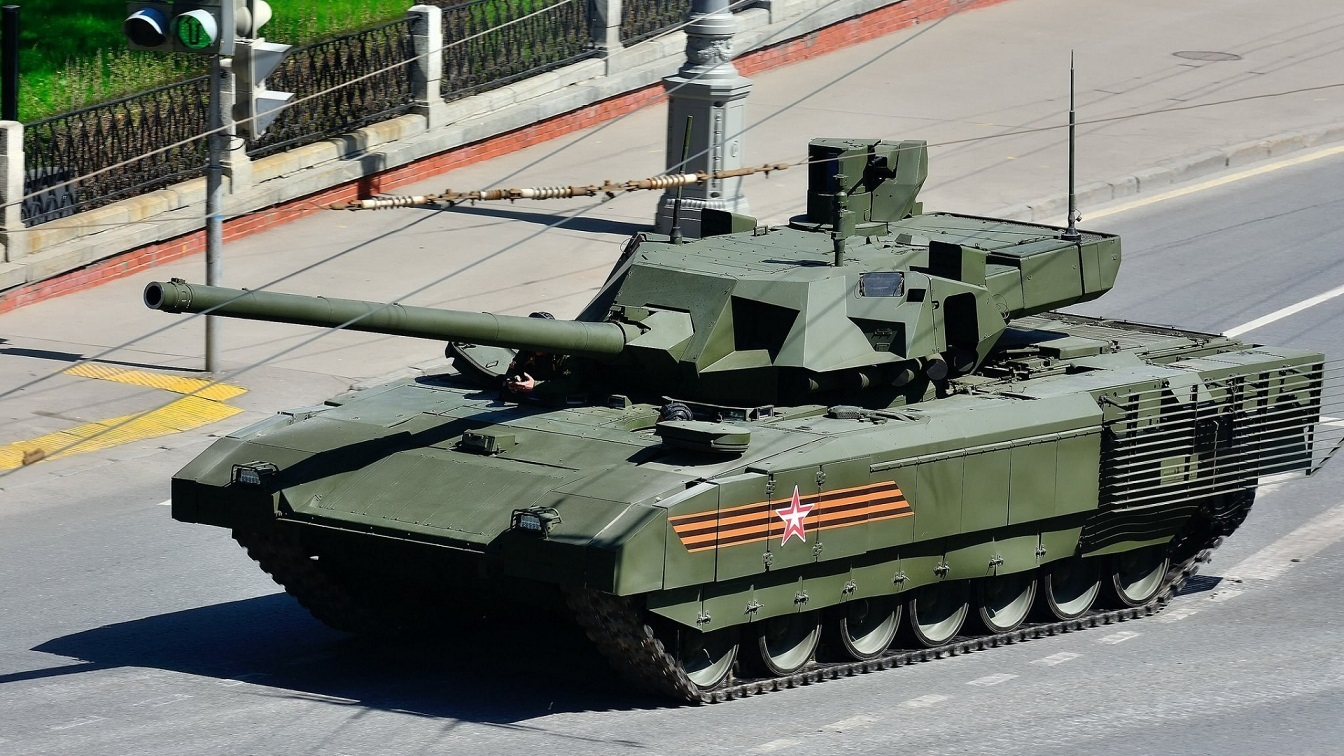
The Armata "universal combat platform" (универсальная гусеничная платформа «Армата») was ordered in the early 2010s as a common heavy chassis for a tank, a heavy infantry fighting vehicle, an armoured recovery vehicle and other variants, to replace the line of designs descended from the T-72. The design work was done at the Ural Design Bureau of Transport Machine-Building (Уральское конструкторское бюро транспортного машиностроения, UKBTM) in Nizhny Tagil under Uralvagonzavod. The vehicles were shown in rehearsals and the 9 May 2015 Victory Day parade in Moscow, with several items covered or blanked. The background is on this wiki's T-14 Armata page. [DOCUMENTED]
From the first parade photographs, observers noticed that the T-14 turret carried things no previous Russian tank had: four flat rectangular panels near the turret corners, a ring of small windows, a row of tubes beneath the turret on each side, and turreted grenade launchers on the roof. The Russian press called the assembly Afghanit and reported that it was the tank's active protection. [DOCUMENTED]
NII Stali
NII Stali (ОАО «НИИ стали», the Scientific Research Institute of Steel) in Moscow is Russia's principal institute for armour. It designed the Kontakt-5 and Relikt reactive armour families and the composite packages for several Soviet and Russian tanks, and it has a department working on active protection. In a 2021 Zvezda programme on the Armata's protection, NII Stali's head of marketing, Evgeny Chistyakov, discussed Afghanit as part of the institute's work with Uralvagonzavod and said that its radar "is additionally fitted with an active phased array". The institute has also publicly shown its "upper hemisphere protection complex" (комплекс защиты верхней полусферы), and the traversable roof launchers on the T-14 are widely labelled as part of that complex, as in the annotated photograph above. [DOCUMENTED]
KBP Tula
In September 2016 Izvestia, quoting an unnamed Defence Ministry source, reported that Afghanit had begun intercepting depleted-uranium sabot darts in trials, and described the system as "developed and produced by the Tula Instrument Design Bureau" (KBP). KBP is the bureau that built Drozd, the Pantsir air-defence system (see Pantsir) and the Kashtan close-in weapon (see Kashtan), so the attribution is not absurd. It has not been repeated by KBP itself, and later Russian sources, including NII Stali staff, describe the work as NII Stali's. [DOCUMENTED that the attribution appeared; SINGLE-SOURCE]
Reconciling the two
The most likely explanation is that Afghanit, like most Russian weapon systems, is a cooperation in which one organisation is the system integrator and others supply parts. NII Stali is the natural integrator for a protection system on a tank whose armour it also designed. KBP has the deepest experience with hard-kill fragment munitions and with fast fire-control electronics. The radar panels may come from yet another house; Russian radar firms such as NIIP (Tikhomirov) and the Istok and Pulsar microwave enterprises have been mentioned in speculation, but no source names the radar maker. [SPECULATION]
Timeline
THE PARTS ON THE TURRET
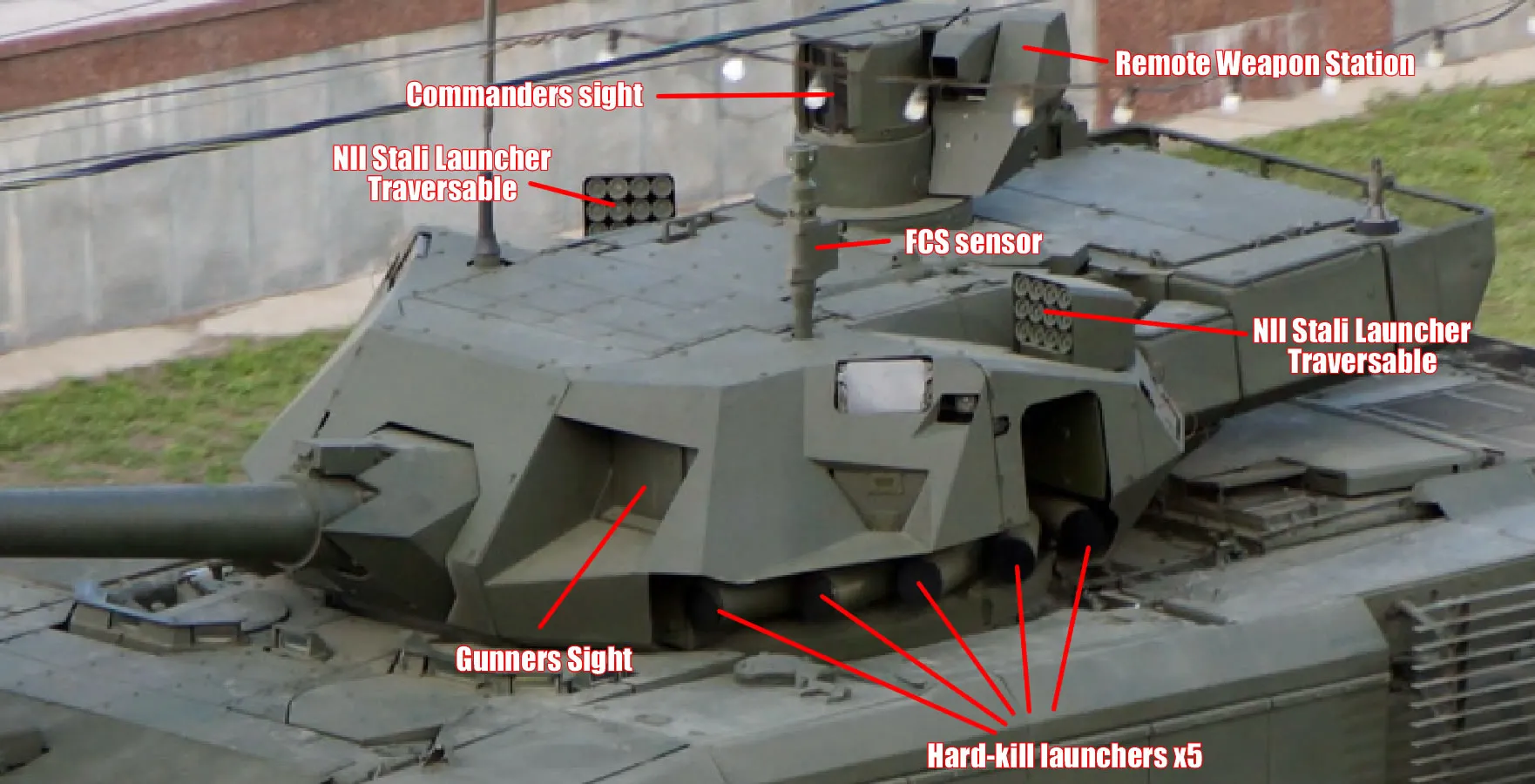
The labelled photograph above is the best single key to the system. Reading the T-14 turret from the top down, the externally visible Afghanit-related parts are as follows. [DOCUMENTED from photographs, with the labels used in Western and Russian annotations]
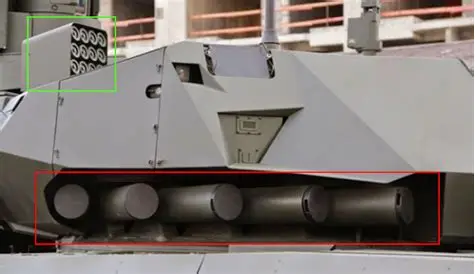
The second photograph, a close side view, shows the arrangement more clearly: the hard-kill tubes are not on the turret roof or bustle but tucked under the side of the turret, where the hull roof and the turret sides meet. They therefore traverse with the turret, which is important, because it means the hard-kill sector follows the gun rather than the hull. [DOCUMENTED that they are turret-mounted; the consequence is ESTIMATE]
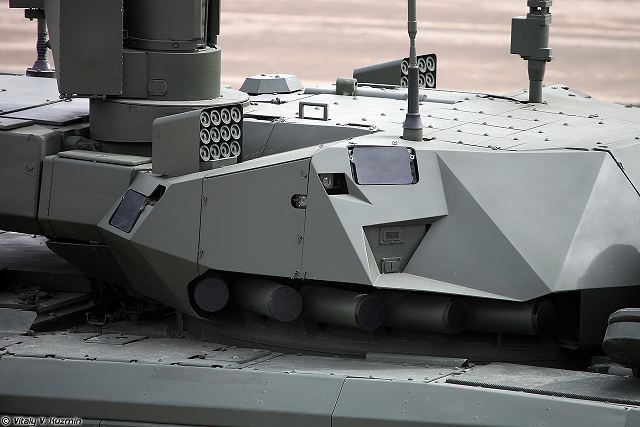
The third photograph, by the Russian defence photographer Vitaly Kuzmin, shows the same area from a lower angle. The tubes have closed caps, and the turret skirt above them is cut to give them a clear exit path. [DOCUMENTED from photographs]
THE SENSOR SUITE
Why sensors are the hard part
An active protection system is mostly a sensor problem. The explosive part, a charge that throws metal into a box of air a few metres away, is old technology. The hard part is noticing, out of all the clutter around a tank in battle, the one object that is going to hit it, measuring exactly where it is going and how fast, and doing so in a small fraction of a second, while not reacting to birds, rain, dust, shell fragments, bullets, friendly vehicles, the tank's own gun blast, or deliberate jamming. Every APS design is a set of compromises around that problem. [BACKGROUND]
Afghanit's answer, as far as the public record goes, is to use several different kinds of sensor that see different physical things, and to require them to agree before acting. That fusion is what Russian sources mean when they call the sensor suite "radio-optical" (радиооптический). [DOCUMENTED that the term is used]
The four radar panels
The four turret-corner panels are described as a pulse-Doppler radar using active electronically scanned arrays. An active phased array is a flat grid of many small antenna elements, each with its own transmit-receive module, so that the beam can be steered electronically in microseconds rather than by turning a dish. For how that works in general, see this wiki's How AESA Radar Works. [DOCUMENTED that they are described as АФАР; BACKGROUND for the principle]
The operating band has not been published. Russian-language encyclopaedic summaries and the Wikipedia article say the main radar is millimetre-wave. A 2023 article by Thomas Withington in European Security and Defence discussed Drozd and Arena in the K-band region (Drozd's radar is usually given as about 24.5 GHz) and treated Afghanit as a newer, more capable design. A millimetre-wave or Ka-band radar would fit the panel size: at 35 GHz the wavelength is under 1 cm, so a panel of 20 to 30 cm across can hold several hundred elements and form a beam a few degrees wide. [SINGLE-SOURCE for the band; ESTIMATE for the arithmetic]
Pulse-Doppler means the radar sends short pulses and measures both the time for each echo to return (range) and the shift in frequency caused by the target's motion (radial speed). Speed is the single most useful filter an APS has. A tank in a field is surrounded by things that are stationary or slow: the ground, trees, buildings, infantry, other vehicles. Everything dangerous to it is fast. An RPG-7 grenade flies at roughly 115 m/s after its motor fires, a Kornet missile at about 250 to 300 m/s, a Javelin at a few hundred m/s in its final dive, and a tank-gun sabot dart at 1,500 to 1,800 m/s. By ignoring everything below, say, 50 m/s and everything not closing on the tank, the radar throws away almost all its clutter. [BACKGROUND]
[ESTIMATE] The Doppler shift for a radar is fd = 2v/λ. At 35 GHz (λ ≈ 8.6 mm), a Kornet missile closing at 280 m/s produces a shift of about 65 kHz; an RPG at 115 m/s about 27 kHz; a sabot dart at 1,700 m/s about 395 kHz. A shell fragment flying past at an angle produces a smaller radial component and a short, unsteady return. A bird produces a few hundred hertz. Those numbers are far apart, which is what makes Doppler filtering effective, and the large shift of a sabot also means the radar's signal processing must sample fast enough to capture it, a design requirement absent from older RPG-only systems.
Search radar and fire-control radar
Several analysts, starting with the Israeli site Defense Update and repeated in the Russian Wikipedia article, describe Afghanit as having two levels of radar: the four corner panels for all-round search and early tracking, and two additional very fast short-range Doppler radars dedicated to the hard-kill channel in the frontal arc. Those two would measure the incoming round's final position and speed to set the exact detonation moment of the interceptor. [SINGLE-SOURCE]
The argument for the split is physical. A radar optimised to search a wide volume needs broad beams and a dwell time long enough to detect small targets at a distance; a radar optimised to time a detonation against a dart at 1,700 m/s needs very fine range resolution, very high update rates and very low latency, but only over a narrow box a few metres in front of the interceptor. One set of hardware does not do both well. The Russian summaries go further and suggest that the soft-kill channel might use longer-wavelength radar (S- or L-band) that is blind to small objects such as bullets and fragments, while the hard-kill channel uses millimetre-wave. That idea comes from published design reasoning in the open literature on APS rather than from any document about Afghanit. [SPECULATION in the specific application to Afghanit]
The diagram reproduced lower on this page, drawn by a Russian enthusiast, labels the system that way: a "near radar" (ближняя РЛС), a "long-range AESA radar" (РЛС дальнего обнаружения с АФАР), and "PFAR receivers", that is, passive phased-array receivers. It is a useful illustration of the commonly accepted architecture, not an official drawing. [SINGLE-SOURCE]
Ultraviolet launch detection
In 2016 Izvestia, quoting a ministry source, reported that ultraviolet detectors had been installed on the T-14 and T-15 and were being tested as part of Afghanit. The explanation given was that the radar-only system could theoretically be confused by a volley of shells and rockets, by debris flying around in battle, or by enemy electronic countermeasures, and that the UV sensors could detect rockets and grenades approaching from any direction. [DOCUMENTED, anonymous source]
How UV missile warning works is well understood from aircraft. A rocket motor's exhaust plume is hot enough to emit in the solar-blind ultraviolet band, roughly 240 to 280 nm. Sunlight at those wavelengths is absorbed almost completely by ozone in the upper atmosphere, so at ground level the background in that band is nearly black. A sensor tuned to it sees an RPG's sustainer motor or an ATGM's booster as a bright point against darkness, with very few false alarms from sky, sun glint or fires. Because UV detection is passive, it emits nothing and cannot be detected or jammed by the enemy in the way a radar can. [BACKGROUND]
The Izvestia report also claimed the UV sensors do not only detect a launch but help evaluate the projectile's speed and trajectory. A single UV sensor gives direction; several overlapping sensors and a time series of angles can give an angular rate, and combined with radar range that gives a full track. [DOCUMENTED that claimed; ESTIMATE for the method]
The UV channel has limits. It sees only things with a burning motor. A tank-gun dart has no motor and is invisible in UV; so is a mortar bomb, a gun-launched missile once its motor burns out, and a drone with an electric motor. An RPG-7's rocket burns for only a short distance after launch, and a Javelin's flight motor burns out before its final dive. UV is therefore a cueing and cross-check sensor, very good at saying "a missile has just been fired from over there", not a sensor that can time an intercept on its own. [BACKGROUND]
Infrared and visible cameras
Russian summaries describe high-definition all-round cameras with near and far infrared channels, integrated with the radar. NII Stali-related descriptions and the T-14's general design suggest these do two jobs: they feed the crew's all-round situational awareness system (the T-14's crew sit in a capsule in the hull and see the world only through cameras), and they give the APS another way to see an incoming object. A thermal camera can see the hot body of a missile, its motor, or a muzzle flash. [DOCUMENTED that cameras exist; SINGLE-SOURCE for their APS role]
The same summaries claim Afghanit can work in a passive mode: radar off, cameras and UV on, so that the tank does not reveal itself by emitting. In that mode the system could still warn of a missile launch and fire soft-kill grenades, but it is unlikely that it could time a hard-kill intercept without radar range data. [DOCUMENTED that the passive mode is claimed; ESTIMATE for the limit]
Laser warning
Every Russian tank since Shtora-1 has had laser warning receivers, and the T-14 has them. They detect the beam of a laser rangefinder, a laser designator painting the tank for a laser-guided missile or shell, or the guidance beam of a beam-riding missile. A laser warning receiver typically gives a direction and a classification (rangefinder pulse, designator pulse code, or beam-rider modulation), and in a soft-kill system the standard response is to turn the vehicle's grenade launchers toward the source and fire an aerosol screen. [BACKGROUND]
The T-14's large angled front sensors are usually identified as laser warning receivers, and the small windows around the turret may include more. [SINGLE-SOURCE identification]
Sensor fusion
The system the sources describe is layered by distance and by physics:
Requiring two different sensors to agree is the standard method for cutting false alarms. A radar can be fooled by chaff or a jammer; a UV sensor can be fooled by a flare; a laser warner can be triggered by a friendly rangefinder. It is much harder to fool all three at once with a single trick. [BACKGROUND]
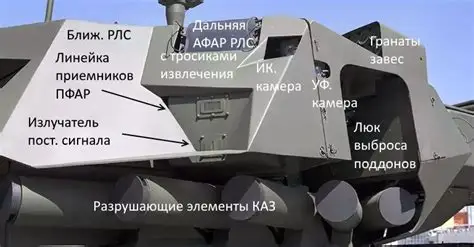
The diagram above, from Russian-language sources, labels the parts as commonly understood: the near radar, the long-range AESA radar, PFAR receivers, infrared camera, ultraviolet camera, smoke grenades, the hatch that ejects spent launcher pallets, and the KAZ destruction elements (the hard-kill munitions). It shows the hard-kill elements along the lower turret side and the smoke grenades on the roof. It is an enthusiast's annotation, but it agrees with the photographs. [SINGLE-SOURCE]
THE SOFT-KILL LAYER
What the roof launchers do
The two traversable launcher blocks on the T-14's turret roof are the soft-kill effectors. Each is a small turret in its own right, carrying a battery of grenade tubes, that can rotate and change elevation. Unlike the fixed smoke-grenade dischargers on older tanks, which can only fire into a fixed fan in front of the turret, a traversable launcher can be pointed at the actual threat direction before firing. That matters because a smoke screen thrown in the wrong place is useless, and because the threats that soft-kill can defeat (guided missiles controlled from a firing post) can come from any bearing. [DOCUMENTED that they traverse]
Russian descriptions name the roof assembly as NII Stali's "upper hemisphere protection complex". The name suggests that the launchers can elevate high enough to address threats from above, such as top-attack missiles or munitions released from the air, which the fixed hard-kill tubes cannot reach. [DOCUMENTED for the name; ESTIMATE for the implication]
Payloads
No official list of Afghanit's soft-kill grenades has been published. By analogy with the Russian grenade families used on Shtora, Arena-equipped tanks and the 902 Tucha (Туча) launchers, the likely payloads include: [SPECULATION based on Russian practice]
Some sources claim the roof launchers can also fire hard-kill munitions upward against top-attack threats, which would make them a second, slower hard-kill layer covering the upper hemisphere. Army Recognition's description of the T-14 refers to "steerable cartridges with smaller charges" and a "VLS" (vertical launch) arrangement on top of the turret, which hints at this, but no source shows it working. [SINGLE-SOURCE]
How soft kill defeats each guidance type
This is why Afghanit needs both layers: soft kill handles guided missiles at range, which are the threat most likely to come from long distance, and hard kill handles unguided weapons and missiles that get through. [ESTIMATE]
Jamming
Older Russian soft-kill systems included electro-optical jammers (the red Shtora "eyes" on T-90 and T-80U tanks), which flooded infrared-command missiles' trackers with a modulated signal. The T-14 does not show obvious Shtora-type jammer lamps. Some Russian media and popular sites have claimed that Afghanit includes "electromagnetic" protection: a field generator able to set off magnetic-influence mine fuzes before the tank reaches them, or to disrupt electronic fuzes. Such systems exist in Russian research (the 2016 reporting talked of an electromagnetic module on the T-14) but there is no photograph or developer statement linking a specific device to Afghanit. [UNVERIFIED]
It has also been claimed that Afghanit includes radio-frequency jamming against radio-controlled improvised explosive devices or drone control links. In 2022 to 2026 Russian forces have fitted many vehicles with add-on jammers against FPV drones; none is a documented part of Afghanit. [UNVERIFIED]
THE HARD-KILL LAYER
The ten tubes
On the T-14 the hard-kill effectors are the ten fixed tubes under the turret, five per side. They are aimed forward and outward, slightly upward, so that between the two groups they cover a broad arc in front of the turret, centred on the gun. Because they are fixed to the turret, the arc traverses with the turret. [DOCUMENTED from photographs; the aiming is ESTIMATE]
Russian sources call them mortars (мортиры, мортирки), a common Russian term for short launch tubes that throw a munition a short distance with a small propellant charge, the same word used for Arena's and Drozd's launchers. [DOCUMENTED]
The number ten has a direct consequence: the tank carries ten hard-kill shots, at most, before the tubes must be reloaded from outside. They are not automatically reloadable from inside the vehicle as far as anyone has shown. If each threat takes one interceptor, the tank can defeat ten unguided rounds from the front; if some threats require two, or if the system fires at false targets, fewer. [ESTIMATE]
On the T-15 the hard-kill tubes are mounted on the hull sides in two banks, giving a different arc; on the Kurganets-25 prototypes, launcher boxes appeared on the turret; on the Bumerang, only some exhibition vehicles showed Afghanit-like fittings. [DOCUMENTED from photographs; details vary between vehicles shown]
What the munition is
Nobody has published a cross-section of an Afghanit protective munition. Three ideas compete:
The truth may be a combination: a munition that throws a cone of heavy fragments or a multi-EFP matrix, with programmable detonation of some elements to steer the pattern, which is what the patent and the Russian summaries describe. [SPECULATION]
The NII Stali research on stopping darts
The most informative technical source connected, at least indirectly, to Afghanit is a review article by NII Stali specialists on their research into active protection against kinetic penetrators, summarised in the Russian Wikipedia article. Its points, which some reviewers link directly to Afghanit's design, are these: [SINGLE-SOURCE summary; the link to Afghanit is SPECULATION]
These points explain both the claimed dual-radar architecture and the reason the hard-kill tubes sit where they do. [ESTIMATE]
Why stopping a dart is so hard
A modern 120 mm or 125 mm APFSDS penetrator is a rod of tungsten alloy or depleted uranium about 25 mm across and 600 to 900 mm long, weighing 4 to 6 kg, travelling at 1,600 to 1,800 m/s at the muzzle and still well above 1,500 m/s at 2 km. It has no fuze, no electronics and no explosive to destroy. Its kinetic energy is of the order of 6 to 9 megajoules. A fragment cloud that would slice through a missile's thin casing merely scratches it. [BACKGROUND]
There are therefore only two useful things a hard-kill system can do to a dart: break it, which requires a very energetic impactor, or yaw it, so that it strikes the armour at an angle and its penetration collapses. A long rod hitting at 30° of yaw penetrates a fraction of the armour it would penetrate nose-first. Yawing is the realistic goal, and it requires hitting the rod off-centre near the nose, early enough that the yaw has time to grow before impact, but late enough that the rod does not have time to re-stabilise. [BACKGROUND]
[ESTIMATE] At 1,700 m/s, a dart covers 1.7 m in a millisecond. If the interceptor detonates 5 m in front of the armour, the dart reaches the armour about 3 ms later. A tumble rate of a few revolutions per second would turn a 700 mm rod only a few degrees in that time; a strong off-axis impulse near the nose could produce much faster yaw. The NII Stali argument for a detonation "several metres" away is consistent with the need for this distance.
[ESTIMATE] The timing precision required is severe. If the fragment sheet is effective over a slice of the dart's path 0.5 m deep, the detonation must be timed to within about ±0.15 ms for a dart at 1,700 m/s. For an ATGM at 250 m/s, the same slice gives ±1 ms. This is the reason a separate fast fire-control radar and a fast fuze are needed for darts.
The 1,700 m/s figure and the 3,000 m/s figure
The 1,700 m/s figure appeared in Russian reporting in 2015 as a capability already achieved or about to be. It corresponds to the muzzle velocity of modern tank-gun darts, so it is the natural benchmark. The 2016 Izvestia report gave a range of 1.5 to 2 km/s and claimed first trial intercepts that year, including of depleted-uranium darts. A later anonymous claim that Afghanit would be developed to intercept objects at 3,000 m/s by around 2020 would cover hypervelocity missiles and future electromagnetic guns; nothing further was reported. [DOCUMENTED that claimed; UNVERIFIED as capabilities]
No video, test report or independent observer has confirmed Afghanit intercepting a sabot. Western analysts are divided: some accept that a dart can be yawed by a well-timed EFP or heavy-fragment charge and that Russia may have demonstrated this in controlled trials; others think the claim was aspirational. Germany's AMAP-ADS and the US have also claimed or researched kinetic-energy interception, so the idea is not impossible in principle. [DOCUMENTED that views differ]
THE ENGAGEMENT CHAIN, STEP BY STEP
Nothing below comes from a developer description of Afghanit's software. It is the sequence that the published parts imply, written out so the timing can be checked. The steps and the time budget are [ESTIMATE] unless marked otherwise.
Case 1: a Kornet-type laser beam-riding missile from 3 km
1. Launch. An enemy crew fires a missile from 3 km. The booster motor fires. The UV sensors on the side facing the launcher see a bright point in the solar-blind band and report a bearing. At the same time the laser warning receivers detect the guidance beam's coded pulses and report the same bearing. Two independent passive sensors now agree. [The capability to detect launch by UV is DOCUMENTED as claimed]
2. Classification. The computer tags this as a guided missile threat: a beam-rider is coming. The crew gets an alarm on their displays. Flight time at about 250 to 300 m/s is 10 to 12 seconds.
3. Soft-kill response. The roof launcher on the threatened side turns toward the bearing. Turning a small launcher through 180° takes a fraction of a second to a second. It fires aerosol grenades, which burst some tens of metres away and form a screen in one to three seconds. The beam is scattered, the missile loses guidance and flies on a ballistic path. The tank may also move or turn the turret to put its frontal armour toward the threat.
4. Radar track. In parallel, the corner radar facing the threat picks up the missile at some hundreds of metres to a kilometre or more and tracks it. If the missile keeps coming toward the tank, the system prepares the hard-kill channel.
5. Hard-kill engagement. If the missile is still on a collision course within the hard-kill arc, the fire-control radar measures its range and speed when it is perhaps 20 to 50 m away; the computer selects a tube whose arc covers the predicted intercept point and fires it. The interceptor flies a few metres out and is detonated, with a lead calculated from the measured speed, when the missile is a few metres from it. The fragment sheet or slug destroys the missile body or its warhead, or the warhead functions prematurely far from the armour.
6. Aftermath. One tube is gone. The system resets and resumes watching.
In this case Afghanit has several seconds and two layers. The soft-kill layer should handle most such missiles if it works as described; the hard-kill layer is a backup.
Case 2: an RPG-7 from 150 m
1. The grenade is launched by a small charge and its rocket motor ignites about 10 m out, flying at around 115 m/s average to the tank, so the flight takes about 1.3 seconds.
2. The UV sensors may see the brief motor burn, giving a bearing. The radar picks up the grenade at perhaps 100 m or less.
3. Soft kill is useless: an RPG is unguided.
4. If the grenade is in the frontal arc, the hard-kill channel tracks it, predicts the intercept and fires one tube when the grenade is perhaps 10 to 20 m away. At 115 m/s, the grenade covers 1 m in about 9 ms. The interceptor must leave the tube, fly a few metres in a few milliseconds, and detonate. This is the classic APS engagement for which Drozd and Arena were built and which every modern system can do.
5. If the grenade comes from the side or rear, outside the arc of the ten tubes, the T-14 relies on armour, ERA and slat or screen protection. [ESTIMATE from photographs of tube direction]
Case 3: a tank-gun sabot from 2 km
1. The enemy tank fires. The muzzle flash and blast might be seen by infrared cameras, and the enemy laser rangefinder would be detected by laser warning a second or two before firing, if used. The dart itself emits nothing in UV.
2. Flight time is a little over one second.
3. The radar must detect a very small object (a rod 25 mm across, with a small radar cross-section from head-on) at hundreds of metres and track it in the few hundred milliseconds before impact. [ESTIMATE]
4. The fast fire-control radar must measure its speed and position as it enters the last tens of metres, the computer must choose a tube, and the interceptor must be fired and detonated with a timing accuracy of a fraction of a millisecond, a few metres in front of the turret.
5. The aim is to strike the rod's front section and give it enough yaw to reduce penetration so that the remaining effect can be stopped by the T-14's frontal armour and Malakhit. Destroying the rod is not expected.
[ESTIMATE] With a hard-kill tube firing an interceptor at, say, 100 to 200 m/s out to a burst point 3 to 5 m away, the interceptor flight alone takes roughly 20 to 50 ms. In that time the dart covers 35 to 85 m. So the decision to fire must be taken while the dart is still roughly 40 to 100 m away, and the interceptor is launched toward where the dart will be, not where it is. The fire-control radar must therefore have its track established at over 100 m from the tank. This is far beyond what an RPG engagement requires and explains the claimed need for a second radar.
Reaction time
A figure of 0.1 second "effective reaction time" and a minimum intercept range of about 4 m circulate in Russian popular articles. The 0.1 s figure is plausible for a missile or RPG engagement from first detection to detonation, but against a dart it would be far too slow if it meant the whole chain, and would have to refer only to some part. Neither number can be traced to a developer. [UNVERIFIED]
COVERAGE
Soft kill: full circle, full hemisphere
Four corner radar panels, all-round UV and camera coverage, and roof launchers that traverse give the soft-kill layer full 360° coverage, which is what Russian sources claim ("protects the tank from all sides"). The ability of the roof launchers to elevate suggests some upper-hemisphere coverage. [DOCUMENTED that claimed]
Hard kill: the frontal arc
The ten fixed tubes point forward and outward. Without published angles, a reasonable reading of the photographs is that they cover perhaps 90° to 120° centred on the gun, with some upward angle. The Russian Wikipedia summary says the mortars under the turret protect the frontal hemisphere, while protection against missiles (through the soft-kill layer) is 360°. [ESTIMATE; DOCUMENTED that summarised this way]
Because the tubes are on the turret, the commander can turn the turret toward a threat, and the hard-kill arc turns with it. That works against a known threat direction but does not help against a surprise attack from the flank or rear. [ESTIMATE]
Above
The fixed tubes cannot reach high-elevation threats: Javelin and NLAW-type top-attack missiles, artillery-delivered smart submunitions, guided mortar bombs, loitering munitions and FPV drones diving from above. Coverage there rests on the roof launchers (if they can fire hard-kill munitions upward, which is unconfirmed), the remote weapon station, and armour. [ESTIMATE]
Below
Mines and improvised explosive devices are out of reach of any conventional APS. Claims of an electromagnetic device to pre-detonate magnetic mines are unverified. [UNVERIFIED]
THREATS: WHAT IT IS CLAIMED TO STOP AND WHAT IT PROBABLY CANNOT
LIMITATIONS
Magazine depth
Ten hard-kill rounds on the T-14 is a fixed ceiling. A determined attack by several RPG teams, a salvo of missiles, or deliberate decoys designed to make the system fire could empty the tubes. Trophy, by comparison, uses reloadable launchers with several rounds each. Drozd had eight, Arena about 22 to 26 in its original form, Arena-M twelve (per Janes reporting at IDEX 2025). [DOCUMENTED for the comparison figures; ESTIMATE for the implication]
Salvo and multi-threat attacks
A salvo of two missiles fired a fraction of a second apart toward the same tank is the standard method of overwhelming an APS. Each engagement needs time for the system to track, fire and reset, and a fragment sheet from the first intercept may blind the radar for some milliseconds. Western ATGMs such as the Javelin are not designed for salvo use, but Russia's own Kornet-EM fires paired missiles on one beam specifically to defeat APS, so Russian designers understand the problem well. Afghanit's ability against salvos is unknown. [DOCUMENTED for the Kornet-EM pairing; Afghanit's salvo performance is not public]
Top attack and drones
The arc of the fixed tubes leaves the roof uncovered. Since 2022 most tank losses in Ukraine have come from artillery, mines, top-attack munitions and drones rather than from the frontal shots that APS designers optimised for. Unless the roof complex provides real hard kill upward, Afghanit, like most first-generation APS, is facing the wrong way for the dominant threat of the 2020s. [ESTIMATE; DOCUMENTED that drone and artillery dominate losses]
Collateral danger to infantry
Any hard-kill APS that throws fragments or slugs out to several metres endangers infantry walking beside the tank. Drozd was criticised for this in Afghanistan. Arena's documented hazard zone is 20 to 30 m. Afghanit's tubes fire forward, which is where accompanying infantry should not be, but the danger exists and limits how tanks and infantry can fight together. [DOCUMENTED for Drozd and Arena; ESTIMATE for Afghanit]
Signature
A radar that emits is a beacon. An enemy with a radar warning receiver or electronic support measures could detect a tank with its APS radar running. The passive mode helps, but then the hard-kill layer is unlikely to work. [ESTIMATE]
Sensor damage and maintenance
The radar panels, cameras and UV sensors sit on the turret exterior and are vulnerable to artillery fragments, small arms and blast. Losing one corner panel creates a blind sector. Keeping several hundred millimetre-wave modules aligned and calibrated in field conditions is a maintenance burden. [ESTIMATE]
Cost and production
Afghanit is expensive and has been built only in the numbers needed for the T-14 and T-15 trial fleets. Russia has not fitted it to T-72B3, T-80BVM or T-90M tanks; those receive Arena-M if any APS. That production decision is itself the clearest signal that Afghanit is regarded as a high-end system tied to the Armata. [DOCUMENTED that it is not fitted to legacy tanks]
COMPARISON WITH OTHER SYSTEMS
Zaslon
Zaslon (Заслон, "barrier"), from the Ukrainian Microtek company, is a modular hard-kill system that detonates its munitions very close to the armour. The NII Stali research article mentioned above contrasts its own approach with Zaslon's: detonation at the armour is too late to yaw a dart. [DOCUMENTED]
Drozd (Soviet, KBP Tula)
The first hard-kill system in service, early 1980s on T-55AD. Two millimetre-wave radars (about 24.5 GHz), eight launchers with 107 mm fragmentation rockets on the turret sides, frontal arc only, against slow rockets and missiles (70 to 700 m/s). See Drozd for the full article. [DOCUMENTED]
Arena / Arena-M (KBM Kolomna)
A multi-faced radar on a mast at the turret rear, a ring of protective munitions around the turret, about 270° coverage in the original, 50 m detection, slow to medium threats only. Arena-M is the current version on T-90M and T-72B3A. See Arena-M. [DOCUMENTED]
Trophy (Rafael/IAI Elta, Israel)
Four EL/M-2133 radar panels around the turret, two traversable launchers either side that fire a pattern of explosively formed slugs, 360° coverage, combat-proven since 2011 on Merkava and since 2019 on US Abrams. The visual similarity between Afghanit's four corner panels and Trophy's has been noted by many observers. Trophy is not claimed to defeat darts. [DOCUMENTED]
Iron Fist (IMI/Elbit, Israel)
Combines radar and infrared sensors, laser warning and soft-kill obscurants with traversable launchers firing a blast interceptor that disrupts the threat without fragments. On Namer and some export vehicles. Its combination of soft and hard kill on one sensor set is the closest Western analogue to Afghanit's architecture. [DOCUMENTED]
AMAP-ADS / StrikeShield (Germany)
Distributed sensors and small directed-energy charges built into armour modules around the vehicle, firing within a metre or two of the hull. Claimed by its maker to have some capability against kinetic-energy rounds. [DOCUMENTED that claimed]
Quick Kill (US, Raytheon)
Developed for the US Future Combat Systems: an AESA radar with vertically launched interceptors that pitch over toward the threat. Not fielded. [DOCUMENTED]
SIDE-BY-SIDE: ACTIVE PROTECTION SYSTEMS (HARD AND SOFT KILL)
Cells marked [U] are unverified or disputed, and [E] marks estimates. Unmarked cells are documented in at least two sources.
| Item | Drozd | Drozd-2 | Arena / Arena-M | Afghanit | Trophy | Iron Fist | Shtora-1 (soft kill) |
| Era / maker | 1977–83, service 1983; KBP Tula | 1990s demonstrator | 1990s (Arena); 2020s (Arena-M); KBM Kolomna | 2010s; KBP Tula / NII Stali credited [U] | 2000s; service 2011; Rafael / IAI Elta | 2000s; IMI / Elbit | 1980s; service about 1989; VNIITransmash / Elers-Elektron [U] |
| Carriers | T-55AD, T-62D | T-80U / T-80UM / UM2 trials | T-80UM, T-72 trials; Arena-M on T-90M, T-72B3A | T-14, T-15 trial fleet | Merkava, M1 Abrams, others | Namer, some exports | T-90, T-90S, early T-90A, T-80UK |
| Sensor | 2 Doppler radars, about 24.5 GHz | Improved Doppler radars [U] | Multi-faced mast radar (K-band [U]); Arena-M small radar modules | 4 AESA-type panels plus UV/IR sensors | 4 EL/M-2133 AESA panels | Radar plus IR sensors | Laser warning receivers (coarse 360°, precise ±45°); no radar |
| Kill mechanism | 107 mm HE-fragmentation rocket, burst about 6.6 m | Same principle, more launchers | Fragment charge thrown up, fired downward | Fixed tubes; fragment / blast munition [U] | EFP slug pattern | Blast interceptor (no fragments) | IR jammers spoof SACLOS trackers; 3D17 aerosol screen |
| Hard-kill arc | Frontal, about ±40° (some say 60° total) [U] | About 120° [U] | About 270° (not rear) | Frontal (sensors all round) | 360° | 360° | No hard kill; jamming about ±20° per jammer, frontal |
| Threat speed window | 70–700 m/s | Similar [U] | 70–700 m/s | Claimed up to 1,700–3,000 m/s [U] | RPGs and ATGMs; not darts | RPGs and ATGMs; KE claimed limited [U] | Not speed-gated; acts on guidance (SACLOS, laser) |
| Reaction time | About 0.05–0.1 s electronics; about 0.35 s full cycle [U] | n/a | About 0.07 s (published) | About 0.1 s claimed [U] | Under 1 s total [E] | Not published | Screen in about 3 s |
| Ammo / reload | 8 rounds, 1 per 20° sector; manual reload from outside | More than 8 [U] | 22–26 (Arena); 12 (Arena-M); manual | About 10 hard-kill tubes; manual [E] | Several per launcher; automatic reload | Several per launcher; automatic | Jamming unlimited; 12 grenades, manual reload |
| KE dart defeat | No | No | No | Claimed [U] | Not claimed | Limited claim [U] | No (screen only denies re-ranging) |
| Infantry danger | High, about 20–30 m | Similar [E] | 20–30 m zone | Exists; tubes fire forward [E] | Smaller zone but not zero | Low (blast only) [E] | Negligible [E] |
| Status | Retired; about 250 built [U] | Not adopted | Arena-M in limited service | Trial fleet only | In service, combat-proven | In service | Jammers dropped on T-90M; still on older T-90s |
Summary
Afghanit's design is closest to Iron Fist in philosophy (soft and hard kill sharing sensors) and to Trophy in sensor layout (four corner panels), with Russian-style fixed tubes inherited from the Drozd and Arena lineage, and a much more ambitious claimed threat envelope that includes darts. Of all these, only Trophy has a substantial public combat record. [ESTIMATE as a judgement]
WHICH VEHICLES
STATUS AND COMBAT USE
The T-14 has remained in low-rate trial and evaluation for a decade. This wiki's T-14 Armata page gives the fleet in October 2026 as roughly twenty hulls, with the war in Ukraine fought mainly with T-72B3, T-80BVM and T-90M tanks. [DOCUMENTED on this wiki]
Russian state media reported in 2023 that T-14s had been used in Ukraine, mostly firing from indirect positions, and Russian officials later said the tank was too expensive to commit to the front. Ukrainian and Western observers have produced no verified footage of a T-14 under direct attack with Afghanit operating. As of October 2026 there is no confirmed public record of Afghanit intercepting anything in combat. Its performance is known only from Russian claims about trials. [DOCUMENTED that no combat record is public]
That makes Afghanit unusual: a system much discussed, widely credited in the online press with capabilities it may or may not have, and never seen in action. The war has meanwhile shifted the threat toward top attack and drones, pushing Russian designers to adapt the cheaper Arena-M rather than spread Afghanit. [ESTIMATE as an assessment]
SOURCE CONFLICTS
WHAT IS NOT PUBLIC
GLOSSARY
RELATED ARTICLES
SOURCES
Own working: Doppler shifts, timing budgets and intercept geometry on this page are my arithmetic from published figures and are marked as estimates.
IN ONE SENTENCE
Afghanit is the Armata family's two-layer shield: radar panels, UV and infrared eyes and laser warners feeding steerable smoke launchers that can blind a guided missile from any direction, and ten fixed tubes under the turret meant to destroy rockets and missiles, and by Russian claim even yaw tank-gun darts, in the frontal arc; it is ambitious, unproven in combat, and built in only the handful of vehicles that carry it.