WHAT IT IS
Drozd (Дрозд, "thrush") is the Soviet Union's first operational hard-kill active protection system for tanks. Its factory designation is usually given as KAZ 1030M (комплекс активной защиты 1030М, "active protection complex 1030M"). It was accepted for service in 1983 on modernised T-55 tanks, which then became the T-55AD and T-55AD-1, and it was also fitted in small numbers to the T-62D and T-62D-1. [DOCUMENTED] It was the first system of its kind anywhere to be issued to troops, about two decades before Israel's Trophy reached service. [DOCUMENTED]
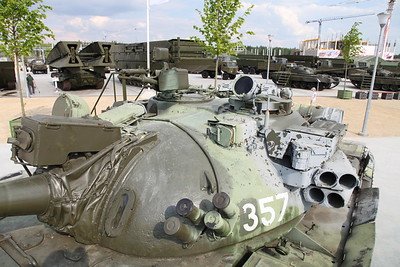
Hard-kill means the system physically destroys or damages the incoming round. It does not try to confuse a missile's guidance; that job belongs to soft-kill systems such as Shtora-1. Drozd watches a sector ahead of the turret with small millimetre-wave Doppler radars. When the radar sees an object closing at the right speed and on the right course, the computer fires a 107 mm protective projectile from one of eight tubes on the turret sides. That projectile flies a short distance and bursts about 6–7 m from the tank, spraying a fan of fragments and blast across the threat's path. [DOCUMENTED]
In one sentence: Drozd is a radar-cued, short-range shotgun for tanks that covers the front arc and fires once per threat, from a small magazine that has to be reloaded by hand.
It is not reactive armour. Kontakt-1 and later explosive tiles act only after the round touches the tank. Drozd acts before contact, in open air. It is also not Arena, which came a decade later from a different design bureau, uses a different radar and covers a much wider arc. See Arena-M for that line of development, and T-80BVM and T-90M for the tanks that carry today's systems.
WHY THE SOVIET ARMY WANTED IT
[BACKGROUND] By the mid-1970s, Soviet tank designers faced a problem that thicker armour could no longer solve. The infantry anti-tank weapon had become cheap and deadly. The RPG-7 was spread across every army and guerrilla movement the Soviet Union supplied or fought. Its shaped-charge grenade could punch through 260–330 mm of steel, more than the side armour of any tank and more than the front of the older ones. Wire-guided missiles such as the American TOW and Dragon, the Franco-German MILAN and HOT, and the Soviet Union's own Malyutka, Fagot and Konkurs could reach 500–600 mm or more. The 1973 Arab–Israeli war, studied closely in Moscow, showed tank columns losing heavily to infantry missile teams.
[BACKGROUND] The T-55 and T-62 made up the bulk of the Soviet tank fleet and were thinly armoured by later standards. Rebuilding them with composite armour was impossible, because the turret castings could not take the weight and shape change. Appliqué armour helped (the T-55AM and T-62M got the "Brezhnev's eyebrows" bolt-on arrays on the turret front), but each added kilogram cost mobility. A system that could stop a grenade before it hit, at a total weight of about a tonne, was an attractive alternative.
[DOCUMENTED] Soviet engineers had been studying "active protection" ideas since the 1950s. An early concept known as Shater (Шатёр, "tent"), around 1958, was the first recorded Soviet attempt. Work continued through the 1960s and 1970s on several layouts. Drozd was the first one mature enough to field.
BEFORE DROZD: EARLIER SOVIET ACTIVE PROTECTION PROJECTS
Drozd did not appear from nothing. It was the end product of about twenty years of Soviet experiments, most of which never left the proving ground. Knowing what came before explains several of Drozd's design choices, especially the fixed launchers and the narrow arc.
Shater (Шатёр), late 1950s. [DOCUMENTED] The earliest Soviet concept usually cited is Shater, begun around 1958 at the tank design bureau in Tula and later associated with the Kharkiv (Morozov) tank bureau's interest in protecting new tanks against the first anti-tank guided missiles. The idea was a "tent" of defensive fire: detect an incoming round and fire a counter-charge at it. [SINGLE-SOURCE] Shater is said to have used an early detection sensor and a small number of explosive charges. Nothing usable was built, because the electronics of the time could not detect and decide fast enough, and the sensors were too large to fit on a turret.
Work for the T-64 at Kharkiv, 1960s. [SINGLE-SOURCE] Several Russian and Ukrainian histories mention studies at Kharkiv in the 1960s for protecting the new T-64 with an active system. These studies are poorly documented. Their main result seems to have been a clear statement of the problem: a sensor that can see a grenade at 50–100 m, a decision in tens of milliseconds, and a counter-munition that works at a few metres.
Parallel ideas for armoured vehicles. [UNVERIFIED] Some Russian sources list other early projects with names that cannot be checked against primary documents, including designs that used mortar-like counter-charges and "mine" systems that blew a protective cloud of fragments upward. Their existence is plausible but the details are not trustworthy, and they are not described further here.
What changed by the 1970s. [BACKGROUND] Three things made Drozd possible. First, small solid-state microwave sources and mixers had become available, so a Doppler radar could fit in a box the size of a briefcase rather than a cabinet. Second, transistor and early integrated-circuit logic could make decisions in milliseconds without valves. Third, the Soviet ammunition industry had decades of experience with proximity and time fuzes for anti-aircraft shells, the same physics needed for a projectile that has to burst a few metres from the tank.
Why fixed tubes. [ESTIMATE] A moving launcher, aimed by a servo, would have been slow and heavy. With 1970s motors, swinging a launcher by even 30 degrees would take more than the 100–200 ms available. Drozd avoided this by giving each sector its own fixed tube. The cost was the "one shot per sector" limitation. Arena, two decades later, solved the same problem differently, with a ring of many fixed charges around the turret. Trophy uses a fast-slewing launcher, possible only with modern motors and electronics.
WHAT DROZD WAS DESIGNED AGAINST
To judge Drozd fairly, it should be measured against the threats it was built for, not against modern drones and top-attack missiles.
RPG-7 and its grenades. [BACKGROUND] The RPG-7's PG-7V grenade leaves the launcher at about 115–120 m/s and is boosted by its rocket motor to about 290–300 m/s. Its effective range against moving tanks is about 300 m. At short range, when the grenade reaches the tank, it may still be accelerating, so its speed at the moment of interception may be anywhere from about 120 to 300 m/s depending on range. All of this sits well inside Drozd's 70–700 m/s gate.
Recoilless guns. [BACKGROUND] The SPG-9 recoilless gun and its Western equivalents fire rounds at 400–700 m/s at launch, boosted in some cases. Drozd's upper limit of 700 m/s appears chosen to include them.
First- and second-generation missiles. [BACKGROUND] The Malyutka (AT-3 Sagger) flies at about 115–120 m/s. TOW flies at about 280–300 m/s, MILAN at about 200 m/s, HOT at about 250 m/s and Dragon at about 100 m/s. All are inside the gate. These missiles were slow enough that, in theory, they gave Drozd more time to react than an RPG grenade at close range.
Excluded threats. [BACKGROUND] Tank guns fire armour-piercing fin-stabilised darts at 1,500–1,800 m/s and HEAT shells at 900–1,000 m/s. Both are above the gate. Artillery and mortar rounds coming from above are outside the elevation window. Mines and roof-attack weapons are outside both.
[ESTIMATE] The design point therefore looks clear: a tank operating against infantry, at short and medium range, mainly from the front. That is exactly the role of a Naval Infantry tank in a landing or a motor-rifle tank in close country, and it matches the user units reported for Drozd.
WHO BUILT IT
[DOCUMENTED] Most Russian sources credit the main development to the Instrument Design Bureau (KBP, Конструкторское бюро приборостроения) in Tula, with work beginning around 1977. The tank integration was handled by the T-55 and T-62 design organisations and the tank repair plants that rebuilt the hulls.
[CONFLICT] Some Russian accounts instead place the lead role with the Central Design Bureau of Instrument Making (TsKB "Tochpribor") in Moscow or with Tula-region institutes working for KBP. Other accounts name NII Stali (the Scientific Research Institute of Steel) for armour aspects. The short accounts available in the West do not agree, and the original programme documents have not been published. This page uses "KBP Tula and partner institutes" as the safest description. Names of individual chief designers vary between sources and are not given here as fact. [UNVERIFIED]
[DOCUMENTED] The development timeline usually given is: research and design 1977–1981, state trials 1981–1982, and acceptance into service in 1983. Serial installation ran through the mid-1980s at tank repair plants.
HOW IT WORKS: THE CHAIN OF EVENTS
The whole system exists to do one thing in well under half a second: notice a round heading for the tank, decide that it is real, and put fragments in its path. The chain is the same for every hard-kill system, and it is worth walking through it in order before looking at each part.
1. Search. The radars are always transmitting while the system is armed. They watch the sector ahead of the turret for any moving object.
2. Speed gate. The radar measures how fast each object is closing. Only objects closing between about 70 and 700 m/s are considered. Slower objects (birds, people, vehicles, thrown dirt) and faster ones (tank gun rounds, which Drozd cannot handle) are ignored. [DOCUMENTED]
3. Track and confirm. The computer checks that the object keeps coming at a steady speed on a course that will hit the tank, rather than passing by. It also works out which side and sector it is coming from.
4. Fire. The computer selects the launcher that covers that sector and fires its projectile.
5. Intercept. The projectile flies out, reaches a point about 6.6 m from the tank, and bursts. The fragments and blast hit the incoming round, and either detonate it early, break its shaped-charge cone, or knock it off course.
6. Reset. The system re-arms for the next threat, using a different launcher. Each launcher holds one round. Once all of a side's tubes are spent, that side has no protection until the crew reloads.
THE RADAR SENSORS
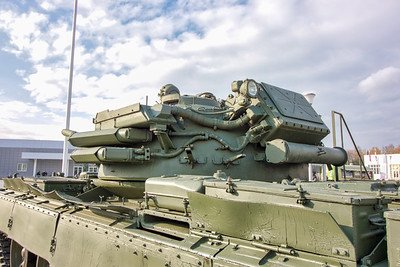
[DOCUMENTED] Drozd uses small millimetre-wave Doppler radars mounted on the turret. The commonly published layout has two radar units, one on each side of the turret, each covering roughly half the frontal arc. They sit with the launcher banks, as the museum photograph below shows. Most Russian sources describe the radar as working in the millimetre band. [SINGLE-SOURCE] A frequency of 24.5 GHz (K-band) is quoted in several sources. Strictly, 24.5 GHz is a centimetre wavelength (12.5 mm), so "millimetre-wave" in these sources should be read loosely.
Why Doppler. A Doppler radar measures speed directly. When a radio wave bounces off an object moving towards the radar, the returning wave is compressed: its frequency rises by an amount proportional to the closing speed. The shift is
f_d = 2 v f / c
where v is the closing speed, f is the radar frequency and c is the speed of light. At 24.5 GHz, an RPG-7 grenade closing at about 120 m/s gives a shift of about 20 kHz. A missile at 200 m/s gives about 33 kHz, and an object at the 700 m/s top of the gate gives about 114 kHz. [ESTIMATE, own arithmetic] These are audio-to-low-radio frequencies, easy to filter with 1970s analogue electronics. That is the main reason a Doppler radar was chosen: a speed gate can be built from simple filters, with no digital signal processing.
Why the speed gate is 70–700 m/s. The lower limit cuts out everything that moves at human or vehicle speed, plus ground clutter, rain and most debris. The upper limit sits above the speed of every shoulder-fired grenade and guided missile of the time, but below tank gun rounds. APFSDS darts arrive at 1,500–1,800 m/s, and full-calibre HEAT shells at 900–1,000 m/s. [DOCUMENTED for the gate; BACKGROUND for threat speeds] Drozd's projectile could not reach or damage a heavy, fast dart in time anyway, so the designers excluded those speeds rather than waste rounds on them.
Range. [SINGLE-SOURCE] Published figures put the detection range at roughly 330 m, with the decision to engage made much closer in. Other sources describe a much shorter working zone of tens of metres. Both can be true: the radar can see far, but the system only commits to firing once the threat is inside a fixed distance window. [ESTIMATE] For an RPG grenade at 120 m/s, 330 m is under 3 seconds of flight; for a missile at 200 m/s it is about 1.6 seconds.
Tracking without a computer screen. Drozd's radar is not an imaging radar. It does not produce a picture. It produces a signal whose frequency tells speed and whose strength and timing tell roughly where the object is. To decide whether the object will actually hit, the system compares returns over time. A real threat on a collision course shows a steady Doppler frequency and a rising signal strength. A round that will miss shows a frequency that falls off as the angle changes. [ESTIMATE, from general Doppler-fuze principles; Soviet documents describing the exact algorithm have not been published]
Weakness of the approach. A Doppler-only sensor cannot easily tell size or shape. Anything inside the speed gate on a collision course looks like a threat. That includes, in principle, high-speed fragments from nearby shell bursts, some ricochets and fast-moving debris. Accounts of false or wasted launches are a recurring theme in later criticism of the system. [SINGLE-SOURCE]
THE COMPUTER AND CONTROL UNIT
[DOCUMENTED] The radar outputs go to an electronic control unit inside the turret. Contemporary descriptions call it a computing device or processor. It is built from 1970s Soviet solid-state components. Its jobs are:
[ESTIMATE] The time available is short. If the system decides at, say, 20 m from the tank for a 120 m/s RPG grenade, it has about 0.17 s before impact. The projectile has to leave the tube, travel several metres and burst before the grenade reaches that burst point. Soviet sources give a system reaction time of roughly 0.05–0.1 s for the electronics, with the rest of the time taken by the projectile's flight. Some English summaries say "0.35 s" for the full cycle from detection to intercept. These figures are not directly comparable: one is electronics only and the other includes flight time. [CONFLICT]
[DOCUMENTED] The unit draws power from the tank's 24–27 V electrical system. Power consumption figures in Russian sources are in the hundreds of watts while transmitting. [SINGLE-SOURCE] A figure of about 800 W is sometimes quoted.
RADAR SIGNAL PROCESSING IN MORE DETAIL
The published descriptions of Drozd's radar are short. What follows combines those descriptions with the standard engineering of continuous-wave Doppler sensors of the 1970s. Where a step is inferred rather than documented, it is labelled.
Continuous-wave operation. [ESTIMATE] The simplest way to build a short-range Doppler radar is continuous-wave (CW): the transmitter runs all the time, and a mixer combines the received signal with a sample of the transmitted signal. The output of the mixer is the difference frequency, which is exactly the Doppler shift. A CW radar of this kind has no "range" measurement in itself; it measures speed only. That fits the published descriptions of Drozd, which emphasise the speed gate and say little about range measurement.
Getting some idea of distance. [ESTIMATE] A pure CW radar cannot tell whether a target is 20 m or 200 m away. Drozd needed to know when the threat would arrive at the 6.6 m intercept point. There are three ways a 1970s designer could solve this:
[SINGLE-SOURCE] Russian descriptions refer to the radar "determining the speed and the moment of approach", which is consistent with any of these. Which method Drozd used is not known from published sources.
The speed gate as filters. [ESTIMATE] At 24.5 GHz, the Doppler shift is about 163 Hz per m/s of closing speed. The 70–700 m/s gate therefore corresponds to a band of about 11.4 kHz to 114 kHz. A band-pass filter with those edges does most of the work of rejecting clutter. Ground return from a moving tank, vegetation moving in the wind, rain and people all produce shifts below a few kilohertz and are cut off by the lower edge.
Your own motion. [ESTIMATE] The tank itself moves. At 50 km/h (about 14 m/s) its own motion adds up to about 2.3 kHz to the shift of anything ahead of it, and reflections from the ground ahead show a shift of similar size. That is well below the 11.4 kHz lower edge, which is one reason the lower limit is 70 m/s rather than, say, 20 m/s.
Collision course test. [ESTIMATE] A round that will hit the tank closes along the radar's line of sight, so its Doppler shift stays almost constant. A round that will miss by several metres passes at an angle, and as it gets close its line-of-sight speed falls quickly: the Doppler frequency drops. A simple frequency-tracking circuit can detect this "frequency roll-off" and veto the launch. This is the same principle used by Doppler proximity fuzes to time a burst at closest approach, turned around to reject misses.
Two radars, two halves. [DOCUMENTED that there were two units, ESTIMATE for the logic] With a radar on each side of the turret, each covering half the arc, the system can tell left from right simply by which radar sees the threat. Finer direction, to choose one of four 20° sectors on that side, needs either a multi-beam antenna or comparison of signals between antenna elements. [SINGLE-SOURCE] Some accounts describe each radar as having several receiving channels, which would allow a sector to be selected by comparing their outputs.
False-alarm control. [ESTIMATE] The radar has to avoid firing at things that pass through the gate for a short moment: a fragment from a nearby shell burst can be inside 70–700 m/s for a few milliseconds. Requiring a steady return for some minimum time, perhaps 10–20 ms, filters out most such events. The price is that it eats into the time budget for real threats.
FUZE TIMING: GETTING THE BURST IN THE RIGHT PLACE
The protective projectile has to burst at a point where it will hit the threat. The threat is moving at up to several hundred metres per second, so timing errors of a few milliseconds move the threat by a metre or more.
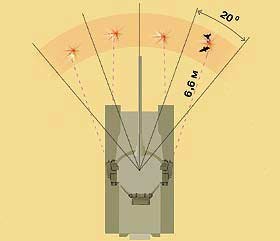
The geometry. [DOCUMENTED for 6.6 m, ESTIMATE for the rest] The tube points into its 20° sector. The threat comes into that sector heading for the tank. The projectile and the threat must meet at roughly 6.6 m from the turret side. The computer has to fire at a moment such that the projectile, which needs a fixed time to reach that distance, arrives at the meeting point just as the threat does, or just before.
A worked example. [ESTIMATE] Suppose the projectile leaves the tube at about 150–200 m/s after its short boost. Covering 6.6 m then takes about 35–45 ms. An RPG grenade at 150 m/s covers about 5–7 m in the same time. So the launch must happen when the grenade is still about 12–14 m from the tank: 6.6 m for the meeting point plus the 5–7 m it travels while the projectile flies. For a missile at 300 m/s, the launch distance rises to about 17–20 m. For a recoilless round at 600 m/s, it rises to 28–34 m. The computer must therefore adjust the firing moment to the measured speed. This is the core calculation the electronics performed.
Fuze options. [ESTIMATE] The projectile's burst can be set by a time fuze set at the moment of launch, or by a fixed delay since the burst distance is constant. A fixed delay is simplest and matches the published fixed 6.6 m figure. The variable part, matching the threat speed, is then done by choosing when to fire, not when to burst.
Error budget. [ESTIMATE] If the speed is measured to within about 5%, the predicted arrival time at the meeting point is good to a few milliseconds, giving a position error of perhaps half a metre for an RPG. The fragment fan at 6.6 m, spread across a 20° sector, is about 2.3 m wide in azimuth. This margin is sufficient for typical errors, which is presumably why the designers chose a fan rather than a narrow jet.
Why fragments and not a single slug. [ESTIMATE] A single heavy slug or explosively formed penetrator, as Trophy uses, needs precise aiming in both azimuth and elevation, which in turn requires a steerable launcher and a precise tracking radar. Drozd had neither. A fan of fragments trades precision for coverage, which suits fixed tubes and a simple radar.
THE LAUNCHERS AND THE 107 MM PROJECTILE
[DOCUMENTED] Drozd carries eight launch tubes, four on each side of the turret in two banks. Each tube is 107 mm in calibre and holds a single protective projectile. The tubes are fixed in direction: each one points into its own sector. The projectiles are often called 3UOF14 in Russian sources. [SINGLE-SOURCE for the index]
[DOCUMENTED] The projectile is a short rocket-boosted round with a high-explosive fragmentation warhead. After launch it flies along a fixed line into its sector. It is time-fuzed or command-fuzed to burst at about 6.6 m from the tank, at the point where the threat is predicted to be. The burst throws a cone or fan of fragments, together with blast pressure, across the threat's path.
[SINGLE-SOURCE] Projectile mass figures of around 9 kg each appear in some sources, which would put eight rounds at about 72 kg, a small part of the system's total weight of about 1,000 kg. Most of that weight is mounting brackets, protective housings and cabling, plus the turret modifications themselves.
What the fragments do. [BACKGROUND] A shaped-charge warhead works by collapsing a metal cone into a thin, fast jet. Anything that crushes or tilts the cone, sets off the main charge early or tears the fuze off weakens the jet. An RPG grenade hit at 6–7 m from the tank and set off early has to shoot its jet through air, the slat or rubber skirts and the armour. Jets break into particles after a short distance and lose much of their power. A grenade with a crushed cone or wrecked fuze may not fire at all. Drozd does not have to destroy the round completely; it only needs to make its jet much weaker by the time it reaches the armour.
[ESTIMATE] The 6.6 m figure is a compromise. Further out, the fragment cone spreads too thin and timing errors grow. Closer in, the tank's own armour and fittings are hit by the burst, and an early-detonated grenade still puts its jet onto the armour at near full strength.
THE 20-DEGREE SECTORS AND COVERAGE ARC
[DOCUMENTED] Each launcher covers about 20 degrees of azimuth. Four tubes per side give 80 degrees, so the whole system covers roughly ±40 degrees either side of the turret's forward line, about 80 degrees in total. The diagram above shows this layout: two fans of sectors from the turret sides, meeting at the front.
[DOCUMENTED] Coverage in elevation is limited. Published figures give roughly −6° to +20°. That fits the threats of the time: ground-launched grenades and missiles flying nearly flat. It gives no protection against top-attack weapons, mortar bombs or anything diving from above.
Rotation with the turret. Because the system is mounted on the turret, the covered arc follows the gun. A crew that keeps the gun pointed at the likely threat direction keeps Drozd pointed there too. But the hull sides, rear and turret rear are not protected at all. [DOCUMENTED]
One shot per sector. Each 20° sector is served by one tube. Once that tube has fired, a second threat from the same sector cannot be engaged by that launcher. Neighbouring tubes cannot swing to cover it, because they are fixed. [DOCUMENTED; consequences are ESTIMATE]
AN ENGAGEMENT, MILLISECOND BY MILLISECOND
This timeline follows a single RPG-7 grenade fired at a T-55AD from 150 m, slightly off the gun line, inside the left-front sectors. The system's published parameters are used where they exist. The timings in between are estimates from the physics, not figures from Soviet documents. [ESTIMATE throughout, except where labelled]
t = −1,000 ms: launch. The grenade leaves the RPG at about 115 m/s. Its rocket motor ignites about 10 m from the firer and accelerates it toward about 290 m/s. At 150 m range, it reaches the tank in about 0.6–0.7 s, at an average speed of about 230 m/s.
t = −650 ms: first detection. The grenade is roughly 130–150 m from the tank and inside the radar's reported detection range. [SINGLE-SOURCE for detection range] Its Doppler shift is about 35–45 kHz, comfortably inside the 11–114 kHz pass band. The left radar's output shows a clean tone. The control unit starts to track it.
t = −650 to −150 ms: confirmation. For several hundred milliseconds the system watches the tone. The frequency stays steady (a collision course), the signal strength rises steeply, and the speed stays in the gate. Debris and the firer's backblast never enter the gate. Sector selection is made from the relative channel outputs: sector 2 on the left side, for example.
t ≈ −80 ms: commit. With the grenade closing at about 270 m/s, the computer calculates the firing moment. To meet it at 6.6 m, the projectile must be fired when the grenade is about 17–19 m away, roughly 65–70 ms before impact. The control unit sends the firing pulse to tube 2 on the left side.
t ≈ −70 ms: launch of the protective projectile. The electric igniter fires the propellant. The 107 mm projectile leaves the tube in a few milliseconds and accelerates outward along the sector's centreline.
t ≈ −25 ms: burst. About 40–45 ms after launch, the projectile reaches 6.6 m and bursts. The fragment fan spreads across the sector. The grenade, now about 7 m out and closing at about 270 m/s, runs into the fan within a few milliseconds.
t ≈ −24 to −20 ms: effect on the grenade. Depending on what is hit, three outcomes are possible. The piezo fuze in the grenade's nose is crushed and fires, setting off the warhead about 5–6 m from the armour; the jet then breaks up over that distance and loses most of its penetration. Or the cone is crushed and the jet is badly formed. Or the grenade is pushed off course and passes the tank. [BACKGROUND for shaped-charge behaviour]
t = 0: what would have been impact. The armour is struck at most by fragments of the grenade and the protective projectile. These can damage optics, aerials and external stowage, but are not a threat to the hull. [ESTIMATE]
t = +1 s onward: reset. The control unit marks tube 2 left as spent. Sector 2 left is now without protection. The other seven tubes remain ready. The crew sees the spent indicator.
Lessons from the timeline. [ESTIMATE] The electronics have hundreds of milliseconds to detect and confirm a threat at 150 m, so the radar side of the problem is not tight at this range. The tight part is the final 70 ms, when the firing moment must be right to within a few milliseconds. At very short range, say an RPG fired from 30 m, the grenade arrives in about 0.2 s and is still near its launch speed. The radar sees it for perhaps 100 ms before the commit point. That is still enough in principle, but much tighter. Below about 15–20 m, the grenade arrives before the projectile can be fired and reach the intercept point: Drozd has a minimum engagement range. This is true of all hard-kill systems.
RELOADING, SERVICE AND MAINTENANCE
Reloading. [DOCUMENTED that reloading was manual and from outside the tank] Each launch tube is loaded from outside. A crew member has to leave the turret, remove the cover or closure of the spent tube, extract any spent components, insert a new projectile and connect it. Projectiles are stored in packing outside the tank, or carried by the supporting unit. [ESTIMATE] With practice, reloading one tube likely takes a few minutes; all eight could take 15–30 minutes. Under fire this is not realistic, so in practice Drozd's eight rounds were the tank's protection for an entire engagement.
Projectile weight and handling. [SINGLE-SOURCE] With each projectile reported at about 9 kg, a single crew member can carry and load them. They contain high explosive and propellant and must be treated as live ammunition; the tubes have safety features to prevent firing when the system is disarmed.
Radar maintenance. [ESTIMATE] A 24.5 GHz radar is sensitive to dirt, ice and water on its window. Mud thrown up by the tracks, snow and dust could degrade performance. Crews would have had to keep the radar covers clean. Soviet tank crews were not used to looking after delicate electronics on the outside of their vehicles, which was one of the criticisms of the system.
Electronics in the turret. [ESTIMATE] The control unit sits inside the turret, protected from the weather but exposed to vibration, gun firing shock and temperature swings from −40 °C to over +50 °C. Soviet military electronics were designed for those conditions, but 1970s components still failed more often than the mechanical parts of a tank. Regular testing with built-in test equipment, or a separate tester, would have been needed. [SINGLE-SOURCE] Some sources mention a test mode that checks the radar and launcher circuits without firing.
Training. [BACKGROUND] A Drozd tank needed a commander who understood when to arm and disarm the system, a crew who could reload it, and technicians who could repair the electronics. The Naval Infantry, a smaller and better-trained force, was better placed to provide that than conscript motor-rifle units.
Safety on the march. [ESTIMATE] When driving in columns, near friendly troops or in garrisons, the system had to be switched off. The commander therefore had to judge when the tank was entering a threat area. A system that is off when the ambush comes provides no protection, so the safety and the protective value of the system were in direct conflict.
CREW CONTROLS AND MODES
[DOCUMENTED] The commander has a control panel that switches the system on, arms it and shows the status of each launcher. The crew can select automatic operation, in which Drozd fires on its own when a threat is detected, or switch it off. There is no "fire on command" mode in the published descriptions; the reaction times involved are far too short for a human.
[SINGLE-SOURCE] Sources mention an indicator for each tube showing loaded or spent. Some versions included a warning to the crew when a launch occurred.
[BACKGROUND] Crew discipline matters. A crew operating with dismounted infantry nearby must keep the system off or risk killing its own soldiers. Crews in convoys, at checkpoints or in towns must make the same choice. In practice that means the system is not armed much of the time.
POWER, MOUNTING AND THE TANK'S OTHER SYSTEMS
Electrical load. [ESTIMATE] The T-55's electrical system was designed around a generator of a few kilowatts, supplying radios, lights, the gun stabiliser and the turret drive. Adding Drozd's radar and electronics, at several hundred watts, was a significant but manageable load. The firing pulses for the launchers are brief and draw on the batteries. On a stationary tank with the engine off, the system would drain the batteries over a few hours.
Mounting. [DOCUMENTED] The launcher banks sit on brackets on the turret front quarters, each bank angled to cover its side. The radars sit near the banks with protective housings. Cables run into the turret through sealed glands. [ESTIMATE] The mountings also have to survive the shock of the main gun firing and hits by small-arms fire and shell splinters. A heavy machine-gun round can disable a radar or launcher; Drozd was not designed to survive direct fire on its own components.
Effects on other equipment. [ESTIMATE] The launcher banks occupy space that otherwise held stowage boxes and could restrict the commander's view to the front quarters. The radar transmissions at 24.5 GHz are far from the frequencies of the tank's own VHF radios, so mutual interference was unlikely. Several Drozd tanks operating together would see each other's transmissions, but a stationary tank produces no Doppler shift, and a moving one produces very small shifts, well below the gate.
Weight. [SINGLE-SOURCE] About 1,000 kg for the full system. On a T-55 of 36 t, that is under 3% of its weight, comparable to the T-55AM's appliqué armour. The combination of both raised the tank's weight to around 38 t, with some reduction in mobility.
THE INTERCEPT PHYSICS: WHY A FEW METRES IS ENOUGH
Shaped-charge sensitivity. [BACKGROUND] A shaped-charge warhead works only if its cone collapses symmetrically and at the right distance from the target, the "stand-off". The PG-7V grenade has a stand-off of a few calibres built into its nose. Detonating it at 5–6 m instead, with its jet travelling through air, breaks the jet into separate particles that spread and tumble. Penetration falls sharply, often by more than half.
Damaging the cone. [BACKGROUND] A fragment that hits the cone or the explosive before detonation can prevent the jet from forming properly. A single steel fragment of a few grams, travelling at more than 1,000 m/s, can do this.
Fuze function. [BACKGROUND] The PG-7V's fuze works by a piezoelectric crystal in the nose that fires the charge on impact. A fragment hit on the nose can trigger the fuze early, which is what Drozd aims for. A hit elsewhere may cut the fuze wire or break the grenade apart without detonation.
Guided missiles. [ESTIMATE] Missiles are longer and heavier. A fragment fan may hit the motor or the control section rather than the warhead. A missile with a damaged control section may still hit, but off-axis, with reduced effect. Missiles flying slowly give more time, which helps. Overall, the 80% figure is more likely for RPG grenades than for heavier missiles.
Fragment density. [ESTIMATE] At 6.6 m from the tank, a 107 mm projectile with a few kilograms of fragments could put dozens of fragments per square metre into the target region. A grenade presents a cross-section of around 0.006 m² (85 mm diameter) side-on, but much more if it is passing through the fan obliquely. The probability of at least one hit is high, but not certain. This is consistent with the 80% claimed effectiveness rather than near-100%.
DANGER TO INFANTRY
[DOCUMENTED] Drozd's fragmentation burst is dangerous to anyone standing near the tank's front. The hazard zone is usually given as about 20–30 m in front of the vehicle, with a smaller risk area to the sides. This was one of the main reasons the system was not popular with the army. Soviet tactics paired tanks closely with motor-rifle infantry, and infantry often rode on tanks.
[ESTIMATE] The danger has two parts. The first is the projectile's own fragments, thrown forwards and outwards from the 6.6 m burst point. The second is the incoming round's remnants, which may still be scattered on detonation.
INSTALLATION ON THE T-55AD AND T-62D
[DOCUMENTED] The T-55AD was a T-55 rebuilt to the T-55AM standard with the Drozd system. The T-55AD-1 was a variant with a different engine or fire-control fit, depending on the source. [CONFLICT] Sources agree the T-55AD had the Volna fire-control system and could fire the 9K116 Bastion gun-launched missile; whether every T-55AD was missile-capable is less clear.
[DOCUMENTED] The T-62D and T-62D-1 were the equivalent T-62 conversions. The T-62D-1 had a different power unit. Numbers built were small.
[DOCUMENTED] On both types, the launcher banks are mounted on the turret front quarters, and the radars are close by. Bolted-on protective covers shield the electronics. The installation also usually included the appliqué turret armour of the AM/M upgrades.
[SINGLE-SOURCE] Production numbers are reported as around 250 systems in total, mostly fitted to T-55AD tanks of the Soviet Naval Infantry. Some sources say the Naval Infantry took most of them because its tanks were expected to fight in close country during landings, where infantry anti-tank weapons are the main threat.
[UNVERIFIED] Other figures in circulation range from "a few dozen" to "several hundred". No official production total has been published.
AFGHANISTAN AND COMBAT CLAIMS
[CONFLICT] Drozd is often described as having been used in Afghanistan, with claims of RPG interceptions. The evidence for this is thin.
[SINGLE-SOURCE] Some Russian accounts say a number of T-55AD tanks were sent to Afghanistan for trials in the mid-1980s and that the system intercepted RPG grenades in action. Figures sometimes quoted include an effectiveness of about 80% against RPG grenades, but those figures appear to come from trials rather than recorded combat.
[UNVERIFIED] Other accounts say Drozd was never used in Afghanistan, or that only a handful of tanks went there. Russian historians writing in the 2000s and 2010s often repeat the claim without primary sources.
[ESTIMATE] The most reasonable reading is that a small number of systems may have been tried in Afghanistan, that the 80% figure is from proving-ground trials, and that combat effectiveness cannot be confirmed from published records. The 40th Army's tank fleet was mostly T-55 and T-62 variants, so it is plausible that some T-55ADs or T-62Ds were there, but large-scale use is unlikely.
[BACKGROUND] Afghanistan exposed the weaknesses of any system like Drozd: ambushes from high ground, short-range attacks from the sides and rear, and infantry escort riding on the tanks. Even if the system worked as designed, it would cover only part of the threat.
DROZD AND KONTAKT-1: THE CHOICE THE ARMY MADE
The decision between Drozd and explosive reactive armour shaped Soviet tank protection for twenty years, and it is worth setting out the trade in numbers.
Kontakt-1. [DOCUMENTED] Kontakt-1 (Контакт-1) explosive reactive armour entered Soviet service in the early-to-mid 1980s, about the same time as Drozd. It consists of flat steel boxes, each holding a pair of thin explosive plates, bolted in overlapping rows over the hull front, turret and side skirts. A full set on a T-72 or T-80 weighs roughly 1.2–1.5 t, about the same as Drozd. [SINGLE-SOURCE for the weight]
How it works. [BACKGROUND] When a shaped-charge jet hits a tile, the explosive detonates and drives the steel plates sideways across the jet. The moving plates keep cutting into fresh parts of the jet, eroding it and breaking it up. Penetration of a single-charge warhead such as the PG-7V falls by roughly half or more.
Comparison in practice. [ESTIMATE, from the documented characteristics of both]
[ESTIMATE] Given these trade-offs, it is not surprising that the army chose reactive armour for the fleet and left Drozd to the Naval Infantry. The same argument returned in the 1990s and again in the 2020s: once tandem warheads and top-attack weapons spread, the advantages of active protection grew again, which is why Arena-M and Afghanit exist.
WHY DROZD WAS NOT WIDELY ADOPTED
[DOCUMENTED] Drozd was not fitted to the T-64, T-72 or T-80 in series. Several reasons are given:
[BACKGROUND] Reactive armour did not end the need for active protection. As missiles got tandem warheads designed to defeat reactive armour, interest returned, this time in a wider-coverage system: Arena.
DROZD-2
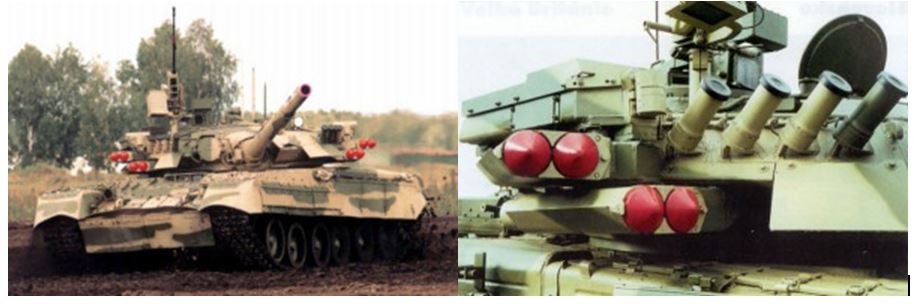
[DOCUMENTED] Drozd-2 (Дрозд-2) was an updated system shown in the 1990s and 2000s, mainly on the T-80U and T-80UM. It was offered for export, including at Russian arms shows.
[DOCUMENTED] Drozd-2 used improved electronics and new launcher modules. The photographs show red-capped launcher tubes in banks on the turret. Several sources describe a widened arc of about 120 degrees with more launchers, trialled on a T-80UM2-type tank; others describe it as still mainly frontal. [CONFLICT]
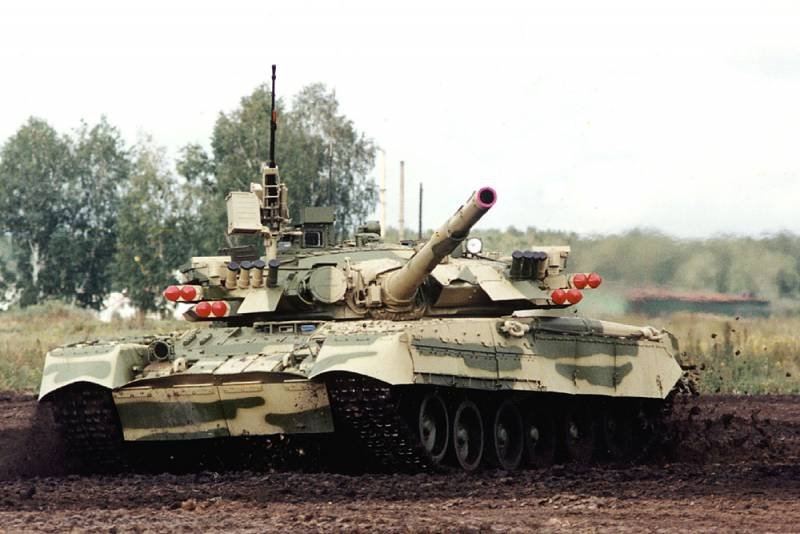
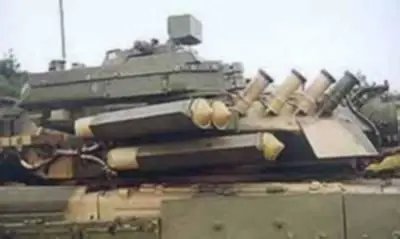
[SINGLE-SOURCE] Drozd-2 was reportedly marketed at about USD 300,000 per system in the 2000s, but no buyers are known. [UNVERIFIED] Some reports mention Chinese or Indian interest, without contracts.
[ESTIMATE] Drozd-2 was overtaken by Arena from KBM Kolomna, which used a different radar (with a wider coverage and better discrimination) and a larger number of protective munitions. Arena was also shown on T-80UM tanks in the 1990s. Neither was adopted widely by the Russian army until the 2020s, when Arena-M returned in response to drone and anti-tank missile threats in Ukraine.
DROZD-2 TRIALS AND THE 1990s
What changed. [SINGLE-SOURCE] Drozd-2 is described as a lighter and more compact system with modern electronics, more launchers and a wider arc. Published figures for its arc range from about 120 degrees to more. It was shown on the T-80U and T-80UM tanks at Russian demonstrations and exhibitions in the 1990s, and in photographs a characteristic row of red-capped launchers appears on the turret sides.
The trials vehicles. [SINGLE-SOURCE] Russian sources mention a T-80UM2 experimental tank fitted with Drozd-2 together with other new systems. [UNVERIFIED] Some sources also say Drozd-2 was tested on T-72 and T-90 hulls; this is not confirmed by photographs or official statements.
Why the red caps. [ESTIMATE] The red caps visible in the photographs are most likely protective covers for display and transport, a common Soviet and Russian practice for inert or display rounds and for keeping dirt out of tubes. They do not indicate a different type of projectile.
Competition with Arena. [DOCUMENTED] In the 1990s, KBM Kolomna's Arena was the main rival. Arena had a single high-mounted radar with nearly all-round coverage (except the rear) and about 26 charges. Drozd-2 kept the older concept of side banks of launch tubes covering the front. Russian commentators and the exhibition publicity of the time suggest Arena was seen as the more advanced system. Neither entered large-scale service: the Russian army in the 1990s had almost no money for upgrades.
Export attempts. [SINGLE-SOURCE] Drozd-2 was offered for export and was shown to foreign delegations. Quoted prices of about USD 300,000 per system circulate, but are not confirmed. No export customer is known. [UNVERIFIED] Reports of Chinese interest and of Chinese systems influenced by Drozd appear on enthusiast forums but have no reliable sources.
What happened to Drozd-2. [ESTIMATE] By the 2000s, the system had disappeared from Russian publicity. Arena continued to be developed into Arena-E (export) and later Arena-M. The Armata programme, from the 2010s, chose a new system, Afghanit. Drozd-2 therefore appears to have been a dead end, though its design team's experience fed into later work.
LEGACY: WHAT DROZD TAUGHT LATER DESIGNERS
[ESTIMATE, drawing on the comparison of documented system features] Comparing Drozd with its successors shows how each of its weaknesses was addressed.
[BACKGROUND] The broad concept, a short-range radar driving a counter-munition fired at a few metres, has not changed since Drozd. What changed is the quality of the sensor and computer, which decides how many threats can be engaged, how wide the arc can be, and how false alarms can be avoided.
COMMON MISCONCEPTIONS
"Drozd was the first APS in the world." [DOCUMENTED] It was the first to enter service. Other countries studied similar ideas earlier or at the same time, but none fielded one before 1983.
"Drozd covered the whole tank." [DOCUMENTED] It did not. Its arc was frontal only, about ±40° in the most common description (some say ±30°).
"Drozd was proven in combat in Afghanistan." [CONFLICT] This is not supported by published combat records. The 80% figure appears to come from trials.
"Drozd could stop tank shells." [DOCUMENTED] It could not. Its gate ended at 700 m/s, below tank gun projectile speeds.
"Drozd was cancelled because it did not work." [ESTIMATE] It worked well enough to be accepted into service. It was limited by its coverage, its danger to infantry and the arrival of cheaper reactive armour, not by failure of the basic principle.
"Drozd is the same as Arena." [DOCUMENTED] They came from different design bureaus with different concepts: side tube banks firing outward, compared with a ring of charges fired upward.
SOURCES AND HOW RELIABLE THEY ARE
Drozd is well known in name but poorly documented in detail. That shapes every figure on this page.
Russian primary documentation. [DOCUMENTED that it is not available] The state trials reports, the technical manual and the production records of KAZ 1030M have not been published. Everything known comes from secondary sources.
Russian secondary sources. [BACKGROUND] Most figures come from articles in Russian specialist magazines, such as Tekhnika i Vooruzhenie (Техника и вооружение), and from books on Soviet tank development written in the 1990s and 2000s, often by people connected with the design bureaus. These are generally reliable on the existence of systems and their broad characteristics, but sometimes inconsistent on numbers and dates, and they rarely cite sources.
Russian Wikipedia. [SINGLE-SOURCE] The Russian article on Drozd gives detailed specifications, some uncited. It is a useful summary but should not be used as a primary source.
English-language sources. [BACKGROUND] Most English descriptions, including Wikipedia, Army Recognition, Military Today and many books on modern tanks, repeat the same figures: 1983, T-55AD, 107 mm, 70–700 m/s, 6.6–7 m, 80%, about 250 units. They are mostly derived from the same Russian secondary sources. Repetition does not make them independent confirmation.
Where sources disagree.
This page's approach. Where two sources agree, a figure is marked [DOCUMENTED]; where only one gives it, [SINGLE-SOURCE]; where they disagree, the conflict is noted. Arithmetic based on published figures is marked [ESTIMATE].
LIMITATIONS IN DETAIL
Arc. The ±40° arc covered the most likely threat direction for a tank advancing in open country, but not for one in a town, a valley or an ambush.
Elevation. The −6° to +20° window misses top-attack missiles and drones.
Speed gate. Tank gun rounds above 700 m/s are ignored. Drones and slow rockets below 70 m/s are ignored. Modern FPV drones fly at 20–40 m/s, well under the gate. [ESTIMATE] Drozd as built could not engage them at all.
Single shot per sector. A second round from the same direction gets through. Salvo attacks with two RPGs, a common tactic, can defeat it.
Reload. The tubes are reloaded by the crew from outside the tank. In combat that means exposing crew members, so in practice reloading happens only after the action.
Electronics and false alarms. The radar cannot tell a grenade from other fast objects in the gate. Shell fragments and debris could trigger launches.
Tandem warheads. A tandem-warhead missile has a small leading charge and a main charge. Drozd's fragments may destroy or weaken it, but if only the front charge is damaged, the main charge may still work. [ESTIMATE]
DROZD IN ITS INTENDED ROLE: THE NAVAL INFANTRY TANK
[BACKGROUND] The Soviet Naval Infantry (морская пехота) was a small, elite force meant to seize beaches, ports and islands, mostly on the flanks of the NATO area: Norway, the Baltic approaches, the Turkish Straits and the Pacific coast. Its tank units used T-55s for a long time after the army moved to newer types, because the T-55 was light enough for Soviet landing ships and easy to maintain at sea.
[ESTIMATE] A tank landing from a ship comes off the ramp at walking speed into the most dangerous place on the battlefield: a beach overlooked by defenders with short-range anti-tank weapons. It cannot manoeuvre, it faces the enemy head-on, and its infantry has not yet spread out around it. That is almost exactly the situation Drozd's design fits. The threat comes from the front, at short range, from grenades and light missiles, and the first minutes count most. Eight intercepts in the first minutes of a landing could keep a tank alive long enough to get off the beach.
[ESTIMATE] The same features that suited a landing were weaknesses in Afghanistan, where attacks came from mountainsides above the road, from the sides of convoys and from the rear, and where tanks spent most of their time near friendly troops at outposts. This may explain why the Naval Infantry is reported to have kept the system while the army showed little interest.
Tactics with Drozd. [ESTIMATE] A commander of a Drozd tank would want to keep the turret pointed toward the most likely threat, accept that the flanks were unprotected and rely on accompanying infantry and other tanks to cover them, arm the system only on entering a threat area, keep infantry behind the tank or well to the sides, and after any intercept treat that sector as open until reloaded. These are the same rules that apply to modern APS-equipped tanks, though modern systems give more margin.
DROZD AGAINST MODERN THREATS
It is useful to ask how a Drozd-equipped tank would fare today, because the question explains why the newer systems look the way they do. [ESTIMATE throughout]
Tandem RPG grenades. The PG-7VR and similar tandem rounds have a small front charge to set off reactive armour, followed by the main charge. Against Drozd, the front charge may be destroyed together with the main charge, since both are hit by the fragment fan at 6.6 m. Tandem designs are therefore not specially effective against Drozd; the fan hits the whole round.
Modern ATGMs. Kornet, Javelin and others are faster or attack from above. Kornet flies at about 250–300 m/s inside the gate, from the front, and would be a fair target. Javelin attacks from above in top-attack mode and would be outside Drozd's elevation window. NLAW overflies and fires downward, also outside the window.
FPV and loitering drones. At 20–40 m/s, FPV drones are below the 70 m/s gate and invisible to Drozd's logic. Even if the gate were lowered, they approach from above and from any direction. Drozd's design has nothing to offer against them. This is why Arena-M development has concentrated on new radar modes for slow targets, and why Afghanit-class systems combine radar with optical sensors.
Salvo attacks. Two RPGs fired at the same sector within a second or so would exhaust that sector's tube with the first. The second would get through. Modern systems with many overlapping charges or a rapidly reloading launcher are less vulnerable to this.
Kinetic rounds. Tank and autocannon rounds above 700 m/s remain outside the gate. Modern systems attempt, with limited success claims, to deflect even these, mainly with heavy charges and very fast sensors.
QUICK REFERENCE: WHAT EACH PART DOES
SIDE-BY-SIDE: ACTIVE PROTECTION SYSTEMS (HARD AND SOFT KILL)
Cells marked [U] are unverified or disputed, and [E] marks estimates. Unmarked cells are documented in at least two sources.
| Item | Drozd | Drozd-2 | Arena / Arena-M | Afghanit | Trophy | Iron Fist | Shtora-1 (soft kill) |
| Era / maker | 1977–83, service 1983; KBP Tula | 1990s demonstrator | 1990s (Arena); 2020s (Arena-M); KBM Kolomna | 2010s; KBP Tula / NII Stali credited [U] | 2000s; service 2011; Rafael / IAI Elta | 2000s; IMI / Elbit | 1980s; service about 1989; VNIITransmash / Elers-Elektron [U] |
| Carriers | T-55AD, T-62D | T-80U / T-80UM / UM2 trials | T-80UM, T-72 trials; Arena-M on T-90M, T-72B3A | T-14, T-15 trial fleet | Merkava, M1 Abrams, others | Namer, some exports | T-90, T-90S, early T-90A, T-80UK |
| Sensor | 2 Doppler radars, about 24.5 GHz | Improved Doppler radars [U] | Multi-faced mast radar (K-band [U]); Arena-M small radar modules | 4 AESA-type panels plus UV/IR sensors | 4 EL/M-2133 AESA panels | Radar plus IR sensors | Laser warning receivers (coarse 360°, precise ±45°); no radar |
| Kill mechanism | 107 mm HE-fragmentation rocket, burst about 6.6 m | Same principle, more launchers | Fragment charge thrown up, fired downward | Fixed tubes; fragment / blast munition [U] | EFP slug pattern | Blast interceptor (no fragments) | IR jammers spoof SACLOS trackers; 3D17 aerosol screen |
| Hard-kill arc | Frontal, about ±40° (some say 60° total) [U] | About 120° [U] | About 270° (not rear) | Frontal (sensors all round) | 360° | 360° | No hard kill; jamming about ±20° per jammer, frontal |
| Threat speed window | 70–700 m/s | Similar [U] | 70–700 m/s | Claimed up to 1,700–3,000 m/s [U] | RPGs and ATGMs; not darts | RPGs and ATGMs; KE claimed limited [U] | Not speed-gated; acts on guidance (SACLOS, laser) |
| Reaction time | About 0.05–0.1 s electronics; about 0.35 s full cycle [U] | n/a | About 0.07 s (published) | About 0.1 s claimed [U] | Under 1 s total [E] | Not published | Screen in about 3 s |
| Ammo / reload | 8 rounds, 1 per 20° sector; manual reload from outside | More than 8 [U] | 22–26 (Arena); 12 (Arena-M); manual | About 10 hard-kill tubes; manual [E] | Several per launcher; automatic reload | Several per launcher; automatic | Jamming unlimited; 12 grenades, manual reload |
| KE dart defeat | No | No | No | Claimed [U] | Not claimed | Limited claim [U] | No (screen only denies re-ranging) |
| Infantry danger | High, about 20–30 m | Similar [E] | 20–30 m zone | Exists; tubes fire forward [E] | Smaller zone but not zero | Low (blast only) [E] | Negligible [E] |
| Status | Retired; about 250 built [U] | Not adopted | Arena-M in limited service | Trial fleet only | In service, combat-proven | In service | Jammers dropped on T-90M; still on older T-90s |
COMPARISON WITH ARENA, AFGHANIT AND TROPHY
Arena (KBM Kolomna, 1990s; Arena-M today). Arena uses a multi-faced radar on a mast at the turret rear with much wider coverage (about 270° in azimuth, everything except the rear) and about 22–26 protective munitions in a ring around the turret; Arena-M carries twelve. Each munition is thrown upward and detonates above the threat, throwing fragments down. Arena-M adds improved radar processing, aimed at drones. [DOCUMENTED] Compared with Drozd, Arena covers more, carries more rounds and is still dangerous to infantry. See Arena-M.
Afghanit (Armata family, 2010s). Afghanit is the active protection system of the T-14 Armata and related vehicles. It combines four AESA-type radar panels with ultraviolet and infrared sensors, soft-kill launchers, and about ten fixed hard-kill tubes under the turret that cover the frontal arc. Like Drozd, its hard-kill channel is frontal and its tubes are fixed; unlike Drozd, its sensors look all round. Russian reports claim it can intercept sabot darts at 1,500–2,000 m/s, a claim that is not independently confirmed. [DOCUMENTED for the architecture; UNVERIFIED for the dart claim] See Afghanit and T-14 Armata.
Trophy (Rafael, Israel, 2000s). Trophy uses four flat-panel radars for 360° coverage, and launchers that fire explosively formed penetrators (EFPs) to destroy incoming threats. It has a combat record in Gaza and Lebanon and is fitted to the Merkava, M1 Abrams and other vehicles. [DOCUMENTED] Compared with Drozd, Trophy covers all around, can reload automatically, and uses a smaller hazard zone, though not zero.
[ESTIMATE] Drozd was a first-generation system: simple sensors, fixed launchers, limited arc. It proved that hard-kill protection could work, but showed the problems that later systems had to solve.
KEY FIGURES
RELATED ARTICLES
SOURCES