WHAT IT IS
Shtora-1 (Штора-1, "curtain") is a Soviet and Russian soft-kill active protection system for armoured vehicles. Its official name is TShU-1 "Shtora-1" (ТШУ-1), and Russian documents call it a complex of optical-electronic suppression (комплекс оптико-электронного подавления, КОЭП). It was accepted for service around 1989 and became widely known on the T-90 tank from 1992, after appearing on the T-80UK command tank. [DOCUMENTED; the service date varies by source, see below]
Soft-kill means that Shtora does not shoot down incoming rounds. It tries to make the enemy's weapon miss. It does this in two ways:
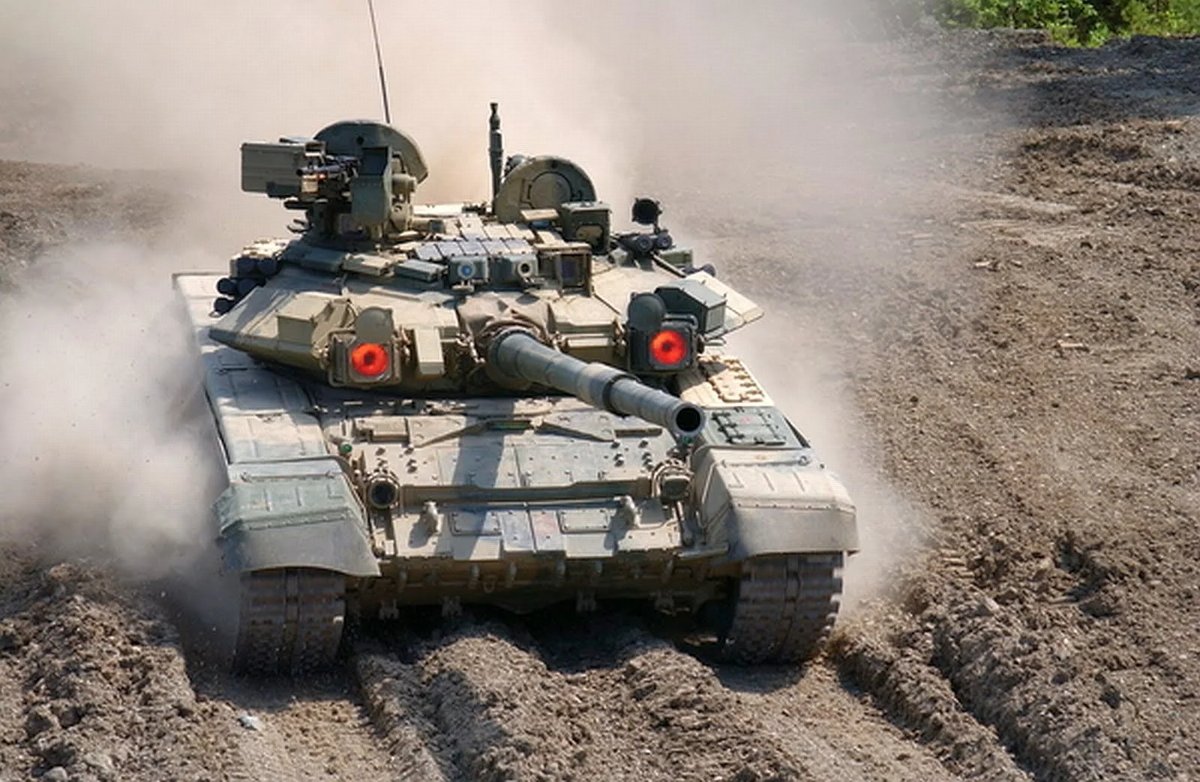
In one sentence: Shtora-1 is a set of infrared jammers, laser detectors and smoke grenades that defeats the guidance of a missile or the aim of a laser-guided weapon, rather than the warhead itself.
It is not a hard-kill system like Drozd, Arena-M or the hard-kill channel of Afghanit. Those fire a munition at the incoming round. Shtora works on the eyes of the weapon: the operator's sight, the launcher's tracker, the missile's seeker or laser receiver. It also does nothing against an unguided RPG grenade or a tank gun round fired with optical aim; those were the targets of Drozd and of reactive armour.
WHY A SOFT-KILL SYSTEM
[BACKGROUND] By the late 1970s, most NATO anti-tank firepower at medium and long range came from wire-guided missiles using SACLOS guidance (semi-automatic command to line of sight): TOW, HOT, MILAN and Dragon. The operator holds the sight crosshair on the target. The launcher's infrared tracker watches a flare or lamp in the missile's tail and measures how far the missile is from the line of sight. It sends steering commands down the wire to bring the missile onto that line. The missile has no seeker of its own; everything depends on the launcher's tracker seeing the missile's flare correctly.
[BACKGROUND] At the same time, laser rangefinders were spreading to Western tanks, and laser-guided weapons were arriving: the US Copperhead artillery round, Hellfire missiles from helicopters, laser-guided bombs. A laser rangefinder gives a tank gunner a first-round hit at 2–3 km. A designator lets an observer guide a shell or missile onto the tank.
[ESTIMATE] Both threats had a weak point that a soft-kill system could exploit. SACLOS trackers were simple infrared sensors that could be confused by a brighter, similarly modulated source. Lasers had to illuminate the tank, which could be detected and then blocked by smoke. A system aimed at those two weak points would cover most of the long-range threats to a tank from the front, without endangering nearby infantry and without carrying explosive interceptors.
[BACKGROUND] Drozd's hard-kill concept covered short-range RPG grenades but was heavy, frontal and dangerous to infantry. Kontakt-1 reactive armour covered the hull against shaped charges. Shtora was designed to sit above both: it acts at long range, before the missile is close, and against weapons that the other layers handle poorly.
WHO BUILT IT
[CONFLICT] The development is credited in different sources to different organisations. The most frequently cited are:
The original state documents are not published, so this page names VNIITransmash and Elers-Elektron as the most likely leads while marking the attribution as uncertain. [UNVERIFIED]
[DOCUMENTED] Development took place in the 1980s. Most sources give 1989 as the year of acceptance into service; some say 1988 or the early 1990s, reflecting the time between acceptance and installation on series tanks. [CONFLICT]
THE THREATS SHTORA WAS BUILT AGAINST
Each of the main Western missiles of the 1980s used a slightly different guidance link. The list explains which ones Shtora's jamming could reach. [BACKGROUND for the missile data; ESTIMATE for Shtora's effect]
[ESTIMATE] Against the NATO inventory of about 1985, Shtora's two halves together covered most long-range guided threats to a tank's front. By 2000 much of that inventory had been modernised with exactly the features that defeat Shtora.
THE PARTS OF THE SYSTEM
[DOCUMENTED] A complete Shtora-1 installation on a T-90 consists of:
[SINGLE-SOURCE] The weight of the complete system is usually given as about 350 kg, and the power consumption as about 1 kW, most of which goes to the two jammer lamps.
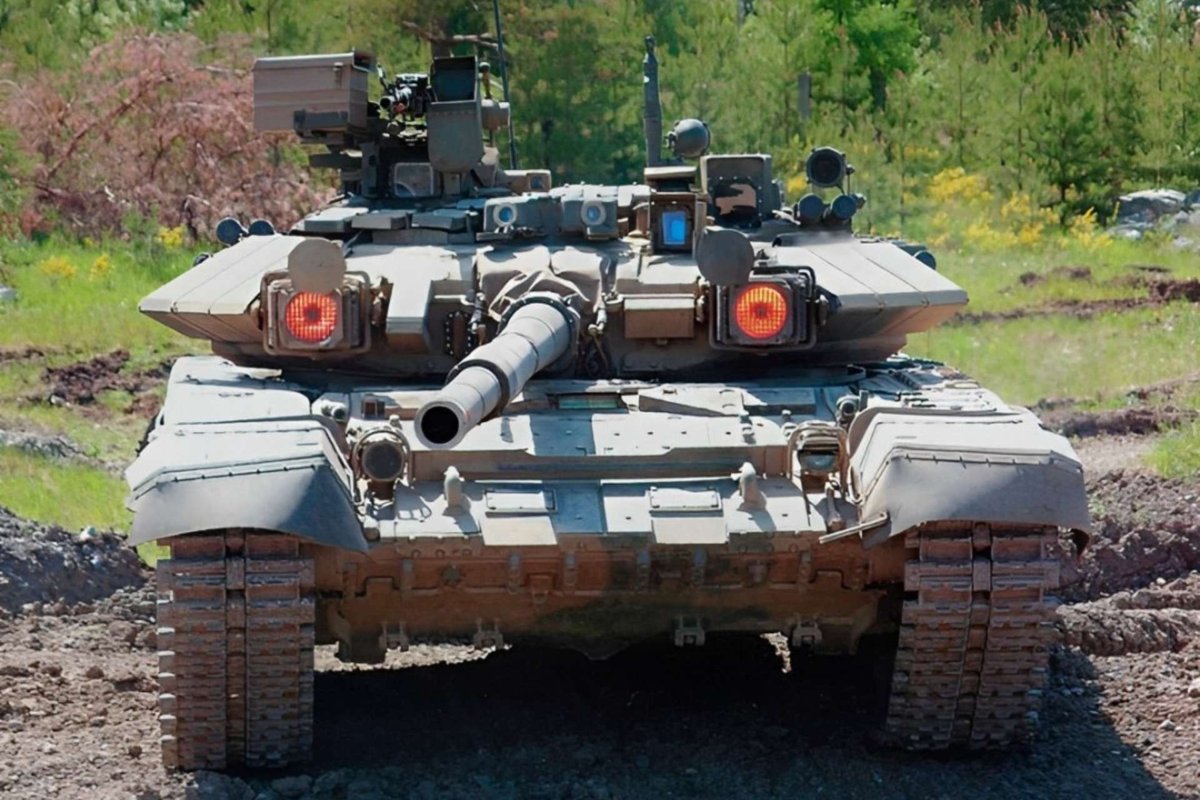
THE INFRARED JAMMERS: OTShU-1-7
The two OTShU-1-7 units are the most visible part of Shtora and the part that does its main work against wire-guided missiles.
Construction. [DOCUMENTED] Each unit is a box mounted on the turret front, with a round lens or window at the front and cooling fins on the casing. The close-up photograph shows the finned body and the large circular window. Inside is a powerful lamp, usually described as a xenon arc lamp, with a reflector and filters that pass mainly near-infrared light. [SINGLE-SOURCE for the lamp type] When the system is on, the units glow red or orange in visible light, which is why they are often called "eyes". The visible glow is the edge of the lamp's spectrum leaking through the filter; most of the energy is in the infrared.
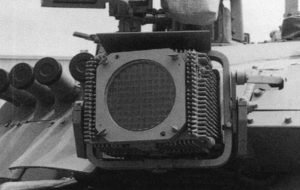
Spectrum. [SINGLE-SOURCE] The jammer output is usually quoted as covering roughly 0.7–2.5 µm, the near and short-wave infrared, which is the band in which SACLOS trackers of the 1970s and 1980s looked for the missile's flare or lamp.
Beam. [SINGLE-SOURCE] Each jammer covers a sector of about ±20° in azimuth and about 4.5° in elevation, centred on the gun line. The two units together give a jamming sector of roughly 40° in front of the turret. Because the jammers are fixed to the turret, the turret must point roughly toward the threat for jamming to work. That is one reason Shtora includes automatic turret slewing.
Modulation. [DOCUMENTED] The lamps are not simply switched on. They are modulated with a coded pattern that imitates the modulation used by Western missile tracers. Each SACLOS missile type uses a particular way of making its tracer stand out from background light, for example pulsing it at a set frequency. Shtora's modulator produces a signal that matches the coding the tracker expects. [ESTIMATE] The system probably carries several codes, cycling between them or matched to known missile types, since the jammer does not know in advance which missile is coming.
HOW JAMMING A SACLOS MISSILE WORKS
This is the core of Shtora, and it is worth working through step by step.
1. Normal SACLOS guidance. [BACKGROUND] The operator keeps a crosshair on the tank. The launcher contains an infrared tracker (sometimes called a goniometer or localiser) aligned with the sight. The tracker sees the missile's tail flare as a bright spot. It measures the angle between the spot and the centre of the field of view, which is the line of sight to the tank. That angle, converted to a distance at the missile's range, is the steering error. The launcher's computer sends commands down the wire to reduce the error to zero, so the missile flies along the line of sight and hits where the crosshair is.
2. The tracker's problem. [BACKGROUND] The tracker must pick the missile out of a background full of sunlight, burning vehicles and flares. It does this by looking only at a narrow band of infrared and only at signals with the expected modulation. A source that is bright in that band and carries the right modulation looks to the tracker like a missile.
3. What Shtora adds. [DOCUMENTED in principle; ESTIMATE in detail] When Shtora's jammer is lit, the tank itself carries a bright, correctly modulated infrared source. Seen from the launcher, the jammer is near the centre of the field of view, because the operator is aiming at the tank. The missile's own tracer is somewhere else in the field, close to the line of sight but offset.
4. The tracker is confused. [ESTIMATE] Depending on the tracker design, it may lock onto the jammer instead of the missile, average the positions of the two sources, or jump between them. In each case it calculates the wrong steering error. If it thinks the missile is at the jammer, it sees the "missile" already on target and stops correcting; the real missile drifts off. If it averages, it sends corrections that move the real missile away from the line of sight.
5. The missile misses. [DOCUMENTED that this is the intended effect] The false corrections drive the missile into the ground in front of the tank, or past it. A wire-guided missile cannot recover once the wrong commands have been sent for a second or two, because it has no seeker of its own.
Timing. [ESTIMATE] SACLOS missiles are slow, around 150–300 m/s, and fly for 5–20 seconds at their usual ranges. Shtora has ample time to start jamming once the threat is recognised, which is usually from the missile launch or the laser warning. In practice the jammers are often run continuously in combat areas when the threat of wire-guided missiles is high.
What makes jamming work best. [ESTIMATE] The jammer has to outshine the missile's tracer in the tracker's band. Early in flight, when the missile is close to the launcher, its tracer is bright and the tank is far; jamming is weakest. Later, as the missile approaches the tank, its tracer gets relatively dimmer compared with the jammer's output, and the jamming becomes more effective. That is helpful, because steering errors late in flight cannot be corrected.
INSIDE A SACLOS TRACKER: WHY IT CAN BE FOOLED
To see exactly where Shtora's jamming acts, it helps to look inside the trackers it was designed against. [BACKGROUND for the general designs; ESTIMATE for how Shtora interacts with each]
Reticle trackers. Many first- and second-generation trackers used a spinning reticle: a disc with a pattern of clear and opaque segments placed in front of a single infrared detector. As the disc spins, the light from the missile's tracer is chopped into pulses. The timing and phase of the pulses tell the tracker where the tracer is in the field of view. This is the same principle used in early heat-seeking air-to-air missiles.
Modulated-beacon trackers. Trackers for missiles with a modulated beacon look only at light that flickers at the beacon's frequency, using electronic filters tuned to it.
Detector-array trackers. Later trackers used small arrays of detectors (a quadrant detector or a line array) instead of a reticle. The position of the tracer is calculated from the relative signal on each element.
Imaging trackers. Modern trackers use small cameras and image processing. They can see two separate sources and reject the one that is not where the missile should be, or that sits still in the image.
The "pull-down" effect. [ESTIMATE] When the tracker believes the missile is already on the line of sight, it stops correcting. Many SACLOS missiles tend to sink and are constantly corrected upward; without correction they drop. This fits the reports of jammed missiles hitting the ground in front of the tank.
THE RADIOMETRY: HOW BRIGHT DOES A JAMMER NEED TO BE?
Infrared jamming is a contest of brightness inside one small part of the spectrum. The rough numbers show why Shtora's lamps had to be so large and power-hungry. [ESTIMATE throughout; the physics is standard, the missile figures are typical published values]
The missile's tracer. A SACLOS missile carries a flare or a lamp in its tail. Early TOW and MILAN used pyrotechnic flares; later TOW-2 added a xenon beacon and a thermal beacon. A flare's output in the near infrared is in the range of tens to hundreds of watts per steradian. Because it points back toward the launcher, the tracker sees it end-on.
The tracker's view. The tracker has a narrow field of view, a few degrees wide, centred on the line of sight. At 2 km, a 1° field covers about 35 m. The tank and the missile are both inside it for most of the flight.
The jammer's output. For Shtora to win, the jammer's radiant intensity in the tracker's band must be comparable to, or greater than, the tracer's, as seen from the launcher. The jammer is farther away than the missile, so it must be brighter in absolute terms. A missile at 500 m from the launcher, with a tank at 2.5 km, is 5 times closer; by the inverse-square law, the jammer must be about 25 times brighter than the tracer to look equally bright. Later in flight, at 2 km from the launcher, the ratio falls to about 1.6.
What that means for power. A xenon arc lamp turns perhaps 10–30% of its electrical power into near-infrared output. With a few hundred watts per lamp and a reflector concentrating the beam into a sector of about 40° × 4.5°, the radiant intensity on the beam axis can be several hundred to over a thousand watts per steradian. That is enough to compete with a flare at medium and long range, but not necessarily at the very start of the missile's flight. This fits the description of jamming being most effective in the middle and late parts of the flight.
Why modulation matters. Brightness alone is not enough. Trackers reject sources that do not carry the right modulation. A jammer with the wrong code is just another background source. This is why Shtora's modulator is as important as its lamps, and why later Western trackers moved to codes that are harder to imitate.
THE MODULATION QUESTION: CODES AND COUNTER-CODES
[ESTIMATE, from the general history of infrared countermeasures] A jammer is only as good as its knowledge of the enemy's tracker. To set Shtora's codes, Soviet designers needed to know how TOW, MILAN, HOT and Dragon trackers filtered their tracer signals. Some of that could be learned from published Western literature and patents; some from captured missiles, of which there were many after the Arab–Israeli wars and in Afghanistan, where Western missiles reached the mujahideen in the 1980s.
That knowledge has a shelf life. Once the West knew that a Soviet jammer existed, the obvious step was to change the codes, add a second beacon in a different band, or use guidance with no tracker to fool. Each of those steps was taken, as described above. The aircraft world had seen the same contest with flares and seekers since the 1960s.
[ESTIMATE] A practical consequence is that a Shtora jammer set up for 1980s codes may be ineffective against a 2000s missile of the same name. "Shtora works against TOW" is true for some TOW versions and not for others.
THE LASER WARNING RECEIVERS
The second half of Shtora deals with lasers. Its laser warning receivers tell the crew, and the system, that the tank is being measured or illuminated by a laser.
What they detect. [SINGLE-SOURCE] The sensors respond to laser light in roughly the 0.65–1.1 µm band. That covers the ruby lasers of early rangefinders at 0.69 µm and the neodymium (Nd:YAG) lasers at 1.06 µm used by most rangefinders and designators of the 1980s and 1990s. [ESTIMATE] It does not cover the 10.6 µm CO₂ lasers used by some later rangefinders, nor the eye-safe 1.54 µm lasers that became common from the 1990s onward. Some later Shtora versions are said to have extended coverage; details are not public. [UNVERIFIED]
Coarse and precise sensors. [DOCUMENTED] Shtora uses two kinds of sensors.
How direction is found. [ESTIMATE] Laser warning receivers of this type usually use several photodiodes, each looking through a slit or mask into a different direction. The pattern of which diodes are lit, and how strongly, gives the angle of arrival. A coarse sensor might use a few wide sectors; a precise sensor uses many narrow ones. The quoted 3.75° resolution would correspond to dividing a 90° sector into 24 channels.
Rangefinder or designator. [ESTIMATE] A rangefinder fires a single pulse or a short burst, typically once per shot. A designator fires a steady train of coded pulses at 10–20 per second for many seconds, to guide a weapon. A laser warning receiver can tell these apart from the pulse pattern, and Russian descriptions say Shtora can distinguish them and react accordingly. [SINGLE-SOURCE]
LASER WARNING IN MORE DETAIL: FALSE ALARMS AND DISCRIMINATION
A laser warning receiver must react to real lasers and ignore everything else. [ESTIMATE, from general LWR engineering]
Short pulses. Military rangefinders and designators fire pulses of about 10–20 nanoseconds. Sunlight, glints, gun flashes and explosions produce light that rises and falls over microseconds to milliseconds. A receiver that responds only to very fast rising pulses rejects nearly all natural sources. This is the main trick of every laser warner.
Wavelength filters. Narrow-band filters around the expected laser lines, or a band such as 0.65–1.1 µm, cut background light further.
Pulse repetition. A rangefinder fires single pulses or short bursts. A designator fires a steady coded train, often 10–20 Hz. By counting pulses over a fraction of a second, the system can tell the two apart and decide whether to slew the turret and fire grenades (designator) or to warn the crew (rangefinder).
Scattered light. A laser aimed at a nearby tank, or at the ground nearby, scatters light that may reach the receiver. The receiver must decide whether the tank itself is the target. Threshold settings trade sensitivity against false alarms.
Why two kinds of sensor. The coarse sensors give all-round warning with simple, wide-angle optics. The precise sensors give accurate direction in the frontal arc for aiming the turret and grenades. This division keeps the cost and complexity down while giving accuracy where it matters most.
AUTOMATIC TURRET SLEW AND THE AEROSOL SCREEN
When a laser is detected, Shtora can respond in several ways depending on the mode chosen by the commander.
Turret slew. [DOCUMENTED] In automatic mode, the system turns the turret toward the laser source using the tank's own turret drive. This points the jammers, the main gun and the grenade launchers toward the threat. [SINGLE-SOURCE] The slewing speed is that of the turret drive, about 40°/s on a T-90, so turning from side to rear can take several seconds.
Grenade launch. [DOCUMENTED] The system then fires aerosol grenades from the 902A launchers toward the laser source. These are 3D17 grenades, 81 mm in calibre, which burst at about 50–80 m from the tank and form an aerosol cloud. [SINGLE-SOURCE for distances]
Screen timing. [DOCUMENTED] The cloud forms in about 3 seconds and lasts about 20 seconds, depending on wind. [SINGLE-SOURCE for duration] It is roughly 10–15 m wide and several metres high.
What the screen blocks. [DOCUMENTED] The 3D17 aerosol blocks visible light, near infrared and laser wavelengths including 1.06 µm. [SINGLE-SOURCE] Some descriptions say it also degrades thermal imaging in the 8–14 µm band. [CONFLICT] Others say it is effective mainly in the visible and near infrared, with only partial blocking of thermal imagers. The aerosol particles are designed to scatter light at the wavelengths of interest; blocking long-wave infrared requires particles of a different size, which is why the claim is disputed.
Why 3 seconds matters. [ESTIMATE] A laser-guided missile such as Hellfire flies at about 400 m/s. From 5 km, it arrives in about 12 seconds. A laser-guided artillery round such as Copperhead falls for 20–30 seconds, with designation needed only for the last 10–15. A laser rangefinder gives a firing solution to a tank gun, and the shell arrives in 1–2 seconds after firing. Shtora's 3-second screen is therefore fast enough to block designators and to deny re-ranging, but not fast enough to stop a tank shell already fired on a good range.
THE AEROSOL GRENADE AND LAUNCHER
902A Tucha launchers. [DOCUMENTED] The 902A Tucha (Туча, "cloud") is the standard Soviet and Russian 81 mm smoke grenade launcher for tanks. On the T-90, Shtora uses twelve launchers in two banks on the turret. Each launcher holds one grenade and is fired electrically.
3D17 grenade. [DOCUMENTED] The 3D17 is an 81 mm aerosol grenade developed for Shtora. [SINGLE-SOURCE] The grenade flies about 50–80 m before bursting, and a salvo of several grenades forms a curtain in front of the tank.
What is in the cloud. [ESTIMATE] Aerosols that block visible and near-infrared light use fine particles with sizes close to the wavelengths to be blocked, about 0.5–2 µm. Blocking 1.06 µm laser light needs particles in that range. Blocking 8–12 µm thermal radiation needs larger particles, around 5–10 µm, or materials such as brass flakes or graphite. One cloud that blocks every band is hard to make. That is the physical basis of the dispute over whether 3D17 blocks thermal imaging.
Laser return and false ranges. [ESTIMATE] A laser rangefinder fired at a tank behind a fresh aerosol cloud may get a return from the cloud itself, giving a false range of 50–80 m. A gunner who trusts that range will fire short. This false-range effect is part of the protection, apart from simply hiding the tank.
Timing of a salvo. [ESTIMATE] The 3 seconds quoted for screen formation include the grenade flight time (under a second) and the time for the cloud to spread. Wind can shorten the useful life of the screen or move it off the line of sight.
Moving behind the screen. [BACKGROUND] Soviet doctrine expects a tank that fires a screen to move, back or sideways, so that it is no longer where the enemy last saw it. The screen buys a few seconds; manoeuvre makes them count.
CONTROL PANEL AND MODES
[DOCUMENTED] The commander's control panel lets the crew choose how Shtora reacts. Three modes are usually described:
[SINGLE-SOURCE] The panel shows the direction of the laser threat in sectors, the state of the jammers and the grenades remaining.
[ESTIMATE] In practice, automatic mode is useful in open terrain against long-range threats, but it can be dangerous in close combat, where turning the turret automatically may point the gun away from a more immediate threat. Crews and commanders often prefer semi-automatic mode for that reason.
POWER AND INTEGRATION
[SINGLE-SOURCE] The system's power consumption is usually quoted at about 1 kW, almost all of it for the two jammer lamps. The T-90's generator and batteries can supply this when the engine is running. With the engine off, running the jammers drains the batteries quickly.
[ESTIMATE] The jammers also produce a great deal of heat; the cooling fins on the casings are needed to keep the lamps within their operating temperature. A jammer running continuously in hot weather may need to be switched off at intervals.
[DOCUMENTED] On the T-90, the laser warning receivers are linked to the fire-control system. The direction of the laser can be passed to the gunner's sight, allowing the crew to return fire at the source. [SINGLE-SOURCE]
[ESTIMATE] Rough arithmetic shows the scale. The T-90's generator is usually given as about 10 kW at 27 V, so a 1 kW Shtora load is about 10% of its output, or about 37 A. The main battery bank on Soviet tanks of this class holds a few hundred ampere-hours. Running the jammers alone from batteries with the engine off would therefore take a large share of the charge within a few hours, leaving less for engine starting, radios and the turret drive. That is a practical reason crews in static positions keep the jammers off and why the system is mainly used with the engine running. The firing pulses for the grenades and the laser warning electronics use very little energy by comparison.
THE INSTALLATION ON THE T-90 AND T-80UK
[DOCUMENTED from photographs] On the T-90, the two OTShU-1-7 units sit on the turret front either side of the gun, set into the Kontakt-5 reactive armour. The laser warning sensors sit on the turret roof: the precise heads near the front, the coarse heads giving all-round view. The twelve 902A launchers are in two banks on the turret sides, angled forward. The control panel is at the commander's station.
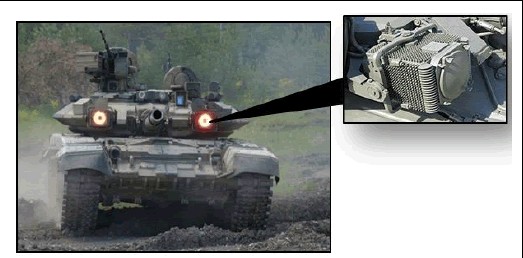
[DOCUMENTED] The T-80UK, a command tank, carried a similar layout on its T-80U turret. [SINGLE-SOURCE] Some T-80U tanks in Russian service also had Shtora fitted.
[ESTIMATE] Placing the jammers either side of the gun keeps them close to the turret's centre line, so their beam covers the tank's front when the turret faces the enemy. It also uses space that would otherwise carry reactive armour, a trade-off that later led the T-90M to remove them in favour of more armour.
JAMMING GEOMETRY AND TURRET SLEW TIMES
The jammers cover about ±20° from the gun line. What happens when the threat is elsewhere? [ESTIMATE throughout]
Turret speed. The T-90 turret traverses at up to about 40°/s. Turning 90° to face a flank threat takes over 2 seconds; turning 180° takes over 4 seconds.
Missile flight time. A TOW fired from 3 km takes about 12–15 s to arrive; a MILAN at 2 km takes about 10–12 s. There is time to turn the turret and start jamming before the missile reaches the critical last part of its flight, if the threat is detected early.
Detection is the problem. SACLOS missiles do not use lasers. Shtora's laser warning receivers do not see them coming. Unless the crew sees the launch, or another sensor (such as a missile warning system, which Shtora lacks) detects it, the turret will not turn in time. That is why the jammers are normally left on and pointed along the most likely threat direction.
Hull or turret. The jammers are on the turret. A tank moving one way while its turret points another can keep jamming toward a threat on its flank, but the hull side is then exposed to other threats.
AN ENGAGEMENT: SACLOS MISSILE
This example follows a TOW-type missile fired at a T-90 from 2.5 km. [ESTIMATE throughout, from published characteristics]
t = 0 s: The missile is launched. The operator keeps the crosshair on the tank.
t = 0–1 s: The T-90 crew does not know a missile is coming unless they see the launch. Shtora's laser warning receivers have nothing to detect: TOW does not use a laser.
t = 1–3 s: If the jammers are already on (the normal combat practice), the launcher's tracker sees both the missile's tracer and the jammer in its field of view. If the jammers are off, the crew must spot the missile or launch and switch them on.
t = 3–10 s: The tracker, confused by the jammer, sends wrong commands. The missile begins to deviate from the line of sight.
t = 10–12 s: The missile hits the ground short of the tank, or passes it.
Lesson. The jammer must be on before or soon after launch. A crew that is not alert loses much of Shtora's value against SACLOS missiles.
AN ENGAGEMENT: LASER-GUIDED WEAPON
This example follows a laser-designated missile or shell. [ESTIMATE throughout]
t = 0 s: An observer illuminates the tank with a designator.
t = 0.1–0.5 s: Shtora's coarse sensors detect the laser. The precise sensors measure its direction if it is in the frontal arc.
t = 0.5–2 s: In automatic mode, the turret turns toward the laser source if needed.
t = 2–3 s: Aerosol grenades are fired toward the source.
t = 5–6 s: The screen is fully formed. The designator spot is scattered or blocked. The weapon loses its guidance and falls wide, or hits the screen area rather than the tank.
Lesson. Against designators, Shtora's response is fast enough. Against rangefinders, it can prevent the enemy from getting a good range, but not stop a shell already fired.
WORKED EXAMPLE: A COPPERHEAD ROUND AGAINST A T-90
The M712 Copperhead is a 155 mm artillery shell with a laser seeker. It is the kind of weapon Shtora's laser half was designed to beat, and the timings show how. [BACKGROUND for Copperhead; ESTIMATE for the engagement]
The attack. A forward observer 3 km from the tank has a laser designator. A howitzer 15 km away fires a Copperhead. The shell flies a ballistic arc for about 40–50 seconds. The observer switches on the designator for roughly the last 10–20 seconds, so the seeker can find the spot as the shell comes down through the clouds.
What Shtora sees. As soon as the designator illuminates the tank, the coarse sensors detect coded pulses at 10–20 Hz. The system classifies them as a designator, not a rangefinder. If the observer is in the frontal arc, the precise sensors give the direction to within a few degrees; if not, the coarse sensors give the quarter and the turret slews.
The response. Within about 1–3 seconds the turret faces the observer and a salvo of 3D17 grenades is fired. About 3 seconds later a cloud stands between the observer and the tank.
The outcome. The laser spot now falls on the cloud, 50–80 m in front of the tank, or is scattered so much that the seeker sees no clear spot. A Copperhead that has already locked on follows the brightest spot: the cloud. It lands in front of the tank. Even a near miss from a 155 mm shell can damage a tank, but the chance of a direct hit falls sharply. This is the reasoning behind the claimed 4–5 times reduction against laser-guided weapons.
What could go wrong. If the observer is above the sensors' elevation limit, for example on a high ridge or in a helicopter, the coarse sensors may not see the laser. If the designator uses a wavelength outside the 0.65–1.1 µm band, nothing is detected. If the shell is already close when the designator switches on, the screen may not form in time. If the wind is strong, the cloud may drift off the line of sight.
WORKED EXAMPLE: A MISSILE FROM THE FLANK
This example shows the weakness of a frontal jammer against a flank attack. [ESTIMATE throughout]
The attack. A T-90 is moving along a road with its turret forward. A MILAN team 1.5 km away on its right flank, at 90° to the gun line, fires.
What Shtora sees. Nothing. MILAN uses no laser, so the laser warning receivers stay silent. The jammers point forward and are 70° away from the missile's tracker.
The crew. If the commander spots the launch flash, he can turn the turret toward it. At about 40°/s, turning 90° takes a little over 2 seconds. The jammers then point at the launcher. MILAN takes about 7–8 seconds to fly 1.5 km. That leaves about 5 seconds of jamming, enough to cause a miss if the codes match.
Without detection. If nobody sees the launch, the missile flies unjammed and hits the hull side, where the reactive armour and side skirts are the only protection.
Lesson. Shtora's jamming depends on the threat being in front, or on the crew detecting it. A missile launch warning sensor, which Shtora lacks, would close this gap. Later systems such as Afghanit add one.
WHAT THE ENEMY OPERATOR SEES
[ESTIMATE, from the physics and from published descriptions] An enemy missile operator looking at a Shtora-equipped tank through a daylight sight would see two red-orange glows on its turret front, bright but not blinding. Through a near-infrared night sight, they would look like two very bright headlights. Through a thermal sight they would barely show; the lamps' housings are warm, but not much warmer than the engine deck.
During a jammed engagement, the operator holds the crosshair on the tank as trained. The missile flies out, but instead of settling onto the crosshair it starts to drift, usually downward, or begins to wander. The operator cannot correct it: in SACLOS guidance the operator only aims; the tracker steers. A few seconds later the missile hits the ground short. To the operator it looks like a malfunction.
If the tank also fires a screen, the operator sees a grey-white cloud form in front of it within a few seconds and loses sight of it. A laser rangefinder fired into the cloud gives a range of tens of metres instead of kilometres.
SHTORA AND THE TANK'S OWN WEAPONS
[DOCUMENTED] The laser warning data can be passed to the gunner's sight. When a laser is detected in the frontal arc, the gunner can be cued toward its source.
[ESTIMATE] This makes the laser warning receiver also a targeting aid. An enemy tank that ranges the T-90 with its laser gives away its position. The T-90 can screen, move and return fire at the cued direction. In tank-against-tank fighting, this may be as valuable as the screen itself: the side that lases first reveals itself.
[ESTIMATE] The jammers have no targeting role, but their glow, visible to the enemy, is a known risk. In some situations, crews may prefer to keep them off and rely on reactive armour, accepting the risk from SACLOS missiles rather than being visible at night.
ENVIRONMENT: DUST, RAIN AND SUN
[ESTIMATE] The system's performance changes with conditions.
MAINTENANCE AND CREW PROCEDURES
[ESTIMATE, from general Soviet tank practice] The OTShU-1-7 jammers need periodic lamp replacement, window cleaning and modulation checks. The laser warning receivers must be kept clean and checked with test equipment that simulates laser pulses. The grenade launchers must be reloaded from outside after use and kept free of mud and ice. [SINGLE-SOURCE] The system has a built-in test function for the main circuits.
[ESTIMATE] Arc lamps have a limited life, perhaps hundreds of hours. Crews avoid running them in training to save lamp life, which means they may not be in the habit of running them in combat either.
WITHIN THE TANK'S LAYERED DEFENCE
Shtora is one of several layers on a T-90 or T-80UK. [ESTIMATE, based on the documented features of each layer]
[ESTIMATE] In that scheme Shtora covers medium- and long-range guided weapons, reactive armour covers the warheads that get through, and a hard-kill system such as Drozd or Arena covers short-range unguided threats. This is why Russian designers in the 1990s showed tanks with Shtora and Arena together, and why Afghanit combines both approaches.
Tactics. [ESTIMATE] A T-90 commander in a threat area would switch the jammers on when entering ground where SACLOS missiles are expected; set Shtora to automatic or semi-automatic depending on whether friendly troops and vehicles are nearby; move after firing a screen; and use the laser warning display to find the laser source and return fire.
EFFECTIVENESS CLAIMS
[SINGLE-SOURCE] Russian sources give the following figures for Shtora-1's effect on the probability of a hit:
[ESTIMATE] These figures come from trials and manufacturer material, not combat records. They are plausible for the missile types of the 1980s, but they depend strongly on the crew switching the jammers on in time and on the missile using a tracker that Shtora's codes can deceive.
[CONFLICT] Some Western analysts argue that the figures are optimistic and that Shtora's real effect on modern missiles is small. Others note that the system was effective enough against early TOW and MILAN to force changes in Western missile designs.
LIMITATIONS
Fire-and-forget missiles. [DOCUMENTED] Missiles with their own seekers, such as Javelin, Spike, NLAW and Brimstone, do not rely on a launcher tracking their tail. Shtora's jammer has nothing to deceive. Some of these missiles use imaging infrared seekers, which lock on the target's heat signature; the jammer's glow could, in principle, add a bright spot, but modern imaging seekers track the target shape, not the brightest point.
Top attack. [DOCUMENTED] Javelin, TOW-2B, Bill and other top-attack missiles approach from above or fly over the tank. Shtora's jammers point forward and roughly horizontal, with an elevation sector of a few degrees. Its laser warning receivers cover up to about +25° only. Top-attack threats are largely outside its coverage.
Laser beam riders. [DOCUMENTED] Missiles such as Kornet, Konkurs-M in some versions, and the Ukrainian Stugna-P and Skif use laser beam-riding guidance. A receiver at the back of the missile looks back toward the launcher and steers to stay in the centre of a coded laser beam. There is no tracker on the launcher watching the missile's tail, so Shtora's jammer is irrelevant. [ESTIMATE] Beam-riding lasers are low-power and continuous; whether Shtora's laser warning receivers detect them reliably is disputed. If they do, the aerosol screen can break the beam, but only if it forms before the missile arrives.
Thermal imagers. [ESTIMATE] Modern tank and missile sights use thermal imagers working at 3–5 µm or 8–12 µm. Shtora's jammers emit mainly at 0.7–2.5 µm and do not affect thermal sights. The aerosol screen may or may not block thermal imaging (see the conflict above). If it does not, the enemy can continue to see and aim at the tank through the screen.
Unguided and gun-launched rounds. [DOCUMENTED] RPG grenades, recoilless rounds and tank guns aimed by optics without lasers are not affected.
Counter-coded trackers. [ESTIMATE] Western missiles introduced trackers with improved codes, dual-band (xenon and thermal) beacons and trackers that reject sources outside the expected position. TOW-2's thermal beacon at long-wave infrared is not matched by Shtora's near-infrared lamps.
Self-revealing. [ESTIMATE] The jammers glow visibly and brightly in near infrared. A tank with its jammers on is easier to see through night-vision devices working in near infrared. This trade-off is one reason crews may keep jammers off until needed.
Frontal arc only for jamming. [DOCUMENTED] The jammers cover about ±20° each. Missiles from the sides or rear are not jammed unless the turret turns to face them.
Limited grenade supply. [DOCUMENTED] Twelve grenades, fired in salvos of several, give only a few screens before the launchers are empty and must be reloaded from outside.
HOW THE WEST RESPONDED
[BACKGROUND] The existence of Shtora, together with similar soft-kill systems and the expected spread of jammers, pushed Western missile designers toward guidance that infrared jammers cannot deceive.
[ESTIMATE] In that sense Shtora worked: it made the original SACLOS designs less useful and forced a change. But by the 2000s the threats it was designed against had largely been replaced.
COULD SHTORA BE UPDATED?
[ESTIMATE] Several of Shtora's limitations come from the technology of its time, not from the concept.
[ESTIMATE] The T-90M's choice to keep laser warning and smoke while dropping the lamps shows which parts of Shtora remained useful: the warning and the screen, not the jammers.
HISTORY AND SERVICE
Development, 1980s. [DOCUMENTED] Shtora was developed in the 1980s to protect the newest Soviet tanks against Western SACLOS missiles and laser-guided weapons. The first installation is usually said to be on the T-80UK command tank, and the system was accepted around 1989.
T-90. [DOCUMENTED] The T-90, accepted in 1992, carried Shtora-1 as standard. The two jammers either side of the gun, with the T-90's Kontakt-5 reactive armour around them, became the tank's visual signature. The parade photograph below shows the layout.
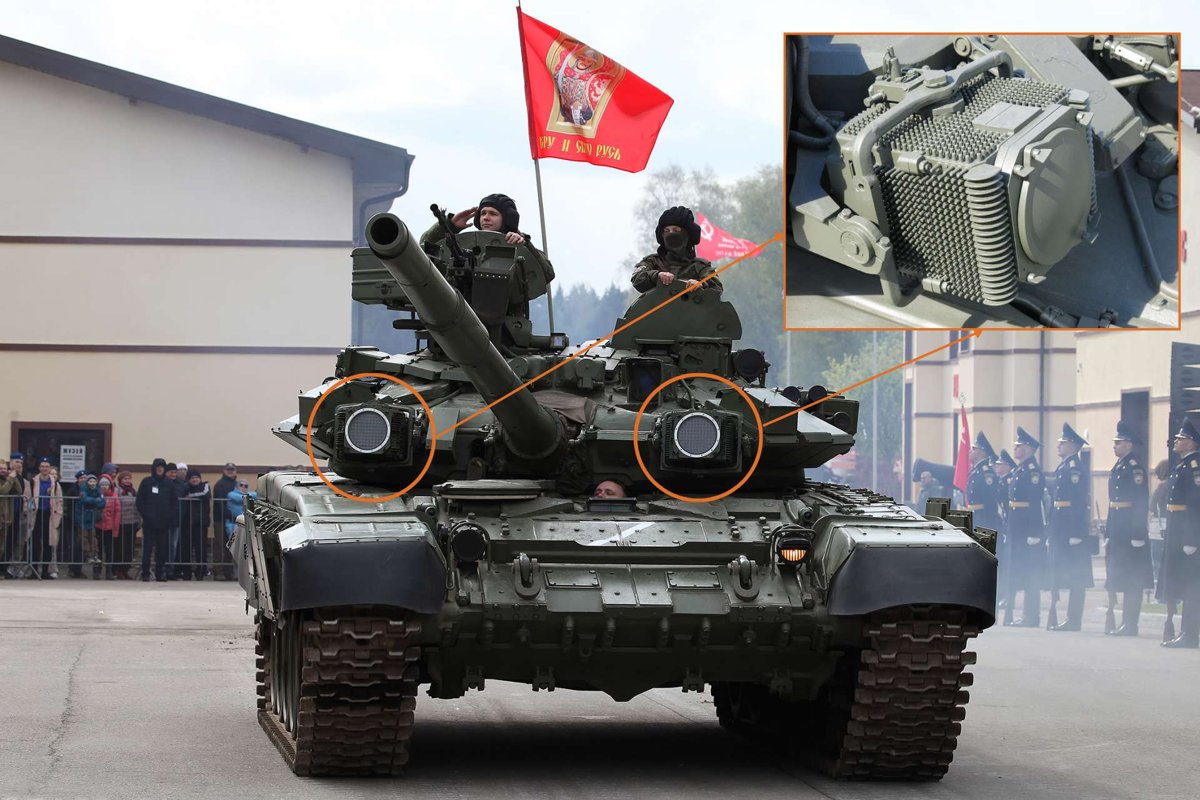
T-90S and export. [DOCUMENTED] Export T-90S tanks for India and Algeria were offered with Shtora. India's early T-90S had Shtora jammers; [CONFLICT] later Indian tanks are reported to have the system omitted or replaced by Indian or other systems.
T-90A. [DOCUMENTED] The T-90A, from 2004, kept Shtora in early batches. [CONFLICT] Later T-90A production and modernisations are reported in some sources without the jammers, keeping only the laser warning receivers and grenade launchers.
T-90M. [DOCUMENTED] The T-90M, in service from the 2020s, does not carry the OTShU-1-7 jammers. It has a laser warning system linked to the 902A Tucha launchers. The space where the jammers sat is taken by Relikt reactive armour. See T-90M.
T-80UK. [DOCUMENTED] The T-80UK, a command version of the T-80U, carried Shtora-1 together with improved communications and navigation.
Other vehicles. [SINGLE-SOURCE] Shtora components were offered for the BMP-3 export versions, the T-72 modernisations and other vehicles. Some BMP-3 export versions for Gulf states were reported with Shtora. [UNVERIFIED] Iran's Zulfiqar tank and other foreign designs are sometimes said to have Shtora-like jammers; these are not confirmed to be Shtora.
Ukraine: Varta. [DOCUMENTED] Ukraine developed its own system, Varta (Варта, "guard"), derived from Shtora, for the T-84 and T-84 Oplot. It uses similar infrared jammers, laser warning receivers and grenade launchers.
COMBAT RECORD
Chechnya and Dagestan. [SINGLE-SOURCE] T-90s took part in operations in Dagestan in 1999. Reports describe a T-90 surviving multiple RPG hits, credited to its Kontakt-5 armour rather than Shtora. There are no clear reports of Shtora defeating missiles there; the threats were mostly unguided grenades.
Syria. [DOCUMENTED] In 2016, a video showed a T-90A in Syria hit by a TOW missile. The tank survived, apparently with damage to external equipment. [CONFLICT] Some commentators said the Shtora jammers were not switched on; others said they were on but did not stop the missile. The video does not show clearly whether the jammers were active. [ESTIMATE] The TOW in that video was most likely a TOW-2 or later, with a thermal beacon that Shtora's lamps cannot imitate, which would explain the hit even with the jammers on.
Ukraine. [DOCUMENTED] Russian T-90A tanks with Shtora took part in the war in Ukraine from 2022. Ukrainian forces used Javelin, NLAW, Stugna-P (a laser beam-riding missile) and drones, none of which Shtora's jammers can deceive. [ESTIMATE] The laser warning receivers and grenades may have had some value against laser rangefinders and Stugna-P's beam, but the system's main jamming function was almost irrelevant in that war.
VARIANTS AND SUCCESSORS
Shtora-1. [DOCUMENTED] The original system described on this page, TShU-1.
Shtora-1 export. [SINGLE-SOURCE] Versions with different modulation codes and electronics, offered for export.
Shtora-2 / modernised Shtora. [UNVERIFIED] References to a Shtora-2 or a modernised Shtora with improved sensors, wider laser coverage and better codes appear in some sources. Details are not public, and it is not clear whether such a system entered service.
Varta. [DOCUMENTED] The Ukrainian derivative described above.
Afghanit soft-kill channel. [DOCUMENTED] The T-14's Afghanit system includes soft-kill elements: laser and UV warning, aerosol grenade launchers and possibly jamming. It shares Shtora's principle of detecting the threat's guidance and blocking it, but with modern sensors. See Afghanit.
T-90M approach. [DOCUMENTED] The T-90M keeps a laser warning and aerosol screen system but drops the infrared jammers, reflecting the decline of SACLOS threats.
TIMELINE
SHTORA ON LIGHTER VEHICLES
[SINGLE-SOURCE] Russian industry offered Shtora components for infantry fighting vehicles, notably export BMP-3s. [ESTIMATE] A lighter vehicle gains more from soft kill than a tank does, because it has far less armour to fall back on when a missile gets through; on the other hand, it has less electrical power and less turret space. A BMP-3 installation would likely use laser warning and aerosol launchers, which are small, with the jammers optional. The turret-slew function is also less useful on a vehicle whose small turret carries only part of its armament. The same logic explains why many later Russian and foreign vehicles carry laser warning and smoke but no jammers: those two parts give most of the remaining value at a fraction of the weight and power.
SHTORA WITH HARD KILL: THE 1990s CONCEPTS
[DOCUMENTED] In the 1990s, Russian exhibitions showed T-80U and T-80UM tanks fitted with both Shtora and the Arena hard-kill system, and T-80UM variants with Drozd-2. The idea was a layered defence: Shtora against long-range guided weapons, Arena or Drozd against short-range grenades and missiles, and reactive armour against what got through. [ESTIMATE] Neither combination entered series production, mainly for cost reasons, but the concept led directly to Afghanit, which combines soft and hard kill in one system with shared sensors.
SIDE-BY-SIDE: ACTIVE PROTECTION SYSTEMS (HARD AND SOFT KILL)
Cells marked [U] are unverified or disputed, and [E] marks estimates. Unmarked cells are documented in at least two sources.
| Item | Drozd | Drozd-2 | Arena / Arena-M | Afghanit | Trophy | Iron Fist | Shtora-1 (soft kill) |
| Era / maker | 1977–83, service 1983; KBP Tula | 1990s demonstrator | 1990s (Arena); 2020s (Arena-M); KBM Kolomna | 2010s; KBP Tula / NII Stali credited [U] | 2000s; service 2011; Rafael / IAI Elta | 2000s; IMI / Elbit | 1980s; service about 1989; VNIITransmash / Elers-Elektron [U] |
| Carriers | T-55AD, T-62D | T-80U / T-80UM / UM2 trials | T-80UM, T-72 trials; Arena-M on T-90M, T-72B3A | T-14, T-15 trial fleet | Merkava, M1 Abrams, others | Namer, some exports | T-90, T-90S, early T-90A, T-80UK |
| Sensor | 2 Doppler radars, about 24.5 GHz | Improved Doppler radars [U] | Multi-faced mast radar (K-band [U]); Arena-M small radar modules | 4 AESA-type panels plus UV/IR sensors | 4 EL/M-2133 AESA panels | Radar plus IR sensors | Laser warning receivers (coarse 360°, precise ±45°); no radar |
| Kill mechanism | 107 mm HE-fragmentation rocket, burst about 6.6 m | Same principle, more launchers | Fragment charge thrown up, fired downward | Fixed tubes; fragment / blast munition [U] | EFP slug pattern | Blast interceptor (no fragments) | IR jammers spoof SACLOS trackers; 3D17 aerosol screen |
| Hard-kill arc | Frontal, about ±40° (some say 60° total) [U] | About 120° [U] | About 270° (not rear) | Frontal (sensors all round) | 360° | 360° | No hard kill; jamming about ±20° per jammer, frontal |
| Threat speed window | 70–700 m/s | Similar [U] | 70–700 m/s | Claimed up to 1,700–3,000 m/s [U] | RPGs and ATGMs; not darts | RPGs and ATGMs; KE claimed limited [U] | Not speed-gated; acts on guidance (SACLOS, laser) |
| Reaction time | About 0.05–0.1 s electronics; about 0.35 s full cycle [U] | n/a | About 0.07 s (published) | About 0.1 s claimed [U] | Under 1 s total [E] | Not published | Screen in about 3 s |
| Ammo / reload | 8 rounds, 1 per 20° sector; manual reload from outside | More than 8 [U] | 22–26 (Arena); 12 (Arena-M); manual | About 10 hard-kill tubes; manual [E] | Several per launcher; automatic reload | Several per launcher; automatic | Jamming unlimited; 12 grenades, manual reload |
| KE dart defeat | No | No | No | Claimed [U] | Not claimed | Limited claim [U] | No (screen only denies re-ranging) |
| Infantry danger | High, about 20–30 m | Similar [E] | 20–30 m zone | Exists; tubes fire forward [E] | Smaller zone but not zero | Low (blast only) [E] | Negligible [E] |
| Status | Retired; about 250 built [U] | Not adopted | Arena-M in limited service | Trial fleet only | In service, combat-proven | In service | Jammers dropped on T-90M; still on older T-90s |
COMPARISON: SOFT KILL VERSUS HARD KILL
Shtora-1 vs Drozd. [DOCUMENTED for the features] Drozd fired 107 mm fragmentation rockets at short-range threats in the frontal arc. Shtora deceives missiles and blocks lasers at long range. Drozd was dangerous to infantry; Shtora is not. Drozd worked against unguided grenades; Shtora does not. They were designed for different threats and complement each other. See Drozd.
Shtora-1 vs Arena / Arena-M. [DOCUMENTED] Arena is hard kill with a radar and a ring of charges, covering about 270°, against short-range grenades and missiles. It does nothing at long range. Shtora acts at long range but not at short range. See Arena-M.
Shtora-1 vs Afghanit. [DOCUMENTED] Afghanit's soft-kill channel continues Shtora's idea with modern warners and screening. Its hard-kill channel covers the frontal arc with fixed tubes. Afghanit is in effect a successor that merges Shtora's role and Arena's. See Afghanit.
Shtora-1 vs Trophy. [DOCUMENTED] Trophy is hard kill, with 360° radar and explosively formed slugs. It does not jam or screen. A Trophy-equipped tank is protected from most RPGs and missiles that fly into its bubble, regardless of their guidance; Shtora only protects against guidance it can deceive.
Soft kill in general. [ESTIMATE] Soft kill is cheap, safe for infantry and has unlimited "shots" for jamming, but it works only against weapons whose guidance it understands. Hard kill works against almost any projectile in its envelope, but has limited rounds and endangers people nearby. Modern systems combine both.
COMMON MISCONCEPTIONS
"The red lights are lasers." [DOCUMENTED] They are not. They are infrared lamps with a visible red glow.
"Shtora blinds enemy gunners." [DOCUMENTED] It deceives trackers; its effect on a human looking through an optical sight is slight.
"Shtora stops all missiles." [DOCUMENTED] It works against SACLOS missiles whose trackers it can deceive and against laser-guided weapons it can screen. It does not stop fire-and-forget, top-attack or beam-riding missiles.
"Shtora is a hard-kill system." [DOCUMENTED] It is not. It fires smoke, not interceptors.
"Shtora was useless." [ESTIMATE] It was well designed for the threats of the 1980s and pushed Western designers to change their missiles. It lost value as those threats were replaced.
KEY FIGURES
SOURCES AND HOW RELIABLE THEY ARE
Manufacturer and Russian state material. [BACKGROUND] Most of the detailed figures for Shtora come from Russian export brochures, exhibition material and articles in Russian military magazines from the 1990s, when Russia was actively marketing the T-90S. These sources are reliable for the system's components and broad concept, but their effectiveness figures are promotional.
Russian Wikipedia and enthusiast sites. [SINGLE-SOURCE] Detailed specifications such as the 3.75° resolution and the elevation limits mostly trace back to these brochures via Russian encyclopaedic summaries.
Western analyses. [BACKGROUND] Jane's, Army Recognition, Military Today and similar sources repeat the same figures with commentary. Western technical analyses of SACLOS trackers and IR countermeasures give the physics but rarely discuss Shtora specifically.
Combat evidence. [CONFLICT] Videos from Syria and Ukraine show T-90s with Shtora being hit and surviving, or being destroyed, but rarely show clearly whether the jammers were on and what missile was used. Claims on both sides should be treated with caution.
Where sources disagree.
This page's approach. Agreement between at least two independent-looking sources is marked [DOCUMENTED]; brochure-only figures [SINGLE-SOURCE]; physics and timing worked from those figures [ESTIMATE].
RELATED ARTICLES
SOURCES