Home |
Data Base |
Technical |
Radio |
Search
KH-59 OVOD / KH-59M OVOD-M
Х-59 «Овод» | Raduga | NATO: AS-13 Kingbolt / AS-18 Kazoo
Air-launched stand-off missile
Project Orlan Data Base // public encyclopedia
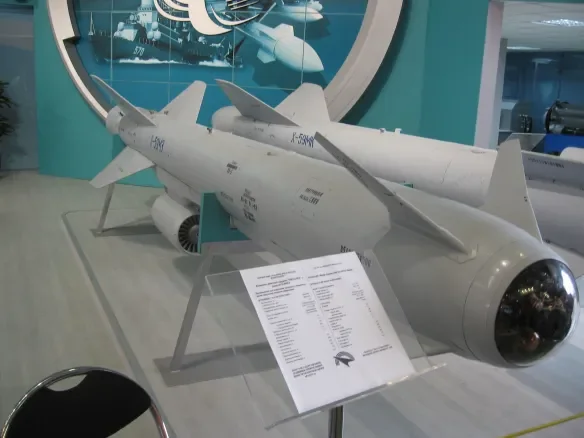
Kh-59-family missiles on an indoor exhibit; the missile behind is marked X-59MK. Both have the small jet engine in a pod slung under the rear of the round body, the layout of the long-range family, and the nearer missile shows a large glazed seeker dome in the nose.
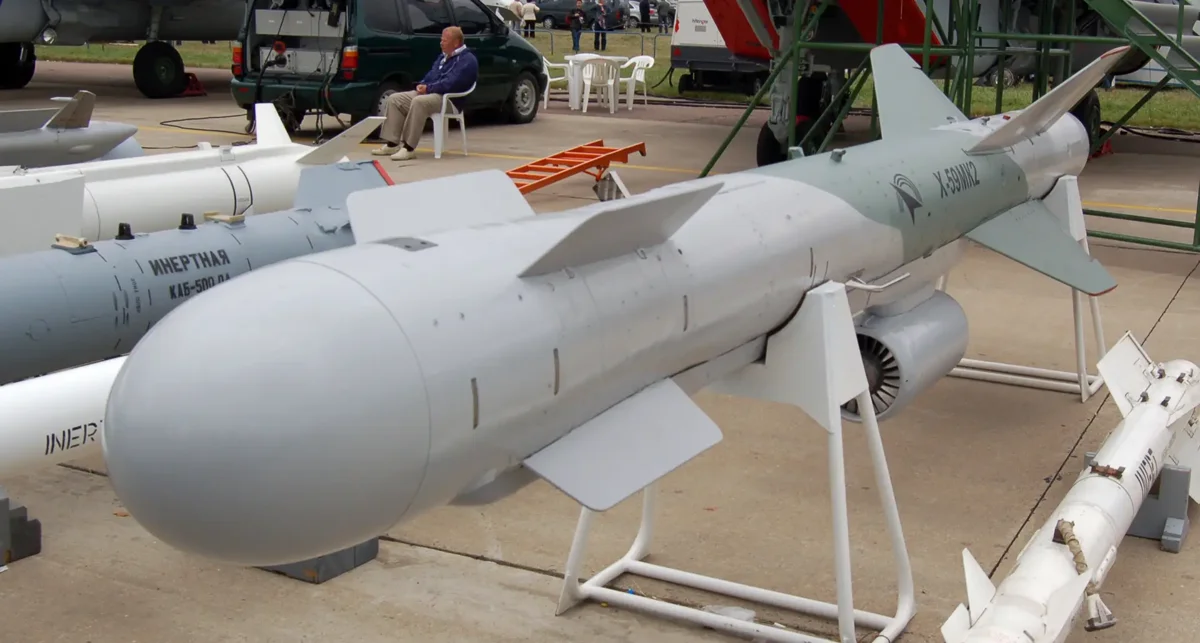
A Kh-59MK2, marked X-59MK2, at an airshow static display. This is the round-bodied land-attack MK2 with its engine pod clearly visible under the rear body; the flat-sided Kh-69 grew out of a later redesign that moved the engine inside.
Related article: Kh-69, the reduced-signature successor developed from the Kh-59MK2.
WHAT IT IS
The Kh-59 Ovod (Х-59 «Овод», "gadfly"; factory designation izdeliye D-9; NATO AS-13 Kingbolt) is a Soviet and Russian air-launched, subsonic stand-off missile designed by MKB Raduga in Dubna and built mainly at the Smolensk Aviation Plant (SmAZ). It was made to let a tactical bomber hit a defended point target from outside the reach of short-range air defence, using a television picture sent back from the missile to an operator in the aircraft. The original missile entered service in 1980 on the Su-24M. [DOCUMENTED]
The family grew in steps. The Kh-59M Ovod-M (AS-18 Kazoo) of the late 1980s and early 1990s swapped the solid-fuel sustainer for a small jet engine slung in a pod under the body, doubled the warhead and roughly tripled the range. Later members, the Kh-59MK anti-ship missile, the Kh-59MK2 land-attack missile and the domestic Kh-59M2 and Kh-59M2A, added satellite navigation, strapdown inertial systems and new seekers, and pushed the declared range to about 285 km. A redesigned, flat-sided Kh-59MK2 shown in 2015 became the Kh-69. [DOCUMENTED]
In the war against Ukraine the Kh-59 is one of the most common Russian air-launched missiles. The great majority of the Kh-59s Russia has fired are the long-range, turbojet-powered members of the family, carrying their engine in that small pod under the rear body, not the original rocket-powered Ovod. That is the main framing of this article. The Ukrainian Air Force reports them together with the Kh-69 as "Kh-59/69" in its daily summaries. [DOCUMENTED for the reporting; see COMBAT USE IN UKRAINE for designations]
QUICK FACTS
- Designer: MKB Raduga (ГосМКБ «Радуга»), Dubna, now part of the Tactical Missiles Corporation (KTRV). [DOCUMENTED]
- Main producer: Smolensk Aviation Plant (SmAZ); also linked to Dubna Machine-Building Plant. [DOCUMENTED]
- Type: air-to-surface stand-off missile; cruise configuration with wings and canards; subsonic. [DOCUMENTED]
- Original Kh-59: two solid rocket motors (jettisoned booster plus sustainer), TV-command guidance, about 40 to 45 km range, 148 kg warhead, 760 to 790 kg. [DOCUMENTED]
- Kh-59M: solid booster for launch, then a small turbojet in a ventral pod; 115 km; 320 kg penetrating or 280 kg cluster warhead; about 920 to 950 kg. [DOCUMENTED]
- Long-range family (Kh-59MK, MK2, M2, M2A): no booster; small turbojet or turbofan in the ventral pod; declared 285 km; up to 960 kg. [DOCUMENTED]
- Guidance: inertial, plus satellite navigation on later versions; terminal TV, imaging, active radar or electro-optical scene-matching depending on version; operator-in-the-loop command guidance through a pod on the aircraft for TV versions. [DOCUMENTED]
- Speed: about Mach 0.72 to 0.88, or 900 to 1,050 km/h; Ukrainian intelligence gives 310 m/s for the Kh-59M2. [DOCUMENTED]
- Carriers: Su-24M, Su-30 family, Su-34, Su-35, Su-57 (tests), MiG-29K/SMT and export Flankers. [DOCUMENTED]
- First combat use: Chechnya, 1994 to 1996 (four launches). [SINGLE-SOURCE]
- Unit cost: about 16 million roubles in 2010, from a KTRV annual report. [SINGLE-SOURCE]
DESIGNATIONS AND NAMES
The Russian name is Kh-59; "Kh" is the transliteration of the Cyrillic letter Х, the traditional prefix for Soviet air-launched missiles. The project name Ovod means gadfly or horsefly. The original missile was izdeliye (product) D-9 and the Kh-59M was D-9M. The NATO reporting names are AS-13 Kingbolt for the original and AS-18 Kazoo for the Kh-59M and its descendants. The AS-22 name is attached to the Kh-59MK2 in some references, and also to the Kh-69 in some press reports; which missile NATO actually means by AS-22 is not settled in public sources. [CONTESTED]
The suffixes follow a loose pattern. M marks the modernised, jet-powered Ovod-M. E (Э) marks export versions (Kh-59ME, Kh-59M2E). K indicates an anti-ship (korabelnaya) application, as in Kh-59MK. 2 indicates a second-generation guidance set. A appears in the domestic Kh-59M2A, whose differences from the M2 are not published. [DOCUMENTED for the designations; the meaning of "A" is UNVERIFIED]
A note on the term "LR". The site owner calls the version used in Ukraine the long-range or "LR" model. None of the sources reviewed for this page uses "LR" as an official suffix. The long-range role is covered by the designations Kh-59MK, Kh-59MK2, Kh-59M2 and Kh-59M2A. Ukrainian Defence Intelligence (GUR) files the wreckage it has examined under "Kh-59M2/M2A", and Conflict Armament Research (CAR) has traced a "Kh-59MK2" recovered in Ukraine in March 2023. Both are 285 km-class missiles with the engine pod under the body. In this article, "long-range Kh-59" means that family. [DOCUMENTED for the designations; "LR" is an informal label]
ORIGINS: RADUGA AND THE KH-58 AND KH-25 ROOTS
Raduga began the work in the early 1970s. Western references say the first concept was based on the Kh-58 (AS-11 Kilter) anti-radiation missile but was dropped because a fast missile gave the operator too little time to find a target on a TV screen. The Kh-59 was then developed as a longer-ranged, slower relative of the Kh-25 (AS-10 Karen) family. The TV seekers for the Kh-59, the Kh-29T and the KAB-500Kr guided bomb came from the same Soviet electro-optical industry. [SINGLE-SOURCE for the Kh-58 starting point; DOCUMENTED for the Kh-25 lineage]
The requirement was to hit important, defended targets from medium range, up to about 40 km, without the aircraft having to see the target itself. Russian accounts describe a two-stage guidance scheme: an autonomous programmed flight first, then radio-command guidance using the TV seeker once the missile reaches the target's detection line, with the option of handing over to automatic homing. [DOCUMENTED]
Design flight tests ran from 1975 to 1977 at the GLITs state flight-test centre at Akhtubinsk. State trials were finished in 1979, and the complex of a Su-24M bomber, a guidance pod and two Kh-59 missiles was accepted into service in 1980. A version for the single-seat Su-17M4 was accepted in 1982. Trials on the Su-17M4 gave very good results, with missiles repeatedly hitting within 1 to 1.5 m of the aiming cross. The Air Force chose the two-seat Su-24M, where the navigator could steer the missile, partly because Su-17 production was ending. The developers received the USSR State Prize in 1984 for the Kh-59 precision weapon complex. [DOCUMENTED, Russian sources: Markovsky and Perov 2005; airwar.ru]
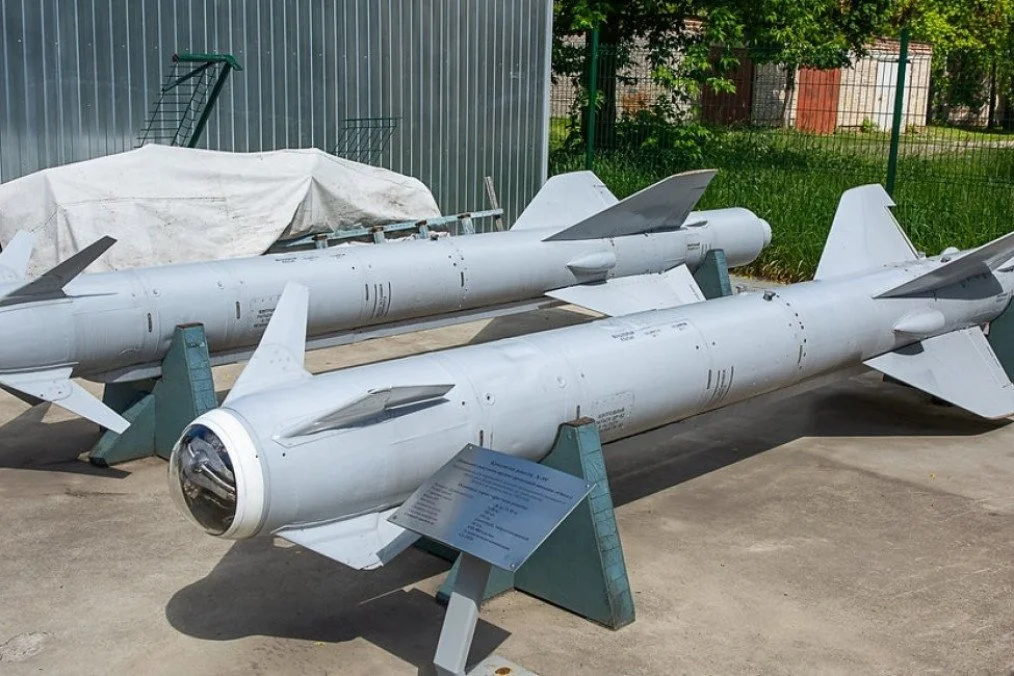
Two original Kh-59 Ovod missiles on stands outdoors beside a metal shed. Note the glazed TV-seeker nose and the clean underside: there is no engine pod, because the original Ovod used a solid booster and solid sustainer and reached only about 40 to 45 km.
THE ORIGINAL KH-59: ROCKET-POWERED AND TV-GUIDED
The first Kh-59 is a tailless layout with large rear wings and folding destabiliser canards near the nose. It has two solid motors. A jettisonable booster at the tail fires after release and drives the programmed first stage of flight. It is then blown off by pyrotechnic pushers, which uncovers the antenna block in the tail for the command link. A sustainer with two side-mounted nozzles keeps the missile at a subsonic speed of about 285 m/s. The side nozzles were used because the tail was taken up by the antennas. A light AMg-6 alloy nose cap protects the TV window from dust and insects while the missile rides on the aircraft and is jettisoned at launch. [DOCUMENTED, airwar.ru]
The navigation set was the SNAU-59 inertial system. The guidance system was Tekon-1 (Текон-1), named after the Lviv production association that built it, with the Tubus-2 TV seeker. The missile cruised at about 7 m over water or 100 to 1,000 m over land, using a radar altimeter. Launch speed is 600 to 1,000 km/h from 0.2 to 11 km altitude. The usual figures are a length of 5.37 m, a span of 1.26 m, a body diameter of 380 mm, a launch mass of 760 to 790 kg and a 148 kg warhead. A circular error probable of 2 to 3 m is quoted. Range was 40 to 45 km. The missile is carried on an AKU-58-1 ejector launcher. [DOCUMENTED]
In Soviet and Russian service the original Kh-59 was fielded only on the Su-24M. It could be carried by other types fitted for the pod, including the MiG-27, Su-17M3 and M4, Su-22M4, Su-25 and Su-30 family. It was first shown publicly in 1991 and exported as the Kh-59 or Kh-59E. [DOCUMENTED, Jane's as cited by Wikipedia]
KH-59M OVOD-M: THE ENGINE MOVES INTO A POD
The appearance of the small RDK-300 turbojet, developed for long-range cruise missiles, let Raduga rebuild the Ovod. The solid sustainer and its side nozzles were deleted, and a turbojet was hung under the fuselage in its own nacelle. The middle of the body became a large fuel tank for ordinary aviation kerosene, with a filler neck and drain system. A solid booster stayed in the tail to bring the missile to the right speed and height to start the turbojet after separation. When the booster is fired off, a fairing over the engine intake is also dropped; it protects the intake from debris during the aircraft's take-off. The destabiliser canards were enlarged because the missile was heavier, and they spring out and lock at launch. The autopilot gained an engine regulator that starts the engine and controls fuel flow with height and speed correction. [DOCUMENTED, airwar.ru]
The space freed in the old sustainer bay was used for a warhead twice as heavy: a 320 kg penetrating warhead, or a 280 kg cluster warhead with fragmentation and shaped-charge submunitions. The guidance remained TV-command (Tekon-1A, 1B or 2 sets with the Tubus-2A seeker) with a radar altimeter. The link range grew to 140 km, allowing a launch range of up to about 115 to 120 km. The missile can be launched from as low as about 100 m and flies at a set height of 50, 100, 200, 600 or 1,000 m over land, or about 7 m over the sea. Accuracy at maximum range is quoted as 2 to 3 m. [DOCUMENTED]
The Kh-59M is 5.69 m long, 380 mm in diameter and 1.26 to 1.3 m in span, and weighs 920 to 950 kg. It uses the same AKU-58-1 launcher, and a Su-24M with the SUO-1-6M weapon control system and the guidance pod can use it without modification. Trials also began on strike versions of the Su-27. Western sources say details first appeared in the early 1990s and development started in the 1980s. The export version is the Kh-59ME; a 200 km Kh-59ME was offered in 1999. [DOCUMENTED]
The early 1990s were hard on the programme. Production at Smolensk was delayed by the lack of state orders and by the break in Soviet supply chains, because the maker of the seeker and the Tekon guidance system was in Lviv, now in independent Ukraine. [DOCUMENTED, airwar.ru; missiles.ru]
THE UNDERSLUNG ENGINE
It is often thought of as a booster engine. On the long-range Kh-59 it is the cruise engine itself: a small turbojet or turbofan in a streamlined nacelle hung under the rear half of the round body, ahead of and below the rear wings, with its intake facing forward and its exhaust at the back of the pod. It is not a rocket booster. On the original Kh-59 the only booster was a solid rocket in the tail, and there was no pod at all. On the Kh-59M the tail booster was kept to bring the missile up to engine-start conditions, and the pod engine did the cruising. On the 285 km missiles the tail booster gave way to fuel, and the pod engine does all the work after the missile drops from the launcher. [DOCUMENTED for the layout; the booster deletion on the MK is from Army Recognition and Kyiv Post]
Several engines are named for the pod:
- RDK-300 / R95-300 family. The RDK-300 is the turbojet that made the Kh-59M possible. Russian references list the R95TP-300 and R95TP-300BT for the Kh-59M and M2. GUR lists a "TRDD R95-300 (R95T)" in its Kh-59M2/M2A component file. The R95-300 line is associated with the Kh-55 strategic cruise missile and with production at Motor Sich in Zaporizhzhia. Russian Wikipedia classes some of these as turbofans; English sources often say turbojet. [DOCUMENTED for the names; the turbojet or turbofan classification is CONTESTED]
- TRDD-50AT (product 36MT). A small turbofan from the TRDD-50 family, which also powers the Kalibr. GUR lists it as the standard engine of the Kh-59M2/M2A and names ODK-Saturn as the maker. NPO Saturn listed the 36MT for the Kh-59M class. [DOCUMENTED]
- TRDD-50B. Listed by Russian sources as an option for the Kh-59MK and MK2, and as product 37-04 for the redesigned Kh-59MK2 that became the Kh-69. [SINGLE-SOURCE, Russian Wikipedia citing KTRV and bmpd]
During the war, GUR said in August 2025 that Russian industry had been taking old R95T engines out of retired missiles to fit them to new Kh-59M2 and M2A airframes in place of the standard TRDD-50AT. In November 2024 a pro-Ukrainian blogger published photos of an almost complete downed missile, identified as a Kh-59MK, with a "P95-300" engine originally produced by Motor Sich and a metal ballast block in place of its radar seeker (Kyiv Post). Defense Express judged that the older engine would cut speed or range and change the heat signature. [DOCUMENTED for the reports; the performance effect is an ESTIMATE]
Why a pod? A pod leaves the whole round body free for fuel and warhead, and lets Raduga put a jet engine on an airframe originally designed around solid motors without redesigning the body. The cost is drag and radar signature: the pod, its pylon and the open intake are large reflectors. When Raduga redesigned the Kh-59MK2 for internal carriage on the Su-57, the engine went inside the body. That step is the subject of the Kh-69 article. [DOCUMENTED for the change; the signature reasoning is ESTIMATE]
THE LONG-RANGE FAMILY: KH-59MK, MK2, M2 AND M2A
Kh-59MK (also given as Kh-59A). An anti-ship missile first shown at MAKS 2001. It has a strapdown inertial navigation system (BINS), a combined radio altimeter and speed meter, a GLONASS/GPS receiver and an ARGS-59E active radar seeker. It cruises at 10 to 15 m over the sea, drops to 4 to 7 m near the target and has a 320 kg penetrating warhead. Range is 285 km against a destroyer- or cruiser-size target. Rosoboronexport says it is meant for radar-contrast surface targets of about 300 square metres radar cross-section or more, in sea states up to 6, by day or night, with hit probabilities of 0.9 to 0.96 against destroyers and cruisers and 0.7 to 0.93 against boats. It is fire-and-forget and needs no guidance pod. [DOCUMENTED; the hit probabilities are maker's claims, SINGLE-SOURCE]
Kh-59MK2 (original form). First shown at MAKS 2009. It is the Kh-59MK airframe with the radar seeker removed and a land-attack guidance set fitted in its place: BINS, GLONASS/GPS and an optical-electronic system for the final approach, described in Western reporting as a digital scene-matching area correlator (DSMAC) with a window in the nose. It flies at 50 to 300 m to fixed targets with known coordinates and carries a 320 kg penetrating or 283 to 285 kg cluster warhead. Range is given as 285 km, weight up to 900 kg and CEP 3 to 5 m. It keeps the round body and the ventral engine pod. China reportedly received about 200 Kh-59 missiles for the Su-30MK2 from 2008 to 2015, and these may have included MK and MK2 rounds. [DOCUMENTED; the China numbers are SINGLE-SOURCE, TASS via Navy Recognition]
Kh-59M2. Reported in 2004. Russian Wikipedia describes it as a version with an active radar seeker and a relay-command (трансляционно-командная) guidance system for use day and night against land and sea targets with known coordinates. Other references describe new TV or imaging-infrared seekers. GUR's component file for the M2 and M2A lists both an ARGSN U559 active radar seeker made by Radar-MMS and a TV seeker (TVGSN) made by MNITI. In other words, the domestic M2 family takes more than one seeker. [DOCUMENTED for the component list; the exact seeker mix by sub-version is UNVERIFIED]
Kh-59M2A. Named by GUR alongside the M2. No public specification separates the two. [UNVERIFIED]
Kh-59MKM. Shown in 2021 (Janes). A penetrator version with no seeker, carrying a heavier warhead of about 360 kg in place of the seeker section, claimed to go through about 3 m of reinforced concrete. Defense Express describes the extra charge as four additional shaped charges in the former guidance bay. [SINGLE-SOURCE]
Other names. The Kh-59L laser-guided version was developed but probably never produced. Kh-59T is an alternative name for the TV-guided original. Kh-20 is a possible name for a nuclear variant carried by Su-27 family aircraft (Jane's). Russian Wikipedia mentions a nuclear warhead option developed by RFYaTs-VNIIEF for a Tu-160 application. Neither nuclear claim is confirmed. [UNVERIFIED]
SPECIFICATIONS BY VARIANT
| Item | Kh-59 | Kh-59M / ME | Kh-59MK | Kh-59MK2 (round) | Kh-59M2 / M2A |
| Role | land, TV-command | land, TV-command | anti-ship | land, fixed targets | land and sea, known coordinates |
| Length | 5.37 m | 5.69 to 5.7 m | 5.7 m | 5.7 m | up to 5.7 m |
| Span | 1.26 m | 1.26 to 1.3 m | 1.3 m | 1.3 m | 1.3 m |
| Body diameter | 0.38 m | 0.38 m | 0.38 m (0.42 m nose) | 0.38 m (0.42 m nose) | 0.38 / 0.42 m |
| Launch mass | 760 to 790 kg | 920 to 950 kg | 930 kg | up to 900 kg | up to 960 kg |
| Propulsion | solid booster + solid sustainer | solid booster + pod turbojet (RDK-300 / R95TP-300) | pod engine (RDK-300, R95TP-300BT, TRDD-50AT or TRDD-50B) | pod engine (as MK) | pod TRDD-50AT standard; R95-300 substitutes |
| Warhead | 148 kg | 320 kg penetrating / 280 kg cluster | 320 kg penetrating | 320 kg penetrating / 283 kg cluster | 320 kg; penetrating 9-B-2347-02, HE-frag 9-B-2347-01, cluster 9-V-2347 |
| Max range | 40 to 45 km | 115 km (ME up to 200 km) | 285 km | 285 km | 285 km (GUR) |
| Min range | n/a | 10 to 15 km | 5 to 25 km | n/a | n/a |
| Speed | about 285 m/s | Mach 0.72 to 0.88 | 900 to 1,050 km/h | 900 to 1,050 km/h | 310 m/s (GUR) |
| Cruise height | 7 m sea; 100 to 1,000 m land | 7 m sea; 50/100/200/600/1,000 m | 10 to 15 m, 4 to 7 m terminal | 50 to 300 m | 7, 50, 100, 200, 600 or 1,000 m (GUR) |
| Launch height | 0.2 to 11 km | 0.1 to 5 km | 0.2 to 11 km | 0.2 to 11 km | 0.2 to 5 km (GUR) |
| Launch sector | 360 deg | 360 deg | +/-45 deg | +/-45 deg | 360 deg (Russian Wikipedia) |
| Guidance | INS + TV command (Tekon-1) | INS + TV command (Tekon-1A/1B/2) + radar altimeter | BINS + GLONASS/GPS + ARGS-59E radar | BINS + GLONASS/GPS + electro-optical | BINS-M2 + SN-99 GLONASS + radar or TV seeker |
| CEP | 2 to 3 m | 2 to 3 m | n/a | 3 to 5 m | 5 to 7 m (GUR) |
| Pod needed | yes | yes | no | no | for TV mode |
Sources for the table: Rosoboronexport and KTRV brochure data as summarised by Russian Wikipedia and airwar.ru; GUR War and Sanctions file for the Kh-59M2/M2A. Figures differ by a few percent between sources. Where GUR differs from the maker it is shown as GUR. [DOCUMENTED, with conflicts noted]
GUIDANCE IN DEPTH
The Kh-59 family has used four kinds of guidance across its history, often more than one in the same missile. This section takes them one at a time.
1. Programmed and inertial cruise. Every version starts autonomously. The target position is set before flight and stored in the carrier's navigation and attack system (PrNK), and the missile flies a programmed course on its own inertial system. The original used the SNAU-59 inertial unit. The later missiles use a strapdown, or platformless, inertial system (BINS). GUR identifies the unit in the M2 and M2A as the BINS-M2 made by ITT. A radio altimeter holds the selected height. GUR names the A-079 radio altimeter and its AG-079-01 antenna from UPKB Detal, the same maker that supplies the Kalibr's altimeter. The Kh-59MK adds a "complex radio-technical altitude and speed meter", which measures speed over the ground as well as height. [DOCUMENTED]
2. Satellite correction. From the Kh-59MK onward, a satellite receiver corrects inertial drift. Brochures say GLONASS/GPS. GUR identifies the receiver in the M2 and M2A as the SN-99 by KB NAVIS, with its own antenna unit, the same receiver family found in the Kalibr and the Kh-101. Whether a particular long-range Kh-59 carries an adaptive anti-jam antenna of the Kometa type is not shown in the GUR Kh-59 file reviewed for this page. Kometa-M is documented for the Kh-69. [DOCUMENTED for SN-99; UNVERIFIED for Kometa on the Kh-59]
3. Operator-in-the-loop TV command guidance. This is the classic Kh-59 method and the one that sets it apart from Western cruise missiles. It works like this:
- After launch, the missile flies its programmed leg. On the original Kh-59, the tail booster is shed, uncovering the link antenna in the tail. [DOCUMENTED]
- The TV seeker in the nose sends a picture of the terrain ahead down a video channel to the carrier, where it appears on a cockpit display. A Tekon-Elektron product list names the IT-23M cockpit indicator. [DOCUMENTED]
- The operator, the navigator in a Su-24M or the weapons officer in a Su-34, watches the picture. With the target in the cross-hairs of the video-command display, the operator steers the missile semi-automatically over a separate command radio channel. A movable aiming mark is laid over the chosen target, which Russian writers compare to a video game. [DOCUMENTED]
- When the seeker has a firm lock on a contrasting object, it can be switched to automatic homing for the last part of the flight. Otherwise the operator can steer almost to impact. That lets the missile hit low-contrast targets a simple contrast tracker could not lock on. [DOCUMENTED]
- On the original Kh-59, command guidance begins about 5 to 10 km from the target. Western references give about 10 km for the Kh-59ME's TV system switching on. [DOCUMENTED; the 10 km figure is Rosoboronexport via Wikipedia]
The pod has antennas covering both the front and rear hemispheres. That means the aircraft can launch, turn away and fly back out of the air-defence zone while the operator keeps guiding the missile. It also gives the 360-degree launch sector quoted for the TV versions. The link range is 140 km for the Kh-59M with the Tekon-1B set. That is what limits the Kh-59M to about 115 to 120 km: the missile must remain within link range of the aircraft through the terminal phase, so range is set by the link, not the fuel. [DOCUMENTED, airwar.ru]
The seekers were developed at MNITI, the Moscow television research institute: the Tubus-2 for the original, the Tubus-2A for the Kh-59M, and the TV seeker in GUR's M2 file. Production of several of these items was handled by Tekon-Elektron of the Lviv Elektron concern, including a gyro-stabilised TV-command seeker sold as T-2 (A-2-01M / Tekon-2). The Russian pilots' Telegram channel "Fighterbomber" described a 2022 Kh-59M2 attack on a bridge near Odesa as using a TV seeker able to work by day and in very low light, "but not at night". [DOCUMENTED for the industry facts; SINGLE-SOURCE for the low-light comment]
4. Autonomous terminal homing. The long-range versions can also finish without an operator:
- Active radar (Kh-59MK; M2 with ARGSN U559). The ARGS-59E seeker on the MK and the U559 seeker by Radar-MMS in the M2 file let the missile find a radar-contrasting ship or object itself. That makes it fire-and-forget and usable at night and in bad weather. [DOCUMENTED]
- Electro-optical scene matching (Kh-59MK2). The MK2 compares what its optical sensor sees near the target with stored reference imagery, the DSMAC principle. Western reporting says the guidance was borrowed from the Kh-555 strategic missile. That attribution is a Western assessment. [DOCUMENTED for the principle; SINGLE-SOURCE for the Kh-555 origin]
- Satellite and inertial only. If the seeker is absent, the missile still reaches its coordinates on BINS and SN-99. GUR and Defense Express report missiles flown that way in Ukraine, with a weight dummy in the seeker bay and usually a cluster warhead to make up for the lost precision. [DOCUMENTED]
What the sources do not say is how a single M2 or M2A decides between modes in flight, whether TV and radar seekers are interchangeable modules, or whether the Su-34 can retarget a missile in flight over the link once the TV seeker is not fitted. These points are not public. [UNVERIFIED]
HOW THE MISSILE COMMUNICATES: THE DATALINK
This section stays strictly with what is documented. Russia has published almost nothing about the Kh-59 link. What is known comes from Ukrainian industry catalogues, because the Soviet supplier was in Lviv, and from Western analysts quoting them.
Two channels. Russian technical histories describe "two-channel communications equipment": a video channel from missile to aircraft carrying the TV picture, and a command radio channel from aircraft to missile carrying the operator's steering commands. [DOCUMENTED, airwar.ru; Markovsky and Perov]
Command uplink: 3 cm band (X band), pulsed. A catalogue of Tekon-Elektron items lists a transceiver with a gyro-stabilised tracking antenna, the 1DV1-401AMK, described as receiving the pulse signals of the 3 cm command radio link and transmitting the TV radio-link signals. A 3 cm wavelength is about 10 GHz, which is in the X band. Analyst Carlo Kopp (Air Power Australia) and other references describe the same part as the "X-band 1DV1-401AMK pulse-mode command uplink transceiver" with gimballed, stabilised antennas. The exact frequency, pulse format and coding are not published. [DOCUMENTED for "3 cm, pulse"; exact frequency UNVERIFIED]
Video downlink: analogue FM television. The same catalogue lists the SB-1A, a solid-state medium-power unit associated with analogue FM TV signals in the command-guidance radio link. Kopp's text calls it the "solid state FMCW analogue TV downlink transceiver". The Russian catalogue wording is garbled and appears to call it a transmitter "for demodulation". No source reviewed gives the downlink frequency band. It is often assumed to share the X band with the uplink, but that has not been confirmed here. [DOCUMENTED for analogue FM TV; band UNVERIFIED; the catalogue wording is CONTESTED]
Aircraft end: the pod. On the aircraft, the link equipment is carried in a pod:
- APK-9 (АПК-9) "Tekon", also written PK-9 or PK-9M in Russian sources. It is about 4,000 mm long and 450 mm in diameter and weighs about 260 kg, with front and rear antenna blocks. It is used with the Kh-59 and Kh-59M, and the APK-9E is the export model. [DOCUMENTED, airwar.ru; Jane's]
- APK-8. Named as an alternative pod for the Kh-59M by a Russian reference site, which also claims the pod lets the missile be used from foreign aircraft such as the Mirage III, F-15 or F-16. No evidence of that integration was found. [SINGLE-SOURCE for APK-8; UNVERIFIED for the foreign-aircraft claim]
- Later pods. Some Western references name a BPN-9M pod for the Kh-59MK, and photos show a "BPN-59M" style pod on Chinese Flankers. Their function and links are not documented in the sources reviewed. [UNVERIFIED]
The link range is 140 km for the Kh-59M (Tekon-1B). A wargame database gives 120 nautical miles, about 222 km, for the APK-8/9 link, without a source. That figure is not used here. [DOCUMENTED for 140 km; the 120 nmi figure is UNVERIFIED]
Do the long-range versions need the pod? The Kh-59MK and MK2 are described as autonomous, with satellite and inertial navigation plus their own seekers, and need no pod for fire-and-forget use. The TV-command mode of the M2 family needs a link. Whether the Su-34 and Su-35 carry an external pod for it or have link equipment built in is not documented in the open. Russian videos of Su-34 attacks with TV-guided Kh-59M2s show the TV picture being used in the cockpit, so the aircraft clearly has link capability. [DOCUMENTED for the autonomous MK/MK2; UNVERIFIED for the Su-34/Su-35 hardware]
Jamming and EW vulnerability. In engineering terms, a missile that depends on a live two-way radio link has three exposures. These are explained below, with the documented facts kept separate from the analysis.
- Uplink jamming. The command receiver in the missile looks back toward the aircraft through a tracking, stabilised antenna, which helps reject jamming from other directions. Russian sources state no jam-resistance figures. Jamming the uplink would need a jammer inside the missile's rear antenna pattern and strong enough to overcome a nearby high-power transmitter. [ESTIMATE]
- Downlink jamming. Analogue FM video degrades gradually and visibly under interference rather than failing outright. The operator would see a noisy picture. A ground jammer near the target has geometry on its side, because the missile's downlink antenna points away from the target toward the aircraft. [ESTIMATE]
- Satellite jamming. Ukraine jams GNSS widely. The long-range Kh-59's inertial system bridges short outages. A missile that loses satellite fixes for a long time drifts by an amount that depends on the inertial grade, which is not published. [DOCUMENTED that Ukraine jams GNSS; drift figures UNVERIFIED]
- Link geometry as an operational limit. With the TV mode the aircraft must stay within about 140 km of the missile and in radio line of sight. A low-flying missile far from a high-flying aircraft can drop behind terrain. This is why TV-guided Kh-59 attacks in Ukraine are associated with launches from the border or the Black Sea at altitude. [ESTIMATE]
- Emissions as warning. A missile that transmits video can in principle be detected by signals intelligence or ESM receivers. No public Ukrainian claim of detecting Kh-59s by their links was found. [UNVERIFIED]
No source reviewed reports a Kh-59 defeated by link jamming in Ukraine. [UNVERIFIED]
WARHEADS
The original Kh-59 had a 148 kg warhead. The Kh-59M doubled this. It carries a 320 kg penetrating high-explosive warhead, described in Western sources as a shaped-charge penetrator, or a 280 to 285 kg cluster warhead with fragmentation and shaped-charge submunitions. The redesign moved warhead mass into the space once taken by the sustainer motor. [DOCUMENTED]
GUR's examination of the Kh-59M2/M2A lists three warhead codes:
- 9-B-2347-01, high-explosive fragmentation;
- 9-B-2347-02, penetrating;
- 9-V-2347, cassette (cluster).
GUR also lists a weight model, the U559, used on cluster-armed missiles in place of the radar seeker. [DOCUMENTED]
A Defense Express analysis of the GUR findings notes that the penetrating warhead has a small damage radius of tens of metres and needs an accurate hit. A cluster warhead covers a wider area, so it is the logical pairing for a missile with no seeker and slightly worse accuracy. [DOCUMENTED for the report; the reasoning is the source's]
Russian sources say the warhead is detonated by contact. They give no figure for the depth of concrete the 320 kg penetrator will go through. The Kh-59MKM's claim of 3 m of reinforced concrete applies only to that variant. [SINGLE-SOURCE]
LAUNCH AIRCRAFT AND PODS
| Aircraft | Kh-59 versions | Link equipment | Status |
| Su-24M / M2 | Kh-59, Kh-59M, later versions | APK-9 (PK-9) pod; SUO-1-6M weapon control system | the original and long-standing Soviet carrier; two missiles [DOCUMENTED] |
| Su-17M4 | Kh-59 | pod | accepted 1982, but not widely fielded [DOCUMENTED] |
| Su-17M3 / Su-22M4, MiG-27, Su-25 | Kh-59 | APK-9 | listed as able to carry; not fielded in Soviet service [DOCUMENTED, Jane's] |
| Su-27 strike versions / Su-27SM | Kh-59M | pod | trials begun in the 1990s [DOCUMENTED] |
| Su-30 family (Su-30M, MK, MKK, MK2, MKI, MKM, MKA, SM) | Kh-59M/ME, MK, MK2 | APK-9 or export pod for TV versions | Russia and exports [DOCUMENTED] |
| Su-34 | Kh-59M2/M2A, MK2, MK | link capability shown; hardware not public | main carrier against Ukraine [DOCUMENTED for use; hardware UNVERIFIED] |
| Su-35S | Kh-59 long-range family | not public | carrier listed by GUR and KTRV [DOCUMENTED] |
| Su-57 | Kh-59MK2, Kh-69 | internal bay for the Kh-69 | Kh-59MK2 test launches reported [DOCUMENTED] |
| MiG-29K / KUB, MiG-29SMT, MiG-35 | Kh-59M, MK, MK2 | pod for TV versions | listed by maker and GUR [DOCUMENTED] |
| Tejas (India) | Kh-59 | not public | listed in one reference [SINGLE-SOURCE] |
The missile is carried on an AKU-58-1 ejector launcher, from the AKU-58 family first built for the Kh-58. Launch conditions for the long-range versions are a carrier speed of 600 to 1,100 km/h, about Mach 0.5 to 0.9, at 200 m to 11 km altitude. [DOCUMENTED]
Export users. Russia's state exporter has sold the Kh-59 family to the following countries:
- China: Su-30MKK and MK2; about 200 Kh-59MK/MK2 delivered in 2008 to 2015 by one TASS-based report.
- India: Su-30MKI.
- Algeria: Su-30MKA; a 2010 KTRV report shows planned Kh-59ME deliveries worth about $6 million.
- Malaysia: Su-30MKM.
- Venezuela: Su-30MK2.
- Indonesia, Vietnam and Syria: listed by various references.
[DOCUMENTED for China, India and Algeria; the others are from secondary listings]
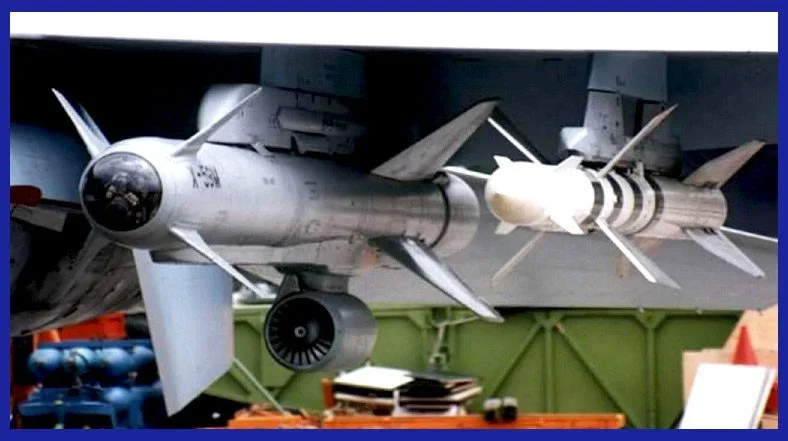
A Kh-59M, marked X-59M, carried under an aircraft next to a smaller missile. The turbojet in its pod under the body sets the jet-powered Ovod-M and its long-range descendants apart from the original Kh-59; the TV-seeker window is in the nose.
COMBAT USE: CHECHNYA AND BEFORE 2022
The first combat use was in the First Chechen War, 1994 to 1996, against militant shelters and depots in the mountains. The weather of the North Caucasus was a serious problem for a TV-guided weapon. One Russian account says there were only two clear days in Chechnya in all of December 1994. Fog and poor visibility broke the guidance in forested mountains and snowy gorges. Markovsky and Perov say the Kh-59 was given up after four launches. [SINGLE-SOURCE]
The Kh-59MK2 was reportedly test-fired by a Su-57 during that aircraft's short deployment to Syria in 2018. TWZ notes that the official video showed a red-painted test round, so it may have been filmed in Russia. [CONTESTED]
COMBAT USE IN UKRAINE
The long-range Kh-59 is the one that matters. Almost all Kh-59s fired at Ukraine have been the long-range versions with the engine pod slung under the body. That is the site owner's reading, and the evidence agrees. The wreckage Ukraine has examined and published is filed by GUR as Kh-59M2/M2A, with the TRDD-50AT or R95-300 pod engine, a 285 km declared range and the 9-B-2347 warhead family. CAR traced a Kh-59MK2 used in March 2023. Kyiv Post reported a Kh-59MK in November 2024. No reviewed source documents the original rocket-powered Kh-59 Ovod being used in this war, and with a 40 km range it would make little sense against targets deep in Ukraine. [DOCUMENTED for the designations recovered; the claim of no original-Ovod use is from the absence of reports]
Carriers and geography. The Su-34 is the main carrier, with the Su-35 also listed. Launches come from Russian airspace near the border, from Belarusian airspace early in the war, and from over the Black Sea and occupied Crimea. On 11 November 2026, the day this page was written, the Ukrainian Air Force reported one "Kh-59/69" launched from the Black Sea in an overnight raid alongside 163 drones. [DOCUMENTED]
Notable events:
- 4 April 2022: CCTV caught a Kh-59M in flight before it struck a grain silo near Mykolaiv. It is the first widely cited Kh-59 use of the full-scale war. [DOCUMENTED]
- 2022: Video from a Kh-59M2's TV seeker, published by Russian sources, shows an attack on a railway bridge near Odesa, generally identified as the Zatoka bridge over the Dniester estuary. According to the Fighterbomber channel the aim point was the lift-tower cables rather than the deck, to block both rail and ship traffic. [DOCUMENTED for the video; the aim-point account is SINGLE-SOURCE]
- 16 August 2022: The Ukrainian Air Force confirmed Kh-59 strikes on an airbase in Zhytomyr Oblast, launched toward the Belarus border, apparently by Su-34s. [DOCUMENTED]
- March 2023: A Kh-59MK2 hit Ukraine. CAR traced its production to the fourth quarter of 2022, a gap of only a few months between building and firing. [DOCUMENTED, Breaking Defense]
- 7 to 8 February 2024: War Monitor reported three Kh-59s flown alongside three Kh-69s, with five of the six downed. [SINGLE-SOURCE]
- November 2024: Photos showed a downed Kh-59MK with ballast in place of its seeker and an old R95-300 engine. [DOCUMENTED]
- 24 to 25 January 2025: The Ukrainian Navy shot down a Kh-59 near Pivdennyi port with a laser-guided APKWS rocket from a VAMPIRE launcher. It is the first public case of that kind. [DOCUMENTED]
- 7 March 2025: In a large combined raid in which Ukrainian F-16s and Mirage 2000-5Fs took part, one Kh-59/69 of eight was shot down. [DOCUMENTED for the claim]
- August 2025: GUR published its Kh-59M2/M2A study naming 116 companies in the production chain, about 50 of them not under any sanctions and making up about 40 percent of the missile's mass. [DOCUMENTED]
- August 2025: Ukraine struck the instrument-making plant in Arzamas, which supplies parts for the Kh-59 and Kh-101. [DOCUMENTED for the claim]
- 26 March 2026: Ukrainian drones struck the Smolensk Aviation Plant, the Kh-59 producer. [DOCUMENTED]
- October and November 2026: Kh-59/69 launches appear in Air Force reports on 26 October (all three downed or suppressed), 30 October (three of four intercepted), 8 November and 11 November. [DOCUMENTED for the claims]
How it is used. Ukrainian commentators describe the long-range Kh-59 as a precise missile for tactical aircraft. It is fired against energy sites, ports, bridges, air bases, and air-defence and military targets, often in small groups at the same time as drone waves. The 285 km range lets a Su-34 hold well back from the front and from Ukrainian fighters and SAMs. Ukrainian sources say a mixed raid of drones and missiles drains the ready interceptors and lets a few Kh-59s through by another route. [DOCUMENTED for the reporting; the effectiveness claims are ESTIMATE]
Interception rates. Ukraine reports Kh-59s shot down regularly, but often only a fraction of each launch. A widely repeated statistic says Ukraine intercepted about 22 percent of Kh-59, Kh-35 and Kh-31 missiles launched. It is lower than the rate for cruise missiles such as the Kh-101, because many guided missiles are fired at targets near the front where air defence is thinner. That figure comes from a single secondary report with no clear method. Results vary a lot from night to night. [SINGLE-SOURCE]
COUNTERMEASURES AND INTERCEPTS
The long-range Kh-59 is a subsonic missile flying at heights down to a few metres over the sea or tens of metres over land. That makes it a target for every layer of Ukrainian air defence:
- Long- and medium-range SAMs: Patriot, S-300, Buk, and NASAMS and IRIS-T. Norwegian open assessments say that a large share of NASAMS kills in Ukraine have been cruise missiles, including the Kh-59. [DOCUMENTED]
- Fighters: Ukrainian F-16s and Mirage 2000-5Fs took part in the March 2025 defence. Which aircraft shot down the Kh-59/69 that night was not stated. [DOCUMENTED]
- Cheap interceptors: The APKWS laser-guided rocket from the ship-mounted VAMPIRE in January 2025 against a Kh-59, and from a ground launcher in October 2025 against a Kh-69. [DOCUMENTED]
- Electronic warfare: GNSS jamming degrades satellite correction. See the datalink section for the link. [ESTIMATE]
The Kh-59's weaknesses as a target follow from its design. The round body and ventral pod give a bigger radar return than the Kh-69's shaped body. The pod's turbojet exhaust gives an infrared signature, and older R95 engines may make this worse. The missile is not fast enough to outrun interceptors. Its strengths are its low flight profile, its short time of flight from border launch points, and how often it is used together with drones. [ESTIMATE]
PRODUCTION AND STOCKS
The Smolensk Aviation Plant (SmAZ) is the main producer of the Kh-59 family, and Raduga in Dubna is the designer. GUR's study of the Kh-59M2/M2A found 116 companies in the production chain and reported constant shortages of domestic and foreign components, limited capacity and repeated schedule slips. Almost all foreign components it identified came from US and Swiss companies, and some were civilian parts made in China and sold on general marketplaces. GUR's Kh-59 component file includes parts with production dates in 2020 to 2022 by Cypress, Altera (Intel) and Analog Devices, among others. [DOCUMENTED]
CAR's investigator Damien Spleeters said in 2023 that the Kh-59s he had seen made after the invasion used a mix of Russian and Western parts made before the war, suggesting reliance on old stocks. [DOCUMENTED]
Ukrainian intelligence does not publish a separate Kh-59 stockpile. In April 2026 GUR estimated Russia's stock at up to 2,600 Kh-29, Kh-31, Kh-35, Kh-58 and Kh-59 missiles combined, with combined production of up to 50 per month. These are Ukrainian estimates and cannot be verified. [SINGLE-SOURCE]
COMPARISON WITH WESTERN EQUIVALENTS
| Missile | Country | Mass | Warhead | Range | Engine | Terminal guidance | Man in the loop |
| Kh-59M | USSR/Russia | 920 to 950 kg | 320 kg | 115 km | booster + pod turbojet | TV command / TV lock | yes |
| Kh-59M2 / MK2 (long-range) | Russia | up to 960 kg | 320 kg | 285 km | pod turbofan or turbojet | radar, TV or electro-optical scene match | TV versions |
| AGM-130 | USA | about 1,320 kg | 2,000 lb class bomb body | about 65 km | rocket | TV / IIR datalink | yes |
| AGM-84H/K SLAM-ER | USA | about 675 kg | about 360 kg | more than 270 km | turbojet | IIR with datalink, ATA | yes |
| AGM-158 JASSM | USA | about 1,020 kg | about 450 kg | about 370 km (ER over 900 km) | turbofan, internal | IIR, autonomous | limited |
| Storm Shadow / SCALP EG | UK/France | about 1,300 kg | about 450 kg | about 250 km export, more for the domestic version | turbojet, internal | IIR scene match, autonomous | no |
| Taurus KEPD 350 | Germany/Sweden | about 1,400 kg | about 480 kg | more than 500 km | turbofan, internal | IIR, autonomous | no |
Western figures are rounded public values. [DOCUMENTED as public figures; the Western figures are not re-verified line by line for this page]
The closest Western counterpart to the TV-guided Kh-59M is the American AGM-130, and even more the AGM-84 SLAM-ER. Both send video back to an operator who can steer or re-aim the missile through a datalink pod (the AN/AWW-13 and similar). SLAM-ER, like the Kh-59M2, uses a turbojet, weighs under a tonne and reaches about 270 km, close to the long-range Kh-59's 285 km. [ESTIMATE as a comparison]
The long-range autonomous Kh-59MK2 is closer in concept to JASSM, Storm Shadow and Taurus, but it is smaller, carries about two-thirds of their warhead, and with its external pod and round body has nothing of their shaping. Those weapons are the yardstick the Kh-69 was built to match. [ESTIMATE]
KH-59 AND KH-69 COMPARED
| Item | Kh-59M2 / MK2 (long-range, pod engine) | Kh-69 |
| Body | round, 380 mm, pod under body | flat-sided, near-square, about 0.4 x 0.4 m |
| Engine | turbojet or turbofan in an external ventral pod | turbofan inside the body |
| Length | about 5.7 m | about 4.2 m |
| Span | 1.3 m | about 2.45 m, pop-out wings |
| Mass | up to 960 kg | 710 to 800 kg (sources differ) |
| Warhead | 320 kg penetrating, HE-frag or cluster | 300 to 310 kg penetrating or cluster |
| Declared range | 285 km | 290 km; about 400 km reported in use |
| Guidance | BINS + GLONASS + radar, TV or electro-optical; TV command option | strapdown INS + GLONASS with Kometa-M + electro-optical/IIR terminal |
| Carriage | external | external or internal (Su-57) |
| Ukraine use | 2022 onward, in numbers | from February 2024, small numbers |
Sources: GUR, Rosoboronexport, Militarnyi and TWZ, as given on the two pages. Full detail and tags are on the Kh-69 page. [DOCUMENTED, with conflicts noted there]
WHAT IT IS NOT
The Kh-59 is not a strategic cruise missile. It has nothing in common with the Kh-101 except its maker and its general guidance principles. It is not a ballistic or "hypersonic" weapon like the Kinzhal. It is not an anti-radiation missile like the Kh-58 or Kh-31P, though Ukrainian reports often list them together. The underslung pod on the long-range versions is a cruise engine, not a rocket booster. The original Kh-59 had no pod. [DOCUMENTED]
CAVEATS
Most figures for the Kh-59 family come from Russian export brochures and KTRV material, which describe export versions and may not apply to Russia's own missiles. Ukrainian GUR data comes from examined wreckage and is the best guide to the domestic M2 and M2A, but GUR is a party to the war. Interception claims cannot be independently verified. The datalink details come from industry catalogues and secondary analysts. The exact frequencies, the downlink band and the link waveforms have not been published, and this page does not guess at them. [BACKGROUND]
STATUS
In service with the Russian Aerospace Forces (VKS) on the Su-24M, Su-30SM, Su-34 and Su-35S. The long-range versions are in regular combat use against Ukraine as of November 2026, reported alongside the Kh-69. In service with several export users. Production continues at Smolensk despite Ukrainian strikes on the plant and its suppliers. The flat-sided Kh-69 is taking over the stealthier, top-end role, but on GUR figures it is built in far smaller numbers than the Kh-59 family. [DOCUMENTED / SINGLE-SOURCE as noted above]
IN ONE SENTENCE
The Raduga Kh-59 Ovod began in 1980 as a 40 km, rocket-powered, TV-guided missile that the Su-24M navigator flew onto the target through an X-band command link and a video downlink. It grew into the 285 km long-range Kh-59M2/MK2 family, with a small jet engine slung in a pod under the body and satellite, radar and optical guidance, and that long-range version is the one Russia's Su-34s and Su-35s have fired at Ukraine in numbers since 2022.
RUSSIAN TERMS USED IN THIS ARTICLE
- Х-59 «Овод»: Kh-59 Ovod ("gadfly"); изделие Д-9: product D-9.
- ГосМКБ «Радуга»: Raduga design bureau; КТРВ: Tactical Missiles Corporation; СмАЗ: Smolensk Aviation Plant.
- ТГСН: TV seeker; АРГС: active radar seeker; БИНС: strapdown inertial navigation system; НАП: satellite navigation user equipment.
- ТРД / ТРДД: turbojet / turbofan; РДТТ: solid rocket motor; подфюзеляжная гондола: underslung (under-fuselage) nacelle.
- АПК-9 «Текон»: Tekon guidance pod; телекомандная: TV-command; радиолиния 3 см диапазона: 3 cm-band radio link.
- АКУ-58-1: ejector launcher.
SOURCES
- 1. Ukrainian Defence Intelligence (GUR), War and Sanctions portal, "Kh-59M2/M2A Missile" component and specification file (war-sanctions.gur.gov.ua).
- 2. Defense Express, "Kh-59 Missile Dissected: russian Parts 'Cannibalism,' Unfulfilled Orders, and Chinese Components", 14 August 2025.
- 3. Kyiv Post, "Russian Missiles Found Missing Key Components", 7 November 2024.
- 4. Breaking Defense, "Weapons tracing shows Russia firing new cruise missiles at Ukraine just weeks after production" (Conflict Armament Research), May 2023.
- 5. airwar.ru (Ugolok neba), "Kh-59 Ovod" and "Kh-59M Ovod-M", citing V. Markovsky and K. Perov and Karpenko and Ganin.
- 6. V. Markovsky and K. Perov, Sovetskiye aviatsionnye rakety "vozdukh-zemlya", Exprint, Moscow, 2005, pp. 34 to 39.
- 7. missiles.ru, "Aspects of Russia-Ukraine cooperation: Kh-59M" (Tekon-Elektron product list).
- 8. Air Power Australia (C. Kopp), Russian air-to-surface missile notes on the Kh-59 and APK-9E (as quoted).
- 9. Russian Wikipedia, "Х-59", citing KTRV product pages and bmpd.
- 10. English Wikipedia, "Kh-59", citing Jane's Air-Launched Weapons, Rosoboronexport catalogue and Navy Recognition/TASS.
- 11. Rosoboronexport, Kh-59MK and Kh-59MK2 product pages (roe.ru).
- 12. Army Recognition, Kh-59 family and Kh-59MK notes.
- 13. Fair.org.ua, "Kh-59 Range Explained", 2025.
- 14. Defense Express, "The Ukrainian Navy Intercepts russian Kh-59 Missile with the APKWS (First Video)", January 2025.
- 15. Euromaidan Press, "Ukraine's air force uses Mirage fighters against Russian missiles for the first time", 7 March 2025.
- 16. The War Zone, "Russia Now Using Kh-69 Cruise Missiles In Ukraine: Reports", 16 February 2024.
- 17. New Voice of Ukraine, GUR stockpile and production figures, April and July 2026.
- 18. Charter97 / Focus.ua, reports of the 26 March 2026 strike on the Smolensk Aviation Plant.
- 19. Ukrainian Air Force daily reports via Ukrainska Pravda and Interfax-Ukraine, October and November 2026, including 11 November 2026.
- 20. avia.pro, Kh-59M2 bridge strike video report (quoting the Fighterbomber Telegram channel), 2022.
Related on this site: Kh-69, the reduced-signature successor developed from the Kh-59MK2.
Related on this site: Kh-32, Raduga's supersonic modernised Kh-22.
Related on this site: Kh-101 / Kh-102 strategic air-launched cruise missile.
Related on this site: 3M54 / 3M14 Kalibr, which shares the TRDD-50 engine family.
Related on this site: Kometa CRPA anti-jam satellite navigation antennas.
Related on this site: GLONASS satellite navigation.
Related on this site: INS Inertial Navigation System.
Project Orlan // Underground Information Database