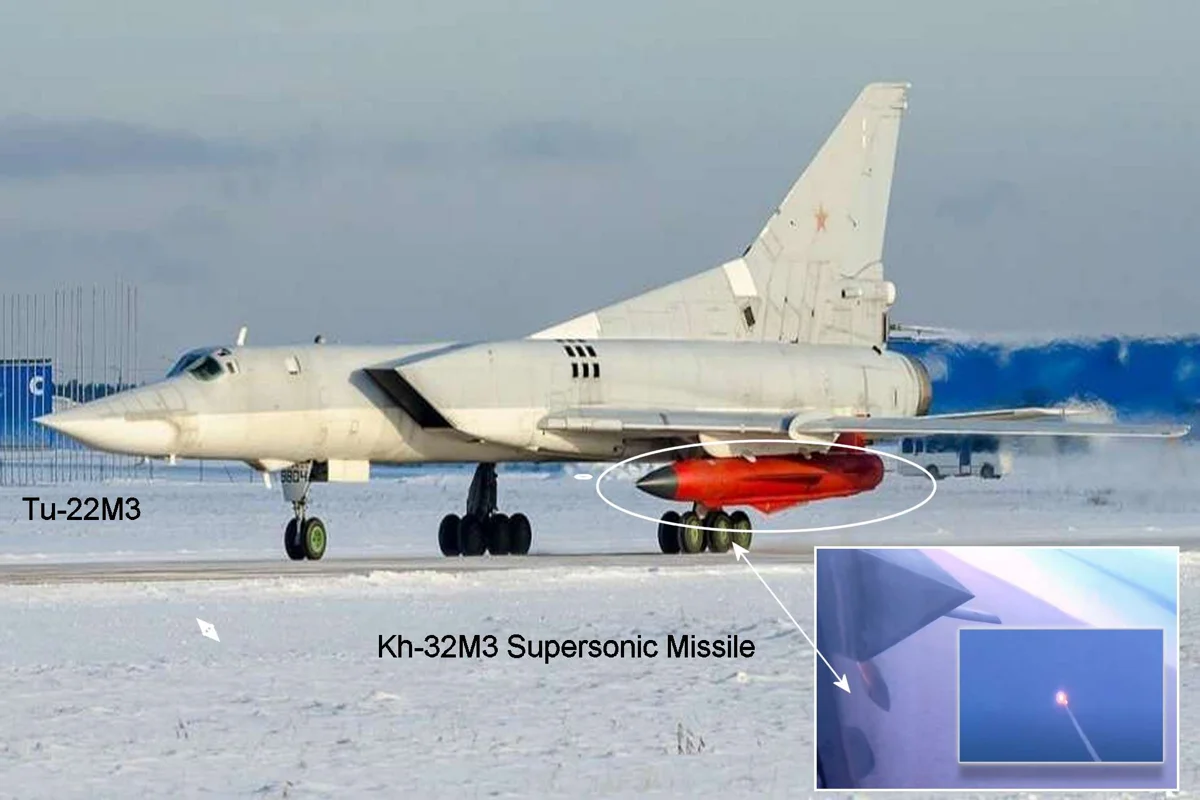
A Tu-22M3 on a snowy runway with a red Kh-32 under the wing glove, labelled in the image as a Kh-32M3 supersonic missile; the inset shows a launch. Red paint is the usual finish for test and evaluation rounds.
A Tu-22M3 on a snowy runway with a red Kh-32 under the wing glove, labelled in the image as a Kh-32M3 supersonic missile; the inset shows a launch. Red paint is the usual finish for test and evaluation rounds.
Related articles: Kh-59, Kh-69, Tu-95, Tu-160.
WHAT IT IS
The Kh-32 (Х-32, NATO RS-AS-4A mod Kitchen in IISS usage) is a Russian air-launched, rocket-powered, supersonic anti-ship and land-attack missile. MKB Raduga developed it as a deep modernisation of the Soviet Kh-22 Burya (AS-4 Kitchen). It keeps the Kh-22's big, slightly modified airframe, about 11.65 m long, 0.92 m in diameter and close to 6 tonnes at launch. Inside it is largely a new missile: a more powerful liquid-fuel rocket engine, larger fuel tanks paid for by a smaller warhead, digital avionics, a jam-resistant radar and inertial guidance system, and its own electronic countermeasures. It is carried by the Tu-22M3 Backfire and its modernised Tu-22M3M version. [DOCUMENTED]
Russian sources give a launch range of 600 to 1,000 km, against roughly 400 to 600 km for the Kh-22. Speed is quoted at Mach 3.5 to 4.6, and Russian press reports describe close to Mach 5 above 30 km. The missile climbs to as high as 40 km before diving steeply onto its target. The warhead is generally given as about 500 kg, against 960 kg for the Kh-22, but Russia has not published the figure. Development began in the late 1980s, stalled through the 1990s, and the missile was declared in service at the end of 2016. [DOCUMENTED for the published figures; the warhead weight is UNVERIFIED]
Russia has used the Kh-22 and Kh-32 against Ukraine since 2022. The Ukrainian Air Force reports them together as "Kh-22/32". Some of the deadliest strikes on civilians in the war are attributed to this family, among them Kremenchuk in June 2022 and Dnipro in January 2023. Ukraine first shot one down in 2024 and intercepted nine of twelve near Kyiv in January 2026. [DOCUMENTED]
QUICK FACTS
THE KH-22 BURYA: WHERE IT CAME FROM
The Kh-22 was ordered by a Soviet Council of Ministers decree of 17 June 1958. The order was for the K-22 complex, a new supersonic Tu-22 bomber with a long-range supersonic missile. The missile went to the Dubna branch of OKB-155, which became MKB Raduga in 1966, under chief designer Aleksandr Bereznyak. KB-1, the forerunner of today's Almaz-Antey, designed the K-22U guidance system in three forms: an autonomous inertial path computer (PSI), an active radar seeker and a passive radar seeker. [DOCUMENTED]
The missile, product D-2, grew out of the K-10P and K-14 projects. Its liquid-fuel rocket engine gave speeds up to Mach 3.5 at 22.5 km, enough at the time to beat any air defence. The first prototypes were built in 1962 at factory 256 in Dubna, later the Dubna Machine-Building Plant. Seeker equipment was trialled from a converted Tu-16K-22. The first normal launch of a Kh-22PG was made on 2 November 1963. [DOCUMENTED]
Testing dragged. In 1965 the Air Force had 105 Tu-22s of all versions and not one missile carrier. Kazan built 76 Tu-22K missile carriers from 1965 to 1969. The type was accepted in December 1968, on condition that the problems were fixed, and the K-22 complex was formally accepted only on 9 February 1971. [DOCUMENTED]
Over the next two decades the Kh-22 became the main weapon of the Soviet naval and long-range missile-carrying aviation. Its intended target was the American carrier battle group. Plans called for attacks by whole air divisions of up to about 80 aircraft from several directions in two waves, with already-launched missiles and jamming aircraft in the lead. The division's task was counted as done when the carrier was sunk or put out of action for a long time. More than 1,000 Kh-22s were built. [DOCUMENTED]
Carriers of the Kh-22:
The Tu-95K-22 matters to this article: it is the only Tu-95 version shown in the sources to have carried a missile of this family. It is not the Tu-95MS. [DOCUMENTED]
Kh-22 variants:
[DOCUMENTED, Russian Wikipedia citing Pervov 1999 and Shirokorad 1999]
Exports and the Ukrainian stock. Iraq received up to 24 missiles in 1983 and 1984. After the Soviet collapse, Kh-22s were left in Russia, Belarus, Kazakhstan and Ukraine. Ukraine had 423, which were destroyed with US Cooperative Threat Reduction help. The first was cut up at Ozerne on 23 October 2004. [DOCUMENTED]
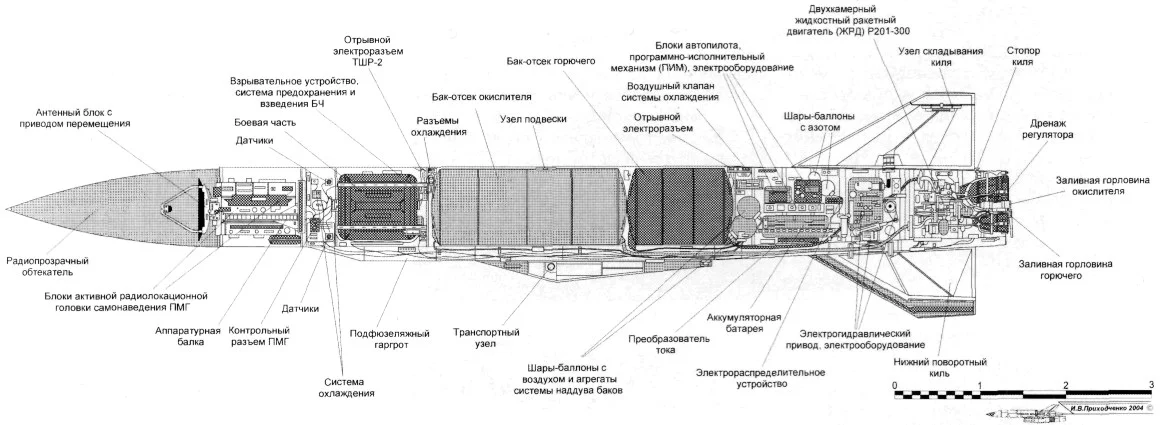
Cutaway of the Kh-22 with the PMG active radar seeker, the version from which the Kh-32 was derived. The labels show, from nose to tail, the radome and movable antenna, the PMG seeker units, the warhead, the oxidizer and fuel tank-compartments, the autopilot and control units, and the two-chamber R201-300 liquid rocket engine. Drawing © I.V. Prokhorenko.
WHY THE KH-22 NEEDED REPLACING
The Kh-22's weakness was its guidance. According to Russian Wikipedia, the deep modernisation began in the late 1980s because of the low jamming resistance of the Kh-22's guidance radar, which worked on fixed frequencies. If an enemy jammed it, a Kh-22 could not be launched at all. Against a US Navy battle group with powerful shipboard and airborne jammers, that was a serious flaw. [DOCUMENTED]
There were other problems:
DEVELOPMENT OF THE KH-32
The timeline below comes mainly from Russian Wikipedia, which cites contract and decree numbers, and from mil.in.ua and Ukrainian reporting based on it. [DOCUMENTED unless noted]
IISS wrote in 2021 that the Kh-32's service status and production numbers were uncertain and that some references to a "Kh-32M" might be a further development for the Tu-22M3M. It also suggested the Kh-32 might have been meant as a stopgap until a new very-high-speed missile, known as "Article 75" or "Gremlin", was ready. [DOCUMENTED for the IISS assessment]
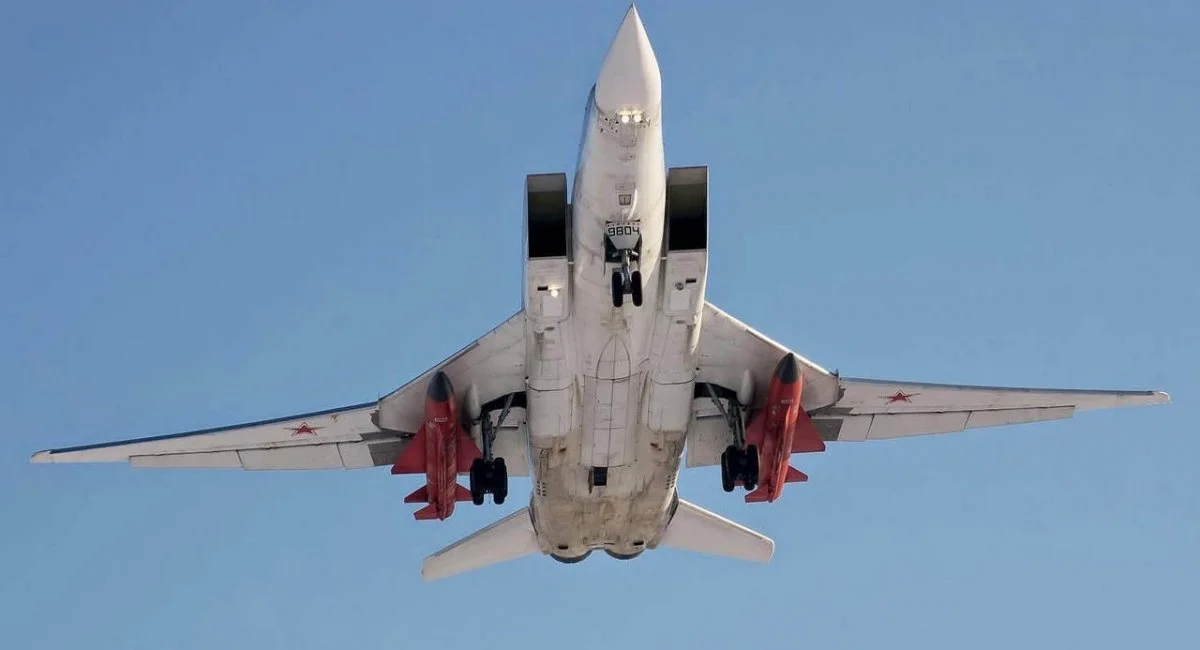
A Tu-22M3 seen from below in flight, gear down, carrying two red Kh-32s, one under each wing glove. The nose-gear door number reads 9804, the bort number Russian sources give for the Tu-22M3 converted for Kh-32 trials.
AIRFRAME
The Kh-32 is built in the Kh-22 body, with the same external dimensions. Russian Wikipedia describes the airframe as "somewhat changed". [DOCUMENTED]
The Kh-22 body. The body is round in section, divided into four compartments joined by flanges, and built largely of stainless steel and titanium to survive the heating of long supersonic flight. In order from the nose:
[DOCUMENTED]
The wing is a low-aspect delta with a 75.5-degree leading-edge sweep. The tail is cruciform. The lower fin folds for carriage under the aircraft, as does the upper part of the main fin. Specified dimensions are a length of 11.65 to 11.67 m, a diameter of 0.90 to 0.92 m, a span of 2.99 to 3.0 m (3.35 m in some sources), a height of 1.81 m with the fin folded and a launch mass of 5,635 to 5,780 kg. [DOCUMENTED]
What changed in the Kh-32. Russian sources list three main differences:
A 2020 Russian account adds a modernised liquid-fuel engine with higher thrust, digital electronics with an onboard digital computer, a jam-resistant active-passive radar, and the missile's own electronic countermeasures. [DOCUMENTED]
Telling them apart. From outside, the two missiles look almost the same. The comparison photo on this page points to the nose and radome as the main visible difference. Kh-32s seen in trials and on Tu-22M3s are usually painted red, the colour normally used for test and evaluation rounds. Service Kh-22s are usually bare metal or gray. Paint colour is not a reliable identifier. [ESTIMATE from photographs]
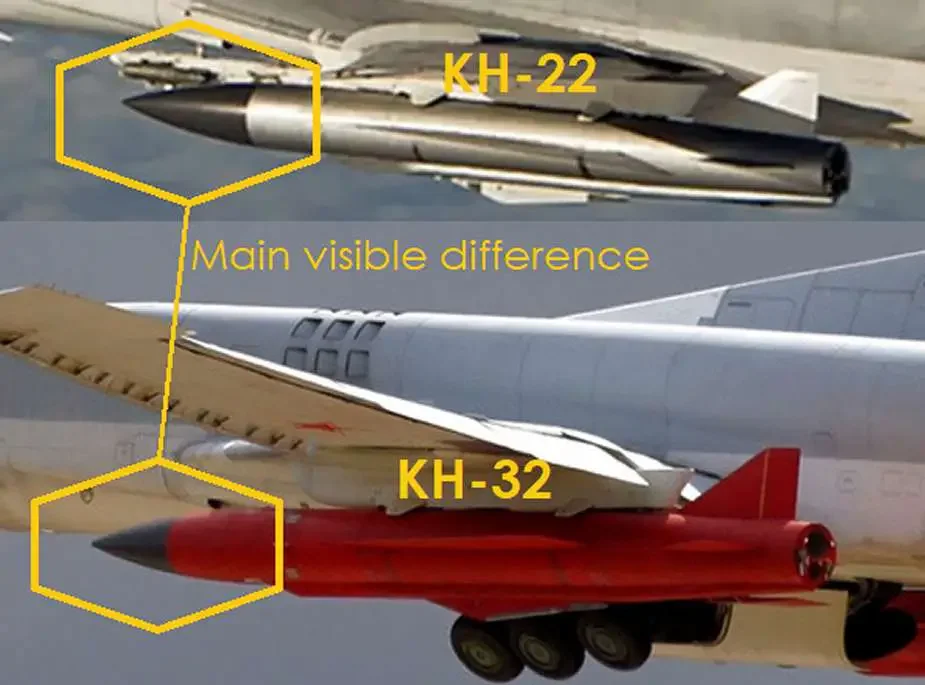
Comparison of a bare-metal Kh-22 (top) and a red Kh-32 (bottom) under Tu-22M aircraft. The graphic marks the nose and radome as the main visible difference; the rest of the airframe is essentially the same.
THE LIQUID-FUEL ROCKET ENGINE
The Kh-22 is powered by the R201-300 (also given as S5.44), a two-chamber, two-mode liquid-propellant rocket engine attributed to the Isaev bureau (KB Khimmash). One chamber gives high thrust to accelerate and climb, and the second, smaller chamber sustains cruise. The propellants are storable hypergolic liquids:
The two ignite on contact, so the engine needs no igniter. They can stay in the tanks for some time, but they are highly toxic and corrosive, and fuelling is a dangerous job. Russian Wikipedia gives a propellant load of about 3,000 kg. [DOCUMENTED; the KB Khimmash attribution is from GlobalSecurity]
GlobalSecurity's Kh-32 entry gives a "two-chamber dual-mode rocket engine developed by KBKhM". Russian sources say the Kh-32 has "a different, more powerful engine" and "a modernised liquid-fuel rocket engine with increased thrust". No designation for the Kh-32 engine is published. Thrust figures for both engines vary between sources and are not reliable, so they are left out of this page. [DOCUMENTED for the general description; engine model and thrust UNVERIFIED]
Why keep a liquid rocket? A liquid engine can be throttled between boost and cruise modes and gives high specific impulse for a long powered flight at high altitude. It also uses the existing Kh-22 production base and ground equipment. The price is the propellant handling problem the Kh-22 always had, which Ukrainian expert Andrii Kharuk and others note "complicates storage, handling and pre-launch operations". [DOCUMENTED for the handling burden; the design reasoning is ESTIMATE]
FLIGHT PROFILE
The Kh-22 profiles. The documented Kh-22 high profile works like this:
1. After release the missile drops away from the aircraft, then its engine starts. 2. It accelerates and climbs to 18.5 to 22.5 km. Its height creeps up as fuel burns off and the missile gets lighter. 3. When the seeker's angle to the target reaches about 30 degrees, the missile pushes over into a steep dive.
The PMG-type guidance had a two-mode autopilot with an upper trajectory at 22.5 km and a lower one at 11.5 km, chosen by launch height: below 6 km gave the lower trajectory, above 6 km the upper. Typical specified cruise heights are 11.5 to 12.5 km and 22.5 to 25 km. A low-level profile against ships is described in Western sources. [DOCUMENTED for the high profile; details of the low profile UNVERIFIED]
The Kh-32 profile. Russian analyst Konstantin Sivkov gives a maximum flight altitude of 40 km. Russian press in 2020 described a speed of about Mach 5 above 30 km. Western descriptions follow the same pattern: launch, a climb into the stratosphere, a long high-altitude, near-ballistic cruise, and a steep, very fast terminal dive. Douglas Barrie of IISS: "After launch, it climbs to a very high altitude, and in the terminal phase it comes in at a steep angle and at high speed." The Ukrainian Air Force spokesman Yurii Ihnat said in January 2026 that these missiles "attack along ballistic trajectories". [DOCUMENTED; the 40 km figure is SINGLE-SOURCE]
Why the profile matters.
[ESTIMATE for the physics; the Barrie quotations are DOCUMENTED]
GUIDANCE
This section separates what the Kh-22 had from what the Kh-32 is said to have, and marks what is only reported.
Kh-22 guidance, by variant:
Kh-32 guidance. Russian sources describe the following:
Land attack. The view that the Kh-32 is better at land attack than the Kh-22 fits the sources. Russian media describe the missile as able to strike "both surface and small ground targets". The new inertial system with terrain matching and radio-command correction is a navigation system for fixed land targets, which the original active seeker was not. The Kh-22's land-attack versions relied on an inertial computer accurate only to kilometres, or on a radar seeker that struggled with cluttered urban scenes. [DOCUMENTED for the claims; how much the accuracy improved is UNVERIFIED]
Ukrainian experts are less impressed. Andrii Kharuk: "Despite the upgrades, this is not a fundamentally new weapon. It is an attempt to modernize an old Soviet design, not to turn it into a precision missile." Militarnyi calls the Kh-22/32 "quite inaccurate". [DOCUMENTED as opinion]
HOW IT GETS ITS TARGETING
At the 200 to 300 km seeker range quoted for it, the Kh-32 can be aimed by the Tu-22M3's own radar. For launches out to 600 to 1,000 km it needs the target position from outside. Against ships, Russian practice has traditionally used:
Against fixed land targets, the coordinates are loaded before flight and the inertial and terrain systems take the missile there. [DOCUMENTED for the Liana system; the targeting chain for a specific launch is UNVERIFIED]
GlobalSecurity names the carrier's targeting radar as "PNA-B". The Tu-22M3's main radar is usually given as the PN-A. The Tu-22M3M is said to have new avionics "as unified as possible" with the Tu-160M. [DOCUMENTED; the radar designation is CONTESTED]
DATALINK AND ELECTRONIC WARFARE
This section sticks to what is documented, which is very thin:
Vulnerabilities. In engineering terms, the radio-command link, if used in flight, is a potential target for jamming. The radar seeker in the dive is the obvious EW target. The inertial and terrain system cannot be jammed in the usual sense. No Ukrainian claim of defeating a Kh-32 by electronic means was found. [ESTIMATE; no EW defeat is documented]
WARHEADS
Kh-22. The main conventional warhead is 960 kg (about 1,000 kg with its compartment), a high-explosive shaped-charge penetrator with 630 kg of TGAG-5 explosive, a mixture of TNT, RDX and aluminium, with a contact fuze. The shaped-charge jet is directed downward, at about 45 degrees to the missile's axis. Against a ship it was claimed to make a hole of about 22 square metres and up to 12 m deep. Nuclear warheads of 350 kt to 1 Mt were available, and the PSI carried a 200 kt warhead. A lighter warhead with 1,200 fragments was made for the anti-radar Kh-22P. [DOCUMENTED]
Kh-32. Western and Ukrainian references give about 500 kg, reduced to make room for fuel. Russia has not disclosed the figure. Russian Wikipedia says only that the warhead is "reduced", and its Kh-22 article mentions a "lightened special warhead", meaning a nuclear one, for the Kh-32. The 2008 test contract names a TK-56 warhead for the 9-A-2362. Ukrainian investigators examined the warhead of a Kh-32 that came down in the Bohodukhiv district of Kharkiv region and dated it by markings to the third quarter of 2023. [DOCUMENTED for the reduction and TK-56; 500 kg is the widely repeated estimate; the nuclear option is SINGLE-SOURCE]
Even at 500 kg, the Kh-32 hits harder than most cruise missiles because of the energy of a several-tonne missile at around Mach 4. In Ukraine the effect on civilian buildings has been devastating, as the Dnipro strike of January 2023 showed. That missile was reported as a Kh-22. [DOCUMENTED for the outcomes]
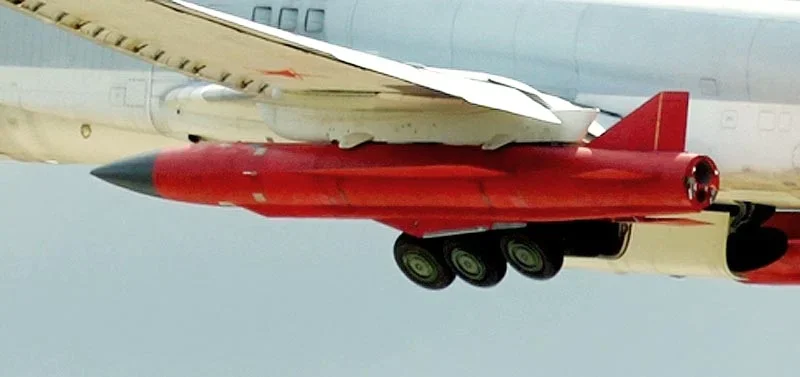
Close-up of a red Kh-32 on the pylon under a Tu-22M3 wing glove, landing gear down. The delta wing, folded upper fin and the engine nozzle in the tail are visible.
LAUNCH AIRCRAFT
| Aircraft | Kh-22 | Kh-32 | Evidence |
| Tu-22M3 | yes, up to three; normally one or two | yes | Kh-32 trials on Tu-22M3 bort 9804; used against Ukraine [DOCUMENTED] |
| Tu-22M3M | yes | yes, the main intended carrier | Russian MoD/Izvestia; IISS [DOCUMENTED] |
| Tu-22M2 | yes | no source | [DOCUMENTED for Kh-22] |
| Tu-22K / KD / KP | yes | no | retired 1992 [DOCUMENTED] |
| Tu-16K-22 | yes, two | no | retired 1991 [DOCUMENTED] |
| Tu-95K-22 | yes | no | accepted 1987, now retired [DOCUMENTED] |
| Tu-95MS / MSM | no | no source found | the MS/MSM carries Kh-55/555 and Kh-101/102 [DOCUMENTED that no source lists it] |
| Tu-160 / Tu-160M | no | no source found | weapons listed are Kh-55/555, Kh-101/102 and Kh-BD [DOCUMENTED that no source lists it] |
Does the Tu-160M or Tu-95MS carry it? No source reviewed for this page documents either aircraft as a Kh-32 carrier:
Izvestia's 2026 summary lists the modernised Tu-160M and Tu-95MSM weapons as the Kh-101 and Kh-BD, and the Kh-32 for the Tu-22M3M only. Ukrainian sources say the Kh-32 "can only be launched from the Tu-22M3". Defense Express says the Tu-22M3 carries only the Kh-22 and Kh-32 and no subsonic cruise missiles.
Two facts give the idea some background:
Neither makes the Tu-160M or Tu-95MS a Kh-32 carrier. [UNVERIFIED for any Tu-160M or Tu-95MS carriage]
Launchers. For the Kh-22 these were the BD-45K wing pylon (Tu-22M and Tu-95K-22) and the BD-45F fuselage launcher under the belly of the Tu-22M. The Tu-22 had the BD-294 in the weapons bay and the Tu-95K-22 the BD-206. The Tu-22M3's normal maximum is three, two on the wing glove pylons and one under the fuselage. In practice one or two are usual, and Ukrainian expert Kharuk says "a Tu-22M3 can carry only one or two of these missiles". A missile hung under the fuselage has its lower fin folded and must not land with the fin deployed. [DOCUMENTED]
The Tu-22M3M programme. The first aircraft flew on 28 December 2018. The aft gun turret was replaced by an electronic-warfare complex, the cockpit is new, and the weapons system was "radically updated". Planned numbers are given as 30 (2016 plan) or 20 (Izvestia). The number delivered is not public. [CONTESTED]
Bomber losses. Ukraine claims to have shot down a Tu-22M3 on 19 April 2024 with a modified S-200 at a range of about 300 km. Ukrainian sources also claim drone attacks on Tu-22M3 bases, including the SBU's 1 June 2025 operation against several strategic-aviation airfields. Defense Express estimates that fewer than 55 Tu-22M3s remain, not all of them airworthy. These are Ukrainian claims and estimates. [SINGLE-SOURCE / claims]
SPECIFICATIONS COMPARED
| Item | Kh-22 (Burya) | Kh-32 |
| Designer | OKB-155 Dubna branch / Raduga (A. Ya. Bereznyak) | MKB Raduga (KTRV) |
| In service | 1968 (formally 1971) | end of 2016 |
| Length | 11.65 to 11.67 m | 11.65 m (same body) |
| Diameter | 0.90 to 0.92 m | 0.92 m |
| Span | 2.99 to 3.0 m (3.35 m in some sources) | 3.0 m |
| Launch mass | 5,635 to 5,780 kg | about 5,780 to 5,820 kg |
| Engine | R201-300 (S5.44) two-chamber two-mode liquid rocket; TG-02 + AK-27I | upgraded, higher-thrust two-chamber liquid rocket (model not published) |
| Speed | Mach 3.5 at 22.5 km; up to about 4,000 km/h (M, MA) | Mach 3.5 to 4.6, about 4,000 to 5,400 km/h; about Mach 5 above 30 km (Russian press) |
| Cruise height | 11.5 to 12.5 km or 22.5 to 25 km | up to 40 km |
| Range | about 140 to 300 km depending on profile; 460 to 600 km max | 600 to 1,000 km |
| Warhead | 960 kg HE shaped-charge (630 kg TGAG-5) or 350 kt to 1 Mt nuclear | about 500 kg (estimate); nuclear option reported |
| Guidance | active radar (PG/PMG), passive radar (P/MP/NP) or inertial (PSI/NA) | inertial + terrain + radio-command correction; jam-resistant active-passive radar; onboard ECM |
| Seeker lock-on | before launch on the pylon (PG) | 200 to 300 km (Sivkov); external targeting beyond |
| Control | APK-22 / APK-22A autopilot | digital automatic control system |
| Accuracy | about half within 600 m (Western assessment); CEP up to 5 km for passive area attack | probability of destruction 0.80 to 0.82 (claimed) |
| Carriers | Tu-16K-22, Tu-22K, Tu-22M2/M3, Tu-95K-22 | Tu-22M3, Tu-22M3M |
Sources: Russian Wikipedia Kh-22 and Kh-32 articles (citing Pervov, Shirokorad, Karpenko and Sivkov); GlobalSecurity; IISS; Kyiv Independent. [DOCUMENTED, with conflicts shown]
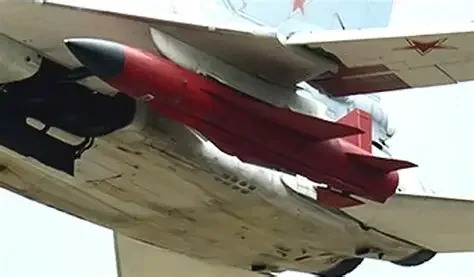
A red Kh-32 under the wing of a Tu-22M3, showing the long body, delta wing and cruciform tail it shares with the Kh-22.
COMBAT USE IN UKRAINE
Attribution. The Ukrainian Air Force reports these missiles as "Kh-22/32", and in practice often just as "Kh-22". From wreckage alone the two are hard to tell apart, and KSRIFE's director Oleksandr Ruvin says that when the missile detonates "there is almost no debris and parts suitable for research". Where a source names one or the other, that is given below. Otherwise this page says "Kh-22/32". [DOCUMENTED]
2022 to 2023: the deadliest strikes. Russia began using the family against Ukrainian targets in 2022:
The UK Ministry of Defence attributed Kremenchuk, Serhiivka and Dnipro to Kh-22 or Kh-32 missiles. [DOCUMENTED]
The Ukrainian Air Force said in early 2023 that it could not shoot these missiles down until it received Patriot. After Dnipro, according to Ihnat, Russia used them less against mainland cities and more against targets in the south such as oil platforms and Snake Island. [DOCUMENTED]
19 April 2024: first Kh-32 interceptions. Russia fired six Kh-32s at Odesa Oblast, according to the Ukrainian Air Force, and Ukrainian air defence shot down two. Photos showed a wing panel holed by fragments from an anti-aircraft missile's warhead. The intercepting system was not named. The missile was dated by its markings to the third quarter of 2023, so it was newly built. The same night, Ukraine claimed its first shoot-down of a Tu-22M3 bomber, with a modified S-200. [DOCUMENTED for the claims]
Kharkiv region. Ukrainian prosecutors and the SBU examined the warhead of a Kh-32 that fell in the Bohodukhiv district of Kharkiv region. They dated it to the third quarter of 2023 and looked for foreign components for sanctions purposes. [DOCUMENTED]
24 January 2026: Kyiv. Russia launched 12 Kh-22/32s from Tu-22M3s over Russia's Bryansk region toward a target on the outskirts of Kyiv. It was the first recorded use of the family against the Kyiv area. Ukraine reported nine intercepted, apparently by Patriot. Ihnat said that 412 Kh-22/32s had been used against Ukraine in total, and only three had been intercepted before that night, so the total rose to 12. The bombers had reportedly been moved from the Far East closer to Ukraine. One Ukrainian analyst suggested the target was the power link between Kyiv and the Rivne nuclear plant and that the route was chosen to pass near Chornobyl. [DOCUMENTED for the Air Force figures; the target analysis is SINGLE-SOURCE]
Numbers. On GUR figures, Russia's stock of Kh-22 and Kh-32 together was:
| Date of GUR figure | Kh-22/32 stock | Kh-32 monthly output |
| 1 December 2025 | about 300 | about 10 |
| mid-April 2026 | up to 350 | up to 8 |
| mid-July 2026 | over 250 | about 10 |
Source: GUR via New Voice of Ukraine. Ukrainian estimates, not verifiable. If the stock figures are right, Russia is still holding a significant number of old Kh-22s alongside new-build Kh-32s. [SINGLE-SOURCE]
THE INTERCEPT RECORD
The Kh-22/32 is the hardest target Ukraine faces among air-launched missiles other than the Kinzhal. On Ihnat's figures, 12 of about 412 launched had been shot down by late January 2026, about 3 percent overall. Nine of those came from a single night near Kyiv, inside the area defended by Patriot. [DOCUMENTED for the figures]
| Date | Event | Source |
| before April 2024 | no confirmed interceptions; Ukraine says it cannot engage the type without Patriot | Ukrainian Air Force [DOCUMENTED] |
| 19 April 2024 | 2 of 6 Kh-32s shot down over Odesa Oblast; SAM fragment damage photographed | Air Force; Defense Express [DOCUMENTED] |
| April 2024 to January 2026 | one further interception, for a total of 3 | Ihnat [DOCUMENTED for the total] |
| 24 January 2026 | 9 of 12 Kh-22/32s intercepted near Kyiv | Air Force [DOCUMENTED] |
Why it is hard. Douglas Barrie (IISS) gives three reasons: the very high altitude after launch, the steep terminal angle and the high terminal speed. He says Patriot, and potentially SAMP/T with the Aster missile, are "really the only systems available to Ukraine that would have a reasonable chance of engaging the Kh-32". A Ukrainian analyst also mentions NASAMS, a claim not supported by other sources reviewed. Even a successful engagement may need several interceptors, at about $2 million each for Patriot, against a missile estimated at around $1 million. [DOCUMENTED for the quotations; the cost figures are SINGLE-SOURCE estimates]
What helps the defender. Few carriers exist, so Kh-22/32 raids are small. The carriers are watched: the Tu-22M3 is a large aircraft whose movements are tracked by satellites and other means, and Russian commentators themselves note that "specialised carriers" make the system vulnerable to observation. And the missile's poor accuracy against small targets limits the harm a single missile does to defended military sites, though not to cities. [DOCUMENTED for the observability comments; the rest is ESTIMATE]
COMPARISONS WITH WESTERN MISSILES
The West has no current equivalent: no Western air force fields a 6-tonne, liquid-fuel, Mach 4 anti-ship missile. The nearest comparisons are shown below.
| Missile | Country | Mass | Speed | Range | Warhead | Propulsion | Status |
| Kh-32 | Russia | about 5.8 t | Mach 3.5 to 4.6 | 600 to 1,000 km | about 500 kg / nuclear option | liquid rocket | in service |
| Kh-22 | USSR/Russia | about 5.8 t | Mach 3.5 to about 4 | up to about 600 km | 960 kg / nuclear | liquid rocket | in service, being replaced |
| AGM-158C LRASM | USA | about 1.1 t | subsonic | more than 370 km | about 450 kg | turbofan | in service |
| AGM-84 Harpoon | USA | about 0.5 t | subsonic | about 120 to 280 km | about 220 kg | turbojet | in service |
| BrahMos-A | India/Russia | about 2.5 t | about Mach 2.8 | about 300 to 500 km | about 200 to 300 kg | ramjet | in service |
| ASMP-A | France | about 0.9 t | about Mach 3 | about 500 km | nuclear | ramjet | in service |
| AGM-69 SRAM | USA | about 1 t | about Mach 3 | about 160 km | nuclear | solid rocket | retired 1993 |
| AGM-28 Hound Dog | USA | about 4.6 t | about Mach 2 | about 1,100 km | nuclear | turbojet | retired 1977 |
The Western figures are rounded public values. They are not re-verified line by line for this page. [DOCUMENTED as public figures]
The pattern. The US Navy and NATO answered the Kh-22 threat with defence, not with a missile like it. AEGIS, the SM-2 and SM-6 missiles and carrier fighters were all shaped partly by the AS-4 and its submarine-launched cousins. Western anti-ship missiles stayed small, subsonic and sea-skimming, and relied on stealth, numbers and low flight rather than speed. The closest Western concepts to the Kh-32's speed and range are the ramjet and hypersonic programmes, such as the ARRW and HACM in the US and the FC/ASW Anglo-French effort. None has yet fielded an anti-ship weapon of the Kh-32's class. [ESTIMATE as an analysis]
Against Russia's own weapons:
The Kh-32 is Russia's high-and-fast option for its bomber force. [DOCUMENTED for the categories]
WHAT IT IS NOT
The Kh-32 is not a new missile in a new body. It is the Kh-22 airframe with new insides. It is not hypersonic by the usual definition of Mach 5 and above, though Russian press reports a speed close to Mach 5 at its highest altitude. It is not a precision weapon in the sense of the Kh-69 or a Western land-attack missile. And on the sources reviewed, it is not carried by the Tu-160M or Tu-95MS. [DOCUMENTED / UNVERIFIED as noted above]
CAVEATS
Almost all technical figures for the Kh-32 come from Russian authors (Sivkov, Karpenko), Russian state media and secondary references that repeat them. Russia has published no official specification. Several often-quoted figures, including the 500 kg warhead, the 40 km ceiling and the 0.80 to 0.82 kill probability, trace back to a few sources. Ukrainian reporting usually cannot tell a Kh-22 from a Kh-32, so wartime attributions of particular strikes to one or the other are uncertain. Stock and production figures are Ukrainian intelligence estimates. [BACKGROUND]
STATUS
In service with the Long-Range Aviation of the Russian Aerospace Forces on the Tu-22M3 and Tu-22M3M. In regular but limited combat use against Ukraine, alongside remaining Kh-22s. Produced at about 8 to 10 a month on GUR estimates. The number of Tu-22M3M carriers delivered is not public, and the Tu-22M3 fleet has suffered losses. [DOCUMENTED / SINGLE-SOURCE as noted above]
IN ONE SENTENCE
The Raduga Kh-32 is the deep modernisation of the Cold War Kh-22 carrier-killer. In the same 11.65 m, nearly 6-tonne body it puts a stronger liquid-fuel rocket, bigger tanks, a smaller warhead of about 500 kg, a jam-resistant active-passive radar, inertial and terrain guidance with radio-command correction, and onboard ECM. It flies as high as 40 km at Mach 3.5 to 4.6 out to 600 to 1,000 km before diving steeply onto its target. It is carried by the Tu-22M3 and Tu-22M3M, and no source shows it on the Tu-160M or Tu-95MS. It has been fired at Ukraine as part of the Kh-22/32 family, which is rarely intercepted.
RUSSIAN TERMS USED IN THIS ARTICLE
SOURCES
Related on this site: Kh-59 Ovod family, Raduga's subsonic stand-off missile.
Related on this site: Kh-69, the reduced-signature successor of the Kh-59.
Related on this site: Tu-95 and Tu-160 strategic bombers (not documented Kh-32 carriers).
Related on this site: Kh-47M2 Kinzhal and 3M22 Zircon.
Related on this site: P-700 Granit supersonic anti-ship missile.
Related on this site: Patriot, the main Ukrainian system able to engage the Kh-22/32.