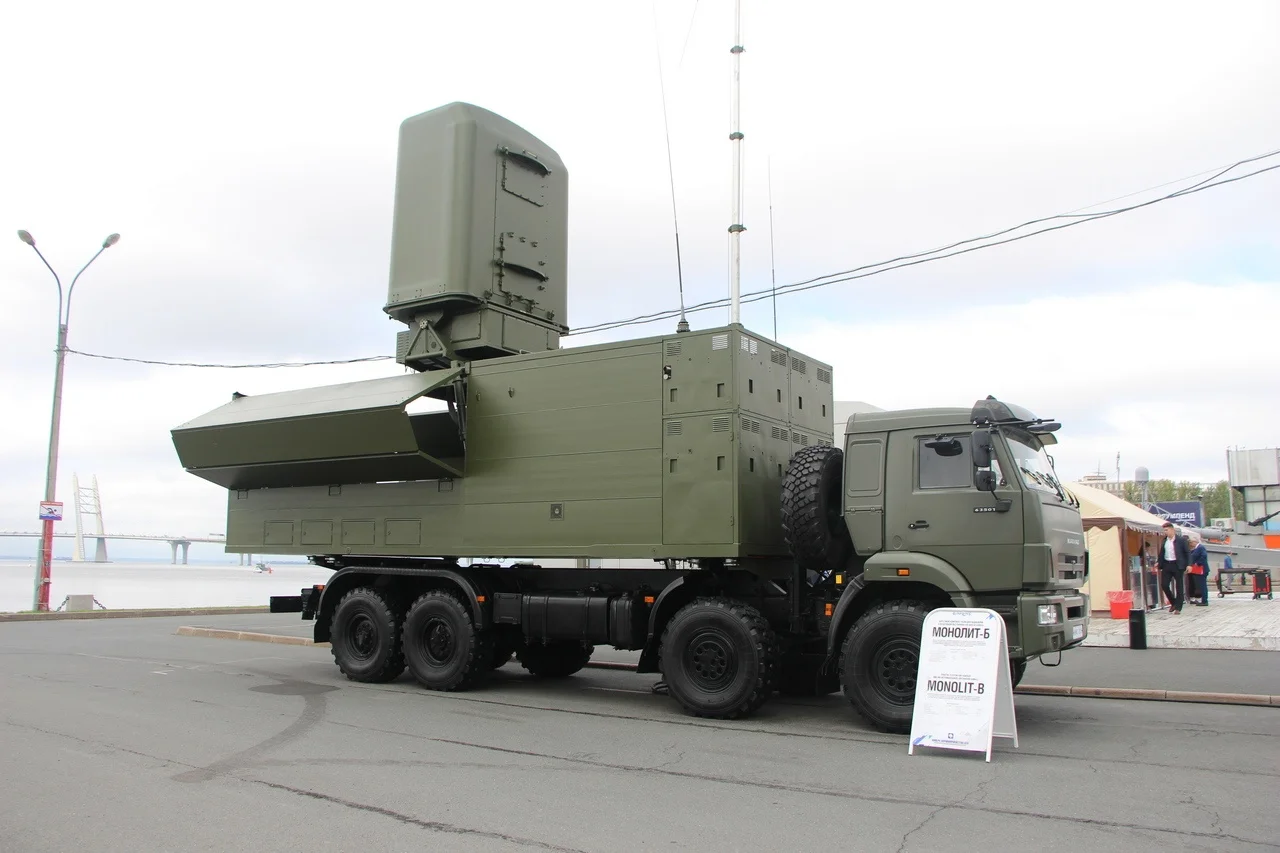
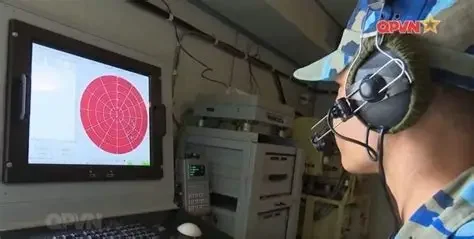
Monolit-B (Russian: Монолит-Б) is a Russian mobile coastal radar system that finds ships far out at sea, beyond the normal radar horizon, and hands their positions to coastal anti-ship missile batteries. It combines two ways of seeing: an active radar that sends out its own signal and listens for echoes, and a passive receiver that silently picks up the radars of enemy ships and works out where they are. Its developer is the Kaluga Instrument-Making Plant Typhoon (Taifun), part of Concern Morinformsystem-Agat. Its main customers are the Bastion-P (P-800 Oniks / Yakhont) and Bal (Kh-35) coastal missile systems. The maker quotes up to 250 km for the active radar in favourable weather and up to 450 km for the passive channel. [DOCUMENTED, maker data via Russian Wikipedia, ODIN, World Defense Review]
WHAT IT IS FOR
A coastal anti-ship missile like the P-800 Oniks can fly about 300 km, but the launcher on the shore cannot see that far. A truck-mounted radar a few metres above the beach sees a ship only to the horizon, roughly 30 to 40 km. Something has to fill the gap between what the missile can reach and what the battery can see. Monolit-B is that something: the battery's own long-range eye and its target-designation (in Russian, tseleukazanie, TsU) source. [BACKGROUND]
The maker lists its tasks as: searching for, detecting, tracking and classifying surface targets with the active radar; over-the-horizon detection, classification and location of emitting radars with the passive system; identification friend-or-foe (IFF); collecting and displaying the sea picture from outside sources such as ships, helicopters and lookout posts; producing target-designation data for coastal missile fire-control systems; and sharing the picture with other vehicles over a short-range data link. [DOCUMENTED, maker description via voenpro / World Defense Review]
Although the name says "surface and air reconnaissance", the published figures are almost all about ships. Air targets are mentioned in the task list, but no air detection range has been published. [DOCUMENTED; air capability UNVERIFIED]
BACKGROUND: WHY A NORMAL RADAR CANNOT SEE OVER THE HORIZON
The curve of the Earth. Microwave radar travels in nearly straight lines. Because the sea curves away, a radar antenna at height h can see a target at height t only out to about 4.12 x (√h + √t) km, with h and t in metres. The 4.12 factor already includes the slight downward bending that the normal atmosphere gives radio waves. [BACKGROUND]
A worked example. Monolit-B's quoted figures assume an antenna 9 to 12 m above sea level. With h = 10 m and a destroyer whose masts and superstructure reach about 30 m, the geometry gives about 4.12 x (3.2 + 5.5) = 36 km. That matches the maker's 35 km figure for "normal propagation conditions" almost exactly, which shows the 35 km number is simply the horizon, not a limit of radar power. [ESTIMATE, illustrative calculation]
Ducting: when the air bends radio waves around the curve. The air is not uniform. Its ability to bend radio waves depends on temperature and especially humidity. Over the sea, the air just above the water is nearly saturated with moisture, and humidity drops quickly with height. That sharp change can bend microwaves downward more strongly than the Earth curves away, so the energy is trapped in a thin layer and skips along the sea surface like light in a fibre-optic cable. This is called a duct. [BACKGROUND]
What that means in practice. The active range is not one number but a weather-dependent band: about 35 km on a bad day, about 100 km on a typical warm-sea day, and up to 250 km on a good one. A crew has to know which day it is. Ducting depends on sea temperature, air temperature, humidity and wind, so the system's performance is much better in the Black Sea or South China Sea in summer than in a cold, windy Baltic winter. [ESTIMATE, from the published figures and general propagation physics]
THE PASSIVE CHANNEL: LISTENING INSTEAD OF TRANSMITTING
A warship's own radars are the loudest thing at sea. Navigation, surface search and air search radars broadcast powerful signals in all directions, and those signals travel one way to a listener, so they can be picked up much farther away than a radar echo could come back. The passive part of Monolit-B (an electronic support measures, or ESM, system; Russian passivnaya radiolokatsiya, "passive radiolocation") does exactly that. [BACKGROUND]
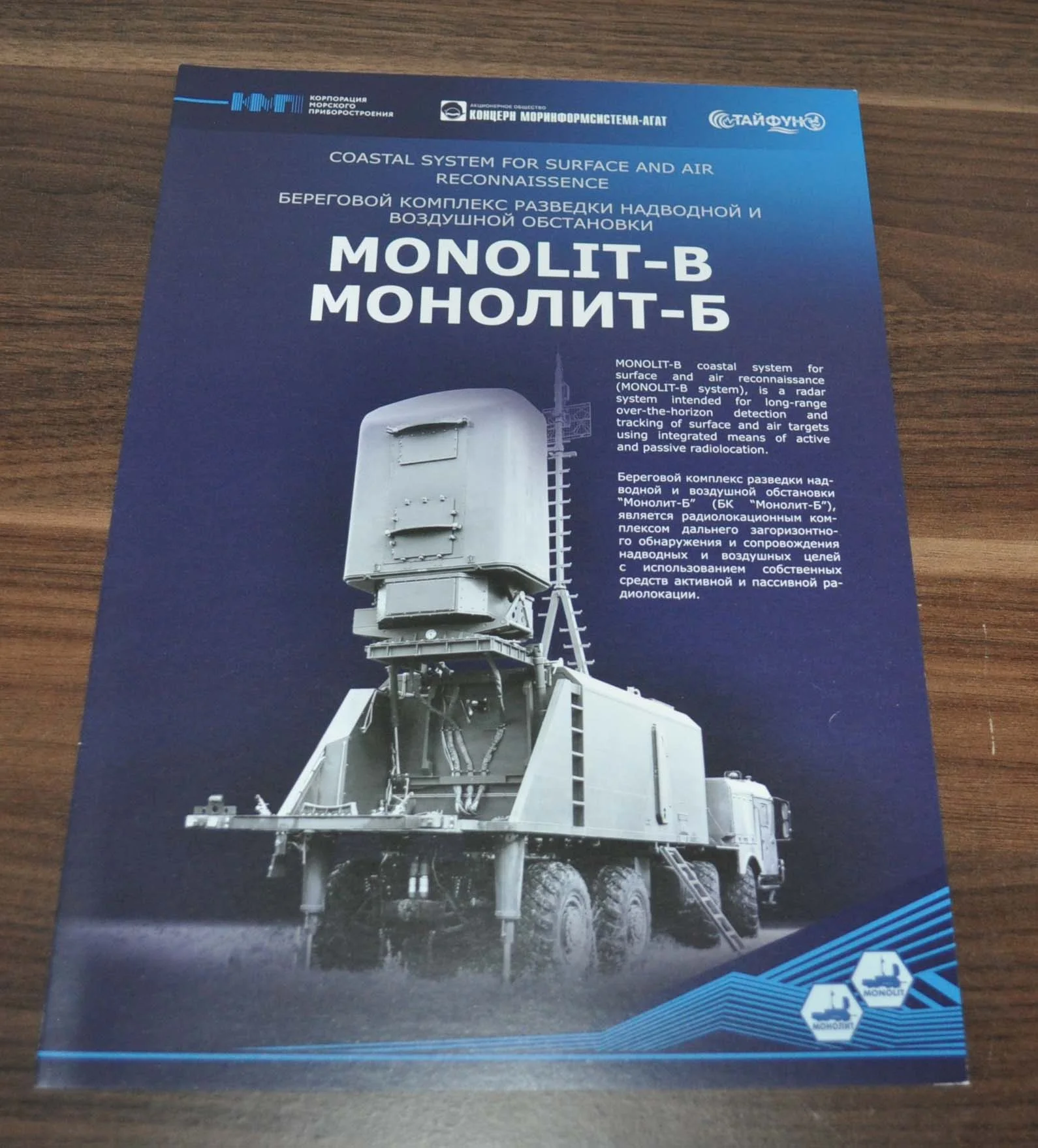
According to the maker, the passive channel detects emitting radars over the horizon, measures their signal parameters (frequency, pulse width, pulse repetition, scan rate), classifies the signals by radar type, and works out the emitter's coordinates. It is rated to detect surface targets at up to 450 km, keep up to 50 targets in detection mode, and produce target-designation data on up to 10. [DOCUMENTED, maker data] The DTIC study gives the passive band of the related Mineral-ME as about 1 to 12 GHz. [SINGLE-SOURCE for Monolit-B]
Why passive matters. The passive mode is covert: the ship being tracked gets no warning that a radar is watching it. Russian Wikipedia, drawing on maker material, says covertness comes from using the jam-resistant Mineral-ME passive mode and from using low-power radar signals in active mode. [DOCUMENTED, maker claim] The obvious limit is that a ship running with its radars switched off (emissions control, EMCON) gives the passive channel nothing to hear. [BACKGROUND]
How a passive system finds range. One receiver alone gives only a bearing. To get a position, you need bearings from two or more places, or the time difference of the same signal arriving at two places. Monolit-B is built as two identical posts, a central post and a peripheral post, which would give the baseline to triangulate. [DOCUMENTED two-post structure; triangulation use ESTIMATE] The short-range mutual data exchange and orientation station (Russian VZOI-VZOR, sometimes written DEORdr in English material) links the posts and other vehicles at 0.2 to 30 km and handles up to 200 targets. [DOCUMENTED, maker data]
HOW IT WORKS, STEP BY STEP
HARDWARE
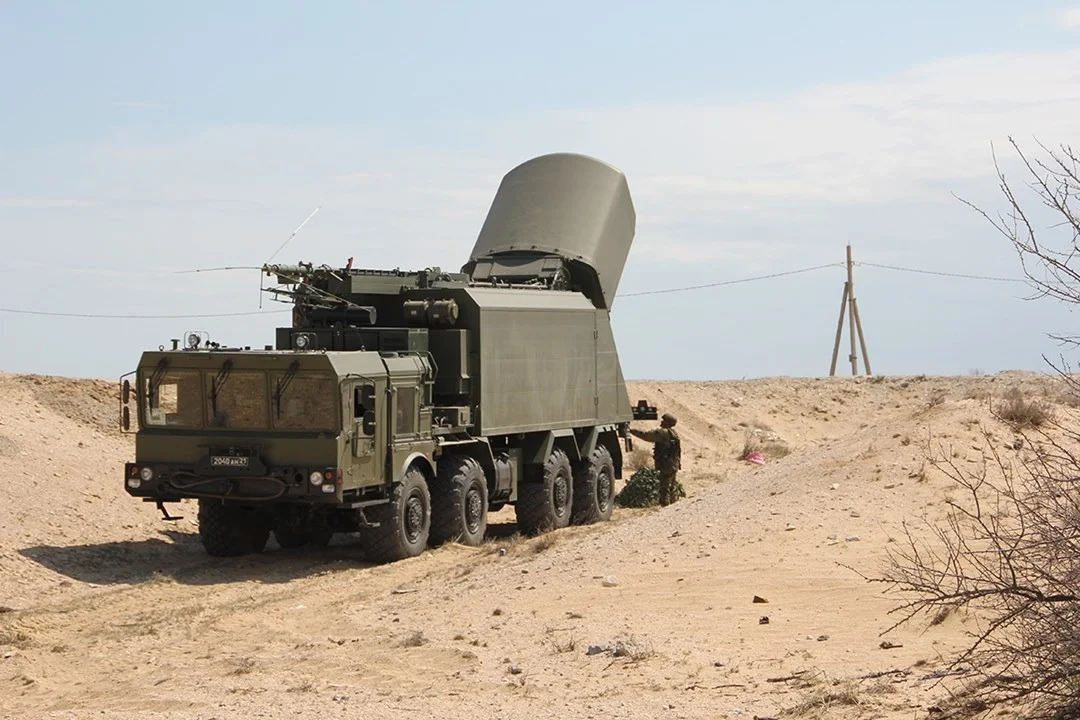
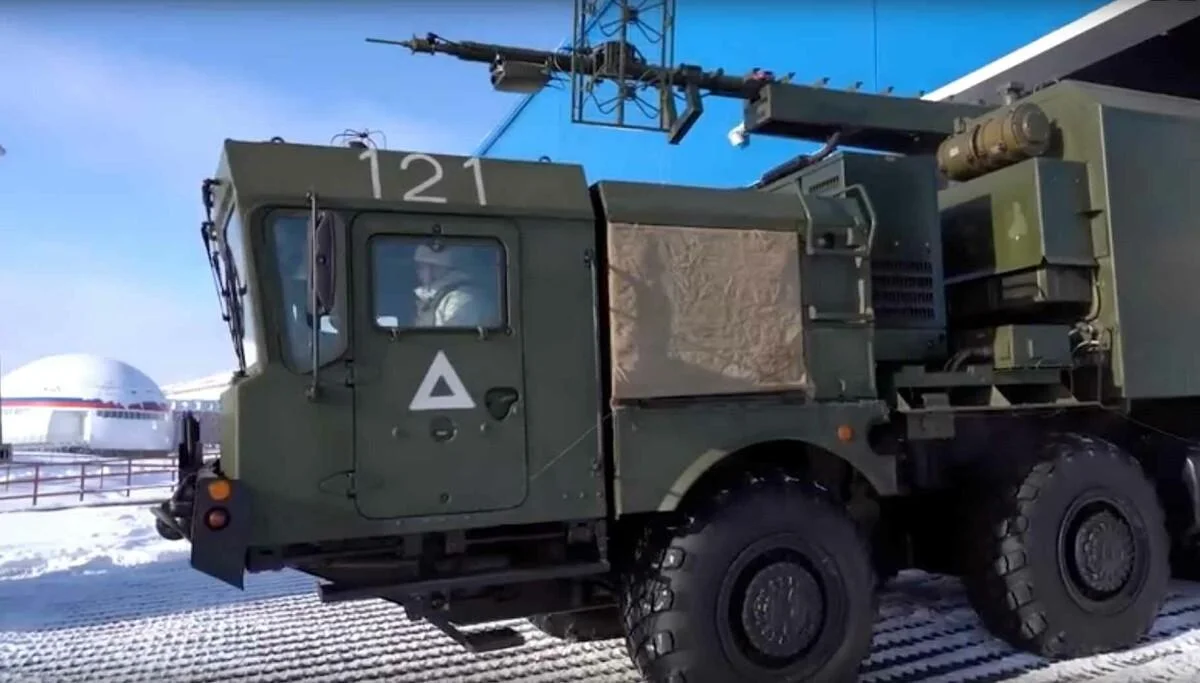
Antenna. The radar antenna is a large flat array that lies folded on the vehicle for the march and is raised and turned for operation. The photos show it stowed horizontally behind the cab and then raised upright. [DOCUMENTED, photographs] Its exact size, scan method and whether it rotates continuously have not been published. [UNVERIFIED]
Mast. A telescopic mast carries additional antennas, seen in the photos with a small dish at the top. Its exact role (data link, communications or the passive antennas) is not published. [UNVERIFIED] Raising antennas higher extends the horizon: by the formula above, going from 10 m to 25 m pushes a 30 m target's horizon from about 36 km to about 43 km. [ESTIMATE]
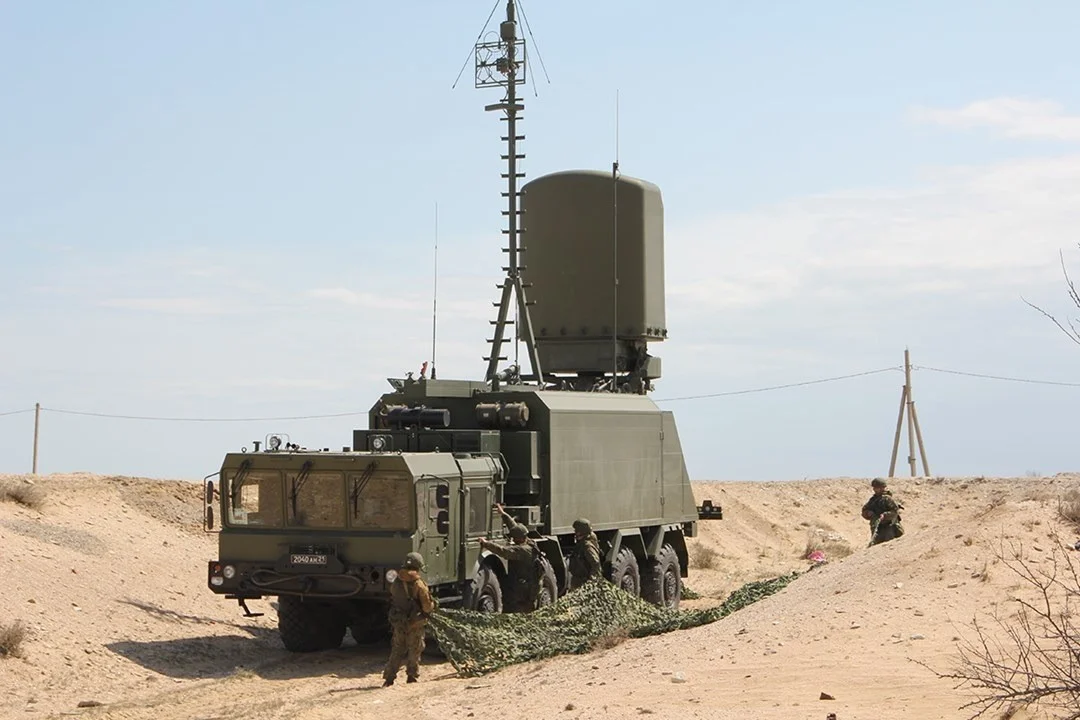
Cabin. The equipment sits in an enclosed module behind the cab with operator workstations. Typhoon presented Monolit-B at IMDS-2019 in St Petersburg as a container ("module") design that fits different chassis, can be self-propelled or stationary, and deploys quickly. [DOCUMENTED, Mil.Press Today, IMDS-2019]
Crew. Five in the self-propelled version; four in the mobile and stationary versions. [DOCUMENTED, maker data via Mil.Press]
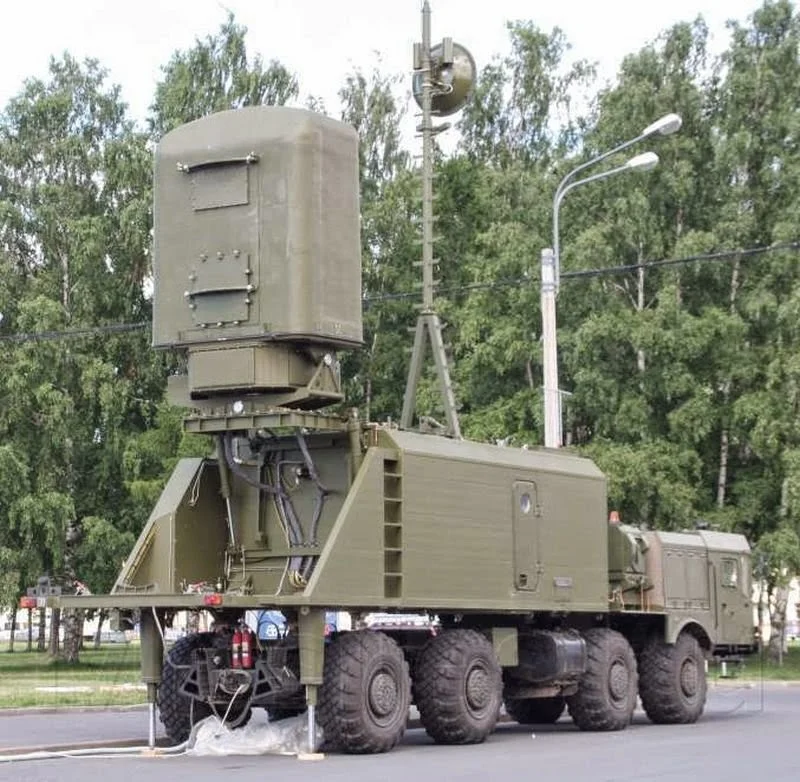
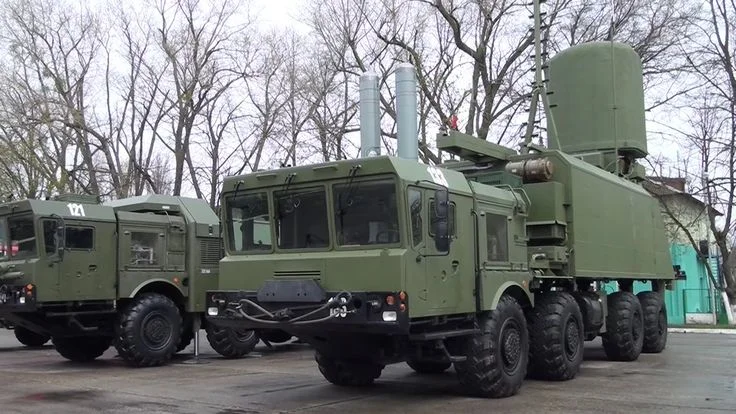
VEHICLES AND VARIANTS
WORKING WITH BASTION-P AND BAL
Bastion-P (K300P). Fires the P-800 Oniks (export Yakhont), a supersonic anti-ship missile with a range of about 300 km on a high-altitude profile and about 120 km if it flies low all the way. CIMSEC notes Monolit-B is in the optional equipment list of the Bastion-P system. [DOCUMENTED, CIMSEC; missile ranges BACKGROUND, widely reported]
Bal (3K60). Fires the subsonic Kh-35 / Kh-35U anti-ship missile, quoted at about 120 km for the original and up to about 260 km for the Kh-35U. [BACKGROUND, widely reported] The Bal battery has its own Harpoon-type surveillance and command vehicles; Monolit-B adds longer-range over-the-horizon detection. [ESTIMATE]
Why the ranges fit. The 90 to 100 km "typical duct" active range and the 450 km passive range bracket the missiles' ranges. On a typical day, the active radar alone would not reach a Bastion missile's full range, so the passive channel and outside sources (aircraft, ships, satellites) are needed for the longest shots. [SPECULATION]
The HMS Defender incident. A Russian press article (VPK.name, 2021) states that it was Monolit-B that detected and tracked the British destroyer HMS Defender off Crimea in June 2021 and passed target data to Bal and Bastion batteries. [SINGLE-SOURCE, Russian media claim]
SPECIFICATIONS (MAKER DATA)
| Parameter | Value | Note |
| Active radar, normal propagation, antenna 9-12 m | 35 km | [DOCUMENTED] |
| Active radar, evaporation duct | 90-100 km | [DOCUMENTED] |
| Active radar, super-refraction | up to 250 km | [DOCUMENTED] |
| Passive radar detection | up to 450 km | [DOCUMENTED] |
| Tracks, active | 30 | [DOCUMENTED] |
| Tracks, passive detection / target designation | 50 / 10 | [DOCUMENTED] |
| Data link (VZOI-VZOR) range / targets | 0.2-30 km / 200 | [DOCUMENTED] |
| Active band | about 8-10 GHz (X band) | [SINGLE-SOURCE, DTIC, for Mineral-ME] |
| Passive band | about 1-12 GHz | [SINGLE-SOURCE, DTIC, for Mineral-ME] |
| Crew | 5 (self-propelled), 4 (mobile/stationary) | [DOCUMENTED] |
| Chassis | 2 x MZKT-7930; KamAZ 8x8 shown | [DOCUMENTED] |
Sources conflict. Mil.Press Today's IMDS-2019 report quotes a Typhoon deputy director as giving up to 500 km active and 750 km passive for the new modular version, much higher than the long-standing 250 km and 450 km figures. Whether that is a newer model or a misquote is not clear. [SINGLE-SOURCE] A VPK.name article also repeats an anecdote about a "3,000 km" radar view; that appears to refer to a different over-the-horizon radar and should not be read as a Monolit-B figure. [UNVERIFIED] ODIN describes a 30 km "fire control" range, which appears to be a misreading of the 30 km data-link figure. [ESTIMATE]
HISTORY, SERVICE AND EXPORT
WEAKNESSES AND COUNTERMEASURES
[SPECULATION, site owner]
Monolit-B is effectively what turns a coastal missile battery from a short-range weapon into a long-range one. Without a sensor that can reach beyond the horizon, Bastion and Bal would depend entirely on outside aircraft, ships or satellites to use their full range, and those are exactly the assets most likely to be missing in a real war.
IN ONE SENTENCE
Monolit-B is Typhoon's two-vehicle coastal active-passive radar system, mainly on MZKT-7930 8x8s, that uses sea-surface radio ducts to see ships 90 to 250 km away and listens for their radars out to 450 km, giving Bastion-P and Bal anti-ship missile batteries the over-the-horizon target data they need.
RELATED ON THIS SITE
HOW THIS ARTICLE WAS BUILT
Written for this site from the sources below. Claims are labelled [DOCUMENTED] where a primary or multiple independent sources support them, [SINGLE-SOURCE] where only one does, [UNVERIFIED] where nothing published located confirms them, [ESTIMATE] for approximate figures or reconstructions, [BACKGROUND] for general physics and context, and [SPECULATION] for reasoning beyond the sources. Where sources disagree, the page says "Sources conflict" and gives both.