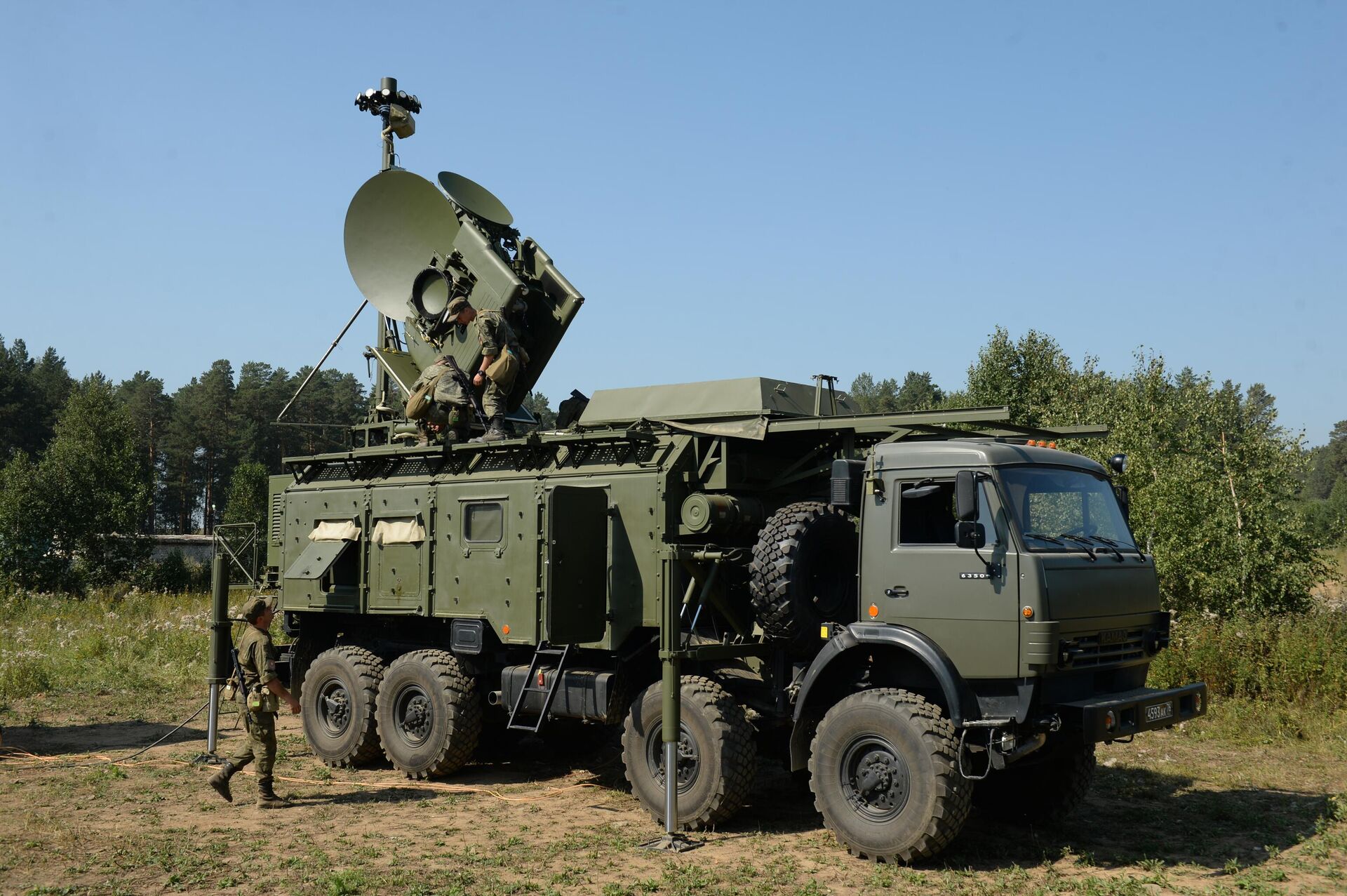
Krasukha-4 (index 1RL257) is a Russian mobile jammer built to blind radars that look down from the sky: imaging radars on reconnaissance satellites, ground-surveillance radars on aircraft and drones, and airborne fire-control and missile radars. It rides on two 8x8 KamAZ trucks, one with the jamming station and its big antenna, the other with a command post. Its maker, KRET, quotes a reach of 150 to 300 km. Its partner, Krasukha-2 (1L269), is a single large-dish jammer on a BAZ 8x8 special chassis that works lower in frequency, in the S band, against airborne early warning (AWACS) radars such as the E-3 Sentry's at up to 250 km. This page covers both: the Krasukha-4 sections first, then Krasukha-2, then a side-by-side comparison.
KRASUKHA-4: WHAT IT IS FOR
Modern Western targeting relies heavily on radar seen from above. A synthetic aperture radar (SAR) on a satellite or aircraft can image the ground through cloud and darkness; a ground moving-target indicator (GMTI) radar, like the one on the US E-8 JSTARS or the UK Sentinel R1, can track vehicle columns from 200 km away; and fighters and missiles find targets with their own radars. Krasukha-4's job is to put noise or false signals into those radars so they cannot see, track or target what it protects: command posts, air defence sites, airfields, missile units. [DOCUMENTED, KRET statements as reported by TWZ, Armada International] It is a protective, area-denial system, not an attack weapon.
BACKGROUND: HOW RADAR WORKS AND WHY IT CAN BE JAMMED
Radar basics. A radar sends out a pulse of radio energy and listens for the faint echo from a target. The time delay gives range; the direction of the antenna gives bearing; the Doppler shift gives speed. [BACKGROUND]
The fourth-power problem. The radar's pulse spreads out on the way to the target and the echo spreads out again on the way back, so echo power falls with the fourth power of distance (1/R^4). Double the range and the echo is 16 times weaker. A jammer, though, only has to make a one-way trip to the radar, so its power falls with the square of distance (1/R^2). This one fact is why a modest ground jammer can drown a powerful radar: the jammer is shouting directly at the radar's receiver, while the radar is listening for a whisper that has bounced off something. [BACKGROUND]
The J/S ratio. Jamming effect is measured as the ratio of jamming power to echo (signal) power at the radar receiver. If J/S is high, the echo is buried and the radar sees noise. Because J falls as 1/R^2 and S as 1/R^4, the ratio favours the jammer more the farther away the radar is. [BACKGROUND]
Burn-through range. As a radar closes in, its echo strengthens faster than the jamming does. At some distance the echo wins and the radar "burns through" the noise and sees the target again. Burn-through range depends on radar power, antenna gain, the target's radar cross-section and the jammer's power. For a jammer protecting an area against stand-off aircraft that stay 150+ km away, the aim is to keep them outside their burn-through range. [BACKGROUND]
A worked example. Take an airborne surveillance radar 200 km from a protected site. If it moves in to 100 km, its echo from the site gets 16 times stronger (2^4), while the jamming it receives gets only 4 times stronger (2^2), so the J/S falls by a factor of 4, about 6 dB. Halve the distance again to 50 km and J/S drops another 6 dB. A jammer that gives the radar a comfortable 20 dB J/S at 200 km leaves it at about 8 dB at 50 km, still jammed, but a radar that can tolerate 10 dB would burn through at roughly 60 km. Real numbers depend on antenna gains, polarisation and the radar's processing gain, which can be 20-40 dB for modern coherent radars. [ESTIMATE, illustrative figures only]
Processing gain. Modern radars do not just listen for raw power. They correlate the echo against the exact pulse they sent (pulse compression) and add up many pulses coherently. Noise that does not match the waveform is suppressed by that processing, so a jammer needs either very high power or a signal that mimics the radar's own waveform. This is why measuring the victim radar first, and then spot jamming or replaying its pulses, matters so much. [BACKGROUND]
Main-lobe and side-lobe jamming. A radar antenna is most sensitive straight ahead (the main lobe) and much less sensitive off to the sides (side lobes). A jammer in the main beam is very effective; one in a side lobe has to be much more powerful. Modern radars use low side lobes, side-lobe cancellers and adaptive nulling to fight jamming from off-axis. [BACKGROUND]
Noise versus deception. Noise jamming fills the radar receiver with random energy to hide echoes. Barrage noise covers the radar's whole tuning band; spot noise concentrates on the frequency actually in use, which needs the jammer to measure that frequency first. Deception jamming instead sends back altered copies of the radar's own pulses to create false targets or wrong ranges and speeds. A digital RF memory (DRFM) records an incoming pulse and replays it modified. KRET's descriptions of Krasukha speak of jamming and of protecting objects from detection; the techniques used are not published. [UNVERIFIED]
WHY SAR AND GMTI ARE VULNERABLE
SAR. A SAR builds a high-resolution image by recording echoes over a long stretch of its flight path, then processing them together as if it had one huge antenna. Every pixel depends on many echoes collected over seconds. Noise injected during that collection spreads across the image and washes it out; a coherent false signal can paint false objects or smear real ones. A satellite SAR is also a fixed, predictable target: its orbit is public, its pass over an area lasts minutes, and it is hundreds of kilometres away, where its echo is weak. [BACKGROUND]
GMTI and AWACS. Airborne surveillance radars must stand off at long range for their own safety, which means weak echoes and a favourable J/S for the jammer. AWACS radars like the E-3's work in the S band (around 3 GHz), which is why Krasukha-2 covers roughly 1-5 GHz; GMTI and fire-control radars mostly work in X band (8-12 GHz) and Ku band (12-18 GHz), which is Krasukha-4's territory. [DOCUMENTED band split, Armada International; band uses BACKGROUND]
KRASUKHA-4: DEVELOPMENT AND MAKER
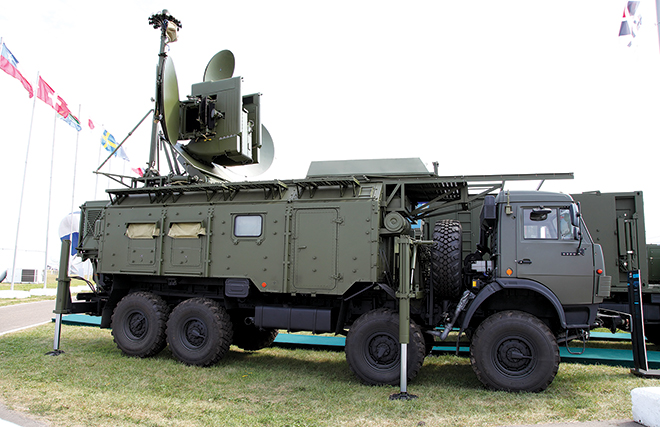
Krasukha-4 was developed under KRET (Concern Radio-Electronic Technologies, part of Rostec) and is produced at the Bryansk Electromechanical Plant (BEMZ). [DOCUMENTED, TWZ; Army Recognition; KRET statements] Its origins are traced to the late 1990s, with serial production starting in the early 2010s. [DOCUMENTED, TWZ] Russian reports from that period described deliveries to the EW brigades of the military districts from about 2014 onward. [SINGLE-SOURCE, Russian press; dates vary]
The meaning of the name Krasukha (Красуха) in this context is not published. [UNVERIFIED]
KRASUKHA-4: COMPONENTS AND VEHICLES
The system is generally deployed as a pair with Krasukha-2 (1L269), which covers the lower radar bands. [DOCUMENTED, Armada International] It can also be fed target information from external reconnaissance and integrated into a wider EW control network. [SINGLE-SOURCE, KRET statements]
KRASUKHA-4: SPECIFICATIONS
| Parameter | Reported value | Note |
| Index | 1RL257 | [DOCUMENTED] |
| Chassis | two KamAZ trucks, usually given as KamAZ-6350 8x8 | Sources conflict on axle count and maker |
| Band | about 8.5-18 GHz (X and Ku) | Armada International [SINGLE-SOURCE origin] |
| Range | 150-300 km | KRET, "in any direction, depending on conditions" [DOCUMENTED claim] |
| Targets | satellite SAR, airborne radars, missile seekers and altimeters, drone radars | KRET [DOCUMENTED claim] |
| Crew | not published | [UNVERIFIED] |
| Deployment time | not reliably published | [UNVERIFIED] |
Sources conflict on scope. KRET and TWZ describe Krasukha-4 as a radar jammer. Later Ukrainian and Western summaries also credit it with jamming GPS, satellite communications and drone control links. [UNVERIFIED for the added roles] The published X/Ku band would not cover GPS (about 1.2-1.6 GHz) or most drone datalinks, so those claims probably mix it up with other systems. [SPECULATION] It is also unclear whether "150-300 km" is detection range, jamming range or both. [DOCUMENTED ambiguity, TWZ]
KRASUKHA-4: HOW IT WORKS IN PRACTICE
A plausible cycle, reconstructed from KRET descriptions and general practice [ESTIMATE]:
Against satellites, warning comes from published orbits: a SAR satellite's passes over a site are predictable days ahead, so the jammer knows when and where to point. [BACKGROUND]
Why it is not invisible. A ground jammer radiating at high power is itself a strong emitter. Anti-radiation missiles and passive location systems can home on it. A well-run unit radiates only when needed, uses decoys and moves. [BACKGROUND]
KRASUKHA-4: DEPLOYMENT AND UNITS
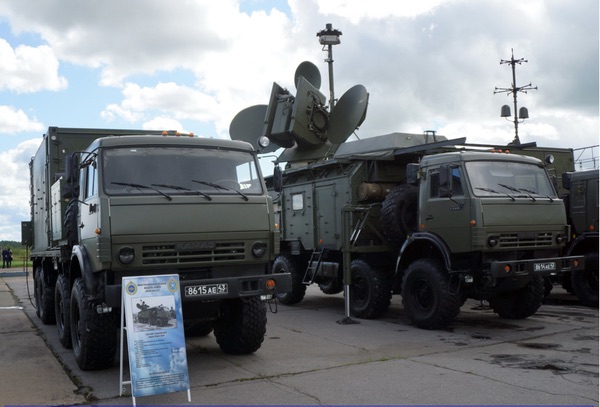
Krasukha-4 has been reported in the EW brigades of Russia's military districts and at key sites, and at exercises including Zapad. [DOCUMENTED, Russian MoD reports] Russian state media reported Krasukha-4 in Syria at Hmeimim air base from 2015, as part of the protection of Russian forces there. [SINGLE-SOURCE origin, Russian state media; widely repeated] Kaliningrad deployments have also been reported. [SINGLE-SOURCE]
KRASUKHA-4: COMBAT USE, LOSSES AND CAPTURES
Syria. Western officers in Syria complained of heavy Russian EW activity from 2015-2018, including against aircraft and drones. Linking specific effects to Krasukha-4 rather than other systems is not possible from open sources. [UNVERIFIED attribution]
Capture near Kyiv, March 2022. Ukrainian forces captured the command-post container of a Krasukha-4 near Makariv, about 50 km west of Kyiv. Photos circulated around 22-23 March 2022, showing the container on its side under branches, damaged but largely intact. The Telegraph reported it would likely go via Ramstein to the US for examination. [DOCUMENTED, TWZ; Armada International; Center for Public Integrity; The Telegraph] The jamming vehicle itself was not shown. [DOCUMENTED]
Destroyed in Zaporizhzhia, 2023. A Krasukha-4 hidden under camouflage netting in a tree line between Urozhaine and Lankove in Zaporizhzhia oblast was found by drones of Ukraine's 14th Separate Regiment and hit. It was described as only the second recorded Russian loss of the type. [DOCUMENTED, Ukrainian StratCom via Militarnyi] Sources conflict on the weapon: Militarnyi describes two shells; Army Recognition says two JDAM-guided bombs. Dates are reported between late October and 1 November 2023. [Sources conflict]
Effectiveness in Ukraine. Krasukha-4 is built against high-end, stand-off radars. Ukraine fielded few such aircraft, and the war's decisive sensors became cheap drones with cameras, which a radar jammer cannot touch. That is likely part of why Krasukha has been rarely seen and rarely lost. [SPECULATION]
KRASUKHA-2: WHAT IT IS FOR
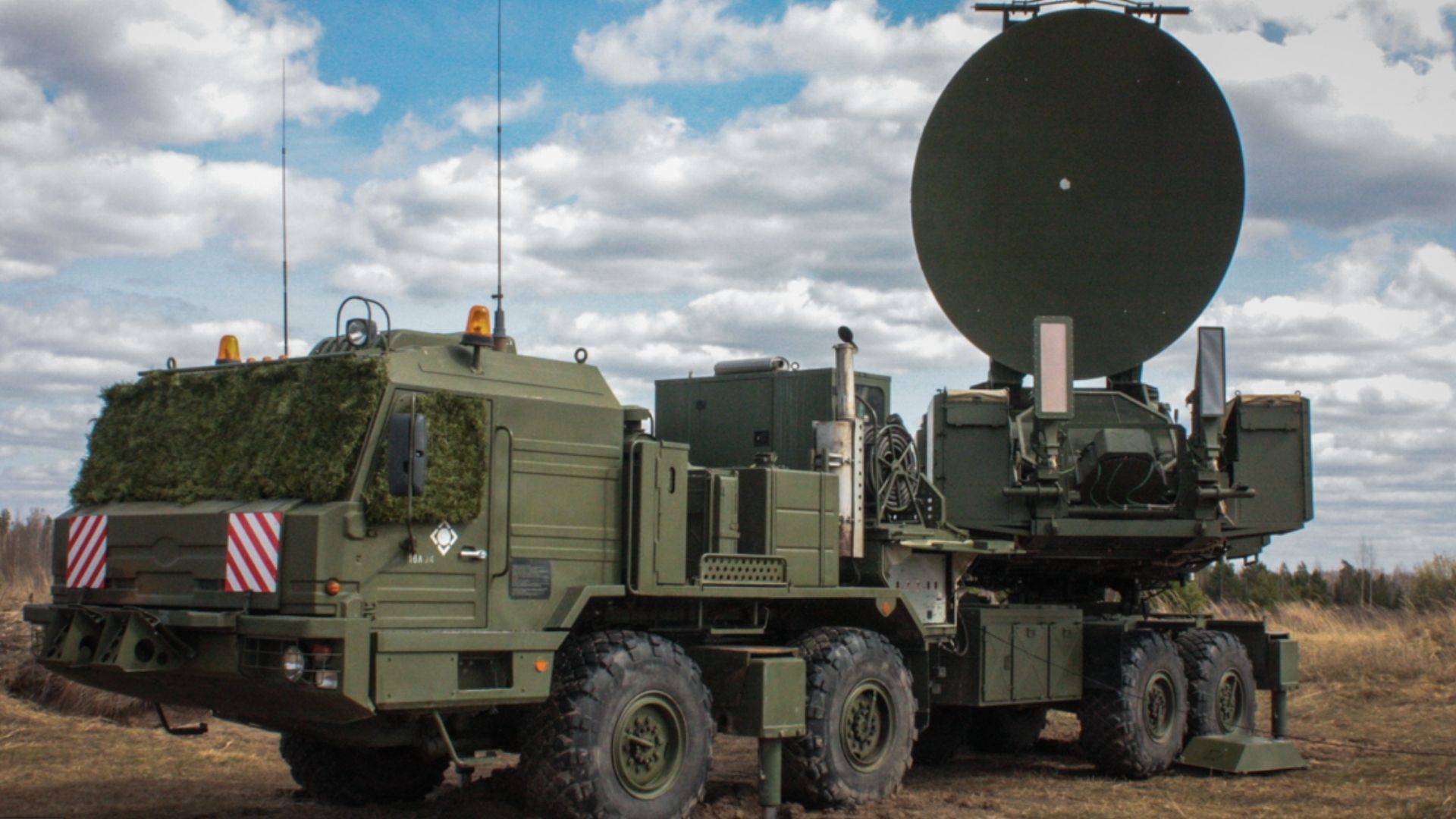
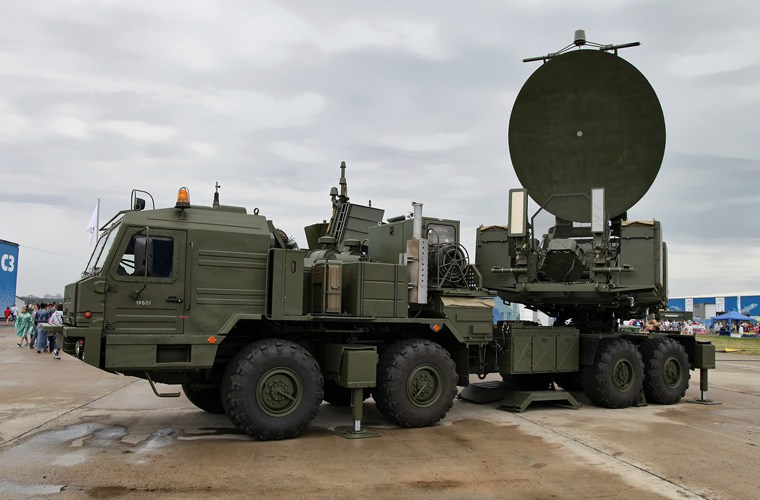
Krasukha-2 (1L269) is the long-range, lower-band half of the pair. US Army ODIN describes it as a ground-based system intended to neutralise AWACS by jamming its radar at ranges up to 250 km, and also to protect ground forces on the march by jamming airborne radars, radar-guided weapons and radar-guided missiles. ODIN and COGINT say Russia uses it to protect Iskander tactical ballistic missile units. [DOCUMENTED, ODIN WEG; COGINT 2023]
The logic is that a big airborne surveillance radar is the eye of an enemy air campaign. The E-3 Sentry's AN/APY-1/2 radar works in the S band, around 3 GHz, and can see aircraft and, at sea, ships from several hundred kilometres away while orbiting far behind the front. If that radar is blinded over a sector, enemy fighters lose the long-range picture and must rely on their own, shorter-ranged radars. [BACKGROUND; E-3 radar band DOCUMENTED in standard references; see A-50 for the Russian counterpart]
KRASUKHA-2: HOW IT WORKS
Why one big dish. At S band a wavelength is about 10 cm. A large parabolic dish concentrates the jammer's power into a narrow beam aimed at one aircraft, and the gain of that dish multiplies the effective radiated power many times over. The trade-off is that a narrow beam covers one target or sector at a time, so the antenna must be steered toward the threat. [BACKGROUND]
Why long range is possible. An AWACS stands off 150-300 km from the area it watches. Its echo from a fighter at that distance is extremely weak, while the jamming it receives only falls with the square of distance (see the J/S and burn-through sections above). The AWACS radar also points its main beam toward the very area the jammer protects, so the jammer is often in, or near, the main lobe. Both facts favour the jammer. [BACKGROUND]
What the jamming does. ODIN says missiles jammed by the 1L269 are given a false target away from the real one, which describes deception (range or angle false targets) rather than only noise. Against an AWACS, the likely aim is to raise the noise floor across its scan and create false tracks. [DOCUMENTED claim, ODIN; technique details UNVERIFIED]
Limits. The E-3 and similar radars use very low side lobes, pulse-Doppler processing and frequency agility, and modern AEW radars such as AESA-based E-7 Wedgetail can null jammers adaptively. How much Krasukha-2 achieves against them is not known publicly. [SPECULATION]
KRASUKHA-2: DEVELOPMENT, CHASSIS AND SPECIFICATIONS
Krasukha-2 is produced under KRET, with COGINT dating adoption to about 2011 and serial deliveries in the early 2010s. [DOCUMENTED, COGINT; date SINGLE-SOURCE] COGINT lists the variant names Krasukha-2O, 1RL269 and RB-261A, which are not explained. [SINGLE-SOURCE]
Chassis. It rides on a Bryansk Automobile Plant (BAZ) special wheeled 8x8 chassis. Sources conflict on the model: ODIN says BAZ-6909; a Russian vehicle reference describes the BAZ-6910-022 (12.4 m long, with two power take-offs to drive the equipment) as built for the 1L269. [DOCUMENTED; model conflicts] The BAZ chassis is the same family used for S-300 and S-400 vehicles. [BACKGROUND]
| Parameter | Reported value | Note |
| Index | 1L269 | [DOCUMENTED] |
| Chassis | BAZ 8x8 special chassis | Sources conflict: BAZ-6909 (ODIN) or BAZ-6910-022 (Russian reference) |
| Band | S band | Sources conflict on edges: 2.3-3.7 GHz (COGINT) or about 1-5 GHz (Armada International) |
| Range | up to 250 km against AWACS | [DOCUMENTED claim, ODIN; KRET] |
| Antenna | one large steerable dish | [DOCUMENTED, photos] |
| Adopted | about 2011 | [SINGLE-SOURCE, COGINT] |
KRASUKHA-2: DEPLOYMENT AND COMBAT USE
KRASUKHA-2 AND KRASUKHA-4 SIDE BY SIDE
| Krasukha-2 | Krasukha-4 | |
| Index | 1L269 | 1RL257 |
| Main targets | AWACS (E-3 class), airborne radars, radar-guided missiles | satellite SAR, GMTI aircraft (E-8 class), fire-control radars, missile seekers |
| Band | S band (2.3-3.7 GHz, or about 1-5 GHz) | X and Ku band (about 8.5-18 GHz) |
| Claimed range | up to 250 km | 150-300 km |
| Antenna | one large dish | twin folding dishes and an array on a rotating mount |
| Chassis | BAZ 8x8 special chassis | KamAZ trucks (jammer plus command post) |
| Known losses | none confirmed | one command post captured 2022; one destroyed 2023 |
The two are meant to work as a pair: Krasukha-2 pushes back the long-range air picture, and Krasukha-4 blinds the imaging and targeting radars that would find and strike what is under the umbrella. [DOCUMENTED pairing, Armada International; roles ESTIMATE]
COUNTERMEASURES (BOTH SYSTEMS)
LIMITS OF THE OPEN RECORD
Performance figures come mostly from KRET and Russian media. The band edges are reported by one Western defence magazine. The exact techniques, power, crew, numbers produced and real effectiveness against US or NATO radars are unknown. The captured container may have told Western analysts a great deal, but none of that analysis is public. [ESTIMATE]
IN ONE SENTENCE
Krasukha-2 is KRET's single-dish S-band jammer on a BAZ 8x8, built to blind AWACS radars at a claimed 250 km, and Krasukha-4 is a two-truck KamAZ-6350 X- and Ku-band radar jammer from KRET and BEMZ, meant to blind satellite and airborne imaging and targeting radars at a claimed 150-300 km, paired with Krasukha-2 for lower bands, with one command post captured near Kyiv in 2022 and one system destroyed in Zaporizhzhia in 2023.
RELATED ON THIS SITE
HOW THIS ARTICLE WAS BUILT
Written for this site from the sources below. Claims are labelled [DOCUMENTED] where a primary or multiple independent sources support them, [SINGLE-SOURCE] where only one does, [UNVERIFIED] where nothing published located confirms them, [ESTIMATE] for approximate figures or reconstructions, [BACKGROUND] for general physics and context, and [SPECULATION] for reasoning beyond the sources. Where sources disagree, the page says "Sources conflict" and gives both.