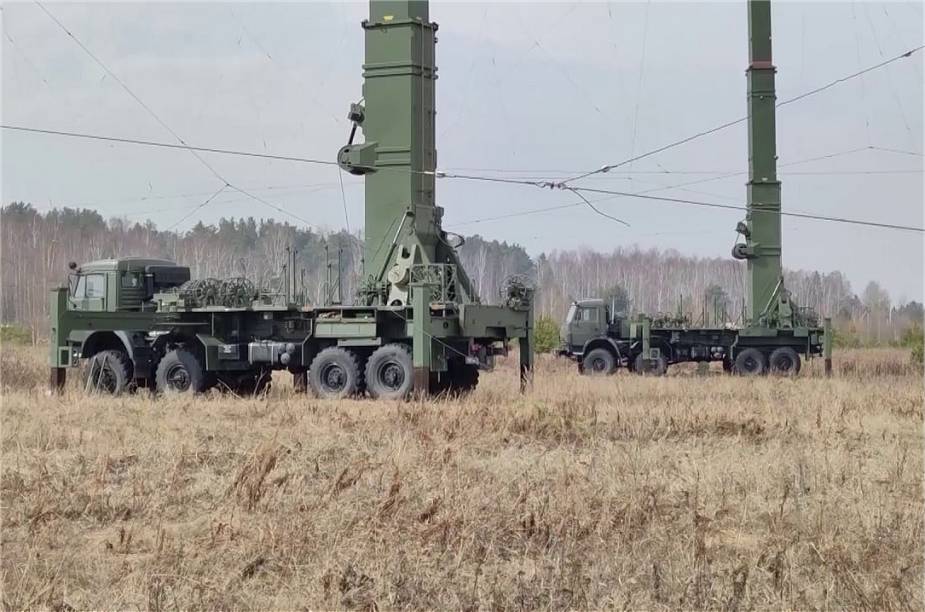
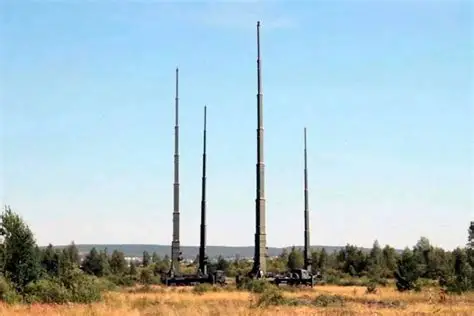
Murmansk-BN is a Russian mobile system for listening to and jamming long-range shortwave (HF) radio. It is a group of KamAZ trucks carrying telescopic masts about 32 m tall, a command post and a generator, and it is meant to find, identify and jam the HF links that ships, aircraft and distant headquarters use when they are far beyond the horizon. Russian sources credit it with an effective reach of 3,000 to 5,000 km, and up to 8,000 km under good conditions. Those figures depend almost entirely on the ionosphere, and this page explains why.
WHAT IT IS FOR
Most military radio is line of sight: VHF and UHF signals travel roughly as far as the horizon, a few tens of kilometres on the ground, a few hundred from an aircraft. To talk across an ocean without a satellite, a ship, a bomber or a distant headquarters uses HF, 3 to 30 MHz, which can bounce off the ionosphere and come down thousands of kilometres away. NATO navies, maritime patrol aircraft, air forces and strategic command networks all keep HF as a backup to satellite links, precisely because it needs no satellite. [BACKGROUND]
Russian descriptions of Murmansk-BN say its job is to collect data on HF emitters automatically, classify them and decide what jamming power is needed to suppress them, so as to deny an opponent long-range HF command links to warships, aircraft, drones and headquarters. [DOCUMENTED, Izvestia via Baltic Fleet press service, 2019; US Army ODIN WEG] Western summaries add that its main stated target is US and NATO strategic HF, including the US Air Force High Frequency Global Communications System. [SINGLE-SOURCE, Army Recognition, repeated in later summaries] No Russian official source located names a specific Western network as the target.
It is therefore a strategic or operational-level system, not a battlefield jammer. It belongs to fleet and district electronic warfare (EW) centres and covers whole seas, not a front line. [DOCUMENTED]
BACKGROUND: HOW HF REACHES 5,000 KM
The ionosphere. Between about 60 and 400 km up, ultraviolet light from the Sun strips electrons from air molecules and creates layers of ionised gas: the D layer (60-90 km), E layer (about 110 km) and F layer (200-400 km, splitting into F1 and F2 by day). A radio wave entering an ionised layer is bent. If the frequency is low enough for the electron density, it is bent all the way back to Earth. [BACKGROUND]
Skywave and hops. A signal sent upward at a low angle, refracted by the F2 layer and returned to the ground, typically lands 2,000 to 4,000 km away in one "hop". The ground or sea can reflect it up again for a second hop, so 6,000 to 10,000 km paths are routine for HF broadcasters. This is called skywave. The part of the signal that hugs the surface, groundwave, dies within a few hundred kilometres over land, farther over seawater. [BACKGROUND]
The skip zone. Between the end of groundwave and the first skywave landing there is often a gap where the signal cannot be heard at all. A jammer cannot reach a receiver sitting in its own skip zone on that frequency. [BACKGROUND]
MUF and LUF. For each path at each hour there is a maximum usable frequency (MUF), above which the wave punches through the ionosphere and is lost, and a lowest usable frequency (LUF), below which the D layer absorbs it. The usable window shifts with time of day, season, the 11-year sunspot cycle and solar storms. In daytime at solar maximum it can run up to 25-30 MHz; at night in solar minimum it can shrink to a few MHz. [BACKGROUND]
What that means for a jammer. A jammer at HF is not a "bubble" around a site. It throws energy along the same skywave paths the victim uses, and it reaches a target receiver only if the path from the jammer to that receiver is open on that frequency at that moment. This is why Russian figures are given as "3,000-5,000 km, up to 8,000 km with good propagation" rather than a hard radius. The quoted jammed area of 640,000 km2 is roughly a circle 450 km in radius, which suggests a footprint at a particular distance rather than blanket coverage out to 5,000 km. [ESTIMATE; the 640,000 km2 figure is from ODIN and Army Recognition]
BACKGROUND: INTERCEPT, DIRECTION FINDING AND JAMMING
Intercept means receiving and recording someone else's transmission. HF intercept is passive and can be done at very long range, because the same skywave that carries a signal to its intended receiver also carries it to anyone else in the footprint. Russia, like the US and UK, has run large fixed HF intercept sites since the Cold War. [BACKGROUND]
Direction finding (DF) measures the bearing a signal arrives from, by comparing its phase or amplitude across several spaced antennas. With bearings from two or more widely separated sites, the transmitter can be located. At HF, skywave DF is harder than ground DF because the ionosphere tilts and moves, so long-range fixes are typically tens of kilometres wide. [BACKGROUND] Murmansk-BN is described as doing radio reconnaissance, meaning search, intercept and classification; open sources do not state its DF accuracy. [UNVERIFIED]
Jamming means putting enough unwanted energy into the victim's receiver that the wanted signal can no longer be decoded. The key point is that jamming works at the receiver, not the transmitter. To deny a ship's HF link to a shore station, you must jam the shore station's receiver, or the ship's, depending on which direction of the link you want to break. [BACKGROUND]
Types of jamming. Spot jamming concentrates all the jammer's power on one channel, a few kHz wide: very effective, but easy to escape by changing frequency. Barrage jamming spreads power across a wide band to cover many channels at once, which costs power per channel. Sweep jamming moves a narrow jamming signal rapidly across a band. Responsive or "look-through" jamming listens, detects a transmission, jams it, and pauses to listen again, which is the mode an automated system like Murmansk-BN is described as using. Jamming waveforms range from plain noise to tones, imitations of the victim's own modem signal, or recorded traffic. [BACKGROUND]
The J/S ratio. What matters is the jamming-to-signal ratio at the victim receiver: how much stronger the jamming is than the wanted signal in the same channel. A narrowband HF voice link may fail at a J/S of around 0 dB (equal power); a robust data modem with coding and interleaving may survive several dB of interference, and spread or hopping waveforms more. [ESTIMATE; the exact threshold depends on waveform] Because the jammer's and the victim's signals both travel by skywave, their path losses can be similar, so a jammer with far more radiated power and better antennas than the victim can win even at very long range. That is the logic behind a complex with a 400 kW power plant and 32 m masts. [BACKGROUND; 400 kW from Armada International and ODIN]
DEVELOPMENT AND MAKER
Murmansk-BN carries the index GT-01 and is attributed to Concern Radio-Electronic Technologies (KRET), the Rostec holding that also builds Krasukha. [DOCUMENTED, ODIN WEG; WeaponSpecs; Armada International] Some Russian-language commentary links its design to institutes that historically specialised in HF EW, but no primary document naming the lead design bureau was located. [UNVERIFIED]
Open sources date its entry into service to 2014, when the first complex was set up by the Black Sea Fleet's 475th Separate EW Centre in Crimea, south of Sevastopol. [DOCUMENTED, Army Recognition; ODIN; several Russian press reports] Development history before 2014, contract dates and programme cost are not in the open record. [UNVERIFIED]
COMPONENTS AND VEHICLES
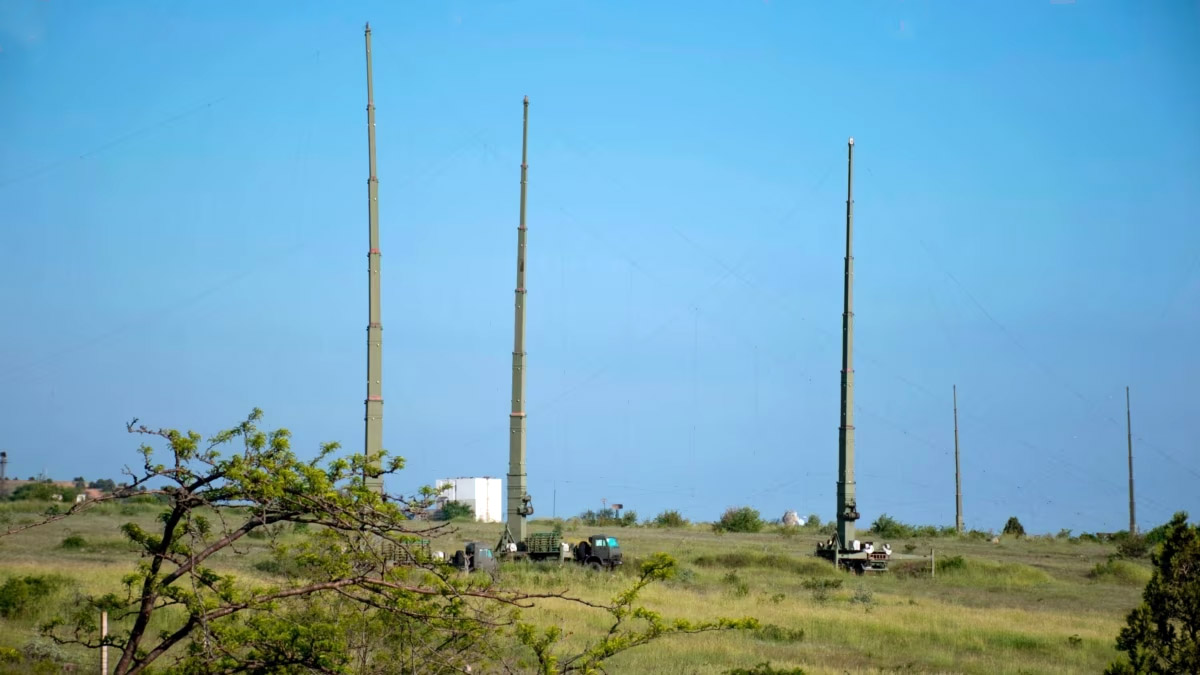
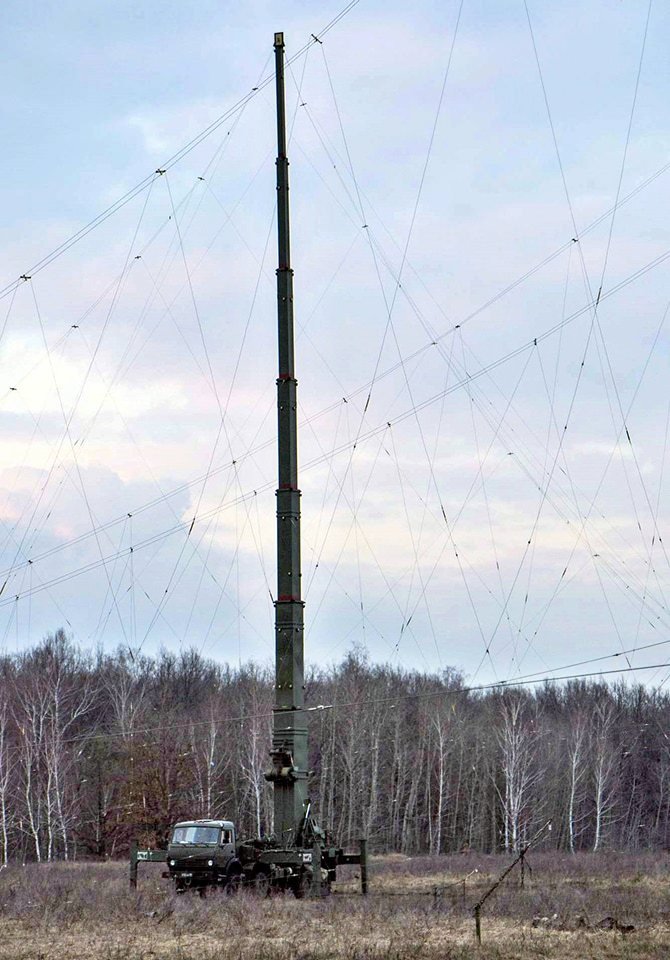
Why tall masts? At HF a wavelength is 10 to 100 m. Antennas need to be a sizeable fraction of a wavelength, and their height above ground sets the elevation angle at which they radiate best. A mast-mounted antenna tens of metres high pushes energy out at the low angles needed for long single-hop skywave, so the 32 m masts are what makes 3,000+ km reach plausible. [BACKGROUND]
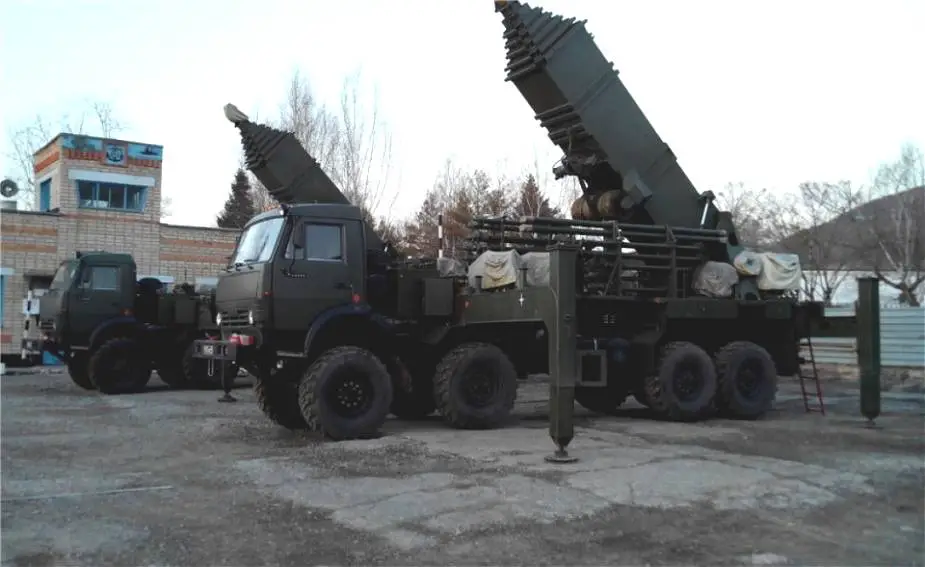
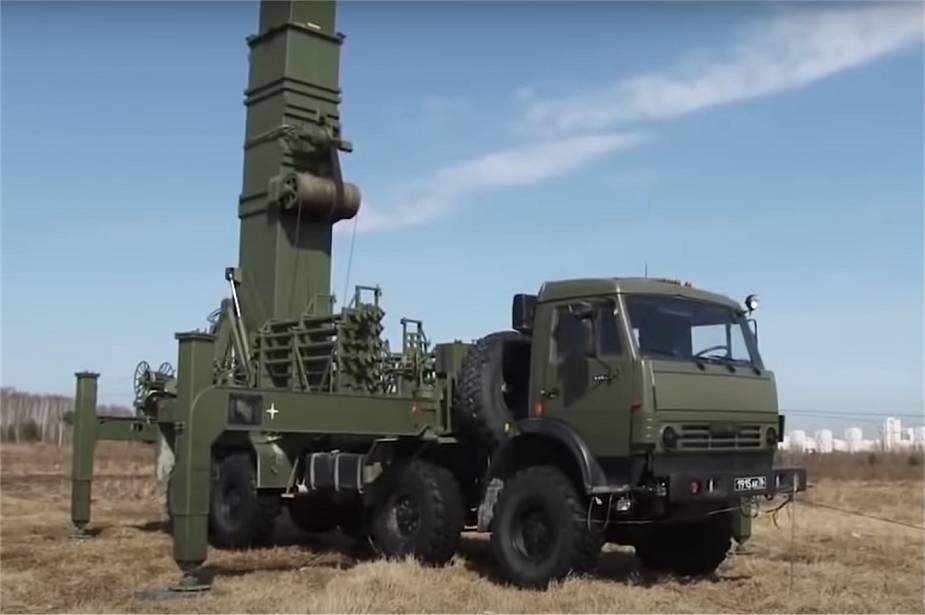
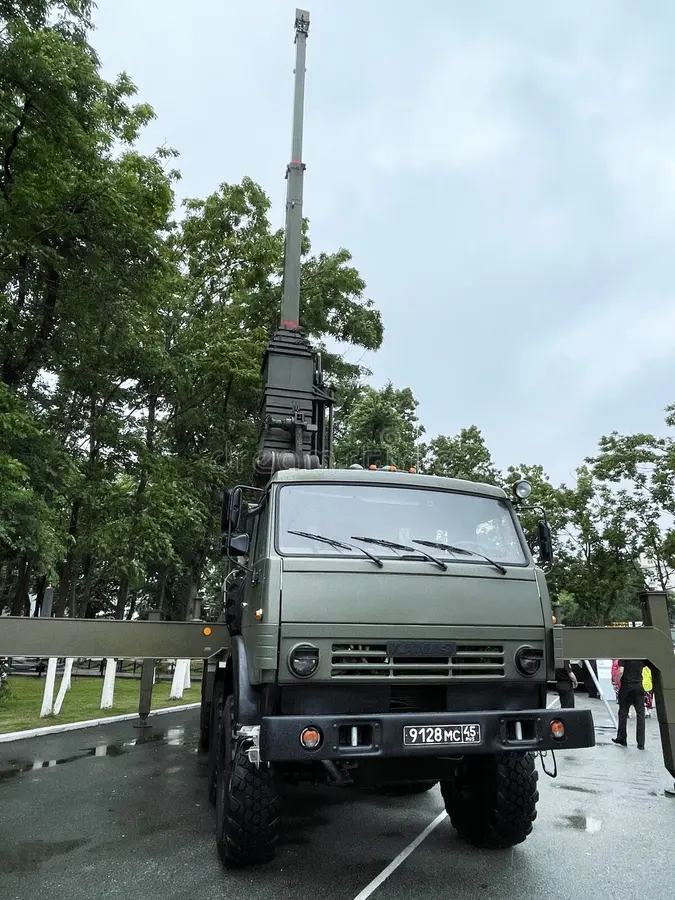
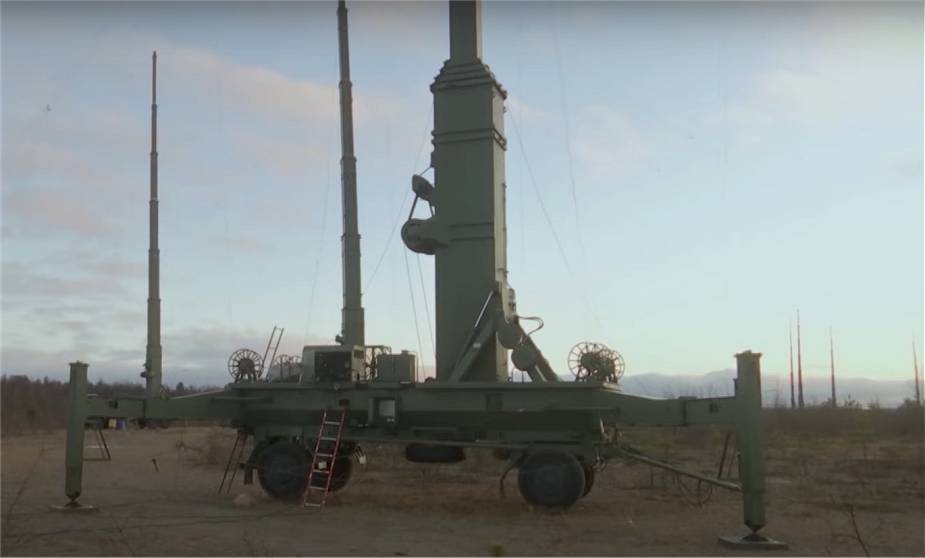
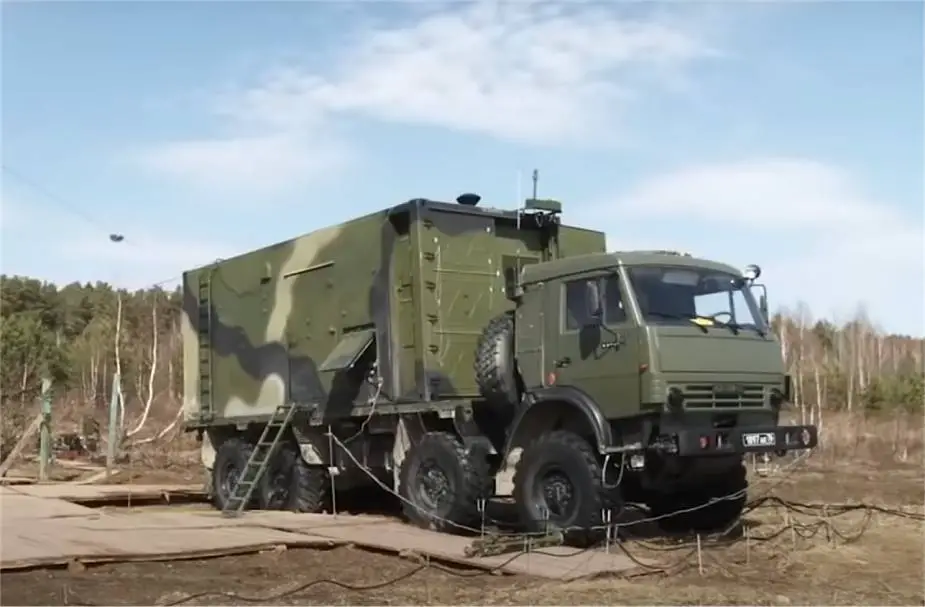
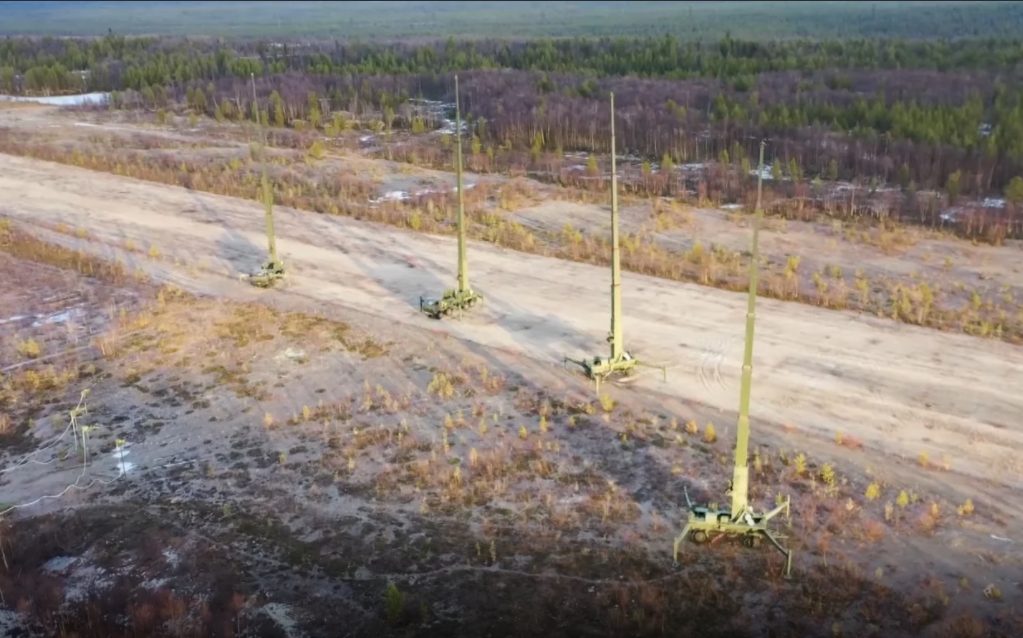
Why several masts? Spaced antennas fed together form an array that concentrates power in a chosen direction, raising effective radiated power without a bigger transmitter, and spaced receive antennas allow direction finding. Armada International reports the four antenna trucks are typically spaced about 35 m apart across a 90-degree arc. [SINGLE-SOURCE, Armada International, citing Russian documents]
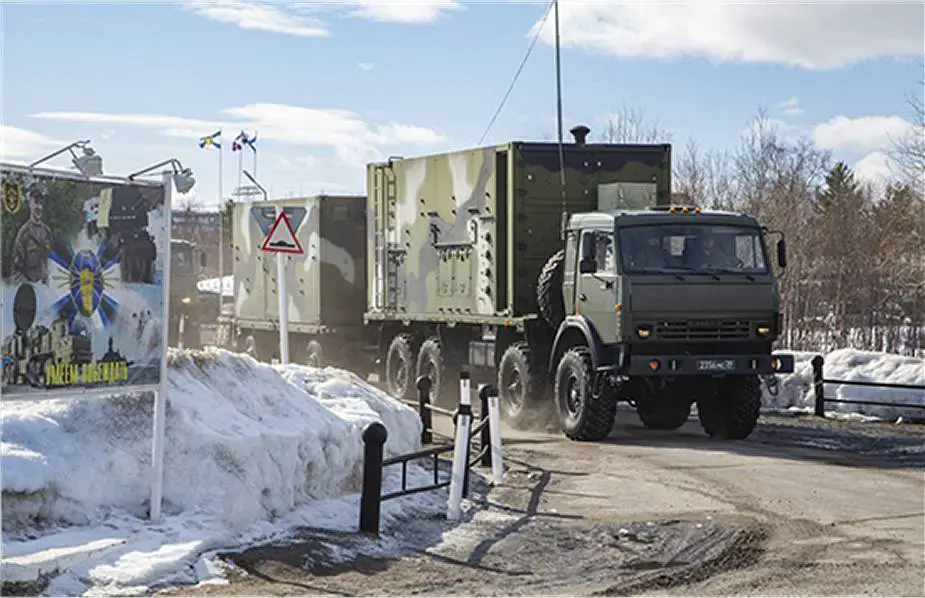
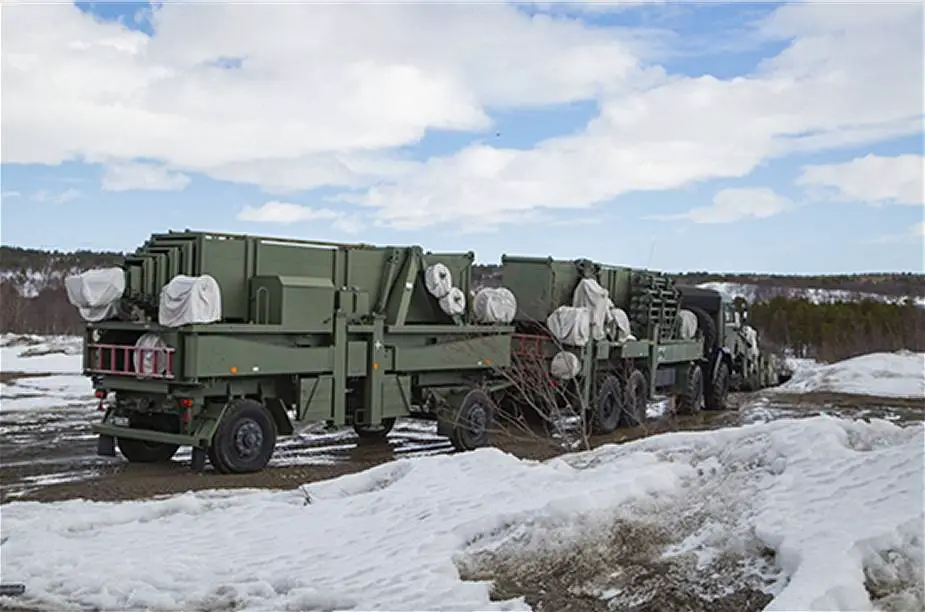
Sources conflict on the vehicle count. Izvestia (via the Baltic Fleet) said the complex moves on seven KamAZ trucks. Armada International, citing Russian documents, says six: four antenna trucks, a command post and a generator. ODIN and Army Recognition describe a full complex as four antenna groups with 16 antennas in total. [DOCUMENTED; the counts disagree] The most likely reading is that a basic set is six or seven trucks and a full complex can field several antenna groups, but the open record does not settle it. [ESTIMATE]
SPECIFICATIONS
| Parameter | Reported value | Note |
| Band | 3-30 MHz (HF) | ODIN, Armada [DOCUMENTED] |
| Effective range | 3,000-5,000 km; up to 8,000 km in good propagation | Russian MoD via Izvestia [DOCUMENTED claim, not tested] |
| Jammed area | 640,000 km2 | ODIN, Army Recognition [SINGLE-SOURCE origin] |
| Mast height | about 32 m | widely repeated [DOCUMENTED] |
| Antennas | up to 16 in four groups | ODIN [SINGLE-SOURCE origin] |
| Power supply | up to 400 kW | ODIN, Armada [DOCUMENTED claim] |
| Deployment time | 72 hours | ODIN [SINGLE-SOURCE] |
| Vehicles | 6 or 7 trucks per basic set | Sources conflict |
Transmitter power per channel, number of simultaneous jamming channels, receiver sensitivity and DF accuracy are not published. [UNVERIFIED] The 72-hour deployment time means this is a semi-fixed system: it moves by road between prepared sites rather than manoeuvring with troops. [ESTIMATE]
HOW IT WORKS IN PRACTICE
Based on the Russian descriptions, a mission cycle runs roughly like this [ESTIMATE, reconstructed from Izvestia and ODIN descriptions]:
ODIN describes it as scanning for emitters, identifying HF links and then jamming selected narrow bands, which matches responsive spot jamming rather than continuous barrage across the whole 3-30 MHz band. [DOCUMENTED, ODIN] That is also the only sensible way to spend the power at these distances. [BACKGROUND]
It also needs propagation prediction. To jam a link 4,000 km away, the operators must know which frequencies are open from their site to the victim's receiver now. Russia operates ionospheric sounders and has long practice in HF propagation forecasting, but how Murmansk-BN does this is not documented. [SPECULATION]
DEPLOYMENT AND UNITS
The placement pattern, at the edges of Russia's sea frontiers, fits the stated mission of covering naval and maritime-air HF in the Black Sea and Mediterranean, the Baltic and North Atlantic, the Barents Sea and the Pacific. [ESTIMATE]
COMBAT USE AND CLAIMS
Russian and pro-Russian media have credited Murmansk-BN with disrupting NATO communications and, in some stories, with causing avionics failures on US F-35s over the Black and Baltic Seas. [UNVERIFIED] The F-35 claim makes little technical sense: an HF communications jammer does not damage aircraft avionics, and there is no confirmation from any Western source. This page treats it as information-warfare noise. [SPECULATION]
Since 2022 the Crimean EW sites have been within reach of Ukrainian drones and missiles, and Ukrainian sources have reported strikes on Russian EW and radar sites in Crimea. No confirmed, imaged loss of a Murmansk-BN complex was located for this page. [UNVERIFIED]
There is no open, measured evidence of Murmansk-BN actually breaking a NATO link at 5,000 km. Radio amateurs and HF monitors regularly report jamming and odd signals on military HF frequencies, but tying a given signal to this system is not possible from public data. [UNVERIFIED]
COUNTERMEASURES
LIMITS OF THE OPEN RECORD
Almost everything about Murmansk-BN's performance comes from Russian announcements, repeated in Western reference guides. The range and area figures are claims, not measurements, and they are physically conditional on the ionosphere. The number of complexes built, the true number of vehicles per set, transmitter power per channel, and evidence of real effect against NATO networks are all unpublished. Treat any confident statement of "8,000 km" as the best-case advertising figure it is. [ESTIMATE]
IN ONE SENTENCE
Murmansk-BN is a semi-fixed, mast-and-truck HF intercept and jamming complex fielded with Russian fleet EW centres since 2014, built to find and deny long-range skywave command links at stated distances of 3,000-5,000 km, with performance that in practice rises and falls with the ionosphere.
RELATED ON THIS SITE
HOW THIS ARTICLE WAS BUILT
Written for this site from the sources below. Claims are labelled [DOCUMENTED] where a primary or multiple independent sources support them, [SINGLE-SOURCE] where only one does, [UNVERIFIED] where nothing published located confirms them, [ESTIMATE] for approximate figures or reconstructions, [BACKGROUND] for general physics and context, and [SPECULATION] for reasoning beyond the sources. Where sources disagree, the page says "Sources conflict" and gives both.
See also: Krug HF-DF — Cold War Soviet HF intercept and direction-finding arrays