Home |
Data Base |
Technical |
Radio |
Search
P-270 MOSKIT (SS-N-22 SUNBURN)
П-270 «Москит» | MKB Raduga / AAC Progress | 3M80 family, NATO reporting name SS-N-22 Sunburn
Supersonic sea-skimming ramjet anti-ship missile for destroyers and missile boats
Project Orlan Data Base // public encyclopedia
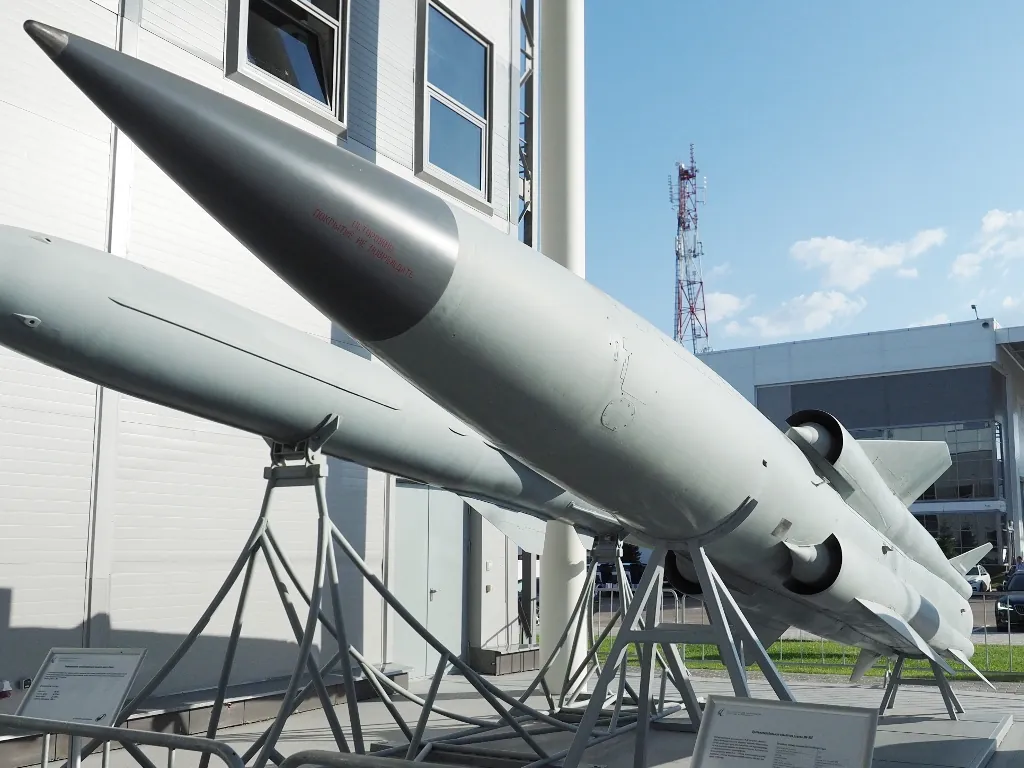
A complete Moskit on outdoor display stands beside a modern building, with a radio mast in the background. The dark ogival radome has red stenciled Russian handling warnings. Two of the four side ramjet inlets are clearly visible on this face, with mid-body wings and X-form tail fins. Plaques stand in front of the mounts. The display site is not identified in the photograph.
Related articles: P-700 Granit, the heavy Chelomey anti-ship missile that fills a different role; P-800 Oniks / Bastion, the later ramjet that replaced Moskit in new construction; Kalibr and Zircon, the other UKSK-cell successors; Project 1155 Udaloy, the gas-turbine partner class and the Shaposhnikov rebuild; and Kashtan, the close-in layer on some of the later carriers.
WHAT IT IS
The P-270 Moskit (П-270 «Москит», "Mosquito") is a late-Cold-War supersonic ramjet anti-ship cruise missile. It was designed by MKB Raduga in Dubna under Igor Sergeyevich Seleznev, built in series at PA / AAC Progress in Arsenyev, and reported by NATO as SS-N-22 Sunburn. The missile's industrial indices are 3M80 and later 3M82; the late export form is 3M-80MVE, and the air-launched show and export form is Kh-41 (also written ASM-MSS). It was built to give destroyers and missile boats a weapon that stays supersonic and sea-skimming from shortly after launch, so that a defended ship has only tens of seconds from radar horizon to impact. [DOCUMENTED]
This is a Raduga missile, from the same bureau as the Kh-22, Kh-55 and Kh-101. It is not a Chelomey / NPO Mashinostroyeniya design. Granit, Bazalt / Vulkan, Oniks and Zircon are the Reutov family. The two lines are easy to mix up in Western tables, and they should be kept apart. [DOCUMENTED]
Series production has stopped. The managing director of AAC Progress, Yuri Denisenko, told the Vladivostok paper Zolotoy Rog that 2014 was the year missile production at the plant ended. Contemporary Russian reporting and later reference compilations treat 1984 to 2014 as the production window. This article found no factory or contract announcement that series production later resumed. What remains is stock: life-extension and exercise firings from surviving Project 956, 1241.1 and 1239 ships, while new construction has gone over to Kalibr, Oniks and Zircon in UKSK cells. That is a confirmed industrial fact plus a well-supported service conclusion, not a guess about a secret line. [DOCUMENTED for the 2014 cutoff; not found for any later restart]
The 2019 firing that is often remembered as the last well-documented live shot is the Pacific Fleet exercise in the Sea of Japan on 15 July 2019, when the Project 956 destroyer Bystry and the missile boat R-24 each fired a Moskit at a ship-target shield about 60 km away. Later open reporting also describes Pacific boats firing Moskit during the Ocean-2024 exercises. Those shots are expenditure of remaining rounds, not evidence of a reopened production line. No documented combat firing against a hostile warship was found as of 14 November 2026. [DOCUMENTED for the 2019 shoot; SINGLE-SOURCE for the 2024 boats; not found for combat use]
As with every system in this database, nearly every performance number below is a manufacturer, ministry or reference-work figure, not a measured combat result. Where the sources disagree, both figures are kept and the conflict is labelled. The designation thicket around this missile is real, and it is left visible rather than "solved."
QUICK FACTS
- Name: P-270 Moskit (П-270 «Москит»); missile indices 3M80 / 3M-80, later 3M82 and 3M-80MVE; NATO SS-N-22 Sunburn. Alternative complex names P-100 and P-105 appear in some lists. [DOCUMENTED; P-100 / P-105 CONTESTED as official names]
- Designer / makers: MKB Raduga, Dubna, chief designer I. S. Seleznev; ramjet 3D83 from MKB Soyuz, Turaevo, in a line begun at OKB-670 under M. M. Bondaryuk; solid booster from KB-2 of Plant No. 81; launchers from KB Mashinostroeniya; ship fire control 3Ts-80 from GNPO Altair; series plant AAC Progress, Arsenyev. [DOCUMENTED]
- Service entry: first carriers commissioned from 1981; formal acceptance commonly given as 1984. The exact acceptance decree was not found. [CONTESTED on the exact date]
- Propulsion: 3D83 kerosene ramjet with a solid booster seated in the ramjet nozzle, ejected after about 3 to 4 seconds. Some tables call the combined installation 3D80. [DOCUMENTED; 3D80 vs 3D83 labelling CONTESTED]
- Speed: often cruise about Mach 2.35 and maximum about Mach 2.8; other tables give "over Mach 2," Mach 2.6, or a high-altitude Mach 3. [CONTESTED]
- Range: early ship 3M80 most often about 90 km; export 3M80E 120 km; late export 3M-80MVE 140 km all-low or 240 km on a combined high-low profile. Other figures (100, 153, 160, 250 km) exist and are tabulated, not averaged. [DOCUMENTED as published figures; CONTESTED across sources]
- Flight: after a short boost and a zoom, cruise at about 10 to 20 m, descending to about 7 m in the last stretch, with terminal anti-aircraft manoeuvres of more than 10 g. [DOCUMENTED]
- Warhead: 300 to 320 kg penetrating high-explosive, about 150 kg of fill, delayed impact fuze. A nuclear option is reported, with conflicting 120 kt and 200 kt yields. [DOCUMENTED for the conventional warhead; yield CONTESTED]
- Platforms: Project 956 / 956E / 956EM destroyers (eight missiles); Project 1241.1 missile boats (four); Project 1239 Sivuch hovercraft (eight); Project 1155.1 Admiral Chabanenko (eight); the unique Project 903 Lun ekranoplan; Kh-41 offered for the Su-33. [DOCUMENTED as fits; Kh-41 operational service UNVERIFIED]
- Production: Progress, Arsenyev, ended in 2014. [DOCUMENTED]
- Export: China is the only confirmed customer (four Project 956E / 956EM destroyers). Lists that add Iran, India, Vietnam or Egypt are not supported by a delivery record found here. [DOCUMENTED for China; other operators CONTESTED / not found]
- Combat use: no documented firing at a hostile warship was found as of 14 November 2026. [not found]
DESIGNATIONS AND THE NAME PROBLEM
What is firmly named. In the better Russian sources, P-270 Moskit is the ship-launched complex: the missile, the KT-152M and KT-190 launchers, the 3Ts-80 (3Ц-80) fire-control set, the loader, and the 3F80 ground equipment. 3M80 (also written 3M-80) is the original production missile in that complex, and NATO calls it SS-N-22 Sunburn. Moskit-E / 3M80E is the export missile, with a range commonly given as 120 km. 3M80E1 was a lighter export offer, about 3,970 kg, often listed at 100 km, displayed around 2001 and not found as a fielded round. Moskit-MVE / 3M-80MVE is the official later export missile, a range-extended modernization of Moskit-E that adds a combined high-low trajectory; published figures are a launch mass of 4,450 kg, a length of 9.745 m, and ranges of 12 km minimum, 140 km all-low and 240 km combined. Kh-41 / ASM-MSS (sometimes written ASM-MMS) is the air-launched form displayed under the Su-27K / Su-33. [DOCUMENTED as names and brochure figures; Kh-41 operational service UNVERIFIED; 3M80E mapping onto the Soviet sequence CONTESTED, see below]
Several conflicts must not be silently merged.
3M82 versus Moskit-M versus 3M80E versus 3M80M. A 4 January 1981 Council of Ministers decree ordered a range increase. The ramjet was given a denser kerosene and a variable-area critical nozzle. Ten Moskit-M rounds were fired from a Project 1241.1 boat between 6 August 1987 and 7 July 1989; the achieved range was unstable, with a maximum of 153 km. Missilery.info, following Shirokorad, then says "the modified missile with extended range has the designation 3M-80E," and treats further stretch as Moskit-MVE. Weaponsystems.net instead maps 3M80 as the original (also called P-100), 3M82 Moskit-M as the improved Soviet round (100 to 120 km, possibly P-100M or P-105), and 3M80E as the export of the 3M82. A German table gives still another dating, with P-270M / 3M82 arriving only in 1996. [DOCUMENTED as that site's reading of the tests; the index mapping CONTESTED]
The article does not write "3M82 is just another name for 3M80E." One careful Russian compilation gives the extended-range test missile the export-looking index 3M-80E and barely uses 3M82; several Western compilations treat 3M82 as the Soviet Moskit-M and 3M80E as its export twin. Both cannot be presented as settled. The hardware change — new fuel, variable nozzle, mid-to-late 1980s tests, a maximum recorded 153 km — is better documented than the index. [CONTESTED]
3M80MVE versus 3M80MBE. The official later export index, in Russian, is 3М-80МВЕ, and the complex is Москит-МВЕ. Cyrillic В is V, so in Latin that is 3M-80MVE / Moskit-MVE, which is how the KTRV-derived industry pages give it. 3M80MBE (and "Moskit-MBE") appears in English translations and in some China-related Western writing. It is almost certainly the same Cyrillic string with В read as B, a transliteration artefact, not a separate missile, unless a manufacturer sheet is found that uses both on purpose. 3M80M without the VE suffix is a shorthand for a mid-1980s longer-range round and is not obviously the same object as 3M-80MVE, whose distinctive published feature is the combined trajectory, not only a new fuel. [DOCUMENTED for MVE; MBE treated as a spelling of the same thing]
P-80, P-100, P-105, and the "two SS-N-22s" story. Missilery uses P-270 for the complex. Other compilations title the family P-100 / P-270, or attach P-105 to Moskit-M, often with their own question marks. A 1990s Western reconstruction, associated with Stuart Slade and later inherited by general encyclopedias, split SS-N-22 into a Chelomey rocket called P-80 Zubr and the Raduga ramjet P-270, and sometimes added a submarine "P-100 Oniks." That reconstruction is not corroborated by the Raduga / Shirokorad / missilery accounts used here. The later Chelomey ramjet is the P-800 / 3M55 Oniks (SS-N-26), already covered on this site, and its industrial family is 3K55 / 3M55, which is exactly the number that reconstruction attached to "P-100 Oniks." That looks like a conflation, not a second Sunburn. Some German and English tables instead use P-80 Zubr as a name for the early 3M80 itself, which is a different claim (one missile, two names). Both versions are flagged; neither is endorsed as fact. This article uses P-270 for the complex and 3M80 / 3M82 / 3M-80MVE for the rounds, and says plainly that P-100 and P-105 appear as alternative complex names. [CONTESTED]
A few stray indices should be ignored or handled carefully. 3M81 is listed by Carlo Kopp as part of the family, with no further breakdown found here. [SINGLE-SOURCE] 9M80E and Kh-4, which appear on one widely copied Western page, are typos for 3M80E and Kh-41 and are not used. ASM-MMS versus ASM-MSS is a spelling conflict for the air-launched show name; missilery uses ASM-MSS. [CONTESTED spelling]
DEVELOPMENT HISTORY
Work on a successor to the subsonic and transonic ship missiles then arming Soviet destroyers and boats started at MKB Raduga in 1973. In role it was a follow-on to the P-120 Malakhit (SS-N-9), not a Chelomey heavy. The chief designer was Igor Sergeyevich Seleznev, later associated with the Kh-55 family (see Kh-101). [DOCUMENTED]
The industrial split, as given in compilations after Karpenko, Ganin and Shirokorad, was unusually wide. On-board and ship fire control came from GNPO Altair in Moscow, under S. A. Klimov; the ship set is the 3Ts-80. The ramjet was begun at OKB-670 under M. M. Bondaryuk and finished at MKB Soyuz in Turaevo under V. G. Stepanov, as the 3D83. The solid booster came from KB-2 of Plant No. 81, under I. I. Kartukov. Launchers came from KB Mashinostroeniya: the four-round KT-190 for Project 956 and 1239, and the two-round KT-152M containers for Project 1241.1. Series production was at Progress in Arsenyev, Primorsky Krai. [DOCUMENTED]
Flight tests began at the Peschannaya Balka ("Sandy Beam") range in June 1978. Two booster-only throw shots, on 9 June and 10 October 1978, worked. A long pause followed, mainly because the ramjet was not ready. A 29 December 1979 shot failed when the ramjet did not light and the booster stayed in the nozzle. A 3 July 1980 shot was counted a success for launch and low flight, but the ramjet still did not reach design rating. The first full-configuration shot, on 27 January 1981, was without the active seeker channel and failed on the flight-control system. Direct hits begin in the April–June 1981 work, including combined active and passive seeker channels on 26 June 1981, which closed the flight-design test programme. [DOCUMENTED]
State tests ran from August 1981, from a shore launcher, a Project 1241.1 boat (yard no. 402), and the first two Project 956 destroyers, Sovremenny and Otchayanny. On 21 August 1981 a shore launch reached 102 km with a direct hit. On 29 April 1982 the first destroyer shot, from Sovremenny in the Northern Fleet at a target ship OS-111, reached 141 km and hit the superstructure — longer than the later "90 km" brochure range, and worth keeping as a test figure, not a silently raised service range. On 26 May 1982 a two-missile salvo from Sovremenny was only partly successful (one hit, one overflight at 17 m). On 28 November 1982 a starboard two-missile salvo from Otchayanny in the Barents, at a 5-second interval and 20 knots, scored two hits. The commission counted 15 launches (14 missiles and one mock-up): 8 fully successful, 5 partly successful, 2 unsuccessful. [DOCUMENTED]
The adoption date is mildly contested. RIA, in the 2019 firing story, says tests began five years after 1973 and the missile was accepted in 1984. Weaponsystems.net says 1984 or 1985. Missilery says the 3M-80 complex was adopted "in the early 1980s" on the Project 956 ships, the first of which (Sovremenny) commissioned on 24 January 1981, before the state-test series had finished. The clean way to write it is: first carriers commissioned from 1981; formal acceptance commonly given as 1984. The exact decree date was not found as a document for this article. [CONTESTED]
The 4 January 1981 range-extension decree and the 1987–89 Moskit-M shots are described above. A further, later modernization produced the combined-trajectory 3M-80MVE, marketed for the Chinese second pair of destroyers (Project 956EM) and for Project 12421 boats. The air-launched form was shown to CIS leaders at Machulishchi in February 1992 and to the public at Zhukovsky in August 1992. Raduga was still offering it for export in 1998, when FlightGlobal reported that it had not entered service. [DOCUMENTED]
HOW THE RAMJET WORKS
The Moskit is a combined rocket-ramjet. It is not a turbojet and not a scramjet. A ramjet has no compressor or turbine: at supersonic speed, air rammed into the inlets is compressed by the shape of the ducts alone, kerosene is burned in that air, and the exhaust leaves faster than the air came in. That is the thrust. A ramjet gives no useful thrust when the missile is standing still, so a rocket booster has to get it up to speed first. [BACKGROUND for the cycle; DOCUMENTED for this missile's plant]
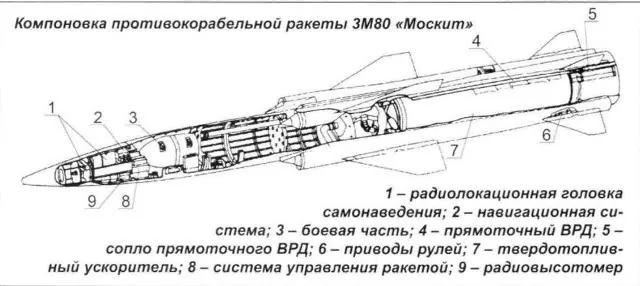
A Russian cutaway titled "Компоновка противокорабельной ракеты 3М80 «Москит»" (layout of the 3M80 Moskit anti-ship missile). The numbered callouts are: 1, radar seeker; 2, navigation system; 3, warhead; 4, ramjet; 5, ramjet nozzle; 6, control-surface actuators; 7, solid-propellant booster, shown in the nozzle; 8, missile control system; 9, radio altimeter.
The published plant is a liquid-fuel ramjet, the 3D83 (прямоточный воздушно-реактивный двигатель 3Д83), burning kerosene, from the OKB-670 then MKB Soyuz (Turaevo) line. Published figures give a start window of Mach 1.8 to 2.5, a light-up time of 0.5 seconds, and a run time of 250 seconds. A solid-propellant booster is seated in the ramjet nozzle. After about 3 to 4 seconds the grain is spent and the case is pushed out of the nozzle by ram air, after which the ramjet can breathe through a clear throat. Early tests failed in exactly this hand-off: on 29 December 1979 the ramjet did not start and the booster stayed in the nozzle; on 31 August 1982 the ramjet did not start and the round fell at 12.8 km. [DOCUMENTED]
Some tables call the combined installation 3D80, "consisting of the 3D83 ramjet and the powder booster." Weaponsystems.net instead assigns a 3D80 ramjet to the early 3M80 and a 3D83 to the 3M82 / 3M80MVE, and gives both a 250-second burn. This article's reading is that 3D83 is the ramjet and 3D80 may be the installation index on some drawings, but a split-by-variant reading cannot be ruled out from a manufacturer sheet, because none was opened. [CONTESTED]
The mid-1980s range work changed the fuel grade (a "more energy-dense kerosene") and added a variable critical-section nozzle so the ramjet could stay efficient across a wider speed and altitude band. That is the documented engineering content of "Moskit-M," whatever index it finally wore. [DOCUMENTED]
The airframe matters at Mach 2 in dense sea-level air. The body is a body of revolution with an ogival nose, four side inlets and ducts, and X-form folding wings and tail. Wing and tail skins are described as titanium OT4 / OT4-1, spars as VKL-3, the tank section as stainless, the ducts as welded titanium, and the radome as a three-layer glass-cloth fairing. Weaponsystems.net adds that inlets, wings and body use titanium "to cope with the heat of air friction at high speeds in dense air at low altitude," and that the layout is descended from the 3M9 (SA-6 Gainful) ramjet family. The SA-6 analogy is single-source in that compilation; the four-inlet ramjet geometry is documented in the Russian descriptions. [DOCUMENTED for the layout; SA-6 analogy SINGLE-SOURCE]
The contrast already drawn on the Oniks page still holds. Oniks packs its booster inside the ramjet combustor and ejects the spent case aft, which keeps the canister short enough for the 3S14 UKSK cell. Moskit's booster-in-the-nozzle arrangement is the older, longer solution. Lengths around 9.4 to 9.75 m are the result. [DOCUMENTED]
VERSIONS
3M80. The original ship missile. Launch mass 3,950 kg, length 9.385 m, diameter 0.76 m, folded and open span 1.3 / 2.1 m. Ship range is most often given as 90 km (some tables 90 to 100, or "up to 120"). Speed is usually quoted as cruise about Mach 2.35 and maximum about Mach 2.8, or, in shorter tables, simply "over Mach 2." Service from the early 1980s / 1984. [DOCUMENTED, with range and speed conflicts reserved for the specifications table]
3M80E (Moskit-E). The export missile. Mass 4,150 kg in the missilery table, same 9.385 m length as the 3M80. Ship range 120 km. This is what went to China on the first pair of Project 956E destroyers, together with the complex. Whether 3M80E is "just an export 3M80," "the export of Moskit-M / 3M82," or the name of the 1987–89 extended-range round is the conflict already flagged. [DOCUMENTED as the export index and the 120 km figure; CONTESTED as a unique airframe]
3M80E1. A lighter export offer, 3,970 kg, with range often given as 100 km. GlobalSecurity dates a Raduga display of a lightened 3M-80E1 to August 2001. It was not found as a fielded round. [DOCUMENTED as an offer]
Moskit-M / 3M82 / (sometimes) 3M80M. The mid-life Soviet range and motor upgrade: new kerosene, a variable nozzle, and in some accounts a larger tank. The test maximum was 153 km and unstable in 1987–89. Service-range figures then scatter: 100 to 120, 120, 160, even 250 km in one compilation. An in-service date of 1996 in one German table does not match the 1987–89 shots. The upgrade is real; the index and the advertised range are contested. [DOCUMENTED / CONTESTED]
3M-80MVE (Moskit-MVE; also written 3M80MBE). A KTRV / Raduga modernization of Moskit-E. Two published profiles: all-low at 10 to 20 m to 140 km, or combined with a high leg at about 12 km and a 40 to 45 km terminal skim at 10 to 20 m, to 240 km. Mass 4,450 kg, length 9.745 m, minimum range 12 km, speed "up to 2,900 km/h" in the industry write-up. It was intended for Project 956EM and 12421, and as a possible shore fit. [DOCUMENTED] Weaponsystems.net instead gives MVE 120 km sea-skim and 160 km with a high leg, a direct conflict with the 140 / 240 km brochure. [CONTESTED]
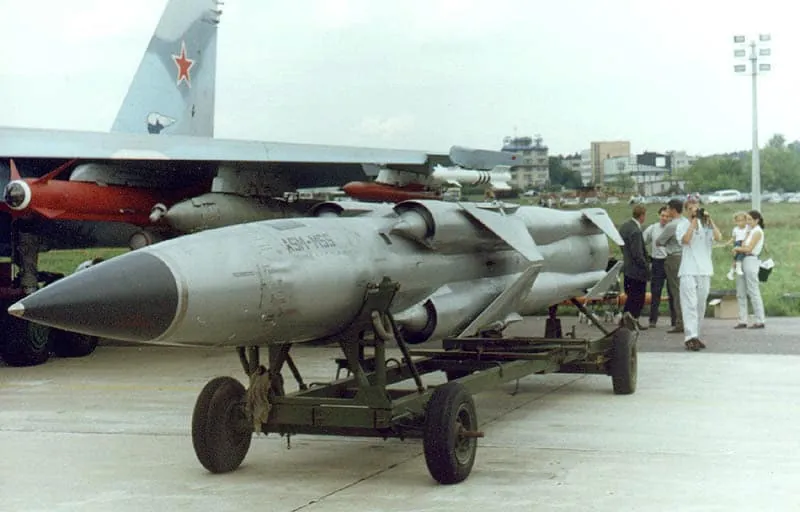
An air-launched Moskit, stenciled ASM-MSS (the Kh-41 show and export name), on a four-wheel ground dolly in front of a Flanker-family fighter. The aircraft's tail carries a red star; under the wing are other stores, including a red-nosed missile. People stand on the apron in the background. The setting looks like an air show or static display; no tail number is readable in the photo, so the airframe is not identified here.
Kh-41 (ASM-MSS / ASM-MMS). An air-launched 3M80-class round with a folding wing, carried as one missile on the Su-27K / Su-33 centreline tunnel and also marketed on the Su-32FN. Missilery's range table gives 250 km for a 3M80 launched from an aircraft, which is a high-altitude launch figure, not a ship figure, and should not be copied into a Sovremenny row. The missile was displayed in 1992 and pushed for export in 1998. Entry into Russian service was not found, and was explicitly denied in the 1998 FlightGlobal report. [DOCUMENTED as a variant; UNVERIFIED as an operational Su-33 weapon]
Coastal and submarine versions. Manufacturer-style text says the MVE can be adapted to a fixed or mobile shore post for an export customer. Kopp, writing in the late 2000s, described a Moskit-E coastal variant "in development," a two-round TEL on an MZKT-7930. Some aggregator pages invent a P-270MV and NATO SSC-7/12 numbers. No confirmed Russian coastal battalion, and no primary for those NATO SSC numbers, was found. Russia's fielded coastal anti-ship systems on this site are Bastion (Oniks) and, elsewhere, Bal (Kh-35). A submarine-launched Moskit is often asserted in general encyclopedias. No operational submarine fit was found in the Russian technical pages used here. The underwater, canister-launched ramjet in this role is the Oniks. [DOCUMENTED as an offer; UNVERIFIED / not found as fielded systems]
FLIGHT PROFILES, AND WHY IT IS HARD TO DEFEND AGAINST
Two families of profile are documented, plus a terminal weave. Together they are the reason the Moskit has a reputation, in both technical writing and in naval wargames, as a nastier problem for a ship's air defences than the much larger P-700 Granit or P-1000 Vulkan, even though it has less range.
All-low, the classic ship profile. After a short boost, the missile does a "горка" (a zoom or pop-up), then settles at about 10 to 20 m (some texts say "about 20 m") for the cruise. In the last stretch it descends to about 7 m above the wave crests. Intensive anti-aircraft manoeuvres at more than 10 g (Weaponsystems.net: 10 to 15 g, turns up to 60 degrees) are described as ending 9 km from the target; some accounts also describe a "змейка" (snake or S-weave) in that terminal run. A post-launch heading change of plus or minus 60 degrees is a published figure, so a boat can fire off-axis. [DOCUMENTED] An S-manoeuvre in the final stage cuts effective range and terminal speed. That is physics, and should be stated as such, but the magnitude was not found. [ESTIMATE as a qualitative effect only]
Combined high-low (3M-80MVE, and analogously the air-launched long-range case). Industry text describes a high segment at about 12 km, then a terminal low segment of 40 to 45 km at 10 to 20 m, for a 240 km shot; or staying low the whole way for 140 km. The high leg buys range in thinner air and spends it as radar detectability. Kopp's older wording, "high altitude at Mach 3, or sea-skimming at Mach 2.2," is the same idea with different numbers; those Mach figures are contested against the missilery "maximum 2.8 / cruise 2.35" pair and the MVE "up to 2,900 km/h" line (2,900 km/h is about Mach 2.4 at sea-level ISA, and should not be silently converted into Mach 2.8). [DOCUMENTED as the two MVE profiles; CONTESTED on the Mach split]
Why this is a harder problem than Granit or Vulkan. The heavy Chelomey missiles, covered on the P-700 Granit page and, for Bazalt / Vulkan, in the comparisons there, are a different mass class and a different doctrine: long-range, high-altitude cruise, mid-course updates, a coordinated salvo, and a terminal descent onto the target. They are dangerous, but they spend much of the flight high enough to be seen earlier. A defender has time, in tens of seconds that can stretch past a minute or two, to build a track, assign missiles and start a fire-control loop. The classic ship-launched Moskit does not offer that courtesy. It goes down to 10 to 20 m early, stays there, and in the last stretch drops to about 7 m while weaving at more than 10 g. A sea-skimmer first seen at a radar horizon of roughly 15 to 25 nautical miles, closing at around Mach 2 or more, leaves a defender on the order of 25 to 60 seconds. Manufacturer-derived texts often say 25 to 30 seconds for a 3M82-class shot, versus 120 to 150 seconds for a subsonic Exocet. Those are illustrative horizon-and-speed sums, not stopwatch results from a trial against Aegis. [ESTIMATE as a timeline; DOCUMENTED as the published profiles and as the form of the argument]
US Navy writing in the 1990s treated the supersonic sea-skimmer, with the Sunburn as the named example, as the threat that made a mix of soft-kill and hard-kill necessary (SSDS: ESM and decoys, better sensors, point-defence missiles, and Phalanx), because the horizon-to-impact time left "no margin for error." That is a US assessment of the problem, not a claim that Phalanx cannot hit a Moskit or that Aegis cannot. The close-in layer on some of the later Moskit carriers themselves is covered under Kashtan. [DOCUMENTED as a 1997 USNI argument]
The same difference shows up in naval simulations. In the commercial game Sea Power, players often find that a Moskit, despite its shorter range, is harder for a Western air-defence fit to stop than a P-700 Granit or a P-1000 Vulkan, because it stays fast and very low and leaves little time to engage. That is a game observation, not a trial result, and it is not a published kill probability. The physical reasons the game is capturing — a Mach 2-class sea-skimmer first seen at the radar horizon, closing in tens of seconds, with a high-g terminal weave — are the ones described in the open technical literature and in that 1990s US Navy writing about the Sunburn-class threat. [BACKGROUND / ESTIMATE; the simulation is not a source for any figure in this article]
Minimum range is 10 km in most 3M80 tables and 12 km for the MVE. [DOCUMENTED]
SEEKER, GUIDANCE AND THE SHIP'S FIRE CONTROL
The architecture, from the manufacturer-style descriptions and the MVE layout diagram, is inertial mid-course with a radio altimeter holding the sea-skim height, and a combined active / passive radar seeker in the nose, under the glass-cloth radome, with the guidance package and battery behind it and the warhead aft of that. [DOCUMENTED] The seeker frequency band, in megahertz or as I / X / Ku, was not found in the sources opened for this article, nor were antenna type, radiated power, pulse structure or a published ECCM waveform. Those figures are not borrowed from the Oniks (Granit-Elektron monopulse, frequency-hopping, plus or minus 45 degrees, 50 km-class acquisition), which is a different seeker on a different missile. The Oniks page already warns against mixing the two. Kopp attributes an "Altair" active radar seeker; Altair is documented as the bureau for the ship and onboard control system, but the seeker attribution to Altair is single-source in that survey. Weaponsystems.net says there is no secondary optical or infrared seeker. [not found for band and waveforms; Altair seeker and "no IR" SINGLE-SOURCE]
The ship-side 3Ts-80 fire control can process designation on up to four targets, load those data into the missiles, and fire single shots or a salvo at a 5-second interval until the magazine is empty. Time to first launch is given as 50 seconds from power application and 11 seconds from a high-readiness state. [DOCUMENTED]
Mid-course update is a separate question. Weaponsystems.net says updates can come via datalink from a Ka-25Ts radar helicopter, a Tu-95RT, or even the Legenda satellite system. That is the standard Soviet over-the-horizon naval targeting chain (Mineral / Band Stand on the ship is the organic radar). Whether the missile itself has a mid-course command receiver, or only the ship's fire-control is fed by those sources before launch, is not cleanly sourced. Over-the-horizon targeting of the battery is documented in general Soviet practice; in-flight retargeting of a Moskit is unverified. [UNVERIFIED for in-flight command]
The passive channel is documented. In Soviet and Russian combined seekers that usually means the head can angle-track a shipboard jammer or a radiating fire-control radar and, in some modes, use the active channel to complete a range solution. Manufacturer text claims "high probability of hitting the target even under enemy radio countermeasures," with advertised kill probabilities of 0.99 against a group of boats or a ship strike group and 0.94 against a convoy or a landing force. Those numbers are brochure probabilities, not trial results published with a sample size. Writing that the missile has a home-on-jam ability is a fair engineering inference from an active-passive anti-ship head; writing that a specific home-on-jam mode was demonstrated is more than the sources will bear. [DOCUMENTED as claims; UNVERIFIED as measured ECCM performance]
There is no documented missile-to-missile "wolf pack" datalink of the Granit / Bazalt type. The 3Ts-80 assigns targets before launch. That distinction is already made on the Granit and Oniks pages, and it is kept here. [DOCUMENTED as an absence in these sources]
WARHEAD
The conventional warhead is a penetrating high-explosive or semi-armour-piercing charge with a delayed impact fuze. The body's kinetic energy and residual fuel are described as adding to the effect. Warhead mass is given as 300 kg, or 300 to 320 kg; the explosive fill is about 150 kg in the missilery and airbase tables. [DOCUMENTED; the last 20 kg of mass CONTESTED]
A nuclear option, index 3G80P, with a yield of 0.2 Mt (200 kt), appears in a war-russia table apparently after Shirokorad. Other English pages give 120 kt. The yield is contested; the 3G80P index is single-source in that compilation. This article mentions a reported nuclear option with conflicting 120 kt and 200 kt figures and does not pick a yield. [CONTESTED / SINGLE-SOURCE]
Colour text in RIA, GlobalSecurity and missilery says the missile is designed to kill ships up to about 20,000 tonnes, that "1 to 2 missiles [suffice for] a destroyer, 1 to 5 a 20,000-tonne merchantman," and that "15 to 17" would be needed against a formation. These are manufacturer or press claims, not combat results. [UNVERIFIED as effectiveness]
SPECIFICATIONS
The table keeps conflicting figures side by side rather than averaging them. Special cautions: the 141 km shot from Sovremenny on 29 April 1982, and the 153 km Moskit-M test maximum, are test figures, not silently raised service ranges; 250 km is an air-launch or high-profile press figure; and Weaponsystems.net's 160 km MVE high-profile disagrees with the 240 km brochure.
| Parameter | 3M80 | 3M80E | 3M82 / Moskit-M | 3M-80MVE | Kh-41 (air) |
| Complex / export name | P-270 (also P-100 in some lists) | Moskit-E | Moskit-M; P-105 in some lists | Moskit-MVE (also written MBE) | Kh-41, ASM-MSS / ASM-MMS |
| Length | 9.385 m (missilery, airbase) | 9.385 m | 9.745 m in some tables as 3M82 — CONTESTED if it is not a different airframe | 9.745 m (industry, missilery) | Not found separately; expected near the ship missile |
| Diameter | 0.76 m | 0.76 m | 0.76 m | 0.76 m | Not found separately |
| Span, folded / open | 1.3 / 2.1 m | Same | Same | Same | Folding wing, same class |
| Launch mass | 3,950 kg | 4,150 kg | 4,150 kg in some 3M82 tables | 4,450 kg | Not found separately |
| Warhead | 300–320 kg penetrating HE, about 150 kg fill; nuclear option reported, yield 120 or 200 kt CONTESTED | Same class | Same class | 300 kg in the MVE layout diagram | Same class, not separately documented |
| Speed | Cruise Mach 2.35, max Mach 2.8 (missilery); "over Mach 2"; some tables Mach 2.6. CONTESTED | Often folded into the same pair; some notes Mach 2.23 or 2.1. CONTESTED | Some tables Mach 3.0 or Mach 2.8; some split Mach 3 high / Mach 2.2 low. CONTESTED | "Up to 2,900 km/h" (industry); some tables Mach 2.8. 2,900 km/h is about Mach 2.4 at sea-level ISA. CONTESTED | Not found separately |
| Range, low profile | 90 km (missilery); 90–100 or "up to 120" in other tables; 141 km is a 1982 test shot. CONTESTED | 120 km (missilery) | 100–120, 160, or "up to 250" depending on the table; test max 153 km unstable. CONTESTED | 140 km (industry, missilery); 120 km in one Western table. CONTESTED | 250 km in the missilery "3M80 from aircraft" line. SINGLE-SOURCE as a table entry |
| Range, combined / high | Not a published early-ship mode in the brochure table; some press gives 250 km "on a high profile" without saying which version. CONTESTED | Not found as a separate high-profile number | Not cleanly separated | 240 km (industry, missilery); 160 km in one Western table. CONTESTED | See the 250 km air-launch line |
| Minimum range | 10 km | 10–12 km | 10 km | 12 km | Not found |
| Cruise height | About 10–20 m, terminal about 7 m | Same | Same | 10–20 m on the low and terminal legs; about 12 km on the high leg | Not found separately |
| Ramjet | 3D83 (or 3D80 installation / early index — CONTESTED) | 3D83 class | 3D83, variable nozzle, new fuel | 3D83 class | Same principle; not a shared part number with the Kh-31 |
| Seeker band | Not found | Not found | Not found | Not found | Not found |
| Platforms | 956, 1241.1, 1239, 1155.1, 1240 trials, Lun | China 956E; export offer | Later Russian and, on some mappings, the 956EM path | Offered on 956EM, 12421, shore | Su-27K / Su-33, marketed Su-32FN; service UNVERIFIED |
Ready time, salvo and life, from the same tables: 50 seconds from power on, 11 seconds from high readiness, 5 seconds between rounds (a four-round group in 15 seconds in the airbase sheet). On-board storage in the container is about 1.5 years (18 months in the KT-152M description). That figure is about shipboard ready storage, not the life of a round in an arsenal, and should not be misread as "the inventory died in 2016." [DOCUMENTED]
LAUNCH PLATFORMS
Project 956 / 956E / 956EM Sarych (Sovremenny). The main battery: two quadruple KT-190 launchers, eight missiles, alongside the Uragan / Shtil SAM and the two twin AK-130s. This is the surface-warfare half of the pair already described on the Udaloy / Project 1155 page (the 1155 hunts submarines; the 956 fights ships). Seventeen Project 956 ships were completed at Severnaya Verf by the end of 1993; unfinished hulls became the Chinese sale. [DOCUMENTED]
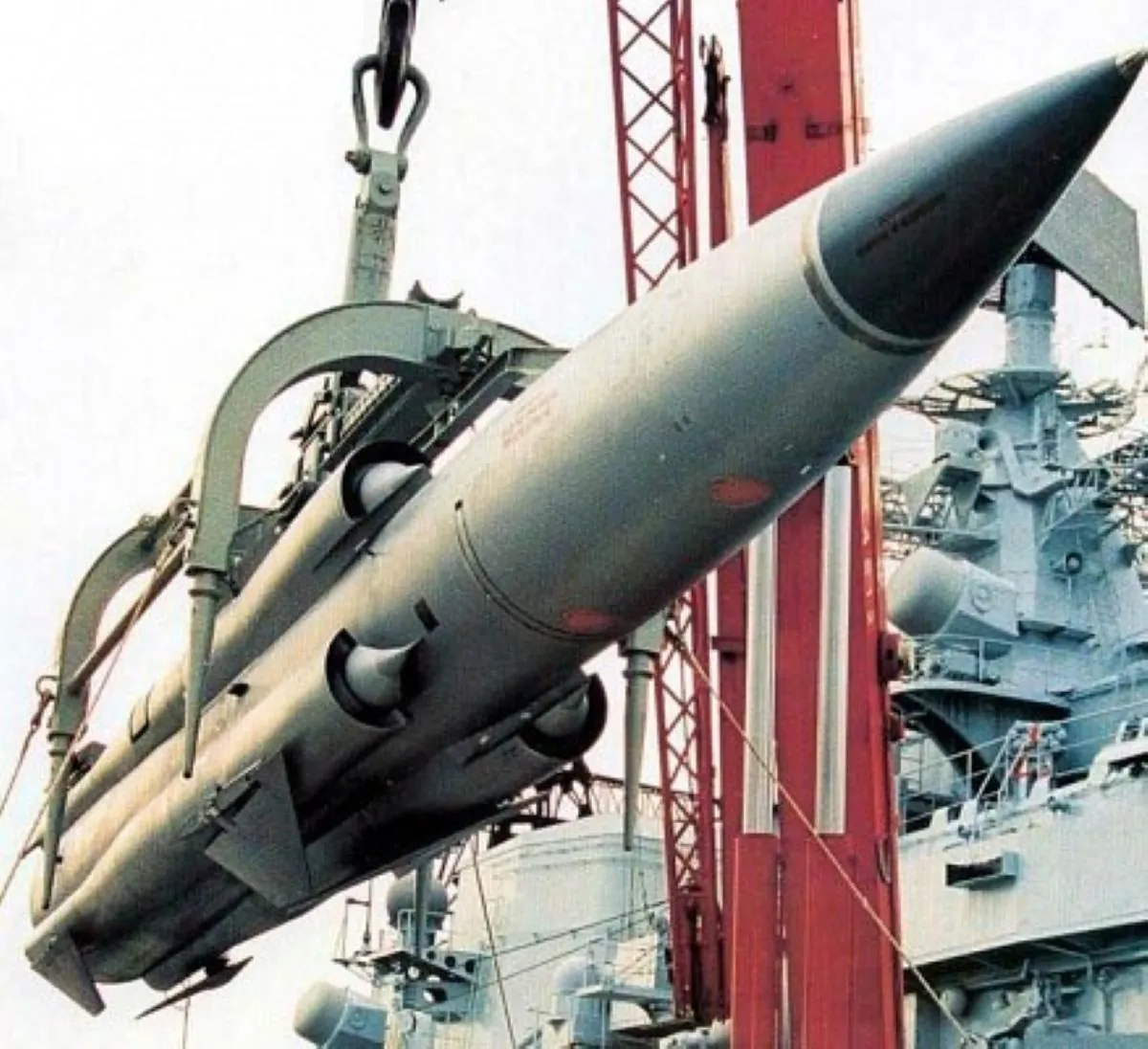
A Moskit is hoisted in a handling beam, nose up, with all four side inlets and the folded fins clearly visible. A red crane frame stands behind it, and a warship superstructure with a large enclosed mast and radars fills the background. The mast and radar fit are consistent with a Project 956 Sovremenny-class destroyer, though the ship is not named in the photograph.
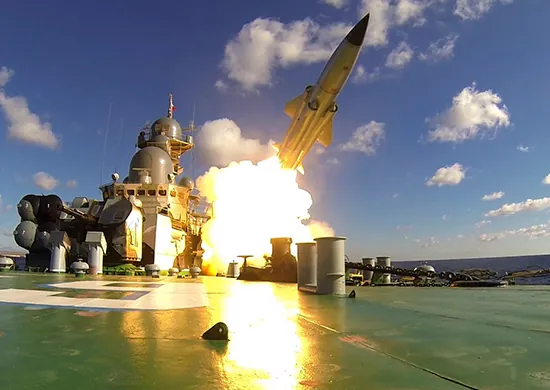
A Moskit climbs away from a box launcher in a cloud of booster flame, photographed from a green helicopter deck looking toward the superstructure. The green flight deck and stacked superstructure are consistent with a Project 956 Sovremenny-class destroyer, though the ship is not named here.
Russian 956 status by late 2025 / 2026 is a residual force. Open reporting describes Bystry as decommissioned in 2022 (she was one of the two 15 July 2019 shooters), Burny as effectively finished as a repair prospect around 2023, and Admiral Ushakov as removed from the combat inventory in December 2025. Nastoychivy in the Baltic has long been inactive and has been the subject of decommissioning reports. Each hull's exact strike date is treated as single-source in the stories cited; the trend is documented: the class is leaving the fleet, and it is not being rebuilt around UKSK / Oniks the way some Project 949A and 1144 ships are. Why that mid-life path was not taken is taken up in WHAT REPLACED THE MOSKIT below. [DOCUMENTED as a trend; individual retirement dates SINGLE-SOURCE in the cited reports]
Chinese Hangzhou class (Project 956E and 956EM). Two 956E (Hangzhou 136, Fuzhou 137) and two 956EM (Taizhou 138, Ningbo 139) were delivered with Moskit: the first pair with the 3M80E complex, the second pair with the longer-range export missile (3M-80MVE, often written 3M80MBE in China-related English). From about 2015, and with Hangzhou reported complete in late 2019, China has been refitting at least the first ships, replacing the eight Moskit tubes with YJ-12 (YJ-12A in some captions) and the Shtil launchers with a 32-cell VLS for HQ-16. That is replacement, not Chinese licensed production of Moskit. [DOCUMENTED as the original fit and as a Hangzhou-class upgrade path] How many of the four hulls have completed the missile swap, and what happened to the removed 3M80E / MVE rounds, was not found.
Project 1241.1 / 12411M Molniya (Tarantul III). Two twin KT-152M launchers, four missiles, is the standard description (airbase: "two twin KT-152M, one pair each side"). One compilation's one-line table says 2×3, which would be six; that is contested and is probably a table error. The first 1241.1 boat was delivered in 1981 and used in state tests. More than twenty were built at Almaz, Sredne-Nevsky and Khabarovsk. [DOCUMENTED for the class and the four-round fit; CONTESTED on 2×3]
These boats are not all gone. Pacific and Baltic units remained in service into the mid-2020s and still fired Moskit in 2024 (see below). New-build Project 12418 boats, however, are being finished for the Caspian Flotilla with Kh-35U Uran-U, not Moskit or Oniks — a replacement type, not a 12411M mid-life rebuild. [DOCUMENTED]
Project 1239 Sivuch (Bora / Samum; NATO Dergach). Two unique air-cushion (surface-effect) small missile ships, aluminium-magnesium hull, about 1,050 t full load, up to about 50 knots on the gas turbines. Each has two quadruple Moskit launchers (eight missiles), plus Osa-M, an AK-176 and two AK-630M. Bora went into trial service on 30 December 1989; Samum was built in 1991–92. In 2023–24 both were still a Black Sea asset: Samum was reported damaged by a Ukrainian Sea Baby drone in September 2023 and back in service in 2024; both were reported shifted toward Novorossiysk under drone threat. [DOCUMENTED as the fit; 2023–24 movements SINGLE-SOURCE in the Ukrainian / OSINT reporting]
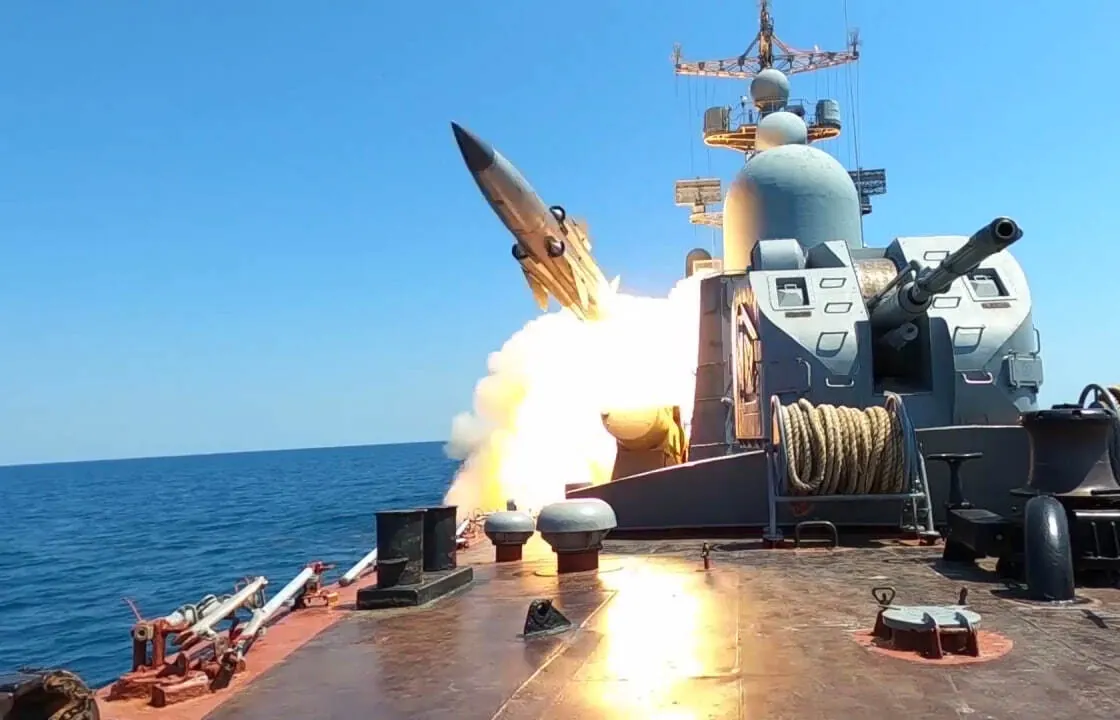
A Moskit leaves its box launcher in a burst of booster flame, photographed from the forecastle of a small warship. A 76 mm AK-176-style gun sits to the right, a coil of rope is on the deck, and the painted deck is reddish-brown. The gun, radomes and deck color are consistent with a Project 1239 Sivuch (Bora / Samum); the individual ship is not identified in the frame.
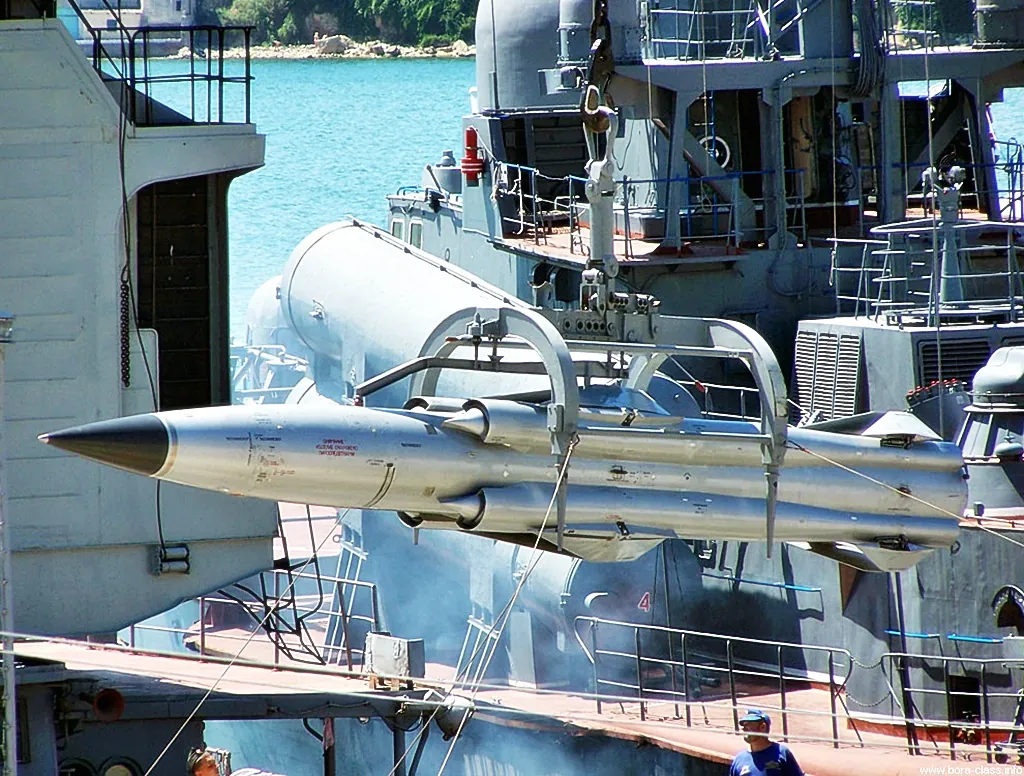
A Moskit is crane-hoisted in a handling beam, its dark radome, four side inlets and folded fins visible, alongside a small warship in a sheltered harbor. A hull marking "4" is painted on the ship's side. The photograph is watermarked www.bora-class.info, which identifies the ship as a Project 1239 Sivuch (Bora / Samum) air-cushion missile ship. A sailor in a blue cap stands on the barge or support deck in the foreground.
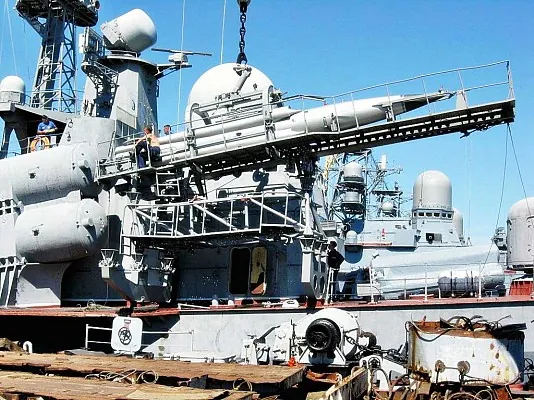
A Moskit in a long loading frame is being crane-positioned onto a compact warship, the missile's dark nose visible at the far end of the rails. Sailors stand on the platform around the frame. The superstructure, radomes and a similar ship in the background are consistent with the two Project 1239 Sivuch air-cushion missile ships (Bora and Samum). Dock equipment sits in the foreground.
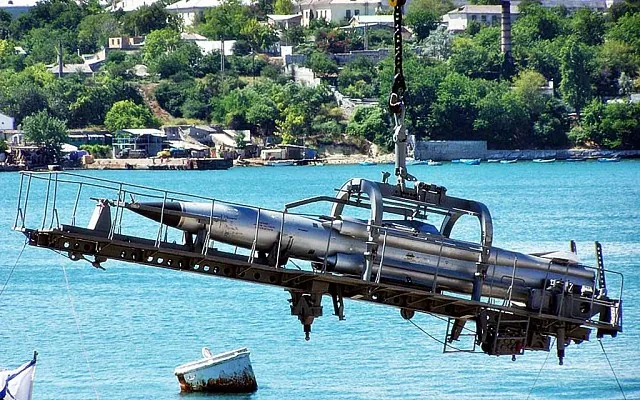
A Moskit sits in a long open loading frame as a crane lifts the whole tray over turquoise water, with a wooded, built-up shore behind it and a small rusted boat in the foreground. The location is not identified in the photograph.
Project 1155.1 Admiral Chabanenko (Udaloy II). One ship, eight Moskit in two quadruples, as already stated on the Project 1155 page. She has been in a long overhaul / modernization, with open reporting in 2025 that the planned rebuild would replace the Moskits (Kalibr / Oniks / Zircon path) and that completion has slipped badly. [DOCUMENTED as the original fit; the replacement, if it happens, is a planned change, not a completed one]
Other carriers, limited or unique. Project 1240 MRK-5, a hydrofoil trials ship, had two twin launchers. [DOCUMENTED as a trials fit] The Project 903 Lun ekranoplan carried six missiles in three twin mounts. Booster-blast trials on a Lun mock-up at Peschannaya Balka took place on 5 October and 21 December 1984; later Caspian launches included one unsuccessful shot and one two-round salvo counted successful. One Lun was built. It was never a fleet type. [DOCUMENTED as a unique carrier] The Su-27K / Su-33 (and the marketed Su-32FN) could carry one round under the fuselage; see Kh-41 above; operational service was not found. One English translation names "Project 11556 Admiral Lobov" as a carrier. The Russian text says 11551. That is the 1155.1 / Chabanenko line with a garbled name (Admiral Lobov is a name from the Slava / 1164 story, not this ship). "11556 Admiral Lobov" is not imported here. [CONTESTED as a typo]
EXPORT CUSTOMERS
The only confirmed export customer is China: two Project 956E and two 956EM destroyers, with 3M80E on the first pair and the long-range export missile on the second. Russian reporting in 2015 still described the export as being for those Chinese 956E ships. Weaponsystems.net, writing later, says China was the only customer, and that the missile was not exported even to the Warsaw Pact in Soviet times. [DOCUMENTED]
A widely copied unsourced line that China ordered "500" rounds is not used here. No contract document was found. [UNVERIFIED] Chinese domestic production of Moskit was not found. The later Chinese move is to put YJ-12 on the same hulls. YJ-12 is a Chinese supersonic ramjet anti-ship missile often compared to Moskit; that is not evidence it is a licensed 3M80, and this article does not say it is.
India, Iran, Vietnam and Egypt are not confirmed, and the claims are probably wrong. RIA's 18 July 2019 explainer listed "China, Iran, India and Vietnam" as operators. Some aggregator pages have mentioned Egypt and, in one paragraph, India. India fields BrahMos / Oniks-family weapons, not a documented Moskit battery. No delivery record for Iran, Vietnam or Egypt was found. The RIA list is treated as a press error, not as a second source. [CONTESTED]
IS IT STILL BEING BUILT?
This is the question the 2019 firing naturally raises, and the answer has to be kept in two piles: what is confirmed, and what would be a guess.
Confirmed. AAC Progress in Arsenyev, the series plant, ended missile production in 2014. Managing director Yuri Denisenko said so in an interview with Zolotoy Rog, reported on 18 December 2015 by Techinsider (and in a contemporary BMPD post of the same news). Missile work had loaded about 30 percent of the plant; the freed stamping and machining shops were to go to aircraft work. By then Progress, inside Russian Helicopters, was a Ka-52 house, and had earlier built P-15-family missiles, Mi-24s, and Yak-50/55s. Independent compilations give production as 1984 to 2014, "several hundred" rounds, no longer in production. "Several hundred" is an estimate; the end-year is consistent with Denisenko. [DOCUMENTED for the cutoff; ESTIMATE for the total]
This research found no subsequent announcement — no new Progress contract, no 2022–2026 mobilisation notice, no restored 3M80 line — that series manufacture has resumed. A Moskit-MVE page remaining in an export catalogue is not a production report. Catalogues lag. The 2019 and 2024 exercise shots are stock, consistent with a finished line, not a new production drumbeat. [DOCUMENTED as the absence of a restart announcement; the shots themselves DOCUMENTED / SINGLE-SOURCE as cited below]
Fair speculation, labelled as such. Some repair, recertification or life-extension of remaining rounds almost certainly happens at a naval arsenal or at Progress, because boats still fire them years after 2014 and the published on-board life is only about 18 months in the container before a trip back through the 3F80 ground set. The existence of a repair shop is a reasonable inference; a new-build shop is not. A named repair or life-extension contract was not found. Residual Russian carriers into the mid-2020s — some 12411M boats, the two 1239 hovercraft, and whatever 956 / 1155.1 hulls have not yet been stricken or rebuilt — will take their magazines to zero by firing, expiry, or the ship's retirement, unless a line is reopened. [ESTIMATE for repair and for the residual inventory; not found for a named contract or a reopened line]
Verdict. Series production of the 3M80 family at Progress ended in 2014. Russia and China are using, storing, or replacing remaining stock. Claims that "Moskit is still in production" were not supported by anything found for this article. If a later source shows a reopened line, that would be new information, not something to be assumed.
WHAT REPLACED THE MOSKIT
The short version is that nothing replaced the Moskit on the ships that already carried it. Russia did not pull the angled KT-190 and KT-152 boxes off those hulls and bolt in a new missile. It stopped building the missile, it is retiring the main carriers, and it put the anti-ship job on newer weapons in newer (or rebuilt) ships. China, the only export customer, is taking a different path and swapping the tubes for a domestic missile. Each of those points needs its own label.
The original magazine is being retired, not rebuilt. The Project 956 destroyers were the Moskit's main battery, eight rounds each. As already noted, Bystry was reported decommissioned in 2022, and the remaining hulls have been leaving the line rather than going into a mid-life conversion around UKSK cells. That is a documented trend, even where an individual strike date rests on a single report. They are not being recelled the way some Project 949A Oscar II boats and the Project 1144 battlecruiser Admiral Nakhimov are being rebuilt around Kalibr, Oniks and Zircon — a path already described on the Granit page. [DOCUMENTED as a trend]
A large part of the reason no Project 956 was given that kind of rebuild is the ship's plant, not only the age of the missile. The 956s use a high-pressure boiler-turbine installation. It needed skilled crews, strict water chemistry and regular overhauls. In the 1990s that maintenance often was not done, and many of the ships ended up laid up because of boiler problems. Army Recognition, quoting the Russian analyst Dmitry Boltenkov in a 2021 piece on Admiral Ushakov, called the boiler-turbine plant "the weak point," one that "demands servicing by skilled specialists and regular maintenance" and that "could not be done in [the] 1990s," after which "many project 956 warships became inoperative." GlobalSecurity likewise describes the choice of a boiler-turbine plant as widely regarded as unfortunate, and notes reports that several of the early ships suffered from poor maintenance and problems in the high-pressure steam boiler system. This site's Project 1155 article already records the same contrast: after 1991, most of the 956s were laid up because their high-pressure steam boilers were hard and expensive to maintain, while the gas-turbine 1155s fared much better, and that plant difference is a big part of why the 1155s outlasted their partners. [DOCUMENTED for the plant, the 1990s lay-ups, and the contrast with the 1155]
That the boilers are a key reason none of the Russian 956s received a Shaposhnikov-style mid-life missile rebuild is the site's reading of those facts, not a quoted official decision document. No source opened for this article produced a ministry statement that said, in so many words, "we will not modernize the Sarychi because of the boilers." The inference is straightforward, and it should still be labelled as an inference: a class that was already expensive to keep steaming was a poor candidate for a deep strike-missile conversion, and the navy spent that kind of money on gas-turbine hulls instead. [ESTIMATE as the causal step]
The contrast is the Project 1155 Udaloy, and the one finished example is Marshal Shaposhnikov. The 1155s run on a COGAG gas-turbine plant. They start in minutes rather than the hours a steam plant needs, and they stayed usable when the 956s were being laid up. That history is set out in the Project 1155 article. Marshal Shaposhnikov was rebuilt at Dalzavod in Vladivostok from 2016 to 2021 (main work from 2016; sea trials from 10 July 2020; back with the Pacific Fleet in 2021) and reclassified from a large anti-submarine ship to a first-rank frigate. The visible missile change was the fitting of two 3S14 UKSK vertical launchers, 16 cells in all, in the position of one of the old AK-100 guns, for Kalibr-NK and Oniks, plus Uran (Kh-35) box launchers. TASS, citing the Pacific Fleet press office on 27 April 2021, said the upgraded ship had entered the fleet's constant-alert forces after test-firing Kalibr, and that she "currently carries two versatile shipborne launchers for 16 Kalibr-NK and Oniks cruise missiles and eventually for Tsirkon hypersonic weapons." A September 2020 USNI Proceedings survey of the Udaloy modernizations describes the same 16-cell Kalibr-family fit. [DOCUMENTED] The original 1155s never carried Moskit; the point of the comparison is the plant and the modernization path, not a missile swap on the same ship. The one Udaloy-line ship that did carry Moskit is the unique Project 1155.1 Admiral Chabanenko, whose planned replacement of those eight tubes has not been completed.
New construction went to universal cells, or to a cheaper subsonic missile. New Russian ships are being built around the 3S14 UKSK for Kalibr, Oniks and Zircon, not around KT-190 or KT-152 boxes. That is the path already described on those pages. New Project 12418 boats, a Tarantul descendant, are being finished for the Caspian Flotilla with Kh-35U Uran-U, not Moskit or Oniks. [DOCUMENTED] The remaining Project 12411M Tarantul boats and the two Project 1239 hovercraft have kept their old Moskit stock, and have gone on firing it in exercises. Their magazines will run down with the ships. That is residual use, not a second production run. [DOCUMENTED as continued exercise use; ESTIMATE for how the residual stock ends]
China replaced the tubes with YJ-12. As noted above, at least the lead Hangzhou-class ships have been refitted, with the eight Moskit tubes replaced by YJ-12 and the Shtil launchers by a 32-cell HQ-16 VLS. How many of the four hulls have finished that swap was not found, and no licensed Chinese 3M80 line was found. YJ-12 is a Chinese design often compared to Moskit; comparison is not a licence. [DOCUMENTED as an upgrade path; not found as Chinese production of Moskit]
THE MA-31 TARGET, AND WHAT THE US NAVY LEARNED
Two separate facts should not be glued into one. By the mid-1990s, US surface officers were writing that the supersonic sea-skimming anti-ship cruise missile was the threat that "keeps them awake nights," and they named the Raduga 3M-80 Moskit (SS-N-22 Sunburn) as a principal example, alongside the Kh-31. Horizon-to-impact time was the issue. The Navy's answer was a mix of soft-kill and hard-kill, and, just as hard, a shortage of realistic targets on which to train and to test those systems. The converted Talos MQM-8G Vandal inventory was running out; the YAQM-127A SLAT ramjet target had failed its shots and been cancelled. [DOCUMENTED]
The target they bought was not a Moskit. Captain Arnold Henderson's September 1997 Proceedings article explicitly floated buying "an actual threat … such as the Russian Raduga 3M-80 Moskit … or the Zvezda-Strela Kh-31A." The programme that went ahead was the MA-31, a McDonnell Douglas / later Boeing conversion of Kh-31 bodies and motors, warhead and seeker removed, with a remote autopilot, beacon, telemetry and a flight-termination system. A 1995 Foreign Comparative Test contract led to QF-4 launches in 1996–2003 (13 launches, three failures). A 1999 award for 34 targets was only partly filled (18 of 34 by 2005) after post-2001 Russian export restrictions; the Navy standardised on the domestic GQM-163A Coyote and cancelled MA-31 in 2007. [DOCUMENTED]
Kh-31 is sometimes nicknamed "Mini-Moskit" because it is also a ramjet anti-ship and anti-radiation round. It is a Zvezda-Strela missile, not a Raduga Moskit, and already appears in a different role on the MiG-31 page. MA-31's value as a Sunburn-class surrogate was kinematic (supersonic sea-skim, high-g weaves; Boeing briefings used "up to 15 g"), not a copied 3M80 seeker. Henderson also noted that its sea-skim range was too short for fully realistic fleet training, and that logistics depended on a Russian pipeline that promptly became a problem. This article does not write that the US "tested against Sunburn" with MA-31, or that MA-31 is a Moskit. [DOCUMENTED]
COMBAT USE, THE 2019 FIRING, AND LATER STOCK
No sourced case was found of a Moskit being fired at a hostile warship, in the Cold War, in Georgia, in Syria, or in the war against Ukraine. The Black Sea hovercraft Bora and Samum have been present in that war, and Samum has been reported damaged by a drone, but that is not a Moskit combat launch. The accurate statement is that no documented combat firing was found as of 14 November 2026, not that the missile is known never to have been used. [not found]
The 2019 firing. Pacific Fleet live-fire, Sea of Japan, 15 July 2019. The ships were the Project 956 destroyer Bystry and the missile boat R-24, a 1241.1-class Moskit boat of the Primorskaya flotilla. The target was a "large ship shield," 60 km away. Bystry fired first; R-24 fired at an interval of a few seconds. The Russian Ministry of Defence said both missiles hit at the appointed time. Two high-altitude MiG-31s and an A-50 AEW&C aircraft were tasked to detect and, if ordered, destroy the missiles; no such order was given. Channel One said up to 20 ships plus ASW aircraft and army UAVs took part in the wider event. The same-day Channel One report is dated 15 July 2019; a same-day Voennoye Obozreniye piece says "today." The MoD video was issued and wrapped by RIA Novosti on 18 July 2019. [DOCUMENTED] The RIA explainer's operator list (Iran, India, Vietnam) and its "10–120 / 250 km" range line are not treated as better than the brochure table; they are a wire-service summary.
Later firings, as evidence of remaining stock. Open reporting of the Ocean-2024 exercises describes Pacific Fleet missile boats R-14 and R-18 firing Moskit in the Sea of Japan around 10 September 2024, in a period when other fleets were shooting Oniks, Kalibr and Kh-35. The exact boats and day are single-source in the secondary pieces found. Weaponsystems.net also captions a 2016 launch and a 2017 launch from a Project 1239. The pattern is exercise expenditure of remaining rounds, not a new production drumbeat. [SINGLE-SOURCE for the 2024 boats; DOCUMENTED as a pattern of later exercise use]
MOSKIT COMPARED WITH GRANIT, VULKAN AND ONIKS
Cross-links: P-700 Granit, P-800 Oniks / Bastion, and, for the later UKSK replacement path, Kalibr and Zircon. There is no dedicated P-500 Bazalt or Kh-22 article on this site as of this writing; Bazalt is treated on the Granit and Zircon pages, and Kh-22 is mentioned on the Kh-101 page as another Raduga air-launched heavy, a cousin only in the corporate sense.
| P-270 Moskit (3M80 family) | P-500 Bazalt / P-1000 Vulkan | P-700 Granit (3M45) | P-800 Oniks (3M55) |
| Bureau | Raduga (Dubna) | OKB-52 / NPO Mashinostroyeniya (Reutov, Chelomey line) | Same Reutov line | Same Reutov line |
| NATO | SS-N-22 Sunburn | SS-N-12 Sandbox | SS-N-19 Shipwreck | SS-N-26 Strobile |
| Role / size | About 4 t class "light" supersonic anti-ship missile for destroyers and boats | Heavy, about 8 t class, surface-ship and surfaced-submarine salvo weapon | Heavy, about 7 t class, underwater and surface launch, carrier-killing salvo | About 3 t class "universal" ramjet, UKSK / Bastion / submarine tubes |
| Propulsion | Ramjet plus nozzle-mounted solid booster (3D83) | Turbojet with booster in the Bazalt family — not a Moskit-style ramjet | Turbojet, as on the Granit page | Ramjet with booster inside the combustor, shorter canister |
| Flight | Supersonic sea-skim from early in the flight; optional high-low on MVE | High-altitude cruise, mid-course updates, terminal descent; leader-missile datalink on this family | Same family idea, coordinated salvo, datalink | High then sea-skim, or a programmed descent point; no documented leader-missile datalink (see the Oniks page) |
| Seeker | Active-passive radar; band not found | Active radar plus datalink family, as on the Granit page | Same | Granit-Elektron active-passive monopulse, published 50 km-class acquisition — do not copy onto Moskit |
| Typical range | 90–120 km low on early and export ship rounds; 140 / 240 km on MVE | Hundreds of kilometres (see the Granit page's Bazalt comparison) | Long-range, as on the live Granit page | Export often about 300 km class, with longer figures on the live Oniks page |
| Platforms | 956, 1241.1, 1239, 1155.1, Lun; offered air and shore | 1164 Slava, 1143 Kiev, Echo II (surfaced), and others | 1144 Orlan, 949 / 949A, Kuznetsov (as on the live pages) | UKSK ships, Yasen, Bastion, BrahMos derivative in India |
| Production | Progress Arsenyev, ended 2014 | Ended; Vulkan a later stretch | Ended early 1990s (live Granit page) | In production and service, and the replacement path for Moskit ships that get a real rebuild |
| Combat use | None found as an anti-ship firing | Moskva in 2022 carried Vulkan, not Moskit; no combat anti-ship firing of the family is used as a claim here | None as a combat anti-ship firing found here | Used as a land-attack weapon in Syria and extensively in Ukraine, as on the live Oniks page — a different job from Moskit's unused anti-ship role |
The comparison to press, for a reader coming from the other pages on this site: Moskit is the older, longer, sea-skimming-from-the-start ramjet that had to be built into a dedicated angled box on a 1980s destroyer or boat. Oniks is the shorter, UKSK-compatible ramjet that absorbed the role, including the coastal one, and has a published seeker data sheet. Granit and Bazalt / Vulkan are a different mass class and a different doctrine (long-range, mid-course coordination, heavy warships and SSGNs). Kh-22 is a Raduga cousin only in the corporate sense: a much larger, high-altitude, liquid-rocket air-launched weapon, not a ship-box missile.
GAPS AND UNSETTLED POINTS
- Formal acceptance decree date: not found; 1984 versus "early 1980s."
- 3M82 versus 3M80E versus Moskit-M versus 3M80M index mapping: contested.
- 3M80MVE versus 3M80MBE: treated as a transliteration unless a sheet uses both deliberately.
- P-80 Zubr as a separate Chelomey SS-N-22: contested, not adopted here as fact.
- 3D80 versus 3D83: contested labelling.
- Seeker band, antenna, power and ECCM waveform: not found.
- In-flight mid-course command of the missile (as opposed to pre-launch targeting): not found as a clean fact.
- Nuclear yield 120 versus 200 kt, and the 3G80P index: contested / single-source.
- Range and speed figures: many, tabulated, not averaged. The 141 km and 153 km figures are test results; 250 km is an air-launch or high-profile press figure.
- Tarantul load, 4 versus 6 missiles: contested; 4 is the better-documented fit.
- Coastal and submarine versions as fielded systems: not found.
- Kh-41 in operational Su-33 service: not found, and denied in 1998.
- Export operators other than China: not found; the RIA list is contested.
- Chinese or Russian post-2014 new-build production: not found.
- A named repair or life-extension contract: not found.
- Combat firing: not found.
- Total production: "several hundred" only, an estimate.
- 3M81: single-source (Kopp).
IN ONE SENTENCE
The P-270 Moskit (3M80 family, SS-N-22 Sunburn) is Raduga's late-Cold-War ramjet anti-ship missile, a roughly four-tonne, four-inlet sea-skimmer that flies at about Mach 2 to 3 a few metres off the water, weaves hard in the last kilometres, and was built to leave a defended ship only tens of seconds to react; series production at Progress in Arsenyev ended in 2014, China was the only confirmed export customer, no combat firing was found, and the surviving Russian rounds are old stock on retiring or unrebuilt carriers, while new ships have gone over to Kalibr, Oniks and Zircon in UKSK cells.
SOURCES
- 1. Missilery.info, "Противокорабельная ракета 3M80 (3М80Е) «Москит»," including the test narrative after Shirokorad / Karpenko and the brochure-style table. missilery.info/missile/moskit and en.missilery.info/missile/moskit ; layout diagram en.missilery.info/missile/moskit/3m80mve
- 2. Industry / KTRV-derived description of Moskit-MVE and the 12 / 140 / 240 km, 4,450 kg, 9.745 m, two-profile figures. infomach.ru/moskit-mve-complex/
- 3. A. B. Shirokorad, Ognennyy mech Rossiyskogo flota (Yauza / Eksmo, 2004) and Entsiklopediya Otechestvennogo raketnogo oruzhiya (AST / Harvest, 2003), as cited by missilery and war-russia.
- 4. A. V. Karpenko and S. M. Ganin, "Otechestvennye aviatsionnye takticheskie rakety," Bastion No. 1, 2000, as cited by missilery.
- 5. War-russia compilation of the same family, useful for the 3D80-installation wording and the 3G80P line, and itself punctuated with designation question marks. war-russia.info
- 6. Airbase.ru 3M-80 fact sheet. airbase.ru/hangar/weapons/3m-80/
- 7. Techinsider, 18 December 2015, quoting AAC Progress managing director Yuri Denisenko in Zolotoy Rog: 3M80 / P-270 production ended in 2014. techinsider.ru/weapon/233354-v-rossii-prekrashchen-vypusk-protivokorabelnykh-raket-moskit/
- 8. BMPD LiveJournal post of the same announcement, as later archived. web.archive.org/web/20160120235140/http://bmpd.livejournal.com/1634042.html
- 9. Weaponsystems.net, P-270 Moskit — production window, variant mapping, 3D80 / 3D83 split, mid-course-update claim, and MVE ranges that disagree with the brochure. weaponsystems.net/system/1430-P-270 Moskit
- 10. Carlo Kopp, "Precision Guided Munitions in the Region," APA-TR-2007-0109, and "Sunburns, Yakhonts, Alfas and the Region," Australian Aviation, September 2000. ausairpower.net/APA-Regional-PGM.html and ausairpower.net/PDF-A/ascms.pdf
- 11. GlobalSecurity Moskit page — useful colour, several typos (9M80E, Kh-4) not imported here. globalsecurity.org/military/world/russia/moskit.htm
- 12. GlobalSecurity, "Sovremenny Class - Project 956," on the boiler-turbine plant and maintenance problems. globalsecurity.org/military/world/russia/956.htm
- 13. Army Recognition, "Russian Northern fleet continues operating Admiral Ushakov destroyer," 2021, quoting Dmitry Boltenkov on the Project 956 boiler-turbine plant as the weak point and on 1990s inoperability. armyrecognition.com
- 14. This site's Project 1155 Udaloy article, for the 956 boiler lay-ups, the 1155 gas-turbine plant, and the Marshal Shaposhnikov UKSK / Kalibr rebuild.
- 15. TASS, "Upgraded frigate enters service with Russian Pacific Fleet’s constant alert forces," 27 April 2021 (Marshal Shaposhnikov, Kalibr-NK / Oniks, two 16-cell versatile launchers). tass.com/defense/1283581
- 16. USNI Proceedings, "Modernizing Udaloy-class ASW Destroyers," September 2020 (16 vertical-launch cells for the Kalibr family on Shaposhnikov). usni.org/magazines/proceedings/2020/september/modernizing-udaloy-class-asw-destroyers
- 17. Kriegsschiffe.net SS-N-22 table — P-80 / 3M80M / 3M82 dating. kriegsschiffe.net
- 18. Stuart Slade, "Russian Anti-Ship Missile Designations," 1999, GulfLink copy — the "two Sunburns / P-80 Zubr / P-100 Oniks" reconstruction. gulflink.osd.mil
- 19. FlightGlobal, October 1998, "Russia exports air-launched Moskit." flightglobal.com
- 20. Capt. Arnold Henderson, "Training Against the Navy’s #1 Threat," USNI Proceedings, September 1997. usni.org/magazines/proceedings/1997/september/training-against-navys-1-threat
- 21. Joseph Trevithick, The War Zone, 7 May 2020, MA-31 programme history. twz.com/33337/navy-needed-targets-to-mimic-supersonic-anti-ship-missiles-so-they-bought-real-ones-from-russia
- 22. Channel One, 15 July 2019, Pacific Fleet Moskit firings. 1tv.ru/news/2019-07-15/368637-rossiyskie_voennye_proveli_takticheskie_ucheniya_v_yaponskom_more
- 23. Voennoye Obozreniye / Topwar, 15 July 2019. en.topwar.ru/160155-na-tof-proveli-uchenija-s-boevymi-puskami-pkr-moskit.html
- 24. RIA Novosti, 18 July 2019 (MoD video; treat the operator list as unreliable). ria.ru/20190718/1556632997.html
- 25. Ocean-2024 secondary wrap-up naming R-14 and R-18. vpk.name/en/916141_firing-a-volley-what-weapons-did-the-russian-navy-show-at-the-ocean-2024-exercises.html
- 26. Project 956 residual-status reporting, including Admiral Ushakov in December 2025 and the Bystry / Burny wrap-up. www1.ru and en.topwar.ru/281712-strannyj-rasklad-dlja-sarychej.html
- 27. Hangzhou-class YJ-12 upgrade reporting. defenseworld.net, 22 March 2021; armyrecognition.com, 2016 plan coverage.
- 28. Naval News, July 2024, Project 12418 / Uran-U as a new-build path, not a Moskit boat. navalnews.com/naval-news/2024/07/russia-launches-project-12418-tarantul-class-corvette-stupinets/
- 29. Project Orlan pages used for consistency: P-700 Granit, P-800 Oniks / Bastion, Zircon, Kalibr, Project 1155, Kashtan, Kh-101 and MiG-31.
Related on this site: P-700 Granit, the heavy Chelomey anti-ship missile: a different bureau, mass class and flight profile, already out of production.
Related on this site: P-800 Oniks / Bastion, the shorter UKSK-compatible ramjet that absorbed Moskit's role, including the coastal one.
Related on this site: Kalibr and Zircon, the other weapons now carried in the same 3S14 UKSK cells.
Related on this site: Project 1155 Udaloy, the gas-turbine partner class, the 956 contrast, and the Marshal Shaposhnikov rebuild.
Related on this site: Kashtan, the close-in layer on some later Moskit carriers (956EM and 1155.1).
Related on this site: Kh-101, another Raduga design from the Seleznev line.
Related on this site: MiG-31, for the Kh-31, which is the MA-31 parent and is not a Moskit.
Related on this site: Naval and Marine Steam Power Plants, the KVN-98/64 boiler plant of the Sovremenny destroyers that carry Moskit.
Project Orlan // Underground Information Database