Home |
Data Base |
Technical |
Radio |
Search
BMPT
БМПТ | боевая машина поддержки танков | Uralvagonzavod / UKBTM
Tank support fighting vehicle, nicknamed Terminator, officially renamed Spiridon in June 2026
Project Orlan Data Base // public encyclopedia
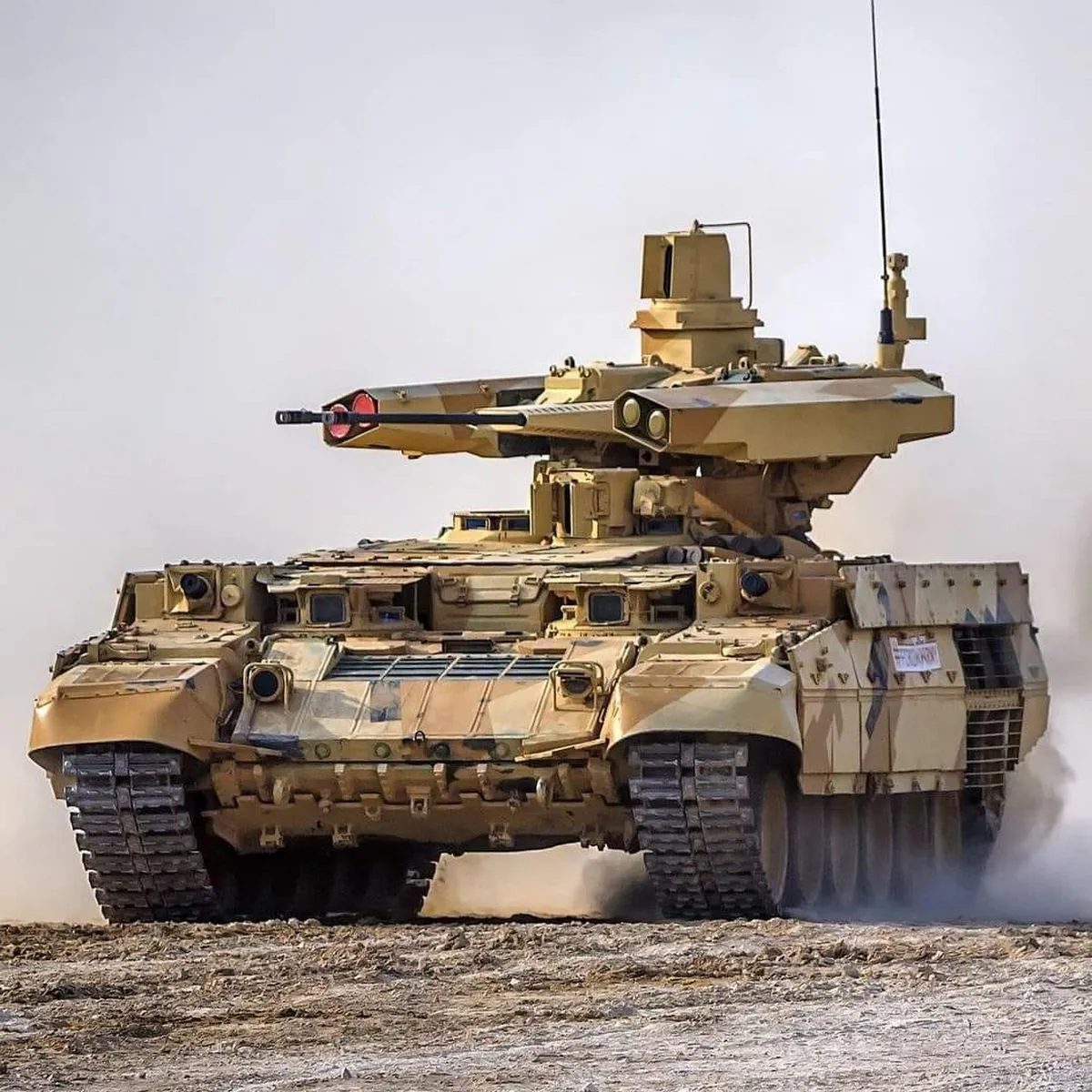
A sand-camouflaged BMPT moving on a dirt track and throwing up dust. The unmanned module carries twin 30 mm 2A42 autocannons and Ataka missile pods; the commander’s panoramic sight and a radio antenna sit on top. Relikt-style ERA is on the glacis, and slat armor is visible at the right rear.
WHAT IT IS
The BMPT (боевая машина поддержки танков, literally “tank support fighting vehicle”) is a heavily armed, tank-hulled fire-support vehicle designed by the Ural Design Bureau of Transport Machine Building (UKBTM) and built by Uralvagonzavod (UVZ) in Nizhny Tagil. It exists to escort tanks and to kill the things that kill tanks: anti-tank guided-missile teams, RPG nests, infantry in upper stories, light armor, field fortifications, and, in the plant description, helicopters and other low, slow aircraft working with army air defence. It is not an infantry fighting vehicle. It carries no dismount squad. The crew fights from inside a tank hull, under an unmanned weapon module. [DOCUMENTED]
The vehicle in Russian Army service, and the one this page is mainly about, is the five-man BMPT adopted after the Army-2017 contract, built on a T-90A chassis, with hull 30 mm AG-17D grenade launchers and four 9M120 Ataka-T missiles beside a pair of 30 mm 2A42 autocannons. The earlier export and development vehicle sits on a modernized T-72 hull. The later export conversion, BMPT-72 or “Terminator 2,” goes back to a T-72 chassis, cuts the crew to three, and deletes the hull grenade launchers. In June 2026 UVZ announced that the type unofficially known as Terminator would be called Spiridon (Спиридон; TASS in English used Spyridon). That is a byname, not a new vehicle. [DOCUMENTED]
Kazakhstan was the first operator, taking ten five-man vehicles in 2011-2013. The Russian Ministry of Defence signed its first production contract on 24 August 2017. The type has been used in the war against Ukraine from 2022, in small numbers, chiefly with the 90th Guards Tank Division. Algeria ordered the BMPT-72 in a large contract reported in 2016; how many have actually arrived is a separate, and contested, question. [DOCUMENTED for the first operators and the 2017 contract; Algerian deliveries CONTESTED]
QUICK FACTS
- Official role: tank support fighting vehicle (БМПТ). UVZ also marketed it as a fire-support combat vehicle (боевая машина огневой поддержки). [DOCUMENTED, UVZ / TASS]
- Designer / builder: UKBTM (Ural Design Bureau of Transport Machine Building); production at Uralvagonzavod, Nizhny Tagil, part of Rostec. [DOCUMENTED]
- Development index: Object 199 “Ramka” (Рамка). Design work from 1998. [DOCUMENTED]
- Crew: 5 on the production / Russian Army BMPT (commander, gunner, driver, two grenade-launcher operators). 3 on the BMPT-72. [DOCUMENTED, UVZ]
- Chassis: modernized T-72 on the 2014 UVZ five-man plant sheet; Russian Army vehicles are widely described as T-90A. BMPT-72 is a T-72 conversion. Torsion-bar suspension, six road wheels a side. [DOCUMENTED, with that hull caveat]
- Combat weight: 48 t +2% (UVZ five-man sheet); 44 t (UVZ BMPT-72 sheet). A 47 t figure in some secondary tables is not preferred. [DOCUMENTED, UVZ]
- Engine: V-92S2 V-12 diesel, 1,000 hp, in standard descriptions and on a Russian cutaway used on this page. The 1,130 hp V-92S2F is the usual engine of later T-72B3 / T-90M tanks; a confirmed BMPT fit was not found on a plant sheet. [DOCUMENTED for V-92S2 as the standard attribution; V-92S2F on a BMPT is UNVERIFIED]
- Main guns: twin 30 mm 2A42, elevation -5° to +45°, traverse 360° with the module. UVZ technical rate of fire up to 600 rds/min (combined). Ready ammunition is commonly given as 850 rounds; some tables say 900. [DOCUMENTED, UVZ, for the angles and rate; ammunition count CONTESTED]
- Missiles: four 130 mm 9M120 Ataka-T family rounds (9M120-1 tandem HEAT, 9M120-1F thermobaric, plus an anti-helicopter round in the family). Range typically 0.4-6.0 km; maximum speed 550 m/s. No published hull reloads. [DOCUMENTED]
- Secondary armament (five-man vehicle): two hull 30 mm AG-17D automatic grenade launchers, vertically stabilized only, narrow traverse; one coaxial 7.62 mm PKTM, commonly 2,000 rounds. Deleted on the BMPT-72. [DOCUMENTED, UVZ]
- Operators: Kazakhstan (10 vehicles, 2011-2013); Russian Ground Forces (from the 2017 contract, 90th Guards Tank Division); Algeria (BMPT-72, large 2016 order, deliveries far below the headline figure as of 2023). [DOCUMENTED for Kazakhstan and Russia; Algerian totals CONTESTED]
DESIGNATIONS AND NAMES
Object 199 is the development index. Ramka (Рамка, “frame”) is the OKR name, often given as Ramka-99. BMPT is the official role abbreviation. “Terminator” was a plant and marketing nickname from early on; UVZ put the word on its own product pages, but it was never a formal Ministry of Defence index in the way Su-35S or T-90M are. [DOCUMENTED]
On 2 June 2026, in the year of the Nizhny Tagil plant’s 90th anniversary, the Uralvagonzavod group told TASS that the tank support vehicle known as the Terminator had been renamed Spiridon (Spyridon in TASS English). UVZ said the change followed a 2025 call for names that drew more than 10,000 letters and about 2,000 unique suggestions, and that it also reflected amendments to Russian law on foreign loanwords. The company linked the name to St. Spyridon of Trimythous and to the sense of the name as “strong, robust, reliable,” and said a trademark application had been filed. The renaming does not, by itself, describe a new chassis or a new armament. This page keeps BMPT as the technical name and notes Terminator and Spiridon as the popular and later official bynames. [DOCUMENTED, TASS / RIA / Interfax, 2 June 2026]
BMPT-72, marketed as Terminator 2, is the three-man T-72 conversion, first shown around the Russian Arms Expo in 2013. BMPT-2017 is a convenient label for the five-man T-90A vehicle contracted at Army-2017; it is still Object 199 in development terms. “Terminator-3” appears in 2017 press and later commentary, sometimes as an Armata-based or 57 mm-gun idea. No official production specification under that name was found for this page. An “Object 183” label for the BMPT-72 turns up in hobby databases and is not treated here as an official index. [DOCUMENTED for BMPT-72 and the 2017 Army type; Terminator-3 and Object 183 are UNVERIFIED or SPECULATION]
WHY IT EXISTS
The usual public explanation starts in Grozny in the winter of 1994-1995. Russian tank columns entering the city were shot at from basements and from upper floors with RPG-7 and RPG-18 launchers. A T-72 or T-80 main gun can be depressed and elevated only in a narrow window; a typical published T-72 elevation is about +14 degrees, which is not enough to fight a team several stories up at short range. The infantry fighting vehicles and APCs that were supposed to cover the tanks, BMP and BTR types, could elevate an autocannon much farther — a BMP-2’s 2A42 is a high-elevation weapon — but they did not have tank armor, and they were destroyed in the same streets. Tanks without close, equally well-protected fire support died, and so did the light escorts. [DOCUMENTED as the standard lesson; the elevation figures are from standard tank data]
That is why the later Object 199 was funded and sold. It is not, however, the first sketch of a tank-support vehicle in the Soviet inventory. In the mid-1980s the Chelyabinsk Tractor Plant (ChTZ) built Object 781 and Object 782 on T-72B chassis. Object 781 is the better described of the two: paired turrets, each with a 30 mm 2A72 and a machine gun, in most specialist accounts. Object 782 lost the comparison and was cancelled. Both prototypes are associated with the Kubinka collection. A later Chelyabinsk experiment, Object 787 “Gadyuka” (Viper), used a T-72AV chassis and mixed cannon, machine-gun and missile armament; an example is shown at Park Patriot. Popular accounts that begin the entire BMPT story in Chechnya skip this earlier work. Grozny is the reason the later UVZ vehicle was taken seriously. It was not the first drawing. [DOCUMENTED in outline; some prototype armament details are secondary]
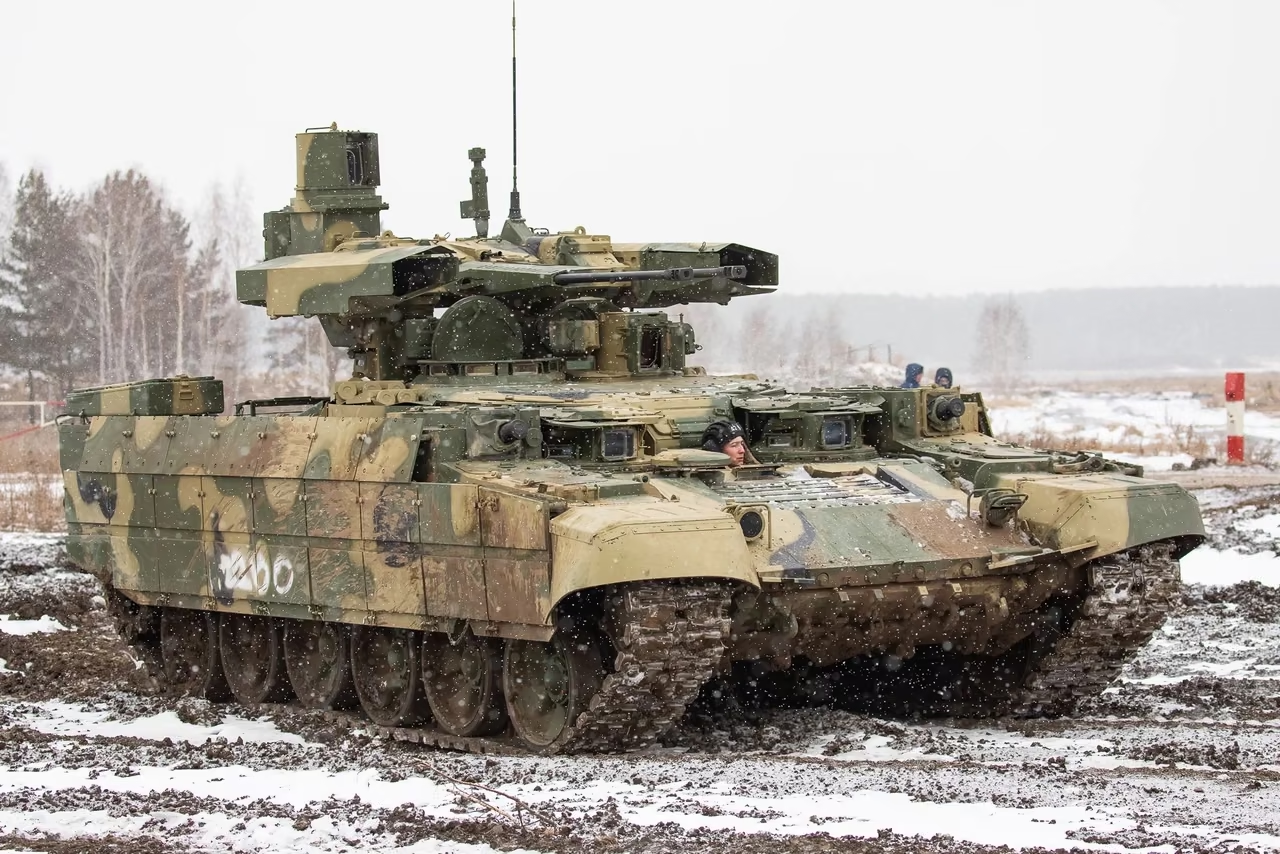
A green-and-tan BMPT in falling snow, with the tactical number 260 on the left side skirt. The driver is visible in the open hatch. The commander’s panoramic sight sits above the unmanned module, six road wheels are visible, and slat armor can be seen at the rear left.
DEVELOPMENT: OBJECT 199 RAMKA
UKBTM began Object 199 work in 1998, under the Ramka-99 experimental design work, against a GABTU requirement in the usual telling. A mock-up was shown around 2000-2001 and a running prototype in 2002. Early Object 199 configurations are described, in specialist writing, as having a single 30 mm 2A42 and 9M133 Kornet missiles before the design settled on twin 2A42 cannons and the Ataka-T missile installation. State trials ran in the mid-2000s. One cluster of sources speaks of intensive proving-ground work in 2002-2004; others say development and trials were finished by the end of 2006. After the trials the vehicle was recommended, in secondary accounts, for production on a T-90 basis. [DOCUMENTED in outline; the trial-year split is CONTESTED]
The Russian Ministry of Defence did not take the type into service around the date that had been discussed for early 2010. A 2010 remark about a small Russian buy was later retracted, and the programme was left without a domestic order. Specialist explanations at the time pointed to the lack of a settled tactical doctrine, the complexity of a five-man vehicle, and the cost of a new type when the army was already modernizing infantry fighting vehicles. Kazakhstan became the first customer instead. [DOCUMENTED that there was no 2010 Russian adoption; the reasons are secondary]
Kazakhstan ordered a first batch of ten five-man BMPTs on a T-90-family chassis. SIPRI-citing sources give the contract year as 2010; some Kazakh and Russian reports say the vehicles were purchased in 2011. Deliveries ran from 2011 to 2013. By late 2013 Kazakhstan was, in the open record, the only operator. Talk of a follow-on 30 vehicles and of licensed assembly by 2015 was reported at the time and has not been confirmed here as completed. [DOCUMENTED for ten vehicles delivered 2011-2013; the order year is CONTESTED]
BMPT-72, TERMINATOR 2
The BMPT-72, shown around RAE 2013, is UVZ’s export and conversion answer: take a T-72B or T-72M hull, replace the turret with a Terminator module, and do it at a tank plant or a repair plant without designing a new chassis. The official 2014 UVZ sheet is clear on what was cut. The crew is three. The two hull AG-17D grenade launchers and their operators are gone. Combat weight is 44 tonnes, not the 47-48 tonnes of the five-man vehicle. Overall height is 3.33 m and width 3.6 m, a little lower and narrower than the five-man plant figures (3.44 m to the panorama, 3.8 m over the side screens). Range with extra fuel drums is given as 500 km, not the 550 km of the five-man sheet. The ATGM installation is described as semi-automatic with a laser guidance channel, with four ready 9M120-1 and 9M120-1F missiles. The visible change in exhibition photographs is the armored shrouds around those missile tubes. [DOCUMENTED, UVZ]
The sales pitch was to armies that already had T-72 tanks and wanted a fire-support vehicle without buying a new hull. That is the vehicle in the Algerian order discussed under EXPORTS. It is not the vehicle the Russian Army contracted in 2017. Contemporary Russian news sometimes used “Terminator-2” as a loose headline for the Army buy; the hardware that went to the 90th Guards Tank Division is the five-man T-90A type. [DOCUMENTED]
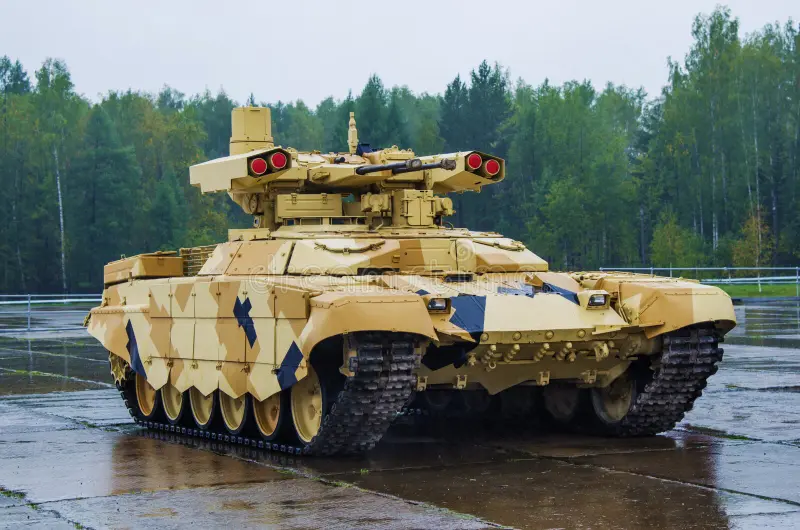
A sand-and-black camouflaged BMPT parked on wet tarmac in front of a forest. Red protective caps are fitted to the Ataka tubes. The commander’s panoramic sight is on the left of the unmanned module, and ERA covers the hull front and sides.
RUSSIAN ARMY ADOPTION
The first Ministry of Defence contract was signed on 24 August 2017, at the Army-2017 forum, between the ministry and Uralvagonzavod. Deputy defence minister Yuri Borisov said this was the first time the Ground Forces were buying a tank support fighting vehicle of UKBTM design. The quantity is widely given as 12 vehicles, for delivery in 2018. That “12” figure is well attested in later specialist reporting; it was not in the short RBC contract story on the day, which also, unhelpfully, quoted BMPT-72 weight and crew figures for a buy that became the five-man T-90A vehicle. A first batch was reported handed over in March 2018 (RIA, 27 March 2018), in time to appear at a parade. [DOCUMENTED for the contract date and the March 2018 hand-over; the 12-vehicle quantity is well-attested secondary]
UKBTM’s general director and chief designer, Andrei Terlikov, told a press conference on 9 September 2017 that a BMPT had already been tried in combat in Syria, against ISIS, and that those results were the basis for the Army-2017 contract. “There was no reason to take it there for parades,” he said, in RIA’s wording: it had been in the fighting, and the ministry had found the information useful. A vehicle in sand camouflage had been shown to Syrian president Bashar al-Assad at Hmeimim airbase on or about 27 June 2017, during a visit with the Russian General Staff. Official language is simply “BMPT.” Some defence outlets called the Syria vehicle a BMPT-72. This page does not pretend to settle the variant from the press photographs alone. Claims that a single vehicle then served with the Liwa al-Quds brigade, or that it was specifically at Deir ez-Zor, rest on weaker secondary reporting and are not treated as established. [DOCUMENTED for Terlikov and the Hmeimim showing; the exact variant and any named Syrian unit are CONTESTED or UNVERIFIED]
The documented Russian user is the 90th Guards Tank Vitebsk-Novgorod Division, in the Central Military District, with garrisons in the Sverdlovsk and Chelyabinsk regions. Specialist reporting put about eight vehicles with the division by 2020. On 1 December 2021 a company of nine was reported as being introduced in a tank regiment of that division, following remarks by the district commander, Alexander Lapin. The type remains uncommon. [DOCUMENTED in outline]
On 1 October 2025, UVZ was reported to have completed a contract and shipped another batch, with additional explosive reactive armor, heavier side protection, anti-drone mesh and spikes, and electronic-warfare equipment, based on combat experience in Ukraine. Released video showed at least five new vehicles on rail. UVZ did not publish the batch size, and this page does not invent a current fleet total. [DOCUMENTED as a delivery event; the number is UNKNOWN]
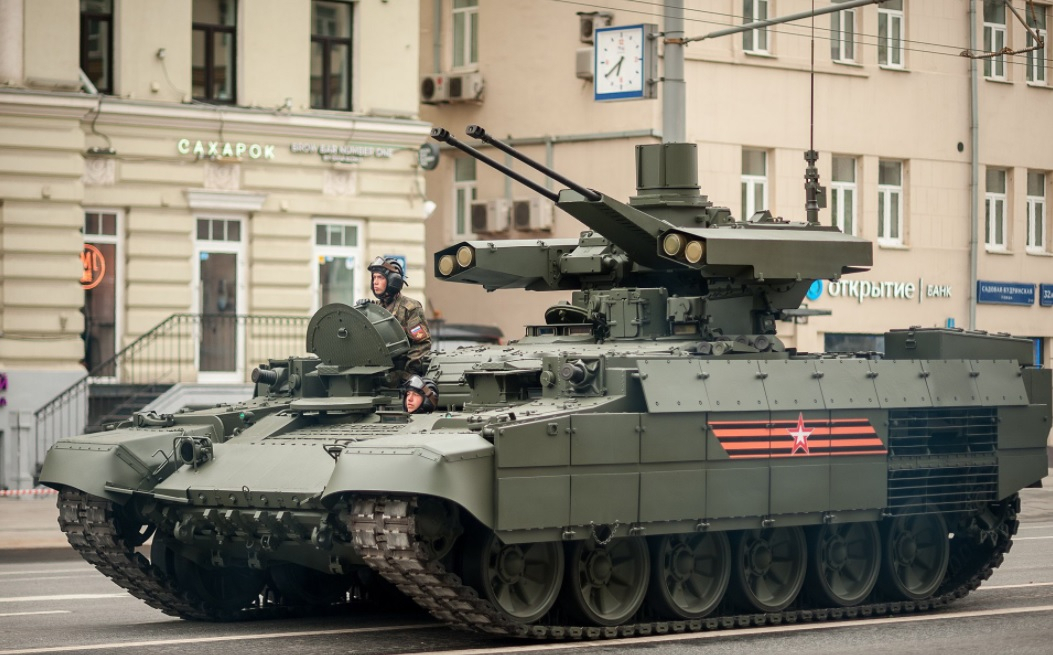
A parade-green BMPT on a city street, with a red star and St. George ribbon on the side skirt. Two crew members are visible, one in the driver’s hatch and one in a left-hand hull hatch. The twin 2A42 cannons and side missile pods are fitted. Shop and bank signs are on the buildings behind, with trolley wires overhead.
CHASSIS, DIMENSIONS AND MOBILITY
The figures in the UVZ columns below are the primary specification for this page. They come from the corporation’s own product pages for the five-man Terminator and for Terminator-2, as archived on 25 June 2014. The five-man page says the vehicle was developed on a modernized T-72 chassis. The Russian Army vehicles contracted in 2017 are widely described as using the T-90A hull. The two hulls share the same family running gear: a torsion-bar suspension and six road wheels a side. The plant numbers are still the best published dimensions, but they should not be silently treated as a measured T-90A data sheet. Where a later secondary table disagrees, that alternate is noted; it is not treated as equal to the manufacturer figure. [DOCUMENTED, UVZ]
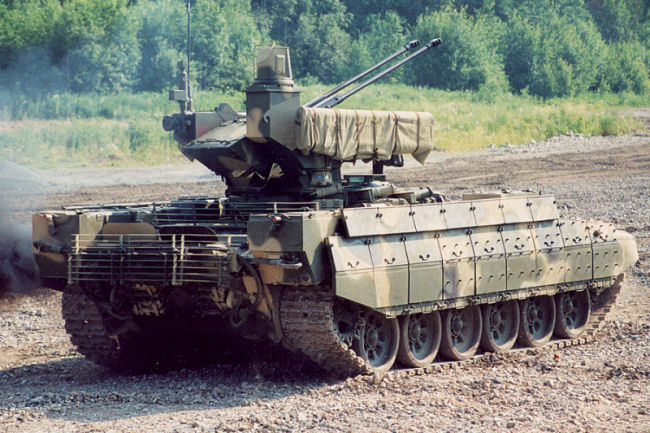
Rear-right view of a green-and-brown BMPT on a gravel track, trailing exhaust smoke. Six road wheels are visible on the near side. Slat (cage) armor covers the rear hull, and ERA blocks run along the side. The twin autocannons are elevated, and a canvas cover is fitted over the right-hand missile pod.
PROTECTION
The BMPT is built to live in the same fire as the tanks it escorts. The hull is a tank hull: a composite glacis in the T-72 / T-90 family, with Relikt third-generation explosive reactive armor widely described on the glacis, the hull sides, and the module or turret face of the production and BMPT-2017 vehicles. Slat or bar cage armor is fitted at the rear, where ERA is harder to apply and where a tandem warhead is less often aimed. An NBC overpressure system and an automatic fire-suppression system are part of the standard description, inherited from the tank chassis. Smoke is provided by the 902A Tucha discharger family; the exact tube count on the BMPT was not found on the 2014 plant sheet. An internal spall liner is often assumed on modern Russian armor and was not confirmed in official BMPT text found for this page. [DOCUMENTED in outline for Relikt, rear slat, NBC and fire suppression; tube count and spall liner UNKNOWN]
The weapon module is unmanned, which keeps the ammunition feeds and the missile tubes outside the crew compartment. Later vehicles fit armored shields or boxed shrouds around the Ataka tubes, a change already visible on the BMPT-72. The October 2025 UVZ batch, as described by the plant and by Russian and Ukrainian specialist press, adds more ERA, heavier side protection, anti-drone mesh and metal spikes, and electronic-warfare gear. That is a factory answer to the FPV-drone problem discussed under COMBAT IN UKRAINE. The BMPT has no published hard-kill active protection system of the Arena-M or Afghanit type, and it is not a Shtora-1 soft-kill fit in the public description used here. Relikt is explosive reactive armor, not an APS. [DOCUMENTED in outline]
ARMAMENT
The firepower that makes the type a type sits in the unmanned module and, on the five-man vehicle, in the two forward sponsons. UVZ’s own 2014 sheet is the starting point; ammunition counts, which the plant page does not list, come from later tables and are tagged where they disagree.
Twin 2A42 30 mm autocannons. The guns are in the overhead module, stabilized in azimuth and elevation. UVZ gives elevation from -5° to +45° and traverse of 360° with the module. The technical rate of fire is given as up to 600 rounds a minute for the installation. That is a combined plant figure. The 2A42, on infantry fighting vehicles, is usually quoted at a low rate of 200-300 rounds a minute and a high rate of about 550. Adding two high-rate figures would contradict the UVZ “up to 600” line, so this page does not do that. UVZ describes the feed as single-belt from magazines in the fighting compartment. That sits awkwardly next to the generic fact that a 2A42 is a dual-feed gun. A coherent reading, also used in some specialist descriptions, is that each tube has one belt, one typically armor-piercing and one high-explosive, so the gunner still has an instant choice of nature without each gun being dual-fed. [DOCUMENTED, UVZ, for angles, the 600 rds/min figure, and the plant wording on the feed]
Ready ammunition is not on the 2014 UVZ sheet. The figure that appears most often in later tables is 850 rounds. Some datasheets, including a widely copied Army Technology table, say 900. The split between AP and HE is not published. The standard 30×165 mm family includes 3UBR6 armor-piercing tracer, 3UBR8 APDS, 3UOF8 high-explosive fragmentation or incendiary, and 3UOR6 high-explosive tracer. Those are the usual 2A42 natures; they are not, in the sources checked here, a unique official BMPT stowage list. Combat video of the twin guns has produced a running argument about barrel vibration and dispersion when both cannons fire. That is an observation from footage, not a manufacturer admission, and it is one of the main technical criticisms of the type. [CONTESTED, 850 versus 900; vibration is observational]
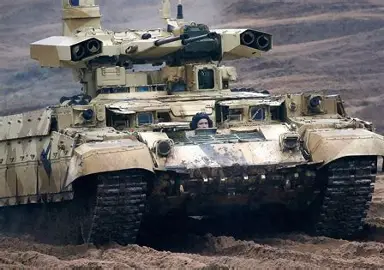
A desert-camouflaged BMPT on dusty ground, seen from the front left. The driver’s hatch is open and a crewman is visible. The unmanned module carries twin 30 mm 2A42 autocannons and four Ataka missile tubes in side pods. ERA tiles cover the glacis and hull sides.
Ataka-T guided missiles. Four 130 mm 9M120-family missiles are carried in two side installations, two tubes a side, with no published reload stowage in the hull. UVZ gives the launcher a traverse of 360° with the module and elevation from -5° to +25° (some brochures give -10° to +25°). The 9M120-1, in the Russian FSVTS catalog and on the Rosoboronexport page, has a maximum range of 6,000 m, a minimum published engagement range of 400 m, a maximum speed of 550 m/s, and a launch mass with tube of about 49-49.5 kg. Average speed is described as supersonic. The tandem HEAT warhead of the 9M120-1 is given in KBM- and UVZ-style tables as at least 800 mm of RHA behind explosive reactive armor. The thermobaric 9M120-1F (9M120F) is the bunker and infantry round. An anti-helicopter member of the family, 9M120O, uses a proximity-fuzed or expanding-rod warhead. Improved 9M120M figures of about 950 mm and 8 km belong to a later missile and are not assumed here as the BMPT load. [DOCUMENTED]
Guidance needs a careful sentence, because sources conflict by talking about different members of the same family. The original helicopter Ataka, like the earlier tank-launched Shturm, is a radio-command SACLOS missile. The FSVTS catalog for the 9M120-1 says the missile is universal: it can be flown by radio command or by a laser-beam channel. The UVZ BMPT-72 plant page specifies a semi-automatic laser guidance channel for the vehicle installation. This page follows that split: the missile family can do both; the BMPT installation is the laser channel. [DOCUMENTED, FSVTS and UVZ; do not flatten this to “radio-command only”]
AG-17D grenade launchers and the PKTM. On the five-man vehicle, two 30 mm AG-17D (AGS-17D) automatic grenade launchers sit in the forward sponsons, each with its own operator. UVZ is explicit that they are stabilized in the vertical plane only, not in azimuth, and that their traverse is narrow: the right-hand launcher from 5° left to 27° right, the left-hand launcher from 27° left to 5° right, elevation -5.5° to +20°. That is a forward, slightly outward arc, not a turret weapon. Secondary tables give 300 rounds per launcher (600 together) and 2,000 rounds for the coaxial 7.62 mm PKTM (6P7 or 6P7K) in the cannon block. Some later lists mention an AGS-30 option; the UVZ plant page names the AG-17D. The BMPT-72 deletes the launchers and the two operators. A secondary write-up that keeps the AG-17D on the Terminator 2 is wrong on that point. [DOCUMENTED, UVZ]
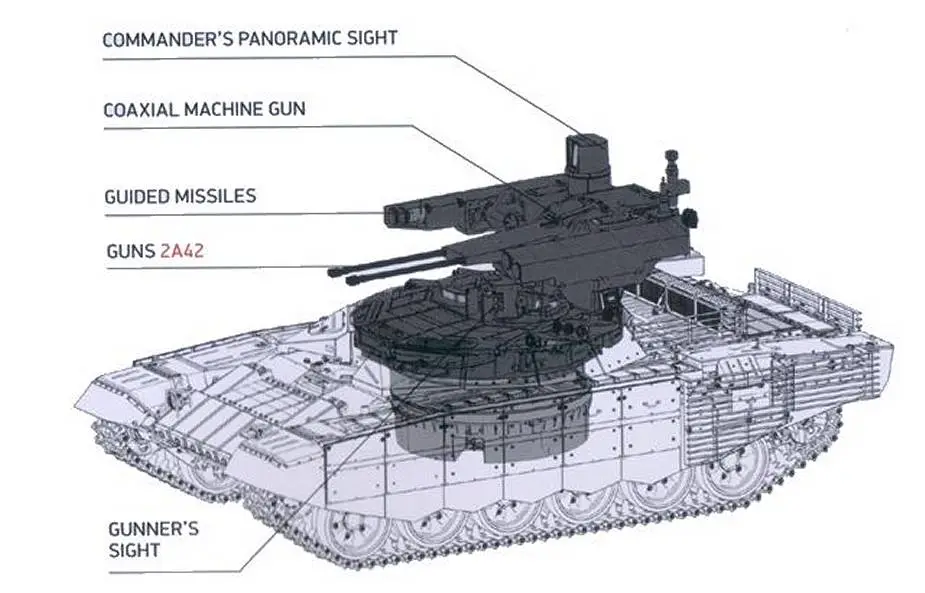
An English line drawing of the BMPT, with the overhead weapon module shaded. Callouts mark the commander’s panoramic sight, the coaxial machine gun, the guided missiles, the twin 2A42 guns, and the gunner’s sight. Slat armor is drawn at the rear.
FIRE CONTROL AND CREW
The fire-control system is referred to as Ramka, the same name as the development work. The commander has a B07-K1 panoramic sight with a 360-degree field of regard, described in standard accounts as having optical, television and laser-rangefinder channels. Whether that panorama has its own thermal channel is less clearly stated. The gunner has a B07-K2 sight with an optical channel, a thermal channel, a guided-missile channel and a laser rangefinder. The usual brochure claim is hunter-killer: the commander can search and hand off a target while the gunner is already firing. A further claim, that the vehicle can engage three or four targets at once, was not confirmed in the official or specialist pages checked for this article and is not treated as a documented fact. A lineage from the Sosna-U or Agat-MP tank sights to the B07 pair was also not confirmed. [DOCUMENTED for the B07-K1 / B07-K2 names and for hunter-killer as a described capability; the 3-4-target claim is UNVERIFIED]
The five-man layout, in UVZ’s own words, is commander, gunner, two course automatic-grenade operators, and driver. The two grenade-launcher operators sit in the forward sponsons and work their own narrow arcs. The three-man BMPT-72 keeps the driver in the front of the hull and the commander and gunner under the module, and drops the sponson stations. In both arrangements the weapon module is unmanned and sits above an isolated crew compartment. A Russian cutaway used on this page labels the commander’s and gunner’s sights, an Agat-MR sight (placed as a hull / sponson sight, which matches earlier specialist notes that the grenade-launcher operators use Agat-MR day/night sights), radios, stowage, a rotating contact device under the module, a fuel tank, and a rear engine compartment with a V-92S2 diesel. Those labels are described as they appear on the drawing. [DOCUMENTED, UVZ, for the five-man stations; Agat-MR and V-92S2 as labeled on the cutaway]
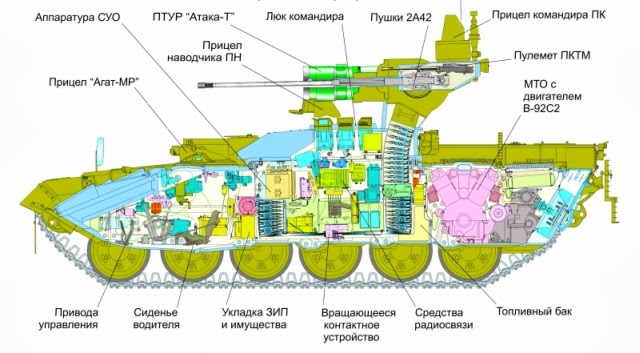
A Russian-language cutaway of a five-man BMPT. Labels identify the fire-control equipment, Ataka-T missiles, 2A42 cannons, PKTM machine gun, commander’s and gunner’s sights, an Agat-MR sight, the driver’s station, spare-gear stowage, radios, a fuel tank, and a rear engine compartment with a V-92S2 diesel.
DOCTRINE
UVZ’s plant description is the cleanest statement of the job. The vehicle is to suppress and destroy tank-dangerous infantry, including troops in cover armed with RPGs, man-portable anti-tank systems and small arms; to kill light armor; to kill tanks and infantry fighting vehicles; and, together with army air-defence units, to fight helicopters and low, slow aircraft. It is meant to move in the same formation as the tanks, with the same protection and the same mobility, so that a tank company is not left to clear a street or a treeline with a 125 mm gun and a coaxial machine gun. The high elevation of the 2A42s is the urban half of that argument. The Ataka missiles are the long-range anti-armor and bunker half. The hull grenade launchers, on the five-man vehicle, are a short-range, forward-arc weapon against infantry the module is already busy for. [DOCUMENTED, UVZ]
How many BMPTs belong with how many tanks is a much softer number. A 16 March 2005 Lenta.ru feature by Pavel Aksyonov, written when a 2005 Russian adoption was still being talked about, said it was assumed that in rough country one BMPT would work with two tanks, and that in a city two BMPTs would “service” one tank. That sentence has been repeated for twenty years. It is early journalism, not a cited field manual. A Russian military-education text located in this research mentions a “reasonable” ratio of one BMPT to three tanks in a regiment discussion. This page records both figures and does not present either as a standing Ministry of Defence regulation. [CONTESTED; 2005 assumption versus a 1:3 remark]
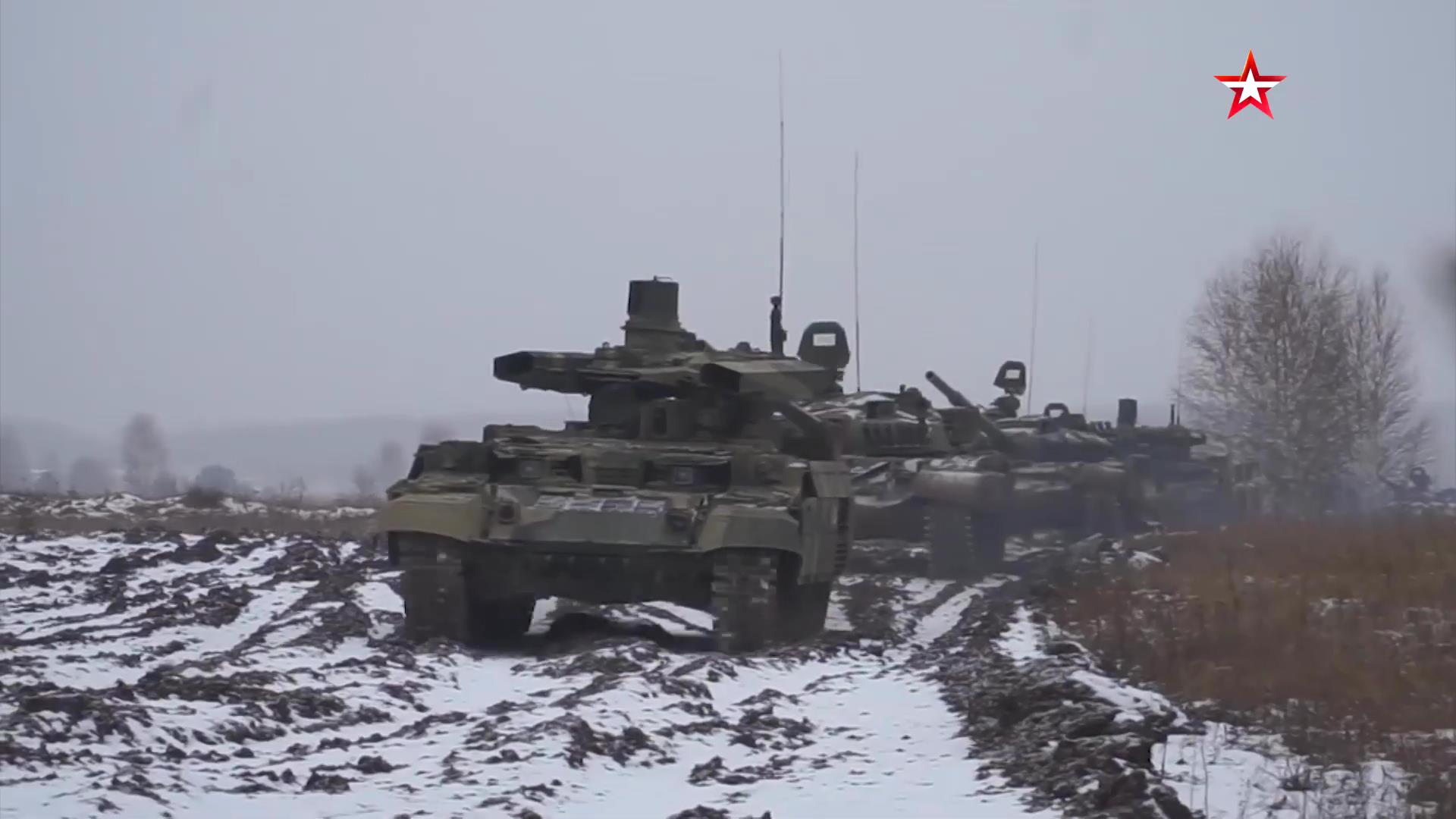
A video still of a BMPT leading a column of tanks along a snowy, rutted track under an overcast sky. At least two main battle tanks follow with their 125 mm guns visible. A red-star television logo is in the upper right corner.
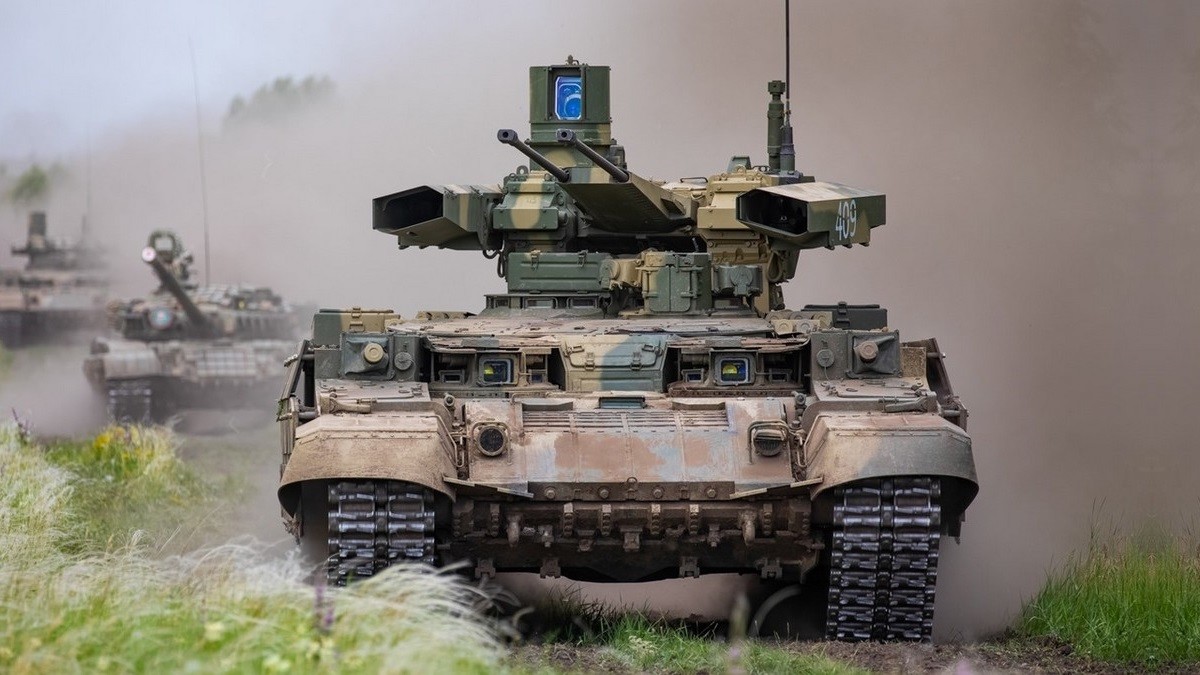
Head-on view of a green-and-brown BMPT, with the tactical number 409 on the right missile pod, moving on a grassy track and throwing up dust. The commander’s panoramic sight shows a bluish window. Two tanks follow in column in the background.
SYRIA, 2017
The Syria deployment matters because the design bureau itself tied it to the first Russian production contract. Terlikov’s 9 September 2017 statement, quoted above, is the primary source: a BMPT was used in combat against ISIS, and those results were the basis for the Army-2017 signing. The Hmeimim showing to Assad in late June 2017 is the other firmly dated public event. Beyond that, the open record gets thinner. This page does not treat a Deir ez-Zor location, a Liwa al-Quds crew, or a definite BMPT-72 identification as documented. What can be said is that a combat evaluation took place in the Syrian theatre in 2017, that the design bureau presented it as useful to the ministry, and that the contract followed in August. [DOCUMENTED for the official link; further operational detail UNVERIFIED]
COMBAT IN UKRAINE
Russian BMPTs were reported in Ukraine from 2022, with the 90th Guards Tank Division, first in the Severodonetsk and Lysychansk fighting and later on the Svatove-Kreminna line. Forest and winter footage is consistent with that sector. The vehicles have been filmed in column with tanks, which is the doctrinal picture, and they have also been filmed under drone attack, which is the war the designers did not advertise in 2002. Field modifications include flexible anti-drone mesh and nets. The factory 2025 vehicles institutionalize more of that protection, plus electronic warfare. [DOCUMENTED in outline from unit and location reporting; a still is not captioned here as a named battle unless the still itself is identified]
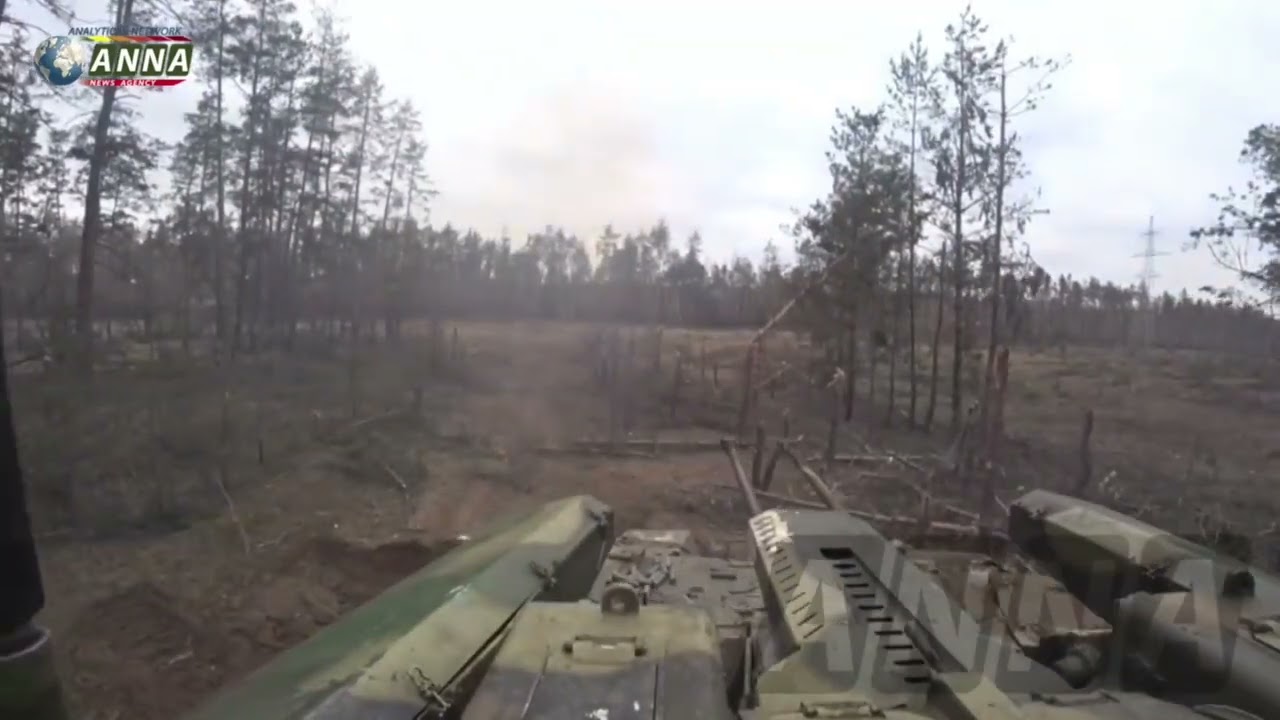
A view over the BMPT’s hull and twin 30 mm barrels, with the left missile pod at the left edge, looking into a damaged pine wood with smoke or dust ahead. The image is a video still with an ANNA News overlay.
Losses are a visual-confirmation floor, not a complete total. The Oryx list “Attack on Europe: Documenting Russian Equipment Losses During the Russian Invasion of Ukraine,” as read for this page on 26 November 2026 (America/Chicago), recorded three BMPT Terminators: one destroyed and two damaged. That figure counts only cases with published photographs or video, and it moves if the list is updated. A 1 October 2025 Militarnyi item inverted the split (two destroyed, one damaged); the live list is preferred. Additional Ukrainian claims, including a 79th Air Assault Brigade report of a BMPT knocked out near Kurakhove in October 2024 and an earlier July claim by the same brigade, sit above that floor and are not added to it. One widely shared incident near Spartak in Donetsk Oblast, documented in an 12 August 2023 post, has been described as a destruction in some reporting; Oryx lists that evidence under damaged. Twin-2A42 vibration, already mentioned, is a recurring comment on combat video from this war. [DOCUMENTED as a dated visual floor; higher claims, and the classification of individual incidents, are CONTESTED]
EXPORTS
Kazakhstan. First operator. Ten five-man, T-90-family BMPTs, delivered 2011-2013. The order year is given as 2010 in SIPRI-citing sources and as 2011 in some Kazakh and Russian reports. A reported interest in more vehicles and in licensed assembly was not confirmed here as a completed second contract. [DOCUMENTED for the ten vehicles; order year CONTESTED]
Algeria. In April 2016, Russia and Algeria were widely reported to have agreed a contract for 300 BMPT-72 Terminator 2 vehicles, to support a large T-90 and T-72 fleet. Deliveries were described as starting in 2018 and running through 2019; social-media images of vehicles on the move in Algeria circulated in 2020. The IISS Military Balance 2023, page 315, is cited in later summaries for only 13 vehicles delivered as of 2023. This page records the widely reported order of 300 and the much smaller 2023 delivery figure, and it does not write “300 delivered.” Whether later batches have closed the gap since 2023 was not established from an official Algerian or UVZ total. [CONTESTED on actual deliveries; 300 is the widely reported order]
Other interest has been reported, including Azerbaijan, Peru, and, in 2017 remarks by Russian officials, Israel and Syria. None of those is treated here as a confirmed operator. [UNVERIFIED as sales]
CRITICISMS AND WHAT COMES NEXT
The serious criticisms of the BMPT are not about whether Grozny was a hard fight. They are about whether this particular weapon mix is the right expensive answer. The 30 mm 2A42, even twinned, does not throw a demolition charge comparable to the 100 mm gun of a BMP-3 or to a 57 mm weapon in the Derivatsiya class, and critics argue that this matters against hard cover in a city. Firing both 2A42s at once is blamed, in specialist commentary and in combat-video discussion, for added dispersion. The AG-17D, on the five-man vehicle, is not stabilized in azimuth and has a narrow forward arc, so it is not a hunt-on-the-move weapon in the way the module is. The BMPT also costs more than a modernized infantry fighting vehicle and still carries no infantry; a T-14 Armata-family heavy IFV, if it were a real production alternative, would be a different and more expensive theory of the same problem. [DOCUMENTED as the usual specialist criticisms; cost figures published in passing are not used here as hard numbers]
A “Terminator-3” on an Armata chassis, or a BMPT with a 57 mm gun, has been sketched in the press for years. No official UVZ or Ministry of Defence production contract under that name was found for this page. The June 2026 Spiridon renaming, and the late-2025 protection kit, are real factory acts. They do not, by themselves, answer the caliber argument. [Terminator-3 is SPECULATION or at best UNVERIFIED as a programme; the rename and the 2025 kit are DOCUMENTED]
SPECIFICATIONS
Primary figures are from the 2014 UVZ plant pages described above. The “also published” column holds secondary or later figures that are widely reprinted. The 2014 five-man page does not name the engine; V-92S2 at 1,000 hp is the standard later attribution and is labeled on the cutaway on this page.
| Item |
UVZ five-man BMPT (2014) |
UVZ BMPT-72 (2014) |
Also published |
Tag |
| Combat weight |
48 t +2% |
44 t |
47 t in some secondary tables |
[DOCUMENTED, UVZ] |
| Crew |
5 |
3 |
— |
[DOCUMENTED, UVZ] |
| Length over mud flaps and slat screens |
7.2 m |
7.2 m |
6.96 m in some unsourced lines |
[DOCUMENTED, UVZ] |
| Width |
3.8 m over side screens; 3.37 m over tracks |
3.6 m |
3.46 m in one secondary table |
[DOCUMENTED, UVZ] |
| Height |
1.94 m to turret roof; 3.44 m to commander’s panorama |
3.33 m |
2.1 m in one secondary table |
[DOCUMENTED, UVZ] |
| Ground clearance |
406 mm |
— |
— |
[DOCUMENTED, UVZ] |
| Ground pressure |
not more than 96 kPa (0.98 kgf/cm²) |
— |
— |
[DOCUMENTED, UVZ] |
| Power / weight |
not less than 15.03 kW/t (20.42 hp/t) |
— |
implies about 1,000 hp at 48 t |
[DOCUMENTED, UVZ] |
| Engine |
not named on the 2014 sheet |
not named on the 2014 sheet |
V-92S2, 1,000 hp, in standard tables and on the cutaway on this page; V-92S2F 1,130 hp sometimes claimed for BMPT-72 |
[DOCUMENTED as V-92S2 in later attribution; V-92S2F UNVERIFIED] |
| Transmission |
— |
— |
7 forward, 1 reverse, in secondary tables |
[SINGLE-SOURCE / secondary] |
| Maximum road speed |
not less than 60 km/h |
60 km/h |
65 km/h in some unsourced “plant” lines |
[DOCUMENTED, UVZ] |
| Range with rear fuel drums |
not less than 550 km |
500 km |
the 500 vs 550 conflict is the two official sheets |
[DOCUMENTED, UVZ] |
| Fuel capacity |
— |
— |
1,200 L in secondary tables |
[SECONDARY] |
| Gradient / side slope |
30° / 25° |
30° climb |
— |
[DOCUMENTED, UVZ] |
| Trench / vertical step |
2.6-2.8 m / 0.85 m |
2.6-2.8 m / 0.85 m |
— |
[DOCUMENTED, UVZ] |
| Fording (unprepared / 5 min / OPVT) |
1.2 m / 1.8 m / 5.0 m |
1.2 m / 1.8 m / 5.0 m |
— |
[DOCUMENTED, UVZ] |
| 2A42 elevation / traverse |
-5° to +45° / 360° |
twin 2A42 (angles not restated) |
— |
[DOCUMENTED, UVZ] |
| 2A42 rate of fire |
up to 600 rds/min (technical, combined) |
— |
single 2A42 often 200-300 low / ~550 high; 850 or 900 ready rounds in later tables |
[DOCUMENTED, UVZ, for 600; ammunition CONTESTED] |
| Ataka-T |
four ready; launcher -5° to +25° |
four 9M120-1 / 9M120-1F; laser channel |
0.4-6.0 km, 550 m/s, 130 mm; 800 mm RHA behind ERA (9M120-1) |
[DOCUMENTED] |
| AG-17D |
two; vertical stabilization only; narrow traverse (see ARMAMENT) |
not fitted |
300 rounds each (600 total) in secondary tables |
[DOCUMENTED, UVZ, for the mount; ammunition secondary] |
| PKTM |
one 7.62 mm, 6P7 or 6P7K, coaxial |
one 7.62 mm PKTM |
2,000 rounds in secondary tables |
[DOCUMENTED, UVZ, for the gun; ammunition secondary] |
WHAT IT IS NOT
The BMPT is not an infantry fighting vehicle and it does not carry a squad. It is not a tank: it has no 125 mm gun. The BMPT-72 is not the vehicle the Russian Army contracted in 2017, even when headlines used the Terminator-2 name. “Terminator” was never a formal MoD index, and “Spiridon” is a 2026 byname, not a new design. The type is not fitted, in the public description used here, with Arena, Afghanit or Shtora. A Terminator-3 on the Armata chassis, or a 57 mm BMPT, is not a documented production vehicle. And the often-repeated 2:1 / 1:2 tank-to-BMPT ratios are not, on the evidence found for this page, a published field-manual rule.
IN ONE SENTENCE
The BMPT is Uralvagonzavod’s tank-hulled, unmanned-module fire-support vehicle — twin 30 mm 2A42 cannons, four Ataka-T missiles, and, on the five-man Army type, two hull AG-17D launchers — built so that tanks do not have to fight infantry and light armor alone, and later officially nicknamed Spiridon after years of being called Terminator.
SOURCES
Plain-text citations only. No outside hyperlinks. Figures were spot-checked against the Uralvagonzavod plant pages, FSVTS / Rosoboronexport missile data, Russian state news, and the Oryx list as described below. Other items come from the named outlets as read in November 2026.
- Uralvagonzavod, “Боевая машина огневой поддержки ТЕРМИНАТОР,” product page, archived 25 June 2014. Five-man plant table: 48 t +2%, crew of five, dimensions (7.2 m; 3.8 m over screens; 3.37 m over tracks; 1.94 m / 3.44 m), clearance 406 mm, ground pressure, power-to-weight, speed, 550 km range with drums, trench, step, fording, 2A42 angles and “up to 600 rds/min,” single-belt feed wording, Ataka-T launcher angles, AG-17D vertical-only stabilization and traverse, PKTM 6P7 / 6P7K. The page describes a modernized T-72 chassis.
- Uralvagonzavod, “ТЕРМИНАТОР-2,” product page, archived 25 June 2014. Three-man T-72 conversion: 44 t, 7.2 × 3.6 × 3.33 m, laser ATGM channel, four 9M120-1 / 9M120-1F, twin 2A42, PKTM, 60 km/h, 500 km with drums, same trench, step and ford figures. No hull AG-17D.
- TASS, 2 June 2026, “Uralvagonzavod renames tank support vehicle Terminator into Spyridon,” and the same-day RIA Novosti and Interfax reports. Contest, St. Spyridon, language-law rationale, trademark application. A byname, not a new vehicle.
- RIA Novosti, 9 September 2017, UKBTM chief designer Andrei Terlikov: a BMPT was combat-tested in Syria against ISIS, and those results were the basis for the Army-2017 contract; Hmeimim showing to Assad in late June 2017.
- RBC, 24 August 2017, first Ministry of Defence contract signed at Army-2017; remarks by deputy defence minister Yuri Borisov. The same story quotes BMPT-72 44 t / three-man figures, which do not describe the five-man T-90A vehicles later delivered to the Army.
- RIA Novosti, 27 March 2018, first batch handed over, in the context of a parade. Some contemporary headlines used “Terminator-2” for this delivery; the Army type is the five-man T-90A vehicle.
- Russian FSVTS catalog entry for the 9M120-1 Ataka missile: 130 mm, 6,000 m, 550 m/s, tandem HEAT, universal radio-command and laser-beam guidance.
- Rosoboronexport, 9M120-1 product page: 400-6,000 m, 550 m/s, about 49-49.5 kg with tube, tandem HEAT / thermobaric / proximity-fuzed high-explosive fragmentation warheads.
- Pavel Aksyonov, “Телохранитель для танка,” Lenta.ru, 16 March 2005. The early “it is assumed” ratio language (one BMPT per two tanks in rough country; two BMPTs per tank in a city). The article’s Shturm-S / Kord armament list is not used as a description of the production vehicle.
- Oryx, “Attack on Europe: Documenting Russian Equipment Losses During the Russian Invasion of Ukraine,” as fetched 26 November 2026 (America/Chicago): 3 BMPT Terminator, of which 1 destroyed and 2 damaged. A dated visual-confirmation floor, not a complete loss total.
- Militarnyi, Sania Kozatskyi, 1 October 2025, “Russian Army Receives New BMPT Terminator Vehicles.” UVZ batch with added ERA, anti-drone measures and EW; 2017 contract often given as 12 vehicles; eight with the 90th Tank Division by 2020. The item’s inverted Oryx split is not followed.
- IISS, The Military Balance 2023, p. 315, as cited for 13 Algerian vehicles as of 2023; SIPRI Arms Transfers Database and later Army Recognition / Military Africa reporting on an April 2016 order of 300 BMPT-72 and on 2018- delivery claims.
- Specialist and encyclopedic summaries used as pointers and clearly tagged where they are the only source for a point: Tank Encyclopedia and Army Recognition on prototypes and BMPT-72; GlobalSecurity.org on the plant-versus-secondary dimension conflict; Wikipedia and ruwiki on B07-K1 / B07-K2 sight names, the 850-round figure, and some prototype identities; Park Patriot and Kubinka-associated pages for Object 787, 781 and 782; Rossiyskaya Gazeta on the October 2025 delivery.
- Photographs supplied for this page, including a Russian cutaway that labels a V-92S2 engine and an Agat-MR sight, and an English line drawing of the unmanned module. Labels are described as they appear on the drawings.
Related on this site: T-90M, the current in-service T-90 family page. The Russian Army BMPT uses a T-90A chassis from that family.
Related on this site: T-80BVM, the other principal Russian tank the BMPT was meant to escort.
Related on this site: T-14 Armata and Object 195 / T-95, the heavier next-generation hulls sometimes mentioned in Terminator-3 sketches.
Related on this site: Afghanit, Arena-M, Drozd and Shtora-1 — active or soft-kill protection, which the BMPT does not carry in the public description used here. Its published kit is Relikt ERA and rear slat armor.
Related on this site: BMO-T, another specialist vehicle built on a tank hull, in that case to carry flamethrower troops rather than to escort tanks with autocannons.
Related on this site: Carousel vs. Bustle: Tank Ammunition Stowage, for how tank ammunition is carried. The BMPT’s 30 mm and missile load sits in an unmanned module, not in a 125 mm carousel.
Project Orlan // Underground Information Database