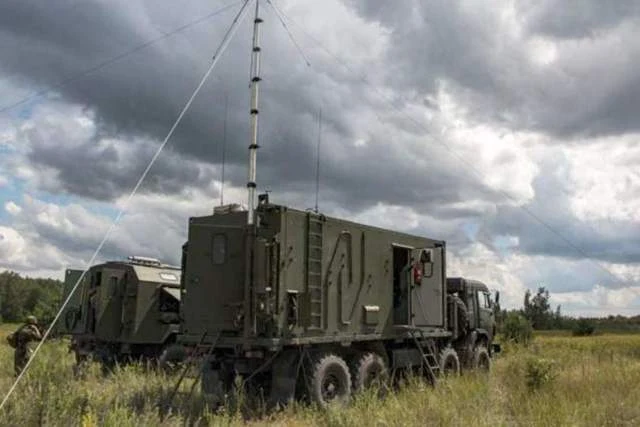
RB-109A Bylina (Былина, "bylina", a Russian epic folk tale) is an automated command and control system for Russian electronic warfare (EW) brigades. It is not a jammer. It is a five-truck complex of receivers, computers and communications that listens to the battlefield spectrum, decides which enemy emitters matter most, and tells subordinate jamming stations what to attack, while trying to keep them off friendly frequencies. Russian media in 2017 described it as close to artificial intelligence and said every EW brigade would have one by 2025. One was destroyed in Donetsk oblast in January 2024. Hard technical data is almost entirely absent from the open record.
WHAT IT IS FOR
An EW brigade owns many jamming stations of different types, each covering its own bands and targets. In older practice, reconnaissance reports came in, staff officers worked out which targets mattered, and orders went to jamming crews by radio or voice. That cycle takes minutes, while modern radios hop frequency many times a second and drones appear and vanish quickly. Bylina's job is to shrink that cycle: automate the analysis, the target choice, the jammer assignment and the monitoring of results. [DOCUMENTED aim, Izvestia, April 2017; RIA Novosti]
Izvestia, citing the Main Staff of the Ground Forces, described RB-109A as an intelligent automated control system (ASU) for EW brigades that analyses the situation in real time without operator participation, finds and classifies targets, chooses how to suppress them, and gives orders to EW stations, while not letting jammers interfere with or corrupt the signals of friendly forces. [DOCUMENTED claim, Izvestia; RIA Novosti] The same report said the first Bylinas would reach the troops in 2018 and all EW brigades would have them by 2025. [DOCUMENTED plan, Izvestia/RIA] Whether that 2025 target was met is not known. [UNVERIFIED]
WHERE IT SITS
Russian Ground Forces EW has three tiers: EW companies in manoeuvre brigades and divisions, EW battalions in combined arms armies, and EW brigades at military district level. [DOCUMENTED, US Army FMSO, 2022] Bylina is the controller for the top tier, the EW brigade. [DOCUMENTED, Izvestia; UAS Vision/Forbes] Izvestia said that after deployment it automatically interfaces with the command posts of battalions and companies, the higher headquarters, and even individual EW stations, with combat control commands and data exchanged in real time. [DOCUMENTED claim, Izvestia]
That makes it the brigade-level counterpart of Palantin, which does a networking job for army-level EW battalions but also carries its own HF and VHF jammers. [ESTIMATE, from the FMSO tier description and the Palantin sources] How the two talk to each other, if they do, is not published. [UNVERIFIED]
BACKGROUND: WHAT EW BATTLE MANAGEMENT IS
Find, decide, attack, check. Every jamming task has four steps: electronic support (ES) finds and identifies a signal; a decision is made whether and how to attack it; electronic attack (EA) jams it; and look-through or other monitoring checks whether the jamming worked or the target has moved. [BACKGROUND] Bylina's claimed contribution is to automate the middle and end of that loop across a whole brigade rather than inside one truck.
Geolocation. One receiver gives a bearing. Receivers spread over a wide area, sharing measurements, can fix an emitter by crossing bearings or comparing arrival times (TDOA). KRET described the Bylina R&D complex as having improved range and accuracy for locating radio emitters. [DOCUMENTED claim, TASS interview with KRET's Vladimir Zverev, via VPK.name] A fixed emitter position is also a target for artillery. [BACKGROUND]
Resource allocation. Given a list of targets (with priority, frequency, location) and a list of jammers (with bands, power, position and current load), the system must pick who jams what. A jammer close to its victim receiver needs much less power than a distant one, so geometry matters as much as band. [BACKGROUND] KRET's phrase for this was "optimally managing jamming complexes", including against frequency-hopping signals and for "spatially distributed" suppression, meaning several jammers in different places working on one target set. [DOCUMENTED claim, TASS/KRET]
Electromagnetic compatibility. Jammers do not tell friend from foe. A barrage across a VHF band also kills friendly radios on that band. Bylina is said to "see" friendly emitters and suppress targets without interfering with them. [DOCUMENTED claim, Izvestia] In practice this needs a live database of friendly frequency plans, which in turn needs the brigade to be tied into the wider command system. [ESTIMATE]
THE "ARTIFICIAL INTELLIGENCE" CLAIM
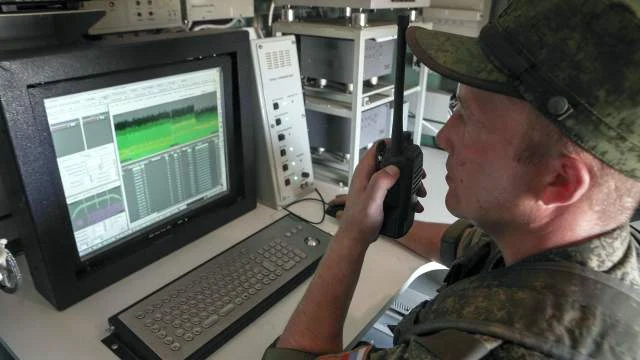
The AI label comes from Russian media, not from a published technical description. Izvestia wrote that experts considered the system "close to artificial intelligence" in its capabilities. [DOCUMENTED, Izvestia] Western coverage repeated this as an "AI-powered" command system, and Forbes (via UAS Vision) quoted an assessment that it made jammers about 50 percent more effective. [SINGLE-SOURCE, UAS Vision/Forbes; the underlying assessment is not identified] Kyiv Post describes machine-learning-based target prioritisation within a radius of about 100 km. [SINGLE-SOURCE, Kyiv Post]
What the open sources actually describe is rule-based or optimising decision support: signal classification, prioritisation and task assignment. That is real and useful automation, but nothing published shows learning on the battlefield or autonomous decisions beyond what an expert-system design could do. [SPECULATION] Russian sources stress that operators only have to "monitor" the system; one Russian blog says the crew confirms the most critical decisions. [DOCUMENTED claim, Izvestia; SINGLE-SOURCE, Zalp Media]
COMPOSITION AND HARDWARE
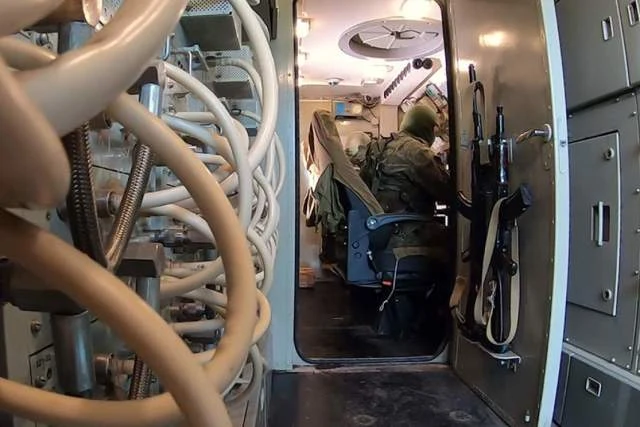
Bylina is described as a fully autonomous complex of five high-mobility trucks plus life-support equipment. [DOCUMENTED, Izvestia; RIA Novosti; COGINT] Photos show KamAZ chassis with box shelters (KUNG bodies) and a raised antenna mast. [DOCUMENTED, photos; WarSpotting lists the destroyed vehicle as a KUNG] The split of functions across the five trucks is not published. [UNVERIFIED] A plausible split is reconnaissance receiver vehicles with masts, a command and computing vehicle, a communications vehicle and a power and support vehicle. [ESTIMATE, by analogy with other Russian EW complexes]
Sources conflict on reach. Army Recognition says it detects radio emitters at up to 800 km, depending on the radio horizon and the height of the reconnaissance modules. [SINGLE-SOURCE, Army Recognition, citing Topwar] Kyiv Post says it analyses the environment within about 100 km. [SINGLE-SOURCE, Kyiv Post] Forbes says hundreds of miles. Line-of-sight VHF/UHF detection from a mast is limited to tens of kilometres against ground targets; long distances are plausible only against HF skywave signals or high-flying aircraft and AEW radars. [BACKGROUND/ESTIMATE] COGINT lists bands and range as unknown. [DOCUMENTED, COGINT]
WHO BUILT IT
Sources conflict. In a 2017 TASS interview, KRET (Rostec) first deputy director general Vladimir Zverev said that under the R&D project (OKR) "Bylina" KRET had created a new reconnaissance and control complex for HF-band jamming stations, already accepted for supply to the EW troops. [DOCUMENTED, TASS via VPK.name] A Russian blog says development of the RB-109A began at the Sozvezdie concern in Voronezh. [SINGLE-SOURCE, Zalp Media] Sozvezdie is the Russian defence industry's designated lead organisation for EW against command and control systems. [DOCUMENTED, Vremya Elektroniki]
These can both be partly true. "Bylina" is an R&D project name, and COGINT notes the name covers at least two other systems in different bands, "Bylina-KV" (KV = HF) and "Bylina-MM". [DOCUMENTED, COGINT] KRET's HF reconnaissance and control complex may be one of those strands rather than the brigade ASU RB-109A itself. [SPECULATION] This page does not name a single confirmed maker for RB-109A. [UNVERIFIED]
WHAT IT CONTROLS
No official list of subordinate systems has been published. Izvestia speaks only of "EW stations" and "jamming stations". [DOCUMENTED] A Russian blog says the design aim was to merge stations such as Krasukha, Murmansk and Zhitel into one organism. [SINGLE-SOURCE, Zalp Media] The likely candidates, by what sits in Russian EW brigades, are:
HOW IT WORKS IN PRACTICE
A reconstructed cycle [ESTIMATE, from Izvestia, TASS/KRET and general EW doctrine]:
Izvestia claims target selection and recognition happens "in a matter of seconds". [DOCUMENTED claim] A Russian blog claims 10 to 15 minutes from halt to combat work. [SINGLE-SOURCE, Zalp Media]
SERVICE AND COMBAT USE
Adoption. First deliveries were planned for 2018; COGINT dates adoption to 2017-2018. [DOCUMENTED, Izvestia; COGINT] KRET said in 2017 that its Bylina complex had been accepted for supply. [DOCUMENTED, TASS] Claims that it was tested in Syria appear in compilations. [SINGLE-SOURCE, COGINT citing press]
Ukraine. Forbes reported that the first operational Bylinas were rushed to the front in autumn 2023. [SINGLE-SOURCE, UAS Vision/Forbes] On 12 January 2024 one was destroyed in Donetsk oblast. [DOCUMENTED, WarSpotting #23136] Sources conflict on how: Forbes credits Ukraine's Shadow drone group with a drone strike, while Army Recognition says HIMARS rockets guided by a drone. [Sources conflict] Both agree a drone found it.
What that shows. A brigade-level controller with masts and five trucks is a high-value, visible target, and it must emit to talk to its stations. Losing it would push a brigade back to slower manual control. [SPECULATION] The wider pattern in Ukraine, where many large Russian EW vehicles were found and hit by drones, applies here too. [SPECULATION, consistent with the Palantin and Krasukha losses]
COUNTERMEASURES
LIMITS OF THE OPEN RECORD
Almost everything on Bylina traces to one 2017 Izvestia article, one 2017 TASS interview, and Western and Ukrainian summaries of them, plus the 2024 loss. Bands, range, data links, the five trucks' roles, the real maker, the number built and how much the "AI" actually decides are all unpublished. [ESTIMATE]
IN ONE SENTENCE
RB-109A Bylina is a five-truck Russian command and control system that automates the find-decide-assign-check cycle for an entire EW brigade; it is a brain for jammers rather than a jammer, and beyond its 2017 publicity and a 2024 combat loss, its real performance is unknown.
RELATED ON THIS SITE
HOW THIS ARTICLE WAS BUILT
Written for this site from the sources below. Claims are labelled [DOCUMENTED] where a primary or multiple independent sources support them, [SINGLE-SOURCE] where only one does, [UNVERIFIED] where nothing published located confirms them, [ESTIMATE] for approximate figures or reconstructions, [BACKGROUND] for general physics and context, and [SPECULATION] for reasoning beyond the sources. Where sources disagree, the page says "Sources conflict" and gives both.