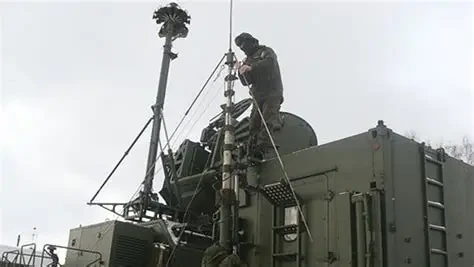
Palantin (Палантин, "stole" or shawl) is a Russian electronic warfare complex from the Sozvezdie concern in Voronezh, mounted on 8x8 KamAZ trucks and adopted in 2019. It does two things. It jams HF and VHF radio, cellular and trunked networks, and drone links itself, and, more importantly, it ties other EW systems such as Zhitel, Moskva and Dzyudoist ("Judoist") into one network so that a single commander can see the whole spectrum and assign jammers to targets. Russian sources sell that network role as its main advance. The open record of how well it works is thin.
WHAT IT IS FOR
A modern battlefield is crowded with emitters: radios, cell phones, satellite terminals, drone control links, radars, navigation receivers. A single jammer truck can see and attack only part of that picture, within its own band and line of sight. Before systems like Palantin, a Russian EW company commander coordinated jammers largely by voice radio and maps. Palantin's purpose is to automate that: pool what all the sensors hear, decide which emitters matter, hand each one to the best-placed jammer, and keep friendly radios working. [DOCUMENTED aim, Rossiyskaya Gazeta via US Army FMSO, 2022]
Rossiyskaya Gazeta described its most important advantage as the ability to combine "Moskva", "Zhitel" and "Judoist" into a "single working network", and claimed it was two to three times superior to the previous generation. [DOCUMENTED claim, FMSO translation] The comparison figure is unverified marketing. [UNVERIFIED]
WHERE IT SITS: THE THREE TIERS OF RUSSIAN ARMY EW
Russian Ground Forces EW is organised in three tiers. Manoeuvre brigades and divisions each have an EW company for tactical tasks; each combined arms army has an EW battalion for operational-tactical tasks; and each military district has an EW brigade for strategic-level tasks. [DOCUMENTED, US Army FMSO, 2022] FMSO names the Borisoglebsk-2 as the main current system of the brigade and division EW companies, and Palantin as the main current system of the army-level EW battalions. [DOCUMENTED, FMSO] That is what "operational-tactical" means here: Palantin works for an army headquarters across a front tens of kilometres wide, not for a single battalion fight.
Above it sit the district EW brigades with heavier, longer-reach systems such as the Krasukha-2 and Krasukha-4 radar jammers and the Murmansk-BN long-range HF jammer. Palantin is the layer between those strategic assets and the frontline jammers. [ESTIMATE, from the FMSO tier description]
BACKGROUND: WHAT "NETWORK-CENTRIC" EW MEANS
Sensors, deciders, shooters. Every EW task has three steps: find the signal (electronic support, ES), decide whether and how to attack it, and attack it (electronic attack, EA). In older systems each truck did all three for itself. In a networked system, sensors on many vehicles feed a shared picture, a control node makes decisions, and jammers act on orders. This is the same idea as an air defence network where radars, a command post and missile launchers share one track picture. [BACKGROUND; compare Russian Air Defense and ESU TZ]
Why it helps.
BACKGROUND: WHAT IS BEING JAMMED
HF (3-30 MHz) carries long-range tactical and command radio by skywave and groundwave. VHF (30-300 MHz) carries most combat-net radio, such as squad and vehicle radios, which travel roughly line of sight. [BACKGROUND; see Russian C3]
Cellular and trunked networks. GSM, UMTS and LTE phones and trunked radio systems (like TETRA or P25) depend on base stations; jamming the downlink near the target or the uplink near the base station breaks them. [BACKGROUND; see P25]
Drone links. Small drones use a command uplink and a video downlink, often in the 0.9, 2.4 or 5.8 GHz bands, plus satellite navigation. Jamming the uplink cuts control, jamming the downlink blinds the operator, and jamming GNSS removes the position fix. [BACKGROUND; see Kometa CRPA]
Spot versus barrage. A system that can identify an enemy radio's exact frequency can spot jam it with little power and little collateral. When the enemy hops frequencies faster than the jammer can follow, the fallback is barrage jamming of the whole hop set, which needs much more power and hurts friendly use of the band. [BACKGROUND]
AUTOMATION: WHAT "DECISION SUPPORT" MEANS HERE
Russian descriptions say the designers built in a decision-making support system: the optimal mission algorithm is generated without human intervention and the jamming load is distributed automatically across the vehicles. [DOCUMENTED claim, Army Recognition, citing Russian reporting] In practice that is a task-allocation problem: given a list of detected emitters with priorities, frequencies and positions, and a list of jammers with bands, power and location, assign each target to the jammer that can hit it best while keeping protected friendly frequencies clear. [BACKGROUND] Operators still supervise and can override; no source located says Palantin engages without a human in the loop. [UNVERIFIED either way]
Software-defined radios. One recent summary says Palantin was designed against existing and future radio systems, including software-defined radios (SDRs), whose waveform can change in software. [SINGLE-SOURCE, Battlepolicy] How well it copes with modern frequency-hopping military networks has not been independently established. [UNVERIFIED]
DEVELOPMENT AND MAKER
Palantin was developed by the Sozvezdie concern (Voronezh), Russia's main maker of tactical radios, automated command systems and army EW, and part of the Rostec group via its radio-electronic holdings. [DOCUMENTED, Militarnyi; FMSO] Sozvezdie also built the ESU TZ tactical command system and the R-330Zh Zhitel. [DOCUMENTED, see ESU TZ and R-330Zh Zhitel]
Adoption is dated to 2019. [DOCUMENTED, Militarnyi; COGINT] Russian reports from around 2018-2019 described the first sets going to EW units of the Southern Military District, and the system appeared at exercises including Kavkaz-2020. [SINGLE-SOURCE per item, Russian MoD press]
The suffix "-K" in Palantin-K is often taken to mean a "complex" (complete set). Most open sources use Palantin and Palantin-K interchangeably. [ESTIMATE]
THE SYSTEMS IT LINKS
Which links, protocols and datalinks join these systems is not published. A plausible route is Sozvezdie's own tactical networking within the ESU TZ framework. [SPECULATION]
COMPONENTS AND VEHICLES
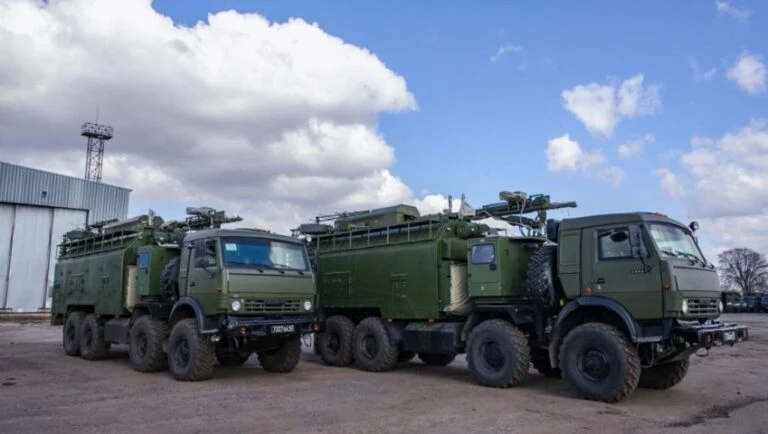
Palantin is carried on four-axle (8x8) KamAZ trucks, in the KamAZ-6350 family, with box bodies, generator sets and folding or telescopic antenna masts. [DOCUMENTED, Rossiyskaya Gazeta via FMSO; photos] The number of vehicles in a full set is not consistently reported. [UNVERIFIED] Photos show trucks with multiple antenna arrays on masts above the cabin body. [DOCUMENTED, photos]
Expected elements by role [ESTIMATE, by analogy with other Sozvezdie complexes]:
Sources conflict on size. Public accounts of a full Palantin set range from a few vehicles to about 22 trucks. [Sources conflict, per Battlepolicy summary] The larger figure may count support, power and communications vehicles of a whole battalion set rather than the core complex. [SPECULATION] A 15 m antenna mast is listed in one compilation. [SINGLE-SOURCE, COGINT]
SPECIFICATIONS
| Parameter | Reported value | Note |
| Developer | Sozvezdie concern, Voronezh | [DOCUMENTED] |
| Adopted | 2019 | [DOCUMENTED] |
| Chassis | KamAZ 8x8 | [DOCUMENTED] |
| Bands | HF (3-30 MHz) and VHF (30-300 MHz) | COGINT, Militarnyi [DOCUMENTED] |
| Effective range | up to 20 km | COGINT [SINGLE-SOURCE] |
| Other claimed effects | navigation, cellular, trunked radio, drone links, air defence radars, C2 | Rossiyskaya Gazeta [DOCUMENTED claim] |
Sources conflict on scope. Russian reports claim Palantin can jam navigation and "disable" air defence radars, but the bands published for its own transmitters (HF and VHF) do not cover GNSS (1.1-1.6 GHz) or most radars. The likely explanation is that the claims describe the network: Palantin directing other systems, like Zhitel for GNSS and Moskva-1 for radar work. [SPECULATION] The 20 km range is plausible for ground-to-ground VHF jamming from mast antennas, which is limited by the horizon. [ESTIMATE]
Sources conflict on range. The same COGINT compilation lists a range of up to 20 km and, separately, a "radio communication suppression range" of 1,000 km. [Sources conflict, COGINT] A 1,000 km figure is only conceivable for HF skywave jamming of distant HF links, where the jammer can reach a receiver far away by bouncing off the ionosphere, as Murmansk-BN does on a much larger scale. The 20 km figure fits VHF ground-wave work. [ESTIMATE] Neither number is confirmed by Russian official specifications located for this page. [UNVERIFIED]
HOW IT WORKS IN PRACTICE
A reconstructed engagement cycle [ESTIMATE, from Russian descriptions and general EW doctrine]:
Russian personnel described the system as detecting Ukrainian drones by itself, intercepting their control signal and jamming it so the drone loses contact. [DOCUMENTED claim, FMSO]
PALANTIN AND BYLINA
Russia's other networked EW controller is the RB-109A Bylina, an automated EW command system on five KamAZ trucks that uses automated decision support (described in Russian media as artificial intelligence) to detect emitters and assign jamming tasks to subordinate systems. Russian reporting says it automatically connects to headquarters, command posts and EW stations after deployment, identifies radios, radars, AEW aircraft, satellites and the low-power radios of sabotage groups, and that the troops were to receive it by 2025; it is described as able to work fully autonomously, with operators monitoring. [DOCUMENTED claims, Army Recognition; COGINT] It sits at the EW-brigade level and is described as a controller of other systems rather than a big jammer of its own. [DOCUMENTED, COGINT; UAS Vision/Forbes] The search phrase "RB-109A" is sometimes attached to Palantin online; the sources are clear that RB-109A is Bylina, a separate system. [DOCUMENTED, COGINT] One Bylina was destroyed by Ukrainian drones in Donetsk oblast in January 2024. [DOCUMENTED, UAS Vision] Palantin overlaps with Bylina's network role but also carries its own jammers. How the two divide the work, and whether they are meant to operate together, is not published. [UNVERIFIED]
DEPLOYMENT AND COMBAT USE
Exercises and Syria. Palantin was shown at Russian exercises from 2019. Claims that it was tested in Syria were not confirmed for this page. [UNVERIFIED]
Ukraine. Rossiyskaya Gazeta reported in 2022 on Palantin's first combat use in Ukraine, saying it disabled reconnaissance drones and jammed cellular and internet communications at Ukrainian command posts. The US Army's FMSO noted that more objective sources had not confirmed its effectiveness. [DOCUMENTED, FMSO]
Losses. The first confirmed destruction came in early 2023 in Zaporizhzhia oblast: aerial reconnaissance of Ukraine's 128th Mountain Assault Brigade spotted a Palantin-K in its travelling configuration, and artillery hit it with the first round, presumably an M982 Excalibur guided shell, adjusted by a Leleka-100 drone. Analysts geolocated the position. [DOCUMENTED, Militarnyi; the shell type is presumed] Ukrainian reporting dates this to February 2023. Further claimed Palantin losses were reported in 2024. [SINGLE-SOURCE per claim]
What the losses show. An EW complex on large trucks with tall masts is easy to see from a drone, and a networked jammer radiates, so it can be located. The loss pattern matches a wider lesson of the war: Russia's large, high-value EW trucks have been hunted, and much of the practical counter-drone EW has shifted to small, numerous, cheap jammers at the front. [SPECULATION, consistent with RUSI reporting on EW in Ukraine]
COUNTERMEASURES
LIMITS OF THE OPEN RECORD
Most of what is written about Palantin goes back to a few Russian press articles and Sozvezdie marketing, repeated in Western and Ukrainian compilations. Number of vehicles, band edges, power, how many sets exist, which units have them, and the real performance of its networking are not public. Its main claimed strength, integration, is also the hardest thing to see from outside. [ESTIMATE]
IN ONE SENTENCE
Palantin is Sozvezdie's 8x8 KamAZ-borne HF and VHF jamming and reconnaissance complex, adopted in 2019, whose main claimed advance is networking other EW systems such as Zhitel and Moskva into one picture under one commander; it has been used and lost in Ukraine, but its real effect remains largely unconfirmed.
RELATED ON THIS SITE
HOW THIS ARTICLE WAS BUILT
Written for this site from the sources below. Claims are labelled [DOCUMENTED] where a primary or multiple independent sources support them, [SINGLE-SOURCE] where only one does, [UNVERIFIED] where nothing published located confirms them, [ESTIMATE] for approximate figures or reconstructions, [BACKGROUND] for general physics and context, and [SPECULATION] for reasoning beyond the sources. Where sources disagree, the page says "Sources conflict" and gives both.